沈家花园非遗馆的文化再生与机器人建构实践,上海 / 同济大学建筑设计研究院(集团)有限公司创盟国际工作室
一、针灸式策略中的文化锚点构建Cultural Anchors within an Acupuncture Strategy
“南桥源”是上海奉贤区南桥镇在历史城区更新背景下提出的重要规划试验项目,提出“一河链九珠”的针灸式更新策略,以浦南运河为纽带,激活包括三古商城、沈家花园、古华园在内的多个文化节点。其中,沈家花园非遗馆作为新建文化空间,承担着连接传统与当代、社区与手工艺的多重角色。本文基于整体更新体系,围绕非遗馆的设计策略、构造逻辑与建造实践展开论述,重点分析其在参数化设计、机器人砖构、结构拓扑优化等方面的综合实践,尝试提出一种以“文化-结构-建造”三位一体为核心的更新建筑路径。
“Nanqiao Source” is a pilot renewal scheme for Nanqiao Town (Fengxian District, Shanghai) that proposes an “One River ∙ Nine Beads” acupuncture approach: the Punan Canal stitches together historic and commercial fragments such as the San‑Gu Market, Shenjia Garden and Guyuan Garden, gradually releasing public and cultural energy through nine micro‑interventions.
▼项目概览,Overall of the project
面对传统城区更新的尺度、生态与文化复杂性,南桥镇在“南桥源”更新体系中,提出“一河链九珠”的系统策略——以浦南运河为骨架,串联三古商城、沈家花园、古华园等文化与商业片段,通过9个节点逐步释放公共性与文化能量。相较整街区重建,该策略强调“针灸式介入”,重视细部激活与原有肌理协同。
Within this framework the newly built Shenjia Garden Intangible‑Heritage Pavilion serves as a cultural anchor that bridges tradition and contemporaneity, community life and craft practice.
▼区位分析,Analysis of the site
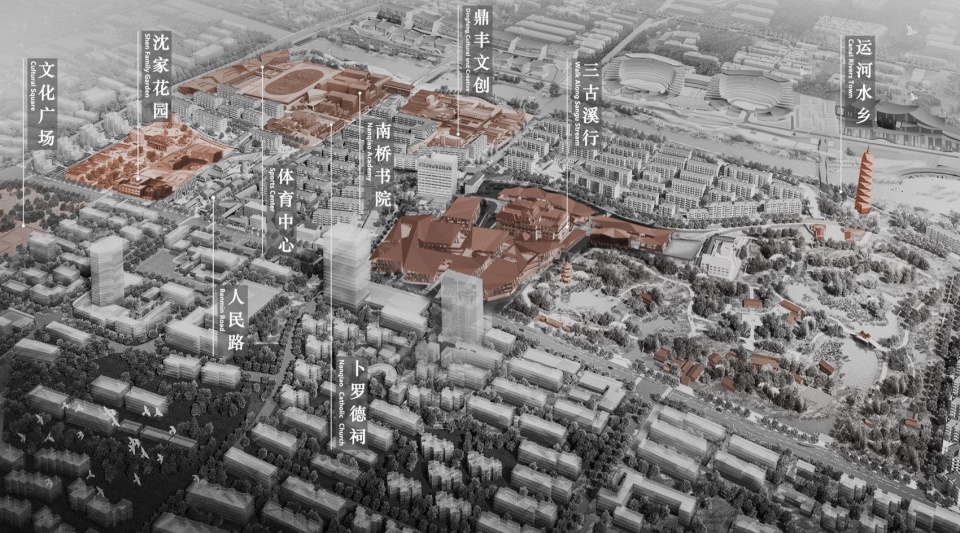
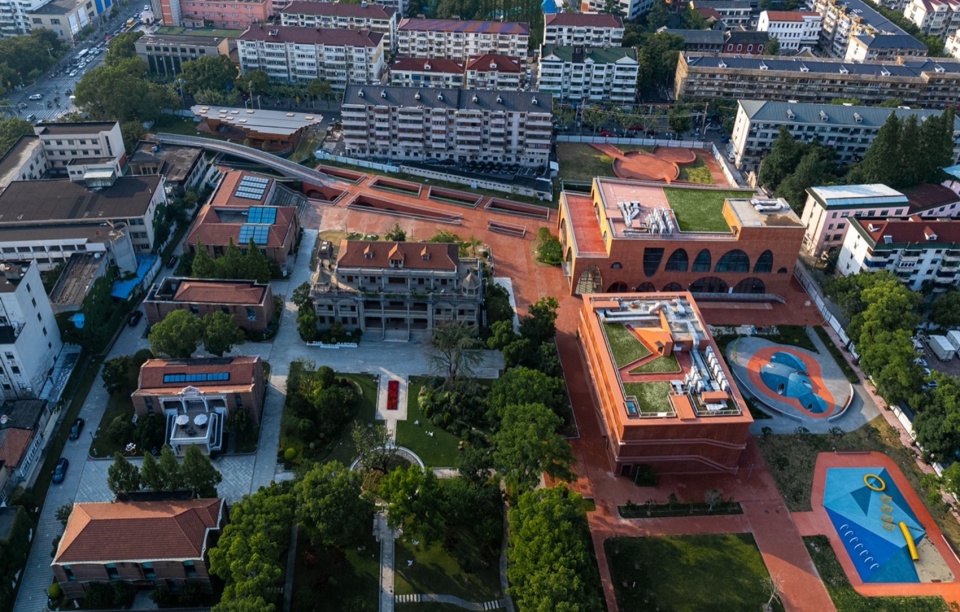
沈家花园位于其中段,是奉贤地区唯一完整保存的20世纪初花园式洋房群。非遗馆即嵌入其更新体系的二期建设中,对面为修缮完成的历史主楼。作为此次更新体系中的文化锚点,非遗馆承担着展示、教育、社区共享、数字建造示范等复合职能。
The project explores an integrated “culture–structure–construction” path by combining parametric design, robotic brickwork and structural topology optimisation.
▼场地鸟瞰,Aerial view of the site
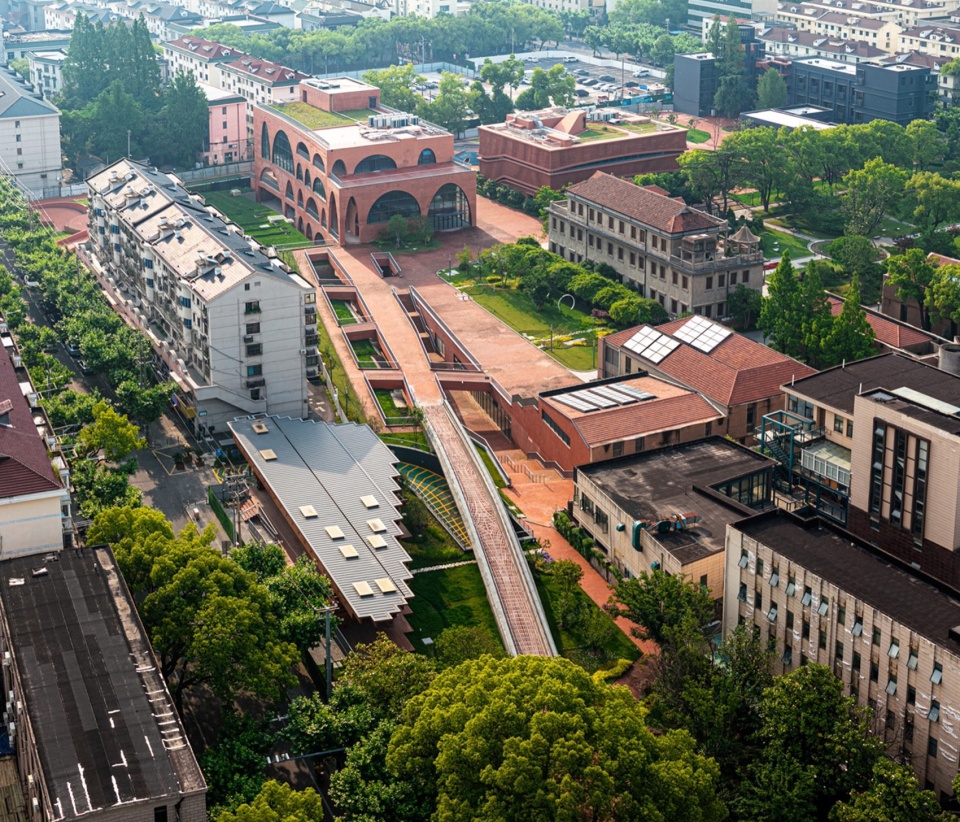
▼建筑鸟瞰,Aerial view of the project
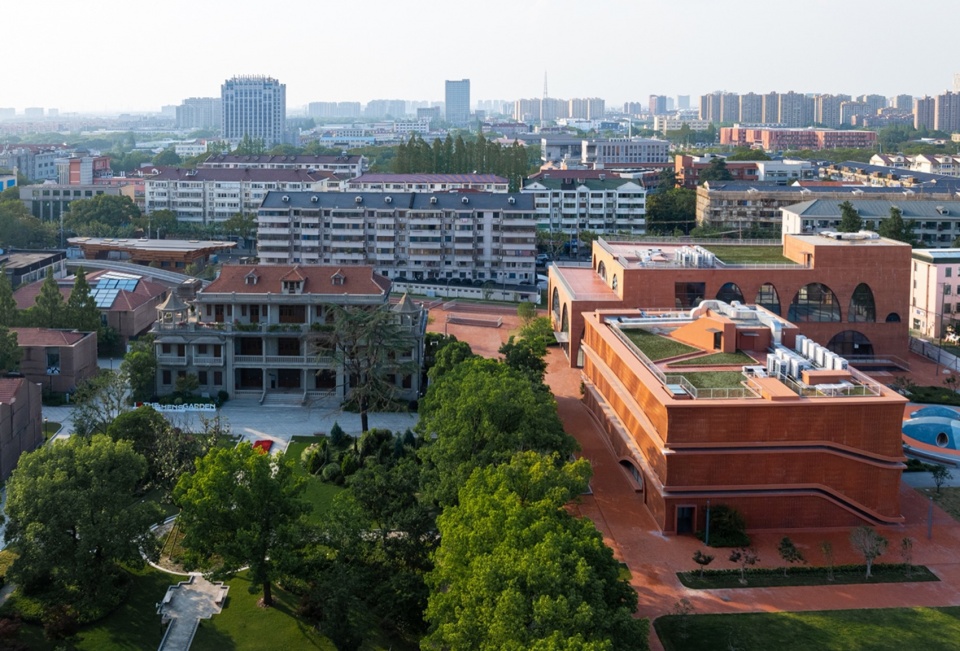
二、语境嵌合的场地策略Contextual Insertion: A Site Strategy of “Restrained Suturing”
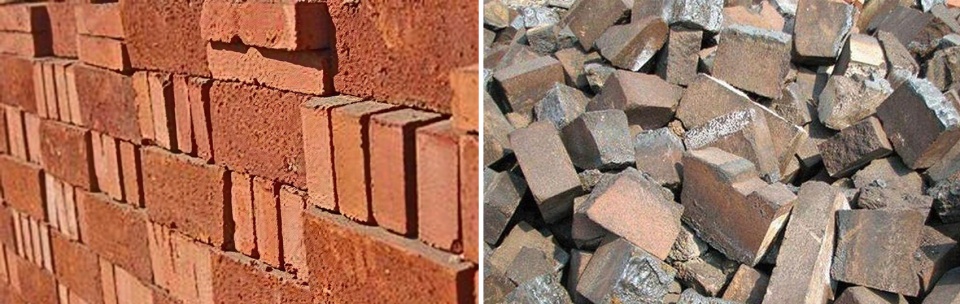
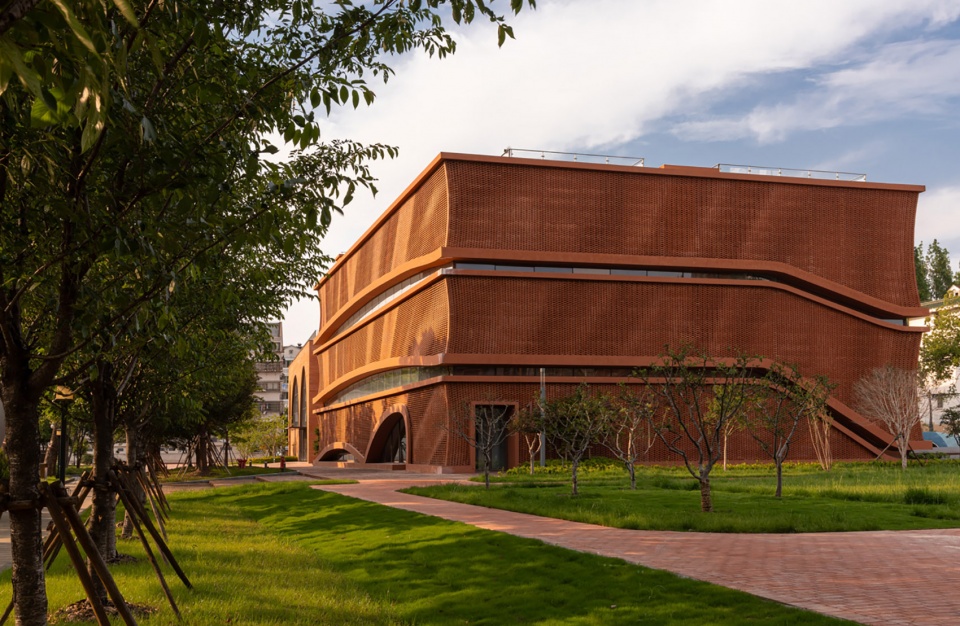
项目选址于沈家花园主楼中轴线末端,面对已修复的历史建筑。设计以“克制嵌合”的姿态介入场地,通过尺度、材质与动线的协商,完成与既有园林语境的协同:项目体量以水平展开替代竖向对抗,融入园区低矮尺度秩序,入口避让原中轴正对关系,提供观看、缓冲与转换空间。以传统黏土砖、清水混凝土、玻璃为主要材料,构建与原主楼材料色调的对位关系。该策略强调新建筑在文脉中的“沉入感”,而非主导性表达,使其成为一个“潜在显现”的文化装置。
Sited on the central axis of the historic garden, opposite the restored main villa, the pavilion adopts a horizontal massing rather than a vertical confrontation, dissolving into the low‑rise garden fabric. The entrance is slightly offset to preserve the original axial vista and to create a zone of viewing, buffering and transition. A palette of clay brick, fair‑faced concrete and glass establishes a chromatic dialogue with the historic masonry while allowing the new building to “settle into” the cultural landscape as a latent yet perceptible device.
▼材质,Material
▼立面近景,Closer view of the facade
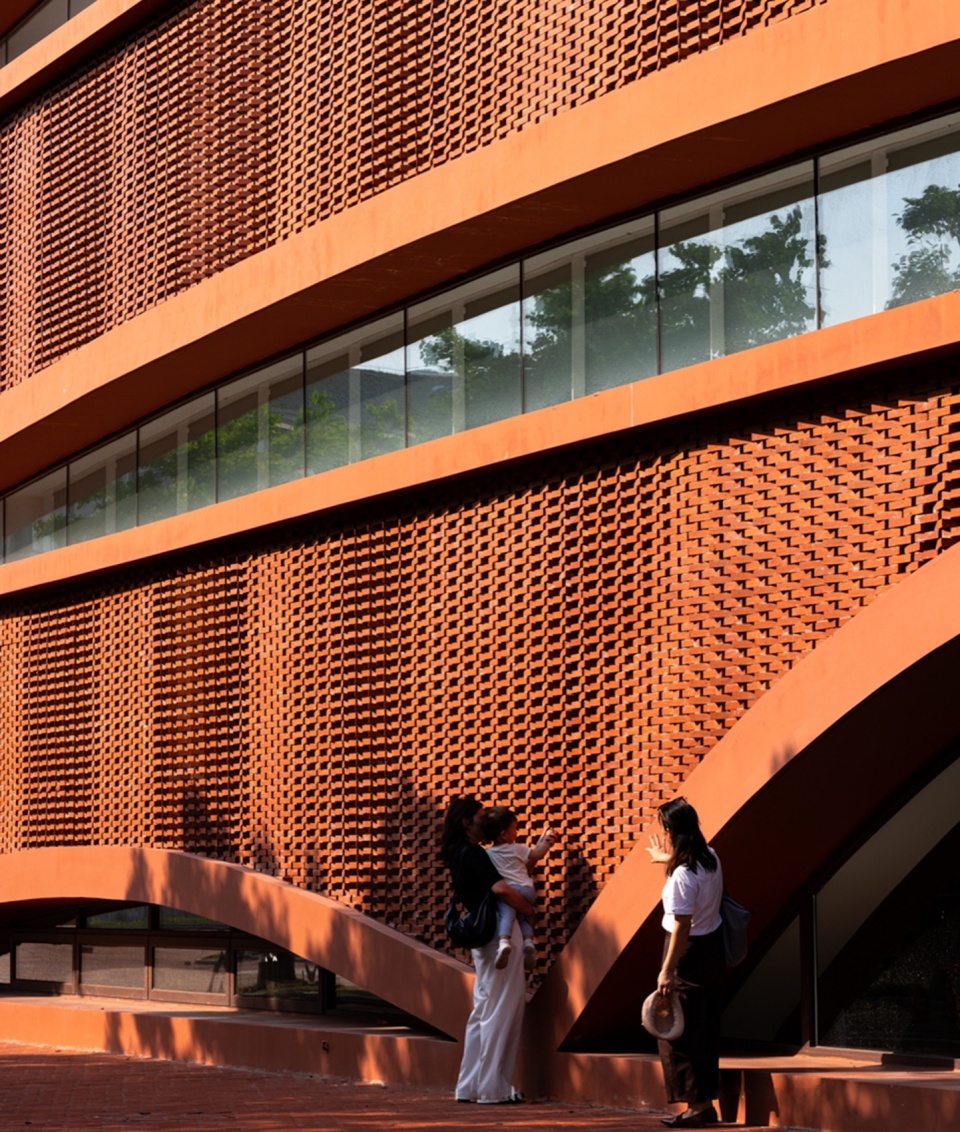
三、织理生成:参数化砖幕的设计逻辑Weaving Morphogenesis: The Parametric Brick Screen
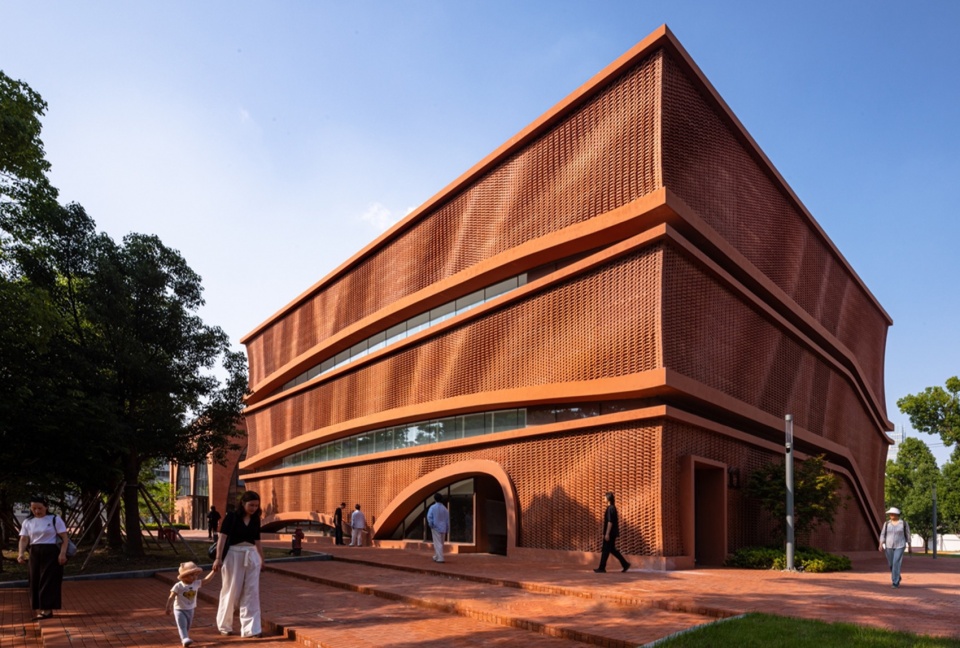
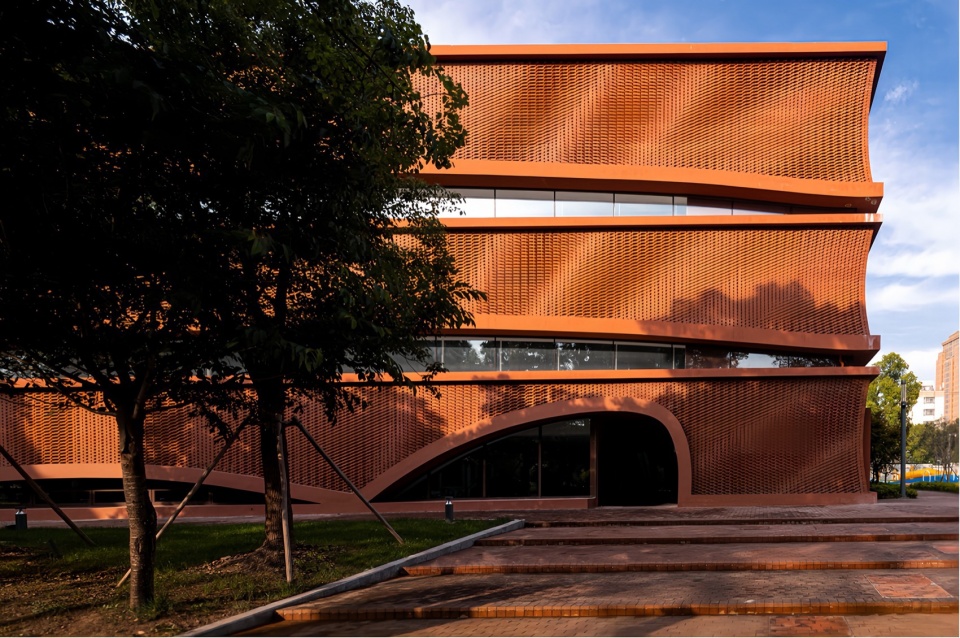
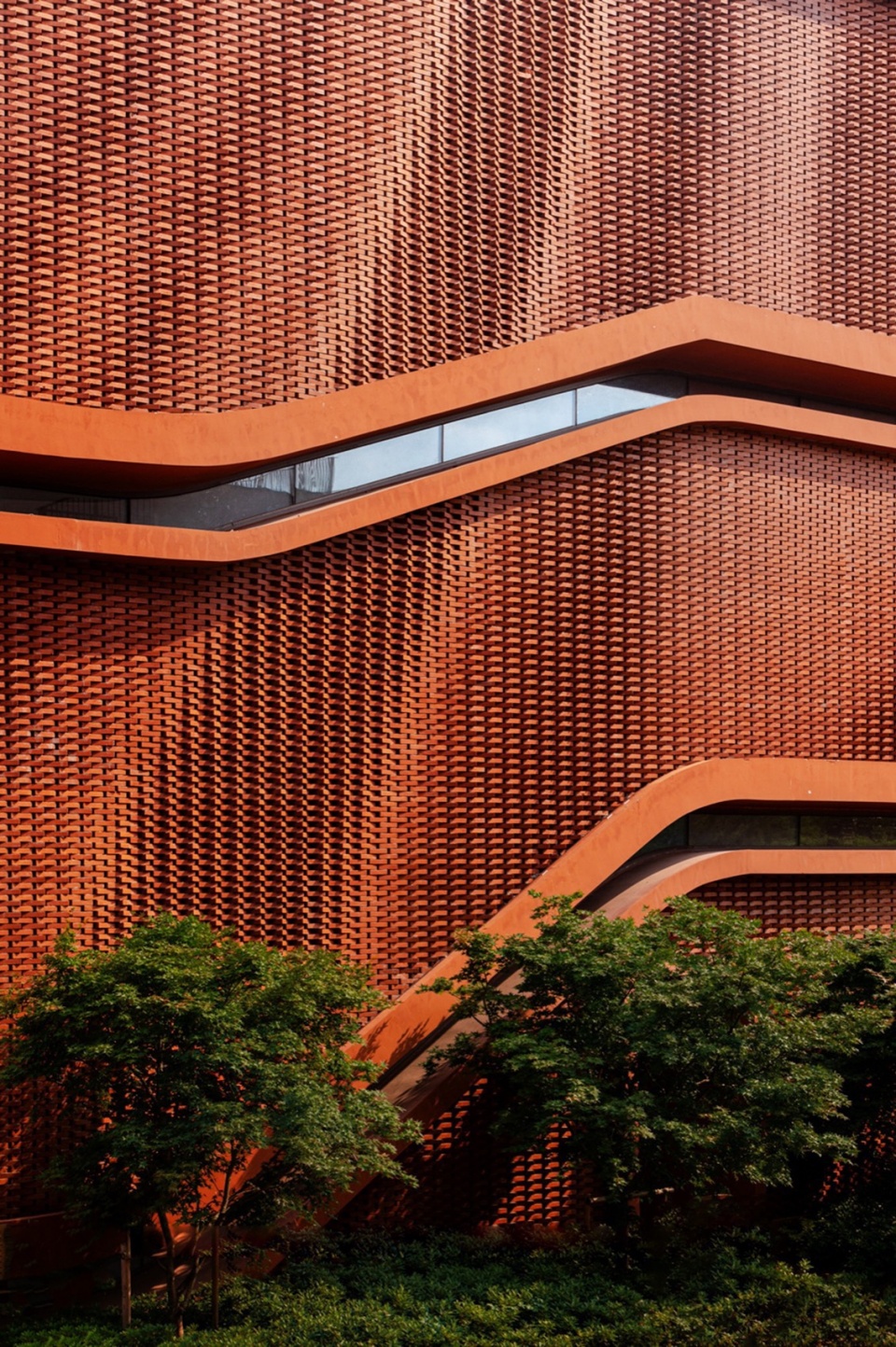
非遗馆最具标识性的元素为其主立面上的“砖织幕”,该构件既是遮阳表皮,也是文化表征。其设计逻辑由“风掠水面”的自然意象出发,经由参数算法转译为结构逻辑:以均匀砖块为单元,通过函数叠加生成旋转角度与出挑距离为形成机制,形成类似“涟漪状”的织纹表皮,砖幕作为建筑外表皮的同时也作为次结构自稳定系统,其背后为钢龙骨支撑体系。
The pavilion’s signature element is a “brick‑weave” screen façade that performs simultaneously as sun‑shade, secondary structure and cultural symbol. Beginning with the natural image of “wind skimming water”, rotation angles and projections of uniform bricks are generated by superimposed functions to produce ripple‑like textures.
▼外观,Exterior view
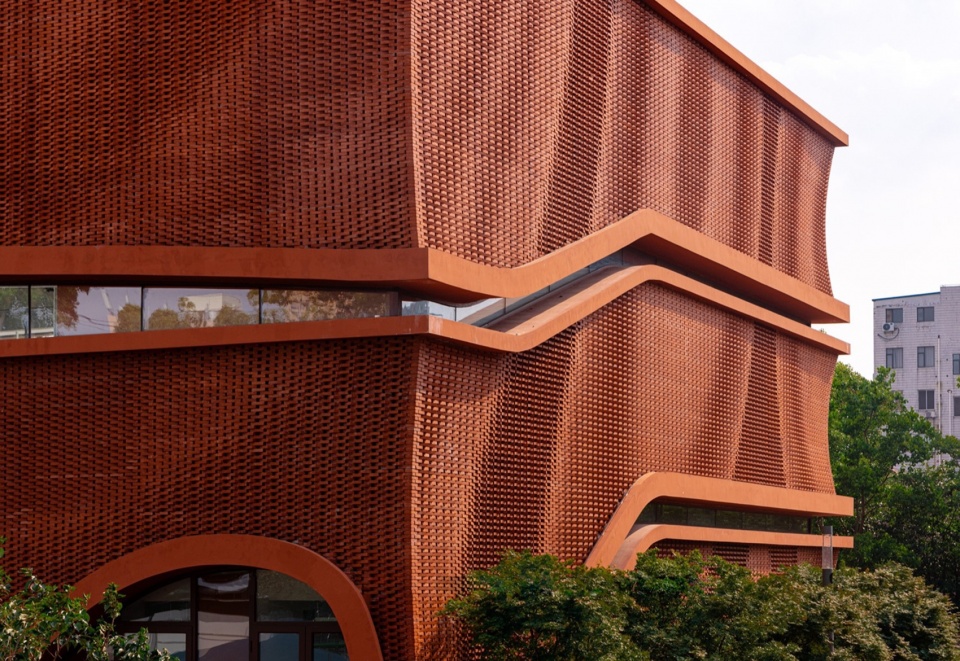
通过可控的孔洞与窗带排布,实现展厅内部均衡采光与遮阳节能双重需求。该设计使传统红砖在算法控制下展现“柔性织物”的视觉感知,实现“再材料化”与“再构造化”的双重转译。
Behind the screen a steel sub‑frame provides support while calibrated apertures deliver balanced daylighting and passive shading. Thus, ordinary red brick is re‑materialised into a “flexible textile”, achieving a double translation of materiality and construction logic.
▼外观,Exterior view
四、机器人砌筑的建造系统Robotic Masonry: From Model to Assembly
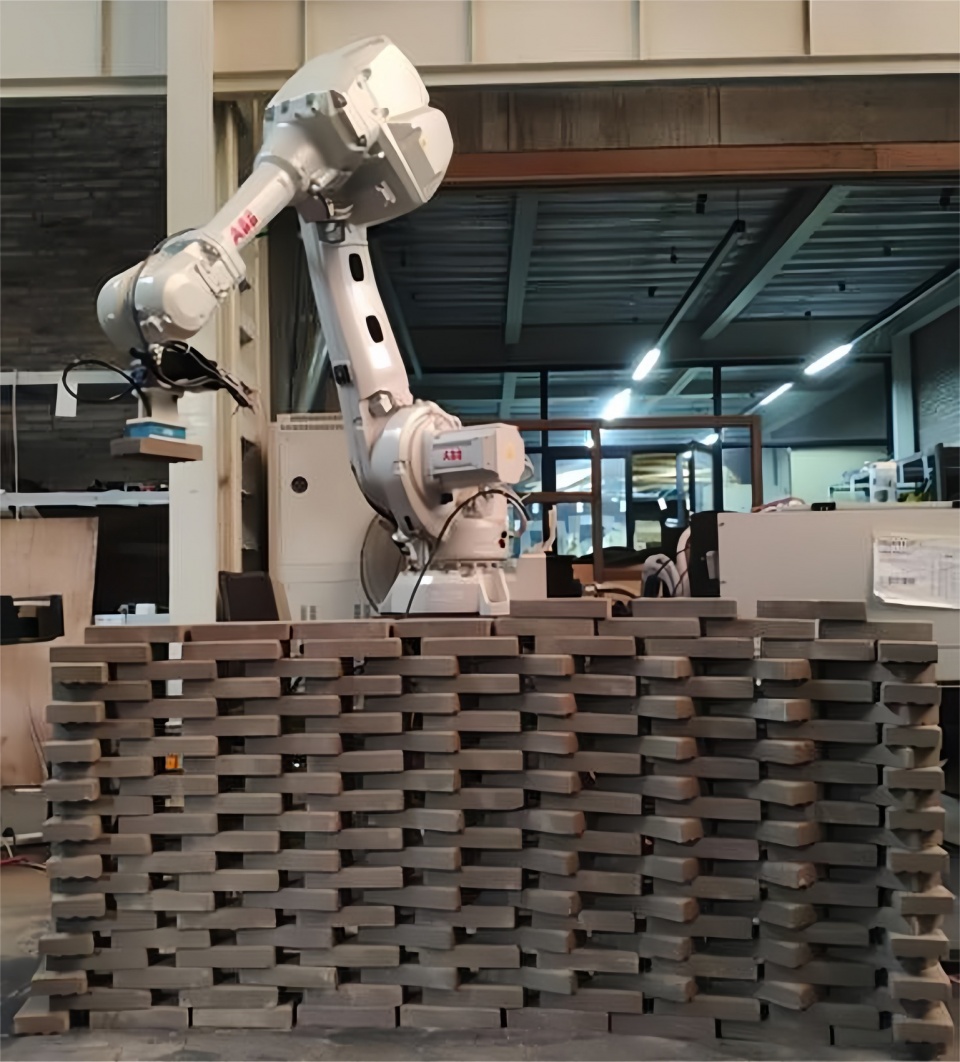
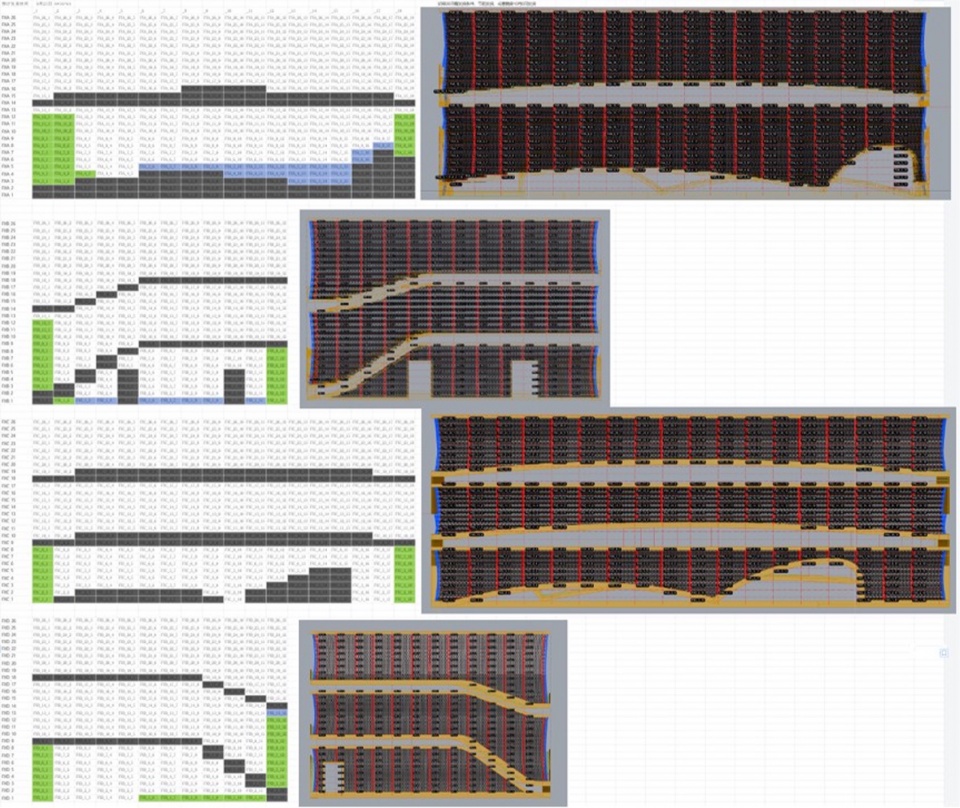
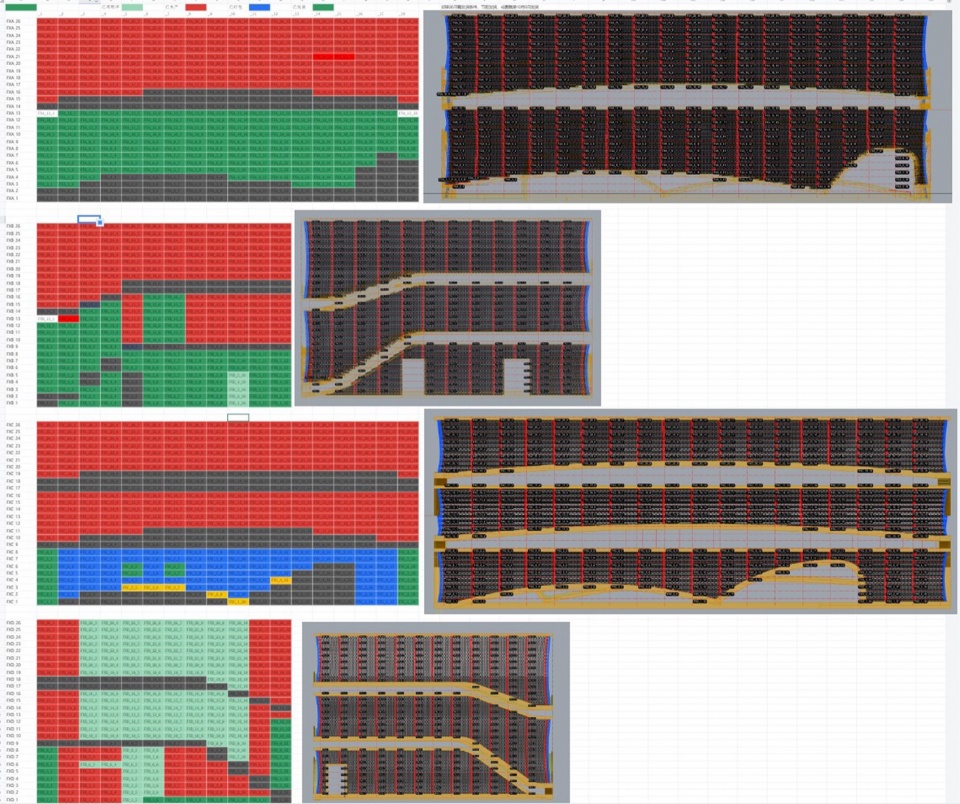
立面砖幕的实现依托于机器人建造体系。设计团队与数字建造平台合作,采用机械臂在工厂进行逐砖精准预制,现场通过分段拼接方式装配完成。整个流程体现为:该项目实现设计到制造闭环,先从参数模型导出砖位信息,自动生成编号与坐标。
The screen is realised through a design‑to‑manufacture loop. Brick coordinates exported from the parametric model are fed into an industrial‑robot workflow that pre‑assembles segments off‑site; these are then dry‑connected on‑site without scaffolding, reducing wet trades, shortening the programme by roughly 30 % and cutting material wastage by about 40 %.
▼立面砖幕的实现依托于机器人建造体系,The screen is realised through a design‑to‑manufacture loop
▼数字建造,The parametric model
▼机器人建造体系,Robot construction system
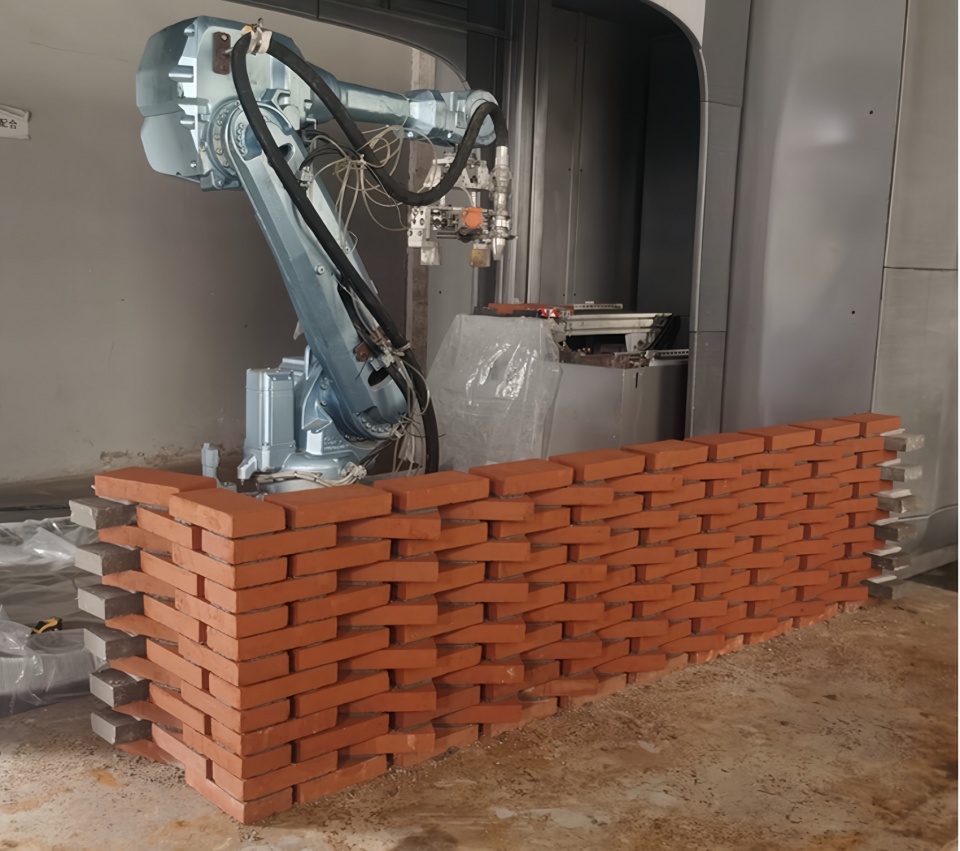
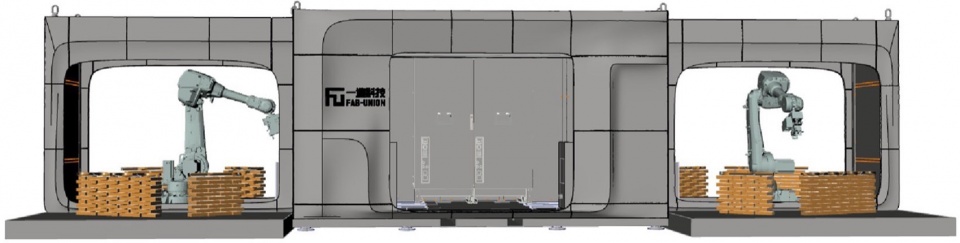
通过位置信息,精准控制机械臂作业路径,通过预制装配施工,分段拼装,干式连接,无需脚手架作业,大幅降低现场湿作业。砖块采用可替换式挂件节点,支持局部维修与更换,延长生命周期。据测算,整体工期缩短约30%,材料浪费降低40%,展现出数字建造在文化项目中的技术适配能力。
Replaceable hanging joints facilitate local maintenance and extend the life‑cycle of the façade, showcasing the adaptability of digital construction in a cultural project.
▼一造科技元宇宙打印机2.0,Yizao Technology Metaverse Printer 2.0
▼立面近景,Closer view of the facade
五、室内空间:结构-动线-环境的三重耦合Interior as a “Structural–Environmental Instrument”
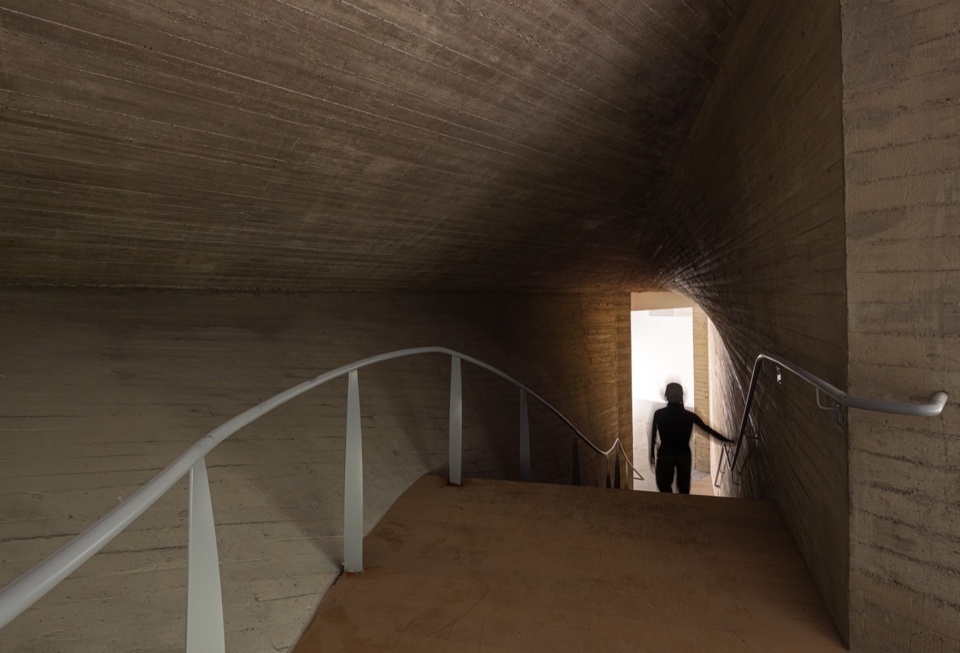
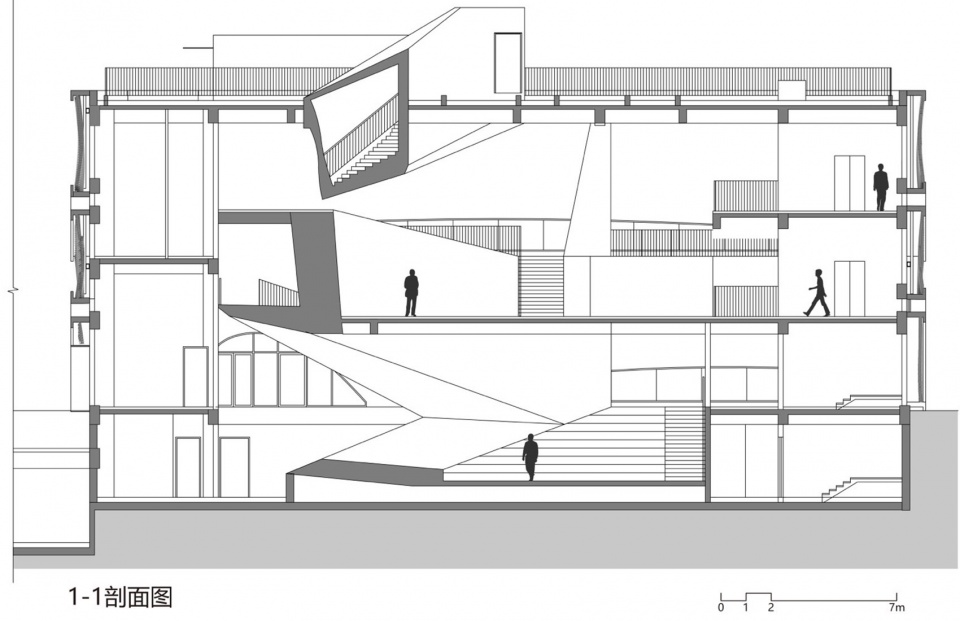
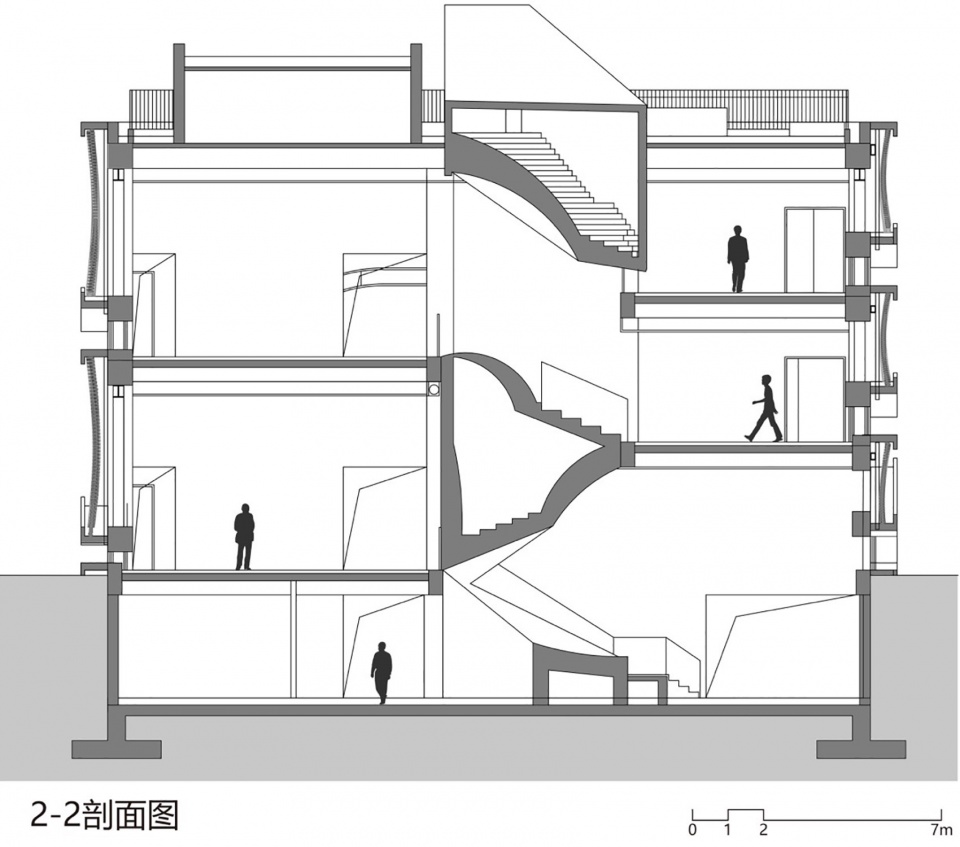
室内并未诉诸装饰性陈列,而是通过 “结构—动线—环境性能” 的多重耦合,打造可步入、可感知的力学-叙事载体。进入前厅灰空间后,视线被主动引向中心的 清水混凝土通贯核空间:这座贯穿三层的结构/交通核心体以双向渐进结构优化(BESO)为几何依据,既承担竖向荷载,又统筹空间组织与微气候调控。
Rather than resorting to decorative display, the interior choreographs structure, circulation and environmental performance. After entering a shaded vestibule, visitors’ sightlines are drawn to a three‑storey fair‑faced‑concrete core derived from Bidirectional Evolutionary Structural Optimisation (BESO).
▼结构-动线整合,Structure-circulation integration
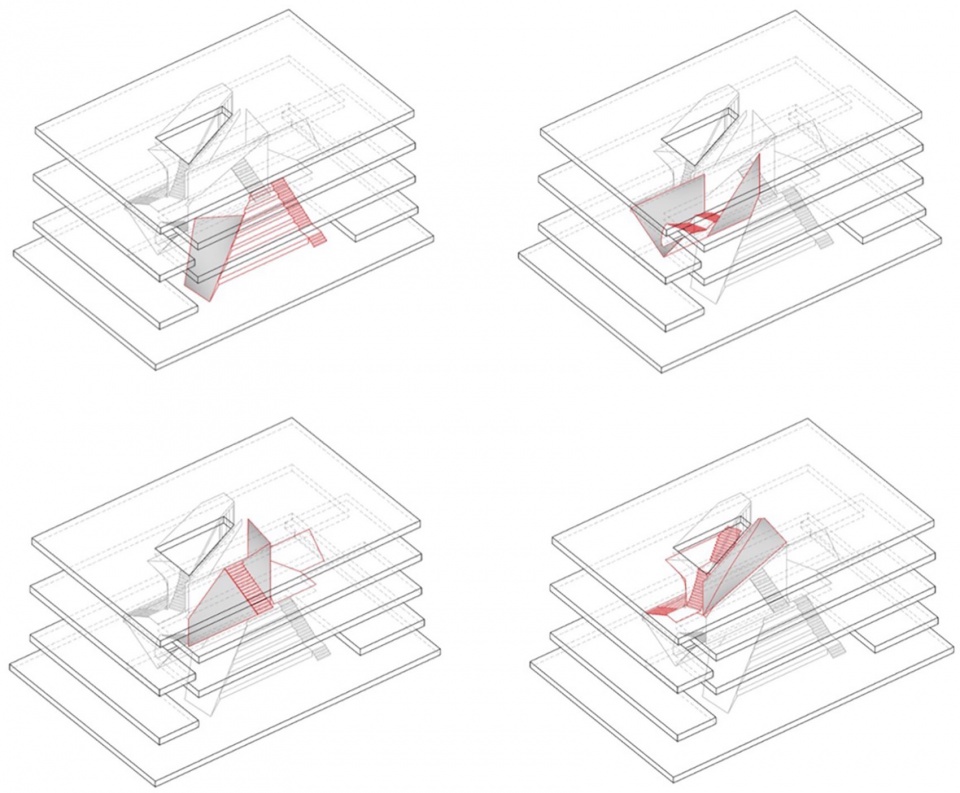
折板-剪刀墙式核心将竖向力流导向两侧基座;楼梯踏步在受拉边缘悬挑,使“行走路径”与“受力路径”叠合,从而把交通体验转译为可读的结构剖面。
Acting as both load‑bearing spine and climatic chimney, the folded‑plate core merges the path of movement with the path of forces: cantilevered stair treads align with tension zones, while slotted skylights and point apertures create a volumetric light‑well.
▼折板-剪刀墙式核心,Acting as both load‑bearing spine and climatic chimney
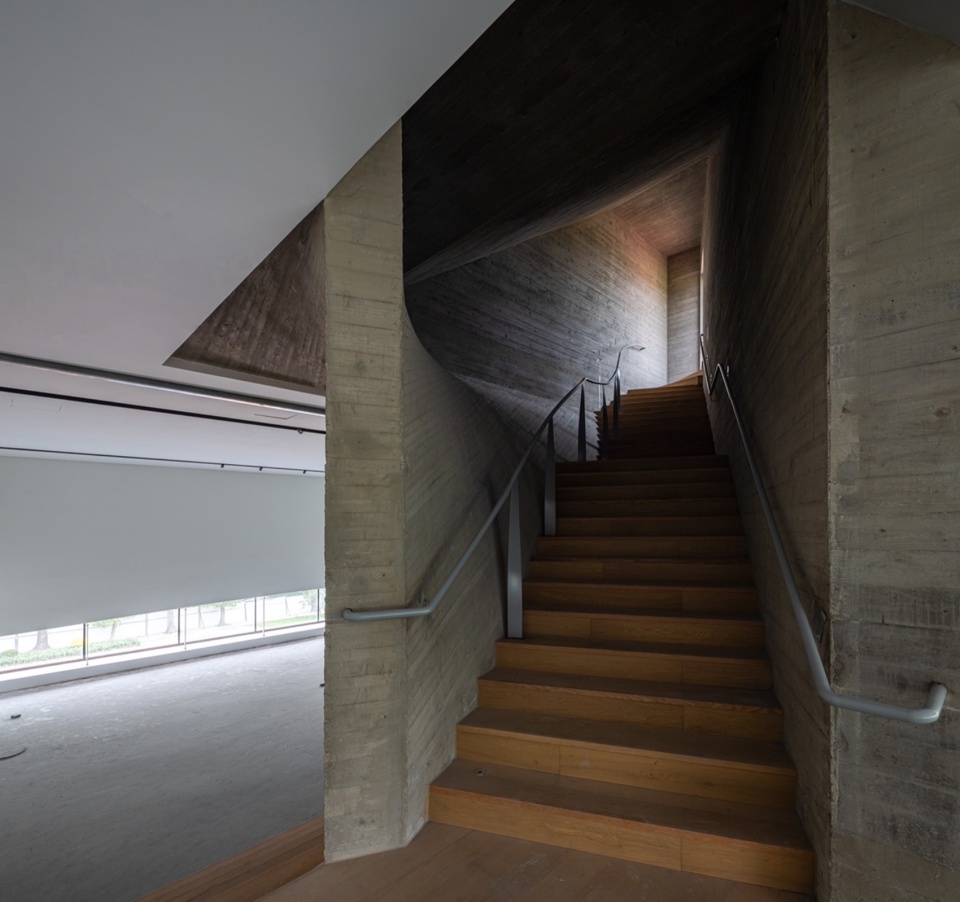
顶部狭缝天窗与侧向点状开口共同构成立体光井;自然光沿折板滑落,在墙面投射出类似结构性能云图的光影,令观者在行进中直接感知力学场与光场的动态对应。
Sunlight glides along the folded planes, casting shadows that resemble structural stress fields; meanwhile stack‑effect ventilation pairs with the self‑shading brick screen for passive cooling in shoulder seasons.
▼楼梯间,Staircase
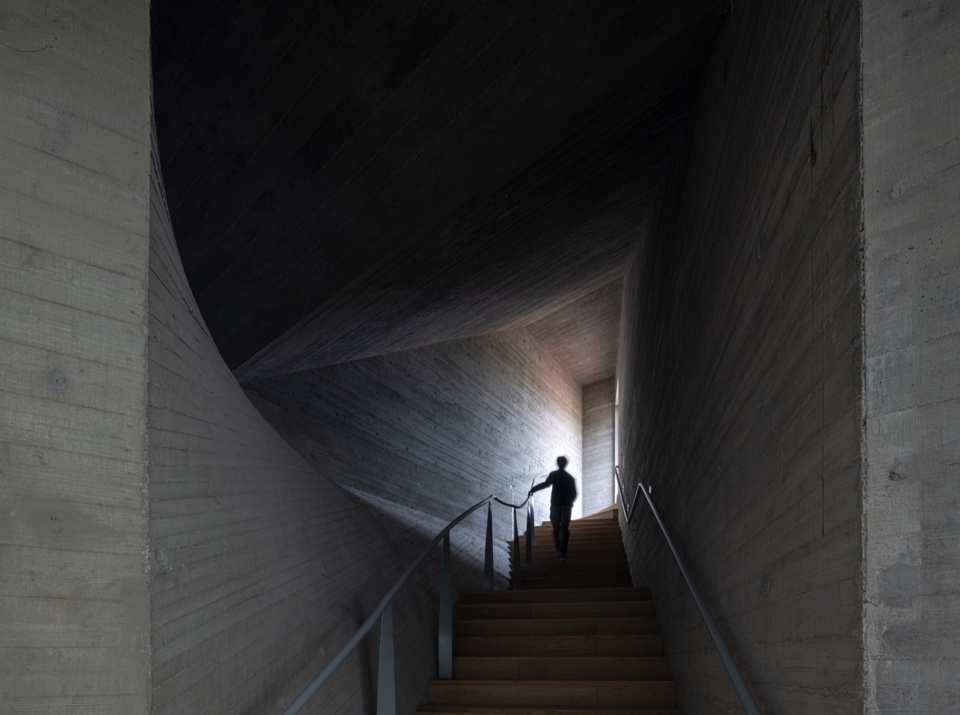
核体空腔利用烟囱效应形成垂直通风;外层砖织幕提供的准自承遮阳与核心排风道互补,构成非空调季节的被动降温策略。核体外围为 24 m × 12 m 的无柱矩形展厅;可移动隔墙与地面插槽系统允许空间在“展陈”与“手工坊”之间快速切换。BIM 预留的机电干线槽隐藏于楼板腔体,确保室内净高与声学完整性。在这一语境中,室内被塑造成一座可步入的“结构-环境仪器”:清水混凝土的理性张力与砖幕过滤的柔性光晕相互叠合,使数字化建造逻辑与地方材料语义在步行尺度上完成深度互文。
A 24 × 12 m column‑free hall with movable partitions can swiftly shift between exhibition and craft‑workshop modes, and services run invisibly within floor cavities to preserve acoustic and spatial clarity.
▼室内视角,Interior view
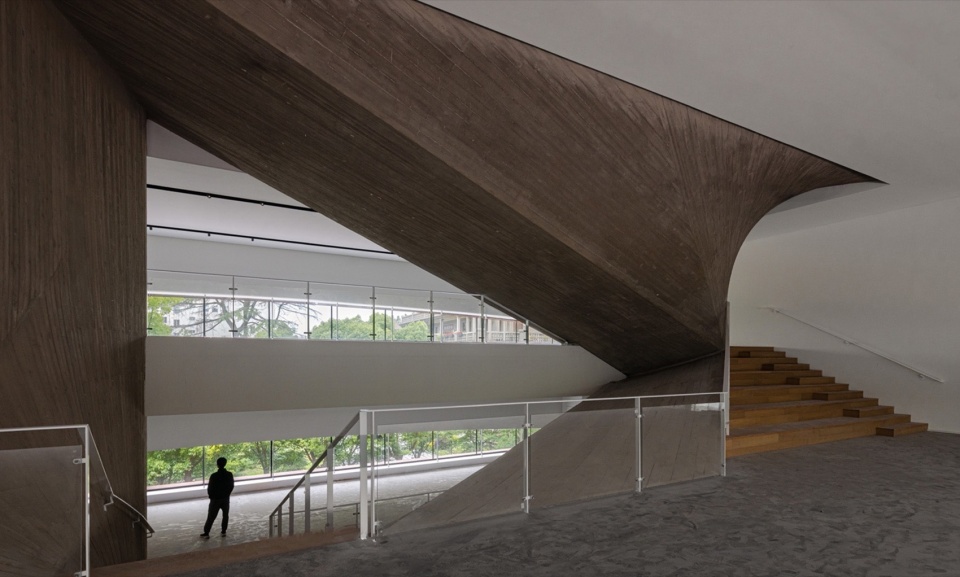
▼楼梯间,Staircase
六、结构设计与拓扑优化策略Structural Optimisation & Formal Continuity
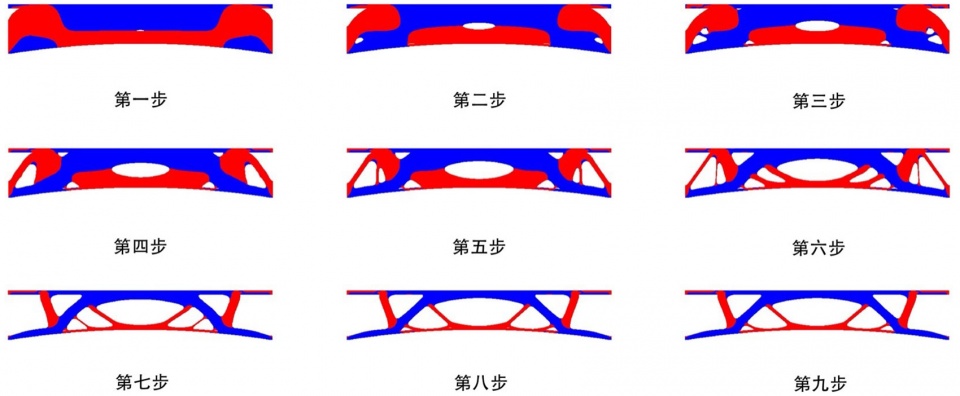
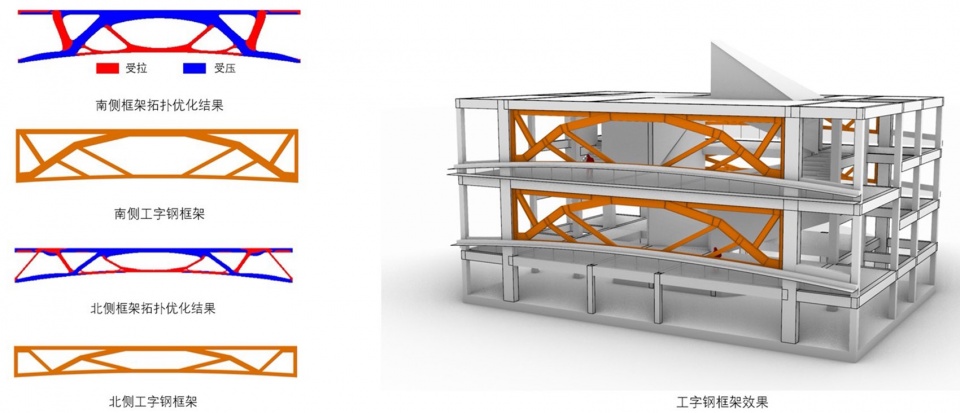
在建筑表达之外,非遗馆亦是一次结构优化设计的实验性探索。南北两侧主要框架结构采用双向渐进结构优化法(BESO)进行轻量化设计。其策略为:输入荷载工况与约束条件,通过BESO算法自动识别主要受拉受压路径,实现拓扑生成。优化结构图谱经后处理转化为工字钢构件体系,精简构件数量,控制节点复杂度。
The north–south frames are light‑weighted via BESO, which identifies principal tension‑compression trajectories under given load cases, then translates the topology into an I‑beam system, reducing members and joint complexity.
▼南立面框架拓扑优化过程,Topological optimization process of the south facade frame
砖幕之起伏形态与内部结构骨架协同设计,实现从形式美学到受力逻辑的连续过渡。该策略有效减少结构冗余,使建筑形体与结构行为趋于一致,体现出由构造引导空间的理性表达路径。
The undulating brick façade and the optimised steel skeleton are conceived as a single continuum, aligning aesthetic form with structural logic.
▼后优化处理过程,The post-optimization processing procedure
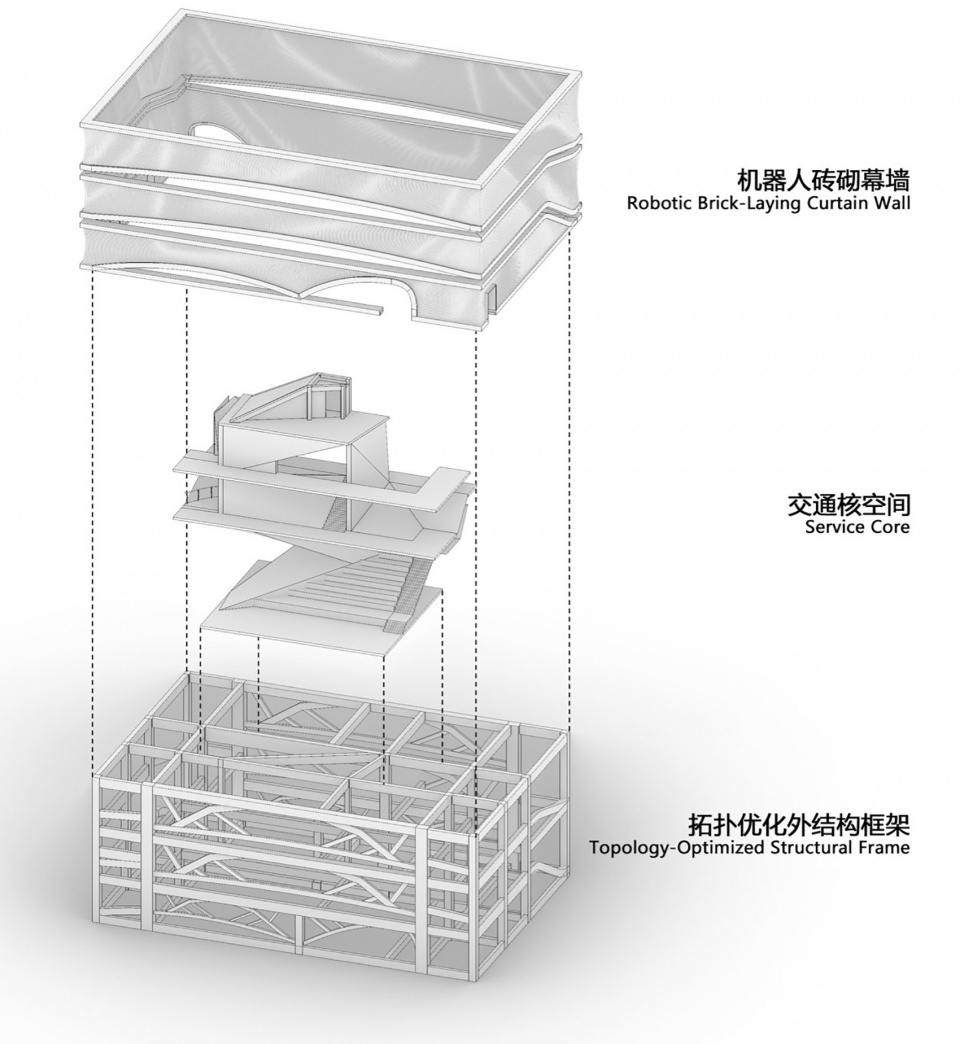
▼轴测分析图,Analysis diagram
七、文化空间的再组织机制 Re‑Organising Cultural Programme
在“南桥源”更新体系中,沈家花园非遗馆扮演着三重核心角色:首先,它是区域文化记忆的容器,承载着非遗技艺传承、手工艺教育和地方文化展陈的功能;其次,它成为智能建造技术的示范样本,通过机器人砌筑和结构优化,生动展示了如何将本地材料进行数字化转译与创新应用;同时,它更是激活城市空间的关键节点,有效串联起主楼与运河步道,共同塑造出一个日常可达、充满活力的公共文化敞廊。其以微尺度的介入方式,重新组织场地记忆、手工技艺与社区公共性,回应城市更新从“物理改善”走向“文化营造”的转向趋势。
The pavilion fulfils three intertwined roles:
· Cultural Memory Vessel – hosting intangible‑heritage exhibitions, craft education and community events.
· Demonstrator of Intelligent Construction – digitally re‑interpreting local materials through robotic masonry and optimisation algorithms.
· Urban Catalyst – stitching the historic villa to the canal promenade and forming an everyday, vibrant cultural loggia.
Through these micro‑scale insertions the project reorganises site memory, craft practices and public life, echoing a shift in urban renewal from physical remediation to cultural making.
▼外观,Exterior view
八、结语:从砖材到数字语境的文化叙事Conclusion: From Brick to Digital Narrative
沈家花园非遗馆以最具地方性的砖材为媒介,借助最具未来性的建造技术,搭建起文化与智能、传统与当代的桥梁。其设计逻辑由砖构表皮展开,通过结构优化、参数织理与数字建造完成一次建筑语言的再语法化。这不仅是一次关于“非遗”的展览空间实践,更是一次关于建筑作为文化机制的当代表达尝试。
By employing the most local of materials—brick—via the most future‑oriented techniques—robotic fabrication—the pavilion forges a bridge between heritage and intelligence, tradition and the contemporary. Its architectural language is re‑grammatised through a brick screen that unfolds into structural optimisation, parametric weaving and digital assembly.
▼鸟瞰,Aerial view
在城市更新语境下,建筑不再只是物理容器,而是文化关系的组织者、语义转换的介体。沈家花园非遗馆作为其中一例,为我们提供了新的视角:新建不意味着重写历史,而是对文脉的再解码与再生成。
Beyond an exhibition venue, it exemplifies architecture as a cultural mechanism: a mediator of meanings rather than a mere physical container. In this sense, new construction does not overwrite history; it re‑decodes and regenerates the context.
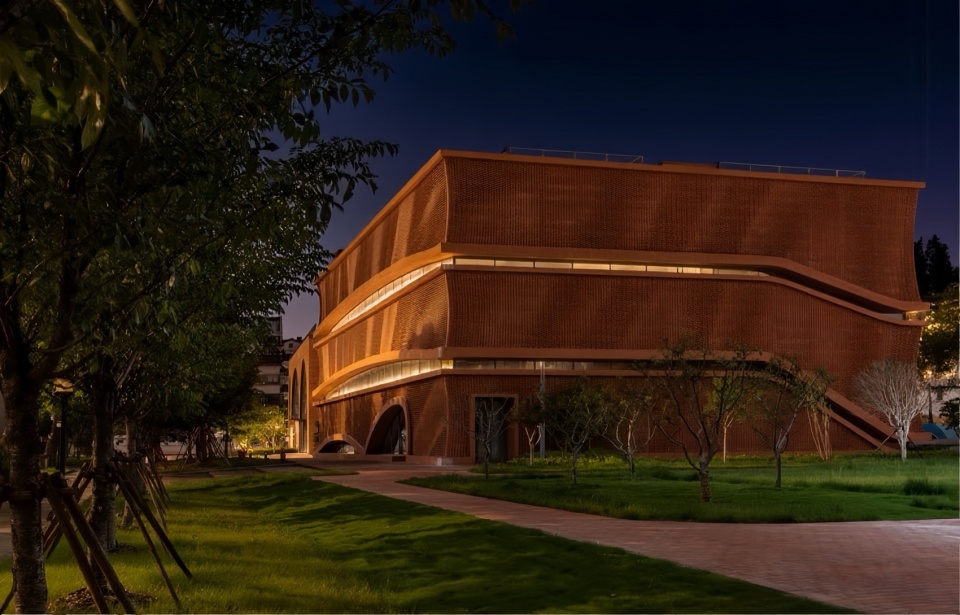
▼夜景,Night view
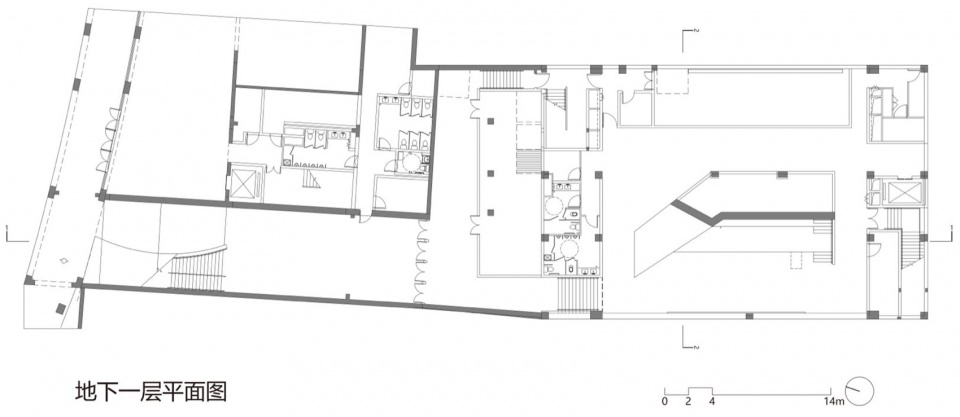
▼地下一层平面图,B1 Plan
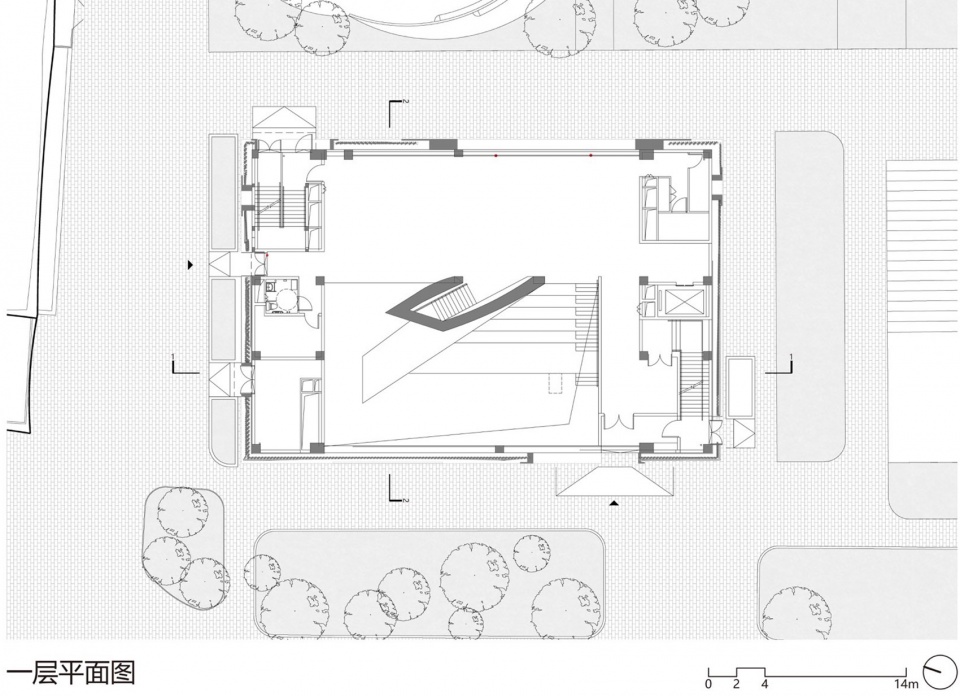
▼一层平面图,1F Plan
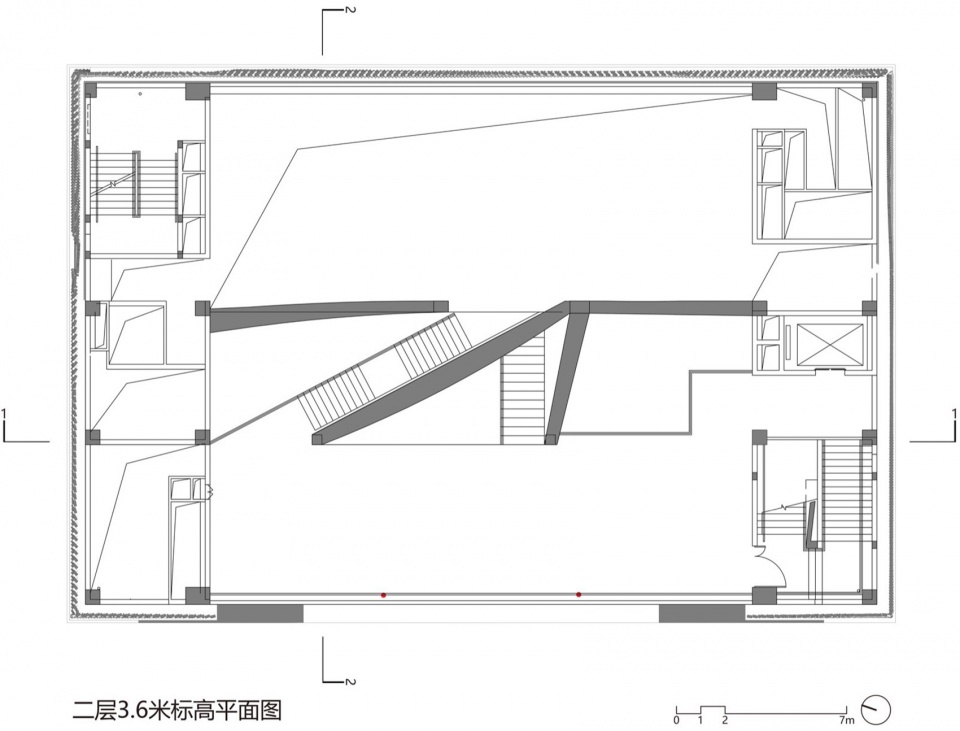
▼二层3.6米标高平面图,2F 3.6m Plan
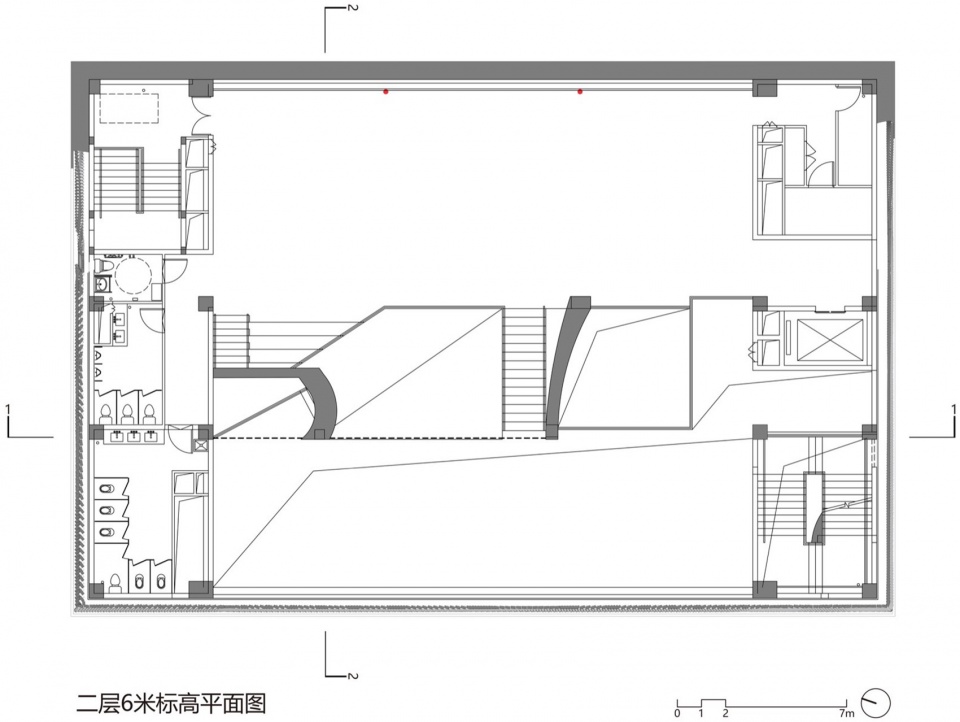
▼二层6米标高平面图,2F 6m Plan
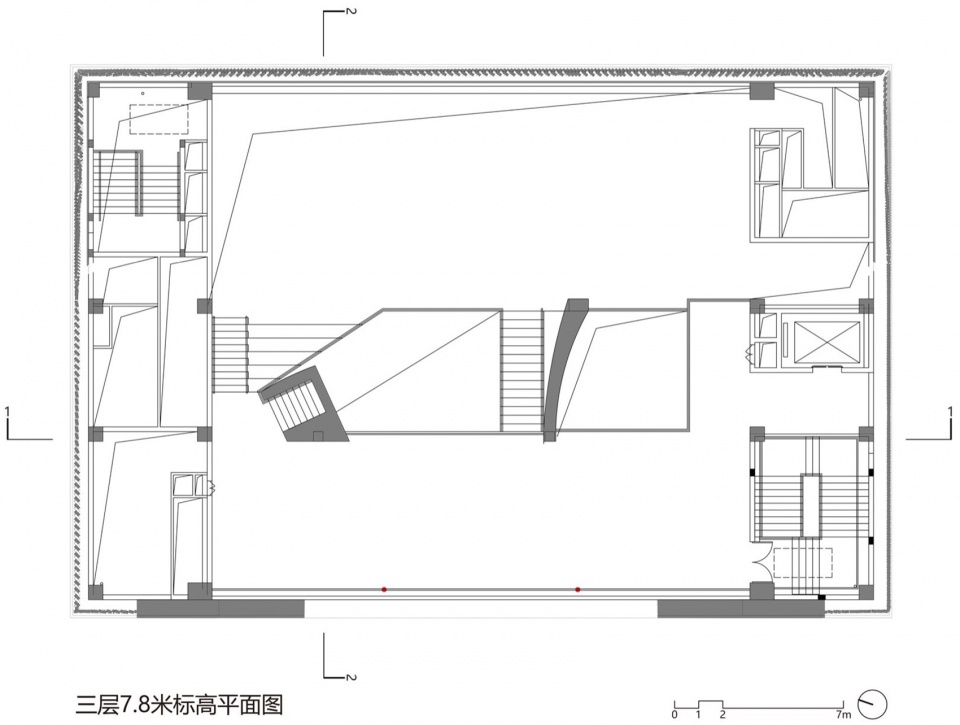
▼三层7.8米标高平面图,3F 7.8m Plan
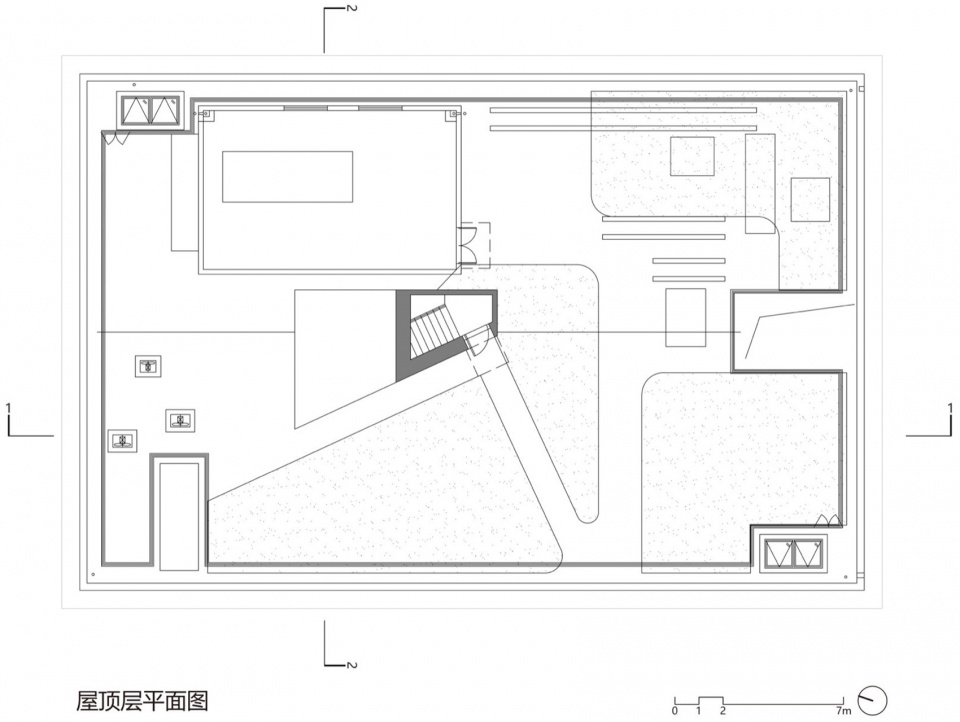
▼屋顶层平面图,Roof Plan
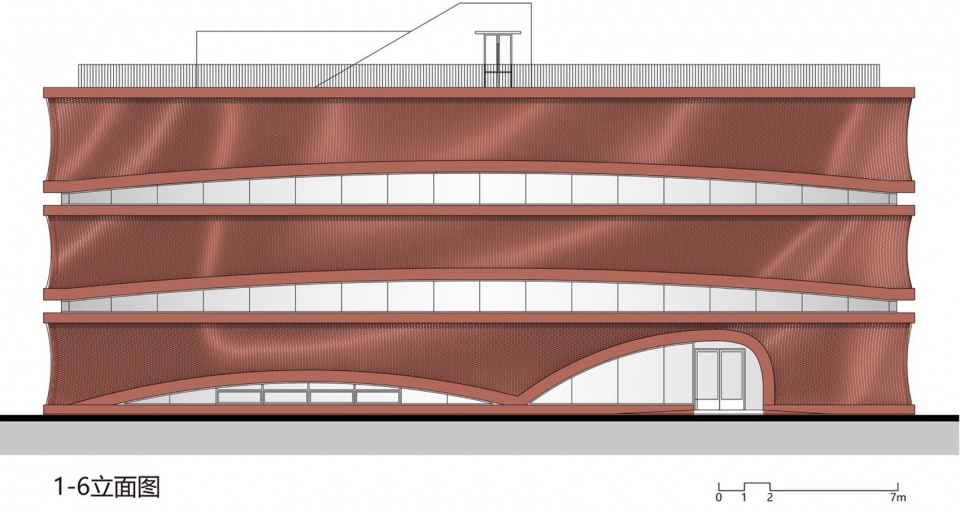
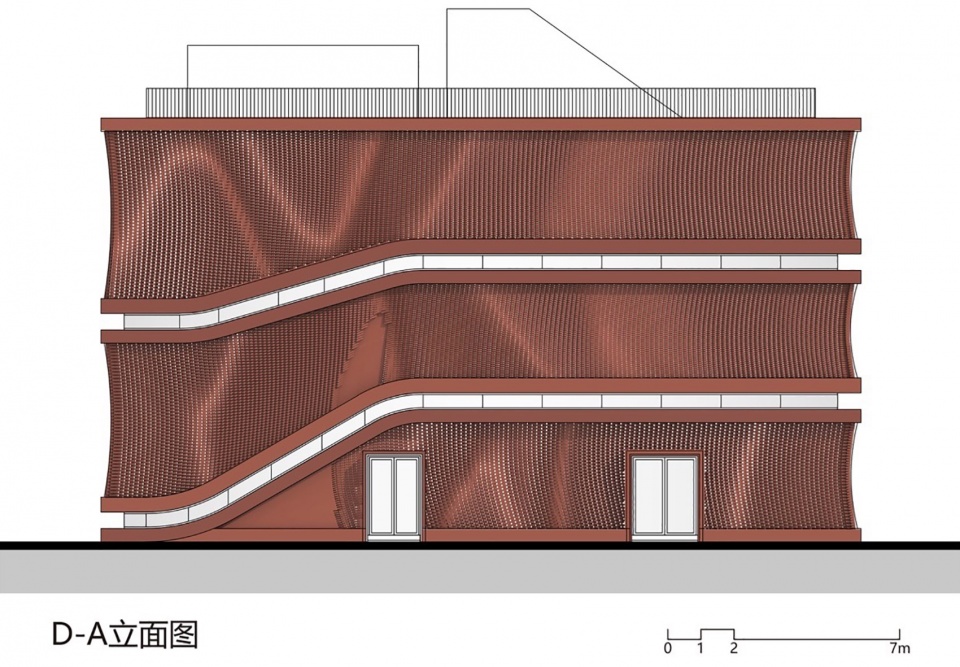
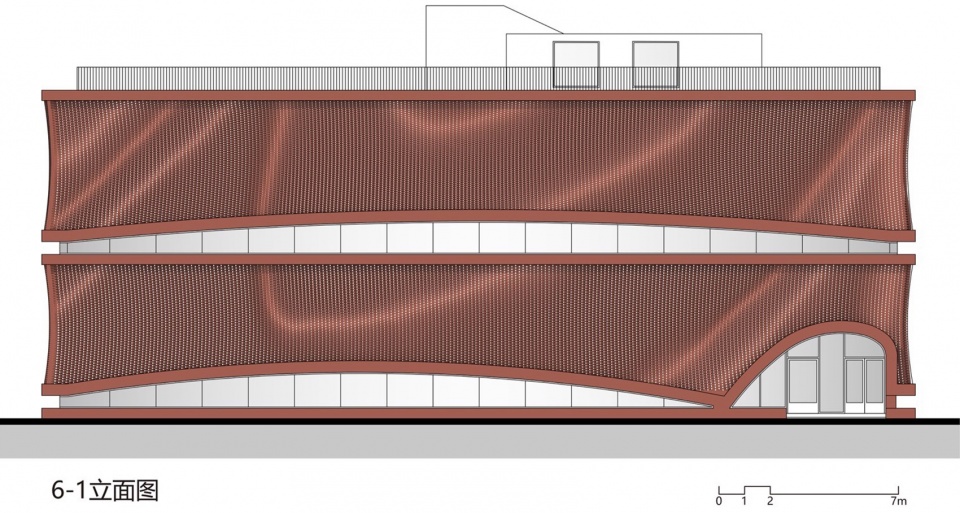
▼立面图,Elevations
▼剖面图,Sections
业主:奉贤区文化和旅游局
代建:奉发集团南桥源公司
主创建筑师:袁烽,同济大学
设计团队:赵奕清、姜边城、张蓓(建筑)王勇,丁程,李进朝(机电)陈泽赳、桑海刚(结构)王炬(室内)高华、徐自立(景观)
设计协理:高伟哲
设计单位:同济大学建筑设计研究院(集团)有限公司创盟国际工作室
建设方:奉贤区文化和旅游局
代建方:奉发集团南桥源公司
智能建造:上海一造科技有限公司
摄影:苏圣亮,是然建筑摄影
建筑面积:2862㎡
设计时间:2021-2025
Owner / Developer: Fengxian District Bureau of Culture & Tourism
Delegated Constructor: Fengfa Group Nanqiao Source Co., Ltd.
Principal Architect: PHILIP F. YUAN
Design Team:
– Architecture: Zhao Yiqing, Jiang Biancheng, Zhang Bei
– MEP: Wang Yong, Ding Cheng, Li Jinchao
– Structure: Chen Zejiu, Sang Haigang
– Interior: Wang Ju
– Landscape: Gao Hua, Xu Zili
Associate Design Coordinator: Gao Weizhe
Design Institute: Archi‑Union Architects, TJAD (Tongji University Architectural Design & Research Institute Group)
Intelligent Construction: Fab‑Union (Shanghai Yizao Technology Co., Ltd.)
Photography: Su Shengliang (Shiran Architectural Photography)
Gross Floor Area: 2,862 m²
Design Period: 2021 – 2025