在水一方·三体未来学院,上海 / 山水秀建筑事务所
波的意象Wave Imaginary
中国古代诗词中常见“波”字。波的字源虽有形声(水和皮的古音)、形意(水和坡)、会意(王安石“水之皮”)等不同说法,但波所代表的水之起伏、以及波在自然界中奇妙的动态传导,则一直为文学家所赏识,并通过文学语言不断描绘其更普遍的内涵、更广阔的尺度、以及更抽象的传播意义。“滟滟随波千万里,何处春江无月明”(春江花月夜),张若虚诗中的波仿佛一种媒介,让月之光华传遍江河湖海;“水是眼波横,山是眉峰聚”(卜算子·送鲍浩然之浙东),王观词中的水波与山峰同享起伏之态,联通山水和眉眼,可以传情。
The character bō (波, wave/ripple) is commonly found in ancient Chinese poetry. While its etymology has been interpreted in several ways—phonetically (the ancient sounds of “water” and “skin”), symbolically (water and slope), or associatively (as described by Wang Anshi, “the skin of water”). However, the undulation of water embodied by the wave, along with its extraordinary dynamic propagation within the natural world, has long been cherished by the literati. Through the medium of literary language, they have continuously articulated its more universal connotations, its expansive spatial scales, and its increasingly abstract significance in terms of transmission. In Zhang Ruoxu’s seminal The Moon over the River on a Spring Night, the lines “She follows the rolling waves for ten thousand li; Where the river flows, there overflows her light” frame the wave as a pervasive medium that conducts the moon’s ethereal luster across the boundless reach of rivers and seas. Similarly, in Wang Guan’s Song of Divination, the couplet “The rippling stream’s a beaming eye; The arched brows are mountains high” establishes a moment where water and peak share a singular undulation, tethering the landscape to the gaze as a conduit for human emotion.
在现代物理学的范畴里,波是连续介质最重要的运动形式。空气中的声波、水面的涟漪、地震波、光波、无线电波、引力波、细胞振动波等等,都是连续介质波动性的体现。描述波的基本物理量是振幅、相位、频率。
In the field of modern physics, waves represent one of the most important forms of motion within continuous media. Sound waves in air, ripples on water, seismic waves, light waves, radio waves, gravitational waves, and cell vibration waves, among others, all exemplify the wave-like behavior of continuous media. The fundamental physical quantities used to describe waves are amplitude, phase, and frequency.
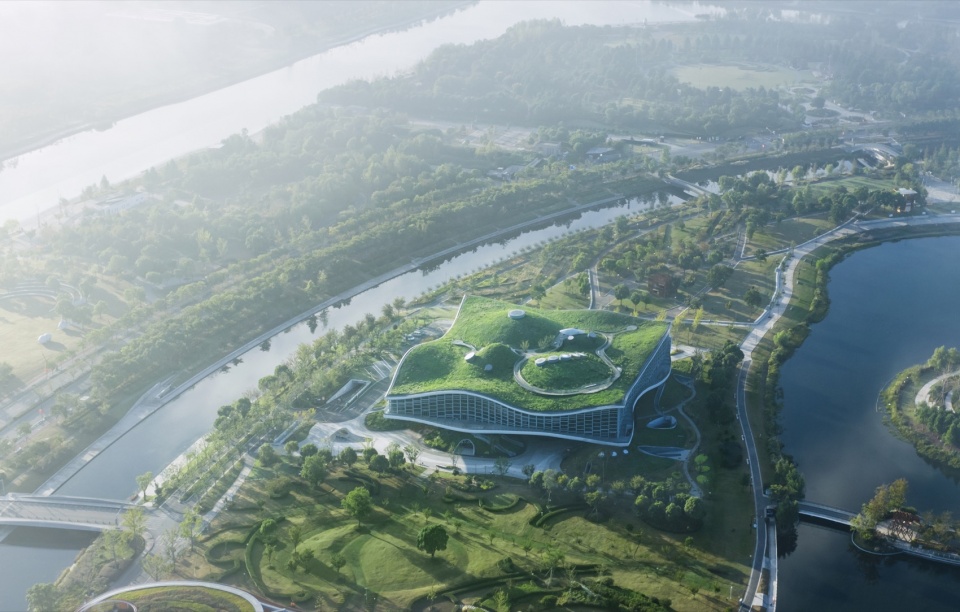
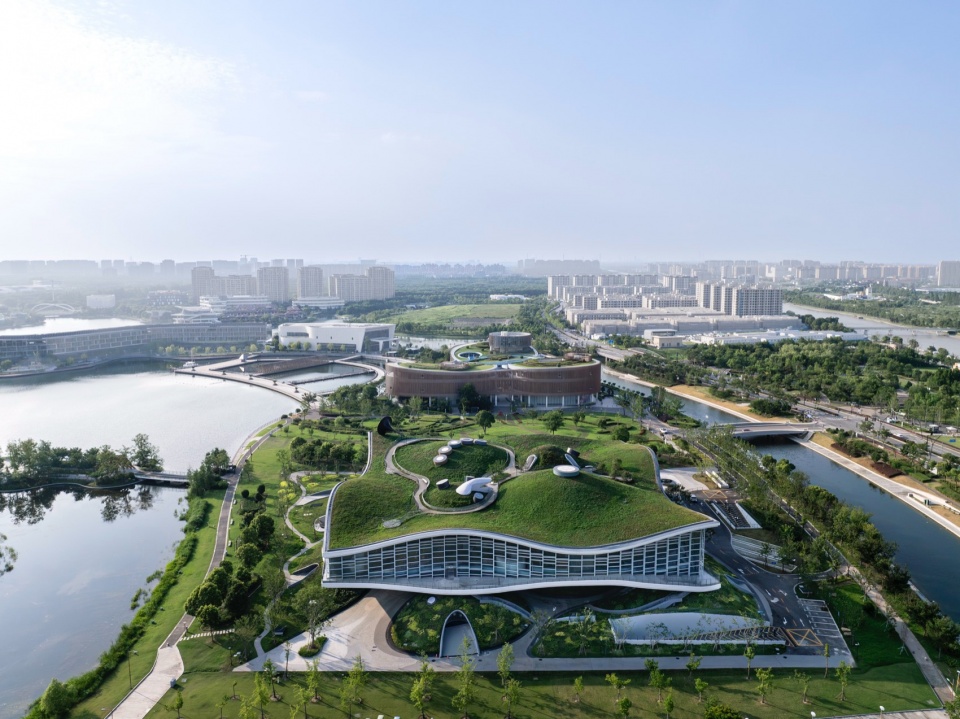
▼在水一方鸟瞰,Bird’s-eye View of Wave Cube
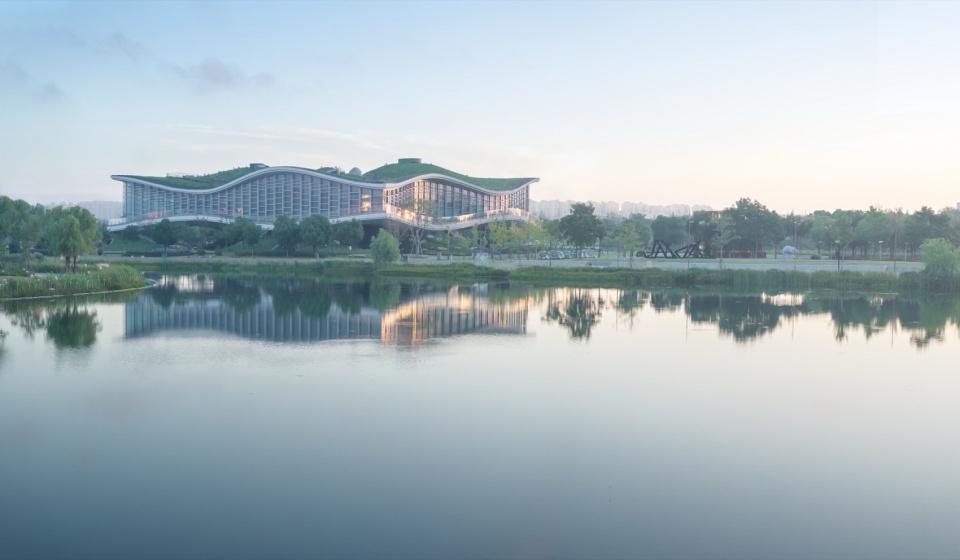
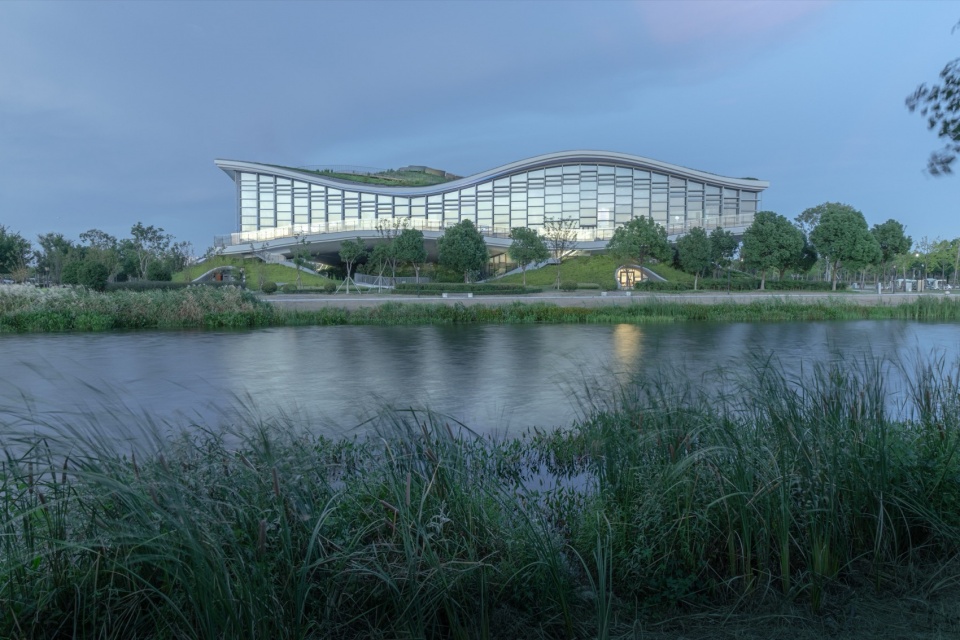
▼在水一方远景,Distant View of Wave Cube
无论在文学还是科学里,波都是既普遍又神秘的。地球的日常环境中,只有少数可见的连续介质产生波动时才能被观察,比如水波,而身体尺度的体验就更难得,例如只有冲浪者才有机会进入海浪内部。建筑做为一种人造构筑物,由静力学结构形成固定空间,以满足人在平坦空间内活动和休憩的需求,自然很难对波这样的动态系统有所参照,只有类似滑板池这样的固定场所才能让人获得动态的起伏体验。山水秀近年的作品持续聚焦在“庭院聚落”、“家的延伸”、“自由细胞”三个方向,其中的“自由细胞”尝试通过技术和空间体验的融合,探索新的建筑形制。延绵的山水、传统建筑屋顶聚落、细胞的连续繁衍和信息传导都和波有着形态上的关联,我们也一直在思考,波的形态对未来的建筑能否有更多可以借鉴的意义?金海湖畔的“在水一方”给我们提供了一次难得的探索机遇。
Whether in literature or science, waves are both ubiquitous and mysterious. In the everyday environment of Earth, only a few visible continuous media generate observable waves, such as water waves, while experiences at the human scale are even rarer, with surfers being among the few who can enter the interior of ocean waves. As a man-made structure, architecture is formed through static systems that create fixed spaces to meet human needs for activities and rest within flat surfaces. Consequently, it is challenging to draw direct comparisons with dynamic systems like waves. Only fixed locations such as skateboarding pools provide an experience of dynamic undulation. In recent works by Scenic Architecture Office, the focus has consistently been on three directions: “courtyard settlement,” “extension of homes,” and “free cell.” Among these, “free cell” explore new architectural forms through the integration of technology and spatial experience. The continuous undulation of mountains and waters, the traditional clustering of architectural rooftops, the reproduction of cells, and the transmission of information all share a morphological connection to waves. We have been continuously thinking whether the morphology of waves could offer further insights for the future of architecture. The “Wave Cube” project by Jin Hai Lake has provided us with a rare opportunity for exploration.
▼在水一方南侧鸟瞰,South Bird’s-eye View of Wave Cube
折拱之波 The Wave of Folded Undulation
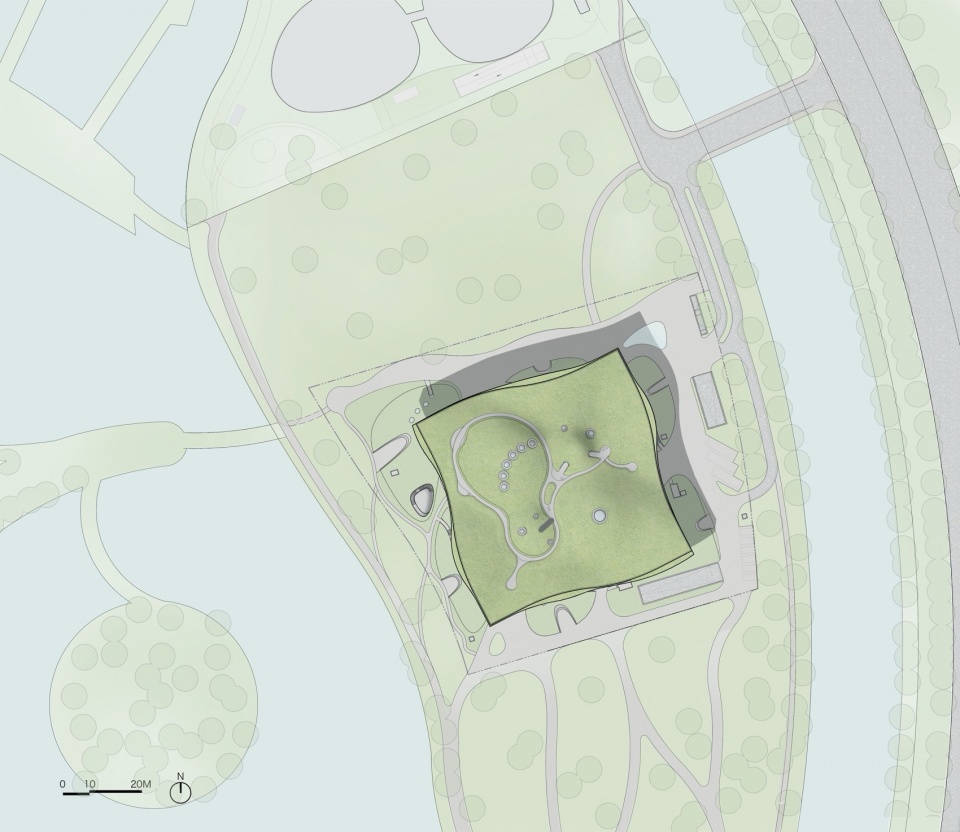
在上海五座新城的规划中,奉贤的金海湖是新城的核心景观。“在水一方”的基地近乎正方形,位于湖东的环形半岛上,东西两侧临水,是一座以科幻为主题的多功能文化地标。设计的走向源自选址和功能定位:建筑在景观空间上与环湖绿带取得协调的同时,也需要在内部体验和外部形象上建立自身的独特性。
In the planning of Shanghai’s five new towns, Jin Hai Lake in Fengxian serves as the central landscape of the new town. The site of “Wave Cube” is almost square in shape, located on a circular peninsula on the eastern side of the lake, with water on both the east and west sides. This multifunctional cultural landmark is themed around science fiction. The design direction stems from the site’s location and functional positioning: the building not only aligns with the surrounding lakeside green belt in terms of landscape integration but also strives to establish its own distinctiveness in both internal experience and external appearance.
▼金海湖整体鸟瞰,Bird’s-eye View of Jinhai Lake
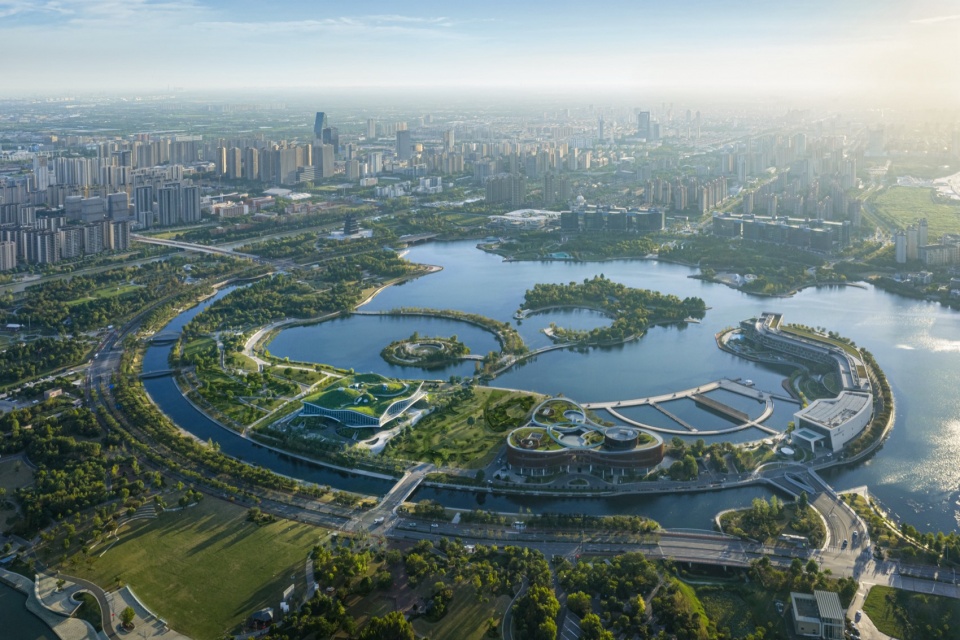
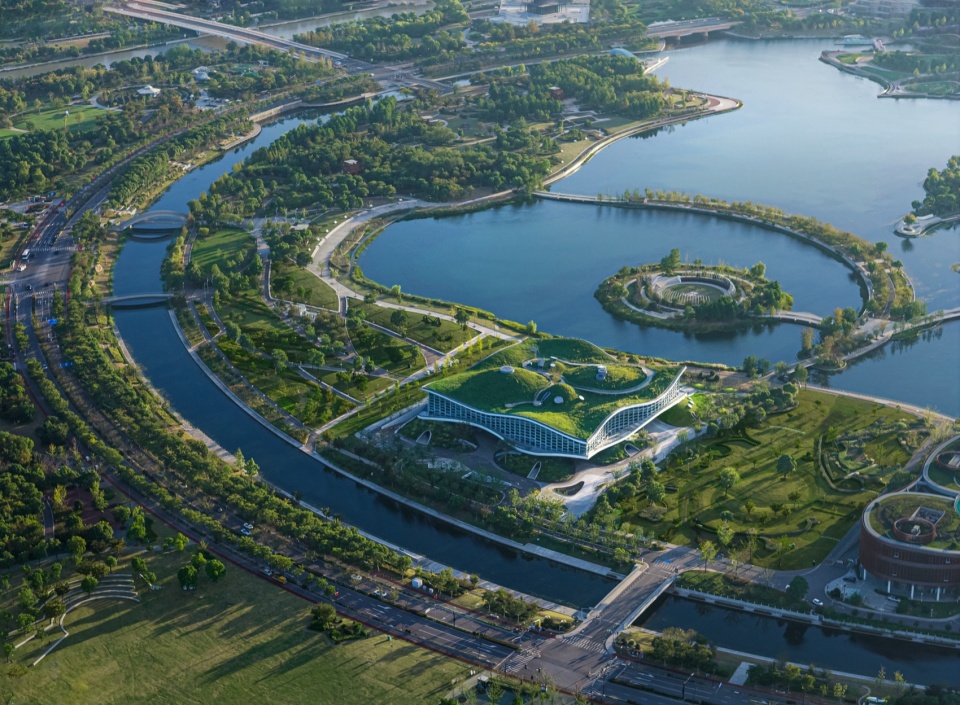
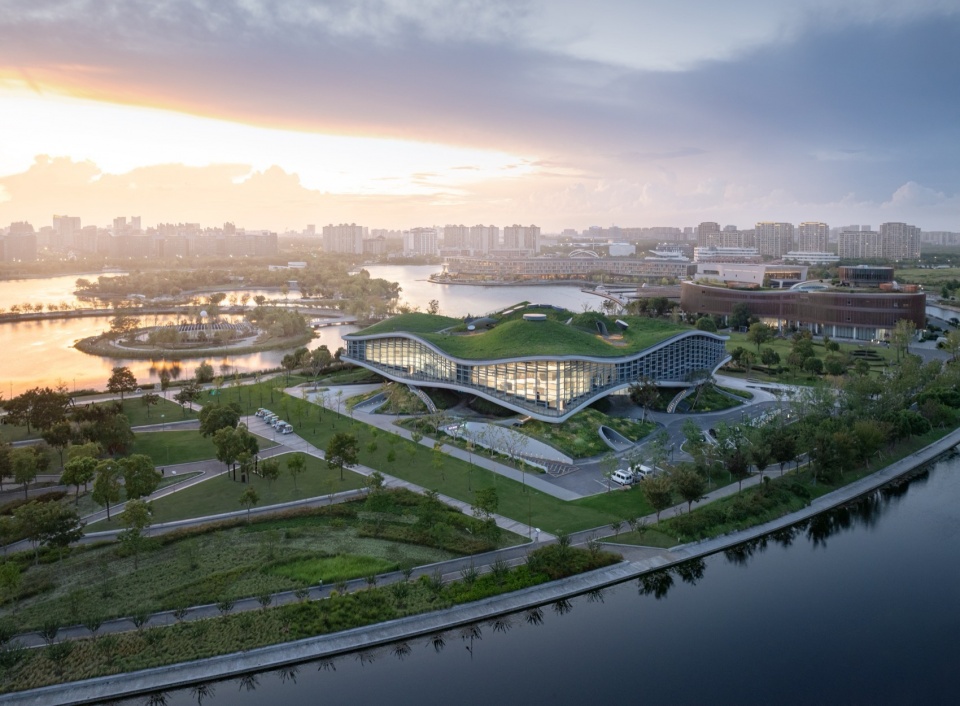
▼在水一方鸟瞰,Bird’s-eye View of Wave Cube
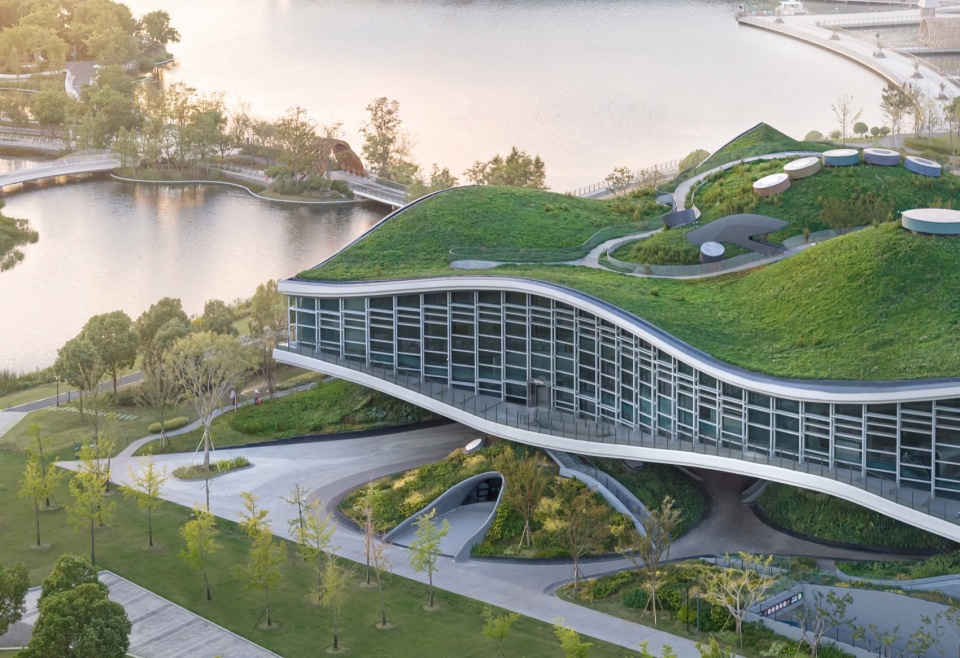
上海多水少山,奉贤更是一片平川沃野,从地貌出发而别具一格是最自然也最有力量的设计方向,因此人造山丘很早就成为构思的一部分。由此出发,我们希望起伏的形态不仅成为外部形象,更能为内部空间提供独特的体验,给科幻主题带来更多突破性演绎的可能。地景、标志性、空间体验:在这三者的交汇处,我们构思出一种由波状单元构成的聚落,可以在三维空间里无限延展,然后从中提取一个局部用于这座建筑。经过多种尺度比选,最终确定的提取范围是大约80X80X20米,由三层波面构成三重上下叠加的起伏空间,通过三维九宫格定义波的振幅和相位,并给出波单元在上层大空间出现的频率:两个完整单元、四个1/2单元、以及两个1/4单元,形成了振幅约12米,跨度约54米,悬挑约27米的波状巨构。可以说,这是山水秀“自由细胞”系列中最大的细胞聚落了。
▼三层波面的生成,Generation of the Triple-layered Wave Surfaces
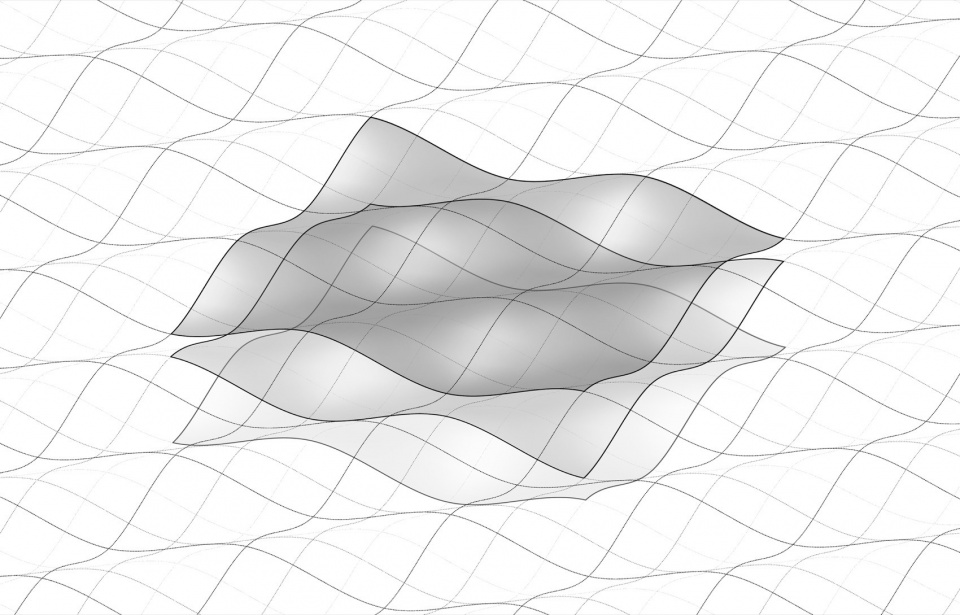
Shanghai is characterized by abundant water and scarce mountains, and Fengxian is particularly a vast, flat expanse of fertile land. Starting from the terrain, a design direction that is both natural and powerful emerged, and the concept of artificial hills became an integral part of the design early on. Building upon this foundation, we sought to create a form of undulation that not only serves as the external image but also provides a unique experience for the interior space, offering more possibilities for groundbreaking interpretations of the sci-fi theme. Landscape, iconicity, and spatial experience: at the intersection of these three elements, we conceptualized a settlement composed of wave-like units that could infinitely extend in three-dimensional space. A portion of this wave form was then extracted for use in the building. After considering various scale options, the final selected range for extraction was approximately 80m x 80m x 20m, consisting of three layers of wave surfaces to form a three-tiered, stacked undulating space. The amplitude and phase of the wave were defined using a three-dimensional nine-square grid, and the frequency of the wave units in the upper large space was determined: two full units, four half units, and two quarter units. This resulted in a wave-like structure with an amplitude of approximately 12 meters, a span of about 54 meters, and a cantilever of about 27 meters. This can be considered the largest cell settlement in the “Free Cell” series of Scenic Architecture Office.
▼在水一方东南侧鸟瞰,Southeast Bird’s-eye View of Wave Cube
在运用正弦曲线得到这个波结构的初步三维模型后,我们邀请结构顾问张准团队开展了结构可行性的研究,并期望波形能够和拱壳的传力原理耦合,推导出可行的结构形式。在讨论中,我们认识到标准的正弦波壳与拱壳相比有完全不同的传力模式,而传统结构意义上的受压拱壳要完成这样尺寸的跨度和悬挑,又需要超出我们预想的矢高和壳体厚度。于是,一种介于壳和波之间、既能受压又能受拉的空间结构形态成为双方共同探索的目标,结构师用简化的折面找到了重力和侧向力的主要传导路径,通过折面到壳面的拓扑变形巧妙地解决了重力、侧向力传导以及悬挑受力的挑战,将钢筋混凝土结构中的受压性能和预应力受拉性能运用到了极致。双方籍由不断的讨论和相互找形,最终一起得到了这个介于拱壳和折面之间的复合结构空间:下部的“绿丘”、中部的“穹洞”、以及上部的“波方”。
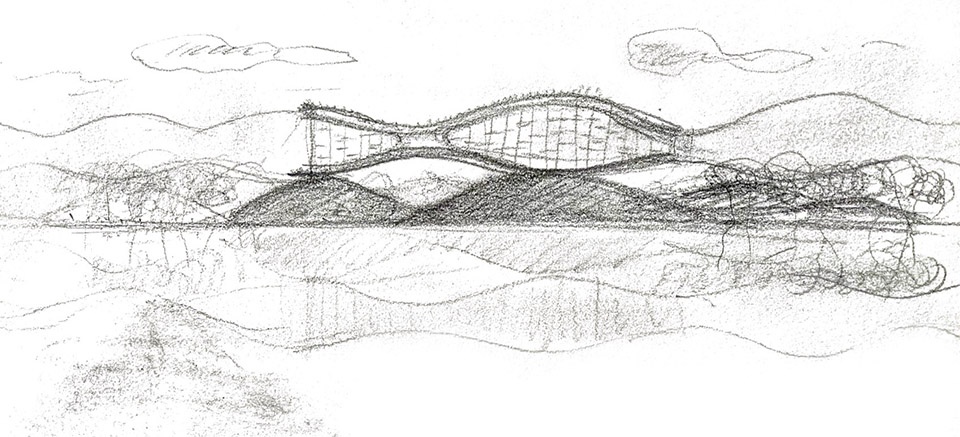
▼在水一方草图,Design Sketch of Wave Cube
Following the generation of an initial 3D model derived from sinusoidal curves, we invited structural consultant Zhang Zhun and his team to conduct a feasibility study. Our objective was to synchronize the wave morphology with the principles of vaulted shell mechanics to derive a viable structural form. During the discussions, we realized that the standard sine wave shell has a completely different force transfer mode compared to an arch. In traditional structural terms, a compressed shell arch capable of spanning such large dimensions and cantilevering would require an unexpectedly high rise and thicker shell than originally anticipated. Consequently, a spatial structural form, positioned between a shell and a wave, capable of both compression and tension, became the common goal for exploration. The structural engineers utilized simplified folded planes to identify the primary paths for gravitational and lateral forces. Through a topological transformation from faceted surfaces to curved shells, they elegantly resolved the challenges of gravity, lateral force transmission, and cantilevered loads, thereby pushing the compressive potential of reinforced concrete and the tensile capacity of prestressing to their absolute limits. Through iterative dialogue and mutual form-finding, the final composite structural system that mediates between vaulted shell and folded plane was developed: the lower “Green Hills,” the central “Vaulted Void,” and the upper “Wave Pavilion.”
▼建筑西立面,West Elevation of the Building
波壳空间 The Interiority of Wave Shell
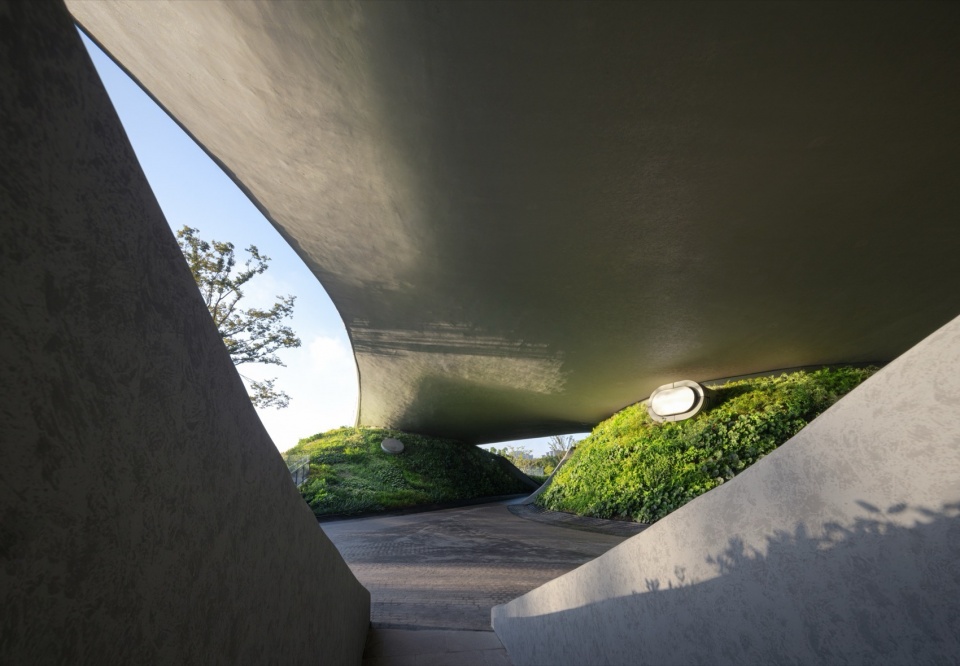
下部的绿丘是从地面隆起的8座混凝土壳,内含展厅、咖啡、餐厅、文创商店、设备用房等。周圈的六座绿丘和两个核心筒一起支撑着上部结构,传导下来的力在丘顶被拆分,其中重力主要由蘑菇柱承担,侧向力则沿丘壳传到地面和地下室顶板;在中间的两座绿丘则与从波方下垂的反壳亲吻在一起,叠合处形成的两个圆洞分别为自动扶梯和升降舞台提供上下贯通的空间。在绿丘的表面,挡土种植格维护住山坡上的种植土,并通过局部的人工照明为暗处的耐阴地被植物补光。在绿丘的内部,兼具排烟和通风功能的圆形天窗将自然光引入洞穴般的空间,增添了柔和神秘的气氛。
▼“绿丘”与“波方”的叠合处的草图,Sketch of the Overlapping Zone Between the Green Hills and the Wave Pavilion
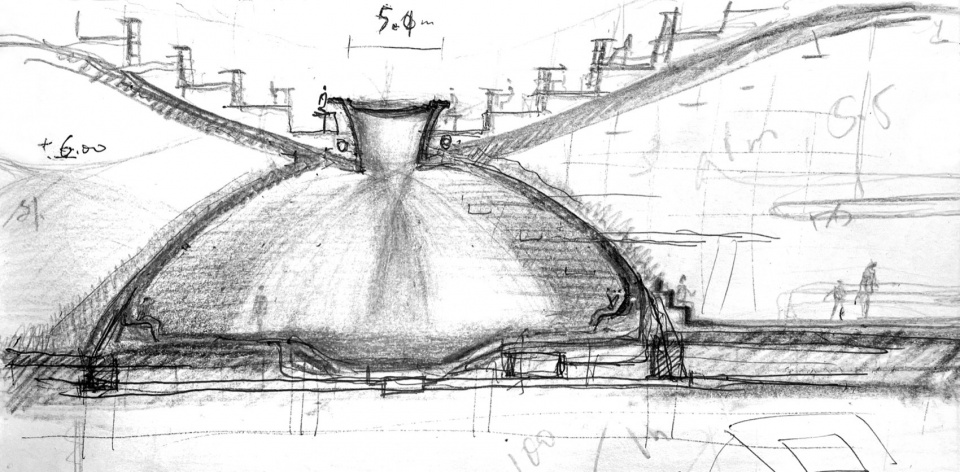
The lower “Green Hills” consist of eight concrete shells emerging from the earth, housing exhibition halls, cafes, bars, cultural and creative shops, and mechanical rooms. The six surrounding Green Hills and two structural cores support the upper structure. The descending forces are partitioned at the crest of each shell: gravity is borne by mushroom columns, while lateral forces are transferred through the hill shells to the ground and the basement roof slab. The two central Green Hills meet in a delicate “kissing” contact with the inverted shells descending from the Wave Pavilion, where the junction forms two circular openings, providing continuous vertical voids for the escalators and a lift stage. On the exterior of the hills, retaining grids secure the topsoil on the slopes, complemented by localized artificial lighting to nourish shade-tolerant groundcover in the shadowed zones. Within the interior, circular skylights—serving dual functions of smoke extraction and natural ventilation—introduce daylight into the cavernous volumes, imbuing the space with a soft, mysterious atmosphere.
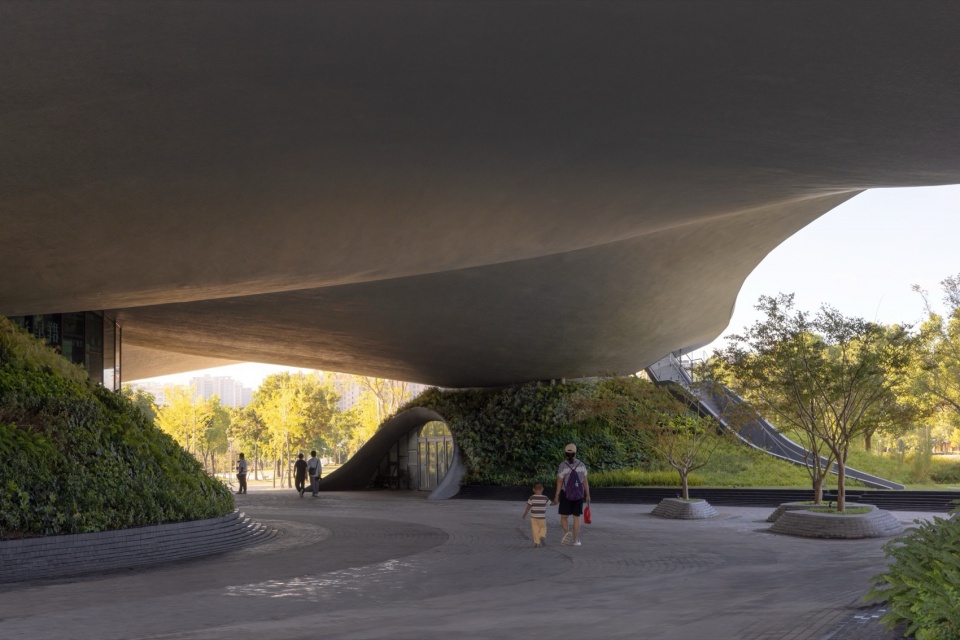
▼支撑着“波方”的“绿丘”,The “Green Hills” Supporting the “Wave Pavilion”
▼“绿丘”上的排烟窗,Smoke Extraction Windows Atop the Green Hills
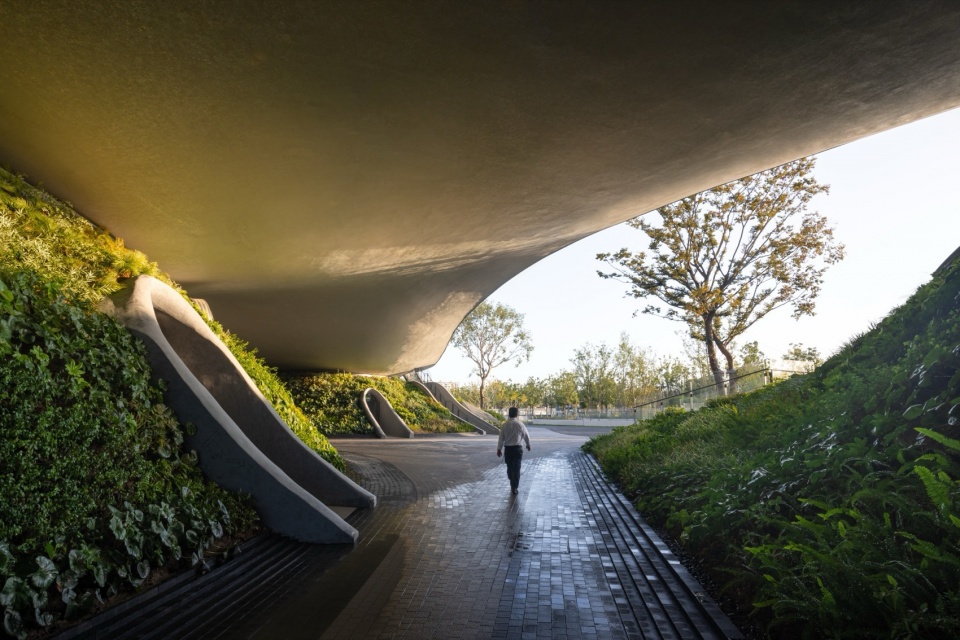
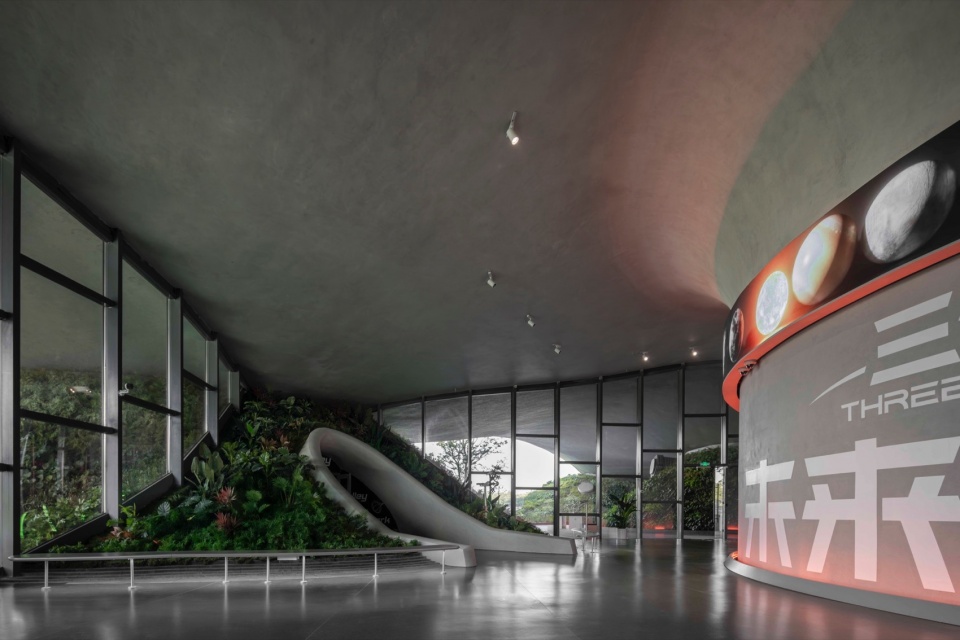
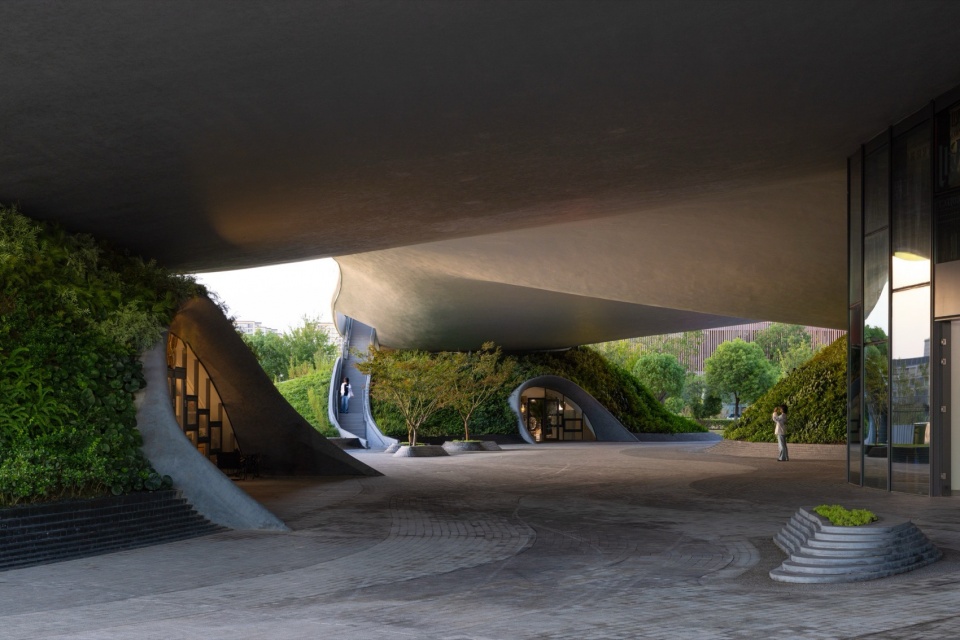
各自隆起的绿丘是分散的,绿丘之间的空间处于上部“波方”的覆盖下,形成了中部连续的“穹洞”。在外围,架空的半户外场所为人群引入周边的风景,并让环湖步道在建筑下方穿过;在中央,落地玻璃幕墙围合出首层门厅,在绿丘环抱中成为建筑内部动线的枢纽和集散地,其中的两个核心筒上下贯穿了整座建筑,承担结构支撑、上下动线和设备通道的功能。穹洞内连续起伏的天花、以及绿丘之间如溪水般流淌的铺地淡化了室内外的差别,在地表形成了整体开放的公共空间。
The individual “Green Hills” are discrete, yet their interstitial spaces are sheltered beneath the overarching “Wave Pavilion,” together creating a continuous “Vaulted Void” in the middle. Along the perimeter, elevated semi-outdoor spaces introduce the surrounding landscape and allow the lakeside promenade to pass beneath the building. At the center, the ground-floor lobby, enclosed by a glass curtain wall, serves as a hub and gathering point for the building’s internal circulation, embraced by the Green Hills. Two structural cores vertically penetrate the entire building, integrating the functions of structural support, vertical circulation, and MEP shafts. The continuously undulating ceiling of the “Vaulted Void,” paired with a floor paving that flows like a stream between the hills, dissolves the threshold between interior and exterior, resulting in a holistically open public space at the ground level.
▼穿越建筑底层的环湖绿道,The Lakeside Greenway Passing Beneath the Building
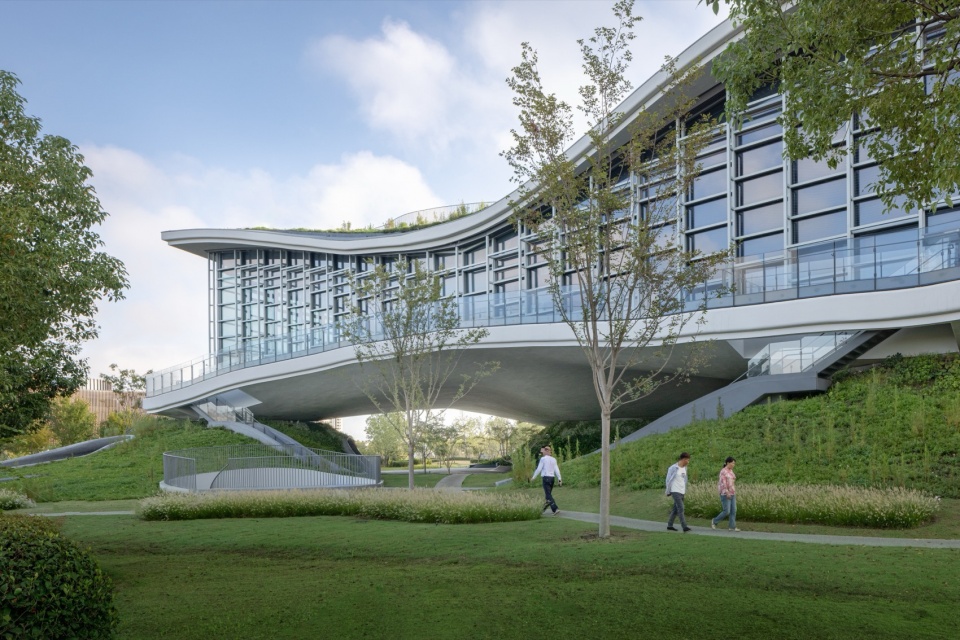
▼绿丘间流淌的铺地,The Paving Flowing Between the Green Hills
▼玻璃幕墙围合成的首层门厅,The Ground Floor Foyer Enclosed by Glass Curtain Wall
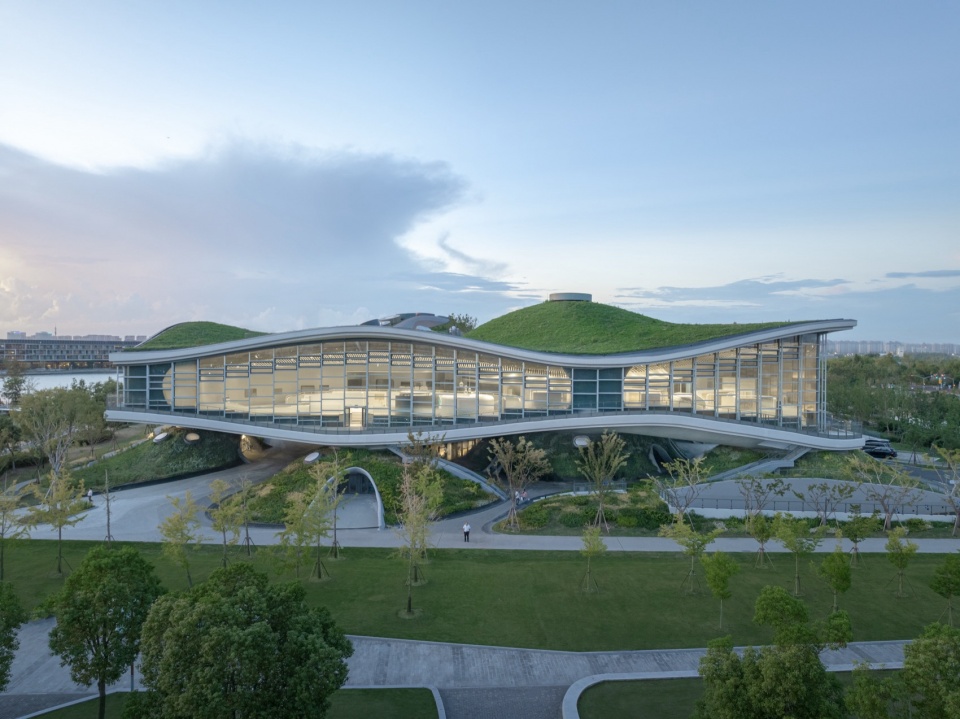
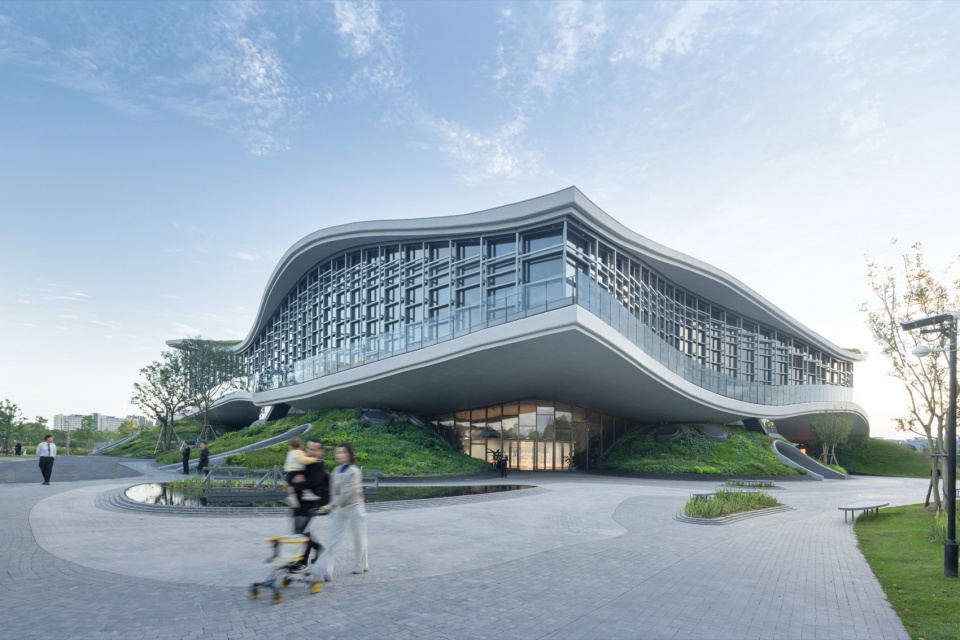
架空在“绿丘”和“穹洞”之上的是巨大的“波方”。预应力混凝土浇筑的上壳和下壳构成了“波方”上下对称的界面。顺应波壳单元的起伏秩序,位于8个合拢点的两个核心筒和周圈的六片剪力墙负责支撑和悬挑,营造出约6400平方米、净空在4.5米和12.5米之间连续变化的波形流动场域,成为一座建筑内部的公园。9.1米标高的平面是这座室内公园的水平漫游路径,环绕着8个形态各异的下沉空间,它们按照提取出来的波单元形态分为整圆、1/2圆和1/4圆三种类型,各自与上空的穹窿对应。我们将空调系统布置在下壳和架空地板之间,并采用低区喷淋和高区水炮结合的方式,以更加清晰地呈现波空间的顶部结构。在两个完整波空间的穹顶,分别安置了单孔大天窗和5孔小天窗,在满足排烟通风的同时引入太阳的光辉。在波方的外圈,由外露桁架支撑的玻璃幕墙构成了面向城市的连续通透界面,并形成了一条起伏环绕的空中步道。
Suspended above the “Green Hills” and the “Vaulted Void” is the massive “Wave Pavilion.” The upper and lower shells, cast in prestressed concrete, form the vertically symmetrical envelope of the “Wave Pavilion.” Adhering to the rhythmic undulation of the wave modules, two structural cores and six peripheral shear walls—positioned at the eight convergence points—provide the support and cantilevered strength. This structural logic engenders a fluid wave-form field of approximately 6,400 square meters, with clearances varying between 4.5 and 12.5 meters, effectively creating an “interior park” within the architecture. The plane at the +9.1m level serves as the horizontal promenade through this indoor park, encircling eight sunken voids of varying shapes. These spaces are categorized into full circles, semi-circles, and quarter-circles based on the extracted wave geometries, each resonating with the vaulted domes above. The air conditioning system is arranged between the lower shell and the raised floor, employing a combination of low-zone sprinklers and high-zone water cannons to enhance the structural clarity of the overhead structure. At the domes of the two complete wave spaces, single large skylights and five smaller skylights are installed to ensure smoke exhaust and ventilation, while inviting the solar radiance within. The outer perimeter of the Wave Pavilion is encased in a glass curtain wall supported by exposed trusses, forming a continuous transparent interface facing the city, and creating an undulating aerial walkway.
▼上下对称的混凝土壳体,The Vertically Symmetrical Concrete Shells
▼论坛活动中的下沉空间,The sunken area hosting forum events
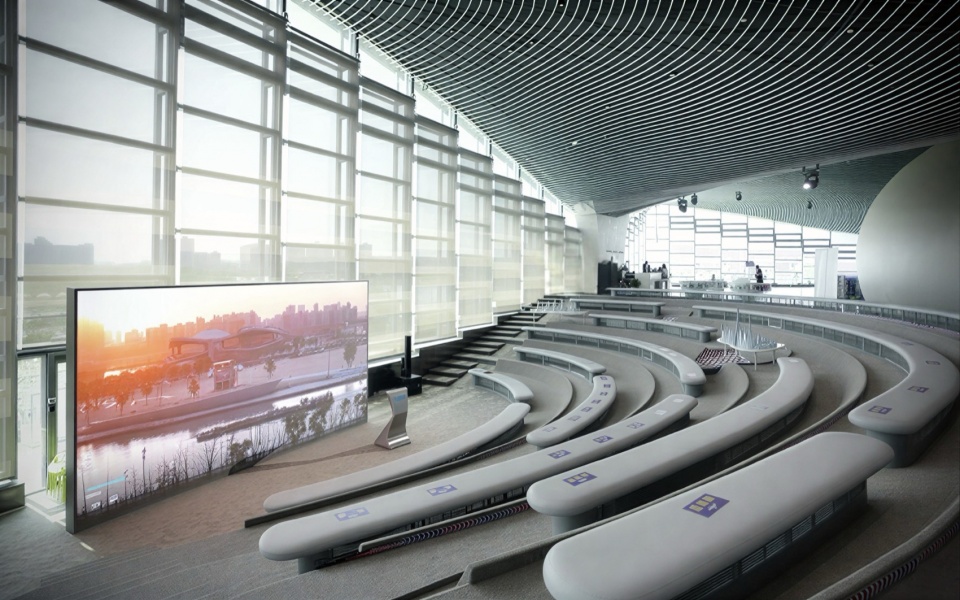
▼论坛活动中的下沉空间,The sunken area hosting forum events
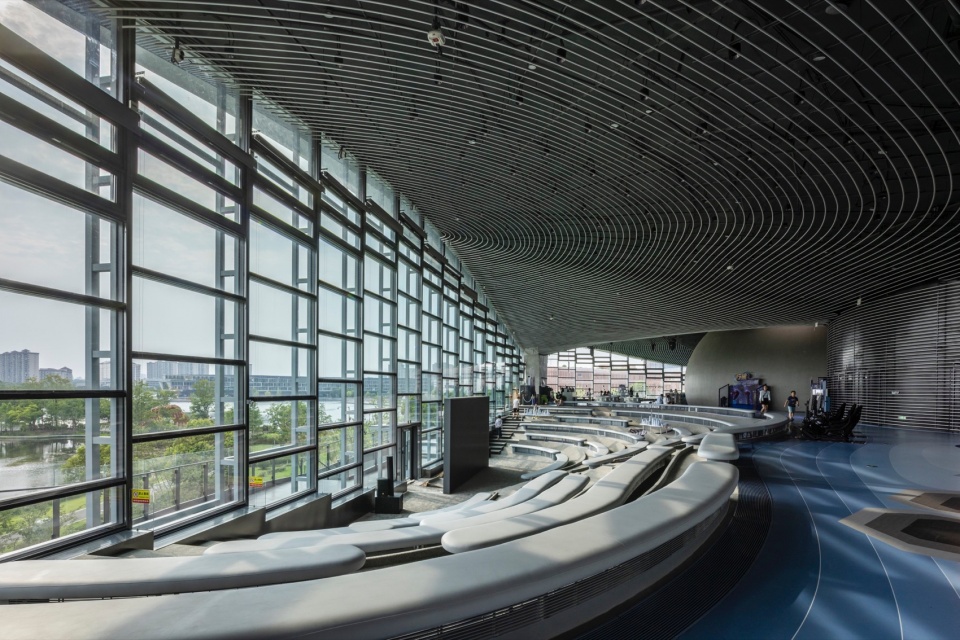
▼“波方”空间起伏的吊顶,The Undulating Ceiling of the Wave Pavilion
力流挑战 The Challenge of Force Dynamics
将正弦波的数学纯粹性拟合并转化为真实的力学承载,是本项目在设计和施工阶段面临的最大挑战。在这个三重波壳面上下叠加的复合空间结构里,力流的传递路径结合了垂直和斜向两种模式,而在建筑的呈现上,波壳形态所代表的斜向力流是我们表达的重心,核心筒与蘑菇柱的垂直传导则被有意消解:实际上,在纯粹波形的内部集结了高密度的结构体系。在施工现场,一整套多系统强耦合的复杂节点也需要精心的组织:环绕核心筒的空间曲线预应力筋、边缘收束的钢骨梁、剪力墙内的型钢骨架,以及密集的预埋机电管线。为了确保这些要素在有限的截面内“互不干涉”,设计方和施工方通过BIM模型的深化进行空间校核,实现了钢筋网对多源构件的精密包裹。
Translating the mathematical purity of a sine wave into a tangible, load-bearing reality was the paramount challenge of both the design and construction phases. Within this composite spatial structure formed by three vertically superimposed wave-shell surfaces, the load-transfer mechanism integrates both vertical and diagonal modes. Architecturally, the diagonal force flow embodied by the wave morphology is the focal point of our expression, while the vertical conduction of the structural cores and mushroom columns is intentionally dissolved. In reality, a high-density structural system is concentrated within the seemingly pure wave forms. Construction required the meticulous organization of complex, highly coupled multi-system junctions: spatially curved prestressing tendons encircling the cores, tapering steel-reinforced beams, structural steel frames within the shear walls, and dense embedded MEP conduits. To ensure these elements remained ‘interference-free’ within constrained cross-sections, the design and construction teams utilized BIM-based spatial verification. This enabled the reinforcing mesh to precisely encapsulate the multi-source components, ensuring seamless integration without conflict.
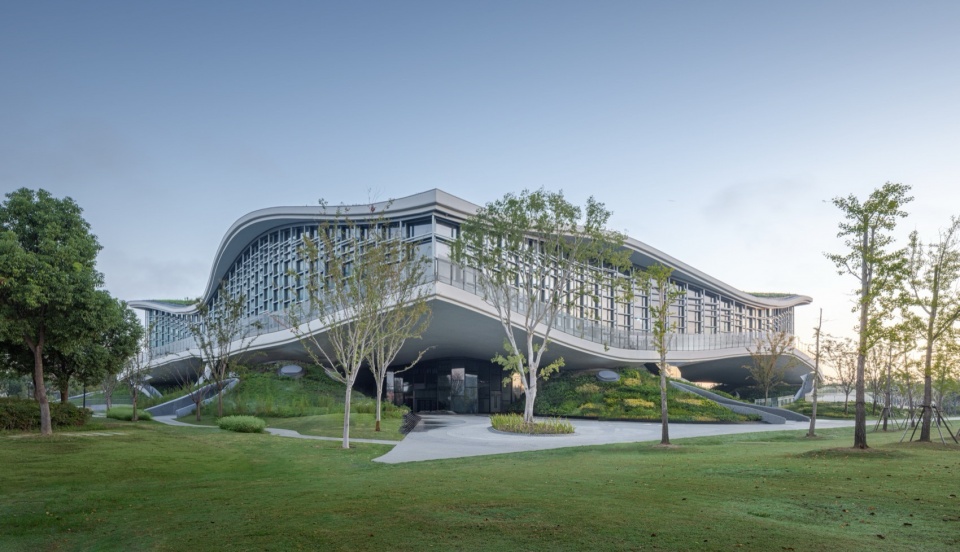
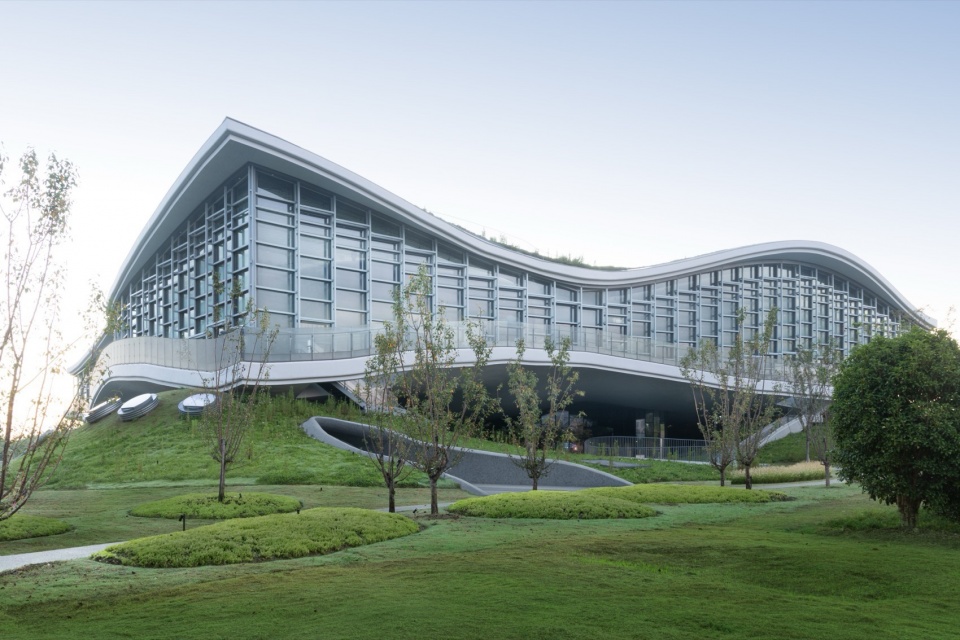
▼建筑外观,Exterior views
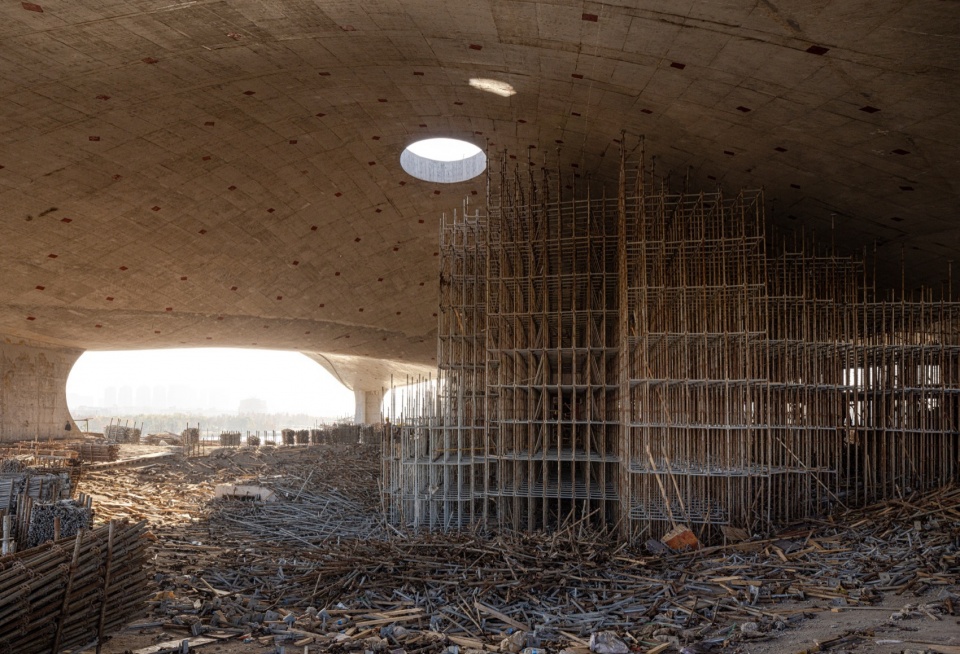
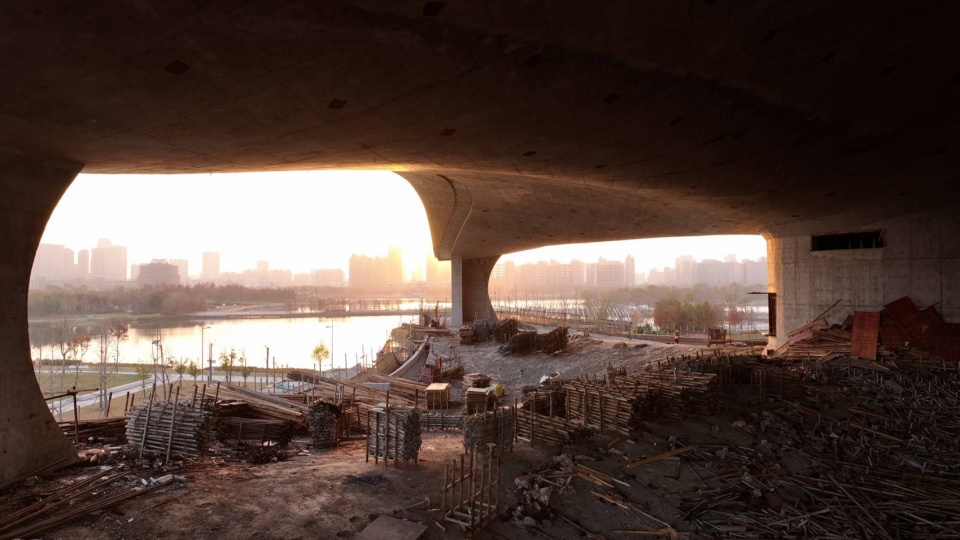
复杂的空间定位与异形模板的精度控制是另一大技术壁垒。基于造价控制原因,项目没有采纳使用三维打印模板浇筑混凝土的施工方案。为了精确还原起伏的波状界面,采用了600mm×600mm(局部300mm×300mm)的高密度脚手架网格作为现浇模板支撑体系。针对模板找型圆钢管在受力状态下易发生空间位移的难题,施工方研发了一种定制的自适应限位构件(抓手),将找型钢管准确锁定在脚手架立杆的中心轴线上。这一工艺的创新,有效地抑制了混凝土浇筑过程中的模板形变,最终确保了波浪型空间曲面的高精度几何还原,也从施工节点设计这一微观角度,维护了这座建筑在受力逻辑上极高的整体性:在结构尚未闭合前,它如同蛋壳般脆弱,需依赖密集的脚手架支撑体系与局部临时支撑维持稳定,直到混凝土浇筑封顶预应力张拉完成,结构完成“合龙”,各构件瞬时各司其职——犹如插上电源,应力流在内部流转贯通,整个“蛋壳”由此获得结构刚度。当模板与支架卸下,素混凝土的真实肌理随起伏的曲面在光影中流动,建筑的生命力随之显现。
Complex spatial positioning and the precision control of non-standard formwork presented another major technical barrier. Due to cost constraints, 3D-printed formwork was declined; instead, a high-density scaffolding grid—measuring 600 mm × 600 mm reduced to 300 mm × 300 mm in complex areas)—was utilized as the support system for the cast-in-place formwork. To solve the issue of circular steel shaping-pipes shifting under load, the construction team developed a customized adaptive limiting component (a “gripper”) to lock the pipes precisely onto the central axis of the scaffolding poles. This technical innovation effectively suppressed formwork deformation during the concrete pour, ensuring a high-precision geometric realization of the undulating spatial curves. From the microscopic perspective of construction detail design, this innovation maintained the rigorous integrity of the building’s structural logic: before the structure was closed, it remained as fragile as an eggshell, relying on dense scaffolding and temporary bracing for stability. Only upon the completion of the pour and the tensioning of the prestressing tendons did the structure achieve “closure”. At that moment, every component instantaneously assumed its role—as if a power switch were flipped, the stress flow circulates and integrates throughout the interior, allowing the entire ‘eggshell’ to attain its structural rigidity. As the formwork and scaffolding were struck, the authentic texture of the fair-faced concrete began to flow across the undulating surfaces in the play of light and shadow, and the vitality of the architecture was finally revealed.
▼拆卸中的密集脚手架和逐渐呈现的形态,The Dense Scaffolding During Striking and the Emerging Form
▼起伏的曲面空间,Undulating curvilinear space
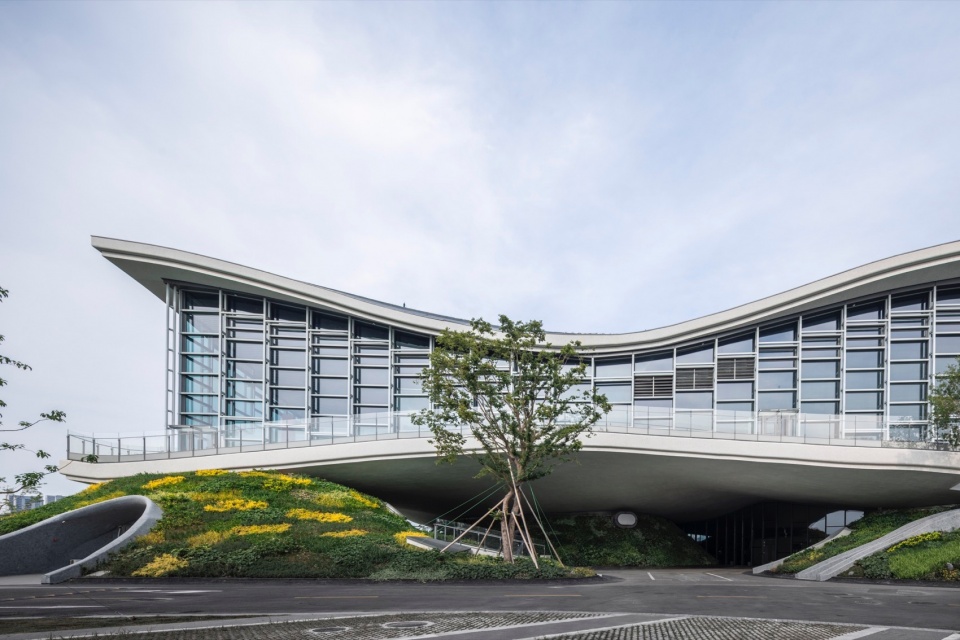
在建筑的东北角和西南角,27米的大尺度悬挑还带来了严苛的形变挑战。从屋面覆土加载初期的即时下沉到随后一年内趋于稳定的缓慢沉降,混凝土的徐变特性使建筑处于动态变化中。为确保裂缝宽度受控并满足幕墙顶部套管的位移限值,悬挑端部设置了两根仅承担竖向力的格构钢柱。为达成视觉统一,钢柱采用了幕墙龙骨的尺度与构图,使异质体系在外观上消隐为整体。监测数据显示,最终沉降量精确落于设计控制值内。
At the northeast and southwest corners of the building, large-scale cantilevers of 27 meters presented rigorous challenges regarding deformation. Due to the creep characteristics of concrete, the structure underwent a dynamic transition—from immediate deflection during the initial loading of roof soil to a gradual settlement that stabilized within a year. To control crack widths and meet the displacement limits of the curtain wall’s top sleeves, two lattice steel columns were installed at the cantilever ends to bear vertical loads exclusively. For visual unity, these columns mirror the scale and composition of the curtain wall mullions, allowing the heterogeneous system to be visually concealed within the whole. Monitoring data confirms that the final settlement falls precisely within the design limits.
▼承担竖向力的角柱与幕墙,Corner Columns Bearing Vertical Loads and the Curtain Wall
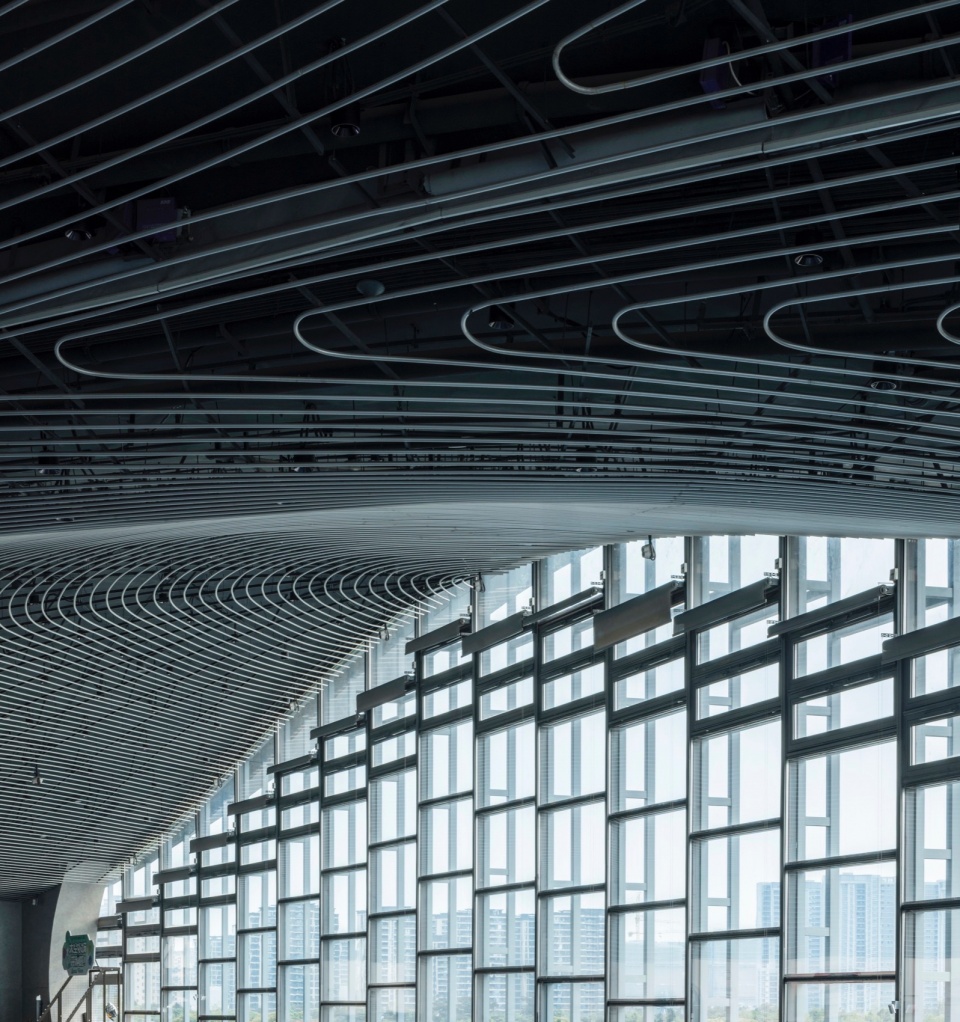
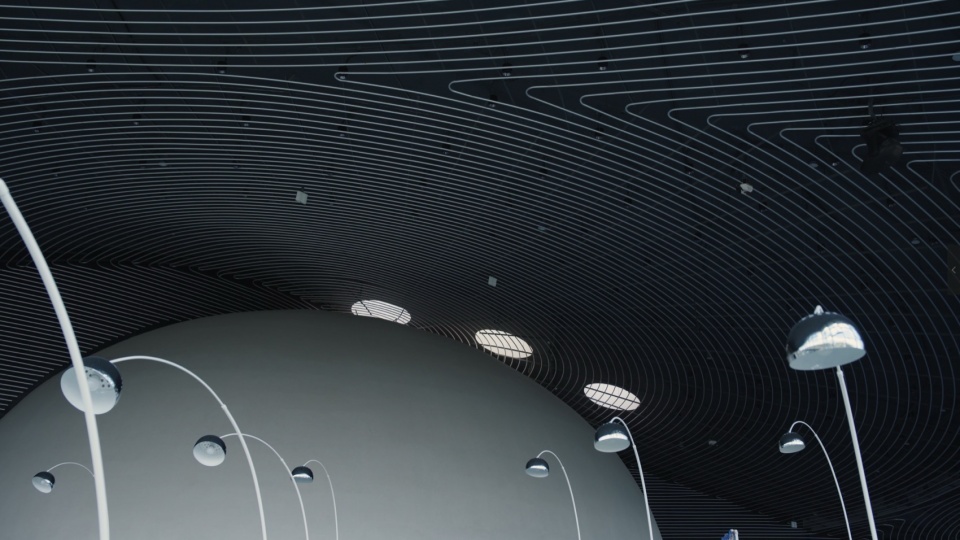
除玻璃幕墙和草坡外,整座建筑在室内外均尽量呈现现浇混凝土结构的表面肌理,仅通过细节上的微差来表达不同空间的氛围。波方的外立面、周圈剪力墙、以及核心筒都采用了半透明的混凝土保护剂;上壳用深灰色保护涂料统一喷涂在壳底和设备管线表面,浮现出银白色铝管构成的流纹天花;在下壳底面,我们采用了一种需要多道工序完成的幻彩保护涂料,借用壳底连续曲面的反射,给偏暗的穹洞带来光影的变化。
Except for the glass curtain walls and grass slopes, the building maximizes the exposure of its cast-in-place concrete texture across both interior and exterior surfaces, using only subtle detailing to differentiate spatial atmospheres. A translucent concrete sealer was applied to the Wave Pavilion’s facades, peripheral shear walls, and cores. On the upper shell, dark grey protective coating uniformly covers the underside and MEP conduits, highlighting a “streamlined” ceiling formed by silver-white aluminum pipes. For the underside of the lower shell, an iridescent protective coating achieved through a multi-stage process leverages the reflections of the continuous curved surfaces to introduce dynamic light and shadow into the dimly lit “Vaulted Void.”
▼银白色铝管吊顶,The Silver-white Aluminum Pipe Ceiling
▼光影变化的“穹洞”,The “Vaulted Void” with Dynamic Light and Shadow
沉浸体验 Immersive Experience
空间的运营方案在多方磨合中三易其稿,最终达成各方共识。二层空间被划分为三大区块:东北是核心“暗区”,作为沉浸式展陈的“黑匣子”,以全封闭形态承载三体科幻主题的深度叙事;西侧的“亮区”面朝金海湖,开放给公共活动;暗区和亮区均由风语筑主理运营,南侧则作为弹性的空间储备,预留未来展览的可能。
The spatial operation scheme culminated in a final consensus after three successive iterations of multi-party refinement. The second floor is organized into three distinct realms: to the northeast lies the pivotal “Dark Zone,” a fully enclosed ‘black box’ designed to anchor the deep sci-fi narrative of The Three-Body Problem; to the west, the ‘Light Zone’ faces Jinhai Lake, opening its expanse to public activities. While both the dark and light realms are curated and managed by Fengyuzhu, the southern sector remains a flexible spatial reserve, held in quiet anticipation for future exhibition possibilities.
▼三体未来学院主入口,Main Entrance of the Three-Body Future Academy
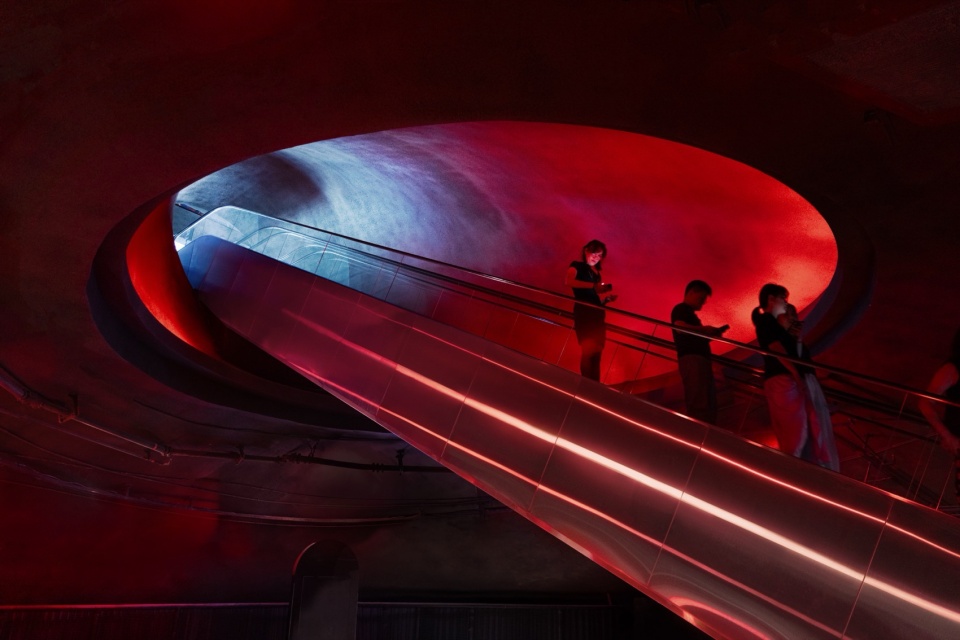
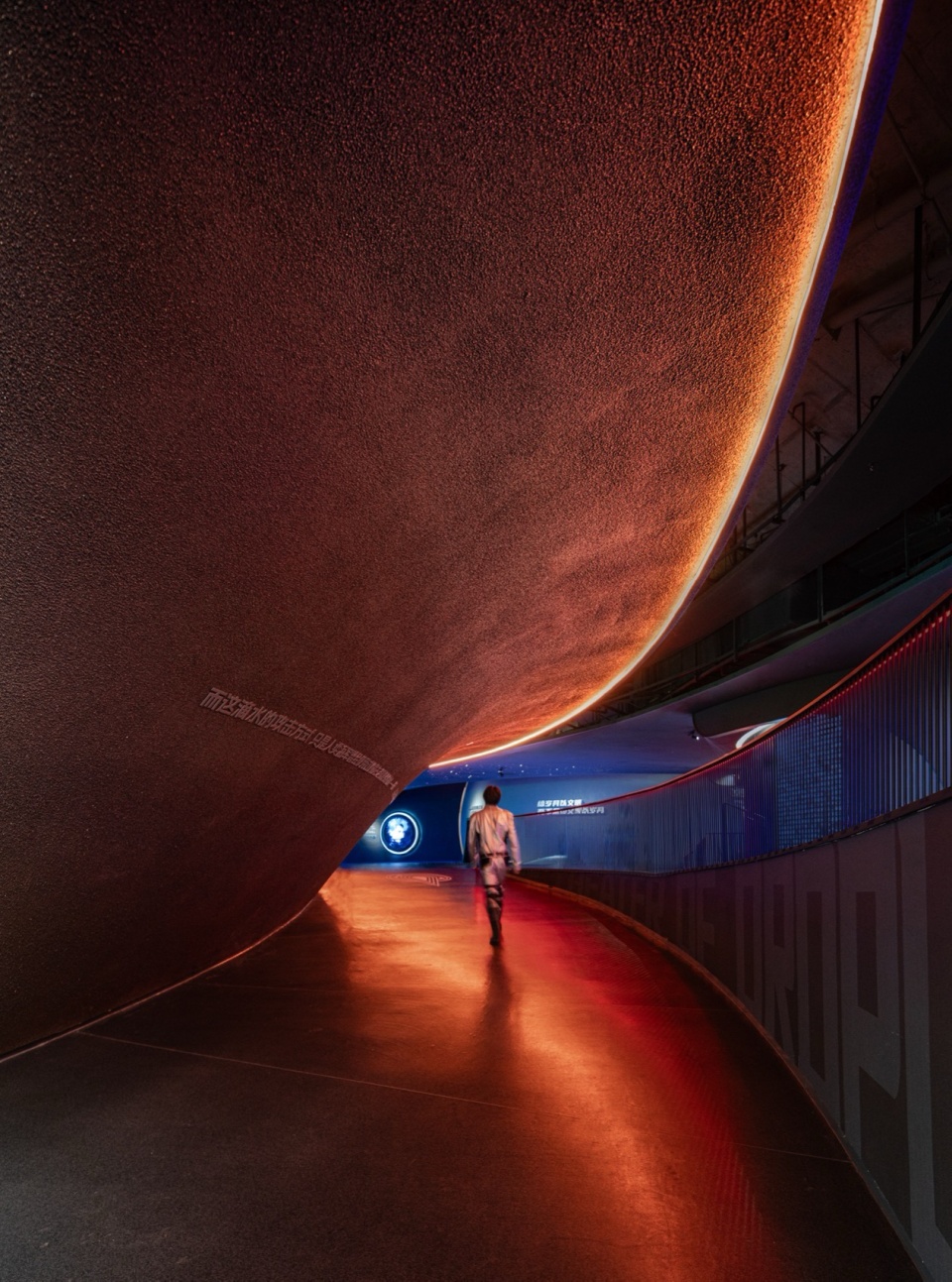
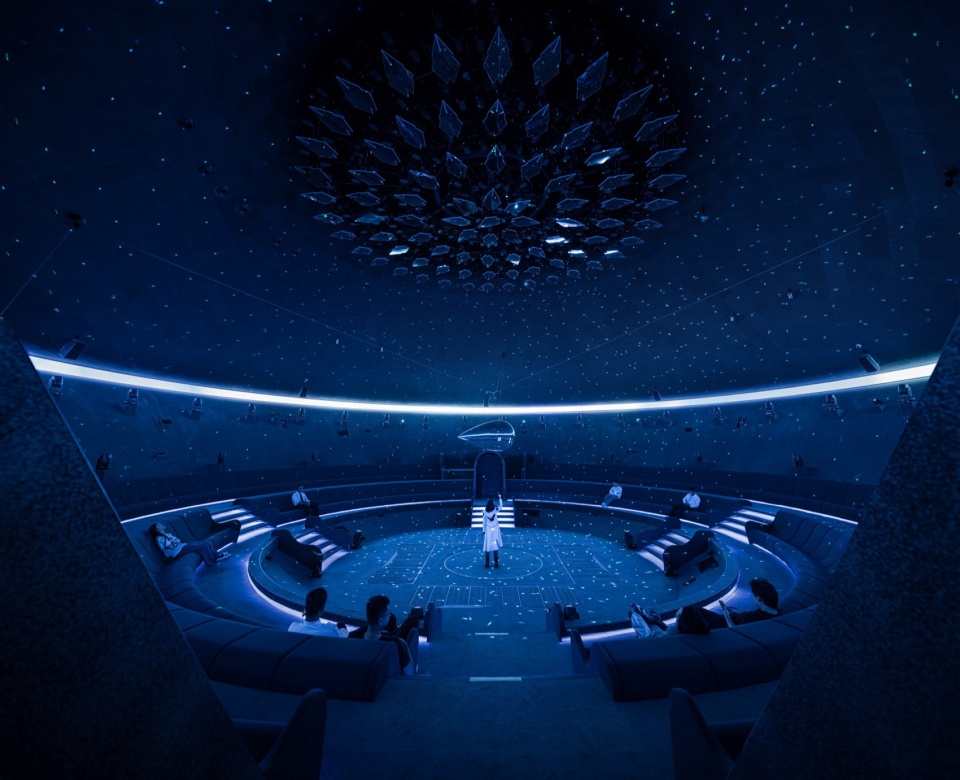
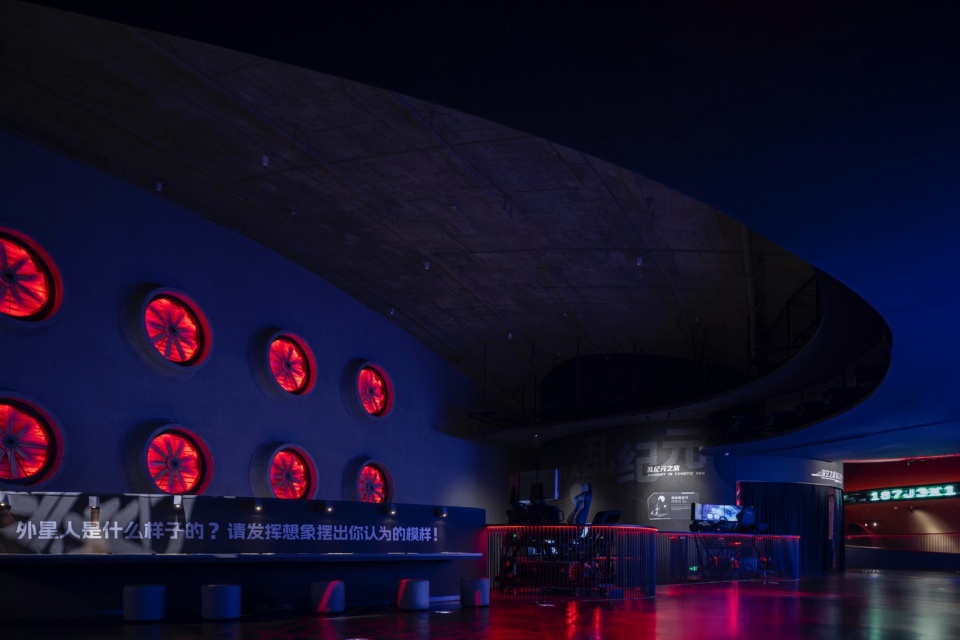
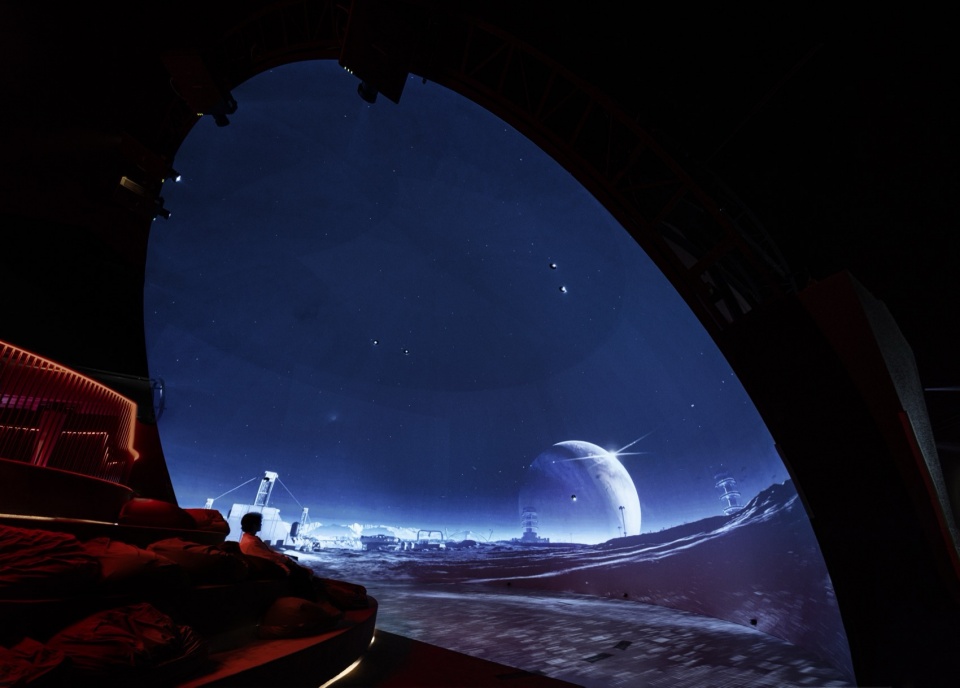
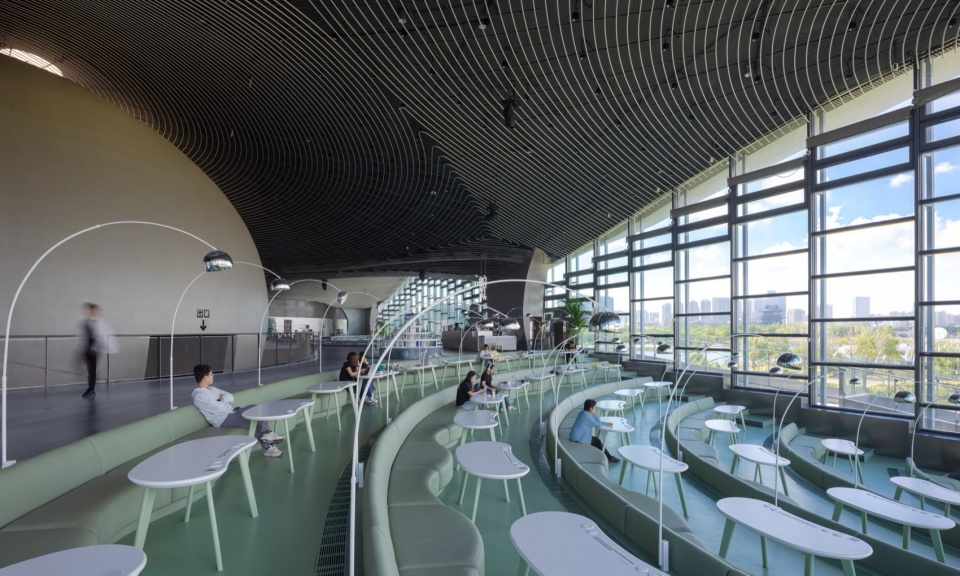
建筑的三层波壳构成了立体场域,给科幻主题的宏大叙事和多元场景提供了不断开合变化、深邃神秘的空间体验。这座“三体未来学院”的主入口位于东北角的悬挑壳面之下,从被“绿丘”包裹的玻璃幕墙来到首层大厅,能够感受到内外绿丘的相互延伸。进入铺满软沙的丘洞,或经由卵形的筒体,搭乘自动扶梯穿过一段黑暗的甬道——仿佛经过科幻小说里的“虫洞跃迁”,从现实世界进入另一重三体世界。在这里,行走即是漫游:远近不一的星球、悬空的“自然选择号“飞船、面壁计划、深空之战、末日登陆车、球幕影院等场景零散分布在穹顶之下,让参观者在这个连绵起伏的暗空间里自由探索。在钵状的水滴剧场内外,环形缝水平贯穿,给整个演出空间提供了一道无垠的视界。从暗区穿越一道门,又来到亮区的的世界:巨大的星体、科幻种子库、以及供阅读休闲和论坛使用的两个下沉空间接踵而至,它们由一条带状的开放漫游道串联起来,面对金海湖的粼粼波光,让人仿若置身降临异星的飞船内部,向外窥视地球的景色。
The building’s triple-layered wave shells establish a three-dimensional spatial field, offering a profoundly mysterious and dynamically shifting experience of enclosure and release for the grand sci-fi narrative and its manifold scenarios. The main entrance to this ‘Three-Body Future Academy’ is located beneath the cantilevered shell at the northeast corner. Moving from the “Green Hill”-wrapped glass curtain wall into the ground-floor lobby, one perceives a seamless extension between the interior and exterior landscapes. Entering the sand-strewn ‘Dune-Void’ or passing through the ovoid core, visitors ascend via escalators through a dark corridor—a ‘wormhole leap’ reminiscent of science fiction, marking the passage from reality into the depths of the Three-Body universe. Here, walking is wandering: planets at varying distances, the suspended Natural Selection starship, the Wall-facer Project, the Battle of Deep Space, the Doomsday Rover, and a dome theater are scattered beneath the vaults, inviting visitors to explore freely within this undulating dark space. Inside and outside the bowl-like ‘Droplet Theater,’ a horizontal ring-fissure pierces through the structure, offering an infinite horizon for the entire performance space. Beyond a threshold from the Dark Zone lies the world of the ‘Light Zone’: colossal celestial bodies, a ‘sci-fi seed bank,’ and two sunken areas for leisure and forums appear in succession, all linked by a ribbon-like open promenade. Facing the shimmering ripples of Jinhai Lake, the space evokes the sensation of being inside a starship landed on an alien world, peering out at the landscape of Earth.
▼贯通的自动扶梯,The Continuous Escalators
▼水滴剧场外围贯穿的水平缝,The Horizontal Ring-fissure Piercing the Droplet Theater
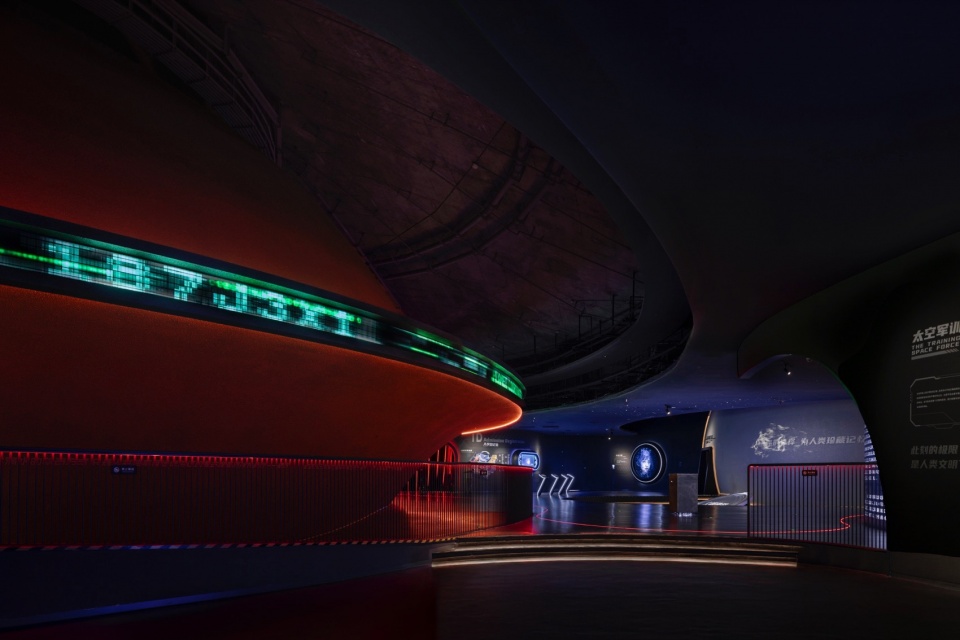
▼水滴剧场外围贯穿的水平缝,
The Horizontal Ring-fissure Piercing the Droplet Theater
▼水滴剧场,The Droplet Theater
▼暗区游戏空间,Gaming Area in the Dark Zone
▼球幕影院,The Dome Theater
▼阅读休闲下沉区,Sunken Area for Reading and Leisure
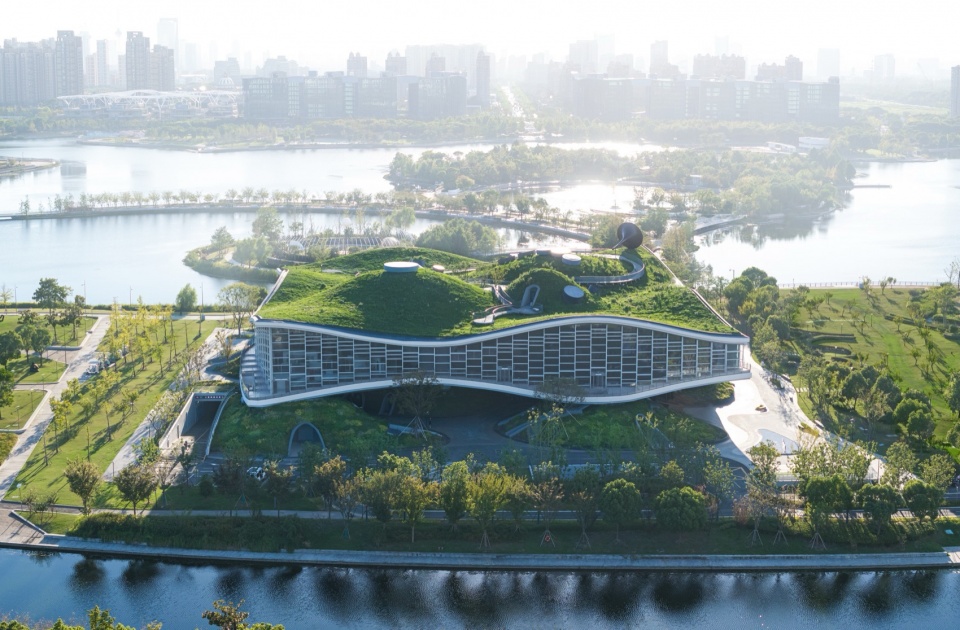
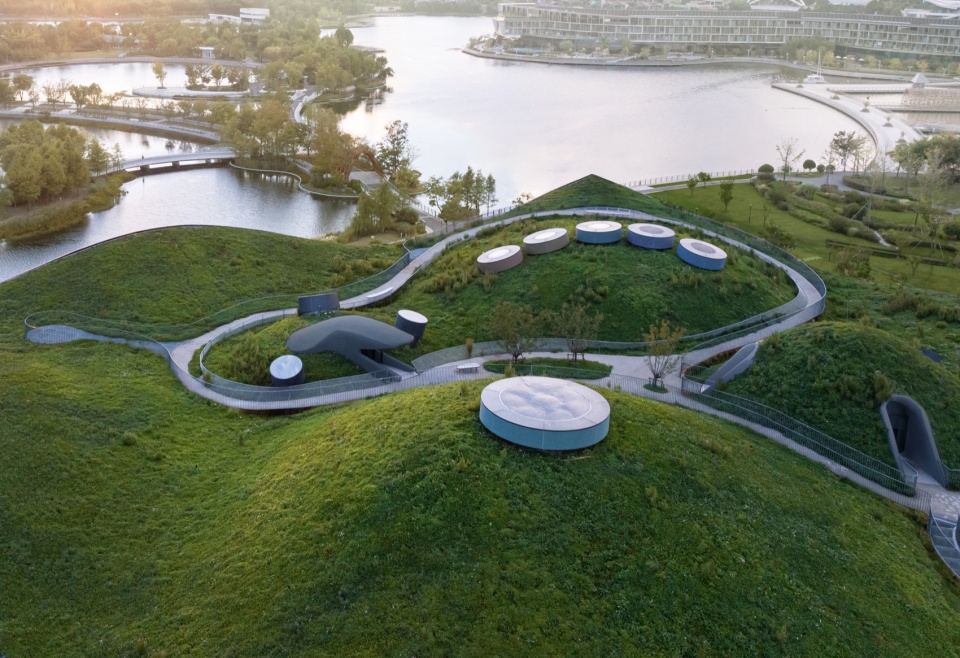
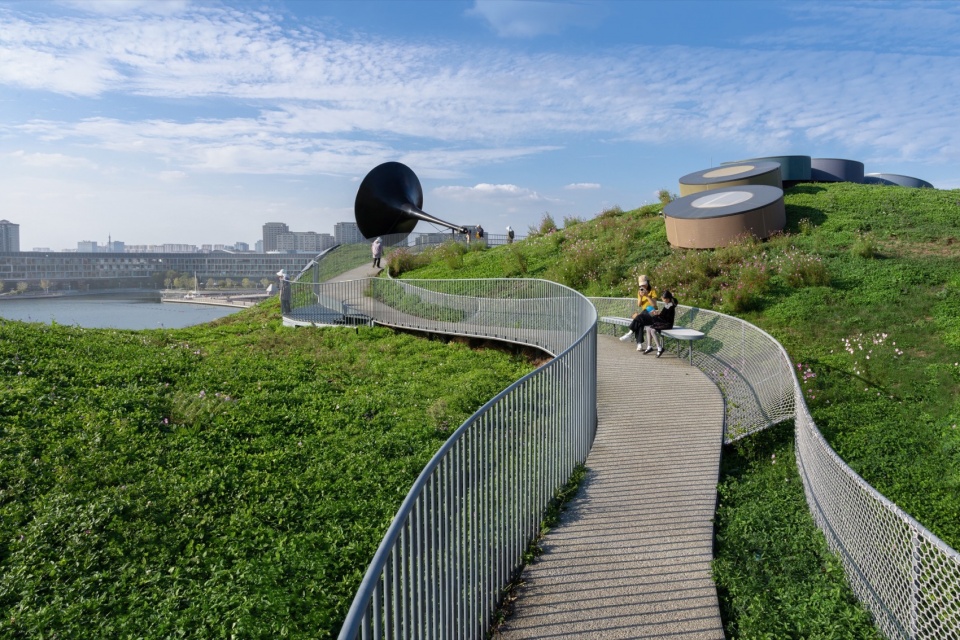
在三重波壳之上,覆盖着随波起伏的草地和野花,成为屋顶的“波上草原”。为了兼顾结构减重和观景需要,我们设定了一条动线固定的8字形环状步道,局部放大可供停留和眺望。沿着步道行走,山丘草坡和四周的风景交替出现,给参观者带来了缓步攀登和景深不尽的身心体验,也使“在水一方”在重重起伏中化身为湖畔的一方绿色波浪。
Atop the triple-layered shells, a rolling meadow of grass and wildflowers creates a “Grassland upon the Waves.” To balance structural load-optimization with panoramic needs, the roof circulation is confined to a fixed figure-eight loop, widening at strategic nodes for rest and observation. As grassy mounds and surrounding vistas alternate, visitors are immersed in an experience of measured ascent and boundless depth. Amidst these undulating layers, the “Wave Cube” is transformed into a cube of verdant wave by the lake.
▼“波上草原”,The “Prairie upon the Waves”
▼屋顶的环状步道,The Figure-eight Looping Trail on the Roof
▼局部放大的观景台,The Strategically Widened Observation Platform
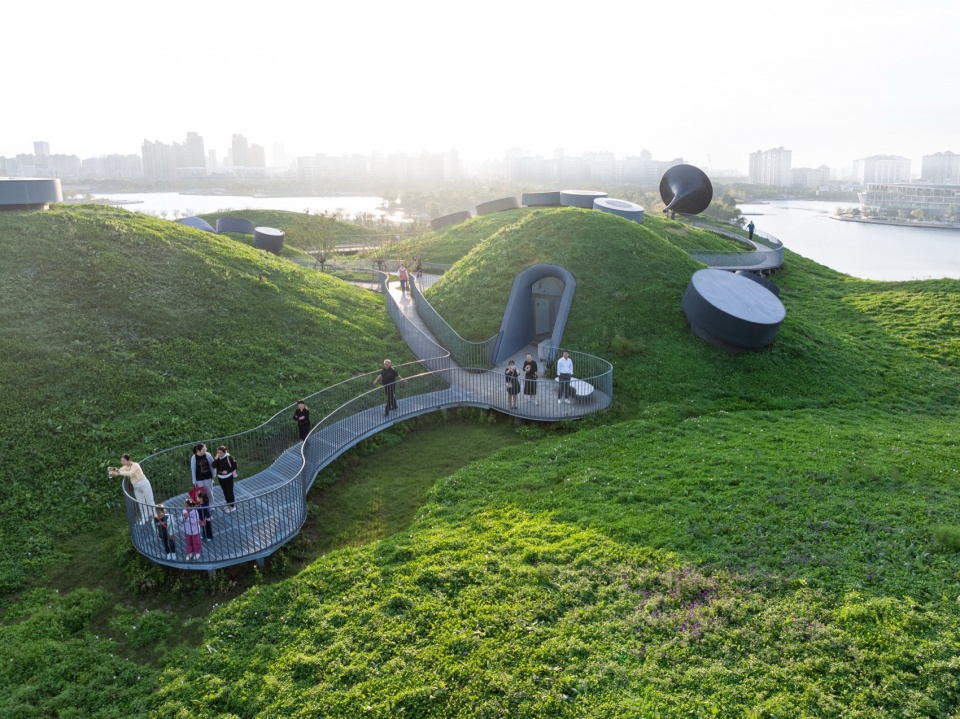
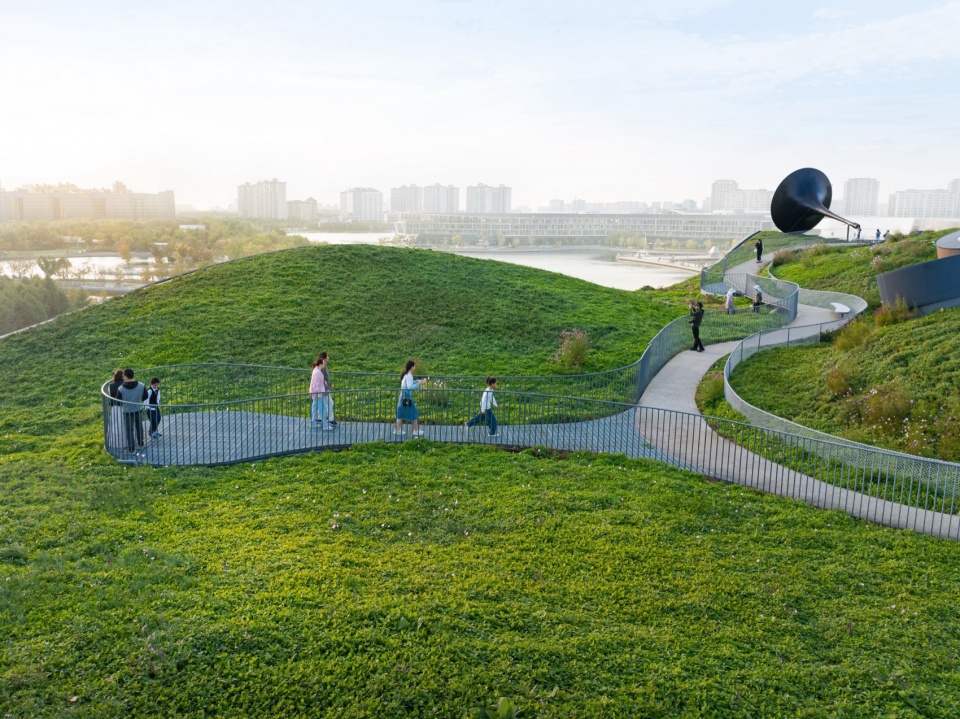
▼沿着步道漫游,Wandering Along the Trail
▼总平面图,Master Plan
▼首层平面图, Ground Floor Plan
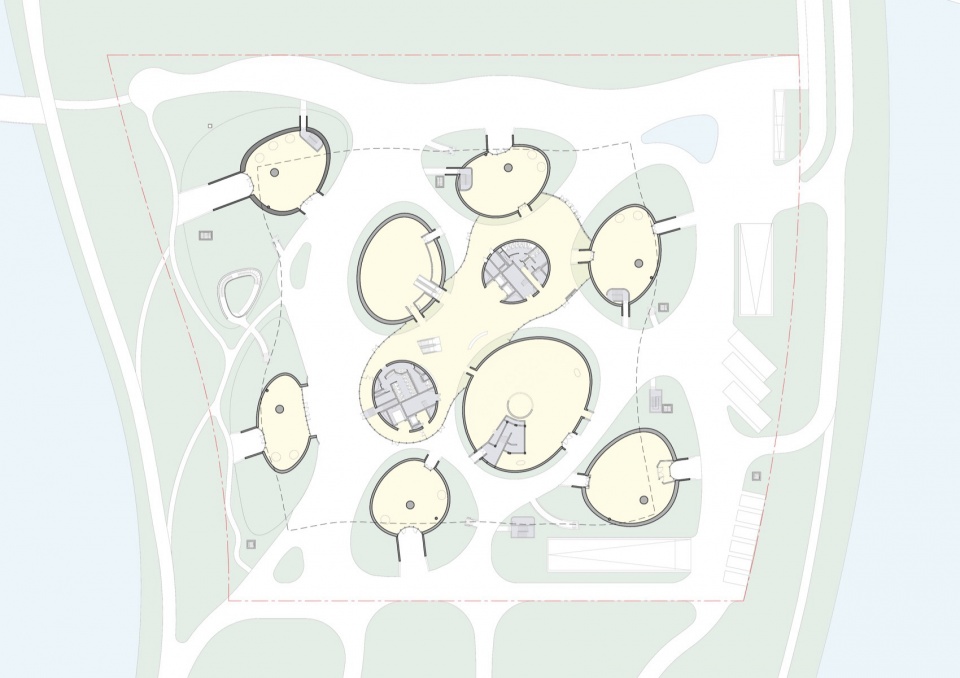
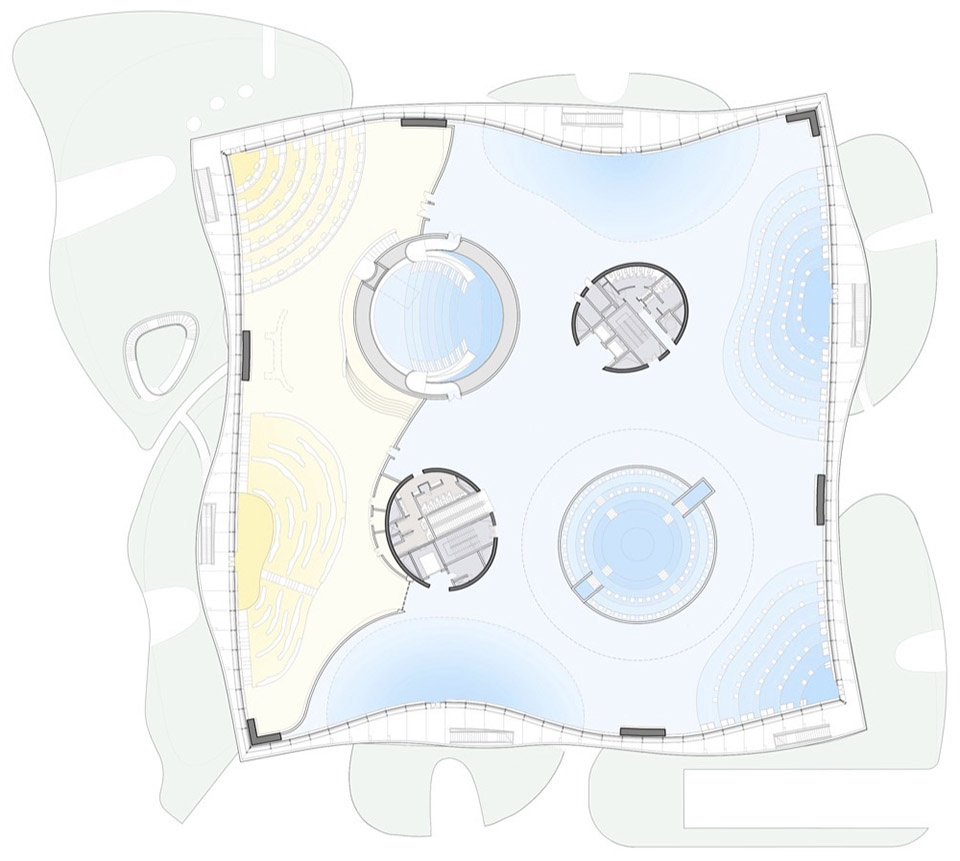
▼二层平面图,Second Floor Plan
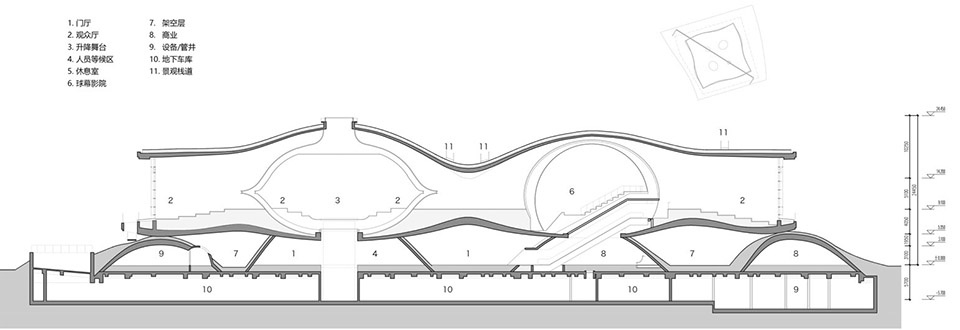
▼剖面图,Section
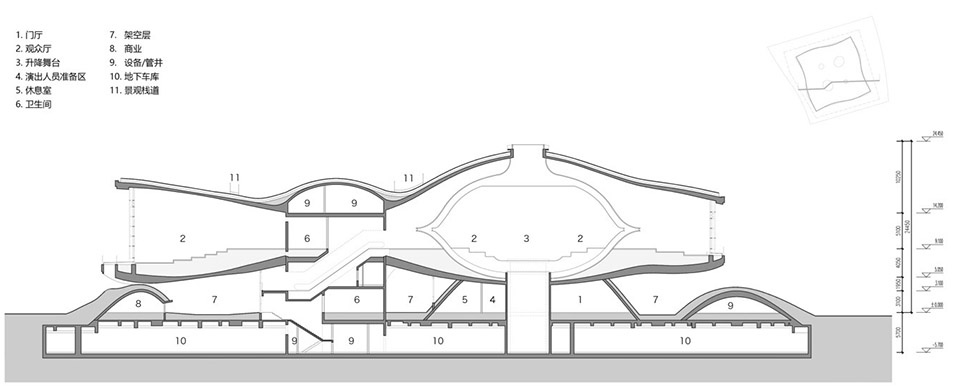
▼剖面图,Section
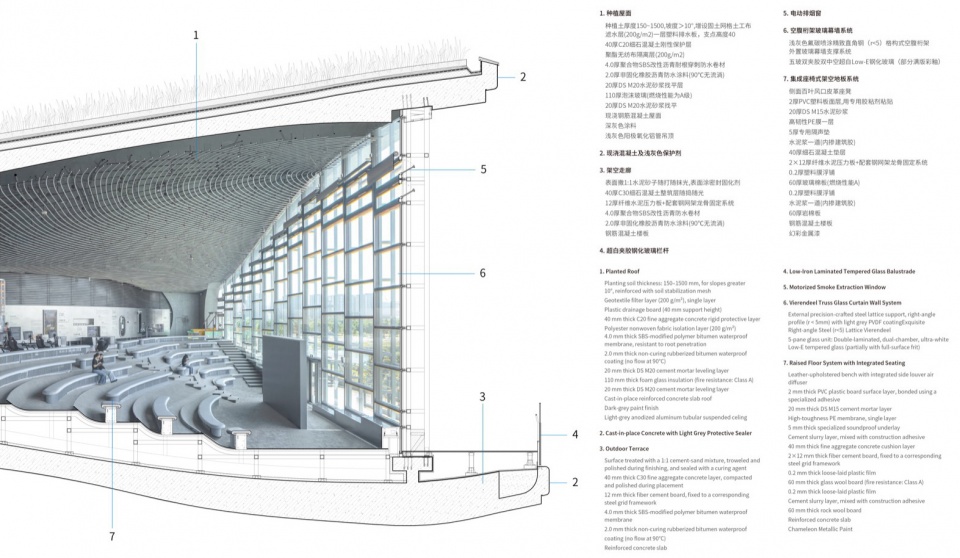
▼细部详图,Detailed drawing
项目概况
Project Data
Project Name: Wave Cube
Location: East Shore of Jin Hai Lake, Fengxian New City
Program: Sci-Fi Themed Experience Center
GFA: 29,700 m²
Building Height: 19.8 m
Design/Completion: 2020/2025
Client: Shanghai Fengxian New City Construction and Development Co., Ltd.
General Contractor: Shanghai Construction Group Co., Ltd.
Design Principal: Zhu Xiaofeng
Structural Principal: Zhang Zhun
Architectural and Interior Design: Scenic Architecture Office
-Project Manager: Li Qitong
-Design Team: Zhang Xuan (Project Architect), Song Yixuan, Chen Xuanxiang, Su Kaiqiang, Sun Jianong, Zhu Xiaoye, Geng Yutong, Hu Siyuan, Shen Ziwei, Zhang Chi
-Interns: Hu Chenghai, Chen Xi, Xu Youlu, Sun Yihan, Li Jing
Local design institute: Tongji Architectural Design (Group) Co. Ltd
Architectural Team: Huang Jianming, Nie Fei, Gao Yun, et al.
Structural Team: Zhang Jinxiao, et al.
HVAC Team: Li Weijiang, et al.
Plumbing Team: Zhao Shiguang, et al.
Electrical Team: Xu Chaoqun, et al.
Lighting Team: Yang Xiu, et al.
Structural Consultant: AND Office/ Cai Yanming, Pan Jun
Structural System: Stacked Prestressed Concrete Shell + Core Tube
Landscape Design: Growdesign Co.Ltd.
Operations and Interior Planning: Shanghai Fengyuzhu Culture Technology Co., Ltd.
Main Materials:
-Walls: Reinforced and Steel -reinforced Concrete, Medium and Dark Grey Concrete Protectants, Laminated Hollow Ultra-White Glass (Triple Glazed with a Single Chamber on the Ground Floor, Quadruple Glazed with Two Chambers on the Second Floor), Dark Grey T-shaped Steel Curtain Wall Frame (Ground Floor), Light Grey Truss Curtain Wall Frame (Second Floor), Stainless Steel and Laminated Ultra-White Glass Railing System
-Flooring: Concrete Hardener Floor, Granite Tiles, PC Bricks (Ground Floor), PVC Flooring (Second Floor)
-Ceiling: Iridescent Protective Coating (Ground Floor), Dark Grey Protective Coating (Second Floor)
Photography: SU Shengliang, LIU Guowei, Fengyuzhu