
成都灰空间建筑景观设计有限公司
********
********
上海市上海市杨浦区
灰空间建筑事务所(Grey Space)于2016年创立于上海,是一个逐步增长、多样化的、具有国际化背景的本土建筑设计团队。灰空间提供多元化的整体规划、建筑设计、室内及产品设计,全周期一体化服务。
沂蒙·云舍,山东/建筑设计
项目位于山东沂蒙山区,距5A级云蒙景区入口约1km,场地南侧即通向云蒙景区的必经之道。 云蒙山峰峦叠翠,常年云雾缭绕,景区门外是非常典型的沿道路生长的北方村落建筑群,项目即坐落其中。沂蒙云舍总建筑面积约1233㎡,共计2层,是一幢拥有19间客房的民宿建筑。
The project site sits in Mount Yimeng, Shandong, about one kilometer away from the entrance of Class 5A Yunmeng Scenic Area, with the only road leading to the scenic area on its south. The peaks of Mount Yumeng are lush and cloudy all year round, while the site is located in a very typical northern village that grows along the road outside the entrance. Yimeng Cloud House is a boutique hostel with 19 rooms in 2 levels, in a total built area of around 1,233 m2.
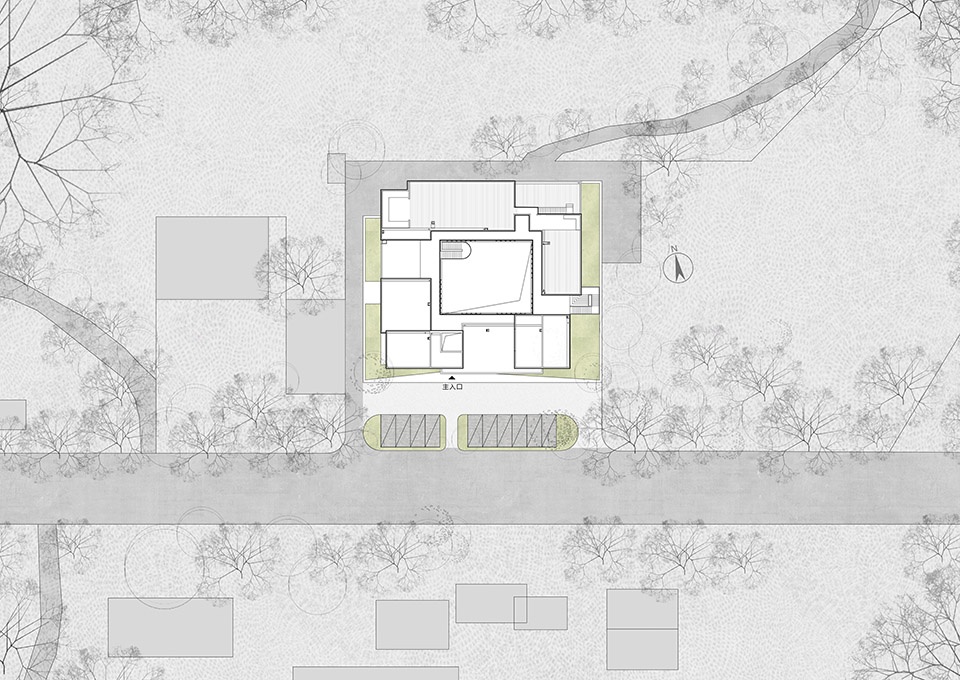
项目用地东西长约40m,南北进深32m。内部平整,外部道路西高东低,存在约1.6m的高差。场地内原有一所小学,在村小合并的历程中被废弃。新建筑依照原址小学的轮廓设计,亦保留了原建筑内院外廊式的空间特征及材料的拼贴方法。
The project site is around 40 metre long from east to west and 32 metre deep from north to south. The site itself is flat, while the external road is 1.6 metre higher on the west. There was a primary school in the site, abandoned in the process of combining village schools. The new building is designed according to the footprint of the original school building, reserving the original spatial characteristics of interior courtyard and exterior corridor as well as the collage of materials.
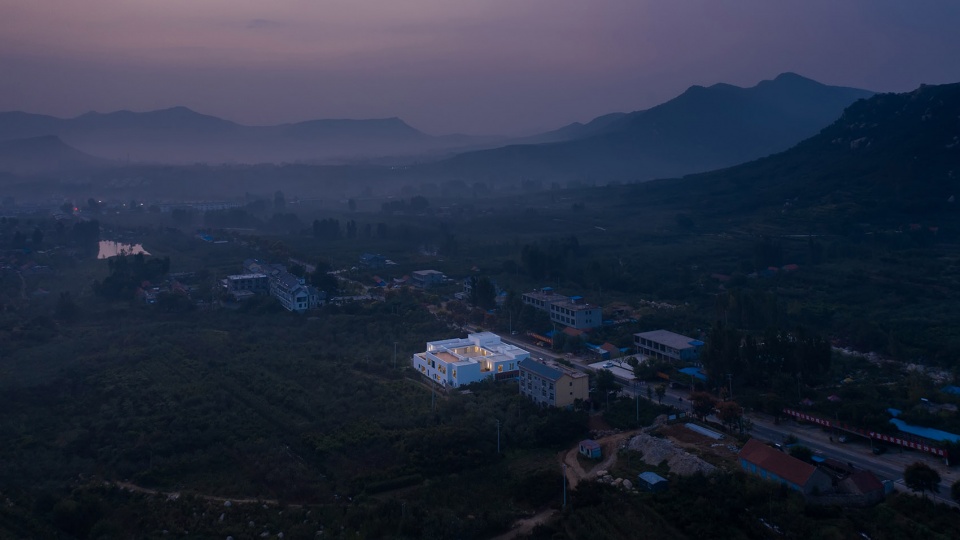
▼云蒙山脚下的村落,Village at the Foot of Yumeng Mountain
因项目靠近云蒙景区的特殊地理位置,设计师在设计之初即与投资运营方探讨,将设计任务定义为一个“命题作文”——即以“云”作为整体意象,贯穿从建筑设计到室内硬装、软装设计,直至运营的全过程。
Due to the particular geographical location of the project closing to Yunmeng Scenic Area, the designer had a discussion with the investor and the operator at the beginning of the design, defining the design brief as a ‘proposition composition’ – that is, taking ‘cloud’ as the overall imagery, throughout the entire process of architectural and interior design till operation.
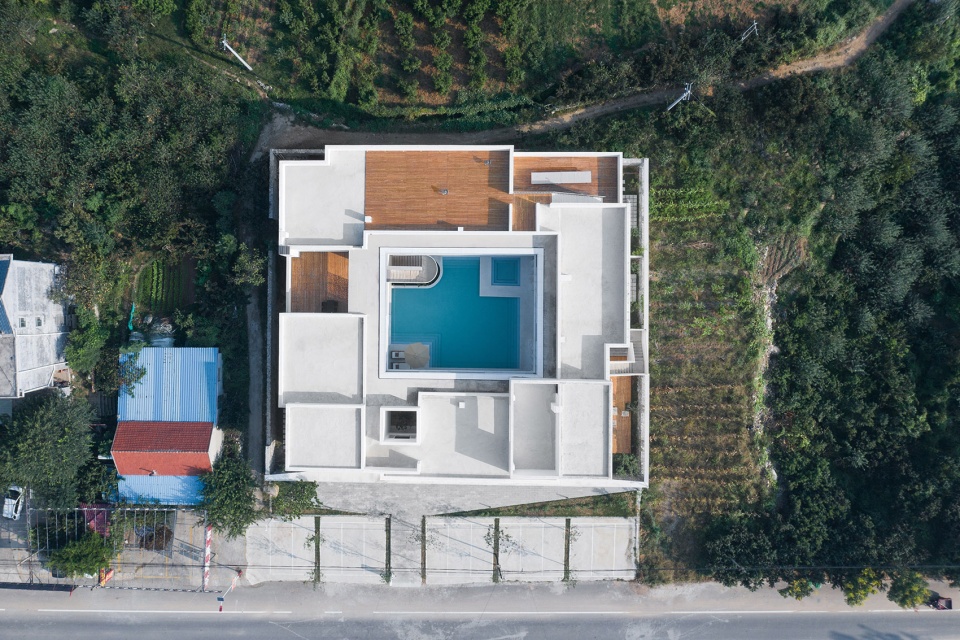
▼项目航拍顶视图,aerial top view of the project
“云”这一意象可以引发多重联想,从抽象到具体,设计师希望通过以下几个层次表达这一意象——漫游式空间架构,模糊的边界,形体的“轻”与“重”,以及材料的象征。
The imagery of ‘cloud’ can evoke multiple associations, from abstract to concrete, where the designer is to interpret this imagery in the following aspects: wandering spatial structure, blurred boundary, ‘lightness’ and ‘heaviness’ in form, and the representation of materials.
▼项目概览,Overview of the Project
漫游式空间架构
Wandering Spatial Structure
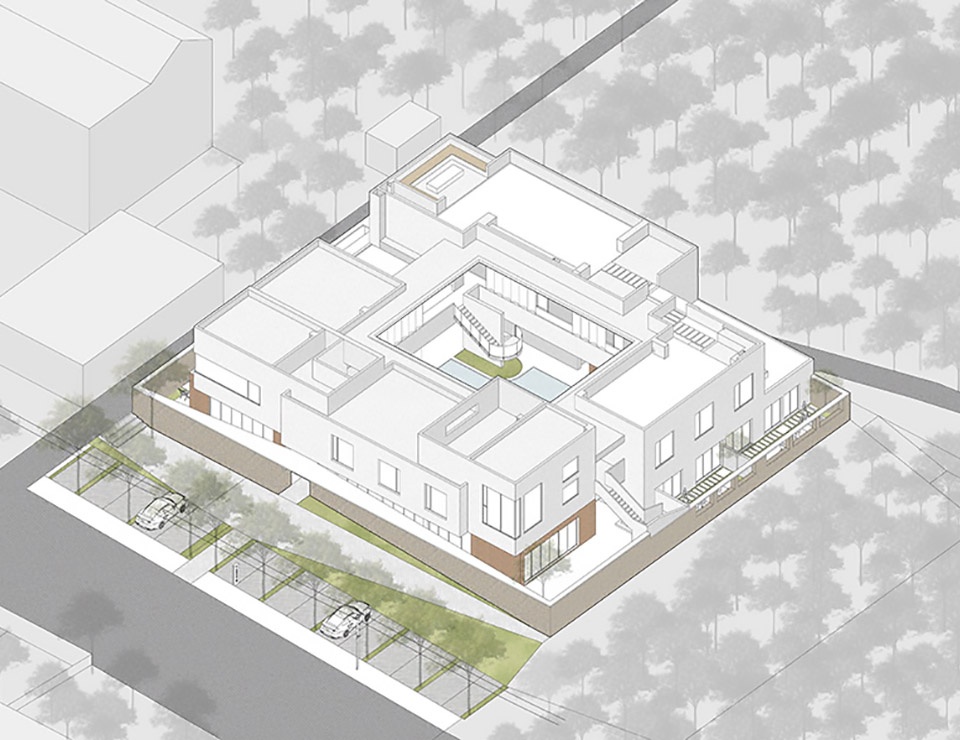
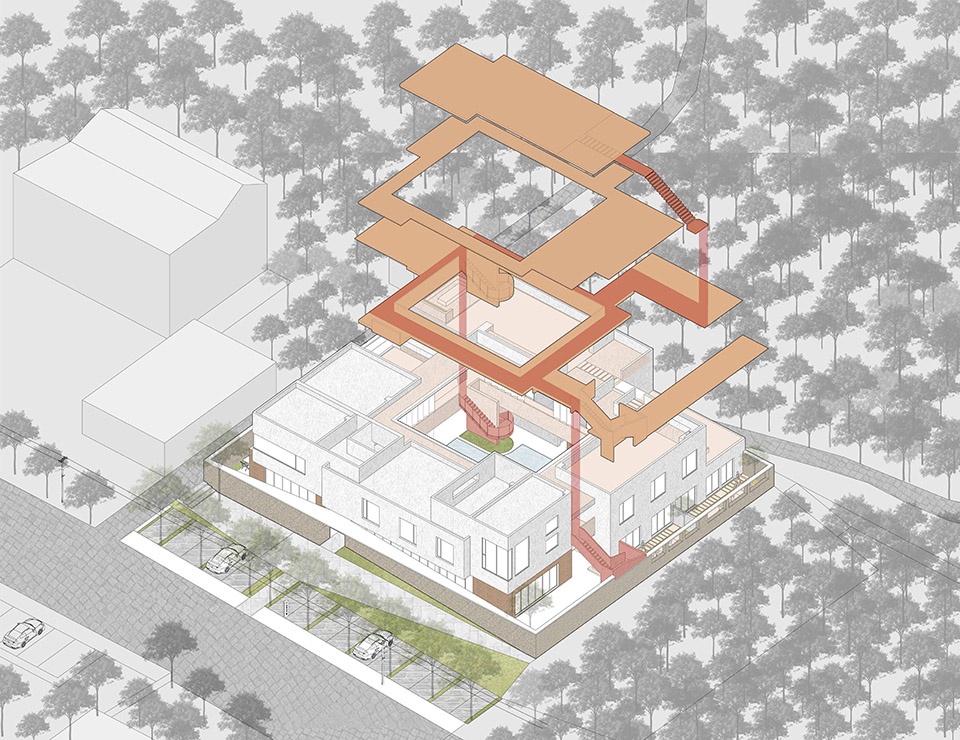
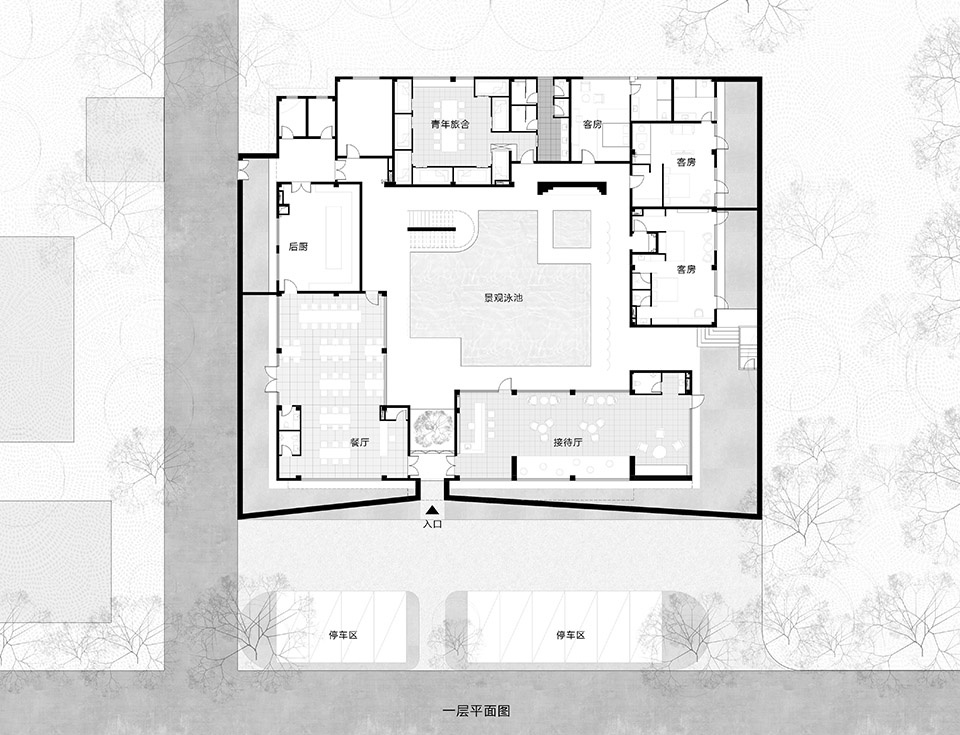
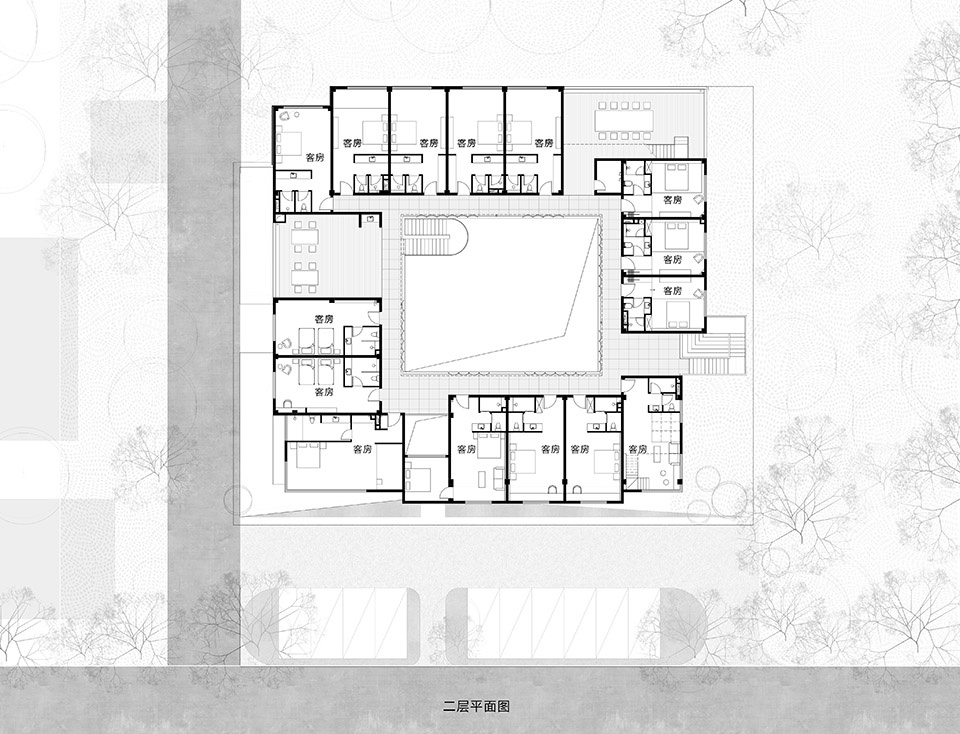
在建筑中,内院式的布局形成沿内圈行走的捷径,而沿着东南西北各向的开口及开口内部通向各个标高的楼梯则延展了路径的维度,并最终形成场地内通达而可无目的漫游的路径。交通流线连接了多个位于不同标高的空间,包括位于院落中央的水池区、入口上方的天井回廊、建筑东侧的休息平台,北侧的户外餐厅,以及屋顶上高低错落的观景露台。这是一系列串接在无预设路径上的空间,希望使用者在体验中逐渐发现。
In the building, the layout of interior courtyard forms a shortcut for walking along the interior circle, which is extended multidimensionally by the openings to the four sides and the stairs in them leading to different levels, in all forming an accessible yet endless wandering path in the site. This circulation has connected several spaces at different levels, including the pool at the centre of the courtyard, the patio veranda above the entrance, the lounge terrace on the east, the outdoor restaurant on the north, and the staggered terraces on the roof. This is a series of spaces scattered along a path without predetermination, hopefully to be discovered by the users in their experiences.
▼轴测分析图,axonometric diagram
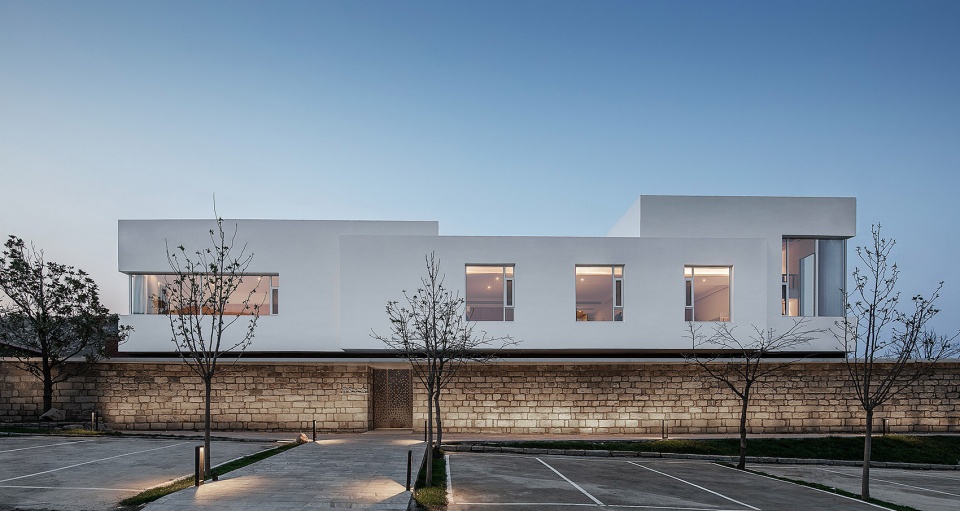
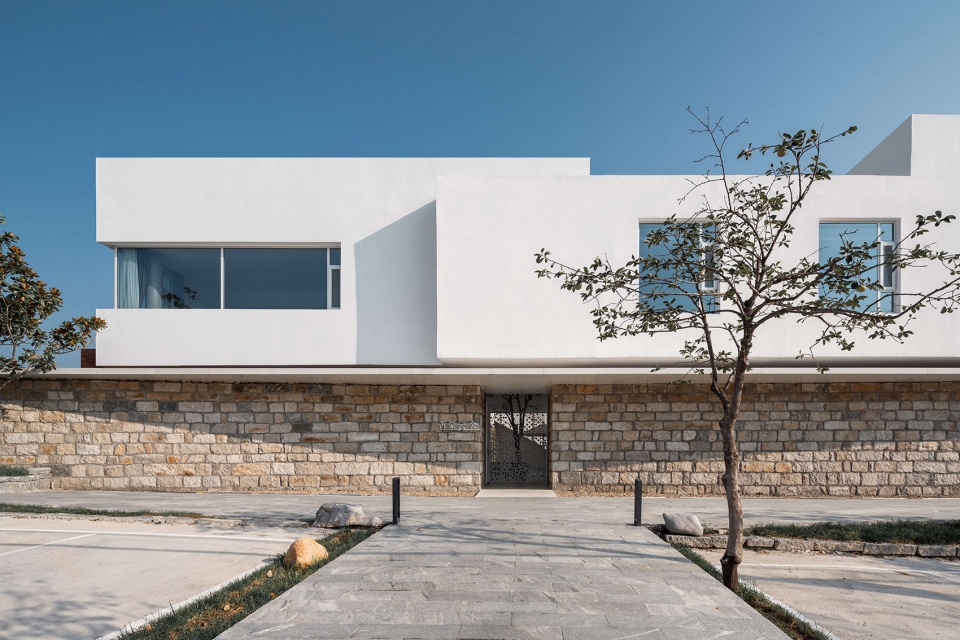
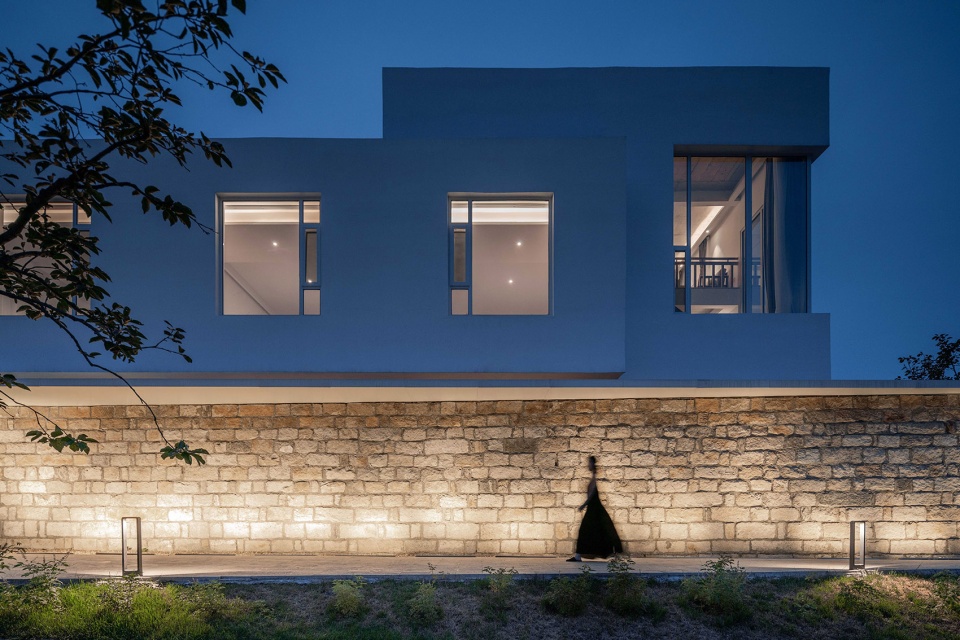
建筑沿街外立面上略低于二层层高线上的一条明确的水平分割线将建筑体量分为上下两个部分。分割线以上为表达“轻”的白色体量,其以下则是没有开窗,仅设一个出入口的连续长墙。墙面质感粗糙,颜色暗淡,与上方白色的建筑体量对比形成了视角感受上的“重”。这条水平分割线也是对外部场地沿道路细微落差的回应,以修正入口广场因为高差在视觉上带来的偏差。
The building volume is divided into the upper and lower parts by a clear horizontal line on the street façade slightly lower than the second floor. Above the line is a white volume of ‘lightness’, while below is a continuous long wall with the entrance as the only opening. The wall is rough in texture and dim in colour, forming the visual ‘heaviness’ in contrast with the white building volume above. This horizontal line is also a response to the slight drop of the external site along the road, to correct the visual deviation of the entrance square due to the height difference.
▼主入口 – 形体的上下分层,Upper and Lower Parts of the Form
模糊的边界
Blurred Boundary
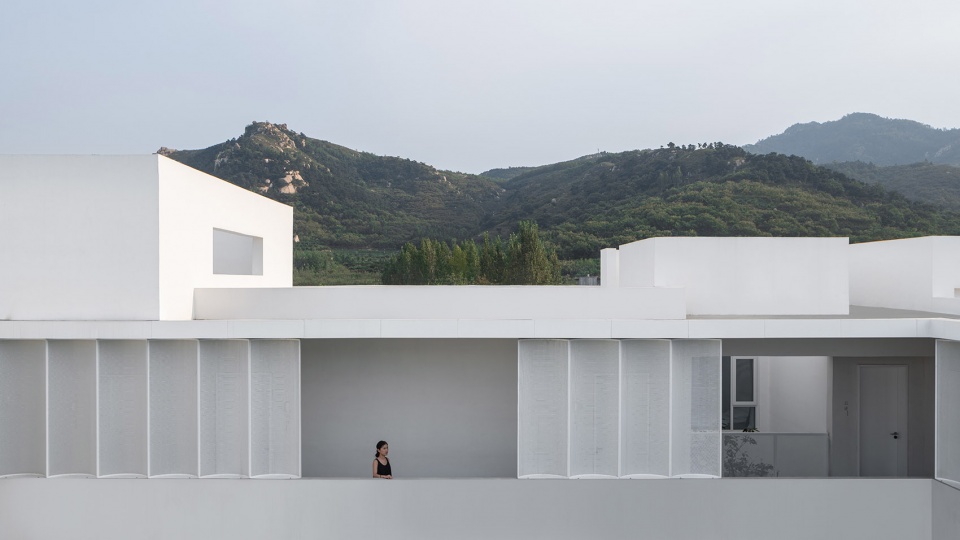
从村落肌理及场地分析得到的平面矩形建筑外轮廓形成了规整的外部界面,进而推得规整的内部边界。但在空间关系上,设计通过打断边界以及面对不同朝向的不同剖面关系的处理,将原有规整边界消解,最终形成模糊的空间边界。此边界的模糊地带为空间多样性提供了更多可能。
The squared footprint derived from the contextual analysis of the village and the site forms a regular exterior interface, which then leads to a regular interior boundary. However, in terms of spatial relationship, the design resolves this regularity by breaking up the boundary and dealing with the sections in different directions, eventually forming a blurred spatial boundary. This blurred zone provides more possibilities for spatial diversity.
▼走廊与错落的屋顶,Corridor and Staggered Roofs
形体的“轻”与“重”
‘Lightness’ and ‘Heaviness’ in Form
建筑共计两层,上部体量以白色涂料为主,下部辅以当地特产花岗岩及局部点缀的红砖。
The building is consisted of two floors. The upper volume is mainly white coated, and the lower supplemented by locally sourced granite and partially decorated with red brick.
▼建筑内院漫游,Wandering in the Interior Courtyard
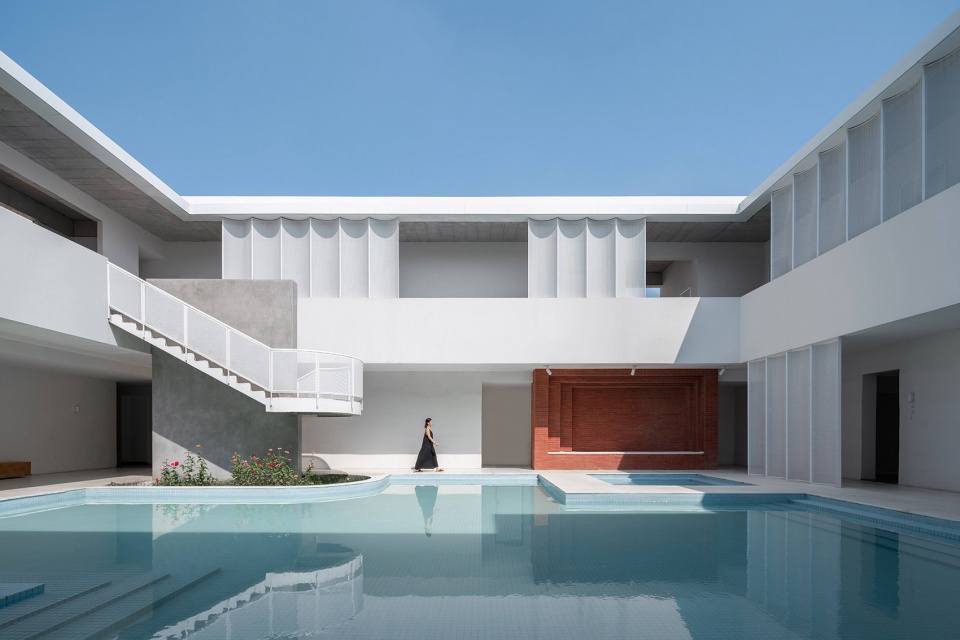
▼院落中央水池,Pool at the centre of the Courtyard
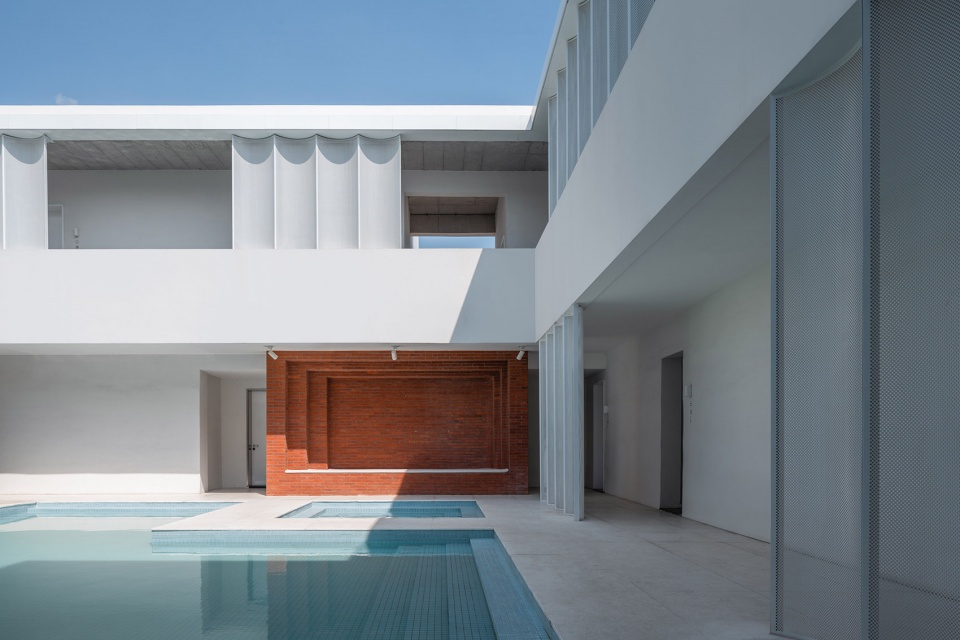
▼红砖与水池细部,details of the red brick and the pool
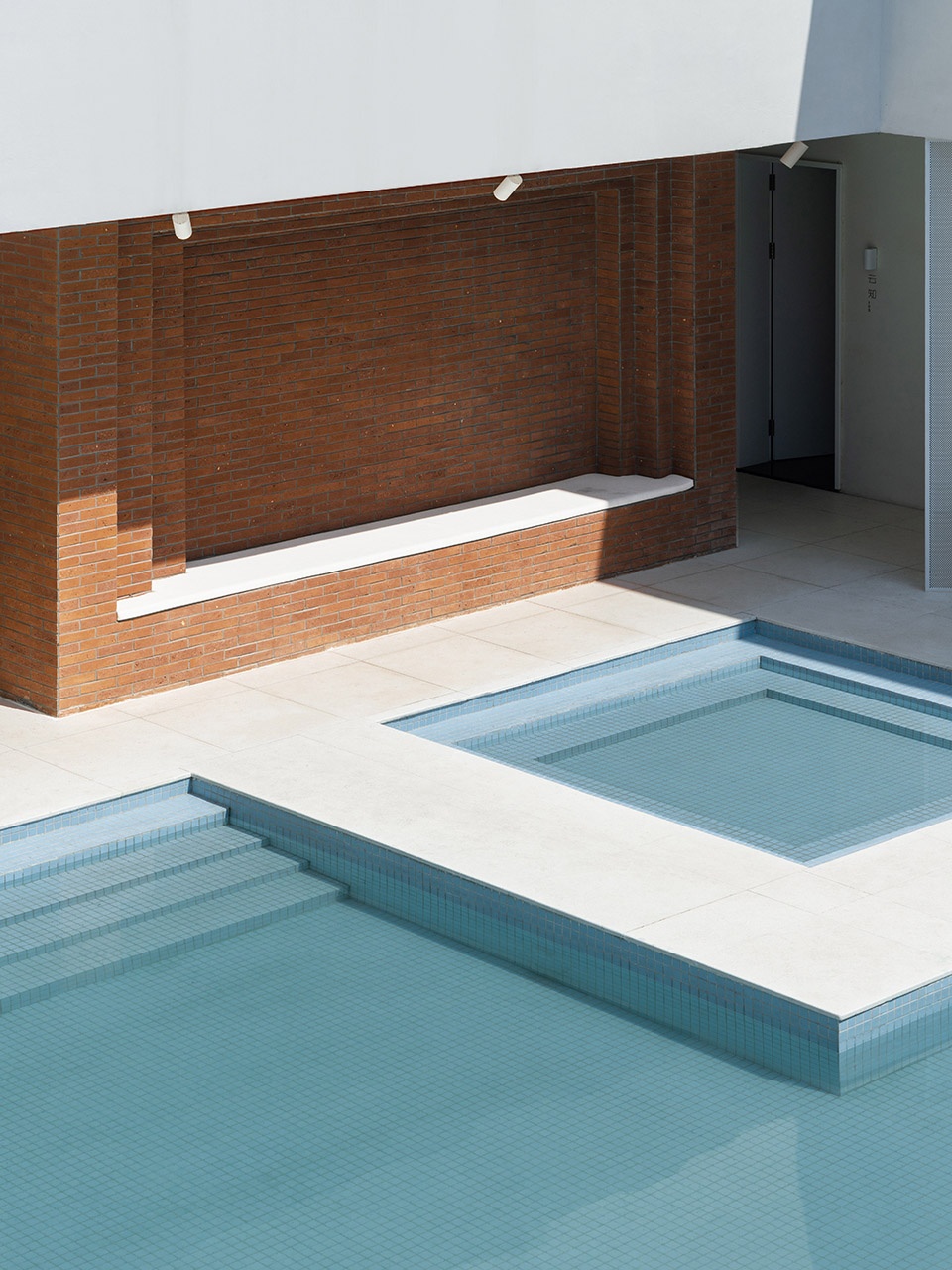
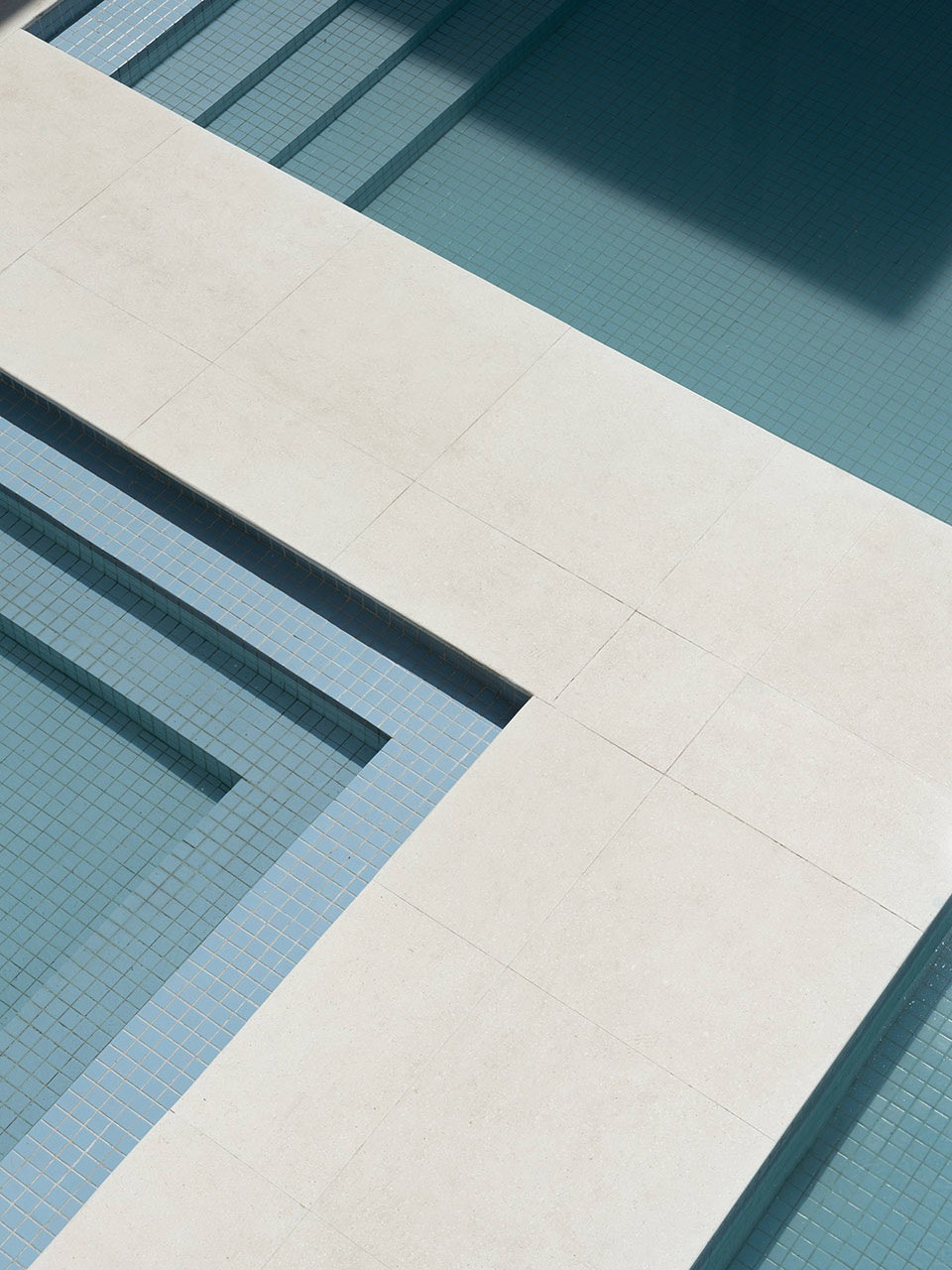
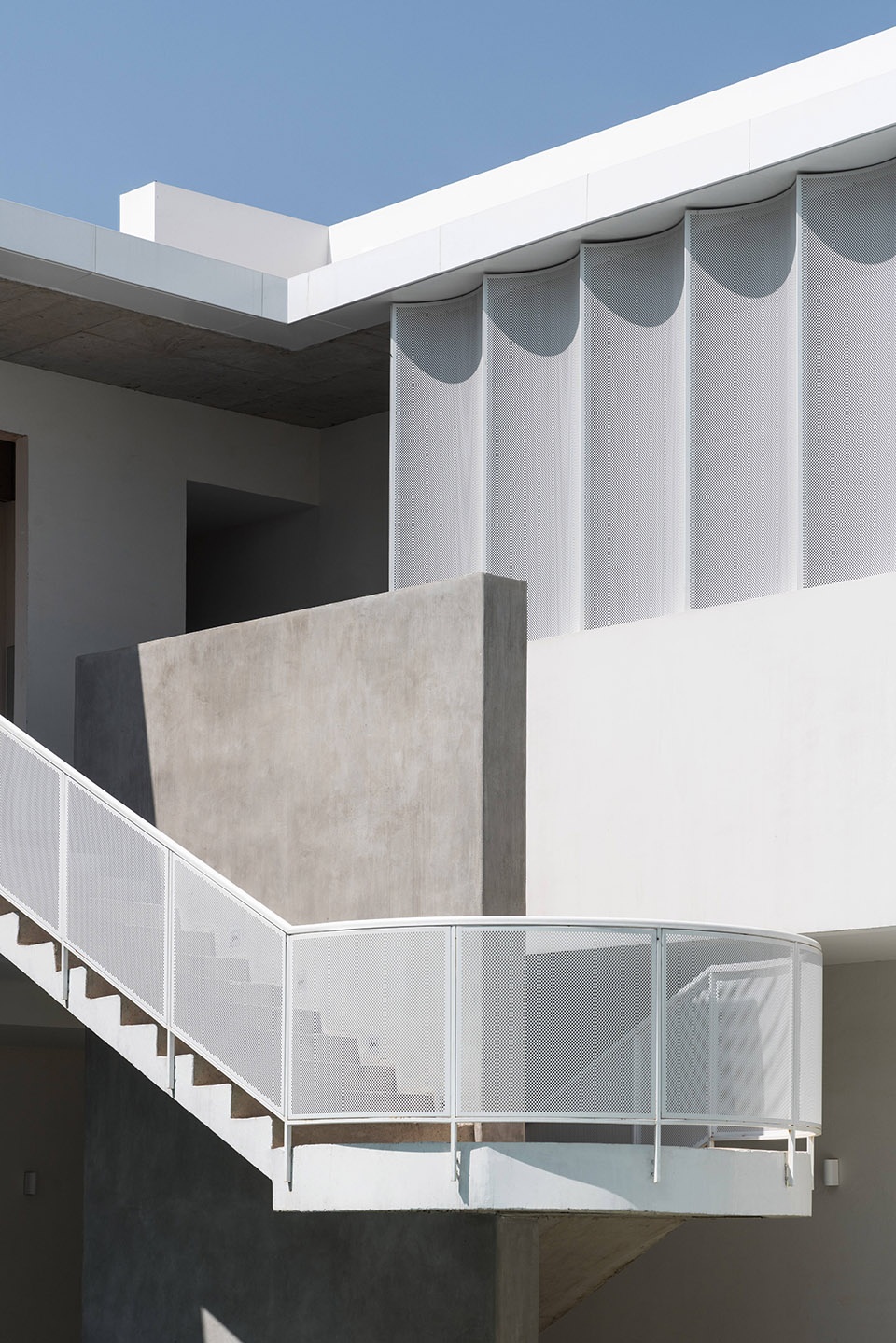
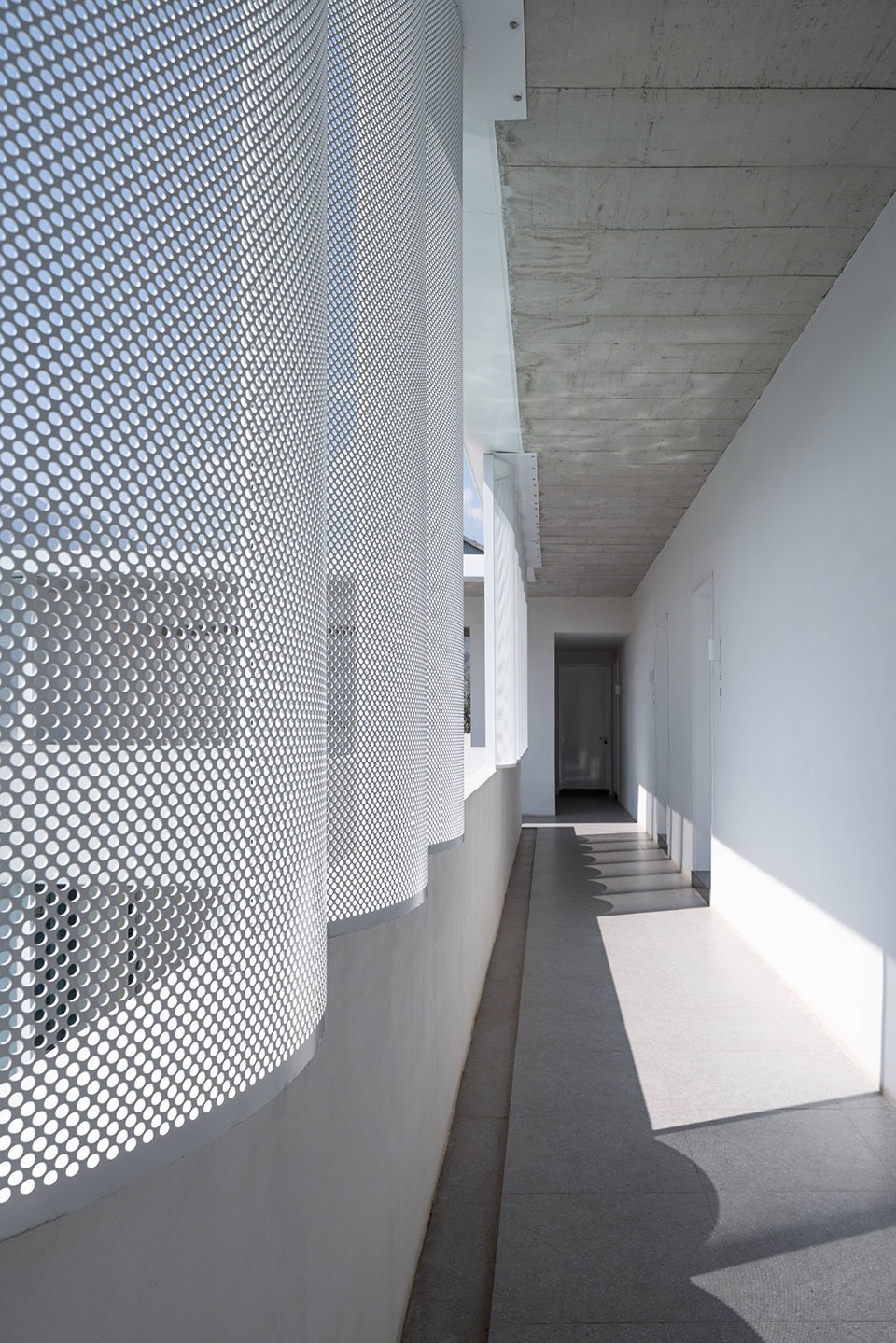
内庭院、楼梯等连续可感知的交通流线上,设计以细密的弧形穿孔铝板形成了院落中如“云”一样轻的质感,而院落中浅蓝色的水池反射的天光进一步增强了这个意象。随机设置的弧形穿孔铝板遮挡部分公共空间及客房入口,用以模糊内院边界。
Along the continuous perceptible walking paths through the interior courtyard and stairs, fine curved perforated aluminum panels are adopted to form a ‘cloud-like’ light quality of the courtyard, which is further enhanced by the sky light reflected by the light blue pool in the courtyard. Randomly placed curved perforated aluminum panels screen some of the public spaces and the entrance to the guest rooms to blur the boundary of the interior courtyard.
▼朝向内院的洞口,Opening to the Interior Courtyard
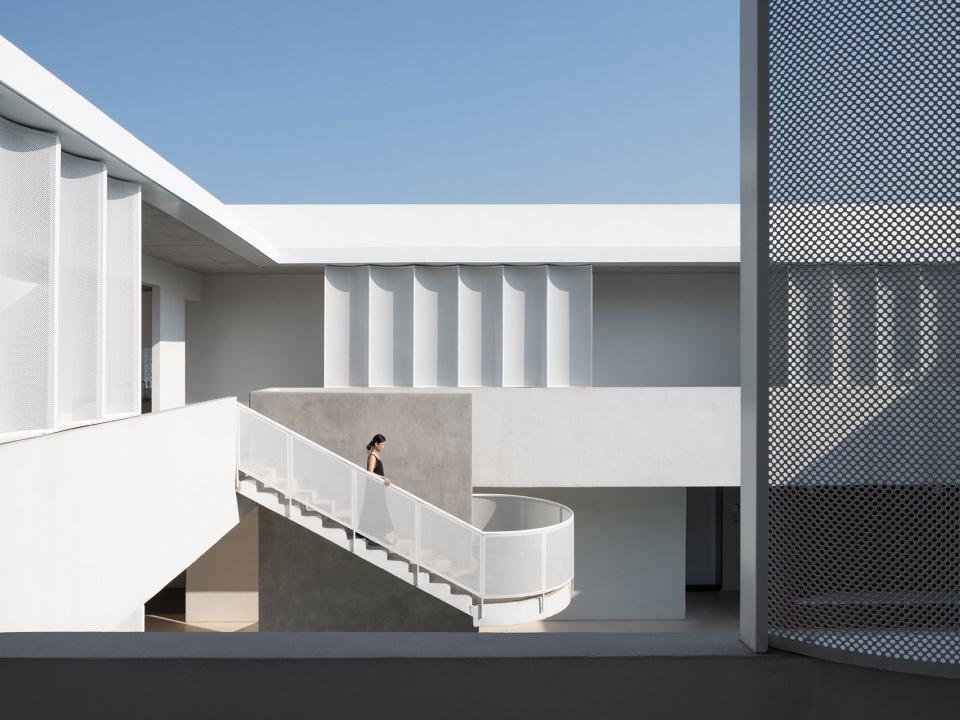
▼错落的空间关系,Staggered Spatial Relationship
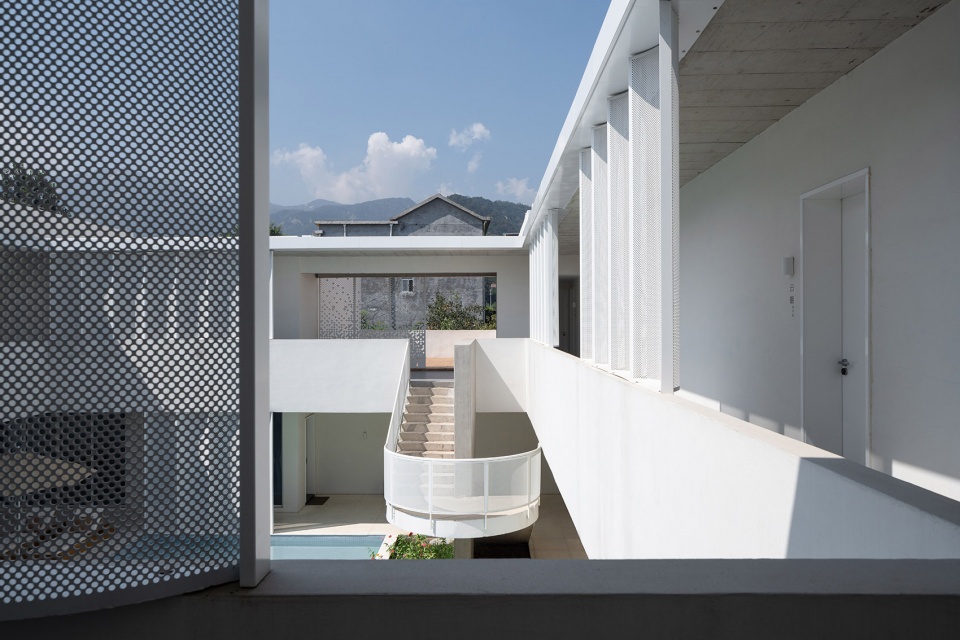
▼模糊的内院边界,Blurred Interior Courtyard Interface
材料的象征
Representation of Material
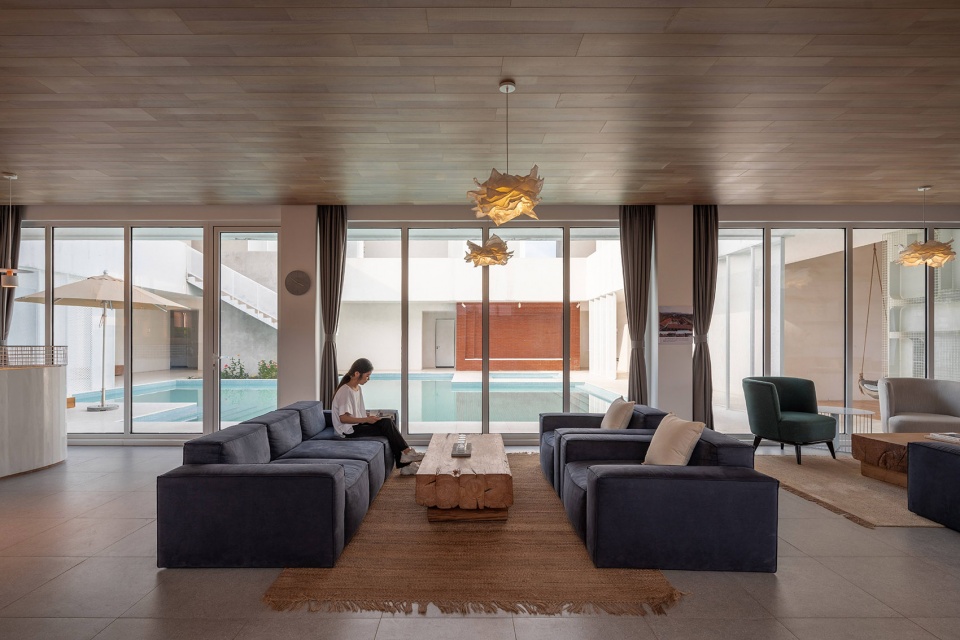
室内设计也延续这个意象,公区餐厅设置云朵吊灯,吊灯上方设置弧形钢丝网格、客房区也以钢丝网构架作为家具的主要构型。室内除了原木色、白色之外,局部点缀克莱因蓝,用以拓展“云”这个意象的边界。
The interior design also continues this imagery with a cloud chandelier in the public dining area and a curved wire grid above the chandelier. The wire grid frame is also used as the main structure of the furniture in the guest rooms. In addition to the original wood and white, the interior is partially decorated with Klein blue to extend the boundaries of the ‘cloud’ imagery.
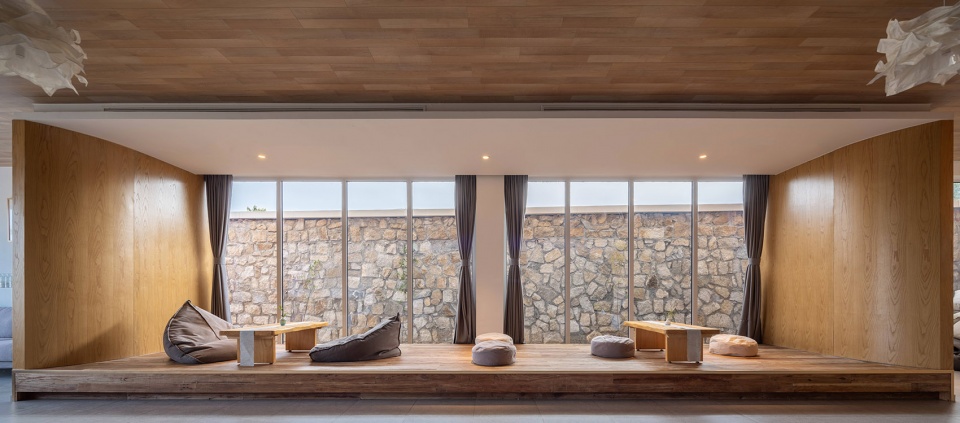
▼接待厅室内,Reception
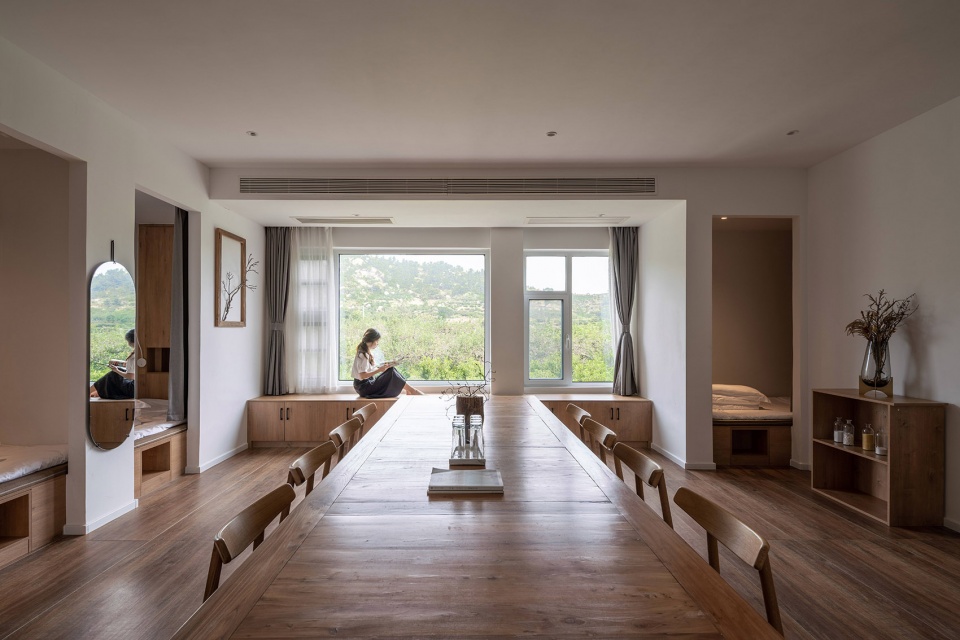
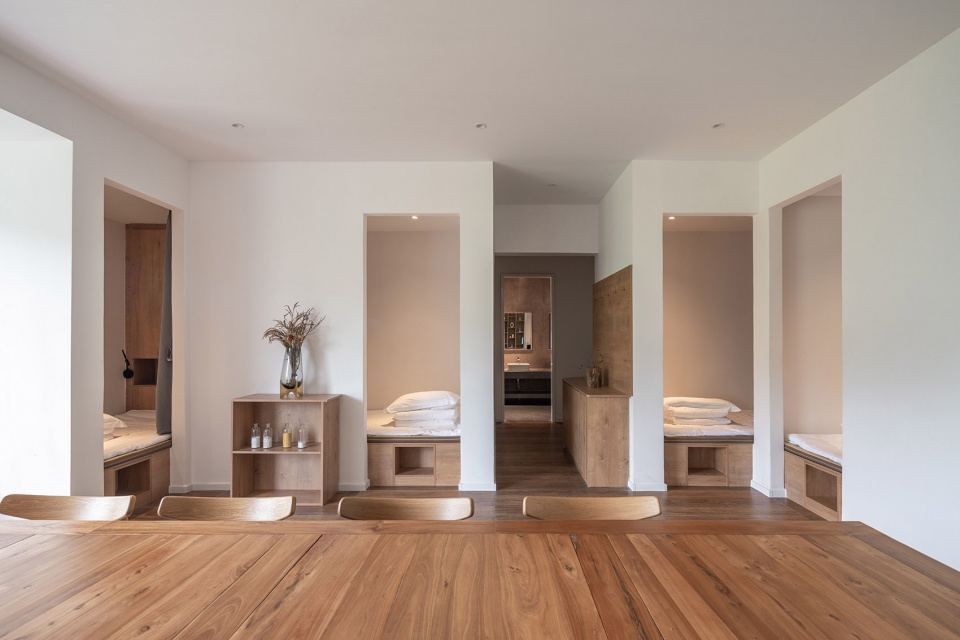
▼青年旅社客房室内,Youth Hostel
沂蒙云舍的设计过程旨在尝试以某种具象的概念为出发点生成整个设计的思路。希望通过这样生成的空间体验能回应「场地」与「建筑」、「材料」与「形式」、「内」与「外」的关系。
The design process of Yimeng Cloud House attempts to generate the whole design thinking from a tangible concept, and hopefully the spatial experience generated in this way can respond to the relationship between ‘Site’ and ‘Architecture’, ‘Material’ and ‘Form’, ‘Interior’ and ‘Exterior’.
▼夜景,night view
▼总平面图,master plan
▼一层平面图,1F plan
▼二层平面图,2F plan
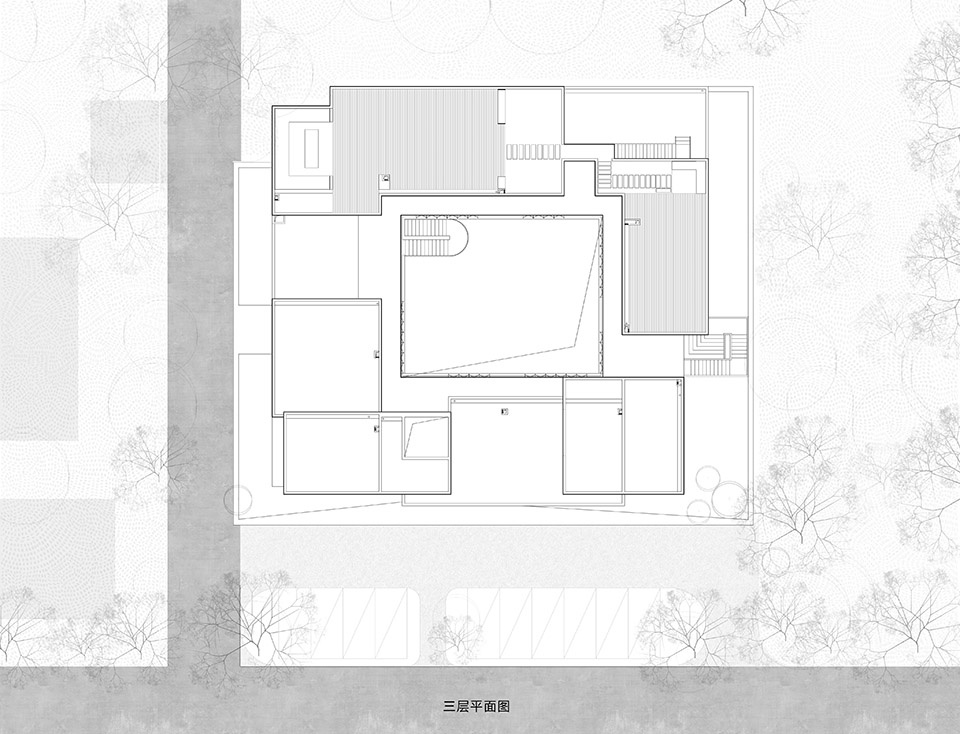
▼三层平面图,3F plan
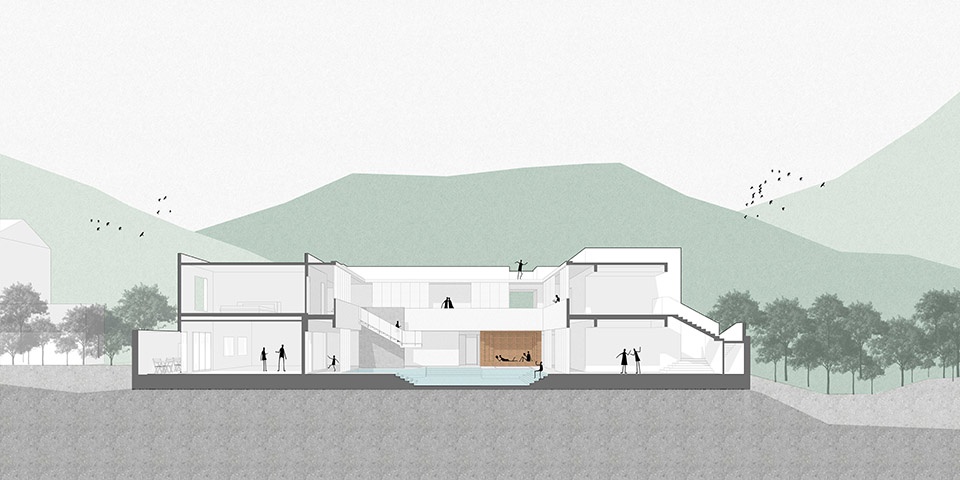
▼剖面图,section
项目信息
项目名称:沂蒙·云舍
文章分类:建筑设计-旅游民宿
设计公司:灰空间建筑事务所
项目地址:山东
项目规模:1233平方米
设计团队:应世蛟、琚安琪、赵柏乔、武星、叶官欣、张凯
结构顾问:黄希
建筑构造:李合生
材料:穿孔铝板,石材,红砖,涂料
施工企业:山东朴筑装饰工程有限公司
Project information
Project Name: Yimeng Yunshe
Article classification: Architectural Design - tourist B & B
Design company: grey space architecture office
Project address: Shandong
Project scale: 1233 square meters
Design team: Ying Shijiao, Ju Anqi, Zhao Baiqiao, Wu Xing, ye Guanxin, Zhang Kai
Structural Consultant: Huang Xi
Building structure: Li Hesheng
Materials: perforated aluminum plate, stone, red brick, coating
Construction enterprise: Shandong Puzhu Decoration Engineering Co., Ltd