Poniatowski大道105号 &12套社会住房 + 1套商业用房,巴黎 / MARS Architectes
历史背景History
本项目位于两栋20世纪初建成的住宅楼之间(1901年与1916年),其中两栋较小的建筑揭示了这些豪斯曼风格楼群背后隐藏的现实。后院的高密度布局,是豪斯曼及其继任者所设定的对齐方式所产生的结果,这种完美的立面背后隐藏着许多惊喜:不规则的地块布局往往不可避免,而整条街区的内部格局成为这种布局的自然结果。这两栋小房子在规模上与周围建筑格格不入,但其顽强存在形成了一个开放的缺口,对19世纪的逻辑和理念构成了微妙的挑衅:在豪斯曼时期,排列整齐的立面与公共空间共同参与城市表达,以直观的方式连接实与虚的空间,展现巴黎大道的风貌。今天,随着有轨电车的建立,这条大道被重新定义,公共空间也得到更新。
Lodged between two housing blocks at the start of the 20th century (1901 and 1916), two smaller buildings gave us a hint of the hidden reality of these Hausmannian blocks. The density of the backyards, resulting of the alignments wanted by Haussmann and his successors that hides many surprises behind these so perfect facades : parcels with unusual geometry that are often incurred, the inside of the isle becoming a consequence. These two small houses, anachronistics by their scale compared to the surrounding fabric, have left by their persistence this open breach, an irrevence to the logic and beliefs of the 19th century, where sequenced facades and public space take part, in a concomitant way in a direct connection amongst full and empty spaces, to express a Parisian boulevard of its time. Today, with the establishment of the tramway, the boulevard was redefined and its public space renovated.
▼立面夜景,night view of the facade
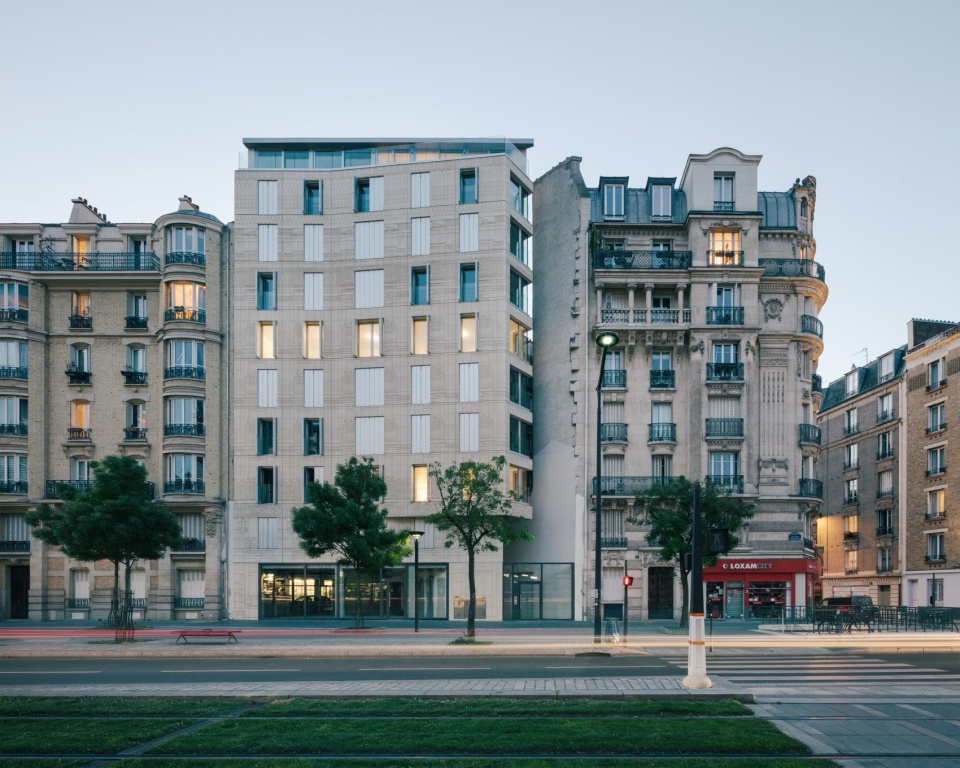
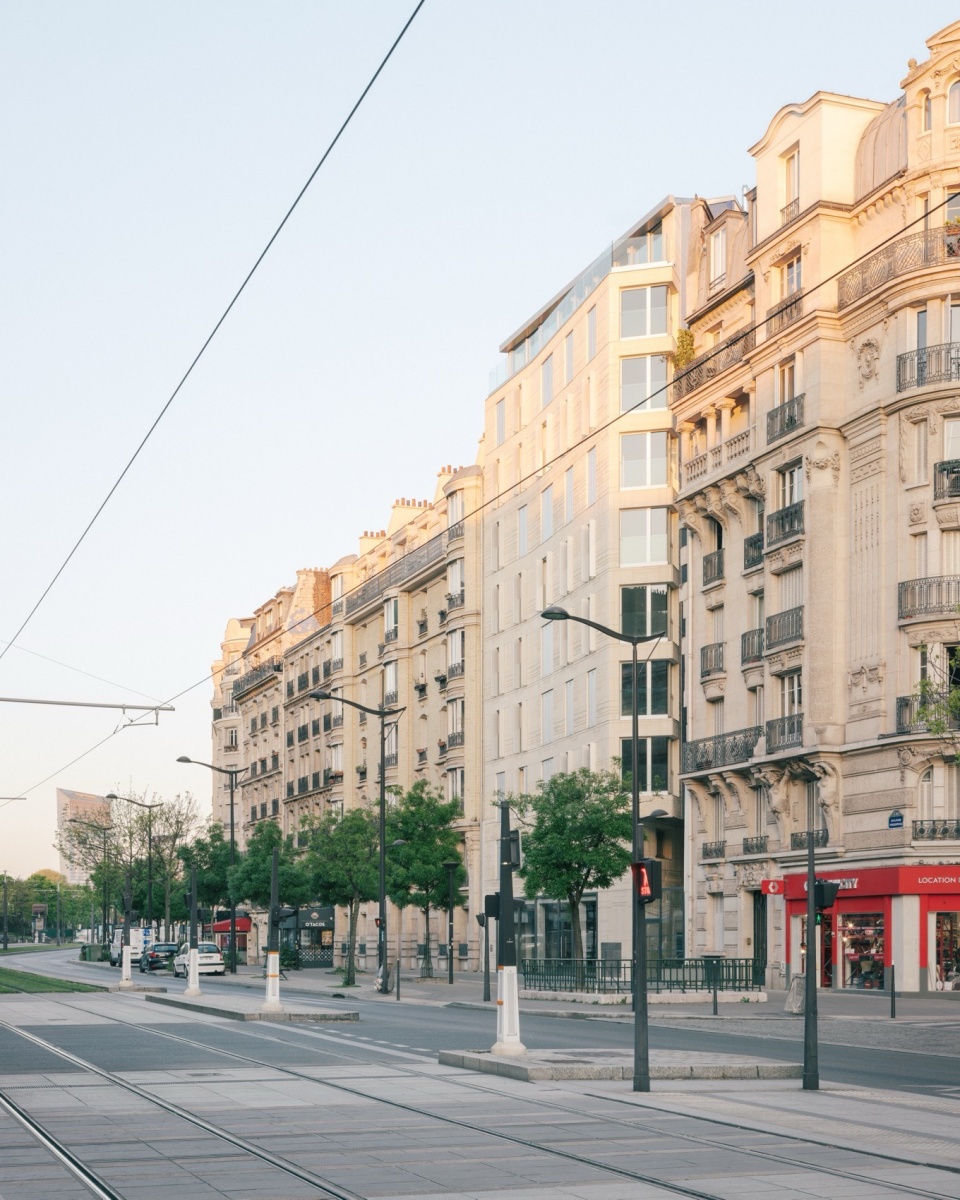
可以说,这条大道及其组成元素的设计早已确立。在社会住房或后豪斯曼建筑之间,我们仍能看到豪斯曼所设想的公共空间构图:也就是说,建筑服从“超越自身的城市秩序。豪斯曼风格的立面,从这个角度看,是公共空间的立面,而不仅仅是单体建筑的立面”(Eric Lapierre,《城市识别》,P53)。即便这些建筑建于20世纪,并遵循与豪斯曼建筑不同的逻辑,我们仍然可以清楚地看到延续下来的痕迹,即沿大道立面保持统一序列的意图。
▼后豪斯曼建筑立面,Post-Hausmann architectural facade
Nonetheless, we can say that the design of this boulevard and its composing elements were already well settled. Between social housing or post haussmannian buildings, we see there, the composition of the public space as imagined by Haussmann : that is to say that architecture is subject “to an urban order which is beyond itself. Haussmannian facades are, from this point of view, facades of a public space before being those of individual buildings” (Eric Lapierre, Identification of a city, P53) Even if they are buildings built during the 20th century, with other logics than those of the Haussmannian buildings, we clearly see the remaining marks with the willingness of homogeneous sequencing of facades along the boulevard.
▼半鸟瞰,half- aerial view
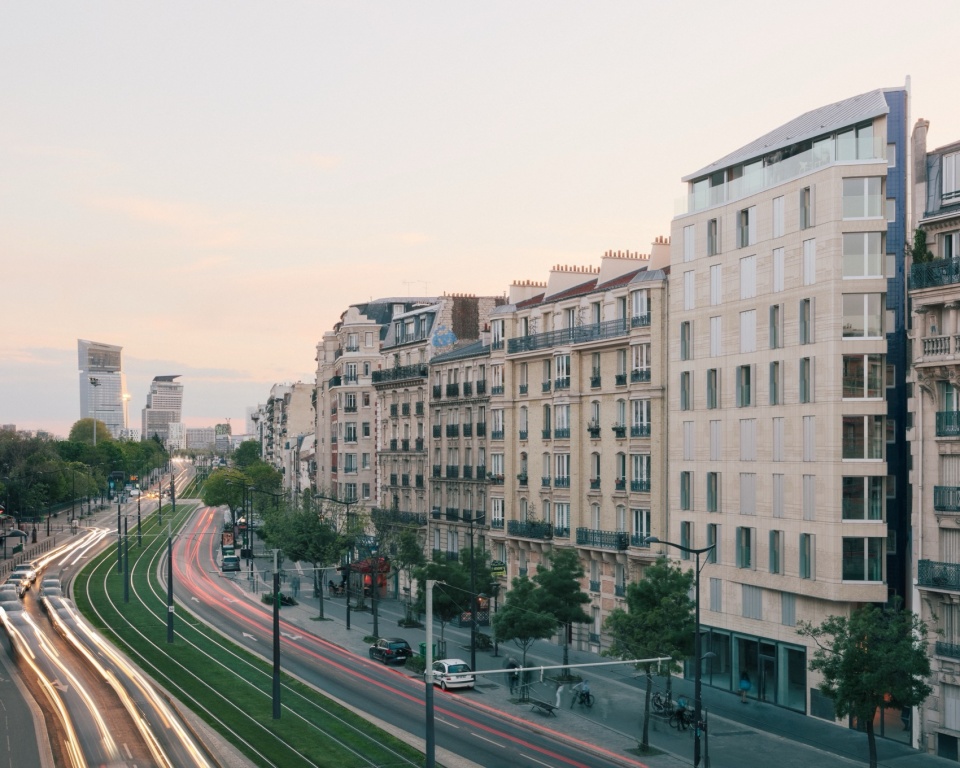
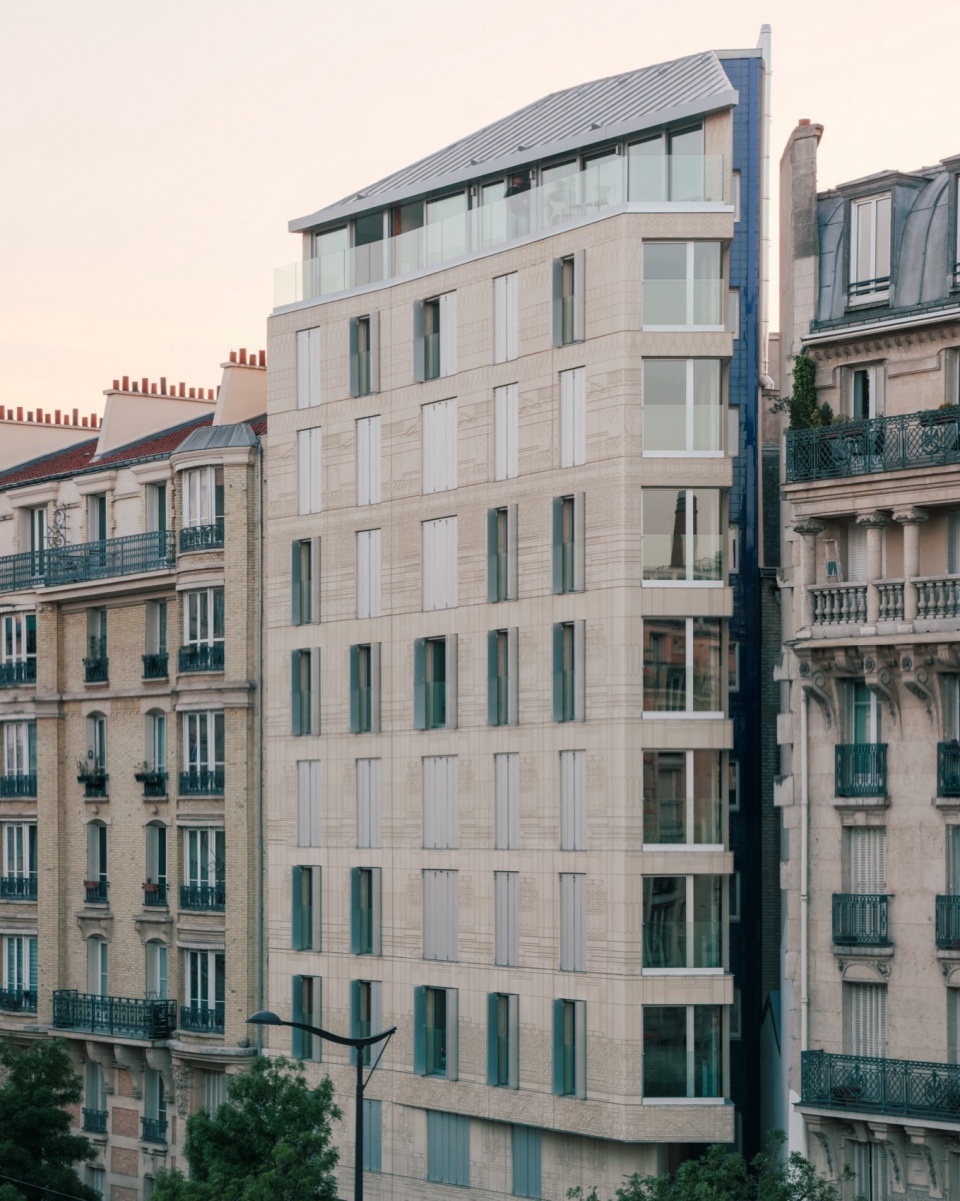
更具体地说,环绕本项目的建筑建于世纪初,可称为后豪斯曼时期,其特点是过去的严格与统一被更个性化的诠释取代:檐口、挑檐、柱式、雕塑、开窗、凸窗、阳台……这些元素以巧妙的节奏和秩序组合在一起。即便有人觉得这些建筑过于繁复甚至略显喧闹,但无法忽视其建造中所体现出的高超技艺与匠心:高档材料的使用、石材切割形成过梁、雕塑、铁艺、砖纹布局……这些在当代建筑中已极少见的细节,提出了一个问题:在这两栋建筑之间,如何进行新的建造?
More precisely, the buildings that frame the project, and which were built at the beginning of the century, which can be called post-Haussmannian period, where the past rigor and homogeneity are replaced by more personal interpretations : cornices, corbelled constructions, pilasters, sculptures, breakthroughs, the appearance of the Bow Windows, balconies, …, are assembled in a clever rythm and order. Even if one can find those buildings to be overloaded, or even a little too talkative, one can only e struck by the quality of the knowledge and the knowhow implemented in their construction : use of noble materials, stone cutting to form lintel, sculpture…, ironwork, brick’s pattern layout, …, so many attentions gone nowadays in the manufacture of the buildings, which raise the question of how to build between these two buildings.
▼后豪斯曼时期的元素以巧妙的节奏和秩序组合在一起,
the elements of the post-Hausmann period are combined together
in a clever rhythm and order
项目概述
城市延续性
Project
Urban continuity
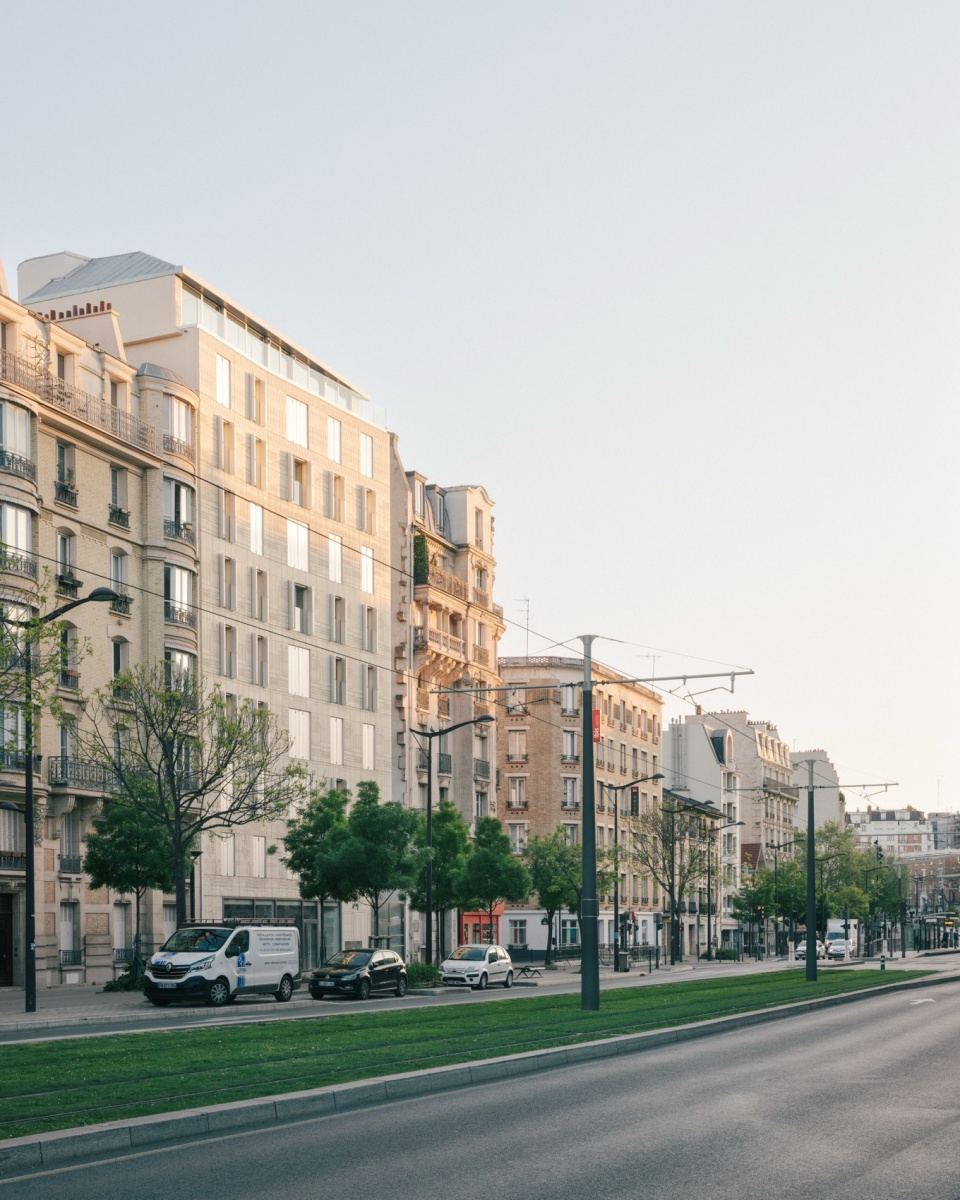
波尼亚托夫斯基大道(Boulevard Poniatowski)建于原蒂耶尔围墙的位置,这也是允许建造如此规模街道的原因之一。大道的品质在于其清晰性:建筑对齐、宽阔且绿化的人行道、沿街商业底层形成公私空间直接联系、实与虚空间的交互。城市延续性源于经典城市主义的原则,这些原则被豪斯曼广泛采纳,构成巴黎城市品质的重要基础。就本项目所在街区及周边建筑而言,可观察到一种组合体系:水平节奏的开窗,通常是一扇大窗与两扇小窗交替;立面分三段:底部由底层和夹层构成,主体由三到九层组成,顶层为顶楼。即便建筑在材料和装饰上各不相同,这种组合体系赋予大道统一尺度与活力。
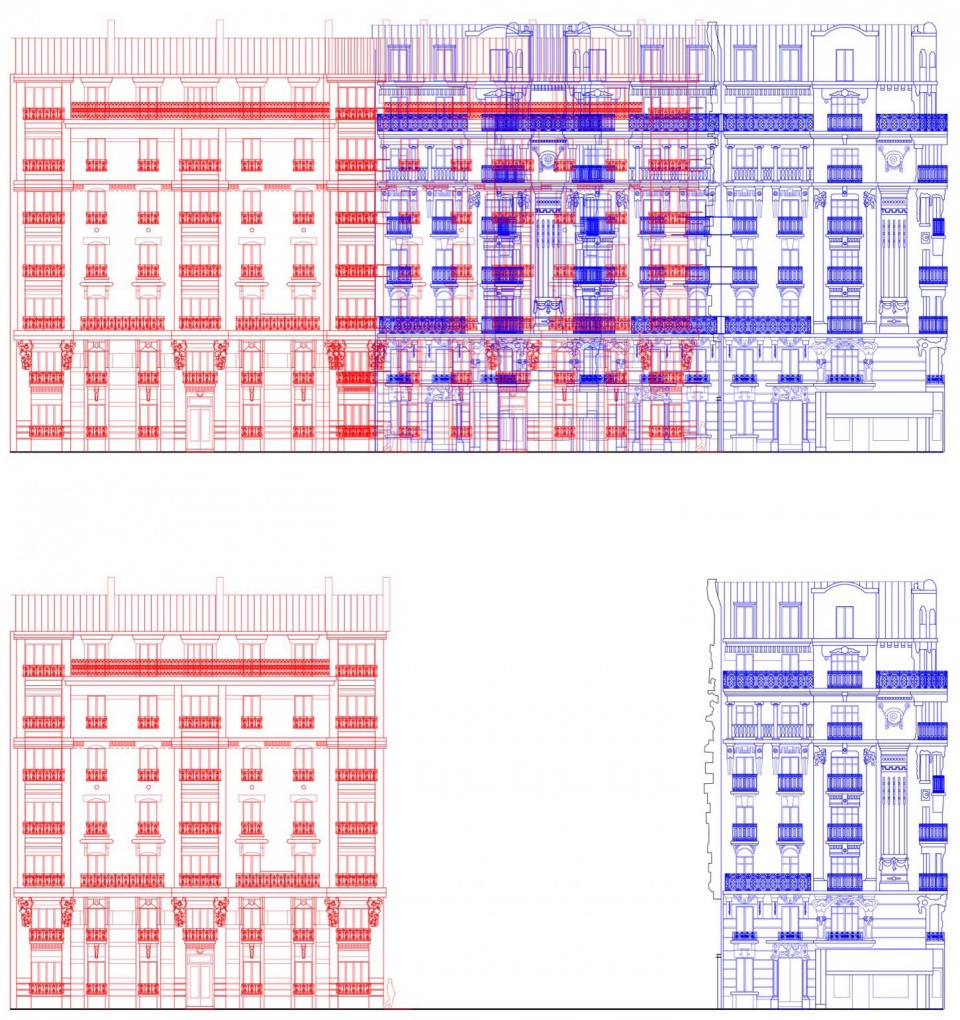
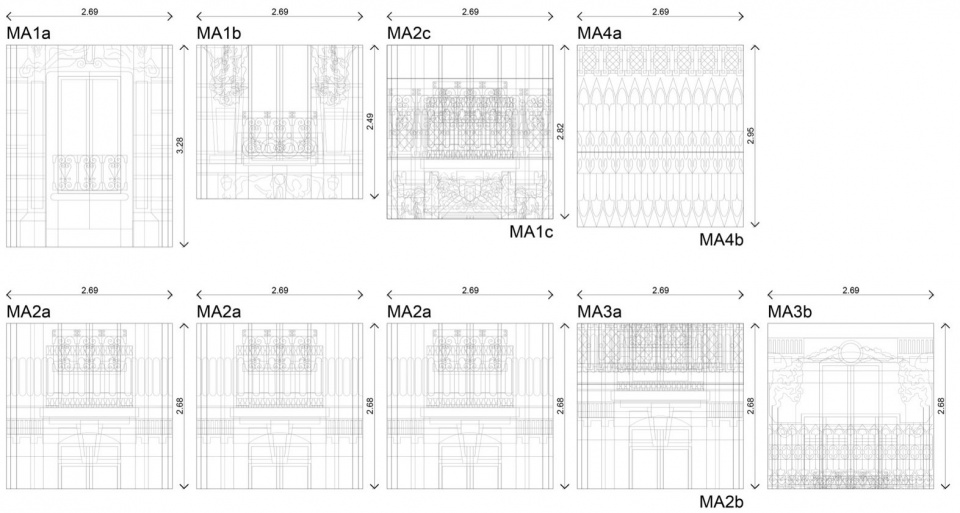
▼立面细部,detailed drawings of the facade
Boulevard Poniatowksi establishes itself in place of the former Thiers enclosure, one of the reasons that allowed the creation of a street of this scale. The quality of the boulevard Poniatowski lies in its clarity : alignment of the building, wide and wooded sidewalk linked to the commercials ground floors allowing a direct connection between public and private space, between full and empty. An urban continuity emanating from the precepts of classic urbanism largely taken up by Haussmann which made and are still making the quality of a city like Paris. Regarding our block and especially the composition of the nearby buildings, we notice a system of composition based : on a horizontal pace of opening, where a large window alternates with two small ones, and on an order of the facade divided into three parts, with a substructure composed of the ground floor and the mezzanine floor, the main body usually constitued with the third to the ninth floors and of the penthouse composed of the last level being the tenth. Even if they are different from one another in their architectural treatment (material, ornaments,…), this system of composition makes it possible to give a scale and life to a clear and homogenous boulevard.
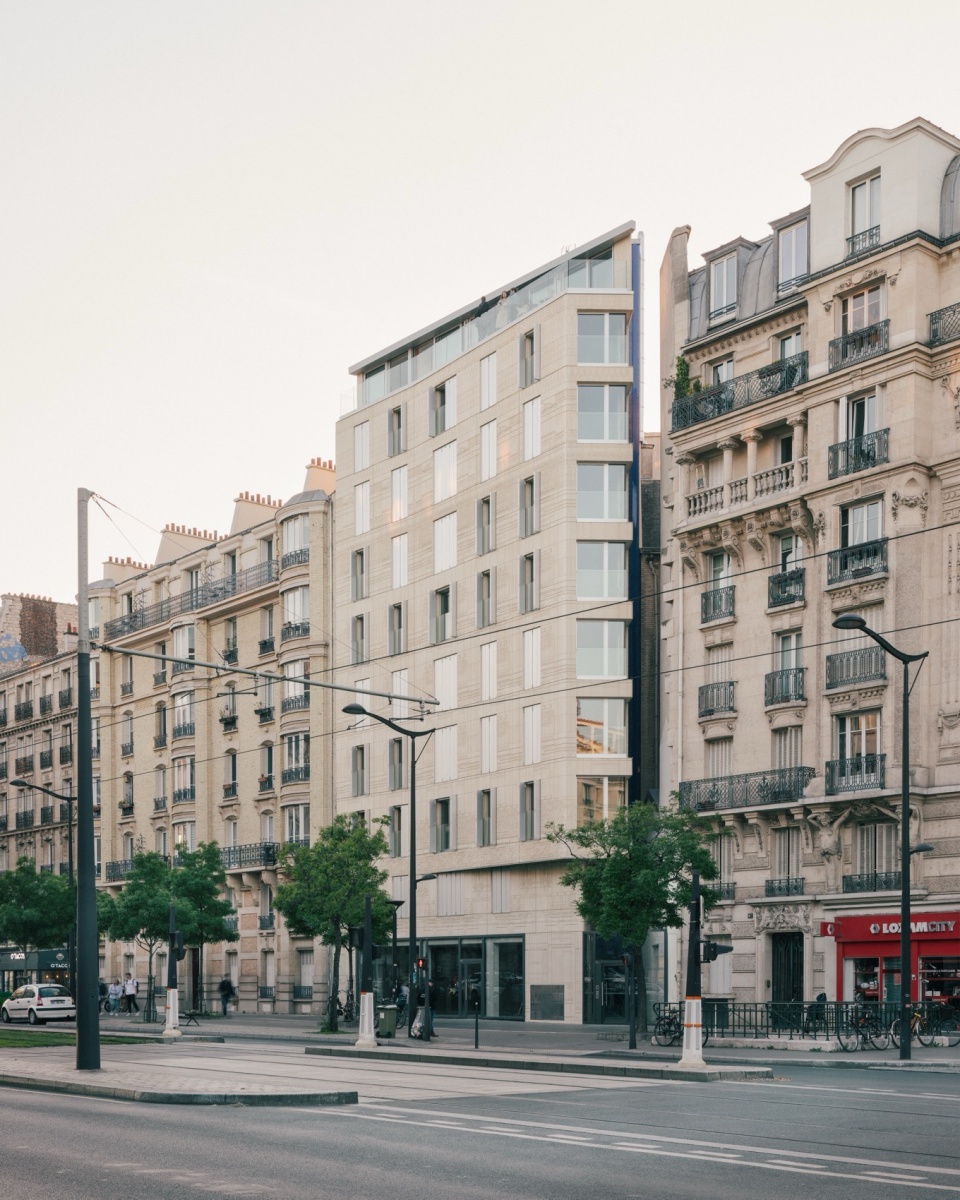
▼街景半鸟瞰,half-aerial view from the street
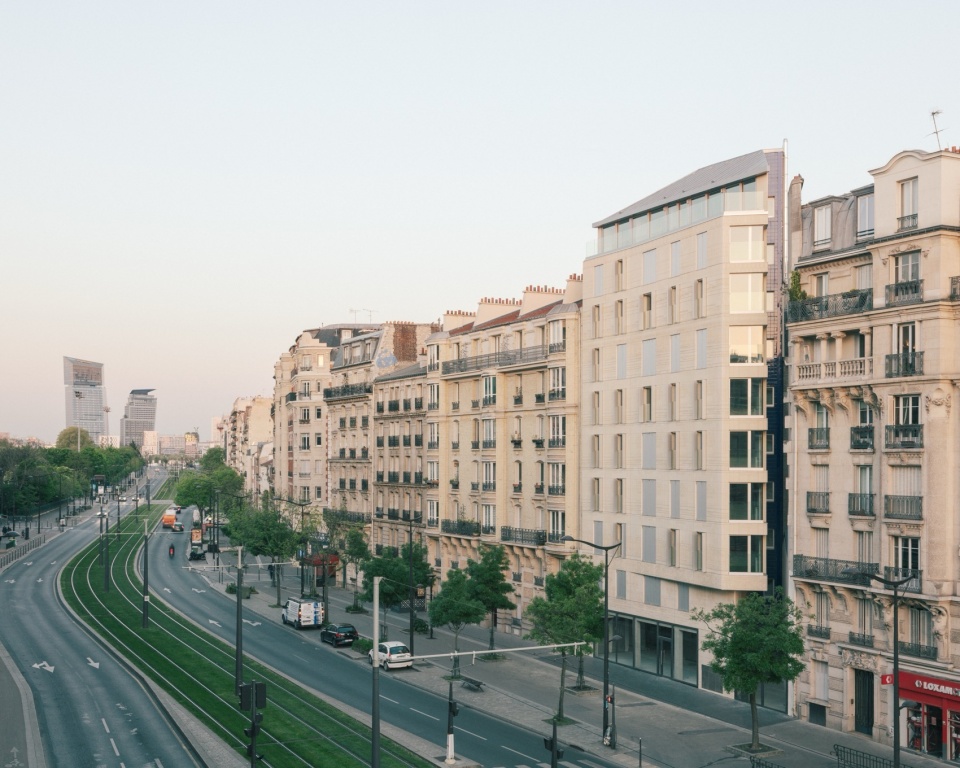
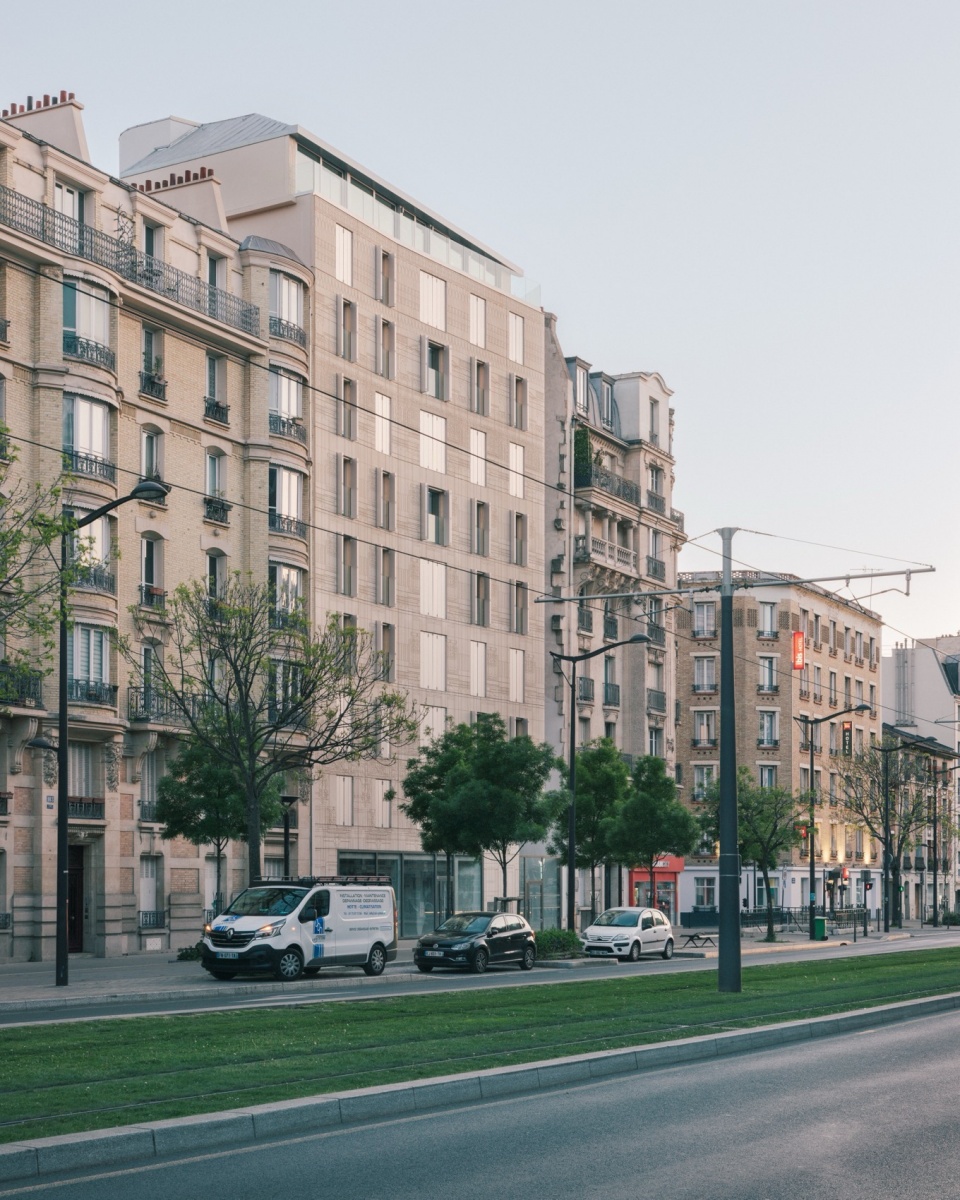
▼街景,street views
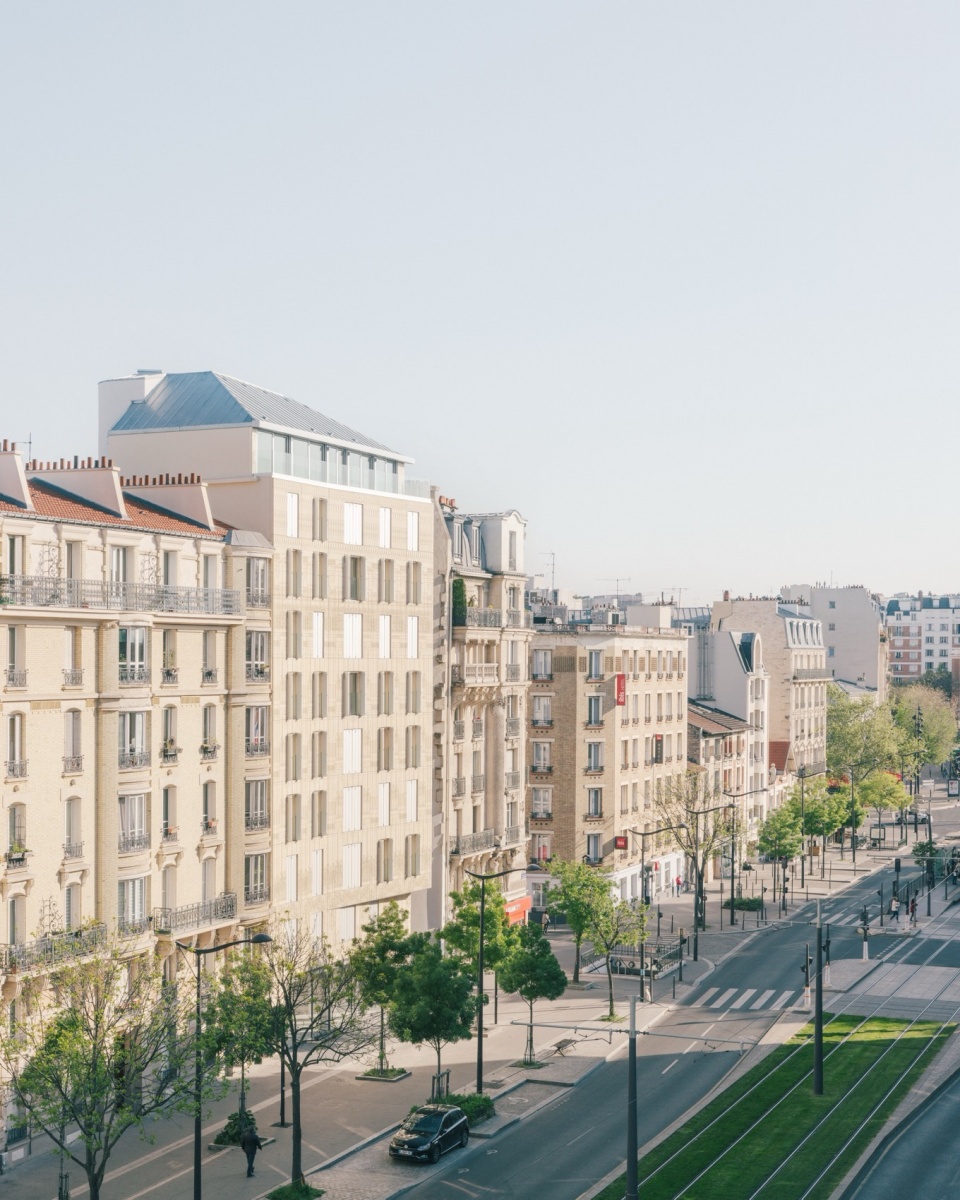
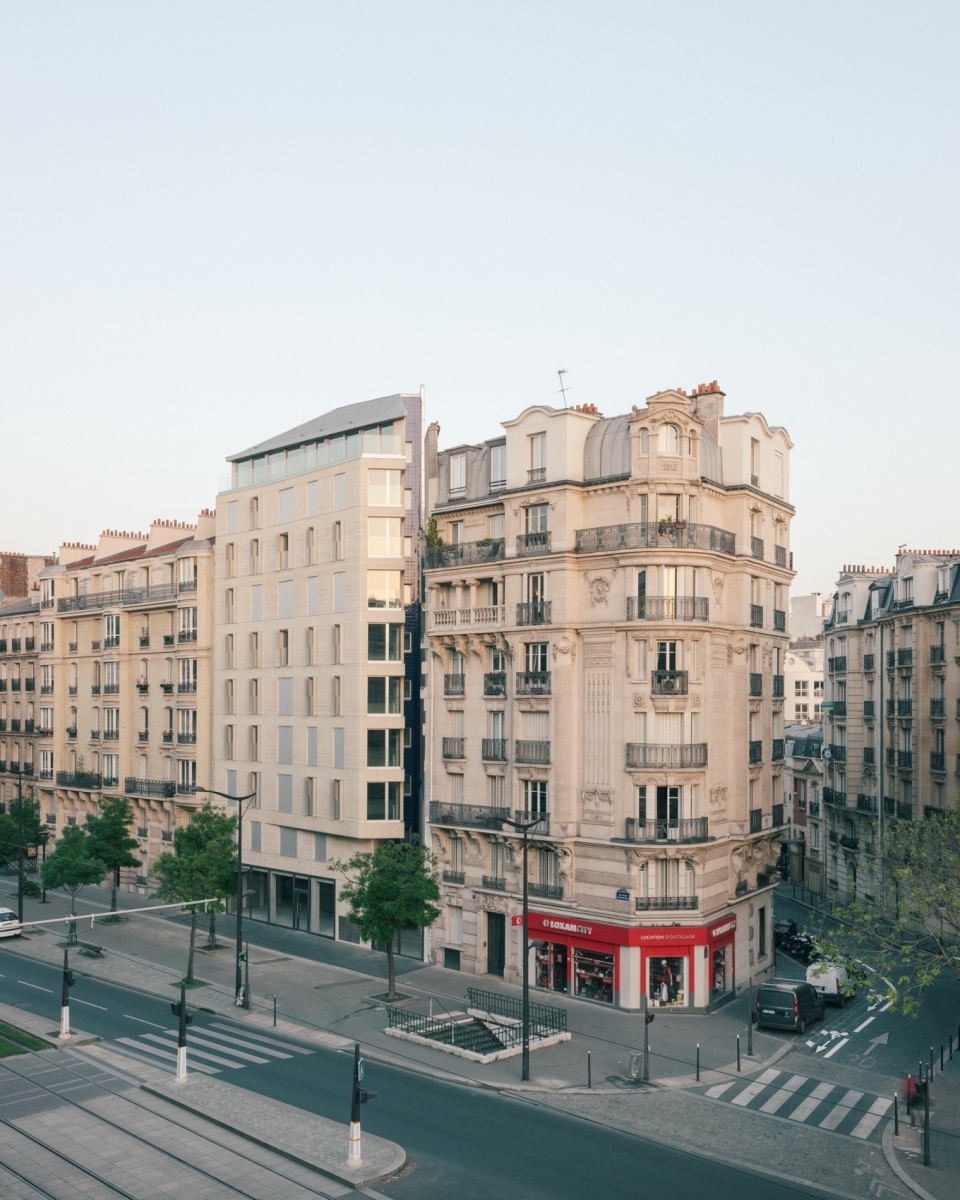
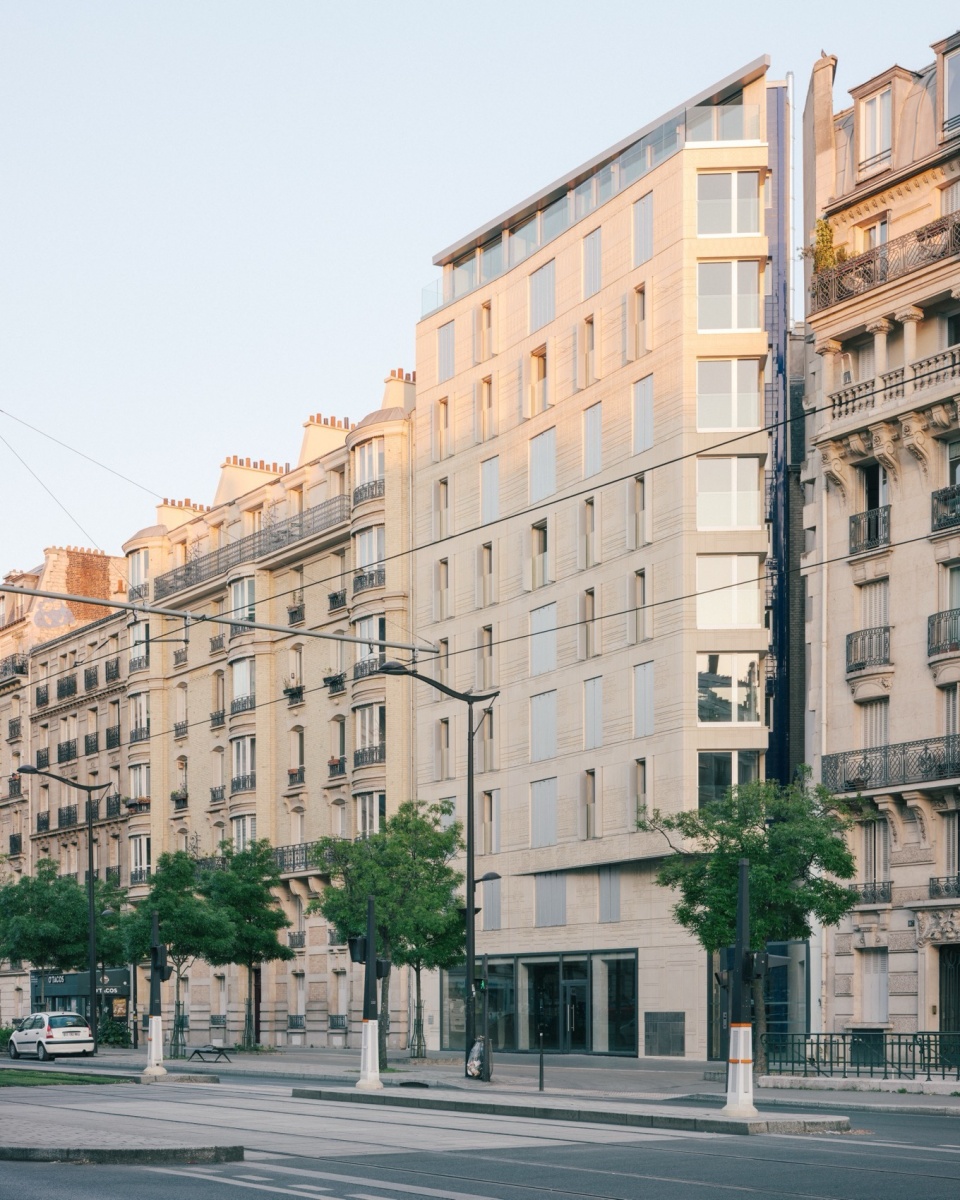
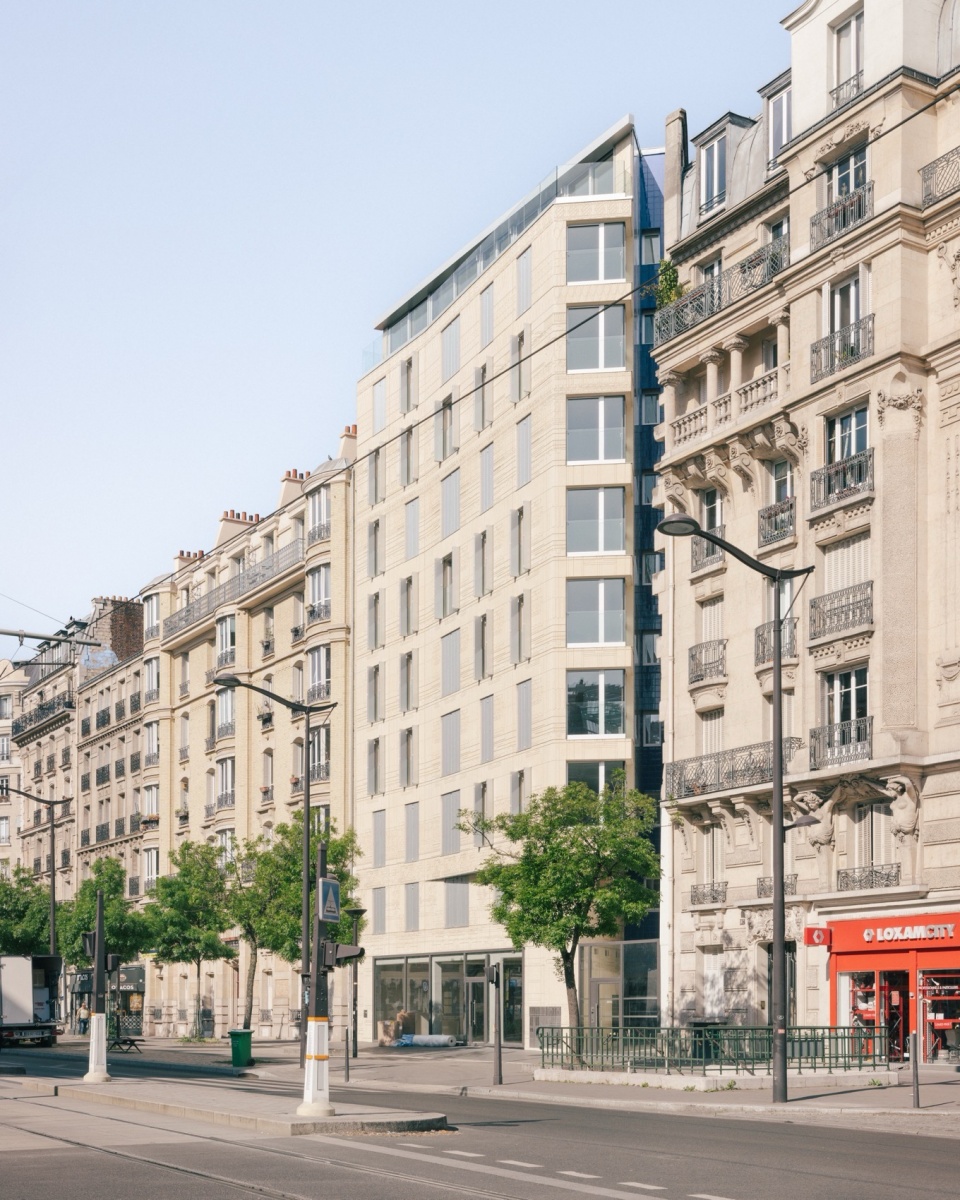
本项目延续了这种城市延续性的设计理念,通过体量变化延续开窗节奏及三段式立面:
-主体从底层轻微抬升,通过微妙的悬挑形成对大道的视觉引导,标示入口位置。顶层退缩,与周边锌制屋顶呼应,其平面采用三角几何,通过透视效果弱化深度感。
-开窗位置与邻近建筑的节奏一致,并与室内户型相协调。采用垂直矩形窗,既可观街也可望天,并辅以金属百叶提供遮阳与私密性。建筑语言虽与周边不同,但在尺度上保持一致,共同塑造公共空间,强调环境氛围与城市感。
▼分析图,analysis diagram
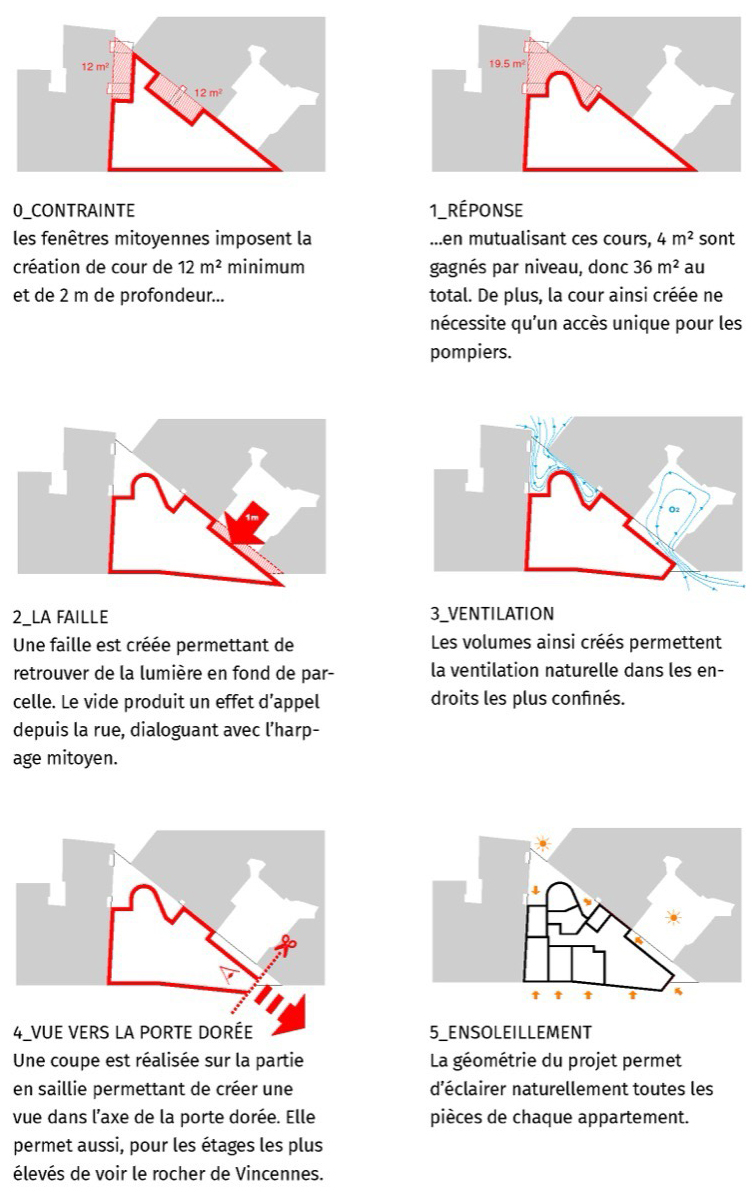
The project inserts itself in this approach of urban continuity by the resumption of the pace of the openings and of the composition in 3 orders by a volumetric deformation:
-Thus the main body lifts away from the substructure by a subtle inflection overhanging the boulevard and allowing clear views at the front end of the building, announcing a breach and the entrance. The penthouse, which is set back, in correlation with the surrounding zinc roofs, expresses itself by a plan using the geometry of a triangle to erase the depth using perspective effects.
-The openings are located in accordance with the rythm of the windows of the neighboring buildings and linked with the interior typology of the dwellings. We propose vertical and rectangular windows that offer the possibility to see the street as well as the sky. They are enhanced with metal shutters that bring solar protection and privacy. The architectural writing of this project is different from the nearby buildings but is a part of a common scale to this boulevard. It takes part in the formalizing of this public space in a method seeking contextuality and urbanity, because the approach of the spirit of a place can only exist in the accuracy of the relationship of the smallest part to the whole.
▼三段式立面,three-part facade
材质或装饰?Material or Ornament ?
邻近的建筑个性鲜明,是那个时代折衷主义的见证,同时深受19世纪的影响。立面上的雕塑和装饰赋予建筑生命。尽管人们可能会质疑这些装饰的意义,但这些立面本身的振动感、光影的变化,赋予了它们独特性,与特定的场景和历史紧密相关,形成了这片城市景观的特质。此外,我们的设计方法并非像阿道夫·卢斯在《装饰与罪》中所提出的那样,对装饰进行批判,将其视为“完全的人工产物”,而是一种情境的诗意表达。我们的目光故意保持天真,就像一个孩子驻足在建筑门廊上雕刻的狮子头前。为什么是狮子头?这并不重要,我们欣赏的,是这种独特的关注、感官的多重体验、痕迹的模糊化,以此呈现一种多层次的建筑阅读体验,同时始终保留一份神秘感。
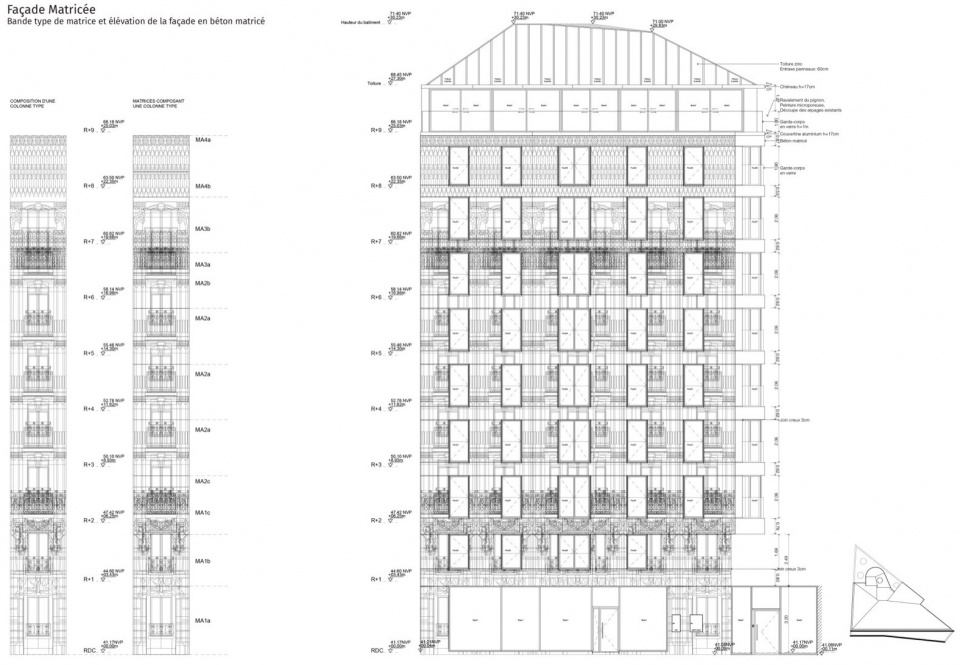
▼立面图,elevations
The neighboring buildings have a strong personality. They are the testimony of the eclectism of this era, still very much influenced by the 19th century. Sculptures and ornaments come to animate these facades. Although one may wonder the meaning of all these ornaments, there remains a quality in the vibration of these facades, games of shadows and light,which give them a particularity in relation to a situation and a history, which caracterize this urban landscape. Also, our approach is not situated in a criticism of the ornament as Adolf Loos could present it in his novel “ornament and crime” : where he considers the ornament as a “complete artifice”, but rather in a poetics of the situation. Our gaze is voluntarily innocent, like a child who stops in front of a lion’s head sculpted on the porch of a building. Why a lion’s head? It does not matter, what we like here is the singular attention, the multiplication of sensations, the blurring of tracks, in order to offer an architecture with mutliple scales of reading, always keeping a part of mystery.
▼街景,street view
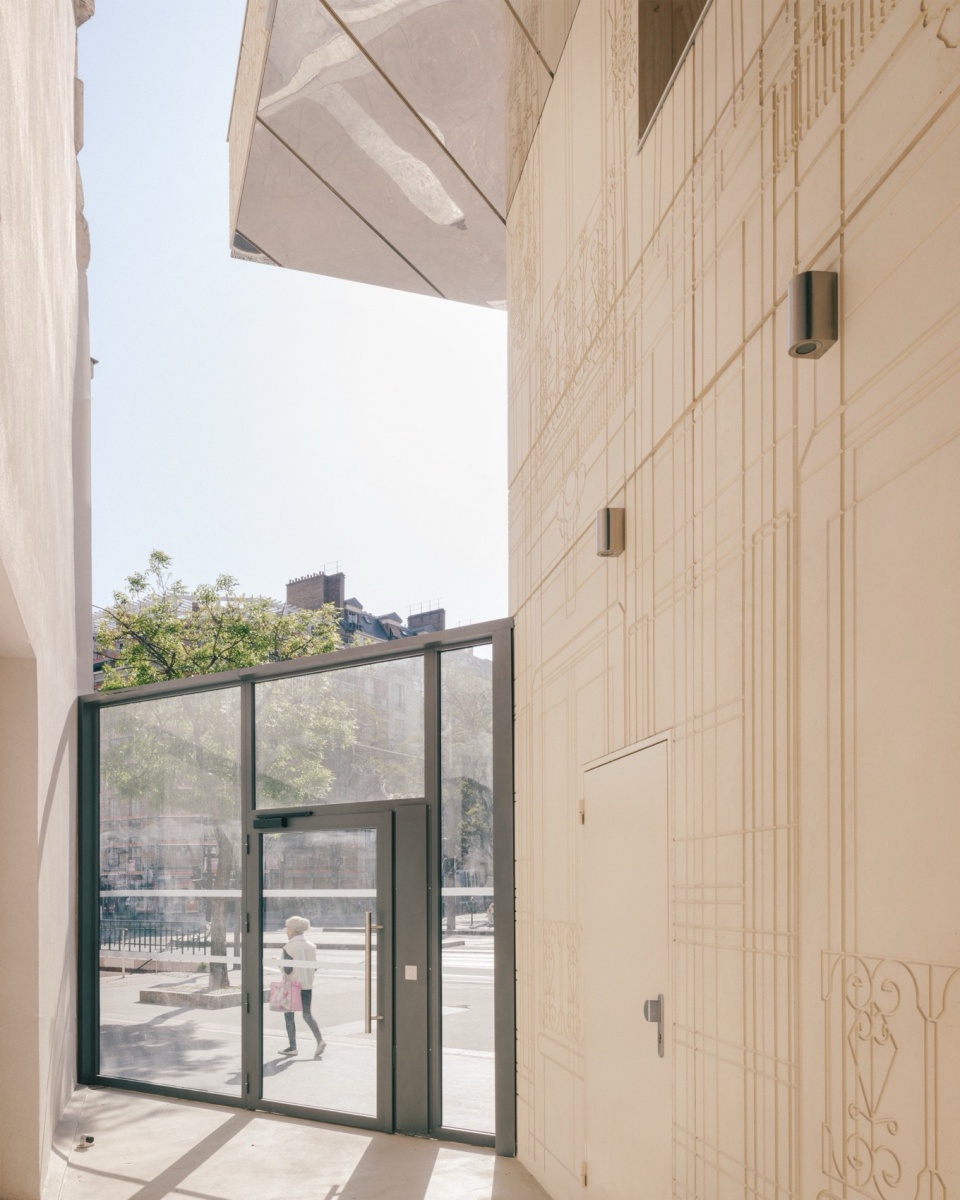
▼沿街入口,entrance from the street
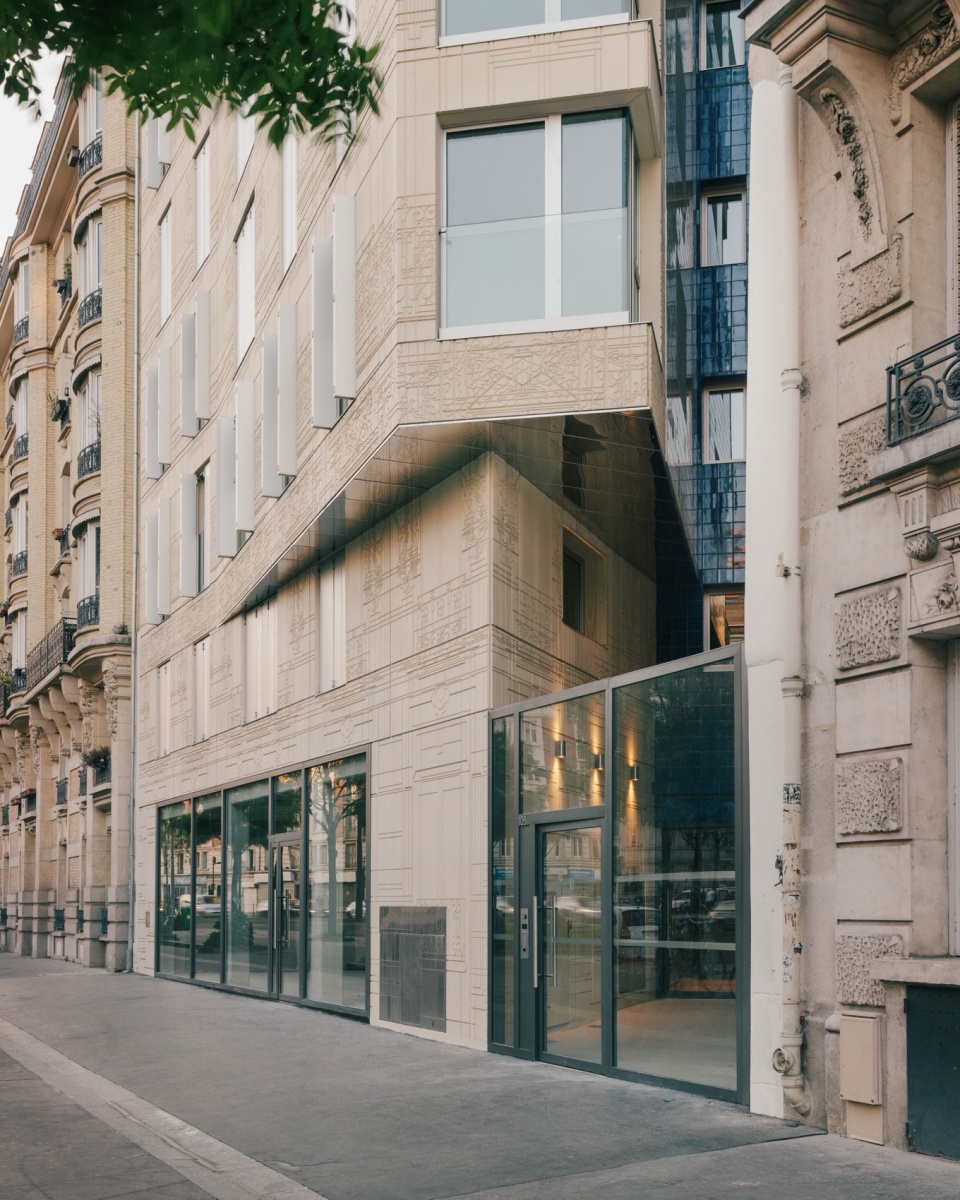
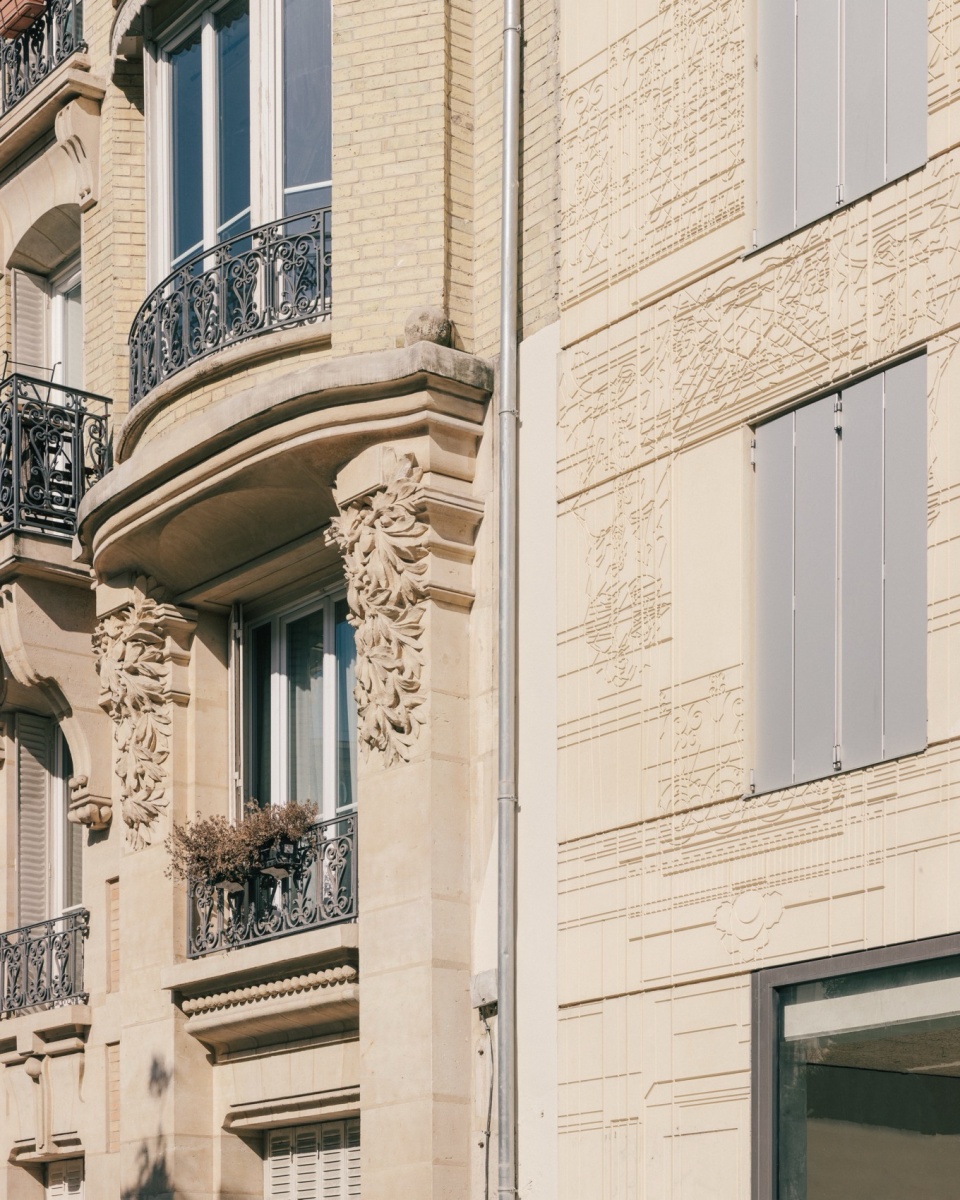
没有什么比一眼就看懂一切更令人沮丧……本项目在材质与装饰之间玩味着模糊性,通过在整个立面上使用矩阵化混凝土实现。通过叠加并重复邻近建筑的图案,立面在自身材质中找到了一种新的装饰语言,使其呈现出多重解读的可能性:远观时,只感受到一种振动感;走近时,开始辨认出某些图案;而当移动时,这些图案又消失,重新成为一种振动的材质。通过这种方式,建筑与周边邻居建立了微妙、时而神秘的联系,避免了“拼贴”或“表面化”的陷阱。这种对装饰的积极再评价,为对精细、边缘及其美学的文化再评价提供了肥沃的土壤,同时也孕育出由此而生的诗意。
Nothing is more frustrating than to have understood everything at first sight…The project plays on the ambiguity between material and ornament, by working with a matrixed concrete on the entire façade. By superimposing and multiplying the drawings of the neighboring buildings, the facade finds a new ornament in its own material, where a multitude of readings are possible: from a distance we only feel a vibration, from close up we begin to recognize certain patterns, then by moving, they disappear to become a vibrating material again. Through this, the building weaves subtle, sometimes mysterious links with its neighbors, avoiding the pitfalls of “pastiche” or “facadism”. This positive revaluation of the ornament creates the fertile ground of a cultural revaluation of the meticulous, of the marginal, of their aesthetics and of a poetry which emerges from it.
▼立面细部,details of the facade
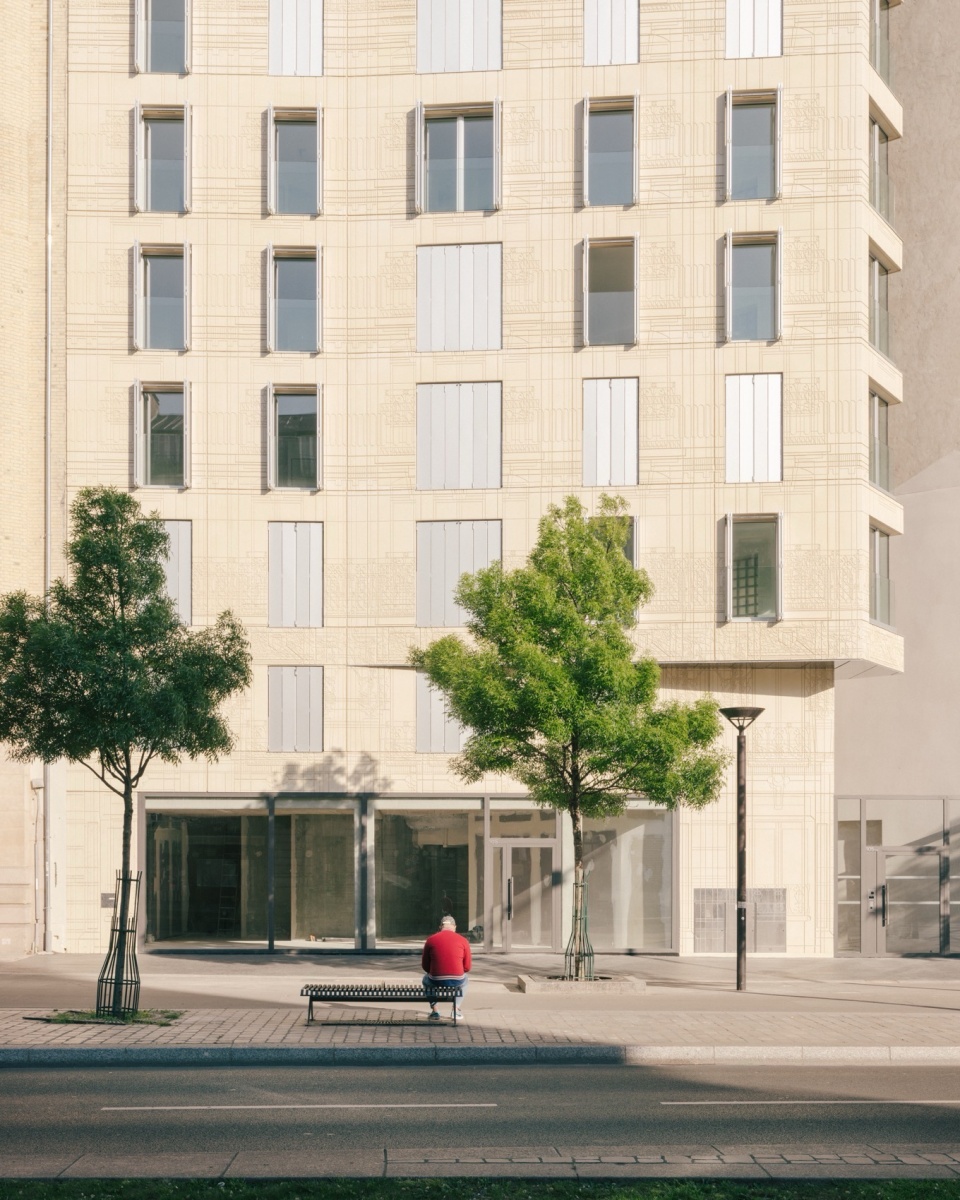
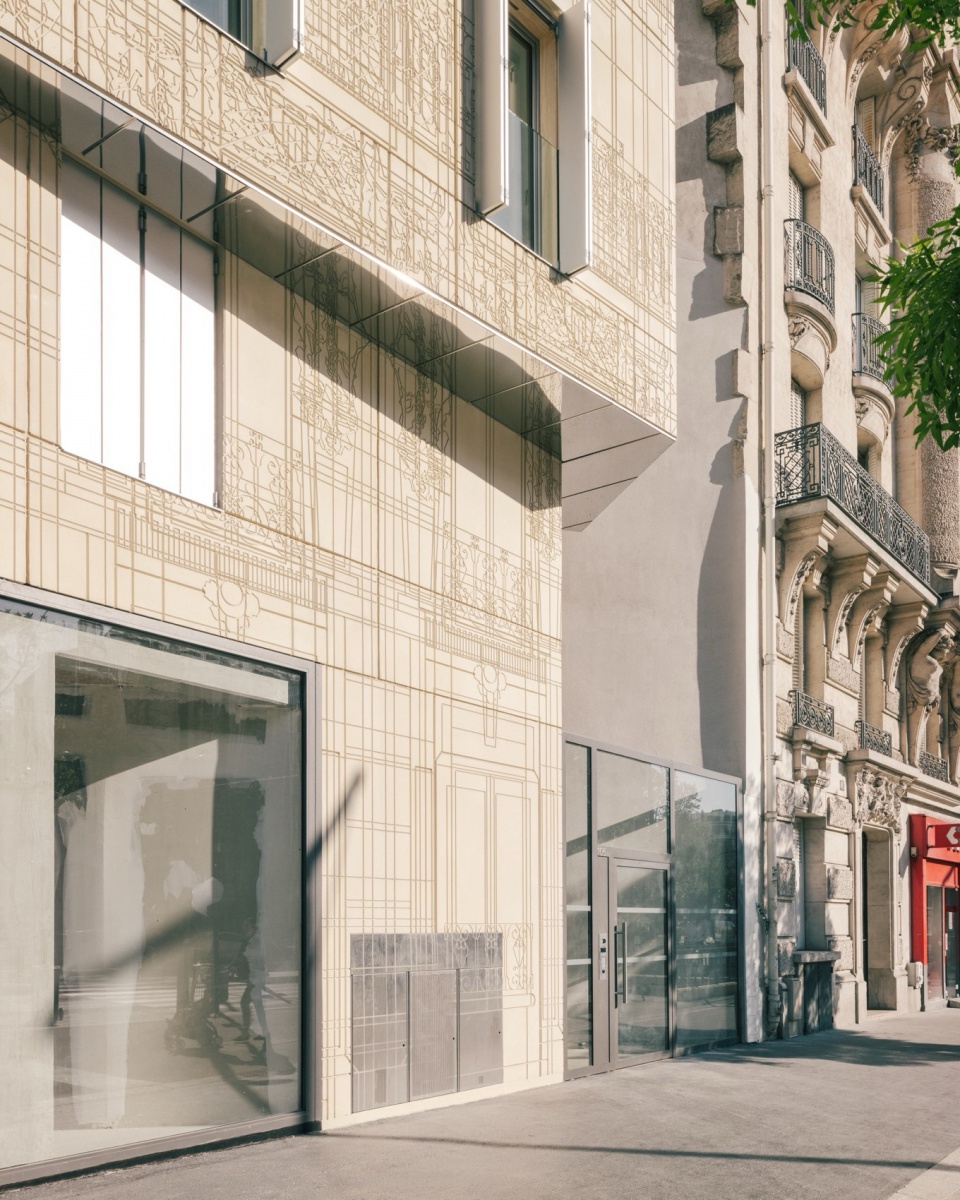
▼新旧对比,
comparison of the old and the new
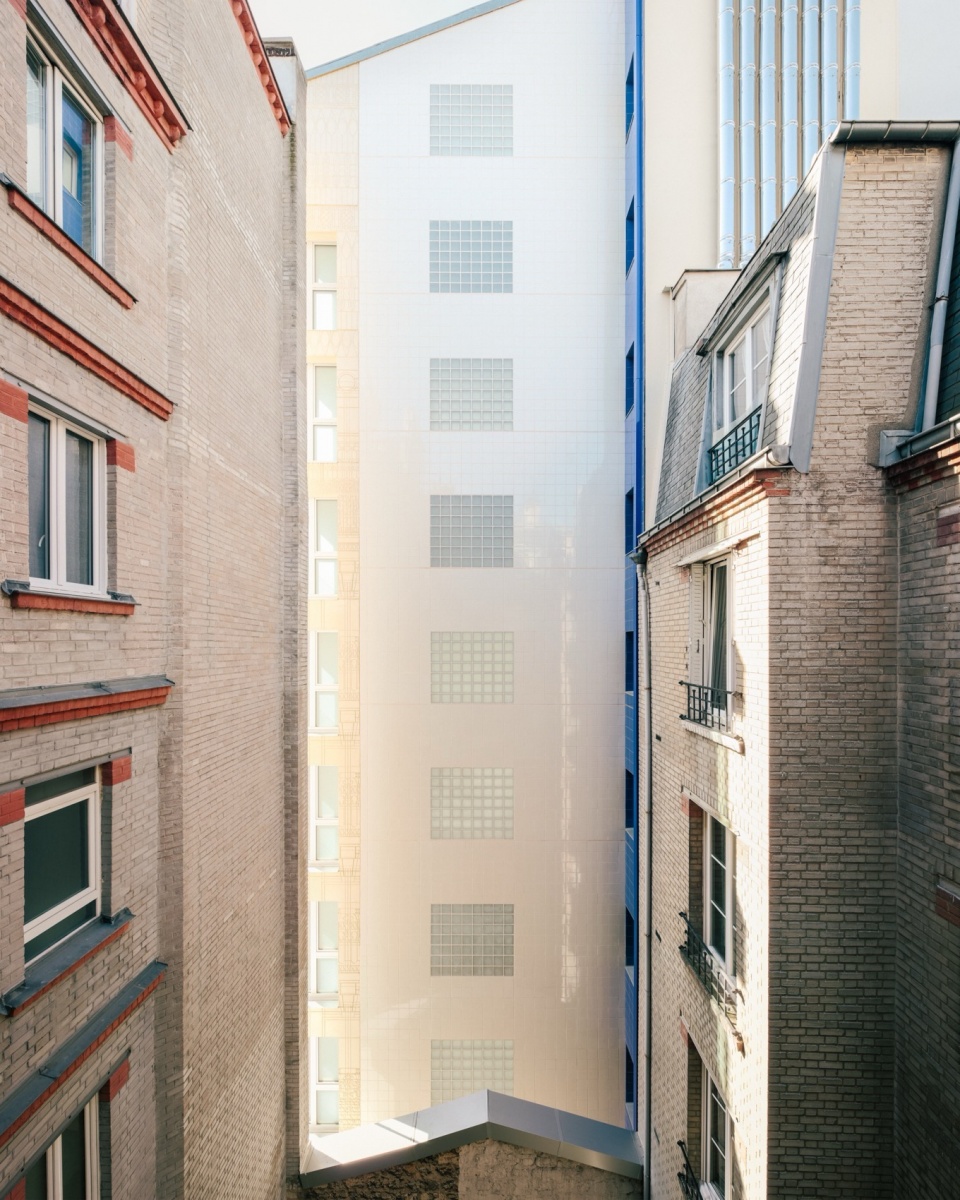
▼楼梯间一侧立面,side facade
居住体验Inhabiting
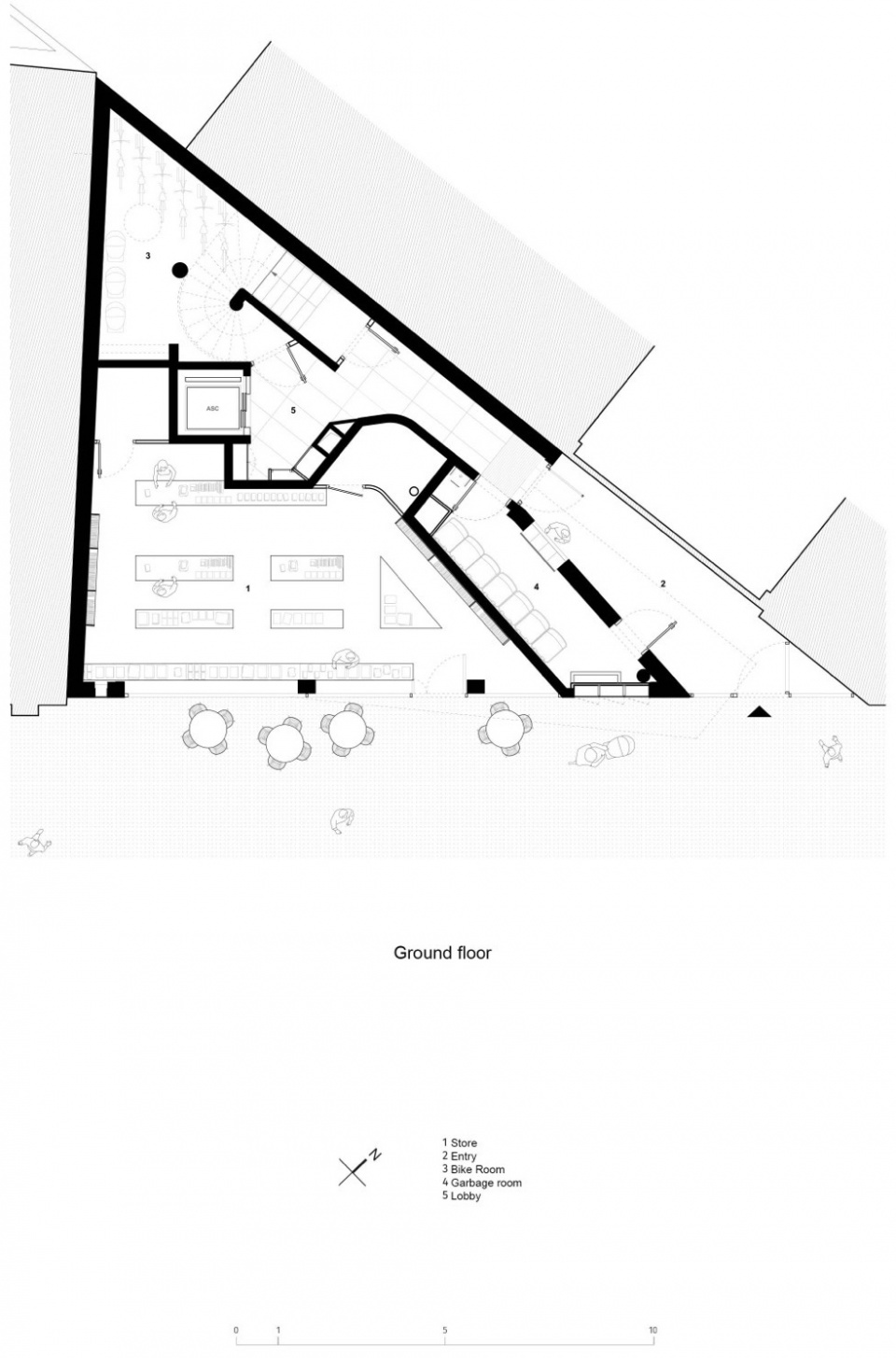
通过在地块核心区域设置“呼吸空间”,本项目创造出能够提供特殊体验的场所,无论是在住宅入口处,还是在公寓内部,都能呈现独特的空间感受。在保持城市整体语境的同时,项目设计了一条动线,并建立了住宅与城市之间自然、直观而机敏的关系。入口自然地位于这一开口处,设有一间双层高的带顶外廊,容纳信箱和自行车架。外廊采用彩色陶瓷印花铺设,呈现出光影图案:这一宽敞而高品质的过渡空间,位于公共空间与建筑共有空间之间,引导人流进入内部的垂直交通空间。
By proposing breathing spaces in the heart of its parcel, the project creates for the establishement of situations capable of offering a particular aspect, both in the accesses to the dwellings and inside the apartments themselves. Still in an urban approach, the project proposes a path as well as opportunistic and obvious relationships between the city and home and vice versa. The entrance, naturally located in the breach, offers a double-height covered exterior hall that houses the mailboxes and the bicycle rack. Worked with a colored ceramic printed with light patterns : generous and qualitative space, in transition between the public space and the common spaces of the building, it leads to the interior vertical.
▼室内概览,overall of interior
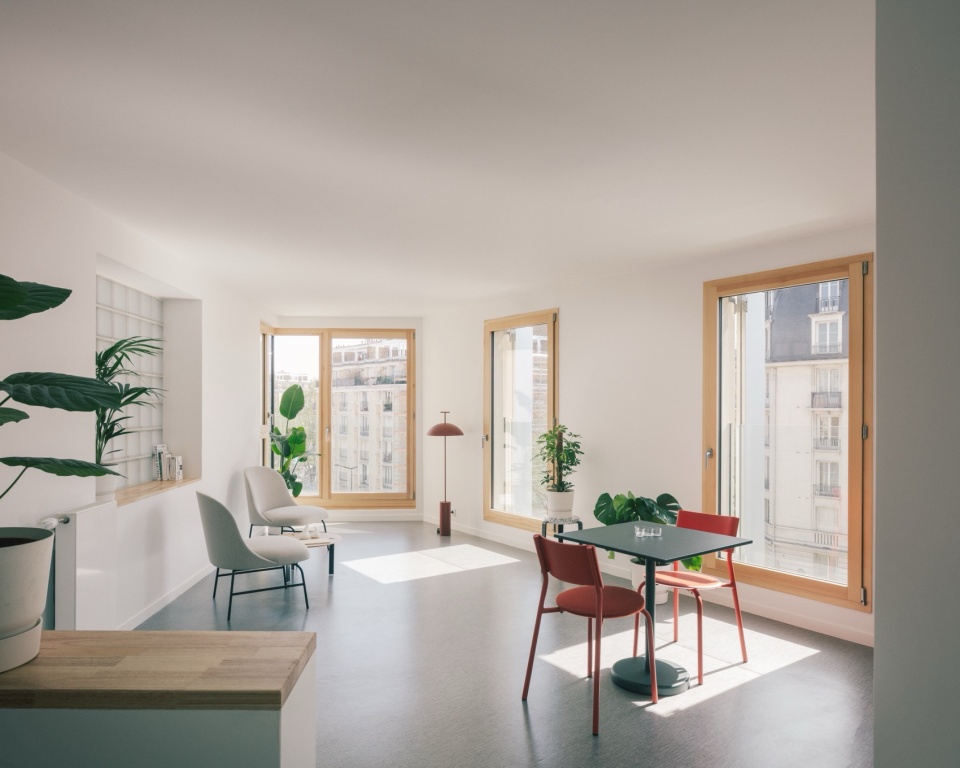
▼所有公寓都朝向街道和庭院双向布局,All the apartments are arranged in a two-way layout facing both the street and the courtyard
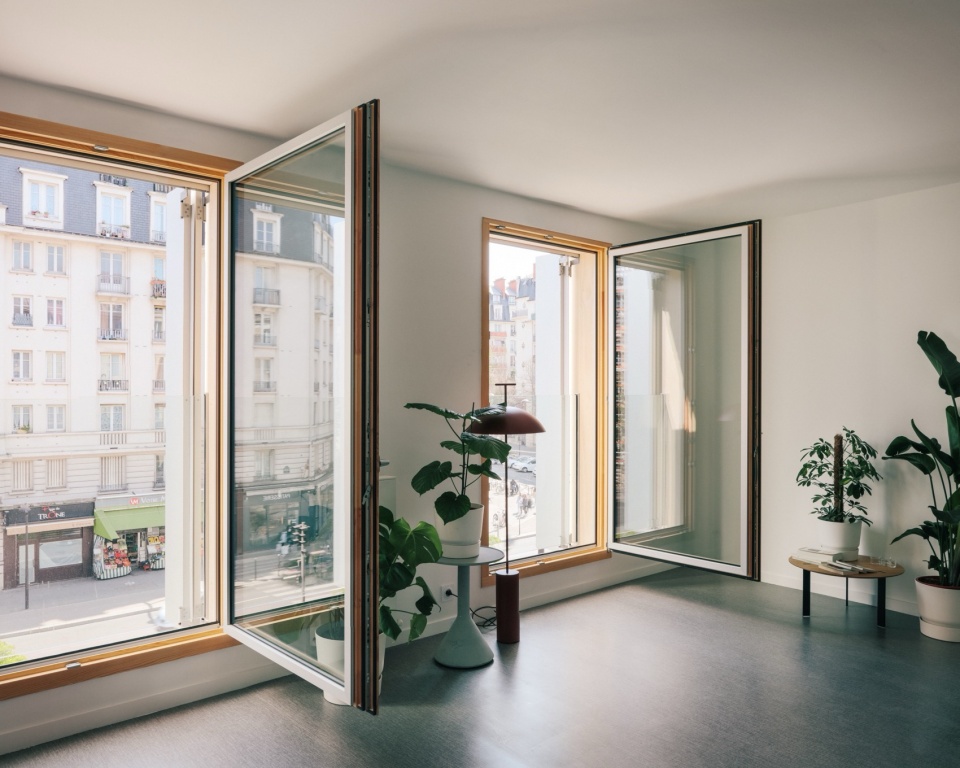
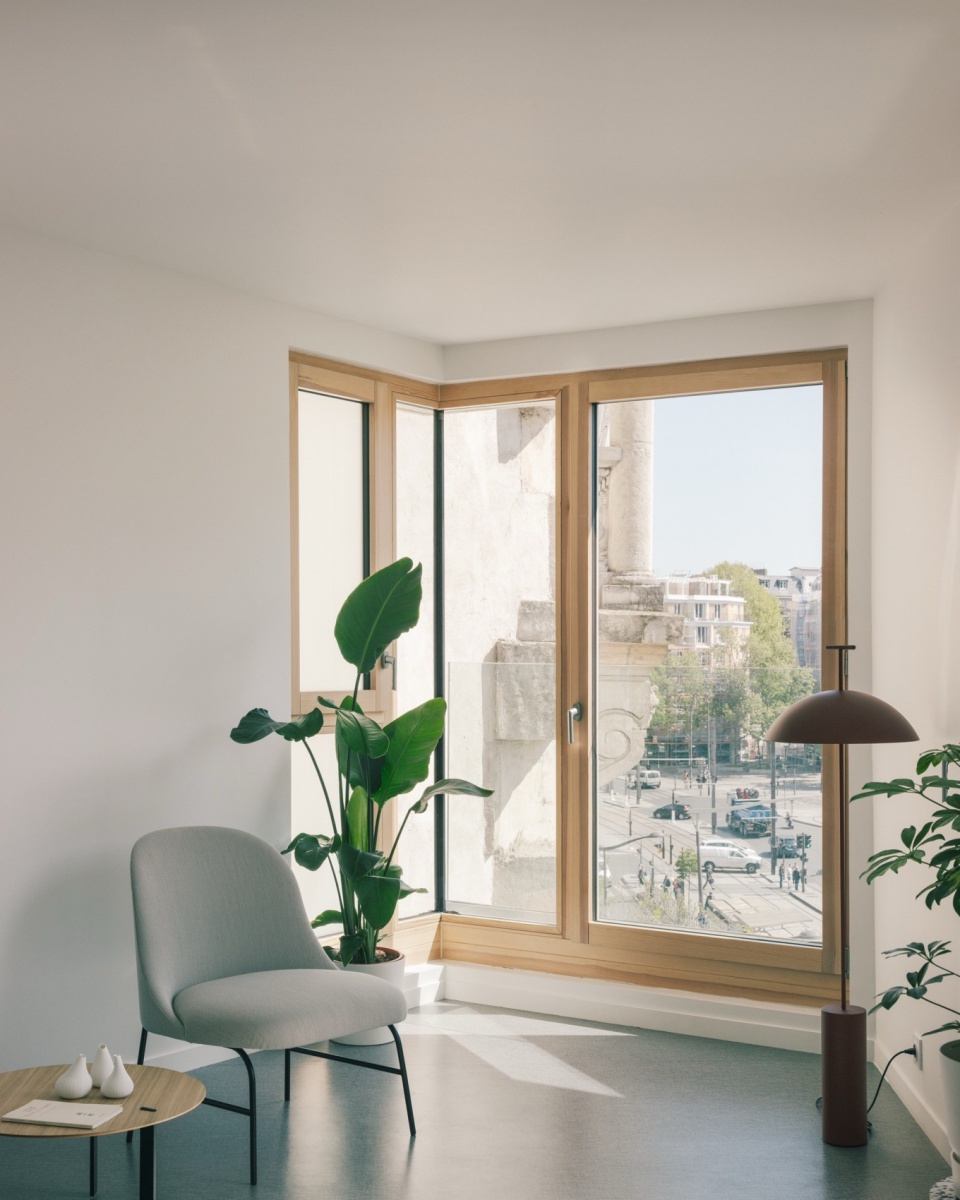
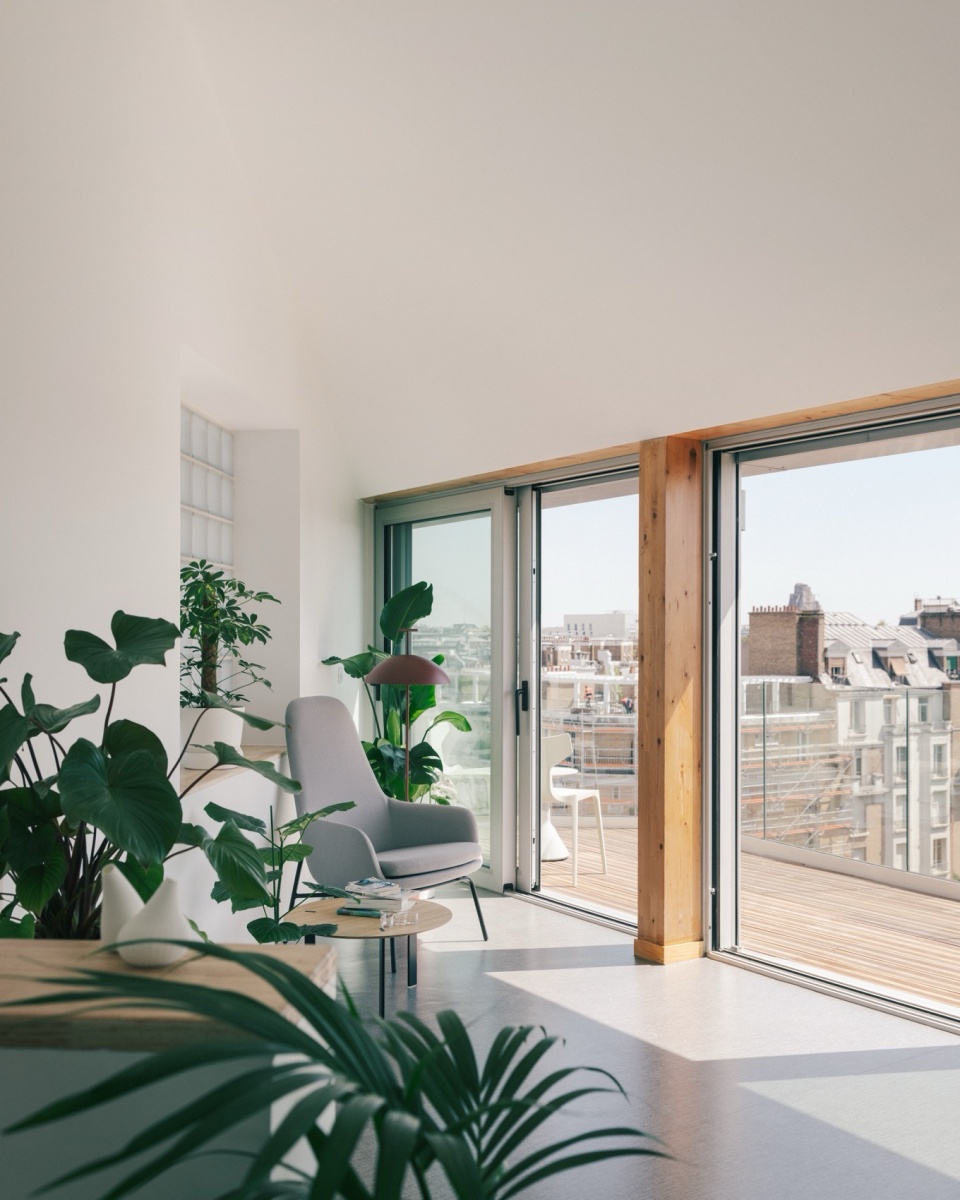
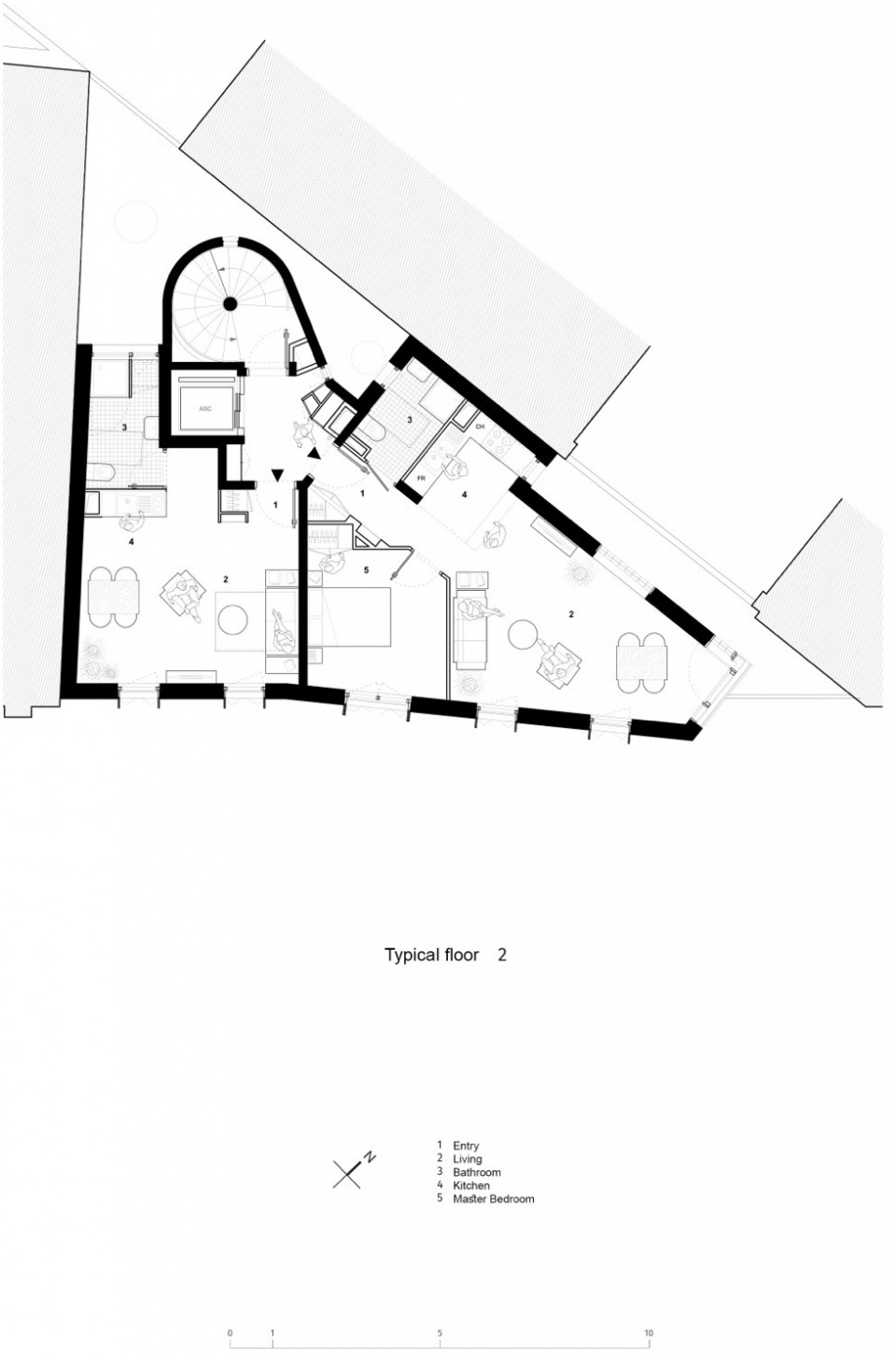
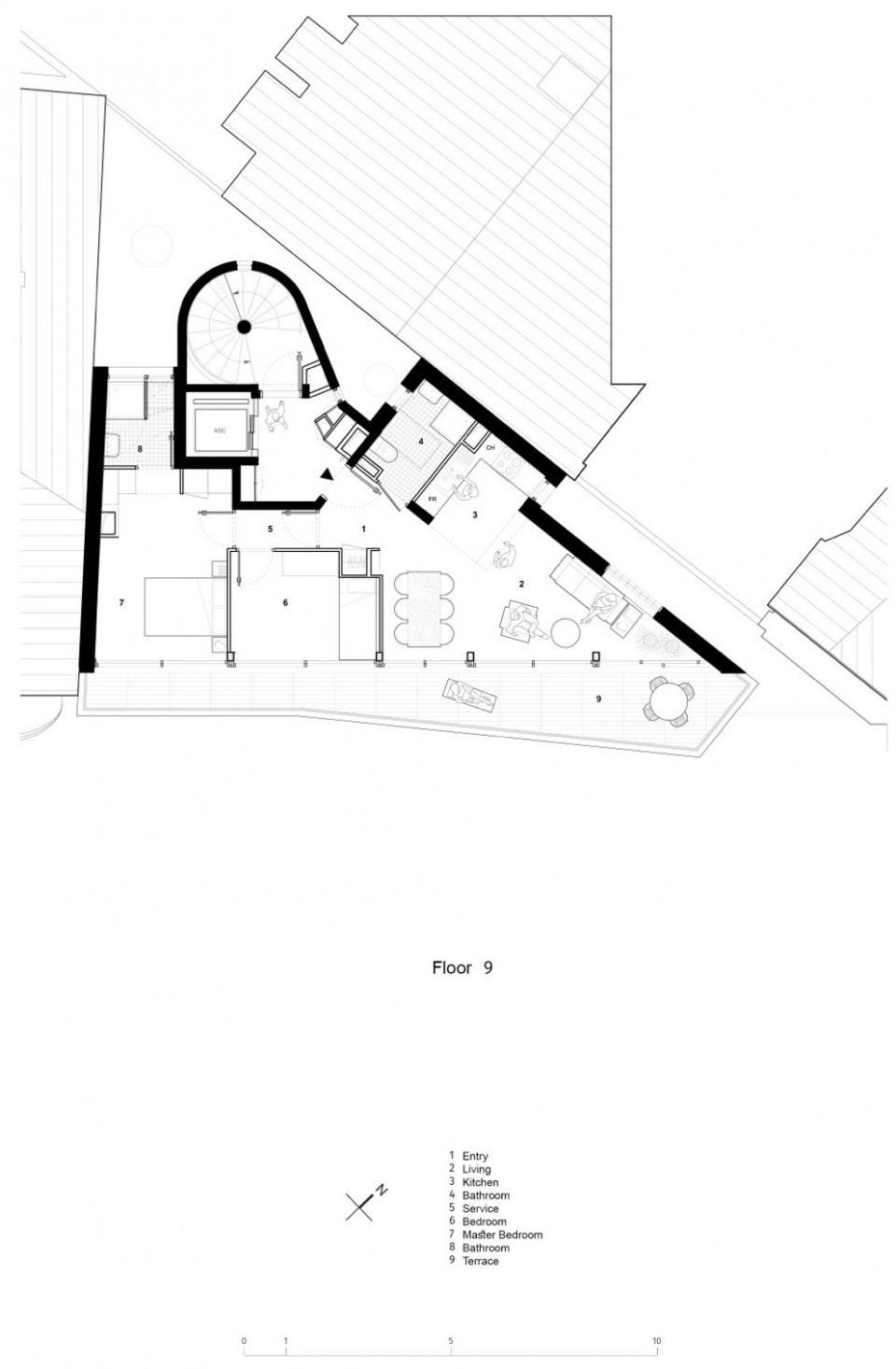
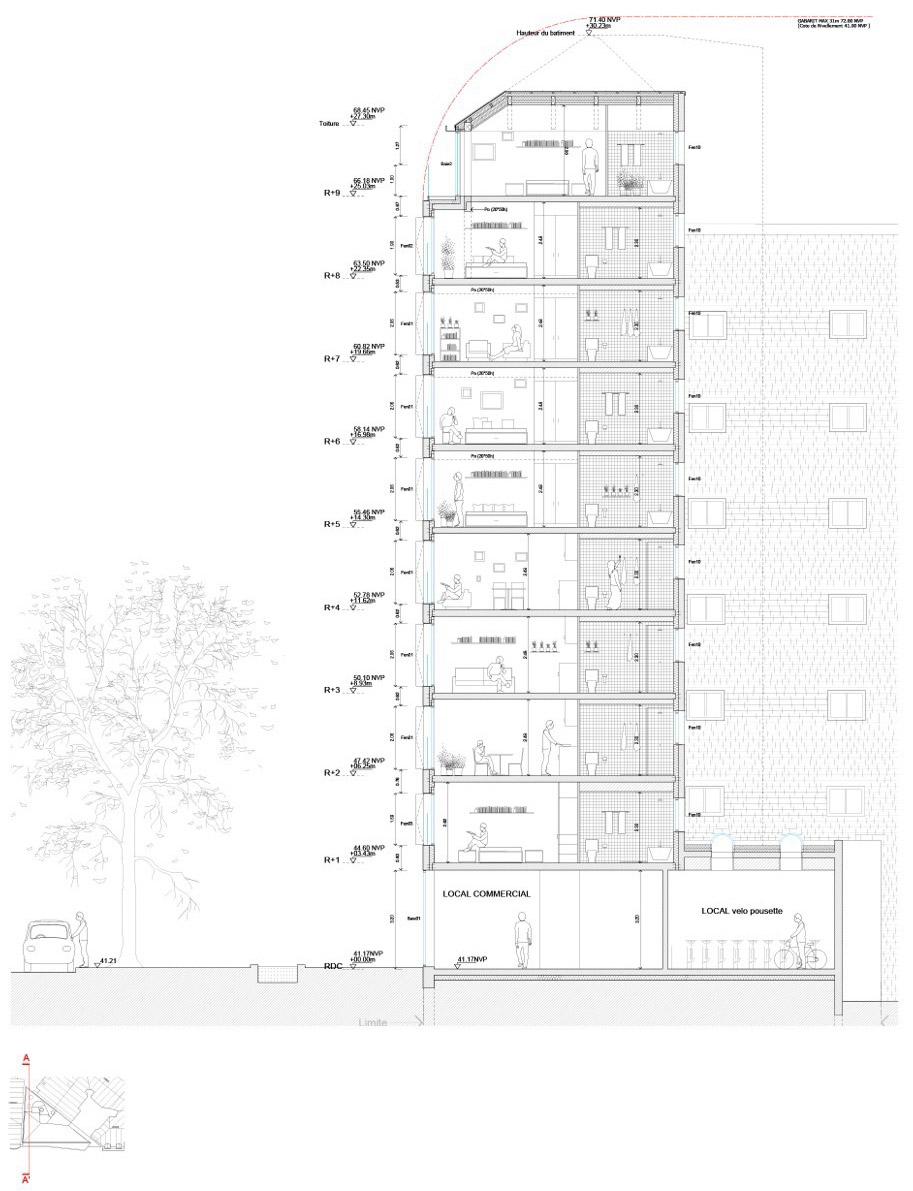
公寓分布在二层至十层,布局清晰:二层为两居室公寓,三至五层每层各设一间单间公寓和一间一居室公寓,六至九层每层为一套三居室公寓,十层为两居室公寓。部分公寓为双向采光,并且所有公寓都朝向街道和庭院双向布局,这是衡量住宅品质的重要特征:所有公寓既能享受街道一侧的阳光,也能感受庭院一侧的凉爽。日间区、夜间区及湿区根据居住者的需求进行战略性布置。因此,厨房、浴室及卫生设施均开向庭院或开口处,保证采光、通风及私密性;卧室位于街道一侧,可享受阳光及大道的无遮挡景观;客厅则位于建筑前端的角落位置,提供面向金门(Porte Dorée)、旺多姆林(Bois de Vincennes)及其传奇猴石(Monkey Rock)的独特视角。
The apartments are located from the second to the tenth floor with a clear distribution: a two-bedroom appartment on the second floor, a studio and an one-bedroom appartment on each floor from the third to the fifth, a three-bedroom appartment on each floor from the sixth to the ninth and finally a two-bedroom appartment on the tenth floor. There are dual-aspect apartments and all have a double orientation on the street and on the courtyard, a fundamental characteristic in the quality of a dwelling: all the dwellings can benefit from the sun on the street side as well as from the coolness of the courtyard. The day, night and wet spaces are strategically located according to the needs of each individual. Thus, the kitchen, bathroom and sanitary facilities open onto the courtyard or the breach, offering light, ventilation and privacy; the bedrooms, on the street side, benefit from the sun and the unobstructed views of the boulevard; the living rooms benefit from the front end of the building, situated at an angle, offering unique perspectives towards the Porte Dorée, the Bois de Vincennes and its legendary Monkey Rock.
▼顶层公寓,the top floor apartment
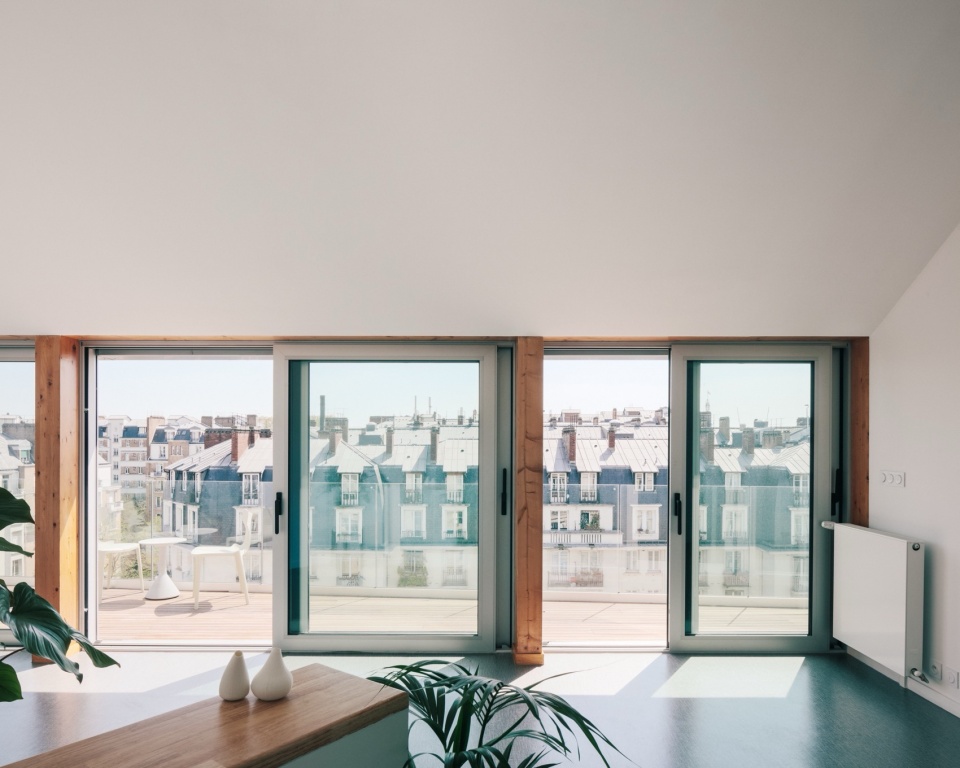
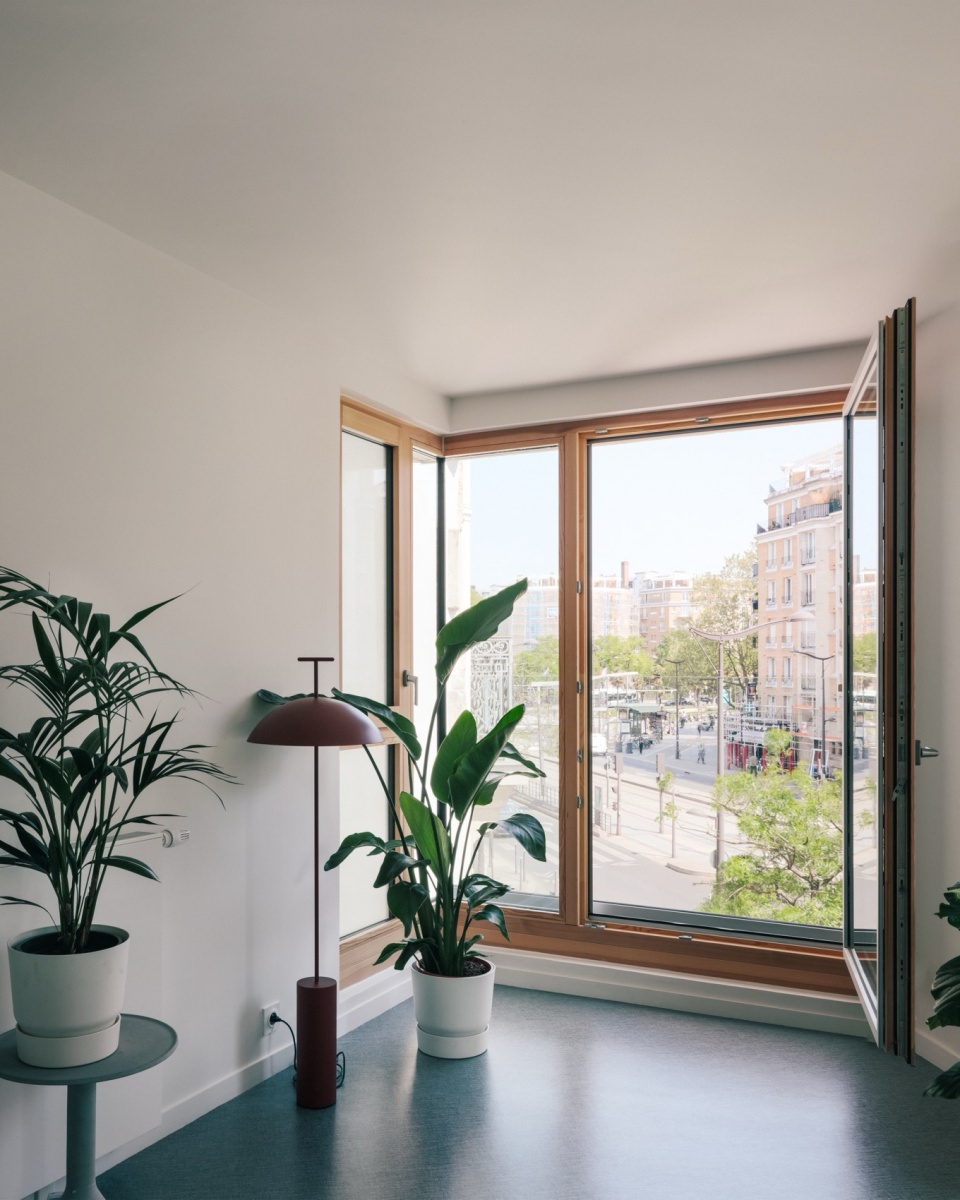
▼角窗,corner window
▼阁楼,loft
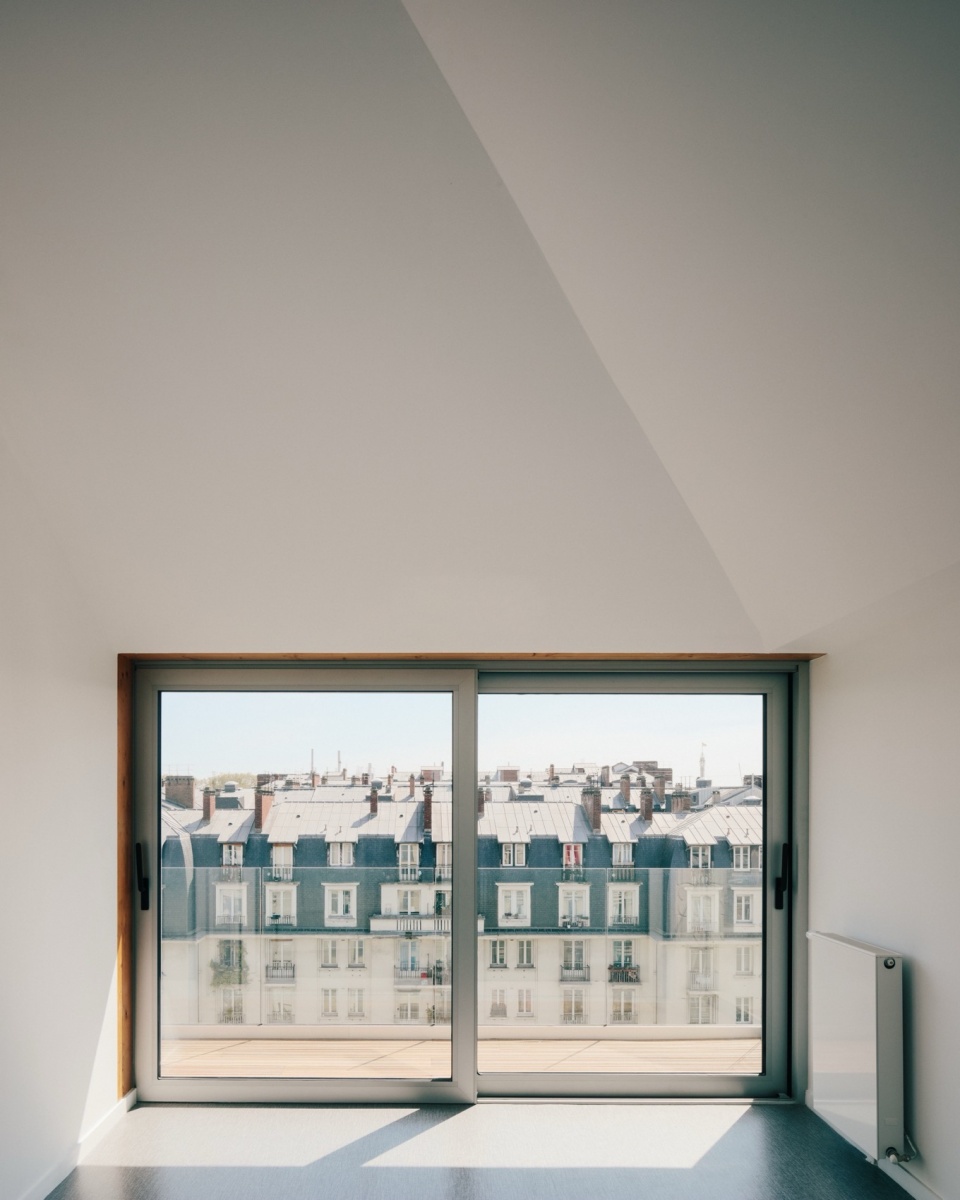
开口与视野的设计依据其朝向及室内功能进行:
-面向庭院和开口处的窗户为单独设计。根据使用需求,可为透明、半透明或法式开启窗,并可旋转以改善通风。
-面向街道的立面通过单窗与双窗交替排列,形成节奏感。百叶窗和玻璃栏杆装饰这些开口,在保证私密性的同时,通过百叶窗的镜面反射效果或按照需求与遮阳要求框定视野,扩大视觉感受。
-在开口处的转角,所有客厅均设有悬挑的拐角窗,面向大道,形成独特景观(Porte Dorée、Bois de Vincennes)。这一开口不仅拓展了公寓的空间感,也让居住者在家中便可感受到超越住宅边界的环境。
The openings and views are worked according to their orientation and interior uses:
-On the courtyard and the breach, the windows are individually designed. Transparent, translucent, French-style opening, pivoting for better ventilation, depending on the use.
-On the street, an alternation of single and double windows creates a rythm on the facade. Shutters and glass railings decorate these openings creating privacy, views dilated by the mirror effects of the shutters or framed according to the desires and the solar protection.
-On the corner of the breach, all the living rooms benefit from a corner window cantilevered onto the boulevard to frame singular views (Porte Dorée, Bois de Vincennes). This opening allows a dilation of the space of the apartments and finally to be at home, while being in an environment that exceeds the limits of its housing.
▼露台,terrace
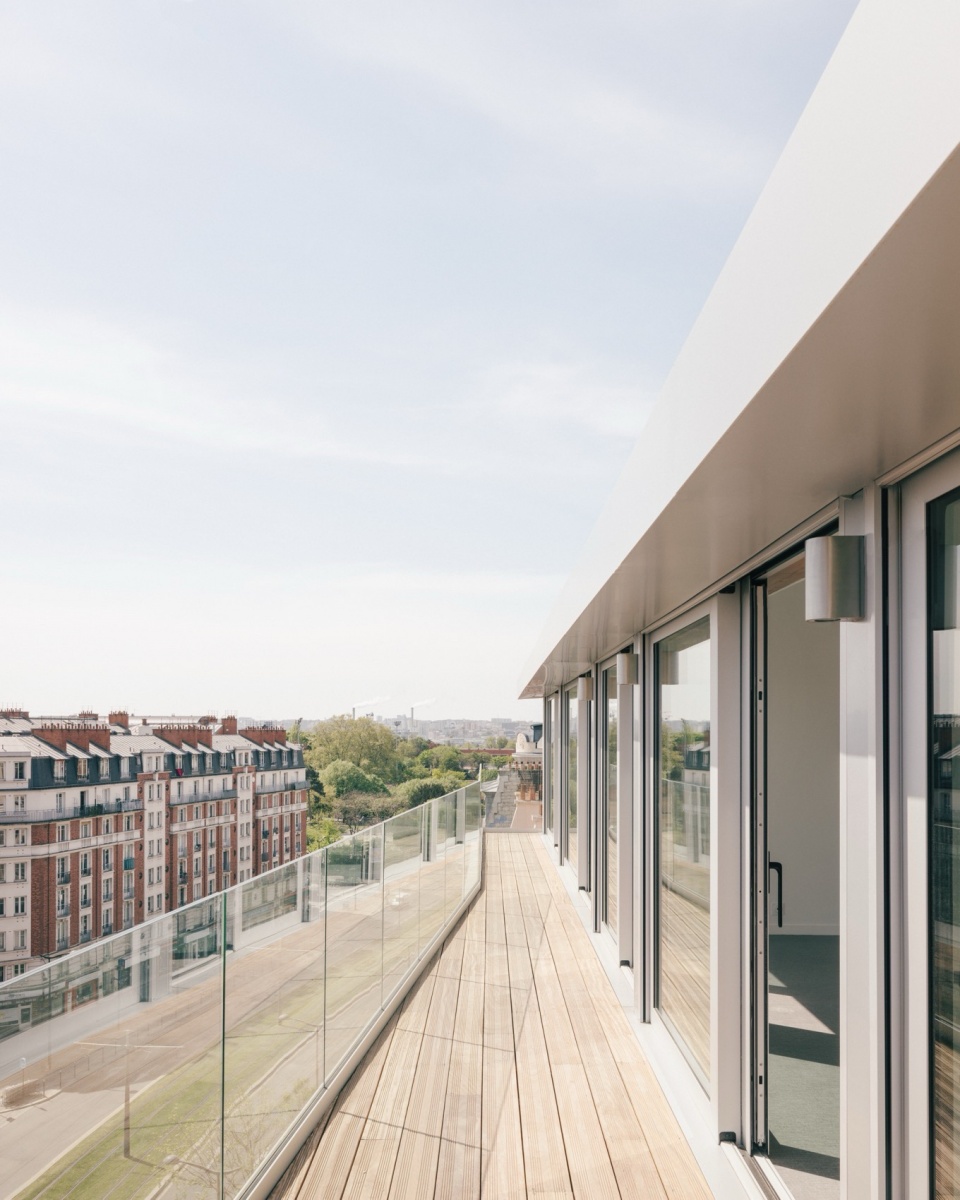
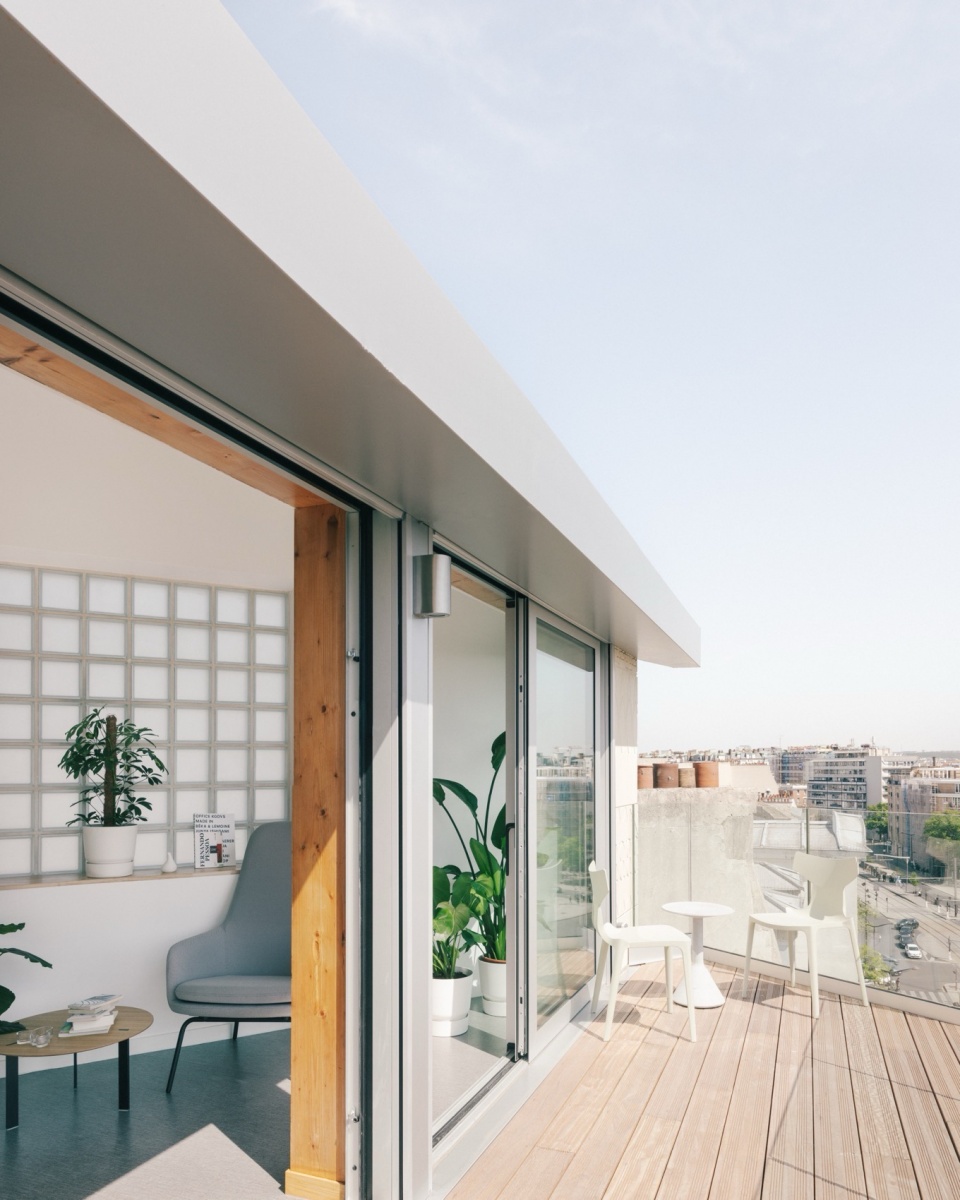
因此,本项目旨在将看似的约束转化为契机,从而提出针对特定场地的回应方案。由建筑之间的呼吸空间(自然采光与通风)产生了城市冲突;由公共空间的品质衍生出项目的尺度,形成清晰的城市连续性;由与周边建筑的关系产生了立面的节奏感和充满活力的材质……在这一切历史中,孕育出了住宅的品质。同时,本项目并非一个通用的设计行为,而是针对特定历史与情境的具体设计行动,需要被精心构思并最终被居住。
The project thus seeks to transform what may appear as constraints into opportunities to define a response specific to this place. Thus, urban conflicts are born from the breathing space between the buildings (natural light and ventilation). From the quality of the public space is born the scale of the project in a clear urban continuity. From the relationship with the buildings is born a rhythm of facade, a vibrant material, … From all this history is born the quality of housing. Also, this project is not a generic act, but a specific act in relation to a history, a situation, that must be designed… Inhabited.
▼入口庭院,entrance yard
▼底层平面图,ground floor plan
▼标准层平面图,typical floor plan
▼顶层平面图,top floor plan
▼剖面图,section
Delivery: 2022
Area: 733 m²
Cost: undisclosed
Specific features: NF Habitat
Effinergie+
Plan Climat de la ville de Paris
Client: RIVP
Architect: MARS Architectes
Engineers: LGX
Technical inspection: BTP Consultant
H&S coordinator: Becs
Geotechnical engineer Botte Sondages
Building company: Tempere construction
Environmental assistance to the contracting authority: Citae