日常项目深度报道:Mission Bay & Uber总部大楼 / SHoP建筑事务所
出品人:向玲 | Producer: Xiang Ling编辑:石安,司源,张笑然,翁畅妍,闫帅朗 | Editor: Shi An, Si Yuan, Zhang Xiaoran, Weng Changyan, Yan Shaluang
OpenAI于2025年3月10日正式启用位于旧金山Mission Bay 的新办公空间,而这处空间正位于Uber总部大楼之中。作为未来科技代表企业之一,OpenAI为何选择这个建筑作为新办公空间?作为本项目的建筑设计师,我们将以旧金山Mission Bay的Ube总部为线索,尝试讨论一个更值得被重新理解的问题:当科技企业重新进入城市中心区域,建筑应如何重新建立与街区、气候和共享空间之间的关系。
OpenAI officially opened its new office in Mission Bay, San Francisco, on March 10, 2025, located within the Uber Headquarters. As a leading company shaping the future of technology, its choice of workplace raises a broader question. Rather than focusing on the building itself, this project offers an opportunity to reconsider how architecture operates when tech companies return to the urban core. Using the Uber Headquarters in Mission Bay as a point of reference, the discussion shifts toward how a workplace can re-engage with its surrounding district, respond to climate, and participate in a shared spatial environment.
海风与街区 Sea Breeze and the District
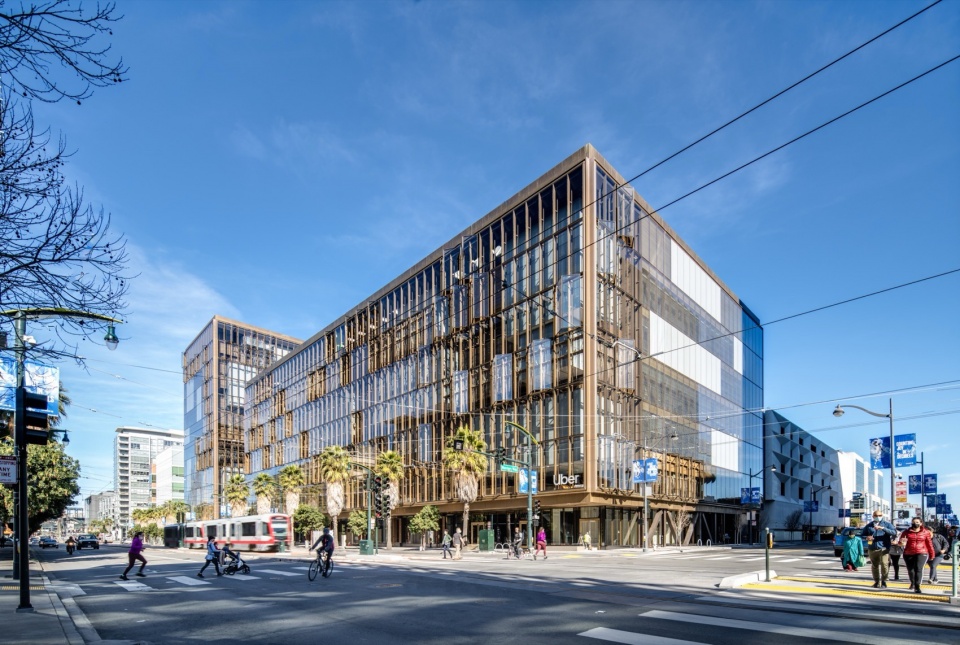
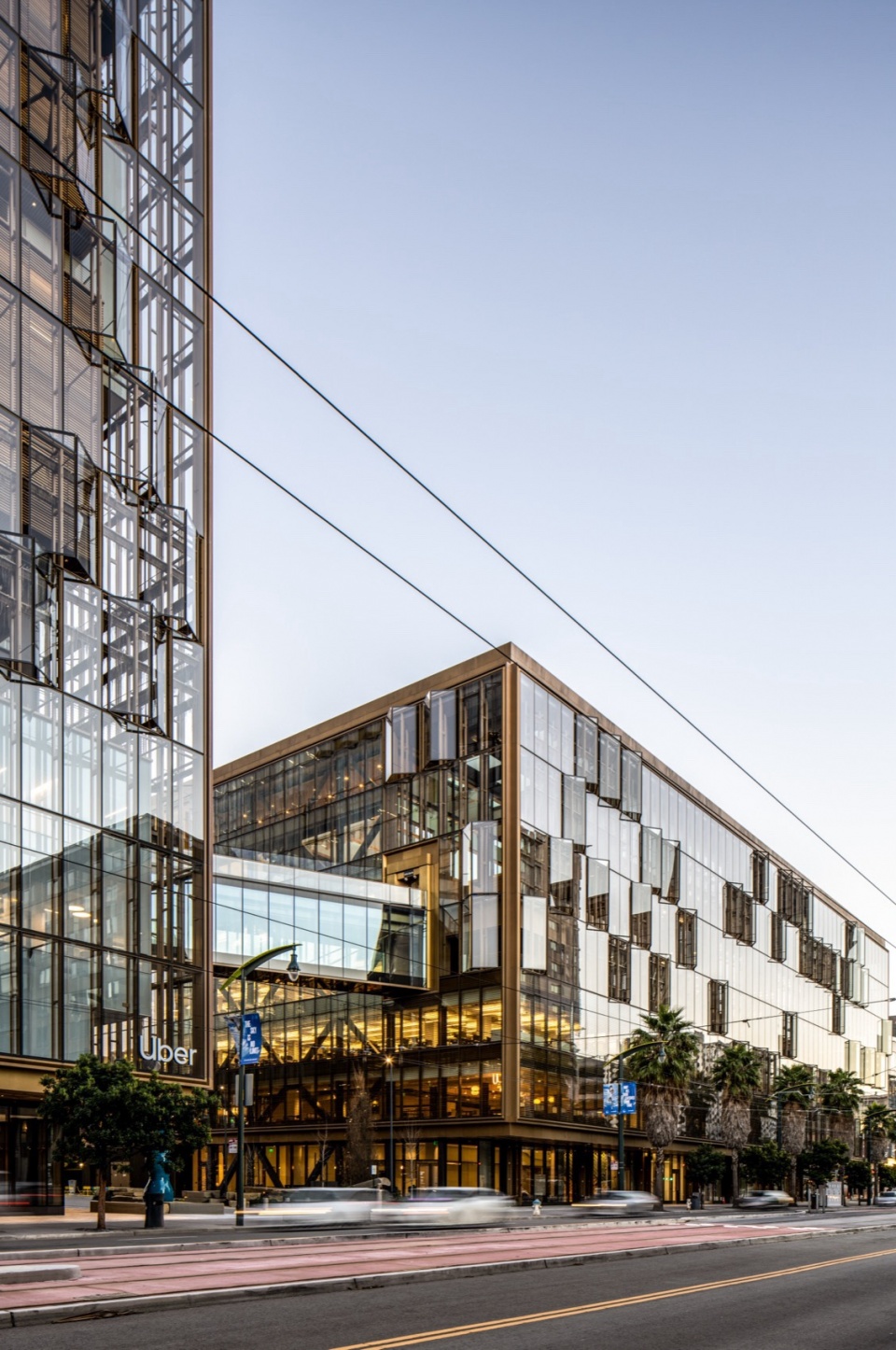
上午十点,旧金山的风从海湾吹向Mission Bay。有人推着自行车经过,也有人在街角的咖啡店外停下来聊天。远处的电车沿着 Third Street 缓慢驶过,阳光落在新建街区的外立面上在反射到街区。和旧金山的市中心相比,Mission Bay的生活、工作节奏更为安静,也更像一片在逐渐成形、富有生机的城市新社区。我们为Uber打造的总部就位于街区转角的位置,它更像城市结构的一部分,与城市融为一体,而不是一个被单独放置在街区里的企业总部。如果把时间倒退5-10年,这样的总部形式并不常见。那时更典型的企业总部,包括科技行业,往往会偏好选址在城市边缘的大面积地块上。
At 10 a.m., the wind moves in from the bay toward Mission Bay. People pass by with their bicycles, while others pause outside a corner café to talk. In the distance, the light rail moves slowly along Third Street. Sunlight reflects off the façades of the new buildings and spills back into the street. Compared to downtown San Francisco, the pace here is quieter—more like an emerging neighborhood, gradually taking shape. The Uber Headquarters sits at a street corner, positioned as part of the urban fabric rather than as a standalone corporate object. Instead of being set apart, it engages directly with the surrounding streets and public life. A decade ago, this type of headquarters was less common. At the time, many corporate campuses—including those in the tech industry—favored large sites at the urban edge.
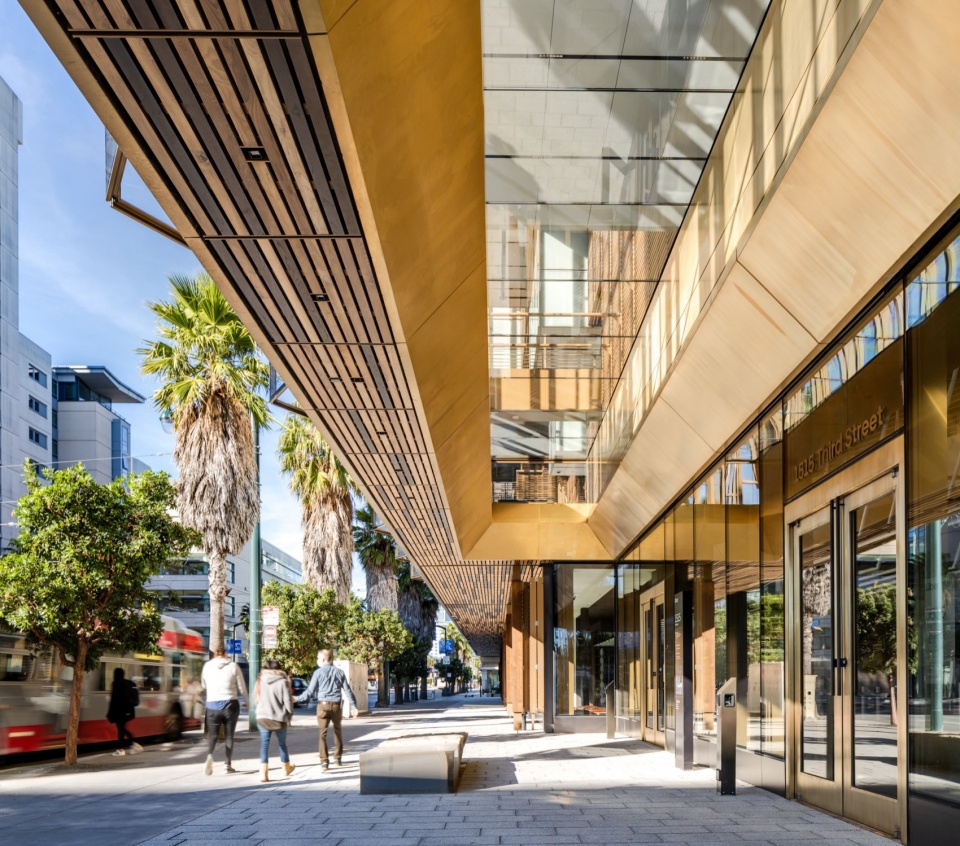
▼Uber 总部位于 Mission Bay 街区转角,以分解后的体量与开放的街道界面重新进入城市,The Uber headquarters sits at a corner in Mission Bay, re-engaging the city through fragmented massing and an open street interface
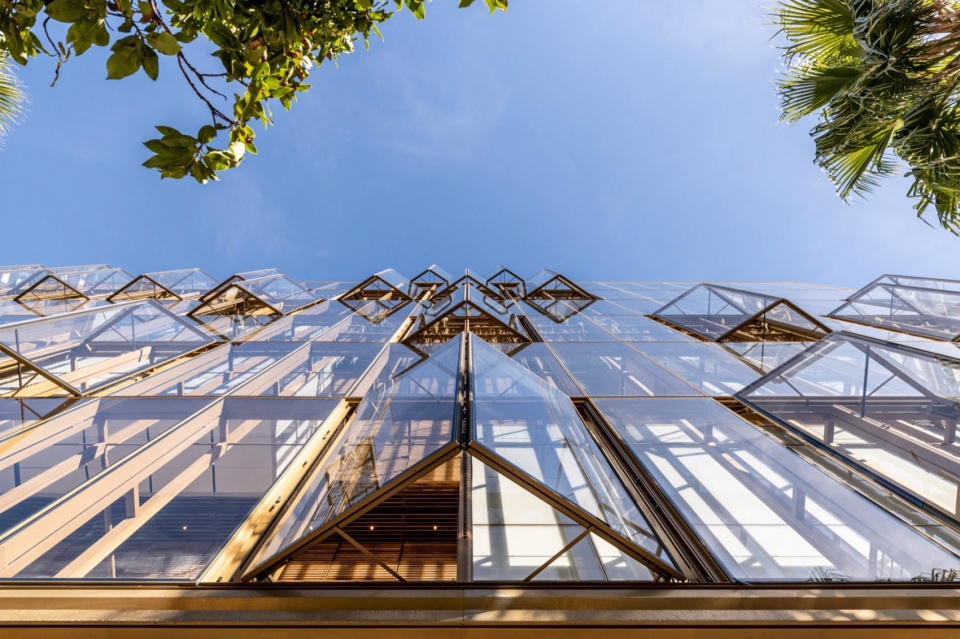
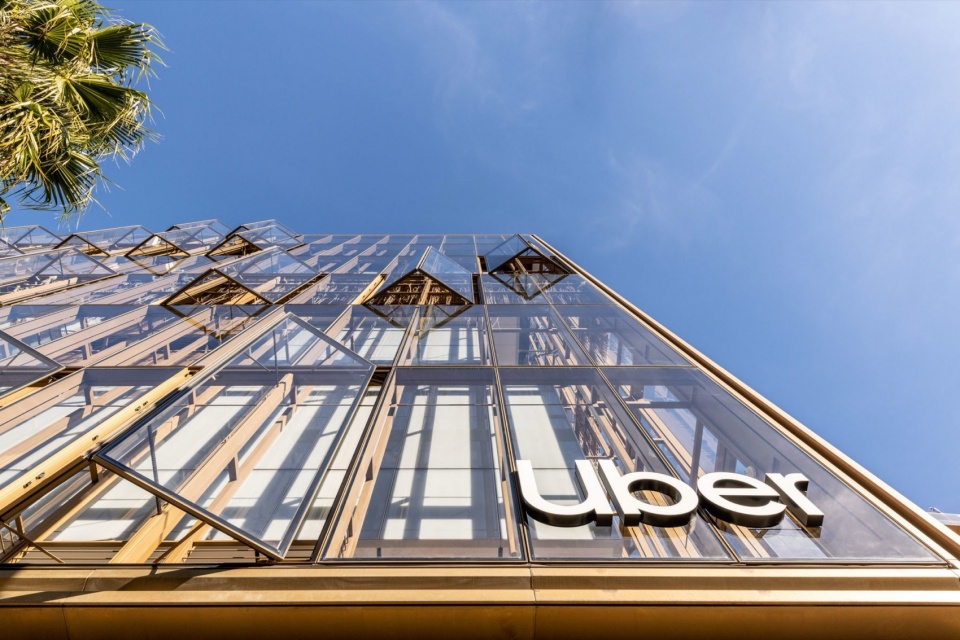
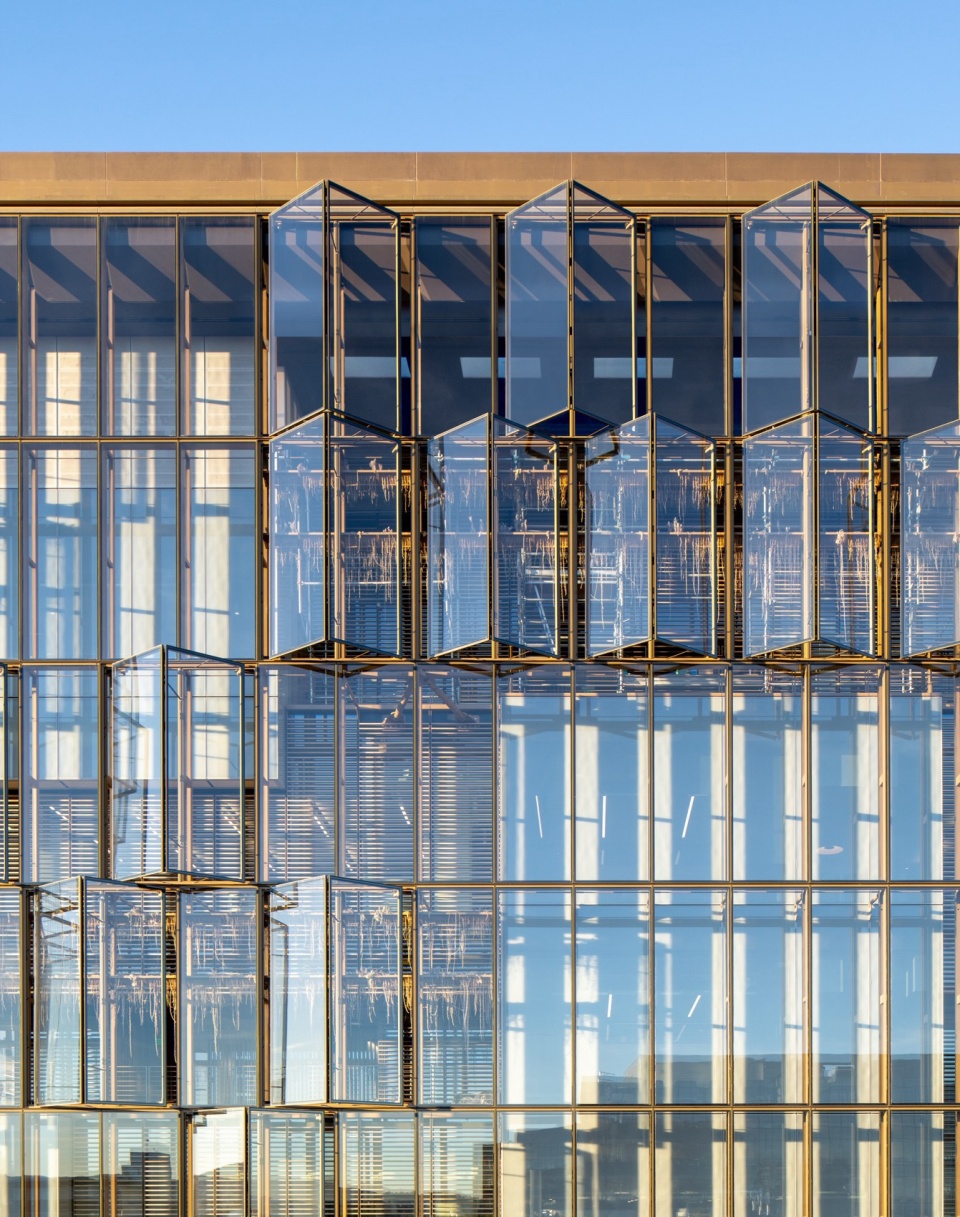
▼可开启立面与楼宇系统联动,使建筑表皮成为一层可调节的环境界面,Operable façades work in tandem with building systems, turning the envelope into an adjustable environmental interface
当总部不再远离城市 When Headquarters No Longer
Move Away from the City
典型的硅谷企业园区大多建立在一大块新片区之上,通过统一规划把办公、餐饮、休闲和交通系统整合进同一个边界。建筑层数低,呈水平展开,强调效率、扩展性,以及企业对空间环境的整体控制。这种模式在产业快速增长阶段非常有效。企业可以在园区内部构建一个高度自给自足的系统,员工的大部分工作与日常活动都在这片边界之内完成,通过集中供应,解决员工、创业者等日常需求,讲究效率。但随着产业环境变化,这种空间模式也开始显露出局限。随着AI与更多创新领域的突破,未来的经济活动,人的创新与灵感越来越重要,各行业也越来越依赖知识交流、跨领域合作,以及与大学、研究机构、创业公司和资本网络的持续连接,而这些关系往往发生在城市核心区域中,总部也因此不再只是企业内部的效率机器。
从趋势上,我们可以看到过去十多年里,越来越多科技企业重新审视选址的考量,更加重视员工的生活与激发他们的灵感,他们越来越多考在城市核心区域设立总部,它们开始面对与街区、公共空间和城市密度的关系。Uber 把总部放在旧金山 Mission Bay,而不是继续沿着传统硅谷路径向郊区展开,这个决定本身就已经说明问题。
The typical Silicon Valley campus is built on large, newly developed sites, where office, dining, leisure, and transportation are consolidated within a single boundary. These environments are generally low-rise and horizontally organized, prioritizing efficiency, scalability, and full control over the workplace. This model proved highly effective during periods of rapid growth, allowing companies to operate as self-contained systems in which most daily activities take place within the campus. As the industry evolves, however, its limitations have become more apparent. With advances in AI and other emerging fields, innovation increasingly depends on human creativity and exchange. Work is now more closely tied to collaboration across disciplines and to ongoing connections with universities, research institutions, startups, and capital networks—relationships that are typically embedded in urban centers. In this context, the headquarters is no longer simply an آلة of internal efficiency.
Over the past decade, more tech companies have begun to reconsider where and how they locate. Greater emphasis is placed on quality of life and on environments that support inspiration. Increasingly, headquarters are moving back into the urban core, where they must engage with the surrounding district, public space, and urban density. Uber’s decision to locate its headquarters in Mission Bay, San Francisco—rather than following the conventional path of suburban expansion—reflects this shift.
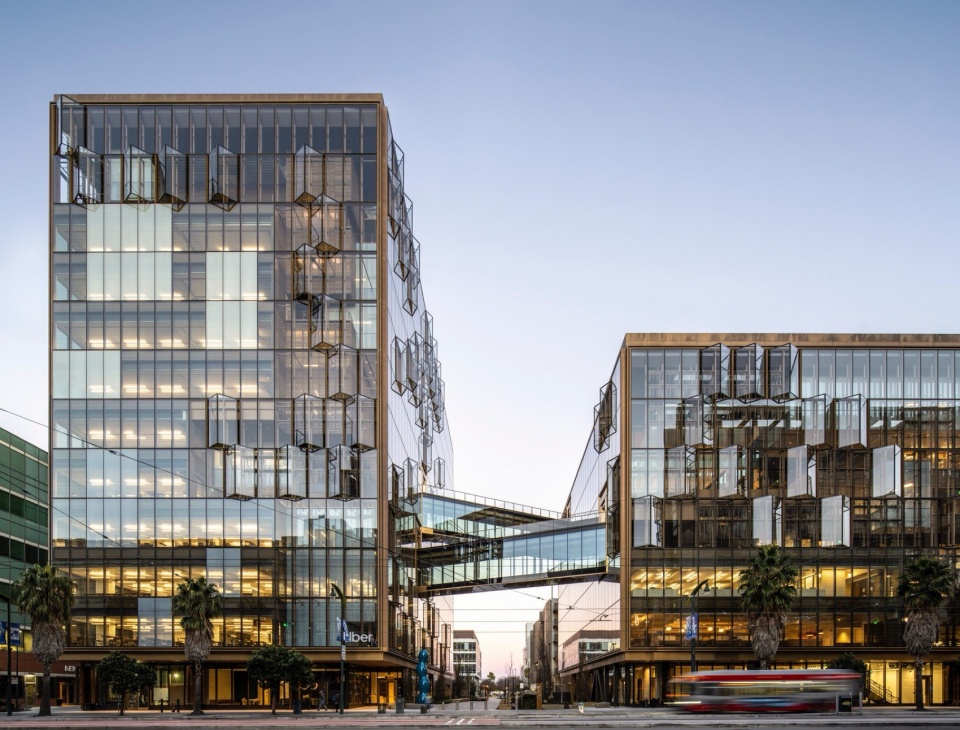
▼项目由两栋高低错动的体量组成,中间形成一段街巷式步行空间,使总部重新回到街区尺度之中,The two offset volumes define a narrow, street-like space between them, bringing the headquarters back to the scale of the district
Mission Bay的新结构 A New Urban Structure in Mission Bay
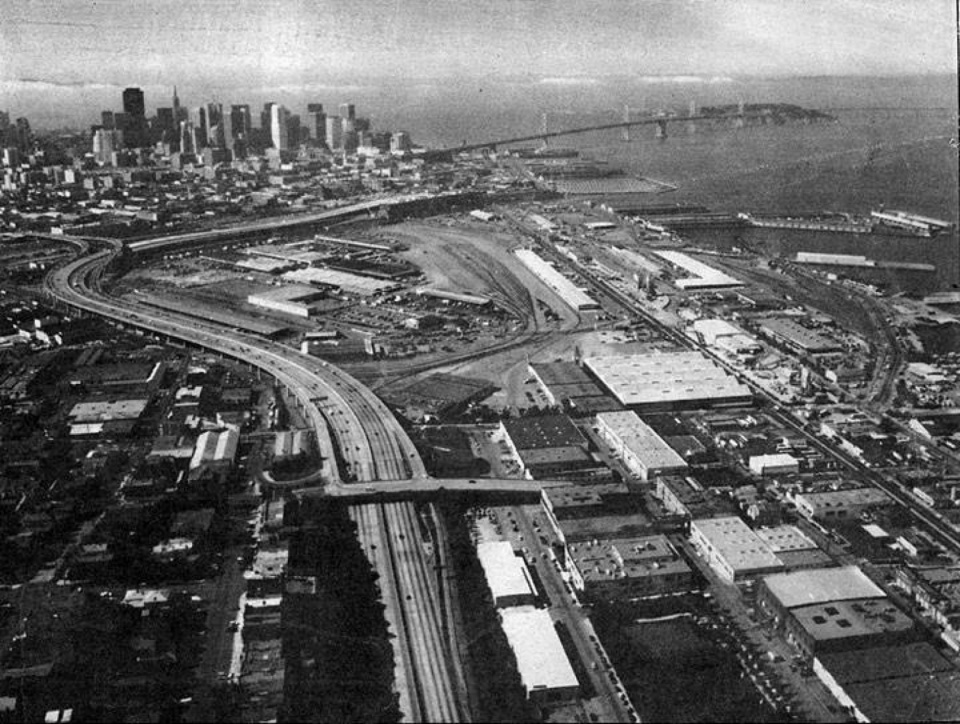
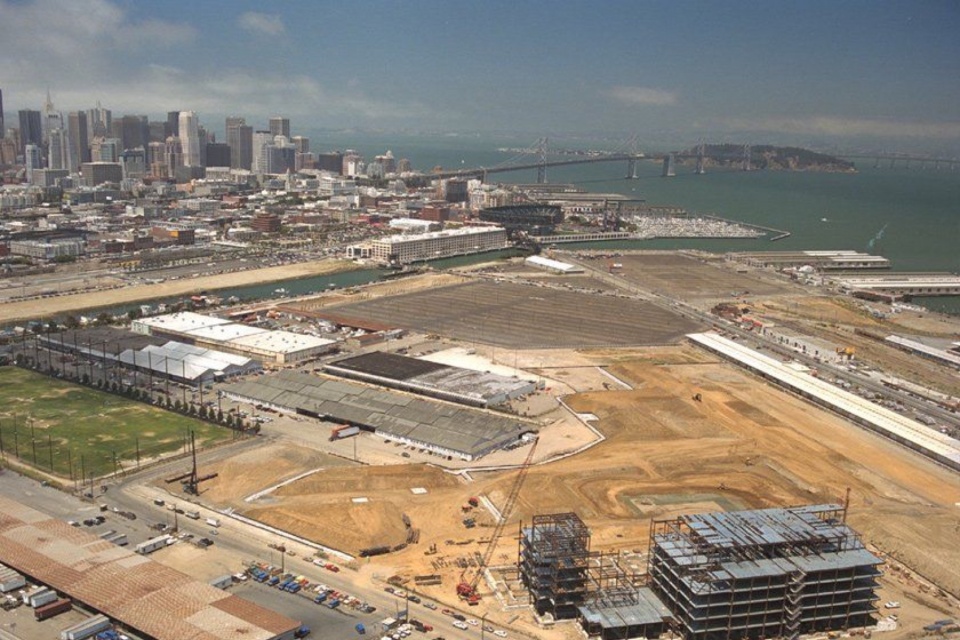
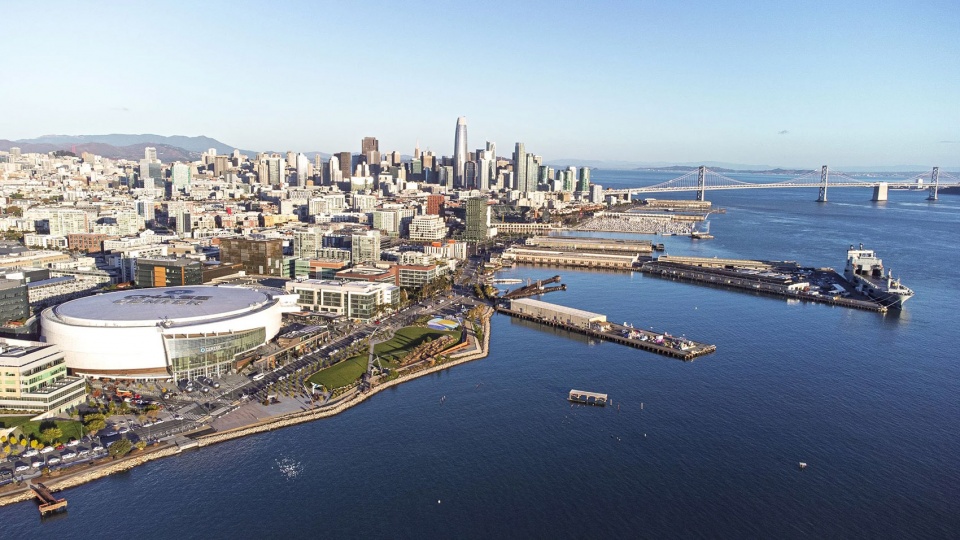
曾经是旧金山重要的港口工业区。进入 21 世纪之后,随着城市产业结构逐渐从制造和港口运输转向科技、科研和创新,这片土地开始经历持续更新。UCSF 医学院与生命科学研究机构率先进入这里,随后,大量生物科技企业、创业团队和风险投资机构陆续进入,使 Mission Bay 逐渐形成一个围绕科研与创新展开的城市网络。产业的进场带来了新的面貌,但这里最重要的变化,是城市结构本身的重组。这片区域内,大学实验室、创业公司、住宅社区和公共设施并不是按功能被远远分开,而是在几个街区范围内相互交织。白天,这里的人流主要来自科研人员和科技企业员工;到了傍晚,周边住宅社区的生活节奏又会慢慢接管街区。咖啡馆、餐厅和街区绿地,也因此同时承担了工作与日常生活的功能。Uber 总部进入 Mission Bay,并不是孤立落下一座办公楼,而是进入一个已经逐渐成型的创新街区。对我们来说,这意味着项目一开始面对的就不只是“总部建筑怎么设计”的问题,而是“总部如何被放进一个高度混合的城市结构之中”。
Mission Bay was once a key port and industrial district in San Francisco. Since the early 21st century, as the city shifted from manufacturing and logistics toward technology and research, the area has undergone sustained transformation. The arrival of the UCSF medical campus and life sciences institutions was followed by biotech firms, startups, and venture capital, gradually forming an innovation-driven urban network. What defines this transformation is not only the change in industry, but a reorganization of the urban structure itself. Within a compact area, research labs, startups, housing, and public amenities are not segregated, but interwoven. During the day, the district is shaped by researchers and tech workers; by evening, the rhythm of nearby residential communities takes over. Cafés, restaurants, and open spaces support both work and daily life. The Uber Headquarters enters this context not as an isolated office building, but as part of an already evolving district. From the outset, the question is not simply how to design a headquarters, but how to position it within a highly mixed urban fabric.
▼20 世纪 80 年代初的 Mission Bay,仍以铁路用地、仓储设施和工业场地为主,Mission Bay in the early 1980s, dominated by rail yards, warehouses, and industrial sites
▼2000年中,随着 UCSF 的进入,Mission Bay 开始从港口工业区转型为新的科研与创新片区,In the mid-2000s, with the arrival of UCSF, Mission Bay began its transformation into a research and innovation district
▼今天的 Mission Bay 已从旧工业港区转型为集科研、办公、住宅与公共空间于一体的滨水创新街区,Today, Mission Bay has evolved into a waterfront district integrating research, office, residential, and public space
重新分配体量 Recomposing the Massing
从街角逐步靠近 Uber 总部时,很难把它理解为一座单一的大体量建筑。项目由两栋建筑组成,一栋 11 层,另一栋 6 层,它们通过透明连桥在不同标高之间连接起来。对我们来说,这种处理并不是为了把总部做得更“复杂”,而是为了避免它继续沿用典型科技园区那种完整、封闭的大块体量逻辑。两栋体量之间的空间也不是简单的留缝,而更像一段被主动组织出来的街巷式步行空间。它让总部不再是一个完整对象,而更像是街区关系的一部分。也正因为如此,这个项目最早的建筑判断,并不是“总部应该有多强烈的存在感”,而是“它如何在进入城市之后,仍然保持从人的尺度来展示可读性”。
Approaching the Uber Headquarters from the street corner, it is difficult to read it as a single, monolithic building. The project is composed of two volumes—an eleven-story tower and a six-story structure—linked by transparent bridges at multiple levels. This strategy is not intended to increase formal complexity, but to move away from the closed, singular mass typical of corporate campuses. The space between the two volumes is not residual, but shaped as a pedestrian passage. It operates less as a gap and more as an extension of the street, allowing the headquarters to become part of the urban fabric rather than a self-contained object. From the outset, the design question was therefore not how iconic the building should be, but how it could remain legible at a human scale once inserted into the city.
▼连桥并不是孤立的连接构件,它和两栋体量之间的步行界面一起,把总部重新组织成一种更接近街区的空间关系,The bridges are not isolated connectors; together with the pedestrian space between the two volumes, they reorganize the headquarters into a spatial condition closer to the scale of the district
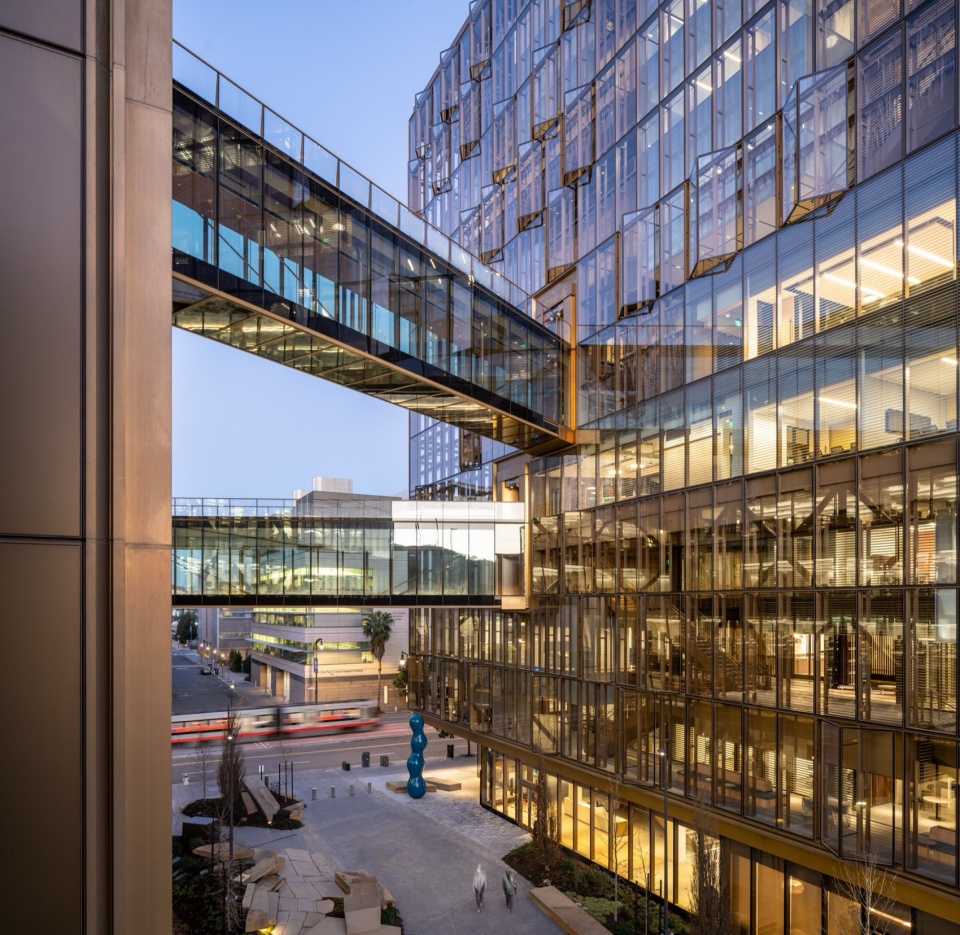
具体到体量的组织方式上,我们更关心的是,怎样把一个总部重新拆解、融入到街区尺度里:较低的体量贴近街道,高体量则稍微向街区内部退让。这种方式使建筑界面保持在一个接近街区尺度的范围内,而不会形成完全封闭的巨大立面。当沿着街道行走时,体量之间的街道,能让大家的视线穿透到建筑内部。连桥在不同高度之间穿插,也让内部活动对城市保持着一种若隐若现的可见性。
At the level of organization, the massing is arranged to align with the surrounding urban scale. The lower volume engages directly with the street, while the taller volume steps back into the block. This keeps the street edge consistent with pedestrian experience and avoids the formation of a continuous, oversized façade. As one moves along the street, views open through the passage and into the building. The bridges, shifting across different levels, allow interior activity to remain partially visible from the city.
▼较低体量贴近街道,使建筑界面更接近街区尺度与日常步行体验,The lower volume aligns with the street, maintaining a scale closer to everyday pedestrian experience
建筑作为环境界面
建筑作为环境界面
Architecture as Environmental Interface
Architecture as Environmental Interface
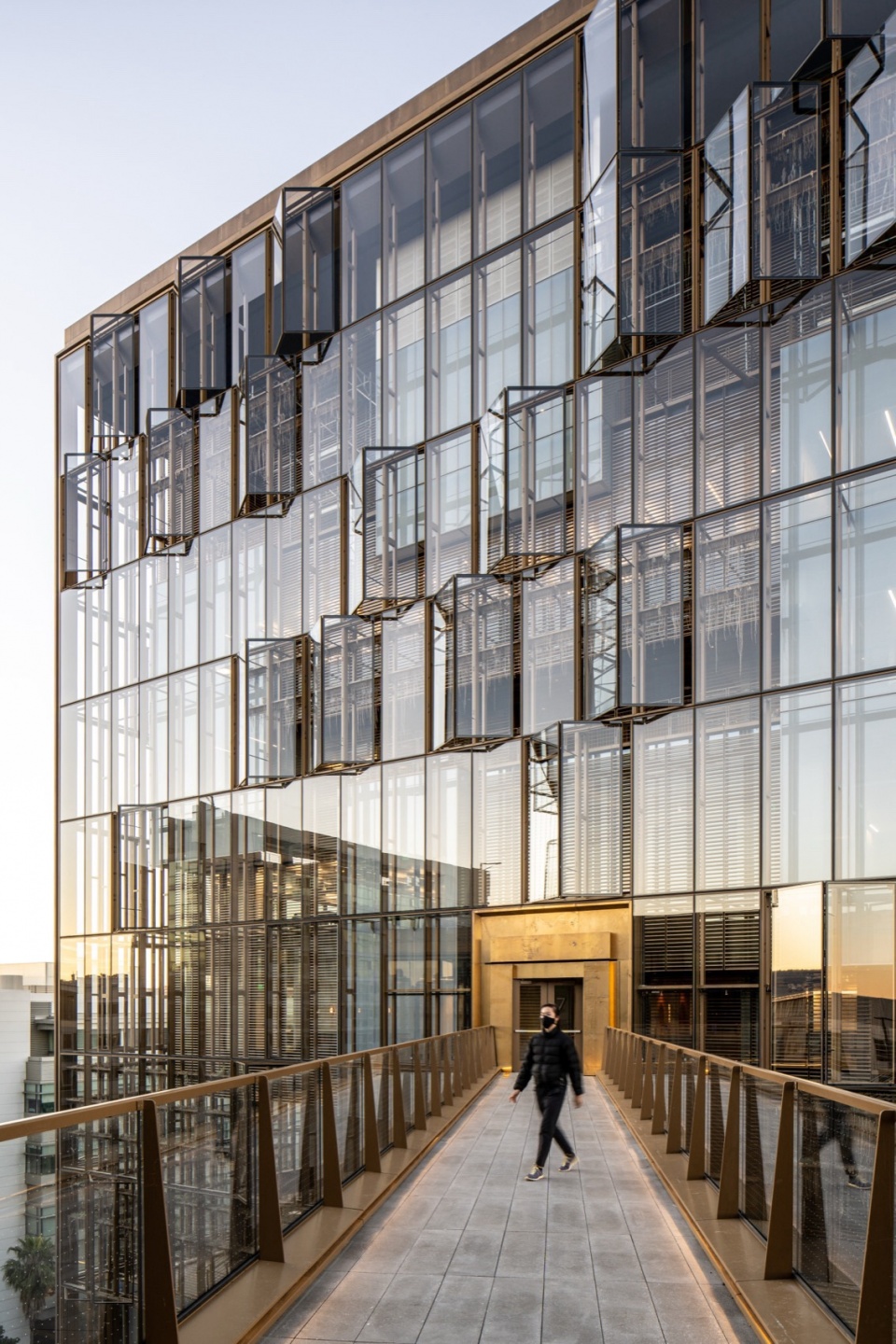
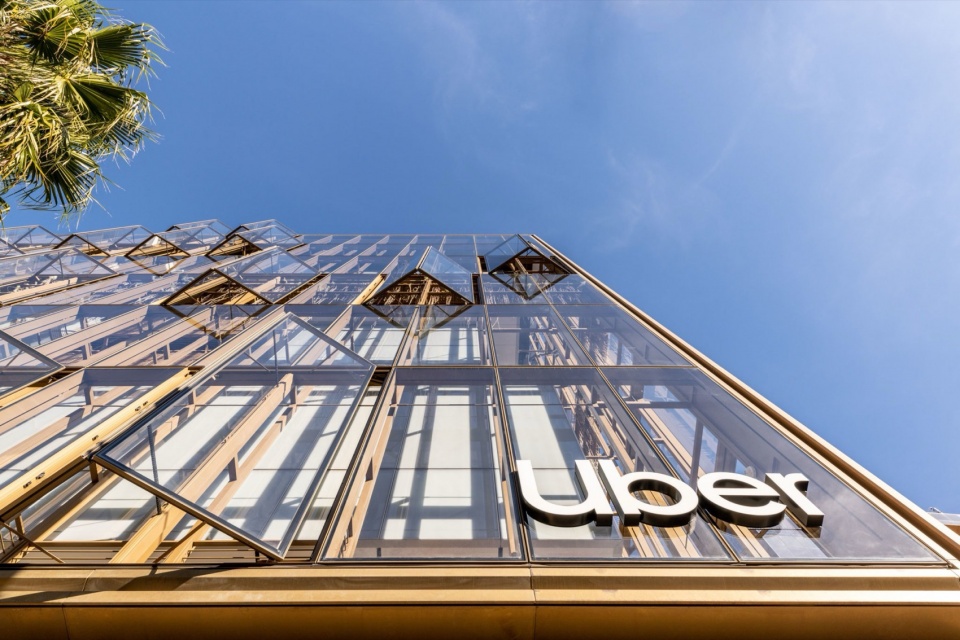
在融入街区的情况下,我们也考虑了如何兼顾企业办公的安静与私密的需求,于是我们在企业总部内,创造了一个街区与办公的过度空间。不得不说,旧金山的气候条件给这个项目带来一个很特别的前提:一年里大约有十个月,温度和湿度都处在一个比较宜人的范围内。我们当时关心的问题,并不是把外立面做成一层更封闭的玻璃表皮,而是在建筑里创造一种会“呼吸”的空间——真正会打开使用的中间空间。也正因为如此,最后形成的并不是一套单纯追求透明度的幕墙,而是一层可以随着气候变化进行调节的界面。位于建筑“共享中庭”边缘,我们打造了可自动开启的玻璃,它会和屋顶气象系统联动,在条件合适的时候引入自然通风;而需要完全室内办公的区域,则位于其后的固定围护系统之内。这样一来,“共享中庭”更像是一层介于城市外部和空调办公环境之间的缓冲带,而不是传统意义上的全空调室内空间。
As the project integrates with the surrounding district, it also addresses the need for privacy and acoustic comfort within the workplace. This led to the introduction of a transitional space between the city and the office environment. San Francisco’s climate provides a particular opportunity: for much of the year, temperature and humidity remain within a comfortable range. Rather than relying on a fully sealed glass façade, the design focuses on creating a “breathing” environment—one that can be actively opened and used. The result is not a conventional curtain wall, but an adjustable interface that responds to changing conditions. Along the edge of the Commons, operable glass panels are integrated with a rooftop weather system, allowing natural ventilation when conditions permit. Enclosed office areas that require greater control are located behind a more fixed envelope. In this way, the Commons functions as a buffer between the exterior city and the conditioned workplace, rather than as a fully enclosed interior space.
▼剖面模型显示了“共享中庭”与办公区之间的关系:可开启立面、平台系统与固定围护共同构成一层介于室内与室外之间的过渡环境,Section model showing the relationship between the Commons and the office areas: operable façades, platforms, and fixed enclosures together form a transitional environment between inside and outside
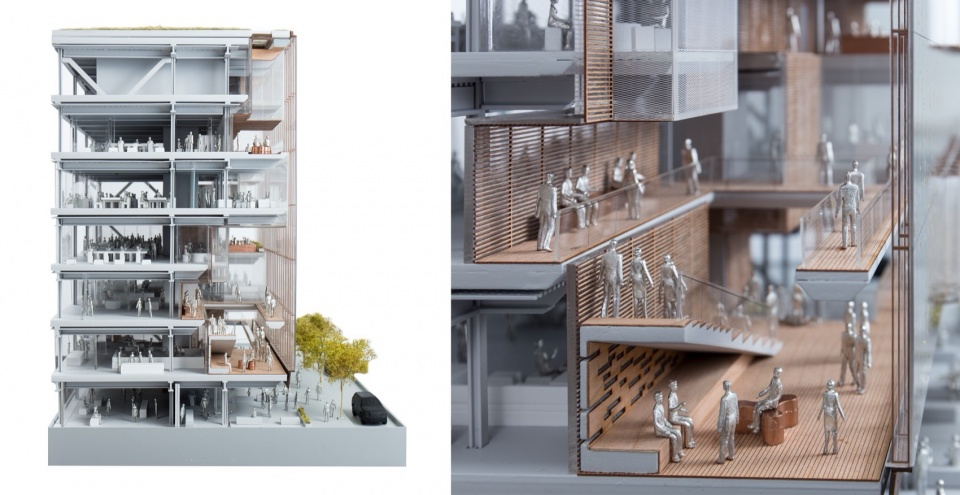
从系统层面看,这两个跨楼层的共享中庭,并不是传统意义上的全空调室内空间,而更接近一种介于室内与室外之间的过渡环境。它们采用的是可切换的混合运行模式:在条件合适时,空间会通过可开启立面参与自然通风与环境调节;在关闭状态下,又重新回到高性能围护系统的标准之中,包括气密、水密和排水要求。更重要的是,这些系统并不是彼此独立工作的。立面、照明、暖通、感应和楼宇管理平台被整合进同一套控制逻辑之中。办公区内部也并不依赖单一的全空气系统,而是通过更细分的环境控制方式,把热环境调节与送风逻辑分开处理。对我们来说,这层立面的价值并不只在于“会呼吸”,而在于它如何与整套建筑系统协同工作,在减少机械通风依赖的同时,把城市气候重新引入到总部内部。
From a systems perspective, the two multi-level Commons are not conventional, fully conditioned interiors, but operate as hybrid environments between indoor and outdoor space. They are designed to switch modes: when conditions allow, operable façades enable natural ventilation and environmental exchange; when closed, the space returns to the performance standards of a high-efficiency envelope, including airtightness, watertightness, and drainage. These systems are not independent. The façade, lighting, mechanical systems, sensors, and building management are integrated into a unified control logic. Within the office areas, environmental control is also more differentiated, separating thermal regulation from air supply rather than relying on a single all-air system. In this sense, the value of the façade lies not only in its ability to “breathe,” but in how it operates as part of a coordinated system—reducing reliance on mechanical ventilation while reintroducing the city’s climate into the workplace.
▼可开启玻璃与固定围护共同组成可调节的立面界面,使建筑表皮真正参与自然通风与环境控制,Operable glazing and fixed enclosure work together as an adjustable façade, allowing the building envelope to actively participate in ventilation and environmental control
Commons:一段被抬升的城市空间 Commons: An Elevated Urban Space
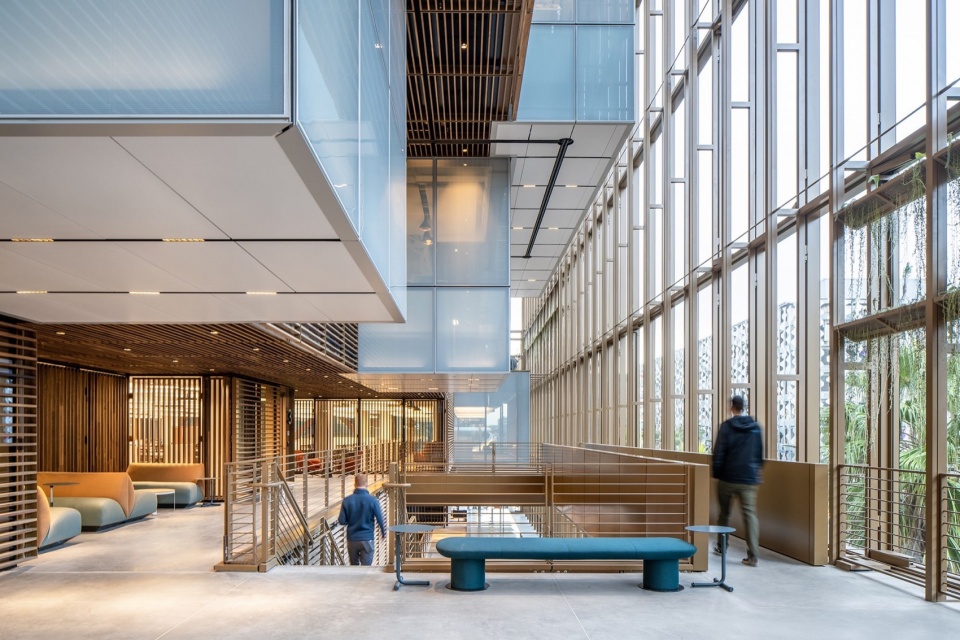
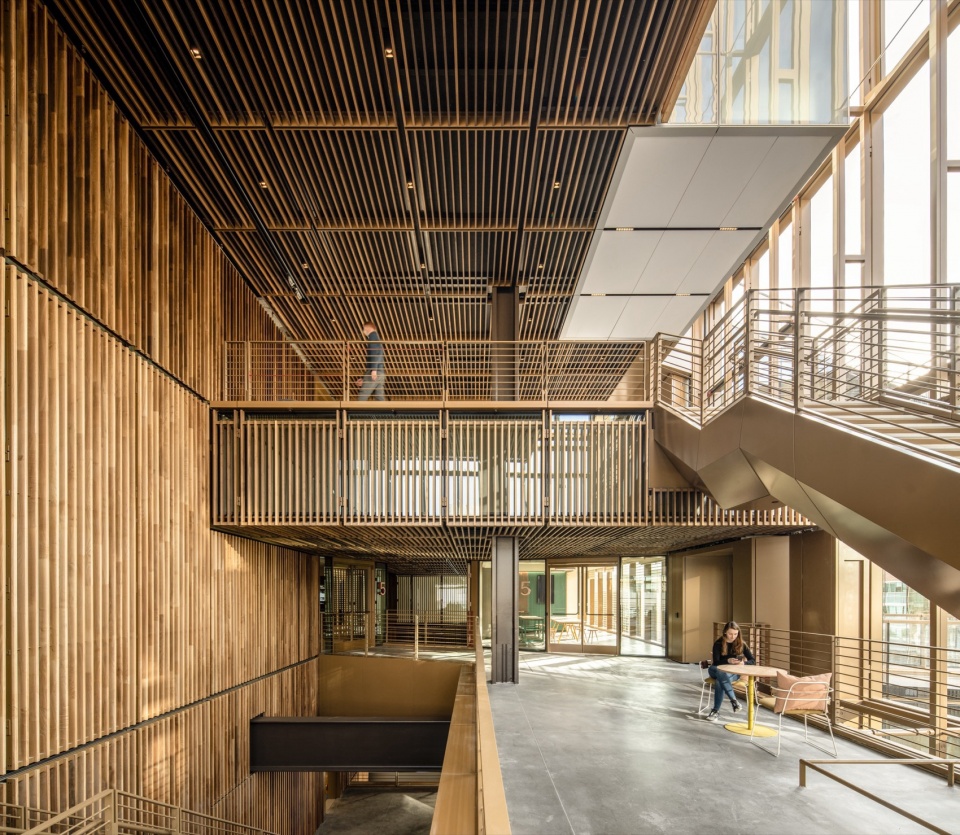
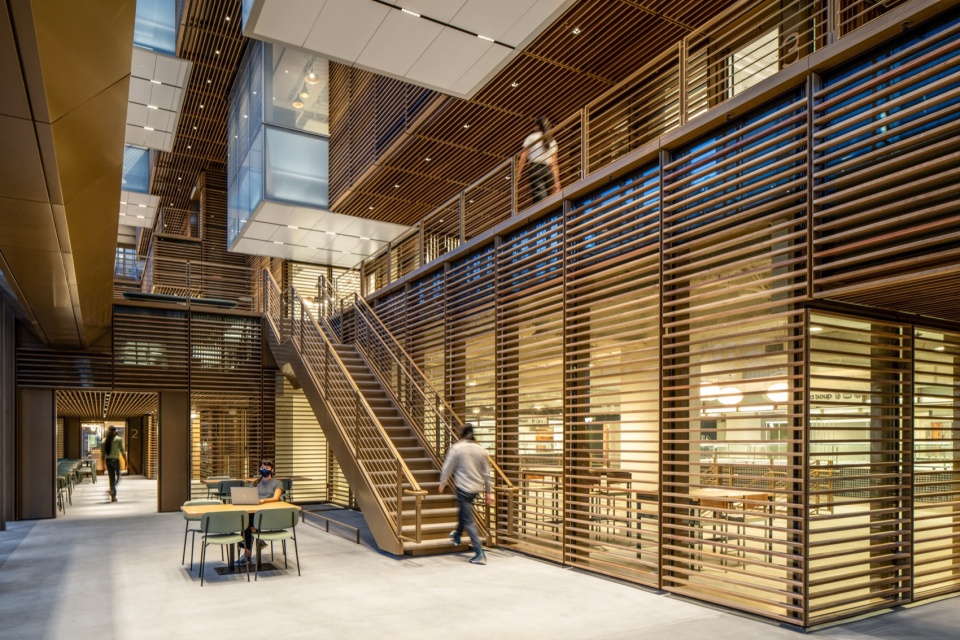
在这个项目里的“共享中庭””,我们把他命名为“Commons”。我们从来没有把它作为一个“凹造型”的中庭。对我们来说,它更像是一段被抬升到建筑内部的公共空间,用来把原本分散在办公楼里的动线、节点和交流重新组织起来。所以它并不是一个单纯追求通高感的巨大空洞,而是由一系列被分层组织平台构成的空间。中庭的楼梯不断向上延伸,把不同楼层连接起来;平台在关键位置稍微放大,让人可以驻足、交谈,或者只是短暂地停留。站在楼梯平台上,视线可以穿透整个空间,从底层一直延伸到上方连桥,不同楼层之间的活动也因此持续地联系在一起。
对我来说,Commons最有价值的地方,并不只是它足够开放,而在于它把原本会被楼层和核心筒切断的关系重新串联起来。传统办公楼里,原本分散发生的行走、停留与对话,在这里被放进了一个连续的空间系统里,增强了人们在空间里的碰面与交流。
A feature known as the Commons redefines the role of the atrium within the workplace. Rather than a singular, sculpted void, it is conceived as a piece of public space lifted into the building—one that reorganizes circulation, gathering, and interaction. The Commons is structured as a vertical network of stairs and layered platforms. Circulation extends upward through the space, linking multiple floors, while enlarged landings provide areas for pause, meeting, and informal exchange. Visual connections extend across the full height of the space, allowing activity on different levels to remain continuously visible. By consolidating movement, pause, and interaction into a single spatial system, the Commons reconnects relationships typically fragmented by floor plates and cores. Functions that are usually dispersed in conventional office buildings are brought together, supporting ongoing exchange and reinforcing a more connected workplace environment.
▼楼梯、平台、边缘停留空间与立面内侧绿植共同构成“共享中庭”的空间层次,使交流与停留在建筑内部持续发生,Stairs, platforms, edge conditions, and interior planting define the spatial layers of the Commons, enabling continuous interaction and moments of pause within the building
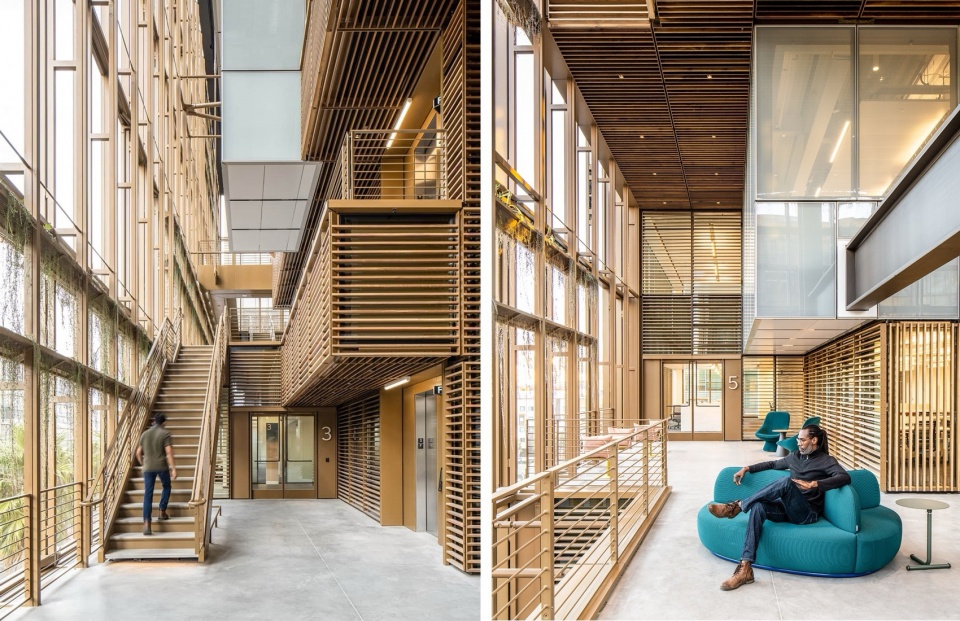
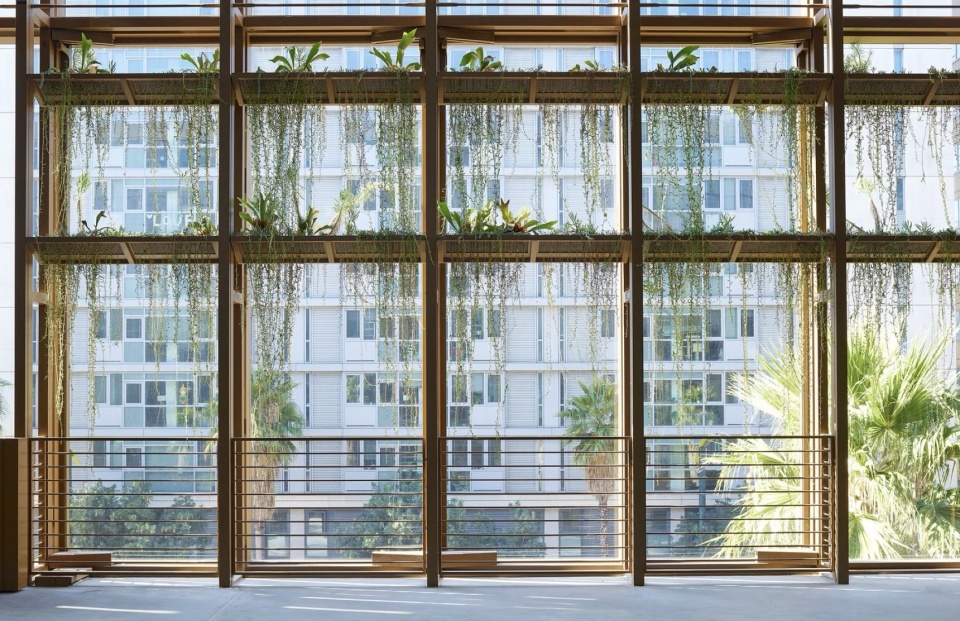
建筑外立面内侧的绿植对这个空间也很重要,它们并不是后期附加的装饰,而是和前面提到的可开启界面、平台以及共享中庭,一起组织进同一套空间逻辑里。植物沿着 Commons 边缘展开,使玻璃、钢结构和人的活动之间多了一层柔和的过渡;当阳光透过立面进入中庭时,绿植也会把原本偏硬的空间边界重新软化下来。对我来说,这些绿植的价值并不只是“增加自然感”,而是它让Commons这层空间真正有了温度,也让建筑和外部气候之间的关系变得更可感知。也正因为如此,Commons不只是附属在办公区旁边的低效共享空间,而是兼备空间舒适、有效流动,且促进交流的空间,是整个项目的核心。
Planting along the inner face of the façade plays an integral role in shaping this space. Rather than being applied as a decorative layer, it is incorporated into the same spatial system as the operable envelope, platforms, and the Commons. Arranged along the edges of the Commons, the planting introduces a soft threshold between glass, structure, and human activity. As sunlight enters through the façade, it is filtered by the vegetation, tempering the harder boundaries of the space and creating a more habitable environment. In this sense, the value of the planting lies not only in introducing a sense of nature, but in giving the Commons a perceptible environmental quality—making the relationship between interior space and external climate more tangible. As a result, the Commons operates not as a residual shared area, but as a central spatial system that combines comfort, movement, and interaction.
▼立面内侧的绿植让“共享中庭”在保持开放与清晰的同时,也拥有更柔和、更可停留的空间感受,Planting along the inner façade softens the Commons while maintaining its openness and clarity, supporting a more inhabitable and continuous spatial experience
当办公空间开始像一条街道 When the Workplace Begins to Operate Like a Street
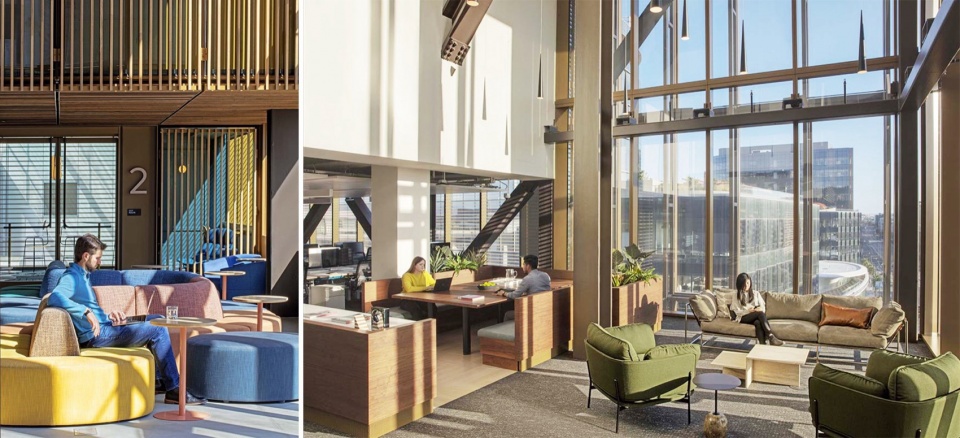
这种像街区一样的空间组织考虑,背后是科技公司工作模式变化的逻辑。随着科技公司团队协作方式不断演变,办公空间逐渐从固定工位转向更加灵活的结构。以 Uber为例子,团队的很多交流并不发生在传统会议室,而是在平台、楼梯、边缘休息区和共享走廊里发生。
This street-like spatial organization reflects evolving patterns of work within technology companies. As modes of collaboration shift, the workplace moves away from fixed desks toward more flexible and distributed environments. At Uber, much of the interaction no longer takes place in formal meeting rooms, but across platforms, stairs, edge zones, and shared circulation spaces.
▼在这里,交流不再只依赖传统会议室,而更多发生在平台、边缘休息区与共享桌面之间。办公空间也因此更接近一条可以停留、可以偶遇的内部街道,Here, exchange extends beyond meeting rooms to platforms, informal seating areas, and shared work surfaces, shaping a workplace that functions more like an internal street
这一点其实和城市环境本身是呼应的。创新活动之所以越来越依赖城市,很大程度上也是因为真正高频和高质量的互动,往往发生在那些不完全被计划好的空间之中。事实上,人们在本能上更趋向于在一个相对轻松的环境中,去沟通过和激发彼此的灵感。建筑如果能够在内部重新组织出类似的关系,它就不只是一个企业对象,而更像是城市结构的一部分。很多人原本担心靠近城市会受到噪音的影响,但实际使用之后,人们反而因为感知到那种白噪音式的城市背景,而觉得自己和城市之间保持着某种连接。总部回到城市,并不只是物理上的回归,很多时候也是感知上的重新连接。
This condition parallels the dynamics of the city itself. Innovation increasingly depends on interactions that occur in spaces that are not fully prescribed. Informal, relaxed environments tend to support more frequent and productive exchange. By reorganizing similar relationships within the building, the workplace operates less as a singular corporate object and more as part of a broader urban condition. While proximity to the city often raises concerns about noise, in practice a level of urban background sound can reinforce a sense of connection. Rather than isolation, the workplace maintains a perceptual link to its surroundings. In this sense, the return of the headquarters to the city is not only physical, but experiential.
▼沿立面展开的边缘空间与平台,使“共享中庭”在内部交流之外,也始终与外部城市保持着视觉与感知上的联系,Edge spaces and platforms along the façade maintain visual and perceptual connections between the Commons and the surrounding city
企业文化,建筑结构与空间的关系 Corporate Culture, Structure, and Space
旧金山位于高强度地震区,所以这个项目从一开始就必须建立起清晰的抗震结构。对我们来说,结构并不应该局限在隐藏空间里的技术条件,而是可以呈现出来,成为空间组织本身的一部分。恰如科技企业的内核,呈现一种技术、秩序与美学结合的逻辑。
在这个项目里,穿插于柱列之间的X形斜撑构成了主体抗侧力体系的重要部分,也让建筑的受力逻辑保持了清晰的可读性。我们并没有刻意把这些结构条件完全消隐,而是让它们在一定程度上进入建筑和空间的表达之中。也正因为如此,这个项目的开放感,并不是建立在结构被弱化的前提下,而是建立在结构被清楚组织之后。无论是共享中庭的纵深、平台之间的穿插,还是步行界面与立面之间的关系,背后都能看到这种结构秩序在发挥作用。
Located in a high seismic zone, the project required a clearly defined structural system from the outset. Rather than treating structure as a concealed technical layer, it is expressed as part of the spatial organization—reflecting a logic that aligns with the technological and organizational culture of the company.
In this project, X-braced frames integrated within the column grid form a key part of the lateral system, while maintaining a legible expression of how the building performs. These structural elements are not fully concealed, but are allowed to participate in the architectural language of the space. The sense of openness is therefore not achieved by minimizing structure, but by organizing it clearly. The depth of the Commons, the interlocking platforms, and the relationship between circulation and façade all operate within this structural order.
▼共享中庭的纵深、平台之间的穿插以及立面关系,背后都能看到结构秩序在起作用,The depth of the Commons, the interweaving of platforms, and the relationship with the façades all operate within a clear structural order
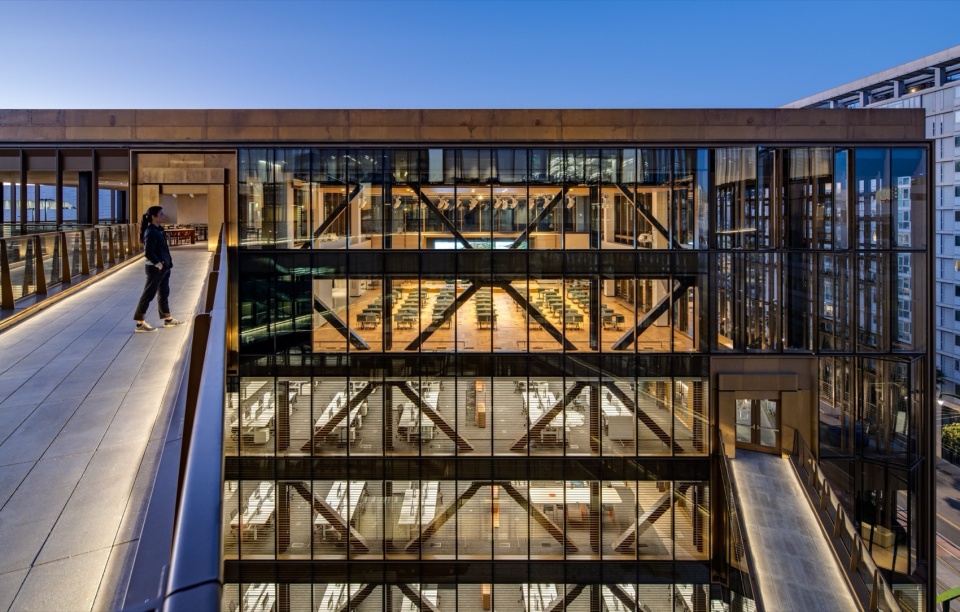
▼X形斜撑不仅承担抗侧力功能,也直接参与了室内空间的表达,使开放感建立在清晰的结构秩序之上,X-braced frames contribute to both lateral stability and spatial expression, reinforcing openness through a clearly articulated structural system
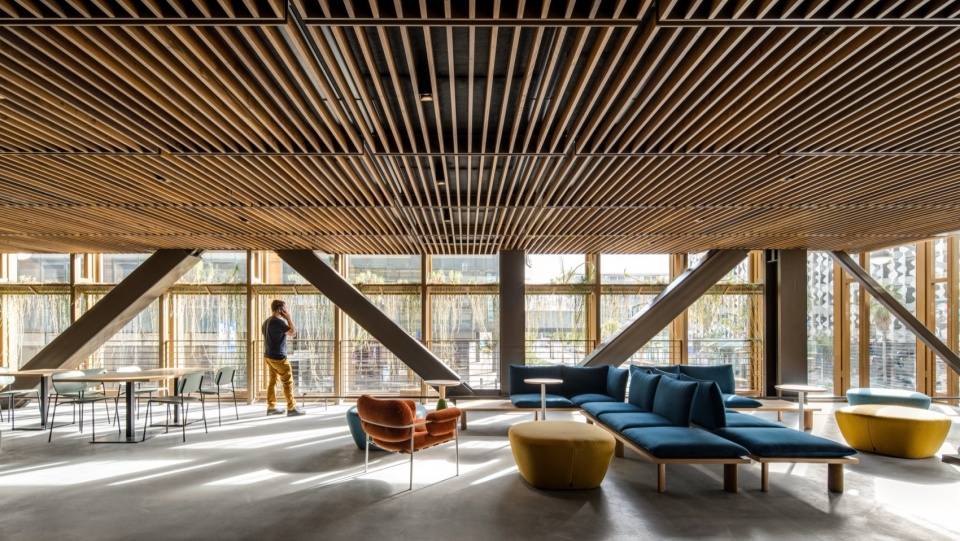
从建造角度看,这种清晰性同样重要。高密度的城市用地、复杂的围护系统以及多层次的空间关系,都要求主体结构、支撑体系、机电系统与幕墙之间保持明确的组织顺序。很多时候,空间最终呈现出的轻盈感,并不是因为结构被削弱了,恰恰相反,而是因为结构被梳理得足够清楚。对我们来说,X形斜撑在这里不仅是抗震体系的一部分,也参与了建筑表达本身。
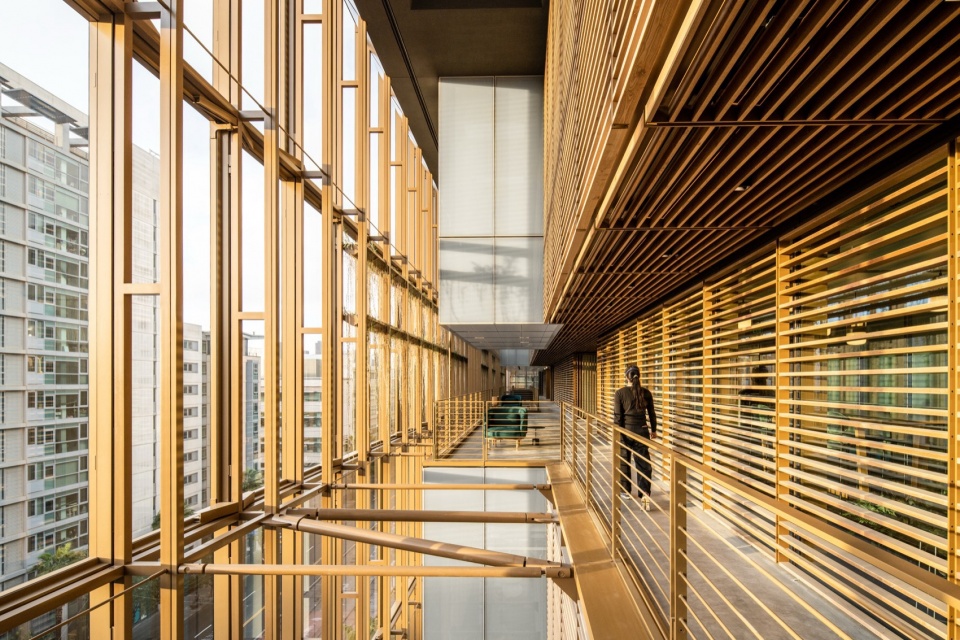
From a construction perspective, this clarity is equally critical. High-density urban sites, complex enclosure systems, and multi-layered spatial relationships require a well-organized hierarchy between the primary structure, support systems, MEP, and the façade. The sense of lightness that the space ultimately conveys is often not due to a weakened structure—in fact, quite the opposite—it comes from a structure that is thoroughly clarified. For us, the X-braced frames here are not only part of the seismic system but also an integral element of the architectural expression itself.
▼这类边缘步行空间的轻盈感,并不是来自结构被弱化,而是来自结构、围护与流线关系被梳理得足够清楚,The lightness of these edge circulation spaces comes not from a weakened structure, but from the clearly articulated relationship between structure, enclosure, and circulation
景观作为整体系统 Landscape as Integrated System
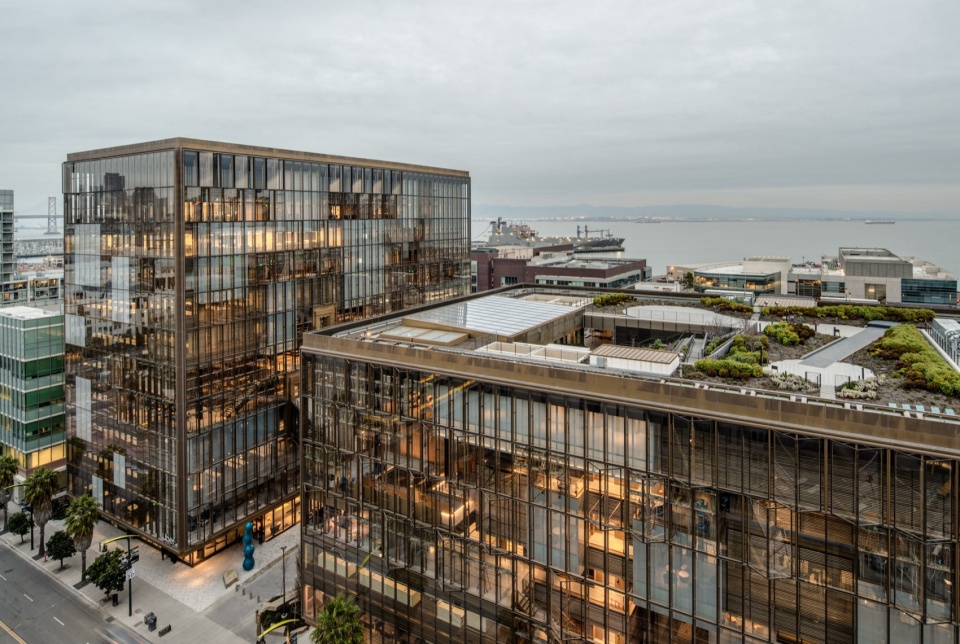
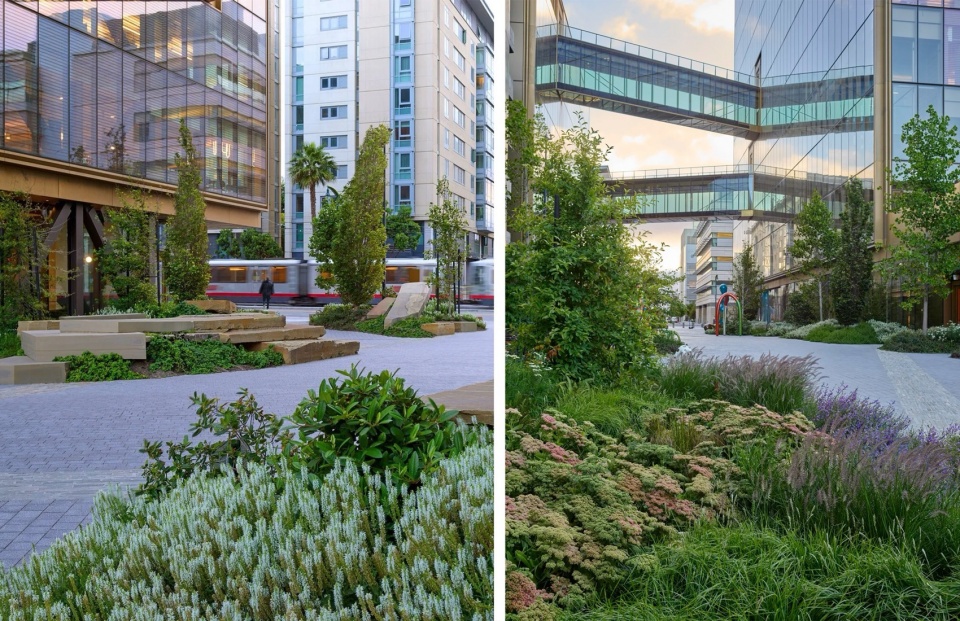
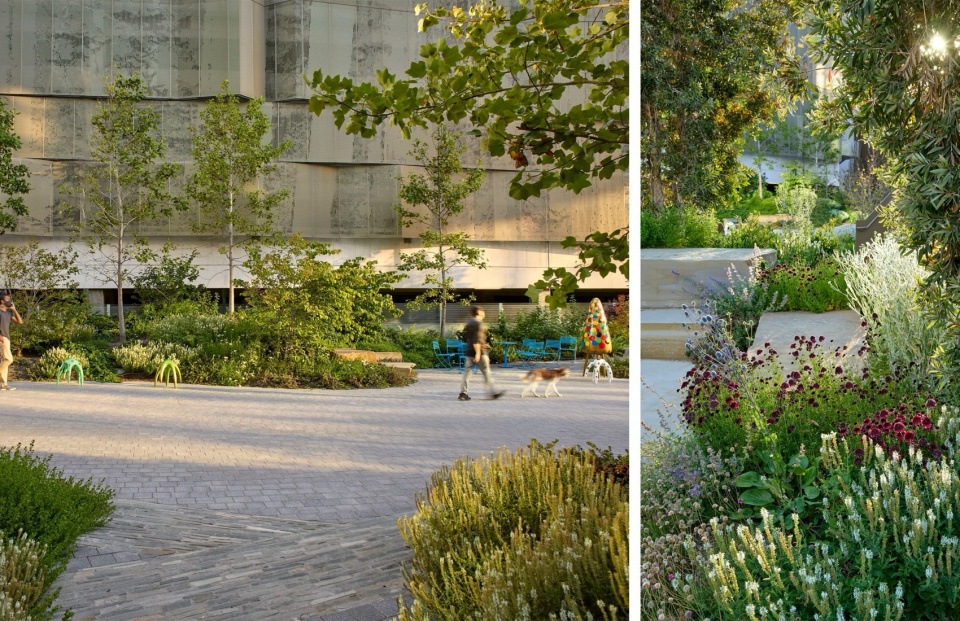
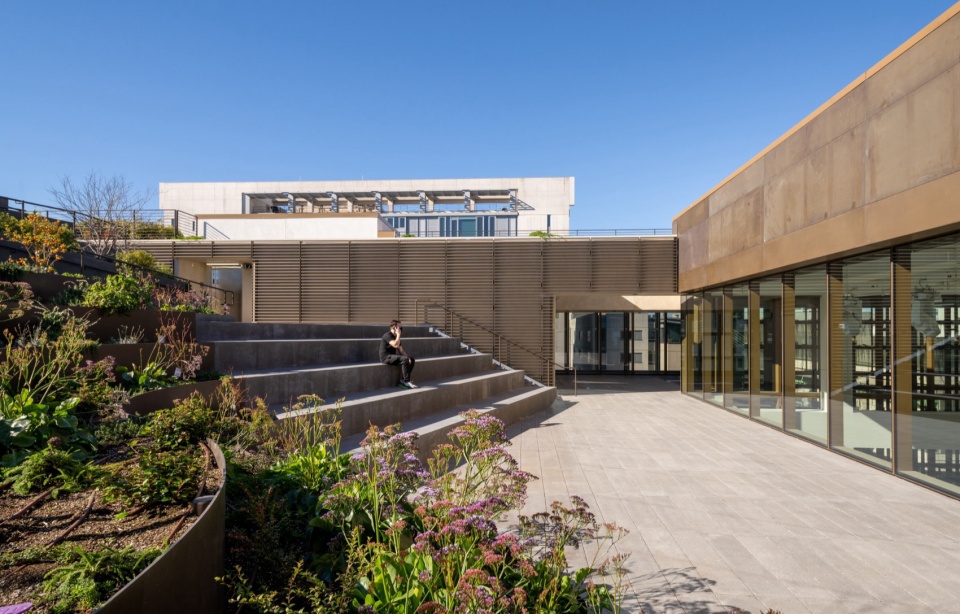
这个项目的景观设计并不只发生在地面,也不只是在建筑顶部放一个屋顶花园。这个场地的景观,是围绕一条线性公园展开的,它连接 3rd Street 与 Bridgeview Way;在这个原本更多是服务于基础设施和通行的空间,通过我们的改造,被转化成真正可以停留和使用的公共绿地。不同铺装、种植与步行动线被重新组织在一起,形成连续的开放空间体验。与此同时,屋顶上的绿植与露台并不是独立存在的“上层花园”,而是和地面的绿化、公园界面以及整个项目的生态策略一起,构成同一套景观体系。屋顶因此也不只是一个休憩层,而是整套绿化系统向建筑内部与上部空间的自然延伸。建筑顶部的露台被划分为多个可以停留的小型区域,一侧是种植区与可食用植物带,另一侧则是开敞的平台,可以用于会议、休憩,或者只是放空自己,看看街区景观。从这里向外望去,可以看到 Mission Bay 的街区逐渐展开,远处是 UCSF 的研究建筑群,再往北则是旧金山市中心的天际线。对我们来说,这种整体性比单独强调某一处“花园”更重要。它让建筑、场地和街区之间形成了更完整的联系,也让这座总部从一开始就更像城市环境的一部分,而不是一个独立摆放的企业对象。
The landscape design for this project is not confined to the ground plane, nor is it limited to placing a rooftop garden atop the building. Instead, the site’s landscape is organized around a linear park that connects 3rd Street to Bridgeview Way. What was once a space primarily serving infrastructure and circulation has been transformed through our design into a public green space that invites lingering and active use. Different paving patterns, planting strategies, and pedestrian routes have been reorganized to create a continuous, open spatial experience. Meanwhile, the rooftop plantings and terraces are not independent “upper-level gardens”; they are integrated with the ground-level greenery, park interface, and the project’s broader ecological strategy, forming a single cohesive landscape system. The rooftop thus becomes more than just a recreational layer—it is a natural extension of the overall green system into the building’s interior and upper spaces. The rooftop terraces are divided into multiple small areas for pause and interaction: one side features planting zones and edible gardens, while the other offers open platforms for meetings, relaxation, or simply gazing over the surroundings. From here, views extend across the unfolding streets of Mission Bay, toward UCSF’s research buildings, and northward to the San Francisco skyline. For us, this sense of integration is more important than emphasizing any single “garden.” It establishes a complete connection between the building, the site, and the surrounding neighborhood, making the headquarters feel from the outset like a part of the urban environment rather than a standalone corporate object.
▼屋顶绿化、地面景观与建筑体量共同构成一套连续的公共与生态系统,The rooftop greenery, ground-level landscape, and building mass together form a continuous public and ecological system
▼线性公园与步行路径将场地重新组织为可停留、可穿行的开放空间。植物层次与人尺度的停留界面,使景观不只是背景,而成为日常使用的一部分,The linear park and pedestrian paths reorganize the site into open spaces for lingering and circulation. Layered planting and human-scaled resting interfaces make the landscape not just a backdrop, but an integral part of daily life
被连续选择的空间样本 A Continuously Chosen Spatial Sample
这个项目真正值得注意的,并不只是它作为一个总部建筑本身,而是它在完成之后,继续被头部科技企业所选择。Uber 当年把总部放进 Mission Bay,本身已经是一种判断:科技企业开始重新进入城市核心区,并重新与大学、研究机构、公共空间和城市网络建立联系。几年之后,OpenAI 又租用了 Uber 总部办公楼中的一部分办公区域,使同一个物理空间开始承载不止一家头部科技公司的活动。在重视逻辑与协同的科技企业中,这种连续的选择并不是偶然,它反映出新一代科技产业与上一代产业在空间需求上的差异。传统产业更依赖封闭、可控和大规模的单一场地,而人工智能和知识型科技产业更依赖高密度的人才网络、跨机构交流,以及与研究、资本和媒体环境的持续接触。它们并不天然适合远离城市的封闭园区,反而更适合嵌入城市型创新街区之中。从这个角度看,Mission Bay 区域所承载的已不只是办公功能,而是一种更适合新一代科技产业生长的城市结构;而 Uber 总部建筑也不再只是停留在企业资产中,而更像一个城市中重要的节点,一个持续被验证的节点,一个承载着未来发展的节点。
What makes this project truly notable is not just its role as a headquarters building, but the way it has continued to be selected by leading technology companies after completion. When Uber placed its headquarters in Mission Bay, it was already a statement: tech companies were beginning to re-enter the urban core, re-establishing connections with universities, research institutions, public spaces, and the broader city network. A few years later, OpenAI leased part of Uber’s office space, allowing the same physical environment to host the operations of multiple top-tier tech companies. In technology companies that value logic and collaboration, this continuous selection is no accident. It reflects a fundamental shift in spatial needs between the new generation of tech industries and their predecessors. Traditional industries tend to rely on enclosed, controllable, and large-scale single sites, whereas AI and knowledge-based tech sectors depend on dense talent networks, cross-institutional collaboration, and ongoing engagement with research, capital, and media ecosystems. These industries are not naturally suited to remote, isolated campuses; they thrive when embedded within urban innovation districts. From this perspective, Mission Bay now functions not just as office space, but as an urban structure more conducive to the growth of the new generation of tech industries. The Uber headquarters, in turn, is no longer merely a corporate asset—it has become a vital urban node, continually validated and capable of supporting future development.
▼两栋体量之间的连接关系,使这座总部建筑始终保持开放、连续且可被重新激活的空间结构,The connections between the two building volumes maintain an open, continuous, and reactivatable spatial structure throughout the headquarters
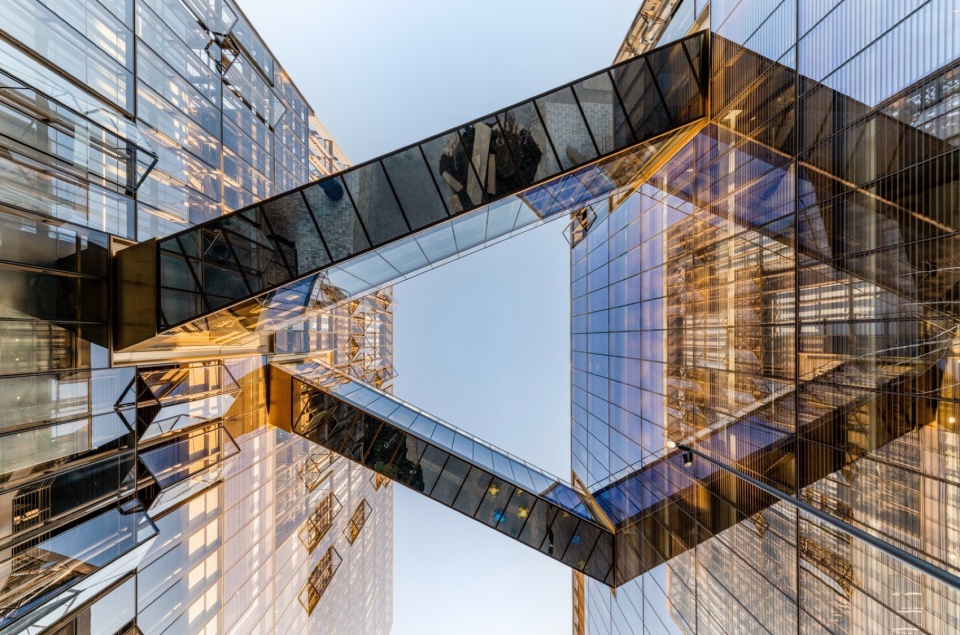
▼这座建筑之所以能够被持续选择,并不只因为它属于某一家公司,而在于它本身就具备面向不同使用者的开放性与适应性,The building’s ability to be continuously chosen lies not in its association with a single company, but in its inherent openness and adaptability to different users
一个总部的另一种打开方式 An Alternative Approach to a Headquarters
回到 Uber 总部本身,我一直觉得这个项目最有价值的地方,并不在于它提供了一个强烈的企业形象,而在于它重新定义了总部与城市之间的关系。这里最重要的设计动作,既不是一个单一的大体量,也不是某一个孤立的技术亮点,而是建筑如何通过体量的分配、共享中庭的组织、可调节的立面界面,以及与街区之间保持的开放关系,把办公楼重新放进城市结构之中。对我来说,Uber 总部给出的答案并不需要“激烈”,但会很“清晰”。它不是一个和城市对立的边界,而更像一个被嵌入城市之中的开放结构。
我相信,这种从根本上结合人的需求,新型产业发展需求,以及为城市节点提升的设计,也是人们对未来办公环境发展的延伸思考。而我们事务所希望能做的,就是不断通过这种长远、清晰的思考,帮助更多企业、城市创造出新的总部,脱离原来总部概念所束缚,为从业人员、企业、城市带来更好的发展。
Returning to the Uber Headquarters itself, I have always felt that the project’s greatest value does not lie in projecting a strong corporate image, but in redefining the relationship between a headquarters and the city. The most important design gestures here are neither a single massive volume nor an isolated technical feature. Instead, the building demonstrates how thoughtful massing, the organization of the Commons, adjustable façade interfaces, and a maintained openness to the surrounding neighborhood can reintegrate a corporate office into the urban fabric. For me, the answer provided by Uber’s headquarters does not need to be “bold,” but it is unmistakably “clear.” It is not a boundary in opposition to the city; rather, it functions as an open structure embedded within it.
I believe that this approach—fundamentally combining human needs, the demands of new industries, and design strategies that elevate urban nodes—is also a reflection on the future development of workplace environments. What our firm hopes to do is to continue applying this long-term, clear-eyed thinking to help more companies and cities create new headquarters, freeing them from the constraints of traditional headquarters concepts, and fostering better growth for employees, companies, and the urban environment.
▼Uber 总部最终呈现出的,并不是一个封闭的企业对象,而是一种能够回应街区、气候与共享空间的开放结构,What the Uber Headquarters ultimately presents is not a closed corporate object, but an open structure that responds to the neighborhood, the climate, and shared spaces
SHoP建筑事务所合伙人张旭专访
SHoP建筑事务所合伙人张旭专访
Q&A with Xu, Associate Principal of SHoP
Q&A with Xu, Associate Principal of SHoP
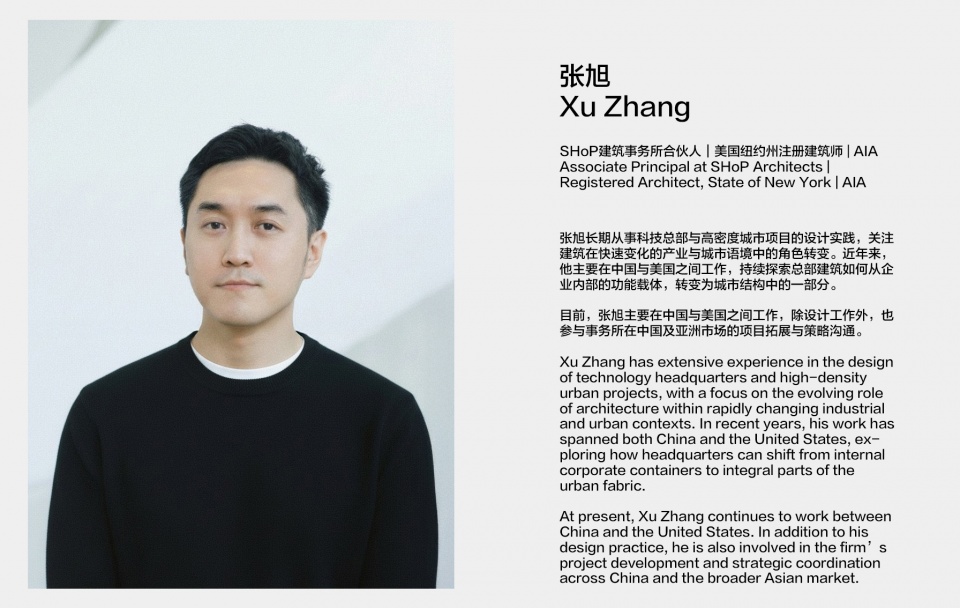
Q1:当总部进入一个大学、科研机构、住宅和公共设施已经交织成型的创新街区,设计任务从起点上发生了怎样的根本变化?
设计的出发点不再是“如何完成一个企业内部的空间系统”,而是“如何让总部成为城市结构中的一部分”。
设计的出发点不再是“如何完成一个企业内部的空间系统”,而是“如何让总部成为城市结构中的一部分”。
总部不再只是企业的“容器”,而更像一个需要被嵌入、被连接、也可以被感知的城市节点。
总部不再只是企业的“容器”,而更像一个需要被嵌入、被连接、也可以被感知的城市节点。
▼屋顶绿化、地面景观与建筑体量共同构成一套连续的公共与生态系统,The rooftop greenery, ground-level landscape, and building mass together form a continuous public and ecological system
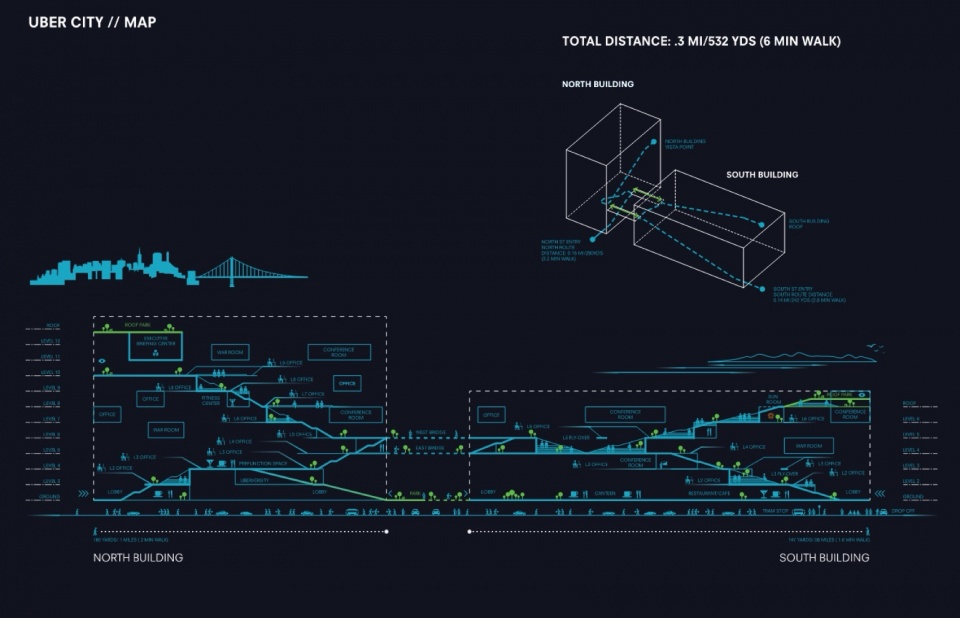
Q2:这个项目最早的建筑判断,并不是“总部应该有多强烈的存在感”,而是“它如何在进入城市之后,仍然保持从人的尺度来展示可读性”。其中“人的尺度的可读性”具体表现在哪些方面?
是空间与停留之间的关系。
是空间与停留之间的关系
它让人始终能够在建筑中找到自己的位置,并理解自己与周围空间的关系。
▼Commons 共享中庭示意图,Analysis diagram of the Commons
Q3:您提到一个有趣的观察:员工刚开始怕吵,后来反而发现喜欢适当的城市白噪音。在隔音设计上,你们是怎么拿捏这个度的?如何在靠近街道的界面上,既保证舒适度,又并非完全隔绝的听觉体验?
我们更关心的,是如何在舒适度与开放性之间找到一个平衡点。
我们更关心的,是如何在舒适度与开放性之间找到一个平衡点。
“不过度消除”的状态,本身也是建筑与城市建立联系的一种方式。
▼“共享中庭”以及一系列介于室内与室外之间的过渡空间,逐步缓冲来自城市的声音, sound is filtered through a sequence of transitional spaces—such as the Commons and semi-open zones
Q4:Uber总部建成后,OpenAI等公司也选择在这座建筑内办公。从设计视角看,是什么使该建筑能够灵活地服务于不同科技企业?在空间布局或设施配置上,有没有为未来变化做的考虑?
从设计角度看,这种“被不同公司持续选择”的能力,并不是后期通过灵活分隔来实现的,而是源自建筑在一开始就被构建为一种具有开放性的空间框架。
在满足 Uber 使用需求的前提下,我们并没有将空间结构完全锁定在单一的组织方式之中,而是为未来可能发生的变化预留了足够的弹性。办公区域本身保持相对清晰与中性的组织方式,使其在使用过程中可以根据不同团队规模与协作方式进行调整,而不会因为某一阶段的需求而被固定下来。
与此同时,建筑内部的公共与半公共空间是以整体系统来组织的,而不是附属于某一个团队或部门。这种空间结构为跨团队交流、临时协作以及非正式使用提供了基础,也使得新的使用者在进入之后,不需要完全重建一套内部体系,就可以快速适应并融入既有的空间环境。
在系统层面,我们也尽量避免将环境控制与设备系统绑定在单一的使用模式之上,而是通过更灵活的分区与控制方式,让空间可以在不同使用强度和组织结构下保持稳定运行。
从这个角度看,这座建筑的适应性并不是一种附加能力,而是一种前提条件。它并不是只服务于某一阶段使用需求的结果,而是一种可以被不同使用者持续激活的空间结构。
▼楼梯、平台与边缘停留空间共同组织出连续的内部街道,使交流、流动与协作不再局限于封闭会议室,而在建筑内部持续发生,Stairs, platforms, and edge zones organize a continuous internal street, enabling movement, interaction, and collaboration to unfold throughout the building
Q5:您觉得Uber总部的做法是可复制的吗?按你们现在在中国和美国做的项目看,下一代的总部还会怎么进化?比如面对更密的城市、更多样的功能,这个思路还能怎么升级?
城市密度在提高,功能在叠加,总部也越来越难以被定义为单一用途的办公空间。它往往需要同时回应工作、生活、公共活动以及与城市之间的关系。
如何在不同城市语境中,持续建立一种可以被使用、被理解、也可以被重新激活的空间结构。
如何在不同城市语境中,持续建立一种可以被使用、被理解、也可以被重新激活的空间结构
▼可开启玻璃与固定围护共同组成可调节的立面界面,Operable glazing and fixed enclosure work together as an adjustable façade
Q1: When a headquarters is placed within an innovation district where universities, research institutions, housing, and public amenities are already intertwined, how does the design brief fundamentally change?
For us, the most fundamental shift is that the point of departure for design is no longer “how to complete an internal spatial system for a company,” but rather “how to make the headquarters part of the urban fabric.”
In a traditional corporate campus, design tends to revolve around efficiency and control: clear boundaries, complete functions, and self-sufficient systems. The building itself operates as a relatively closed entity. However, when a headquarters enters a highly mixed innovation district like Mission Bay, it is no longer confronted primarily with the internal logic of a single corporation, but with an already functioning urban network.
This means that design must recalibrate several relationships: between the company and the district, between office space and public space, and between internal activities and the external urban environment. The headquarters is no longer merely a “container” for the company, but rather a node within the city—one that needs to be embedded, connected, and perceptible.
From this perspective, the task of design is no longer to organize all functions within a singular, complete object, but to maintain workplace efficiency while enabling the building to engage with surrounding research institutions, public spaces, and everyday urban life. This shift may not appear dramatic, but it directly influences how all subsequent spatial and systemic strategies are conceived.
Q2: The project didn’t start with how iconic the headquarters should be, but how it could remain legible at a human scale in the city. How is this expressed?
For us, human-scale legibility is not simply the result of breaking down massing. It’s about whether people can intuitively understand how the building is organized and how it works as they approach and use it.
First, it shows up in the layering of the façade. Instead of a continuous surface, the street edge is articulated through setbacks, openings, and visual porosity, allowing passersby to glimpse internal activities and spatial relationships. As people move along the street, they can begin to grasp how the building is structured—without even entering it.
Second, it’s reflected in the continuity of movement. From the approach to the interior, circulation is kept clear and fluid, so people can instinctively know where to go next, without relying on signage. It’s a kind of space that doesn’t need explanation.
Another key aspect is the balance between movement and pause. Rather than reducing everything to efficient circulation, the design introduces moments for stopping, observing, and interaction. These points allow people to engage with the space, so the building is not just passed through, but actively used and experienced.
In this sense, legibility is not a formal gesture, but a way of organizing space—one that helps people stay oriented and understand their relationship to their surroundings at all times.
Q3: You mentioned an interesting observation: employees were initially concerned about noise, but later came to enjoy a certain level of urban “white noise.” How did you calibrate this in the acoustic design—especially along the street edge—so that it remains comfortable without being completely sealed off?
This is not just a question of soundproofing, but of how we understand the relationship between building and city. In conventional offices, sound is treated as something to control or eliminate. But once a headquarters re-enters the city, complete isolation can make the space feel closed off and weaken its connection to the urban environment. What matters more is finding a balance between comfort and openness.
In this project, instead of a single acoustic strategy, we use spatial layering. Along the street, sound is filtered through a sequence of transitional spaces—such as a shared atrium and semi-open zones—before reaching the work areas. This gradual progression softens and diffuses urban noise. At the same time, quieter workspaces are placed deeper inside and protected through enclosure and layout. This allows street-facing areas to retain a degree of background city sound, while the interior remains stable and comfortable.
In practice, initial concerns about noise often come from uncertainty. Once in use, this level of urban white noise becomes a subtle backdrop, reminding people they are still part of the city rather than isolated from it. For us, this “not over-filtered” condition is itself a way of connecting architecture with the city.
Q4: After Uber’s headquarters was completed, companies like OpenAI also chose to move in. From a design perspective, what allows the building to accommodate different tech companies? Were future changes considered in the layout or systems?
This adaptability isn’t achieved through later subdivision, but comes from an open spatial framework established from the outset. While meeting Uber’s needs, the design avoids locking the building into a single organizational model. The office layout remains clear and neutral, allowing it to adapt to different team sizes and working styles over time.
At the same time, shared and semi-public spaces are organized as a collective system rather than tied to specific teams. This supports collaboration and informal use, making it easier for new tenants to move in without restructuring the space. On the systems side, environmental controls are designed with flexible zoning, so the building can operate efficiently under different patterns of use. In this sense, adaptability is not an added feature, but a built-in condition—allowing the building to be continuously reactivated by different users.
Q5: Do you think the approach taken in the Uber headquarters is replicable? Based on your recent projects in China and the U.S., how might the next generation of headquarters evolve—especially in denser cities with more complex programs?
In a sense, this project is not a prototype that can be simply replicated, but the questions it addresses are widely relevant.
What matters is not a specific form, but how the headquarters redefines its relationship with the city—shifting from a relatively closed corporate object to an open node embedded within the urban fabric. This shift doesn’t depend on a particular massing or spatial type, but on changing urban conditions, industries, and patterns of use.
In our recent work in both China and the U.S., we see a clear trend: increasing density and programmatic overlap. Headquarters can no longer be defined as single-use office buildings. They are expected to accommodate work, life, public activity, and urban engagement all at once—becoming more like hybrid urban spaces than standalone building types.
Looking ahead, the challenge is not necessarily to make headquarters more complex, but to maintain openness and legibility under greater density and constraints. This openness goes beyond physical connectivity, extending to environmental performance, patterns of use, and perceptual links to the city.
From this perspective, the next generation of headquarters is less about a specific architectural form, and more about creating spatial frameworks that can be used, understood, and continuously reactivated across different urban contexts.
张旭现任 SHoP Architects 合伙人、美国纽约州注册建筑师(AIA),长期从事高密度城市与复杂建筑类型的设计实践。其主导或参与的项目涵盖科技公司总部、超高层住宅及城市综合体等多个领域。
Xu Zhang is currently a Partner at SHoP Architects and a registered architect in the State of New York (AIA). His practice has long focused on high-density urban environments and complex building typologies. Projects he has led or contributed to span a wide range, including technology company headquarters, supertall residential towers, and large-scale mixed-use developments.
在近年的工作中,他持续关注科技企业办公模式的变化,以及这一变化如何反向影响建筑与城市的关系。从旧金山Mission Bay 的 Uber 总部,到正在建设中的悉尼 Atlassian 总部,他的设计实践逐渐聚焦于一个核心议题:当科技公司重新进入城市中心后,总部建筑如何从单一功能载体,转变为城市结构中的一部分。
In recent years, his work has increasingly centered on the evolving nature of workplace models in the tech industry—and how these shifts, in turn, reshape the relationship between architecture and the city. From the Uber Headquarters Mission Bay to the Atlassian Headquarters Sydney currently under construction, his design approach has gradually converged on a key question: as technology companies return to urban centers, how can headquarters buildings evolve from singular functional containers into integral components of the urban fabric.
目前,张旭主要在中国与美国之间工作,除设计工作外,也参与事务所在中国及亚洲市场的项目拓展与策略沟通。
At present, Xu Zhang continues to work between China and the United States. In addition to his design practice, he is also involved in the firm’s project development and strategic coordination across China and the broader Asian market.
![美悦达个个世界-游乐园之家-[荒野之家 #139],武汉 / 个个世界 + 先进建筑实验室](https://www.iecwww.com/uploads/images/20260421001/20260421001001.jpg)