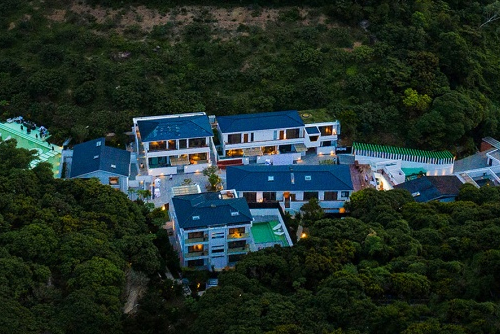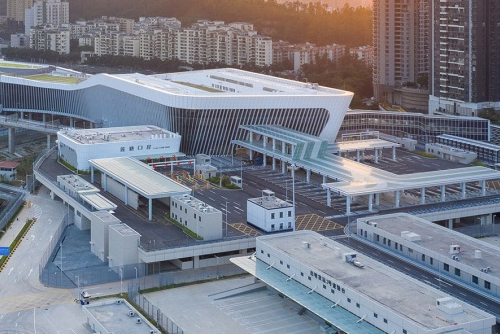
洛扎县中学多功能艺术中心,西藏山南 / 深圳华汇设计
天地之间的场域
The Spatial Realm Between Heaven and Earth
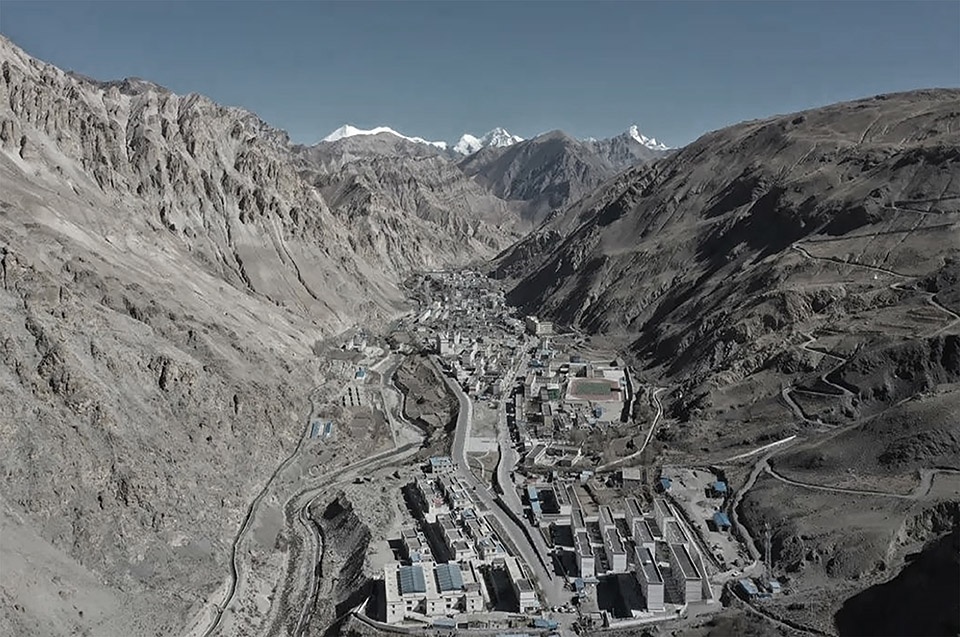
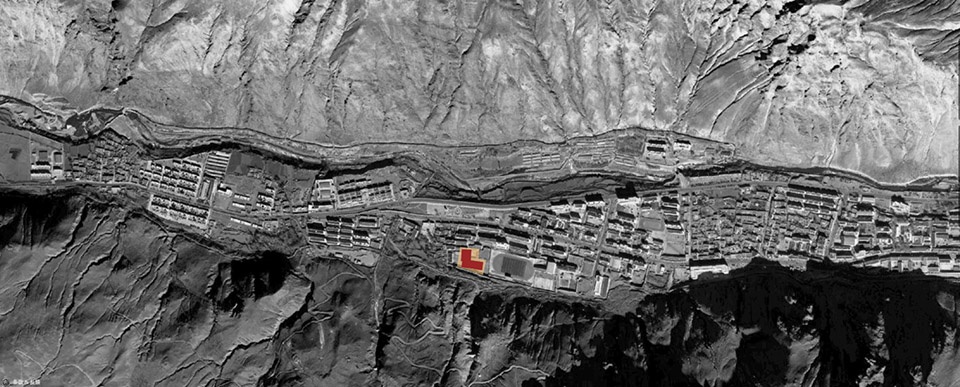
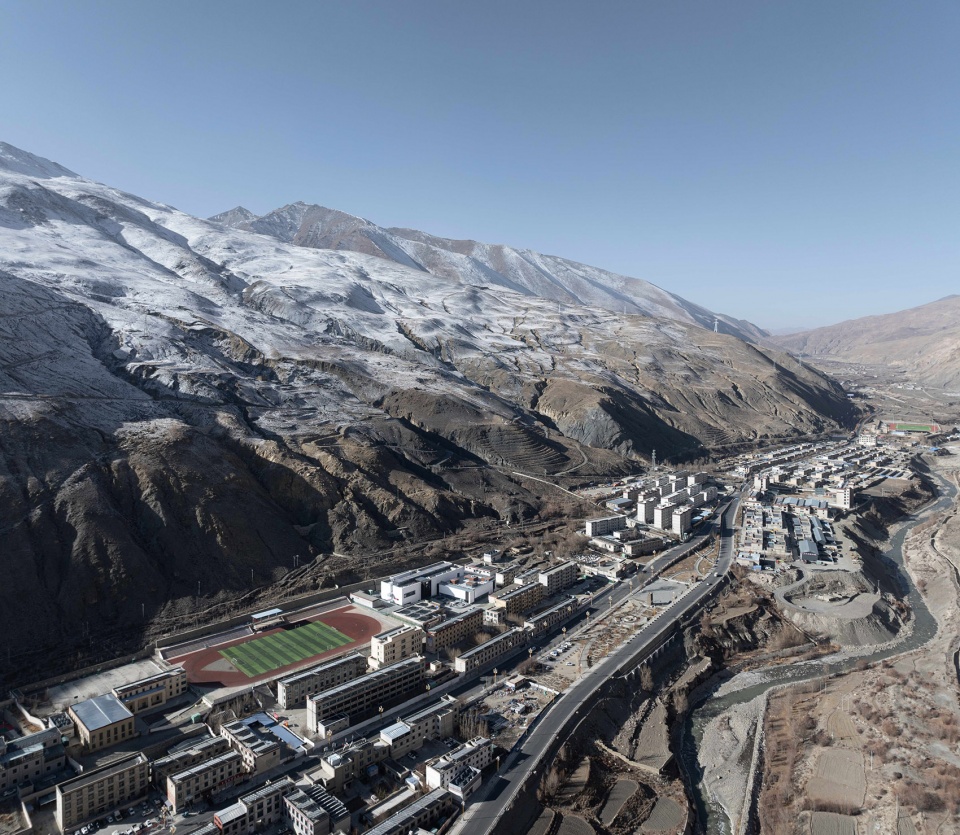
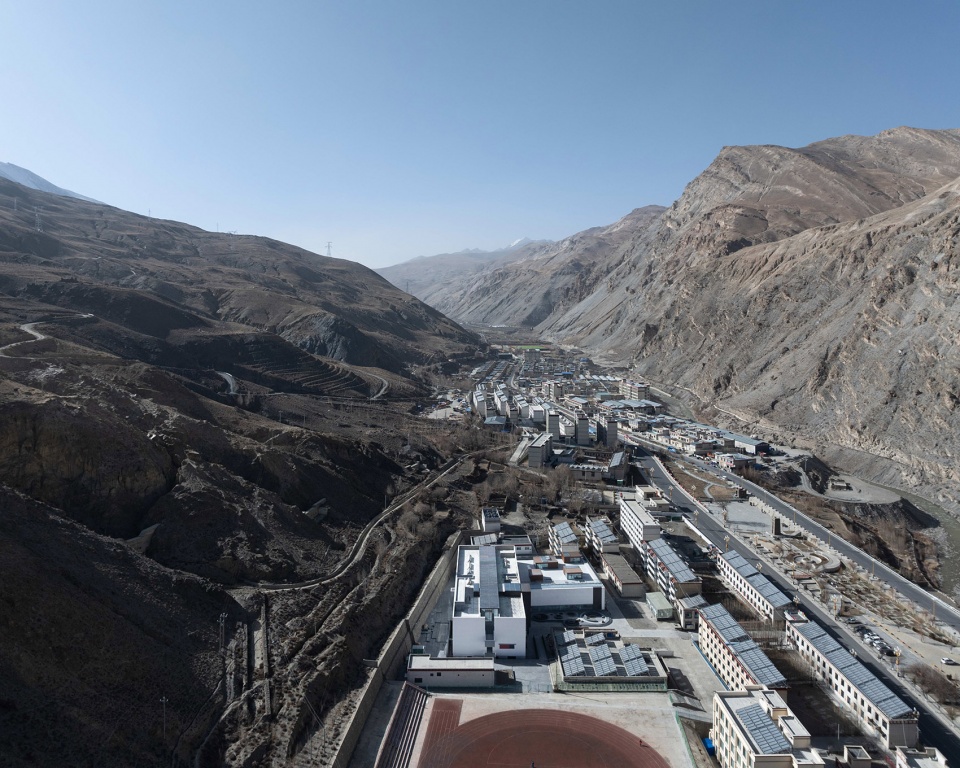
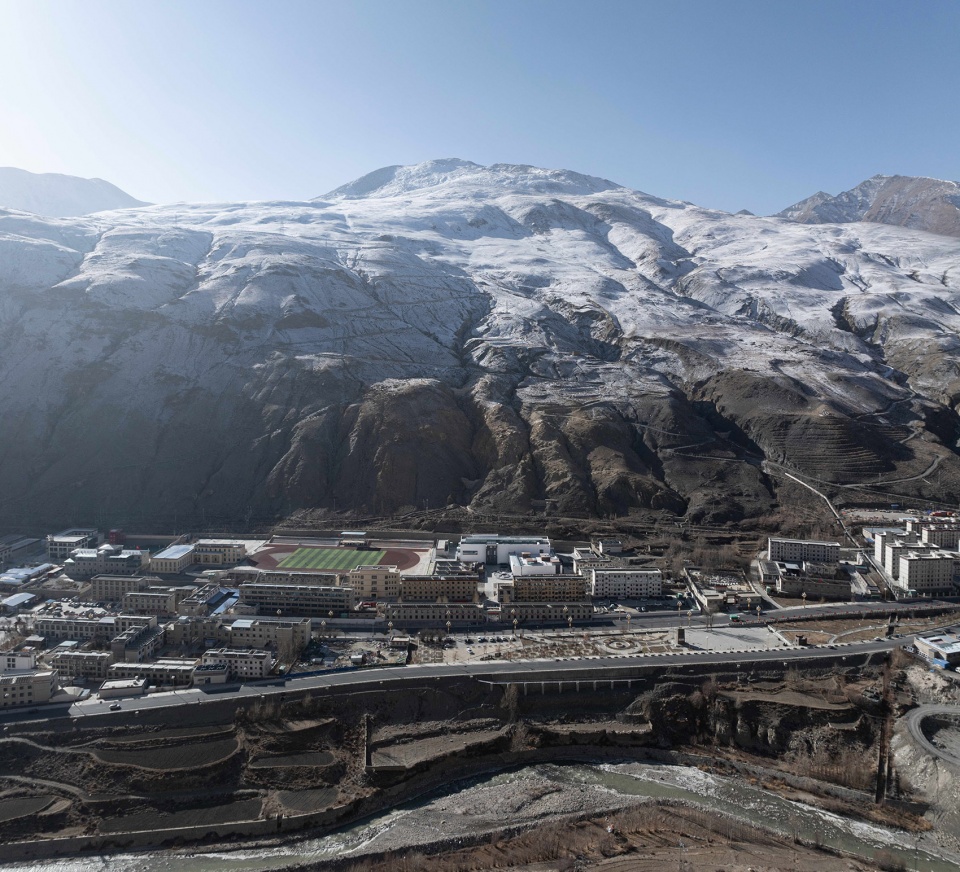
在西藏做设计,往往有着一些截然不同的空间经验。在洛扎项目里,设计就是从山脉与河谷的尺度开始的。隶属西藏自治区山南市的洛扎县,藏语意为“南方大悬崖”,位于喜马拉雅山脉南麓,南与不丹国接壤,总面积5031平方公里,人口2.1万。县域平均海拔3870米,其中海拔超过6000米的山峰就有6座。洛扎沟是洛扎县中部的一条大峡谷,而县城就位于洛扎沟边上的一块局促缓坡上,被两侧高山裹挟。国道219和一条主要街道并行于县城中间,在峡谷中蜿蜒伸展。
In Tibet, architectural design often yields unique spatial design experiences. For the Lhozhag project, the design process began by engaging with the scale of the mountains and valleys.Lhozhag County, where the project is located, belongs to Shannan City of the Tibet Autonomous Region. Its Tibetan name means “Great Southern Cliff.” Situated on the southern slope of the Himalayas and bordering Bhutan to the south, the county covers a total area of 5,031 square kilometers with a population of 21,000. The average elevation of the county is 3,870 meters, and there are six peaks within its boundaries exceeding 6,000 meters in altitude.Lhozhag Gorge is a major valley running through the central part of Lhozhag County. The county is situated on a narrow, gently sloping site along the edge of the gorge, hemmed in by towering mountains on both sides. National Highway 219 and a main street run parallel through the town center, both winding through the gorge.
▼山脉、河谷、县城,Mountains, Valleys and the County
这种天地之间的尺度也塑造了西藏人的心灵场域,辽阔而清澈,质朴又豁达。而我们的多功能艺术中心项目的基地就位于洛扎县的县立初中——洛扎县中学校园内,由中粮集团出资援建,旨在创建一个复合形态的艺术教育空间,为在校师生、当地居民、国际旅客以及赴藏艺术家营造一个跨文化交流的场所。
▼场地范围图纸,Site Plan
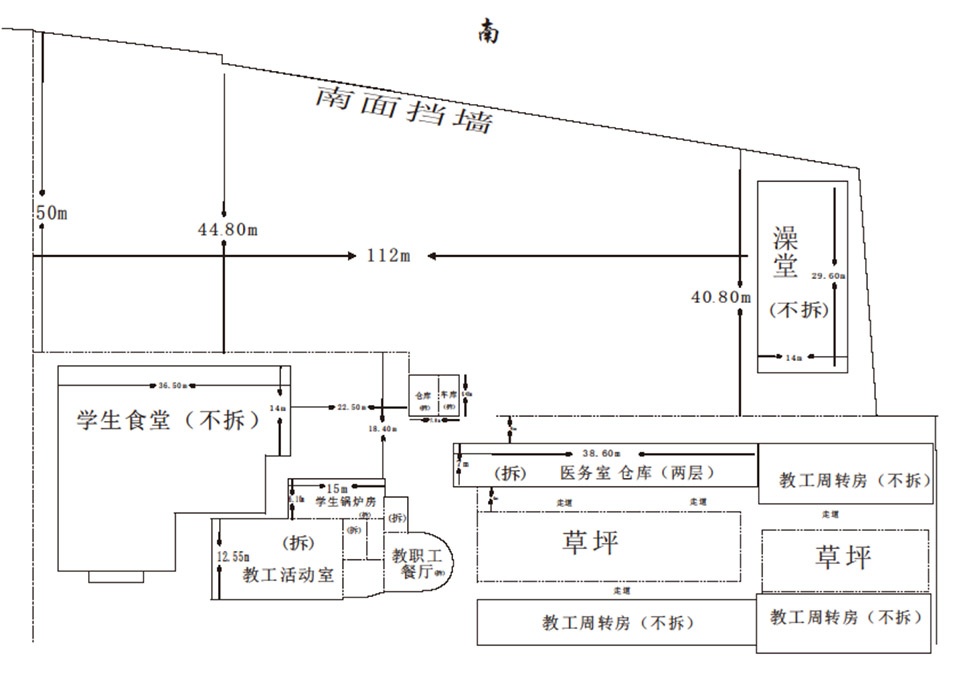
The grand scale between heaven and earth here has shaped the Tibetan spiritual realm—vast and clear, simple yet open-hearted. The site of our multifunctional art center project is located within Lhozhag Middle School, the county’s junior high campus. Funded and built by COFCO Group, the project aims to create a composite art education space that serves as a cross-cultural exchange venue for school staff and students, local residents, international tourists, and artists visiting Tibet.
▼县域卫星地图,County Satellite Map
图底的织补与重构
The Weaving and Reconstruction of the Landscape
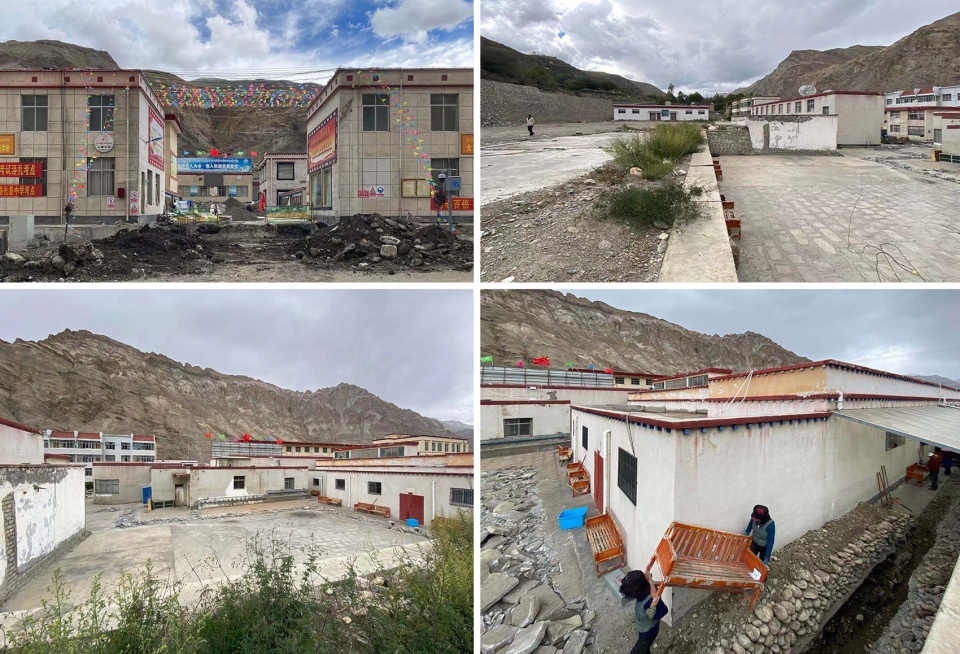
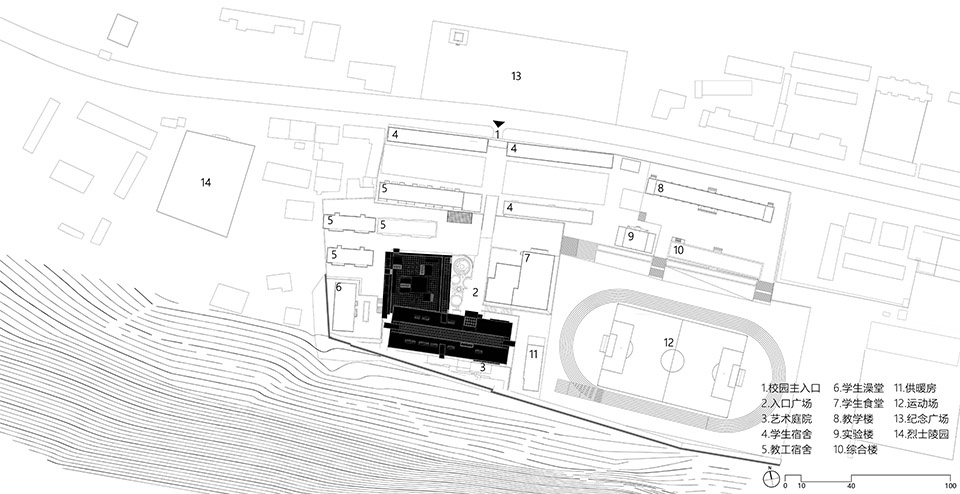
洛扎县中学的基地南面临山,北面临路,路北是一个烈士纪念广场,在往北就是国道219和洛扎沟。校园建设经历不同年代,形成了一系列以散布的条状建筑为主的格局,未能形成整体的空间秩序,所以我们也希望借此机会重新梳理并构建出更为有机的关联性。同时,场地内存在一定的高差,如果利用好也有机会营造更加积极的空间。
The site of Lhozhag County Middle School is situated with the mountains to the south and a road to the north. Beyond the road lies a martyrs’ memorial square, and further north are National Highway 219 and the Lhozhag Gorge. The campus has undergone construction in different periods, resulting in a fragmented layout dominated by dispersed linear buildings. This has prevented the formation of a cohesive spatial order. Therefore, one of our key objectives is to take this opportunity to reorganize and construct a more organic relationship between the elements of the site. Additionally, the site has a noticeable elevation difference, which, if utilized properly, offers the potential to create more dynamic and engaging spaces.
▼基地原貌,Existing Site Conditions
基地面积较为有限,为此设计了采取一种”嵌入式”的策略——首先对于正对着校门的原有教工活动室进行拆除并纳入新建体量,从而形成连续的校园中轴空间,新建建筑则以紧凑的L形体量布置在中轴的南端,形成从校园主入口、前场空间到多功能艺术中心入口小广场的外部空间序列。当把尺度再放大来看,南临山的多功能中心与北临水的纪念广场则在洛扎县城南北进深有限的腹地里面创造了一条城市空间纵轴。
▼空间图底分析图,Spatial Figure-Ground Analysis
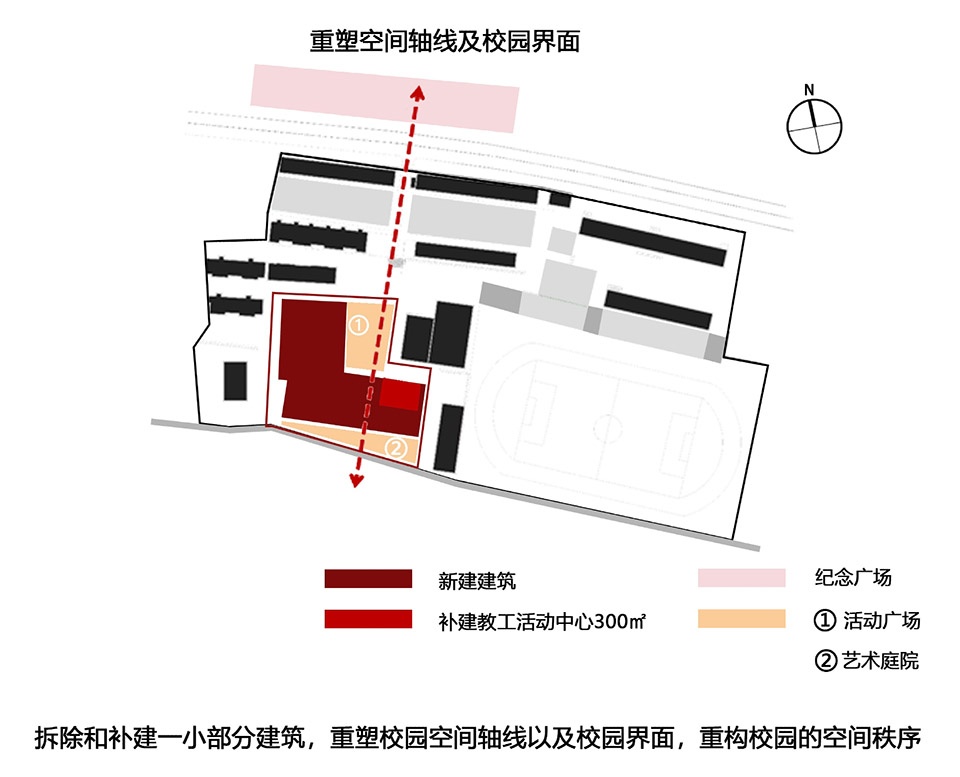
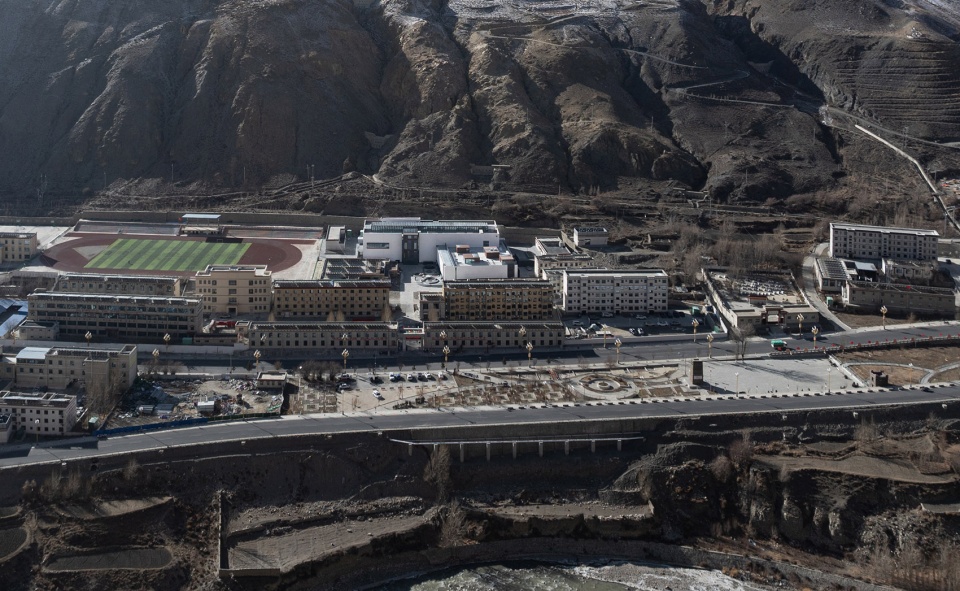
Given the limited area of the site, the design adopts an “embedded” strategy. The first step involves demolishing the existing staff activity room directly facing the school entrance and incorporating it into the new building volume. This move creates a continuous central axis through the campus. The new building is arranged in a compact L-shaped mass at the southern end of this axis, forming a spatial sequence that connects the main entrance of the campus, the front yard, and the small plaza at the entrance to the multifunctional art center. When viewed on a larger scale, the multifunctional center to the south, facing the mountains, and the memorial square to the north, facing the water, create an urban spatial axis within the limited depth of the southern part of Lhozhag County.
▼新建筑与建成环境,New Buildings and the Built Environment
体量组织与空间形态
Massing Configuration and Spatial Morphology
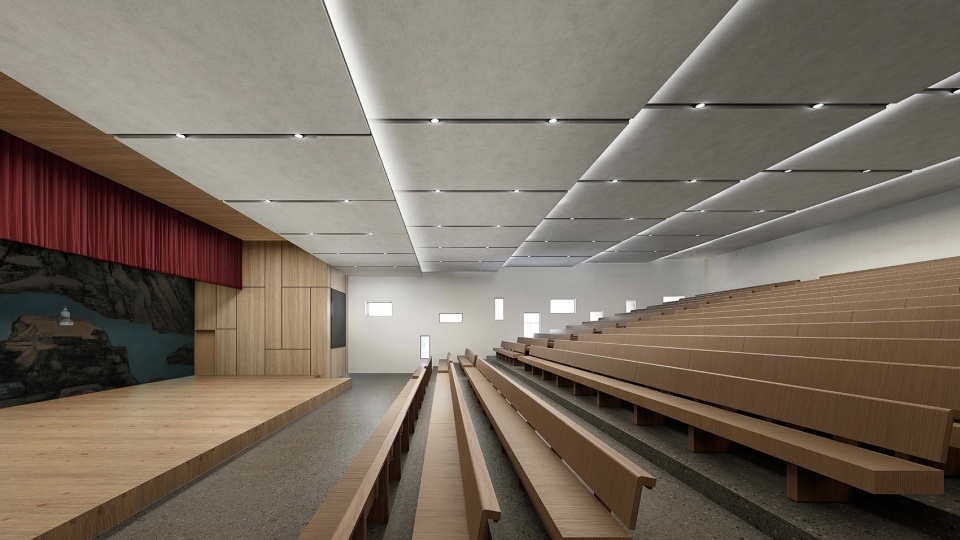
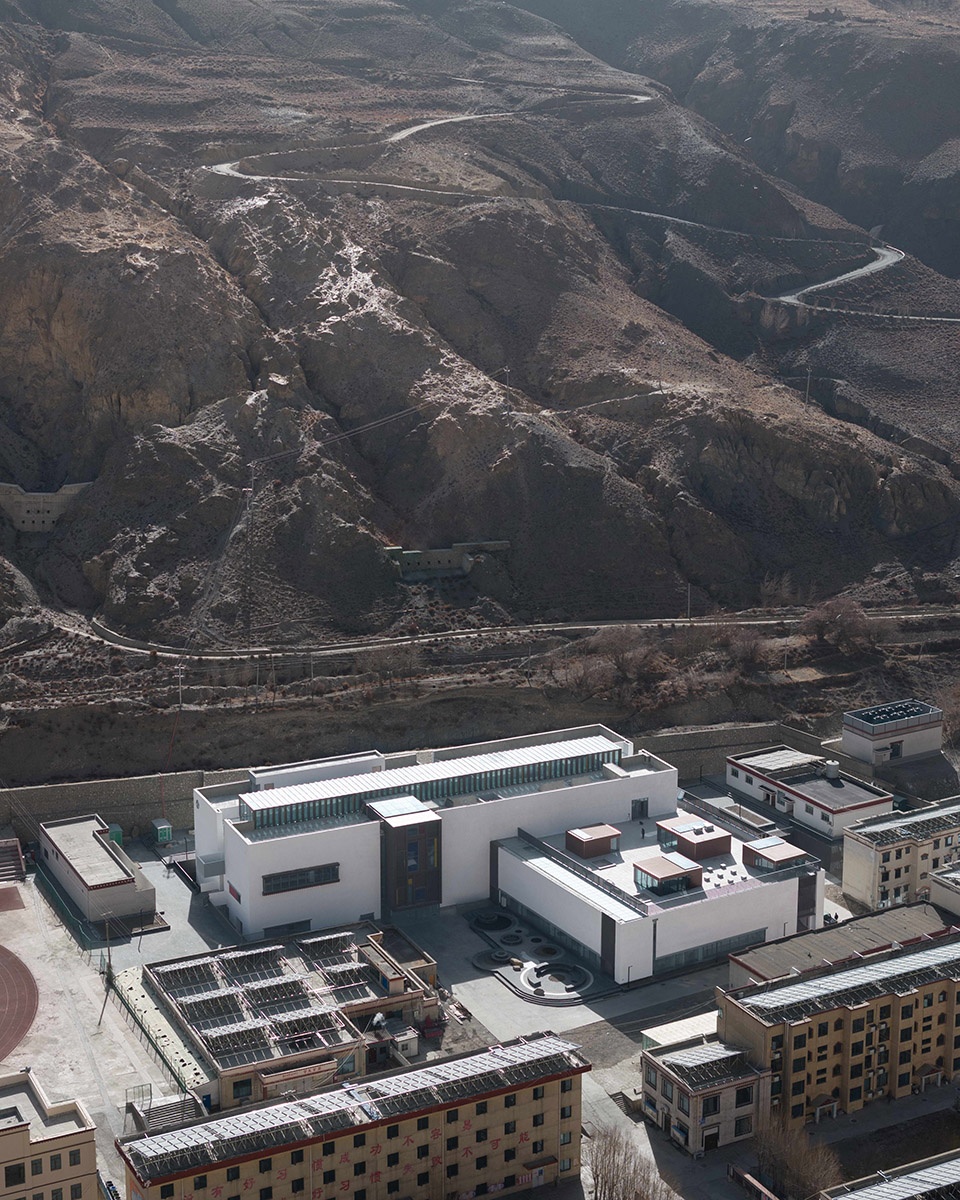
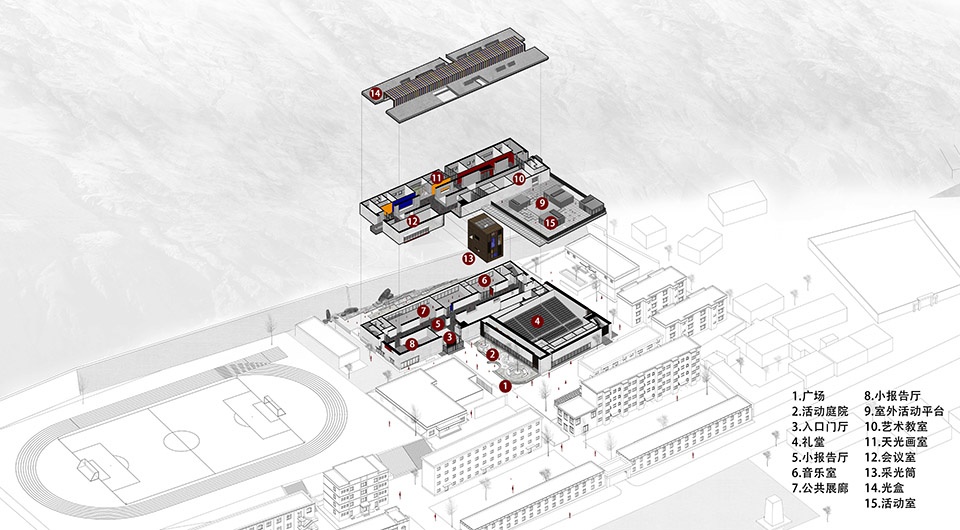
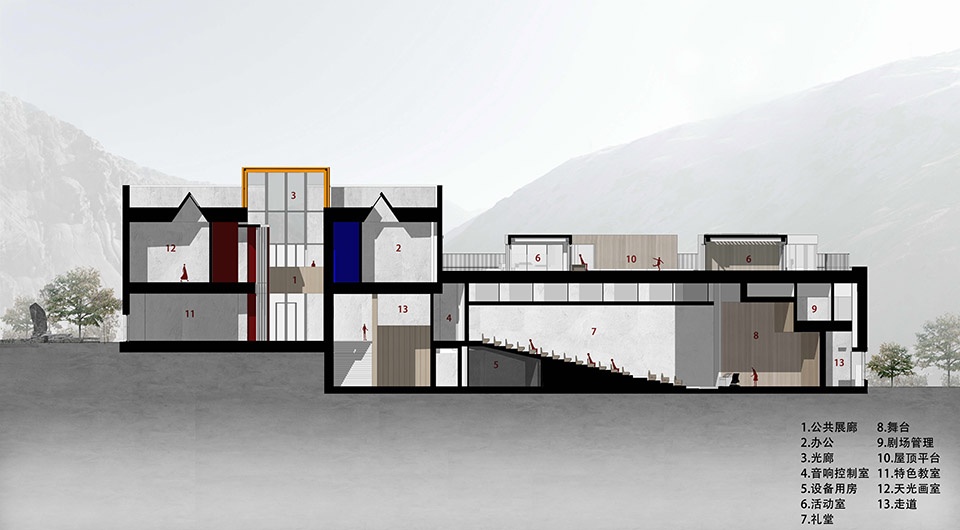
由于基地位于南面山体的北坡脚下,南向空间逼仄,难以实现好的南向自然采光,故而在设计中我们运用了多种形式的天窗来实现对于太阳光的最有效利用。多功能中心主体建筑则由一长一方两个体量构成。长条形的部分又由两条实体与一个狭长中庭形成一种三明治空间结构,两边是艺术教室、工作室为主的小尺度空间,中间是通高的天光中庭,它兼具交通、展览、交流等多种功能。方形体量内部主要是容纳700人的礼堂,在它的侧面也设计了一个天光边厅。
▼轴测图,Isometric Drawing
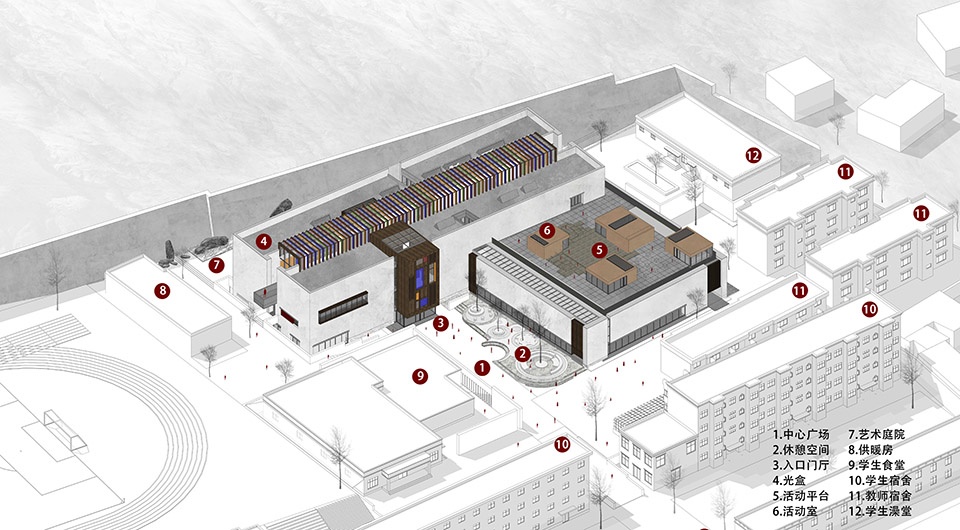
Situated at the northern foothills of a south-facing mountain slope, the project site is constrained by limited space towards the south, making optimal natural daylighting from this direction difficult to achieve. In response, the design incorporates various forms of skylights to maximize solar utilization. The main structure of the Multi-Functional Center is composed of two primary volumes—one linear and one cubic. The elongated volume is organized in a “sandwich-like” spatial configuration, consisting of two solid masses and a narrow central atrium. Flanking the double-height skylit atrium—serving as a hub for circulation, exhibitions, and gatherings—are small-scale spaces housing art classrooms and studios. The square volume contains a 700-seat auditorium, with a skylit side hall designed along its lateral facade.
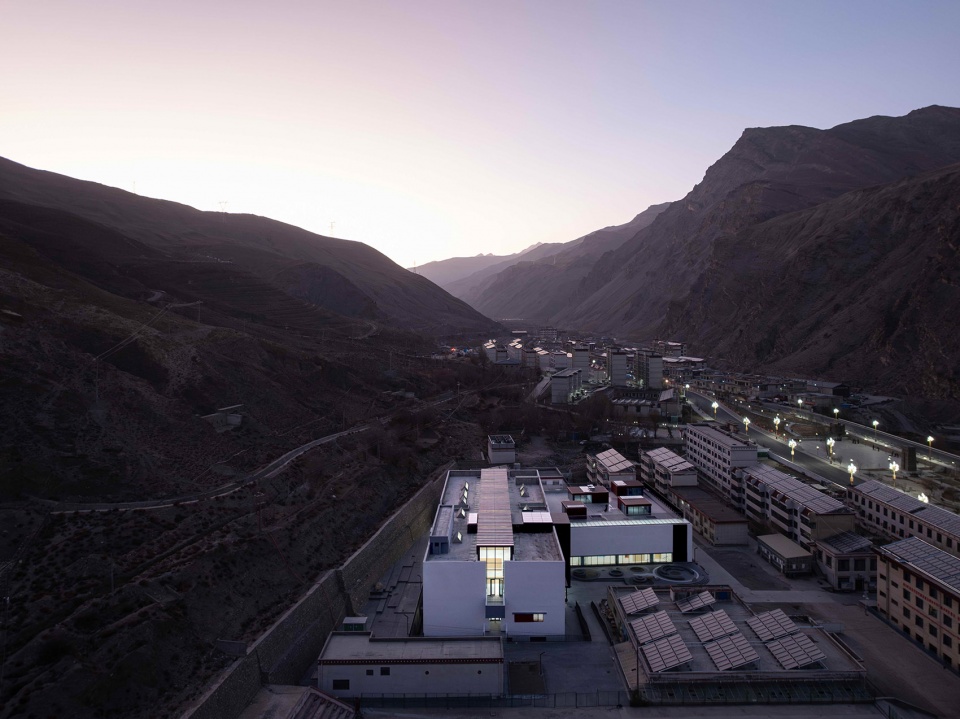
▼夜幕下的新建筑,New Building Under the Night
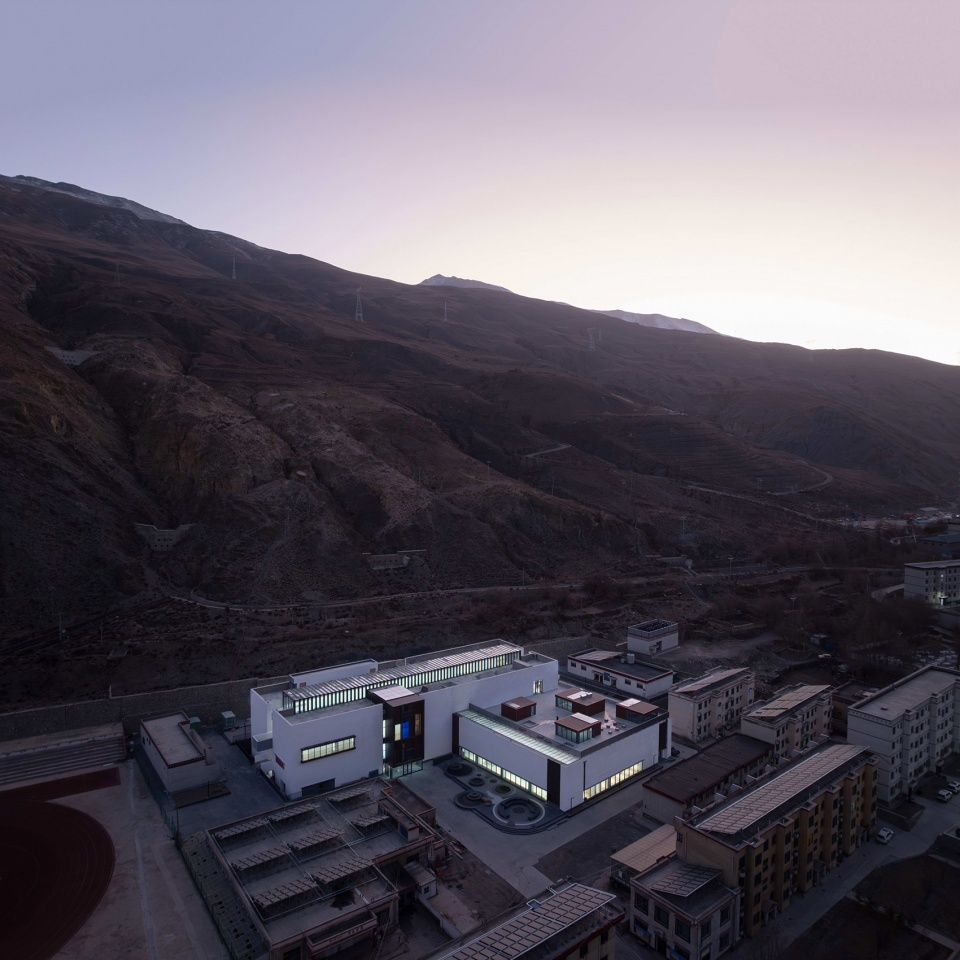
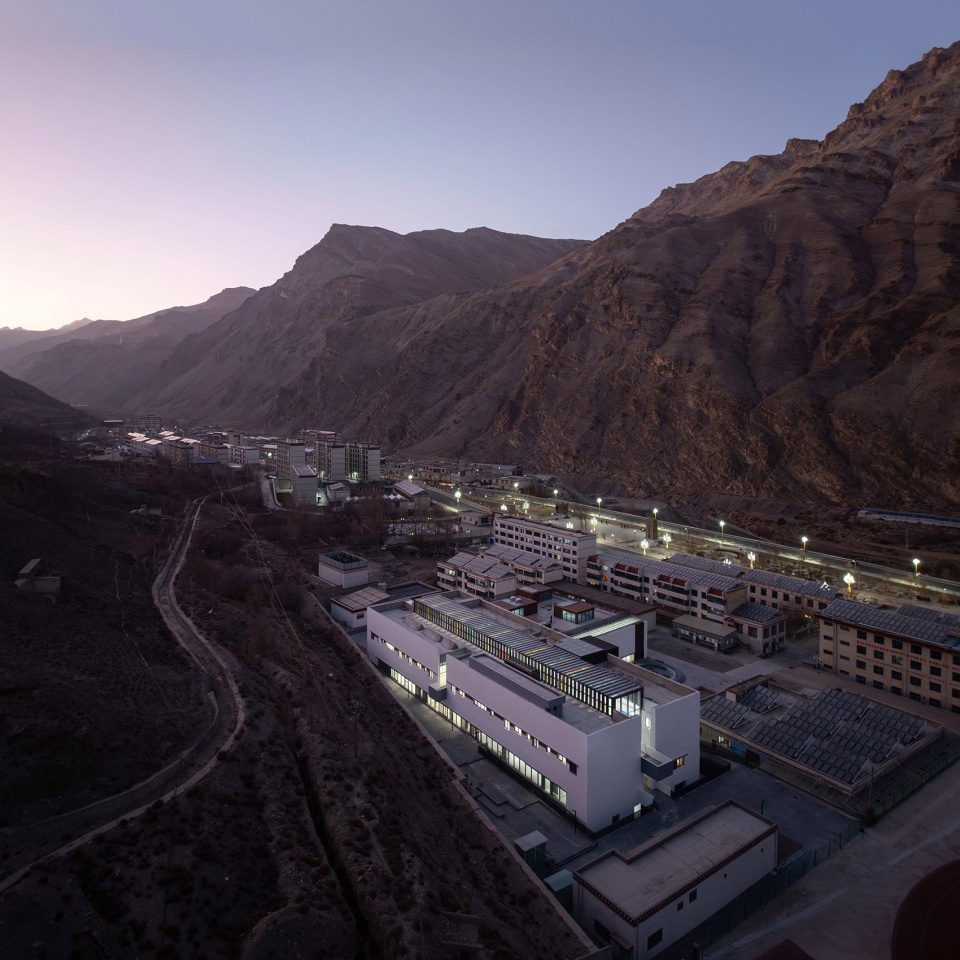
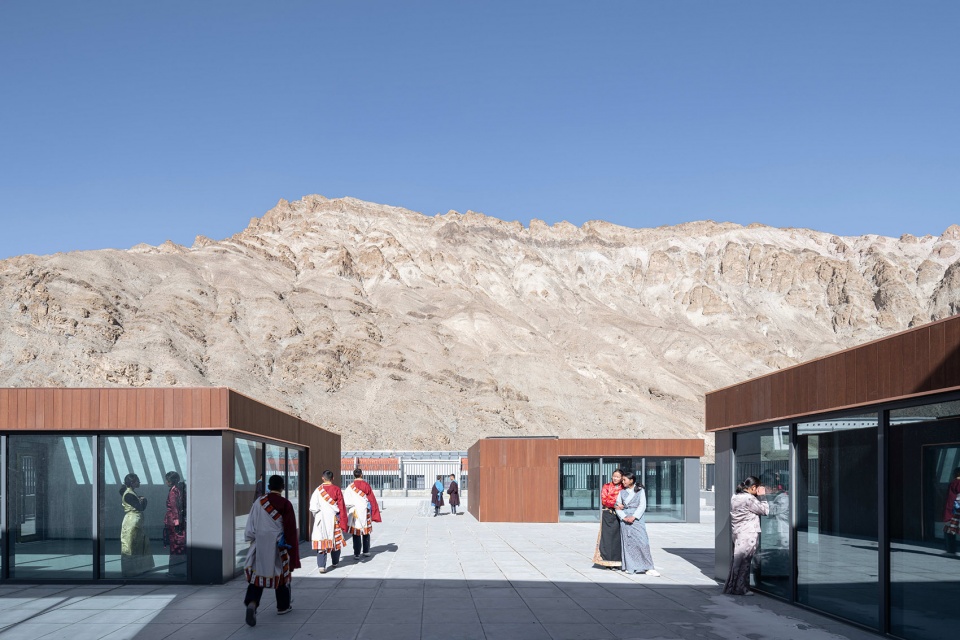
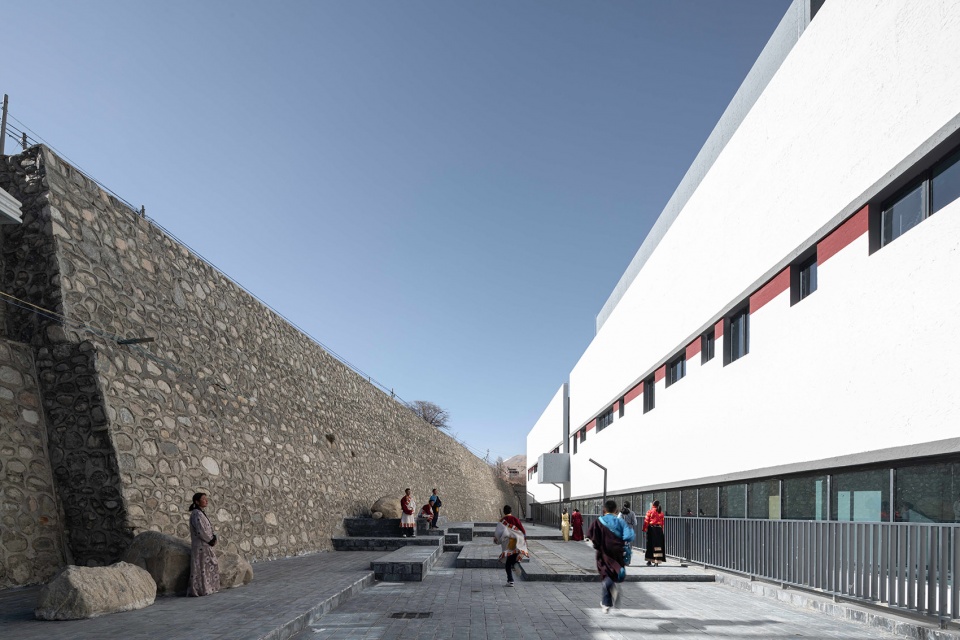
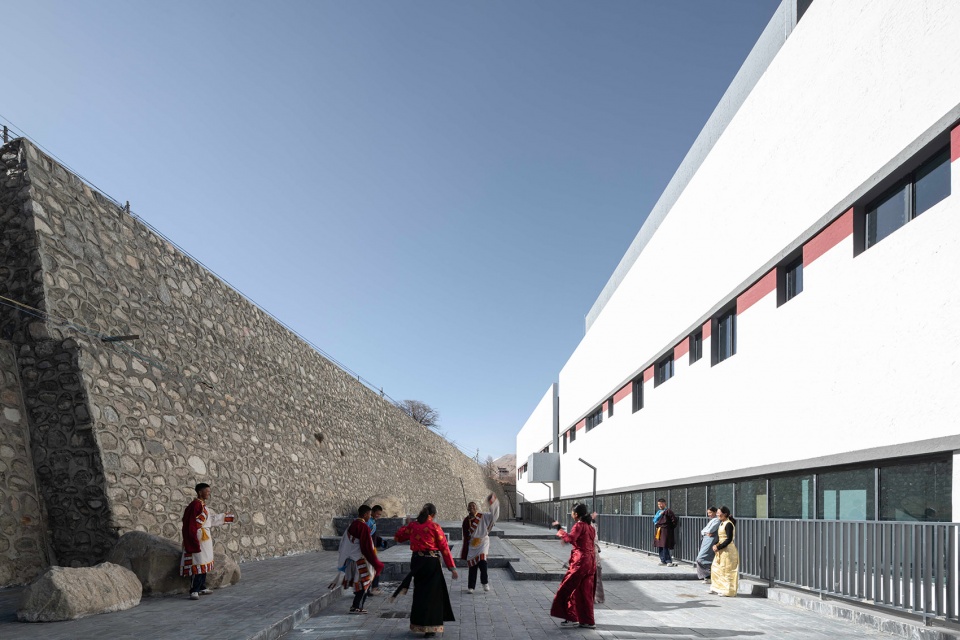
一长一方两个体量之间呈一个接近直角的关系,是对于空间轴线和与周边建筑关系的回应。结合场地的标高,两个体量也形成了一定的高差,礼堂的屋面刚好成为可达性很好的户外活动场地,我们在屋面上还设计了几个南向开窗的小房子,希望让孩子们的课外生活多一些有趣的空间。而在主体建筑南侧与山脚的北向边坡之间,则形成了一个狭长的楔形庭院,如同一个山体与建筑构成的“微缩峡谷”,可以作为室外展场和室内活动空间的外延。
These two volumes are arranged in a near-perpendicular relationship, a deliberate response to both the site’s spatial axis and the surrounding buildings. Considering the site’s topography, a subtle elevation difference is established between the two forms. The roof of the auditorium becomes a highly accessible outdoor activity platform. On this rooftop, several small, south-facing structures with windows are designed to offer engaging and playful spaces for students’ extracurricular activities. Between the main building’s southern edge and the northward-sloping mountain base lies a narrow wedge-shaped courtyard, functioning as a “miniature gorge” between architecture and terrain—an extension of both outdoor exhibition areas and indoor activity spaces.
▼屋面活动平台,Roof Activity Terrace
▼南侧的楔形院子,Southern Wedge-Shaped Courtyard
▼礼堂室内透视,Auditorium Interior Perspective
▼礼堂侧厅,Auditorium Side Hall
低技建造与在地融合Low-Tech Construction and Contextual Integration
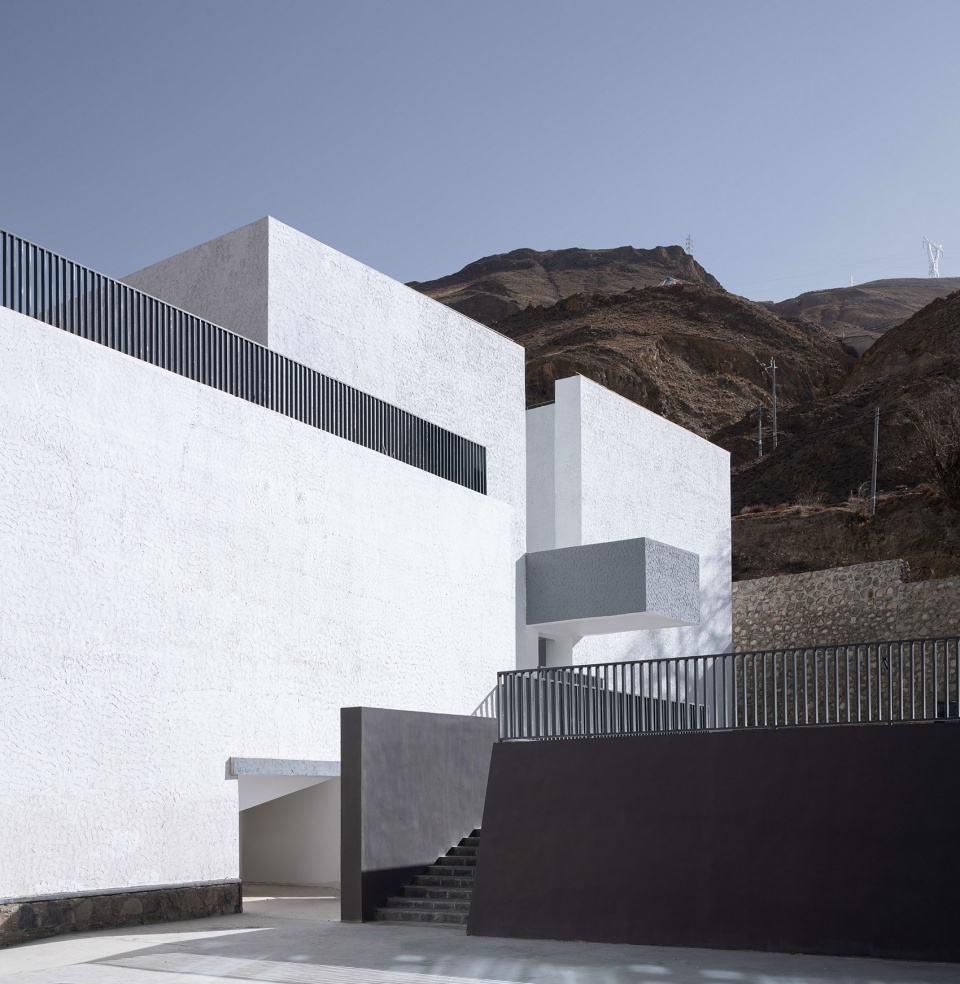
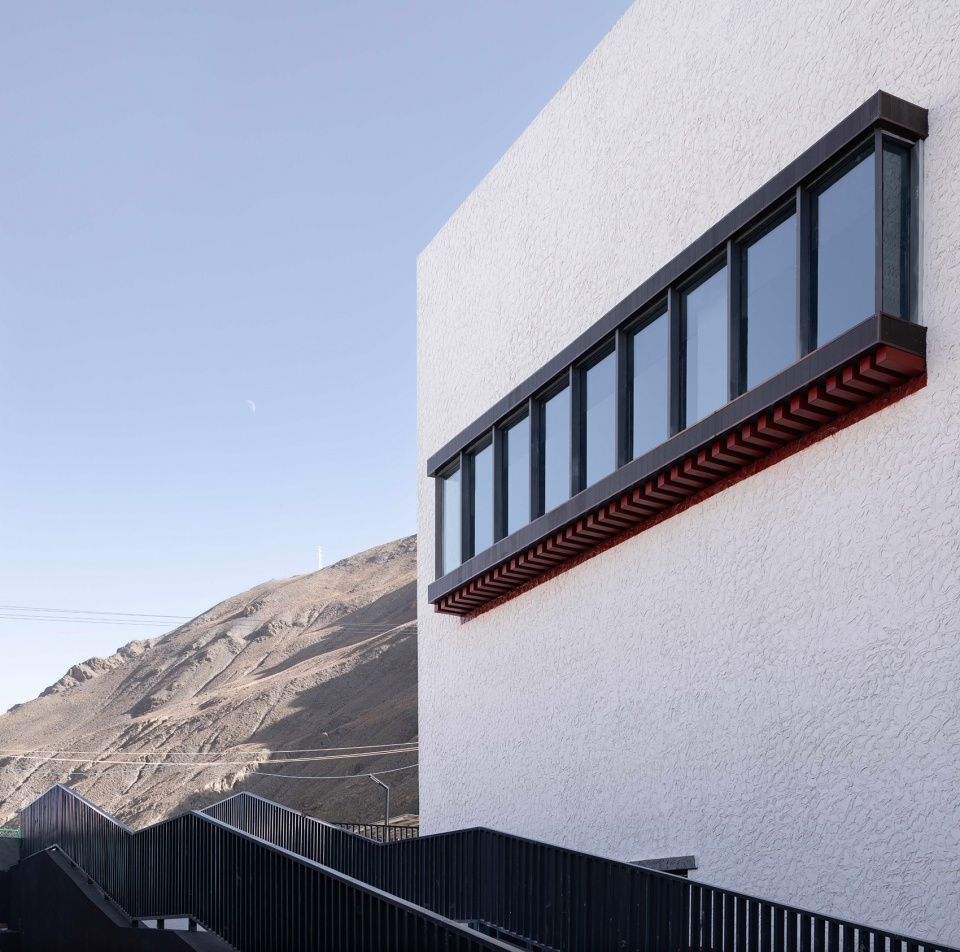
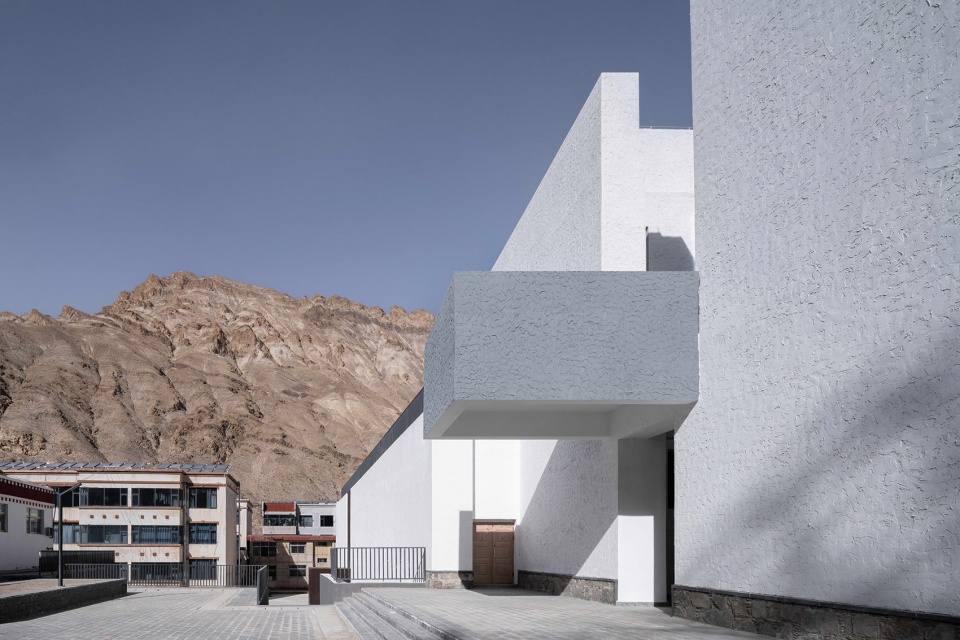
我希望在地性通过当代语言的融合提炼,最好能以一种相对克制的方式被诠释出来。环顾场地周围,无论自然环境还是相邻建筑,都呈现出一种原生的、粗砺的力量。每天孩子们的朗朗读书声就回荡在大山的臂弯里,伴随洛扎沟的水声传向远方。我想让新的房子就像从这山里长出来的石头,既令人好奇又似曾相识。令人好奇的是它像个白色的魔法盒子,里面盛着很多的有意思的空间;似曾相识的是它和周边的房子看起来关系不错,有着不少共同语言。而这块“石头”本身又是与这片土地牢牢长在一起的,结实的让人心安。
Our intention was to express the project’s sense of place through a distilled contemporary architectural language—one that remains restrained and respectful in its articulation.The surrounding context—both its unrefined natural landscape and the neighboring built forms—exudes a raw, elemental force that speaks to the site’s primal character. Each day, the children’s recitations echo through the arms of the mountains, mingling with the distant sound of the Lhozhag Valley stream. I envisioned the new building as a stone emerging from the mountain itself—something that sparks curiosity while also evoking a quiet familiarity. It is curious in the way it appears as a white “magic box” filled with intriguing spatial experiences; yet familiar in its subtle dialogue with the surrounding built environment, sharing a common architectural language. This “stone” is firmly grounded in the land—solid, steady, and reassuring.
▼从校园方向望向建筑,View from the Campus towards the New Building
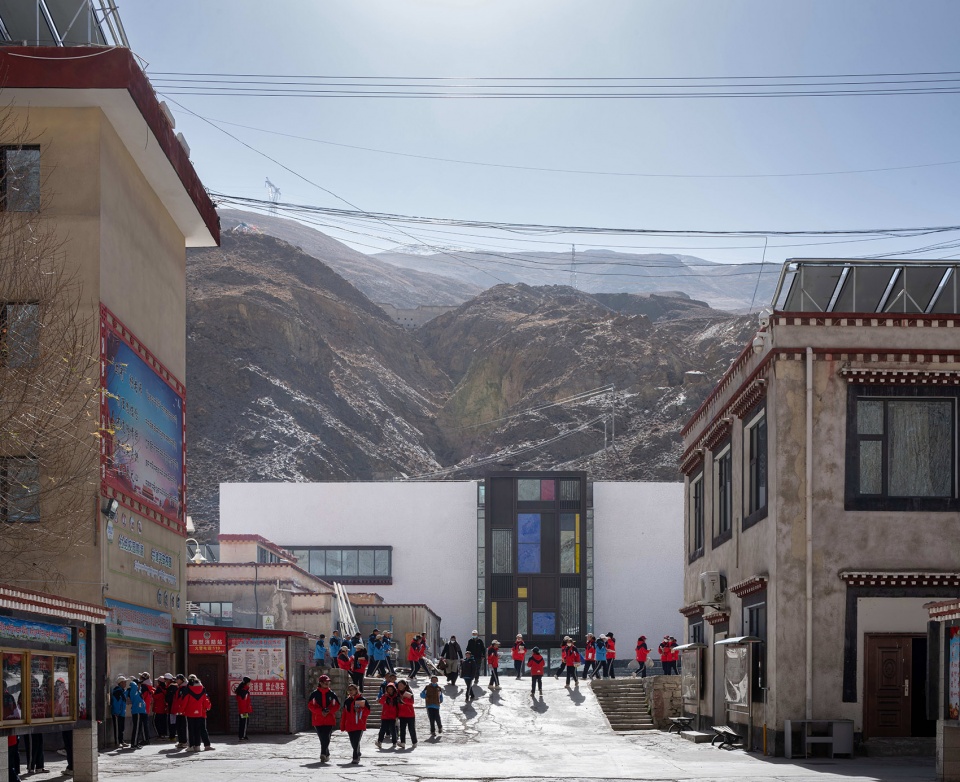
▼建筑西侧外观,Western Façade
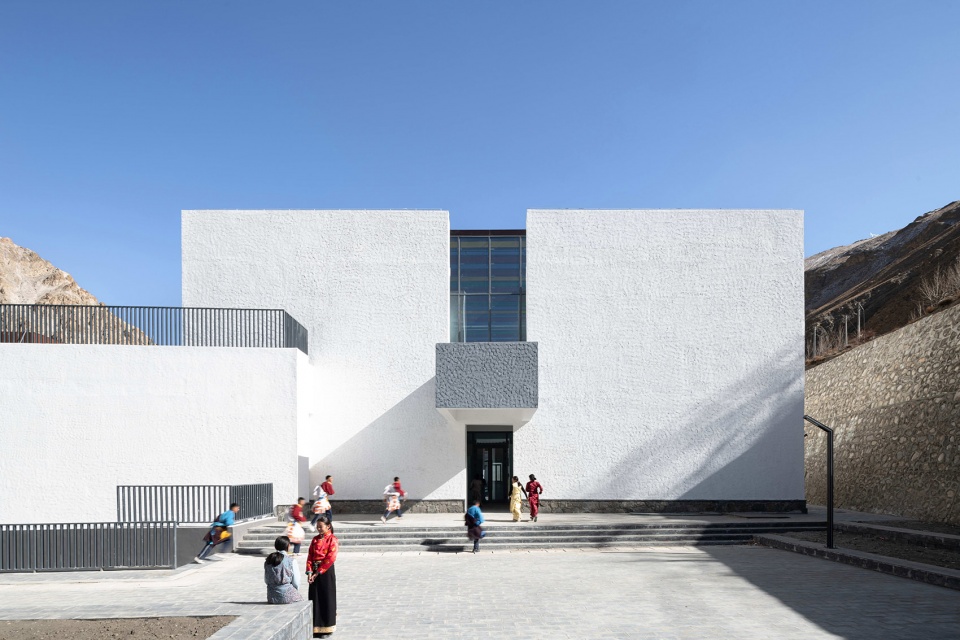
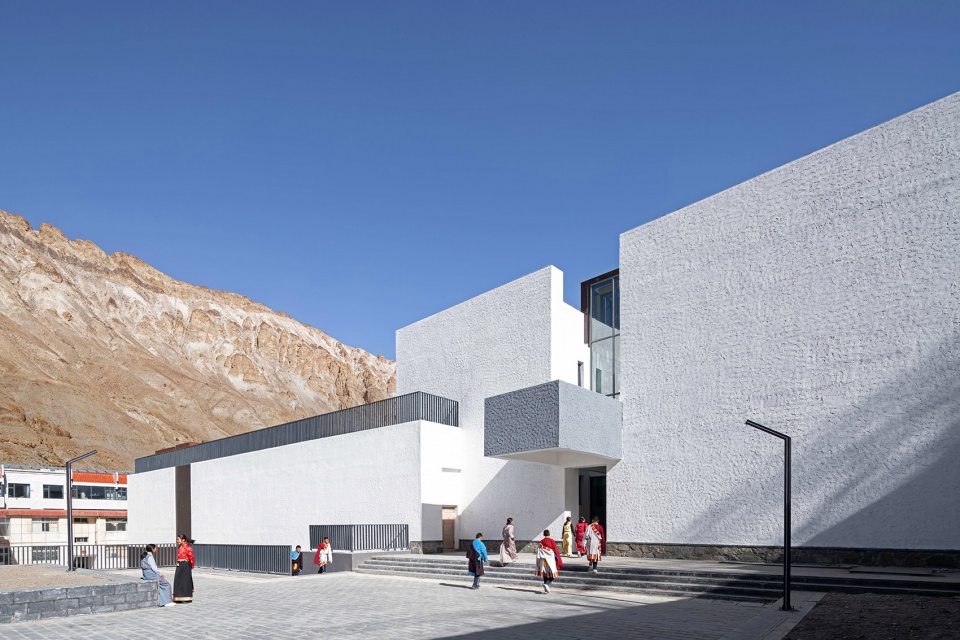
▼建筑与山,Architecture and Mountains
▼嵌入既有环境,Embedding into the Existing Environment
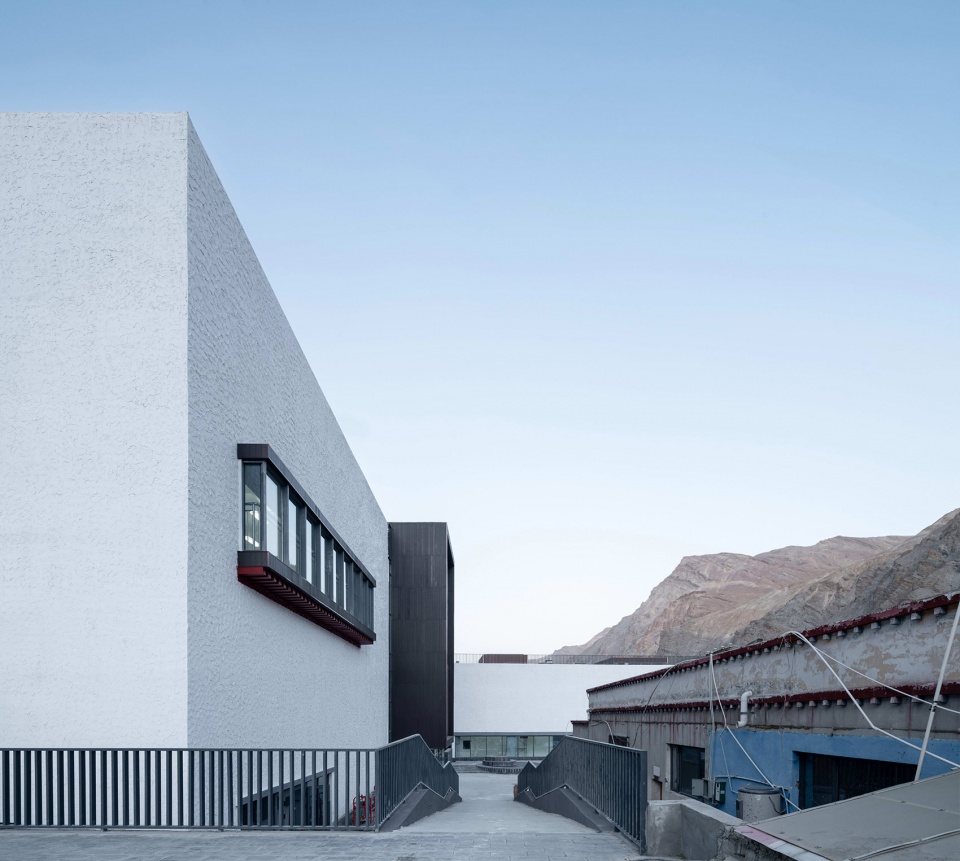
▼嵌入既有环境,Embedding into the Existing Environment
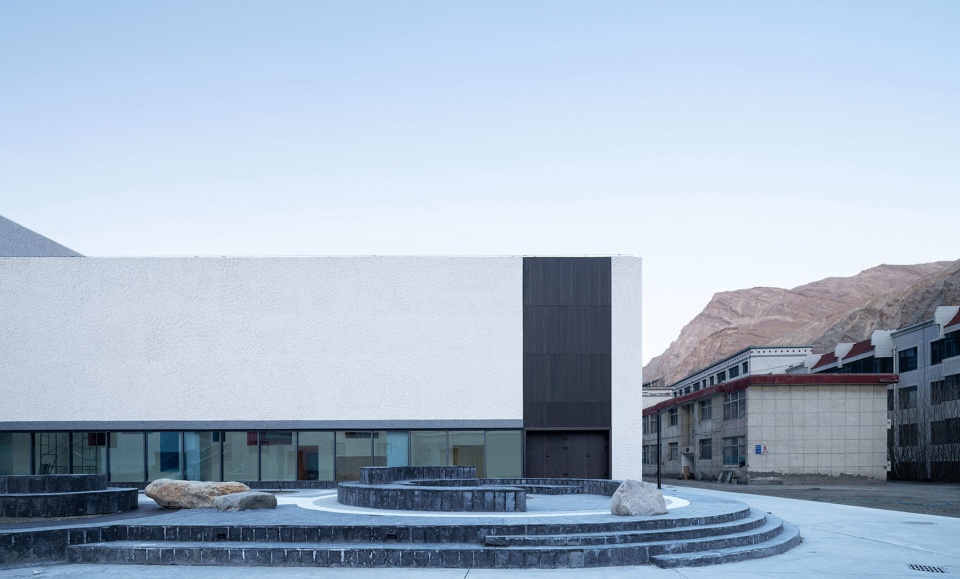
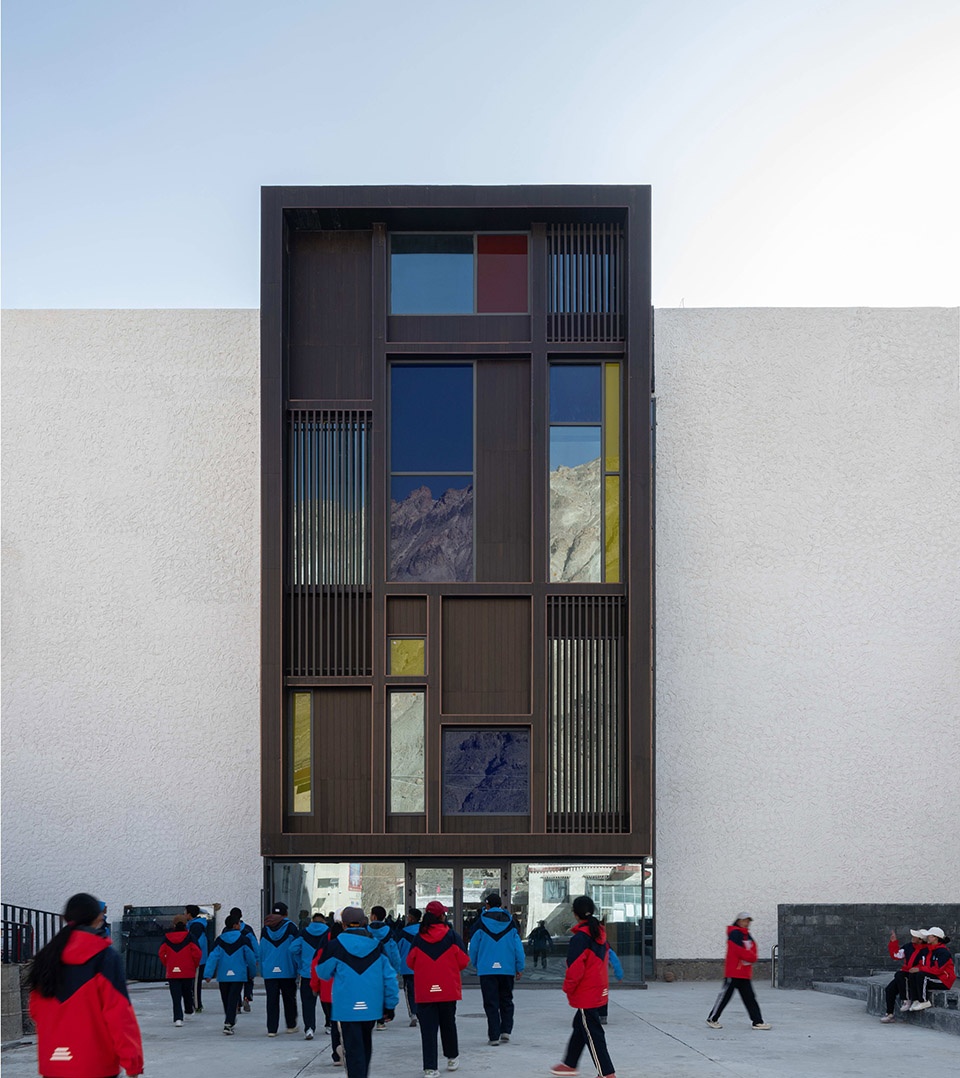
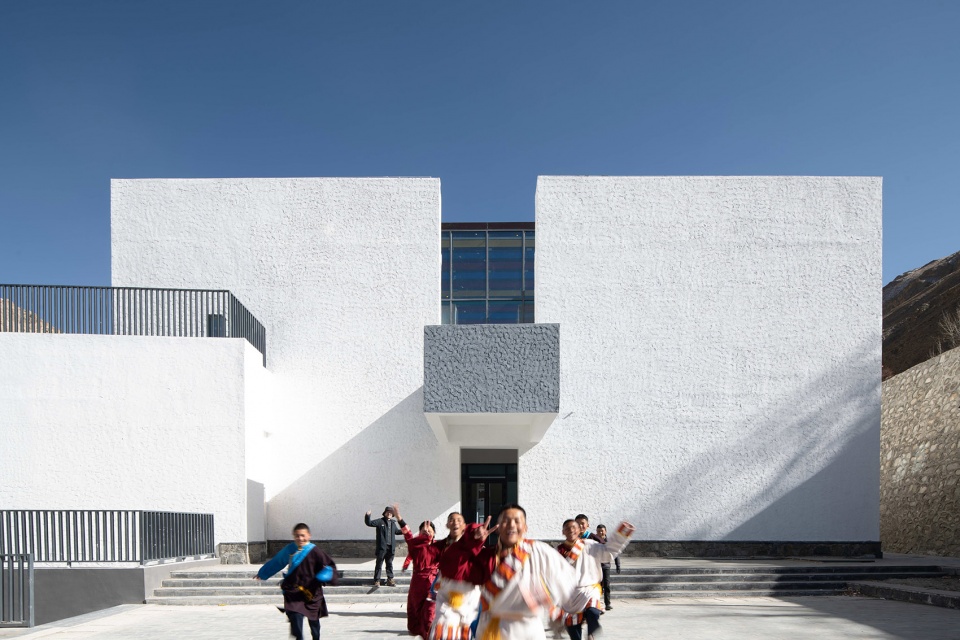
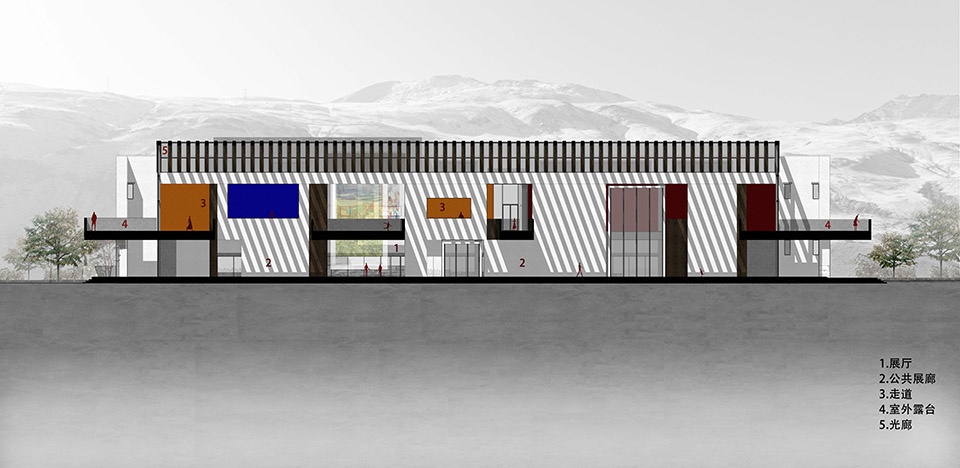
在主入口的立面,我们设计了一个属于洛扎的“蒙德里安画框”,通过虚实处理与色彩构成,立面的玻璃被解构成不同大小和颜色的镜面,孩子们看着倒映的天空、雪山、房子和自己,产生出一种“熟悉的陌生感”,在日常之中,激发着他们的好奇心和探索欲。
At the main entrance façade, we designed what could be described as a “Mondrian frame” for Lhozhag. Through a composition of solids and voids, light and reflection, the façade glass is broken down into mirrored panels of varying sizes and hues. These reflections—of the sky, the snow-capped peaks, the building, and the children themselves—create a sense of “familiar strangeness”, subtly provoking curiosity and encouraging exploration in their daily routines.
▼建筑主入口,Main Entrance of the New Building
所有的建造方式都是常规且易于实现的,多用本地的可回收材料。天窗的设置极大提升了自然光的效率,也实现了更好的室内蓄热性能,有效降低了冬季的采暖能耗。
▼构造节点,Construction Detail
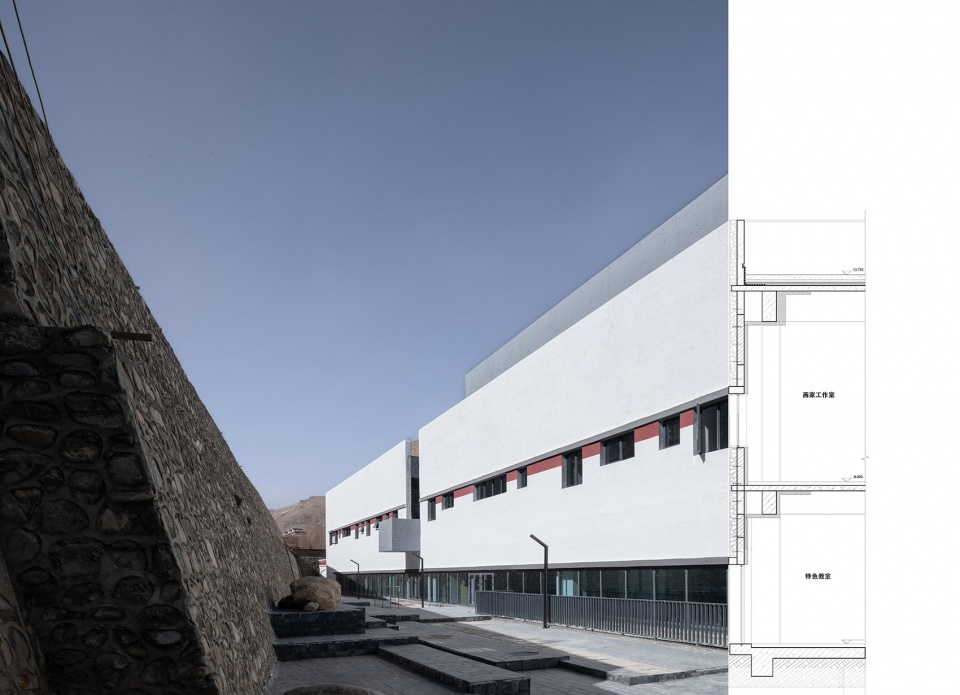
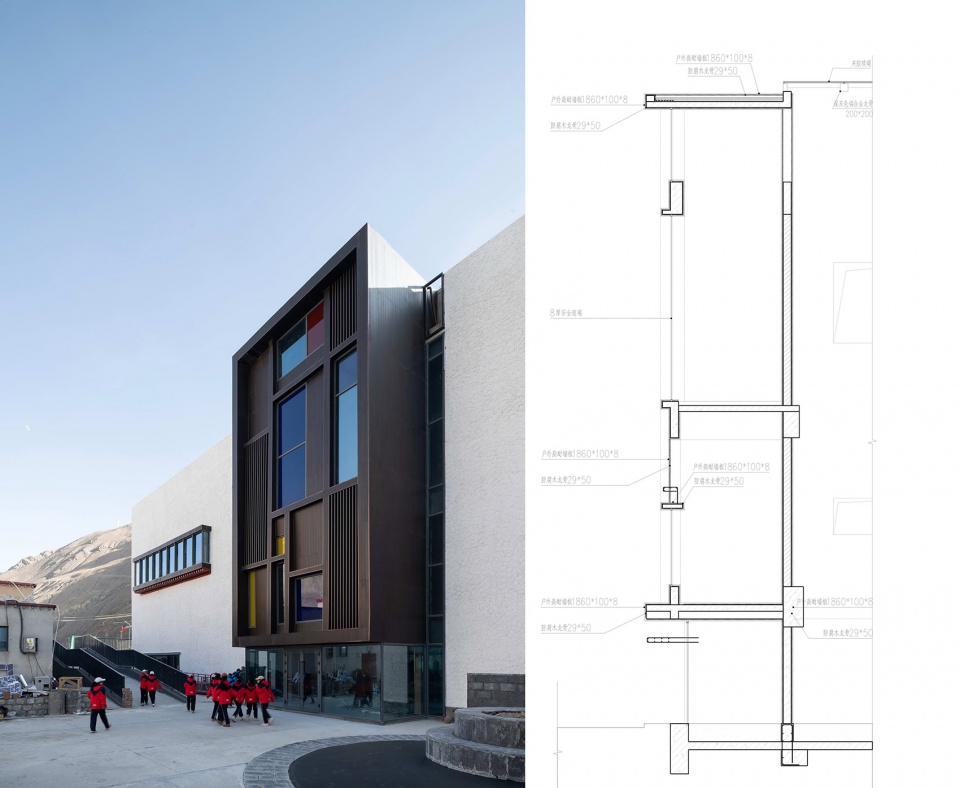
Construction methods employ conventional, locally executable techniques, prioritizing recyclable regional materials. Skylight configurations enhance natural daylighting and thermal mass performance, significantly reducing heating energy use in winter.
▼阳光下的建筑,Sunlit Building
▼天光画室内景,Art Studio Interior with Skylight
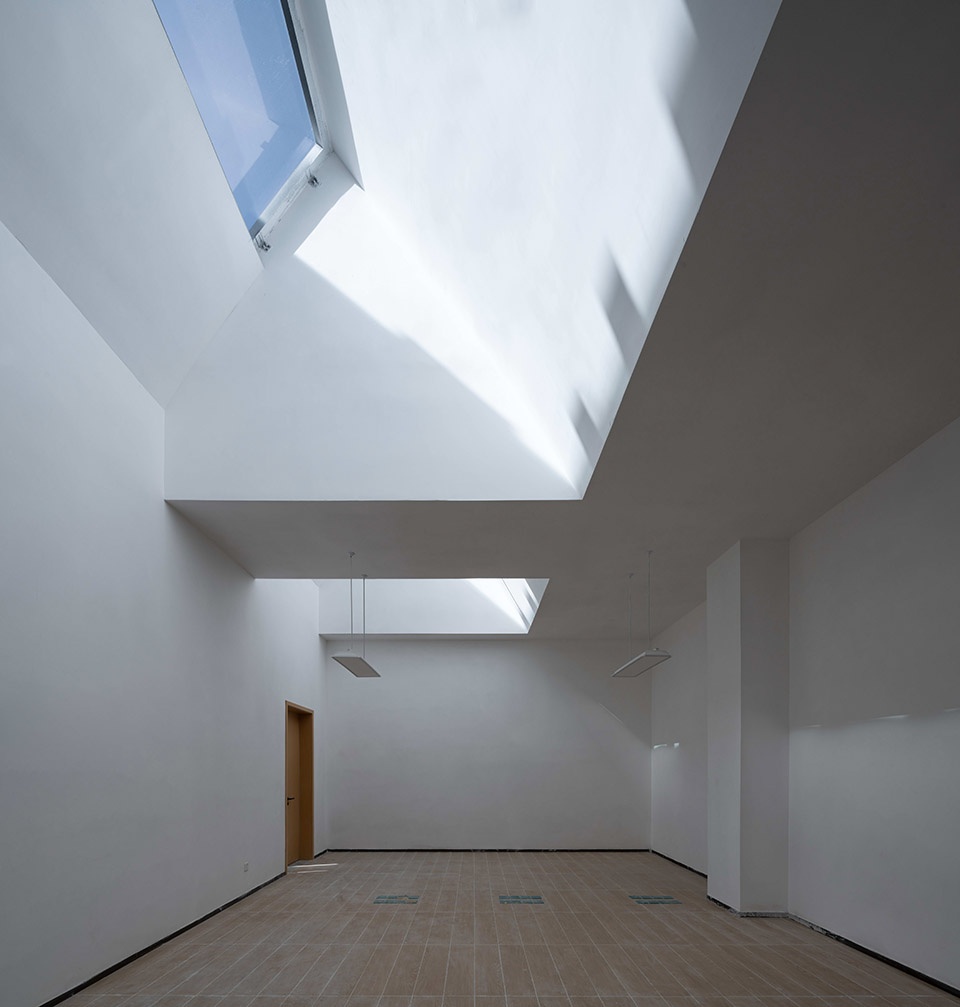
▼礼堂侧厅的天光,Skylight in the Auditorium Side Hall
光之峡谷
The Canyon of Light
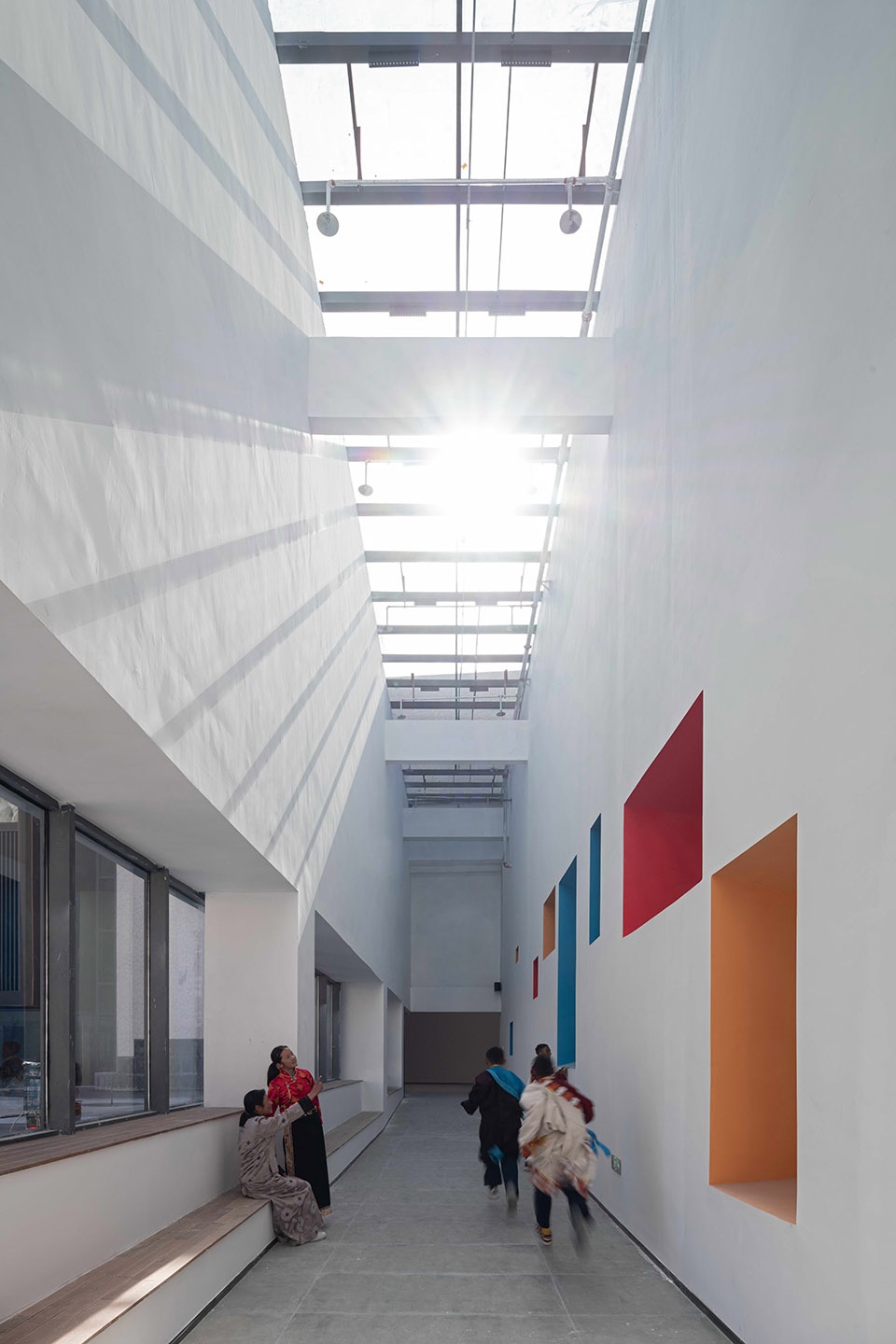
“峡谷光庭”是整个建筑的核心空间,它既是对于洛扎独特自然地貌的抽象再现,也是对于西藏传统建筑特质的当代演绎。 “阳光给峡谷带来生机,日常的生活也由此发生”,我希望用设计将这种朴素而鲜活的生命力呈现出来,无论是空间尺度,还是光影色彩,都是对于这种生命力量的礼赞。
▼藏式空间原型,Tibet Spatial Prototype
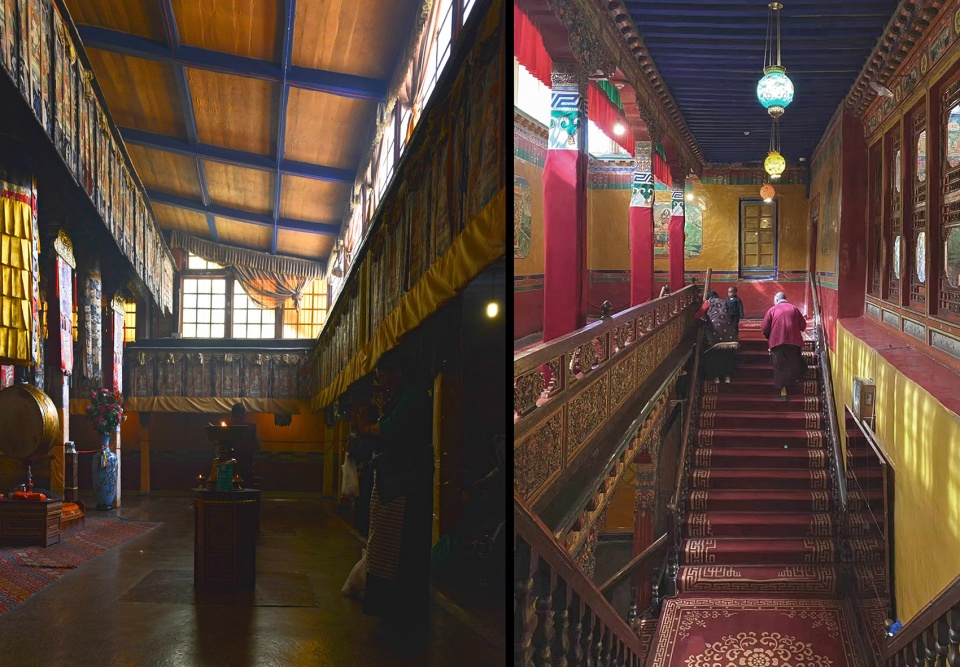
The “Light Canyon Atrium” serves as the spiritual and spatial core of the entire building. It is both an abstract interpretation of Lhozhag’s dramatic natural terrain and a contemporary reimagining of the essential qualities of traditional Tibetan architecture. (Diagram: Spatial Archetype) Inspired by the idea that “sunlight breathes life into the canyon, where daily routines unfold”, the design celebrates this raw, vibrant energy through spatial scale, light quality, and chromatic composition.
▼光庭内景,Light Atrium Interior
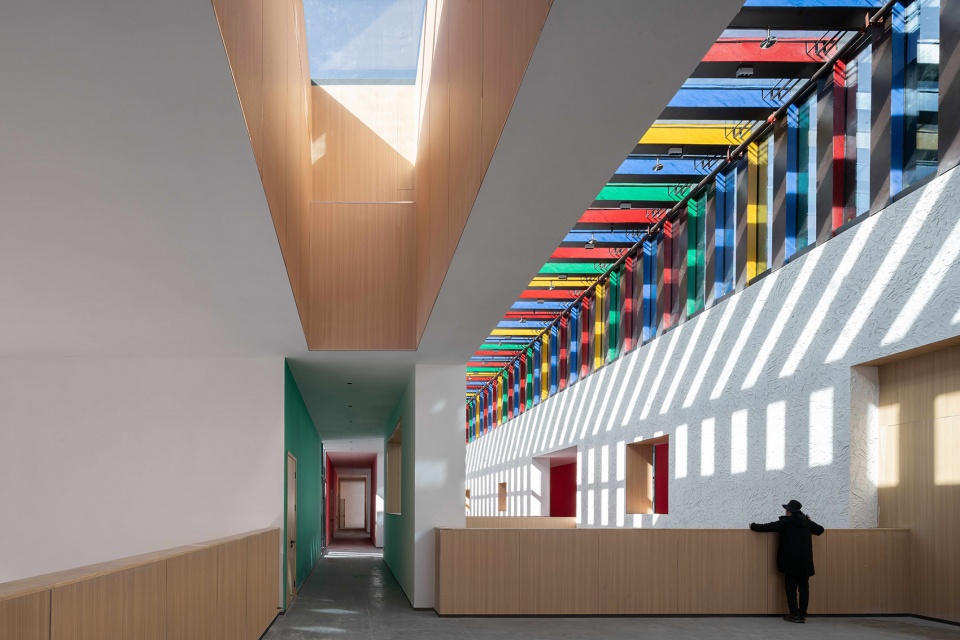
▼学生们在光庭中穿梭,Students Move Through the Light Atrium
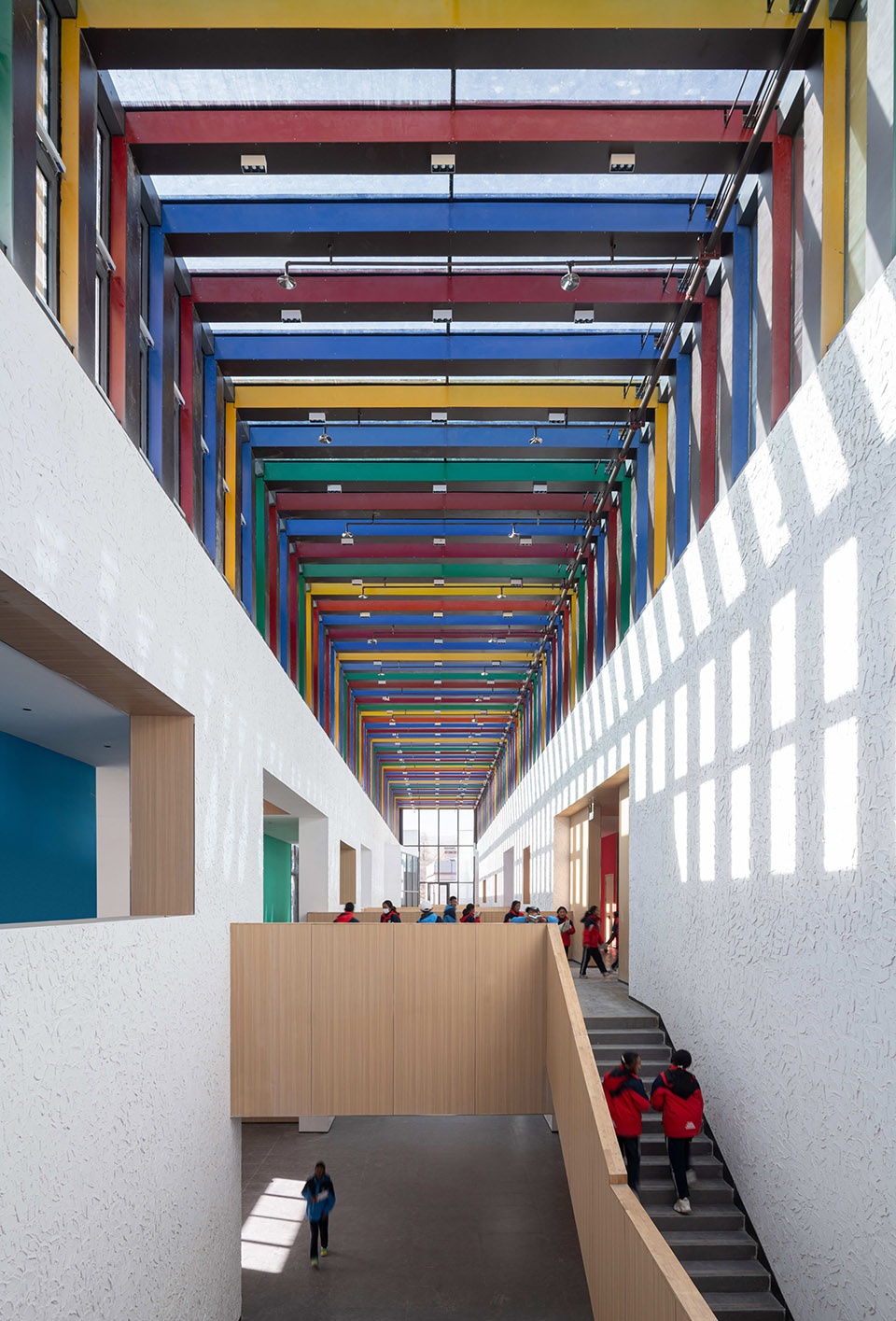
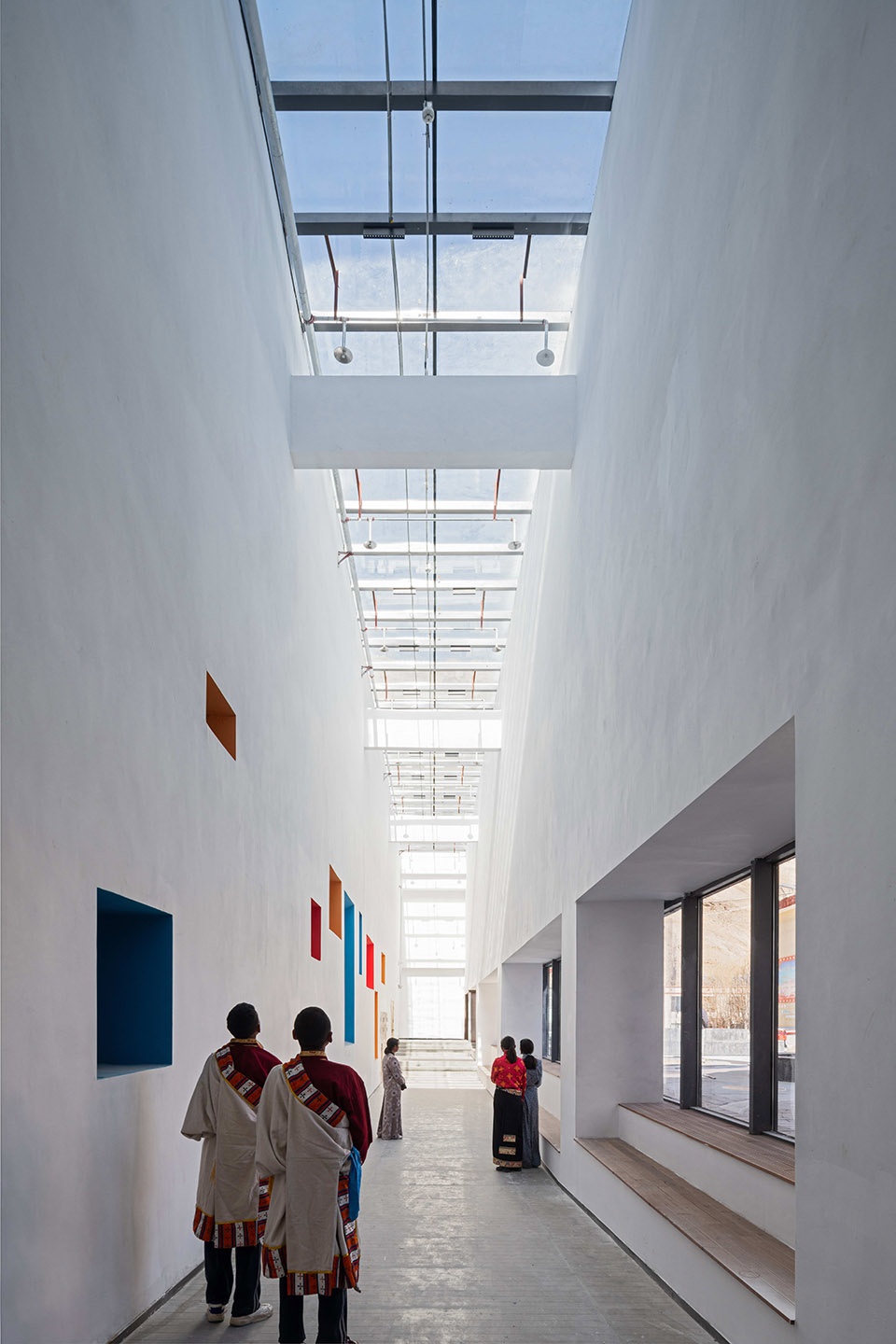
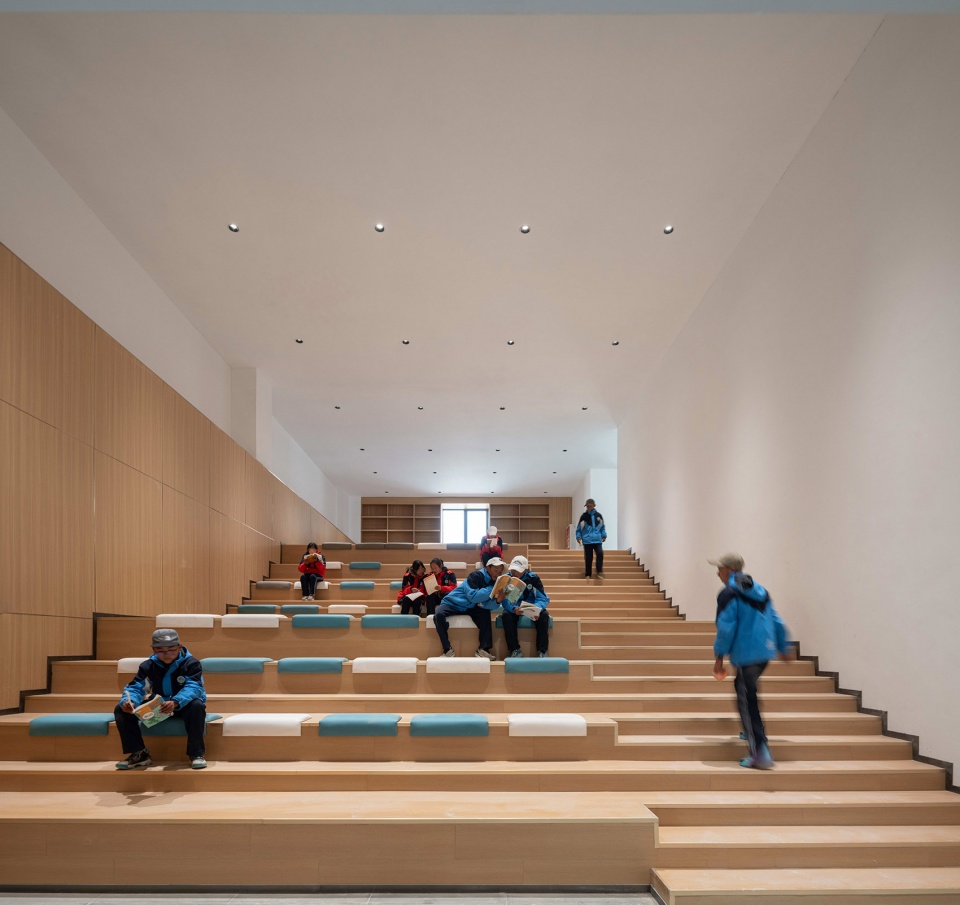
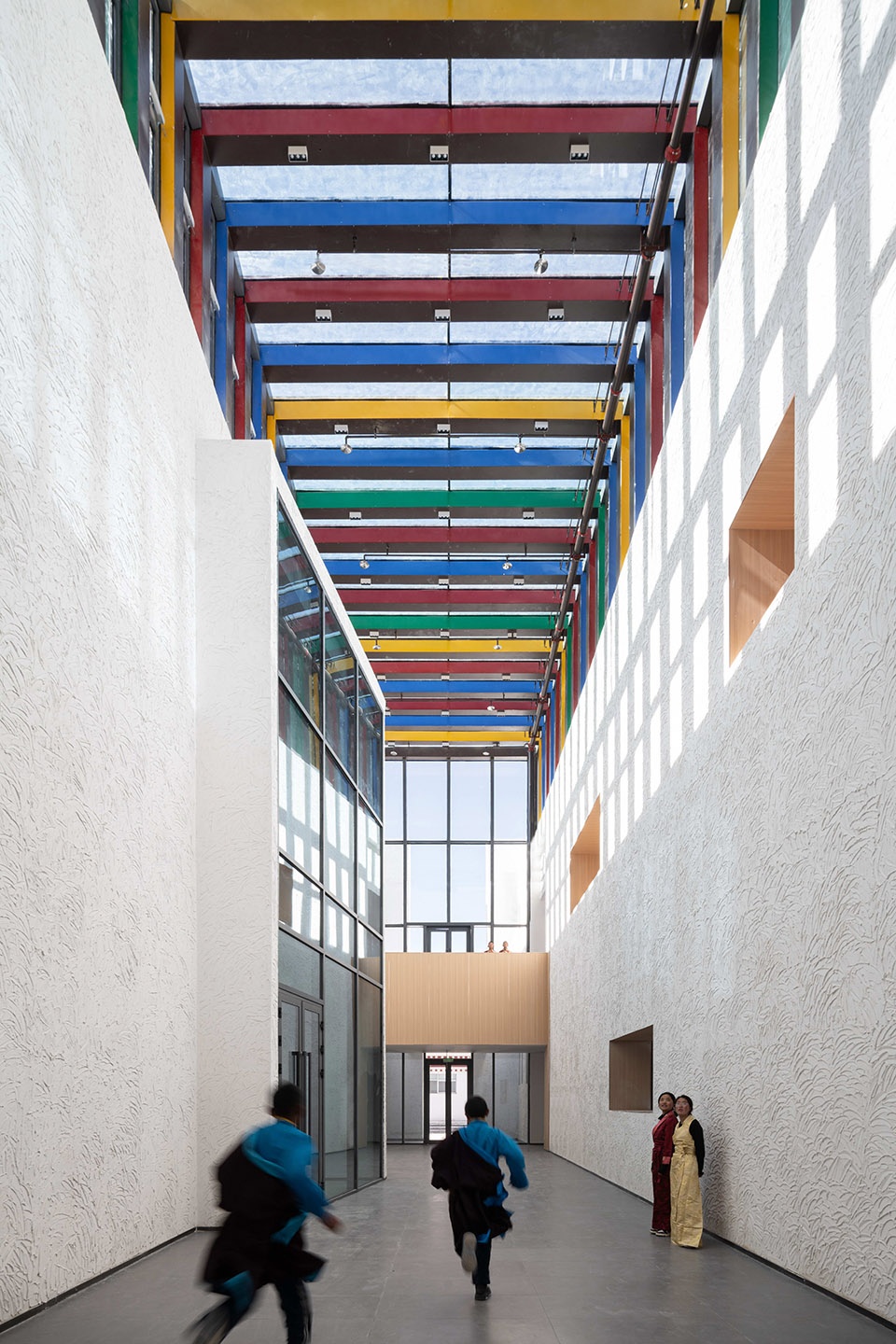
从门厅进来,经过多功能阶梯上到二层,再转过来,一个纵深60米/宽7米/高14米的光庭便呈现在眼前。它是高耸的,获得了最好的天光利用;它是延展的,把各种功能空间连接在一起;它是深远的,将远方的自然一并收纳进来;它是变幻的——或穿越,或停留,或对望,或远眺,总有不一样的惊喜。 当看到空间沿着纵深方向次第展开,孩子们穿着漂亮的衣服开心地穿梭其间,当内外的天空连在一起,在以为走到尽头时又看见正在张开怀抱的远山,此刻我觉得我们最初构想的很多场景已经成为了现实。
Upon entering from the foyer, one ascends a multipurpose stepped platform to the second floor and then turns—only to be met with a breathtaking atrium measuring 60 meters in length, 7 meters in width, and 14 meters in height. This vertical void captures abundant daylight from above, extending across the building to link diverse functional zones. It gathers the distant landscape into its frame, forging a dialogue between interior and exterior, architecture and nature. The experience is ever-changing—one may pass through, pause, encounter, gaze into or out of it—each movement revealing new spatial surprises. Witnessing children in colorful attire moving through the longitudinally unfolding space, where the indoor sky seamlessly merges with the real one beyond, and distant mountains appear to embrace the end of the axis, the envisioned scenarios have materialized as intended.
▼连接一二层的多功能阶梯,Multifunctional Stairs connecting the First and Second Floors
▼从光庭眺望远山,View Distance Mountains from the Light Atrium
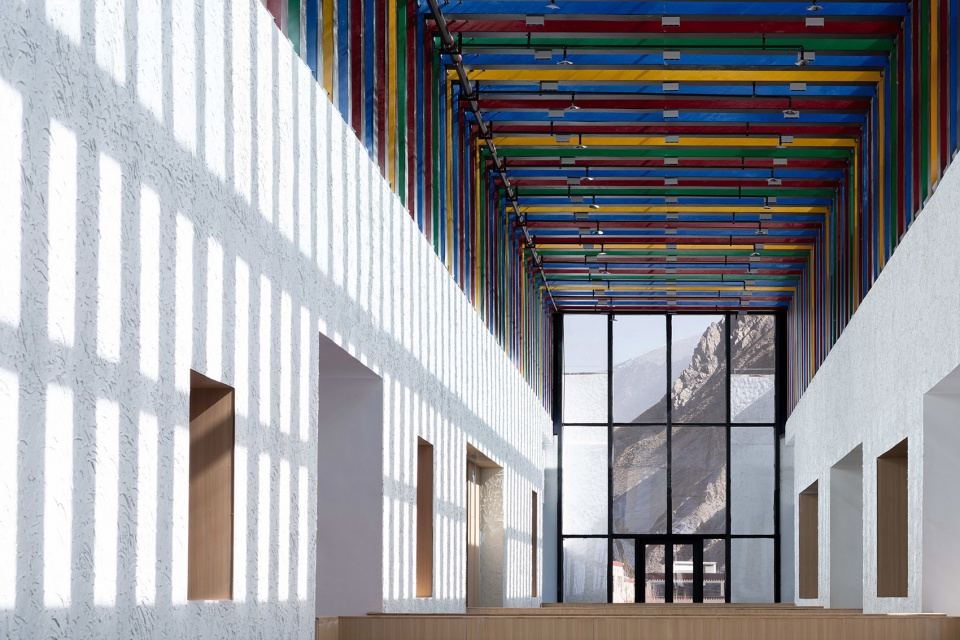
▼光庭内景,Light Atrium Interior
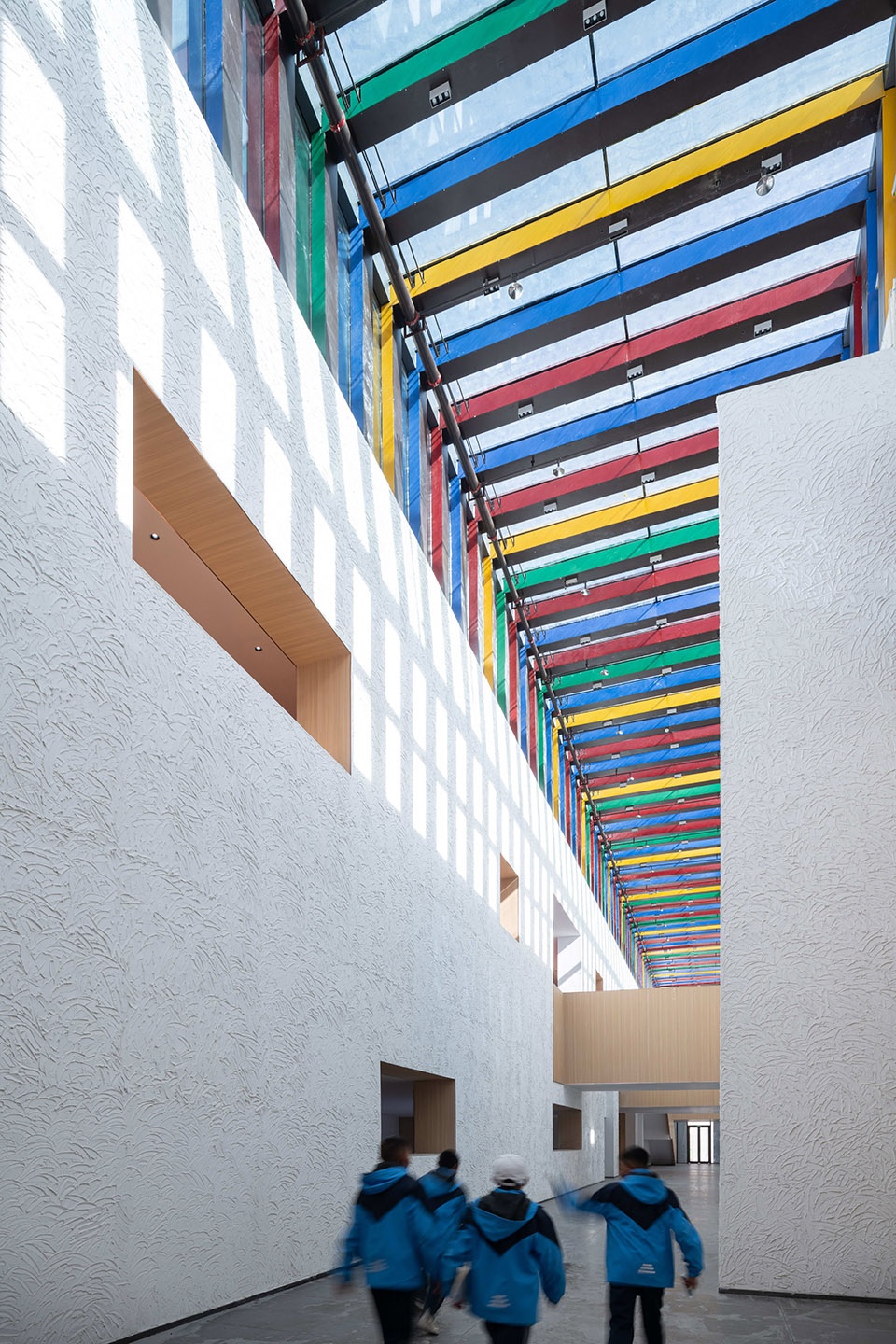
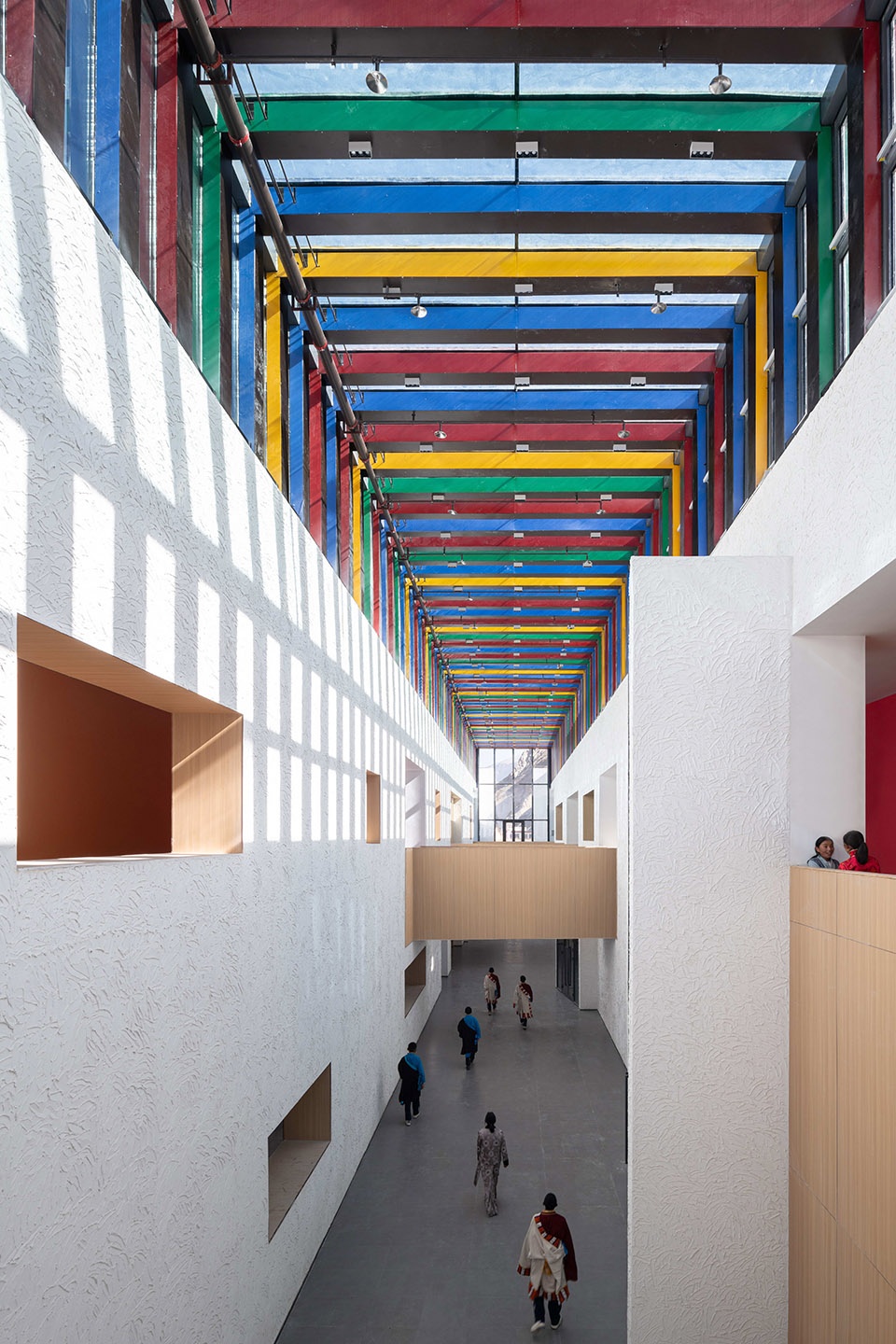
▼孩子们在光庭中穿梭,Students Move Through the Light Atrium
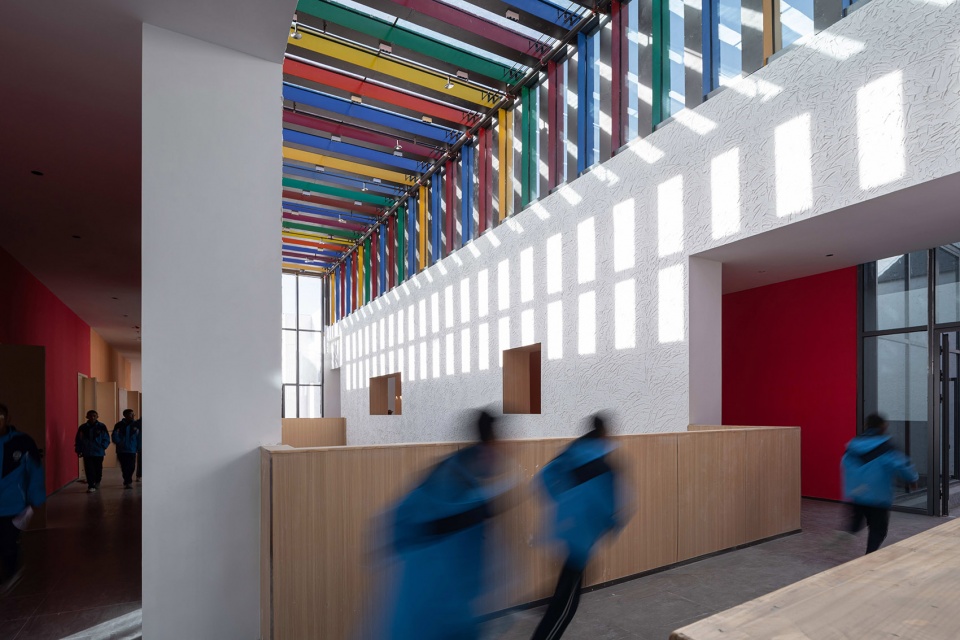
▼光庭内景,Light Atrium Interior
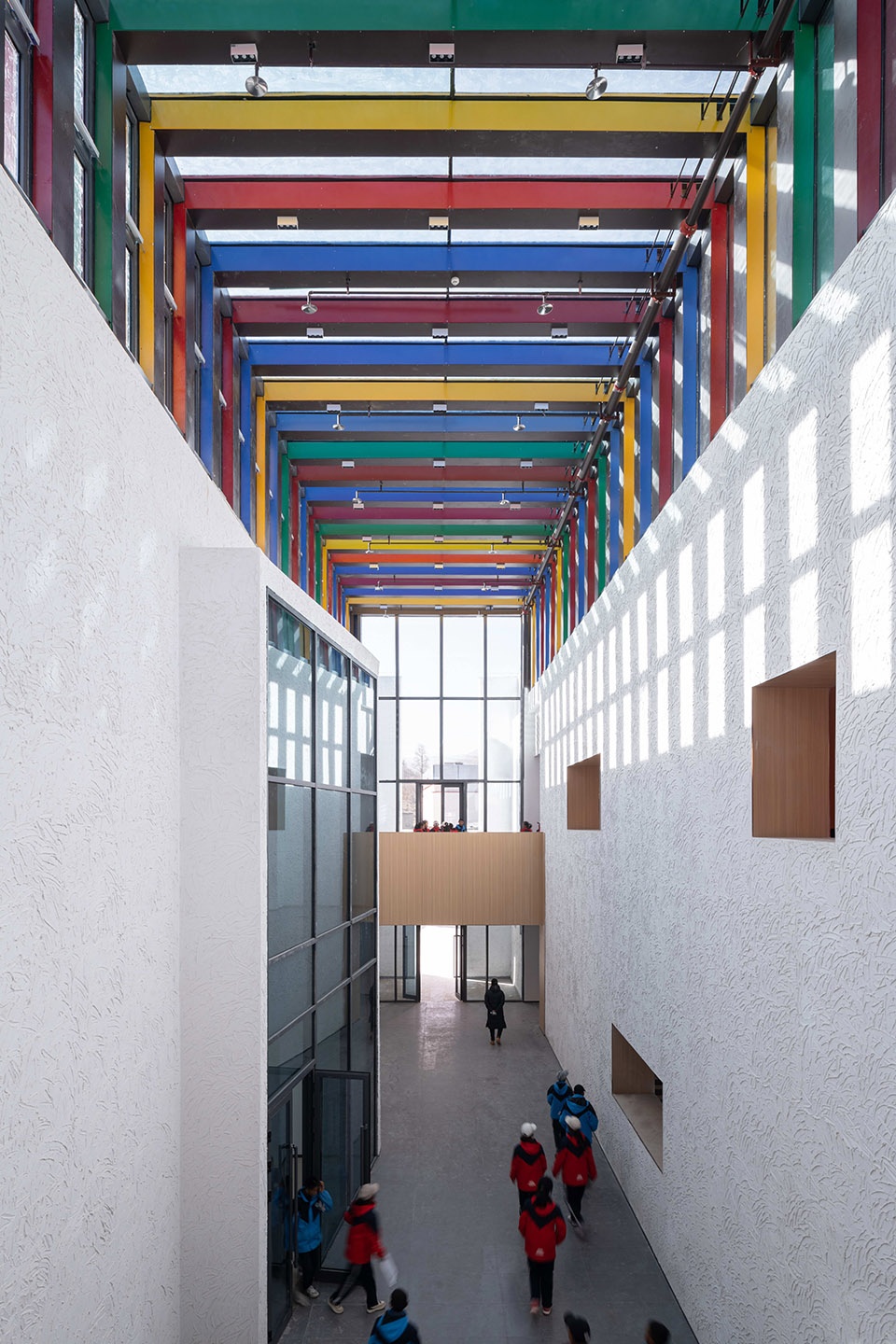
光线需要一把梳子,而使用一把色彩斑斓的梳子,这可能只有在西藏才不会显得唐突。与此同时,白墙作为阳光的画布承接着四时不同的创作。而内部走廊里各种纯色的墙面则通过大小不同的洞口时隐时现,给整个空间进一步增添了生动的气象。
Here, light is “combed” through a kaleidoscopic filter—a gesture that feels uniquely appropriate to Tibet’s vivid natural palette. White walls act as canvases for sunlight’s seasonal performances, while solid-colored interior corridors peek through varying-sized apertures, adding layers of visual liveliness.
▼光庭局部,Partial View of Light Atrium
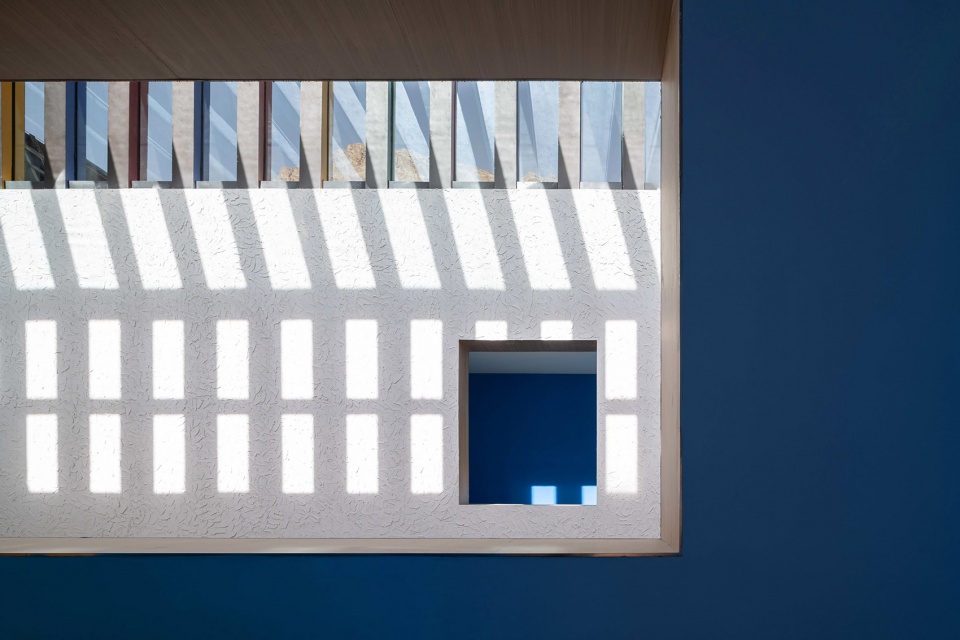
▼从走廊看光庭,View from Corridor toward Light Atrium
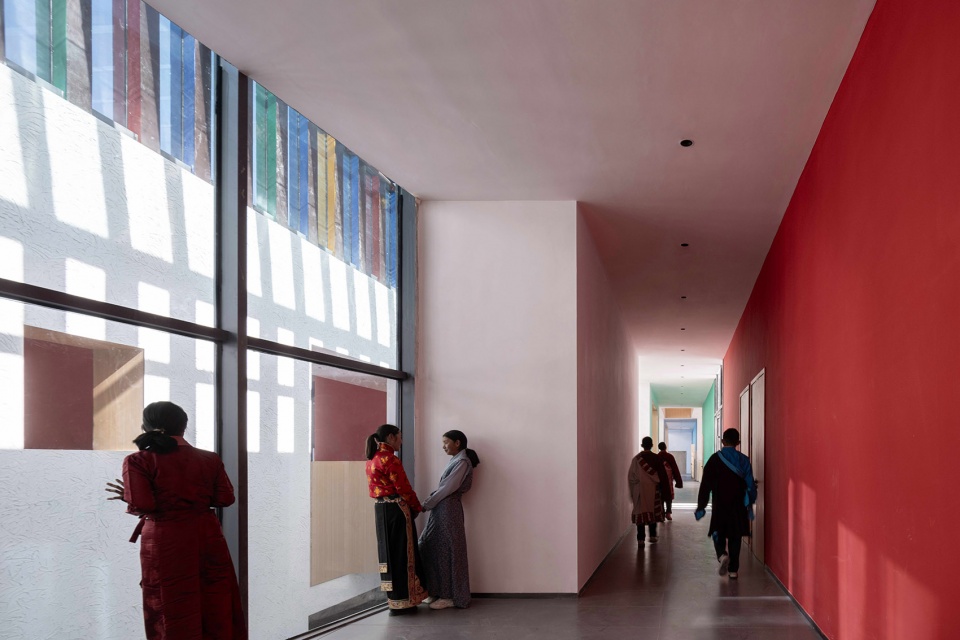
▼光庭局部,Partial View of Light Atrium
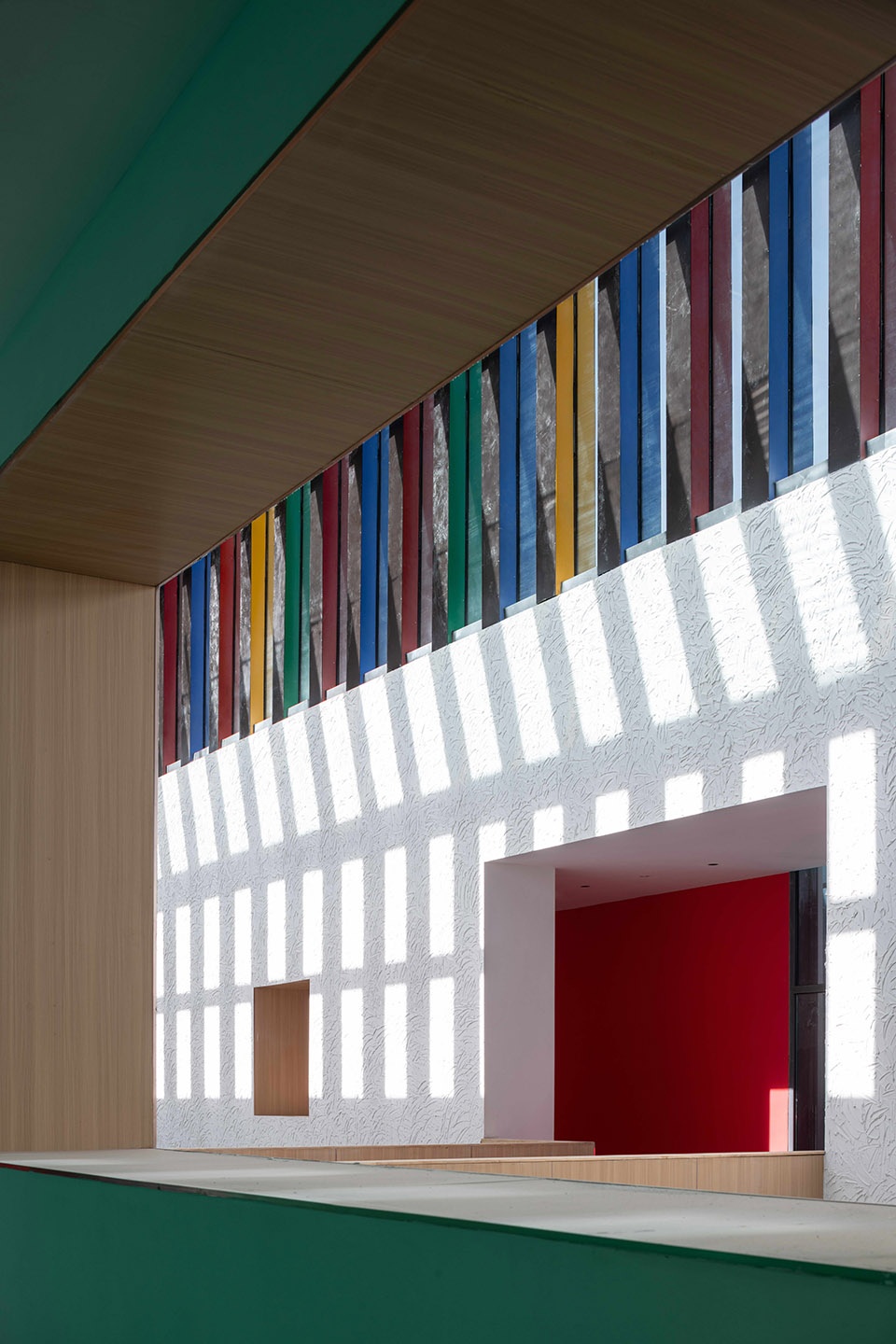
“光之峡谷”进而成为整个项目的核心概念。通过建筑与环境的对话、传统与现代的交融,项目为洛扎县中学创造了一个兼具功能性与艺术性的标志性空间,也成为校园与外界交流的文化窗口。当然我们希望空间的主人更多的时候还是学生,当节假日孩子们穿上传统的藏族服装在这里嬉戏游玩的时候,场景是如此的和谐,以至于让人有一种错觉——仿佛这座建筑原先就在这里,一直在伴随着孩子们的成长,也在见证着每一刻的时光流转。
Ultimately, the “Canyon of Light” became the guiding concept of the entire project. Through a dialogue between architecture and environment, and a fusion of tradition and modernity, the project creates a space that is both functional and poetic—an iconic centerpiece for Lhozhag County Middle School and a cultural threshold for exchange between campus and community. Yet above all, we hope the true owners of the space are the students themselves. On holidays, when children in traditional Tibetan dress gather here to play and laugh, the scene feels so naturally harmonious that it evokes a beautiful illusion: as if this building has always been here,growing with the children, quietly witnessing the passage of time.
▼光庭内景,Light Atrium Interior
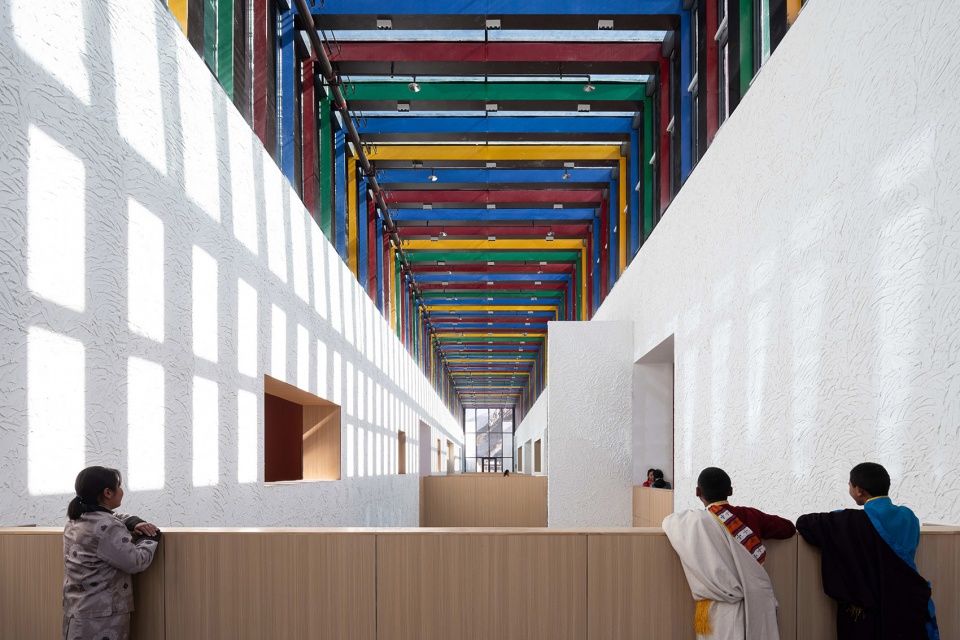
▼奔跑的少年和驻足的少女,Running Teenager and Standing Young Girl
文化的“根”与“翼”
The “Roots” and “Wings” of Culture
▼从西侧挑台望向远山,View from the Western Cantilevered Balcony towards Distant Mountains
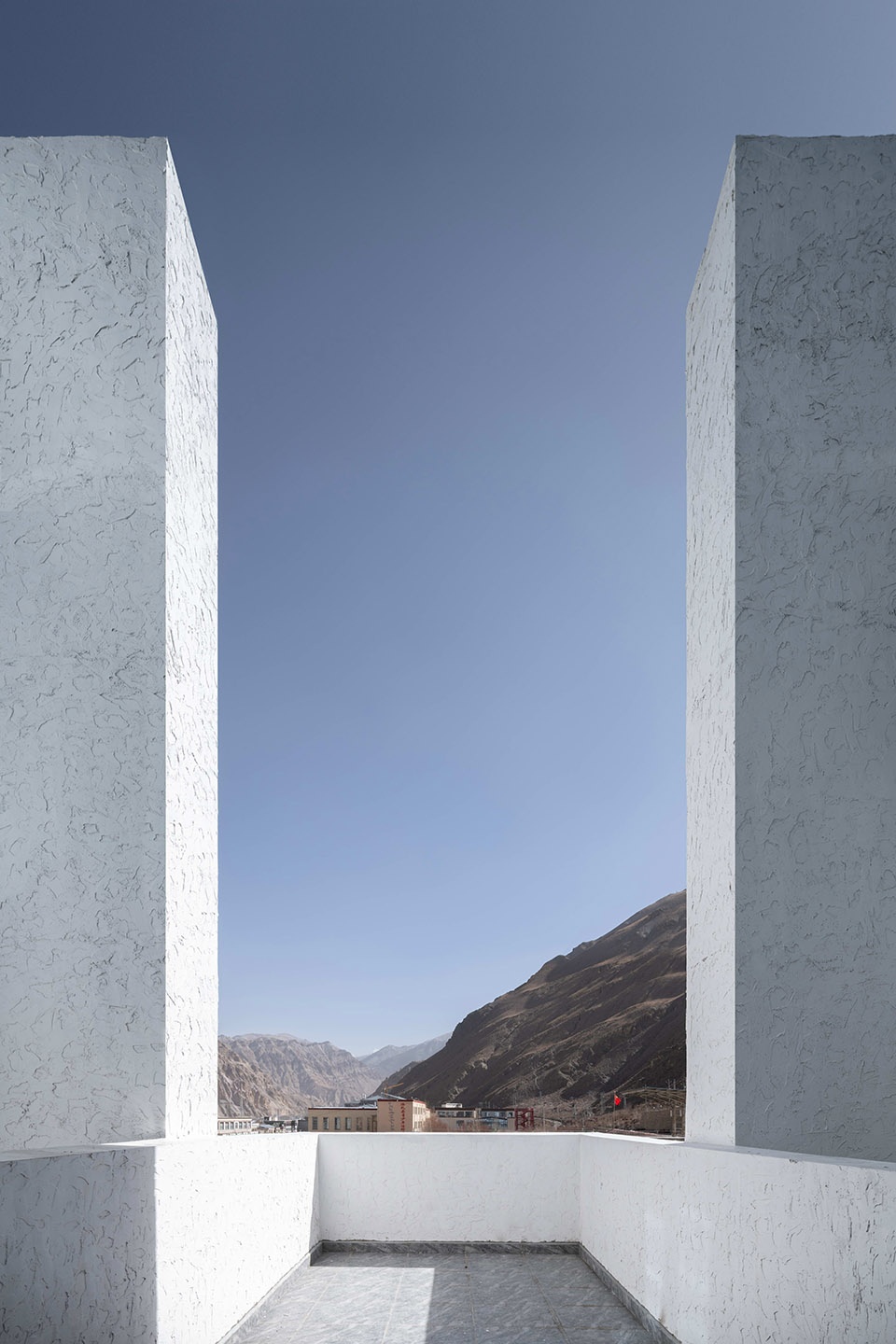
在洛扎,年轻一代面临着两种力量的拉扯:一方面是他们深厚的藏族文化传统,另一方面是现代化的浪潮。恰如那些立面里的镜像,白天倒映着远方的雪山、脚下的村庄、古老的寺院和五彩的经幡,而当孩子们站在镜面前,他们的身影也被纳入这片景象之中。这不仅仅是视觉的折射,更是文化认同的隐喻:“你是谁?”“你的根在哪里?”他们在镜面中看到自己时,也看到了自己的故土,看到了自己的文化如何与世界共存。我们想通过建筑的语言,让孩子们明白,他们不需要在传统与现代之间做出割舍,而是可以在二者之间找到平衡,既扎根于自己的文化,又能勇敢地向世界探索。
In Lhozhag, the younger generation navigates a cultural tug-of-war: between their deep Tibetan heritage and the currents of modernity. Like the mirrored facades that reflect distant snow-capped mountains, village rooftops, ancient monasteries, and colorful prayer flags by day—with the children’s own figures merging into these scenes—the architecture becomes a metaphor for cultural identity. “Who are you?” “Where do your roots lie?” When they see themselves in these reflections, they encounter both their homeland and the coexistence of their culture with the wider world. Through architectural language, the project aims to show that they need not choose between tradition and modernity but can balance both—rooted in their cultural soil while courageously reaching outward.
▼欢乐的孩子们,Happy Children
▼融于天地之间的场域,Field In-between Heaven and Earth
愿峡谷里的光始终照亮孩子们心中的路途。
May the light of the canyon forever illuminate the path in these children’s hearts.
▼峡谷里的光,Light in the Valley
▼轴测分析图,Isometric drawing
▼总平面图,Site plan
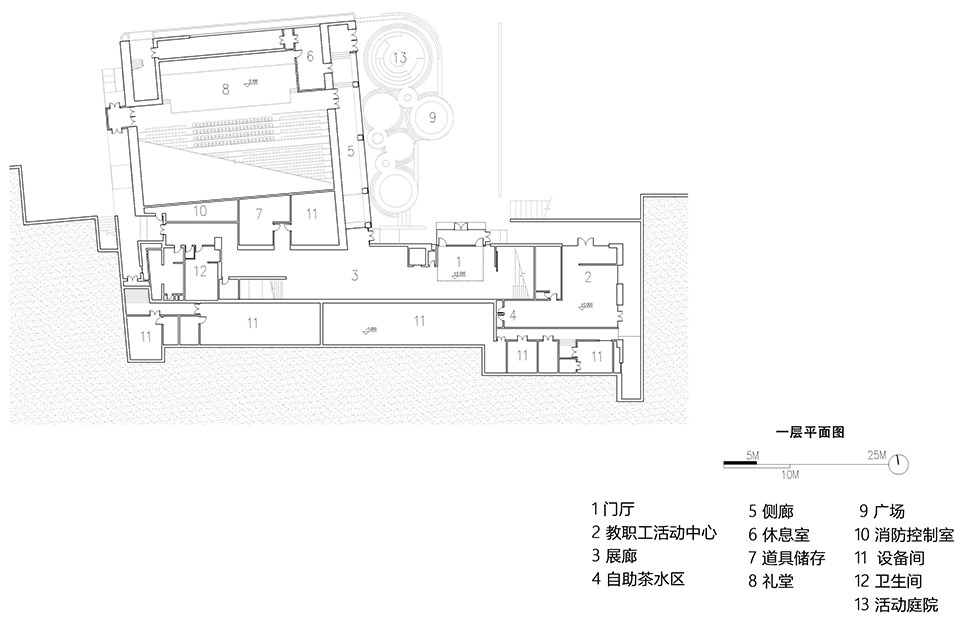
▼一层平面图,Ground floor plan
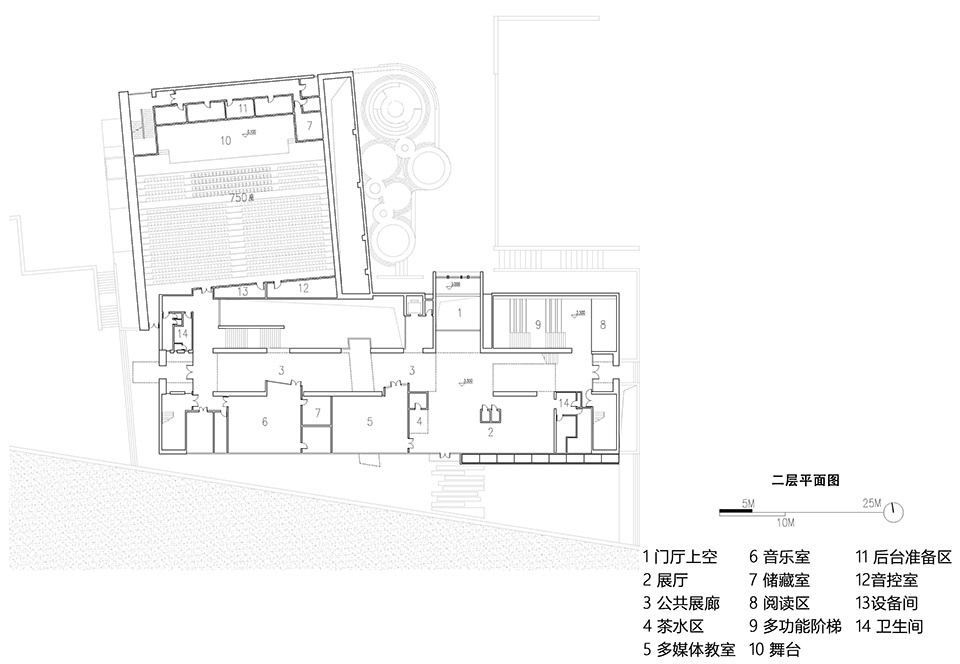
▼二层平面图,Second floor plan
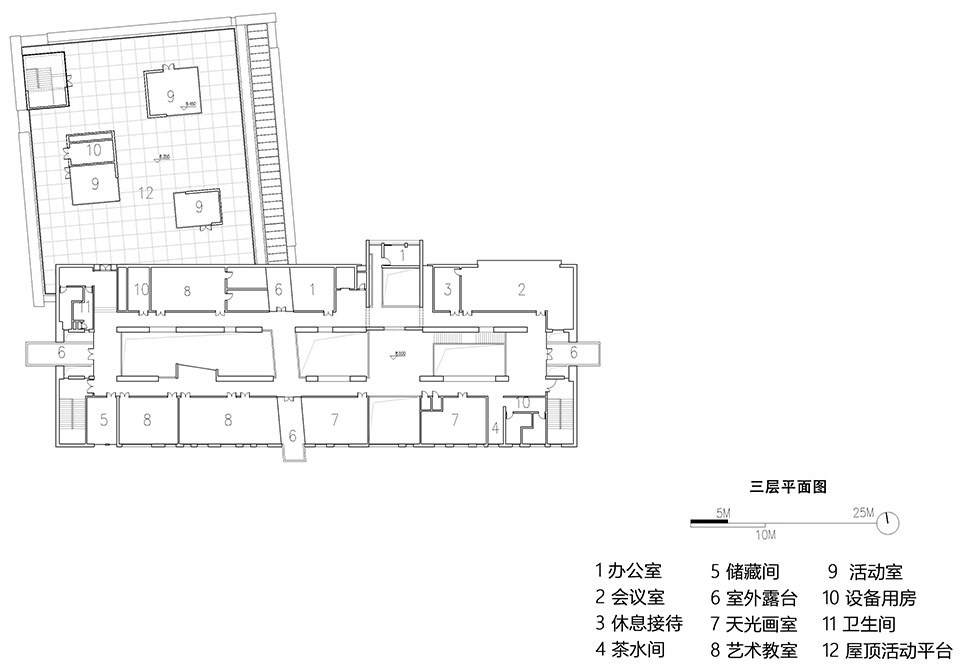
▼三层平面图,Third floor plan
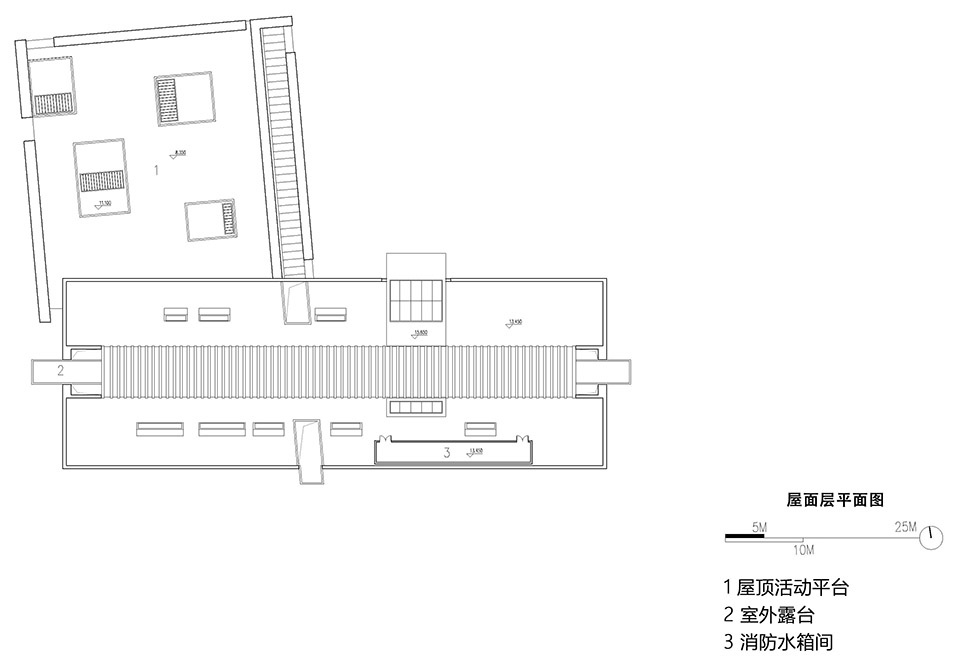
▼屋顶平面图,Roof plan
▼剖面图,Section
Project Name: The Multifunctional Art Center of Lhozhag County Middle School
Architectural Design: Shenzhen Huahui Design
Principal Architect: XIAO Cheng
Architectural Design Team: LIAO Guowei, LIANG Ziyi; WANG Wenkai, LI Yu, XIONG Rui, CHEN Xiting, LI Yanling (Landscape), XU Mu, ZHAO Tingting (Structural)
Location: Lhozhag County, Shannan City, Tibet Autonomous Region, China
Design Date: 2021.9-2022.10
Completion Date: 2024.12
Site Area: 7371㎡
Gross Floor Area: 6009㎡
Client: The People’s Government of Luozhag County
Interior Design: DAS Design
Landscape Design: DAP Design
Construction Documents Design: The Lhasa Branch of Wanyu Engineering Design Co., Ltd.
Construction Contractor: Tibet Shannan Yanghu Construction Group Co., Ltd.
Building main structure: Frame concrete structure
Main materials: Hand-grabbing paint, bamboo wood boards, aluminum plates, colored glass, LOW-E glass
Photograph: Right Angle Image
Writer: XIAO Cheng