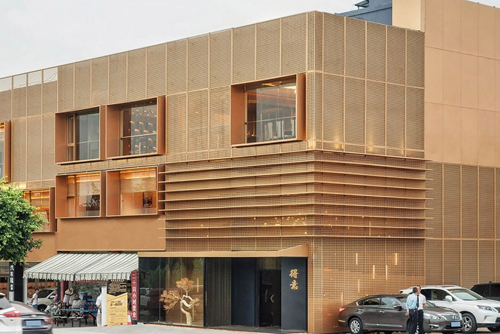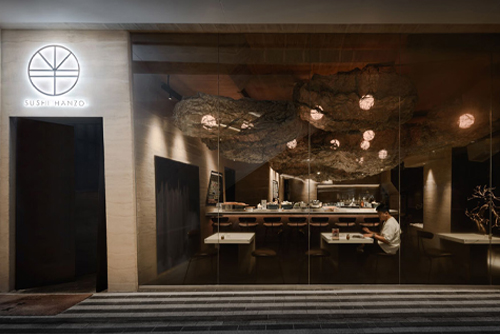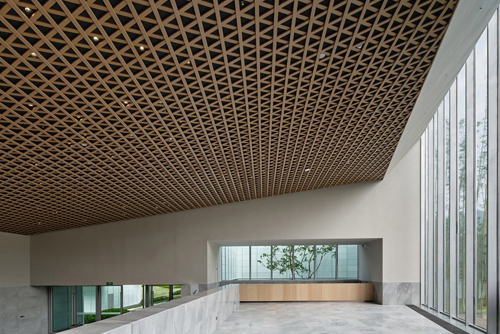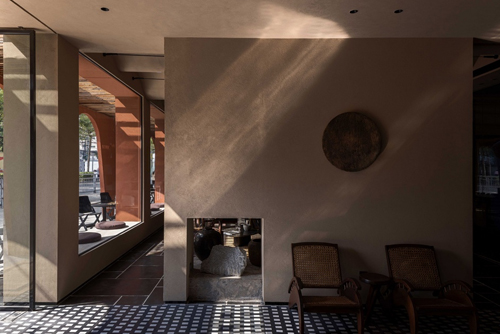
开沅书院,湖州 / 华中师范大学文化与教育建筑研究院(CEAI )+ EMD涌现设计
项目地处章开沅先生故乡——千年江南水乡湖州南浔荻港古村。本项目意在以纪念、传承、发展、文化复兴为目的,打造一个“独特的名人文化资源整合平台”。
The project is located in Mr. Zhang Kaiyuan’s hometown — Digang Ancient Village in Nanxun, Huzhou, a millennium-old water town in Jiangnan. The aim of the project is to create a “unique cultural resource integration platform dedicated to renowned figures”, with the purpose of commemoration, inheritance, development, and cultural revival.
01项目背景 人文及地理区位背景01 Project Background — Cultural and Geographical Context
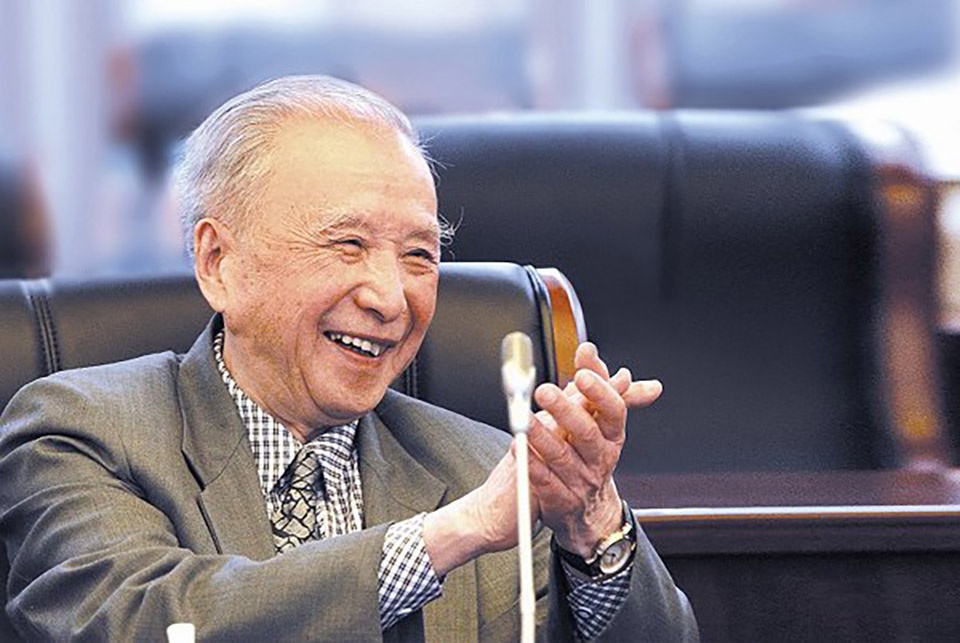
章开沅先生一生致力于我国高等教育事业,在学术研究、大学建设、人才培养、中西文化交流、社会服务等领域作出卓越贡献。章开沅先生继承了中国史学经世致用的优良传统,在辛亥革命史研究、中国资产阶级研究、中国商会史研究、中国教会大学史、南京大屠杀历史文献、史学理论与方法等多个领域有重要开创引领之功,推动了中国史学的学科体系、学术体系、话语体系的建设。1987年9月,章开沅先生第一次到荻港古村“清芬堂”寻根后,便与故乡结下了不解之缘,之后多次回到故乡,并对家乡文化、教育事业发展做出了积极贡献。
Mr. Zhang Kaiyuan devoted his life to the cause of higher education in China, making outstanding contributions in academic research, university development, talent cultivation, cultural exchange between China and the West, and social services. Carrying forward the fine tradition of Chinese historiography with its emphasis on serving society, Mr. Zhang played a pioneering and leading role in multiple fields, including studies on the 1911 Revolution, the Chinese bourgeoisie, the history of Chinese chambers of commerce, the history of Christian universities in China, historical documentation of the Nanjing Massacre, as well as historiographical theory and methodology. His work advanced the development of disciplinary systems, academic systems, and discourse systems within Chinese historiography.In September 1987, Mr. Zhang visited “Qingfen Hall” in Digang Ancient Village for the first time to trace his roots, and from then on formed an inseparable bond with his hometown. He returned many times thereafter, making active contributions to the cultural and educational development of his native place.
▼章开沅先生像,Photo of Mr. Zhang Kaiyuan
运河边上的江南古村:荻港村
The Jiangnan Ancient Village by the Canal: Digang Village
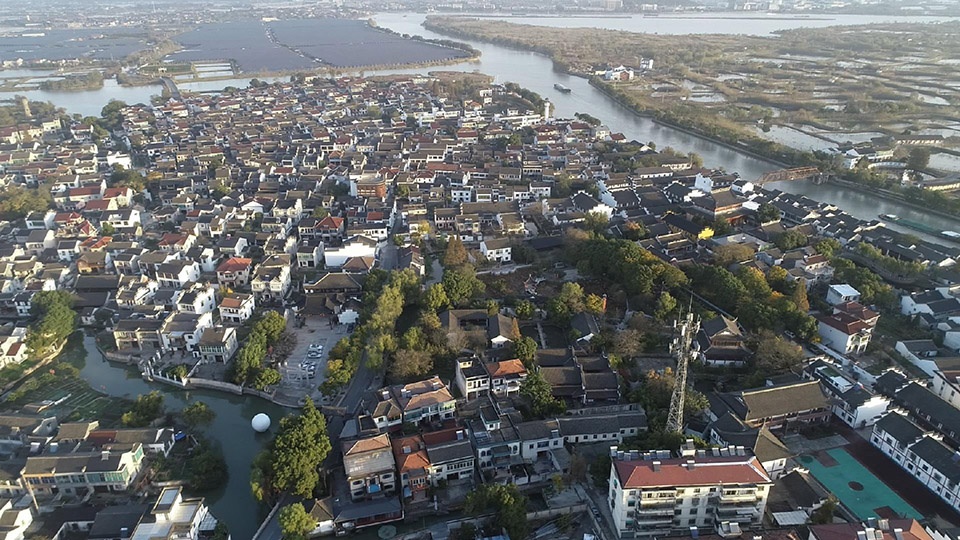
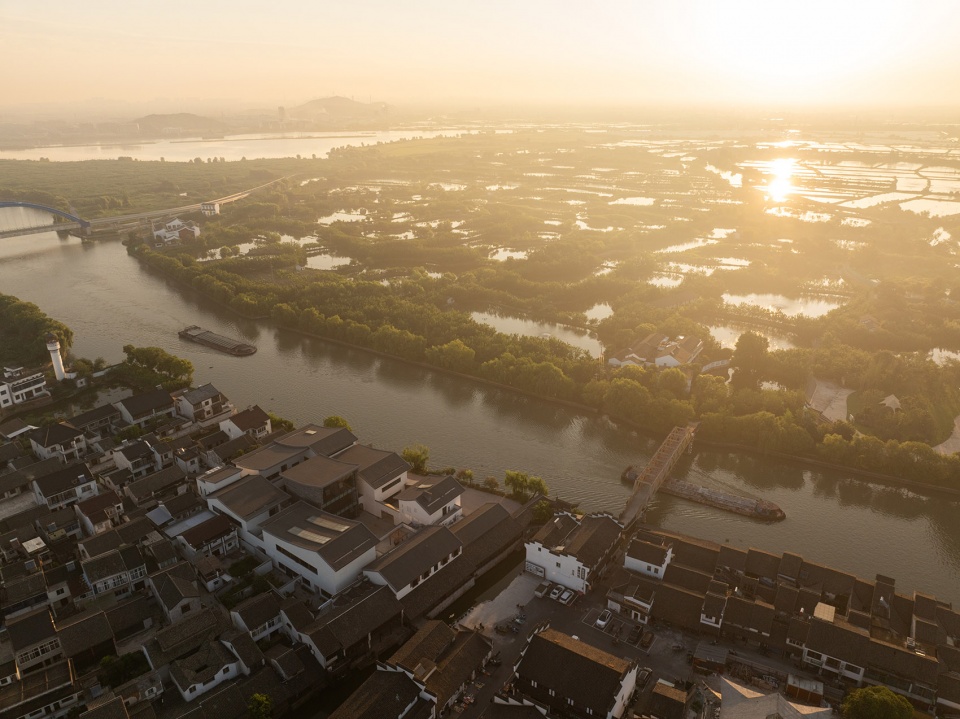
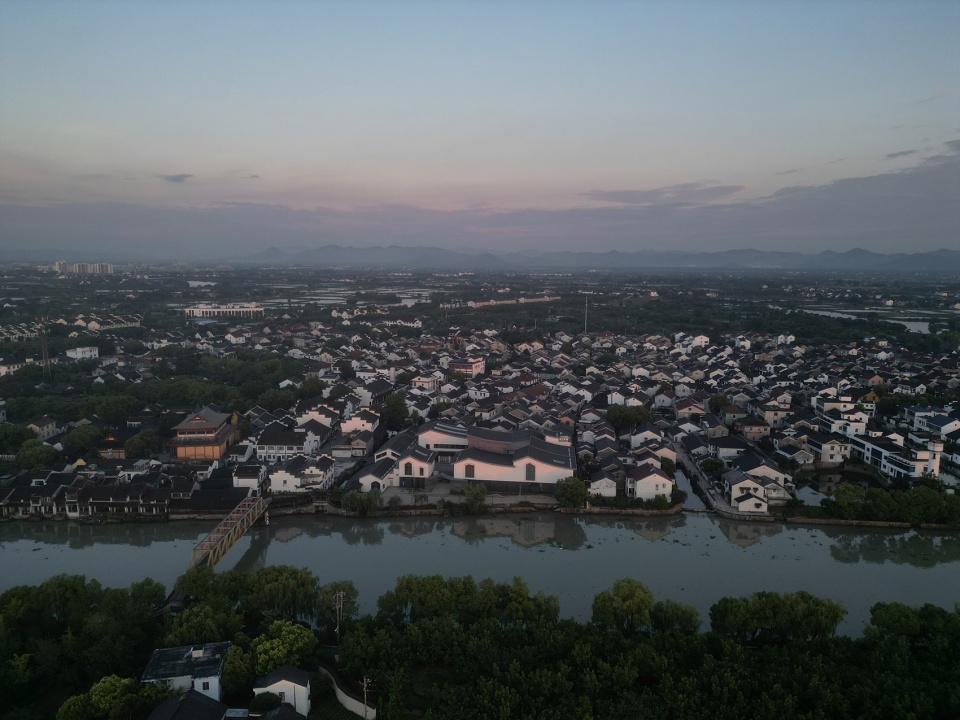
荻港村始于南宋,位于湖州市南浔区和孚镇南部,是杭嘉湖平原一个典型的江南水乡古村。紧依和孚漾,京杭大运河穿村而过,四面环水,河港纵横,绿桑成荫,鱼塘连片。历史上因溪岸芦苇丛生,河港纵横而称荻港,自古有“苕溪渔隐”之称。湖州物华天宝人杰地灵,自古就是名人辈出之地。特别是近现代史上有“一部民国史,半部在湖州”之说。而隶属于湖州的荻港村也不例外。因水而兴,因水而旺,小桥流水人家的古村,历代名人辈出。历史上鼎盛时期,曾走出了2名状元、50多名进士,200多名太学生、贡生,近现代更是诞生了许多著名的地质家、外交家、教育家、科学家、实业家等。全村区域面积6.3平方公里,总人口4000余人。其中章氏、吴氏、朱氏是荻港村的三大氏族,并各自建有祖屋。“清芬堂”便是章氏祖屋之一,也是拟建“开沅书院”的选址地,这一历史文脉让本项目承载了多重历史和社会使命。
Originating in the Southern Song Dynasty, Digang Village is located in the southern part of Hefu Town, Nanxun District, Huzhou. It is a typical Jiangnan water-town village on the Hangjiahu Plain. Nestled beside Hefuyang Lake, the Beijing–Hangzhou Grand Canal runs through the village. Surrounded by water on all sides, it features a crisscross network of rivers and canals, shaded mulberry groves, and continuous fish ponds. Historically, because of the reeds flourishing along the creeks and the intersecting waterways, it was named “Digang,” and it has long been known as the “Fishing Retreat on Tiaoxi.”The entire village covers an area of 6.3 square kilometers, with a population of over 4,000. Among its major clans are the Zhangs, Wus, and Zhus, each with their own ancestral houses. Qingfen Hall is one such ancestral residence of the Zhang clan, and is also the proposed site of the future Kaiyuan Academy. This historical lineage endows the project with multiple layers of historical and social significance.
▼荻港古村远景,Aerial view of the Digang ancient village
场地概况
Site overview
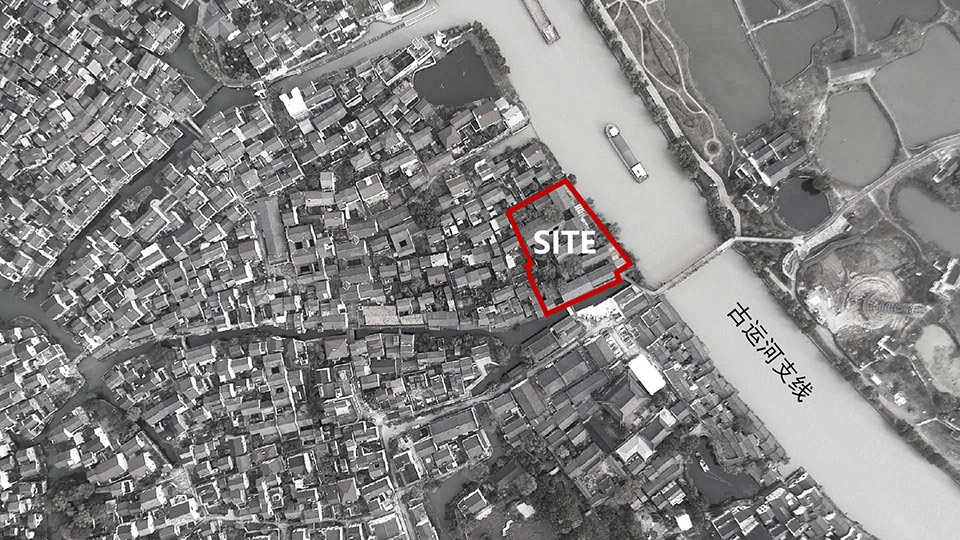
场地位于荻港村杭湖锡航道(古运河支线)与里埭巷交汇处,紧邻古镇中心码头,是荻港古村景区的核心地带。周边有多处近现代名人故居,如三瑞堂(章鸿钊故居)、鸿远堂(朱五楼故居)、礼耕堂(吴氏祖屋)、一元茶馆等,古村人文历史底蕴深厚。
The site is located at the intersection of the Hanghu-Xi Canal (an ancient canal branch) and Lidai Lane in Digang Village, adjacent to the central pier of the ancient town and forming the core area of the Digang Ancient Village Scenic Zone. Surrounding the site are numerous residences of prominent modern and contemporary figures, such as Sanrui Hall (former residence of Zhang Hongzhao), Hongyuan Hall (former residence of Zhu Wulou), Ligeng Hall (ancestral house of the Wu family), and Yiyuan Teahouse, all reflecting the village’s rich cultural and historical heritage.
▼基地位置,Site location
▼三瑞堂(左1)、鸿远堂(左2)、礼耕堂(右2)、一元茶馆(右1),
Sanrui Hall (1st from the left), Hongyuan Hall (2nd from the left), Ligeng Hall (2nd from the right), Yiyuan Tea House (1st from the right)

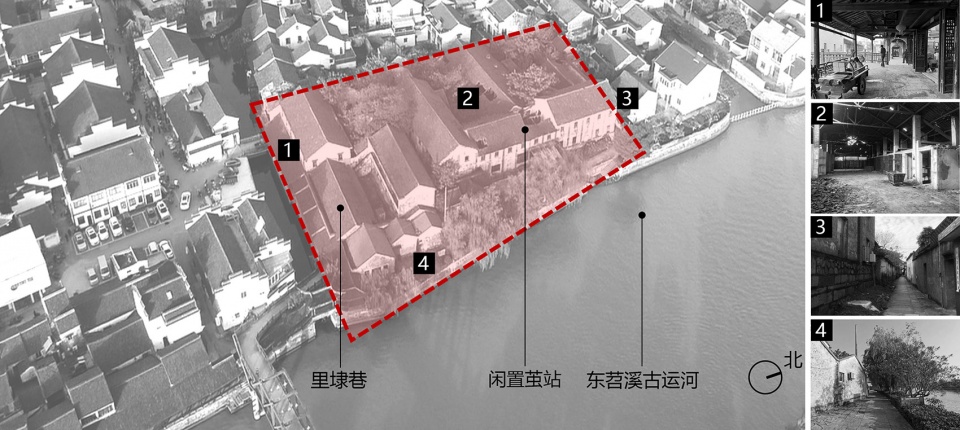
基地南侧为历史老街“里埭巷”最东端,隔内河与演教寺相望;东侧紧邻东苕溪古运河;北部原址为章氏祖屋“清芬堂”,后改建为古村茧站,建筑闲置多年,屋面和墙体坍塌严重;西侧与民居相接而融入全村建筑群。
To the south, the site connects with the eastern end of the historic old street, Lidai Lane, facing across the inner river toward Yanjiao Temple. To the east, it directly adjoins the ancient canal of the Dongtiao Stream. To the north lies the original site of Qingfen Hall, the ancestral house of the Zhang clan, which was later converted into the village’s cocoon station but has been abandoned for years, with severe collapse of its roof and walls. To the west, the site is bordered by village residences, blending into the overall architectural fabric of Digang.
▼基地分析,Site analysis
02设计概念 文化建筑关于纪念性与地域性的设计思考
02 Design Concept — Reflections on Commemorative and Regional Characteristics in Cultural Architecture
纪念性的意境营造:远航之轮
Creating a Memorial Ambience: The Wheel of Voyage
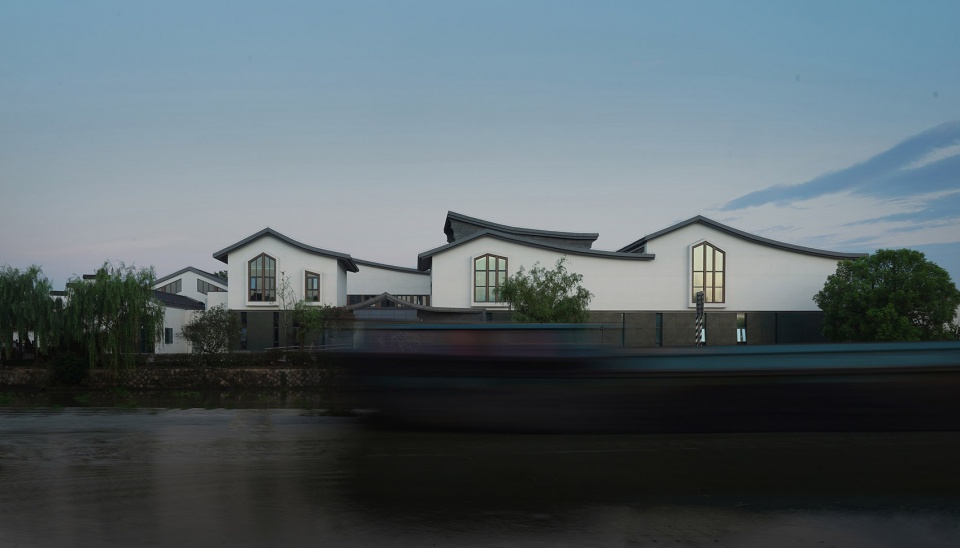
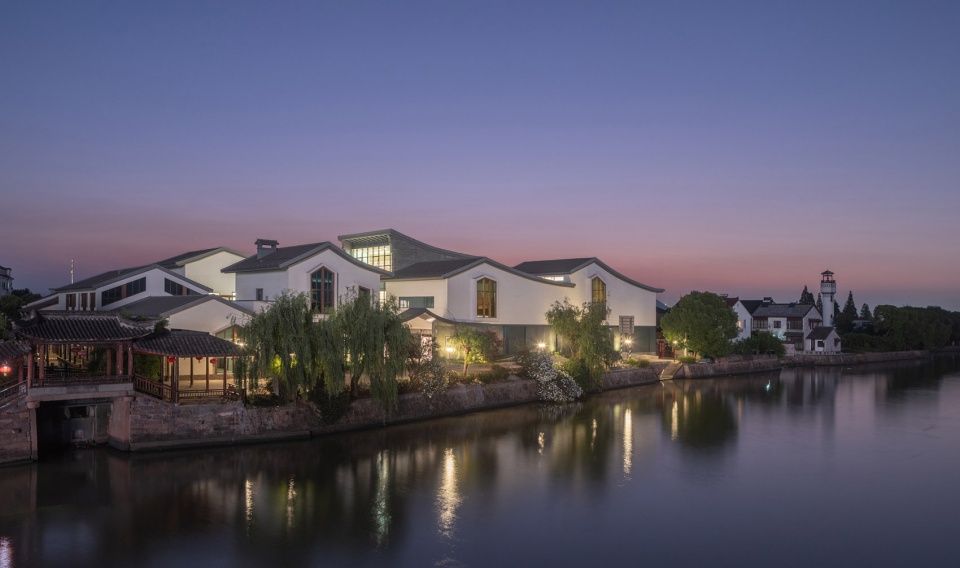
▼从运河对岸远眺开沅书院,A distant view of Kaiyuan Academy from the opposite bank of the canal
开沅书院设计概念正是受到章老这句名言的启发。从运河对岸望去,开沅书院形似一艘巨轮在“史学浩海”中远航。正如章先生所说,“历史不仅是人类集体记忆之载体,而且是人类集体智慧之宝藏。”我们也希望本次设计能够通过隐喻、象征、叙事的手法强化共情力 ,将人的共情与空间设计结合,在场景中唤起并强化参观者对章老的缅怀与追忆:先生远航,风范长留。
The design concept of Kaiyuan Academy is precisely inspired by Mr. Zhang’s famous saying. Seen from across the canal, the Academy resembles a great vessel voyaging through the “vast ocean of historiography.” As Mr. Zhang once said, “History is not only the vessel of humanity’s collective memory, but also the treasure house of humanity’s collective wisdom.”In this spirit, we hope the design can strengthen empathy through the use of metaphor, symbolism, and narrative, intertwining human sentiment with spatial design. Within these scenes, visitors will be prompted to recall and commemorate Mr. Zhang with deep emotion: the scholar embarks on his voyage, yet his spirit endures.
▼从运河对岸远眺开沅书院,A distant view of Kaiyuan Academy from the opposite bank of the canal
地域性的文化表达:吴兴清远山水图卷
Regional Cultural Expression: The Scroll of Wuxing’s Clear and Distant Landscapes
一方山水一方人文,湖州这一特定的山水生态环境与人文传统造就了赵孟頫的“吴兴清远”审美形态,这在他的诗画创作中体现得淋漓尽致。
A unique landscape nurtures a unique culture. The particular ecological environment and cultural traditions of Huzhou gave rise to Zhao Mengfu’s “Wuxing Qingyuan” aesthetic, which is vividly reflected in his poetry and painting.
▼赵孟頫《吴兴清远图》卷,Zhao Mengfu’s “Wuxing Qingyuan”
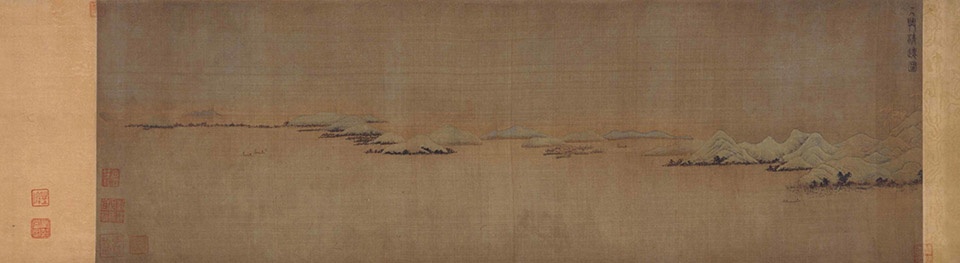
在设计创作过程中,借由“吴兴清远”的主题原型,将开沅书院绘成一幅可观、可游、可读、可居的立体诗意山水画卷。错落有致的建筑立面和大曲线屋顶线条从远处看去,似峰峦连绵、群山叠翠,倒映在古运河“东苕溪”水面上,尽显湖州传统人文的诗画情趣和意境含蕴。
▼模型照片,Model photo
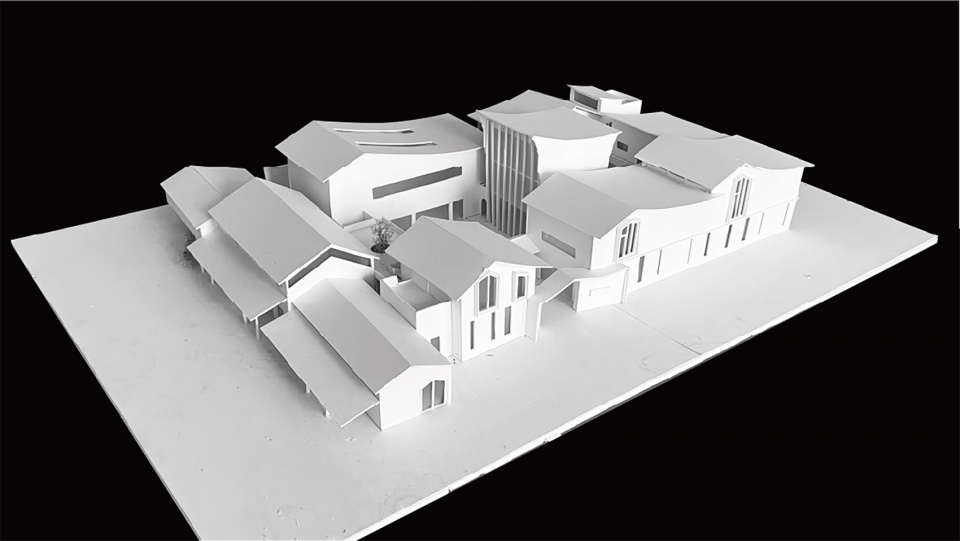
In the design process, drawing on the thematic archetype of “Wuxing Qingyuan,” Kaiyuan Academy is envisioned as a three-dimensional poetic landscape scroll—one that can be viewed, wandered through, read, and inhabited. From afar, the staggered building façades and sweeping curved rooflines resemble continuous mountain ridges and verdant peaks, their reflections shimmering on the waters of the ancient canal, the Dongtiao Stream. Together, they embody the poetic charm and cultural resonance of Huzhou’s traditional landscapes.
▼站在运河天桥上远眺开沅书院,Standing on the canal overpass and looking into the distance at Kaiyuan Academy
▼站在运河天桥上远眺开沅书院,Standing on the canal overpass and looking into the distance at Kaiyuan Academy
03设计理念 统合·共享·涌现
03 Design Philosophy — Integration · Sharing · Emergence
统合文化资源,复兴湖州文化
Integrating Cultural Resources, Revitalizing Huzhou’s Culture
充分发挥资源集聚效应的优势,统合以章开沅先生为代表的荻港乃至湖州名人文化、荻港古村落文化、中国近代史文化、以及湖州的传统和民俗文化等,深度挖掘并构建其社会价值、传承价值、品牌价值、体验价值等价值体系,使开沅书院成为南浔乃至湖州文化的重要集聚地,也是复兴湖州人文的文化新地标。
By fully leveraging the advantages of resource agglomeration, the project integrates the cultural legacy of renowned figures from Digang and Huzhou—represented by Mr. Zhang Kaiyuan—along with the ancient village culture of Digang, the culture of modern Chinese history, and Huzhou’s traditional and folk culture. Through in-depth exploration and construction of its social, heritage, brand, and experiential value systems, Kaiyuan Academy aspires to become an important cultural hub for Nanxun and Huzhou, and a new cultural landmark for the revival of Huzhou’s humanistic spirit.
▼远眺开沅书院,looking into the distance at Kaiyuan Academy from a distant view
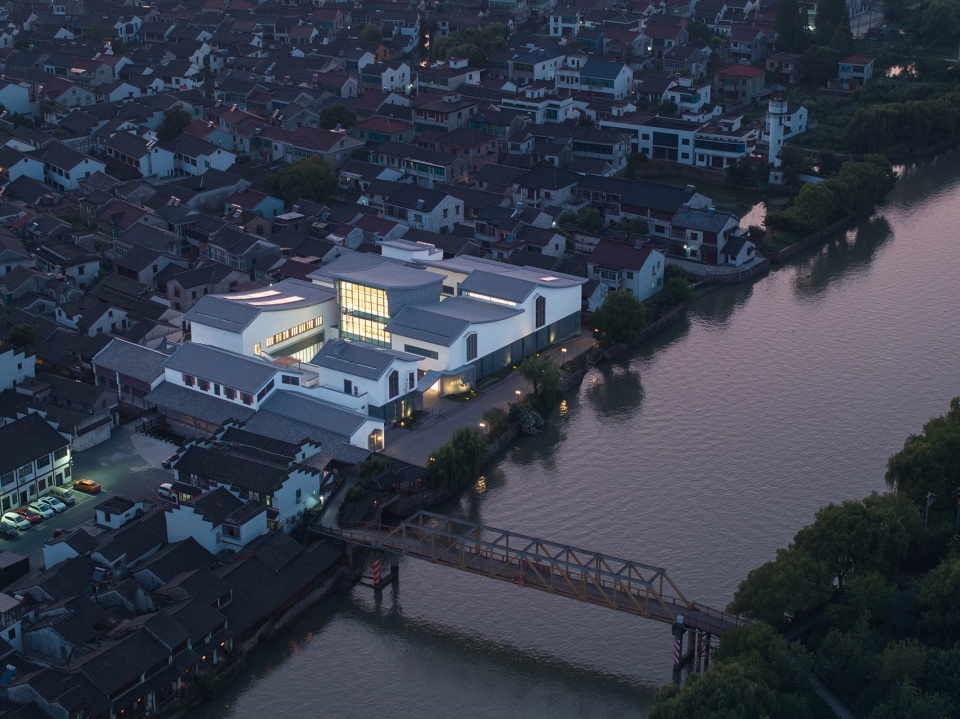
共享整合平台,激活古村活力
A Shared Integration Platform, Revitalizing the Vitality of the Ancient Village
通过“名人文化品牌传播战略”,将以章开沅先生为代表的历史文化名人资源“品牌化”,将开沅书院打造成为一个“共享的文化资源整合平台”,创新“文化交流平台”、“书院育人平台”、“文创孵化平台”,创造系列受众喜爱的名人文化产品,传播湖州文化品牌,激活古村发展活力。
Through a “Celebrity Culture Brand Communication Strategy,” the historical and cultural resources of renowned figures—represented by Mr. Zhang Kaiyuan—will be transformed into a recognizable cultural brand. Kaiyuan Academy will be developed into a “shared cultural resource integration platform,” pioneering new models such as a cultural exchange platform, an academy for education and cultivation, and a cultural and creative incubation platform. By creating a series of cultural products that resonate with audiences, the project will promote the Huzhou cultural brand and revitalize the vitality of the ancient village.
▼远眺开沅书院,looking into the distance at Kaiyuan Academy from a distant view
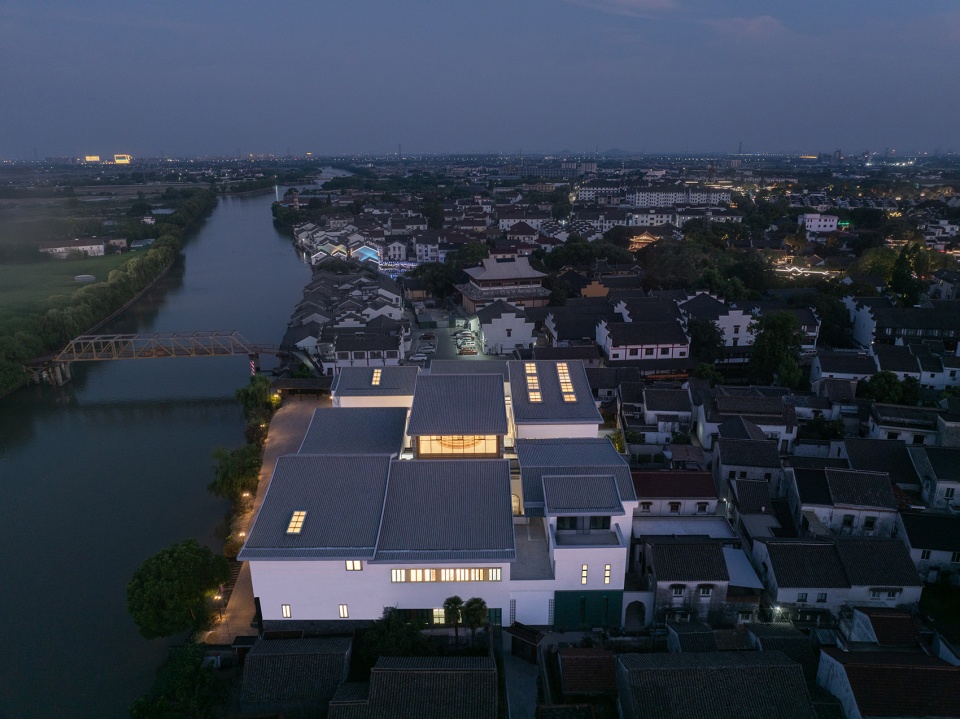
涌现自发机制,创造活动事件
Emergent Mechanisms, Creating Events and Activities
中国书院作为“贤士大夫留意斯文”而建立的自治组织,也是开沅书院所追求的。开沅书院是一个活动孵化器、文化发生器,在人与场景的交互过程中涌现一系列的自组织行为,如纪念、观展、论坛、阅读、历史研究、研学、休闲娱乐等。
As autonomous institutions established by “scholars and gentlemen devoted to culture and learning,” traditional Chinese academies also embody the aspiration of Kaiyuan Academy. Kaiyuan Academy functions as an incubator for activities and a generator of culture. Through the interaction between people and spaces, it gives rise to a series of self-organizing behaviors, such as commemoration, exhibitions, forums, reading, historical research, study tours, as well as leisure and recreation.
▼远眺开沅书院,looking into the distance at Kaiyuan Academy from a distant view
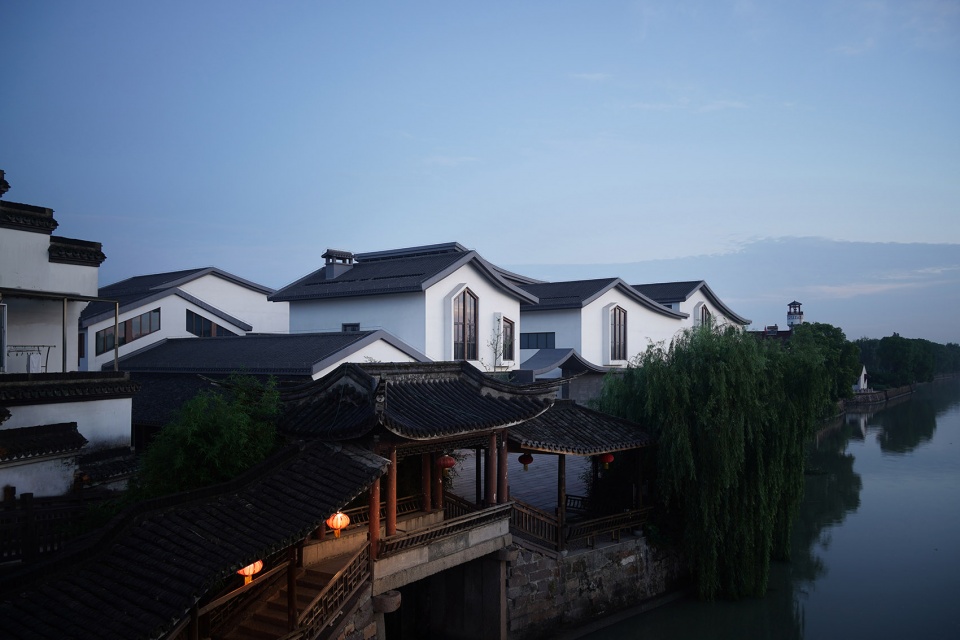
04设计策略 功能·形式·空间
04 Design Strategy — Function · Form · Space
运营思维前置的复合业态策划
Operation-Oriented Mixed-Use Planning
开沅书院的运营目标是以市场化运作搭建历史文化资源整合平台,并使之成为中国数字化时期文化内容提供中心。以文化兴业为核心,以名人文化、历史文化、湖州文化三大资源为驱动,打造文化传播、文化交流、研学研修、商务会议、休闲娱乐等功能作为项目支撑。并以项目式运作理念策划系列“活动经济”,整合产业资源,协调好书院与产业、古村、本地居民之间的关系,探索乡村“农、文、旅”产业融合新模式,极大地促进乡村名人“文化资源”转变成为乡村农文旅产业发展壮大的“文化资本”。
▼设计草图,sketch
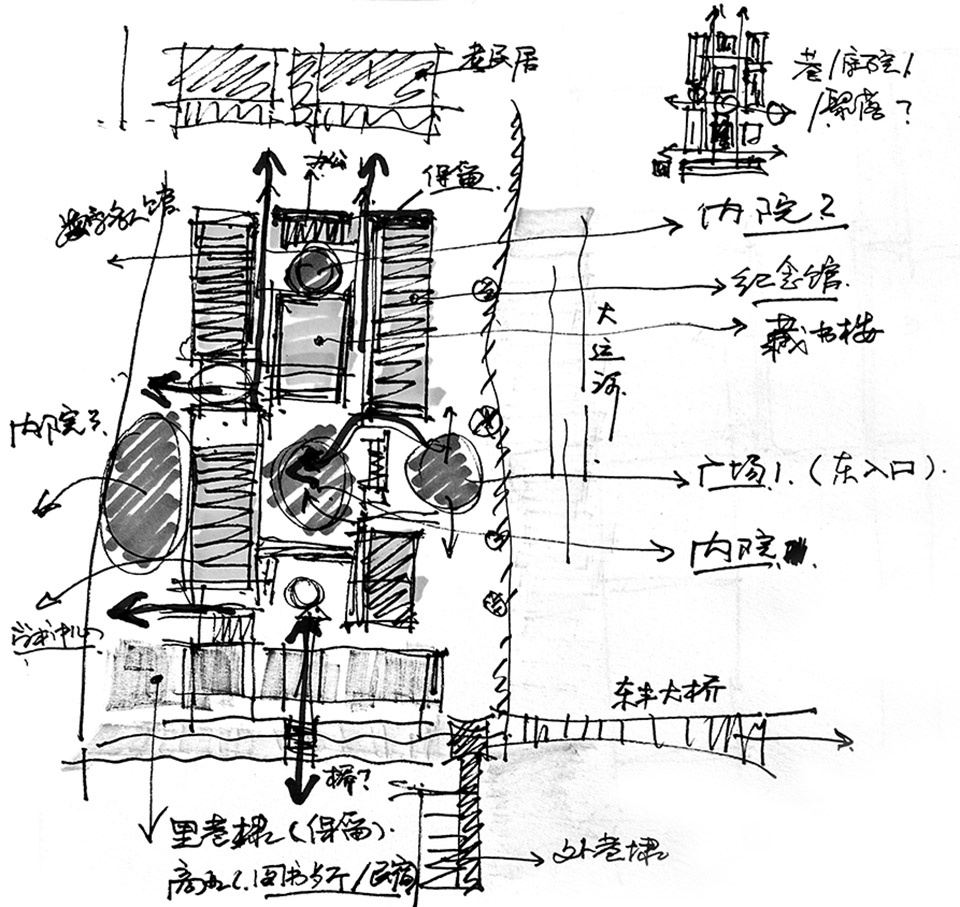
The operational goal of Kaiyuan Academy is to establish a market-oriented platform for integrating historical and cultural resources, positioning it as a center for cultural content in China’s digital era. Centered on cultural development, and driven by three major resources—celebrity culture, historical culture, and Huzhou culture—the project will be supported by functions such as cultural dissemination, cultural exchange, study and research programs, business conferences, as well as leisure and entertainment.Guided by a project-based operational approach, the Academy will plan a series of “event economies,” integrating industrial resources while harmonizing the relationship between the Academy, local industries, the ancient village, and its residents. It aims to explore a new model of rural integration across agriculture, culture, and tourism, greatly transforming the “cultural resources” of rural celebrities into “cultural capital” that fuels the growth and prosperity of rural agriculture–culture–tourism industries.
▼开沅书院外观,Exterior of the Kaiyuan Academy
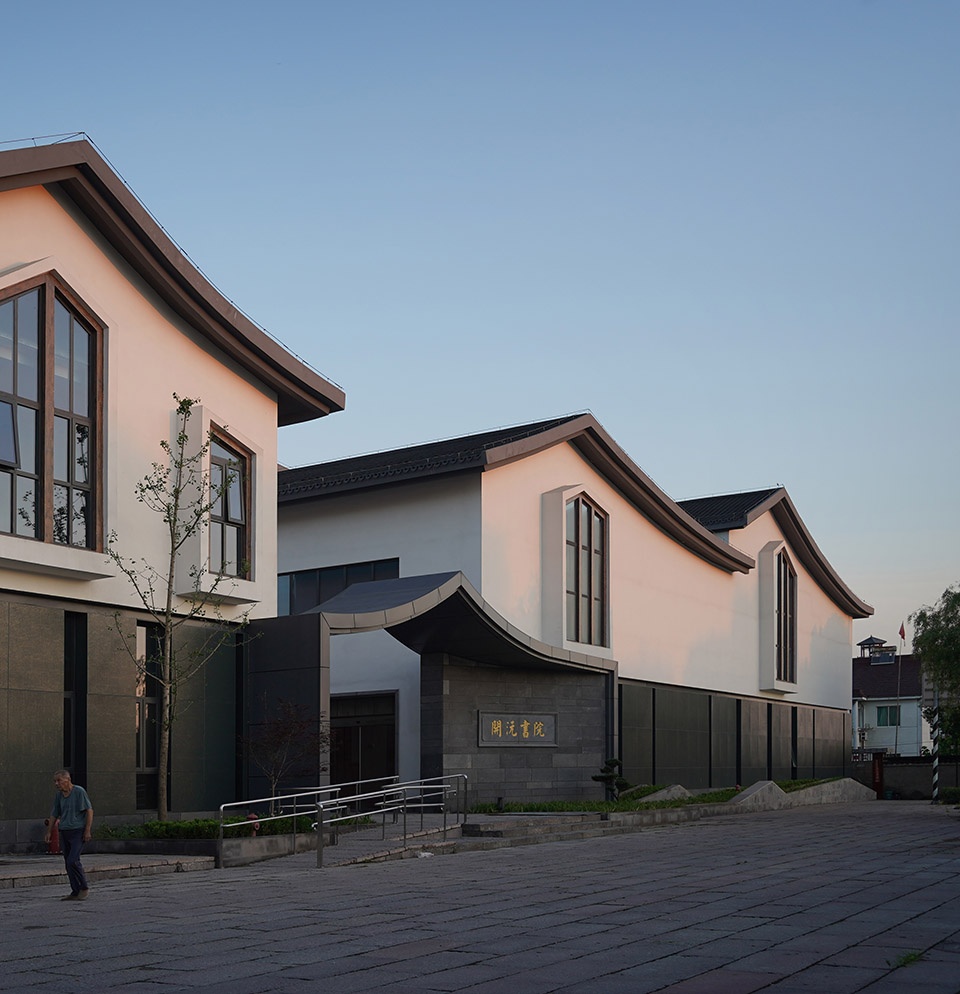
开沅书院的创建,也将全面拓展并提升“书院”的价值与功能,将会改写区域发展的动力结构。而区域名人文化的传承与弘扬,将会成为区域发展的重要动力源。
▼开沅书院的复合功能业态,The multi-functional business format of Kaiyuan Academy
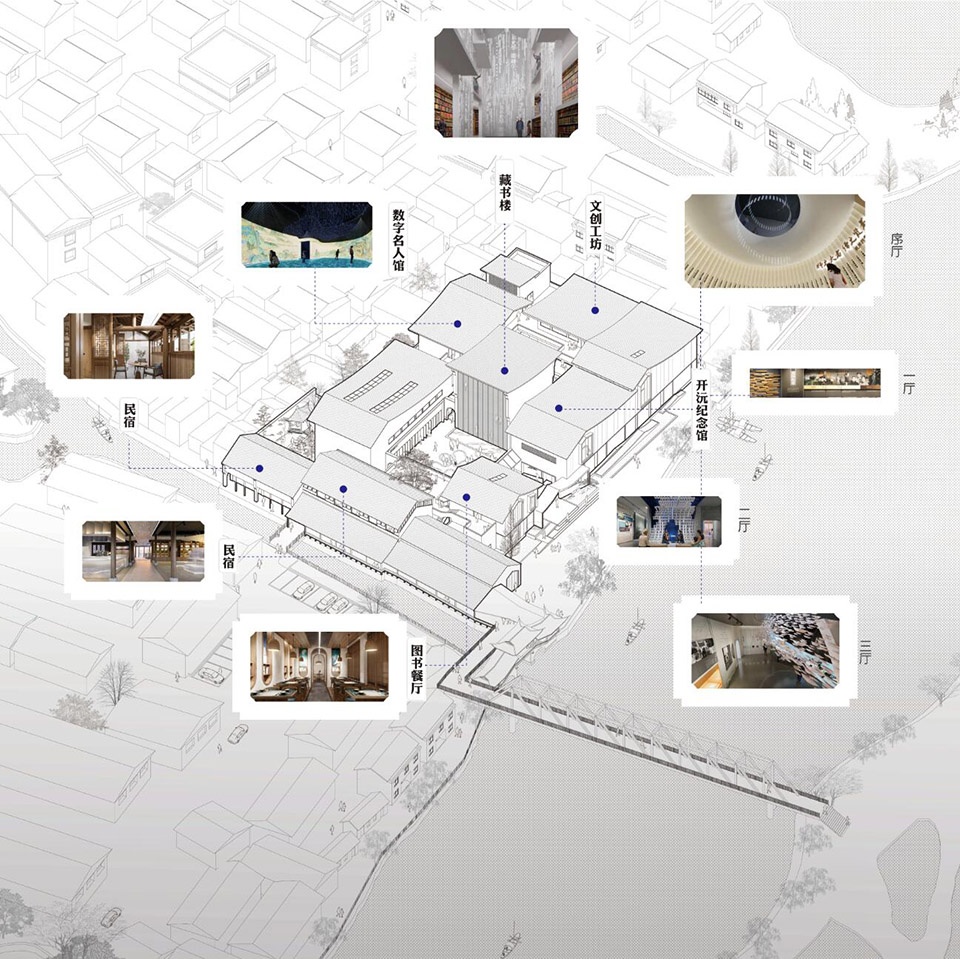
The establishment of Kaiyuan Academy will comprehensively expand and enhance the value and functions of the “academy,” reshaping the driving structure of regional development. The inheritance and promotion of local celebrity culture will, in turn, become an important source of momentum for the region’s growth.
▼建筑夜景,night view of the building
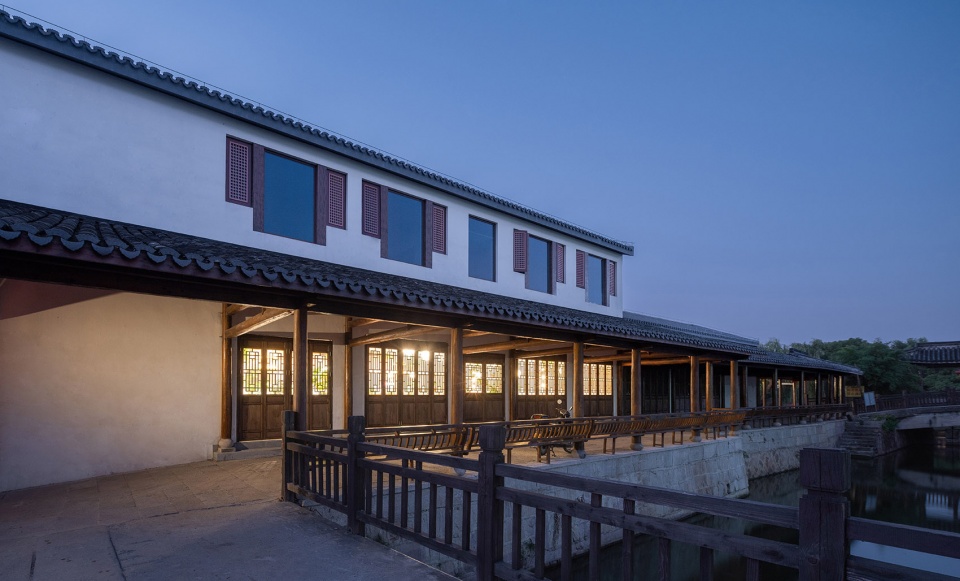
05 传承与创新之下的新旧交融
05 Integration of Old and New under Inheritance and Innovation
历史文脉赓续与建筑功能嬗变
The Continuity of Historical Context and the Transformation of Architectural Functions
这里曾是章开沅先生的祖宅“清芬堂”旧址,随着古村落的发展,后来改建为茧房作为工业生产用房,再到现在的开沅书院,其建筑功能随时代需求不断嬗变。但不管时代如何变迁,它一直都在记录和传承着属于它的历史印记,始终肩负着历史文脉赓续的重任。
▼设计概念,Design concept
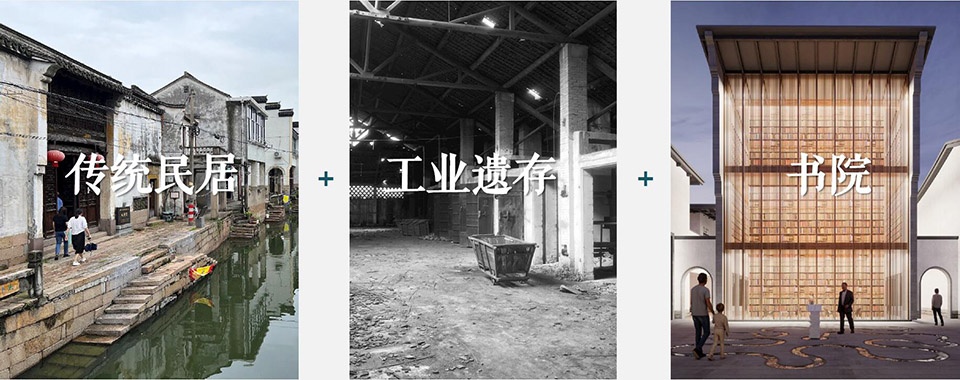
This site was once the former residence of Mr. Zhang Kaiyuan’s ancestral home, Qingfen Hall. With the development of the ancient village, it was later transformed into a cocoon house for industrial production, and now it has become Kaiyuan Academy. Over time, its architectural functions have continually evolved in response to changing needs. Yet regardless of these transformations, the site has always carried and preserved its historical imprint, steadfastly bearing the responsibility of continuing its cultural lineage.
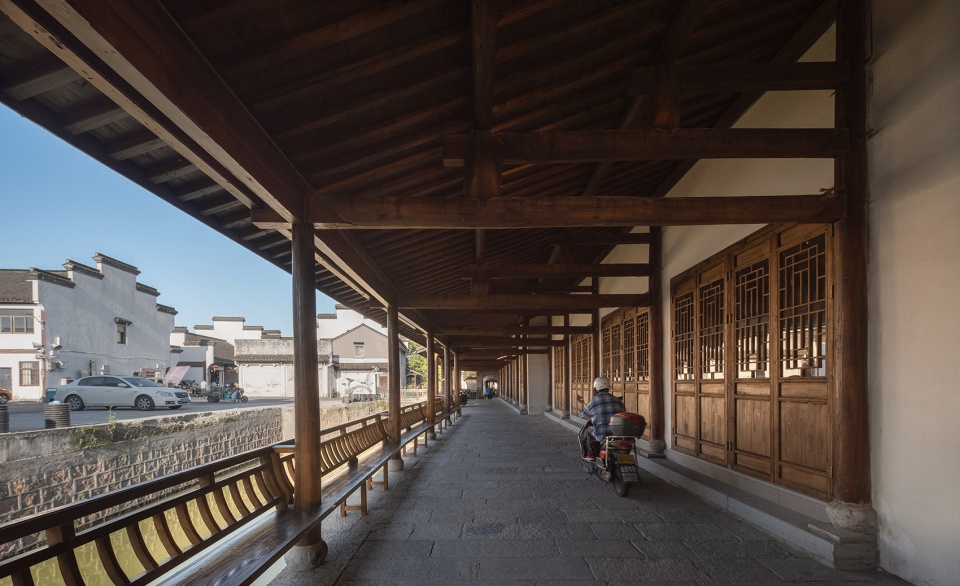
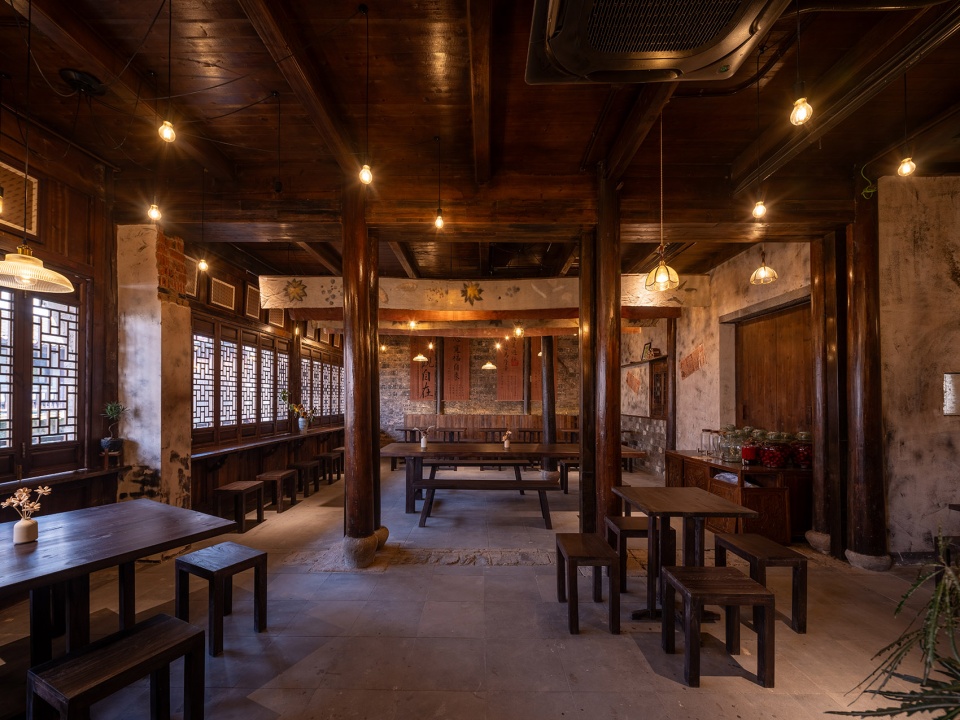
▼民宿、餐饮接待区,Homestay and catering reception area
建筑的保护修复与活化利用
Architectural Conservation, Restoration, and Adaptive Reuse
书院选址区内有局部建筑(里巷埭组成部分)是古村的历史老街,但现状残破且空间利用低效。对此我们坚持保护优先、原貌修复的原则,对该建筑进行修复修缮,保留内巷埭的原真性和完整性。同时重新赋予该建筑新功能以充分地活化利用,为开沅书院后期运营提供文化展示与体验、餐饮、住宿等配套保障。
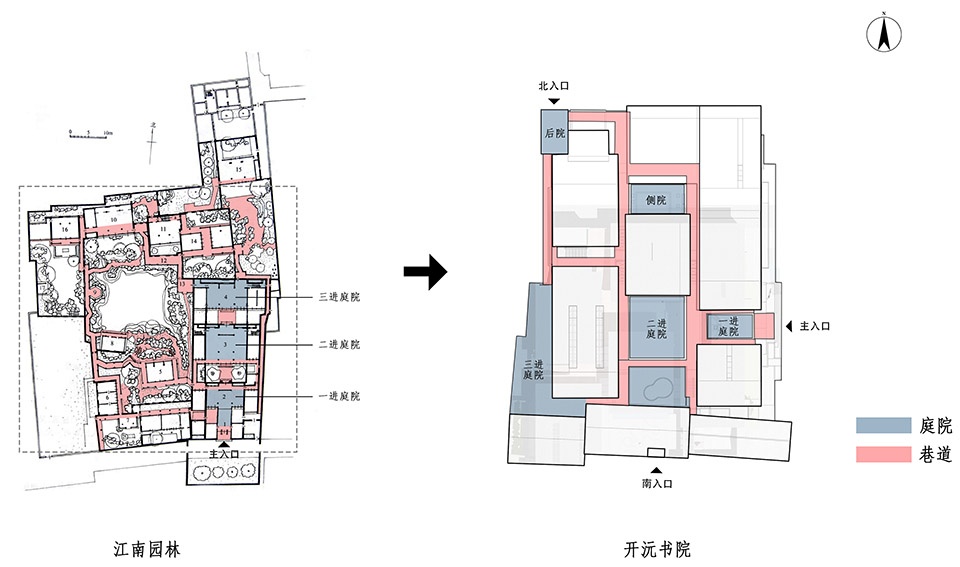
▼传统院落空间格局(左)的传承与现代演绎(右),
The Inheritance and Modern Interpretation of Traditional Courtyard Spatial Layout (left) (Right)
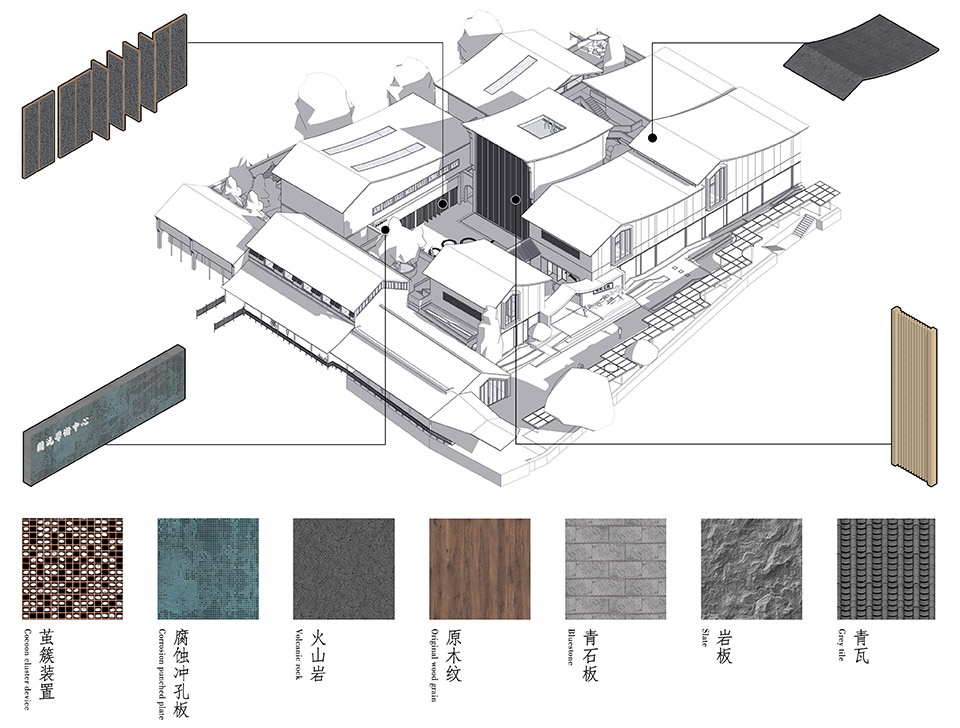
▼建筑材料分析图,Analysis diagram of building materials
Within the selected site area, part of the existing buildings (a section of Lidai Lane) belongs to the historic old street of the ancient village. However, it is currently in a state of disrepair and suffers from inefficient spatial use. In response, we adhere to the principle of “preservation first, with authentic restoration,” undertaking repairs to maintain the originality and integrity of Lidai Lane. At the same time, the building will be endowed with new functions to ensure its adaptive reuse—providing cultural exhibition and experiential spaces, as well as dining and lodging facilities—to support the future operation of Kaiyuan Academy.
▼建筑局部,Building detail
传统空间格局与现代设计表达Traditional Spatial Patterns and Modern Design Expression
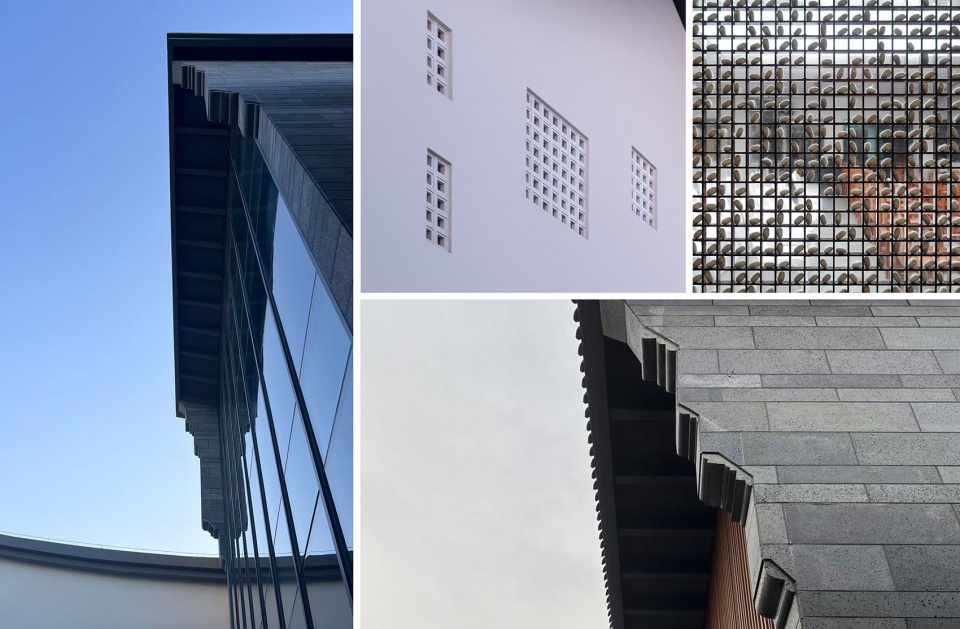
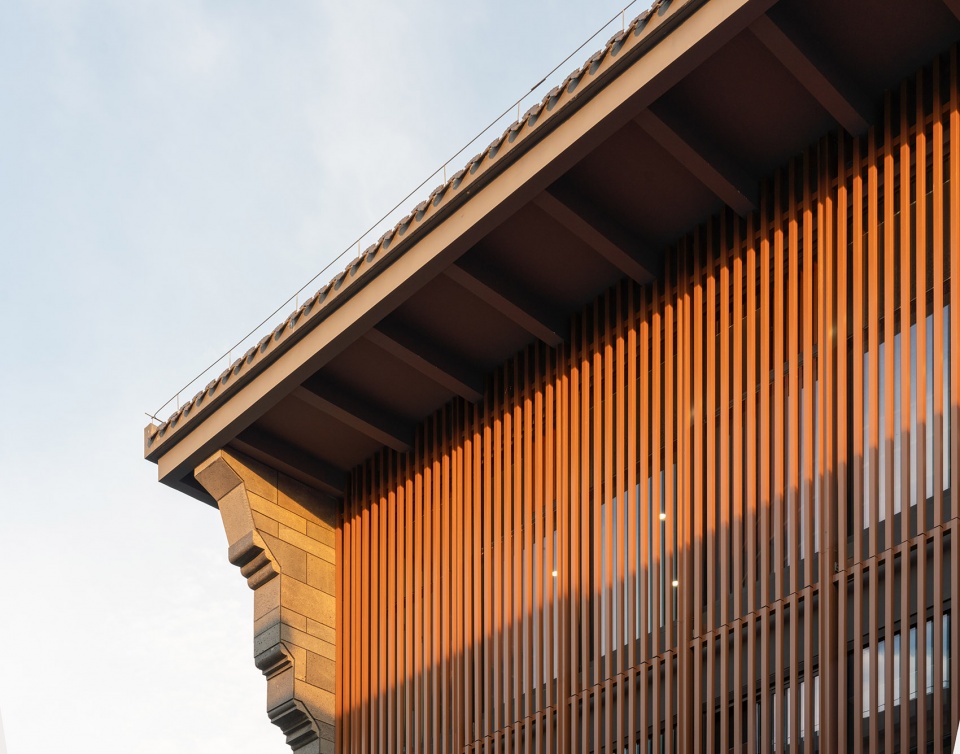
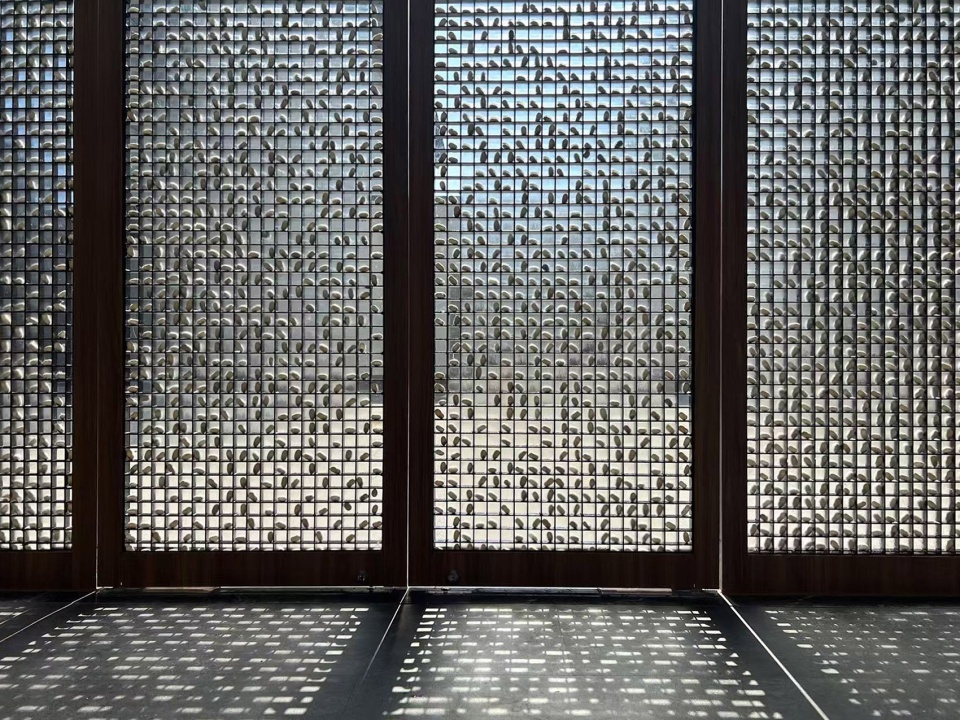
开沅书院建筑整体设计采用中国传统“多进庭院”组合布局,通过围合院落的手法巧妙地实现内外空间的过渡与转换。建筑外墙以灰瓦白墙为主基调,局部运用了冲孔铜板、通透的格栅幕墙等现代材料,同时旧工业茧房的外墙肌理予以部分保留。开沅书院作为公共文化建筑,新材料、新形式的现代表达与传统历史文化传承的关系处理尤为重要。
The overall architectural design of Kaiyuan Academy adopts the traditional Chinese layout of “multi-entry courtyards,” using the enclosed courtyard as a means to subtly achieve transitions and transformations between interior and exterior spaces. The exterior walls take grey tiles and whitewashed walls as the primary palette, complemented by modern materials such as perforated copper panels and transparent lattice curtain walls, while partially retaining the textured surfaces of the old industrial cocoon house. As a public cultural building, Kaiyuan Academy places particular importance on balancing contemporary expressions—through new materials and new forms—with the transmission of traditional historical culture.
▼建筑局部,Building detail
06 空间叙事视角下的空间营造
06 Spatial Creation from the Perspective of Spatial Narrative
开沅书院正如徐徐展开的时光长卷,按叙事逻辑编排着连续不同的序列空间构成完整的叙事性空间。当我们走进院门,跟随着情节线感受不同主题故事性描述的连续影像空间,就如一位年长的老者娓娓道来,述说着他与家乡、家族以及他漫长一生的故事。
▼开沅书院空间叙事结构分析图,Analysis diagram of spatial narrative structure
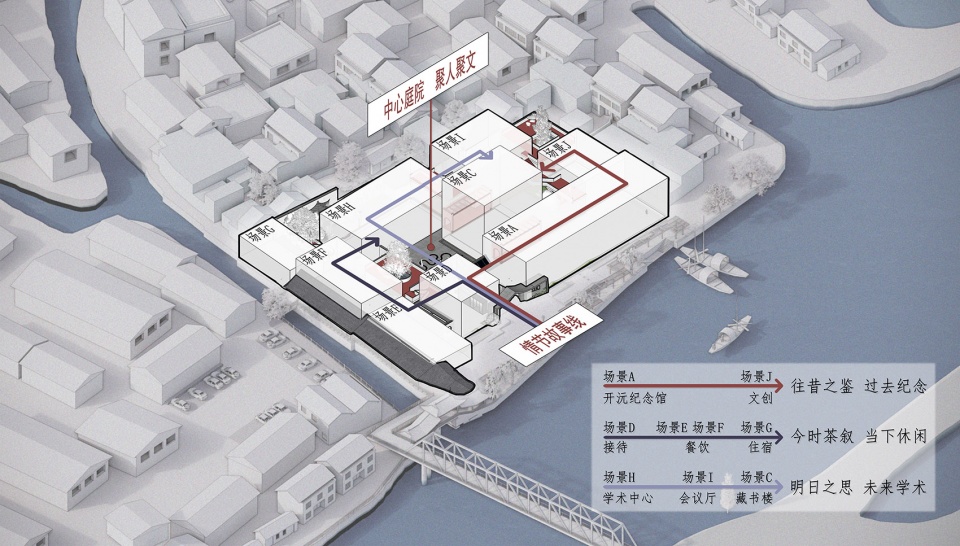
Kaiyuan Academy unfolds like a slowly unrolling scroll of time, arranging a sequence of continuous yet varied spatial experiences according to a narrative logic, thus composing a complete narrative space. Entering through the academy gate, visitors follow the storyline, moving through successive spatial scenes imbued with thematic stories—like listening to an elder speaking gently, recounting his ties to his hometown, his family, and the long journey of his life.
▼外巷埭方向看开沅书院一角,Look at a corner of Kaiyuan Academy from the direction of Waixiangdai
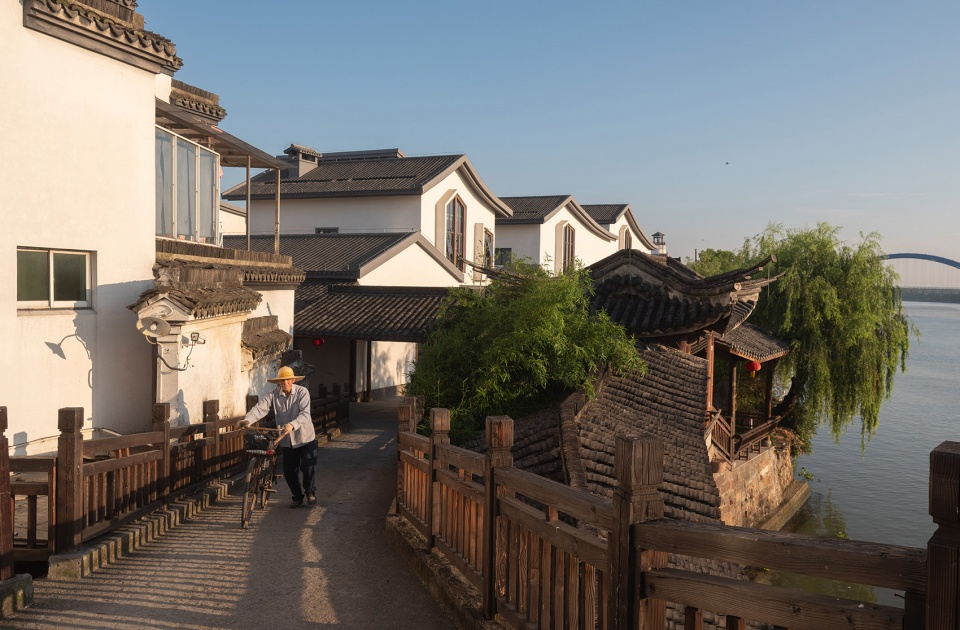
同时,在其中对作为线索的主题道具,如象征性景墙和多义性藏书楼等空间的重点塑造,或对主题道具如纪念性雕塑、经典名言、章氏家宴和客栈等情节记忆的重复再现,结合静态和动态叙事场所的设计,强化故事场景的事件性、隐喻象征性,提升体验感和审美性,鼓励体验者的参与和思考,引发体验者内心自发的认识、理解以及共鸣。
At the same time, key “thematic props” serving as narrative threads—such as symbolic landscape walls and the multi-layered library—are carefully shaped as focal spaces. Other thematic props, including commemorative sculptures, classic quotations, the Zhang family banquet, and the village inn, are repeatedly reinterpreted as elements of memory. Combined with the design of both static and dynamic narrative spaces, these interventions strengthen the eventfulness and metaphorical symbolism of the story scenes, enhancing the sense of experience and aesthetics. In doing so, they encourage visitor participation and reflection, inspiring spontaneous understanding, recognition, and emotional resonance.
▼外巷埭方向看开沅书院一角,Look at a corner of Kaiyuan Academy from the direction of Waixiangdai
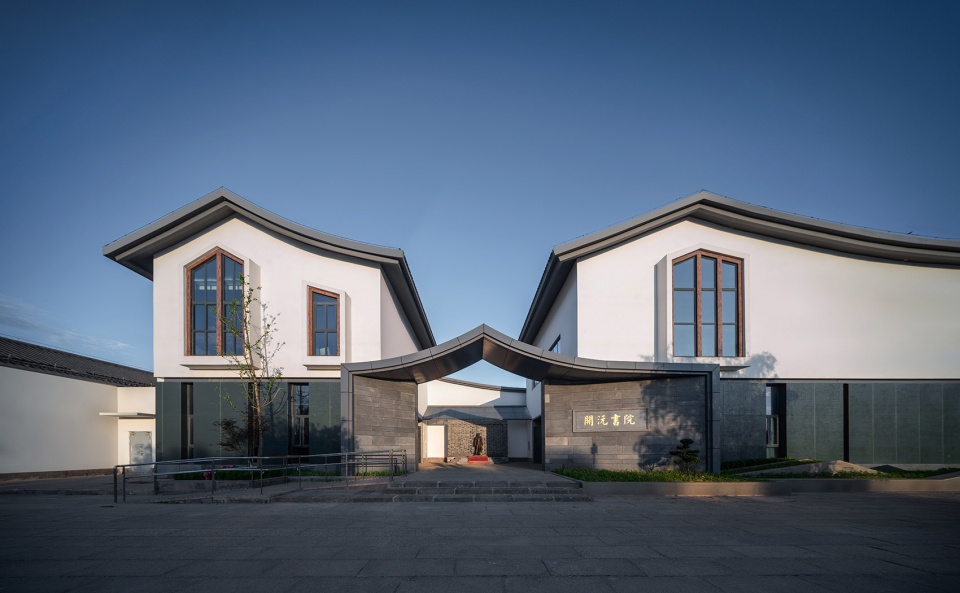
拉开帷幕Opening the Curtain
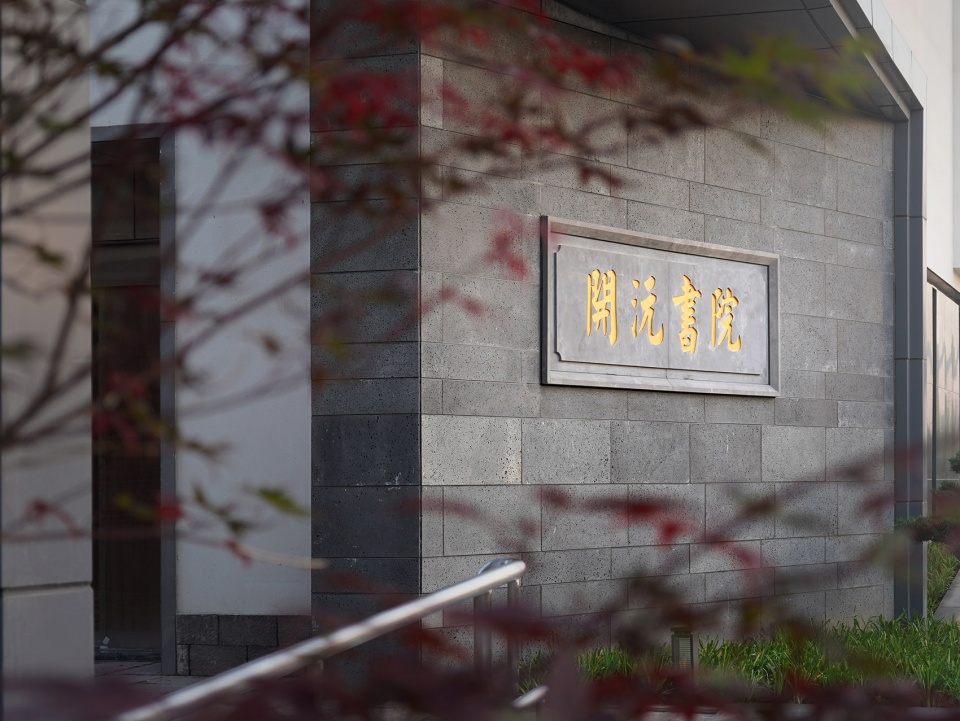
由古村外巷埭穿过亭廊之后豁然开朗,开沅书院映入眼帘。从主入口拾级而上,穿过形似史书的“洞口型场景”院门进入“意境型场景”前院,通过独特性的空间细部叙事性刻画,引诱体验者创造基于自身不同经历与文化记忆的活动事件。比如举头瞻望章老雕塑像和参数化砖砌“风帆”,低头品读雕塑底座上刻着的章老名言“历史是画上句号的过去,史学是永无止境的远航”,引发体验者对章老的缅怀与追忆,并激发体验者前进探索,也为整个“故事”奠定了情感基调。
Passing through Lidai Lane outside the ancient village and across the pavilion corridor, the view suddenly opens up—Kaiyuan Academy comes into sight. Ascending the steps from the main entrance, visitors pass through the “archway-like scene” gate, shaped like an opening in a history book, and arrive at the “artistic-conception scene” of the front courtyard. Through finely detailed narrative expressions in the space, visitors are enticed to create their own experiential events, shaped by personal experiences and cultural memories. For instance, lifting their gaze to Mr. Zhang’s sculpture and the parametrically built brick “sail,” then lowering their eyes to read the inscription on the base of the sculpture—his famous saying, “History is the past with a full stop, while historiography is an endless voyage”—visitors are prompted to recall and honor Mr. Zhang, inspired to continue exploring, and emotionally attuned to the story’s tone from the very beginning.
▼书院东入口,Eastern entrance of the academy
情节发展
Plot Development
故事场景的建构和空间序列的编排是为了更好的表达叙事。开沅书院采用多条情节线并置将故事空间编排在同一时空叙述,相辅相成又互相对比衬托,体验者可以自由选择叙事的发展方向,由自己决定故事最终走向。走进前院,由三条不同方向情节线构成,交汇于中庭。三条情节线的故事空间分别通向清芬堂(向左)、章开沅纪念馆(向右)、学术交流中心(向前),分别讲述了“耕读传家的章氏家族”、“回望章老学术人生”和“章老的学术续航与精神传承”。
The construction of story scenes and the arrangement of spatial sequences are designed to better convey the narrative. Kaiyuan Academy employs parallel plotlines, placing them within the same time-space framework—complementing and contrasting one another—so visitors may freely choose their narrative direction and determine how the story unfolds.In the front courtyard, three different plotlines converge at the central atrium. Each storyline leads to a distinct destination: Qingfen Hall (left), Zhang Kaiyuan Memorial Hall (right), and the Academic Exchange Center (forward). These paths respectively tell the stories of “The Zhang Family’s Legacy of Farming and Learning,” “Looking Back at Mr. Zhang’s Academic Life,” and “Mr. Zhang’s Ongoing Academic Voyage and Spiritual Legacy.”
▼开沅学术中心, Kaiyuan Academy lecture hall
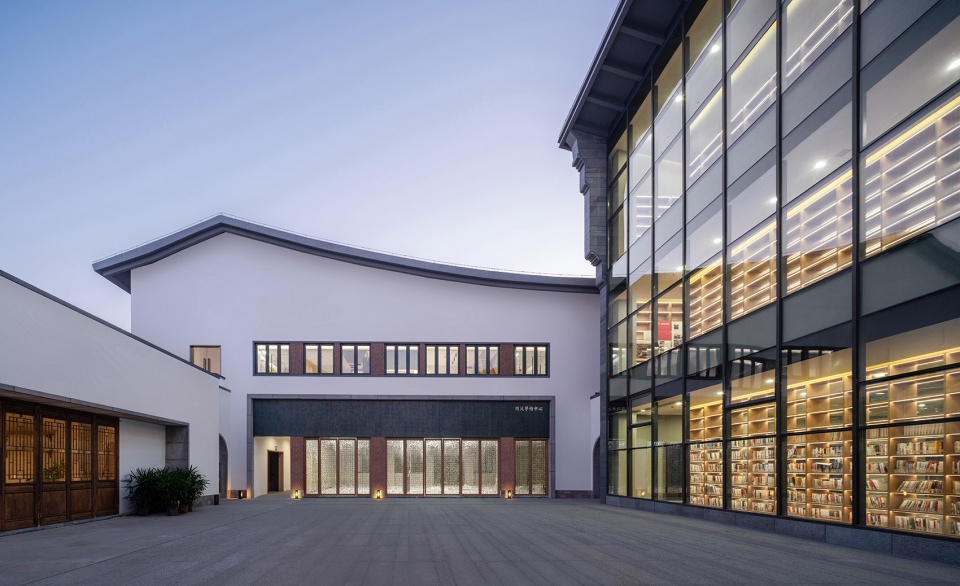
▼开沅学术中心, Kaiyuan Academy lecture hall
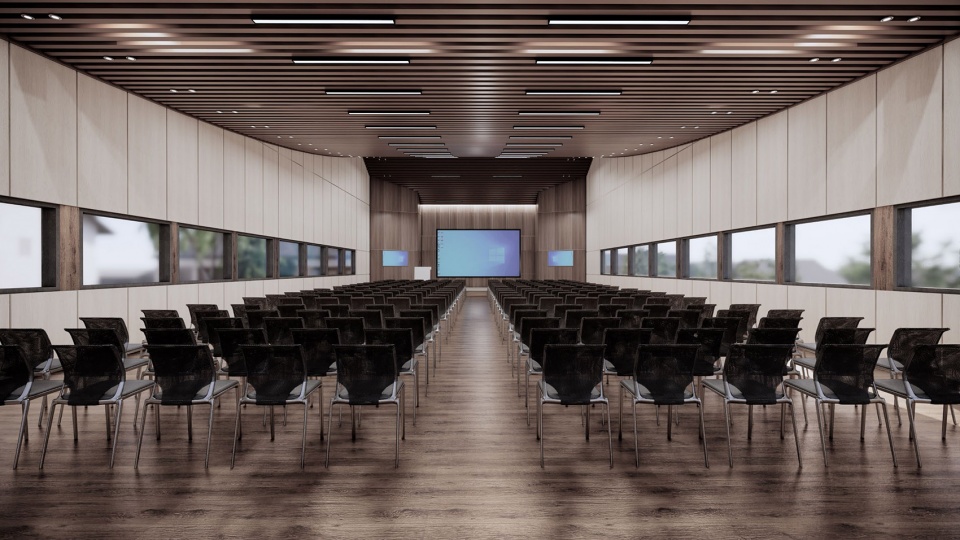
▼一楼会议中心, Meeting center at the ground floor
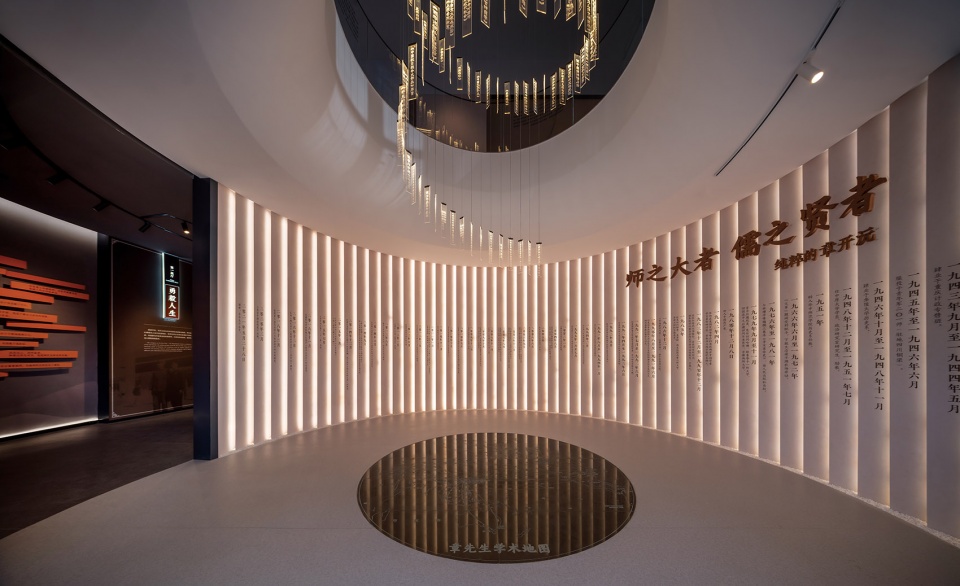
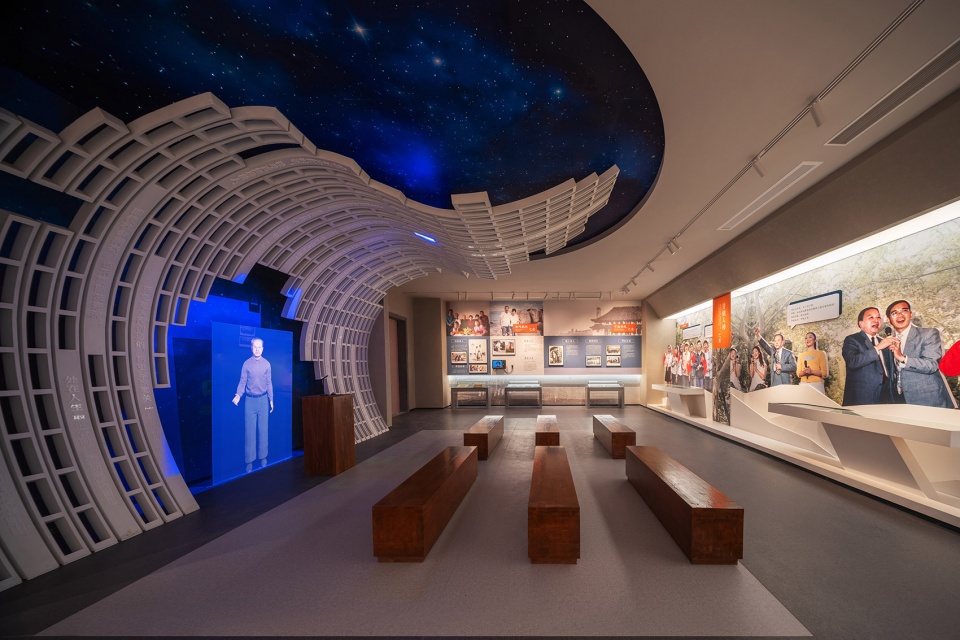
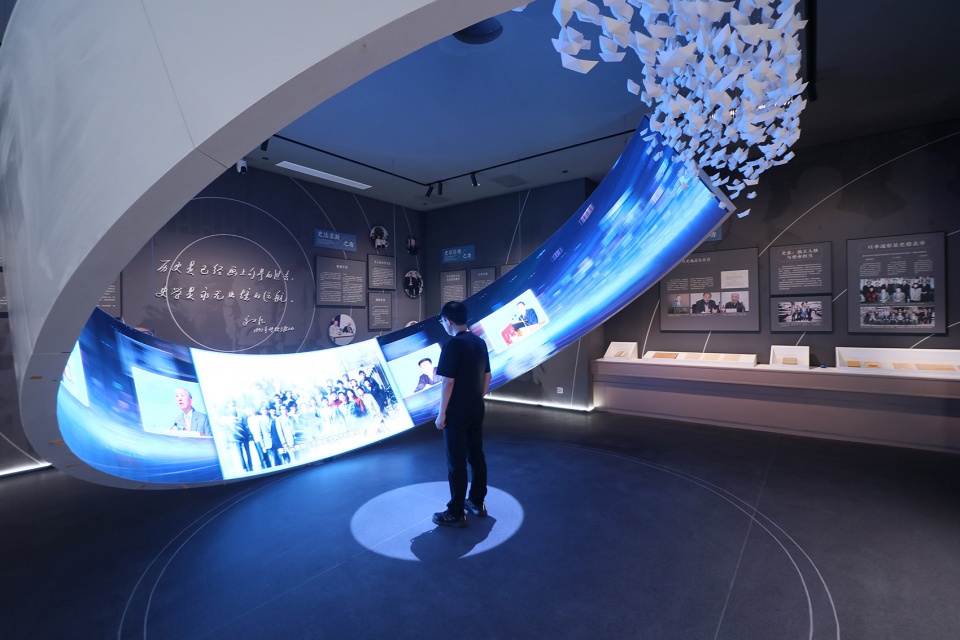
▼开沅学术人生展, academic exhibition
主题升华Thematic Elevation
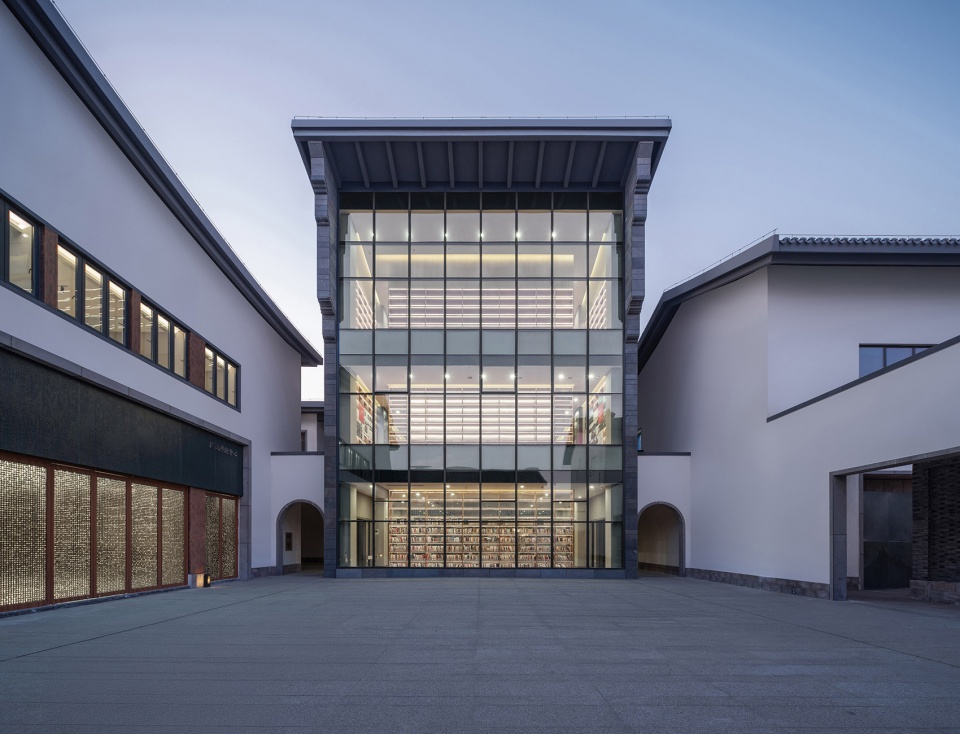
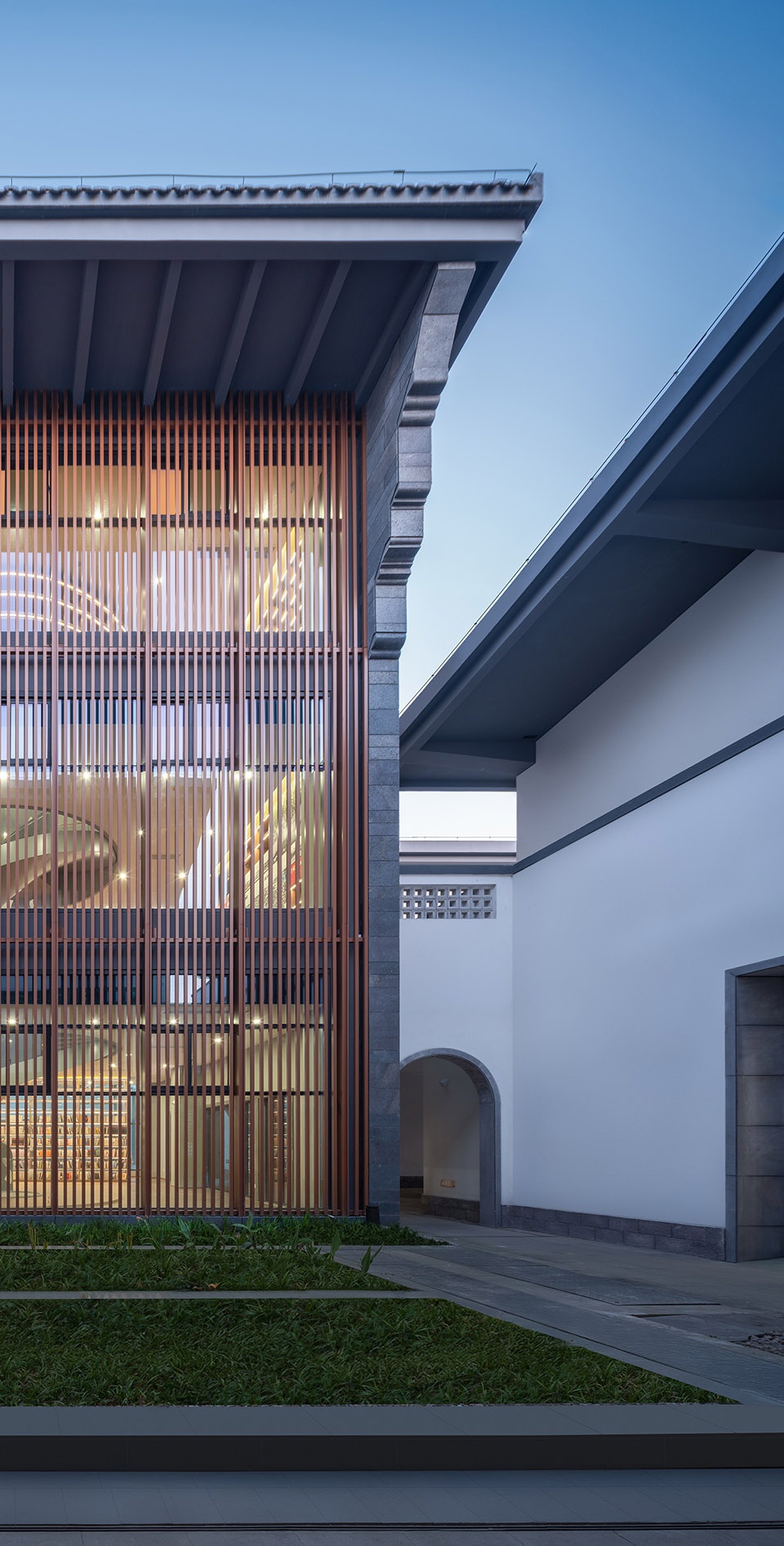
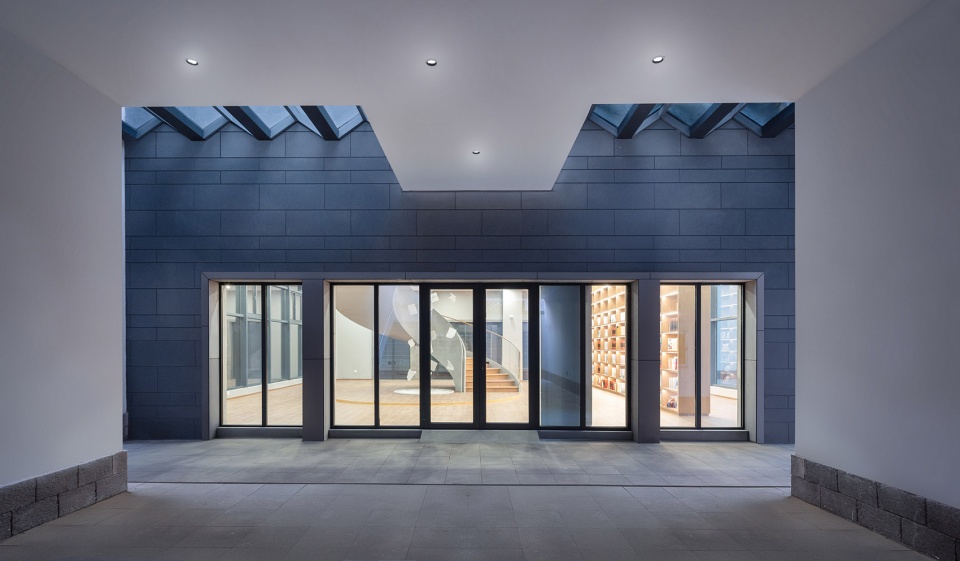
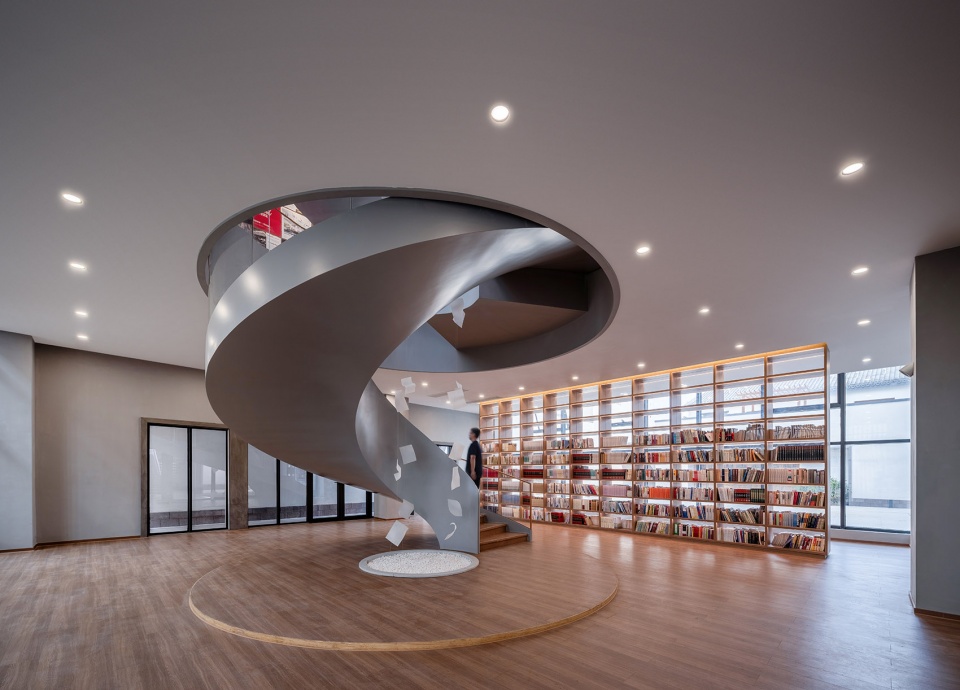
作为书院最具标识性的藏书楼,坐落在文化综合体的中心。整体坐北朝南面向中庭空间,旋转楼梯贯穿连通一至三层,南侧立面处理为玻璃幕墙,视野通透开阔,使藏书楼与中庭之间室内外空间相互交融,引导体验者去参与、探索、交流等。同时,这里将成为一个聚集章开沅先生及其弟子、国内外史学专家经典著作的人类史学精神宝库,是最具活力的活动与事件聚集场所。
The most iconic space of the Academy—the library—stands at the heart of the cultural complex. Facing south toward the central atrium, it is vertically connected by a spiraling staircase running from the first to the third floor. Its southern façade is rendered in glass curtain wall, offering broad, transparent views and allowing indoor and outdoor spaces to merge seamlessly. This design invites visitors to participate, explore, and exchange ideas. The library will become a repository of scholarly spirit—housing classic works by Mr. Zhang Kaiyuan, his students, and historians from China and abroad. It is envisioned as a vibrant hub for activities and events, embodying the living essence of historiography.
▼藏书楼南侧及中庭空间, the library atrium
▼藏书楼北侧及污水处理池顶板绿化, the library greening of the top plate of the sewage treatment pool
▼藏书楼西侧连廊空间, the library corridor
▼藏书楼内部空间,the library interior space
空间蒙太奇
Spatial Montage
开沅书院在建筑空间组合中也采用了拼贴蒙太奇编排和空间插叙组接的手法,强化书院的主题特色。比如将展览空间与馆藏阅览空间、会议接待空间、餐饮住宿空间、文创空间、交通空间等全部编排、拼贴、并置于一个巨大的文化综合体中,各功能空间自由拼接且相互渗透,空间具有强烈的趣味性和感染力。
In its architectural composition, Kaiyuan Academy also employs collage-like montage and spatial intercutting techniques to strengthen its thematic character. For example, exhibition halls are combined with reading and archival spaces, conference and reception rooms, dining and lodging facilities, cultural and creative spaces, and circulation areas. All of these functions are collaged and juxtaposed within a vast cultural complex, freely interwoven and mutually permeable, giving the space a strong sense of playfulness and emotional resonance.
▼不同功能空间(展览/藏书/接待/咖啡/民宿/图书餐厅),different functions space
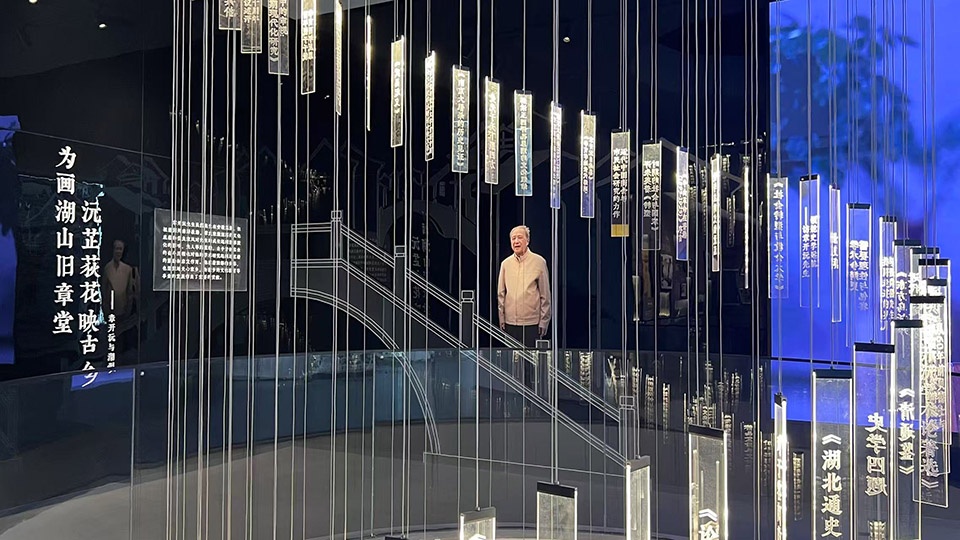
▼不同功能空间(展览/藏书/接待/咖啡/民宿/图书餐厅),different functions space
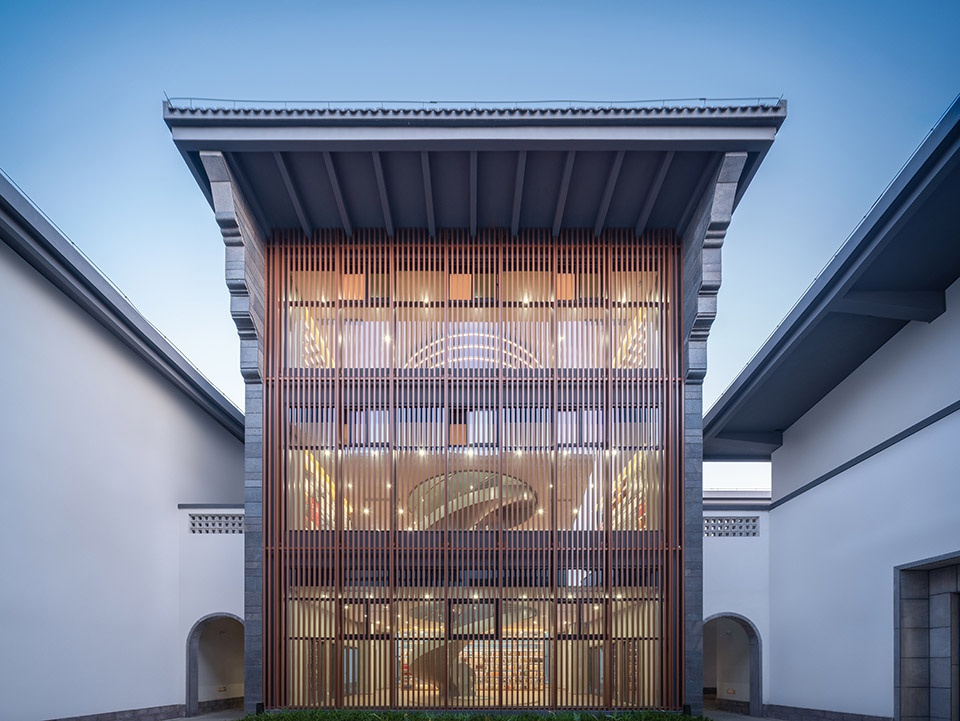
再如立体连廊,叙事空间纵横里外多维度拼贴并置的蒙太奇剪辑处理,让不同空间上下、内外、之间相互渗透,增添了空间的复杂性、神秘性、趣味性,引诱人们前往探索体验,人与空间的互动在此共同创造各种不同的自发性活动事件。
▼建筑空间爆炸分析图,space axonometric
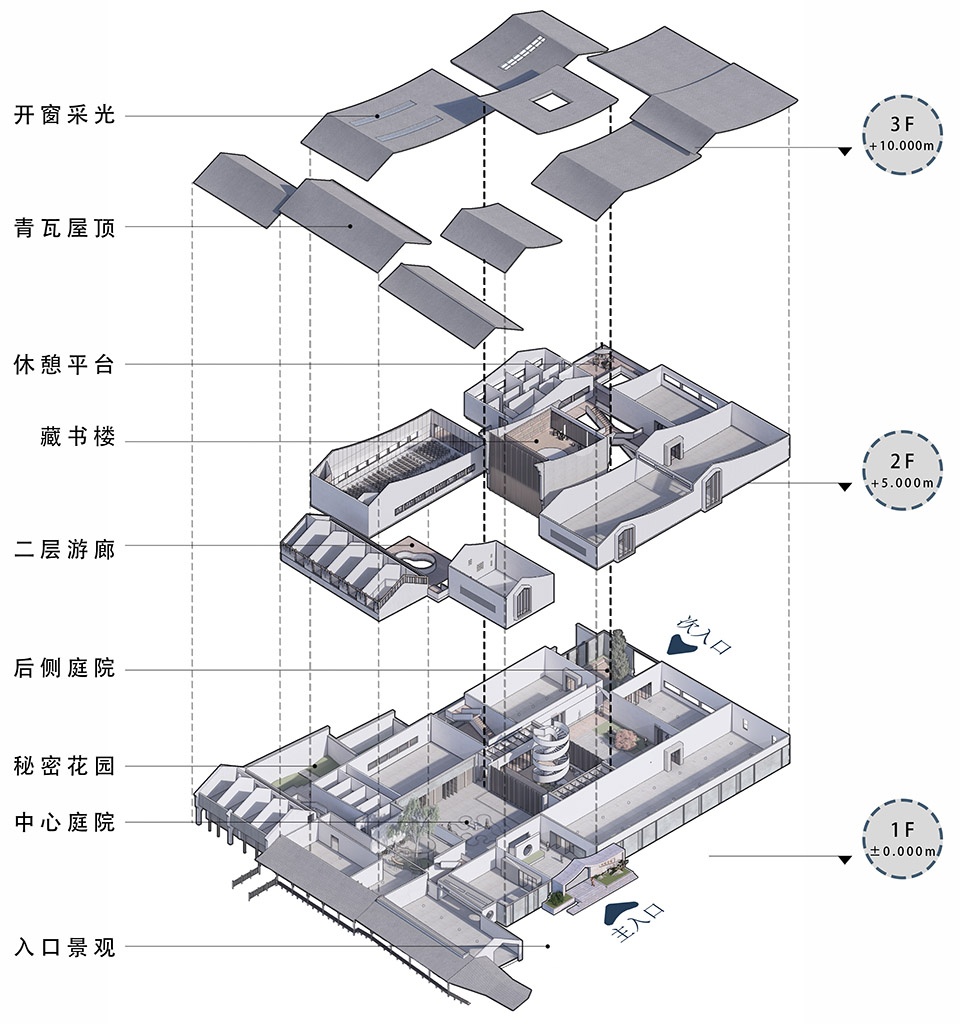
Similarly, the three-dimensional corridor system applies montage-like editing to interlace narrative spaces vertically and horizontally, inside and outside, across multiple dimensions. This allows different spaces to penetrate one another—above and below, inward and outward—adding layers of complexity, mystery, and fascination. The design lures visitors into exploration, while the interaction between people and space continuously generates spontaneous events and activities.
▼走廊空间,corridor space
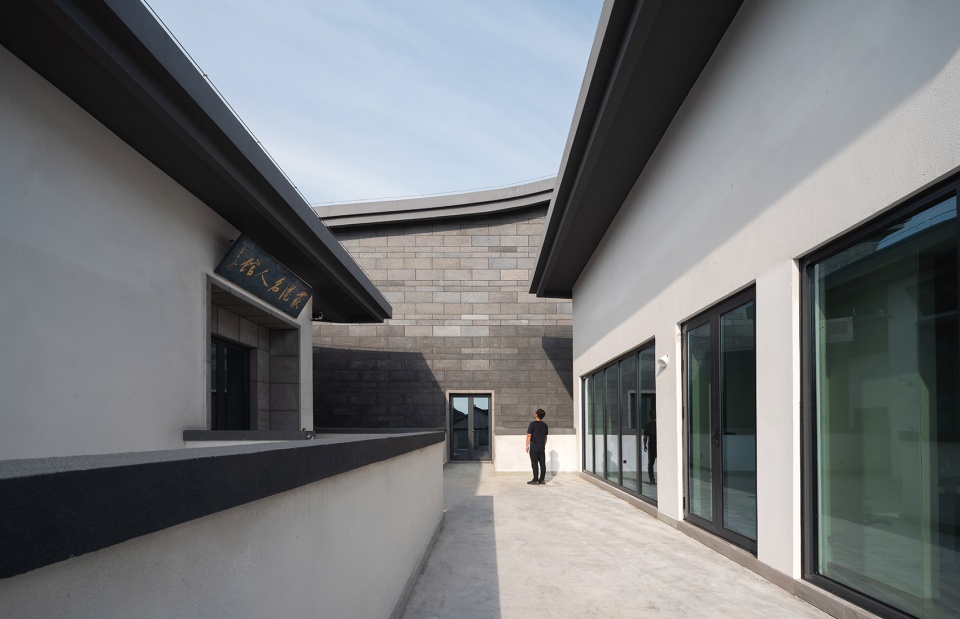
回味冥思
Recollection and Reflection
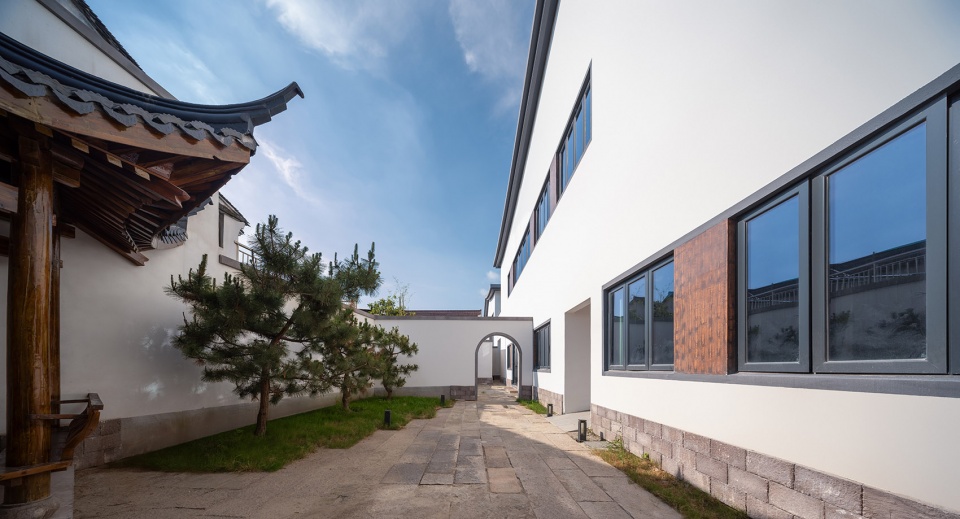
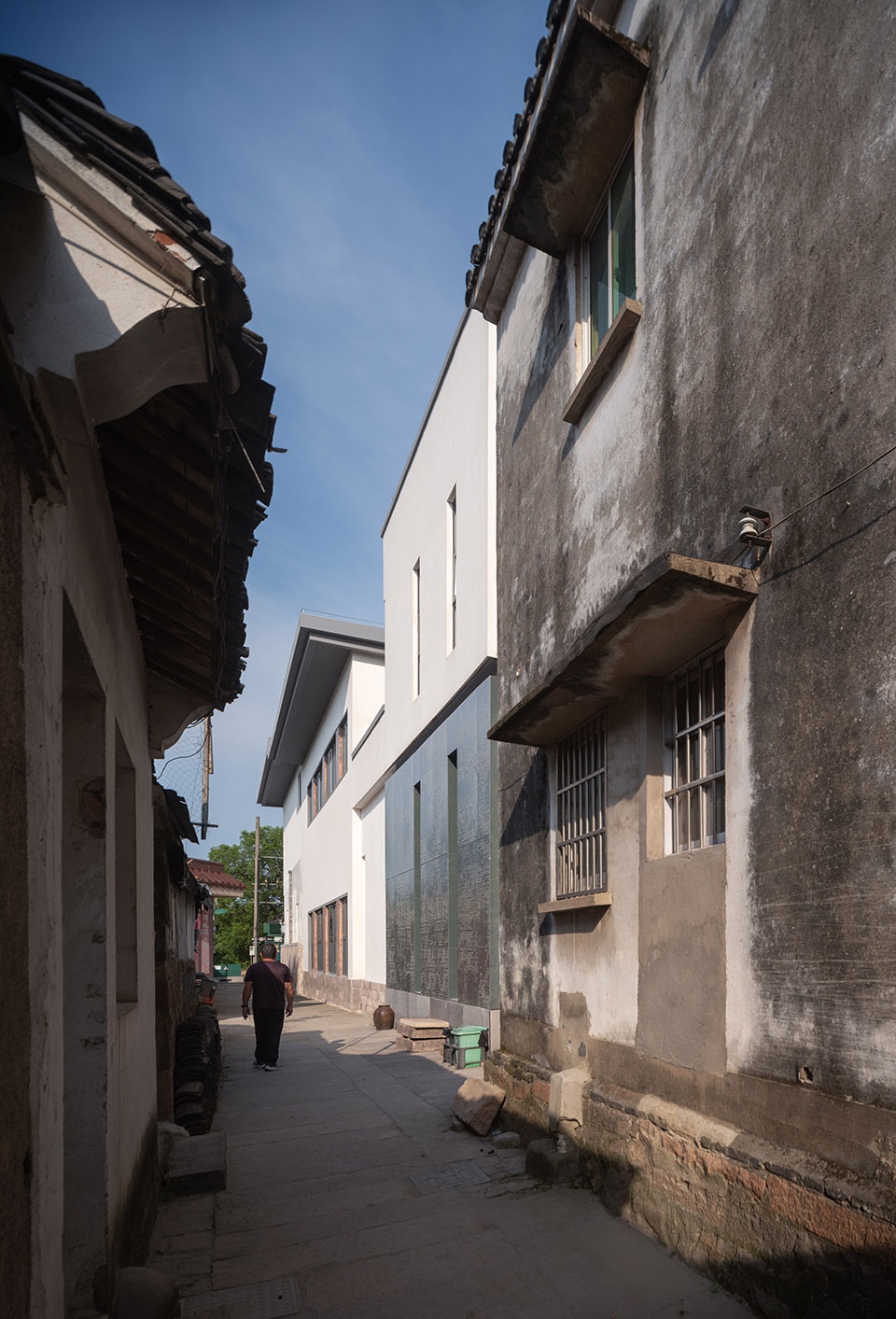
在故事结尾的后院空间采用“留白”的处理方式,将充满象征与隐喻含义的“真知”半亭、“云影松风”庭和幽长狭窄的巷道置于空间序列尽头,运用这种空缺、不确定性空间激发体验者创造性的“补白”,引起体验者的回味和冥思。
At the story’s end, the rear courtyard adopts a design strategy of “leaving blanks.” Here, semi-architectural and symbolic spaces—such as the “True Knowledge” Half Pavilion, the “Cloud Shadows and Pine Winds” Courtyard, and a long, narrow alleyway—form the sequence’s conclusion. These indeterminate, metaphor-rich spaces invite visitors to fill in the blanks with their imagination, sparking reflection, recollection, and deep contemplation.
▼后院与真知亭,the rear courtyard
▼书院北侧巷道,the rear alley
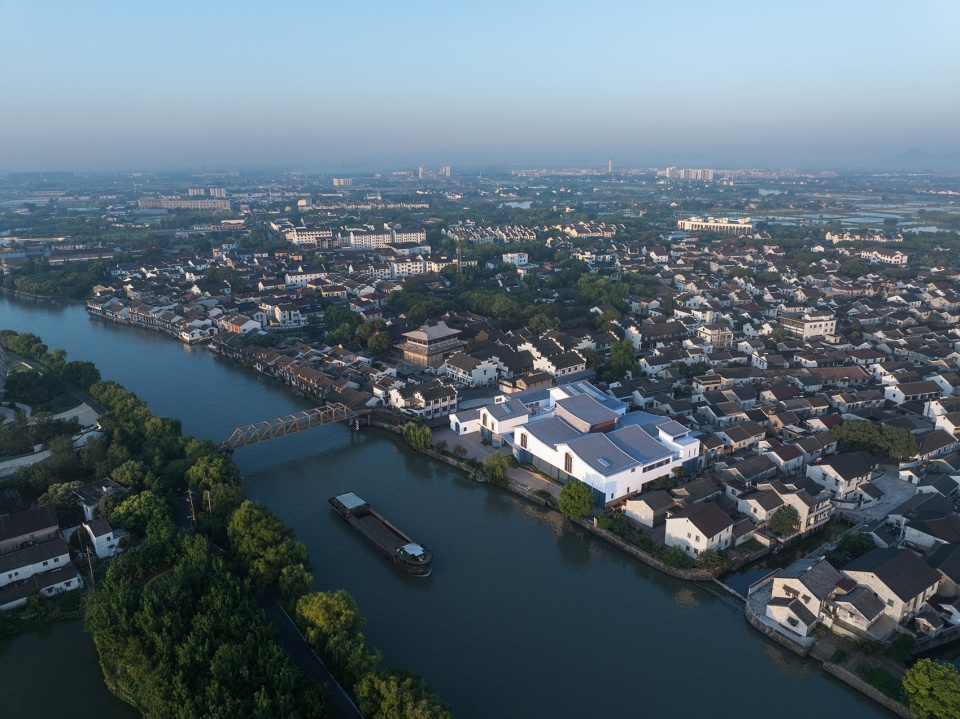
▼项目鸟瞰,aerial view of the project
Project Name: Kaiyuan Academy
Design Unit: Culture and Education Architecture Institute of Central China Normal University (CEAI),
Wuhan Emerging Design Firm (EMD)
Project Consultants:Ma Min, Peng Nansheng, Zhang Mingming
Project Planner:Wang Guohua
Lead Architect:Yan Shengxue
Design Team:Cao Shuwei, Tian Hongxing, Song Gaopeng, Wei Shushan, Huang Zheng, Tu Zhaowei, Zhao Qiuying, Gong Xi, Rao Chengchen, Shi Lifang, Feng Bowen
Class-A Design Institute:Hubei Haiye Engineering Consulting & Design
Construction Unit:Zhejiang Lixin Construction Co., Ltd.
Location:Digang Ancient Village, Hefu Town, Huzhou City, Zhejiang Province
Project Type:Memorial Cultural Architecture
Site Area:3,800 sqm
Floor Area:4,300 sqm
Photography:Zhao Yilong / Visionmore Culture, EMD
Editorial Review:Tian Hongxing, Maple Mei