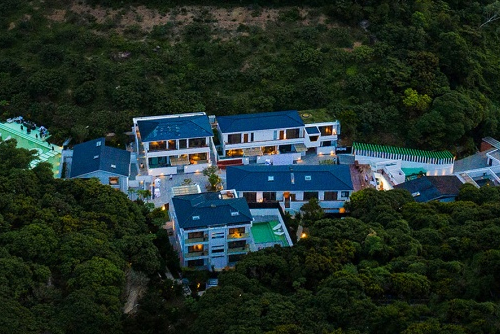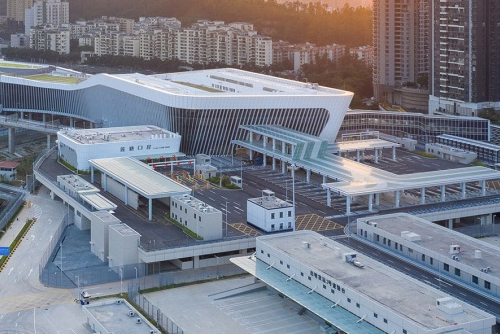
斯里兰卡国防大学附属704床医院大型综合性医院建设EPC工程,斯里兰卡/EPC
本项目是我国推出一带一路政策以来,在南亚地区结出的一颗硕果,设计过程思路缜密严谨,实施过程条理清晰,自建成后,数次登上央视及地方电视台的新闻栏目,对我国医疗设计服务水平起到了非常良好的示范作用。
This project is a great achievement in South Asia since China launched the the Belt and Road policy. The design process is rigorous, and the implementation process is clear. Since its completion, it has appeared on CCTV and local TV news columns several times, playing a very good demonstration role in China's medical design service level.
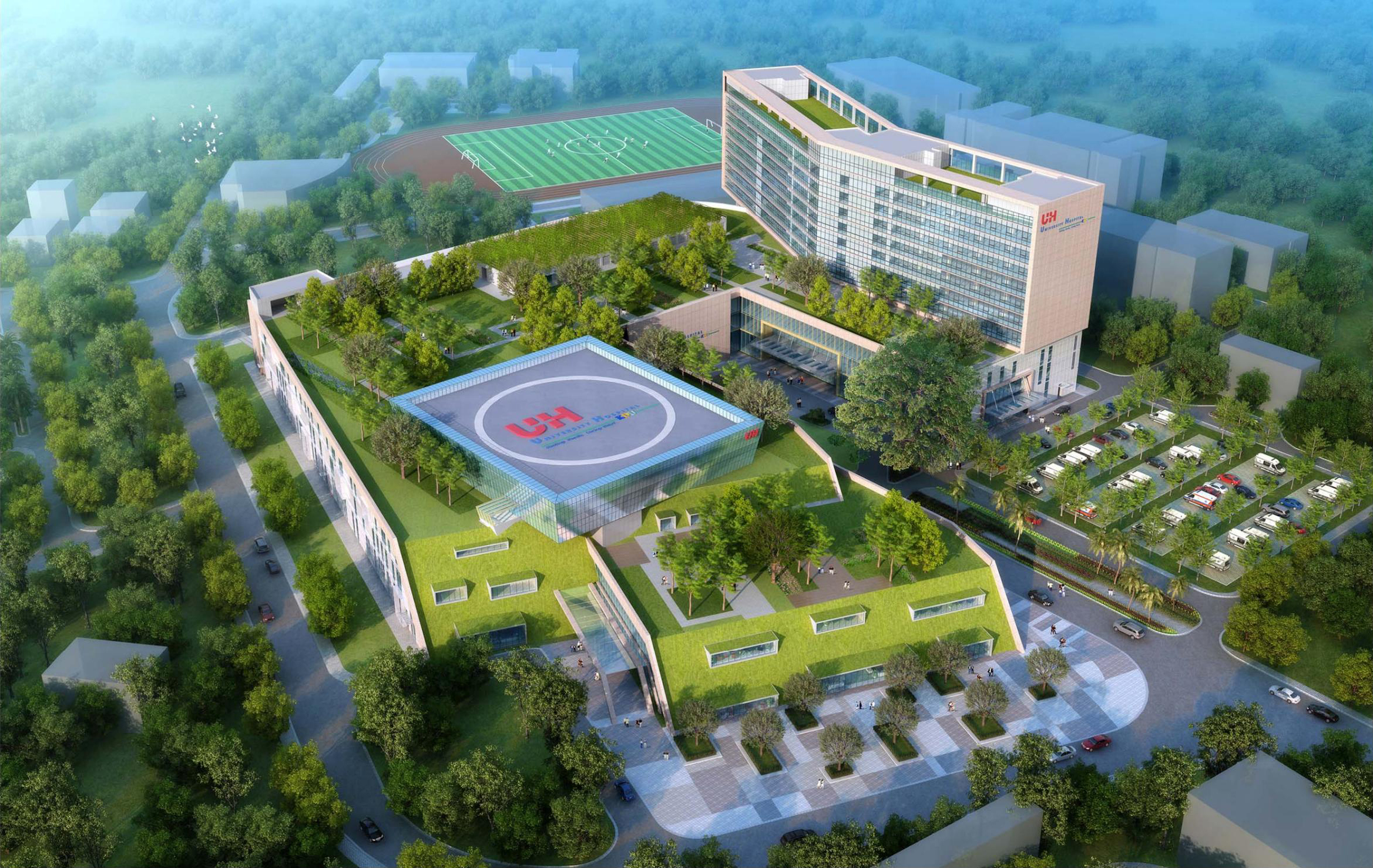
▼医院鸟瞰图 | Hospital aerial view
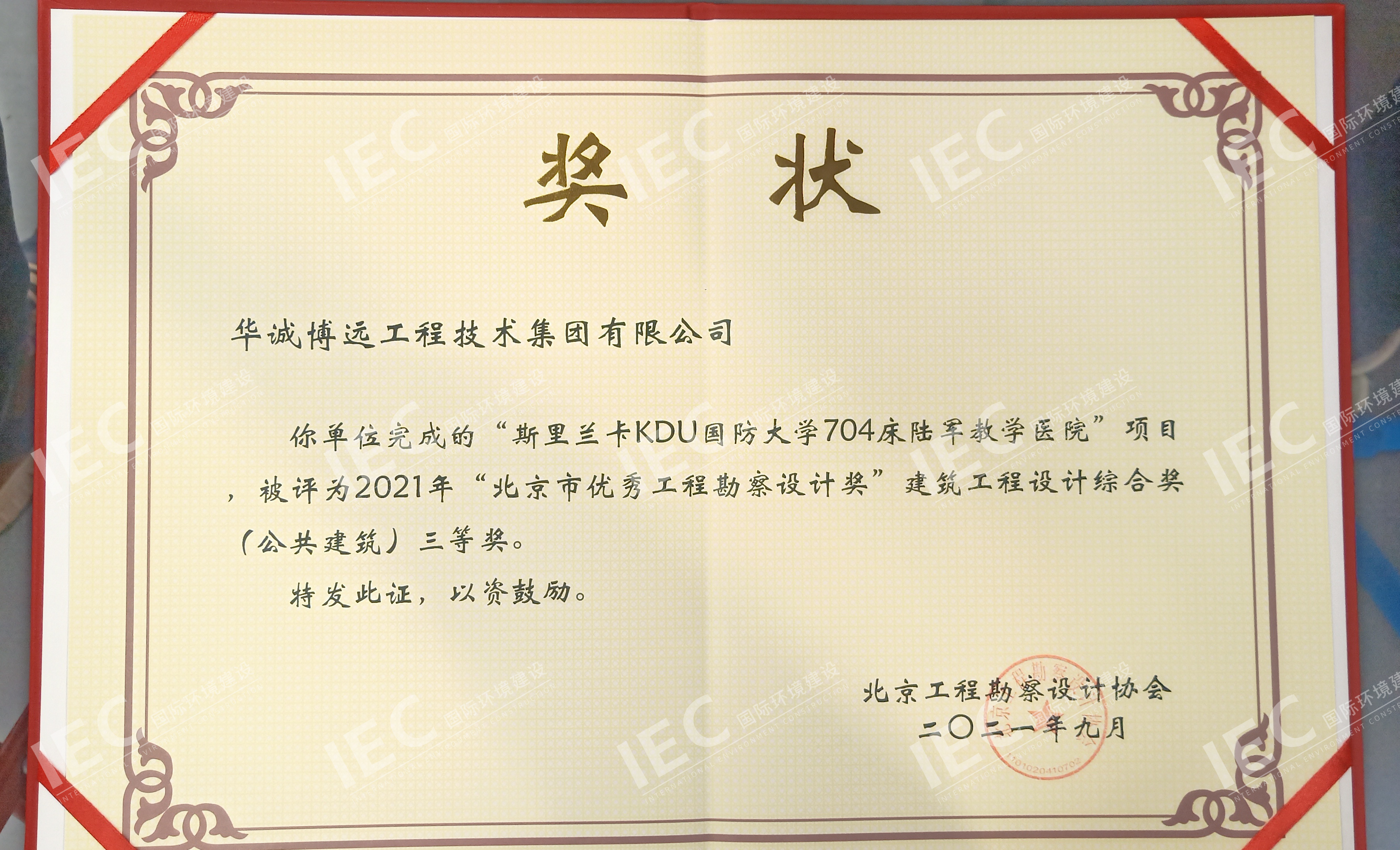
▼获奖证书 | Award certificate
斯里兰卡国防大学附属704床医院是由斯里兰卡政府投资,由我国保利科技有限公司承建的大型综合性医院建设EPC工程,项目总投资约2亿美金,历时四年于2017年5月竣工,最终建设成为南亚地区医院类项目的标杆工程。回首往事,这与建设方良好的领导和管理、设计团队卓越的专业能力、施工方的精细施工都是密不可分的。特别值得强调的是,博远医疗设计团队在建设方的大力配合下,把公司一贯秉承的“精益设计”的方法成功用于海外项目的实践中。方案阶段与使用方事无巨细地保持沟通,高质量的设计图纸表达,精确的施工选材,和团队内部严格的质量管理控制,最终带来了非常良好的效果。我们有幸参与了本工程全过程的建设工作,感受良多。
The 704 bed hospital affiliated with the Sri Lanka National Defense University is a large-scale comprehensive hospital construction EPC project invested by the Sri Lankan government and constructed by China Poly Technology Co., Ltd. The total investment of the project is about 200 million US dollars, and it took four years to complete in May 2017, ultimately becoming a benchmark project for medical hospital projects in South Asia. Looking back on the past, this is inseparable from the excellent leadership and management of the construction party, the outstanding professional ability of the design team, and the meticulous construction of the construction party. It is worth emphasizing that with the strong cooperation of the construction party, the design team of Boyuan Medical has successfully applied the company's consistent "lean design" method to the practice of overseas projects. Maintaining detailed communication with the user during the planning phase, high-quality design drawings, precise construction material selection, and strict quality management control within the team ultimately resulted in very good results. We were fortunate enough to participate in the entire construction process of this project and had a lot of experience.
项目基本情况
斯里兰卡是位于印度东南方的热带岛国,有“印度洋上的明珠”“宝石王国”的美誉,英联邦成员国之一。该国总人口约2100万,其中70%信仰佛教,是世界上著名的佛教国家之一。该国经济发展缓慢,但医疗卫生事业发展尚可,实行全民免费医疗,全国拥有500多所医院,但是大多比较陈旧,设施设备落后。在这样的背景下,本工程是斯里兰卡改善国计民生的国家级重点工程,力求打造成为南亚地区最大的集医疗、教育、研究三位一体的国际化医疗中心。
BASIC INFORMATION OF THE PROJECT
Sri Lanka is a tropical island nation located southeast of India, known as the "Pearl of the Indian Ocean" and "Kingdom of Gems", and is a member of the Commonwealth. The total population of the country is about 21 million, of which 70% believe in Buddhism, making it one of the world's famous Buddhist countries. The country's economic development is slow, but the medical and health care industry is still developing. It implements free medical care for all and has more than 500 hospitals nationwide, but most of them are relatively old and have outdated facilities and equipment. In this context, this project is a national key project for Sri Lanka to improve the national economy and people's livelihood, striving to become the largest international medical center in South Asia that integrates healthcare, education, and research.
▼区位图 | location map
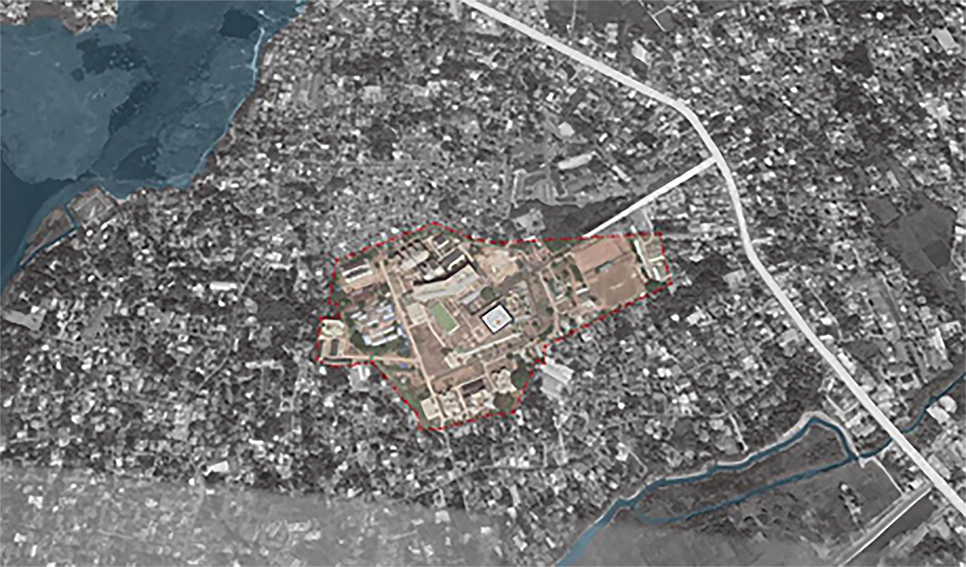
本项目位于斯里兰卡西部省,毗邻首都科伦坡,总用地面积为195亩,周边均为低矮的私家住宅,仅用地东侧500米外有一条国道,用地与国道之间通过一条道路相连。该项目功能比较复杂,包含了医院、教学、科研、宿舍、餐厅、停车等各类用房,总建筑面积12.3万m²,其中医院建筑面积为7.8万m²,为院区内单体面积最大的建筑,高十层,钢筋混凝土框架剪力墙结构,设计总床位为704张。
因地域经济文化、医疗传统、施工方法等诸多差异,该医院的设计理念与国内医院设计的方法不尽相同,总体布局及建筑设计也有非常鲜明的特色,结合具体内容,下文试做逐一阐述。
This project is located in the Western Province of Sri Lanka, adjacent to the capital Colombo. The total land area is 195 acres, surrounded by low rise private residences. There is only a national highway 500 meters east of the land, and the land is connected to the national highway through a road. The project has complex functions, including various buildings such as hospitals, teaching, research, dormitories, restaurants, parking, etc. The total construction area is 123000 square meters, of which the hospital has a construction area of 78000 square meters, making it the largest single building in the campus. It is ten stories high, with a reinforced concrete frame shear wall structure and a designed total of 704 beds.
Due to various differences in regional economy, culture, medical traditions, construction methods, etc., the design concept of this hospital is not exactly the same as the design methods of domestic hospitals. The overall layout and architectural design also have very distinctive features. Based on specific content, the following will attempt to elaborate on them one by one.
以人为本的设计理念
作为英联邦国家之一,斯里兰卡医院建设理念深受欧美发达国家的影响,在分科方式、就诊流程等方面均与我国有较大不同,主要表现在下面的几个方面。
按照身体部位和疾病导向为基准划分科室,提供精准服务
与我国传统以内外科分科方式不同,西方的医疗体系决定了他们按照身体部位和疾病导向为基准进行分科,以患者为中心提供精准的医疗服务。按此模式,我们将临床科室分为心脏血管疾病中心、神经疾病中心、肾脏泌尿与生殖疾病中心、肿瘤中心、内分泌代谢疾病中心、妇产乳腺疾病中心、儿童疾病中心、口腔疾病中心、眼科耳鼻喉疾病中心等。 然后再将这些中心根据业务量的大小进行面积分配,各成一区,分居在医疗主街两侧;各中心内独立配备与疾病相关的各种小型检查设备设施,形成诊疗、检查一体化。
“诊所”模式,一站式服务
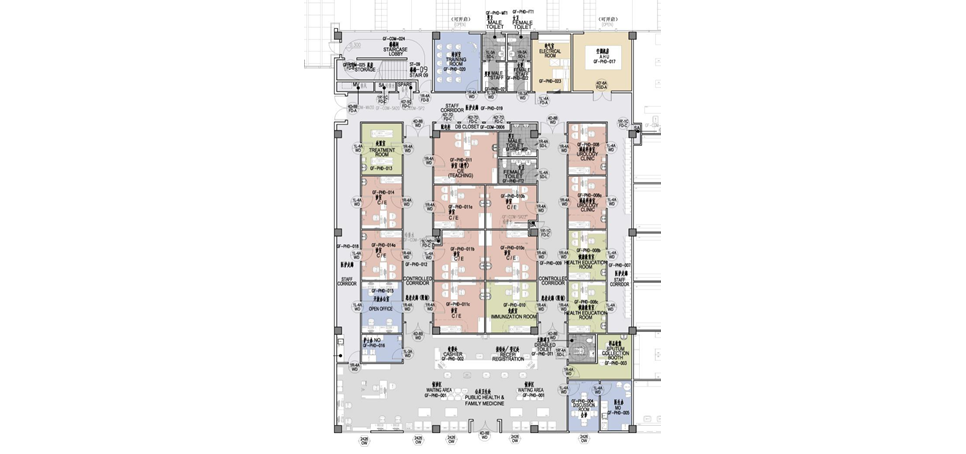
本项目采用“诊所式”的诊疗模式,与患者相关的挂号、诊疗、缴费、小型设备检查等科目均在中心内部完成,中心设有带独立卫生间的检验标本采集室,采集标本后经物流传输系统传送至检验中心。患者一次就诊无需往来穿梭于医院诸多部门,在中心内即能完成大部分诊查项目,中心俨然就是一个独立的诊所,为患者提供“诊所式”的一站式服务,大大缩短了患者就诊路线,给患者带来极大便利。
这种全新的就诊模式简化了我们传统医院设计中门诊大厅的功能,取消了因挂号收费人流过多而造成的拥挤后,空间形式和品质都得到了极大的提升。给患者在和医院的第一次邂逅中,留下一个仁和宁静的良好体验。
Human centered design philosophy
As one of the Commonwealth countries, Sri Lanka's hospital construction philosophy is deeply influenced by developed countries in Europe and America. It differs significantly from China in terms of specialization and treatment processes, mainly manifested in the following aspects.
Dividing departments based on body parts and disease orientation to provide precise services is different from the traditional division of internal and surgical departments in China. The Western medical system determines that they divide departments based on body parts and disease orientation, and provide precise medical services centered on patients. According to this model, we divide clinical departments into cardiovascular disease center, neurological disease center, renal, urinary and reproductive disease center, tumor center, endocrine and metabolic disease center, obstetrics and gynecology breast disease center, children's disease center, oral disease center, ophthalmology ear, nose and throat disease center, etc. Then allocate the area of these centers according to the size of their business volume, divide them into zones, and separate them on both sides of the main medical street; Each center is independently equipped with various small-scale examination equipment and facilities related to diseases, forming an integrated diagnosis, treatment, and examination system.
This project adopts a "clinic style" diagnosis and treatment model, where patient related registration, diagnosis and treatment, payment, and small equipment inspection are all completed within the center. The center has a specimen collection room with an independent bathroom, and the collected specimens are transported to the testing center through a logistics transmission system. Patients do not need to shuttle between various departments of the hospital during a single visit, and can complete most of the examination items within the center. The center is like an independent clinic, providing patients with a "clinic style" one-stop service, greatly shortening the patient's medical route and bringing great convenience to patients.
This new medical treatment model simplifies the functions of the outpatient hall in our traditional hospital design, eliminates the congestion caused by excessive registered and paid foot traffic, and greatly improves the spatial form and quality. Leave a good experience of benevolence and tranquility for patients during their first encounter with the hospital.
▼科室放大平面 | Departmental enlarged plan
资源共享,人文关爱
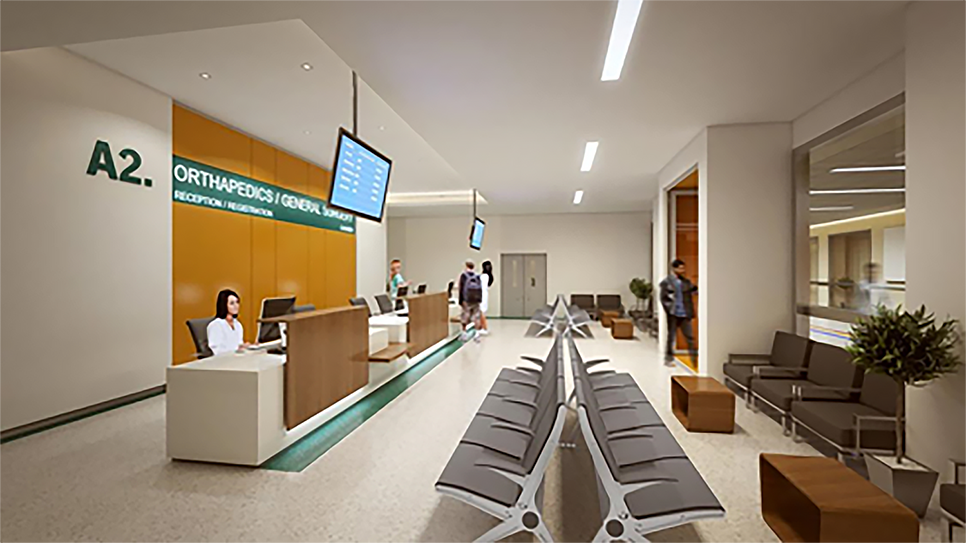
为了给各临床部门提供大型设备检查、检验以及后勤供应,医院建筑内设有共享的医技和后勤部门。医技部门设有放射影像中心、核医学检查中心、检验病理中心、消毒供应中心、药物配置中心等,与患者相关的各部门设有独立候诊空间和护士站,患者可完成缴费和检查项目。后勤部门设有营养厨房、洗衣房、物资库等为各临床部门提供物资供应、餐饮等需要。
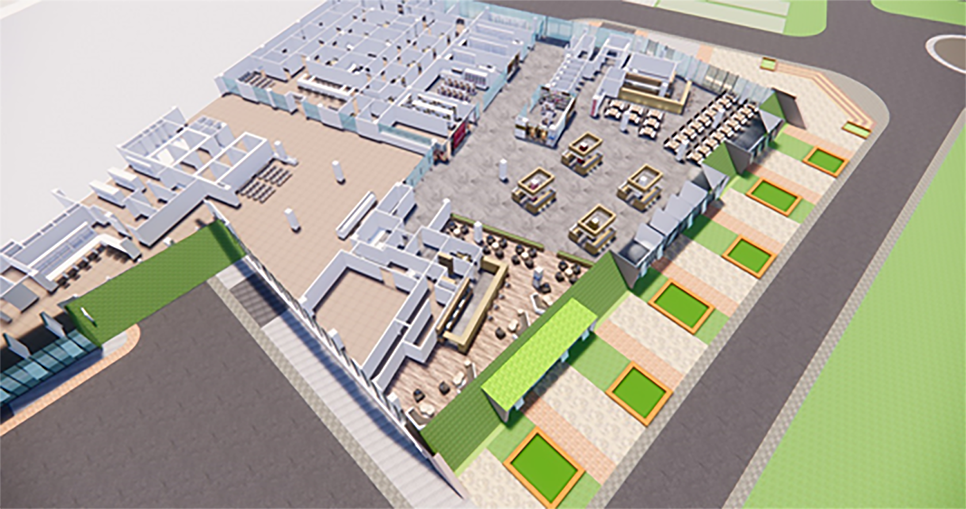
在国外,特别是参观一些发达国家的医院,我们常常会看到医院在满足医疗的同时,还设有各式各样的商业设施,这些设施缓解了病人就诊时的压抑感,生活化的场景带给患者家一样的温暖。本项目设有约3000m²的商业服务设施,位于首层的一端,对内与医疗主街相通,对外设有直接对外的出入口,内设餐饮、咖啡、商店、ATM机、小型商品售卖等设施,满足患者生活需要。另外,由于当地实行医药分离政策,商业区内设有零售药店(Pharmacy),为患者提供购药选择。近些年来,随着时代的发展,我国在医院建设中也越来越重视商业设施的引入,在给患者带来方便的同时,增加了医院的人文体验。
Resource sharing, humanistic care
In order to provide large-scale equipment inspection, testing, and logistics supply for various clinical departments, the hospital building has shared medical technology and logistics departments. The medical technology department has a radiology center, nuclear medicine examination center, laboratory pathology center, disinfection supply center, drug dispensing center, etc. Each department related to patients has independent waiting spaces and nurse stations, and patients can complete payment and examination items. The logistics department has a nutrition kitchen, laundry room, and material warehouse to provide material supply, catering, and other needs for various clinical departments.
In foreign countries, especially when visiting hospitals in developed countries, we often see that hospitals not only meet medical needs, but also have various commercial facilities. These facilities alleviate patients' feelings of oppression during treatment, and the lifelike scenes bring warmth to patients' homes. This project has a commercial service facility of approximately 3000m ², located at one end of the ground floor, connected to the main medical street internally, and has direct entrances and exits externally. It is equipped with dining, coffee, shops, ATM machines, small commodity sales and other facilities to meet the living needs of patients. In addition, due to the local policy of separating medicine and pharmaceuticals, there are retail pharmacies (Pharmacies) in the commercial area that provide patients with purchasing options. In recent years, with the development of the times, China has increasingly attached importance to the introduction of commercial facilities in hospital construction. While bringing convenience to patients, it has also increased the humanistic experience of hospitals.
▼商业区模型 | Business district model
总体规划
“一花一世界,一叶一菩提”
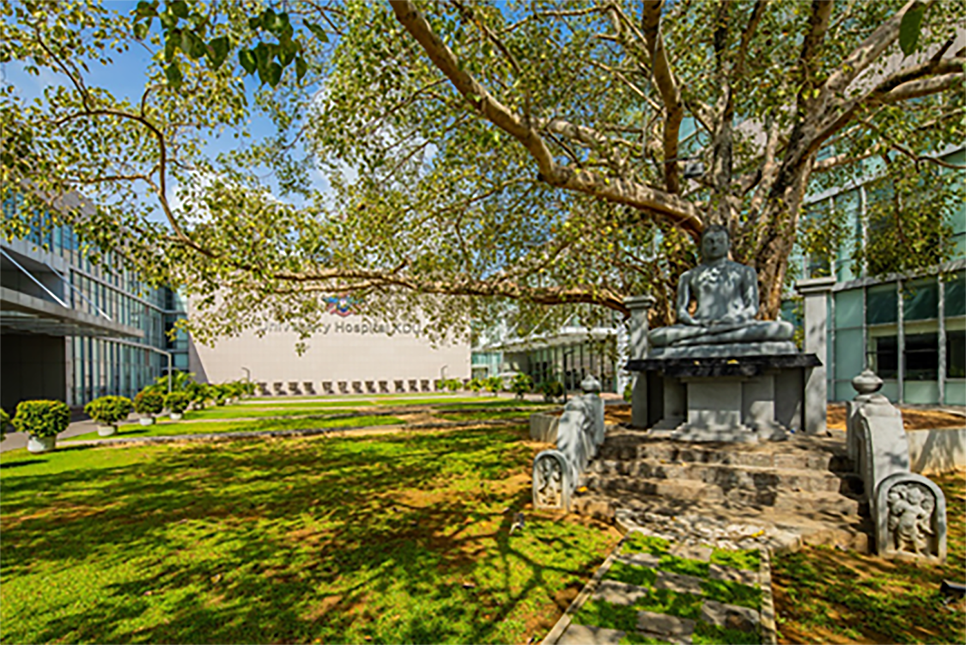
斯里兰卡是佛教国家,菩提树因佛祖释迦牟尼曾在此树下悟道成佛而被称为“圣树”“神树”,在佛教文化中具有崇高的地位。院区现状中央有一颗枝叶茂盛的菩提树,下有一尊年久的佛像。如何将这“一花一世界,一叶一菩提”的精神文脉以及兰卡的地域文化,成功运用到医院的设计中,成为本项目成败的关键之一。
Master Plan
One flower, one world, one leaf, one bodhi
Sri Lanka is a Buddhist country, and the Bodhi tree is known as the "sacred tree" or "divine tree" due to the Buddha Shakyamuni's enlightenment and enlightenment under this tree. It holds a high position in Buddhist culture. There is a lush Bodhi tree in the center of the courtyard, with an old Buddha statue under it. How to successfully apply the spiritual context of "one flower, one world, one leaf, one bodhi" and the regional culture of Lanka to the design of the hospital has become one of the key factors for the success or failure of this project.
▼菩提树近景 | Close up of Bodhi Tree
以“佛”为心,空间围合
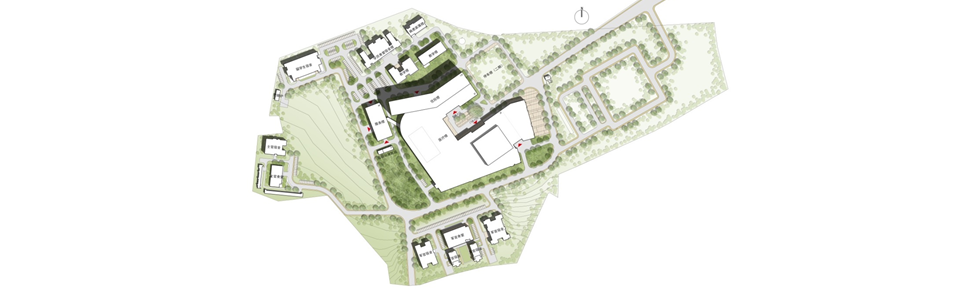
医院是院区内体量最大的单体建筑,它的布局形式是院区规划的重中之重。概念方案设计中,我们决定将医院布置在院区主入口一侧,摈弃了中国在医疗建筑中常用的鱼骨式布局,而采用U字型布局,这样菩提树就可以被围合在U型庭院的中心,并朝主入口方向开口,给患者形成怀抱的欢迎之感,将建筑主要出入口设在庭院内,使得庭院成为患者人流的集散场所。院区内其他建筑围绕在医院的周边。为解决随就诊人群日益增长的停车问题,在院区主入口附近规划有停车楼,拟二期建设。医疗主楼的周围设置环形道路满足使用和消防扑救的需要。
Centered around the Buddha, enclosed in space
The hospital is the largest single building within the campus, and its layout is of paramount importance in the campus planning. In the conceptual design, we decided to place the hospital on the side of the main entrance of the campus, abandoning the fishbone layout commonly used in medical buildings in China and adopting a U-shaped layout. This way, the Bodhi tree can be enclosed in the center of the U-shaped courtyard and open towards the main entrance, creating a welcoming feeling for patients. The main entrance and exit of the building will be located in the courtyard, making it a gathering place for patient flow. Other buildings within the hospital area are surrounding the hospital. To address the growing parking problem among patients seeking medical treatment, a parking building is planned near the main entrance of the hospital area and is planned to be constructed in the second phase. A circular road is set up around the main medical building to meet the needs of use and firefighting.
▼图6 院区总体布局图 | Figure 6 Overall layout of the campus
涅槃重生,体量鲜明
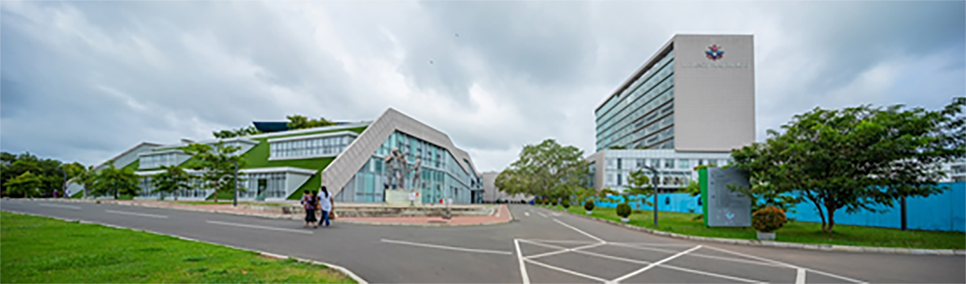
佛教里素有“凤凰涅槃,菩提明心”的说法,菩提树与医院建筑,从精神和物质的两个层面来讲,都是对人救赎和庇护的过程;菩提树和医院病房楼,相对巨大的体量,布置在院区主入口处,使医院在周围低矮的建筑群中鹤立鸡群,突出了医院的可识别性。同时,将外来人流组织在院区主入口一侧,与院区内部人流在主入口处分离,可以形成内外分流的组织形式,有效规避了患者流对院区内其他功能的干扰。
Nirvana and rebirth, with distinct volume
In Buddhism, there is a saying that goes' Phoenix Nirvana, Bodhi Enlightenment '. Bodhi trees and hospital buildings are both processes of redemption and protection for people from both spiritual and material perspectives; The Bodhi tree and hospital ward building, with their relatively large volume, are arranged at the main entrance of the hospital area, making the hospital stand out among the surrounding low rise buildings and highlighting its recognizability. At the same time, by organizing the external flow of people on one side of the main entrance of the hospital area and separating it from the internal flow of people at the main entrance, an internal and external diversion organizational form can be formed, effectively avoiding the interference of patient flow on other functions within the hospital area.
▼图7 主入口实景 | Figure 7: Realistic View of the Main Entrance
体量布局
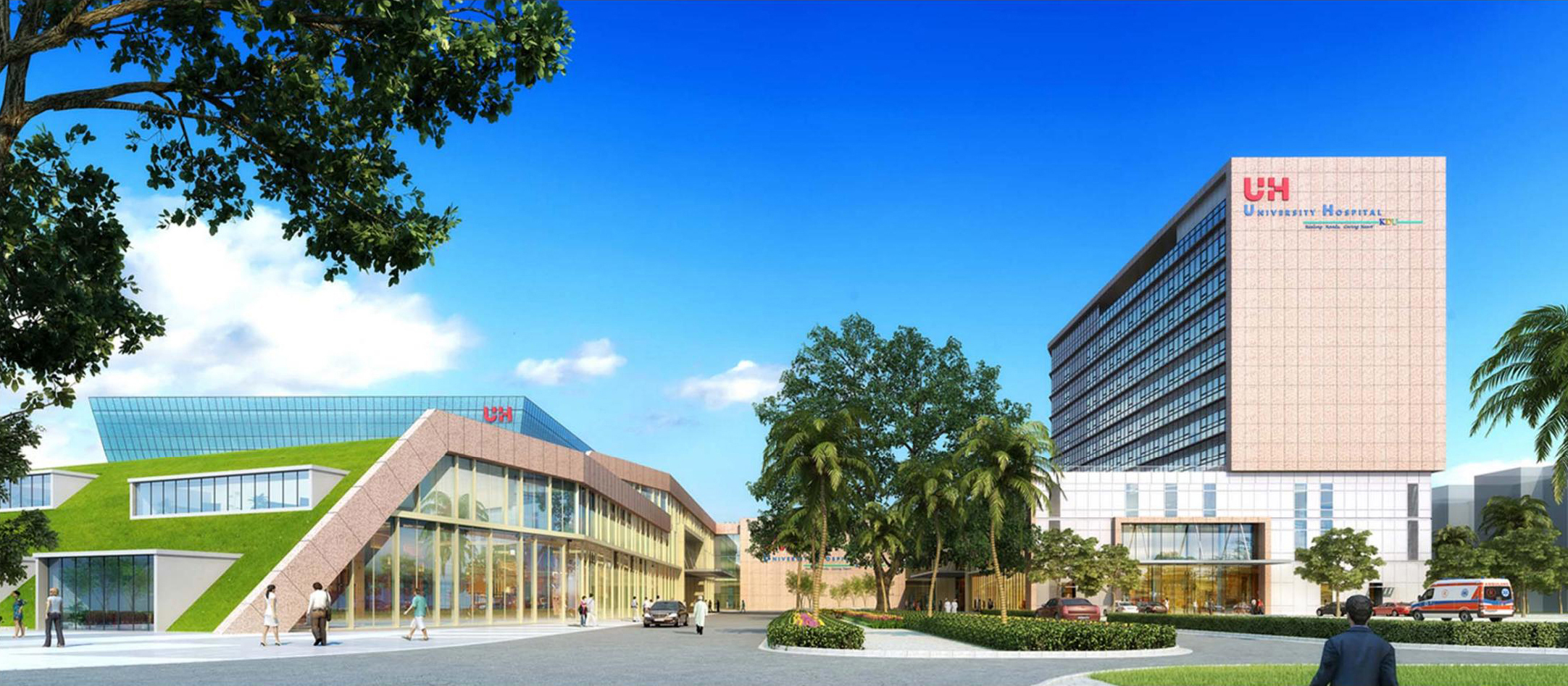
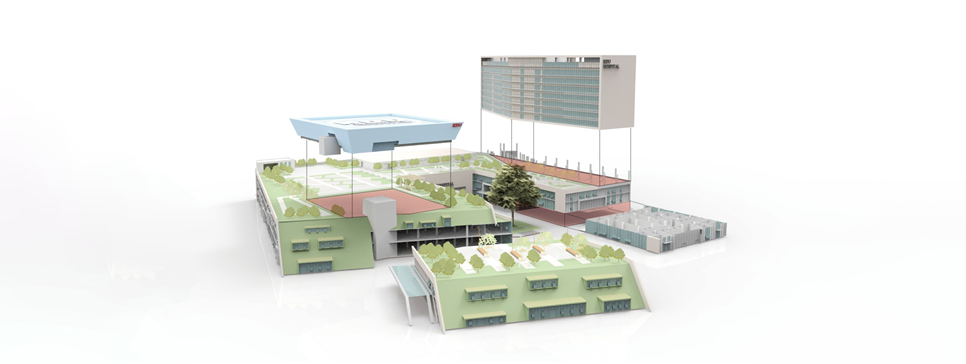
医院建筑涵盖了全部与医疗功能相关的部门、行政、商业设施及后勤辅助部门,功能及流线极其复杂。我们把三层高的U形裙房作为建筑的基座,将高层病房楼和会议中心两个较为大型的体量以庭院为中心置于裙房屋顶的左右两侧。病房楼高十层,为折线形长方体量,会议中心为单层倒置梯台形,二者虽体量差别巨大,但是外观协调统一,相得益彰。
Volume layout
The hospital building covers all departments, administrative, commercial facilities, and logistical support departments related to medical functions, with extremely complex functions and flow lines. We use a three story U-shaped podium as the foundation of the building, and place the two larger volumes of the high-rise ward building and conference center on the left and right sides of the podium roof with the courtyard as the center. The ward building is ten stories high and has a rectangular volume in the shape of a broken line. The conference center is a single story inverted staircase. Although there is a huge difference in volume between the two, their appearance is coordinated and unified, complementing each other.
▼医院体量分析图 | Hospital Volume Analysis Diagram
功能布置
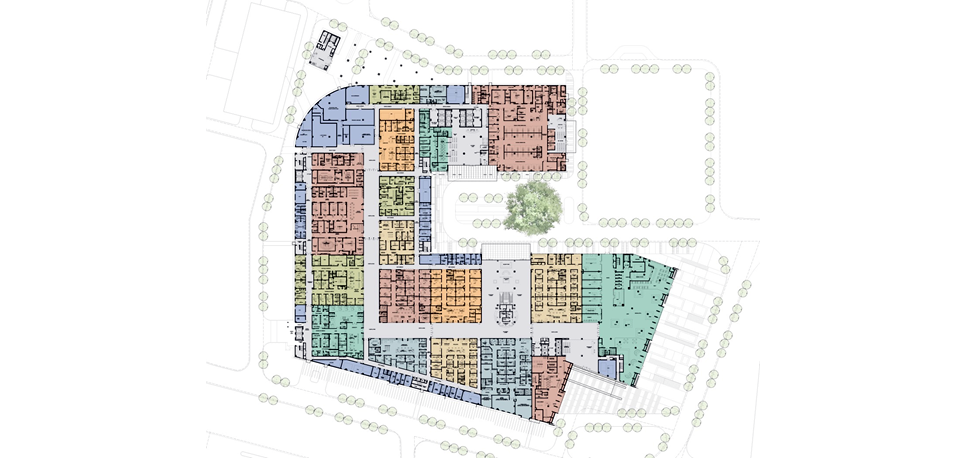
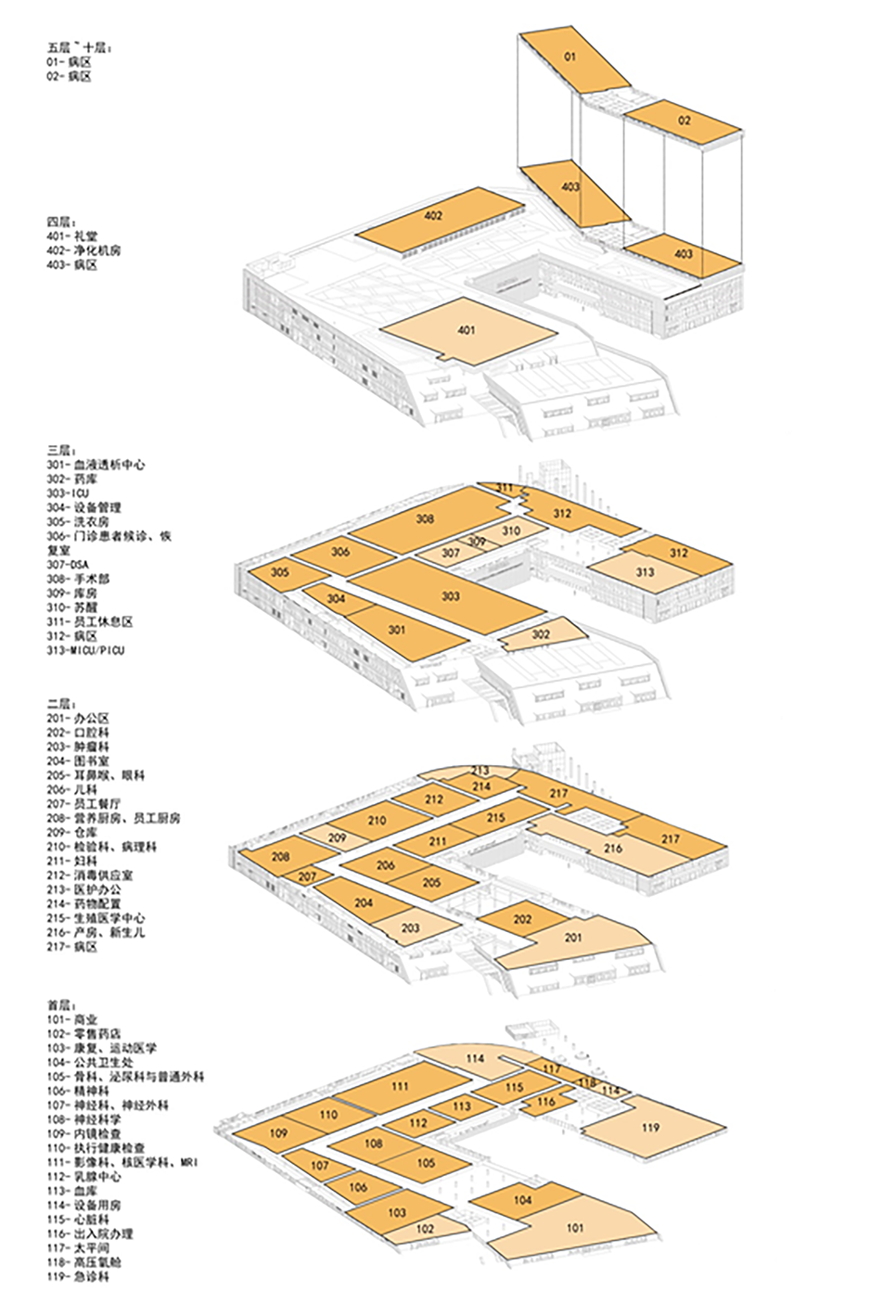
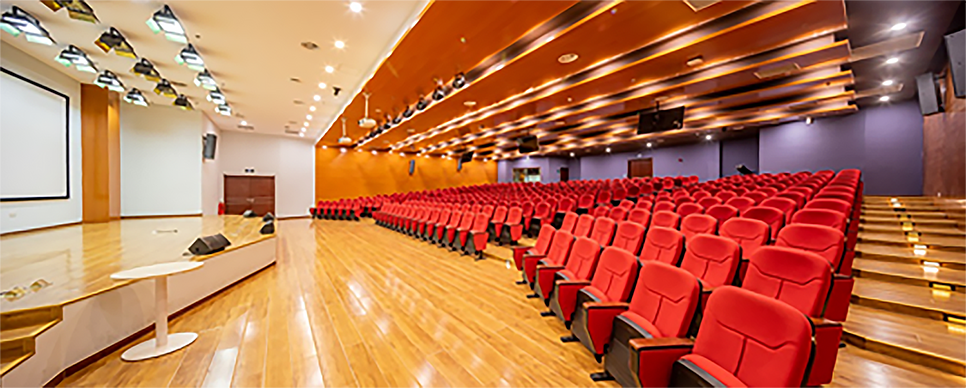
如前所述,由于采用了以人身体部位和疾病导向为基准的分科方式和“诊所式”的一站式服务诊疗模式,从而在一定程度上削弱了门诊科室与医技部门之间的联系。在此基础上,首层和二层主要布置与门急诊患者相关的各临床中心;三层主要布置手术中心、介入中心与重症中心等功能;会议中心设在南侧裙房之上,包含一座可容纳400人的报告厅以及若干可容纳40~80人的会议室和教学用房;北侧裙房之上四至十层每层设置两个病区,其中四至八层每层两个普通病区,九至十层为高级病区。
Functional Layout
As mentioned earlier, the use of a specialized approach based on human body parts and disease orientation, as well as a "clinic style" one-stop service diagnosis and treatment model, has to some extent weakened the connection between outpatient departments and medical technology departments. On this basis, the first and second floors mainly arrange various clinical centers related to door emergency patients; The third floor mainly houses functions such as surgical center, intervention center, and intensive care center; The conference center is located above the south podium and includes a lecture hall that can accommodate 400 people, as well as several conference rooms and teaching facilities that can accommodate 40-80 people; Two wards are set up on each of the four to ten floors above the north podium, with two ordinary wards on each of the four to eight floors and two advanced wards on each of the nine to ten floors.
▼首层平面图 | Ground Floor Plan
▼功能布局图 | Functional layout diagram
内部交通组织
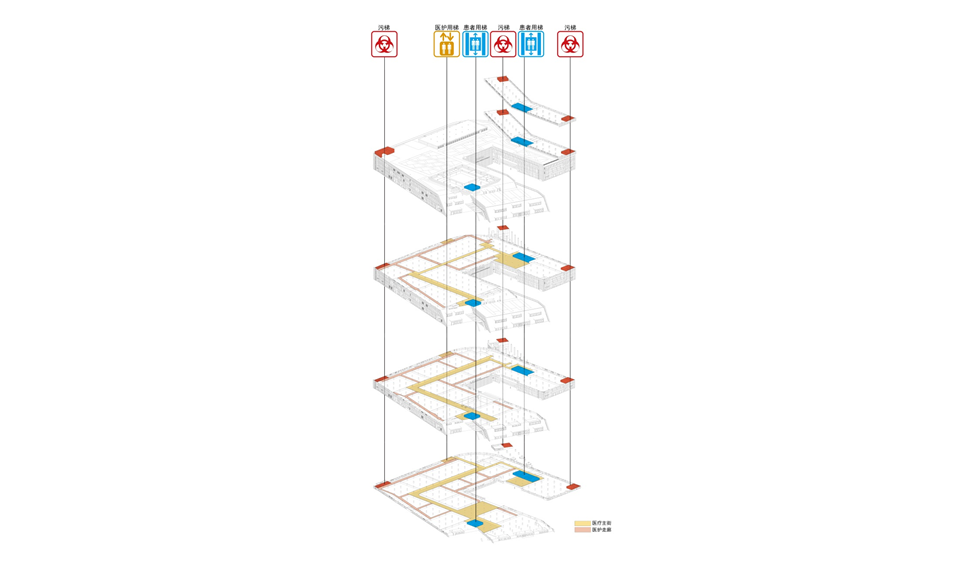
建筑内部交通围绕患患分流、医患分流、洁污分流组织。
Internal traffic organization
The internal traffic of the building is organized around patient separation, doctor-patient separation, and clean and dirty separation.
●患患分流:区分门诊患者、住院患者和急诊患者。
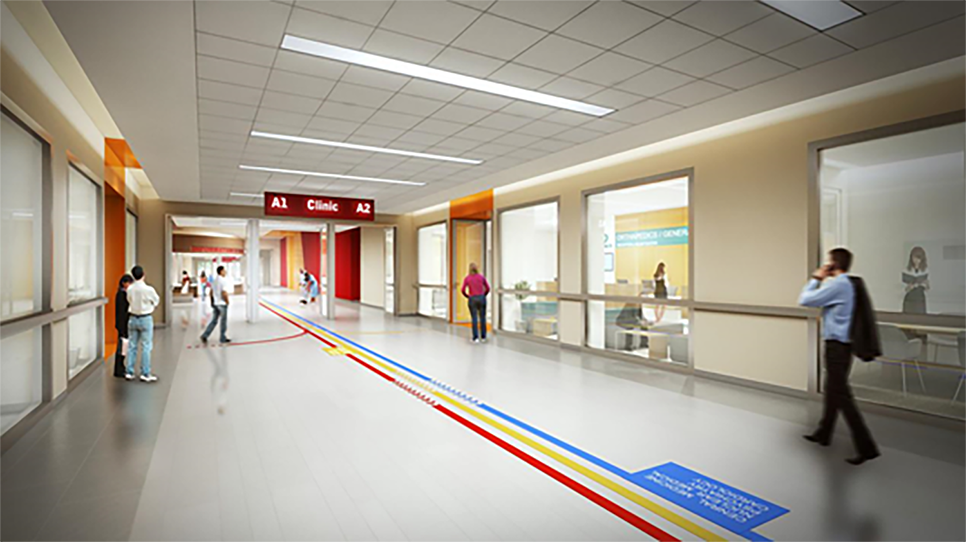
门诊患者流线:门诊大厅位于菩提树南侧,是门诊患者进入建筑的第一站,与设在裙房中间位置的8米宽的“L”形医疗主街直接相连,作为患者水平交通通道;大厅内设有自动扶梯和开敞楼梯连接首层和二层,并就近设置垂直电梯。
●Patient triage: Distinguish between outpatient patients, inpatient patients, and emergency patients.
Outpatient flow line: The outpatient hall is located on the south side of the Bodhi tree and is the first stop for outpatient patients to enter the building. It is directly connected to the 8-meter-wide "L" - shaped medical main street located in the middle of the podium, serving as a horizontal transportation channel for patients; There are escalators and open stairs connecting the first and second floors in the lobby, and a vertical elevator is installed nearby.
▼医疗主街 | Medical Main Street
住院患者流线:住院大厅位于菩提树北侧,与住院部电梯厅直接相连。
急诊患者流线:急诊大厅位于住院部下部东侧,直接对外,与住院部大厅相邻,方便患者转运。
Inpatient flow line: The inpatient hall is located on the north side of the Bodhi tree and is directly connected to the elevator hall of the inpatient department.
Emergency patient flow line: The emergency hall is located on the east side of the lower part of the inpatient department, directly facing the outside and adjacent to the inpatient department hall, making it convenient for patient transportation.
●医患分流:为了避免与患者流线交叉,减少彼此间的干扰,在裙房外环和内环各设有2.5米宽的内部走廊,该走廊与医疗主街之间布置与患者有关的功能房间,此走廊与外墙之间布置医护、教学和机电设备机房。此走廊作用之一是作为员工内部通道,实现医患分流,之二是作为物品运输通道,可使物品方便地送达各科室,做到人物分流。在裙房U形的端部,分别设有两组电梯,作为员工和物品运输使用。
●洁污分流:为了避免交叉感染情况的发生,建筑内严格区分洁污流线。首先是竖向分梯,裙房和病房楼分别设有专用污梯;其次是在手术部、ICU、生殖中心、消毒供应室等部门严格按照洁污分流进行科室内部流程设计,设有污物专用通道,污物在科室内部打包处理后用专用污车通过污梯运至院区内指定地点进行焚烧处理。
●Doctor patient diversion: In order to avoid crossing patient flow lines and reduce interference with each other, internal corridors with a width of 2.5 meters are set up on the outer and inner rings of the podium. Functional rooms related to patients are arranged between this corridor and the main medical street, and medical, teaching, and mechanical and electrical equipment rooms are arranged between this corridor and the outer wall. One of the functions of this corridor is to serve as an internal channel for employees, achieving the separation of doctors and patients. The other is to serve as a transportation channel for goods, making it convenient to deliver items to various departments and achieving the separation of people. At the U-shaped end of the podium, there are two sets of elevators used for transporting employees and items.
●Separation of clean and dirty water: In order to avoid cross infection, clean and dirty water flow lines are strictly distinguished within the building. Firstly, there are vertical staircases, with dedicated sewage staircases in the podium and ward buildings respectively; Secondly, in the surgical department ICU、 The reproductive center, disinfection supply room, and other departments strictly follow the separation of clean and dirty materials in their internal process design. They have dedicated channels for waste disposal, and waste is packaged and processed within the department before being transported by dedicated waste trucks to designated locations within the hospital area for incineration.
▼交通组织图 | Traffic Organization Chart
立面设计
在建筑外观设计方面,首先需要强调标志性和地域性的表达,其次是要体现实用性和与内部功能的协调一致,并且还要考虑对自然环境的适应程度。为了达到以上目的,在保证建筑立面外观整体性统一协调的原则下,我们分段而治,对会议中心、高层病房楼和裙房进行了深入的考量和探索。
“蓝宝石”——造型独特的会议中心
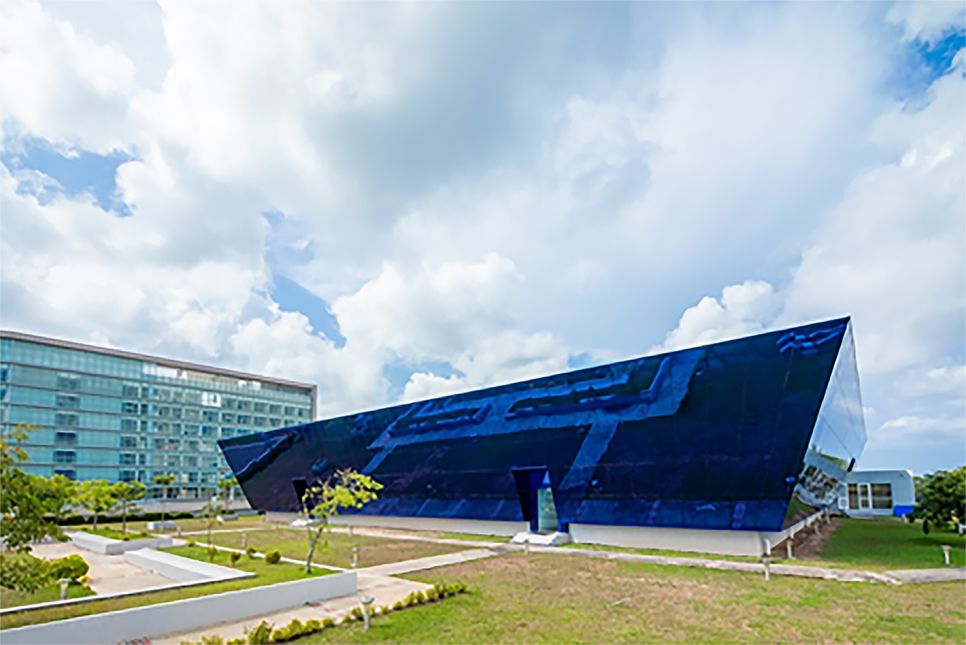
会议中心是本方案的重点造型元素,设计灵感源自斯里兰卡的国宝——蓝宝石,斯里兰卡在梵文中意为“宝石之国”,盛产种类繁多的宝石,其中以蓝宝石最为珍贵。为了使建筑具有明确的地域属性,会议中心采用倒置梯台形,外墙采用深蓝色全隐框镀膜玻璃幕墙,墙面外倾,白天宛若一颗巨大的“星光蓝宝石”,夜晚灯火辉煌,与繁星争辉。蓝宝石有“命运之石”美誉,能护佑佩戴者健康平安,我们的医院亦是患者健康的护佑者,宛若人们心中的那颗蓝宝石。
facade design
In terms of architectural exterior design, it is first necessary to emphasize the expression of symbolism and regionalism, followed by reflecting practicality and coordination with internal functions, and also considering the degree of adaptation to the natural environment. In order to achieve the above objectives, while ensuring the overall unity and coordination of the building facade appearance, we have segmented the treatment and conducted in-depth consideration and exploration of the conference center, high-rise ward building, and podium.
Sapphire - a uniquely shaped conference center
Sapphire "- The conference center, with its unique design, is the key element of this plan. The design inspiration comes from Sri Lanka's national treasure - sapphire, which means" country of gems "in Sanskrit. Sri Lanka produces a wide variety of gemstones, among which sapphire is the most precious. In order to give the building a clear regional identity, the conference center adopts an inverted staircase shape, and the exterior walls are made of dark blue fully hidden frame coated glass curtain walls. The walls are outward sloping, resembling a huge "star sapphire" during the day and shining brightly at night, competing with the stars. Sapphire is known as the "stone of destiny" and can protect the health and safety of wearers. Our hospital is also a protector of patients' health, just like the sapphire in people's hearts.
▼“蓝宝石”会议中心实景 | Realistic view of the Sapphire Conference Center
虚实对比的幕墙——病房楼视觉体验
相对蓝宝石的奇特造型,我们在高层病房的处理上运用的建筑语言相对简朴。因为场地周边的建筑体量均以低矮民居为主,所以病房楼的体量自然而然会被凸显出来,但随之而来的难点是如何形成视觉重心和感官体验?
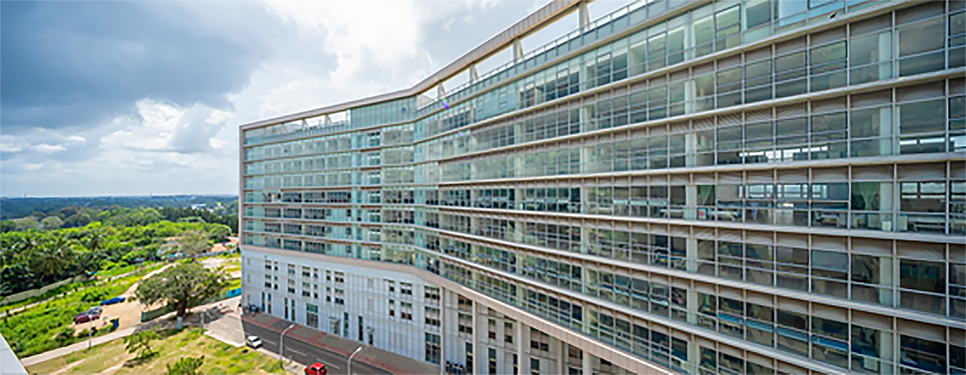
我们首先将两个护理单元做了一个转角变化,让体量变得更加舒展生动;同时在南北两侧立面处理上,通过非空调的病房外窗采用玻璃与百叶结合的方式,增加室内的通风和换气,同时让病房楼的朝向和采光都处于建筑群落中最适宜的位置。
其次,为了更加突出医院的标志性,我们在病房山墙部分采用了大面积的红麻全石材幕墙,由于山墙面和城市道路的视觉关系,自然而然地让医院具有了非常明确的场所特征。
Virtual and Real Contrast Curtain Wall - Visual Experience of Ward Building
Compared to the unique shape of sapphire, the architectural language we use in the treatment of high-rise wards is relatively simple. Because the surrounding buildings are mainly composed of low rise residential buildings, the volume of the ward building will naturally be highlighted. However, the difficulty that comes with it is how to form a visual center and sensory experience?
We first made a corner change between the two nursing units to make the volume more relaxed and vivid; At the same time, in the treatment of the facades on both the north and south sides, non air conditioned ward windows are combined with glass and louvers to increase indoor ventilation and air exchange, while keeping the orientation and lighting of the ward building in the most suitable position in the building community.
Secondly, in order to highlight the hospital's iconic features, we have adopted a large area of red hemp all stone curtain wall in the ward's gable section. Due to the visual relationship between the gable and the city road, the hospital naturally has a very clear place characteristic.
▼病房北侧外观实景 | Realistic appearance of the north side of the ward
纽带——裙房的亲和力
裙房是连接病房楼和会议中心的纽带,整体性、标准化和与功能的协调一致,是我们重点思考的内容。
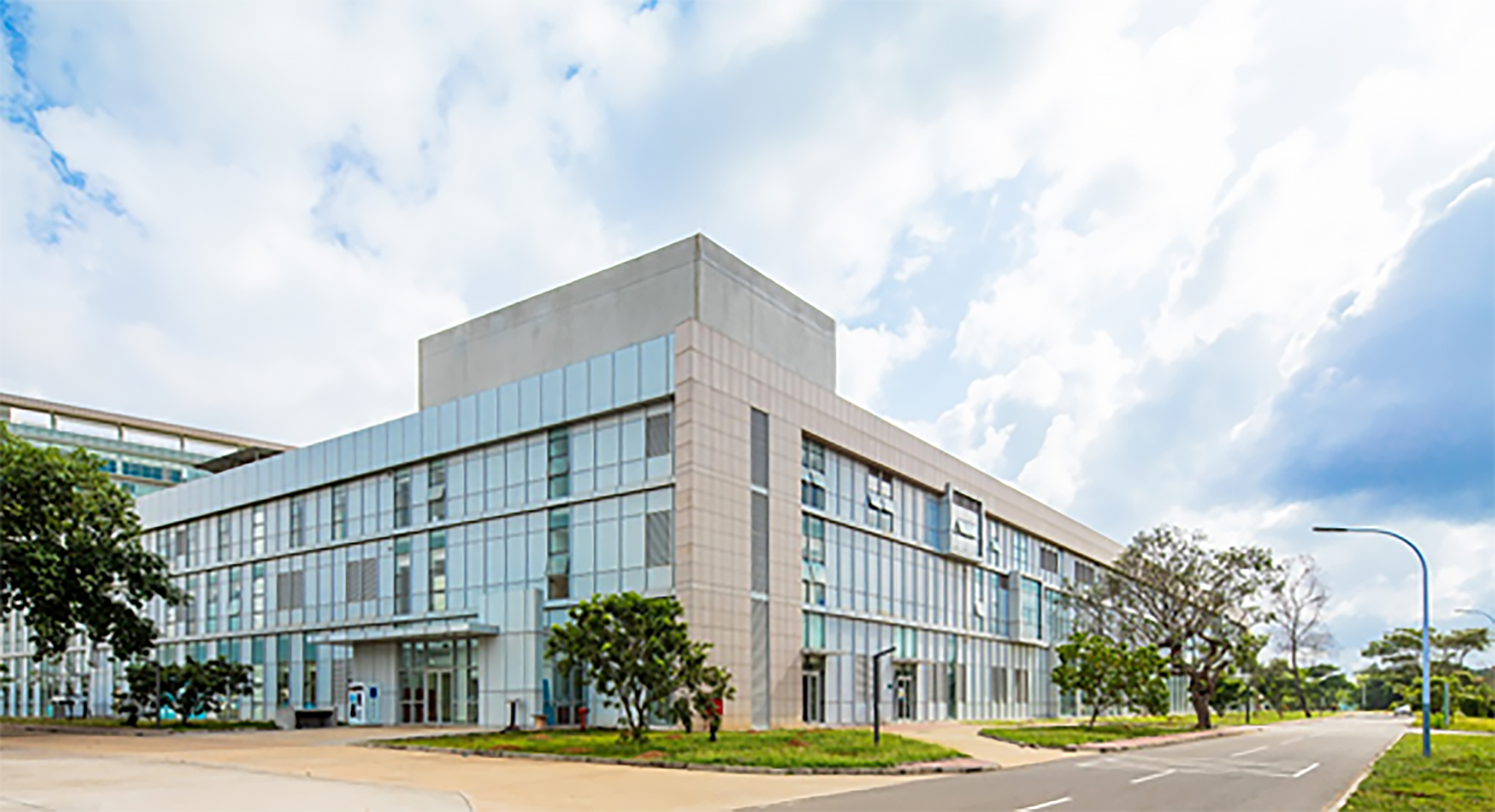
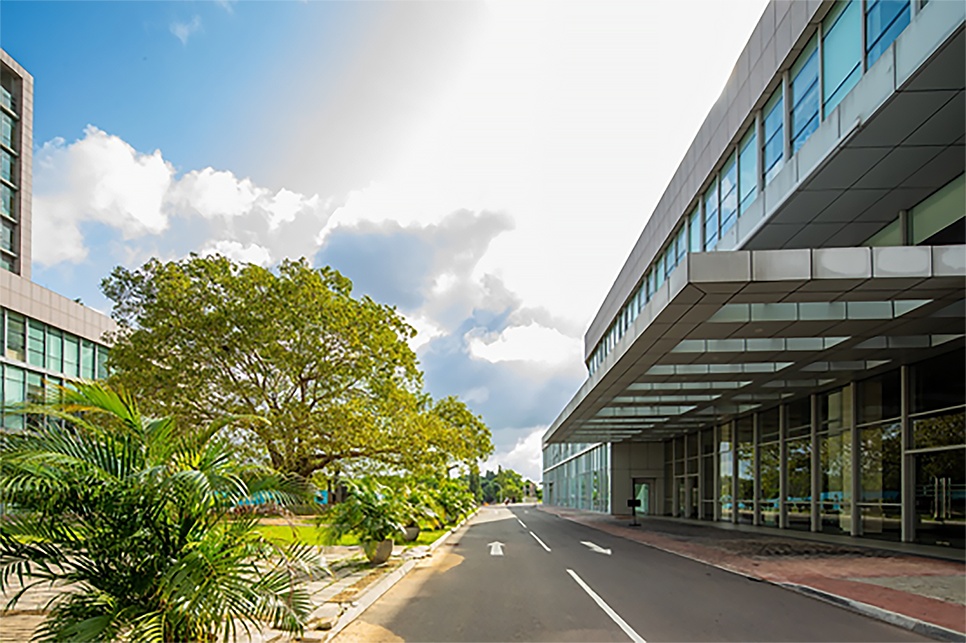
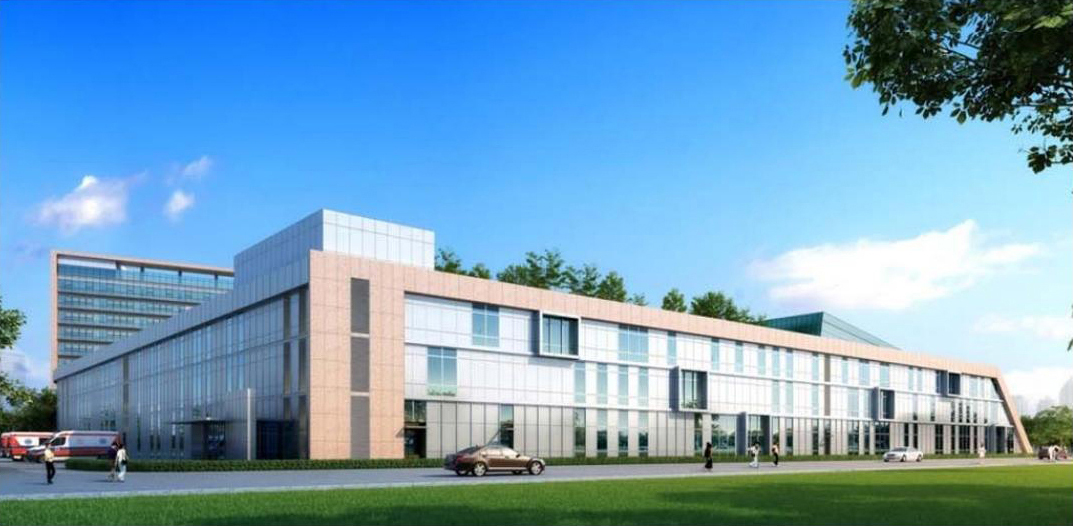
裙房外围采用标准化铝合金幕墙系统,横向间距1350mm的铝合金竖框构成外墙的主要肌理,竖框每层通高,竖框之间根据房间功能灵活选择安装铝板、玻璃或通风百叶,从而使裙房外观既有灵活的韵律感,又保持了整体统一。U型内庭院的周边室内空间,是患者主要聚集场所,采用开放,透明的玻璃幕墙系统,既能具有良好的采光,同时增进了和内庭院的空间视觉交流,增加了建筑的亲和力。
Bonds - Affinity of Skirts
The podium is the link between the ward building and the conference center, and its overall integrity, standardization, and coordination with functionality are the key considerations we focus on.
The outer perimeter of the podium adopts a standardized aluminum alloy curtain wall system, with aluminum alloy vertical frames spaced 1350mm apart horizontally to form the main texture of the exterior wall. The vertical frames are high on each floor, and aluminum panels, glass, or ventilation louvers can be flexibly installed between them according to the room's function, thus making the appearance of the podium both flexible and rhythmic, while maintaining overall unity. The surrounding indoor space of the U-shaped inner courtyard is the main gathering place for patients. It adopts an open and transparent glass curtain wall system, which not only provides good lighting, but also enhances visual communication with the inner courtyard and increases the affinity of the building.
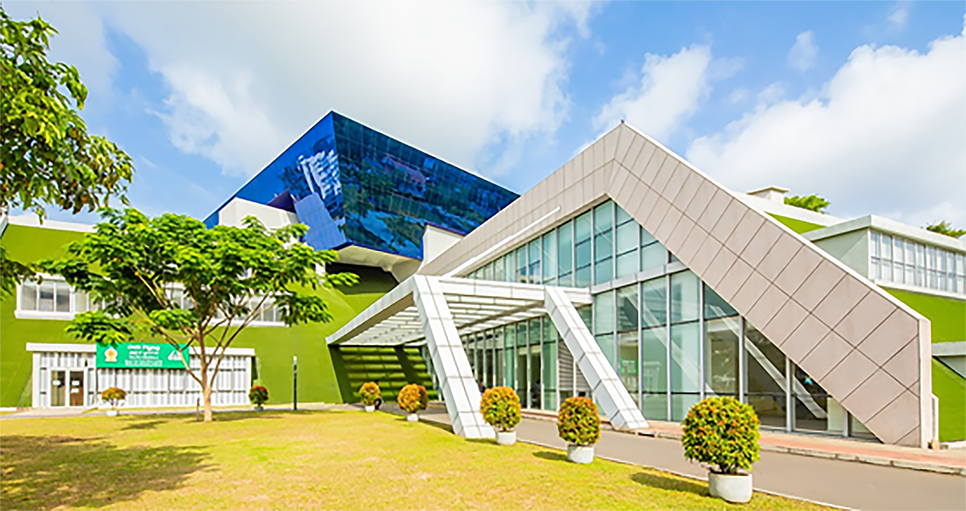
▼裙房外观实景 | Realistic appearance of the skirt house
▼庭院实景 | Courtyard Scene
菩提树左侧裙房端部采用了一个45º度斜坡设计,地面绿化沿斜坡与屋顶绿化自然连接,弱化了建筑入口在空间层次上的压迫感,斜坡上零星散落老虎窗,既有效提高了室内的采光功能,同时增加了建筑的趣味性。
The left side podium of the Bodhi tree adopts a 45 degree slope design, and the ground greening is naturally connected to the roof greening along the slope, weakening the sense of oppression at the spatial level of the building entrance. The scattered tiger windows on the slope not only effectively improve the indoor lighting function, but also increase the fun of the building.
▼裙房局部实景,Partial Scene of Skirt House
室内设计
老子在《道德经》里曾经说过,“埏埴以为器,当其无,有器之用;凿户牖以为室,当其无,有室之用”,讲的就是一种最朴素的空间关系和空间对人的感受。用建筑师的话说,空间没有一处是无用的或者不需要重视而可以敷衍了事的地方。
医院的室内设计的目的,通常是为了给患者营造有利于康复、温暖明亮的疗愈环境。但是在预算有限的制约条件下,如何用常规的材料营造出色的品质也是我们在本项目中的一次成功尝试。室内设计师在设计选材和色彩上,采用了大量鲜亮明快的色彩,而非用单一的饰面材料使空间具有温馨感,让医院室内具有标识性的同时,也充满了兰卡这个国家文化的温情。
interior design
Laozi once said in the "Tao Te Ching", "Use the clay as a vessel, when it is nothing, for the purpose of having a vessel; use the chiseled door as a chamber, when it is nothing, for the purpose of having a chamber." This is the simplest spatial relationship and spatial perception of human beings. In the words of architects, there is no place in space that is useless or can be neglected without proper attention.
The purpose of hospital interior design is usually to create a healing environment that is conducive to rehabilitation, warm and bright for patients. However, under the constraint of limited budget, how to create excellent quality with conventional materials was also a successful attempt for us in this project. Interior designers have used a large number of bright and lively colors in their design materials and colors, instead of using a single decorative material, to give the space a warm feeling. This not only gives the hospital interior a sense of identity, but also fills it with the warmth of the culture of Lanka.
▼门诊大厅,Outpatient Hall
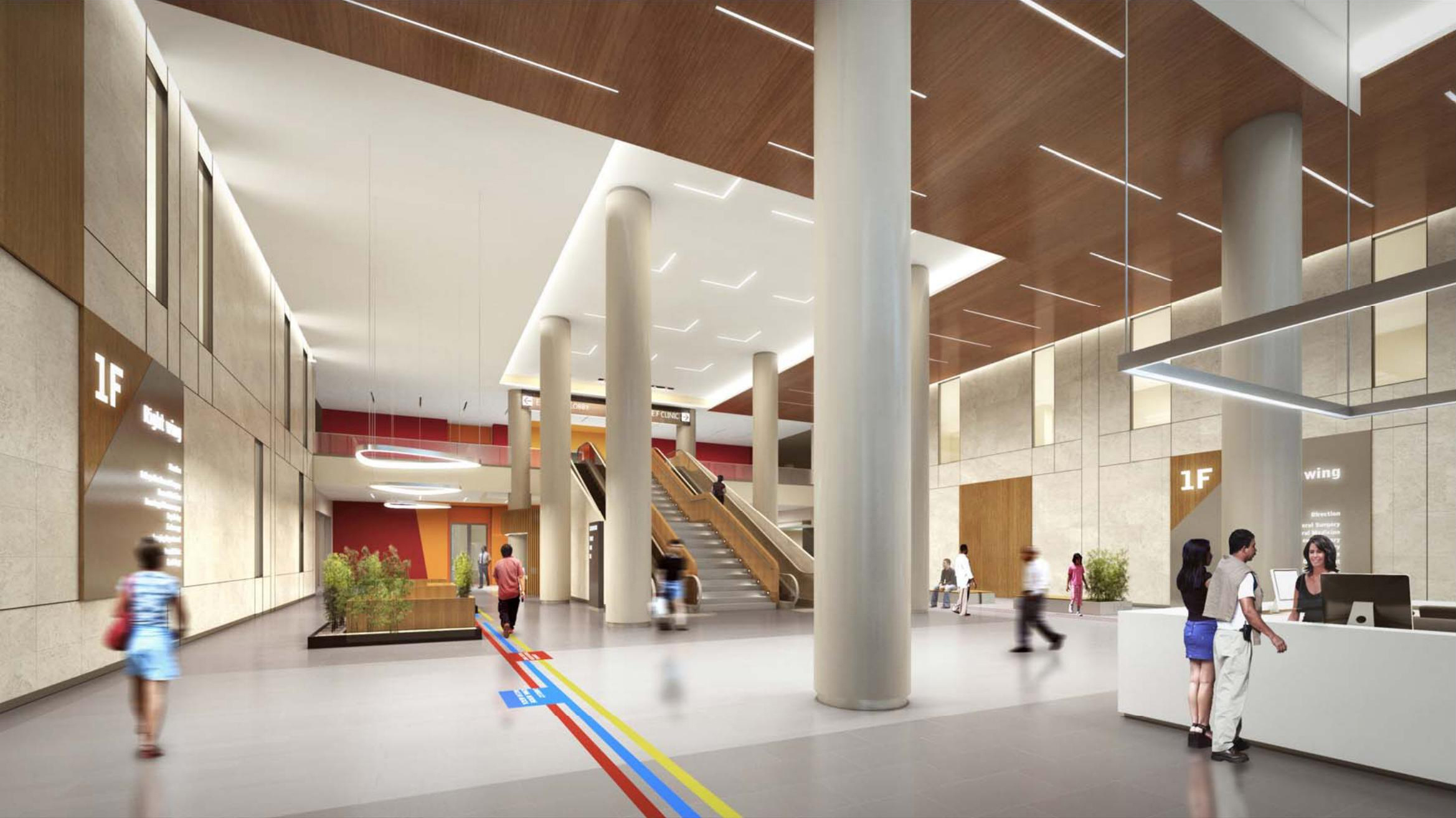
以门诊大厅为例,该空间是一个面积为700m²、高8米、宽23米的双层共享空间,中间设有自动扶梯和楼梯,设计师力求为患者营造一个舒适、安全的暖色调空间,两侧墙面选用大尺寸的米黄色陶瓷条板,顶棚选用木饰面防火板与白色乳胶漆结合,大厅正对面的墙体选用明亮的红色作为视觉重心,为了在温暖的空间中增加沉静的元素,地面选用浅灰和深灰色搭配的冷色调陶瓷地板砖,再辅以造型别致的吊灯、与绿化巧妙结合的休息座椅、色彩突出的标识,共同构成一个温馨的大厅空间环境。
其他内部空间,则根据房间使用功能的差异,在尊重使用者心理和行为习惯的基础上,保持材质和色彩的变化,增加了建筑内部空间的多样性。
Taking the outpatient hall as an example, the space is a double layered shared space with an area of 700m ², a height of 8 meters, and a width of 23 meters. There are escalators and stairs in the middle, and the designer strives to create a comfortable and safe warm toned space for patients. The walls on both sides are made of large-sized beige ceramic strips, the ceiling is made of wood veneer fireproof board combined with white latex paint, and the wall directly opposite the hall is made of bright red as the visual center. In order to add a calm element to the warm space, the floor is made of cool toned ceramic floor tiles in light gray and dark gray, supplemented by uniquely shaped chandeliers, rest seats cleverly combined with greenery, and prominent color signs, together forming a warm hall space environment.
Other internal spaces, based on the differences in room usage functions, while respecting the psychological and behavioral habits of users, maintain changes in materials and colors to increase the diversity of the building's internal space.
▼报告厅,lecture hall
▼候诊厅,Waiting Room
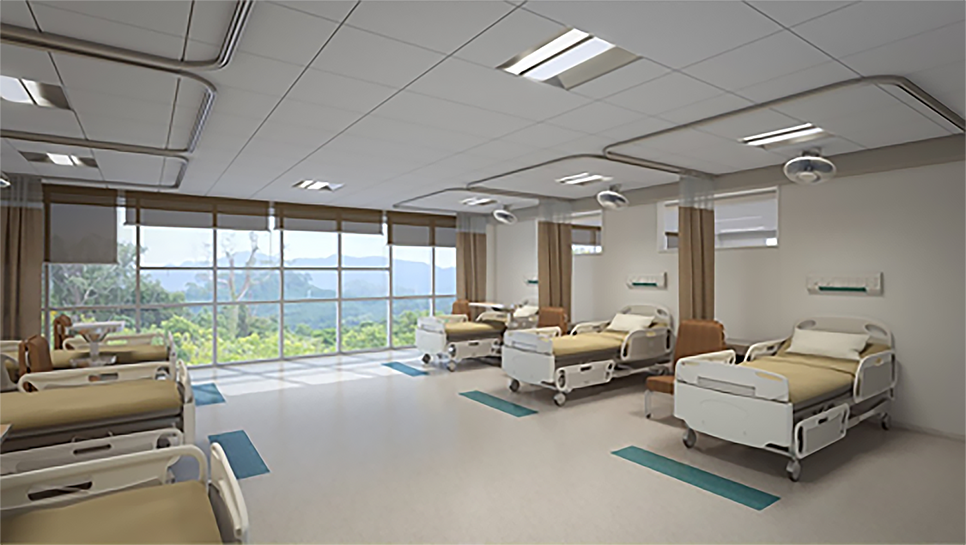
▼普通病房,General ward
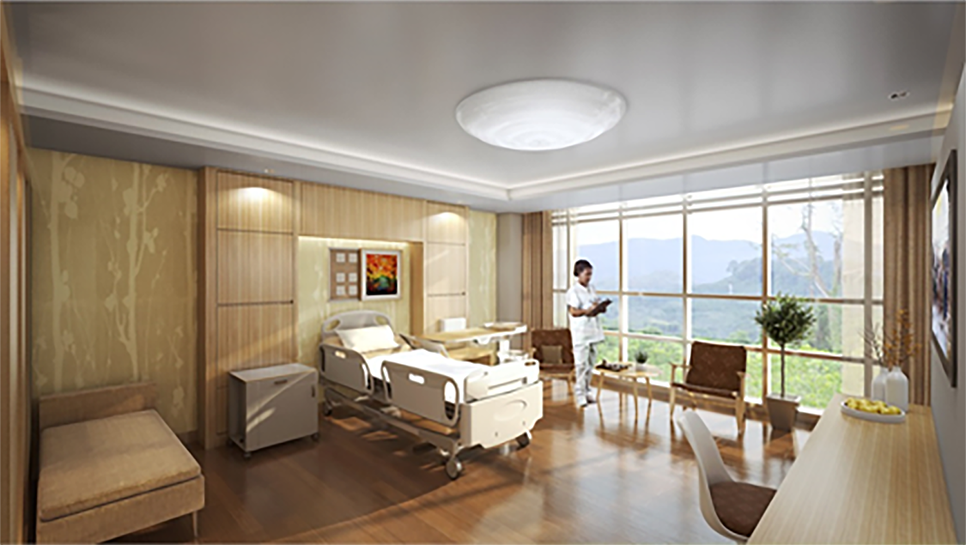
▼VIP病房,VIP Ward
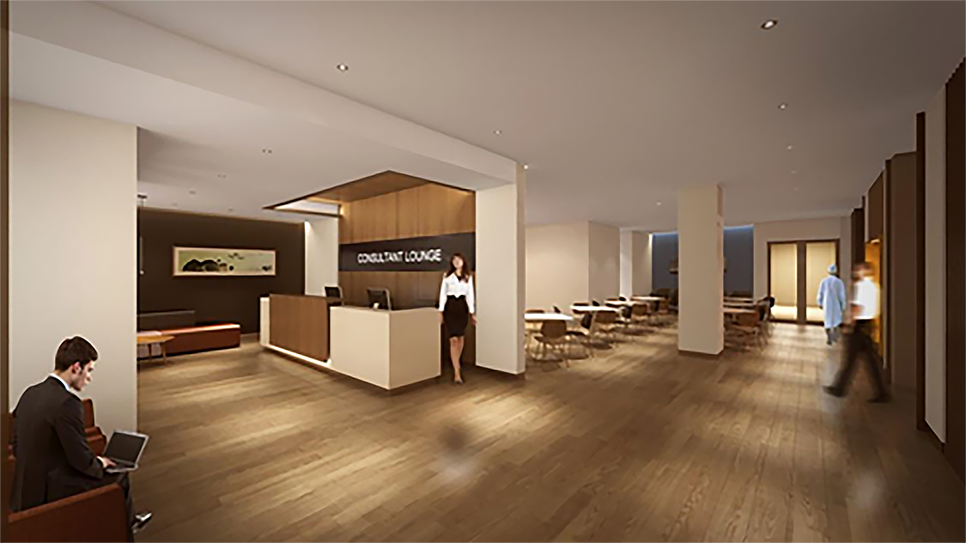
▼高级医生休息区,Senior Doctor Rest Area
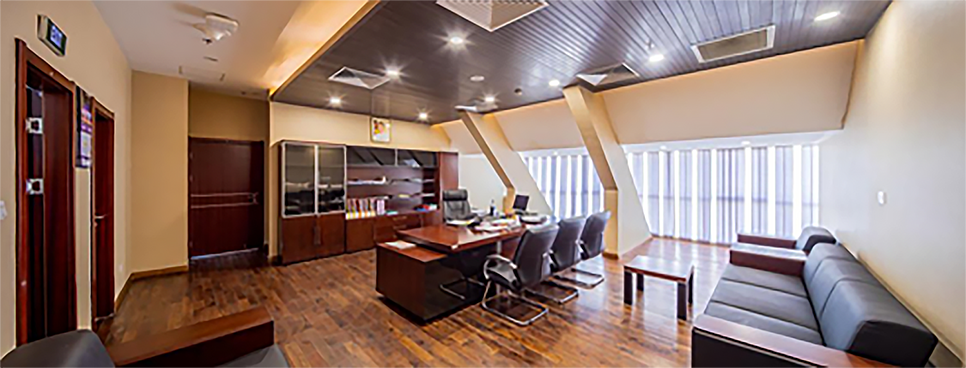
▼院长办公室,Dean's Office
基于精益设计的成本控制
成本控制是建设项目的基本要求,但由于各方面原因,目前几乎成了医院建设不可能完成的任务。本项目历经四年的建设,成功做到了良好的成本控制,赢利甚至超过建设方预期,当然这是所有参建方共同努力的结果,而博远医疗设计团队作为其中重要的一环,也发挥了非常重要的作用。下面我仅从设计方面阐述设计对成本控制的因素。
博远医疗设计团队效仿日本丰田“精益生产”的成功管理理念,在长期的医疗设计和实践过程中,形成了属于自己的一套设计管理体系——“精益设计”。
精益设计首先是充分的前期方案论证。设计方与医院使用方进行了全面细致的沟通,一是对一、二级医疗流程经过反复论证加以确定,二是对全楼除机电设备用房外的所有房间的工艺、家具、医疗设备等进行确认,并对每个房间的用电、用水、用气、网络等情况逐一确认,作为施工图设计的输入条件。其次是博远医疗设计团队按照精益设计的服务管理体系,为本项目提供了全方位的设计总包服务。图纸由当地设计公司CECB作为咨询方进行审查,图纸的设计、绘制和出图标准乃至设计精度、深度和广度均按照英国设计标准执行,并始终保证在设计方的严格监督和管控之下。
虽然精益设计较传统设计工作量大且繁琐,事无巨细,但确实对成本控制起到了关键的促进作用。因前期方案与使用方细致入微的沟通,避免了建设过程中因功能修改造成二次拆改所增加的无谓投资;而精度高、深度细的图纸给施工方提供了准确的施工依据,再加上精准的设备选型和材料的把控,减少了不必要的浪费,也保证了项目的按时竣工。这些都在一定程度上对建设成本的控制起到了决定性的作用。
Cost Control Based on Lean Design
Cost control is a basic requirement for construction projects, but due to various reasons, it has almost become an impossible task for hospital construction. This project has undergone four years of construction and successfully achieved good cost control, with profits even exceeding the expectations of the construction party. Of course, this is the result of the joint efforts of all participating parties, and the design team of Boyuan Medical, as an important part of it, has also played a very important role. Below, I will only elaborate on the factors of cost control in design.
The design team of Boyuan Medical has imitated the successful management concept of Toyota's "lean production" in Japan, and has formed its own design management system - "lean design" - in the long-term process of medical design and practice.
Lean design is first and foremost a thorough preliminary plan demonstration. The design team and the hospital user have had comprehensive and detailed communication. Firstly, the first and second level medical processes have been repeatedly discussed and confirmed. Secondly, the technology, furniture, medical equipment, etc. of all rooms in the building except for the mechanical and electrical equipment room have been confirmed, and the electricity, water, gas, network, and other conditions of each room have been confirmed one by one as input conditions for the construction drawing design. Secondly, the design team of Boyuan Medical provided comprehensive design general contracting services for this project in accordance with the lean design service management system. The drawings are reviewed by the local design company CECB as a consultant, and the design, drawing, and output standards, as well as the design accuracy, depth, and breadth of the drawings, are all carried out in accordance with British design standards, always ensuring strict supervision and control by the design party.
Although lean design has a larger and more tedious workload compared to traditional design, with no details, it does play a crucial role in promoting cost control. Due to meticulous communication between the initial plan and the user, unnecessary investment caused by secondary demolition and modification due to functional modifications during the construction process was avoided; High precision and detailed drawings provide accurate construction basis for the construction party, coupled with precise equipment selection and material control, reducing unnecessary waste and ensuring timely completion of the project. All of these have played a decisive role in controlling construction costs to a certain extent.
结束语
本项目是我国推出一带一路政策以来,在南亚地区结出的一颗硕果,设计过程思路缜密严谨,实施过程条理清晰,自建成后,数次登上央视及地方电视台的新闻栏目,对我国医疗设计服务水平起到了非常良好的示范作用。另外,通过本项目的实施,也同时让我们的团队学习到了许多国际医院先进的设计理念,增加了我们的国际视野,提升了我们全方位的设计能力,让我们今后能够站在更高的平台上,为业主提供高质量的设计服务。
Conclusion
This project is a great achievement in South Asia since China launched the the Belt and Road policy. The design process is rigorous, and the implementation process is clear. Since its completion, it has appeared on CCTV and local TV news columns several times, playing a very good demonstration role in China's medical design service level. In addition, through the implementation of this project, our team has also learned many advanced design concepts from international hospitals, increased our international perspective, and enhanced our comprehensive design capabilities. This will enable us to stand on a higher platform in the future and provide high-quality design services to our clients.
“一花一世界,一叶一菩提”。愿中国设计力量的一花一叶,能够永远丰富和滋养兰卡这个拥有菩提思想的国度,和其以外更为宽广的世界。
One flower, one world, one leaf, one bodhi. May each flower and leaf of Chinese design power forever enrich and nourish Lanka, a country with Bodhi philosophy, and the wider world beyond it.
项目名称:斯里兰卡国防大学附属704床医院大型综合性医院建设EPC工程
项目类型:医疗EPC
所获奖项:北京市优秀工程勘察设计奖
项目地址:斯里兰卡西部省,毗邻首都科伦坡
设计公司:华诚博远工程技术集团有限公司
总用地面积:195亩
总建筑面积:12.3万m²
医院建筑面积:7.8万m²
项目功能:医院、教学、科研、宿舍、餐厅、停车等
建筑结构:钢筋混凝土框架剪力墙结构
建筑层高:十层
设计总床位:704张
项目总设计师:石启雷
项目经理:刘凯
Project Name: EPC Project for the Construction of a Large-scale Comprehensive Hospital Affiliated to the National Defense University of Sri Lanka with Beds 704
Project Type: Medical EPC
Awards received: Beijing Excellent Engineering Investigation and Design Award
Project Address: Western Province of Sri Lanka, adjacent to the capital Colombo
Design Company: Huacheng Boyuan Engineering Technology Group Co., LTD
Total land area: 195 mu
Total construction area: 123,000 square meters
The hospital's floor area is 78,000 square meters
Project functions: Hospital, teaching, research, dormitory, dining hall, parking, etc
Building structure: Reinforced concrete frame-shear wall structure
Building height: Ten floors
Total designed beds: 704
Project Chief Designer: Shi Qilei
Project Manager: Liu Kai