Janošík总部及陈列室,捷克 / Jakub Janošík
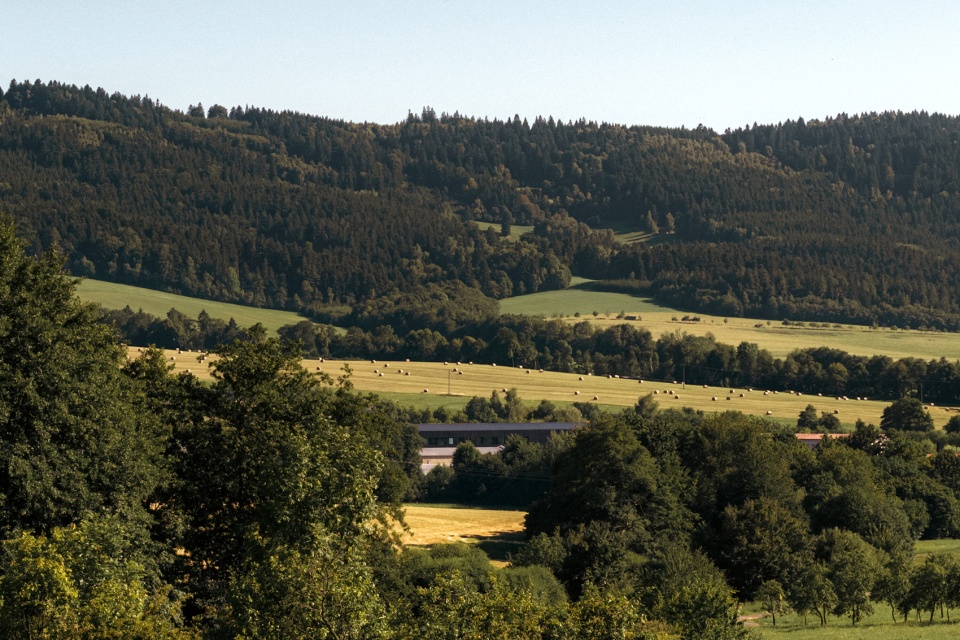
在白喀尔巴阡山脉的山脊下,森林与草地交汇之处,矗立着Janošík公司的新总部与展厅。这家公司专注于为当代建筑生产门窗。
Beneath the ridge of the White Carpathians, where forest turns into meadow, stands the new headquarters and showroom of Janošík, a company producing windows and doors for contemporary architecture.
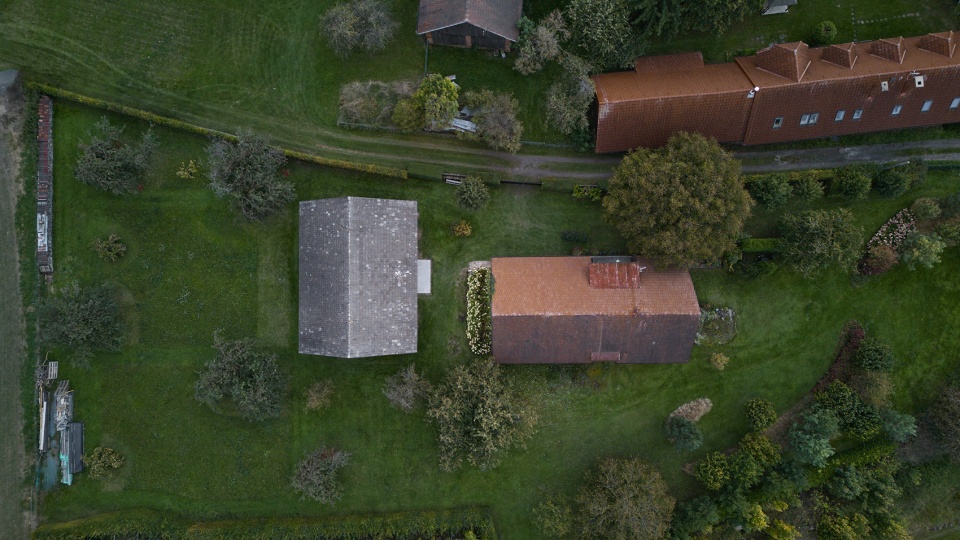
▼场地鸟瞰,aerial view of the site
这座建筑的灵感来自对优质门窗的思考——它们如何通过与周围景观的连接塑造空间与氛围。该建筑由一座建于20世纪50年代的合作社大厅改造而来,原本作为粮仓使用。曾经封闭的结构,如今被在象征与物理层面上双重打开。阻隔被转化为连接,串联起建筑、草地与远方的景致,从而揭示了“窗户”的本质。建筑被命名为 Spoj——“连接”。
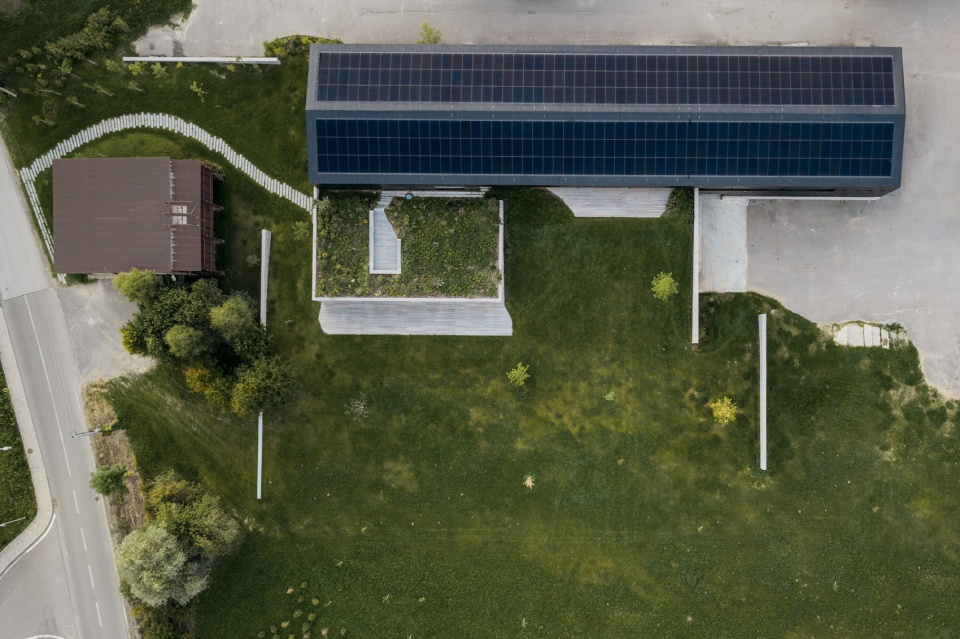
The architecture arose from reflections on quality windows and their ability to shape space and atmosphere through connection with the surrounding landscape. The building was reborn through the reconstruction of a 1950s cooperative hall, originally used as a grain warehouse. What was once a closed structure has been opened both symbolically and physically. A barrier has been transformed into a link between the building, the meadow, and the distant views—so that the very essence of windows could be revealed. The building is called Spoj—The Link.
▼场地鸟瞰,aerial view of the site
这座建筑由Jakub Janošík设计,他同时掌舵着家族企业的设计与艺术方向。
▼建筑与自然相连,connecting architecture with landscape
连接与交融的建筑Architecture of Connection and Merging
这座建筑的设计理念源于对“优质窗户”的思考:让建筑与自然相连,室内与花园之间顺畅过渡,视野无遮拦。同时,设计者希望建筑本身不破坏环境。因此,外部质感粗粝而深沉,内部则克制而宁静。
The architecture and atmosphere of the building were shaped by thoughts about quality windows: about embodying the philosophy of connecting architecture with landscape, about openness to nature, smooth transitions between interior and garden, and unobstructed views. At the same time, there was the wish that the building itself would not disturb the landscape. It is therefore rougher and darker on the outside, restrained and calm inside.
▼室内与花园之间顺畅过渡,smooth transitions between interior and garden
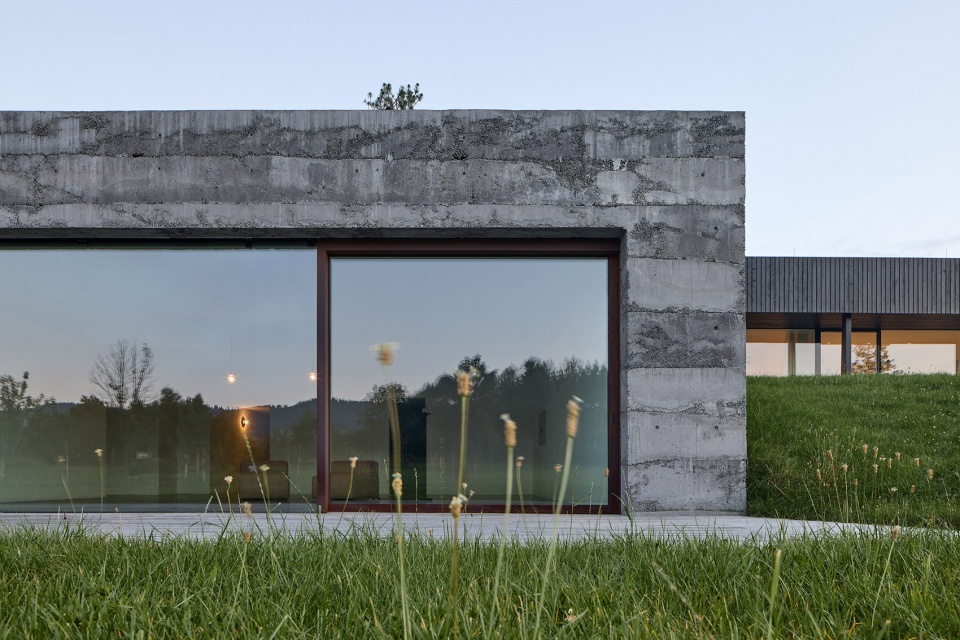
整体形态交织了两个体量:保留了原有大厅的传统双坡屋顶形态,并以新混凝土结构的“怀抱”向景观敞开。这一设计让草地直抵建筑,从五米高的办公空间,人们可以直接步入其间。而在改造之前,大厅被道路与围栏隔绝,封闭于墙体之中。
▼轴测图,axonometric
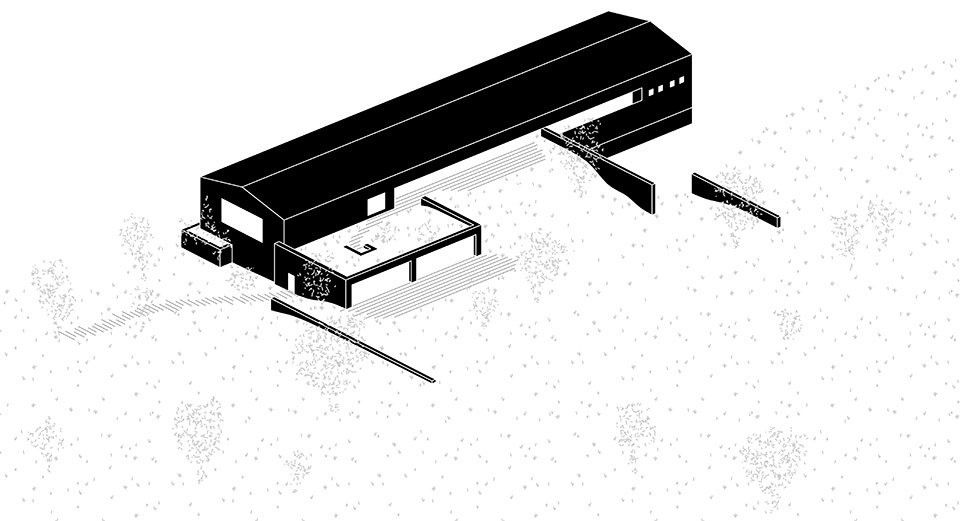
The architectural mass intertwines two volumes: the original hall with its traditional gabled form, and a new concrete “embrace” opening the building to the landscape. This draws the meadow right up to the building, and from the offices five metres above ground one steps directly onto it. Originally, the hall was separated from the meadow by a road and a fence, enclosed by walls.
▼传统双坡屋顶形态及混凝土结构,traditional gabled form and concrete structure
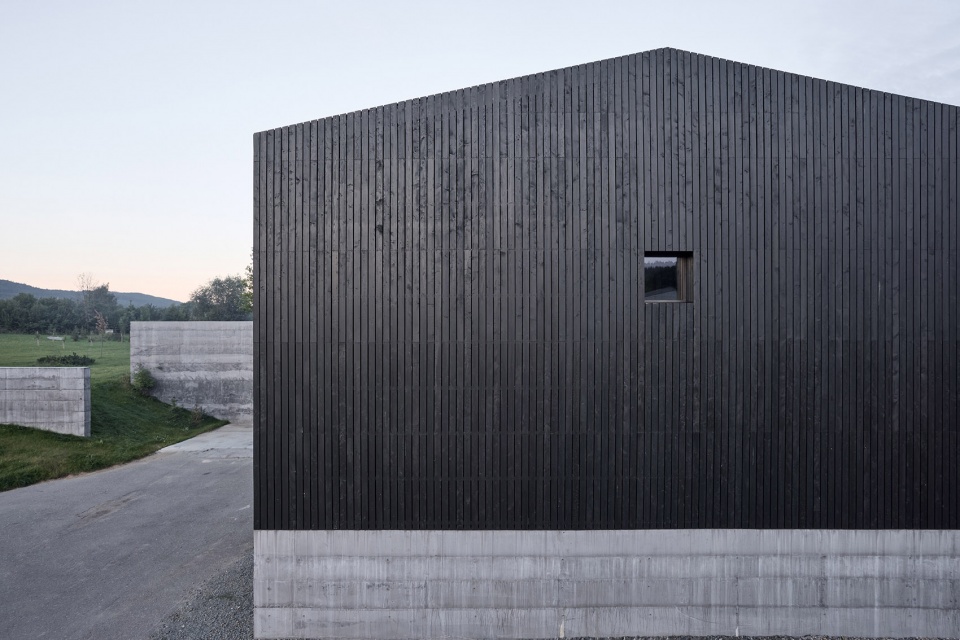
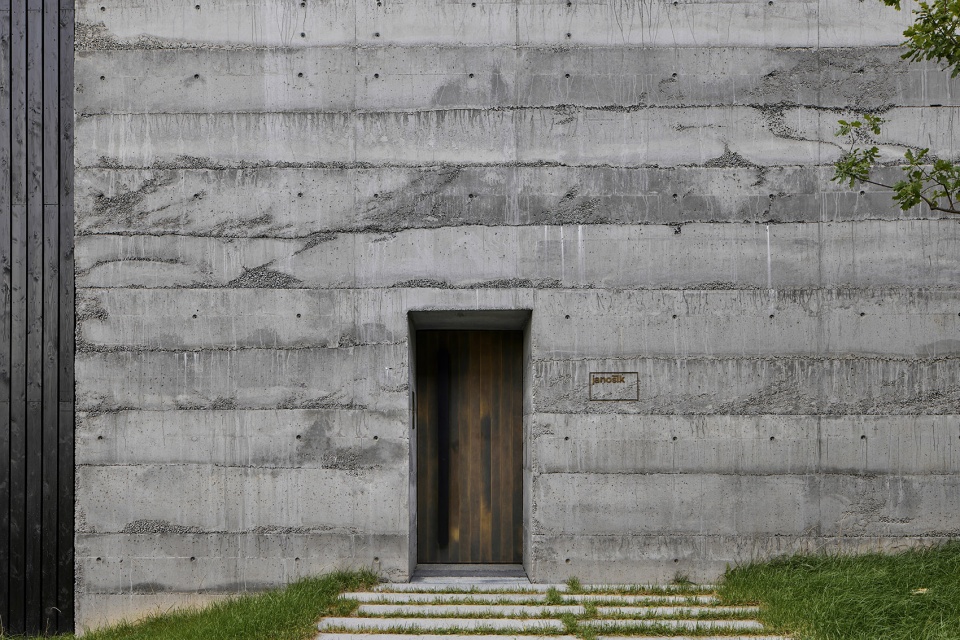
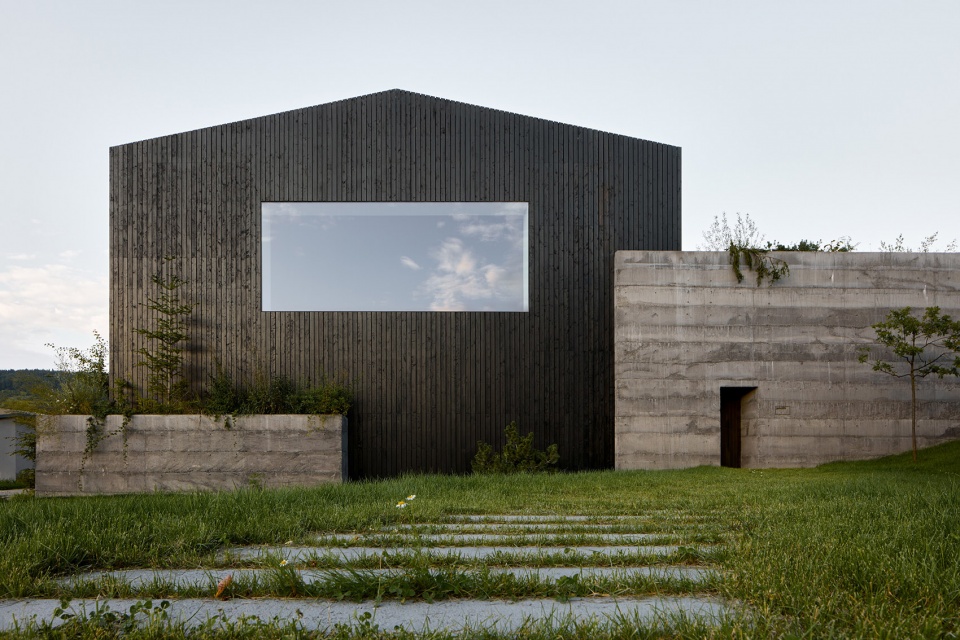
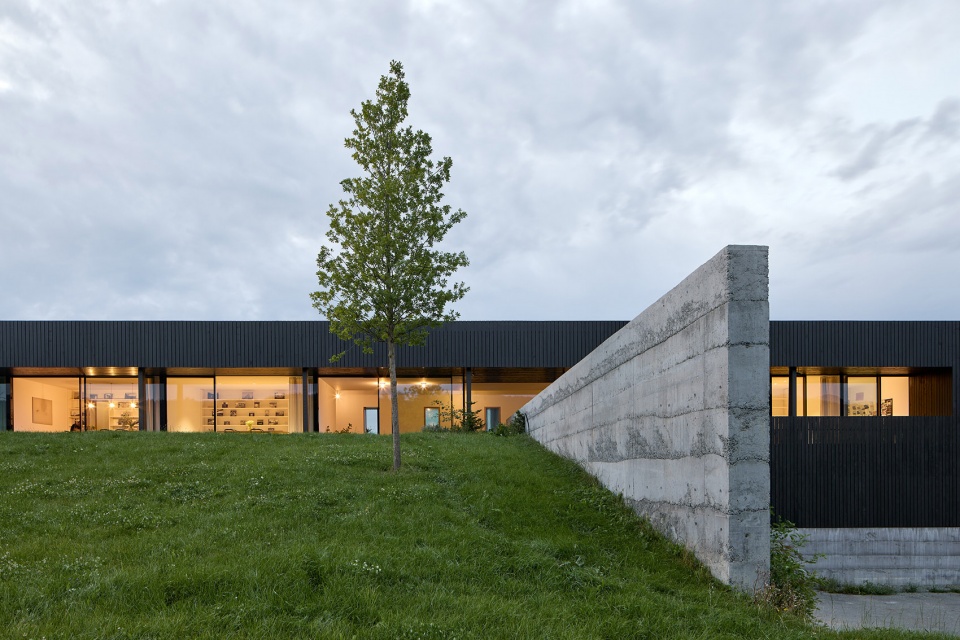
原有大厅的形式被简化至最本质的线条,凸显两个体量之间的对话。从三面望去,建筑如同一座纪念碑;而面向景观的一侧则被削弱、嵌入地形,成为轻盈的水平线。大厅的钢结构被外部保温层与黑色涂装木材所覆盖,并在木质体量上切开四个开口:两端各有一扇巨窗,其中最大的一扇(9×3.2米)位于主立面,展示内部景象,成为访客的明确信号。另一端则是最小的“画境式”窗户。
The form of the original hall has been reduced to its most essential lines, highlighting the dialogue of the two volumes. From three sides the building appears as a monument; towards the landscape, softened and pushed into the terrain, it becomes a light horizontal line.To highlight the steel structure inside, the hall was insulated from the outside and clad in black-painted timber. Four cut-outs were carved into this wooden volume. A single large window is on each gable end. The largest—measuring 9 × 3.2 metres—is on the main façade, revealing what happens inside and serving as a clear sign for visitors. On the opposite side, by contrast, appears the smallest picturesque window.
▼“画境式”窗户,picturesque window
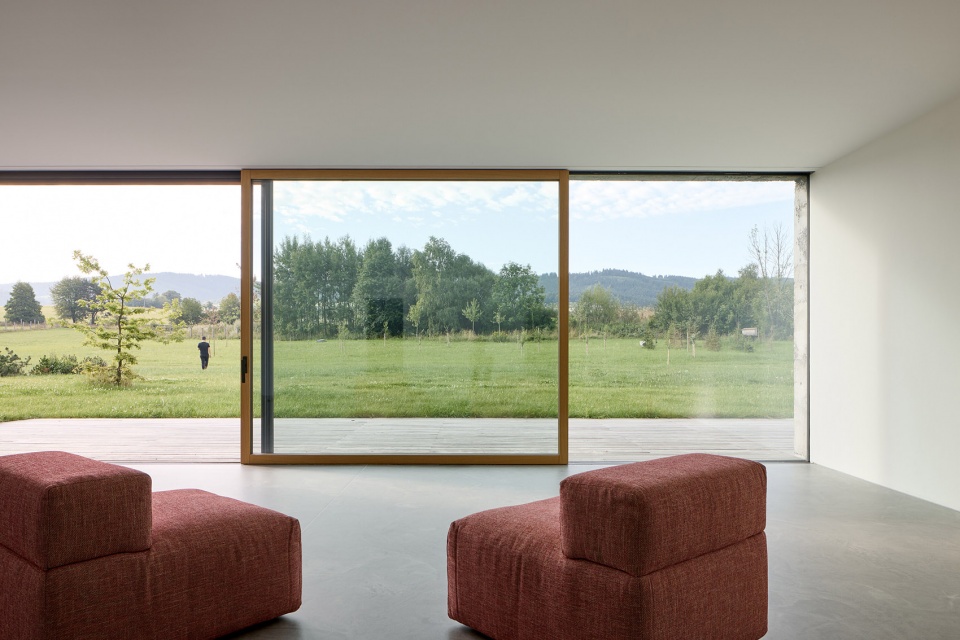
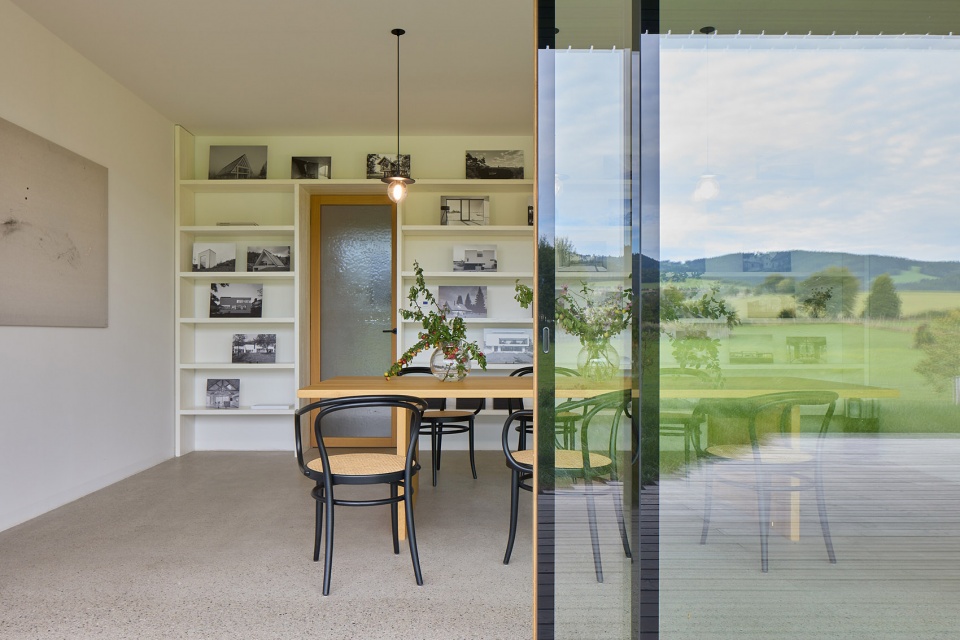
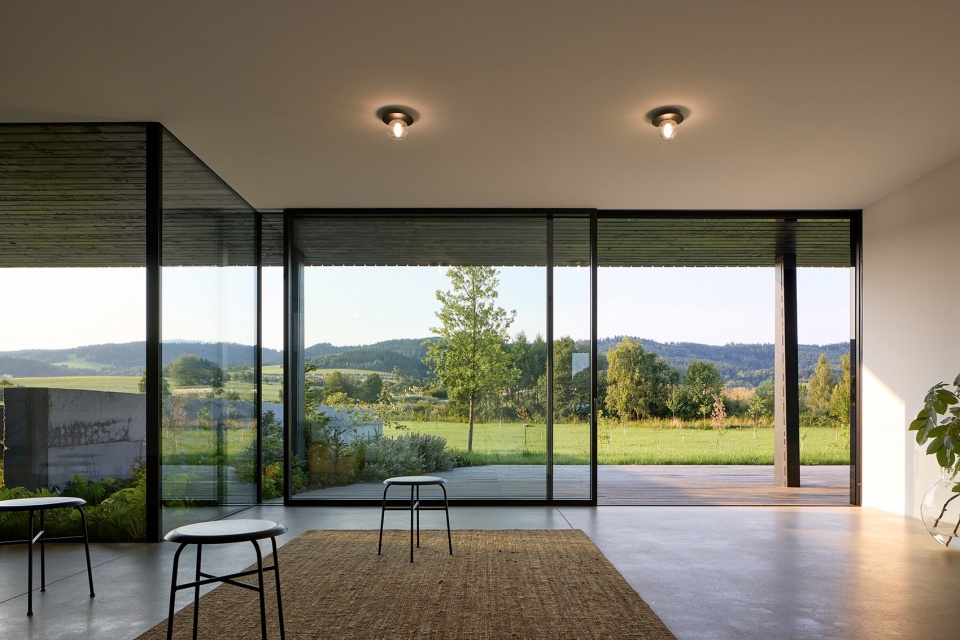
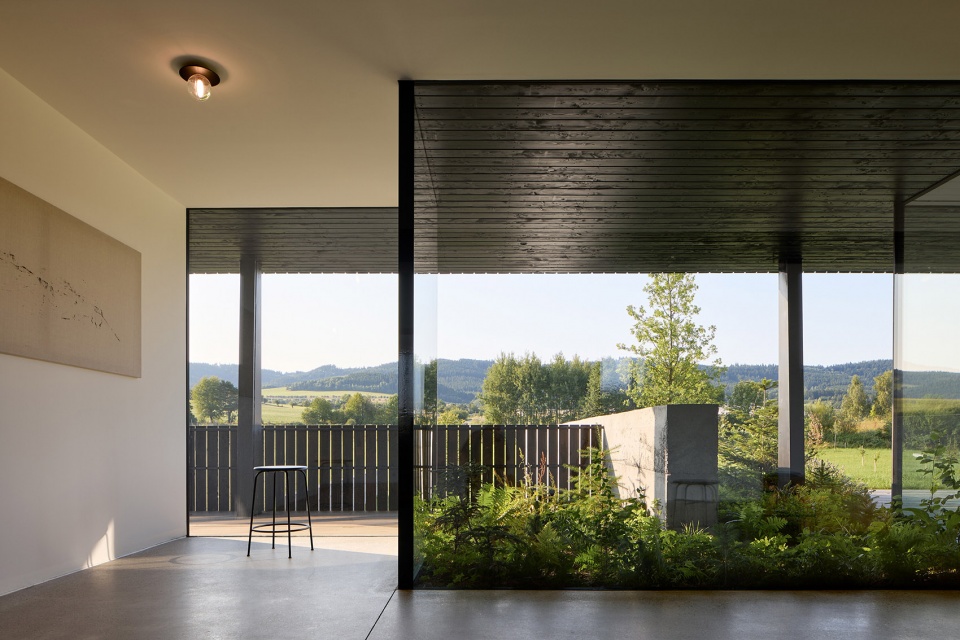
侧立面上嵌入了阳台式廊道,提供办公间的直接出入口;南侧更延展为露台与花园。它们同时发挥遮阳作用,夏季阻隔炽热,冬季则允许低角度的阳光渗入。
Loggias are recessed into the sides of the building, enabling direct access from individual offices; on the southern side, they extend into a terrace and garden. They also act as shading, protecting the interior from overheating in summer and allowing low sun to enter in winter.
▼侧立面上嵌入了阳台式廊道,Loggias are recessed into the sides of the building
环境策略 Environmental Approach
设计选择了改造而非拆除重建,重用既有结构。通过保温与更换窗户,能耗得以降低。冬季利用南向日照取暖,夏季则依靠屋檐与廊道遮蔽,无需空调;炎热时则可启用地板冷却系统。屋顶的太阳能板与黑色体量融为一体,隐匿于景观之中。
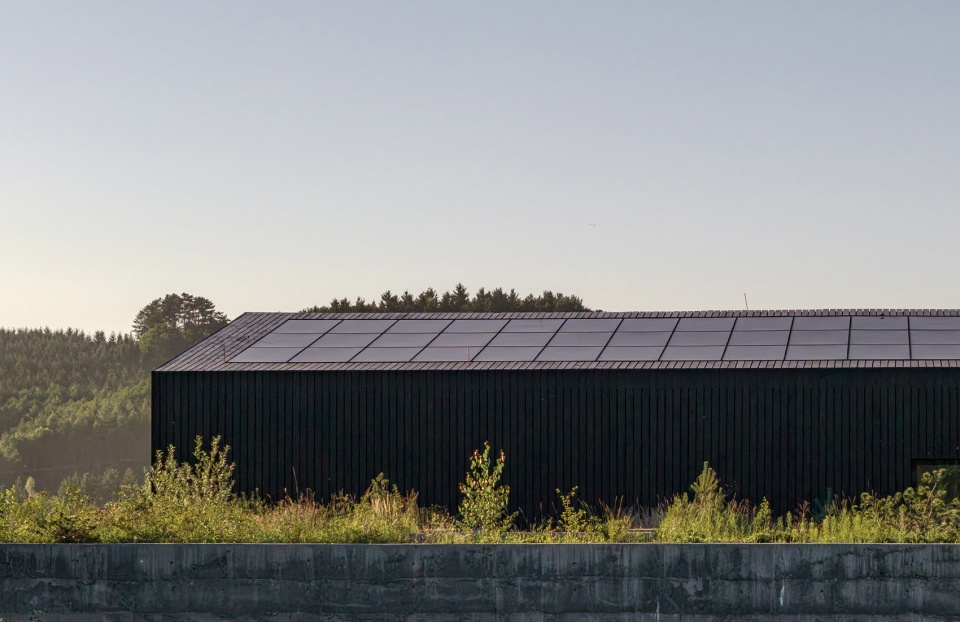
Instead of demolition and new construction, the existing structure was reused. Insulation and window replacement reduced energy demand. The building warms in winter with southern sun, while roof overhangs and loggias shield it in summer, eliminating the need for air conditioning. On hot days, underfloor cooling can be used. The roof is fitted with solar panels flush with the surface, blending with the black volume of the building—helping it remain unobtrusive in the landscape.
▼屋顶的太阳能板与黑色体量融为一体,The roof is fitted with solar panels flush with the surface
材料 Materials
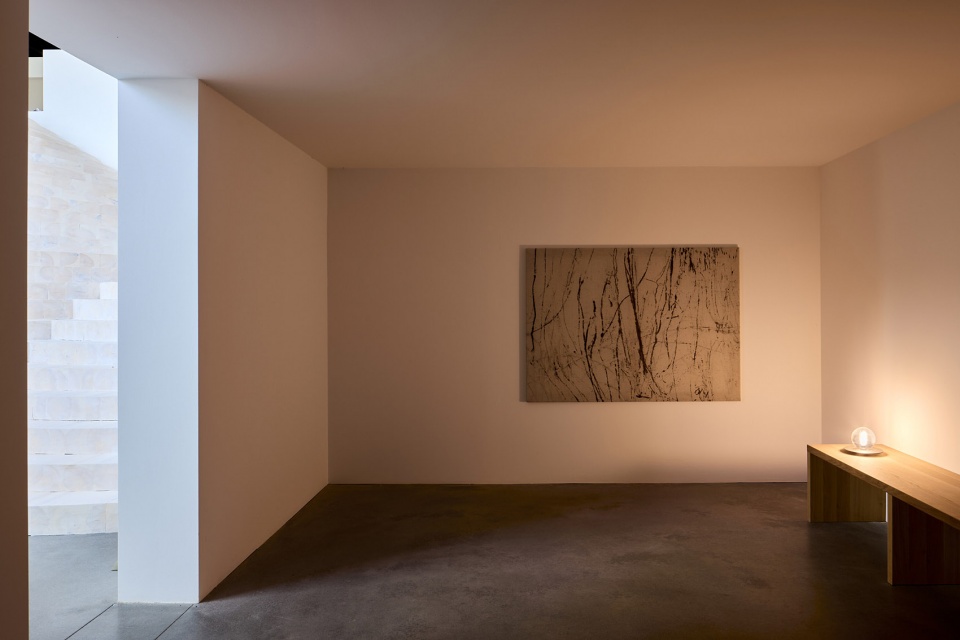
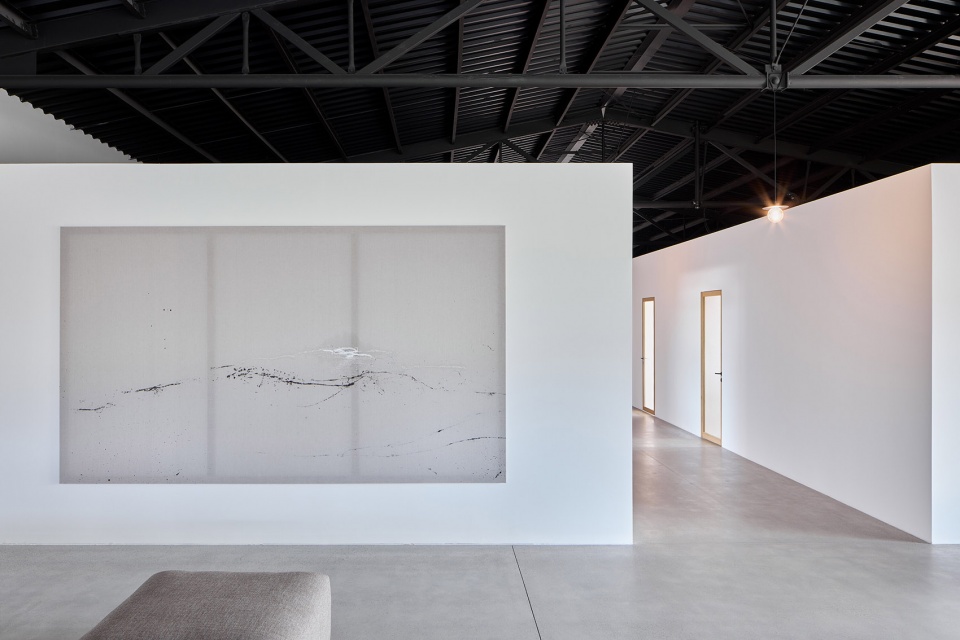
材料与色彩的选择基于“克制”的理念,让自然力量在室内回响,与室外景观融为一体。外立面采用黑色涂装的落叶松,保留木材的天然纹理;混凝土染以砂岩色调,分层浇筑,使其呈现地质般的质感而非技术感。室内空间则以白色为底,宛如展示景观影像的画廊,再辅以漂白云杉、天然橡木、深灰混凝土与亚麻布,呼应瓦拉几亚地区的传统建筑气质。
Material and colour choices were defined by ideas of restraint, to let the forces of nature resonate inside and merge with the landscape outside. The façade is clad with black-painted larch showing the natural wood grain. Concrete is tinted in a sandstone shade and poured in layers to appear geological rather than technical. The interior is white—a gallery for images of the landscape—enriched with bleached spruce, natural oak, dark grey concrete, and linen. Its expression follows the traditional Wallachian architecture.
▼室内空间则以白色为底,The interior is white
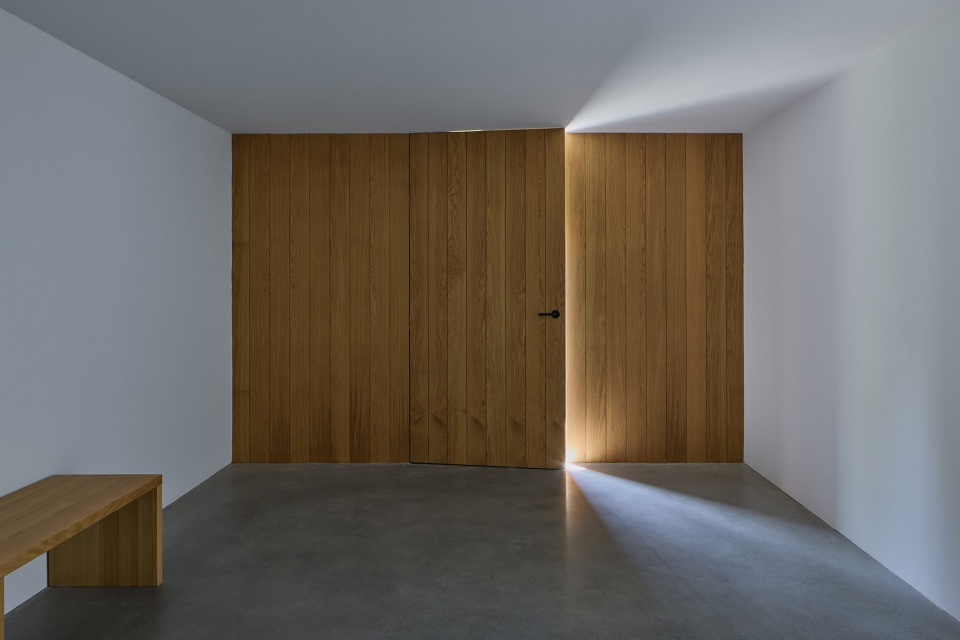
▼室内空间则以白色为底,成为展览的背景布,The interior is white as the backdrop of the exhibitions
内部——虚与实Interior—Both Empty and Occupied
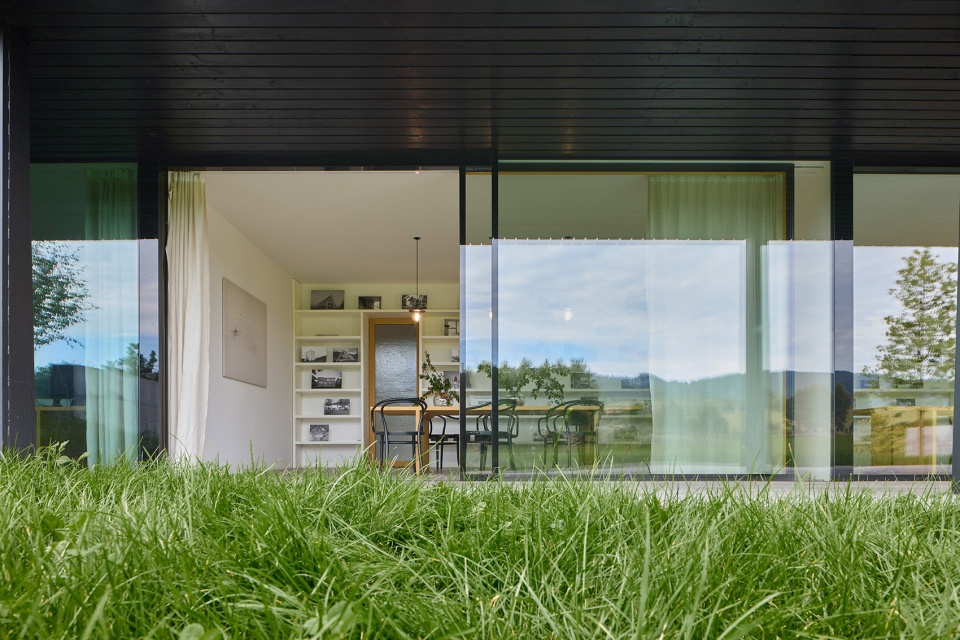
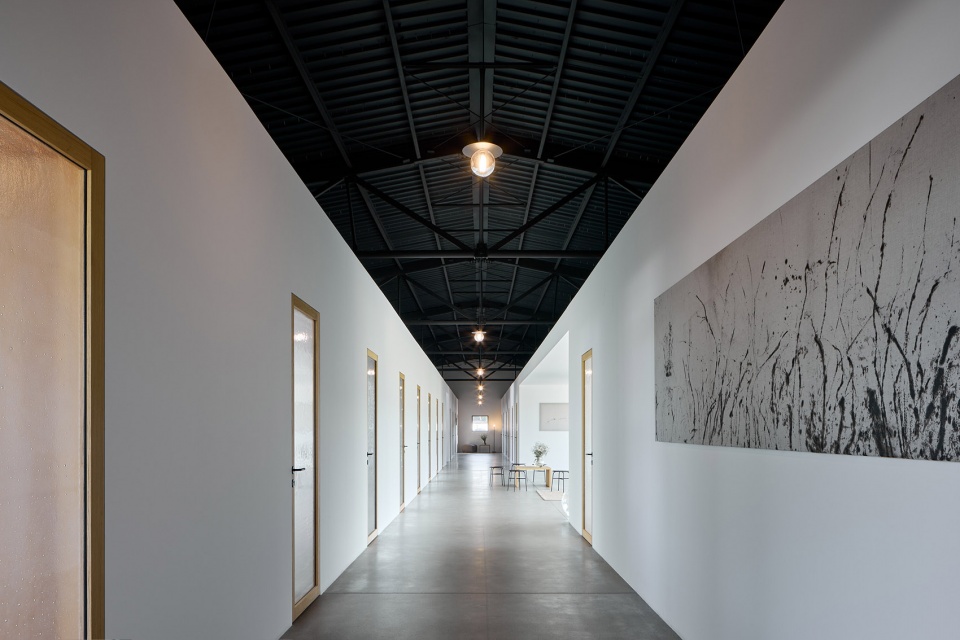
内部空间由嵌入的廊道、开放的屋顶与贯穿建筑的中央走廊塑造。办公室与会议室沿两侧布置,确保安静与私密。中央区域则像一处公共广场,通过推拉玻璃墙与花园与草地相连。
The interior space is shaped by recessed loggias, the open roof, and a central corridor crossing the building. Offices and meeting rooms are placed along the sides, enclosed for undisturbed work. The central area is open like a communal square, connecting to the garden and meadow through a sliding glass wall.
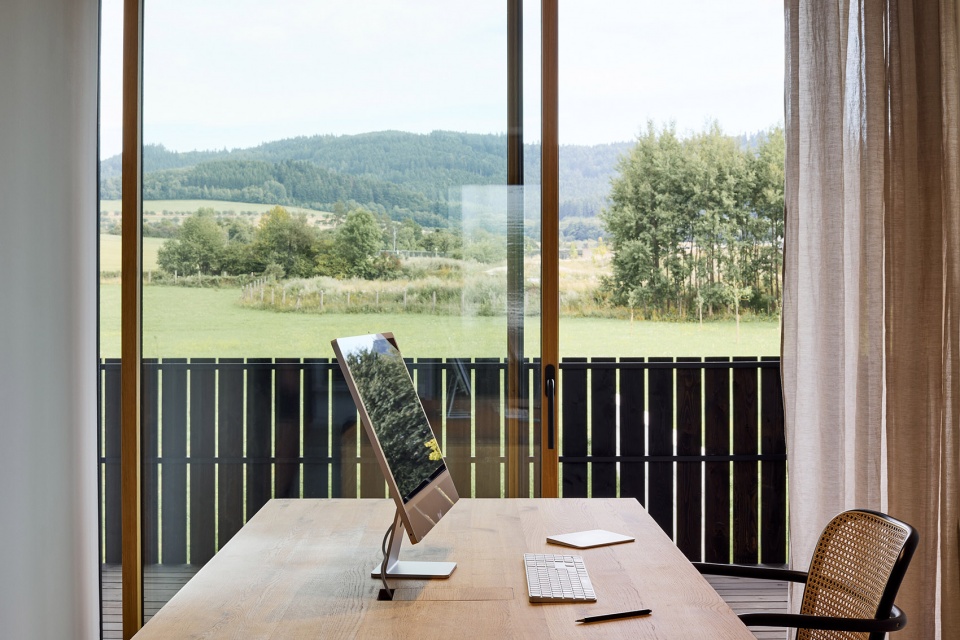
▼办公室与会议室沿两侧布置,Offices and meeting rooms are placed along the sides
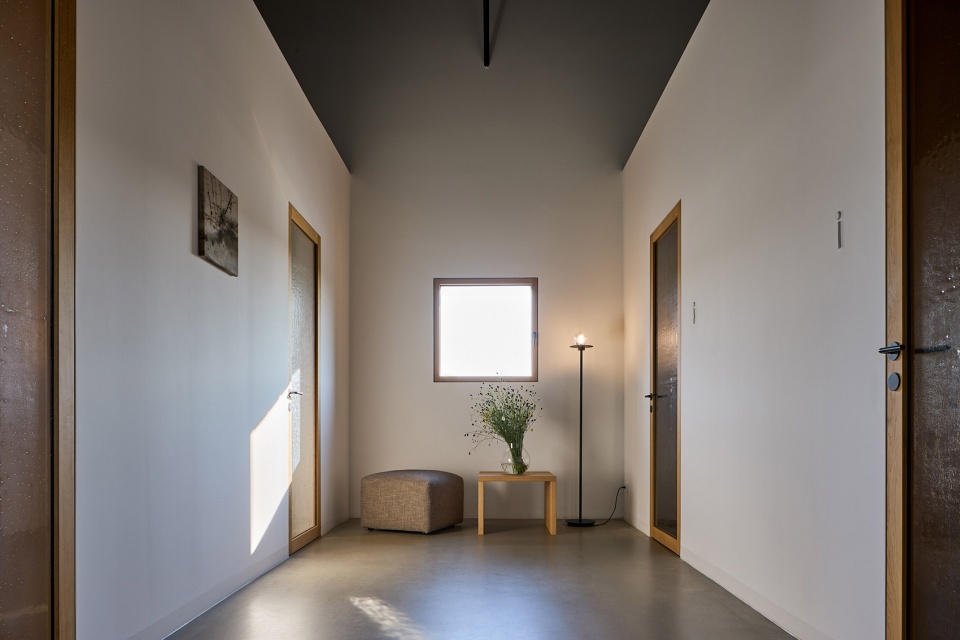
▼办公室空间,Offices spaces
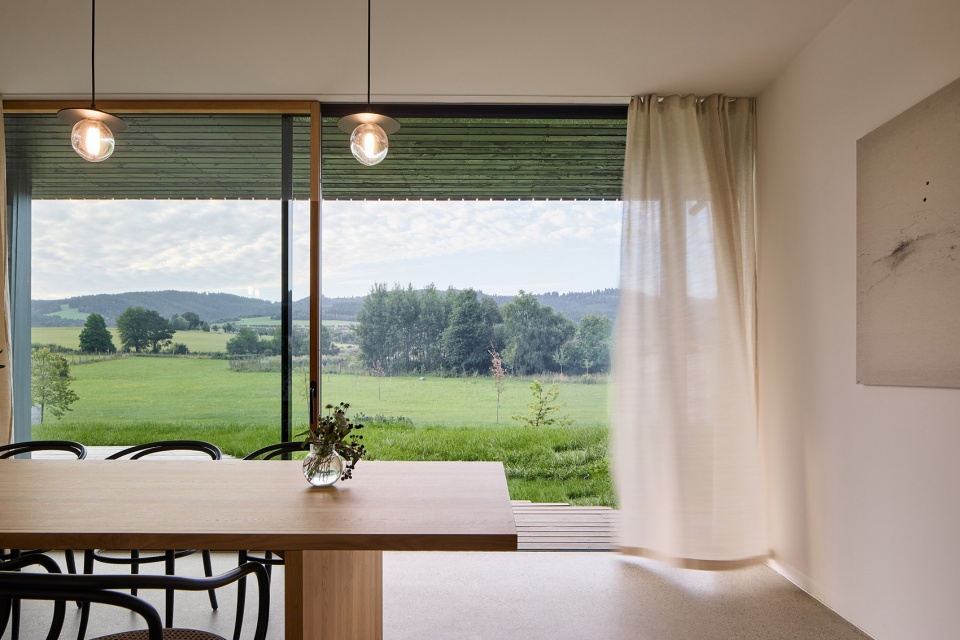
家具皆为量身定制:桌子、书架与厨房出自公司自有工坊,金属部件与座椅则由本地制造。标准化产品极少,仅见于Ton、Audo或LD Seating等品牌的椅子与部分办公设备。
The furnishings were made to measure for the building. Tables, shelves, and the kitchen were crafted in the company’s own workshop, with metal details and seating produced nearby. Standard products are rare—chairs by Ton, Audo, or LD Seating, and office equipment.
▼家具皆为量身定制,The furnishings were made to measure for the building
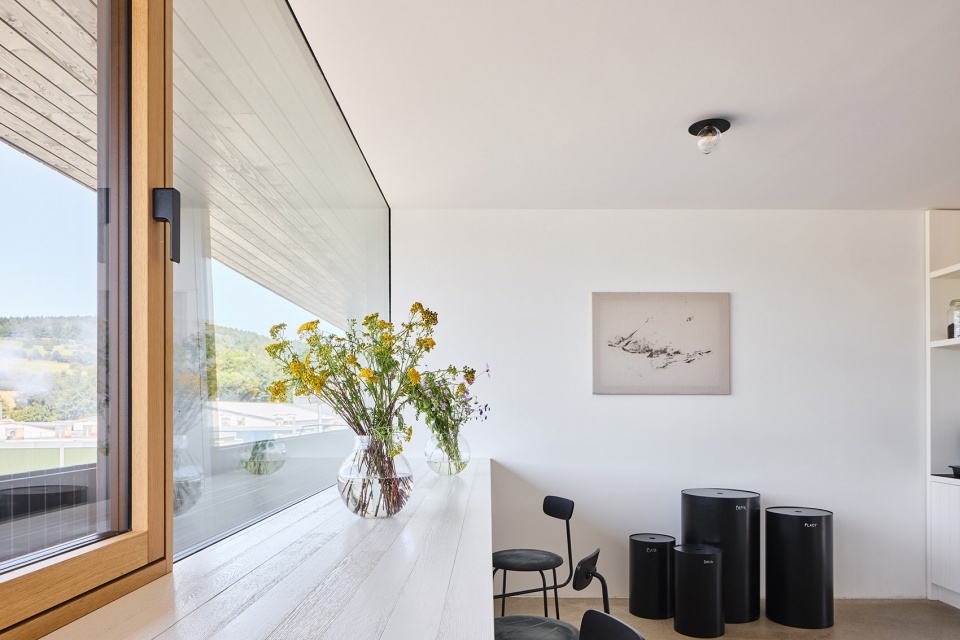
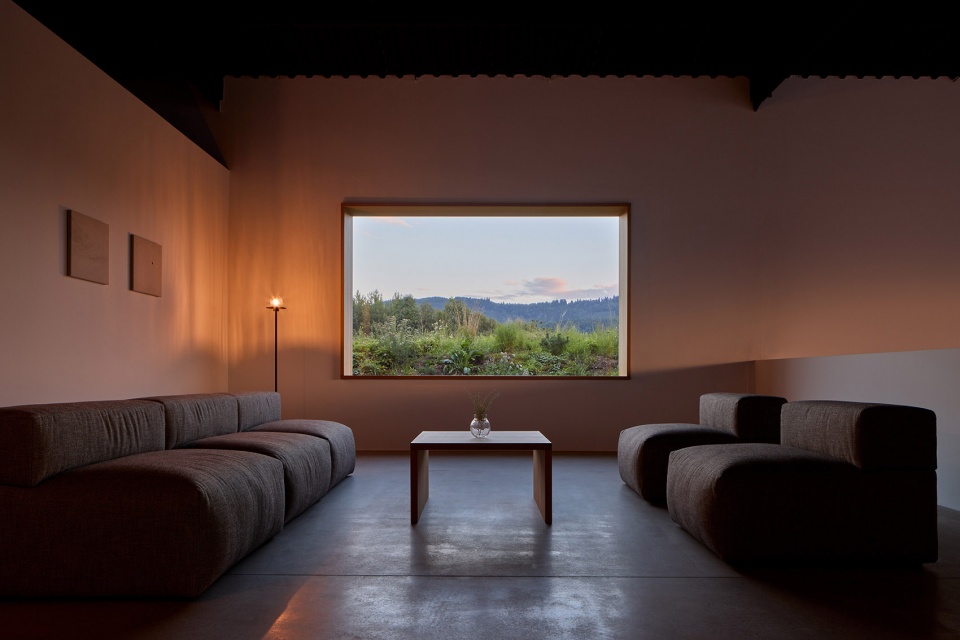
家具设计低调,不刻意装饰。空间的真正装点来自随处可见的景观视野与流入的自然力量:结构、光影、黑暗、比例、高度、节奏,开放与封闭之间的转化,以及不期而遇的惊喜。
The furniture design does not draw attention, decoration is almost absent. The space is instead filled with ever-present views of the landscape and the natural forces flowing inward, shaping moments of space: structure, light, darkness, proportion, height, rhythm, transitions between open and closed, and surprise.
▼设计低调的家具,The furniture design does not draw attention
山丘
Hills
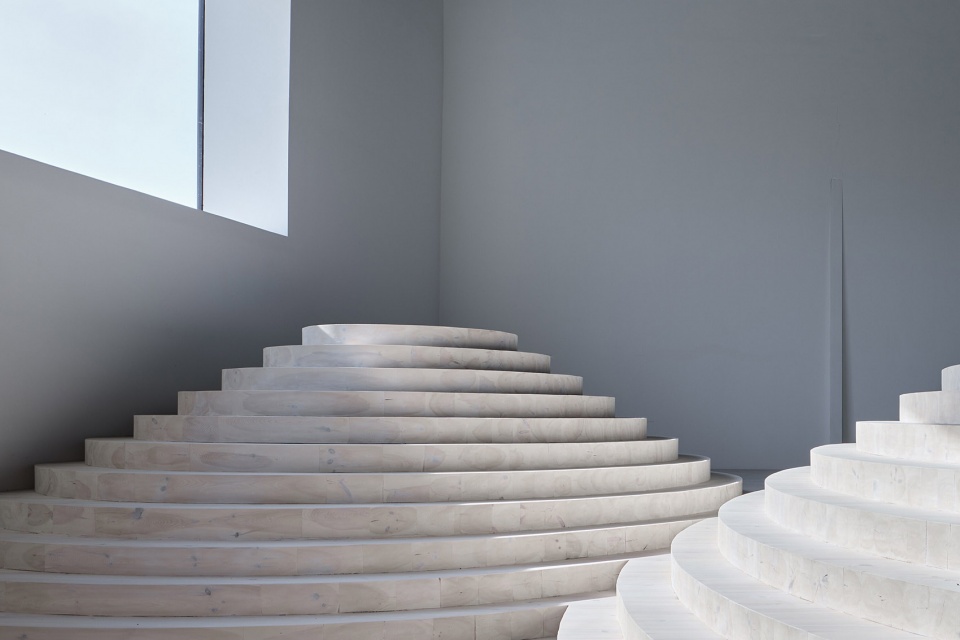
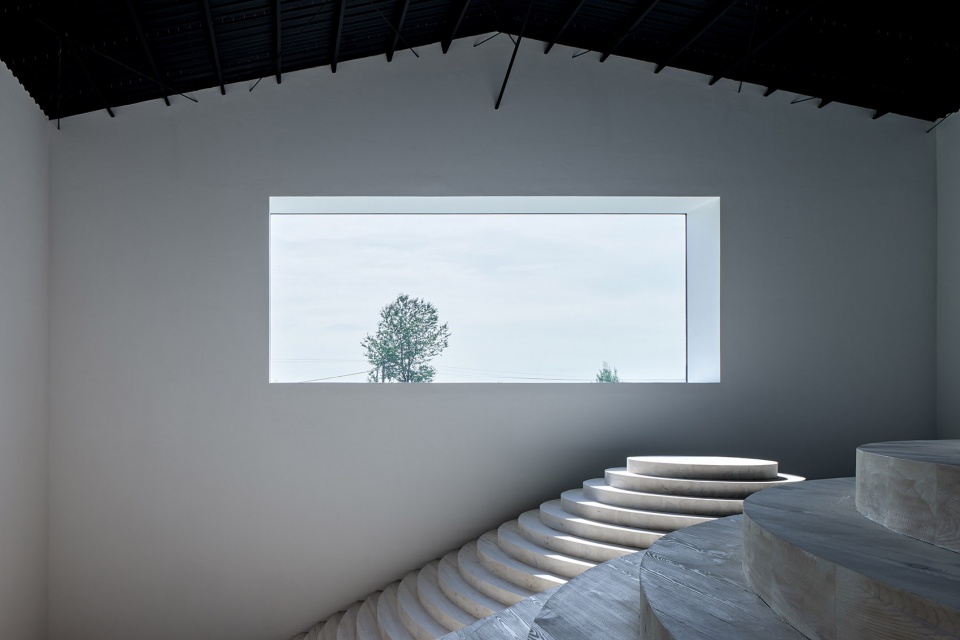
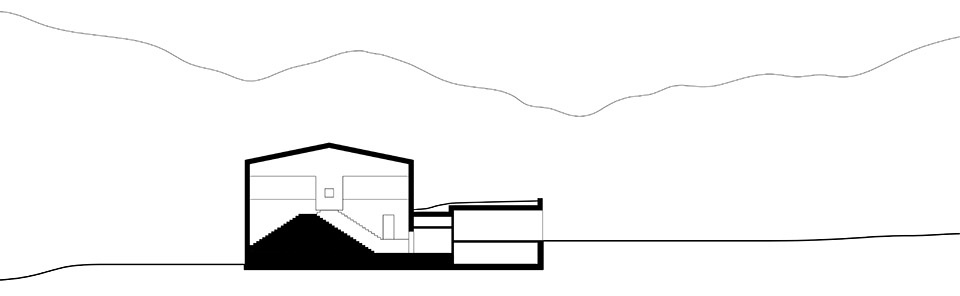
穿过低矮而幽暗的入口大厅,眼前豁然开阔出一个长12米、宽15米、高达12米的巨大空间。建筑中最大的那扇窗户向内伸展,强化了空间的抽象感。在这里,设计师 Maxim Velčovský 创作了一件介于雕塑与楼梯之间的作品。
Behind the low, dark entrance hall opens a space of 12 × 15 metres with a height of 12 metres. Into it projects the largest window of the building, reinforcing the abstraction of the space. Here, Maxim Velčovský designed an object somewhere between sculpture and staircase.
▼介于雕塑与楼梯之间的作品,an object somewhere between sculpture and staircase
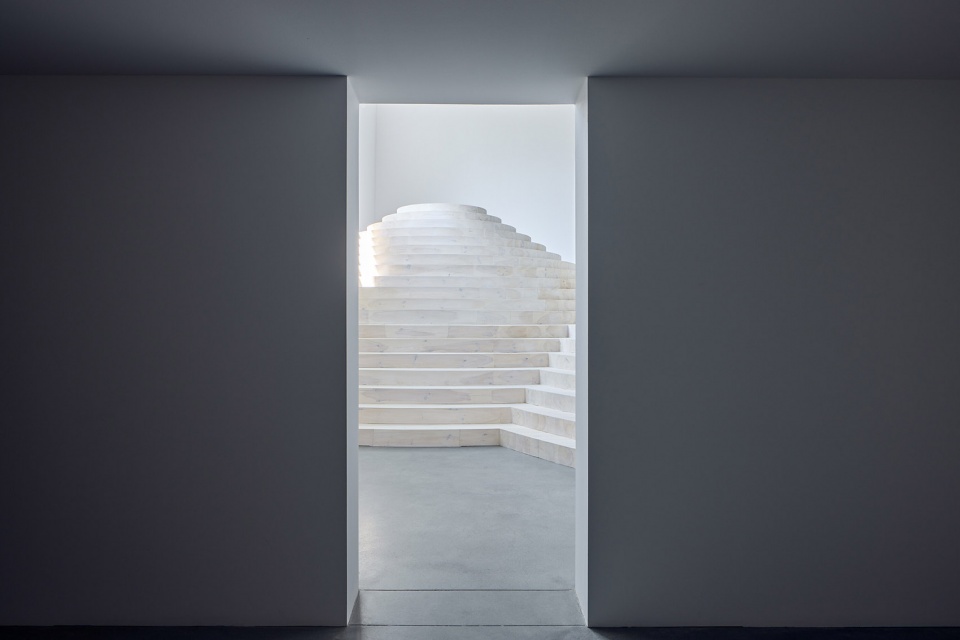
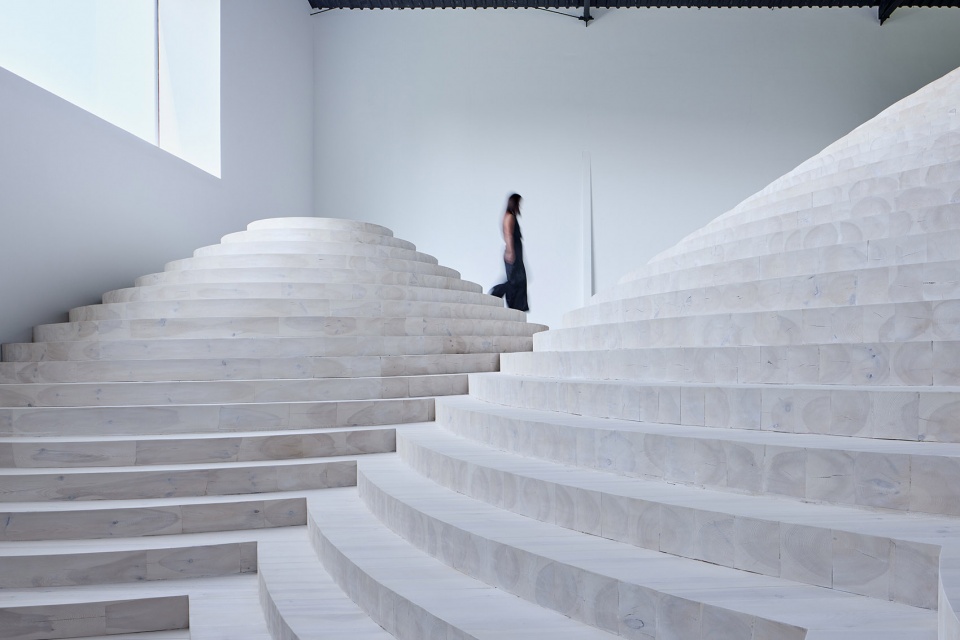
▼宛如巨大山丘,as a giant hill
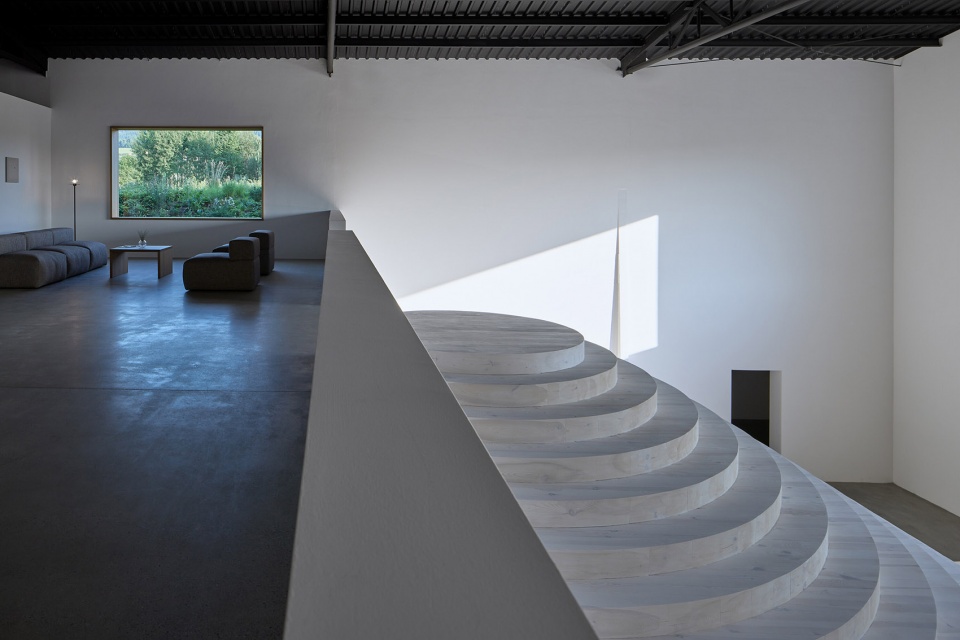
▼雕塑细部,sculpture detail
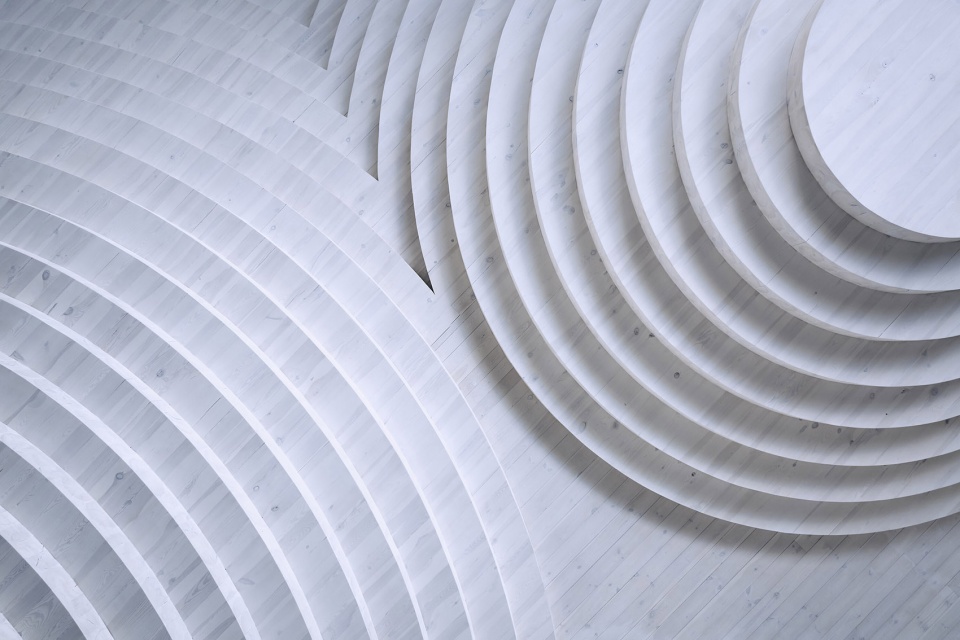
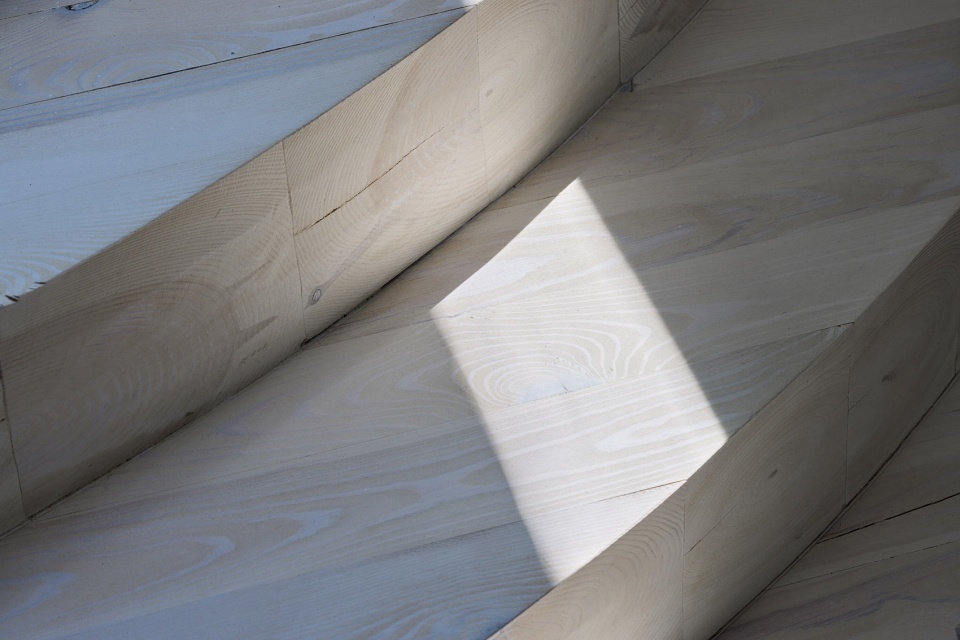
▼透过巨大的窗户凝视远方的景致,gaze at the landscape through the vast window
从自然到文化 From Nature to Culture
在自然力量未能抵达之处,三处艺术与设计的介入延续了建筑与景观的关系。它们源于关于氛围与延展的讨论,让自然与文化在空间中交织生长。
Where the powers of nature did not reach, three artistic-design interventions extend the relationship between building and landscape. They emerged from discussions about atmosphere and its development.
▼让自然与文化在空间中交织生长,extend the relationship between building and landscape
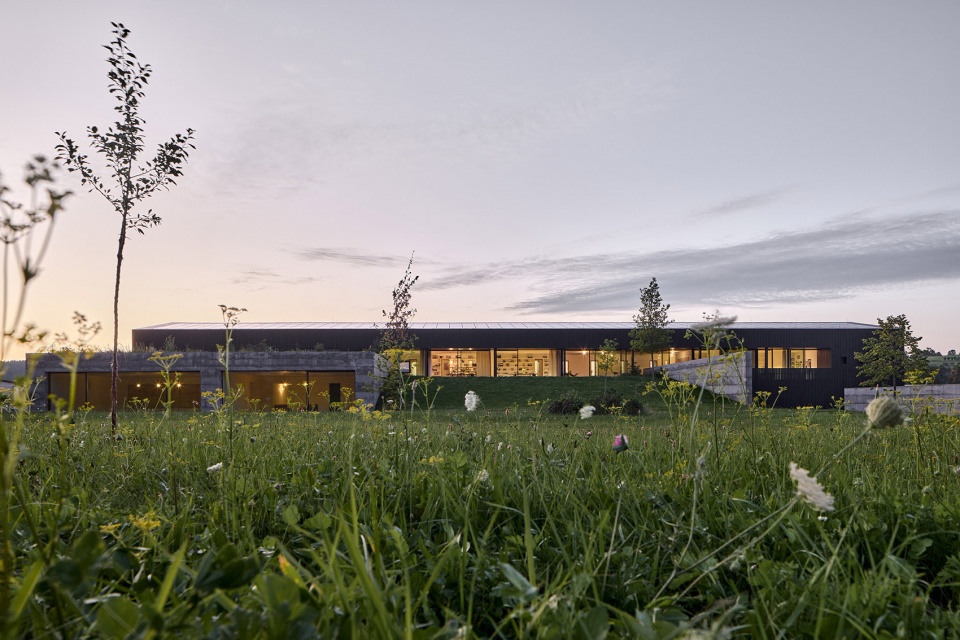
▼傍晚景象,at dusk
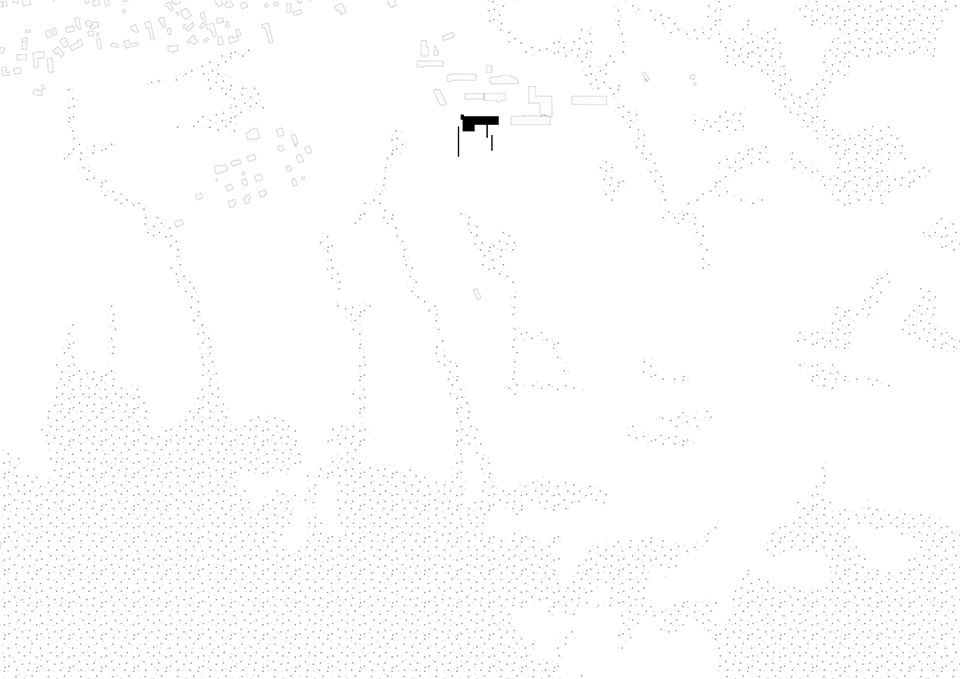
▼场地平面,site plan
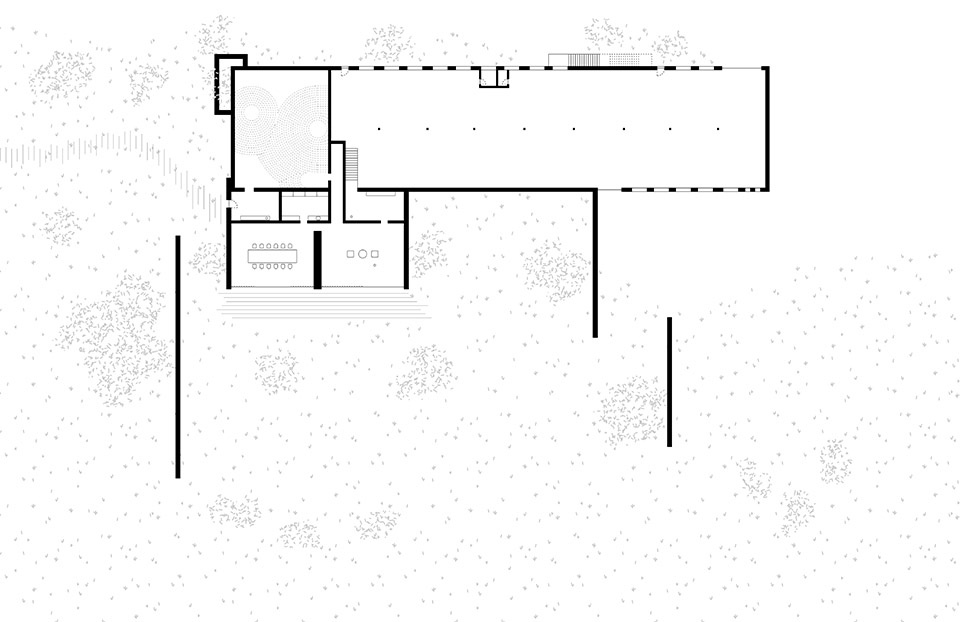
▼一层平面,ground floor plan
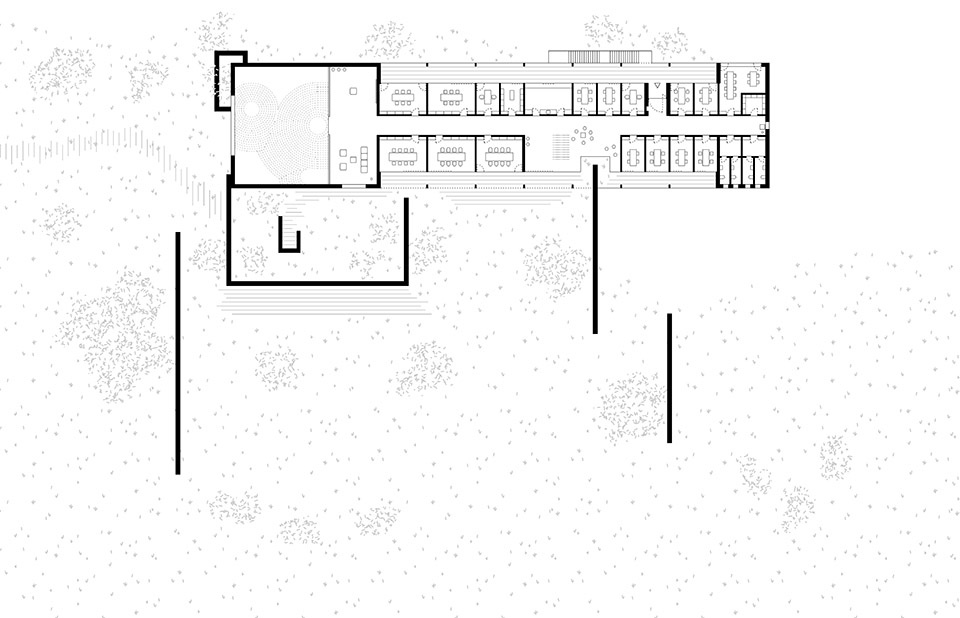
▼二层平面,first floor plan
▼立面,elevation
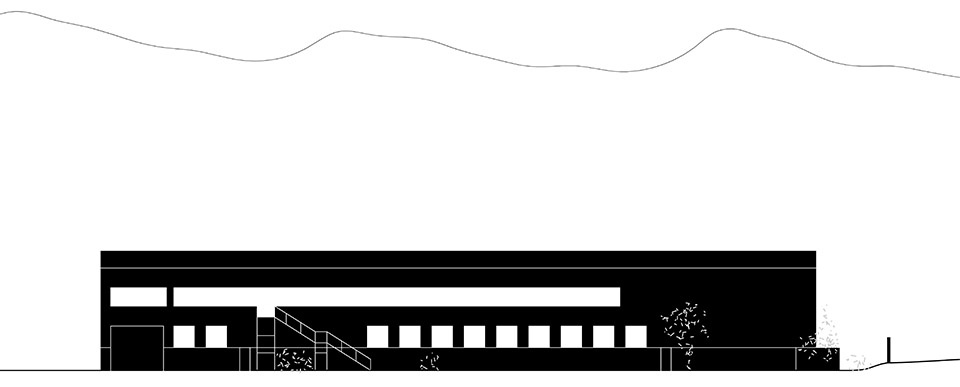
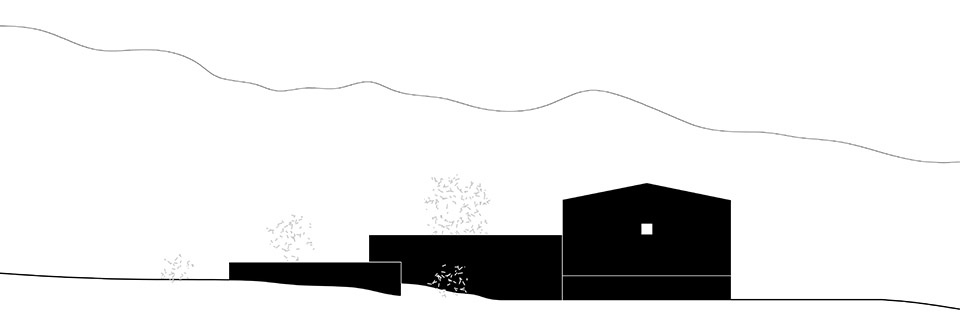
▼剖面,section
Author Jakub Janošík
Website http://www.jakubjanosik.cz
Project location Valašské Příkazy 81
Project country Czech Republic
Project year 2017–23
Completion year 2025
Built-up area 1 050 m²
Gross floor area 2 100 m²
Client JANOŠÍK OKNA-DVEŘE
Client’s e-mail info@janosik.cz
Client’s website http://www.janosik.cz
Photographer Filip Beránek, http://www.filipberanek.com, info@filipberanek.com