重庆涪陵慧谷湖科创小镇首开区 / 上海都设营造
引言:山地建筑不是强行锚固于岩土,而是从地形的褶皱里生长出自身的逻辑。 Introduction: Mountain architecture is not forcibly anchored in rock and soil, but grows its own logic from the folds of the terrain.
都设与重庆山地的对话,始于2018年两江协同创新区“创新∑空间”。彼时我们提出“顺势营造”——将地形从建设障碍重新定义为空间秩序的生成原点。五年后,涪陵慧谷湖科创小镇首开区,将这一认知推进为“伏脉于山水,修台而造景”的方法论。
DuShe Design’s dialogue with Chongqing’s mountains started in 2018 with “Innovation Σ Space” at Liangjiang Coordinated Innovation Zone, where we proposed “Following the Terrain to Create” – redefining terrain as the origin of spatial order. Five years later, Fuling Huigu Lake Sci-Tech Innovation Town advances this into a methodology of “Rooted in Mountains and Rivers, Building Platforms to Create Landscapes”.
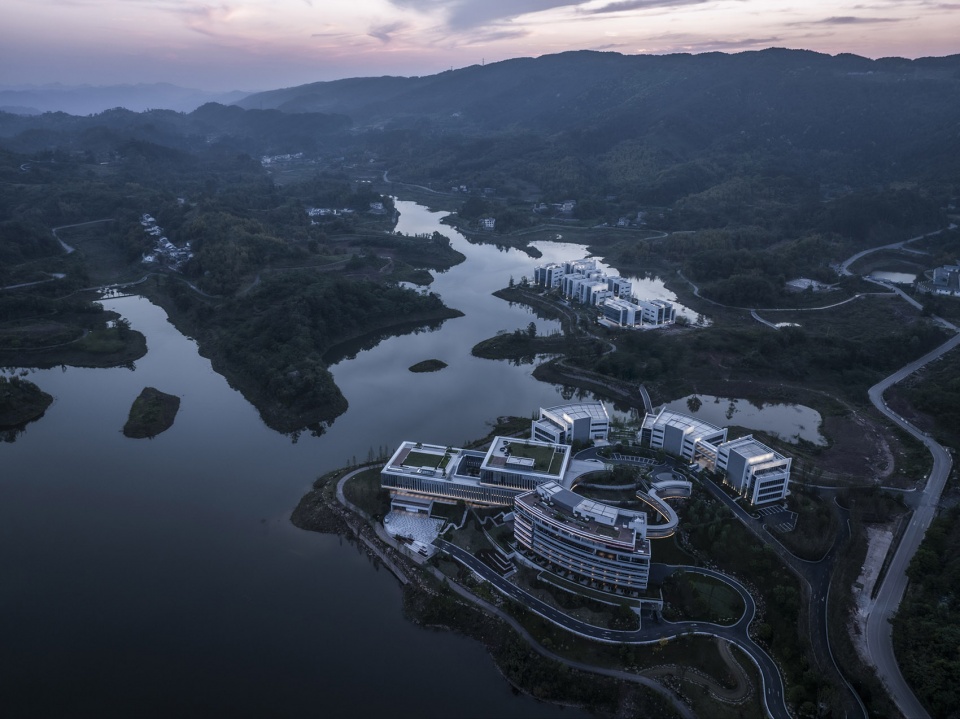
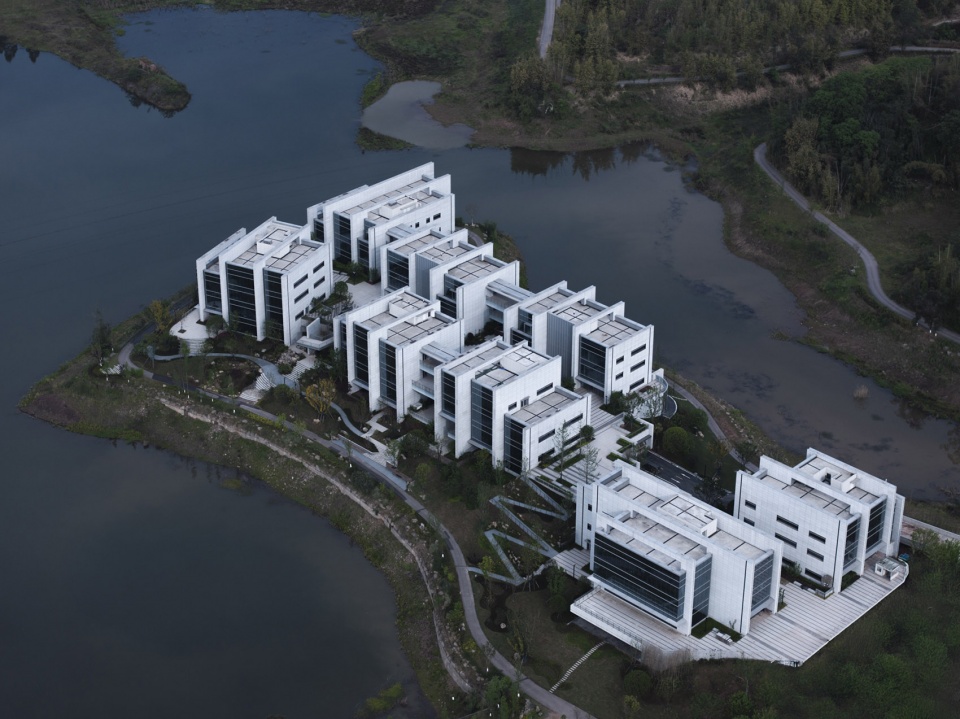
▼项目鸟瞰,aerial view of the project
山地建筑的核心命题并非“如何减少高差影响”,而是“如何将高差转化为空间价值”。设计的起点是场地内既有的等高线、汇水线与植被分布,任务并非消除这些特征,而是识别并强化其内在潜能。设计的本质在于揭示场地固有秩序,实现建造系统与自然系统的逻辑耦合。通过“留山、修台、造景”的地形重构、“通、透、露、挑”的剖面控制,以及“多首层”产权价值再造,慧谷湖建立了一套从场地基因到空间产品的逻辑闭环,为同质化困境中的产业园区提供了一种“不可复制”的解题范式。
The core of mountain architecture is transforming height differences into spatial value rather than reducing their impact. Starting from the site’s contour lines, water catchment lines and vegetation, the design identifies and enhances inherent potential, realizing the logical coupling of construction and nature. Through terrain reconstruction, section control and “multi-first floors” value reconstruction, Fuling Huigu Lake builds a logical closed loop, offering an irreplicable solution for homogeneous industrial parks.
▼项目鸟瞰,aerial view of the project
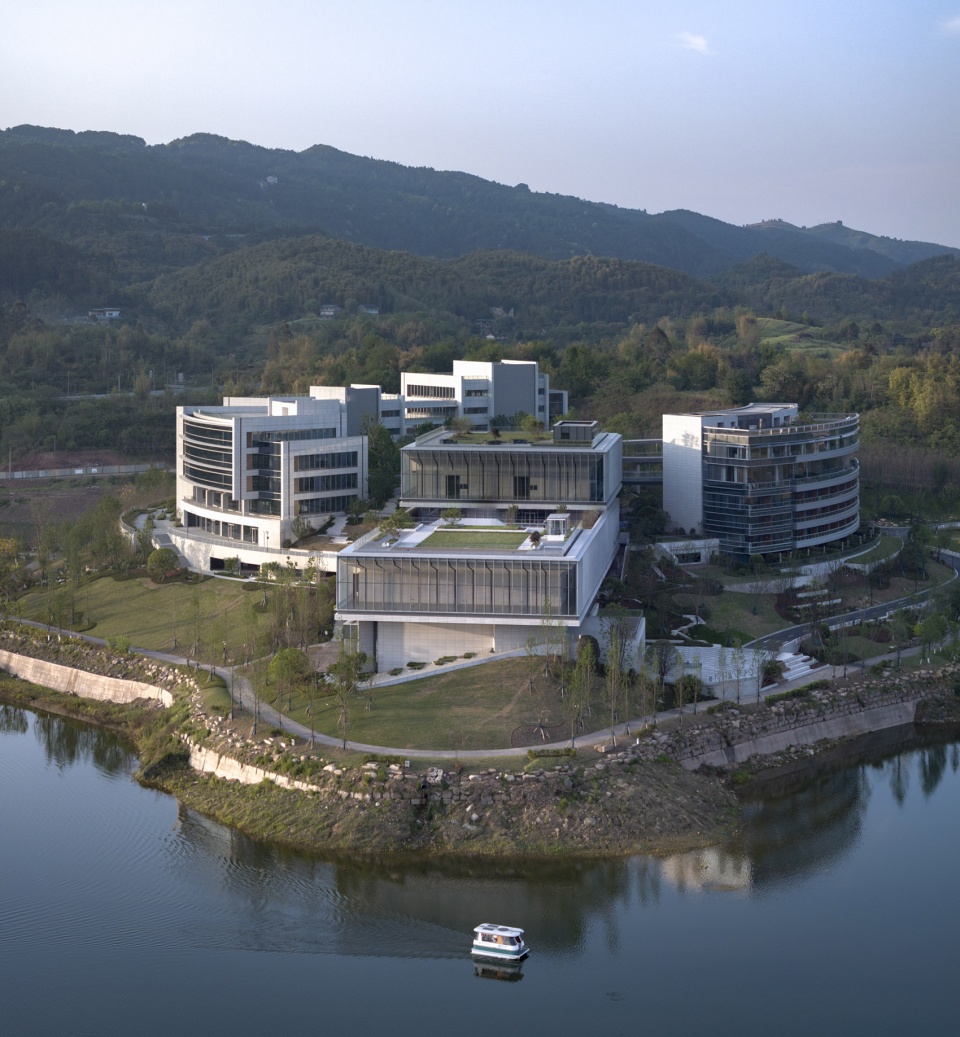
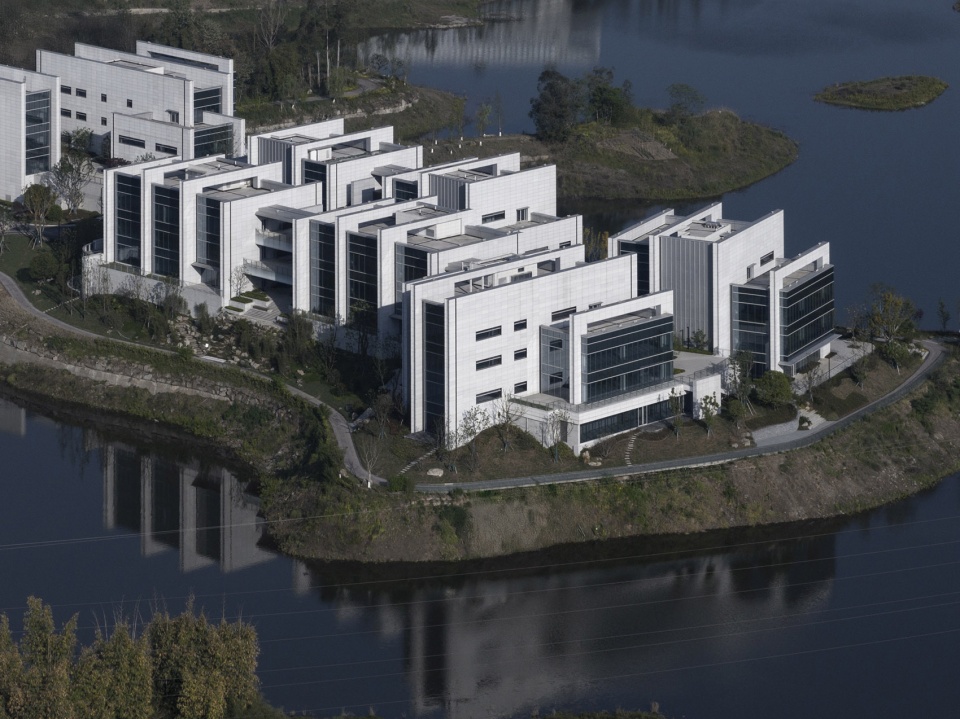
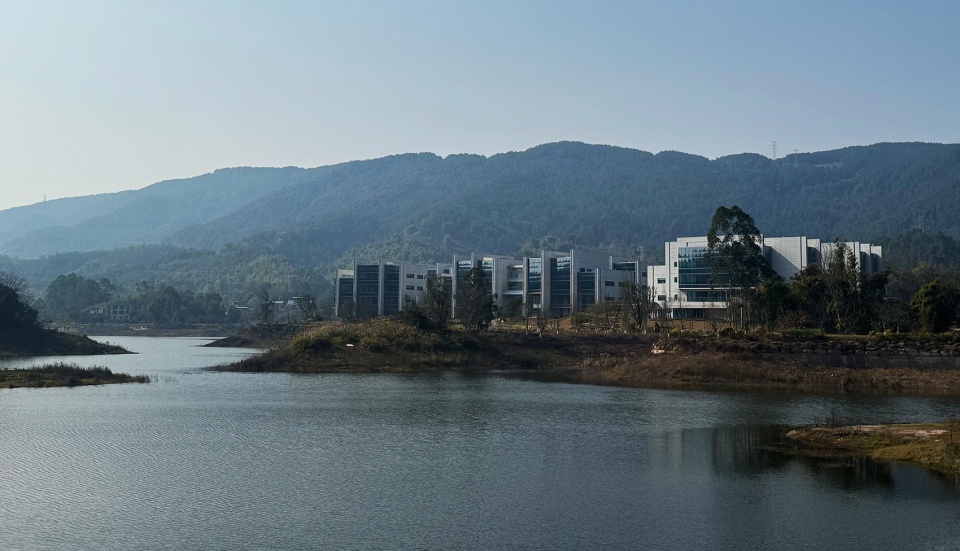
慧谷湖位于重庆涪陵西北,是涪陵高新区衔接重庆主城与渝东北区域的关键节点。湖区岸线曲折,岛丘错落,形成“湖嵌岛、岛衔湖”的地理格局。首开区选址于两个三面环湖的半岛之上:一号岛占地2.8万平方米,建筑面积4.2万平方米,汇集定制办公、会议展示、商业配套及四星级酒店;二号岛占地1.6万平方米,建筑面积2.3万平方米,定位为中小型企业总部办公集群。两岛之间以文馨场为连接节点,共同构成一个功能复合、空间连续的科创聚落原型。一号岛场地最显著的特征是33米高差与20-30度平均坡度;二号岛则呈现典型的渝东丘陵地貌,山脊由西北向东南延伸,三面环水形成半岛态势。在常规开发逻辑中,这些是必须支付高昂土方成本予以“消解”的负面条件。但我们识别出这组参数的另一重属性:垂直方向上功能分区、景观分配、流线组织的天然坐标系。问题的关键从“如何减少土方”转变为“如何利用高差生产空间价值”。
Huigu Lake is located in the northwest of Fuling, Chongqing, serving as a key node of the Fuling High-Tech Zone connecting the main urban area of Chongqing and the northeastern region of Chongqing. The lake features a winding shoreline and scattered islands and hills, forming a unique geographical pattern of “islands nested in the lake, and the lake embracing the islands”. The launch zone is situated on two peninsulas surrounded by water on three sides. Island 1 covers 28,000 square meters with a floor area of 42,000 square meters, integrating customized offices, conference and exhibition spaces, commercial facilities, and a four-star hotel. Island 2 covers 16,000 square meters with a floor area of 23,000 square meters, designed as a headquarters cluster for small and medium-sized enterprises. Connected by Wenxin Plaza, the two islands jointly form a prototype of a multi-functional and spatially continuous sci-tech innovation settlement.The most prominent feature of Island 1 is a 33-meter elevation difference and an average slope of 20–30 degrees. Island 2 presents a typical eastern Chongqing hilly landscape, with ridges extending from northwest to southeast and forming a peninsula surrounded by water on three sides. In conventional development logic, these are regarded as negative conditions that require high earthwork costs to be “eliminated”. However, we have identified another dimension of these parameters: they serve as a natural coordinate system for vertical functional zoning, landscape distribution, and circulation organization. The core issue has shifted from “how to reduce earthwork” to “how to leverage elevation differences to generate spatial value”
▼项目鸟瞰,aerial view of the project
一、地形重构:“留山、修台、造景”的在地营造策略 Topographic Reconstruction: The Site-Specific Strategy of “Preserving Mountains, Building Terraces, and Creating Landscapes”
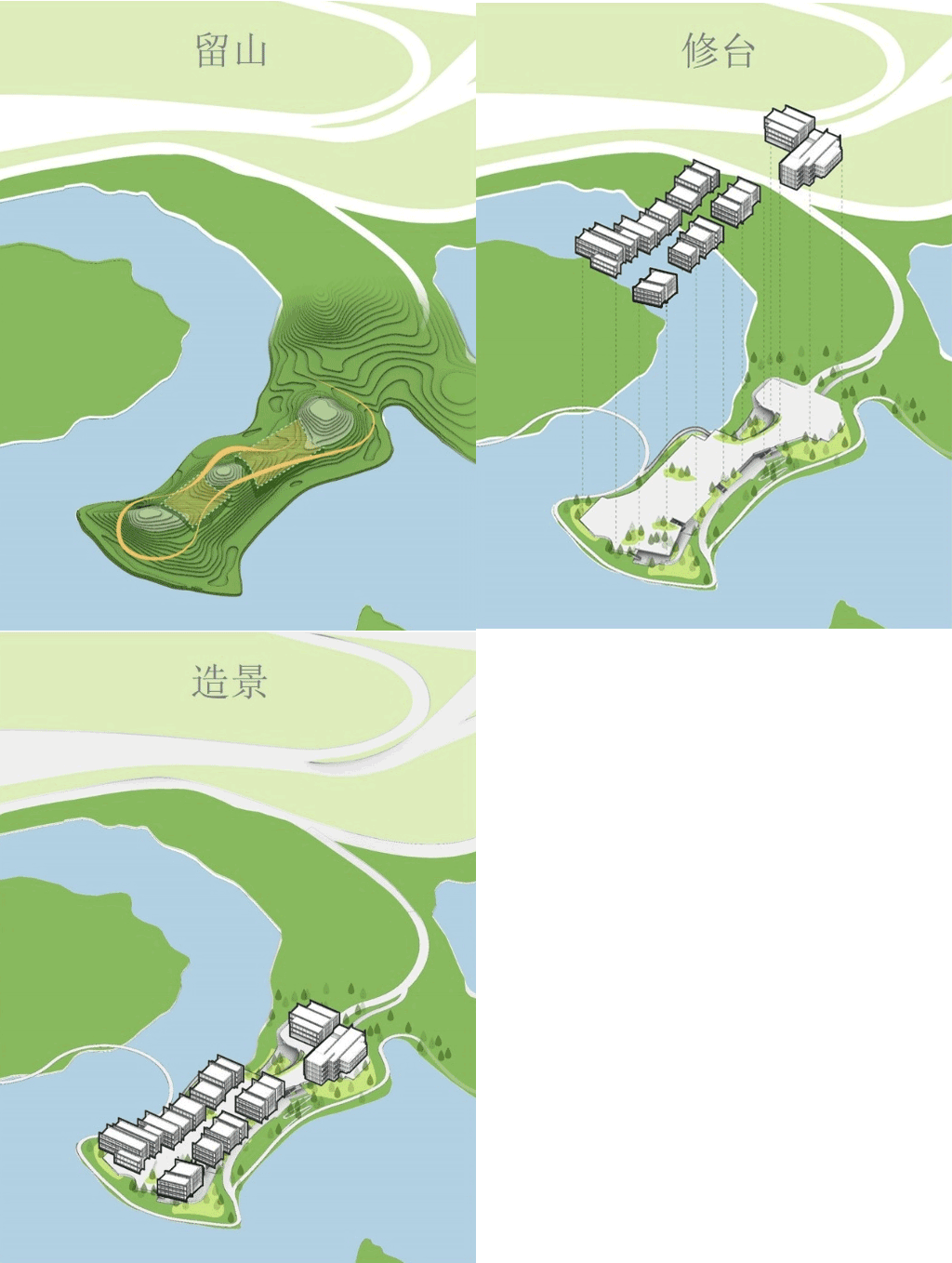
传统山地建筑对高差的应对本质上是“减法思维”——通过削峰填谷将三维地形降维为二维建设用地。一号岛的设计逻辑实现了根本性认知转向:将地形从“建设对象”重新定义为“生产工具”。这一转向的理论基础可概括为“地形生产”概念:山地不再是建筑布局的外部约束条件,而是空间价值的内在生成机制。33米高差不是建设障碍,而是垂直方向上功能分区、景观分配、流线组织的天然坐标系。
▼一号场地生成分析图,Island 1 generation
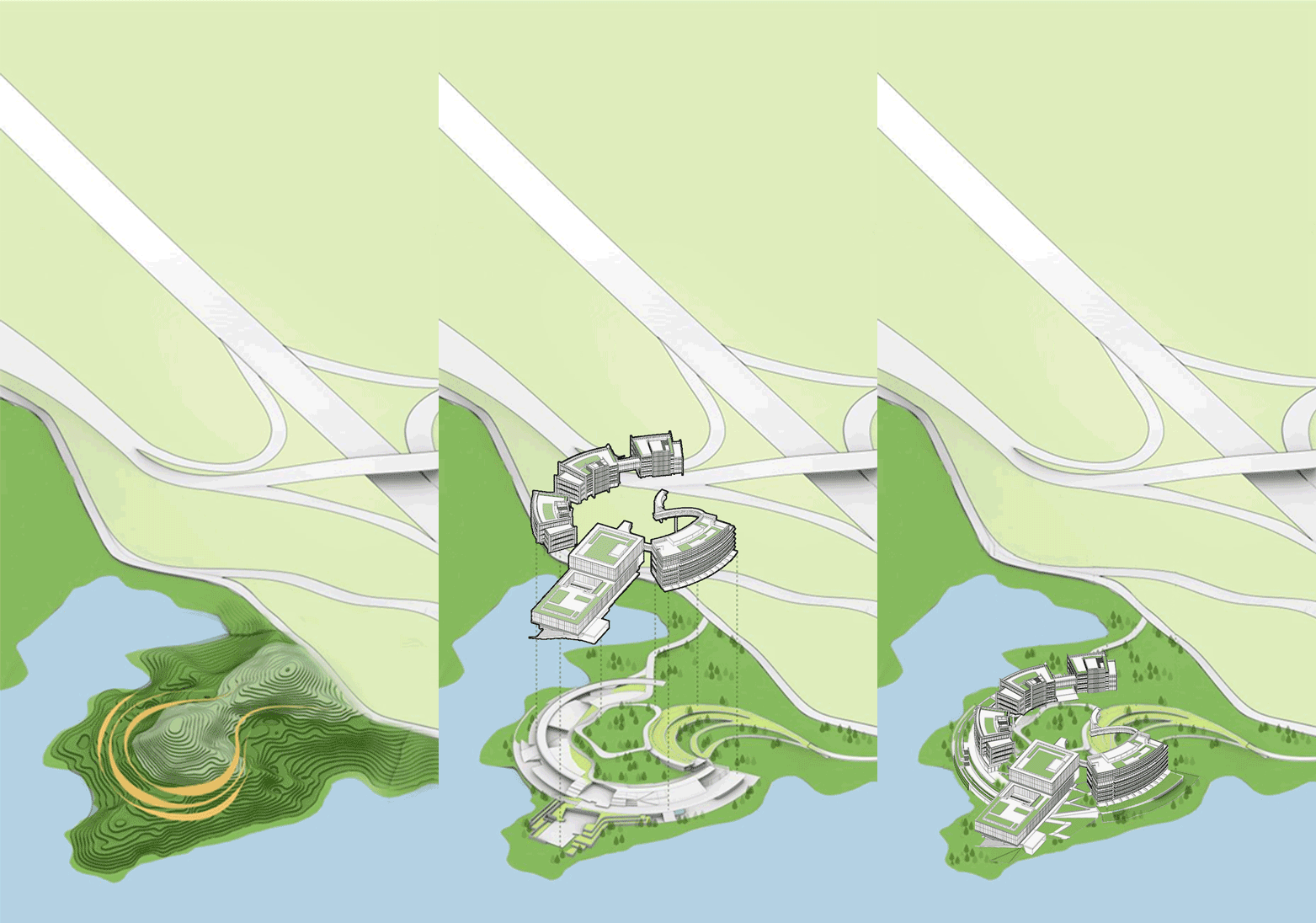
The conventional response to elevation differences in mountainous architecture is essentially a subtractive mindset: reducing three-dimensional terrain to two-dimensional construction land through cutting peaks and filling valleys. The design logic of Island 1 marks a fundamental paradigm shift: redefining terrain from a “construction target” to a productivity tool. The theoretical foundation of this shift is summarized as the concept of “terrain production”: the mountains are no longer external constraints for architectural layout, but the inherent generative mechanism of spatial value. The 33-meter elevation difference is not an obstacle to construction, but a natural coordinate system for vertical functional zoning, landscape distribution, and circulation organization.
▼一号岛鸟瞰,aerial view of Island 1
“留山”其核心不在于“不破坏”,而在于“选择性介入”。通过对场地高程、坡度、汇水线的定量分析,我们精确标定出“不可建设区”与“可干预区”的边界:山顶山脊完整保留,陡坡区域禁止建设,仅在20度以下的平缓地带顺等高线植入功能体块。这一策略的技术实质是“地形骨架的原真性保存”。与常规山地开发中将保留绿地作为“剩余空间”的处理方式不同,慧谷湖的“留山”是剖面设计的起点——建筑体量的分布、高度、朝向均由保留山体的形态反向决定。在一号岛,山顶区域作为生态锚点,不仅未被占用,反而通过架空连廊与建筑形成视线对话;山谷区域被完整保留为峡谷景观带,成为科创之家入口的视觉焦点。在二号岛,常规开发模式会选择平整临湖缓坡以获得最大建筑面积,但我们反向操作:以不可建区域倒推可建区域——将坡度25%以上、汇水线两侧15米范围、原生乔木覆盖率超40%的地块划定为刚性保留区,8栋科创楼全部落位于人工干预已存在的柑橘林退化成台地。地形成为了空间的叙事主体,建筑退居为地形的注释者。
▼一号场地分析图,site analysis
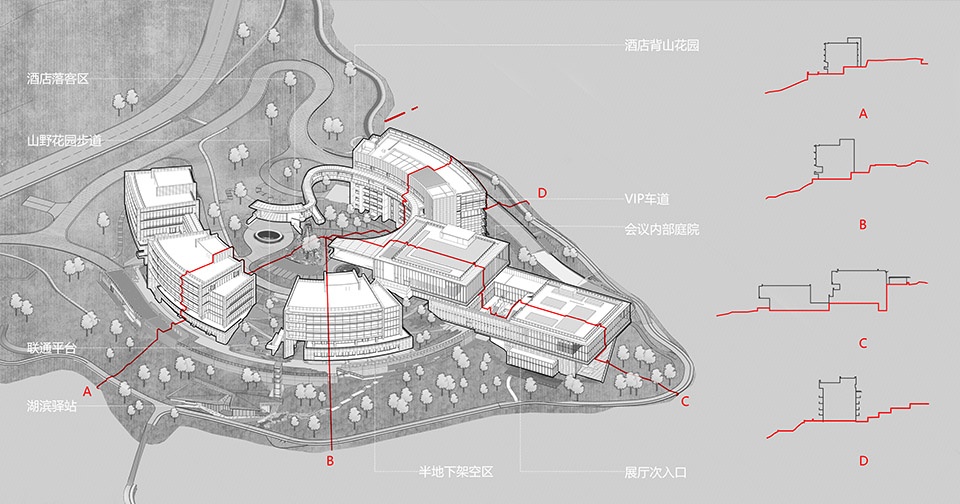
The essence of “preserving mountains” lies not in “non-intervention,” but in selective intervention. Through quantitative analysis of site elevation, slope, and water catchment lines, we precisely define the boundaries between non-development zones and developable zones: mountaintops and ridges are fully preserved; construction is prohibited on steep slopes; functional volumes are only inserted along contour lines on gentle terrain below 20 degrees. Technically, this strategy achieves authentic preservation of the topographic framework.Unlike conventional mountain development, where preserved green space is treated as “leftover area,” “preserving mountains” at Huigu Lake is the starting point of section design: the distribution, height, and orientation of building volumes are determined inversely by the preserved mountain form.On Island 1, the mountaintop serves as an ecological anchor and remains unoccupied, maintaining visual dialogue with buildings via elevated corridors. The valley is fully preserved as a canyon landscape belt, becoming the visual focal point at the entrance of the Sci-Tech Home. On Island 2, conventional development would level gentle lakeside slopes to maximize floor area; we take the opposite approach: defining developable areas by non-development zones. Slopes above 25%, 15-meter buffers along catchment lines, and areas with over 40% native tree coverage are designated as strict preservation zones. All eight sci-tech buildings are placed on terraces formed from degraded citrus groves with existing human disturbance. Terrain becomes the narrative subject of space, while architecture recedes to annotate the land.
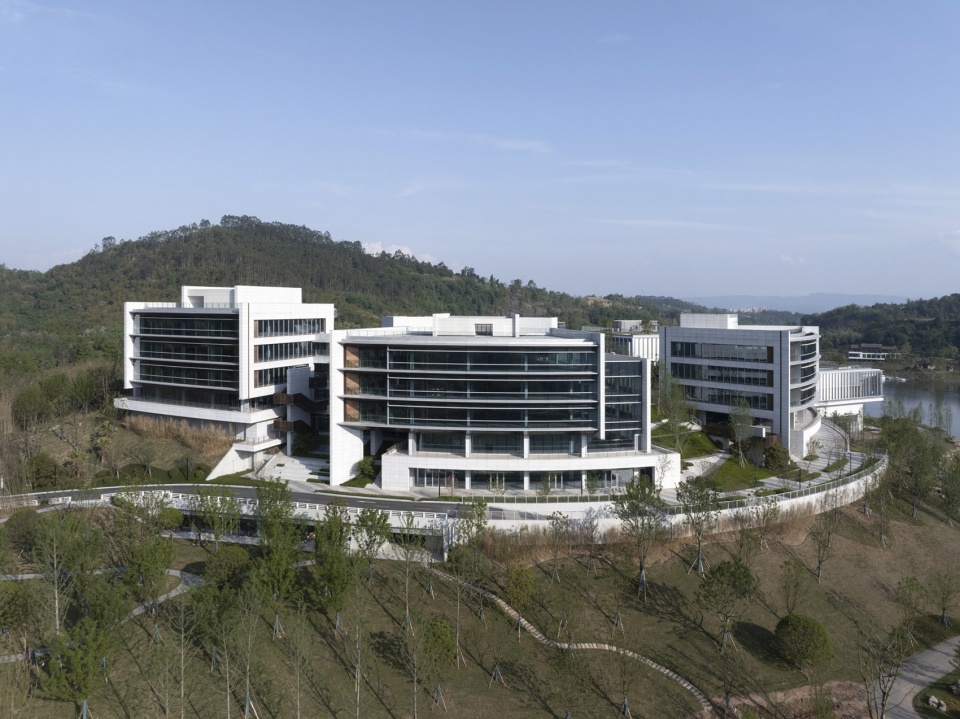
▼一号岛建筑外观,building facade of Island 1
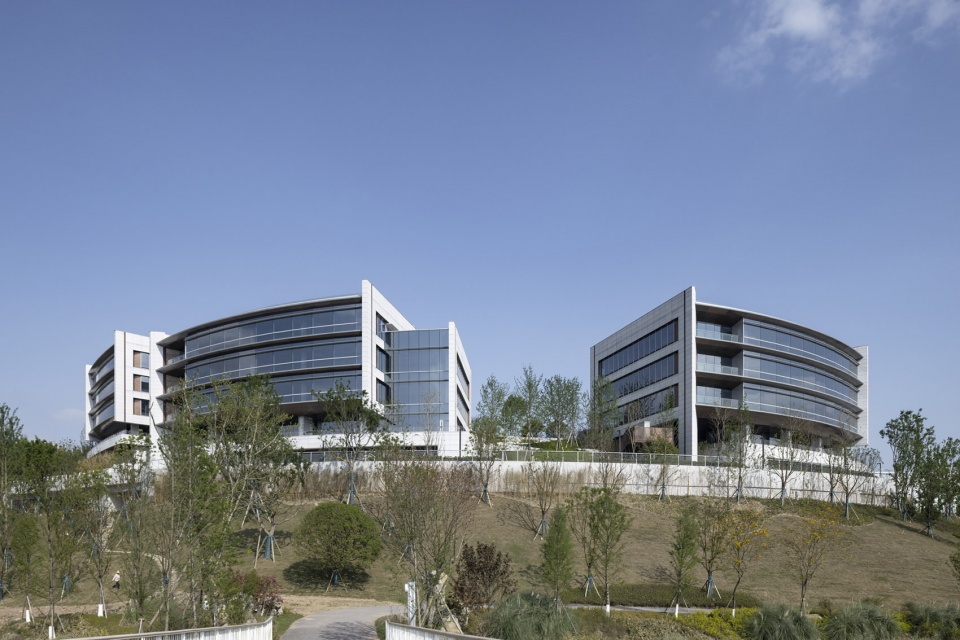
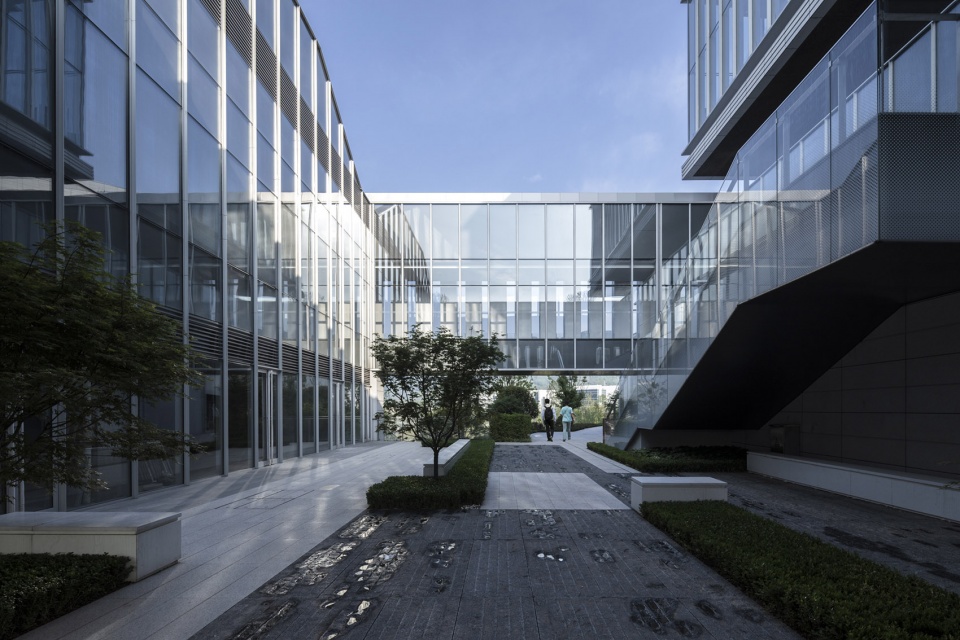
“修台”是对等高线进行空间编程的核心操作。传统山地开发中的“台地”是场地平整的结果——将坡地切割为若干水平台面,建筑落座于台上。一号岛的“修台”在操作逻辑上有本质不同:它不是削山填谷,而是通过立体交通平台的植入,在最小化土方干预的前提下创造建设用地。关键技术突破在于“等高线编程”思维。在一号岛,设计将高差较大区域以退台商业和嵌入式车库“填充”洼地,车库体量采取扁长形态顺等高线延展,仅在山体凹处局部嵌入,两侧设置出入口,既满足功能需求又避免大规模开挖。车库屋顶顺势成为上一层的活动平台,平台之上再植建筑——这是一种“地形的二次生产”:通过人工平台的植入,原始地形被重构为多层级的立体地表,每一层级都与原始等高线保持精确对位关系。在二号岛,我们提出“填谷修台”理念,利用地下车库消化场地下凹区域,形成平整的台地基座。建筑首层与负一层通过坡道与环湖景观相连,平台之间以绿坡与台阶柔和过渡。各栋办公楼通过二层、三层的空中连廊有机串联,形成立体贯通的步行网络,实现高效与体验并存。
“Building terraces” is the core operation of spatial programming of contour lines. In traditional mountain development, terraces result from land leveling: sloped terrain is cut into horizontal platforms for buildings. The logic of “building terraces” on Island 1 is fundamentally different: instead of cutting mountains and filling valleys, construction land is created with minimal earthwork disturbance through the insertion of multi-level traffic platforms. The key technical breakthrough is the thinking of contour programming. On Island 1, recessed commercial spaces and embedded garages “fill” depressions in high slope areas. The garage adopts an elongated form following contour lines, embedded only partially into mountain hollows with entrances on both sides, meeting functional needs while avoiding massive excavation. The garage roof naturally becomes an upper-level activity platform, upon which buildings are further placed—a form of secondary production of terrain. Original topography is restructured into a multi-level three-dimensional ground surface, with each level precisely aligned to the original contour lines.On Island 2, we propose the concept of “filling valleys to form terraces”: sunken garages absorb low lying areas to create a level terrace base. The ground floor and basement level connect to lakeside landscapes via ramps, with gentle transitions between platforms via green slopes and steps. Office buildings are organically linked by sky corridors on the second and third floors, forming a three-dimensional pedestrian network that balances efficiency and experience.
▼一种“地形的二次生产”,a form of secondary production of terrain
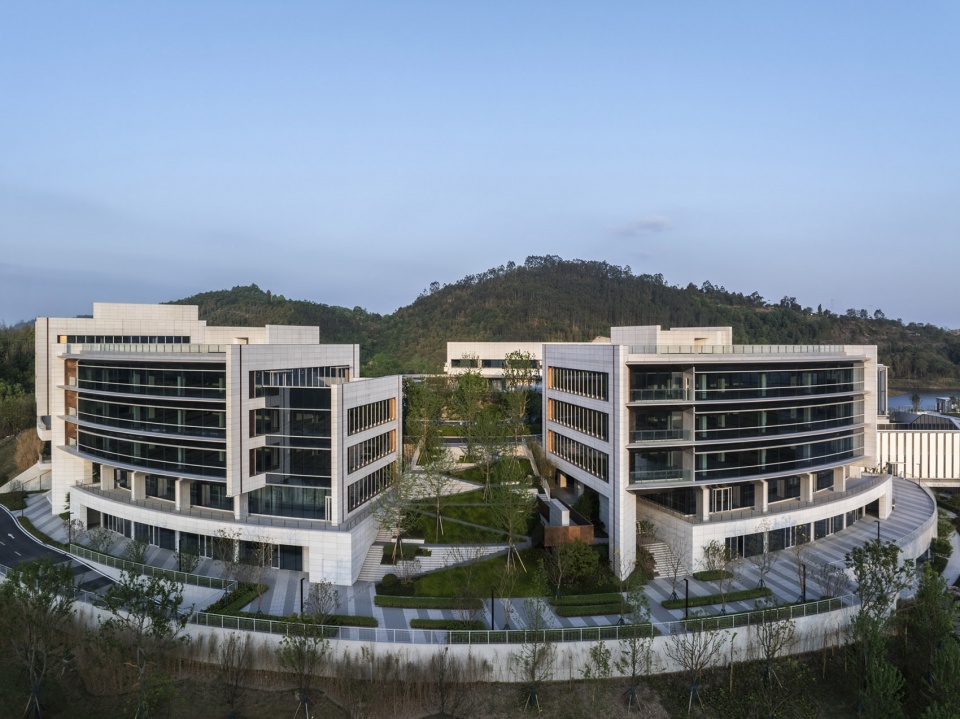
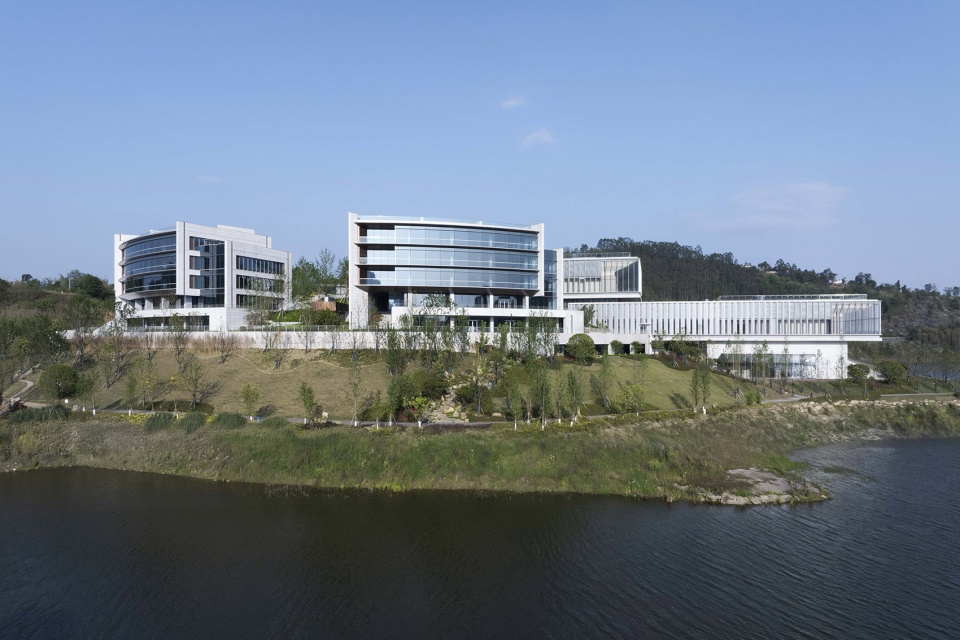
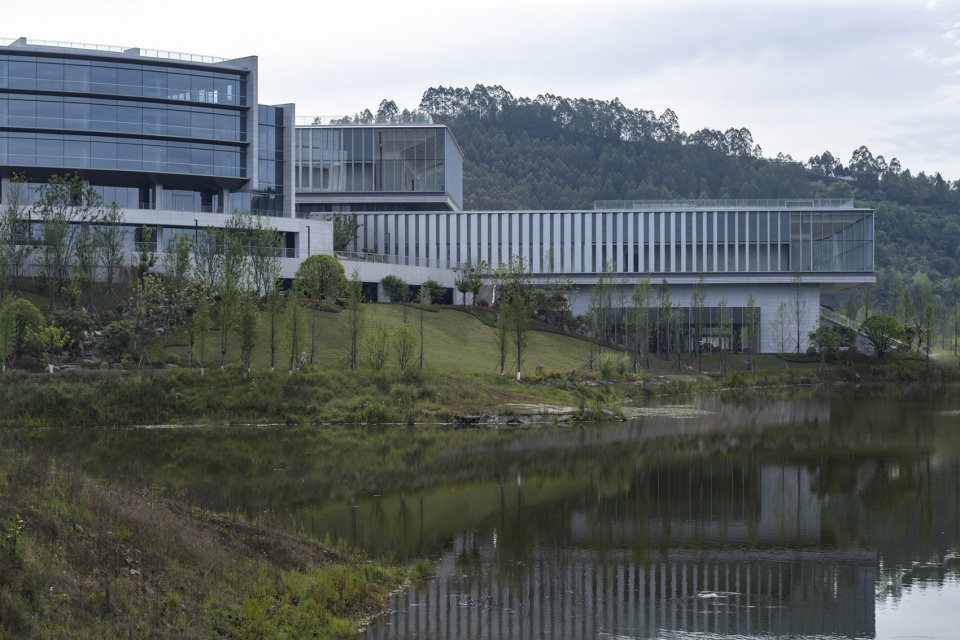
“造景”不是景观设计的后置植入,而是剖面错动的直接结果。当建筑体块沿山势错位布置时,下一层的屋顶自然成为上一层的观景平台,建筑与山体之间的负空间转化为立体庭院,功能体块的间隙生长出室外交流场域。这一机制在一号岛的联合科创中心得到典型呈现。面对凸入湖面的狭长坡地,设计采用“骑等高线”策略:底层设置独立展厅并接入湖面标高,中间层布置会议功能对接办公场地标高,顶层体量平接科创之家配套的多功能厅。三组体块沿等高线逐级退让,错动产生的露台既是观湖平台,也是室外交流场所,更是建筑体量消隐于山体的视觉中介。
“Creating landscapes” is not a post hoc addition of landscape design, but a direct outcome of sectional displacement. When building volumes are staggered along the mountain slope, the roof of the lower level naturally becomes a viewing platform for the upper level; negative spaces between buildings and mountains transform into three-dimensional courtyards; and outdoor communal spaces emerge between functional blocks. This mechanism is exemplified in the Joint Sci-Tech Center on Island 1. Facing a narrow slope projecting into the lake, the design adopts a strategy of “riding contour lines”: the ground floor houses an independent exhibition hall at lake level; the middle floor contains conference spaces aligned with office levels; the top volume connects to the multi-function hall of the Sci-Tech Home. The three volumes set back progressively along contour lines. The resulting terraces serve as lake view platforms, outdoor communication areas, and visual mediators that dissolve building volumes into the mountain.
▼负空间转化为立体庭院,negative spaces between buildings and mountains transform into three-dimensional courtyards
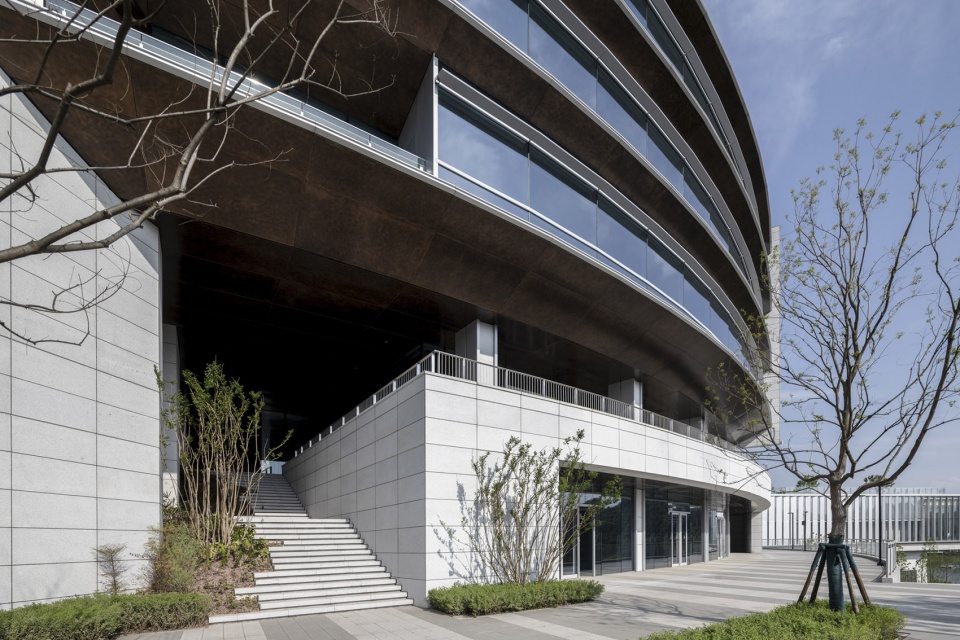
在二号岛,造景即“渗透性景观”,打造视觉通廊。每一栋科创楼均设置“远眺空间”——并非观景平台,而是与核心工作区直接连通的半室外节点。其设计参数具有明确操作性:视窗高宽比≥1:1.8,水平视角覆盖72°-96°,垂直视角同时纳入湖面倒影与天际线。这意味着,使用者不经刻意移步即可在办公状态与山水感知间频繁切换。景观不再是窗外的一幅画,而是工作流程中的认知背景。造景的本质,是将地形视觉化、将视觉功能化。
▼二号场地生成分析图,Island 2 generation
On Island 2, landscape creation means permeable landscape with visual corridors. Each sci-tech building features a “distant viewing space”—not merely a platform, but a semi outdoor node directly connected to core work areas. Its design parameters are highly operable: window aspect ratio ≥ 1:1.8, horizontal viewing angle 72°–96°, vertical view capturing both lake reflections and skyline. Users can shift frequently between working mode and landscape perception without deliberate movement. Landscape is no longer a picture outside the window, but a cognitive background in the workflow. The essence of landscape creation is to visualize terrain and functionalize vision.
▼二号场地鸟瞰,aerial view of Island 2
二、竖向空间控制:“通、透、露、挑”的空间体系 Vertical Spatial Control: The Spatial System of “Connectivity, Transparency, Exposure, and Overhang”
“通、透、露、挑”是重庆山地建筑的四个核心特征,源自干阑建筑应对湿热气候、陡峭地形的千年经验。慧谷湖的设计价值之一,在于将这些经验性建造智慧转译为具有普适操作路径的剖面控制技术。这一转译不是形式模仿,而是对山地建筑空间生产逻辑的理性化提炼。我们认为,“通、透、露、挑”在剖面建筑学框架下可重新定义为四种剖面控制参数:垂直连通系数(通)、视线穿透深度(透)、体量悬挑比率(露)、水平出挑距离(挑)。四组参数构成竖向设计的控制工具,使山地建筑的空间效果从“感觉的把握”走向“精度的控制”。
“Connectivity, Transparency, Exposure, and Overhang” are the four core characteristics of Chongqing’s mountain architecture, derived from the millennial experience of stilt-house architecture in adapting to hot-humid climates and steep terrains. One of the design values of the Huigu Lake project lies in translating this empirical construction wisdom into section-control technologies with universally applicable operational approaches. This translation is not formal imitation, but a rational extraction of the spatial production logic of mountain architecture.We propose that within the framework of sectional architecture, Connectivity, Transparency, Exposure, and Overhang can be redefined as four sectional control parameters: Vertical Connectivity Ratio (Connectivity), Sightline Penetration Depth (Transparency), Volume Exposure Ratio (Exposure), and Horizontal Overhang Length (Overhang). These four parameters form a control toolkit for vertical design, elevating the spatial expression of mountain architecture from subjective perception to precise control.
▼“通、透、露、挑”的空间体系,the spatial system of “connectivity, transparency, exposure and overhang
通Connectivity
“通” 的核心技术成果是多首层系统的建立。常规高层办公建筑中,首层商业价值最高、二层及以上价值递减,垂直方向的价值分布呈单一金字塔结构。山地地形的剖面介入,使这一价值分布模型发生根本性重构。一号岛科创办公区域位于坡度较陡的山体位置,设计借鉴干阑建筑架空做法,使一到三层均可与不同标高场地平接,形成三个独立的“首层”入口。每个首层都拥有独立门厅、独立景观界面、独立场地接入——这意味着原本只有一层具备的地面可达性价值,被复制到三个垂直层级。从产权经济学视角看,这是“地租通过剖面进行再分配”:地形高差转化为了垂直方向的价值级差,每一平方米办公空间的租金定价不再仅由楼层决定,更由与地形的接入方式决定。
The core technical achievement of Connectivity is the establishment of a multi-ground-floor system. In conventional high-rise office buildings, the ground floor carries the highest commercial value, which diminishes on upper floors, forming a single pyramidal value distribution vertically. The sectional intervention of mountainous terrain has fundamentally restructured this model.The sci-tech office zone on Island 1 sits on a steep mountain slope. Drawing on the stilt construction method of traditional stilt buildings, the design allows the 1st to 3rd floors to connect with the ground at different elevations, forming three independent “ground floor” entrances. Each ground floor is equipped with a separate lobby, independent landscape interface, and direct site access—meaning the ground-level accessibility value originally limited to one floor is replicated across three vertical levels.From the perspective of property economics, this represents a “reallocation of land rent through section”. Topographic elevation differences are converted into vertical value differentials. The rental pricing of each square meter of office space is no longer determined solely by floor level, but more importantly by the way it connects to the terrain.
▼建筑有机融入山地地形,building blends into the mountain terrain
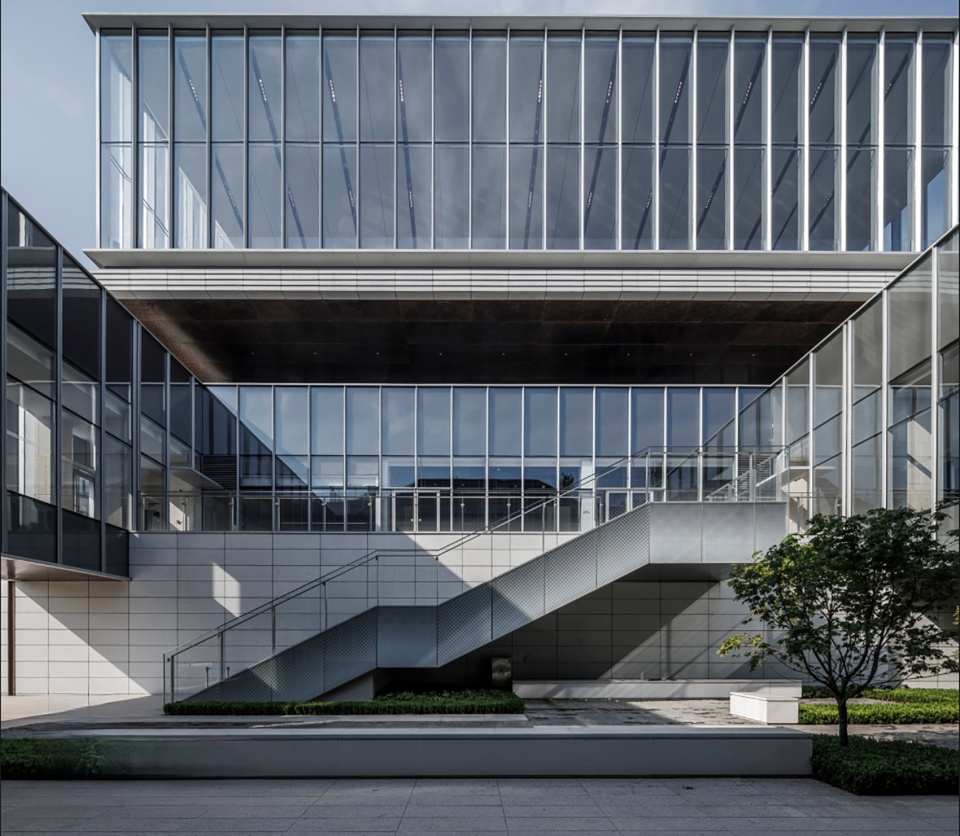
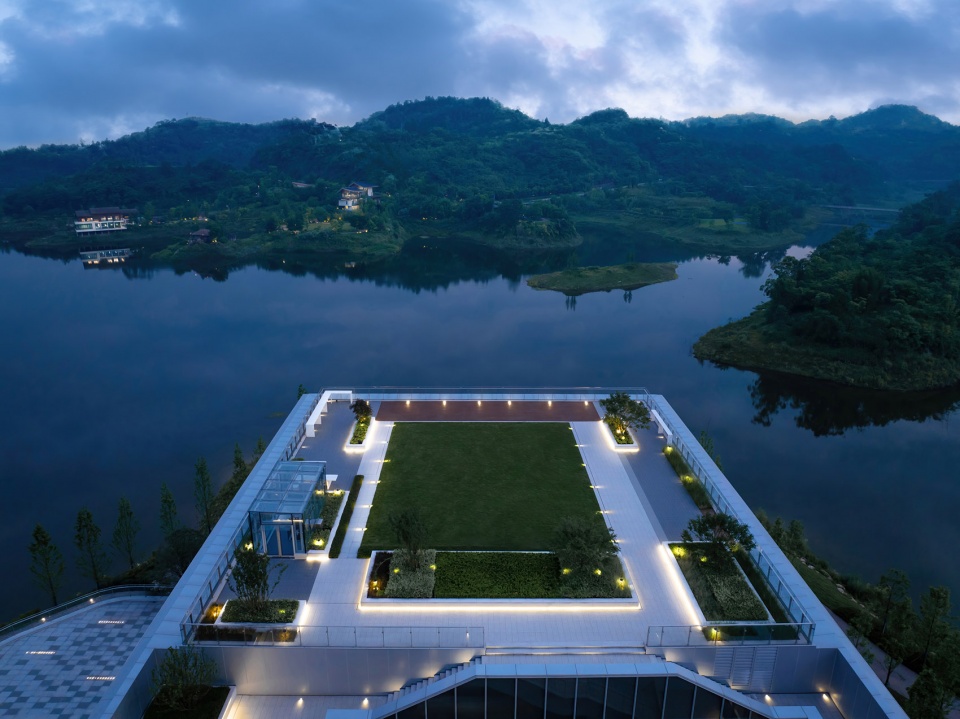
联合科创中心的垂直布局上,建筑以清晰的功能逻辑回应复杂的高差关系:底层展厅独立入户,承接地面人流;中部会议空间与相邻办公区域顺畅衔接,形成功能互联组团;顶层多功能厅与酒店空中通廊平接,获得最为开阔的湖景视野。功能垂直分区与地形高程分级形成精确对位。 建筑形态延续等高线顺应的剖面逻辑。底部体量以折线形态逐步退台,既消解体量感,亦延续山地起伏脉络。整体建筑呈现“轻置于坡地”的视觉状态,与周边环境形成连续地表。
In the vertical layout of the Joint Sci-Tech Center, the building responds to complex elevation changes with clear functional logic: the ground-floor exhibition hall has an independent entrance to accommodate ground-level visitors; the middle-level conference spaces connect smoothly with adjacent office areas to form functionally integrated clusters; the top-floor multi-function hall aligns with the hotel’s sky corridor, offering the broadest view of the lake. Functional vertical zoning is precisely calibrated to topographic elevation levels. The building form follows the sectional logic of conforming to contour lines. The lower volumes adopt a zigzag, stepped-back profile, which reduces visual mass while echoing the undulating rhythm of the mountains. The building appears to “sit lightly on the slope”, forming a continuous ground surface with the surrounding context.
▼中庭空间,courtyard space
▼获得开阔的湖景视野,offering the broadest view of the lake
透 Transparency
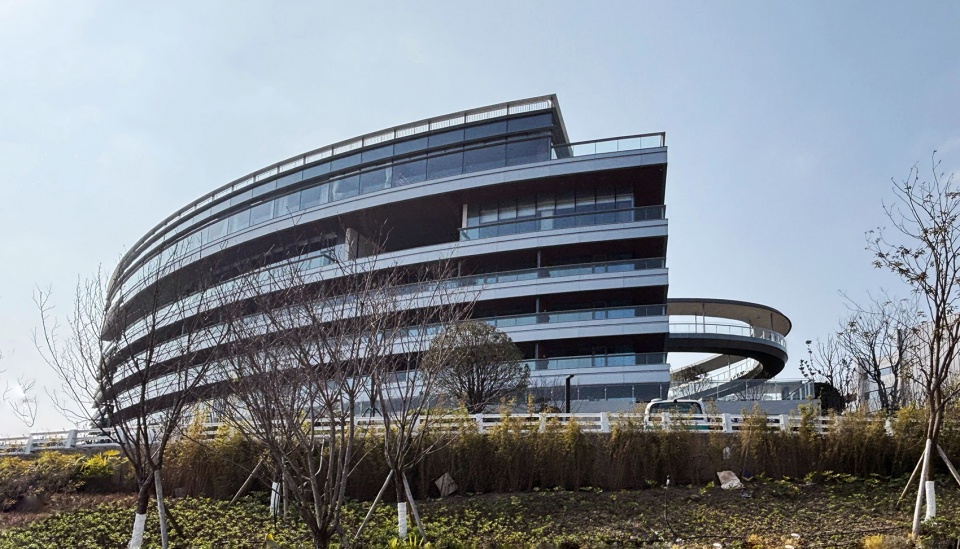
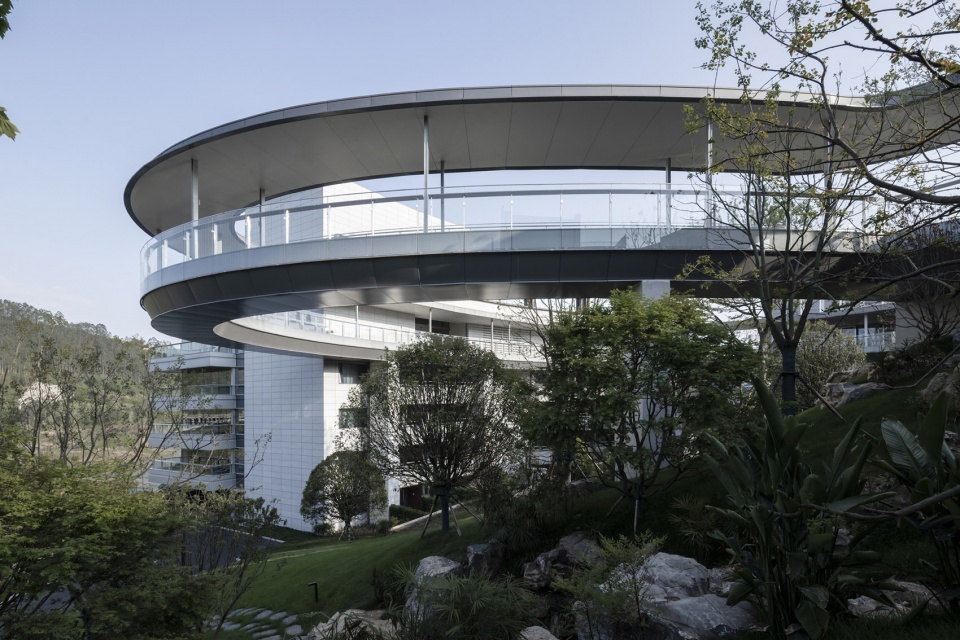
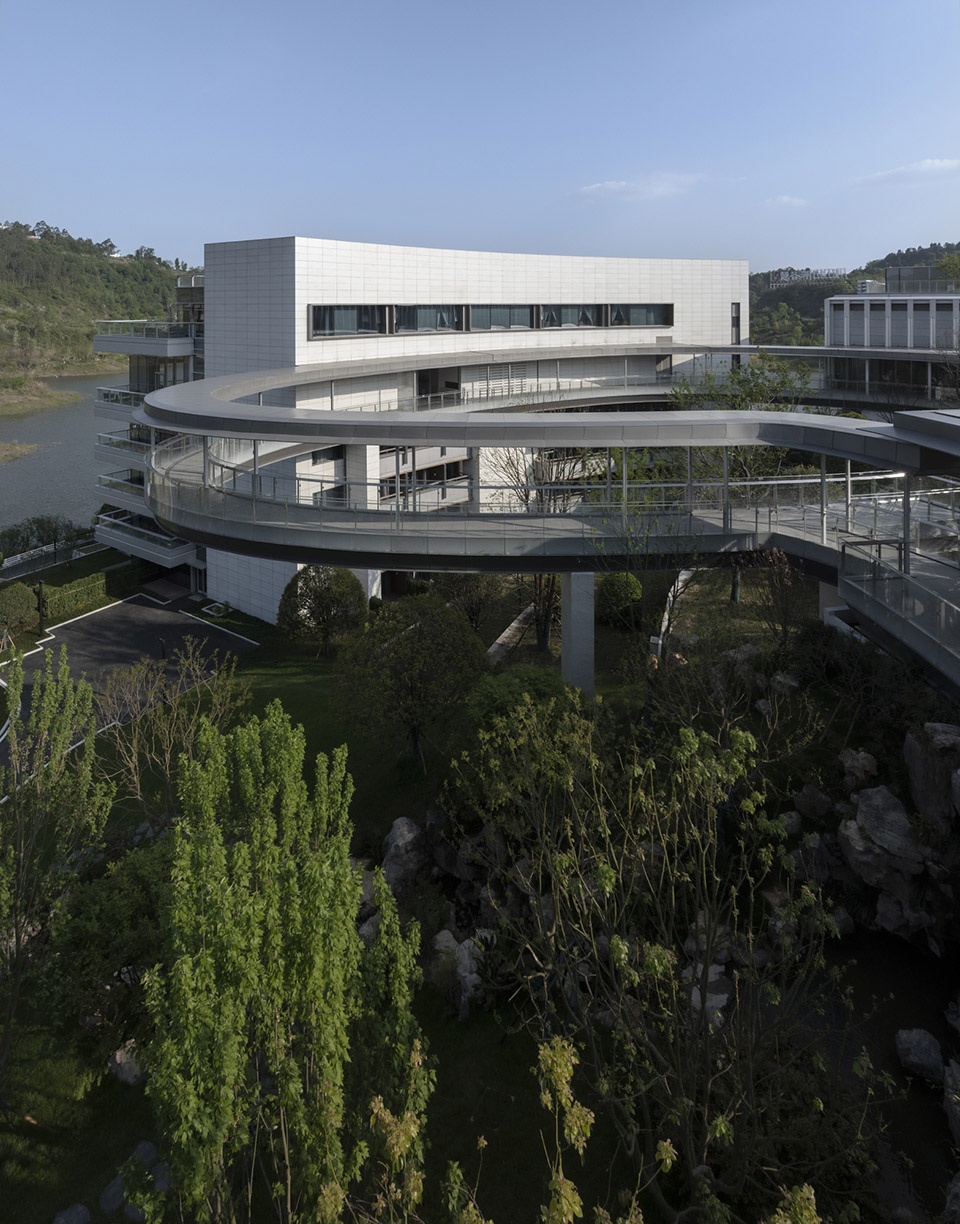
“透” 的极致体现是对视线通廊的剖面编程。一号岛科创之家扇形平面沿湖面展开,每一间客房的玻璃幕墙均以横向为长边,最大化湖景视野覆盖率。视线不再是建筑的附加属性,而是剖面形态生成的直接输入变量。我们以地形为引导,重构空间的叙事逻辑。将通常置于底层的酒店大堂与公共区域置于建筑顶层,并通过一座跨度约35m的C形空中廊桥与入口相连。这一设计看似突破,实则是基于对地势的敏锐阅读:廊桥轻盈跨越山谷,仿佛一道弧线划过山间,既化解了高差,也塑造出进入酒店的第一重仪式感——旅客不再直接步入大堂,而是需经过这座弧形廊桥,在行进中逐渐脱离日常的节奏,视线先是被引向山谷的深邃,继而随着步伐推进,豁然开朗的湖景在廊桥尽头全然展开。
▼一号岛视野设计,view design
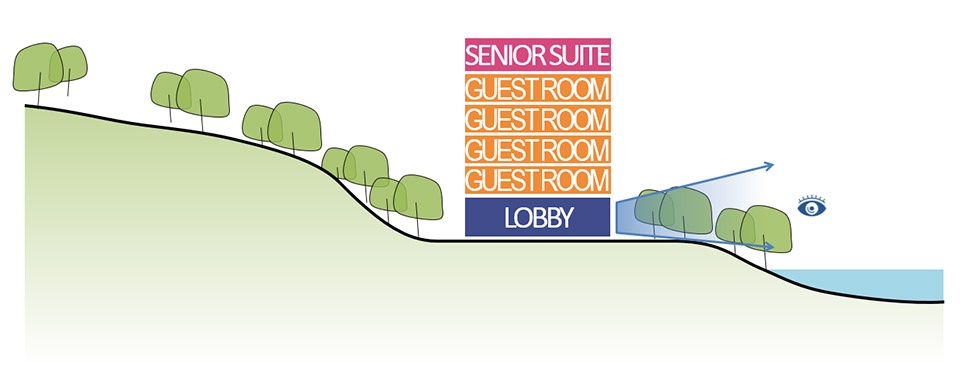
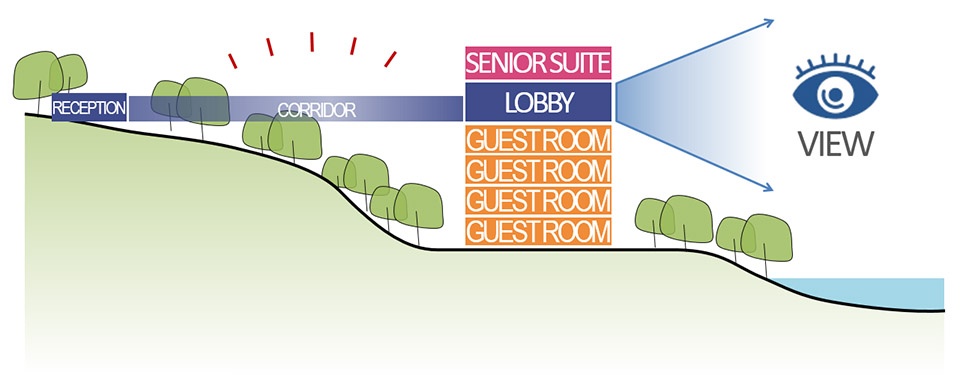
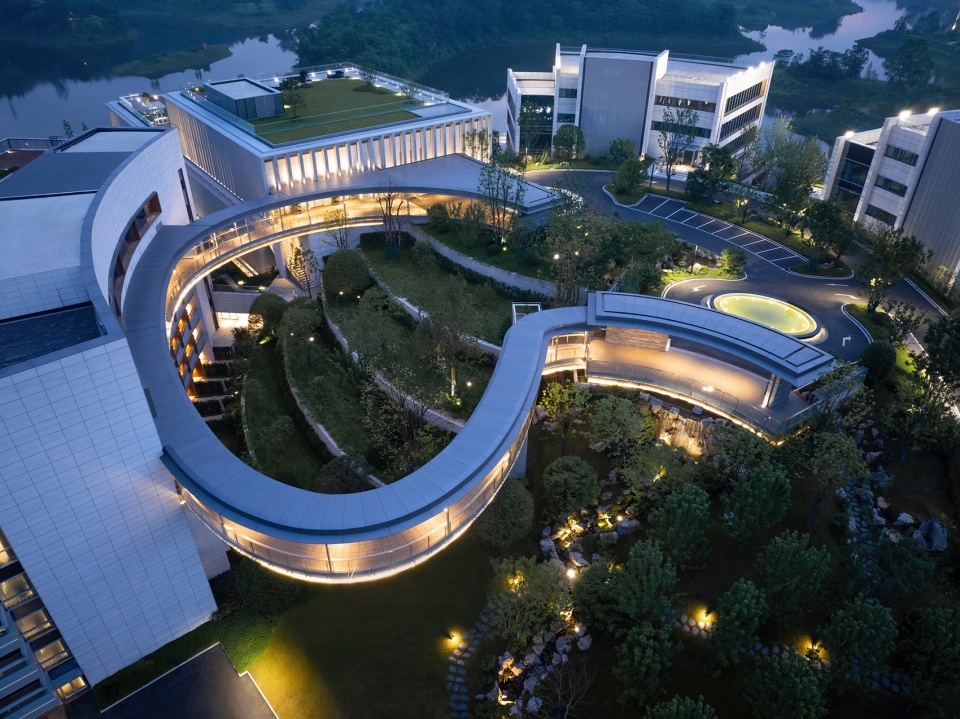
The ultimate expression of Transparency lies in the sectional programming of view corridors. The fan-shaped plan of the Sci-Tech Home on Island 1 unfolds along the lakefront. Each guest room uses horizontally oriented glass curtain walls to maximize lake view coverage. Sightlines are no longer an auxiliary attribute of architecture, but a direct input variable for sectional form generation.Guided by topography, we reconstruct the spatial narrative logic. The hotel lobby and public areas—normally placed on the ground floor—are instead positioned on the top level, connected to the entrance via a 35-meter-span C-shaped sky bridge. This design, though unconventional, arises from a keen reading of the terrain: the bridge lightly spans the valley like an arc across the mountains, resolving elevation differences while creating a ceremonial entry sequence.Guests do not enter the lobby directly; they first traverse the curved bridge, gradually detaching from the rhythm of daily life. Their gaze is first drawn into the depth of the valley, then, as they proceed, the expansive lake view fully unfolds at the end of the bridge.
▼横向玻璃幕墙,horizontally oriented glass curtain walls
▼C形空中廊桥,C-shaped sky bridge
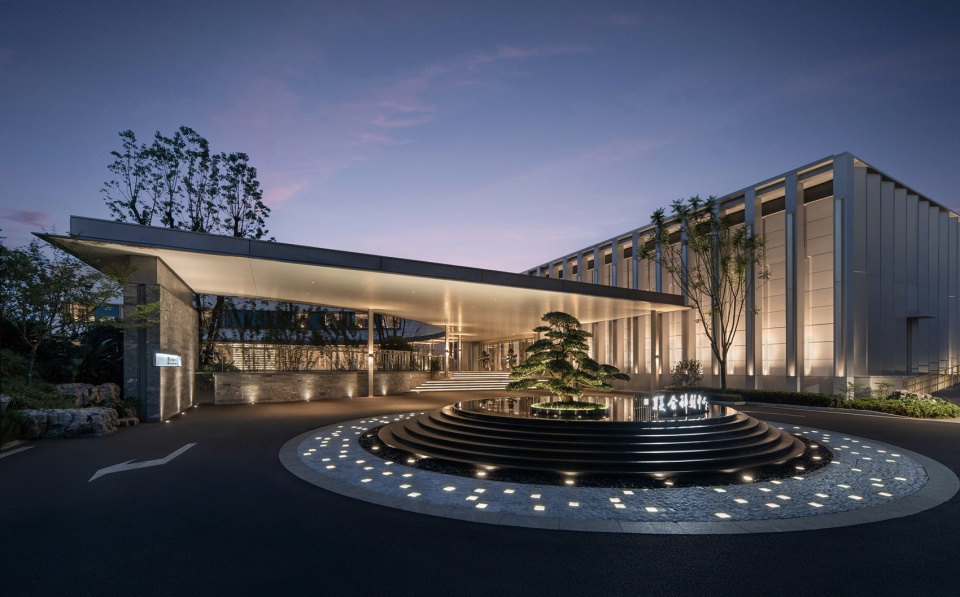
▼塑造出进入酒店的第一重仪式感,creating a ceremonial entry sequence
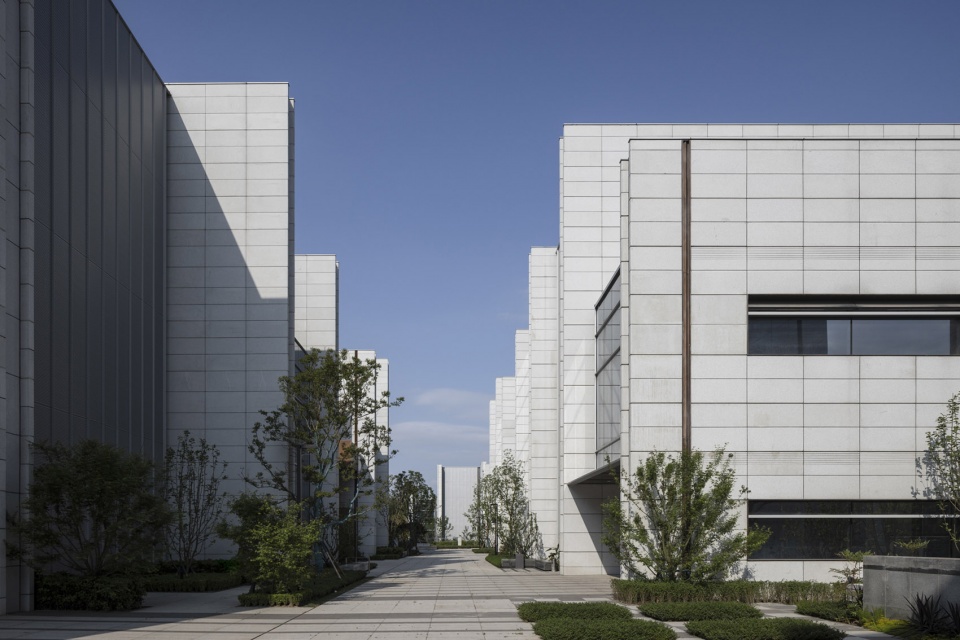
在二号岛,设计以“视觉通廊”与“景观渗透”为核心策略,办公楼栋之间保留恰当间距,形成贯穿建筑群体的视觉通廊。这些通廊由外至内,将外部湖岸的自然野趣逐步过渡到内部庭院的规整绿化,其间通过二层、三层的空中连廊与景观楼梯进行立体串联,在功能连接的同时,也构成观景的行走线索。
On Island 2, the design centers on the strategies of view corridors and landscape penetration. Proper spacing is maintained between office buildings to create visual corridors running through the entire cluster. These corridors transition gradually from the wild natural charm of the outer lake shore to the orderly greenery of inner courtyards. They are three-dimensionally linked by sky bridges on the second and third floors and landscape stairs, serving both functional connections and scenic circulation paths.
▼形成贯穿建筑群体的视觉通廊,create visual corridors running through the entire cluster
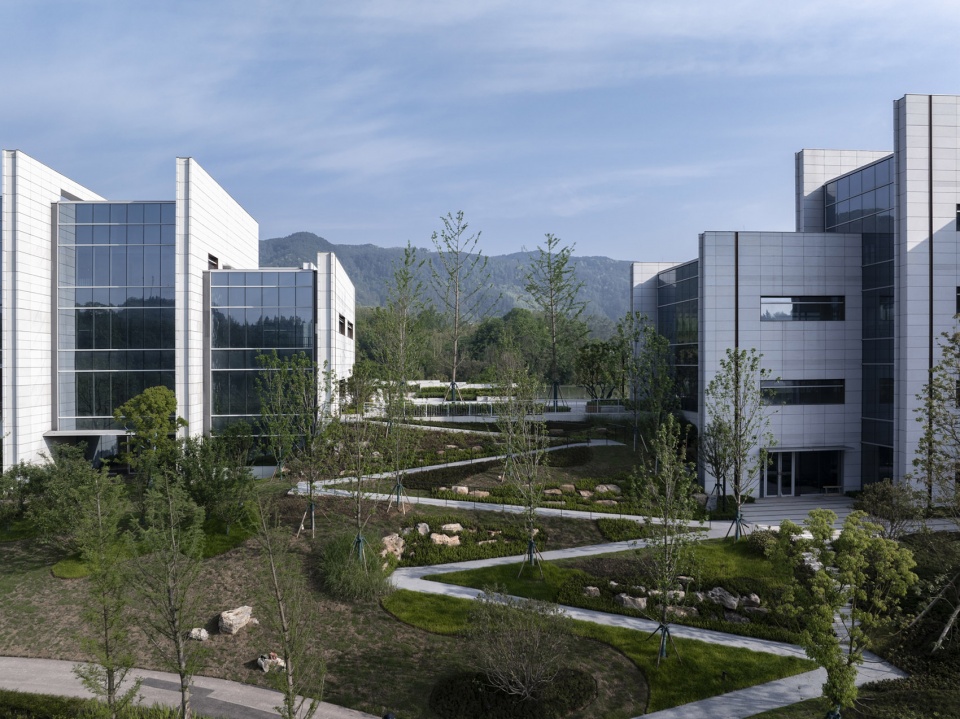
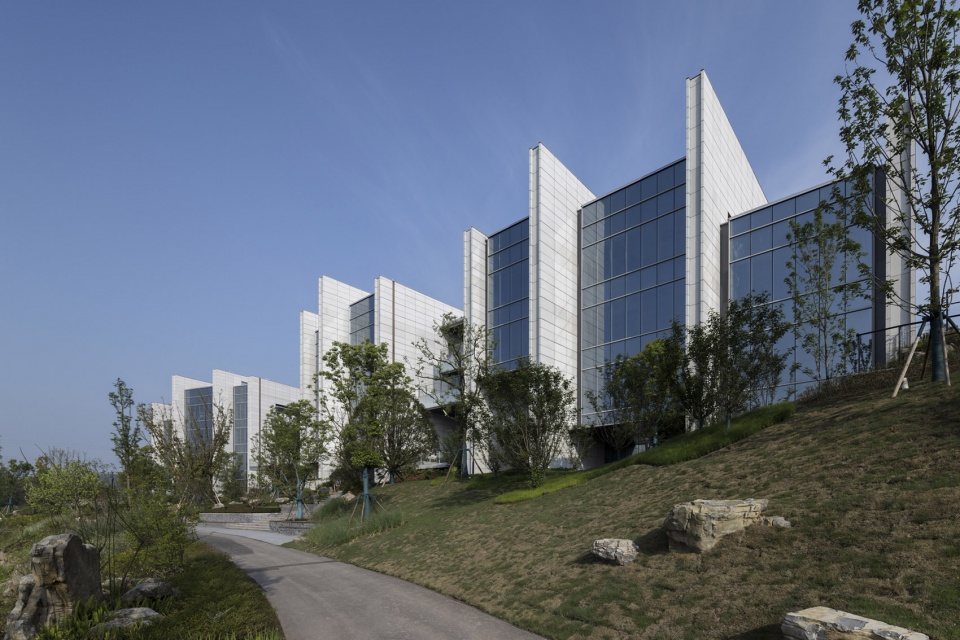
▼将外部湖岸的自然野趣逐步过渡到内部庭院的规整绿化,corridors transition gradually from the wild natural charm of the outer lake shore to the orderly greenery of inner courtyards
“挑”与“露”Overhang & Exposure
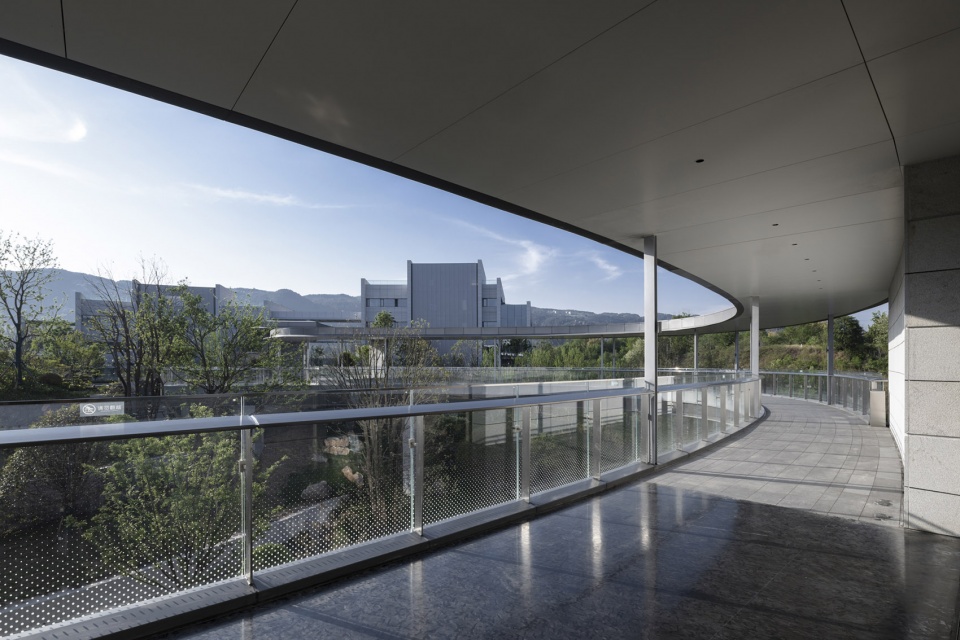
“挑”与“露” 是结构逻辑的真实呈现与水平构件的悬挑延伸。山地建筑为获取景观视野必须出挑,但出挑距离越大,结构构件尺度越大,轻盈感越难保持。这是一对内在矛盾。在一号岛,C形廊桥面对35m跨度与10m出挑所带来的双重挑战,设计放弃了可能影响空间通透感的桁架与斜撑方案,转而采用高度仅1米的扁平箱型梁作为主要水平受力构件,最大限度释放了廊桥行走空间视野;支撑屋顶的竖向结构则选用直径150毫米的纤细十字钢柱,进一步强化了整体结构的空灵意象。靠近酒店一侧,柱子被巧妙整合入客房隔墙体系;临近山体的一端,立柱通过坡地绿植柔化处理,在视觉上逐渐消隐于环境之中。
▼结构细部,structure detail
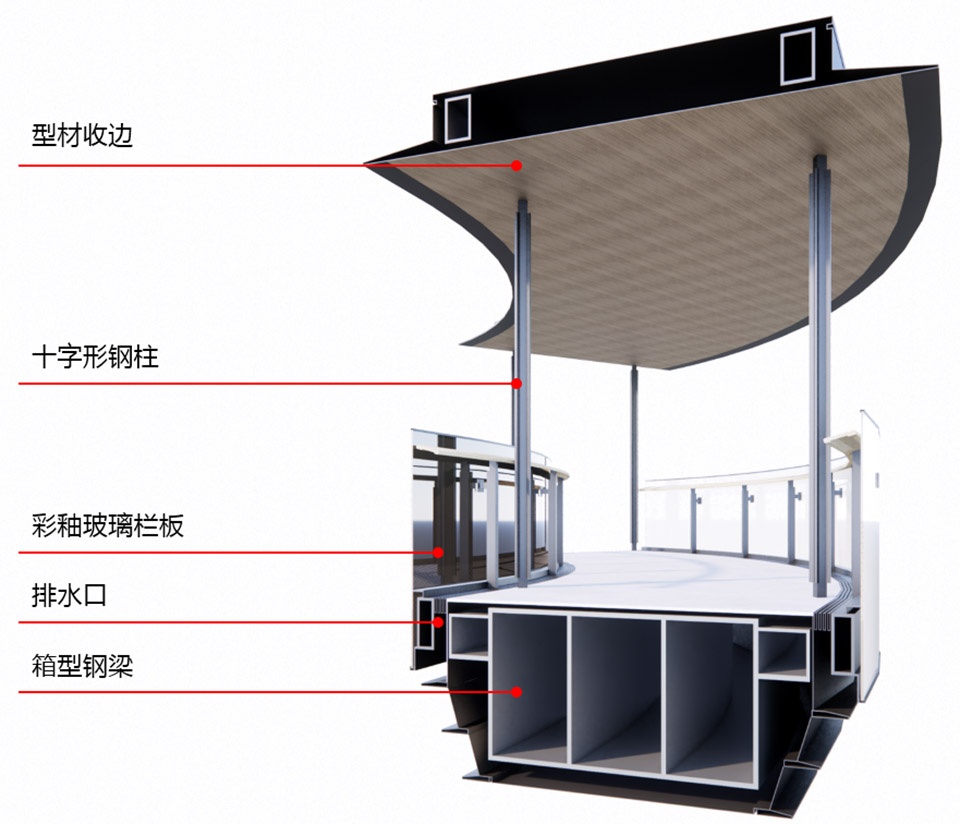
Overhang and Exposure are the honest expression of structural logic and the cantilevered extension of horizontal elements. To maximize landscape views, mountain architecture requires cantilevers; yet the longer the cantilever, the larger the structural members become, making lightness increasingly difficult to achieve. This is an inherent contradiction.On Island 1, the C-shaped bridge faces the dual challenges of a 35-meter span and a 10-meter cantilever. The design abandoned trusses and diagonal braces that would compromise spatial transparency, and instead adopted flat box girders only 1 meter deep as the primary horizontal load-bearing members, maximizing unobstructed views along the bridge. The vertical structure supporting the roof uses slender 150mm-diameter cruciform steel columns, further enhancing the ethereal quality of the overall structure.On the hotel side, columns are subtly integrated into guest room partition walls; at the mountain end, columns are softened by slope vegetation and visually dissolve into the context.
▼最大限度释放了廊桥行走空间视野,maximizing unobstructed views along the bridge
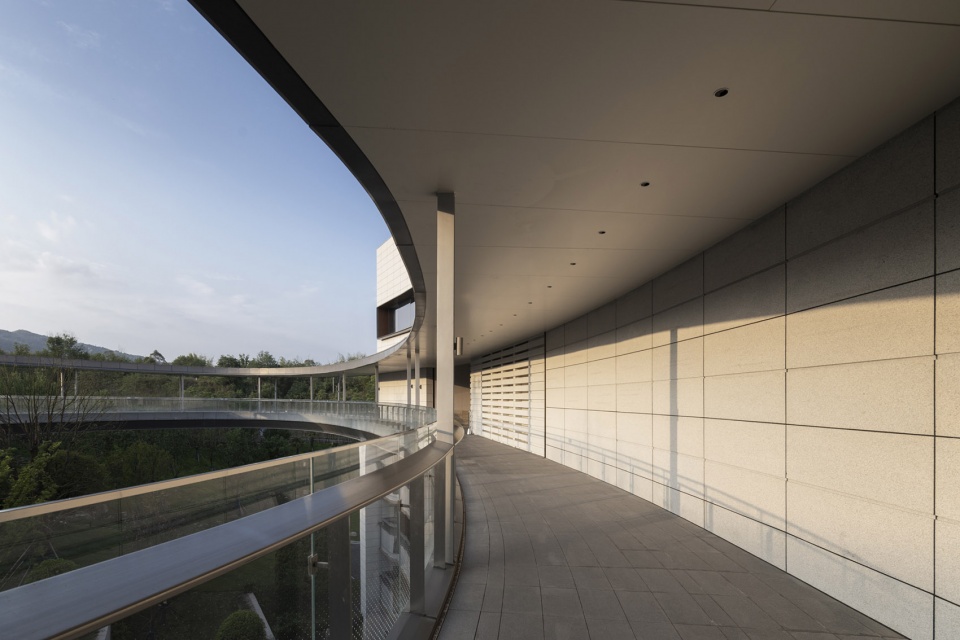
▼强化了整体结构的空灵意象,
enhancing the ethereal quality of the overall structure
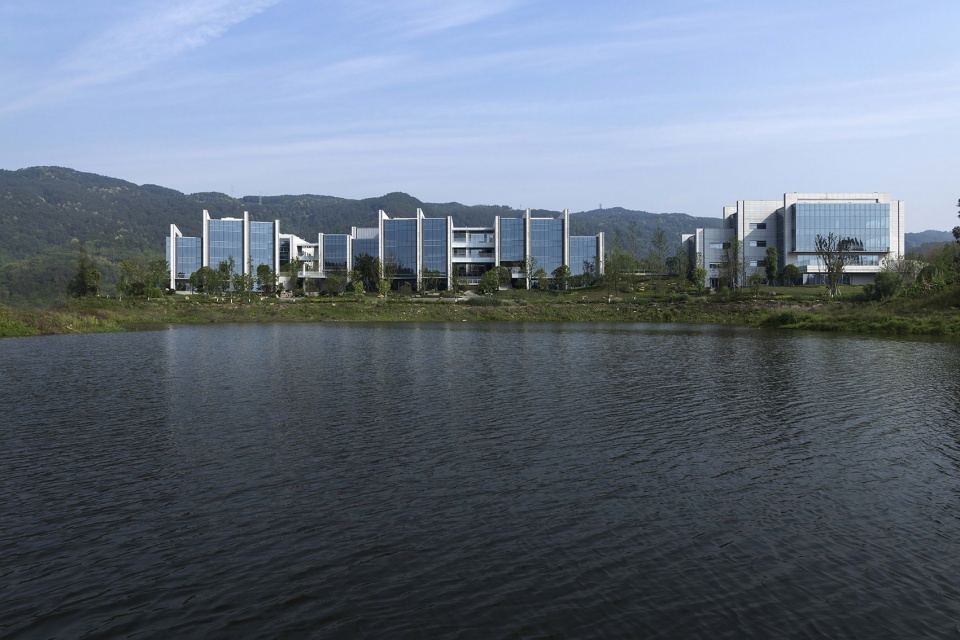
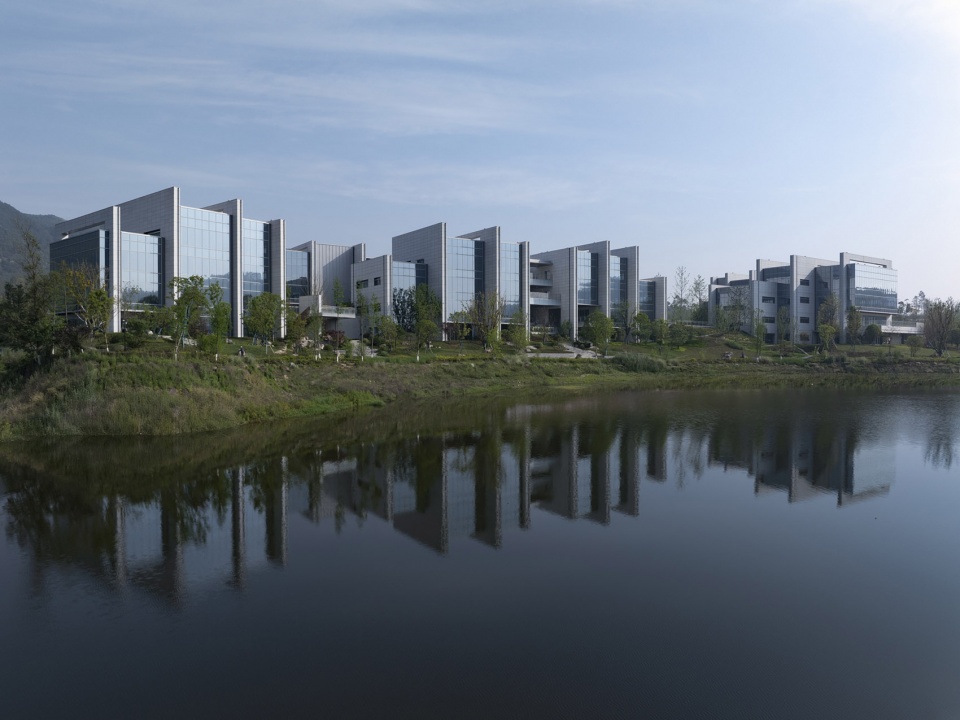
在二号岛,我们将“挑”与“露”组合为连续的视觉语法序列。以临湖立面为例:半室外连廊、架空层、悬挑檐下形成水平线条的连续“挑”;而在悬挑端点,片墙并非全部退后,部分关键节点刻意“露”出,打断水平线条的过度延续。这种“挑-露-挑-露”的交替,在立面上形成类似书写中的断句与停顿——既保持整体流畅,又建立节奏控制。临水片墙间距比例控制在1:1.6至1:2.0之间,形成连续而非离散的界面感知;首层后退形成灰空间,主受力柱向内收进3.0米,视觉上形成“墙体落地而非柱子落地”的错觉;立面采用大片玻璃幕墙与穿孔金属板,模糊结构构件的轮廓线。这三项操作的叠加效应是:建筑下部结构的视觉密度降至感知阈值以下,上部体量由此获得“悬浮”于水面的现象学属性。
On Island 2, we combine Overhang and Exposure into a continuous visual syntax. Taking the lake-facing elevation as an example: semi-outdoor corridors, elevated floors, and cantilevered eaves form a sequence of uninterrupted horizontal “overhangs”. At the cantilever ends, not all panel walls are set back; certain key nodes are deliberately “exposed” to interrupt excessive continuity of horizontal lines. This alternating rhythm of overhang–exposure–overhang–exposure creates pauses in the facade, much like punctuation in writing—maintaining overall fluency while establishing clear visual rhythm.The spacing of lake-facing panel walls is controlled at a ratio of 1:1.6 to 1:2.0, achieving a continuous rather than fragmented interface perception. The ground floor is set back to form a shaded grey space, with primary structural columns recessed 3.0 meters inward, visually creating the illusion that walls touch the ground instead of columns. The facade employs large-area glass curtain walls and perforated metal panels to blur the contours of structural members.The combined effect of these three strategies is that the visual density of the building’s lower structure is reduced below the perceptual threshold, granting the upper volume a phenomenological quality of floating above the water.
▼“悬浮”于水面的意向,a phenomenological quality of floating above the water
三、景观界面:室内空间的地景延伸 Landscape Interface: The Landform Extension of Interior Space
科创之家公区大堂 Public Lobby of the Sci-Tech Home
酒店大堂入口通过内凹镜面水景实现室内外空间衔接,将湖面景致引入室内,形成视觉无界延伸。前台区域面向湖面完全打开,沿窗休闲坐区承载自然光景,空间界面与地景要素形成直接对应关系。
The hotel lobby entrance connects interior and exterior spaces through a recessed mirrored water feature, drawing lake scenery indoors to achieve unbounded visual extension. The reception area opens fully toward the lake, with window-side lounge areas embracing natural light and landscape, establishing a direct correspondence between spatial boundaries and landform elements.
▼通过内凹镜面水景实现室内外空间衔接,connects interior and exterior spaces through a recessed mirrored water feature
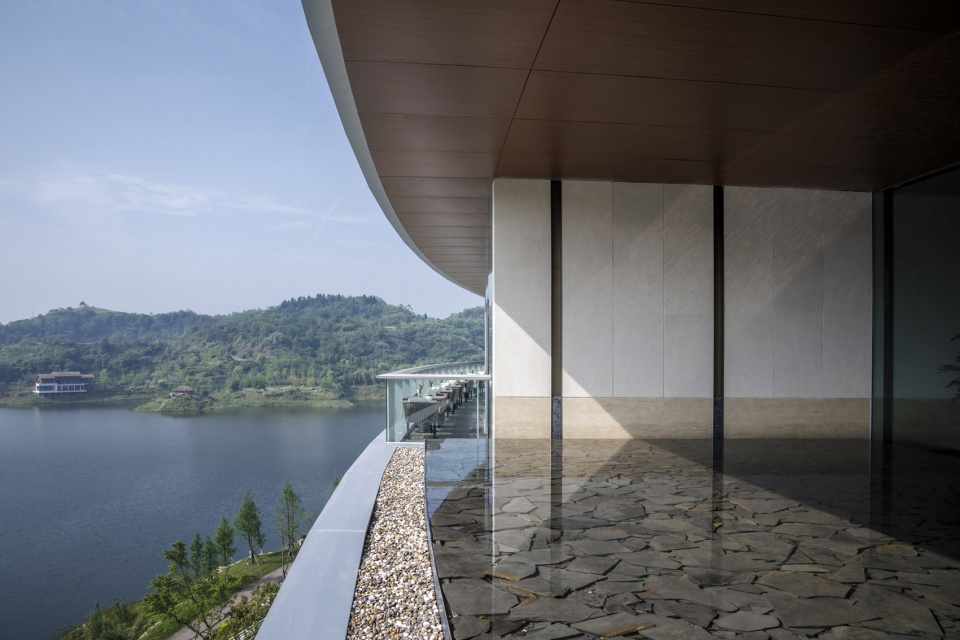
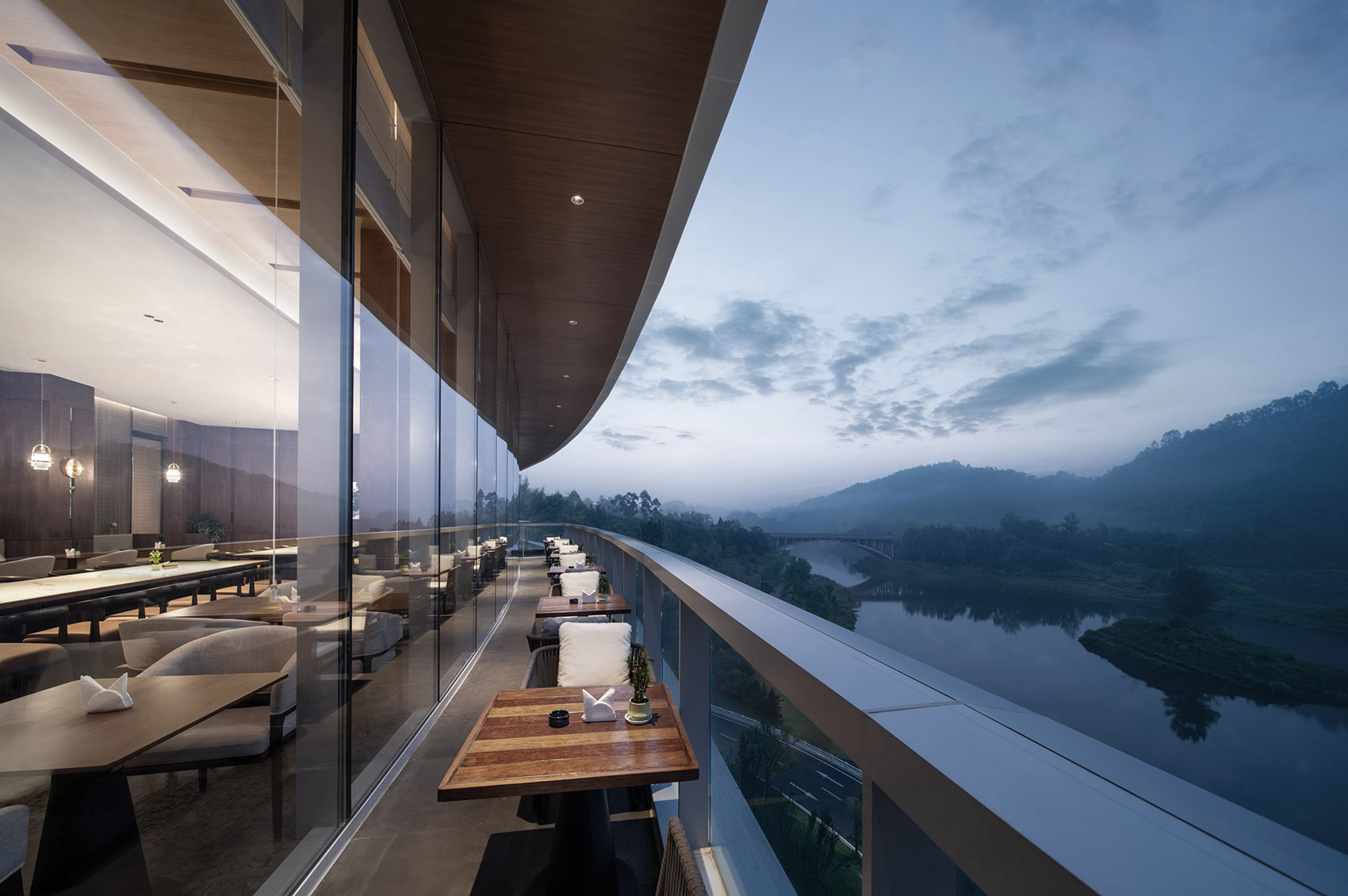
全日餐厅以灰色调与木色铺陈空间基底,拼贴式吊顶局部介入,室外设置外摆区域,实现用餐行为与湖景资源的空间耦合。
The all-day restaurant is grounded in a gray-and-wood tone base. A collage-style ceiling is introduced as an accent, and an outdoor dining area is provided, spatially integrating the dining experience with lake view resources.
▼餐厅外摆区域,outdoor dining area
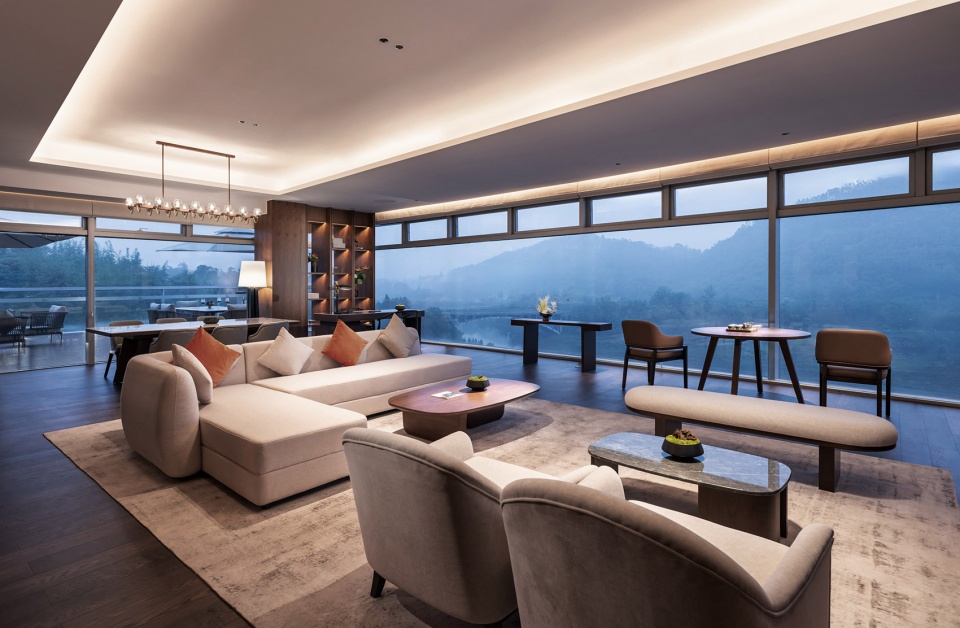
客房设计将湖畔环境特征与科创功能属性并置。室内线条洗练,色调温润,全景落地窗将湖面与远山框入视野。私人阳台作为室内向湖景延伸的过渡空间,完成从人工环境向自然地景的空间层级过渡。
Guestroom design juxtaposes the character of the lakeside setting with the attributes of sci-tech functionality. The interior features clean lines and a warm tone, with panoramic floor-to-ceiling windows framing views of the lake and distant mountains. The private balcony acts as a transitional space extending the interior toward the lake, completing the spatial hierarchy from the built environment to the natural landscape.
▼客房空间,guest room space
联合科创中心前厅Lobby of the Joint Sci-Tech Innovation Center
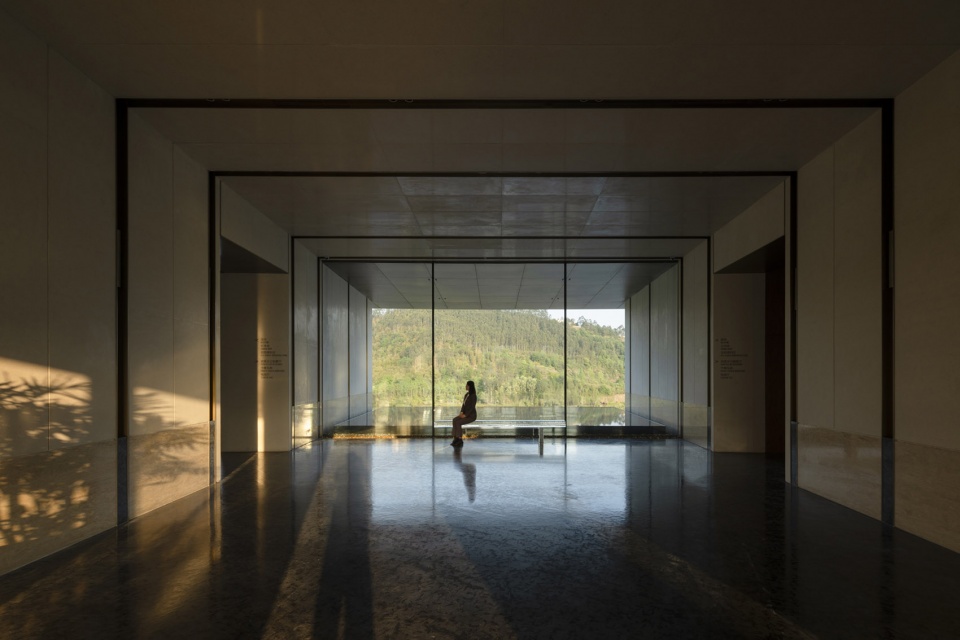
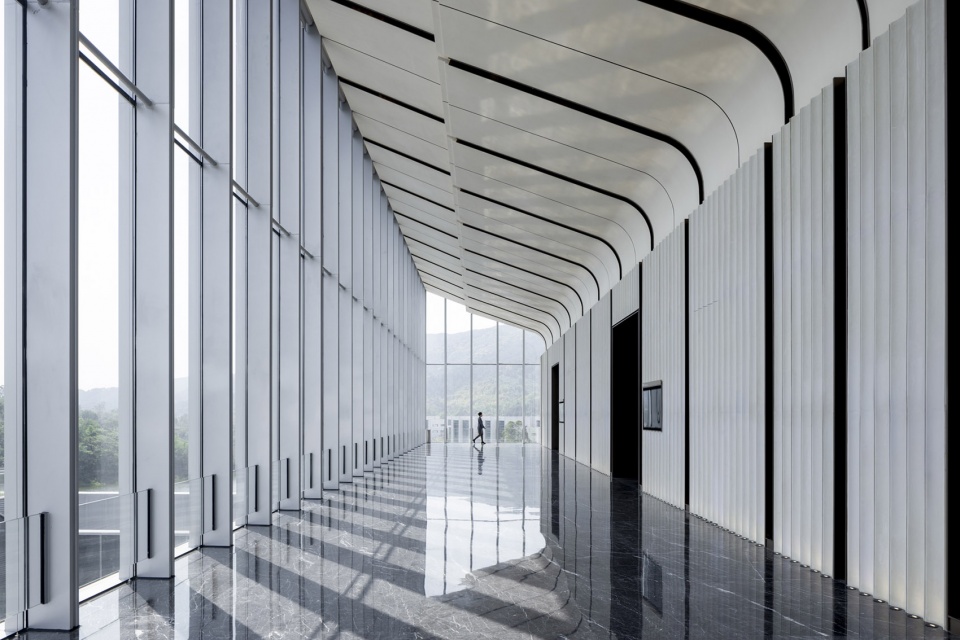
科创中心顶层多功能厅所处地形位置具有特殊性——“凸”入湖面的半岛地形赋予其全景视野条件。为充分响应这一景观资源分布特征,环绕多功能厅的U形前厅朝向湖面展开。室内采用弧形墙顶一体化造型,以连续曲线勾勒空间轮廓,视觉上模糊内与外、人工与自然的边界。墙面饰以波纹肌理,与窗外水光形成材质对话。在此,景观不再是建筑的附加装饰,而是空间形态生成的直接输入变量。
The multi-function hall on the top floor of the Sci-Tech Center occupies a unique topographic setting—a peninsula projecting into the lake, which grants it panoramic views. To fully respond to this landscape asset, the U-shaped lobby surrounding the multi-function hall opens widely toward the lake. The interior features an integrated curved wall-ceiling form that defines the space with continuous lines, visually blurring the boundary between inside and outside, artificial and natural. The walls are finished with a rippled texture that creates a material dialogue with the shimmering water outside. Here, landscape is no longer a decorative addition to the building, but a direct input variable in the generation of spatial form.
▼科创中心顶层多功能厅,the multi-function hall on the top floor of the Sci-Tech Center
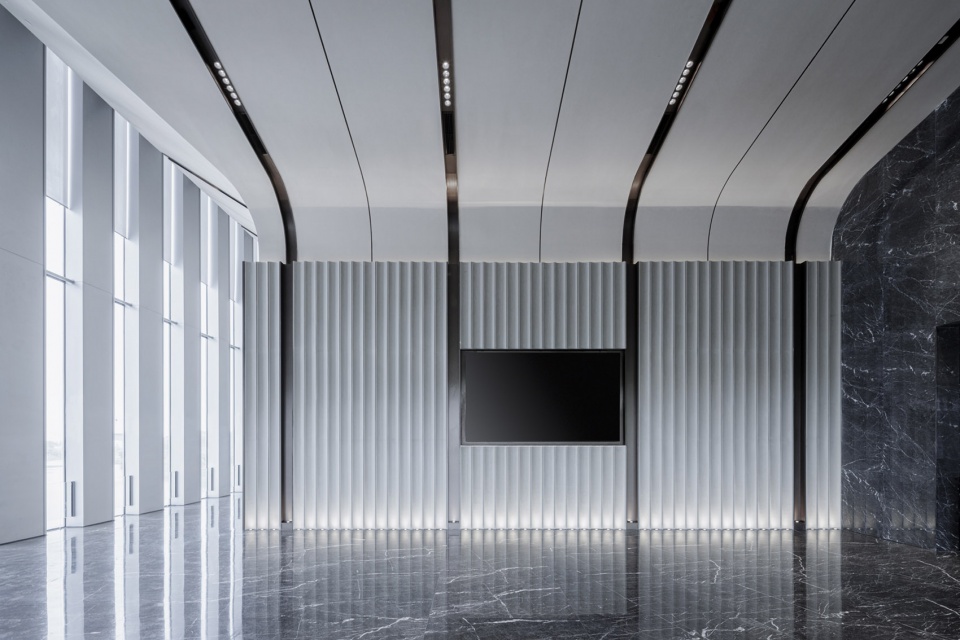
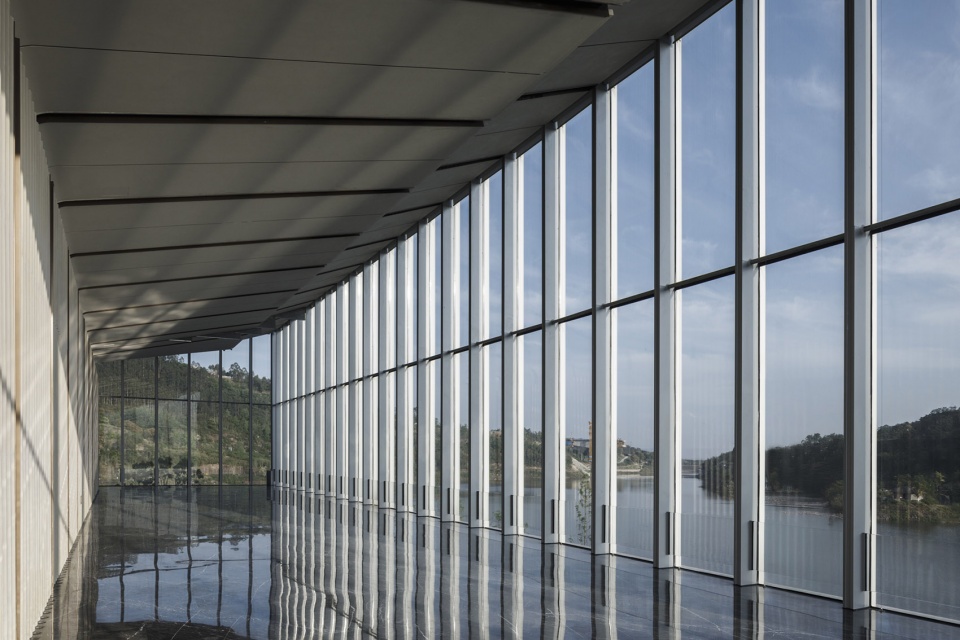
四、建筑表皮 — 人工美学怀抱自然基底 Building Envelope — Artificial Embracing Natural Aesthetics
我们希望建筑呈现简洁而内敛的气质,通过建筑语汇去拥抱自然,将天然的环境作为建筑的第六立面。从层叠的水波里提炼出横向挑檐,把岸边的树林转化成竖向片墙,将这两样作为主要设计元素——就像山间的波纹轻轻荡漾,又如岸边的水杉静静立着,赋予建筑一种与湖光山色自然对话的低调姿态。
We intend the building to convey a simple and restrained character, embracing nature through architectural vocabulary and regarding the natural environment as the building’s sixth facade. Horizontal overhanging eaves are abstracted from overlapping water ripples, while vertical slab walls are derived from the shoreline groves of trees. These two elements serve as the primary design motifs—rippling gently like mountain waves, standing quietly like metasequoias along the bank—endowing the building with a reserved gesture that naturally converses with the lake and mountains.
▼通过建筑语汇去拥抱自然,embracing nature through architectural vocabulary
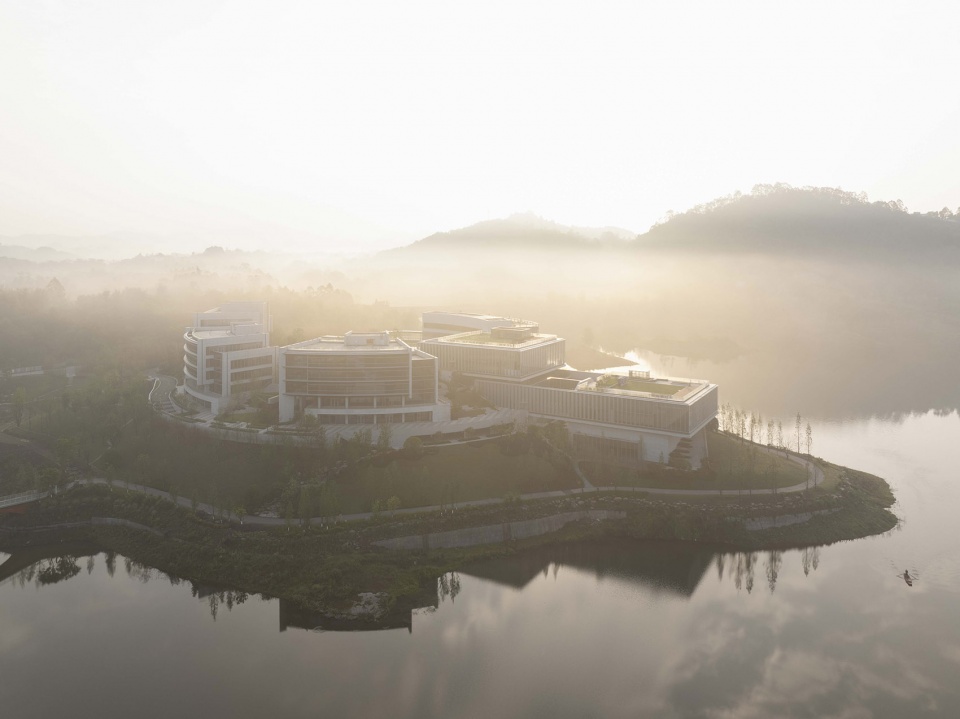
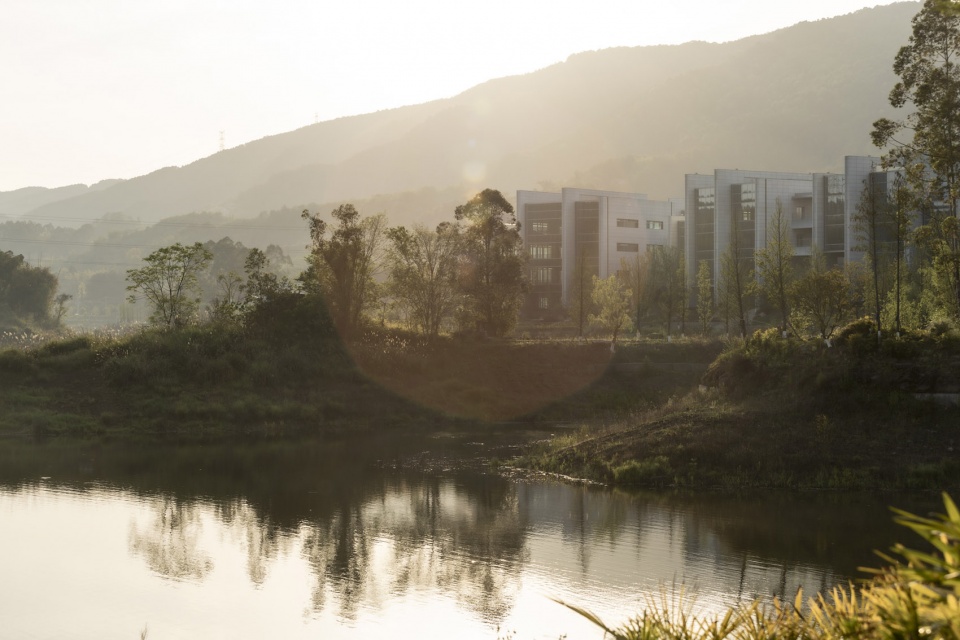
波纹涟漪的立面设计 (一号岛酒店)Facade Design of Rippling Waves (Hotel on Island 1)
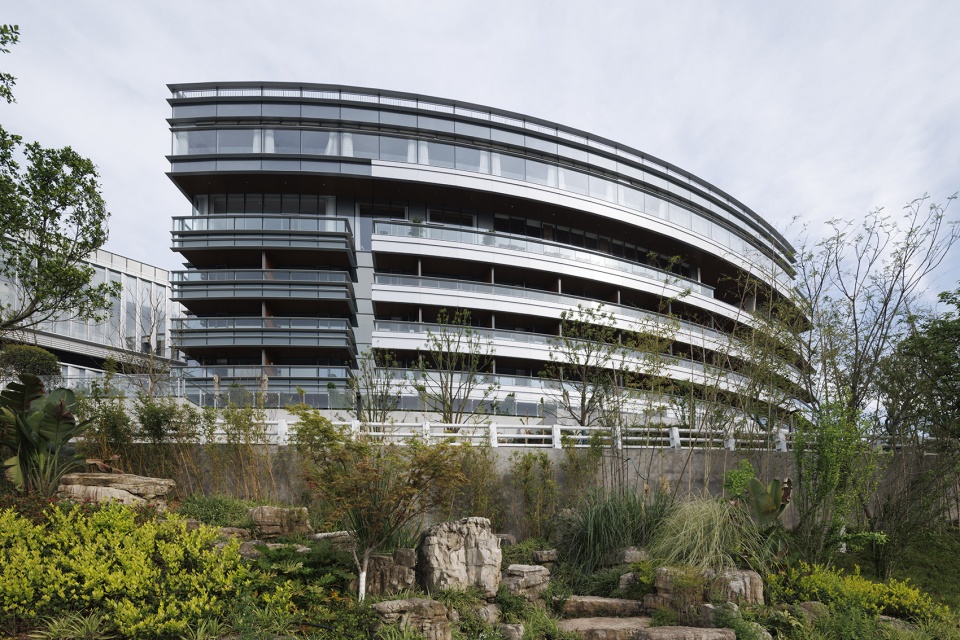
酒店客房立面以湖面荡漾纹理为原型,抽象为层次化的横向线条系统。在构造层级上,横向线条系统呈现清晰的建造逻辑:顶部线条转化为栏杆扶手,兼顾安全与视觉延续性;层间部分选用银白色铝板,表面覆以波纹肌理,在漫射光条件下呈现水光反射效应;出挑横向飞片进一步强化立面轻盈感。阳台区域以木色吊顶营造近人尺度界面,隔板采用深灰色铝板,在保证功能的前提下退居为横向构图的背景要素。
▼横向线条系统细部,horizontal system detail
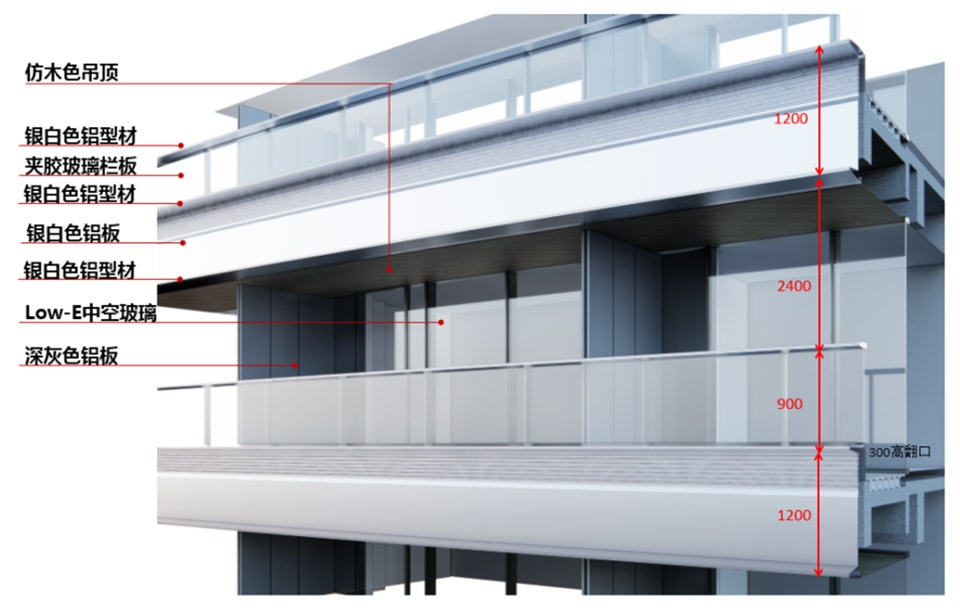
The hotel guest room facade takes its inspiration from the rippling texture of the lake, abstracted into a layered system of horizontal lines. Structurally, this horizontal system follows a clear construction logic: the top line is integrated into balcony railings, balancing safety and visual continuity. Intermediate floor levels use silver-white aluminum panels with a rippled surface finish, creating a water-reflective effect under diffused light. Cantilevered horizontal fins further enhance the lightness of the elevation.Balcony areas feature wood-toned ceilings to establish a human-scaled interface, while partitions use dark gray aluminum panels that recede into the background of the horizontal composition while fulfilling functional requirements.
▼酒店客房立面,the hotel guest room facade
云意漂浮的立面设计(一号岛联合科创中心)Facade Design of Cloudlike Floating Volumes (Joint Sci-Tech Center, Island 1)
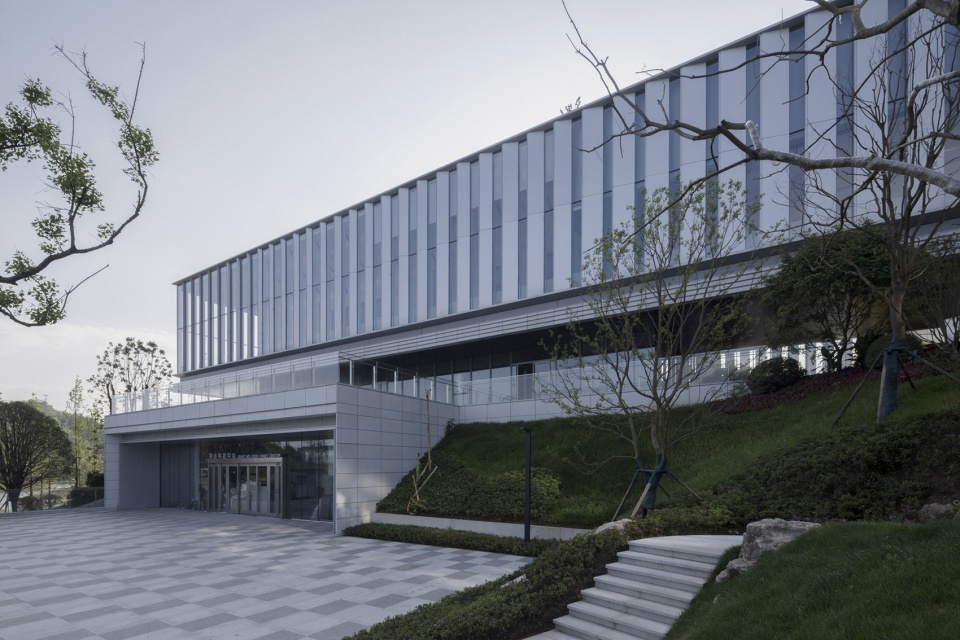
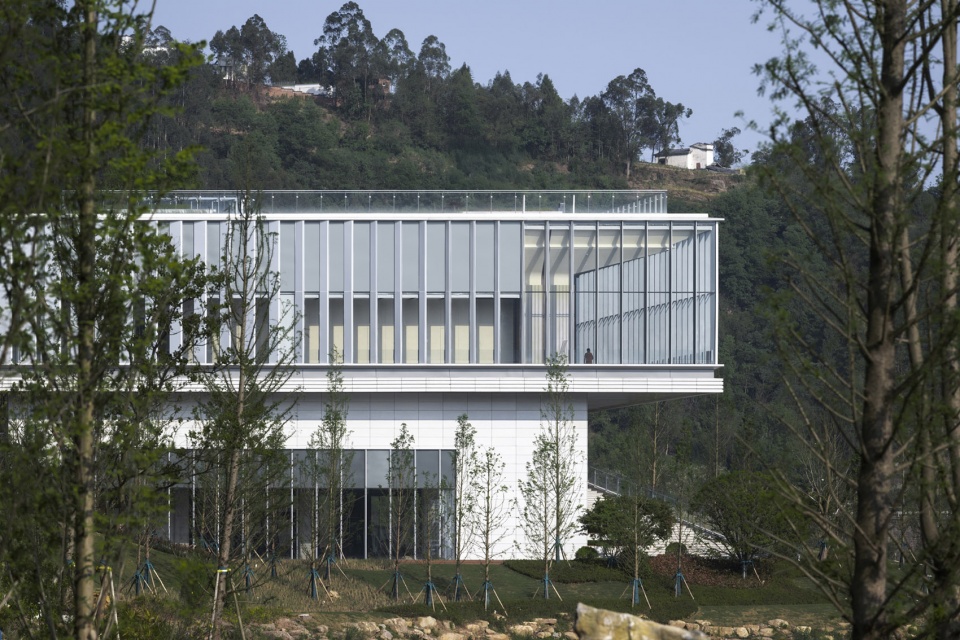
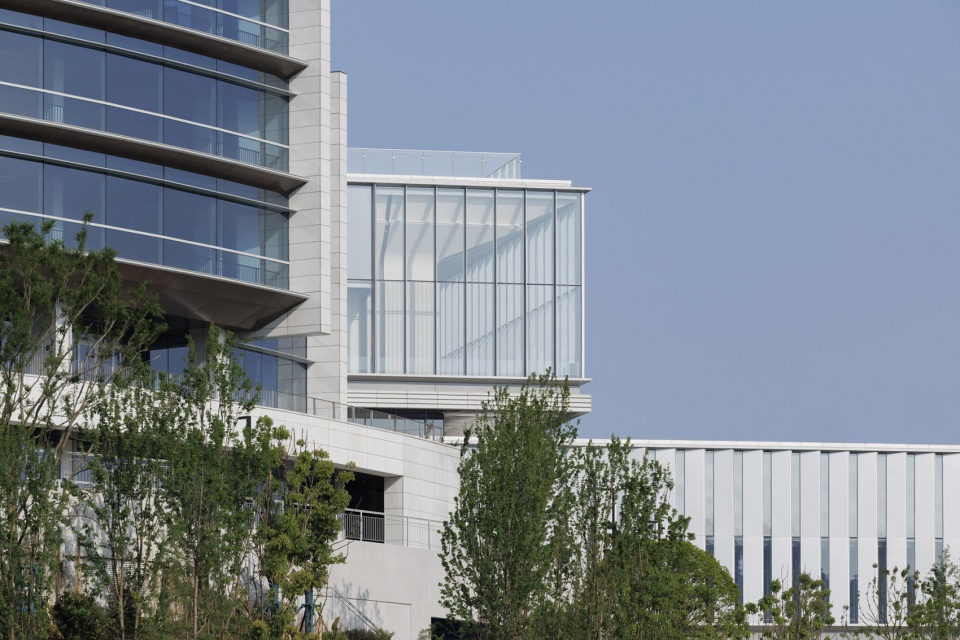
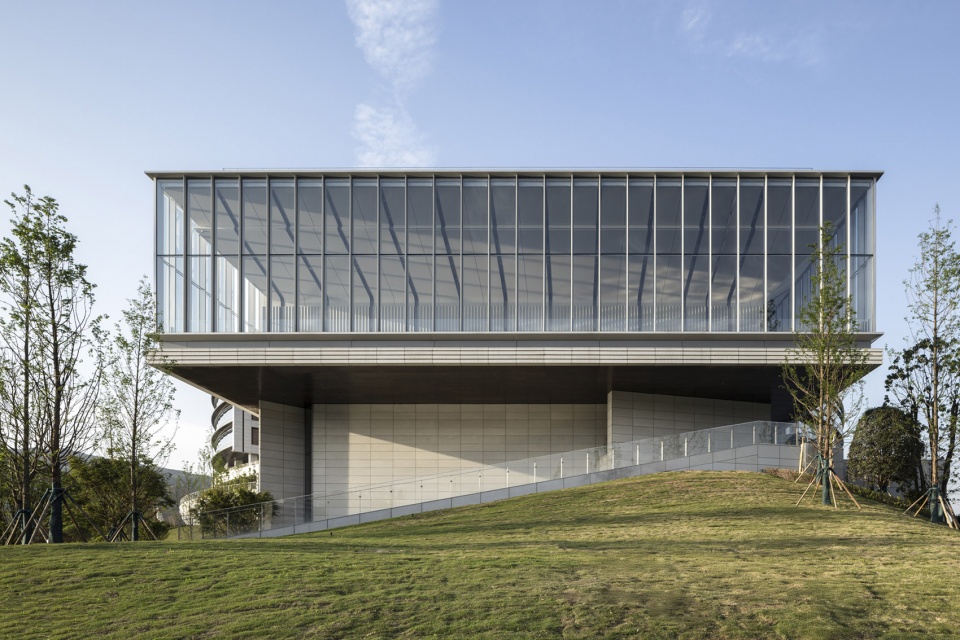
联合科创中心立面从重庆多云多雾的自然气候特征中提取意象资源。通过体量的悬浮处理、大面通透玻璃与渐变竖向线条的组合,塑造出“山中云”漂浮于山麓的建筑形象。为实现极致轻巧的视觉效果,设计贯彻“室内外一体化”理念。在斜面吊顶与玻璃幕墙交接处理上,采用变截面钢结构,将收口尺寸压缩至极限,最大程度削弱吊顶对幕墙视觉连续性的干扰。面对层高较高、玻璃尺寸过大的技术挑战,幕墙采用上下双玻璃拼接方式,单块玻璃面积控制在6平方米以内;拼接处选用纤细胶条衔接,在保证结构安全的同时强化立面的通透感与连续界面。
▼立面细部,the facade detail
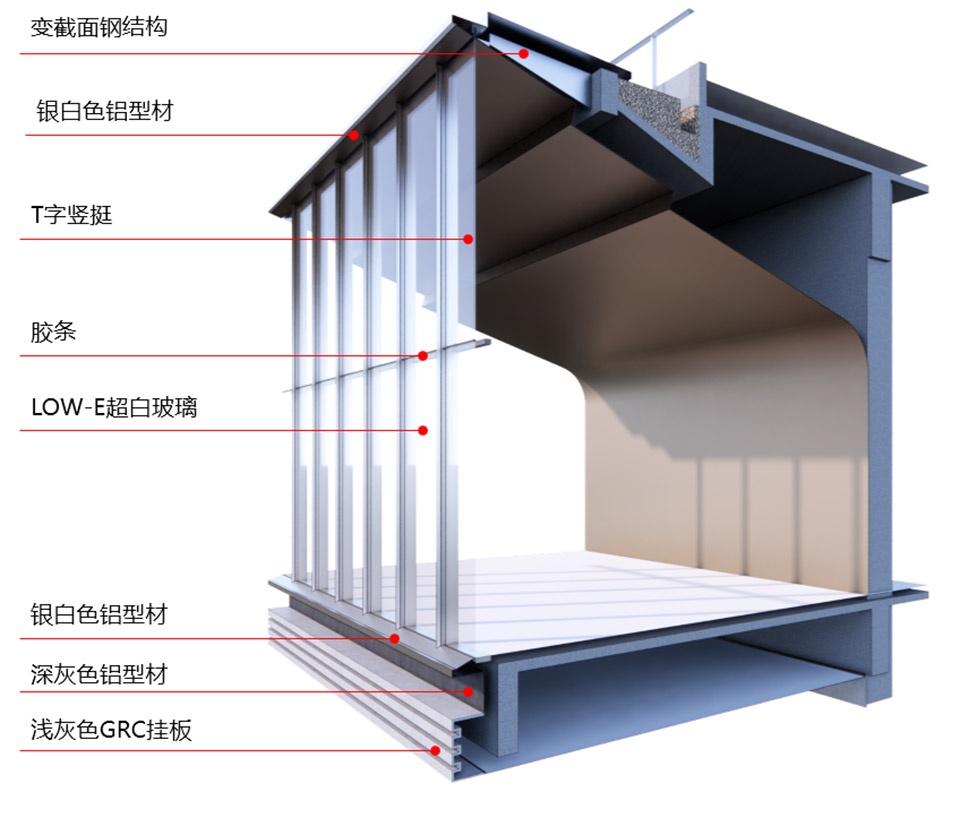
The facade of the Joint Sci-Tech Center draws imagery from Chongqing’s natural climate of frequent clouds and mist. Through the floating volume treatment, large-scale transparent glass, and graded vertical lines, the building is shaped as a “mountain cloud” hovering at the foot of the hill.To achieve an exceptionally light visual effect, the design follows the concept of “interior-exterior integration”. At the junction between the sloped ceiling and the glass curtain wall, tapered steel members are used to minimize the closing detail to its limit, greatly reducing disruption to the visual continuity of the curtain wall.To address the technical challenges of high floor heights and oversized glass panels, the curtain wall adopts an upper-lower two-panel splicing system, with each glass unit limited to within 6 m². Slim gaskets are applied at the joints, ensuring structural safety while enhancing the facade’s transparency and seamless interface.
▼联合科创中心立面设计,the facade of the Joint Sci-Tech Center
适应气候的细部设计(一号岛科创办公区域)Climate-Responsive Detail Design (Sci-Tech Office Zone, Island 1)
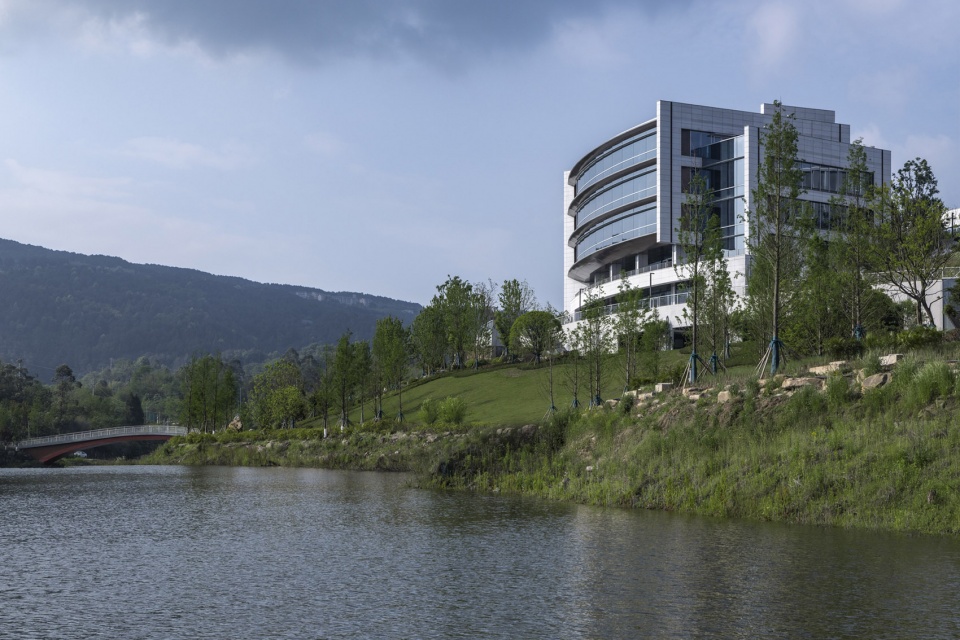
科创办公区域考虑湖景视野需求,沿湖一侧采用大面玻璃幕墙,以横向长窗为主要划分方式,最大化湖景视野覆盖率。立面凸出构件兼具装饰线条与外遮阳双重功能,在通透与舒适之间取得平衡。局部内凹阳台既提供驻足观景的休憩节点,亦作为引导自然通风的“呼吸口”,有效提升室内环境品质。建筑侧向山墙适度采用实墙体量,增强围护结构热工性能,形成对地域气候特征的系统性响应。
▼立面细部,the facade detail
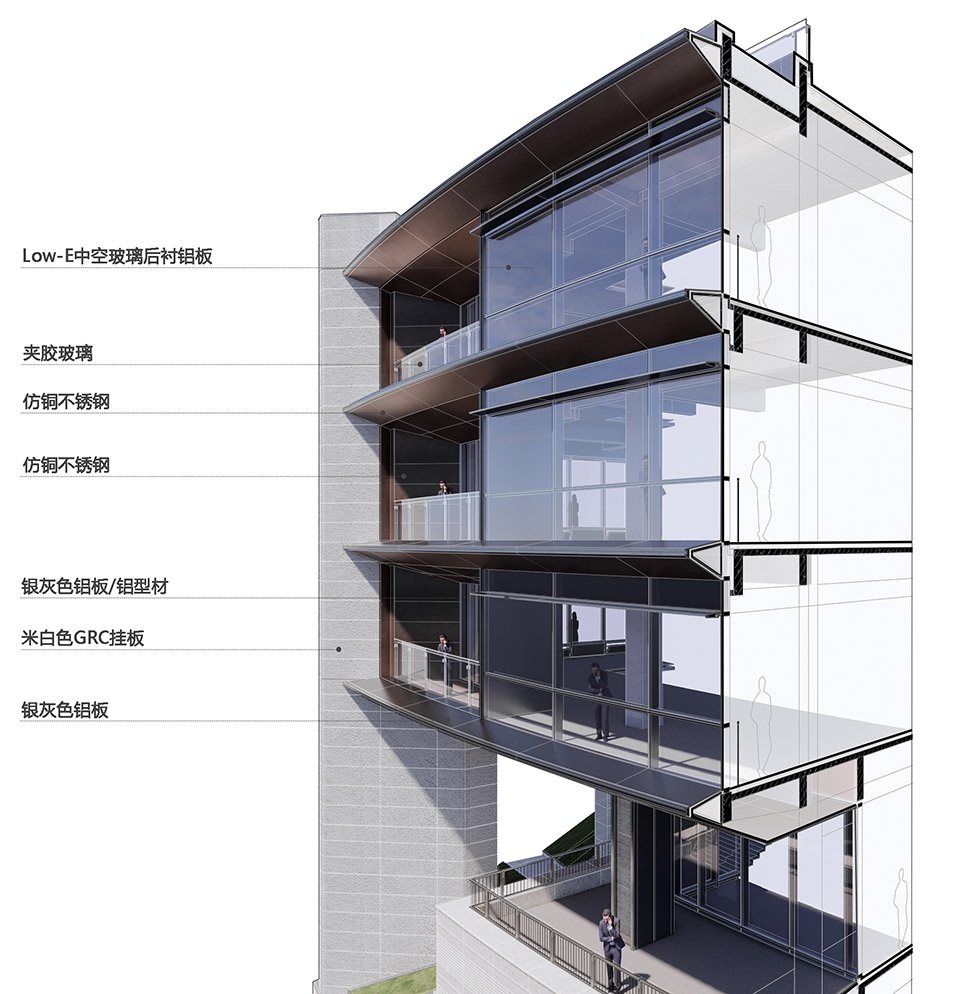
To maximize lake views, the sci-tech office zone features extensive glass curtain walls along the waterfront, organized primarily as horizontal strip windows to achieve the broadest possible view coverage. Protruding facade elements serve a dual role as decorative fins and external sunshades, balancing transparency and thermal comfort. Recessed balconies act as viewing nodes and natural ventilation openings, improving indoor environmental quality. Solid wall construction is employed on the side gables to enhance thermal performance, creating a systematic response to the local climate.
▼沿湖一侧采用大面玻璃幕墙,features extensive glass curtain walls along the waterfront
嵌入岸坡的自然韵律(二号岛) Facade Design in Rhythm with the Shore Slope (Island 2)
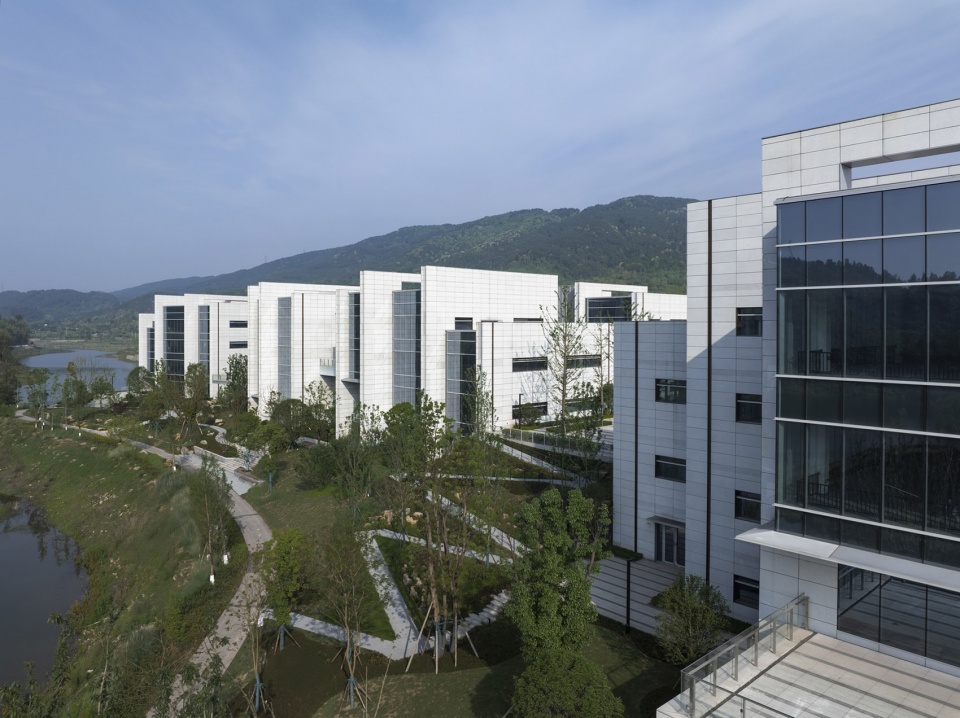
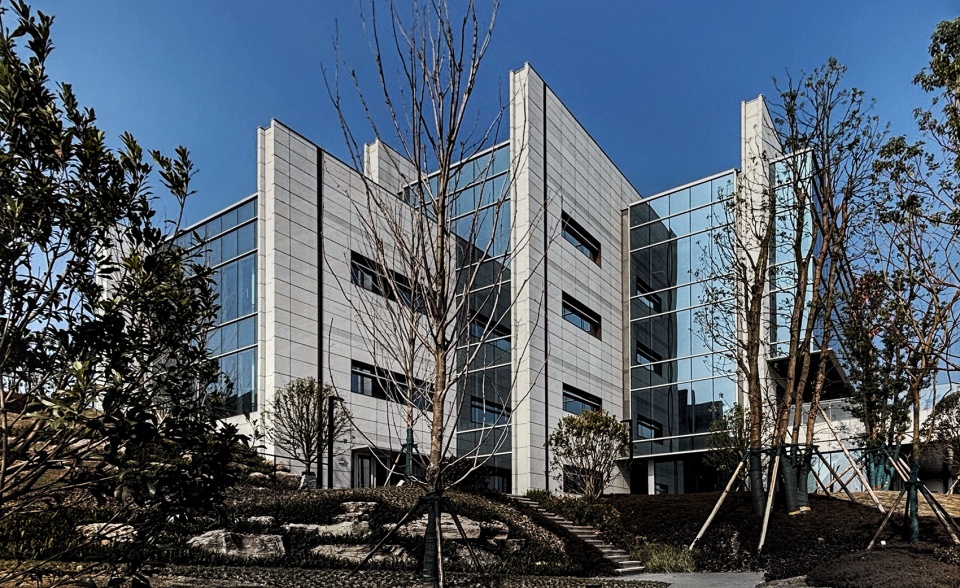
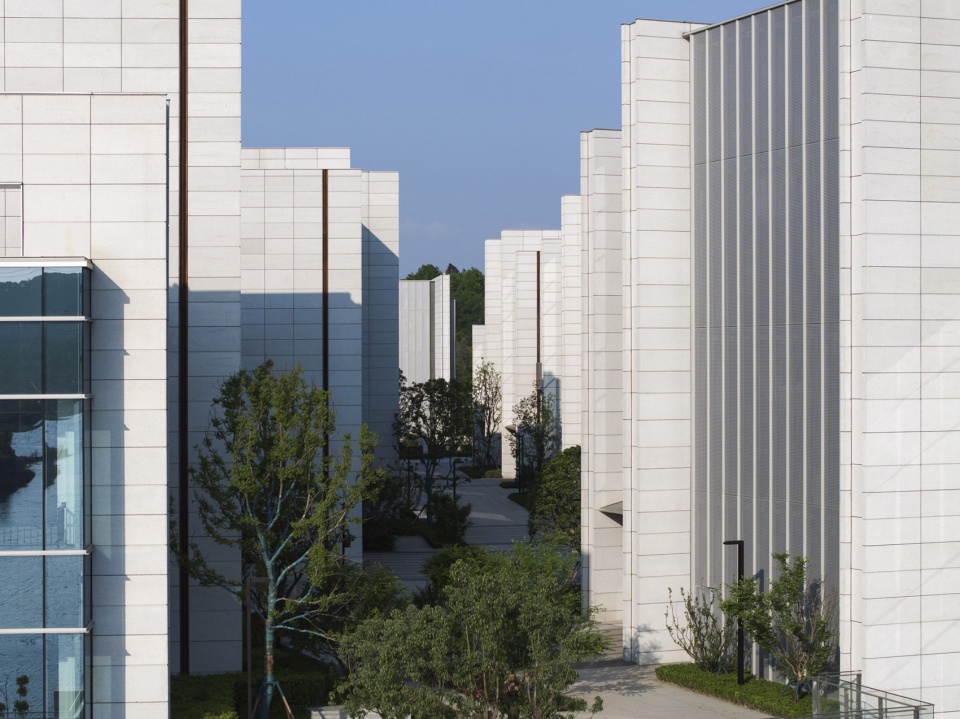
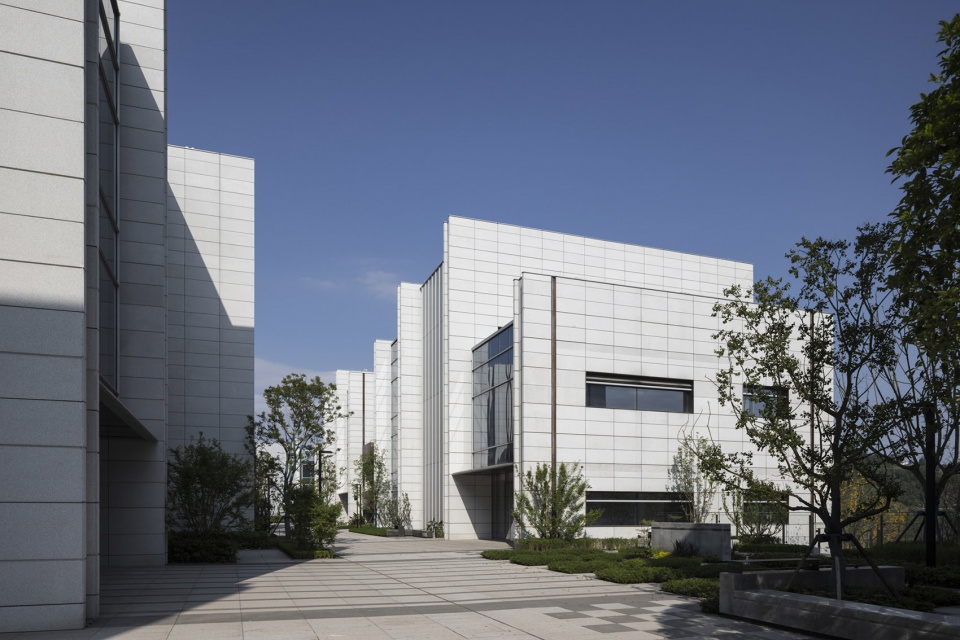
二号岛在立面的细节处理上,建筑朝向湖面的一侧以通透开放为主,采用横向视野开阔的玻璃幕墙,最大化引入湖景。两侧山墙则选用具有横向肌理的GRC板,大板块的划分既保证了立面平整度,其质朴的质感也与山体环境形成和谐对话。在模块构建上,二号岛采用模块化的组合方式,每个模块为500㎡的单元,三个单元为一栋,在标准化的结构框架内,进行单元划分、界面预留、山势落位,体块错落间形成的露台与休闲平台,于自然有机的空间中形成独特的韵律感,用竖向切片回应湖岸的起伏松柏,嵌入岸坡,构成自然界面后的连绵画卷。
▼立面细部,the facade detail
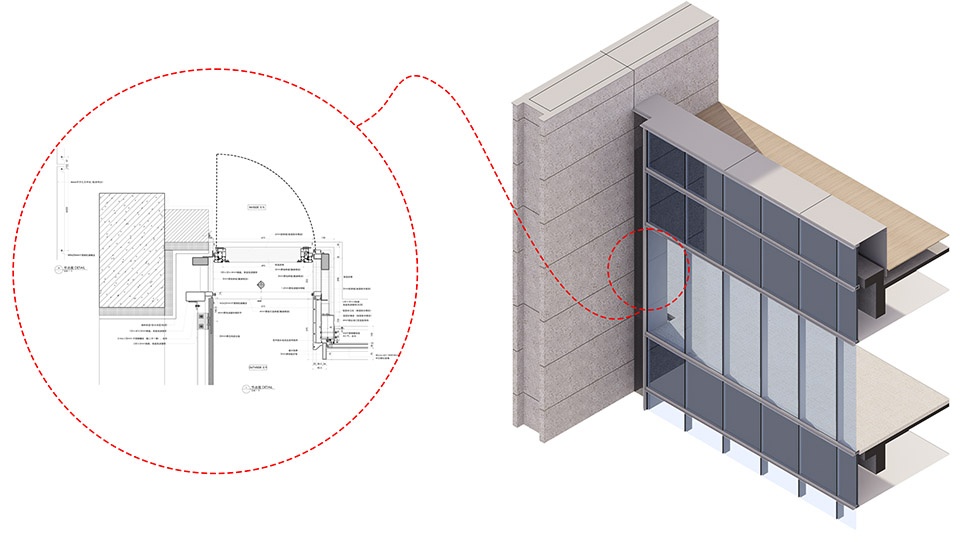
For Island 2, the lake-facing facades are designed to be transparent and open, using wide horizontal glass curtain walls to maximize lake views. The two side gables employ GRC panels with horizontal textures; large-scale panel divisions ensure a smooth facade, while their understated texture harmonizes with the mountainous context.In terms of modular configuration, Island 2 adopts a modular assembly system with 500㎡ as one basic unit, and three units forming one building volume. Within a standardized structural framework, unit division, interface reservation, and terrain adaptation are carefully arranged. The staggered terraces and leisure platforms created by the shifting volumes form a unique rhythm within naturally organic spaces. Using vertical slice-like forms to echo the undulating pine and cypress trees along the shore, the buildings are embedded into the bank slope, composing a continuous picture behind the natural landscape.
▼两侧山墙则选用具有横向肌理的GRC板,the two side gables employ GRC panels with horizontal textures
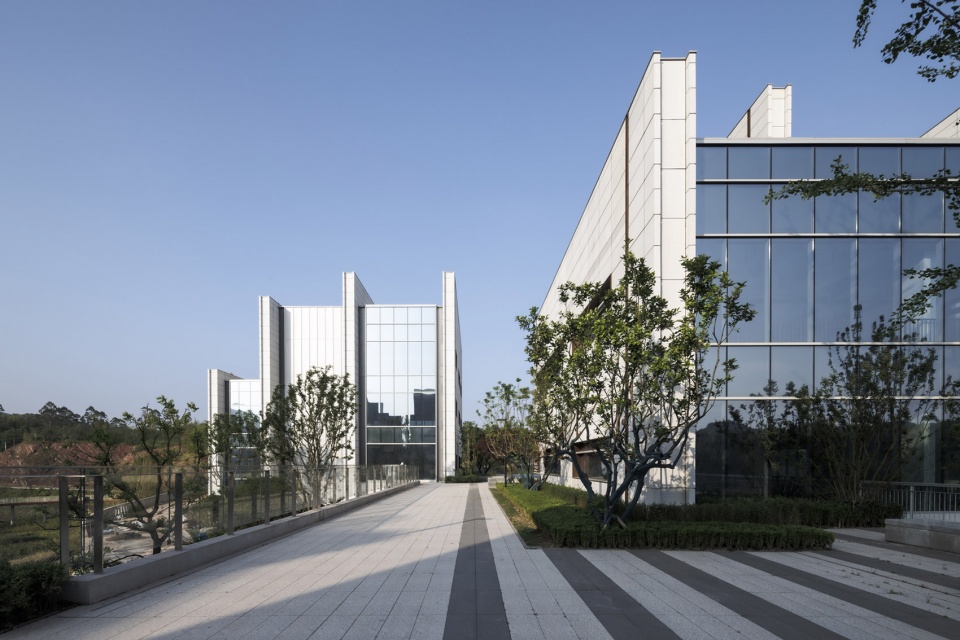
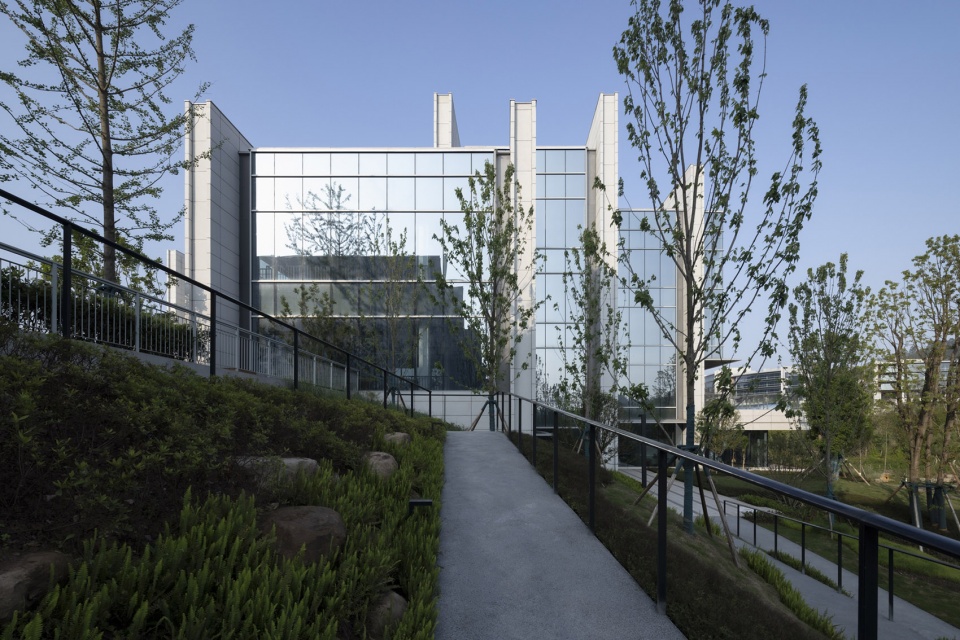
▼用竖向切片回应湖岸的起伏松柏,the shifting volumes form a unique rhythm within naturally organic spaces
结语:山水一直在这里,建筑作为后来者,使一切自然变得更有价值。 Conclusion: The mountains and waters have always been here; as a latecomer, architecture endows all nature with greater value.
重庆慧谷湖产业园“伏脉于山水,修台而造景”的核心:是建筑不以覆盖场地为使命,而以揭示场地的内在秩序为依归。从一号岛的“多首层”价值再造到二号岛的“外野内合”层次转译,从“通、透、露、挑”的剖面控制到“留山、修台、造景”的地形重构,现代性的表达在此不是风格的强势植入,而是通过对山形、水势、坡向、汇水线的精确回应,建构出属于这个时代的技术诗学。每一处台地的放坡、每一块架空的灰空间、每一处通的透庭院,都在回答同一个问题:如何让介入变得不可见,却让场地变得更加可见。
The core of Chongqing Huigu Lake Industrial Park, “drawing vitality from mountains and waters, building terraces to create landscapes”, lies in the fact that architecture does not aim to cover the site, but to reveal its inherent order. From the “multi-first-floor” value reconstruction on Island 1 to the “open exterior and integrated interior” hierarchical translation on Island 2, from the section control of “connectivity, transparency, exposure and overhang” to the topographic reconstruction of “retaining mountains, building terraces and creating landscapes”, the expression of modernity here is not the strong implantation of style, but the construction of a technical poetics belonging to this era through precise response to mountain shapes, water flow, slope directions and catchment lines. Every slope of the terraces, every elevated gray space, and every transparent courtyard all answer the same question: how to make the intervention invisible while making the site more visible.
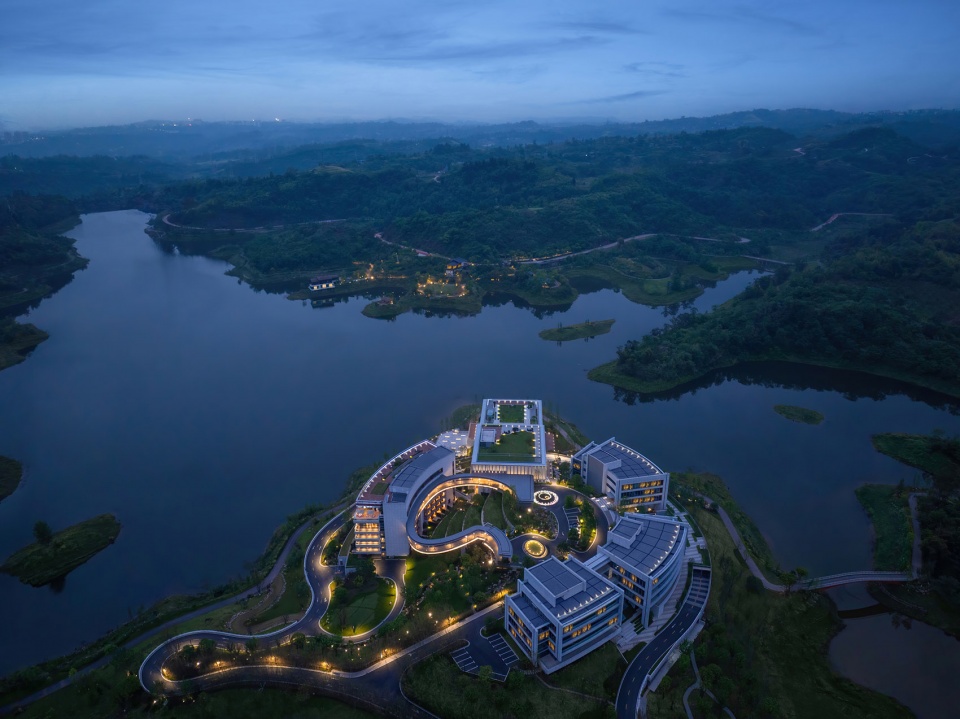
▼夜景鸟瞰,aerial view at night
未来,无论产业迭代还是功能流转,建筑始终是这片坡地上的后来者。但正是这份“迟到”的自觉,使建造获得了根植性——不是强行锚固于岩土,而是从地形的褶皱里生长出自身的逻辑。山水依然在场。而所谓营造,不过是让这片古老的山水,终于长出了属于这个时代的技术轮廓。
In the future, whether through industrial iteration or functional circulation, architecture will always be a latecomer on this slope. However, it is precisely this awareness of “being late” that endows the construction with rootedness—not forcibly anchoring in the soil and rock, but growing its own logic from the folds of the terrain. The mountains and waters are still here. And the so-called construction is nothing more than allowing this ancient landscape to finally take on the technical outline of this era.
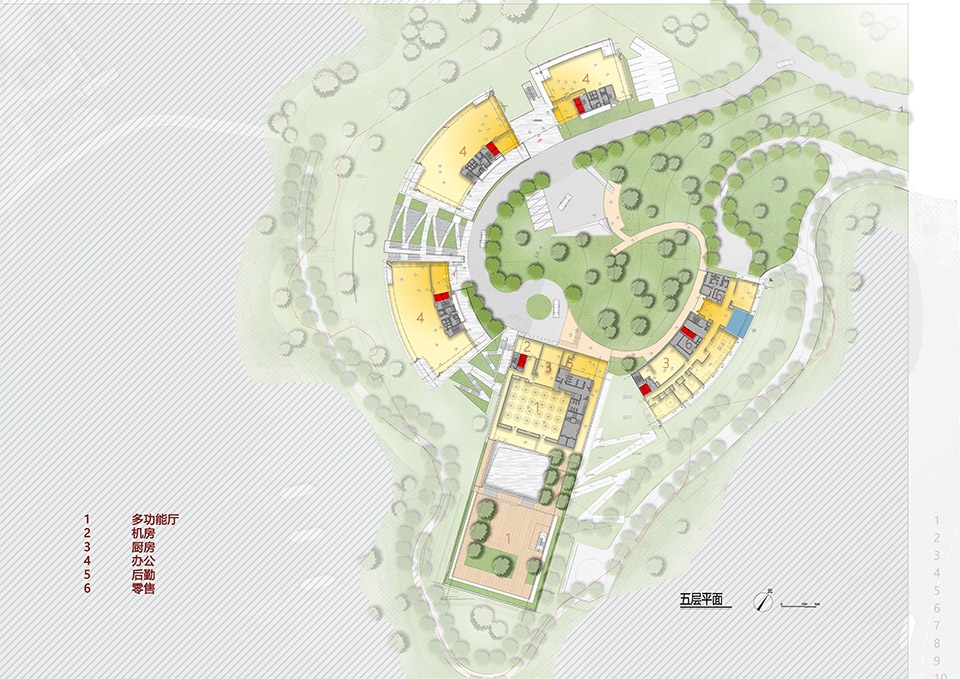
▼一号岛五层平面图,Island 1 fifth floor plan
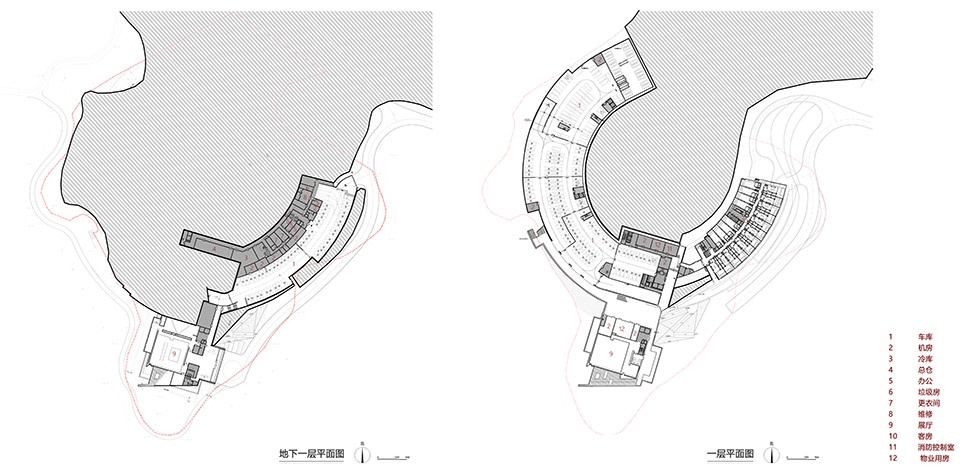
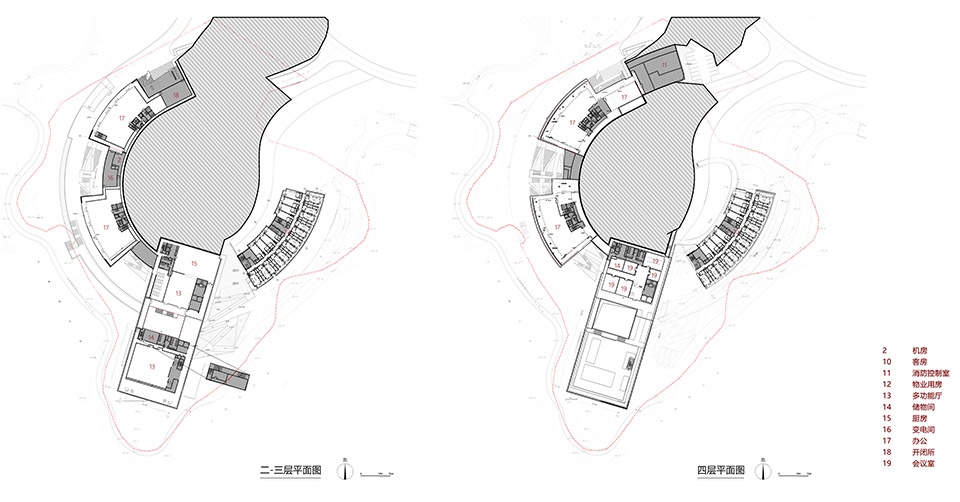
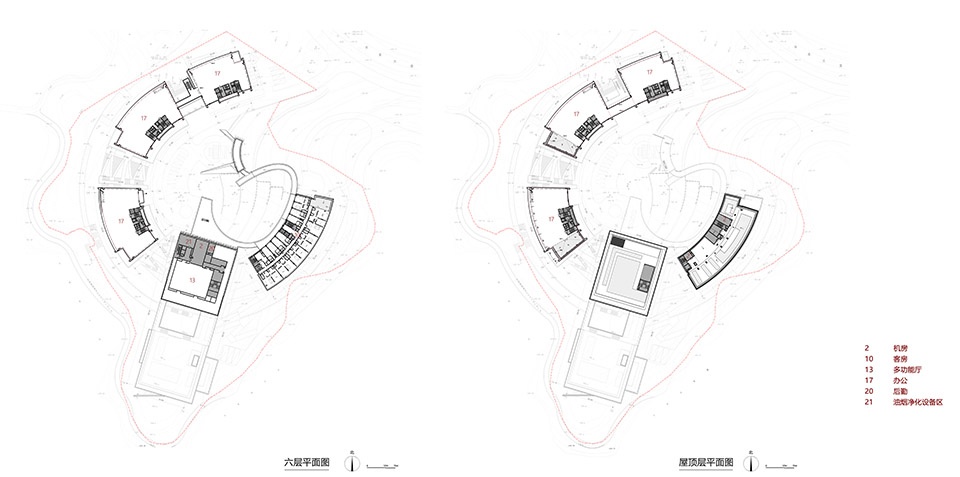
▼一号岛平面图,Island 1 floor plan
▼一号岛立面图,Island 1 elevation


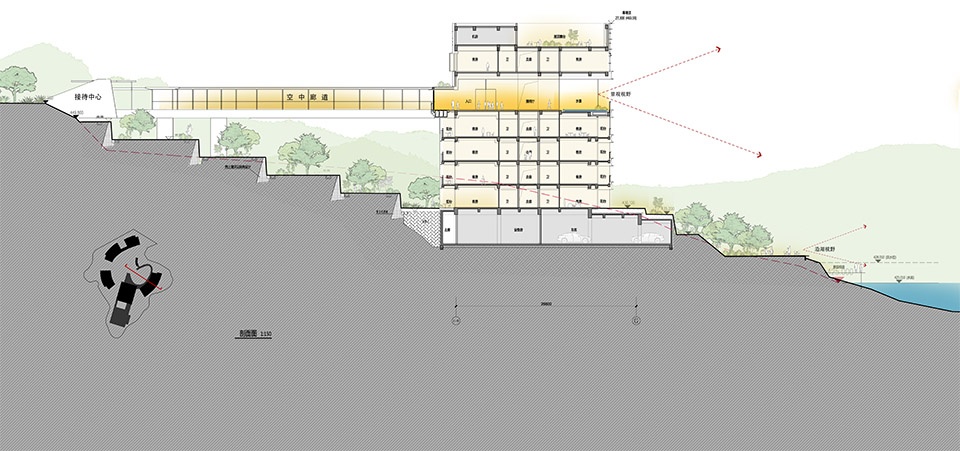
▼一号岛剖面图,Island 1 section
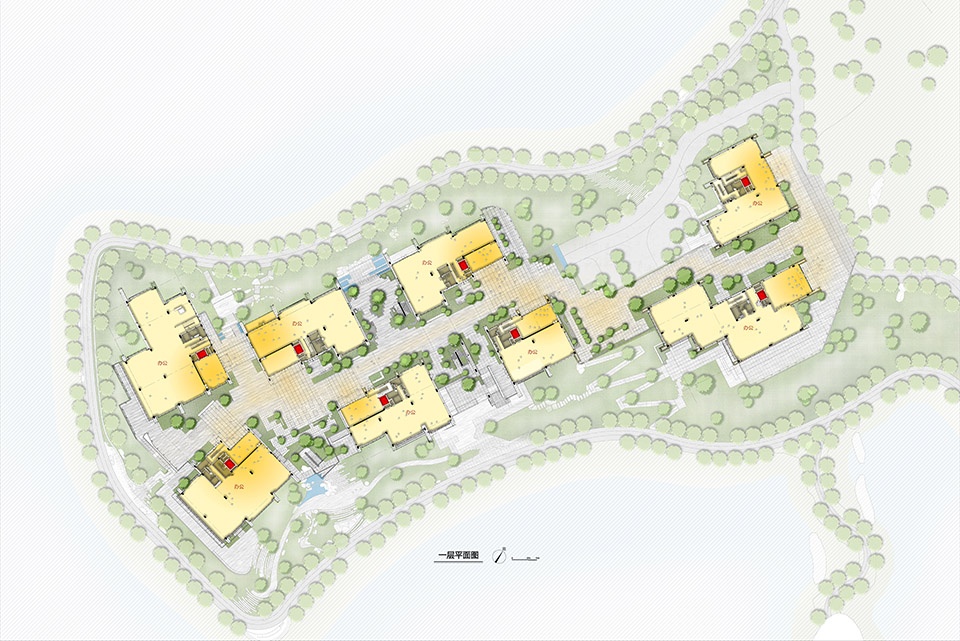
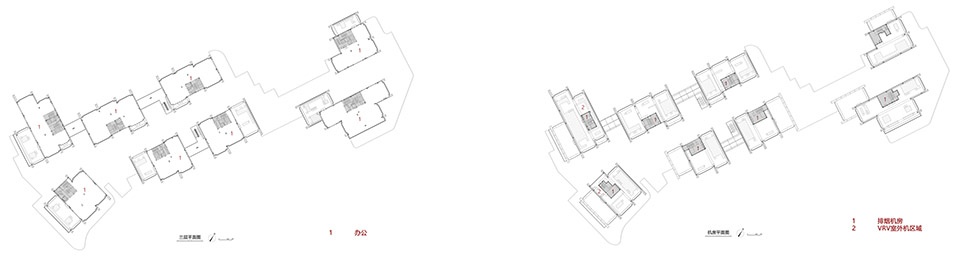
▼二号岛首层平面图,Island 2 ground floor plan
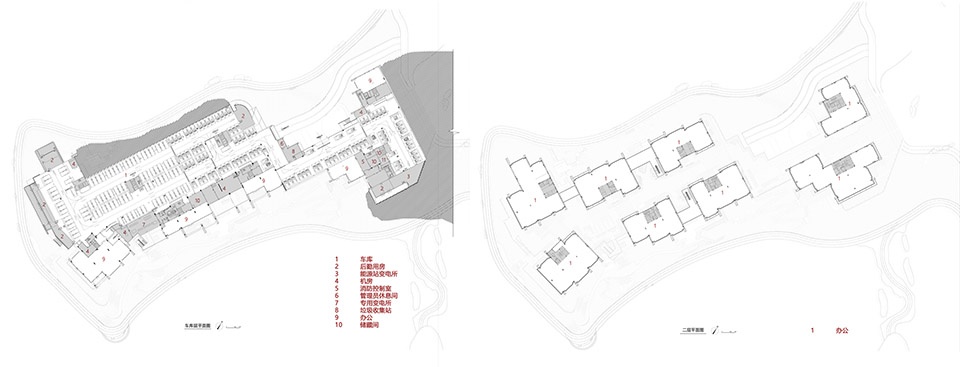
▼二号岛平面图,Island 2 floor plan
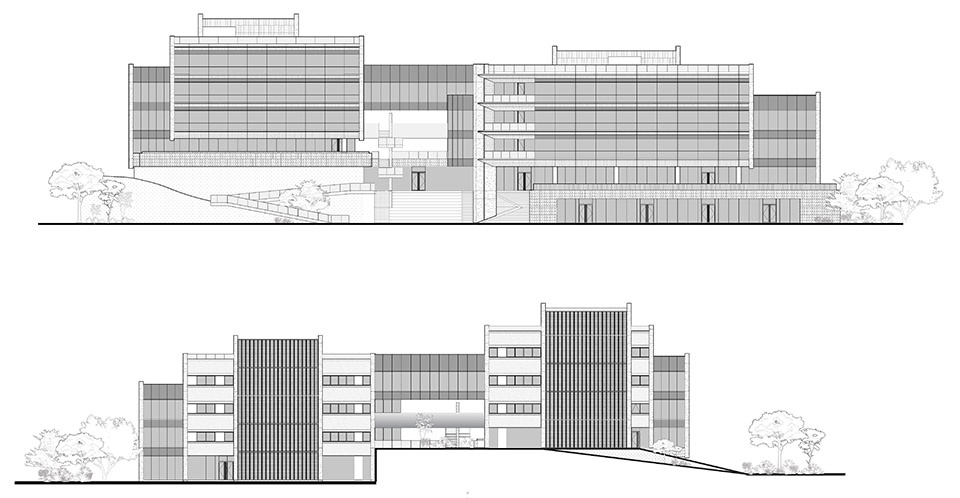
▼二号岛立面图,Island 2 elevation
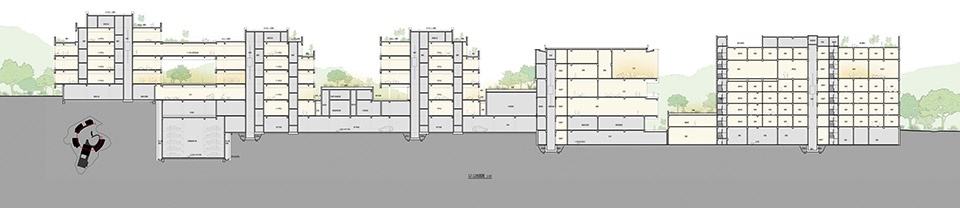
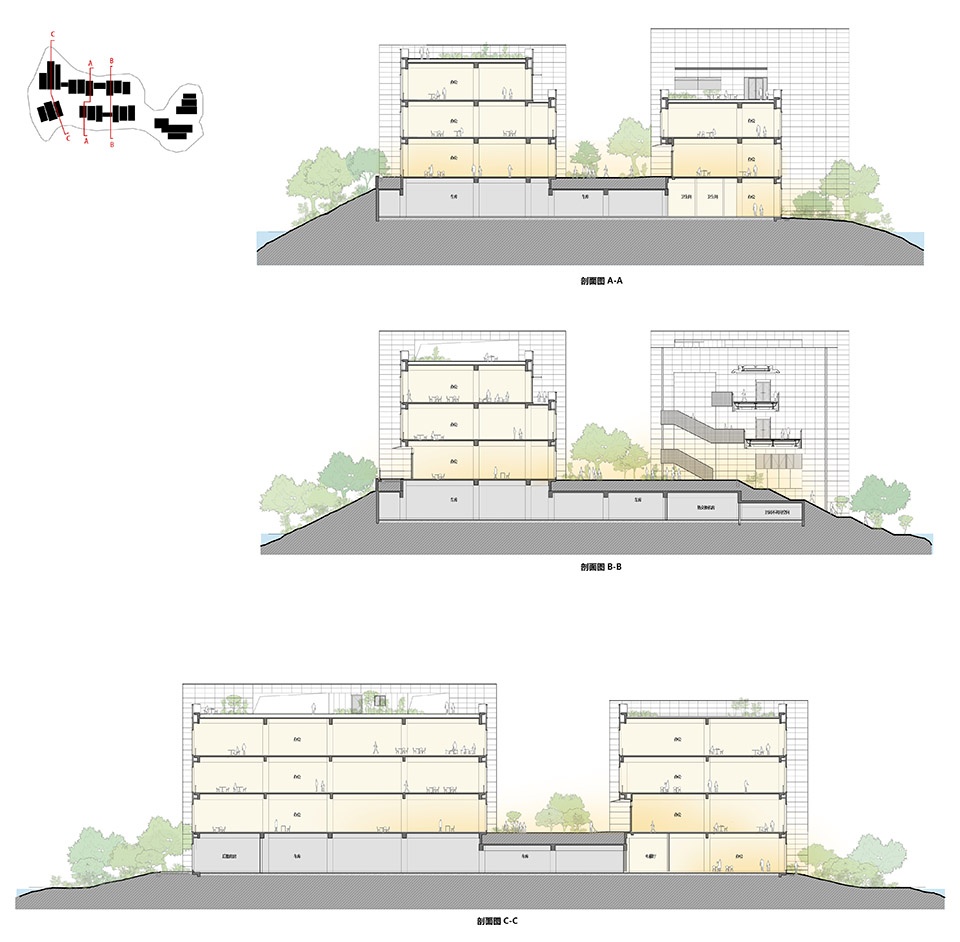
▼二号岛剖面图,Island 2 section
Project Name: Huigu Lake Innovation Town (Initial Zone), Fuling, Chongqing
Completion Year: 2025.3
Island 1 – Gross Built Area: 41,353.01 ㎡ (Public buildings: 30,101.44 ㎡; Ancillary facilities: 420.72 ㎡; Garage: 10,830.85 ㎡)
Island 2 – Gross Built Area: 22,959.08 ㎡ (Public buildings: 15,369.35 ㎡; Ancillary facilities: 311.72 ㎡; Garage: 7,278.01 ㎡)
Project location: Huigu Lake, Lidu New Area, Fuling District, Chongqing
Photo credits: Arch-Exist Photography
Design Firm: DuShe Architectural Design Co. Ltd., Shanghai
Design Team: Ling Kege, Huang Ouhai, Yue Qiujun, Wang Limin, Liu Yijia, Ding Tianqi, Luo Danna, Sang Tian, Liu Mowen, Lin Sheng, Dai Jialu, Li Yanxin, Zhai Yujia, Shi Yingqi, Li Yang, et al.
Project Management Team: Xu Yanning, Li Ying
Client: The First Branch of Chongqing Fuling High-tech Industrial Development Group Co., Ltd.
Construction Drawing Firm: CCTEG Chongqing Engineering (Group) Co., Ltd.
Urban Design Firm: Architectural Design and Research Institute of South China University of Technology Co., Ltd.
Landscape Design Firm: Beijing Beilin Ecological Pastoral Landscape Planning and Design Co., Ltd.
Categories:Office, Conference, Exhibition, Hotel
Material/Branding:
.LOW-E Insulating Glass (CSG)
2.Aluminum Panel (Chongqing Qilv Aluminum Industry, Chongqing Jiucheng Aluminum Industry)
3.Stone (Bush-hammered finish, Shandong White Granite)