监所技防整体解决方案,浙江/其他设计
监所技防整体解决方案
智慧监所建设严格按照公监管【2018】209号文《关于推进智慧监管建设的指导意见》和《智慧监管建设技术指南》等有关规定和要求,充分依托公安网和警务综合平台,贯彻“科技强警”战略,建立统一的智慧监管监所实战应用平台,服务于监所的管理与安全。
Overall solution for technical defense of the prison
In strict accordance with the relevant provisions and requirements of the guidance on promoting the construction of smart supervision and the technical guide for the construction of smart supervision (GGS [2018] No. 209), the smart Supervision Institute fully relies on the public security network and the comprehensive police platform, implements the strategy of "strengthening the police through science and technology", establishes a unified practical application platform for the smart Supervision Institute, and serves the management and security of the Institute.
总体要求
总体设计以“功能第一、实用为主、兼顾美 观”的原则, 充分论证其技术先进性和经济合理 性,以业务完善为基础,力求功能齐全,技术规 范, 安全可靠,方便日后维护和管理,同时也考 虑到日后发展扩充。 在选材方面、投资方面根据功能及设备要求 区别对待,做到投资有重点,建设有侧 重,确保 系统的安全运行。
General requirements
The overall design is based on the principle of "function first, practicality first and aesthetics at the same time", fully demonstrating its technical progressiveness and economic rationality. Based on the improvement of business, it strives to be fully functional, technically standardized, safe and reliable, convenient for future maintenance and management, and also takes into account the future development and expansion. In terms of material selection and investment, they should be treated differently according to the function and equipment requirements, so as to focus on investment and construction, so as to ensure the safe operation of the system.
设计原则
充分体现新技术、新材料、新工艺、新设备 的特点,按照以下设计原则进行:
1)先进性原则:采用成熟、主流的技术构 建系统,充分兼顾需求和技术的发展,充分考虑 与其他系统的连接,建设可扩展的开放系统,注 重系统的数字化和网络化程度。
2)可靠性原则:采用专用硬件设备,保证 7×24小时不间断工作。中心集中管理系统采用国际流行技术和架构进行设计,采用诸多故障处理机制、容错机制、备份机制,以及结构 化、分布式的结构提高系统的可靠性。
3)高性能原则:该系统要求具有很高的处理性能。中心系统集中管理最大支持 10000路以上设备的接入。
4)可扩展性原则:系统采用模块化设计,分布式架构,保证新功能、模块添加的方 便。系统采用标准化接口、协议及流媒体技术,在系统设计时充分考虑到将来系统扩充的 可行性,系统中预留了为后期进行扩展的大量接口。
5)经济性原则:在满足用户需求、保证系统功能完善、先进、可靠的基础上,通过 利用分布式网络系统的远程控制管理功能,尽量降低系统的成本和运行、维护费用。
6)易用性原则:系统功能强大、界面友好、软件设计人性化,易于被普通用户 掌握、操作和使用。
7)易维护性原则:系统基本上可以处于免维护工作状态,且人工维护可在远程 操作,维护简单,易于管理。
8)安全保密原则:严格执行国家和公安机关有关的安全保密规定。
9) 设备选型原则 :
1、选用业界有口碑的、有数十年历史的、有研究成果的、产品性价比高、可靠 性高、售后服务好、业绩良好的企业的产品;
2、选用同类产品中技术最成熟、性能先进、使用可靠的产品型号,以保证器材和系 统的先进性、成熟性。
3、选用高度智能化、高技术含量的产品,建立系统开放式的架构,以标准化 和模块 化为设计要求,既便于系统的管理和维护使用,又可保持系统较长时间的先进性。
Design principles
Fully reflect the characteristics of new technologies, new materials, new processes and new equipment, and follow the following design principles:
1) Progressiveness principle: adopt mature and mainstream technology to build the system, give full consideration to the development of demand and technology, fully consider the connection with other systems, build an extensible open system, and pay attention to the digitalization and networking of the system.
2) Reliability principle: special hardware equipment shall be used to ensure 7 × Work 24 hours a day. The central centralized management system is designed with international popular technology and architecture, and adopts many fault handling mechanisms, fault tolerance mechanisms, backup mechanisms, as well as structured and distributed structures to improve the reliability of the system.
3) High performance principle: the system requires high processing performance. The centralized management of the central system can support the access of more than 10000 devices.
4) Scalability principle: the system adopts modular design and distributed architecture to ensure the convenience of adding new functions and modules. The system adopts standardized interface, protocol and streaming media technology. The feasibility of future system expansion is fully considered in the system design. A large number of interfaces are reserved in the system for later expansion.
5) Economy principle: on the basis of meeting the needs of users and ensuring that the system functions are perfect, advanced and reliable, the cost and operation and maintenance costs of the system can be reduced as much as possible by using the remote control and management function of the distributed network system.
6) Principle of ease of use: the system has powerful functions, friendly interface, humanized software design, and is easy to be mastered, operated and used by ordinary users.
7) Maintainability principle: the system can basically be in maintenance free working state, and manual maintenance can be operated remotely, which is simple to maintain and easy to manage.
8) Principle of security and confidentiality: strictly implement the relevant security and confidentiality provisions of the state and public security organs.
9) Equipment selection principle:
1. Select the products of enterprises with reputation in the industry, decades of history, research results, high cost performance, high reliability, good after-sales service and good performance;
2. Select the product model with the most mature technology, advanced performance and reliable use among similar products to ensure the progressiveness and maturity of equipment and systems.
3. Select highly intelligent and high-tech products, establish an open architecture of the system, and take standardization and modularization as the design requirements, which not only facilitates the management, maintenance and use of the system, but also maintains the progressiveness of the system for a long time.
设计依据
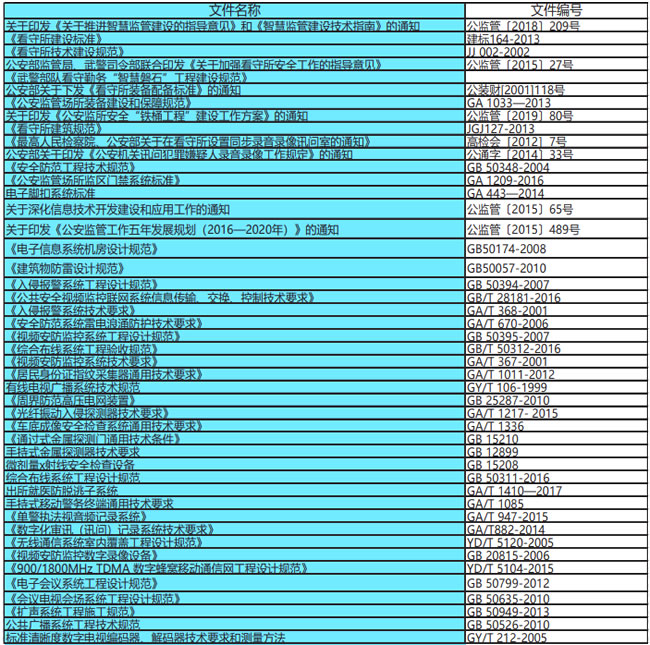
根据有关国家标准、规范,参照国际上通用规则,结合看守所智能化工程所需实现的功能、 工程施工环境等具体特点提供“认真、合理、完善”的设计方案。保证看守所的简便性、实用性 等特点,具体标准如下:
design basis
According to relevant national standards and specifications, with reference to international general rules, and in combination with the functions to be realized by the detention house intelligent project, the project construction environment and other specific characteristics, a "serious, reasonable and perfect" design scheme is provided. To ensure the simplicity and practicality of the detention center, the specific standards are as follows:
设计总体思路
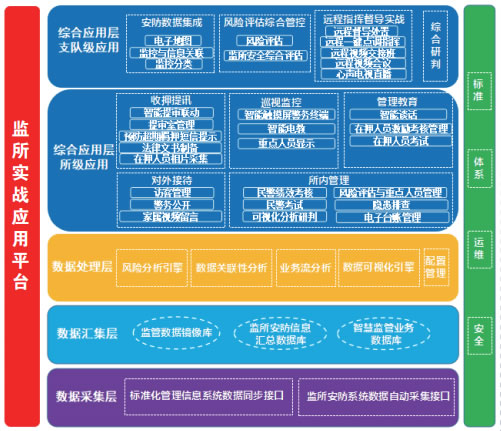
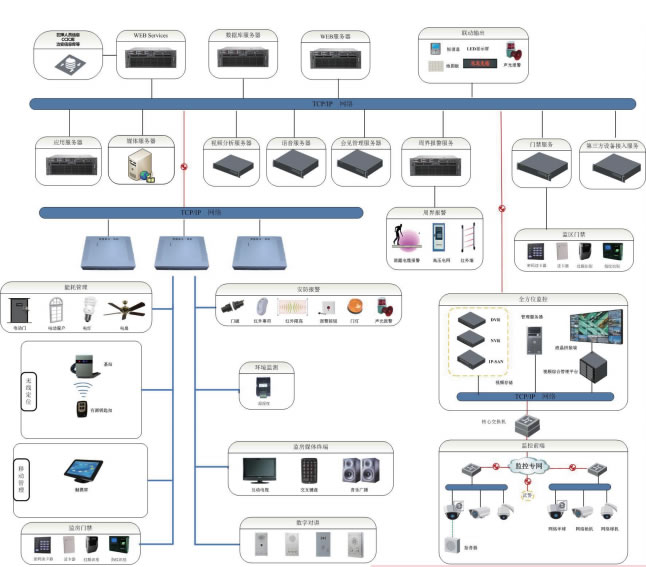
智慧型监所基于感知的物联网技术、云技术建设,利用物联网感知技术、云技术实现监所 智能安防、设备自控、业务管理的高度集成和智能,逐步提高监所安全防控能力、监管信息应 用能力,装备设施管控能力,实现多系统互动,互联的信息传输,并在一个界面上显示和统计 各项数据,提供分析研判决策功能。 智慧监所各系统与省(区)厅,市局监管警务信息系统,应急指挥系统进行有机融合多级 互联,从而形成数字化,网络化,集约化三位一体的智能实战平台系统。
General design idea
Based on the construction of perceived Internet of things technology and cloud technology, smart prisons use the Internet of things perception technology and cloud technology to achieve a high degree of integration and intelligence of intelligent security, equipment self-control and business management, gradually improve the security prevention and control ability, regulatory information application ability, equipment management and control ability, realize multi system interaction and interconnected information transmission, and display and count various data on one interface, It provides analysis, judgment and decision-making functions. The systems of the smart prison are organically integrated and multi-level interconnected with the provincial (District) department, Municipal Bureau supervision police information system and emergency command system, so as to form a digital, networked and intensive intelligent actual combat platform system.
建设背景
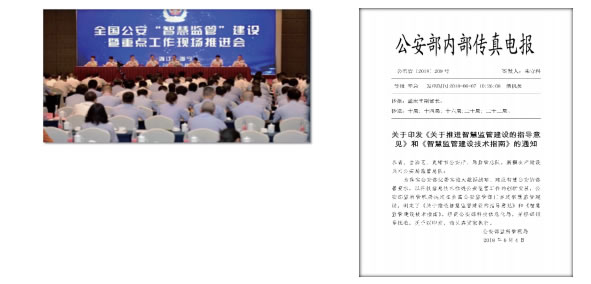
2018年6月9日,公安部在浙江省海宁市召开了全国公安智慧监管建设暨重点工作现 场推进会,会议明确了各地公安机关要积极稳妥推进智慧监管建设,三年内建成。随后, 公安部下发了《关于推进智慧监管建设的指导意见》和《智慧监管建设技术指南》两个指 导性文件。
Construction background
On June 9, 2018, the Ministry of public security held a national meeting on the construction of intelligent public security supervision and on-site promotion of key work in Haining City, Zhejiang Province. The meeting made it clear that local public security organs should actively and steadily promote the construction of intelligent supervision, which should be completed within three years. Subsequently, the Ministry of Public Security issued two guiding documents, the guiding opinions on promoting the construction of smart supervision and the technical guide for the construction of smart supervision.
建设目标,Construction objectives
建设体系
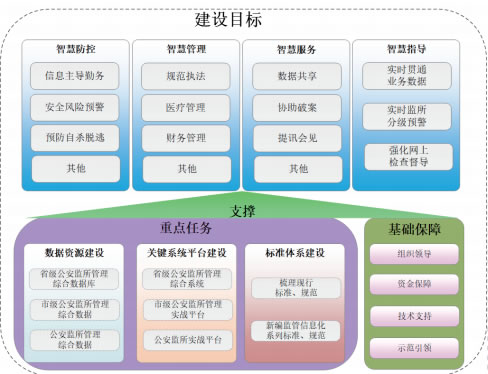
公安智慧监管建设坚持信息主导勤务,强化安全风险管控, 着力构建"1+2+3+4"智慧监管建设体系, "1”是指“全省一体化 实战应用平台”, “2"是指“警务云和大数据应用两大基础资源 支撑”,“3”是指“省市公安监管部门和监所三级实战指挥 中心”, “4”是指“智慧防控、智慧管理、智慧服务、智慧指 导四大智慧应用体系”智慧监管框架体系。
Construction system
Public security intelligent supervision construction adheres to information led service, strengthens security risk control, and focuses on building a "1+2+3+4" intelligent supervision construction system. "1" refers to the "provincial integrated practical application platform", "2" refers to the "two basic resources support of police cloud and big data application", and "3" refers to the "three-level practical command center of provincial and municipal public security supervision departments and prisons", "4" refers to the smart regulatory framework system of "four smart application systems: smart prevention and control, smart management, smart service and smart guidance".
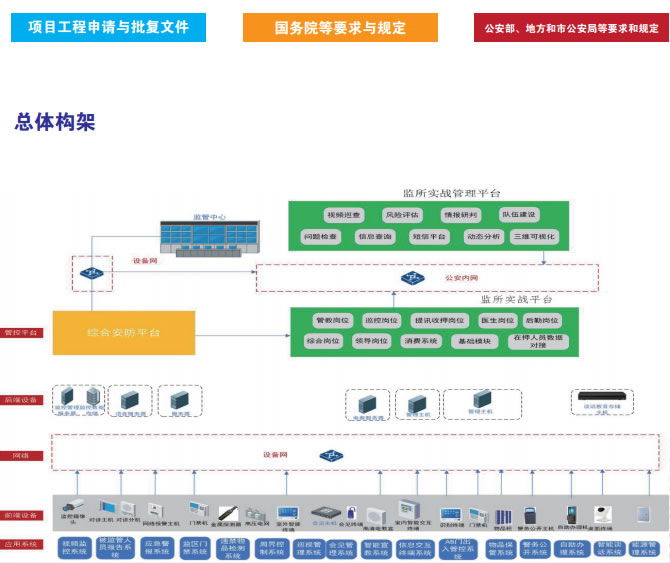
建设内容,Construction content
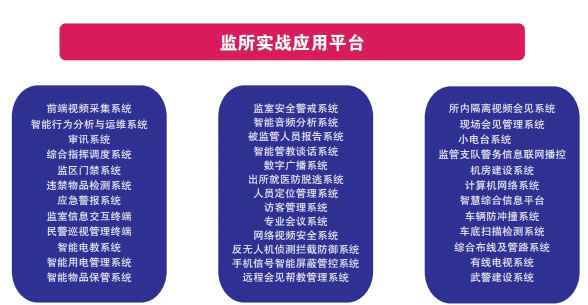
综合指挥调度系统
系统将音频、视频、数据进行高度的融合,构建“平战结合”的指挥调度模式,既满足 了平时的应急培训、应急演练、日常办公、会议会商需求,也能够应急战时的应急指挥、应 急救援、应急决策等要求,达到统一指挥、联合行动的目的,为用户的日常管理和应急处置 提供有效支撑,最大化地提高应急处置效率。
Integrated command and dispatching system
The system highly integrates audio, video and data to build a "peacetime and wartime combination" command and dispatching mode, which not only meets the needs of peacetime emergency training, emergency drill, daily office work, conference and consultation, but also meets the requirements of emergency command, emergency rescue and emergency decision-making in wartime, achieves the purpose of unified command and joint action, and provides effective support for users' daily management and emergency disposal, Maximize the efficiency of emergency response.
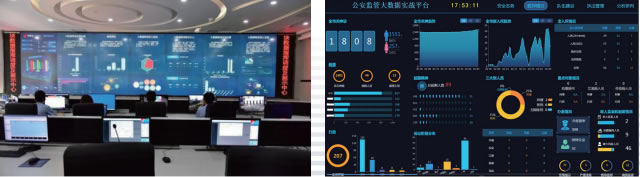
三维应用,3D application
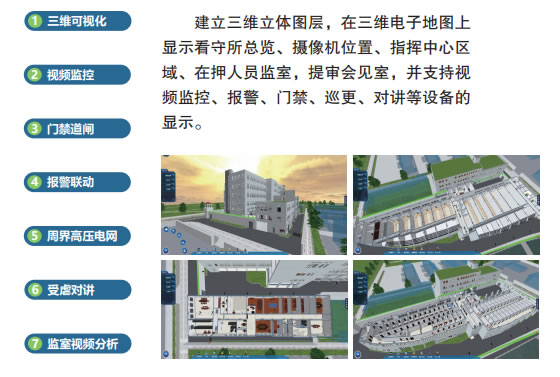
平台架构,Platform architecture