深圳市龙华高级中学教育集团民治校区 / 深圳大学建筑设计研究院·元本体工作室
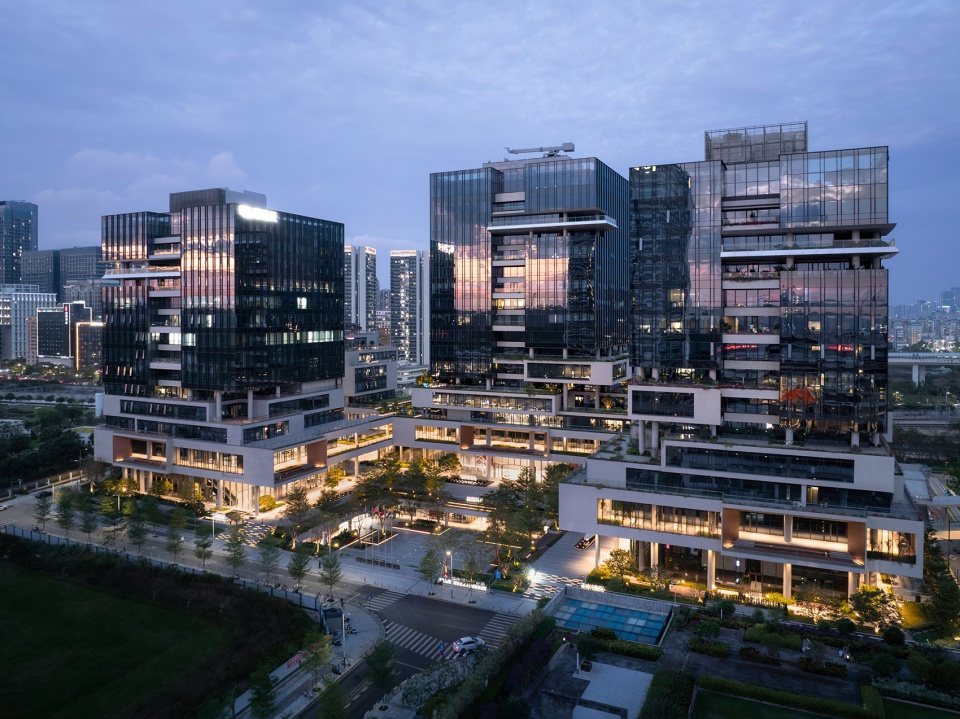
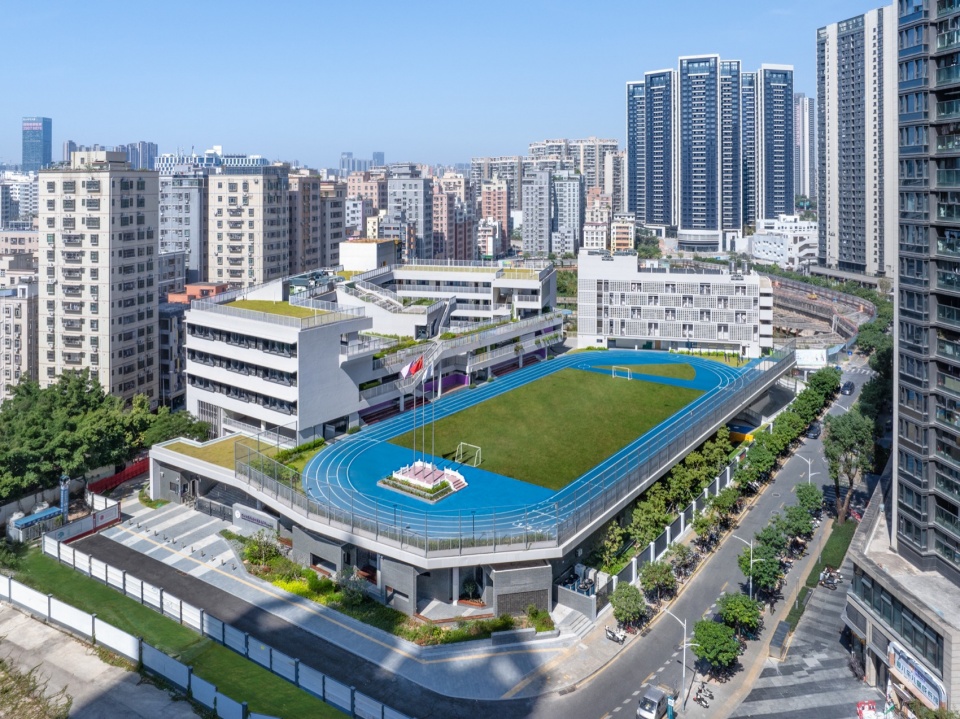
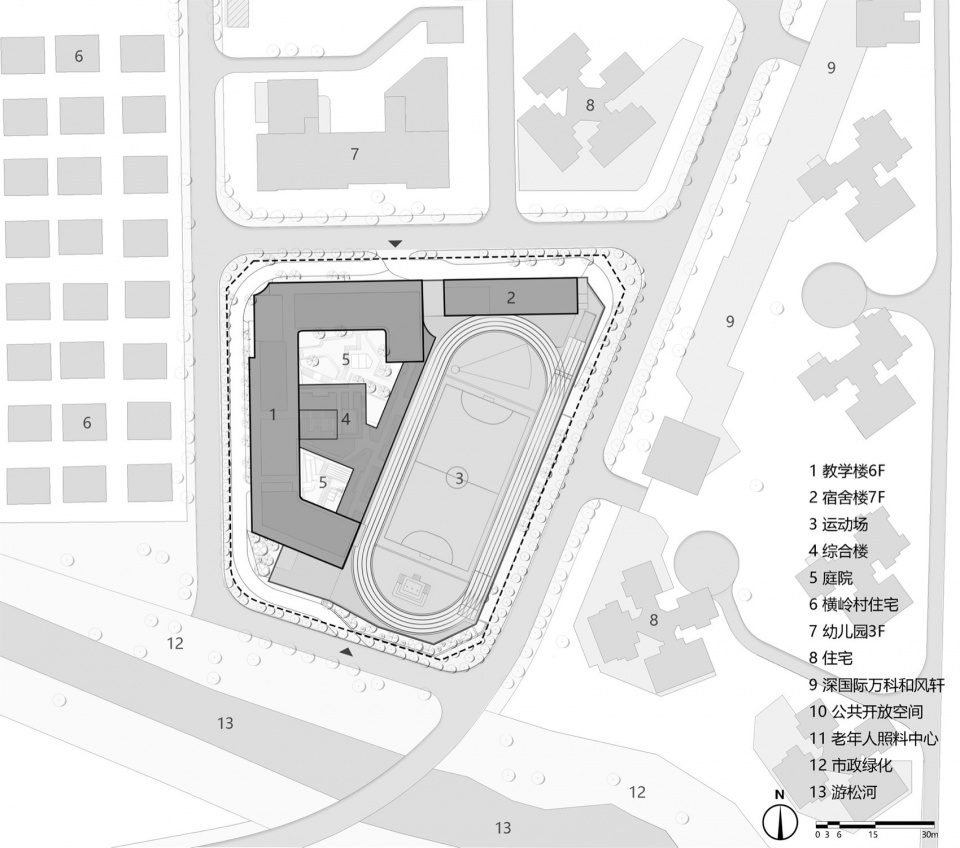
深圳市龙华高级中学教育集团民治校区位于龙华区民治街道横岭旧村片区城市更新单元区域,其区位环境呈现多元混合特征。基地地势北高南低,自然形成约3米的地形高差,项目东侧为超高层住宅小区和风轩,北侧为在建的超高层住宅和幼儿园,西侧为高密度城中村,南侧为规划44米宽的河道景观带,这种复杂的空间格局赋予项目独特的城市更新语境。项目用地面积9393.86㎡,总建筑面积23762㎡,容积率2.08,拟建18班规模的初级中学。
The Minzhi Campus of Shenzhen Longhua Senior High School Education Group is situated within the urban renewal unit area of Hengling Old Village in Minzhi Subdistrict, Longhua District. Its location context exhibits diverse and mixed characteristics. The site features a natural north-high, south-low terrain with an elevation drop of approximately 3 meters. The eastern boundary adjoins the super high-rise residential complex Hefengxuan, while the northern side borders an under-construction super high-rise residential development and kindergarten. To the west lies a high-density urban village, and the southern edge connects to a planned 44-meter-wide riverside landscape corridor. This complex spatial configuration creates a distinctive urban renewal context for the project. The total site area is 9,393.86㎡, the total construction area is 23,762㎡, and the floor area ratio is 2.08, proposed construction of a junior high school with 18 classes.
▼校园鸟瞰,Aerial view of the campus
在高密度城市环境与当代新型教育理念交织的背景下,设计思考回应周边复杂城市肌理,结合场地高差,以“集约高效、因地制宜、空间特色、边界共享”为核心理念,探索校园空间营造。通过立体复合的功能组织与紧凑高效的空间架构,实现土地资源的集约化利用。同时巧妙利用地形高差,将其转化为空间塑造的独特语言,打造层次丰富的竖向空间体系。以“园林・书院”为营造愿景,融合书院人文底蕴与现代园林的空间意趣,塑造兼具文化内涵与时代特征的校园空间特色,构建校园与社区共生的活力场域。
▼设计概念,Design Concept
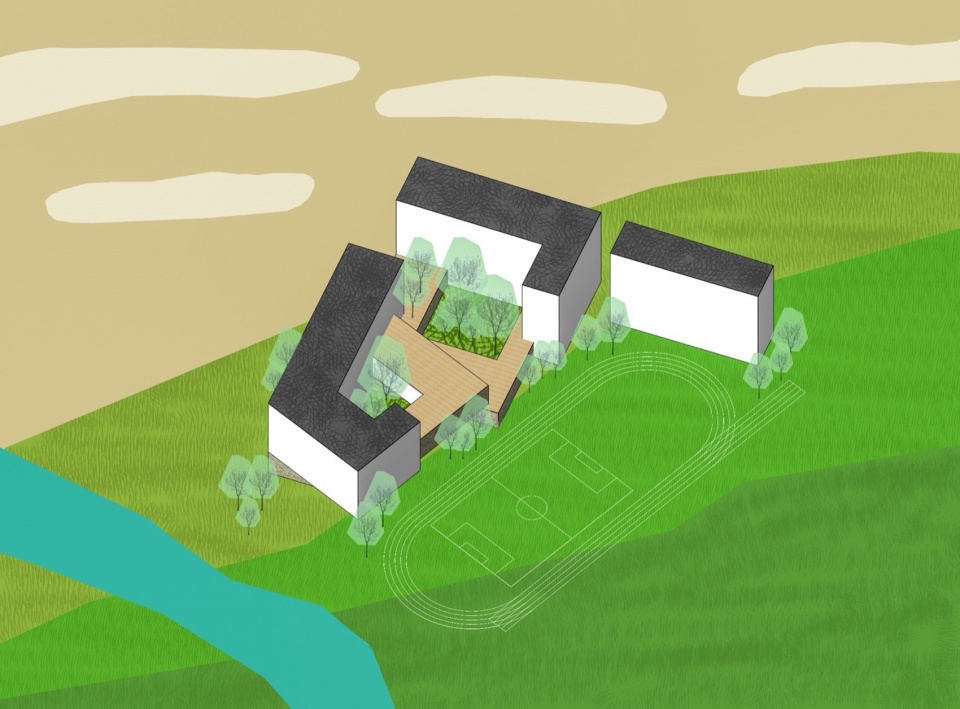
Under the intertwined context of high-density urban environments and contemporary educational philosophies, the design approach responds to the intricate urban fabric while incorporating the site’s elevation variations. Guided by core principles of “intensive efficiency, context sensitivity, spatial identity, and shared boundaries,” the project explores innovative campus spatial configuration. Through three-dimensional composite functional organization and compact spatial frameworks, it achieves intensive utilization of land resources. The natural 3-meter elevation difference is ingeniously transformed into a unique spatial language, creating a multi-layered vertical spatial system. With the vision of a “Scholarly Garden,” the design synthesizes the humanistic essence of traditional academies with the spatial poetry of contemporary garden design. This fusion cultivates campus spatial characteristics that embody cultural depth and modern sensibilities, ultimately forging a vibrant hub for educational-community symbiosis.
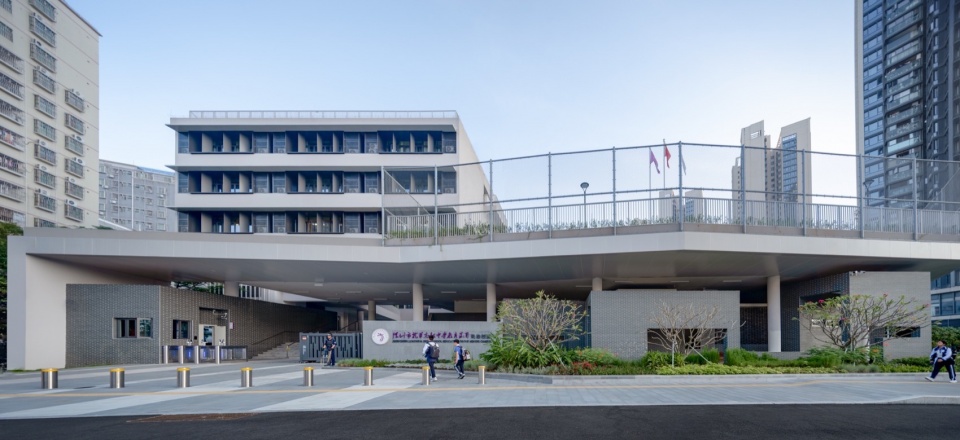
▼南侧主入口广场,Main Entrance Plaza
1 城市关系 合理布局 Urban context and Rational layout
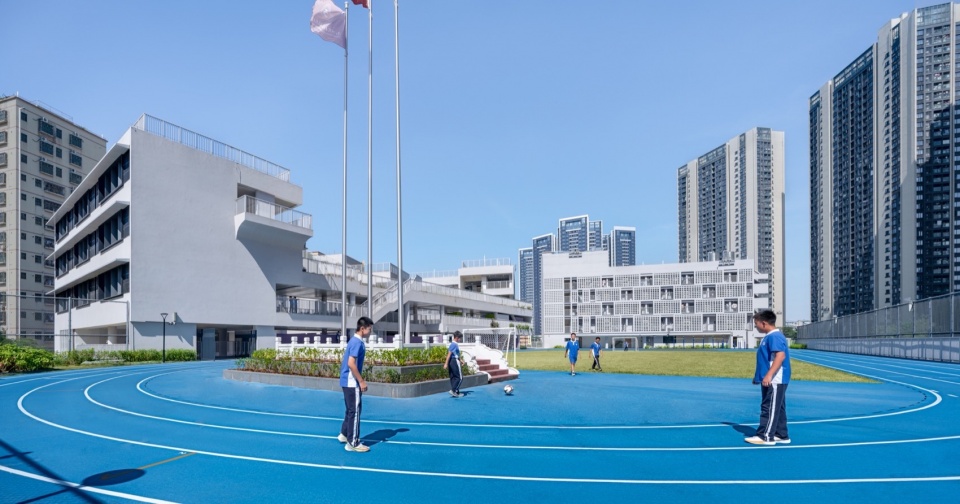
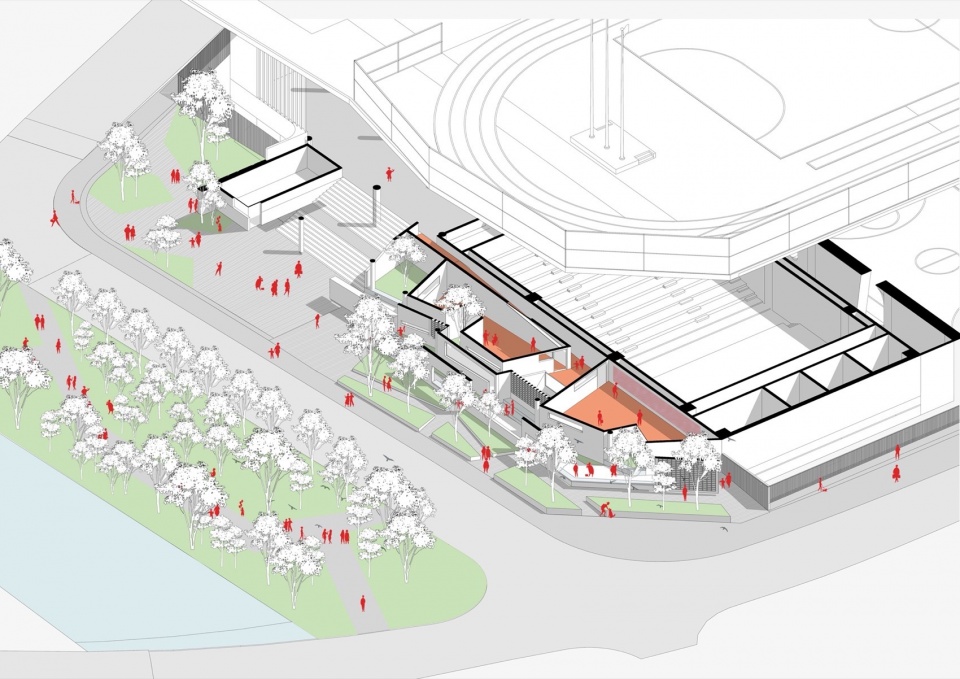
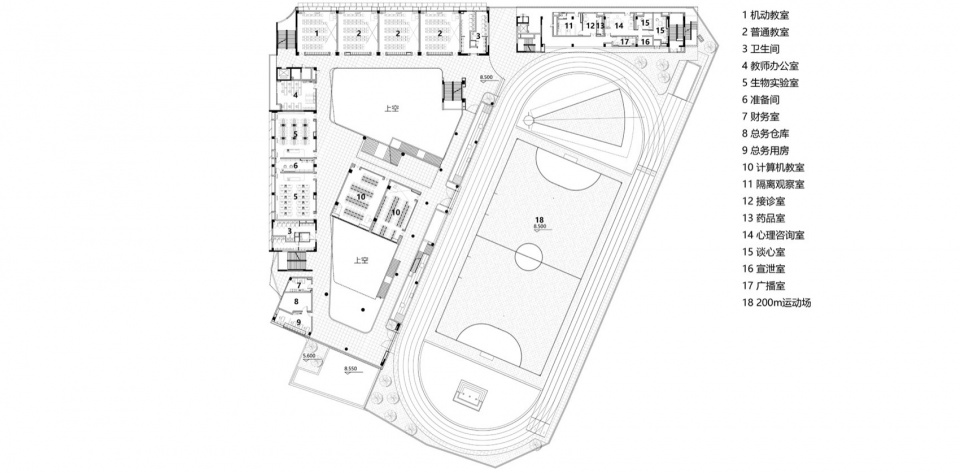
设计基于东南侧河道景观及民治水库景观的资源优势,在总体布局上将运动场置于东侧,采取半围合式庭院设计,使校园朝向东侧景观带,形成校园开放运动场与东侧开敞空间的自然衔接、相互渗透;同时也有效消解了东侧高层住宅带来的空间压迫感。通过周边景观资源的借景与整合,营造开阔舒展的活动与休憩空间,同时强化了校园与城市环境的有机对话。
The design capitalizes on the landscape resources of the southeastern riverside corridor and Minzhi Reservoir, strategically positioning the sports field along the eastern boundary through a semi-enclosed courtyard layout. This orientation aligns the campus with the eastern landscape belt, fostering seamless integration and mutual permeability between the open sports field and the adjacent green space, while simultaneously alleviating the spatial compression from neighboring super high-rise residences. By employing landscape borrowing techniques and systematically integrating surrounding scenic assets, the scheme cultivates expansive activity and recreation zones, reinforcing an organic dialogue between the campus and its urban environment through deliberate spatial choreography.
▼设计分析,Design Analysis
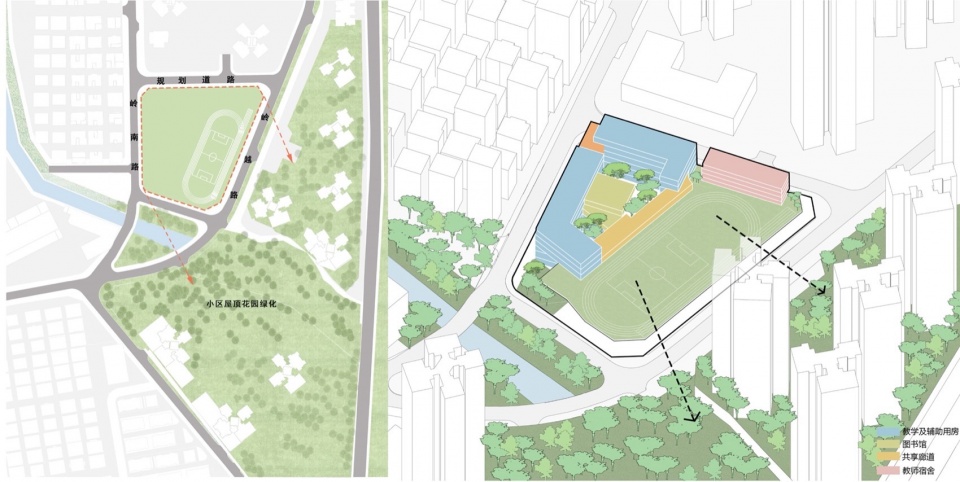
教学、生活、运动三大功能区布局明晰,一条贯穿南北的共享通廊犹如校园的活力脊,将教学区与运动生活区巧妙分隔,既保证各区域相对独立,又实现便捷联通。教学区的普通教室南北分置,通风采光条件良好;南侧直面河道景观带,适合静谧的学习环境。
The campus features three clearly defined functional zones for academics, living, and sports. A vibrant north-south shared corridor serves as the campus’ dynamic backbone, skillfully separating the teaching area from the sports-residential zone while ensuring relative independence for each area and maintaining convenient connectivity. Regular classrooms are arranged on the north and south sides with excellent ventilation and natural lighting. The southern section directly faces the riverside landscape belt, creating an ideal tranquil learning environment.
▼开放运动场透视,Open Sports Field
2 利用地形 有机链接Terrain utilization and Organic link
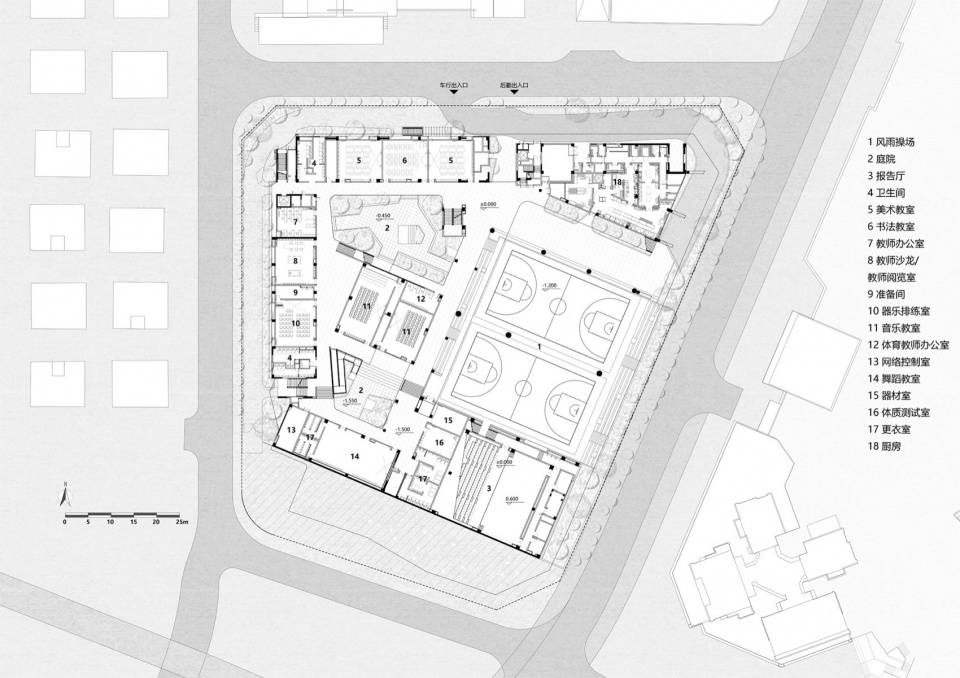
设计利用场地地形高差,设置南北入口与地面有机相接,形成双首层、双入口。场地南侧设置校园人行主入口与二层地面衔接,该入口与河道景观呼应,同时也能利用南侧开阔的河道景观带为校园提供接送等候空间。北侧设置人行次入口和车行出入口,实现人车分流。
▼设计分析,Design Analysis
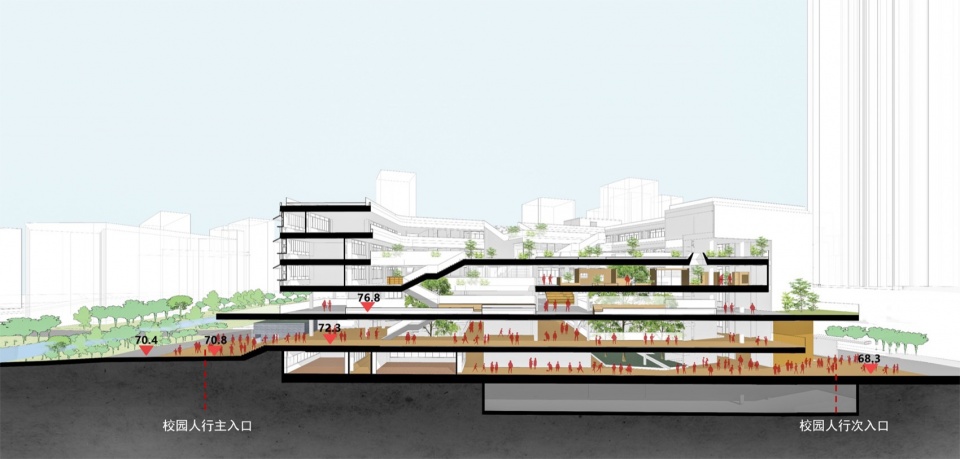
The design leverages the 3-meter elevation drop to create dual ground levels and entrances. The south entrance connects to the riverfront landscape, offering a spacious pick-up/drop-off zone, while the north entrance separates pedestrian system from vehicular system.
▼主入口架空空间,Main Entrance Overhead Space
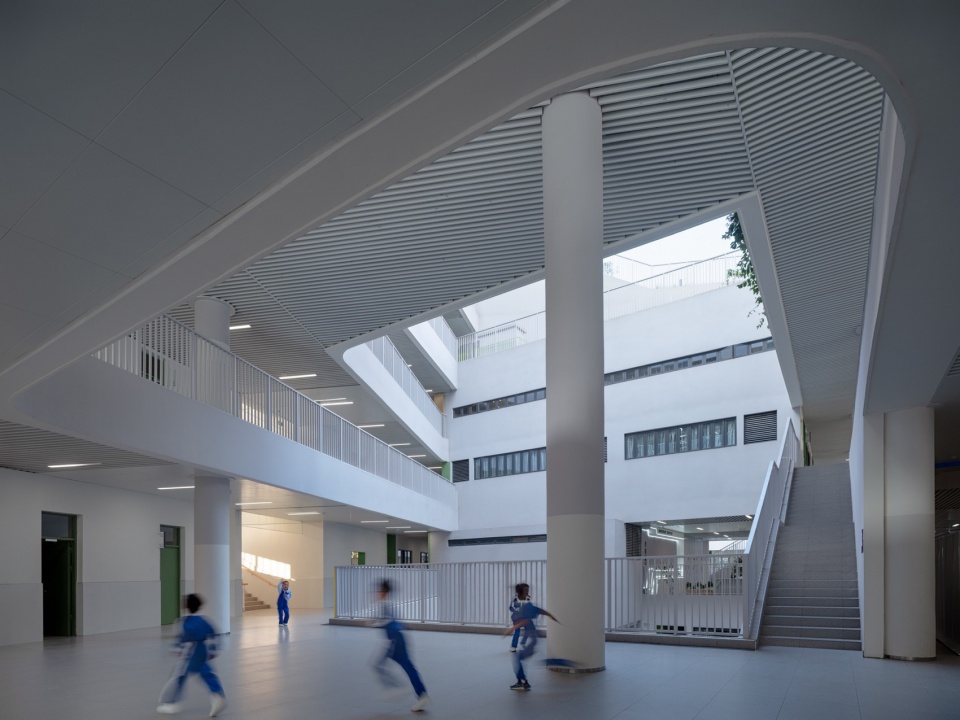
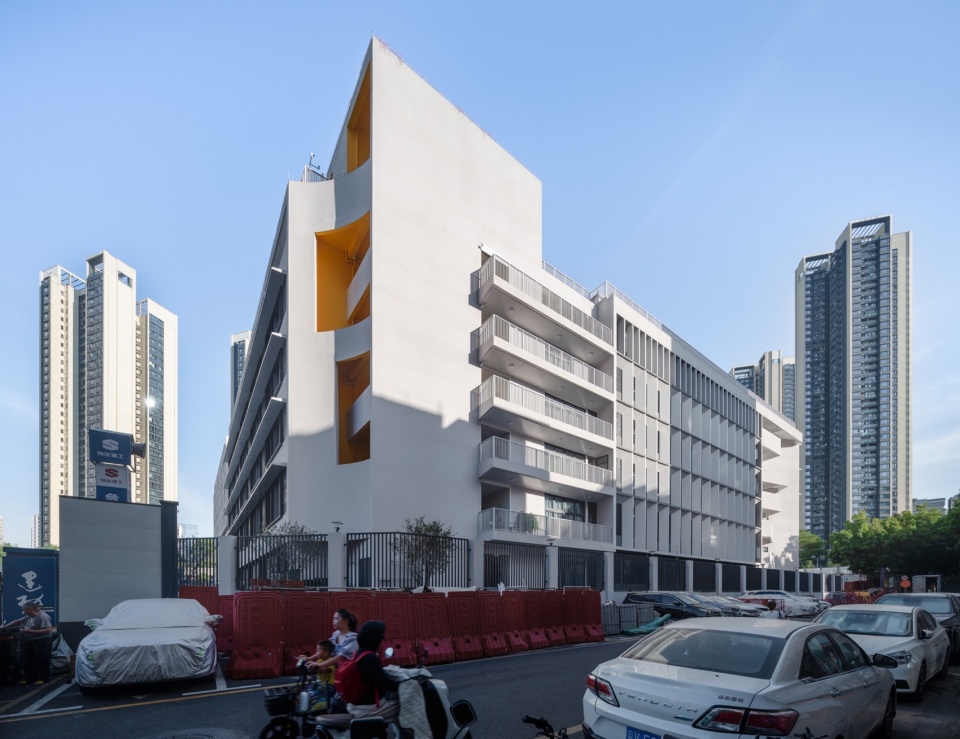
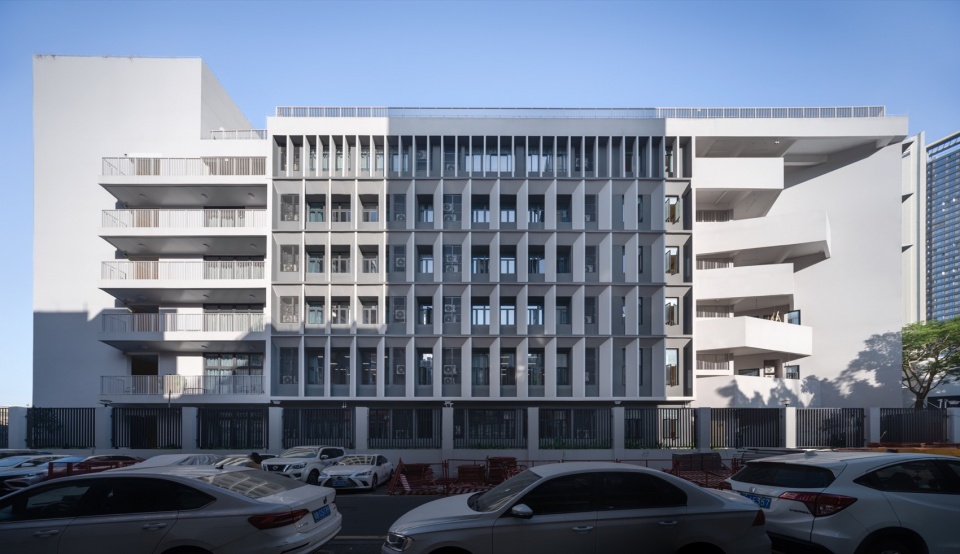
场地处于多元城市要素混杂交织环境中,设计通过简洁的几何体量塑造校园整体形态,以连贯而富有韵律感的立面语言,构建出独特的建筑表情,形成鲜明的校园场所标识性。清晰的形态逻辑和完整的空间序列,在城市新旧交织的肌理中凸显秩序与张力并存的建筑叙事。
The site is situated within an environment of interwoven urban elements. Through simple geometric volumes, the design shapes the campus’ cohesive form, employing a coherent and rhythmic facade language to create distinctive architectural expressions that establish a strong spatial identity. With clear formal logic and well-structured spatial sequences, the design highlights an architectural narrative that balances order and tension within the city’s new-old urban fabric.
▼西北角透视,Northwest Perspective
▼西侧沿街立面,West Facade
3 立体庭院 漫游体验Multi-level courtyard and Roaming experience
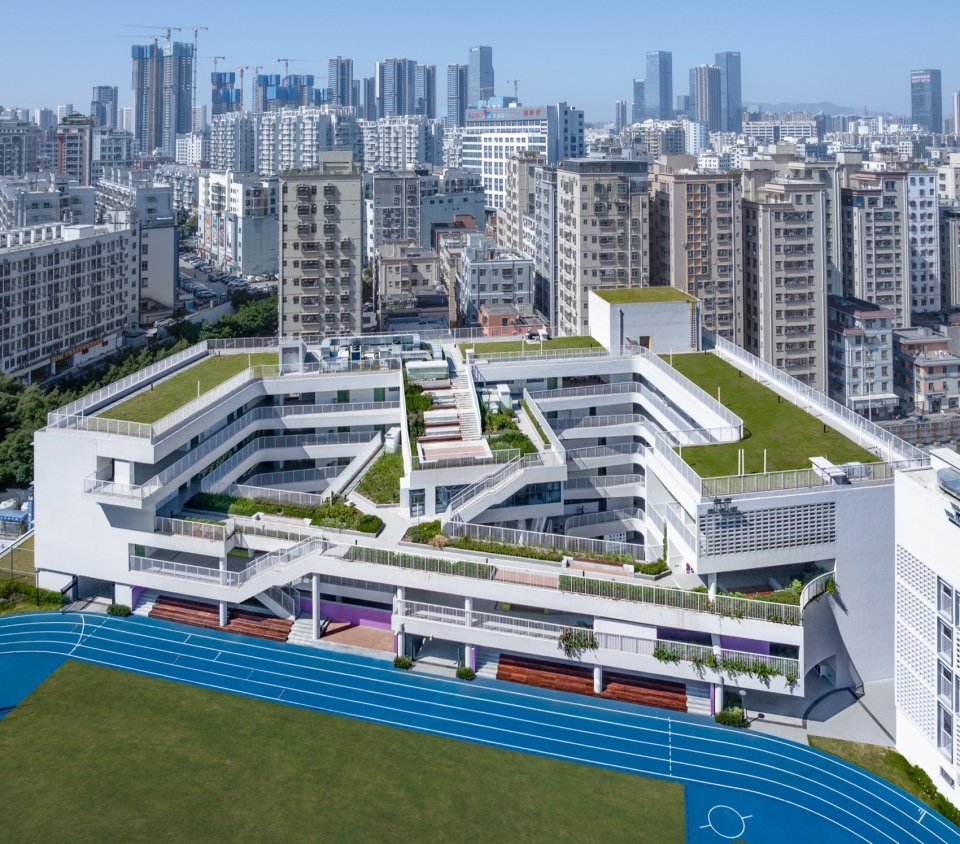
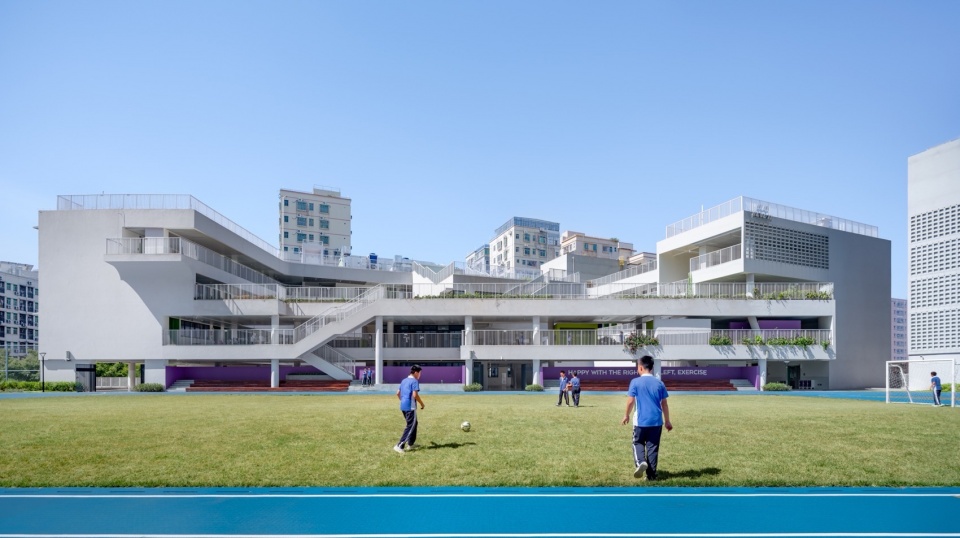
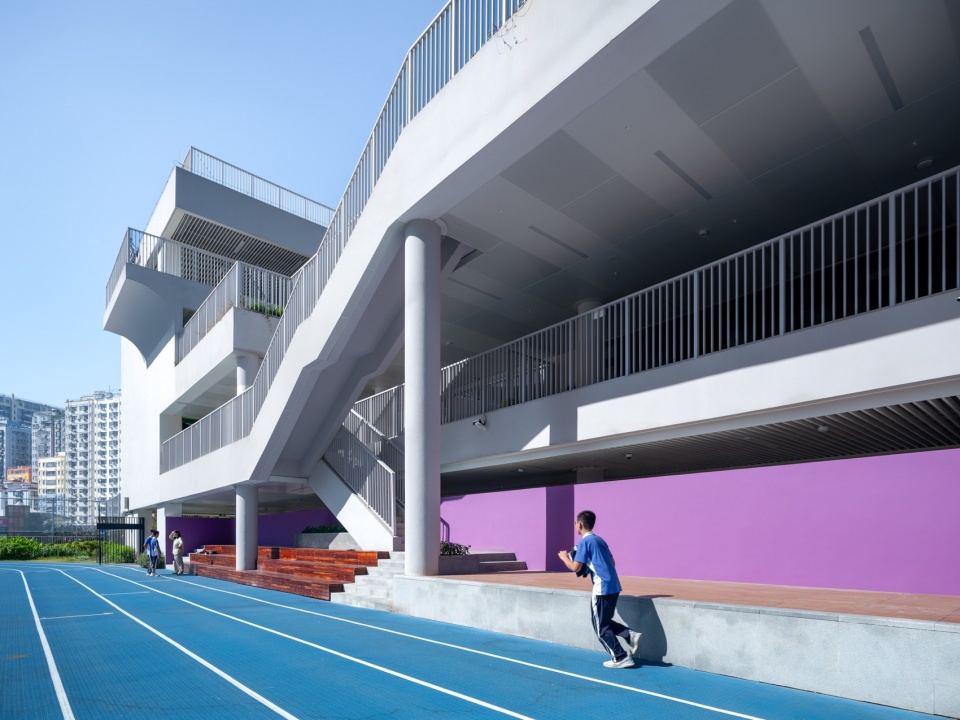
设计通过多层次的立体平台体系,巧妙构建了一所融合书院意境与现代园林的校园。以水平叠加为策略,形成高低错落的立体空间序列,结合垂直绿化系统,打造出富有渗透性的院落体系。
The design skillfully creates a campus that blends scholastic ambiance with modern gardens through a multi-layered platform system. Adopting a horizontal layering strategy, it forms a three-dimensional spatial sequence with varying elevations. Integrated with vertical greening systems, this approach crafts a permeable courtyard network that harmonizes architectural forms with natural elements.
▼立体游园与屋顶花园, Multi-level Courtyards and Rooftop Garden
▼开放运动场,Open Sports Field
▼共享开放学术廊,Shared Open Academic Corridor
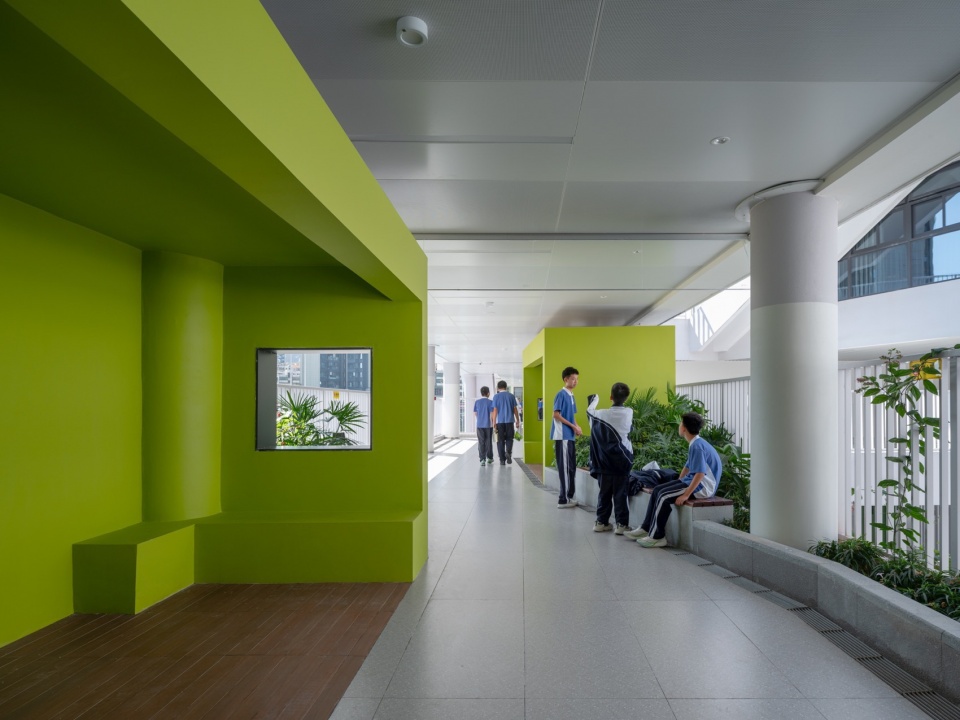
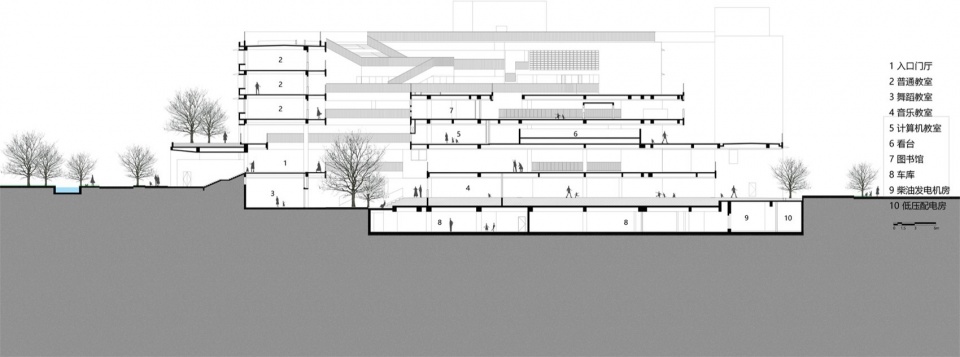
首层设置三处尺度各异的庭院空间,为师生集会、展览演出等集体活动提供了灵活场所;三至四层借运动场景观式看台和园林式共享开放学术廊,提供多样化、多义性的非正式学习空间;五至六层通过屋顶花园与图书馆无缝衔接,形成连续的绿色休闲平台,既拓展了学习交流场所,又创造了亲近自然的生态体验。这种立体多维的空间组织,不仅实现了功能的高效复合,更塑造出层次丰富、充满活力的现代书院空间特质。
▼设计分析,Design Analysis
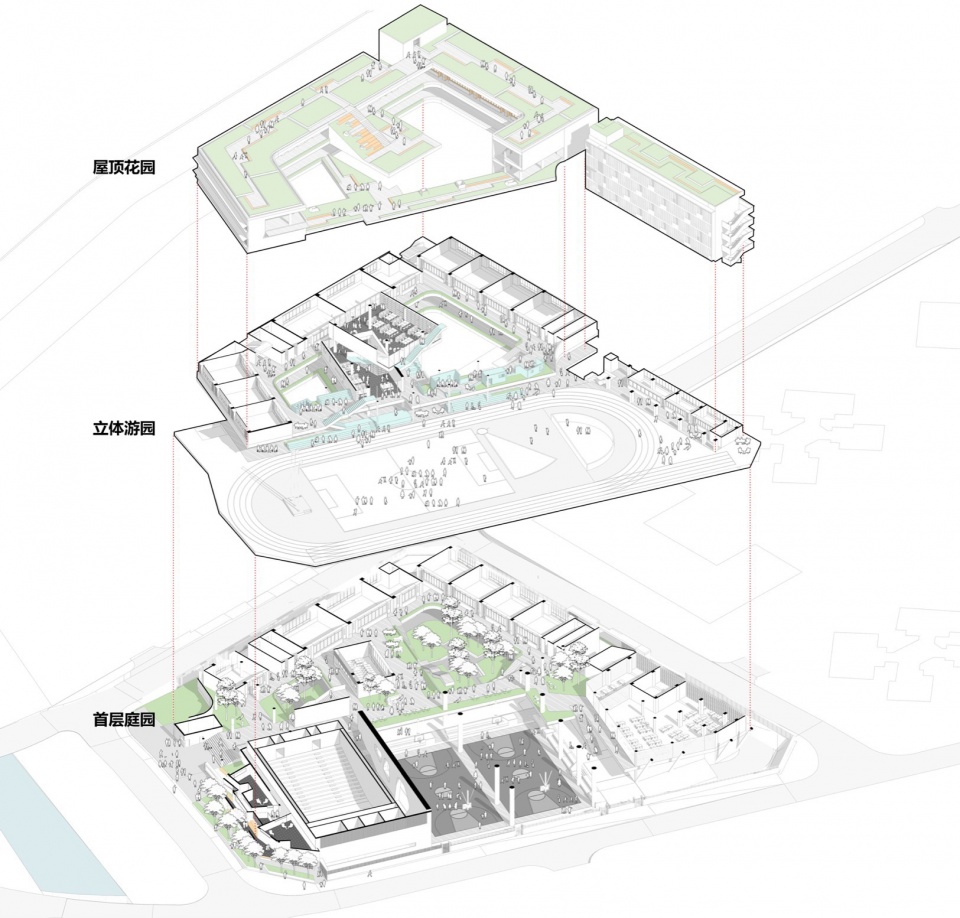
The ground floor features three courtyard spaces of varying scales, providing flexible venues for collective activities such as faculty-student gatherings and exhibition performances. Floors three to four incorporate landscaped spectator terraces for sports events and garden-style open academic corridors, creating versatile informal learning spaces with multiple interpretations. The fifth and sixth floors seamlessly connect to the library through rooftop gardens, forming continuous green leisure platforms that expand learning interaction areas while offering ecological experiences immersed in nature. This three-dimensional spatial organization not only achieves functional efficiency and complexity, but also cultivates a modern scholarly environment characterized by rich spatial layering and vibrant vitality.
▼首层庭院,Courtyard Perspective
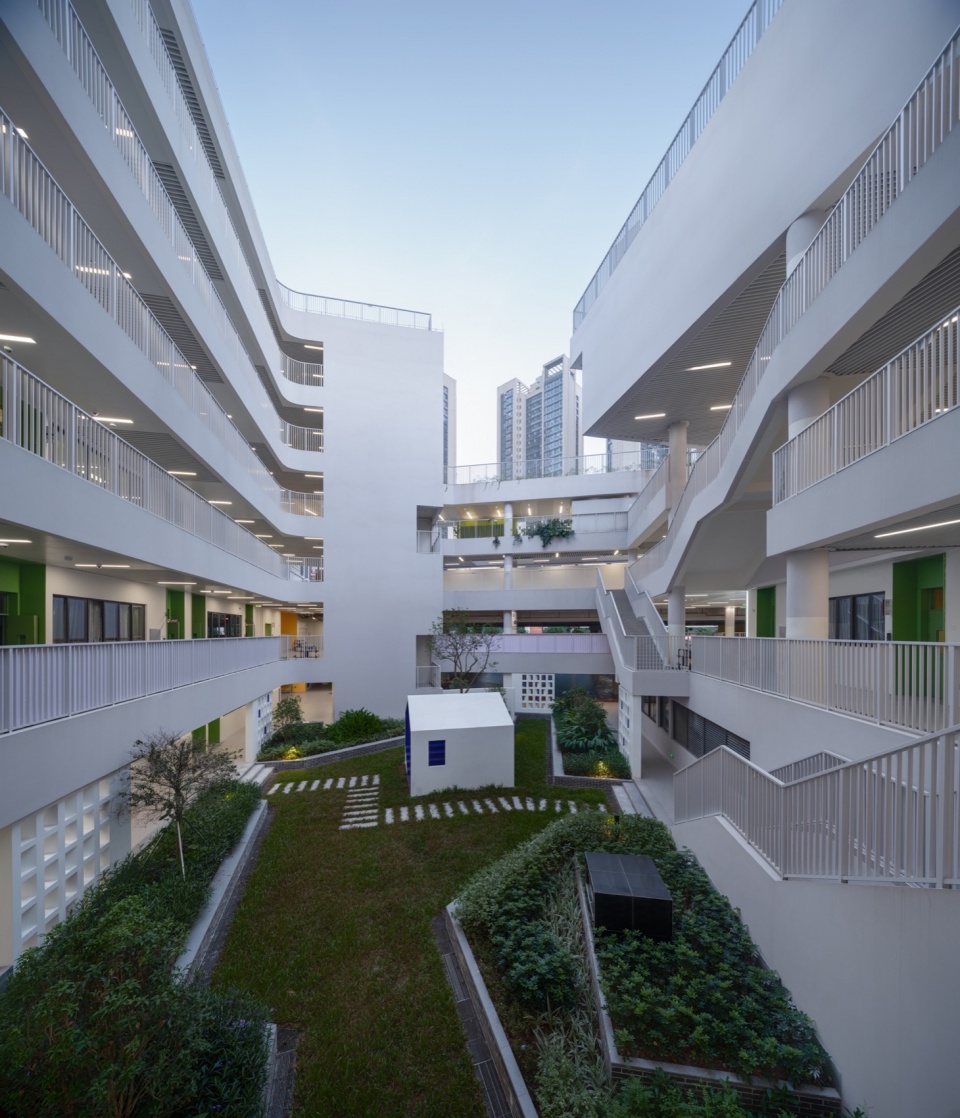
▼庭院透视,Courtyard Perspective
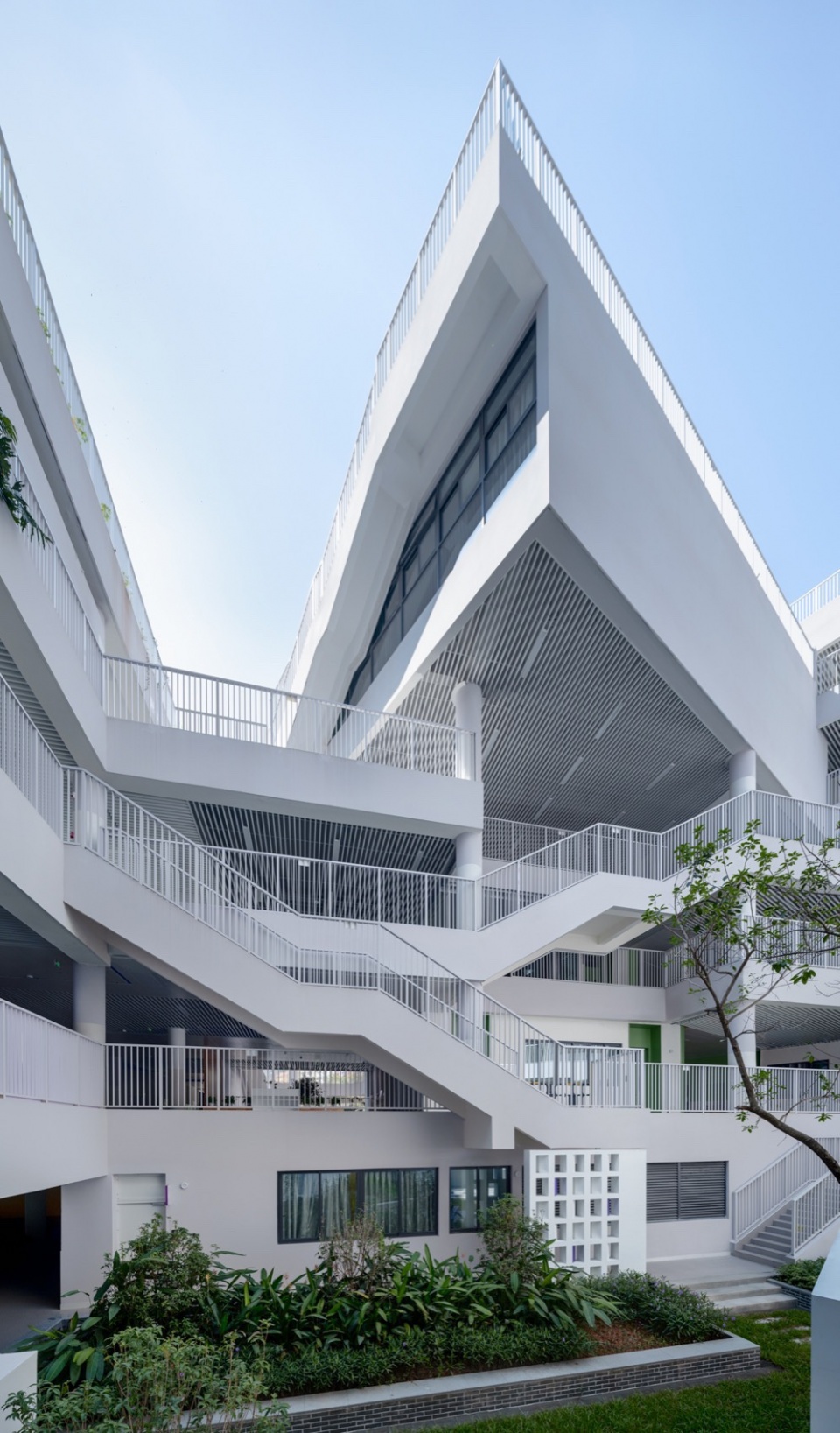
▼主入口庭院,Courtyard Perspective
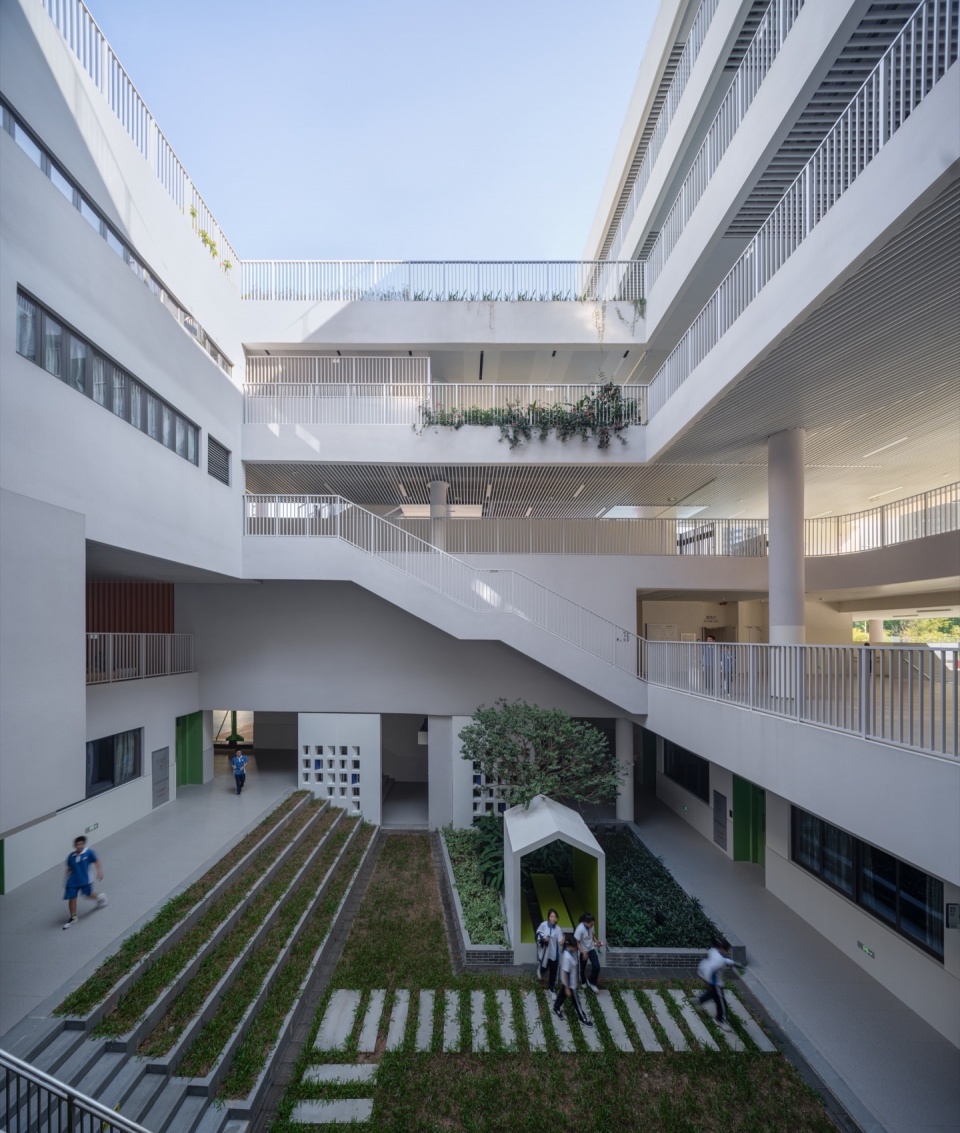
▼庭院俯瞰,Courtyard
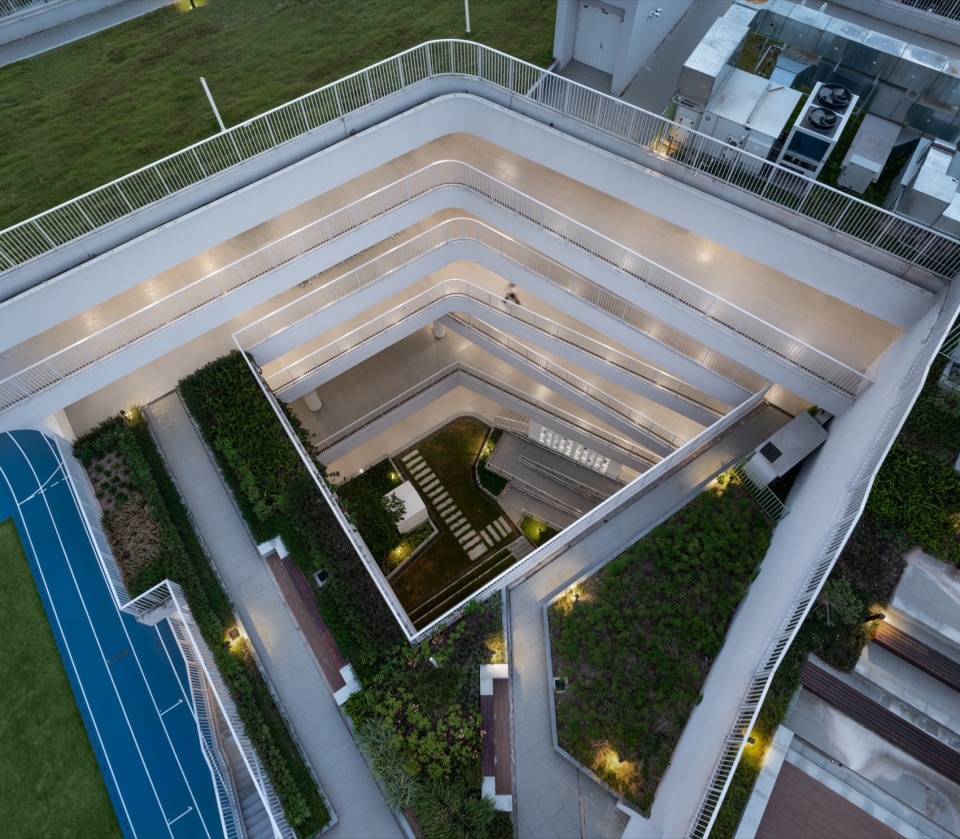
4 绿色边界 檐下共享Green boundaries and Shared undereaves
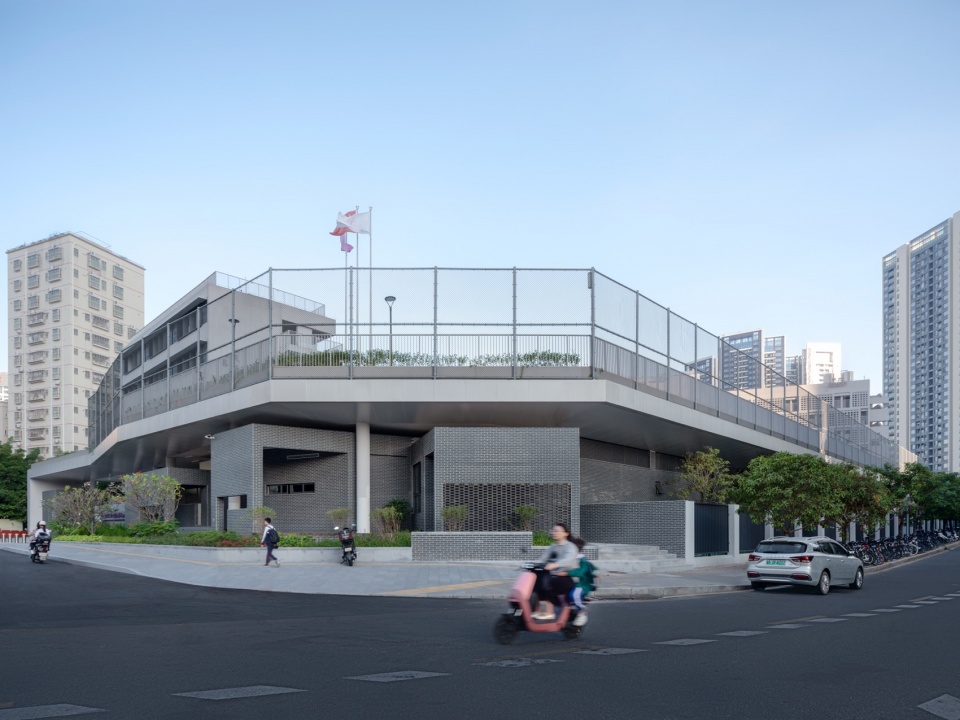
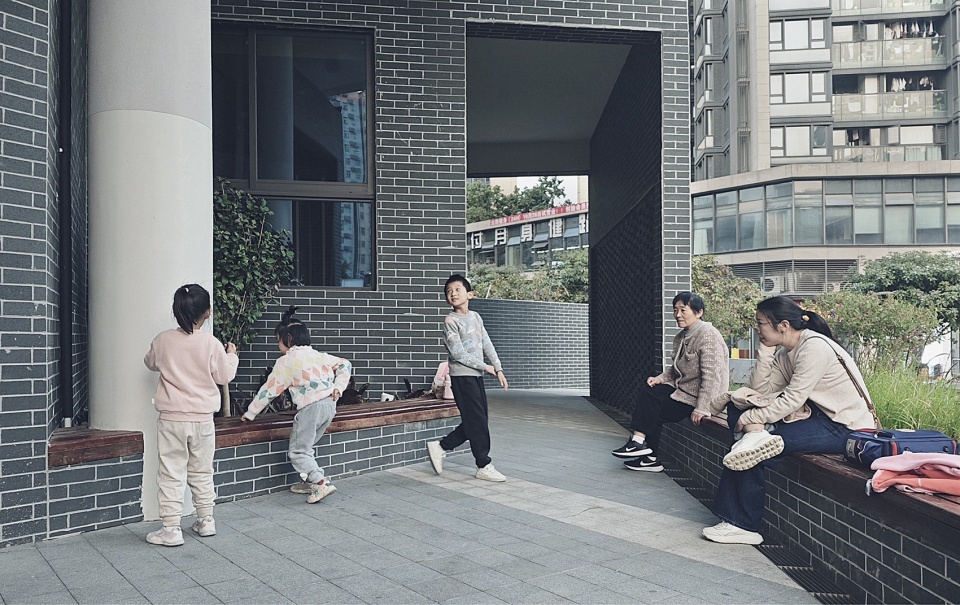
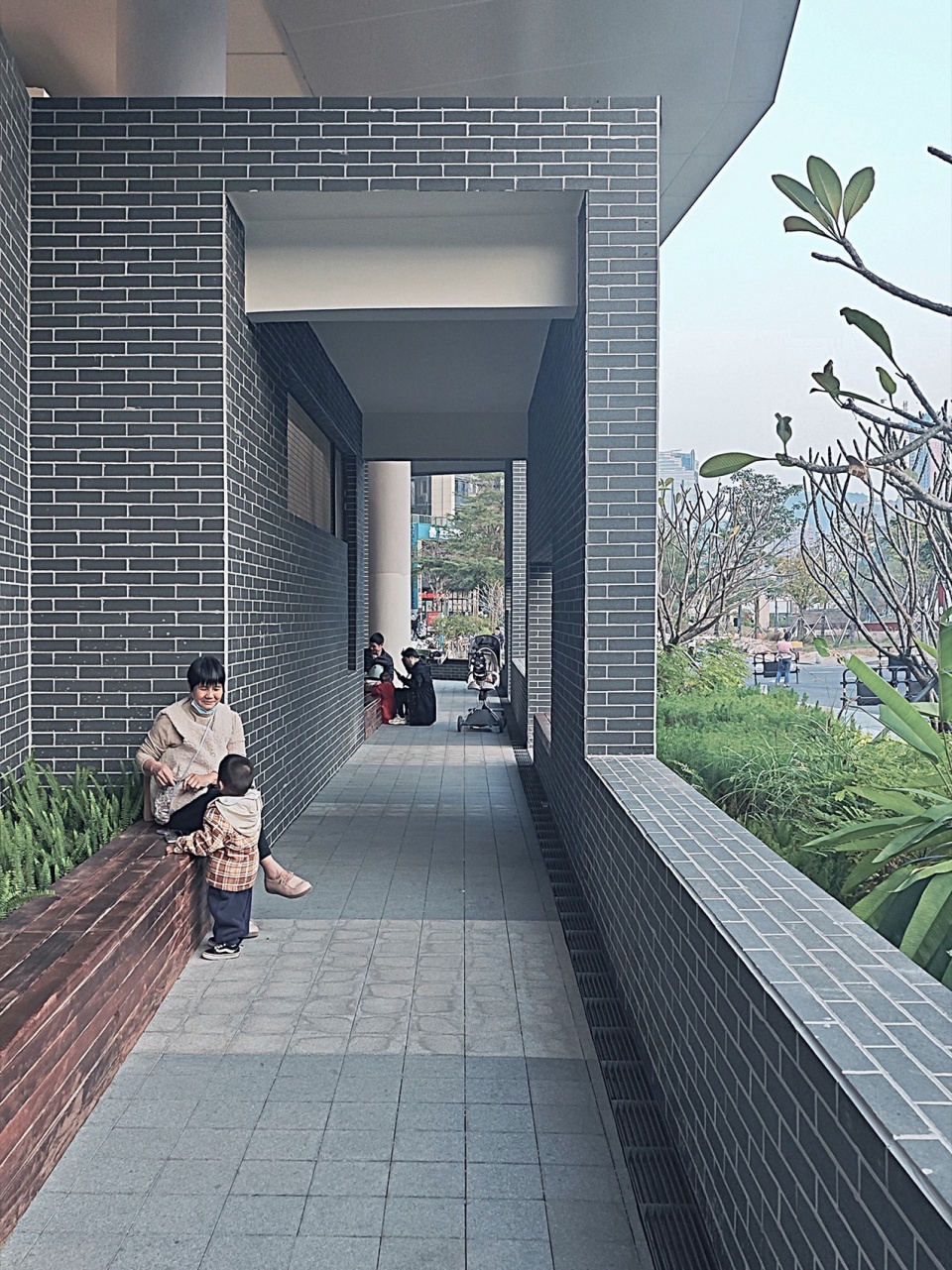
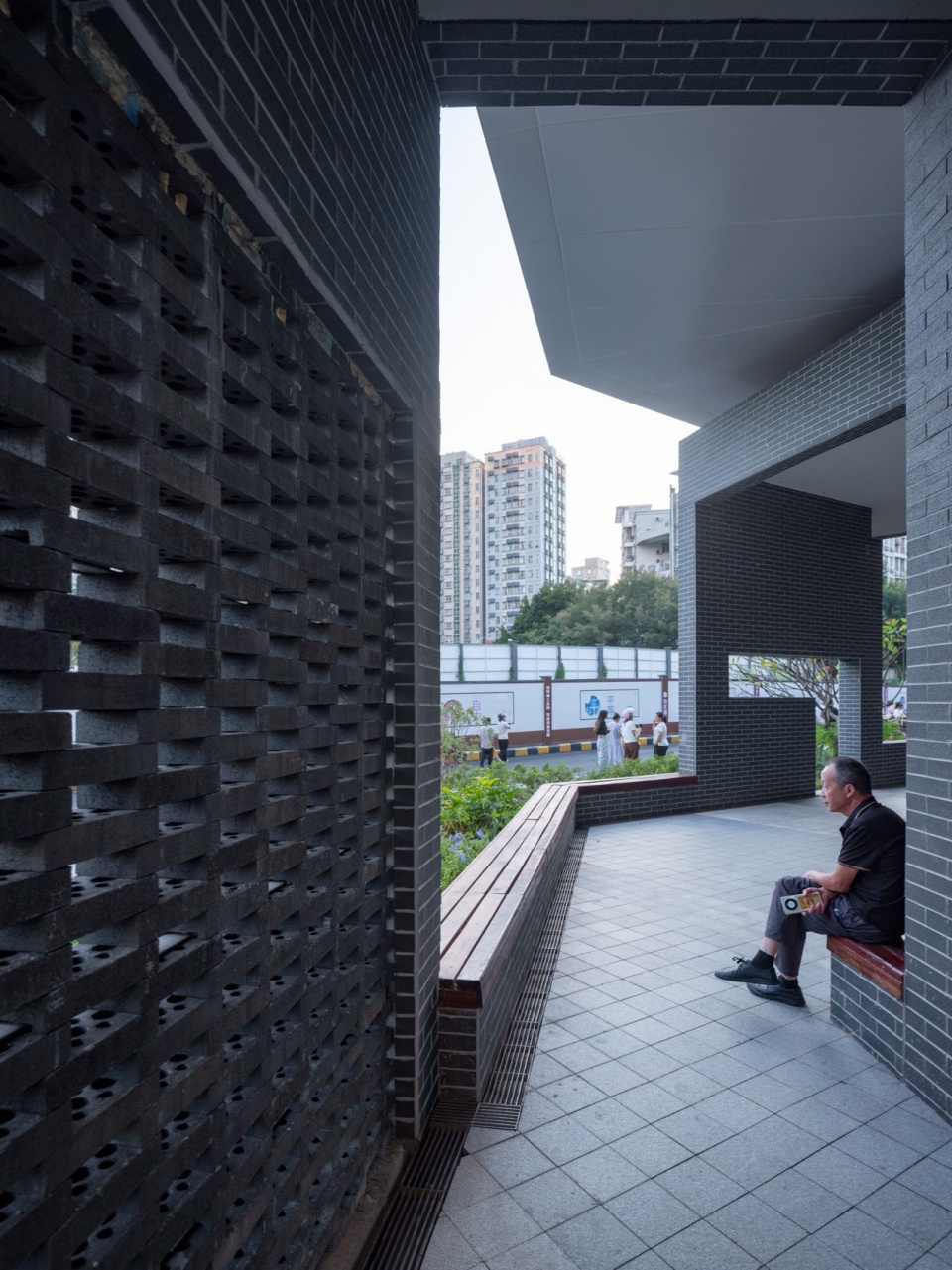
设计充分利用开放河道景观带的资源优势,突破传统校园封闭围墙的固有模式,转而以友好开放的姿态构建积极界面。将校园主入口与运动场挑板下方空间打造为多功能复合的檐下空间系统,设置了兼具家长接送区、临时等候区、文化展览厅及接待区等多种功能的弹性空间,并以园林化的景观手法,塑造出尺度宜人、层次丰富的连续性绿色界面。这些半开放的功能空间既延续了周边城村肌理的小尺度特质,又赋予了校园边界空间全新的文化内涵——既可作为校园德育展示的窗口,又能承载社区文化活动,在空间与人文双重维度上实现了校园与社区的有机共融与良性互动。
▼檐下共享空间,Undereaves shared space
The design fully leverages the resource advantages of the open riverside landscape belt, breaking away from traditional enclosed campus boundaries to establish a friendly, open interface. By transforming the main campus entrance and the space beneath the sports field’s cantilevered structure into a multi-functional canopy space system, it creates flexible zones combining parent drop-off areas, temporary waiting spaces, cultural exhibition halls, and reception areas. Through landscape gardening techniques, the design crafts a human-scaled, multi-layered continuous green interface. These semi-open functional spaces preserve the small-scale urban-village texture of surrounding areas while imbuing campus edge spaces with new cultural significance – serving both as a showcase for campus moral education and a platform for community cultural activities. This approach achieves organic integration and constructive interaction between campus and community, bridging spatial and cultural dimensions.
▼开放共享边界, Open sharing boundaries
▼檐下共享空间,Shared space
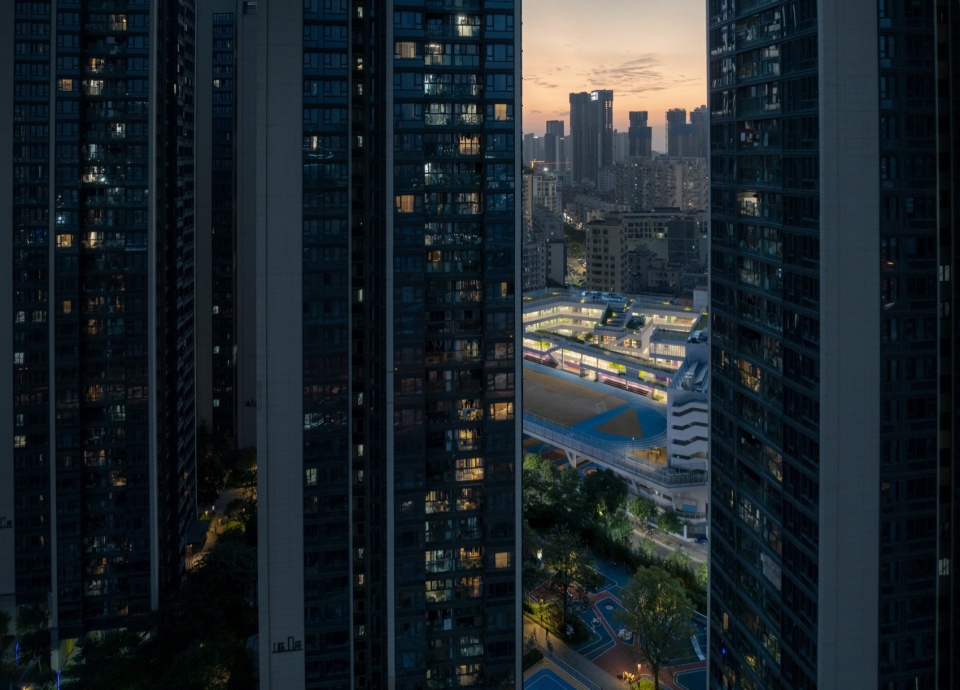
▼夜景,night view
▼总平面,master plan
▼首层平面,first floor plan
▼二层平面,second floor plan
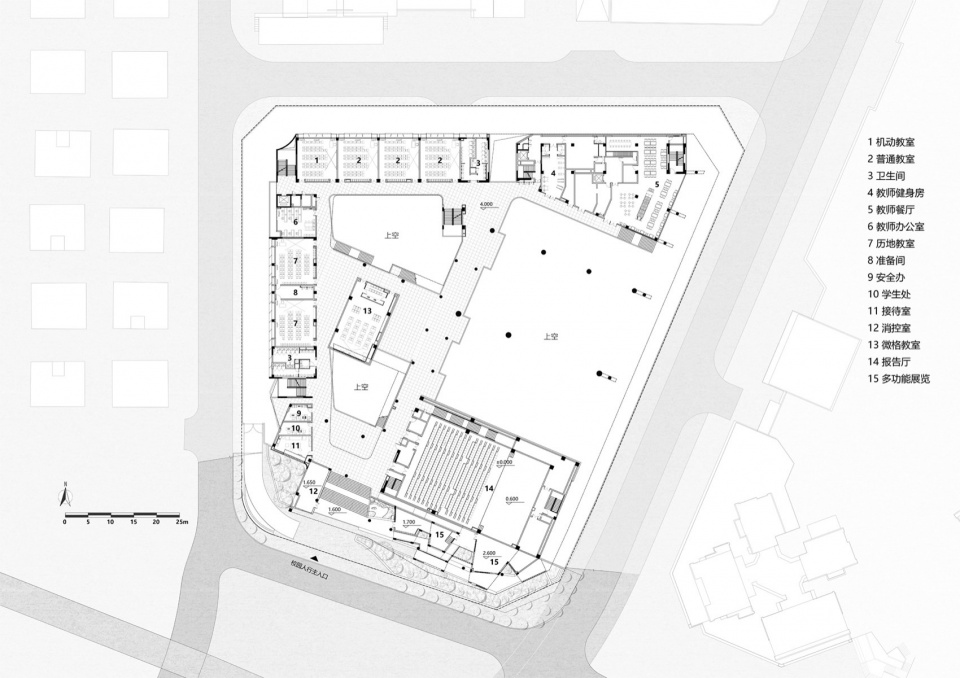
▼三层平面,third floor plan
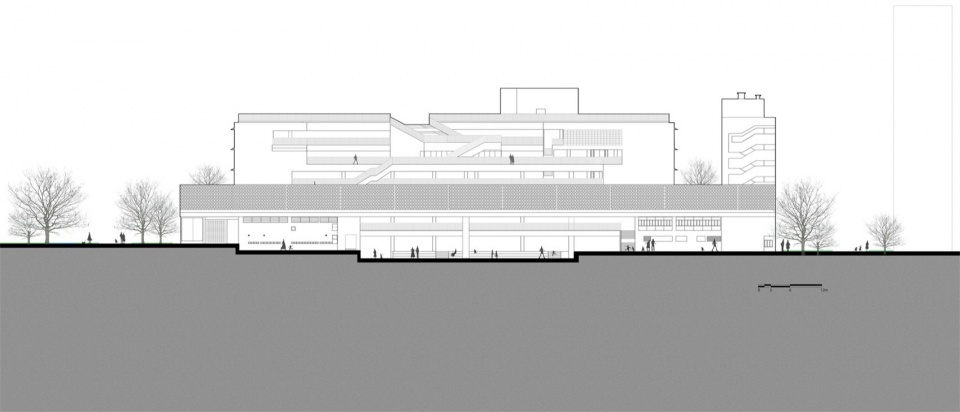
▼东立面,east elevation
▼剖面,section
Project Name: The Minzhi Campus of Shenzhen Longhua Senior High School Education Group
Project Address: Minzhi Street, Longhua District, Shenzhen
Total construction area: 23762㎡
Design period: 2022 — 2024
Completion date: September 2024
Construction Unit: Shenzhen Longhua District Construction and Public Works Department
Agent-construction Organization: Shenzhen Vanke Urban Construction Management Co., LTD
Design general contractor: The Institute of Architecture Design & Research. SHENZHEN University
Interior design unit: Shenzhen SD Space Design CN., LTD
Landscape design unit: Shenzhen SD Space Design CN., LTD
Architectural scheme team: Cai Ruiding, Chen Jingwen, He Weiyong, Liu Jianhui, Zhou Xuemei
Construction drawing team: Fu Hong, Chen Shaowei, Sun Yilu, Yang Zehui, Cao Jiying, Gan Shui, Wang Jingzhe, Tang Jin
Architectural photography: Shan-jian images, Yuanism Architects