遥望总部大楼室内设计,杭州 / 申江海建筑事务所
导语Introduction
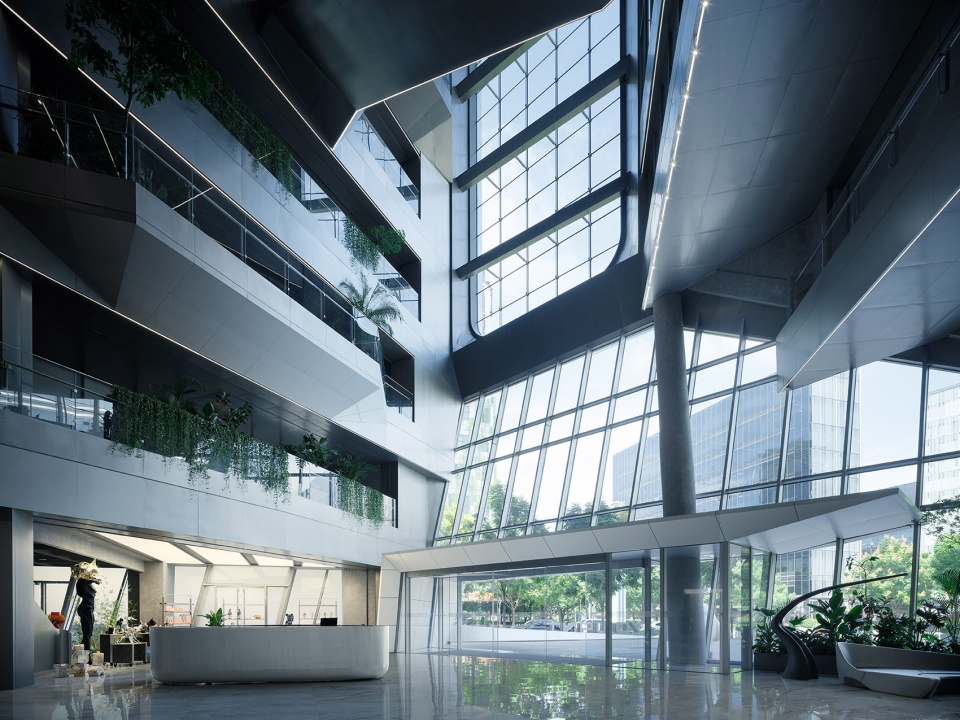
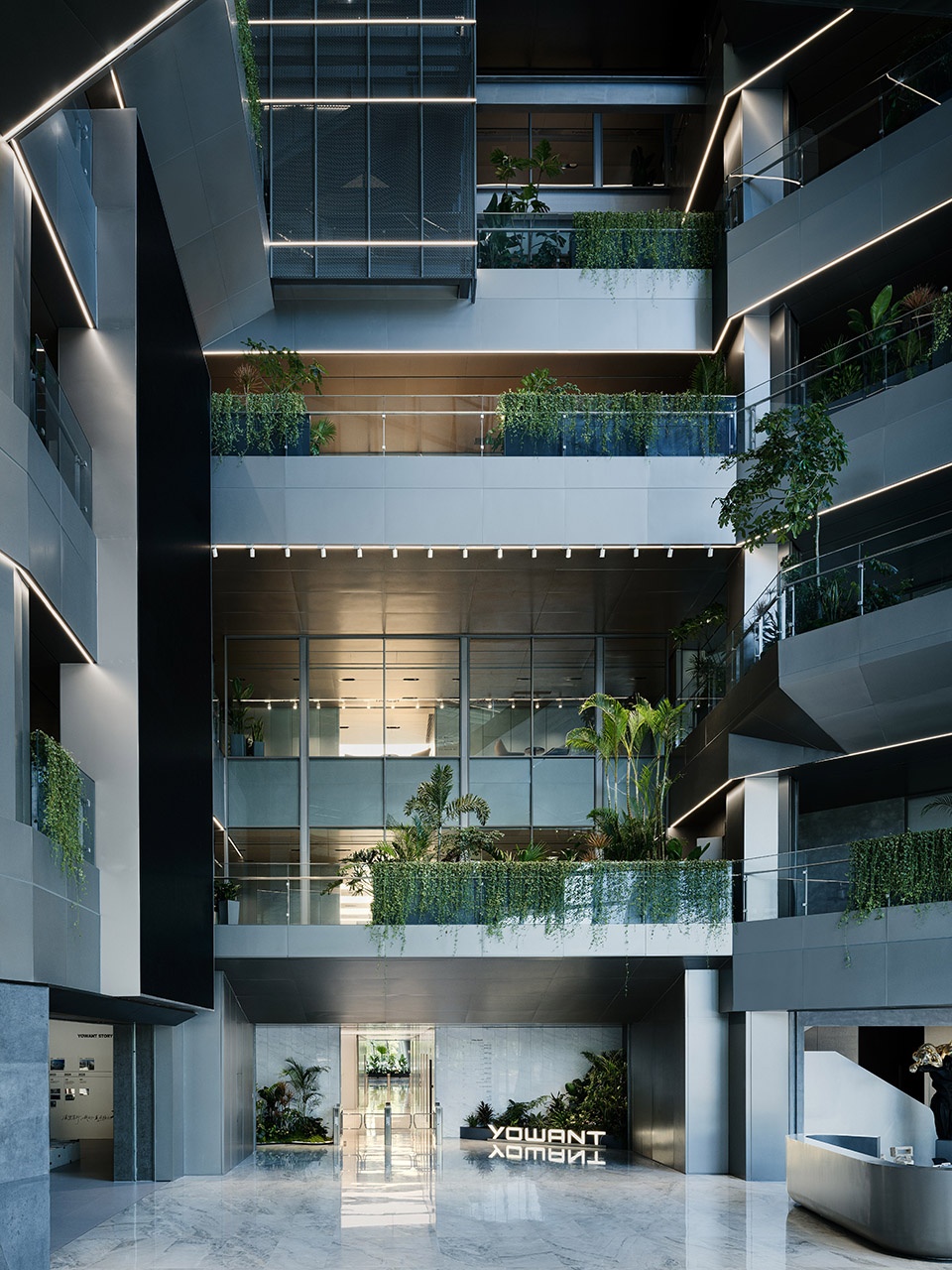
遥望总部大楼位于杭州市未来科技城联创街与海园路交汇处,总建筑面积约42000㎡。本案的核心挑战在于南北双中庭的超高挑空,其中北中庭需跨越9层挑空:如何解决一座跨越九层挑空、南北双中庭的超大垂直空间所带来的物理隔阂,设计团队把这个“巨大的内部空间”变成了一个用于协作、交流和充满绿植的“垂直花园”。通过加入交错叠落的立体楼梯系统和内退式挑台,项目给原本规整的空间,增加了一些自然的、灵活的感觉,最终实现了“高效工作的同时,也需要一个舒适自然的环境”这一目标。
The Yaowang Building is located at the intersection of Lianchuang Street and Haiyuan Road in Hangzhou Future Science and Technology City, with a total building area of about 42,000㎡. The core challenge of this project lies in the ultra-high voids of the north-south double atrium, with the north atrium spanning 9 floors: how to resolve the physical barrier brought by the super-large vertical space spanning nine floors and north-south double atria. The design team transformed this “huge internal space” into a “vertical garden” for collaboration, communication and full of green plants. By adding staggered three-dimensional staircase systems and recessed pickaxes, the project added a natural and flexible feel to the originally neat space, finally achieving the goal of “efficient work while also needing a comfortable and natural environment”.
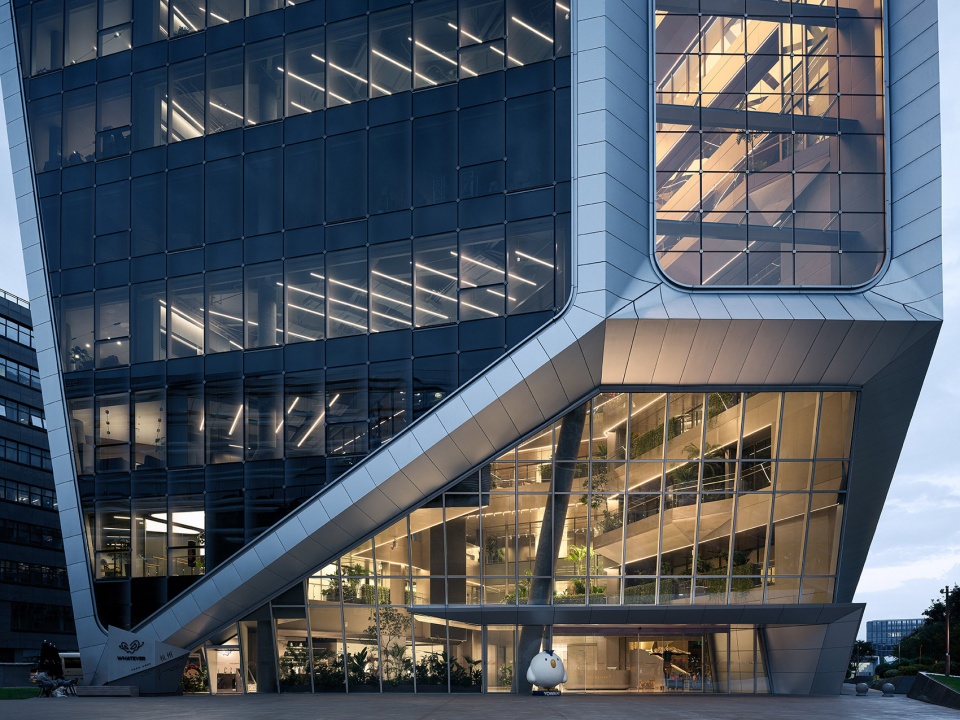
▼入口大堂与中庭概览,A glance of the lobby and atrium
Ⅰ. 空间生成:超大空间的利用与改造Spatial Formation: Using and Transforming Mega-Spaces
1. 垂直交通的建构逻辑:打破楼层物理间隔Design Logic of Vertical Circulation: Dissolving Inter-Story Physical Barriers
本案的核心设计核心在于对交通核的重新定义。面对九层的北中庭超高挑空,单纯的空中连廊无法承担起高效协作的空间职能。设计师将传统连廊升级为一套“交错叠落的立体楼梯系统”,它不仅是一个高效连接上下楼层的交通工具,更是一个可以激发偶遇和短暂交流的非正式协作空间。
▼中庭分析图,Atrium Analysis Diagram
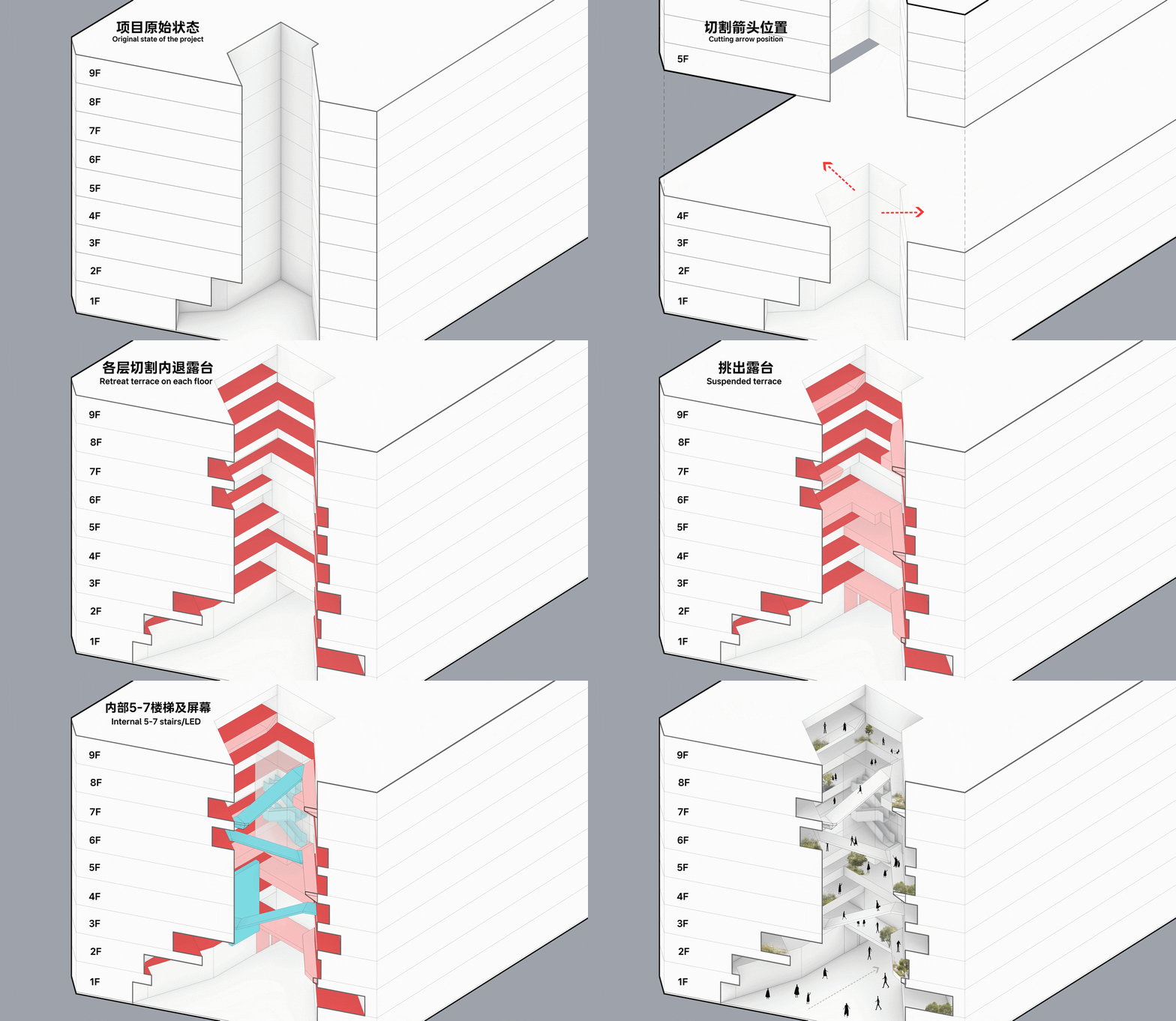
The core design of this project lies in the redefinition of the transportation hub. Facing the north atrium’s ultra-high void spanning nine floors, a simple aerial corridor cannot bear the functional space of efficient collaboration. Designers upgraded the traditional corridor to a set of “interlaced stacked three-dimensional staircase systems”, which is not only an efficient transportation tool for connecting upper and lower floors, but also an informal collaborative space that can stimulate encounters and brief exchanges.
▼交错叠落的立体楼梯系统,The dynamic three-dimensional staircase system
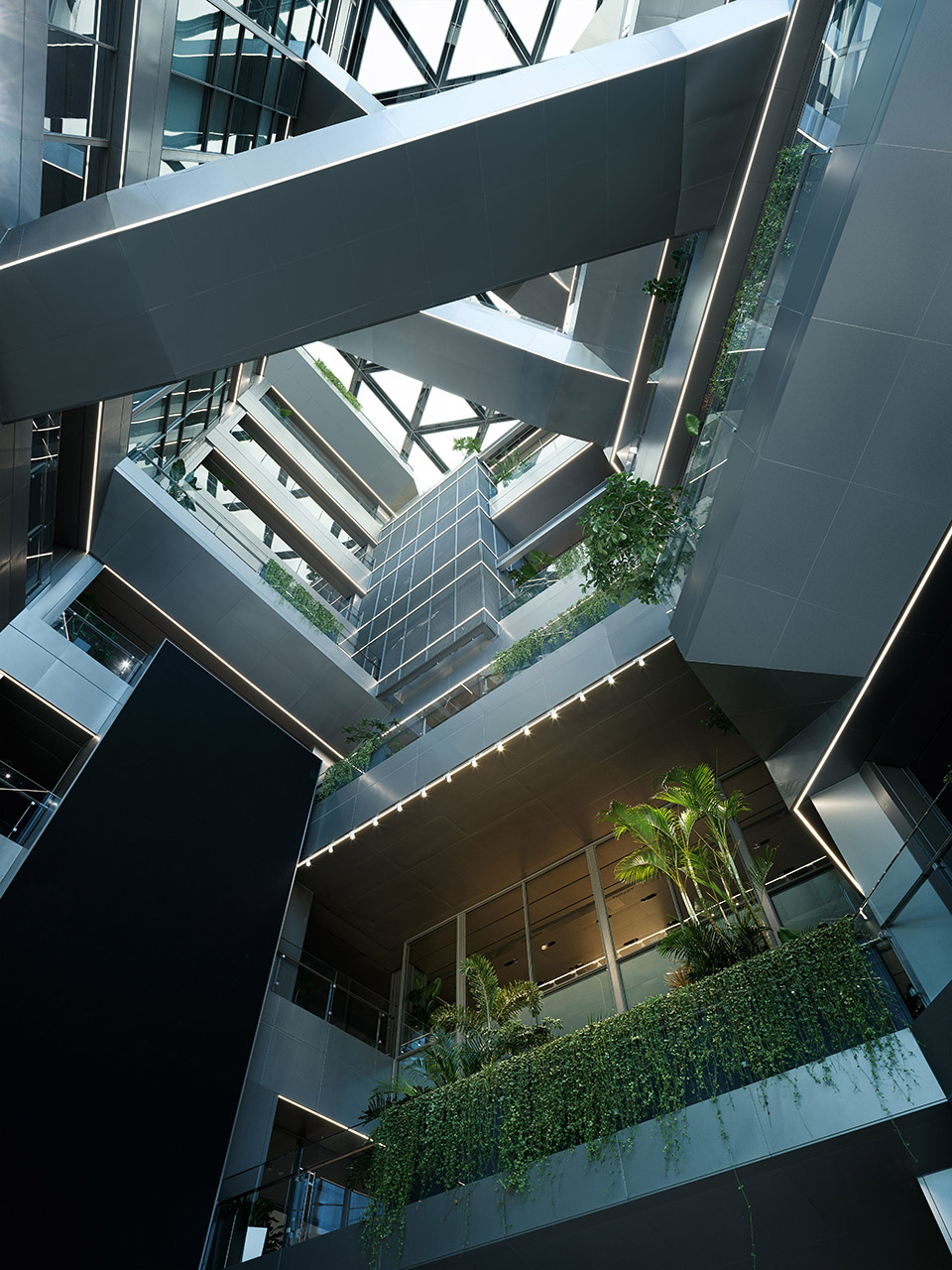
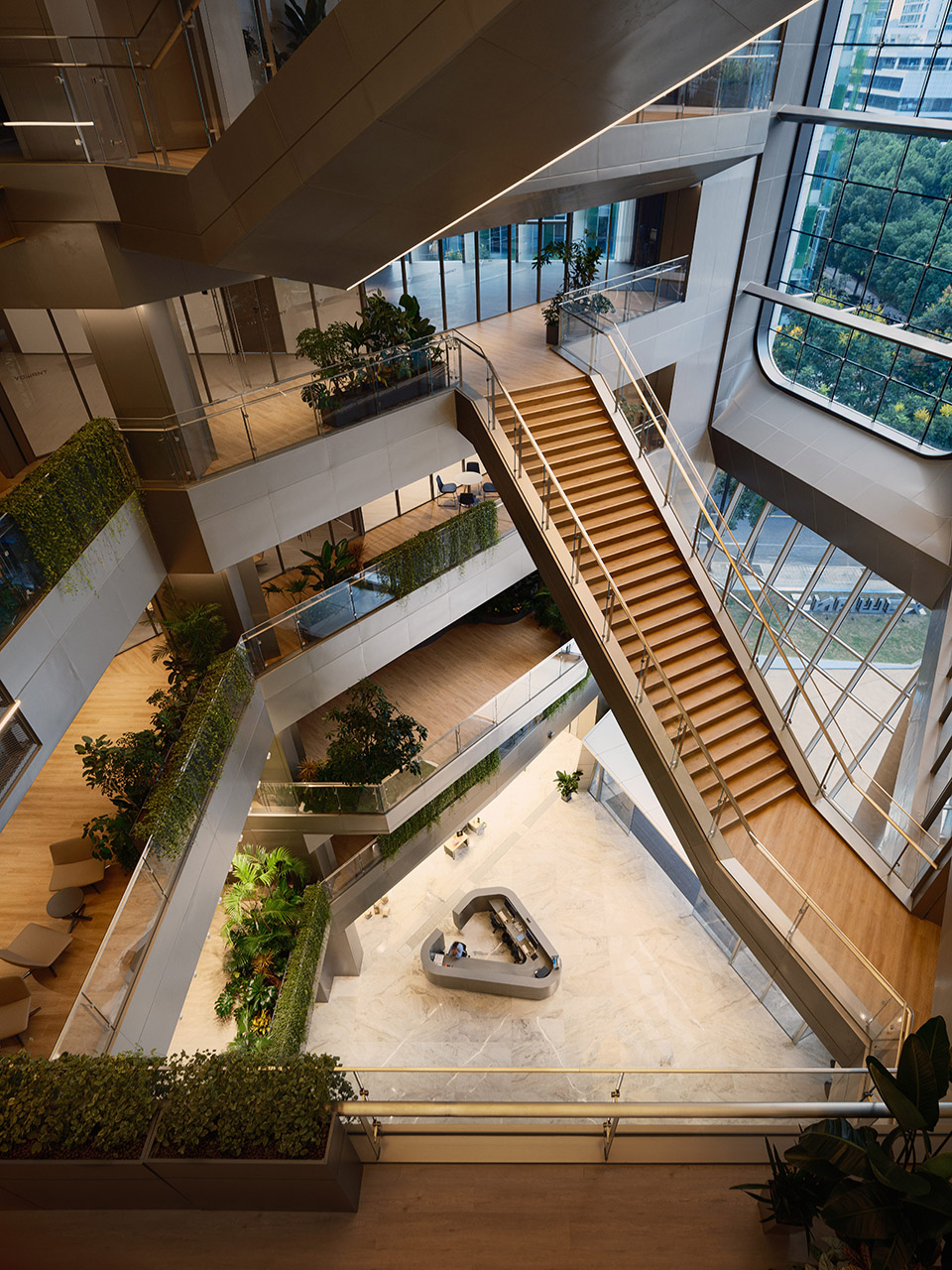
▼交错叠落的立体楼梯系统,The dynamic three-dimensional staircase system
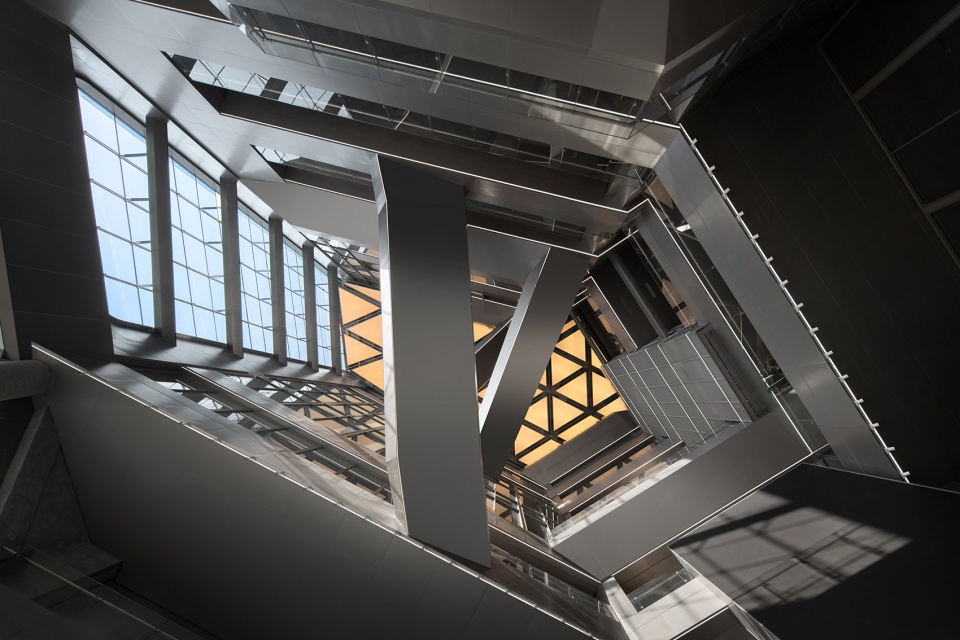
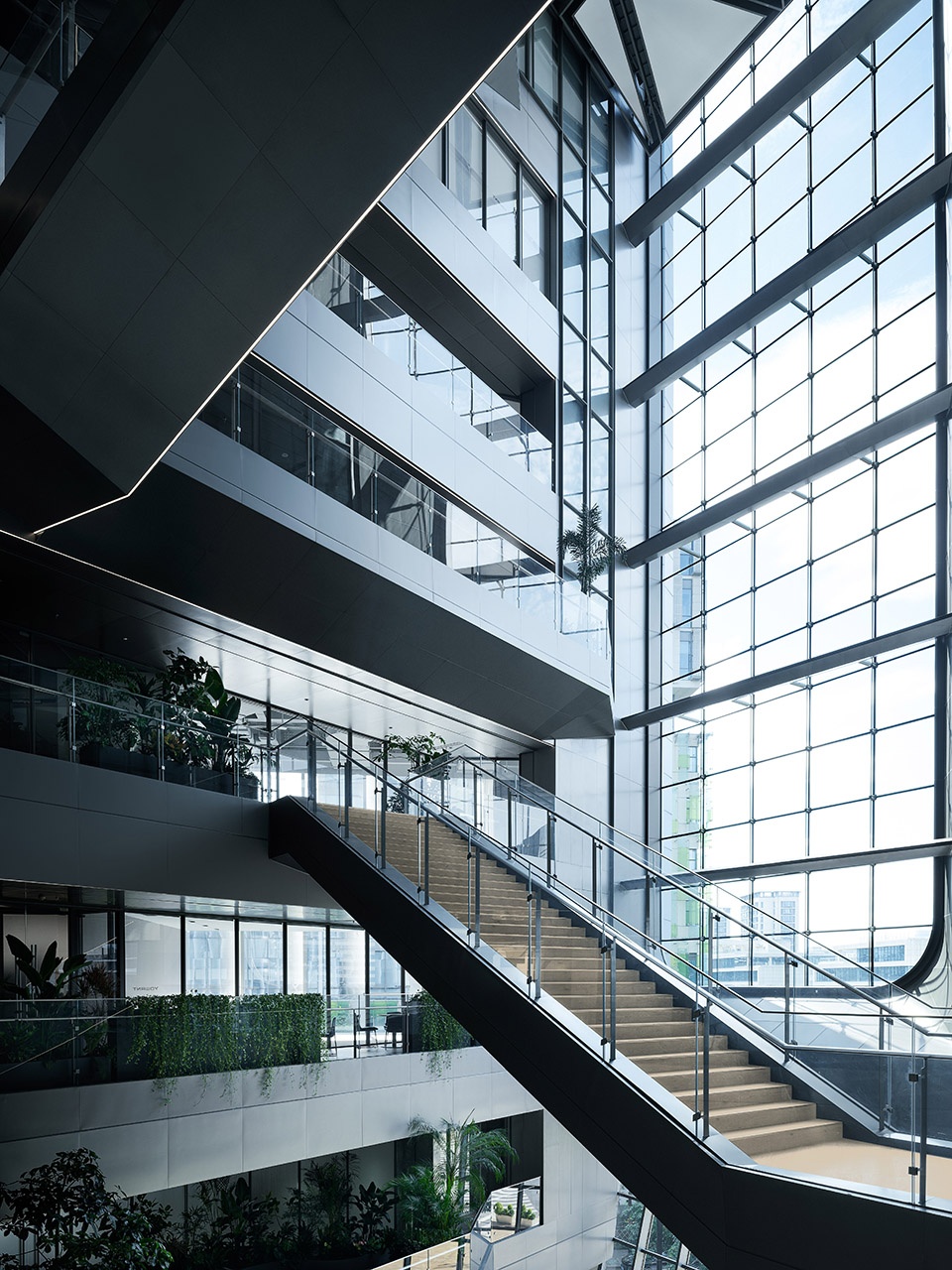
增加楼梯体量并赋予多种功能: 楼梯不再紧贴核心筒,而是大胆地向中庭体块延伸。加宽的踏步为人们在上下楼途中驻足交谈提供了可能,重要的平台节点则作为垂直交通的延伸,促进了不同楼层间的互动与联系。
Increase the staircase volume and give it multiple functions: The staircase no longer hugs the core tube, but boldly extends to the atrium volume. The widened steps provide the possibility for people to stop and chat during up and down stairs, and the important platform nodes serve as extensions of vertical transportation, promoting interaction and connection between different floors.
▼楼梯系统近景,A close-up view of the staircase system
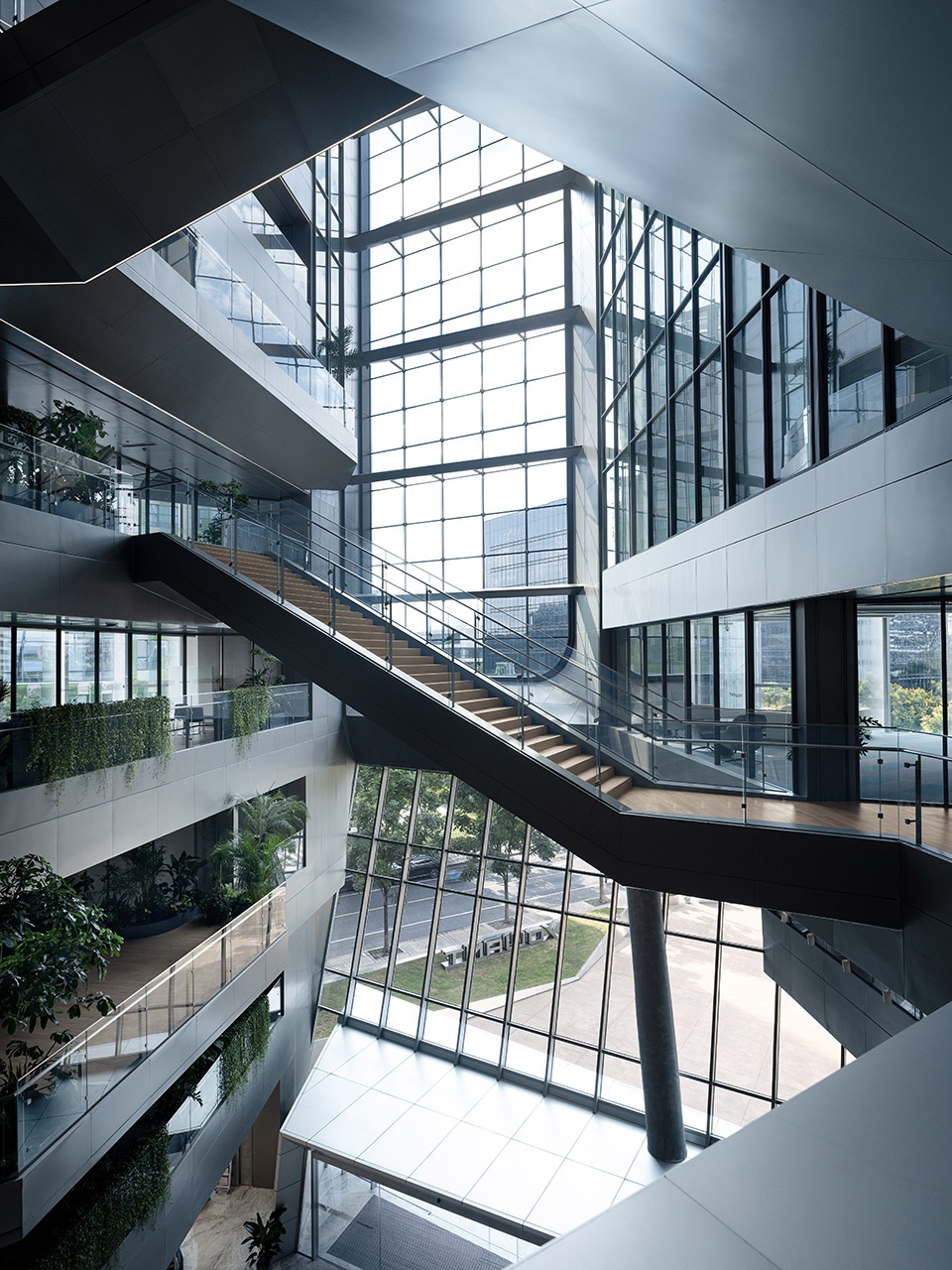
2. 生态的叠层渗透:悬浮绿岛的空间秩序Layered Ecological Permeation: Spatial Order in Suspended Green Isles
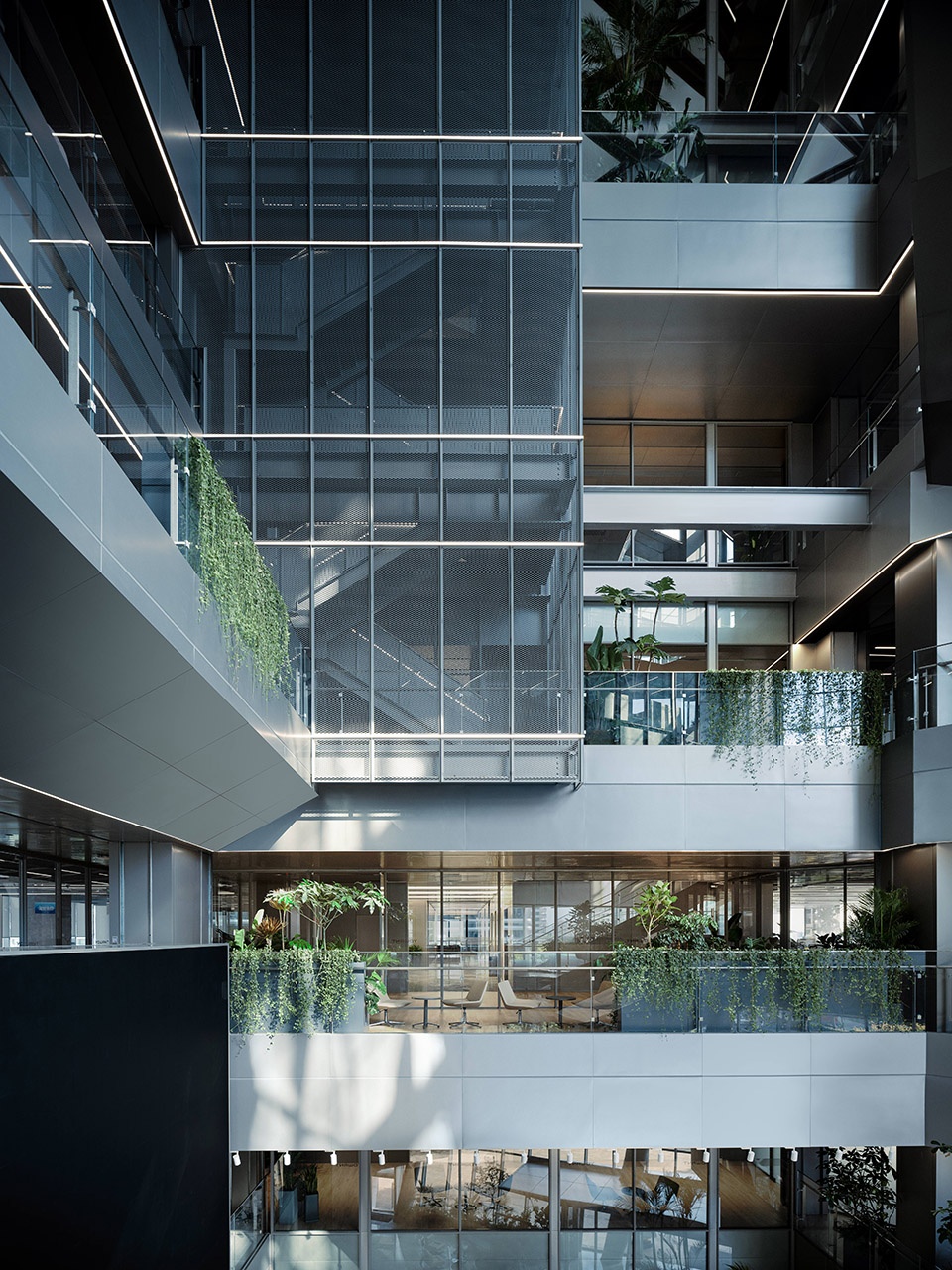
为了平衡高耸中庭的尺度感,设计引入“悬浮绿岛”与“内退式挑台”这一生态系统。设计充分考虑了不同工作模式下的需求,进行上下分区的空间策略(Spatial Strategy):
In order to balance the sense of scale of the towering atrium, the design introduced the ecological system of “suspended green islands” and “recessed pickaxes”. The design fully considered the needs under different work modes, carrying out spatial strategies for upper and lower partitions (Spatial Strategy):
▼中庭的垂直生态系统,The vertical ecosystem within the atrium
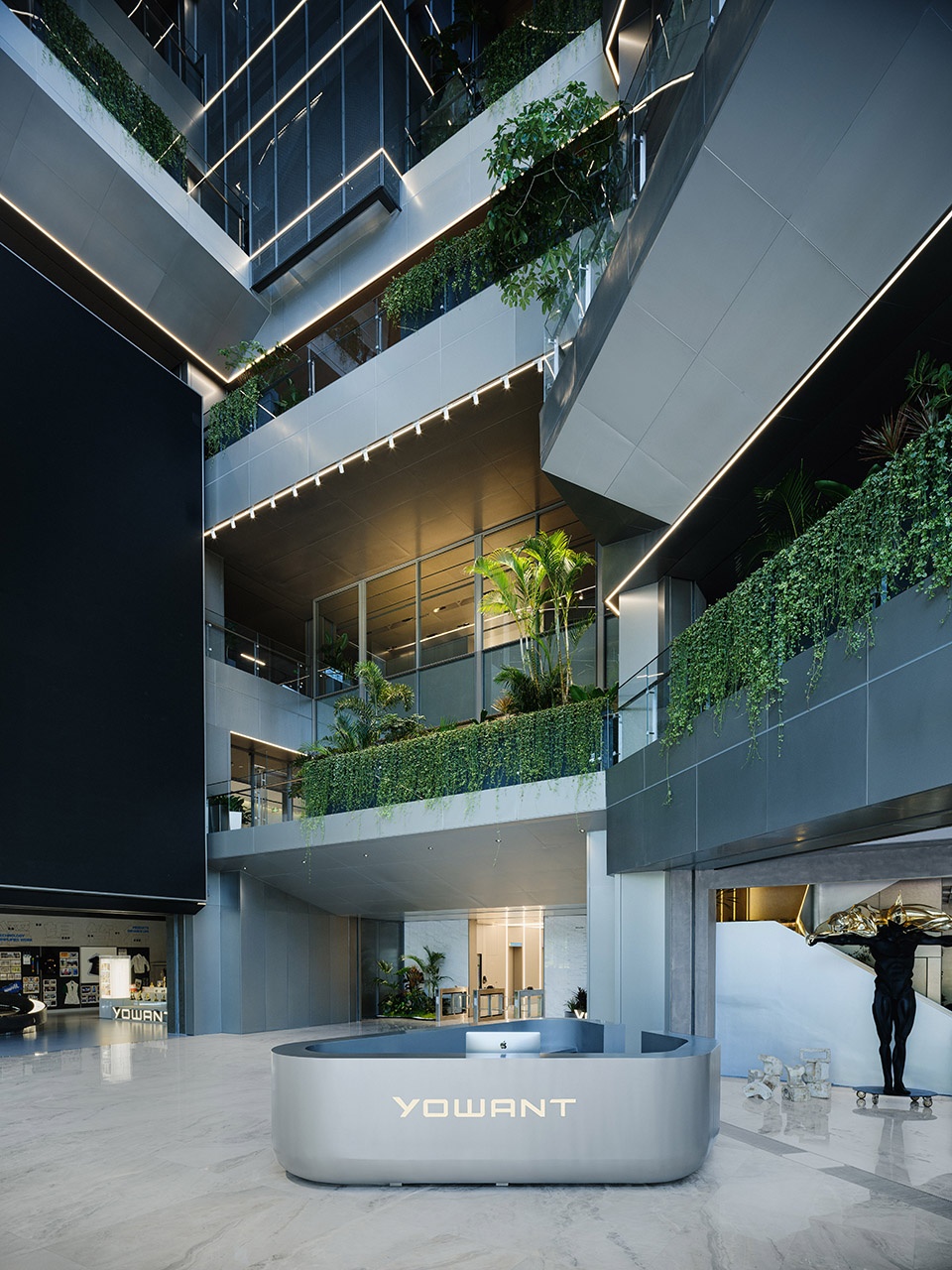
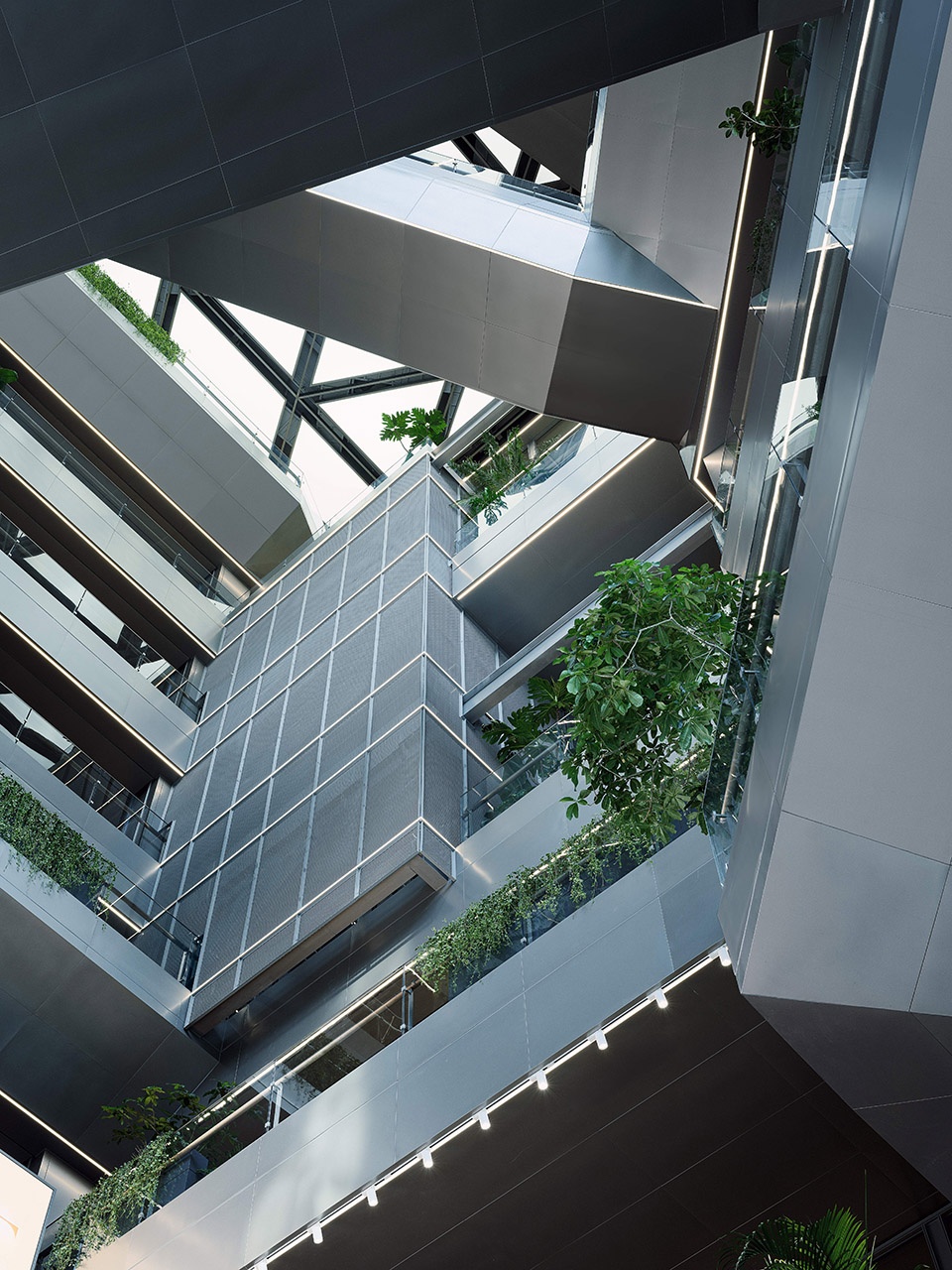
静谧与思考: 在中庭下层,绿植空间向外伸出,营造出被植被包裹的沉浸式内省空间,适用于需要专注的个人思考。
Silence and reflection: In the lower atrium, the green space extends outward, creating an immersive introspective space wrapped in vegetation, suitable for personal thinking that requires focus.
▼楼梯系统近景,A close-up view of the staircase system
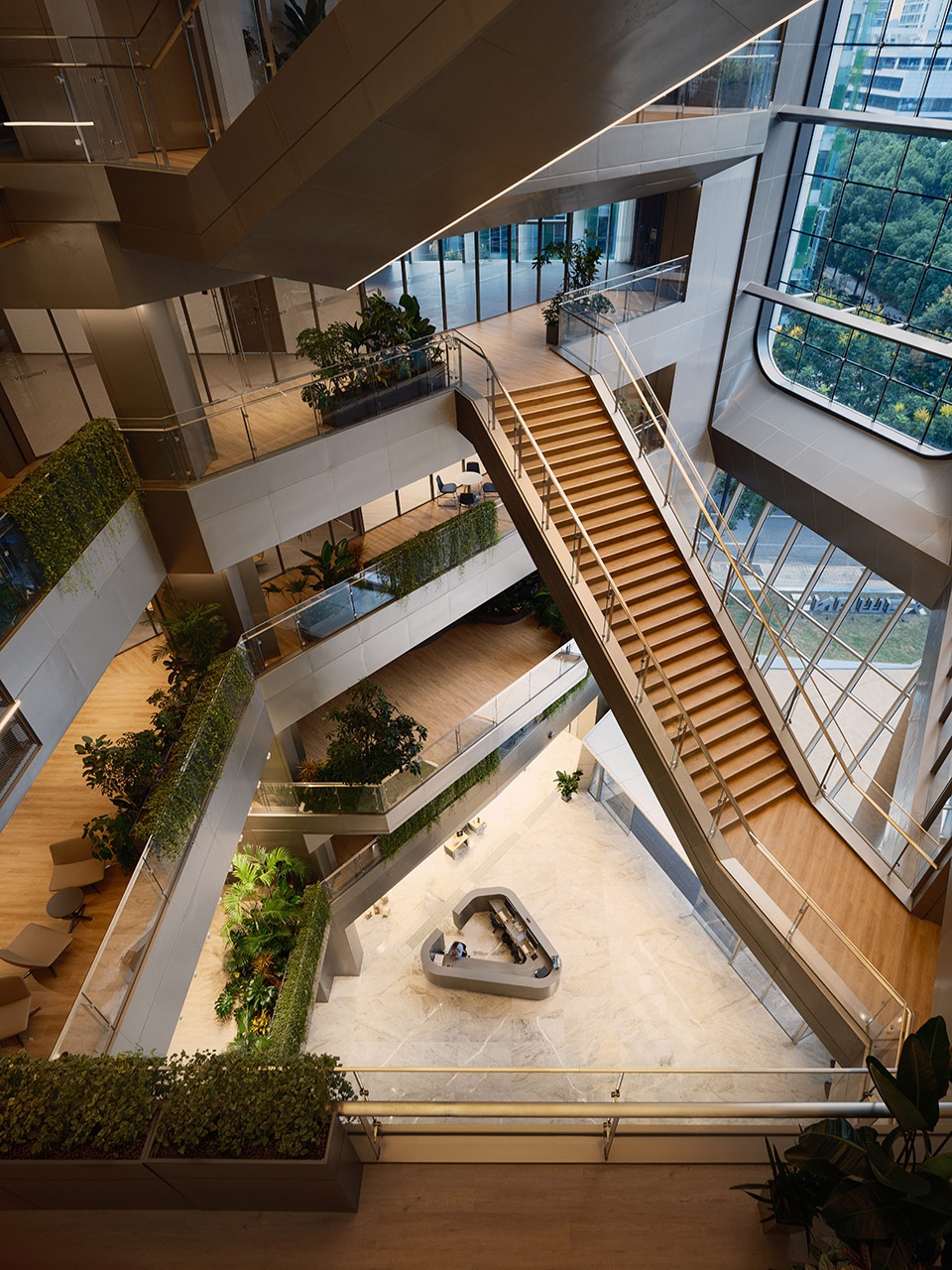
交流与聚集: 在上层,花园区则向内退让,形成更为开放和聚拢的“临时休息化平台”,满足小组会议和团队非正式讨论的需求。这种通过植被空间在垂直方向上内退外伸的处理,成功在规整的楼层网格中,植入了一套灵活的生态布局 (Ecological Sequence)。
Communication and gathering: On the upper floor, the garden retreats inward, forming a more open and gathering “temporary resting platform” to meet the needs of small meetings and informal team discussions. This treatment of inward and outward extension of vegetation space in the vertical direction successfully implanted a flexible ecological layout (Ecological Sequence) in the neat floor grid.
▼仰望中庭的绿岛与结构,Looking up at the suspended green islands and architectural structure
Ⅱ. 材质与光影:仪式感的张力Materiality and Light: The Tension of Ritual
1. 镜面叙事:不锈钢的“反射”与“碰撞”Specular Narrative: “Reflection” and “Collision” in Stainless Steel
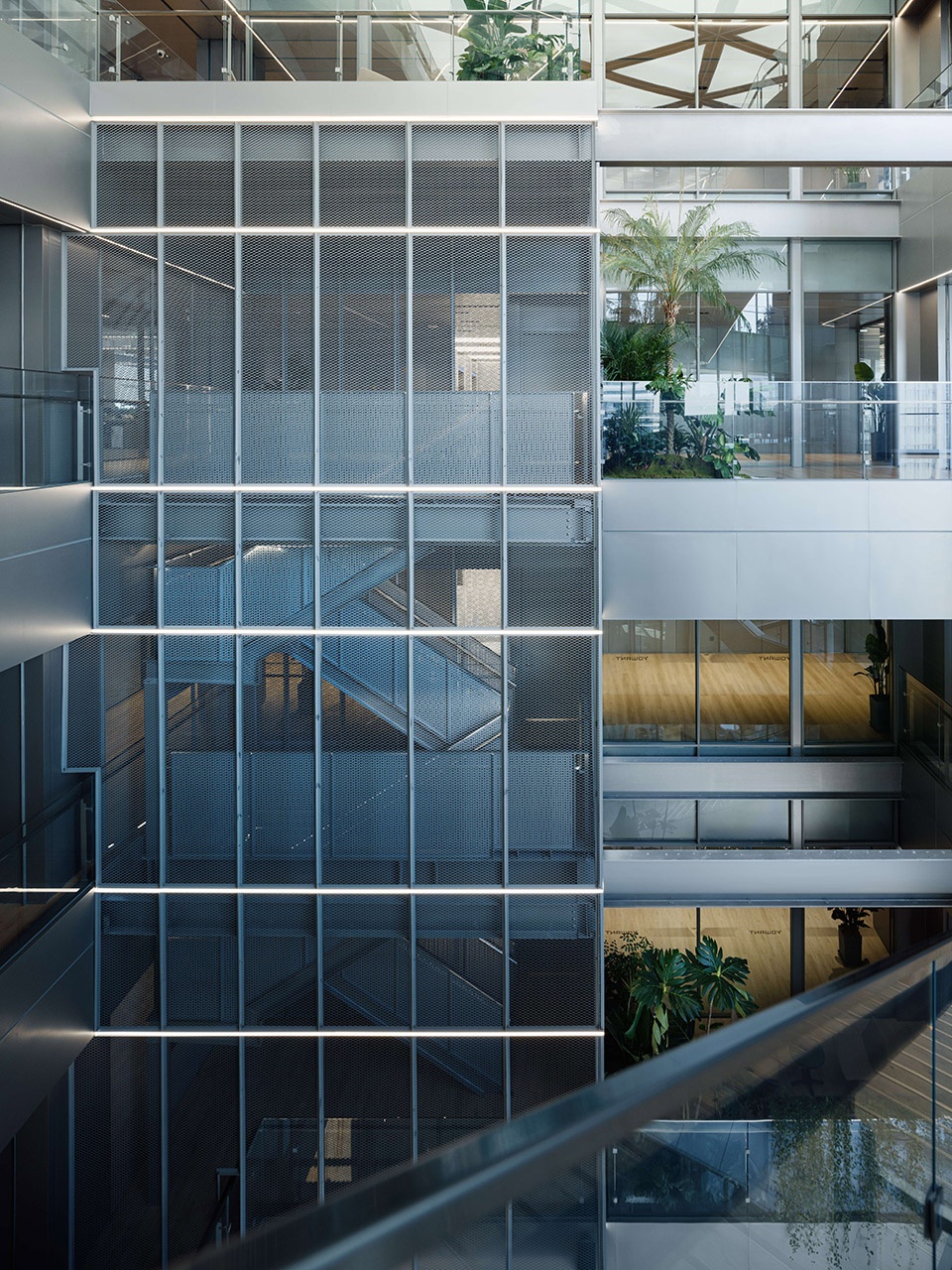
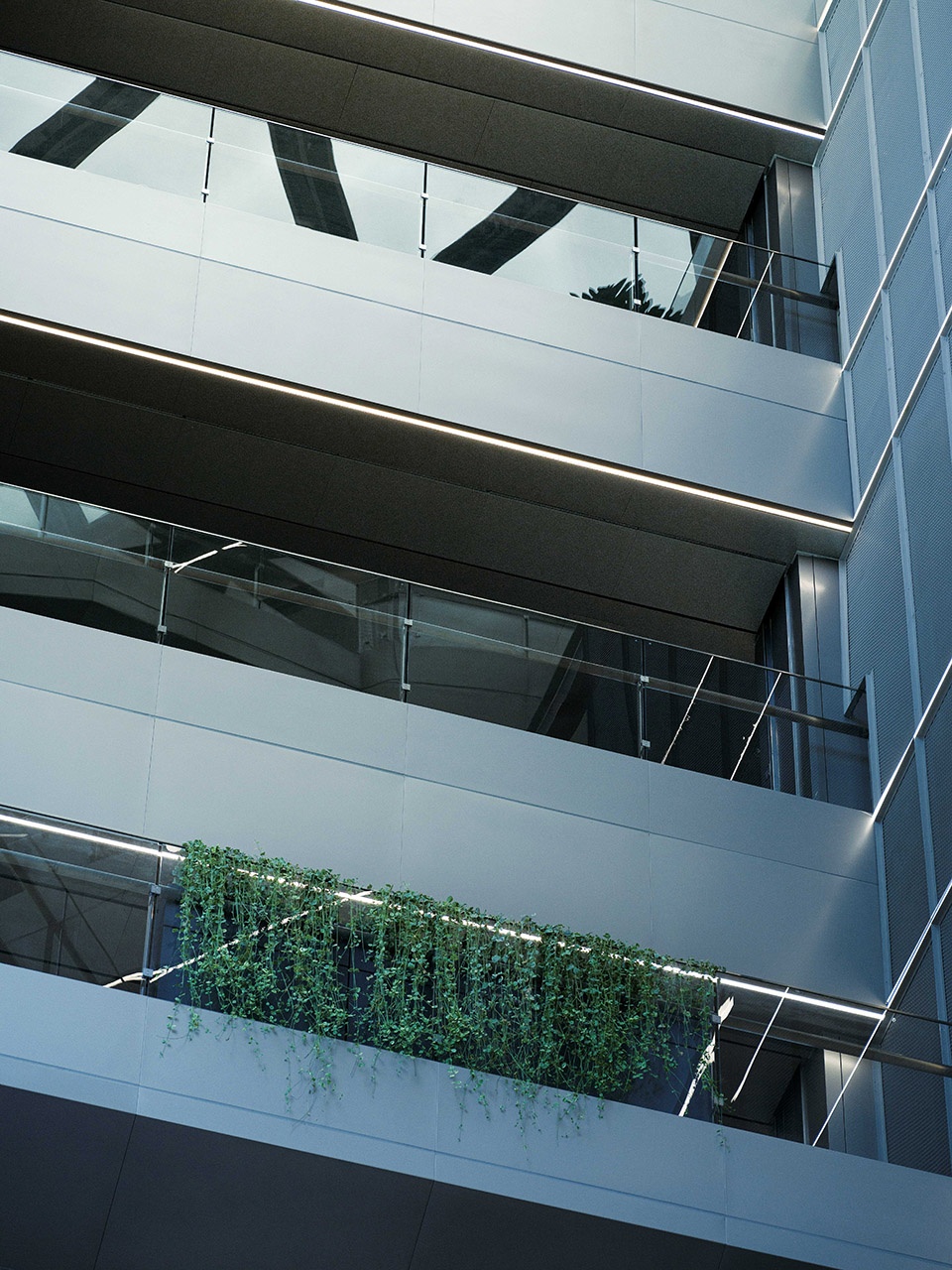
中庭栏板: 通体不锈钢包裹的栏河,其柔光金属质感,与中庭内蓬勃生长的绿植形成强烈的材质对比 (Material Contrast)。不锈钢不仅是结构保护,更成为光线、色彩和倒影的载体,将自然生态元素动态地反射到建筑的理性框架之上,实现了工业与自然的融合。
Atrium railings: The railings are fully encased in stainless steel, with a soft metallic texture that forms a strong material contrast (Material Contrast) with the lush green plants growing in the atrium. Stainless steel not only protects the structure, but also becomes a carrier of light, color and reflections, dynamically reflecting natural ecological elements onto the rational framework of the building, achieving the fusion of industry and nature.
▼不锈钢包裹的栏河与反射,The stainless steel-clad railings and their reflections
▼不锈钢包裹的栏河与反射,The stainless steel-clad railings and their reflections
2. 光的穿透性:入口的参数化仪式感Light Permeability: A Parametric Sense of Ritual at the Entry
电梯厅的未来序曲A Future Overture for the Lift Lobby
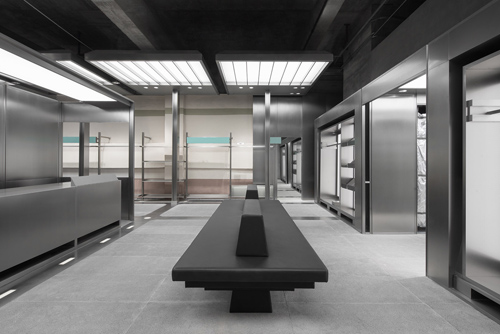
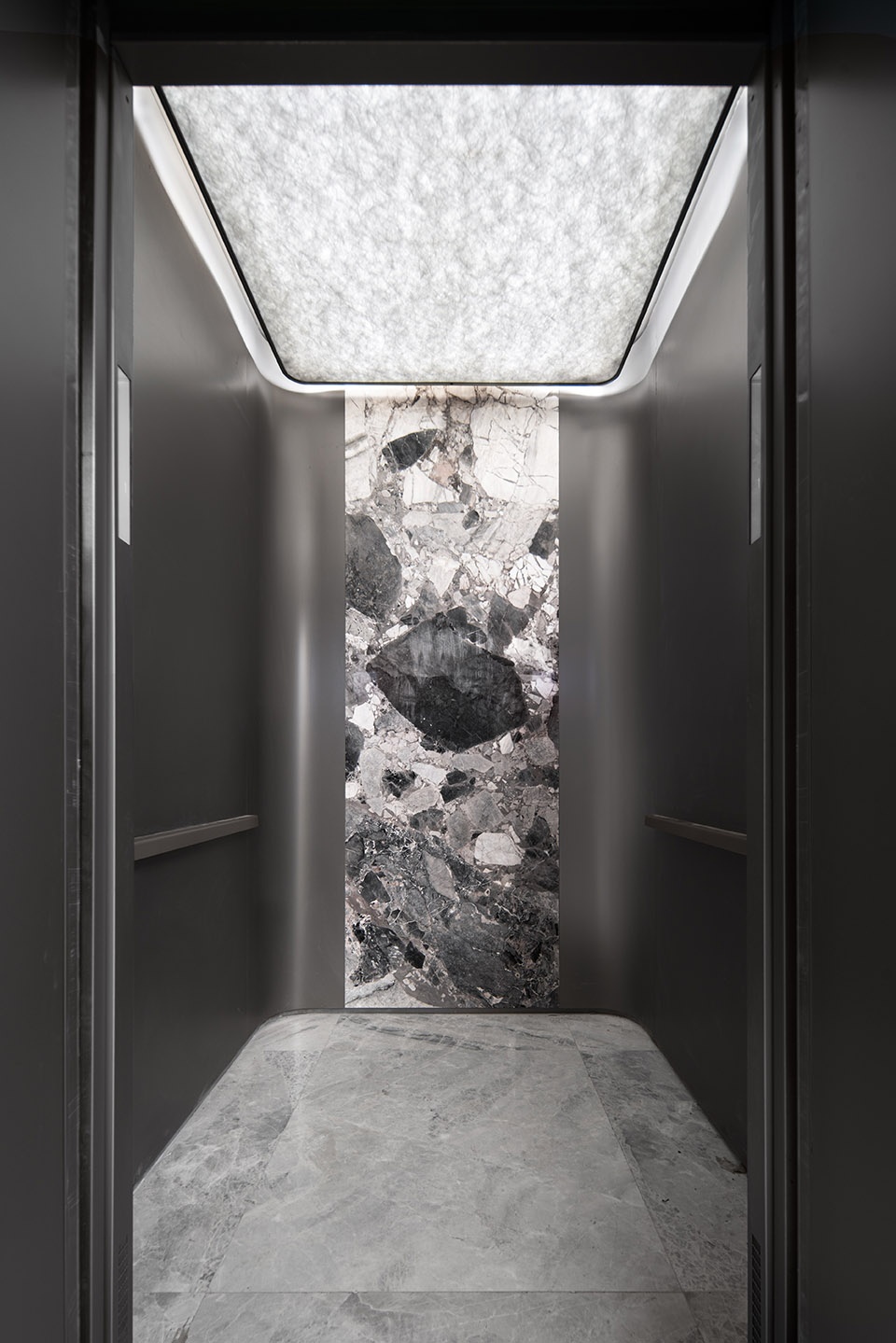
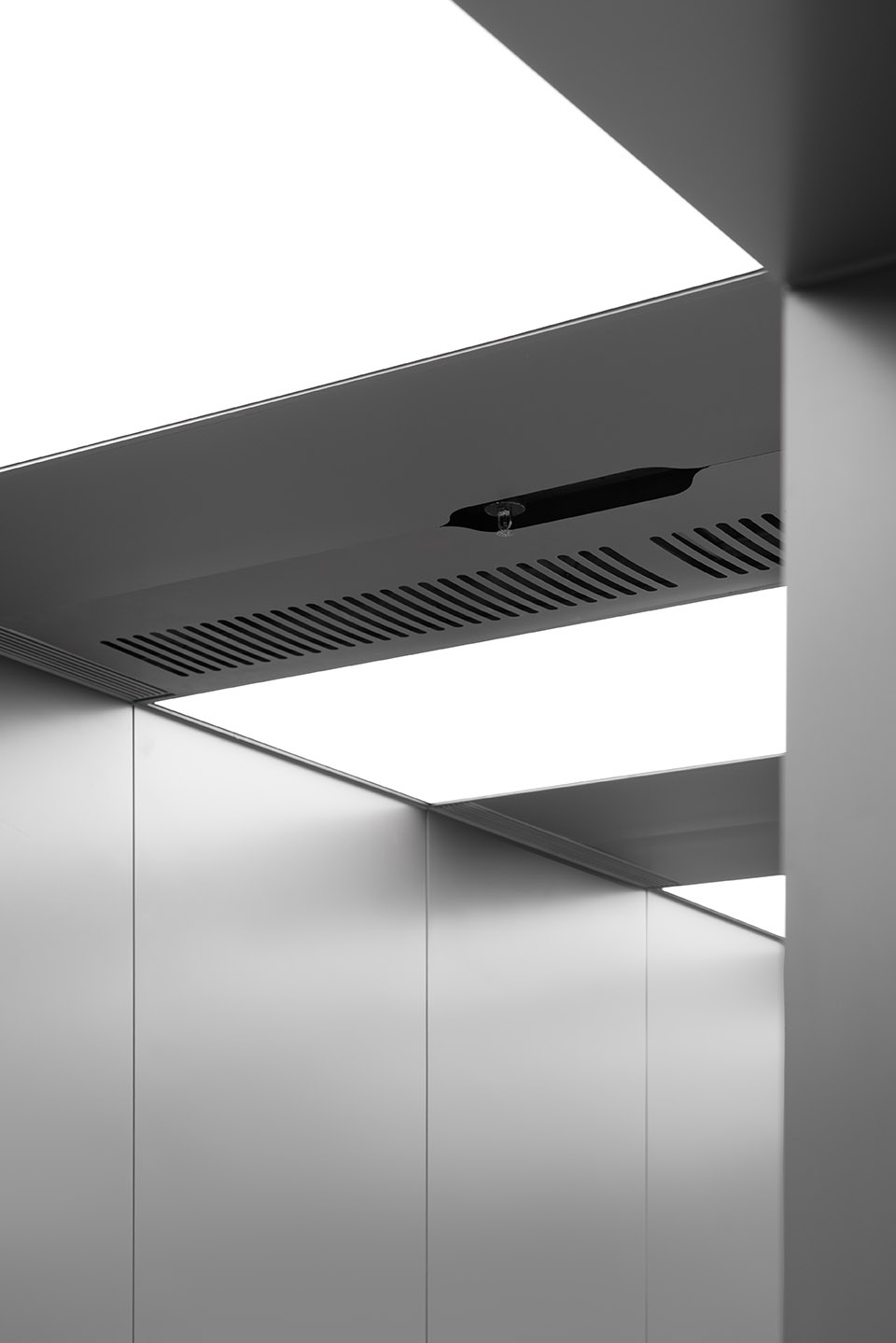
在电梯厅等关键流线节点,设计强化了入口的仪式感:参数化灯模吊顶: 顶部采用参数化设计语言的灯模吊顶,搭配不锈钢墙面。镜面材质对光线产生多次折射与漫射,营造出具有时空穿透性(Spacetime Penetration)的光影效果,预示着一个高效、创新的未来空间即将展开。
In elevator halls and other key streamline nodes, the design strengthens the sense of entry ceremony: Parametric light film ceiling: The top adopts parametric design language for the light film ceiling, matched with stainless steel walls. The mirror material produces multiple refractions and diffusions of light, creating a light and shadow effect with spacetime penetration (Spacetime Penetration), heralding that an efficient and innovative future space is about to unfold.
▼电梯厅,The elevator hall
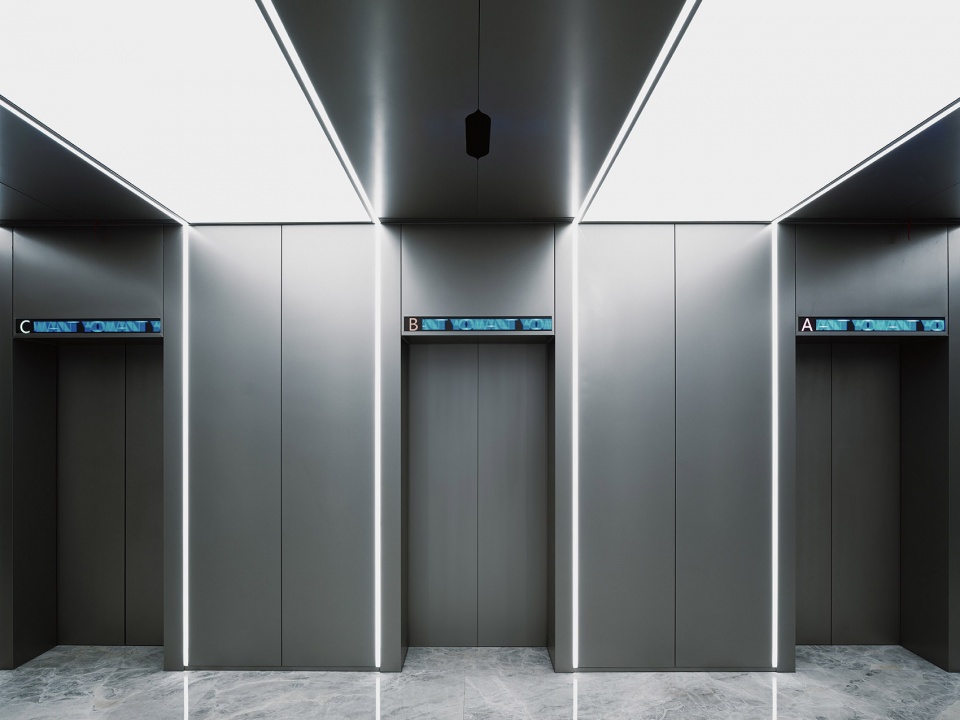
▼电梯细部,Detail of the elevator
Ⅲ. 办公环境:全场景交互与平衡之道Office Environment: Full-Scenario Interaction and the Art of Balance
材质的有机搭配与温度平衡Organic Material Pairings & Thermal Balance
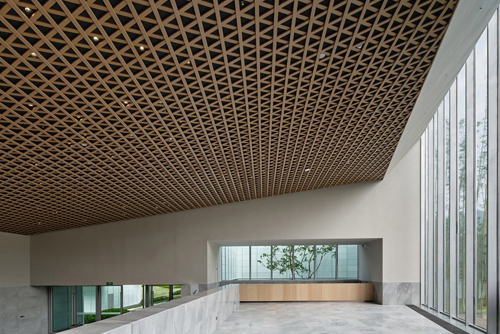
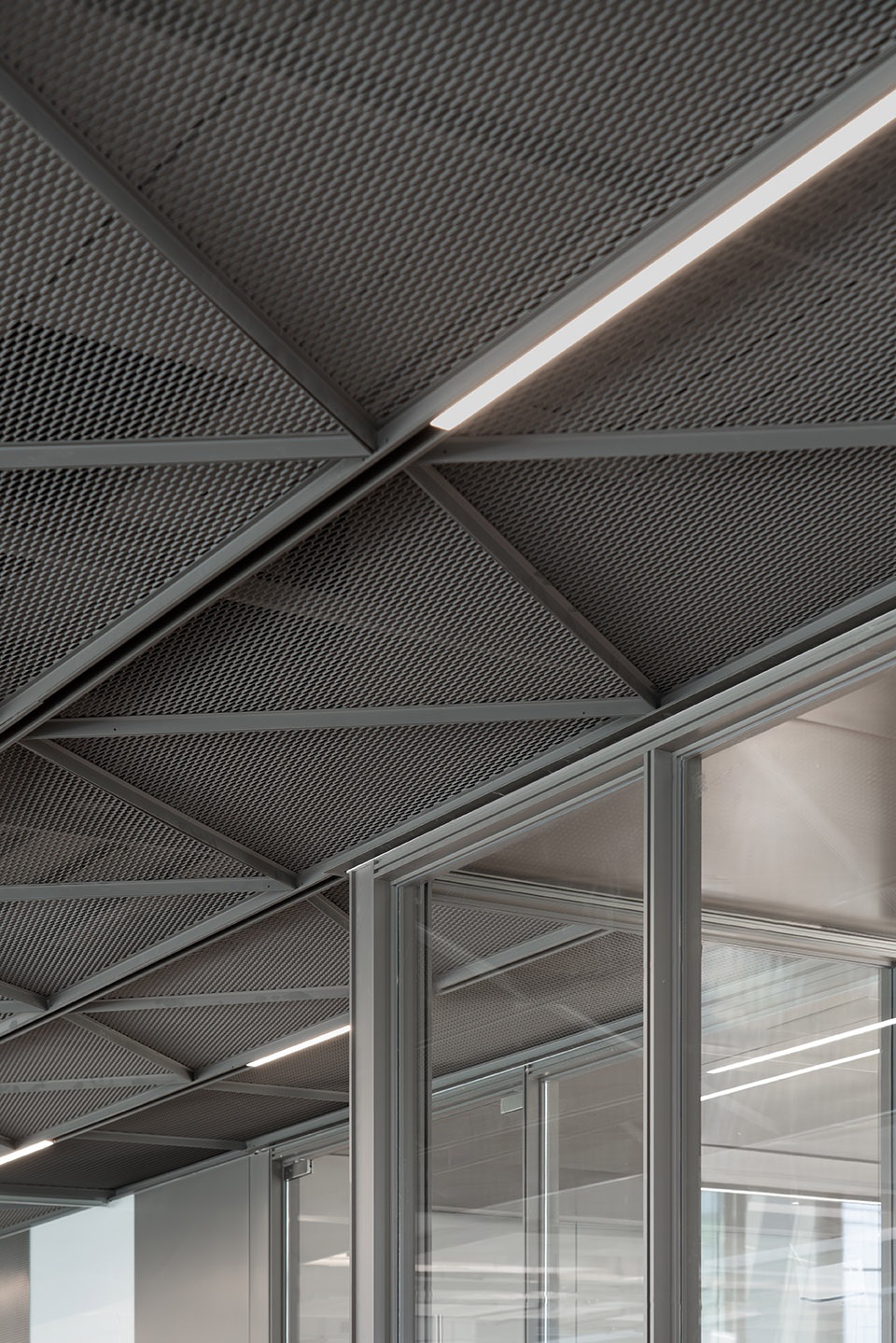
把金属、肌理漆和玻璃这几种材料搭配使用,避免了整个空间看起来太冰冷。肌理漆的质感比较柔和,正好可以中和掉金属和玻璃带来的尖锐感,让办公室看起来既专业,又舒服。穿孔金属网则作为中庭设计语言的延续,被应用于天花和隔断,这种半透明的材料既能隔开空间,又不会挡住视线,感觉很通透。
The combination of metal, textured paint, and glass prevents the space from feeling too cold. The soft texture of the paint neutralizes the sharpness of metal and glass, making the office look both professional and comfortable. Perforated metal mesh, as a continuation of the atrium’s design language, is used for ceilings and partitions. This translucent material divides the space without obstructing the view, creating a sense of transparency.
▼办公区天花细节,Ceiling details in the office area
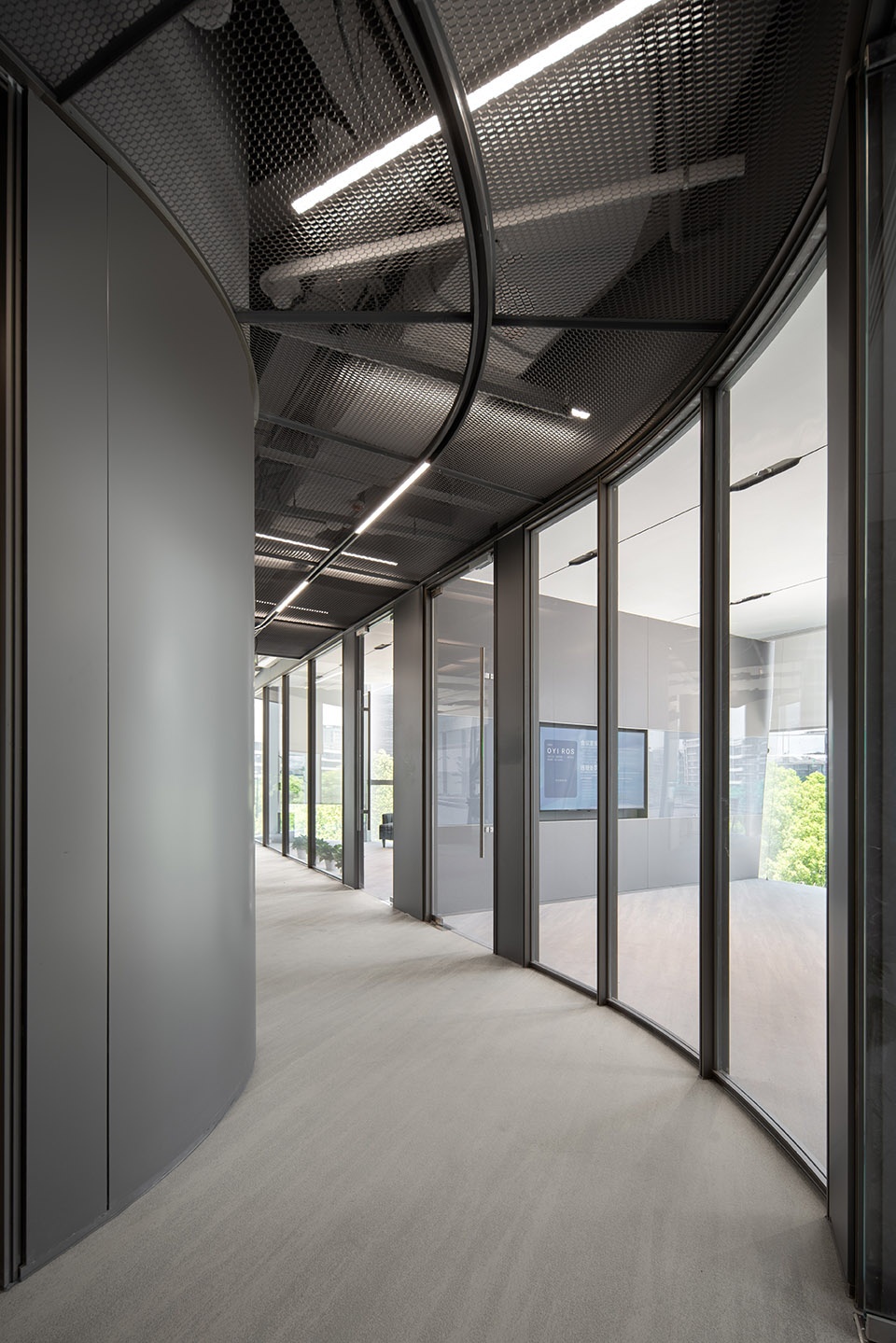
▼办公区细节,Details of the office area
家具模块化和空间边界模糊化Modularity in Furniture and the Dissolution of Spatial Boundaries
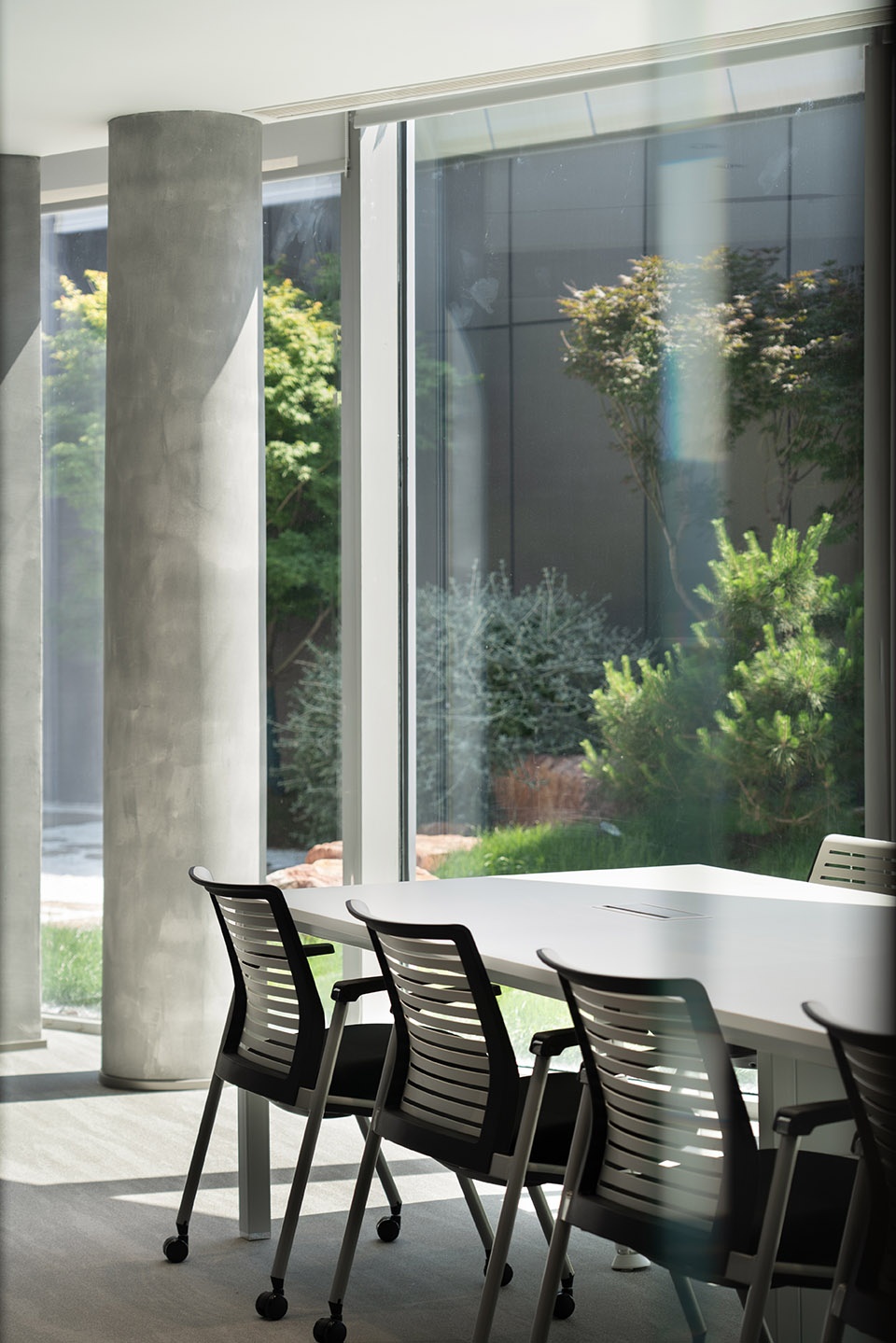
通过家具模块化和空间边界的模糊化处理,实现“站着能聊、坐下能谈、转身就能开会”的协作体验。这样一来,办公空间就成了一个非常灵活的地方,可以随时根据需要变成协作的场所。
Through modular furniture and blurred spatial boundaries, a collaborative experience of “chatting while standing, talking while sitting, and meeting with a simple turn” is achieved. This transforms the office into a highly flexible space that can be adapted for collaboration as needed.
▼中庭的协作空间,Collaboration space within the atrium
▼细部,Detail of the workspace
结语 Conclusion
遥望总部项目是对办公建筑中庭空间的一次成功探索。通过重构垂直交通、引入生态系统和运用富有张力的材质,设计将一个可能造成隔阂的巨大空间,转变为一个促进交流与创新的有机整体。这不仅满足了高效办公的需求,也为人与自然在未来办公建筑中的融合,提供了一个富有启发性的实践范例。
The Yaowang Building is a successful exploration of the atrium space in office architecture. By reconstructing vertical circulation, introducing an ecosystem, and using materials with dynamic tension, the design transforms a potentially isolating vast space into an organic whole that fosters communication and innovation. This not only meets the demands of efficient work but also provides an inspiring example for the integration of humanity and nature in future office buildings.
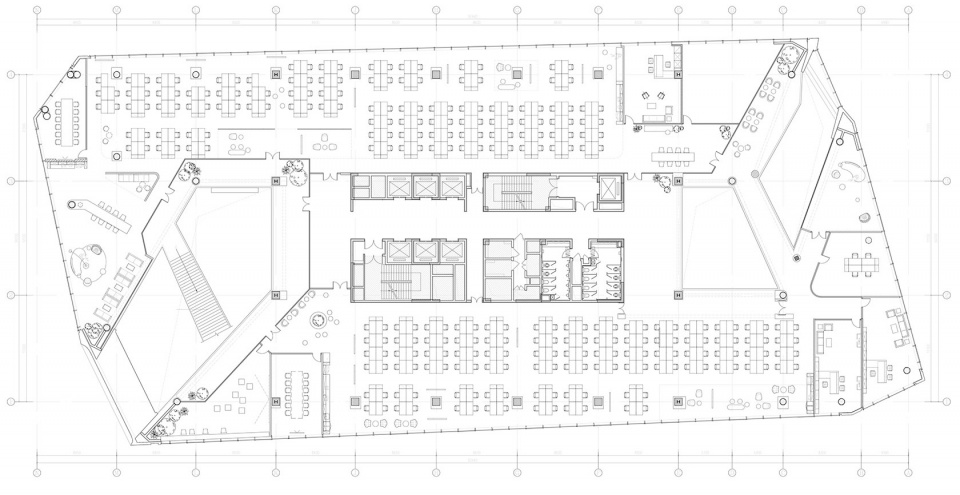
▼标准层平面图,Plan
项目信息
Project Information
Project Name: Interior Design of Yowant Headquarters Building
Project Type: Interior Design
Address: No. 8, Ronggu Lane, Wuchang Sub-district, Yuhang District, Hangzhou City, Zhejiang Province
Client: Hangzhou Yowant Network Technology Co., Ltd.
Interior Design: SA Architects
Design Period: November 2023 – September 2024
Construction Period: September 2024 – July 2025
Design Director: Shen Jianghai
Interior Design Team: Shen Jianghai, Xue Da, Wang Lifeng, Jiang Shihao, Wei Yun, Sun Chundi, Hu Fangting, Qiao Linran, Gu Zhiqiang, Tu Ye, Wang Binghan
Architectural Design: gad Architecture
Building Area: 41,862.26 ㎡
Photography: Yanyu INSPACE Studio / Liu Chengyao