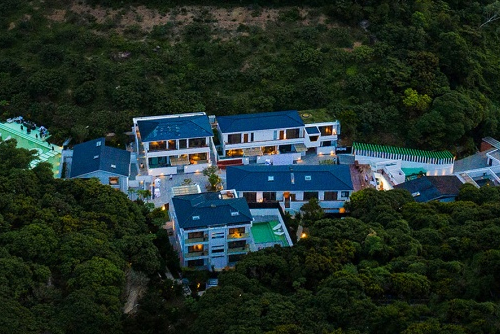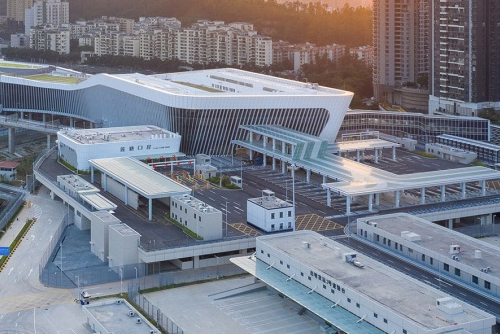
滴水湖环湖景观带改造活力示范段,上海 / 上海建筑设计研究院有限公司
从粗到细的城市生长 Urban Growth: From Macro to Micro
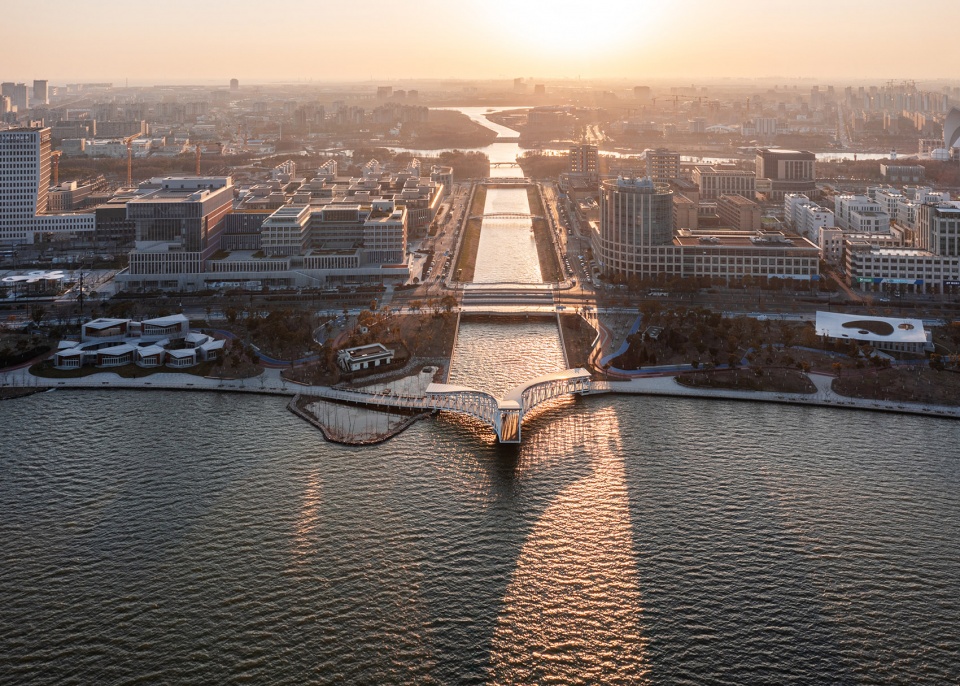
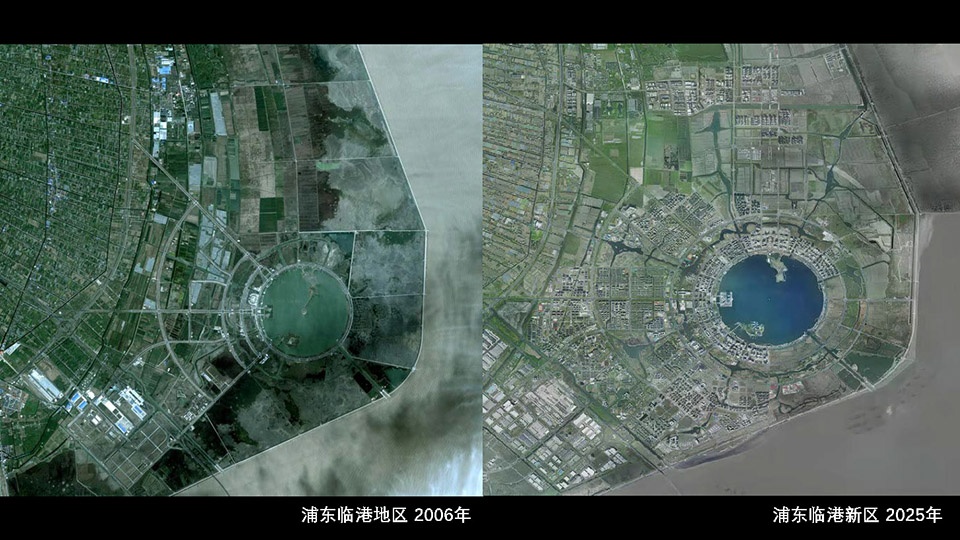
滴水湖环湖景观带改造活力示范段项目基地位于上海市临港新区滴水湖环湖绿化带的西北端,紧邻地铁16号线滴水湖站和主干道临港大道,是进入滴水湖区的先导区域和景观门面。本项目选取约600米区段展开研究、策划和设计,以提升场地功能性和景观品质,并作为后续整体绿化环带改造的先行示范区。临港新区于2002年规划建设,是一个从无到有的全新规划。新区的中心是直径2.5公里的圆形人工湖泊——滴水湖,沿湖一圈为宽度约80米的环湖绿化环带,外侧是向外辐射的环湖大道及不断建设的商务及生活区。巨大尺度的城市规划和从无到有的新城建设,必然导致环湖绿化环带设计的相对粗放和功能缺乏。如今,随着产业建筑和生活人群的不断进驻,市民对城市空间的需求也逐渐变得清晰、具体。
The project Renovation of Dishui Lake Landscape Belt is located at the northwest end of the greenbelt surrounding Dishui Lake in the Lingang New Area of Shanghai. Situated adjacent to Dishui Lake Station (Metro Line 16) and the main Lingang Avenue, the site serves as a gateway and leading landscape area for entering the Dishui Lake district. This project focuses on a 600-meter-long segment for research, planning, and design, aiming to enhance the functionality and landscape quality of the area. It is intended to serve as a pilot demonstration for subsequent comprehensive renovations of the entire greenbelt. Lingang New Area was planned and constructed in 2002, a completely new plan built from scratch. At the heart of the new area is Dishui Lake, a circular artificial lake with a diameter of 2.5 kilometers, surrounded by a greenbelt approximately 80 meters wide. Beyond this are radiating lakeside avenues and continuously developing business and residential areas. The massive scale of urban planning and the construction of a new city from nothing inevitably led to a relatively rudimentary design and functional deficiencies in the lakeside greenbelt. Today, with the continuous influx of industrial buildings and residents, the needs of citizens for urban space have gradually become clearer and more specific.
▼临港新区城区发展,Lingang Avenue development
多角度思考的设计回应 Design Response Through Multiple Perspectives
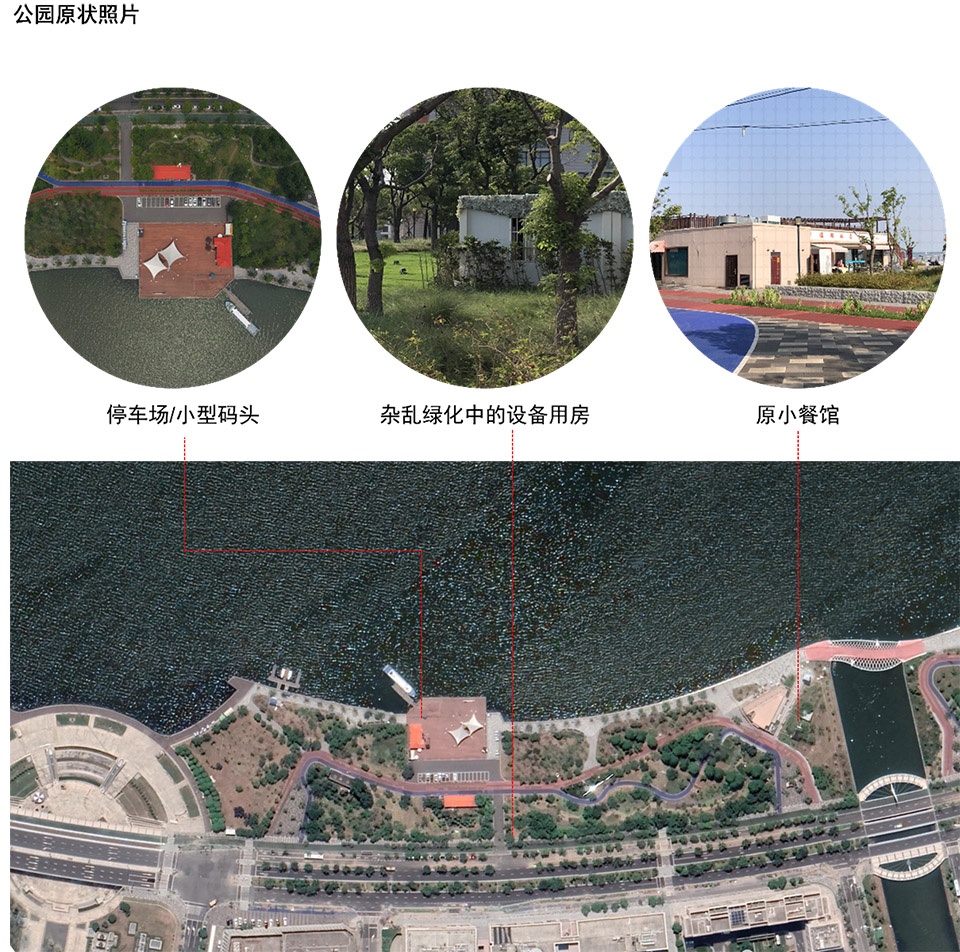
城市更新的前提在于对场地现状的深入观察与思考。当设计师以使用者的视角对场地的状态做了充分的调研:项目基地的原状只有流动摊贩、简易餐馆、小型停车场和废弃码头,缺乏必要的配套建筑;场地内的健身步道缺乏清晰的可达性,周围绿化杂乱,配电间与管线设施散落在灌木丛里,也让人缺乏游览的兴趣。当设计师走出场地来到街道对面,高起的土坡和密集的树丛隔绝了从道路看向滴水湖的视线,泛着波光的美丽湖面也未能展现在行人的面前。
The premise of urban renewal lies in thorough observation and reflection on the existing site conditions. When designers adopt the perspective of end-users and conduct comprehensive surveys of the site’s current state, the following issues were identified: The original site only featured mobile food stalls, simple eateries, small parking areas, and abandoned dock, lacking necessary supporting facilities. The fitness trail within the site had poor accessibility, surrounded by untidy greenery, with utility buildings and scattered pipelines hidden in the shrubs — all of which failed to attract visitors. When designers stepped outside the site and crossed the street, they found that elevated earth slopes and dense clusters of trees blocked the view of Dishui Lake from the road. As a result, the shimmering beauty of the lake remained hidden from passersby.
▼场地原状照片,original site photo
以上种种不足都掩盖了这片城市公园巨大的潜力与魅力,而对应的解决策略也需要是多层次的。设计师从路径、功能、空间和视线四个方面,回应游人行走、停留、使用和观望的行为需求。在这里,景观对于建筑不再是从属或相对独立的关系,而是有机组织、相互影响的综合性设计手段。
These limitations, however, overshadow the vast potential and charm of this urban park — and the corresponding solutions must be multi-layered. The designers responded to the needs of visitors for movement, stay, use, and viewing through interventions across four dimensions: pathways, functions, spaces, and sightlines. Here, the landscape is no longer subordinate to or relatively independent of the architecture, but rather an organically organized and mutually influential comprehensive design approach.
▼场地鸟瞰,aerial view of the site
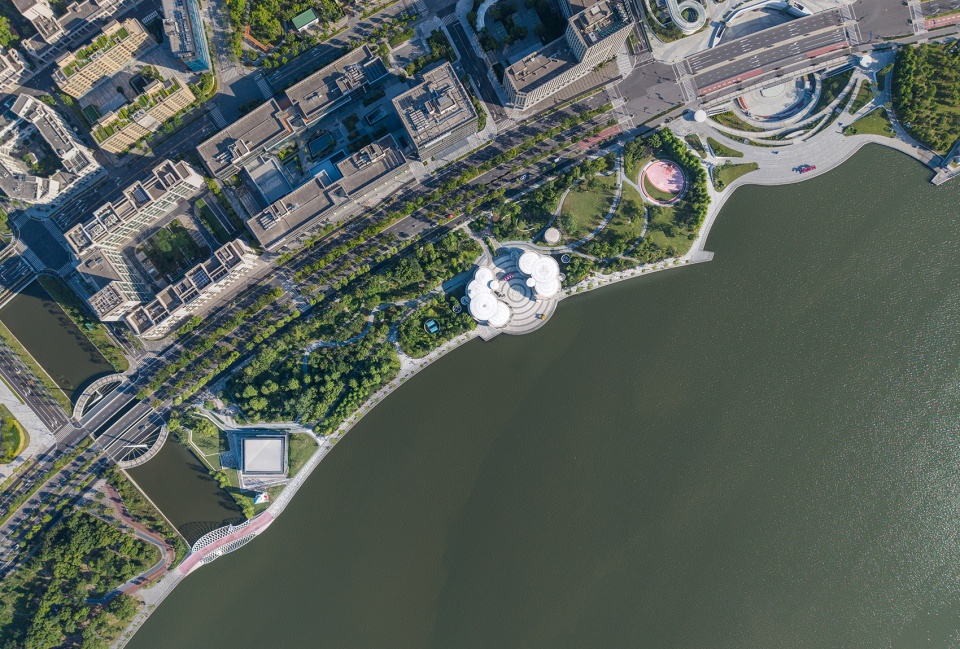
有机织补式的公园更新 Organic Weaving: A Park Renewal Approach
考虑到项目基地只有不到二十年的规划建设历史,避免大拆大建造成的资金浪费和空间记忆断层是更新设计的前提。建筑师通过织补与植入的设计手法,梳理空间肌理,植入功能节点,以点带线织出新的公共空间场域。
Given that the project site has a planning and construction history of less than two decades, the renewal design prioritizes avoiding the financial waste and disruption of spatial memory associated with wholesale demolition and reconstruction. The architects used a design approach of patching and implantation to organize the spatial texture, implant functional nodes, and weave a new public space area from these points to create a cohesive whole.
▼以克制的手法补种景观植物,Replant landscape plants in a restrained manner
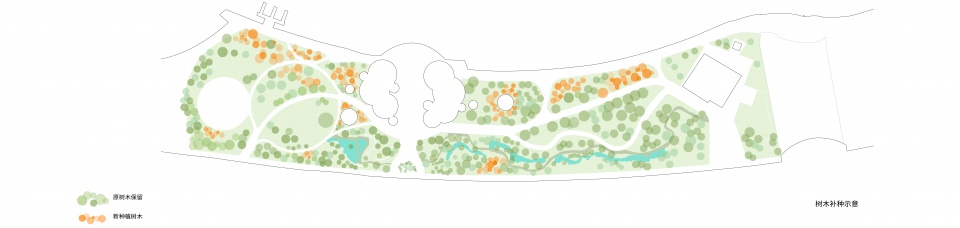
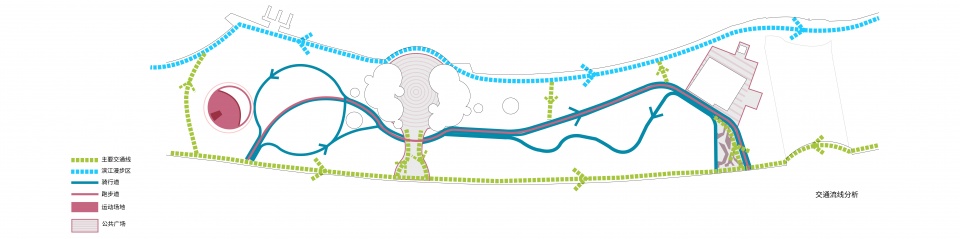
梳理路径:增加公园入口引导人流,将原有步道衔接串联,提供散步、慢跑、骑行等连续路径,为市民和游人提供多重运动情景;
Reorganizing Pathways Streamlining pathways: Adding park entrances to guide pedestrian flow, connecting existing trails, and providing continuous routes for walking, jogging, cycling, etc., offering citizens and visitors multiple exercise options.
▼公园流线的连接与梳理,The connection and organization of park circulation lines
置入功能:设计新建配套:“云朵建筑“(景观茶餐厅)与”绿丽港Live house“(音乐酒吧),为使用者提供遮蔽性的活动空间。建筑师采用简洁的几何形态和干净纯粹的材料,以谦逊的姿态融入自然,不仅为游客提供餐饮、卫生间、休息点等必要配套,也使新建筑成为公园的视觉中心;
Integrating Functions: New supporting facilities have been designed — the “Cloud Pavilion” (a landscape teahouse) and the “Greenport Livehouse” (a music bar) — to provide users with sheltered activity spaces. With simple geometric forms and clean, pure materials, the architecture humbly integrates into the natural surroundings. These new structures not only offer essential amenities such as dining, restrooms, and resting areas for visitors, but also making the new buildings the visual centerpiece of the park.
▼建筑与景观图底关系,The relationship between architecture and landscape drawings
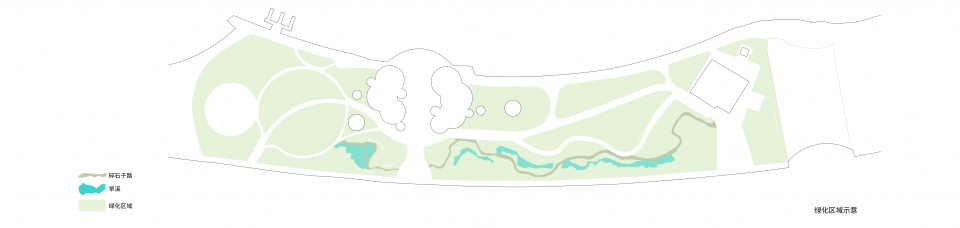
打通视线:结合主干道的机动车流线,打通从道路和城市望向湖面的观景通廊。景观设计师保留场地内的优质植物,通过大量保留、少量移栽和局部补种的方式对公园绿化做整体提升,调整了部分绿化场地的标高,提升湖畔可达性与视觉通透性,实现湖景、园景与城市空间的有机衔接。
Opening Up Sightlines: By aligning with the vehicular flow along the main road, visual corridors from the street and the city toward the lake have been opened up. The landscape architects preserved the high-quality plants on site and improved the park’s greenery by preserving a large number of plants, transplanting a small number of plants, and replanting some areas. They also adjusted the elevation of some green areas to improve lakeside accessibility and visual transparency, thus achieving an organic connection between the lake view, the park view, and the urban space.
▼建筑与景观图底关系,The relationship between architecture and landscape drawings
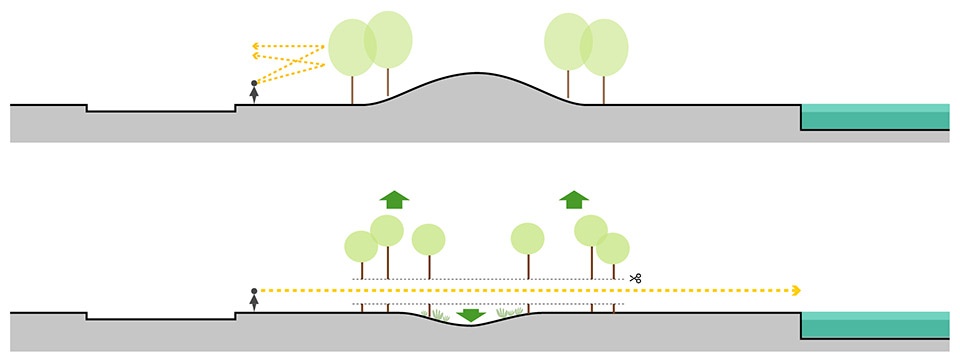
▼视线通廊,viewing corridor
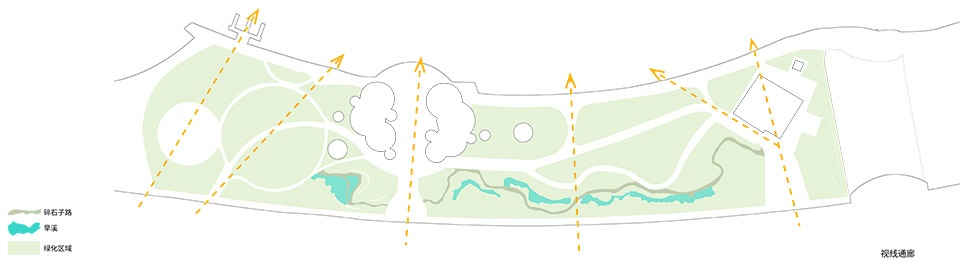
营造场所:以沿湖路径及运动步道为线路,串联起增设入口广场、运动场地、艺术雕塑、小型花境等景观设施,人们可以在其中运动、休息、集会、观赏,整个公园成为充满探索性的乐园。整个设计过程最大化保留了原场地的空间格局和景观元素,在原本空间结构中“织入”新的功能和新的路径,以最小的干预得到最大的空间品质提升。
▼空间示意图,Space analysis
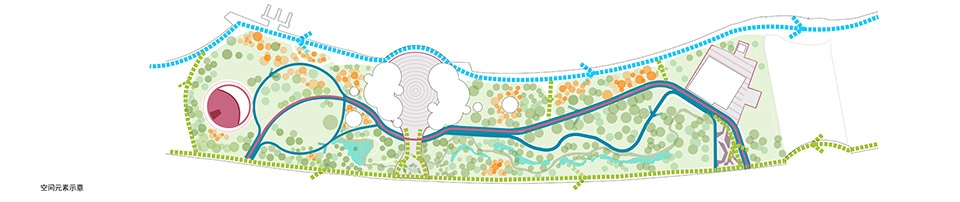
Creating Places: The park connects various landscape features, including an entrance plaza, sports fields, art sculptures, and small flower borders, along a lakeside path and walking trail. People can exercise, rest, gather, and enjoy the scenery, making the entire park a paradise full of exploration. The entire design process maximized the preservation of the original site’s spatial layout and landscape elements, “weaving” new functions and new pathways into the original spatial structure to achieve the greatest improvement in spatial quality with minimal intervention.
▼场地鸟瞰,aerial view of the site
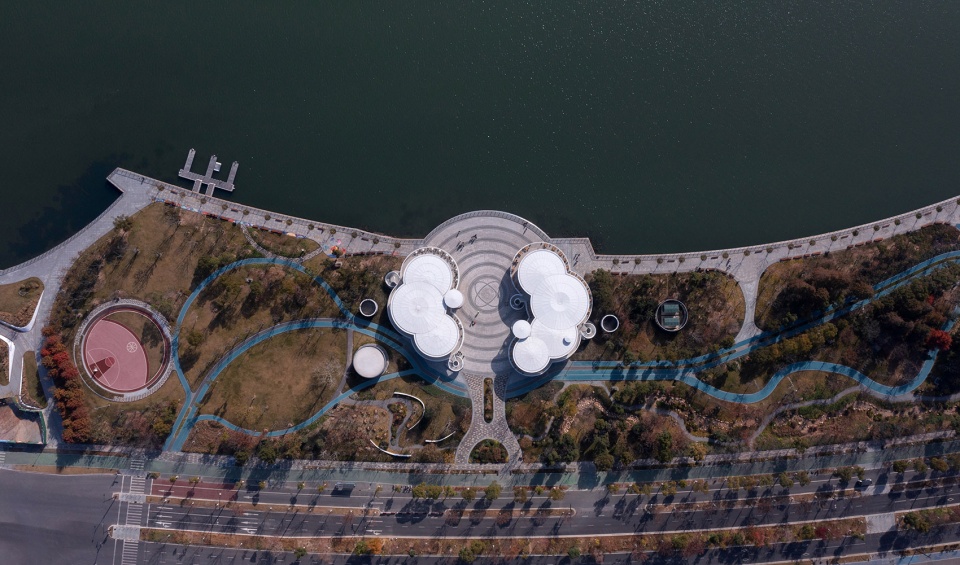
“云端眺望”:全景式空间的营造 “Cloud-View Overlook”: Crafting a Panoramic Space
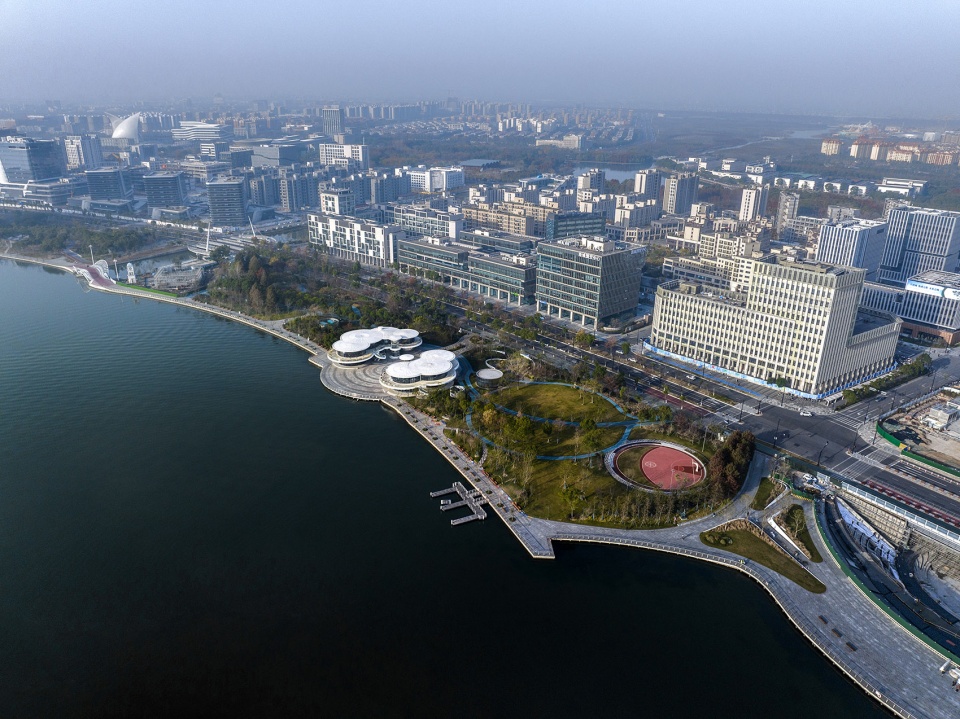
云朵建筑(建筑A)位于原小型码头处,基于整体滴水湖的规划,后续这里不再设置游湖码头,而是完全开放给市民使用。这里位于地块的中心位置,面向滴水湖心,旧码头的驳岸凸出滴水湖的湖岸线,具有非常开阔的面湖景观。
The Cloud Pavilion (Building A) is situated on the site of a former small pier. As part of the overall planning for Dishui Lake, this area will no longer function as a ferry terminal but has been fully opened for public use.Located in the center of the site, facing the heart of Dishui Lake, the old pier’s embankment protrudes beyond the lake’s shoreline, offering a very expansive lakeside view.
▼云朵建筑鸟瞰,aerial view of the Cloud Pavilion (Building A)
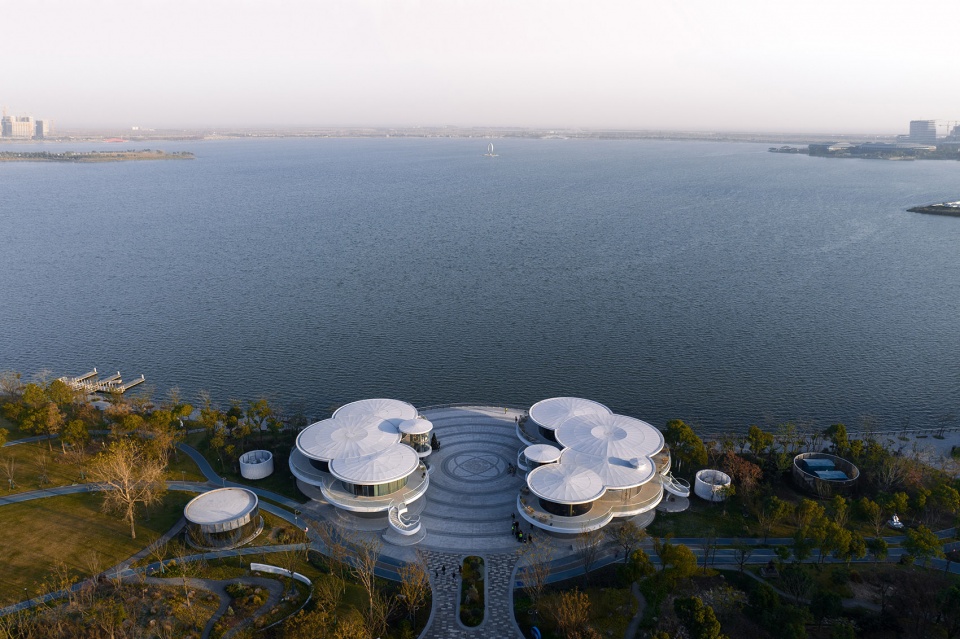
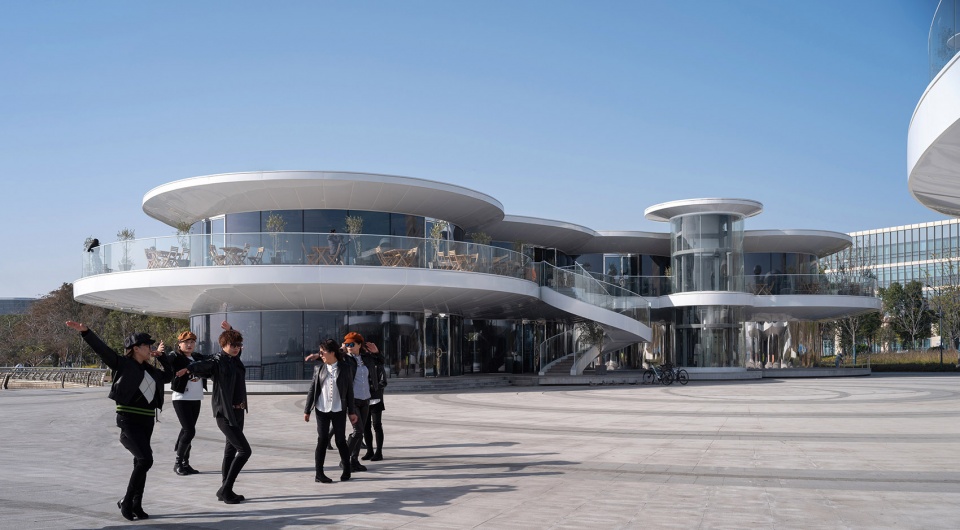
建筑师希望将湖景充分向城市空间渗透:当人们开车从临港新区的主干线环湖西一路经过时,可以通过车窗眺望映射着阳光的湖面。通过两侧对称布置的建筑和公园入口,限定中心的临湖广场,将人们的视线引导到湖面。波光粼粼的滴水湖不仅是人们视线的焦点,也是各种滨水活动的开阔背景:漫步,休憩,舞蹈、庆典,当周末的烟花在天空点亮,这里也是绝佳的观赏平台。
▼中轴线,Central axis
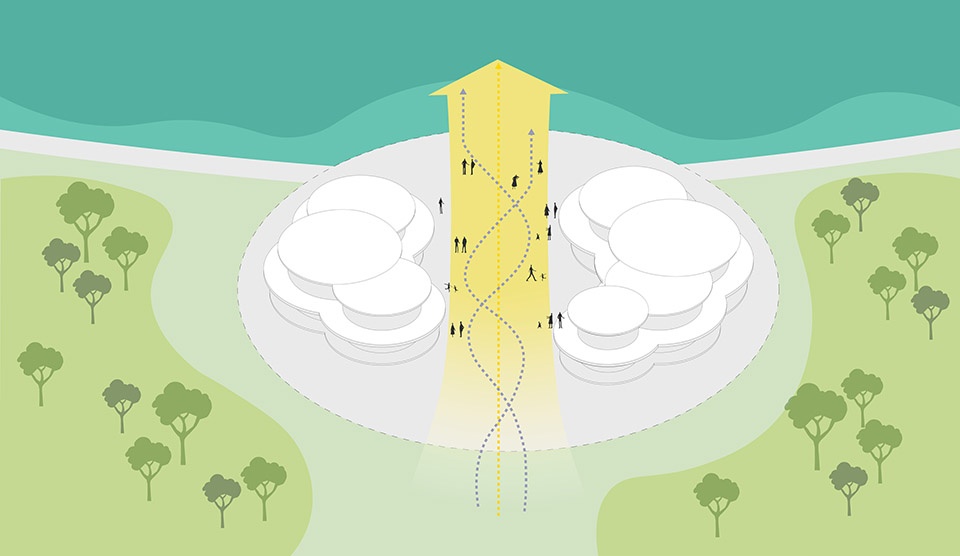
The architects aimed to fully integrate the lake scenery into the urban space: as people drive along Lingang Avenue West, the main road encircling the lake, they can glimpse the sunlit water through their windows. Flanked by symmetrically arranged structures and park entrances, a central lakeside plaza funnels the gaze toward the lake. The sparkling waters of Dishui Lake not only serve as a visual focal point but also form an open backdrop for various waterfront activities—strolling, resting, dancing, celebrations. When weekend fireworks light up the sky, this space becomes an ideal viewing platform.
▼云朵建筑外观,exterior of the Cloud Pavilion (Building A)
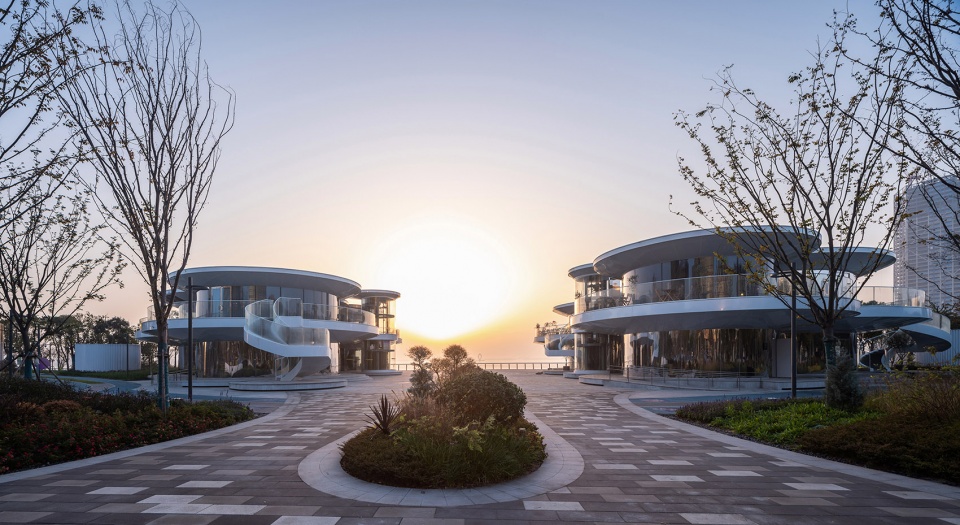
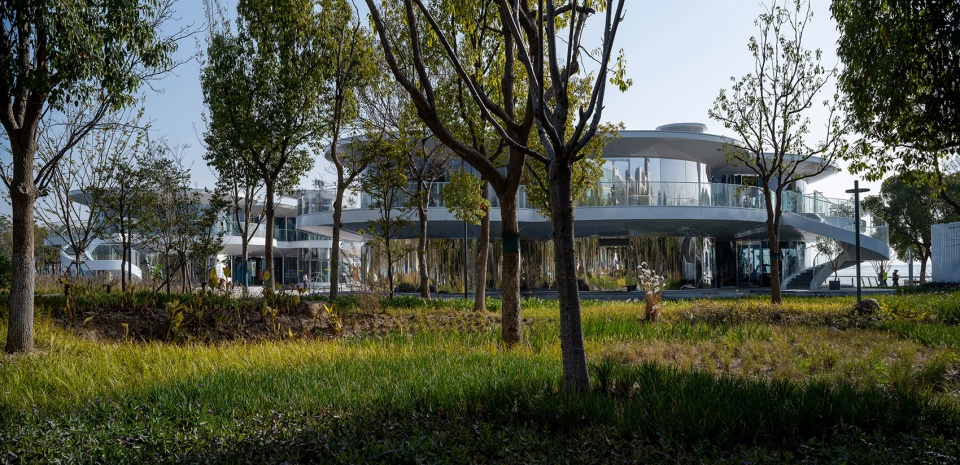
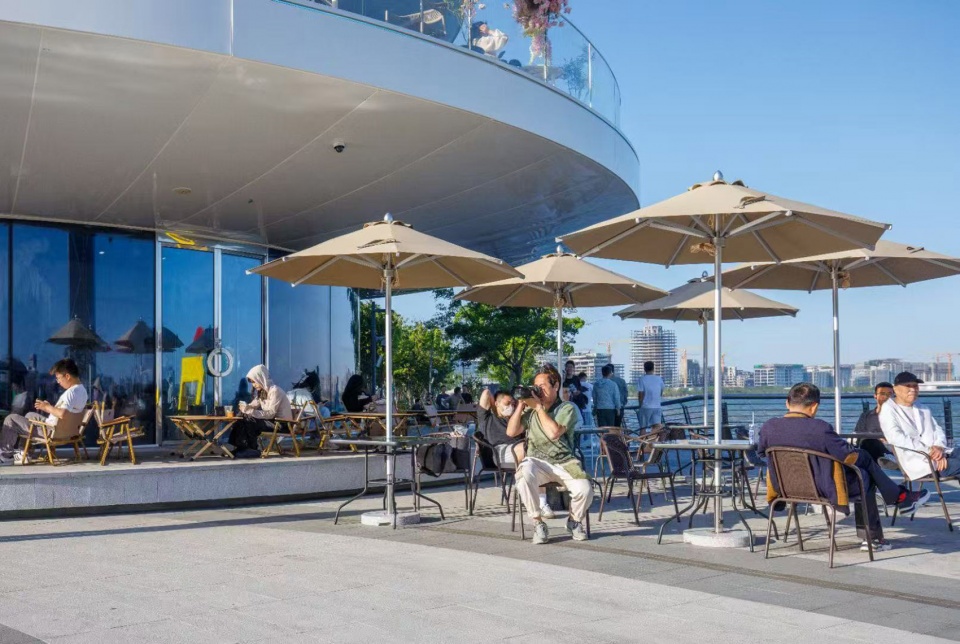
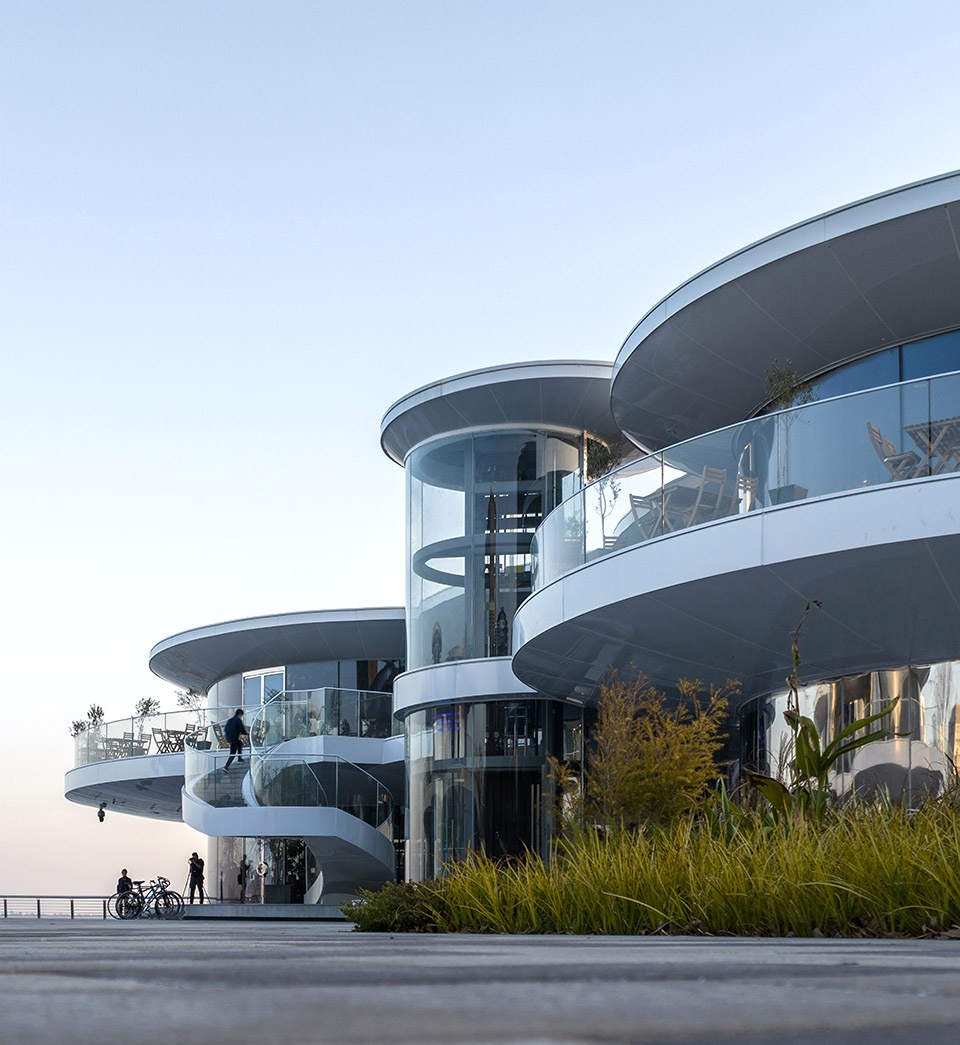
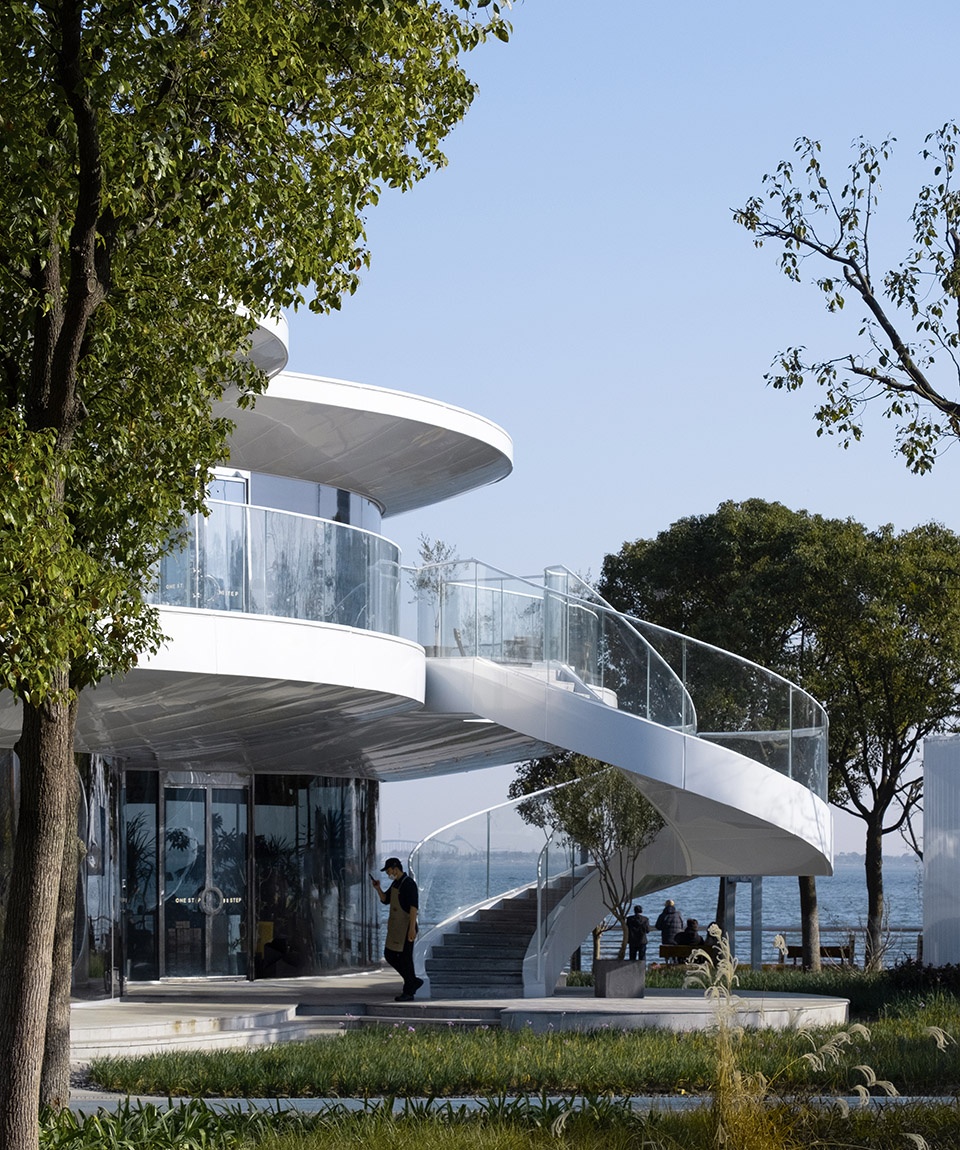
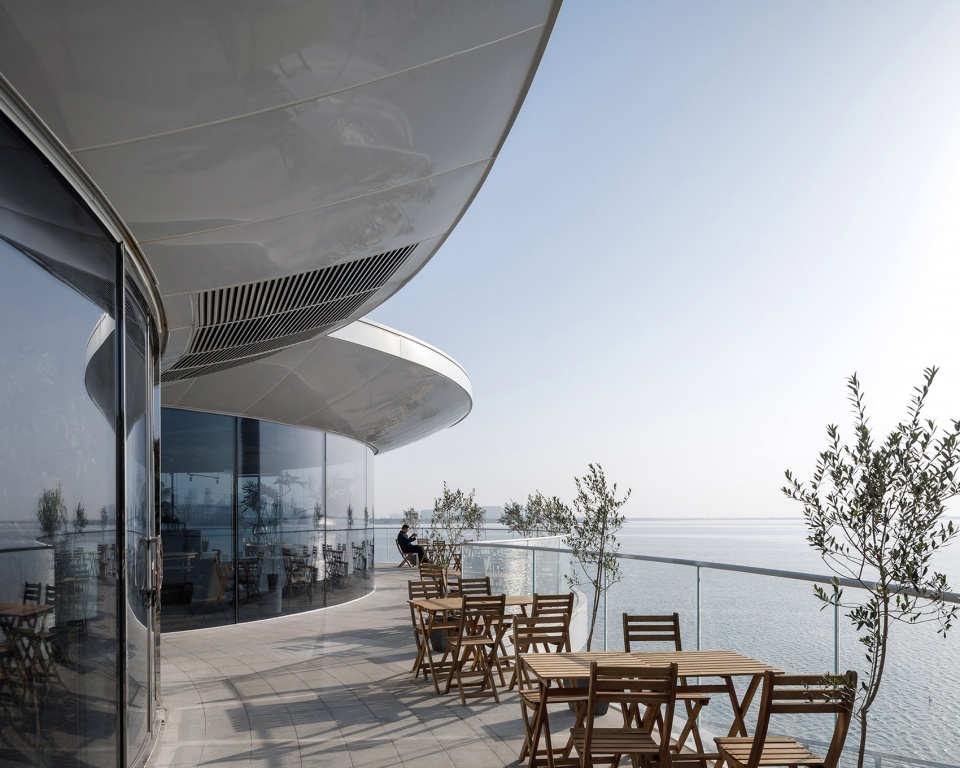
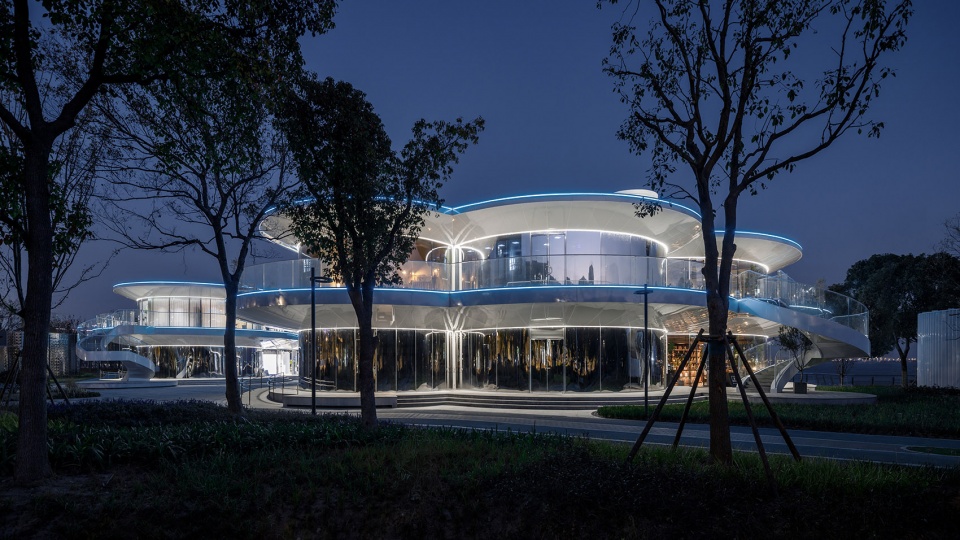
建筑设计秉承着对景观和自然的最大回应。建筑的功能为咖啡轻食餐厅,圆弧形的全玻璃幕墙保证景观面的连续开阔。一层靠近城市的部分以镜面不锈钢作为辅助用房立面,反射周边绿树成荫的公园景观,以透明轻盈的姿态融入自然。一层面向湖面及二层为毫无遮挡的全玻璃幕墙,从室内向外望,可以看到平静而广阔的湖面,和广场上丰富的公共活动。此时,室内与室外的界限变得模糊,湖景与广场的活动被纳入建筑空间,共同创造一种丰富开放的空间氛围。
The architectural design embodies a deep responsiveness to landscape and nature. Functioning as a café and light dining venue, the building features a curved, fully glazed façade that ensures an uninterrupted visual connection to the surroundings. On the ground floor, the urban-facing side is clad in mirror-finished stainless steel for auxiliary spaces, reflecting the lush parkland and allowing the structure to merge transparently and lightly into the natural setting. The lakeside portion of the ground floor and the entire upper level are enclosed in unobstructed glass curtain walls, offering views of the serene, expansive lake and the vibrant public activities on the plaza. Here, the boundary between interior and exterior blurs—the lake scenery and plaza life become part of the architectural experience, together creating a rich and open spatial atmosphere.
▼云朵建筑鸟瞰,aerial view of the Cloud Pavilion (Building A)
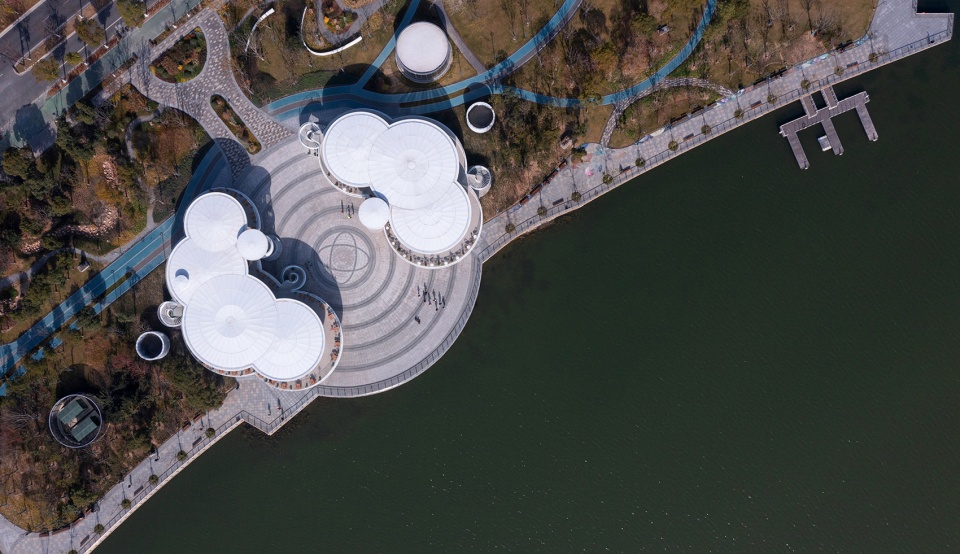
▼圆弧形的全玻璃幕墙,a curved, fully glazed façade
▼广场上丰富的公共活动,the vibrant public activities on the plaza
▼云朵建筑外观,exterior of the Cloud Pavilion (Building A)
▼室内空间,interior space
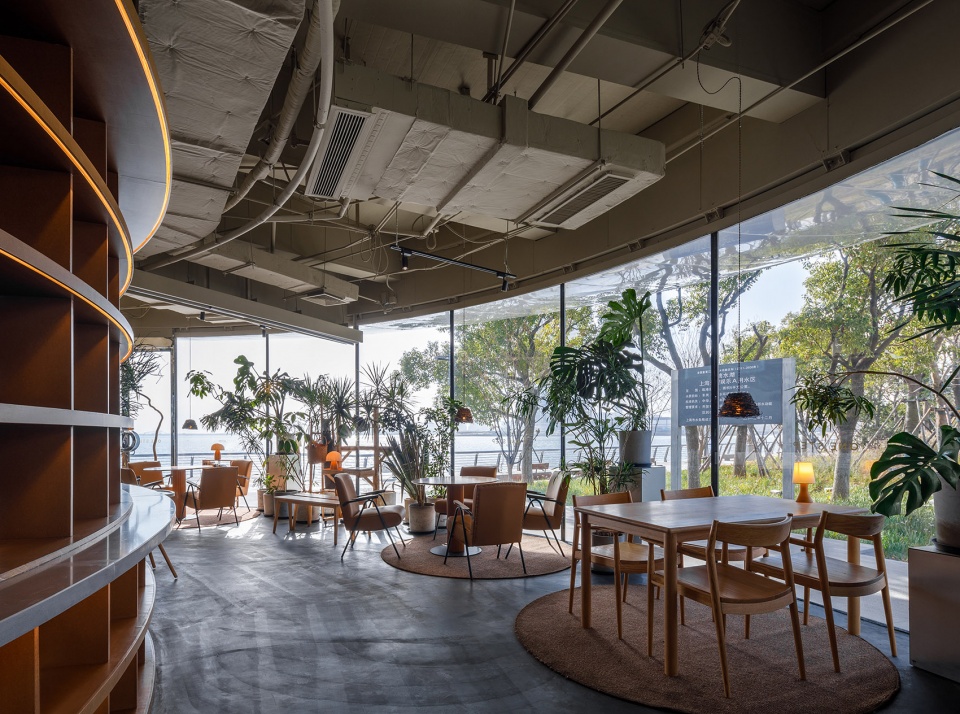
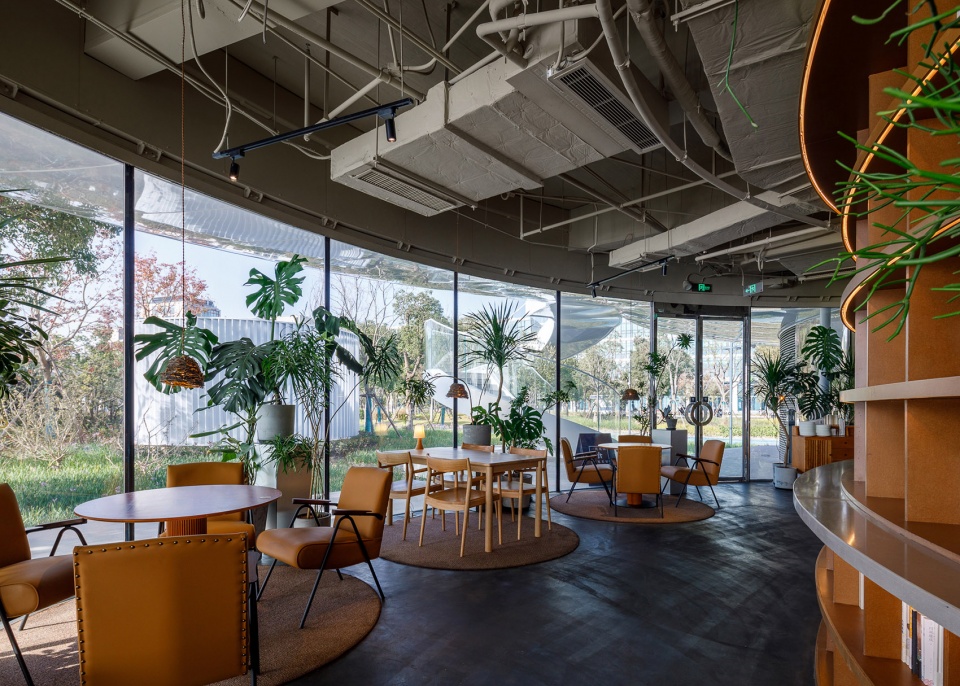
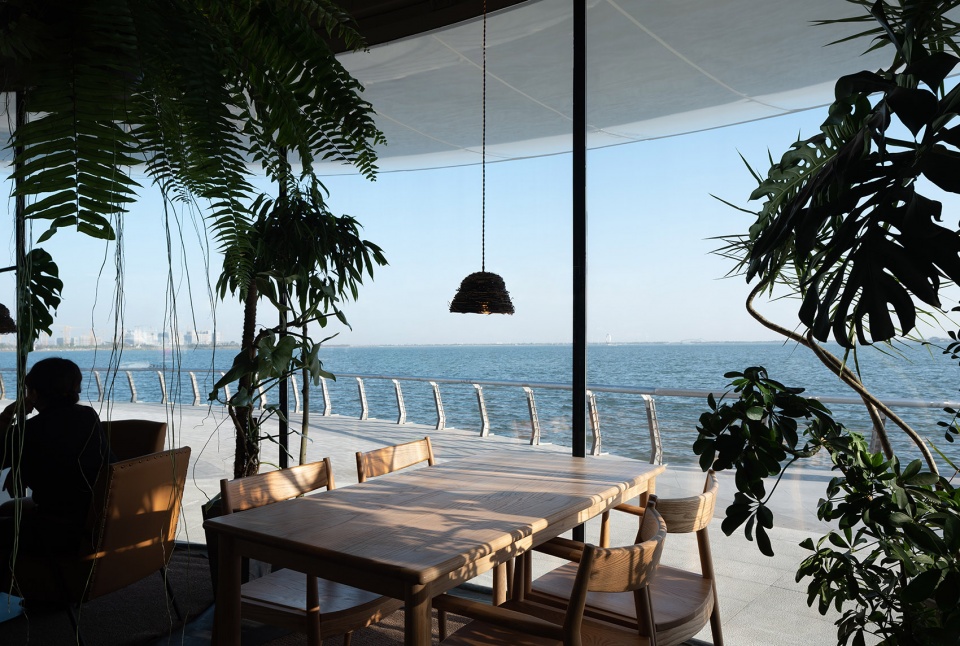
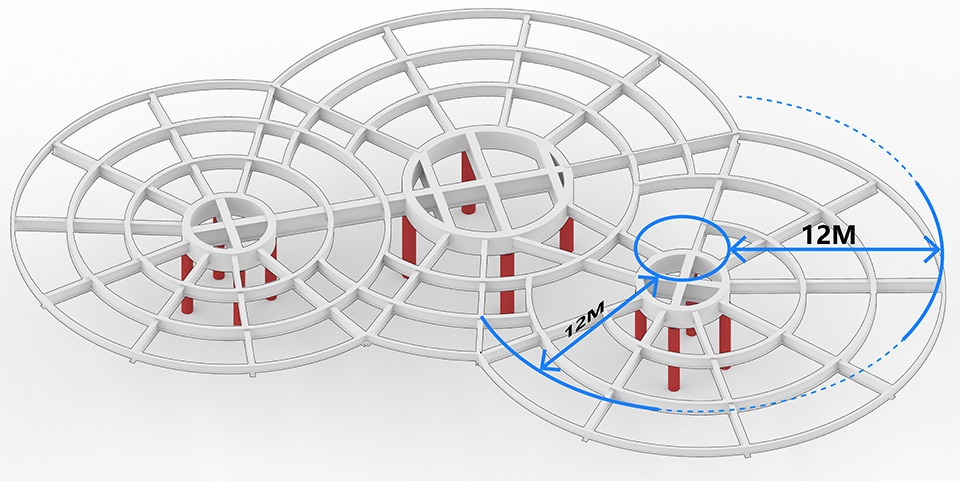
结构设计也服务于建筑空间,为了不遮挡景观面,将柱子集中布置在圆形平面中央,将变截面梁从中央核心向四周发散布置,通过优化悬挑梁的受力分布实现最大12米的大悬挑。这种布置方式有效减轻了边缘结构的负荷,确保了建筑的轻盈和稳定。管井、卫生间等辅助设施围成一个圆形布置在中心柱子附近,顶部机电管线上翻隐藏于梁间空隙、排风百叶布置在挑檐下方,使室内外的吊顶线保持在同一高度,进一步增强空间的整体感。结构、机电设施集中在中心的支撑单元中,悬挑梁像伞骨一般向四周展开,实现无柱灵活的室内空间和360°通透无遮挡的全景视野。
▼建筑结构,building structure
▼建筑剖面,building section
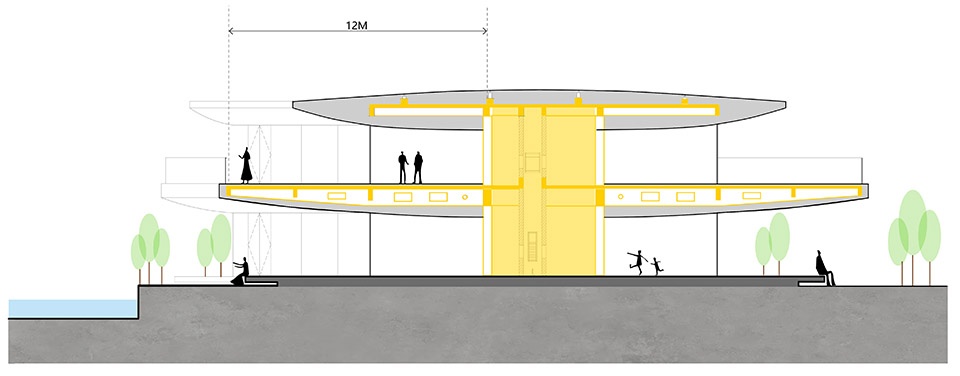
The structural design also serves the architectural vision. To preserve unobstructed views, columns are concentrated at the center of the circular plan, while tapered beams radiate outward from the core. By optimizing the load distribution of the cantilevered beams, a remarkable 12-meter cantilever is achieved. This arrangement effectively reduces the load on the peripheral structure, ensuring both lightness and stability. Ancillary facilities such as pipe shafts and restrooms are arranged in a circular layout around the central columns. Mechanical and electrical conduits are concealed within beam voids, and ventilation louvers are discreetly placed beneath the overhanging eaves. This allows interior and exterior ceiling lines to align seamlessly, enhancing the spatial coherence. By consolidating structural and mechanical elements within the central support unit, the cantilevered beams extend like umbrella ribs, creating a flexible, column-free interior and offering 360° clear panoramic views.
▼室内环状空间,Indoor circular space
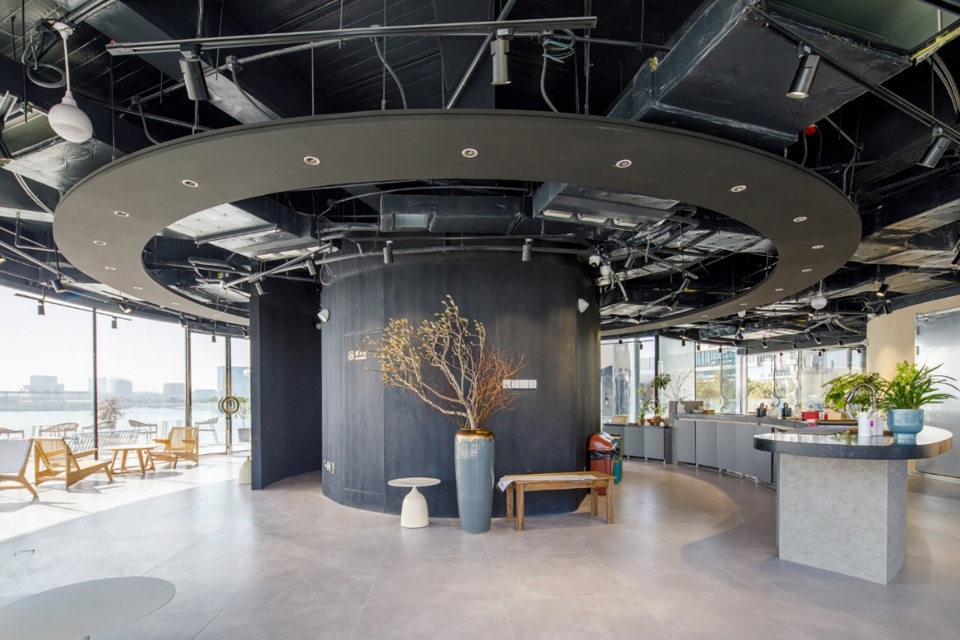
巨大的结构悬挑使宽阔的二层平台成为了可能。相对于建筑一层与热闹的广场活动相邻,建筑的二层则更加静谧。当人们坐在二层平台的玻璃栏杆旁,极目远眺皆为静谧的蓝,建筑像云朵一样,托起城市生活中安静的一隅。
The massive structural cantilever enables the expansive second-floor terrace to become a reality. While the ground floor of the building engages with the lively activities of the plaza, the second level offers a more tranquil experience. As visitors sit beside the glass railings of the upper terrace, their gaze extends into a serene expanse of blue. The architecture, like a floating cloud, elevates a quiet corner of urban life above the bustling city.
▼托起城市生活中安静的一隅,elevates a quiet corner of urban life above the bustling city
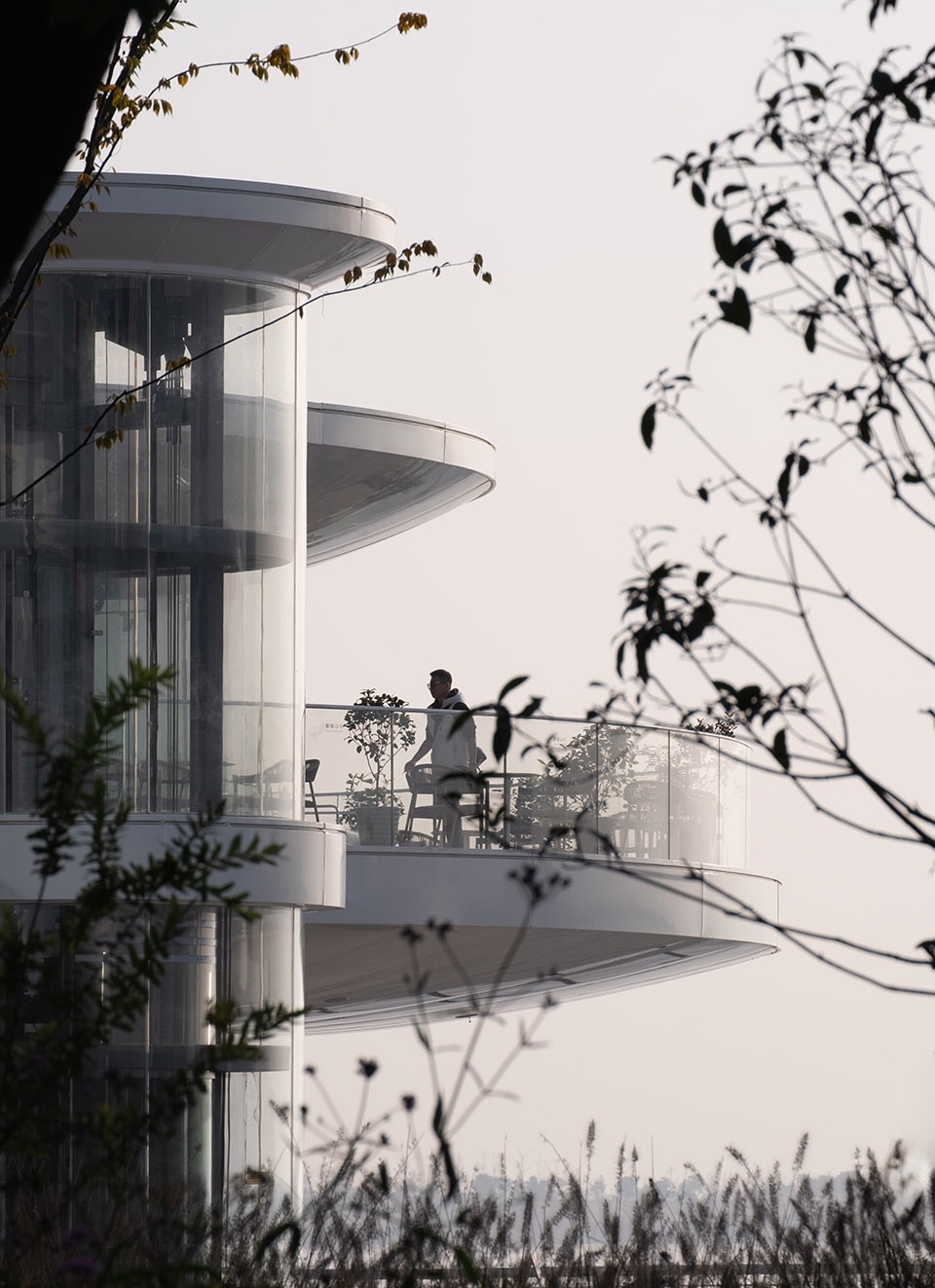
▼宽阔的二层平台,the expansive second-floor terrace
▼场地鸟瞰,aerial view of the site
“音乐盒子”:城市公园的声光晕染 “Music Box”: A Symphony of Light and Sound in the Urban Park
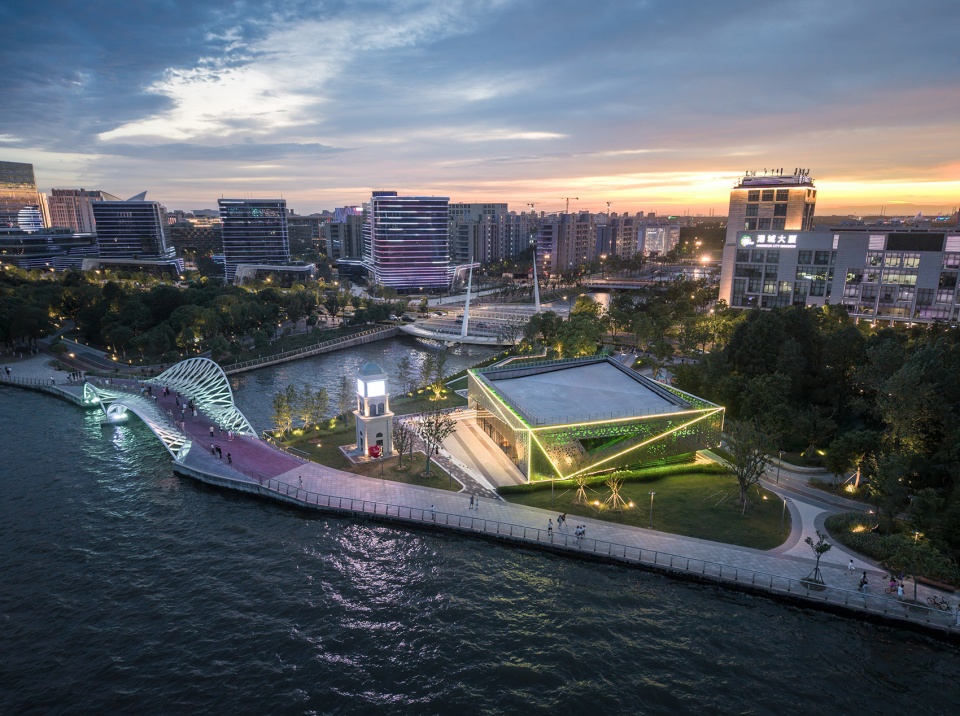
“音乐盒子”(建筑B)位于绿丽港北路与环湖西一路,在600米绿化环带改造活力示范段的末端。这是一个兼具自然景观与城市历史的场所,场地东侧面湖,南侧临河,湖边矗立着一座代表滴水湖建设20年记忆的白色钟塔。
Located at the intersection of Lvligang North Road and West Lakeside Circular Road, the “Music Box” (Building B) stands at the far end of the 600-meter revitalization demonstration section of the greenbelt. This site embodies both natural scenery and urban history: to the east lies the lake, to the south a river, and along the shoreline stands a white clock tower—a symbol of Dishui Lake’s two-decade-long development.
▼“音乐盒子”鸟瞰,aerial view of the “Music Box”
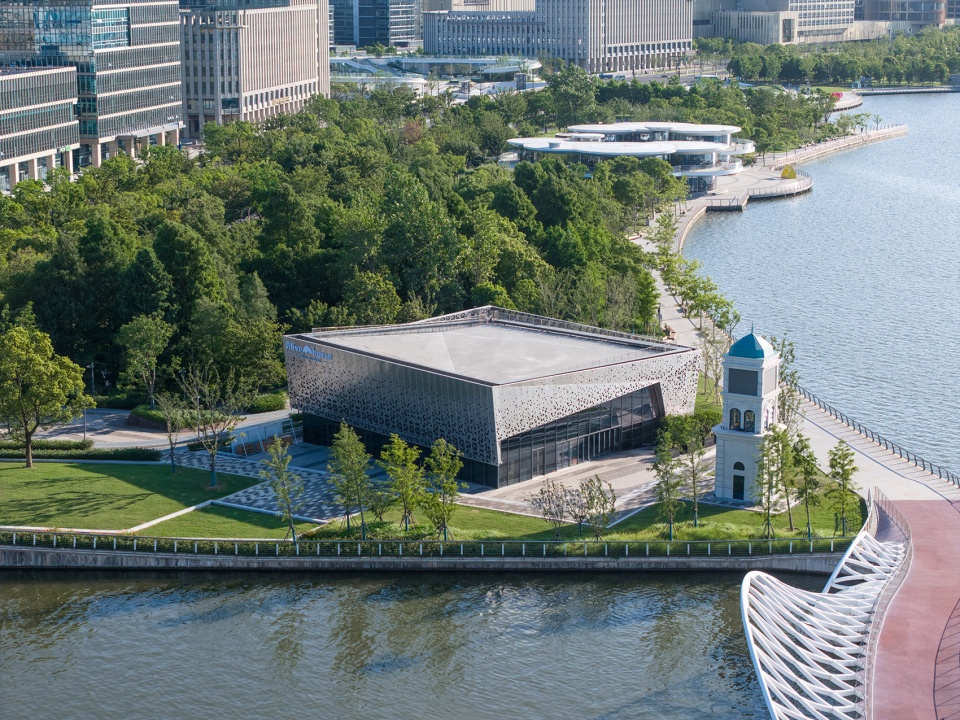
随着时代的发展,城市公园早已超越了植物花园与游园空间的单一范畴,转而成为承载多元市民活动的公共容器。因此,新建建筑不仅需满足多元性的使用需求,更应敏锐回应场地环境与历史要素,塑造具有叙事性的空间体验。本项目直面这一挑战,以谦逊而当代的设计策略建立起新旧建筑之间的对话。设计以场地内现存钟塔为锚点,将建筑主立面朝向这一历史标志物,并选用拉丝不锈钢作为反射界面,模糊地映照出钟塔的倒影,使新建筑既融入环境,又轻巧地提示着时间维度的交接。为进一步强化这一对话关系,设计在新建建筑与钟塔之间置入一个下沉广场,于宽阔的滨江绿地中界定出一处集中式的场域,汇聚人流,提升空间活力。
▼场景合并,scene combination
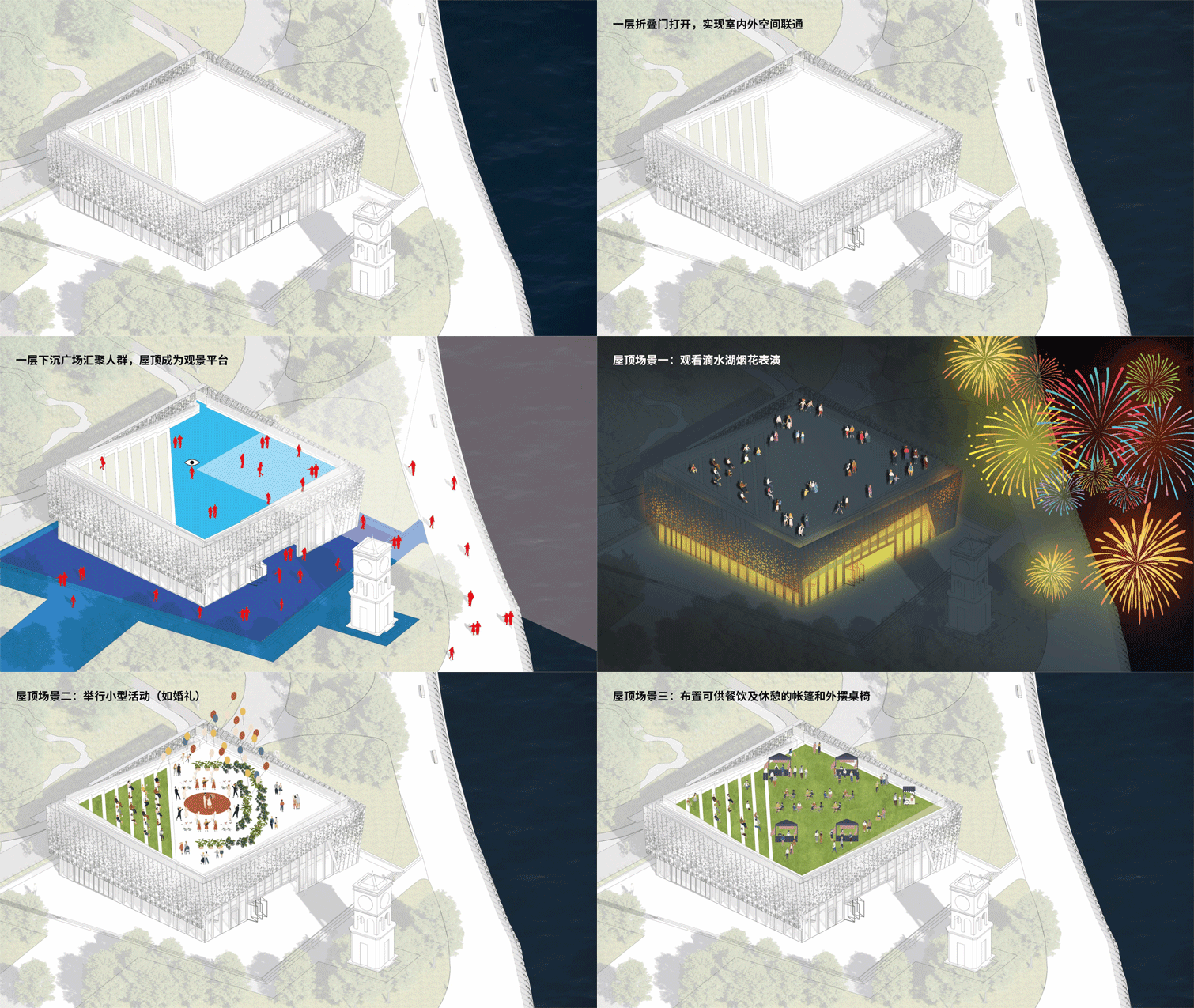
In contemporary practice, urban parks have evolved beyond mere botanical gardens or recreational spaces into public vessels for diverse civic activities. As such, new architecture must not only accommodate varied uses but also respond sensitively to the site’s environment and historical layers, crafting narrative-rich spatial experiences. This project rises to that challenge through a humble yet contemporary design strategy that establishes a dialogue between old and new. Taking the existing clock tower as an anchor, the main façade orients toward this historic marker. Brushed stainless steel is used as a reflective surface, softly mirroring the tower’s image—allowing the new structure to blend into the surroundings while subtly acknowledging the passage of time. To further strengthen this connection, a sunken plaza is inserted between the new building and the clock tower, creating a focused gathering space within the broad riverside greenbelt that draws people in and enhances spatial vitality.
▼“音乐盒子”鸟瞰,aerial view of the “Music Box”
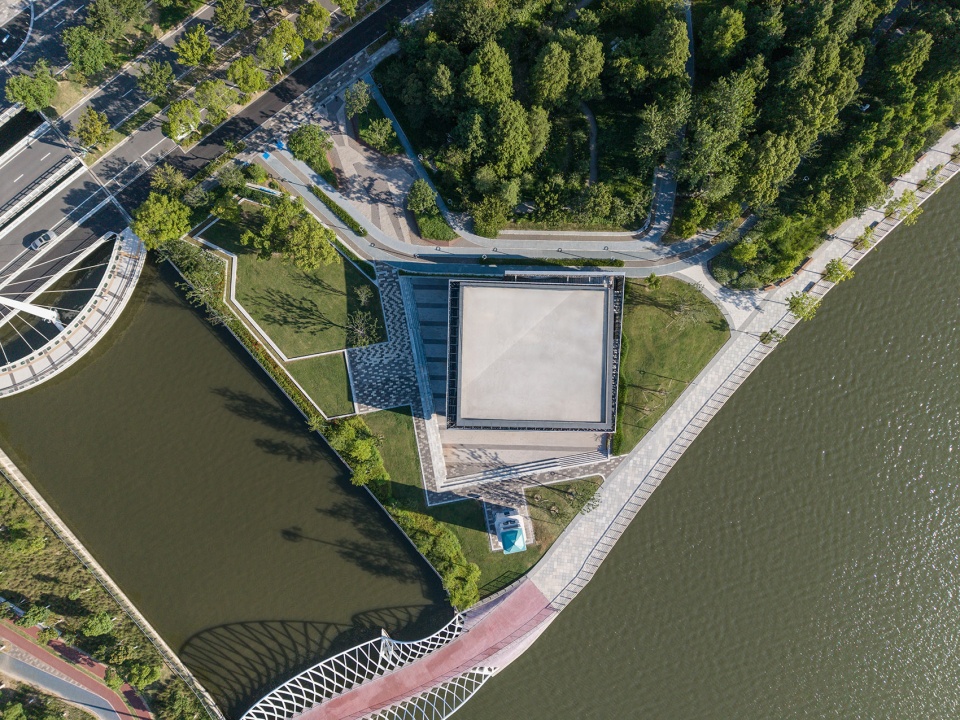
▼“音乐盒子”外观,exterior facade of the “Music Box”
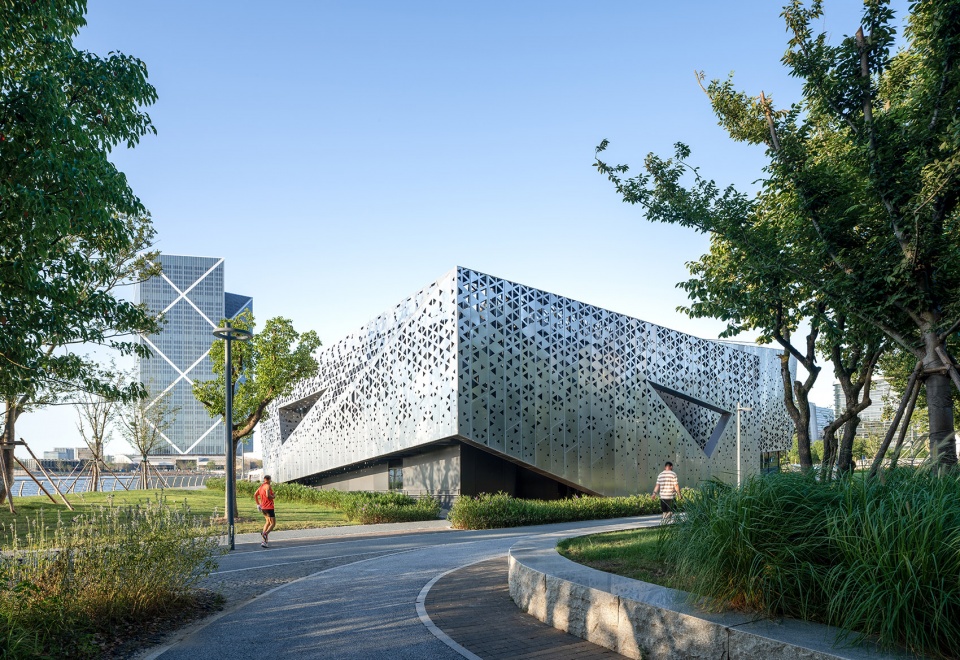
▼“音乐盒子”外观,exterior facade of the “Music Box”
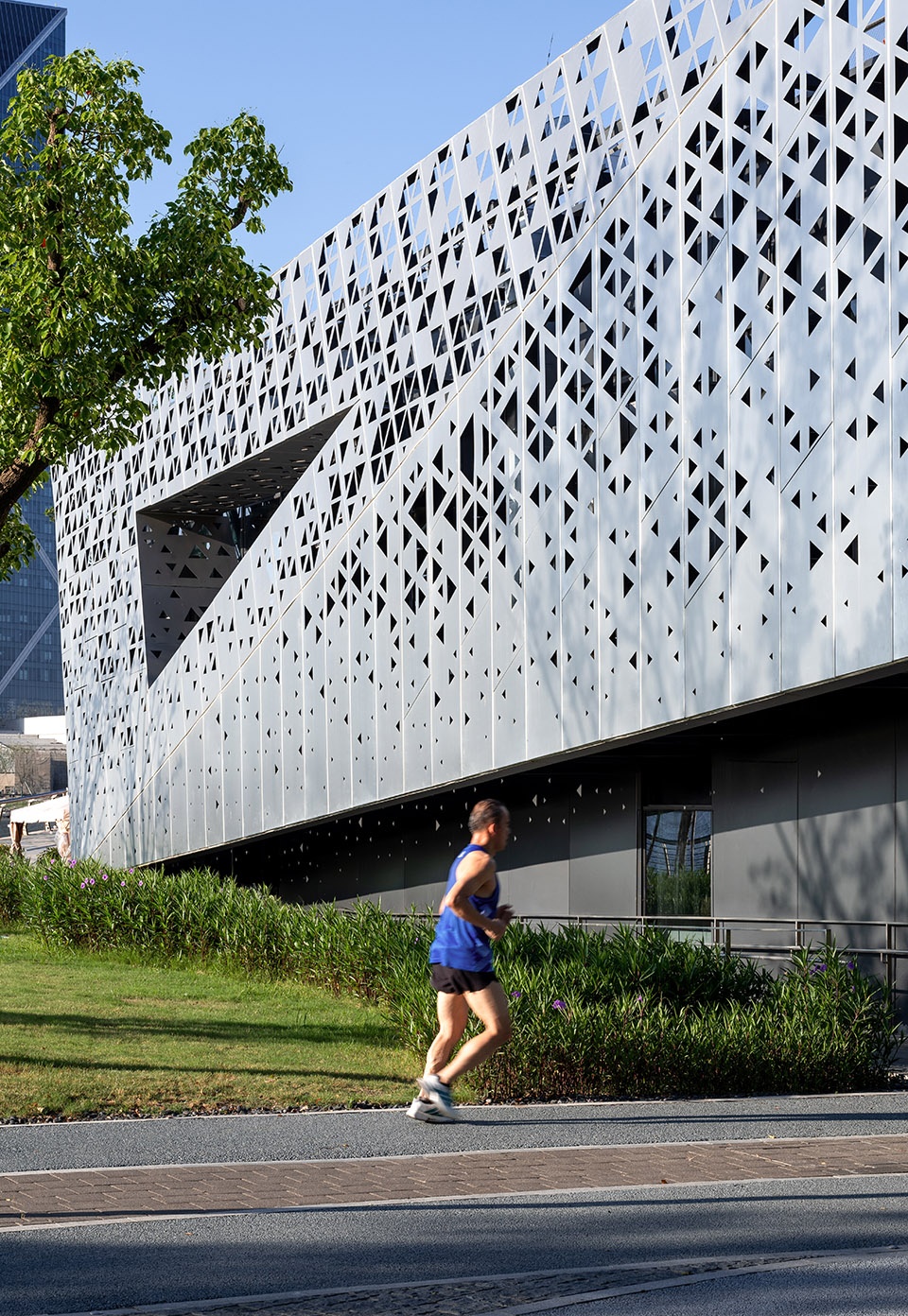
建筑形态概念源自“一个被掀起的音乐盒子”,整体犹如倾斜放置的方盒,底部溢出音乐与光影,蔓延至整个广场空间。这一造型赋予建筑强烈的视觉标识性,为室外音乐广场注入灵动的空间特质。同时,屋顶形成面向湖面倾斜的平台,成为天然的观景平台,建筑北侧的室外直跑楼梯引导广场游人和室内的客人走上屋顶,以更高的视角眺望滴水湖及广场空间。
The architectural form draws inspiration from “a music box tipped open,” with the whole volume resembling a tilted cube from which music and light spill into the square. This gesture gives the building a strong visual identity and imbues the outdoor music plaza with a dynamic spatial character. Meanwhile, the roof forms a sloping platform facing the lake, serving as a natural viewing deck. An outdoor straight-run staircase on the north side guides visitors from the square and building interior up to the roof, offering elevated views of Dishui Lake and the plaza below.
▼“音乐盒子”鸟瞰,aerial view of the “Music Box”
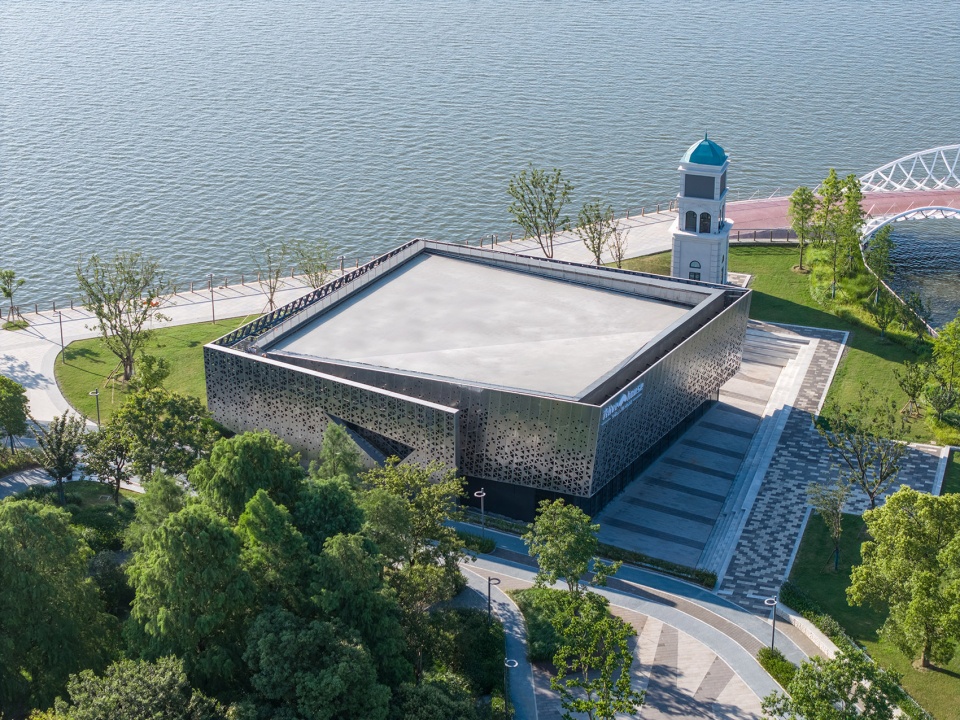
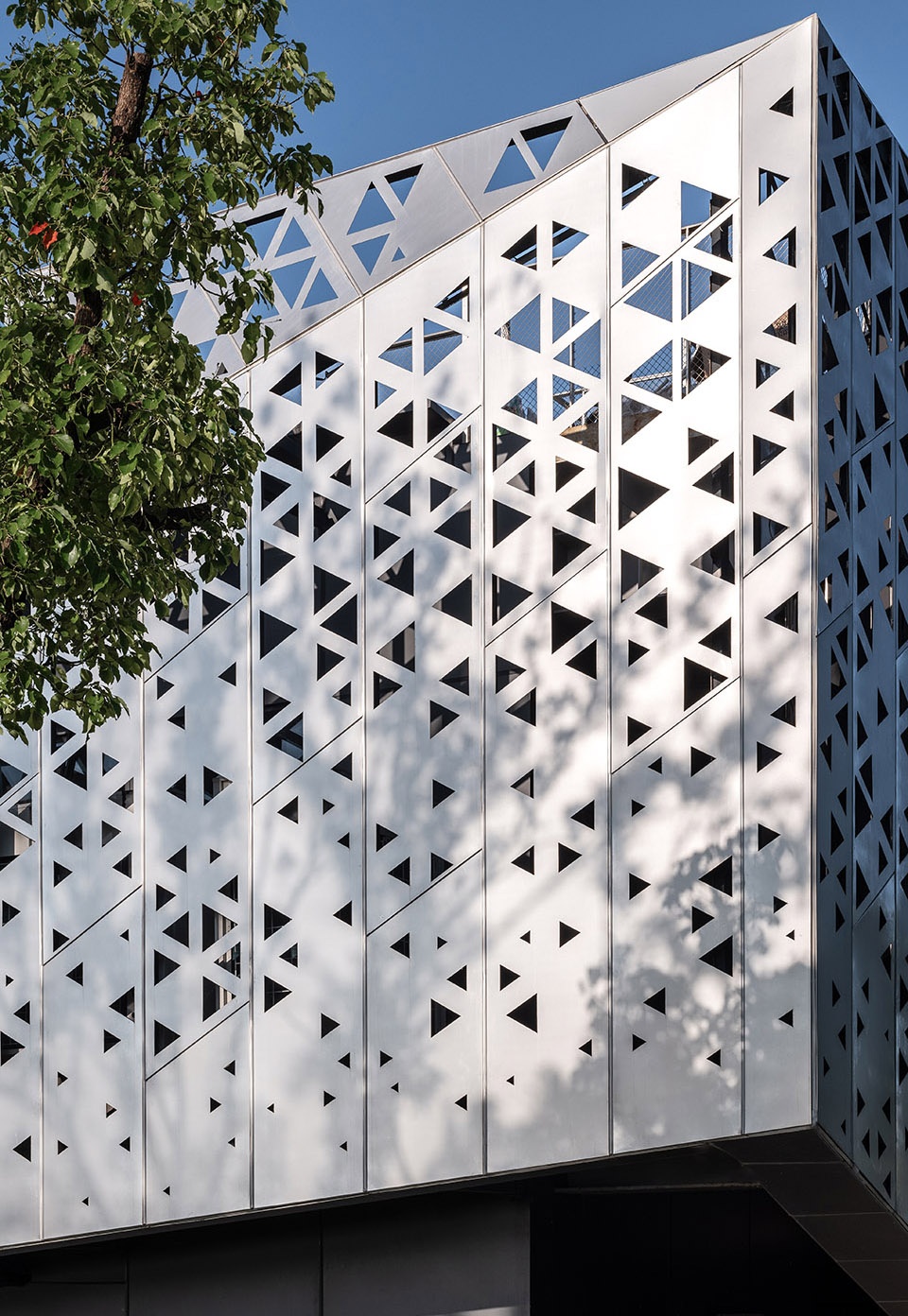
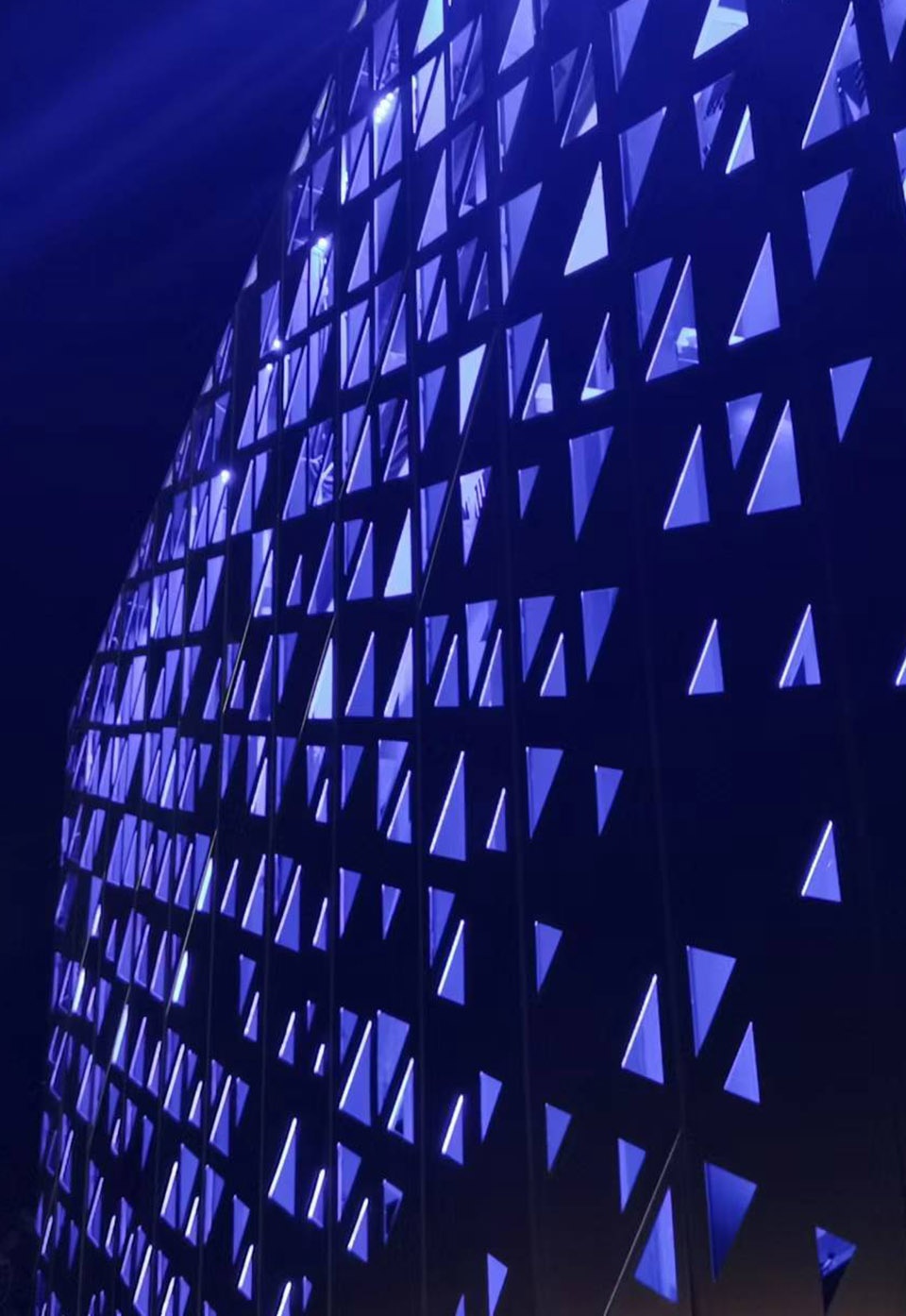
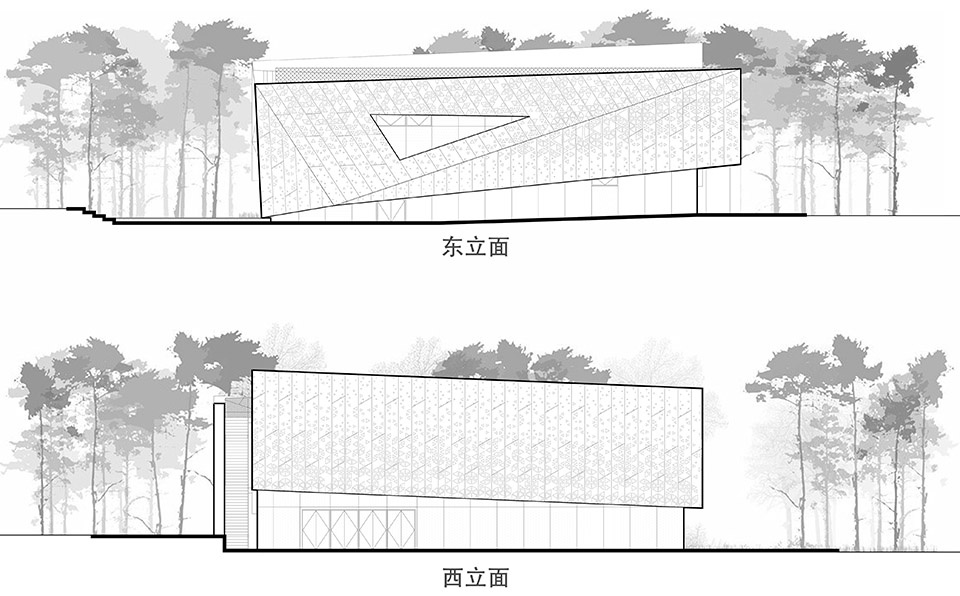
立面设计进一步延续了建筑与周围环境互动的理念。选用哑光磨砂不锈钢板,以低反射、哑光的质感反射周边植被与天空,使建筑既隐匿于自然,又因材料的独特肌理而保有存在感。立面系统由单元式穿孔板组成,通过控制孔洞疏密回应室内采光与观景需求。白天,立面呈现为轻盈而富于变化的表面;夜晚,室内灯光透过穿孔板散射而出,建筑犹如被点亮的光器,在滨湖公园中成为视觉焦点,实现了昼夜有别的建筑表情。
The façade design continues this interplay between architecture and environment. Matte brushed stainless steel panels reflect the surrounding vegetation and sky with low reflectivity and a muted texture, allowing the building to recede into nature while maintaining presence through its material uniqueness. The façade system consists of modular perforated panels, with varying aperture densities responding to interior lighting and viewing needs. By day, the façade appears as a light and ever-changing surface; by night, interior lighting filters through the perforations, transforming the building into a luminous vessel that becomes a visual focal point in the lakeside park—achieving distinct daytime and nocturnal expressions.
▼“音乐盒子”立面设计,facade design of the “Music Box”
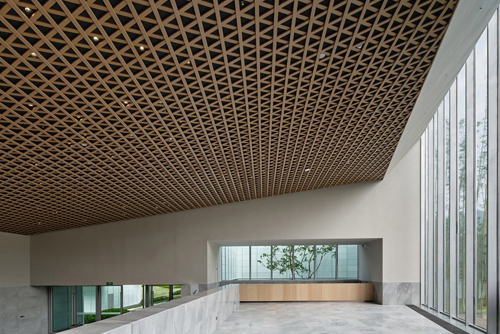
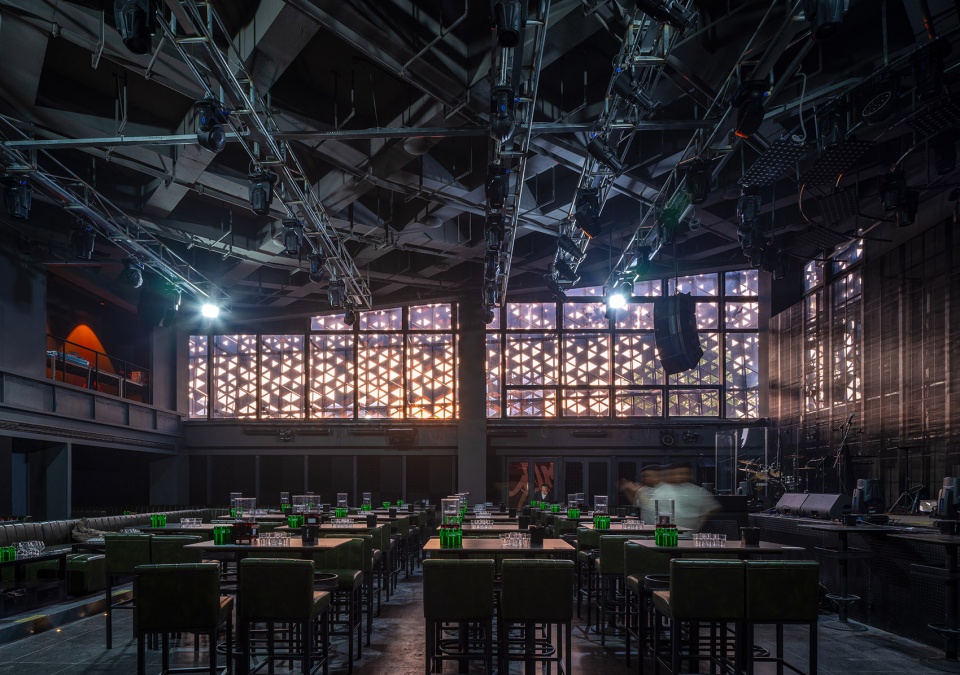
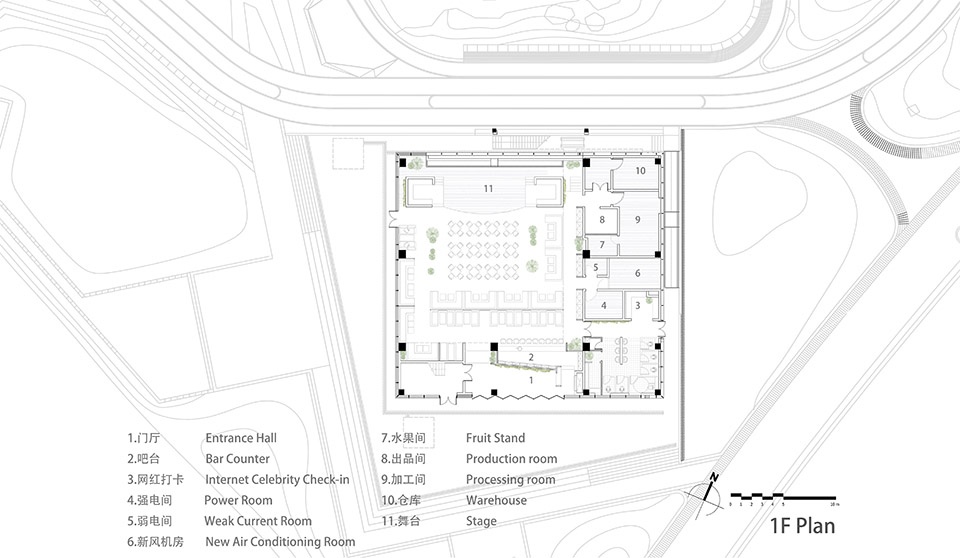
建筑空间的设计充分均衡室内功能与室外观景。远离湖边的区域设置为通高的音乐表演区,靠近湖边及广场的区域则是两层的观景休闲区。表演大厅中,结构采用均匀布置的格子梁系统,呈现清晰的逻辑感。机电管线主管道均被合理布置在大厅外围的房间走道中,确保了大厅内的使用高度和结构简洁。
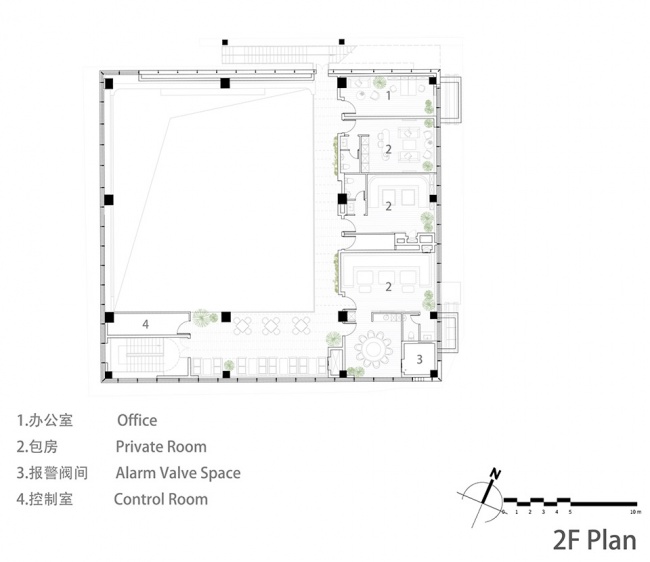
The interior layout carefully balances functional needs with outward views. The area farther from the lake houses a double-height music performance space, while the zones closer to the lake and square accommodate two levels of viewing and leisure areas. In the performance hall, a regularly spaced grid beam system creates a sense of structural clarity. Main mechanical and electrical conduits are routed through peripheral corridors and rooms, preserving ceiling height and visual simplicity in the main space.
▼“音乐盒子”内部空间,interior space of the “Music Box”
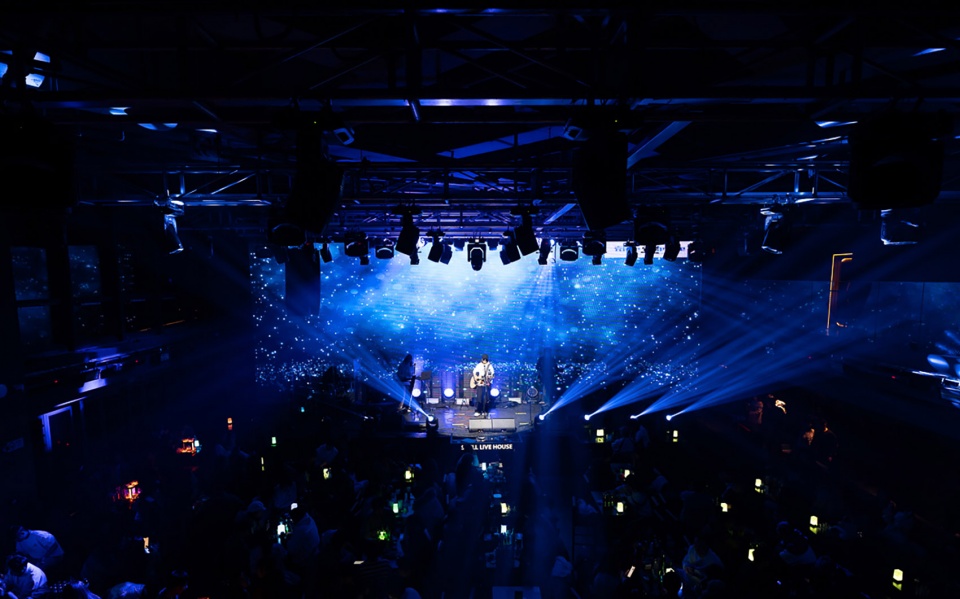
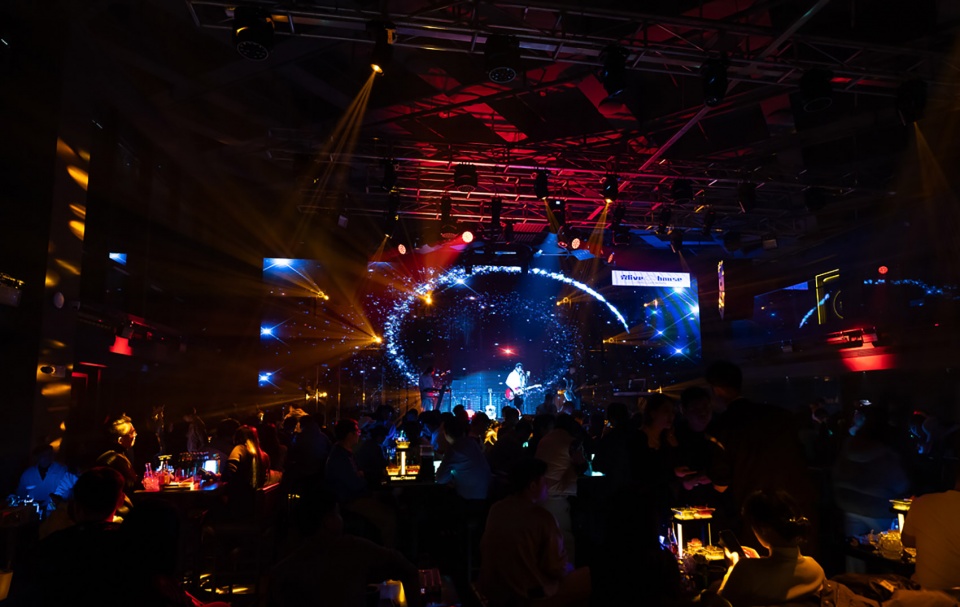
建筑在环境中扮演着精妙的双重角色:它既隐于自然,又独立于自然;既谦逊地回应历史,又积极地创造全新的体验。这种辩证关系通过设计的每一个细节得以呈现。至此,自然元素与人工声光在建筑周围相互交织、共鸣。湖面的波光、林间的风啸、建筑的质感、平台的开阔——这些要素被精心组织成一个多层次、立体化的空间序列。游客的体验路径不再是单一的,而是在行进中不断切换场景:从林荫下的静谧小道,步入建筑投下的阴影;从室内凝望湖景的框景,到登上屋顶平台,获得豁然开朗的全景视野。
The building plays a subtle dual role in its setting: it both recedes into nature and asserts its own presence; it humbly responds to history while actively generating new experiences. This duality is articulated through every design detail. Here, natural elements and human-made light and sound interweave and resonate. The shimmering lake surface, the rustling wind in the trees, the texture of the building, the openness of the platform—all are carefully orchestrated into a multi-layered, three-dimensional spatial sequence. The visitor’s journey is no longer linear but constantly shifts in perspective: from quiet shaded paths into the shadow of the building; from framed lake views indoors to the expansive panorama upon the rooftop.
▼多层次、立体化的空间序列,a multi-layered, three-dimensional spatial sequence
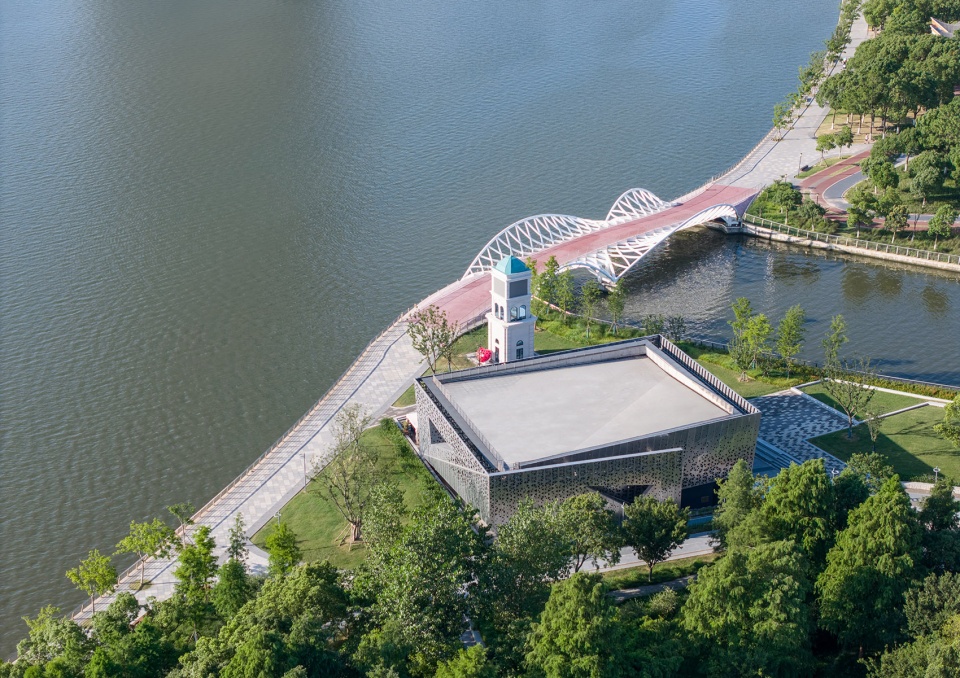
建筑在此超越了功能性的容纳,升华为一段沉浸式的感官旅程。建筑不再是孤立的物体,而是成为激活整个场域、连接自然、历史与人的媒介,为每一位访客提供多元且难忘的空间体验。
In this context, the building transcends mere functionality, becoming an immersive sensory journey. It is no longer an isolated object, but a medium that activates the entire site—connecting nature, history, and people, and offering each visitor a diverse and memorable spatial experience.
▼场地夜景,night view
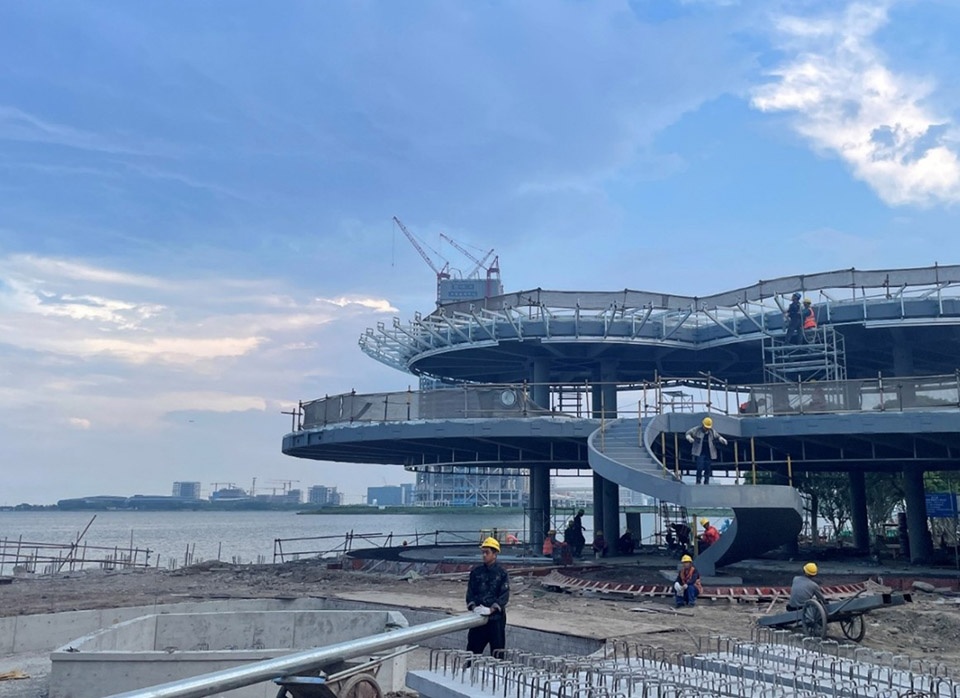
▼施工过程,construction progress
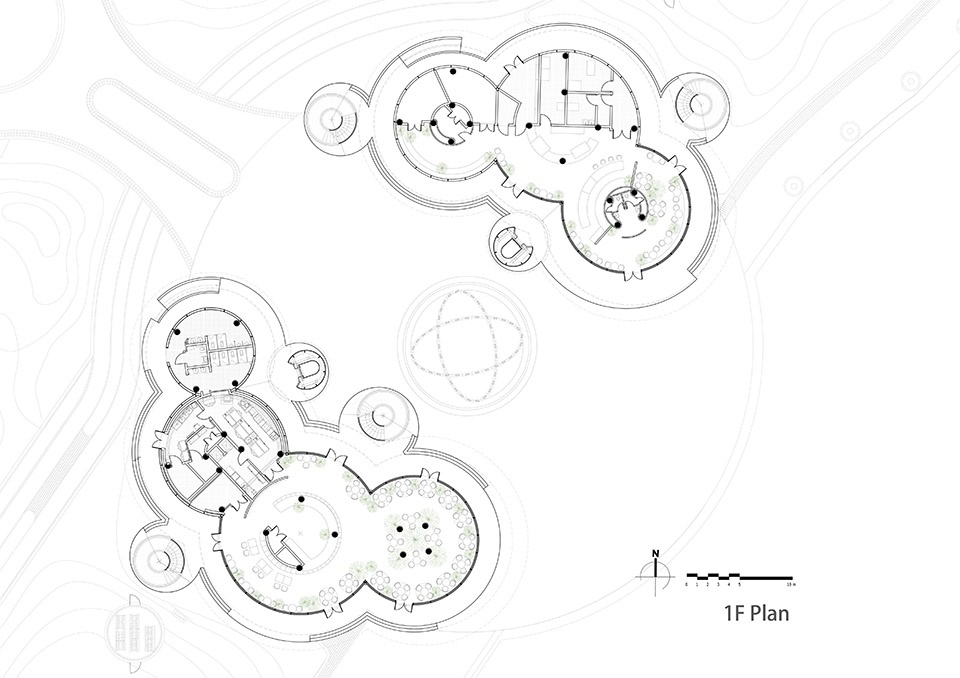
▼云朵建筑一层平面,building A ground floor plan
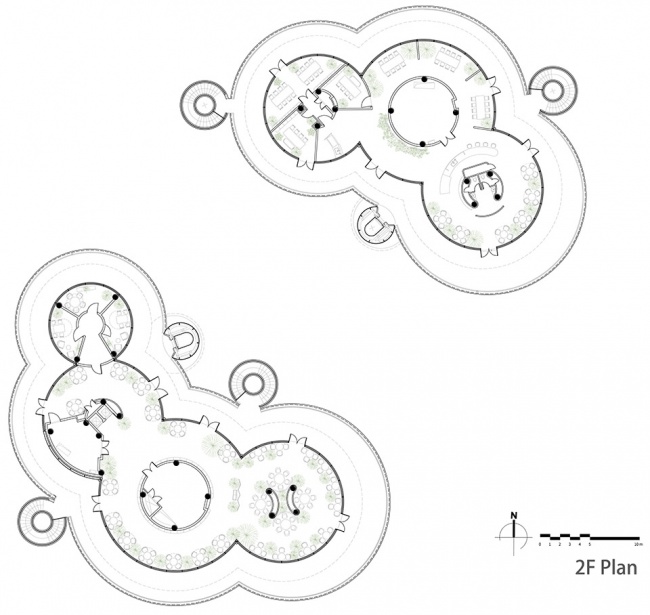
▼云朵建筑二层平面,building A first floor plan
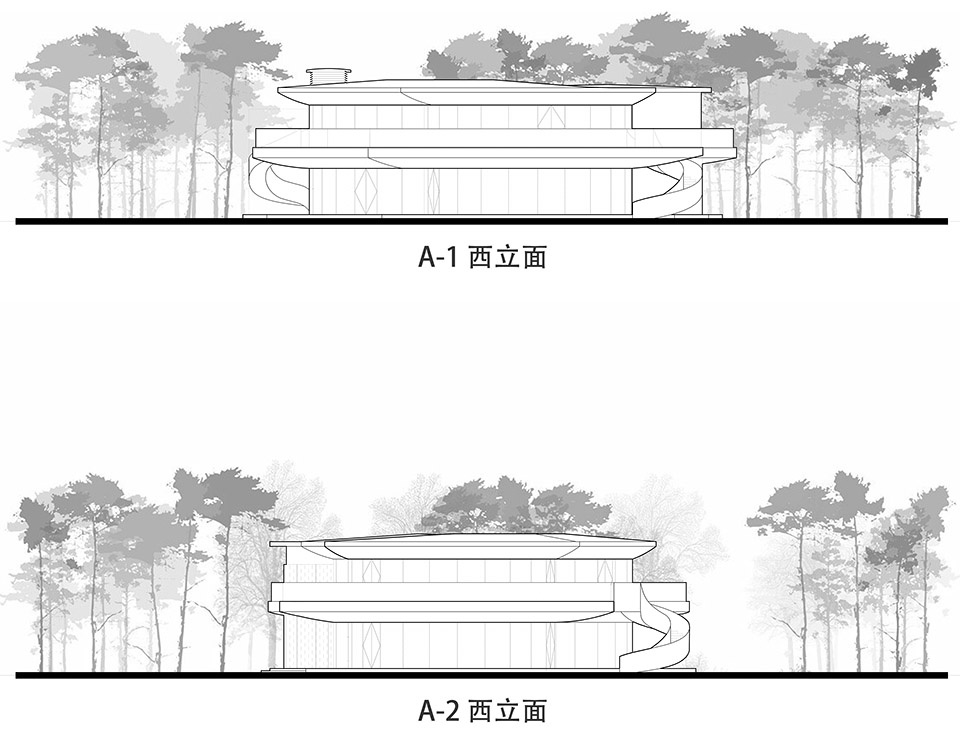
▼云朵建筑立面图,building A elevation
▼“音乐盒子”一层平面图,Music Box ground floor plan
▼“音乐盒子”二层平面图,Music Box first floor plan
▼“音乐盒子”立面图,Music Box elevation
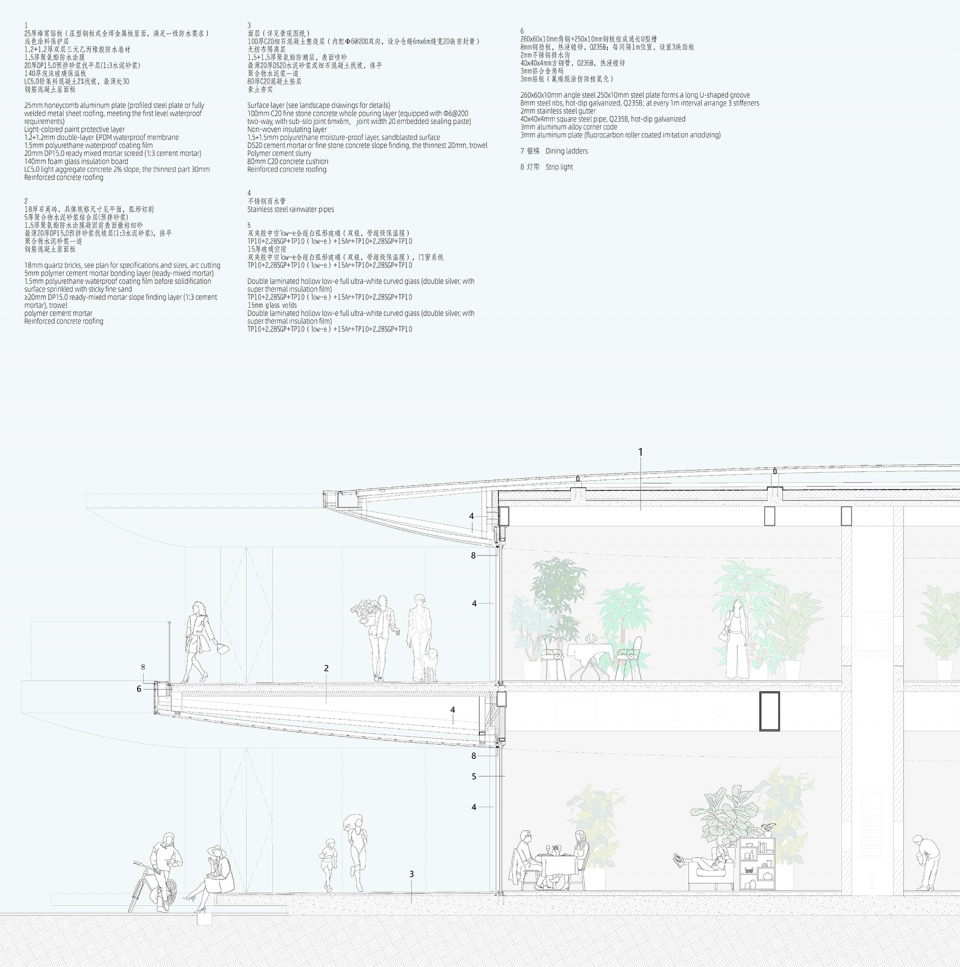
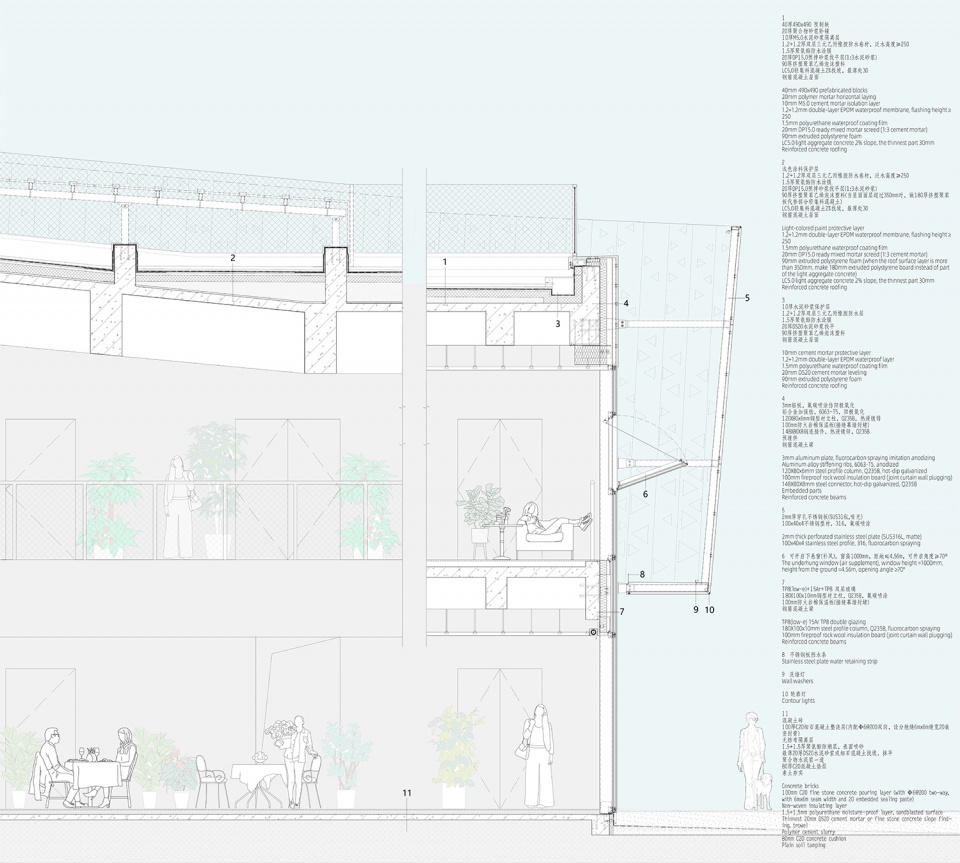
▼墙身大样,wall detail
Project name:Mending and Implantation in Micro-Updates of Urban Park — Renovation of Dishui Lake landscape belt
Project type:architecture&landscape
Design:Arcplus Institute of Shanghai Architectural Design & Research(Co.,Ltd.)
Website:http://www.aisa.com.cn
Contact e-mail: zongtao@aisa.com.cn
Design year:2022.12-2023.3
Completion Year:2024.10
Leader designer & Team:Lead Architects: Su Chang, Tan Chunhui
Chief Architect of Building A: Gong Zhenqiang
Chief Architect of Building B: Zong Tao
Chief Landscape Architects: Shen Lei, Wang Xing
Chief Designer: Tan Chunhui
Project Manager: Ni Jingbo, Xu Xiaogang, Zong Tao
Architectural Design: Zong Tao, Gong Zhenqiang, Qiao Kefei, Chen Di, Wu Changjie, Yang Yigang, Chen Yan
Structural Design: Jia Shuizhong, Liu Hongxin, Zhang Zhenlei, Sun Qiuzhi, Zhang Yifang, Liu Ju
MEP Design: Wu Tongbin, Zhou Haishan, Yang Jianpeng, Wang Hailiang, Pan Da, Huang Pan, Zhang Gaohan, Wei Liang, Wu Meiling, He Jiangbo, Luo Yu
Landscape Design: Wang Zhang, Fan Liqing, Le Ye, Zhu Lingyun, Zhang Xiaohui, Zhou Xinyu, Liu Qinwen, Dong Jiaxin
Facade Design: Li Haiming, Ma Ruifeng, Zhu Taixi
Green Building, Energy Saving and Sponge City: Yan Yan, Sun Bin, Shen Weiwei, Sun Mingyuan, Shen Qihan, Geng Xueqing
Cost Consultants: Liu Xin, Han Xiaoyu
Project location:Lingang,Shanghai
Gross built area: 3173.6㎡
Photo credit: 3000 images
Partner:Construction: Shanghai Landscaping (Group) Co., Ltd.
Construction Agency: Shanghai Xinggang Real Estate Development Co., Ltd.
Lighting Consultant: SYL Shenyu Lighting Design
Hydraulic Engineering: Shanghai Water Conservancy Engineering Design & Research Institute Co., Ltd.
Clients:Ecological Environment and Greening City Appearance Affairs Center, Lingang New District, Shanghai
Materials:Sandblasted Stainless Steel Perforated Panels, Iridescent Panels, Mirror Stainless Steel, Insulated Glass
Brands:Qinfeng,TaiwanGlass,Kinlong