美图立方视觉艺术中心在建中,厦门 / OPEN
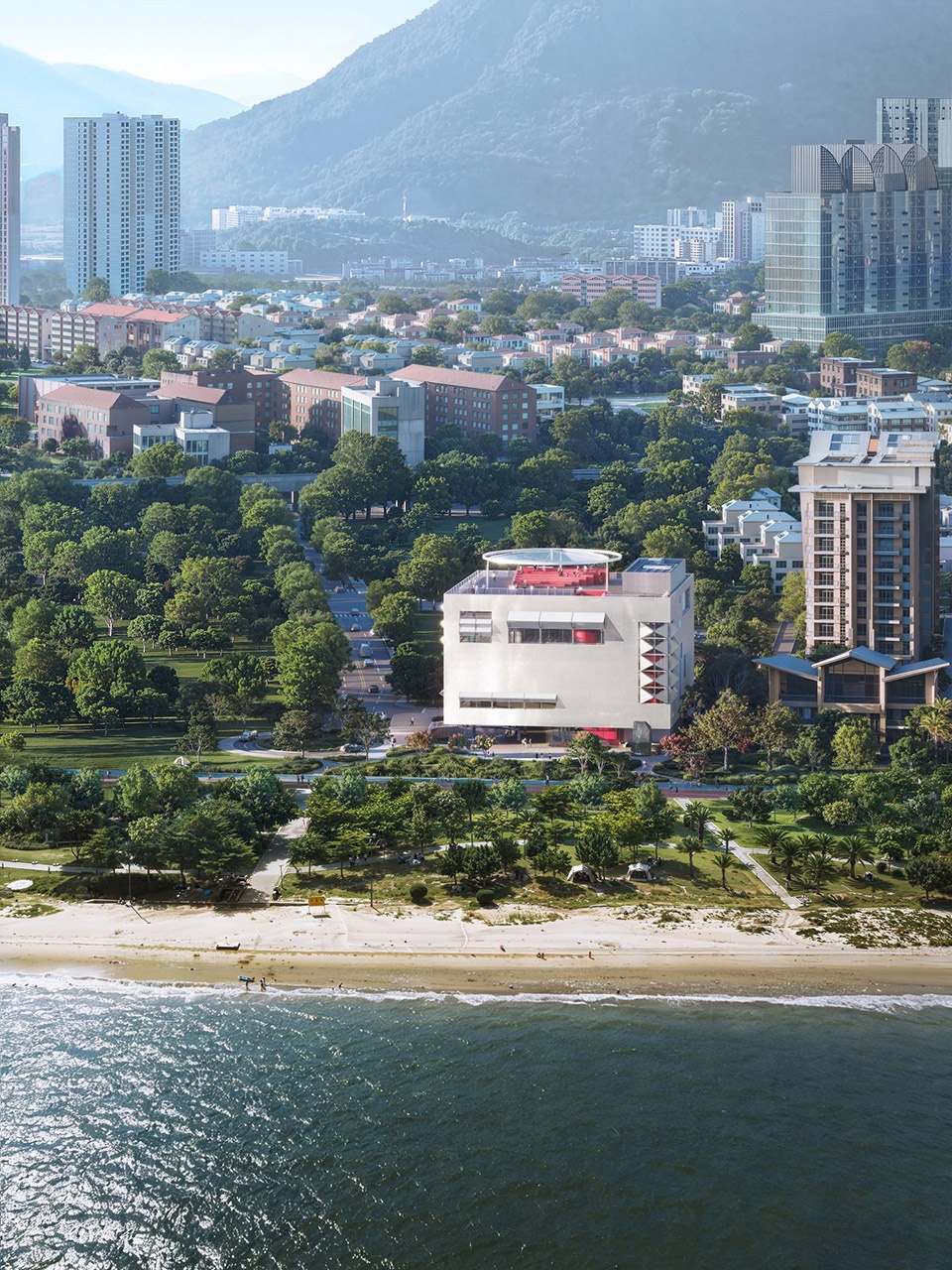
2026 年 4 月 25 日,OPEN 建筑事务所新作“美图立方视觉艺术中心”举行了奠基仪式。美图立方坐落于厦门环东海域,背山面海,以简洁而纯粹的立方形态融入城市与自然之间,同时也是一座持续变化的空间装置:其立面可自由开合,可通风遮阳,并在傍晚透光发亮;内部空间可在 展览、放映、表演、公共活动等多场景之间灵活切换;建筑与城市的关系亦随昼夜交替不断更新。
OPEN’s new project, Cube of Change: Meitu Cube Visual Arts Center, broke ground on April 25, 2026. Perched along the coastline of Xiamen in southern China, the Cube of Change overlooks the East Rim coastal area unfolding across meandering beaches, lush vegetation, and a major sightseeing route. Conceived as an art center for Meitu Inc., the building takes on a deceptively simple form: a cube. Yet this is a cube capable of continuous change. The façade can open and close, filter light, enable ventilation, and glow at dusk; the interior can accommodate myriad transformations, shifting between exhibitions, screenings, performances, gatherings, and public events. The building’s relationship to the coastal city changes from day to night.
▼背山面海的美图立方,
Meitu Cube backed by mountains and facing the sea
面对当下文化、技术与社会各方面的加速变化,美图立方映射了 OPEN 对“灵活性”的深层思考——这不仅是功能策略,更是回应这个时代的一种建筑精神。在有限的体量里,建筑通过开合、连接与共享,成为一个可以呼吸和变化的新型艺术场域。
Responding to our time of accelerating cultural, technological, and social changes, the building crystallizes OPEN’s reflection on flexibility—not merely as a functional strategy, but as an architectural ethos. The result is a highly adaptable cultural building that offers a multisensory experience while remaining open to evolving forms of use, encounter, and public participation.
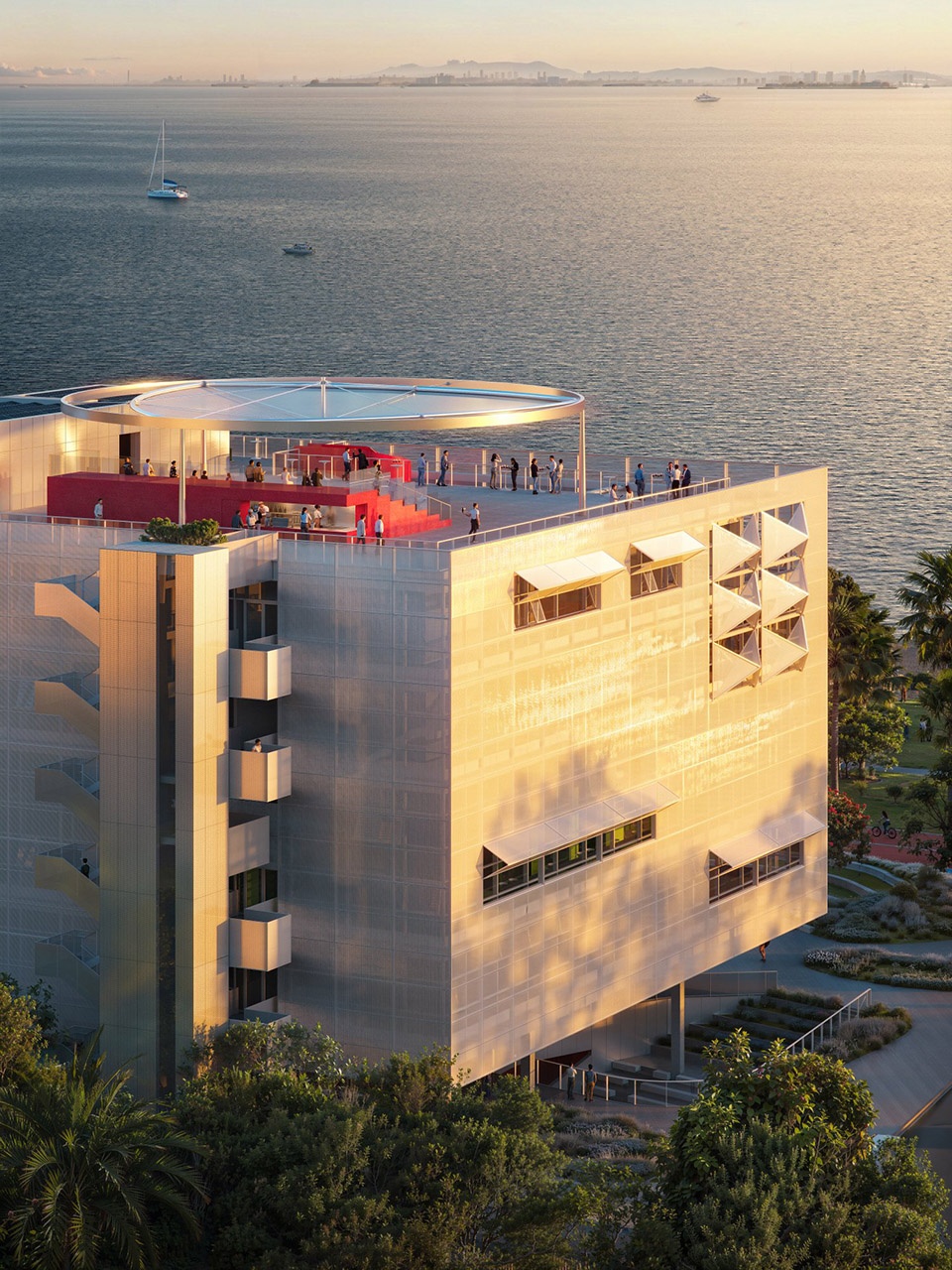
▼面向大海的屋顶剧场,Roof theater facing the sea
建筑流线被组织为一段充满探索与发现的空间旅程。展厅、交通空间、露台与公共空间彼此渗透、相互衔接,形成多路径与多样化的使用方式。这种开放的空间组织鼓励自由探索,使观众从“旁观者”转变为空间体验的参与者。不同的参观路径都会引向一场由视觉、听觉、空间与氛围交织而成的丰富体验,最终汇聚回首层。
▼轴测图,axonometric
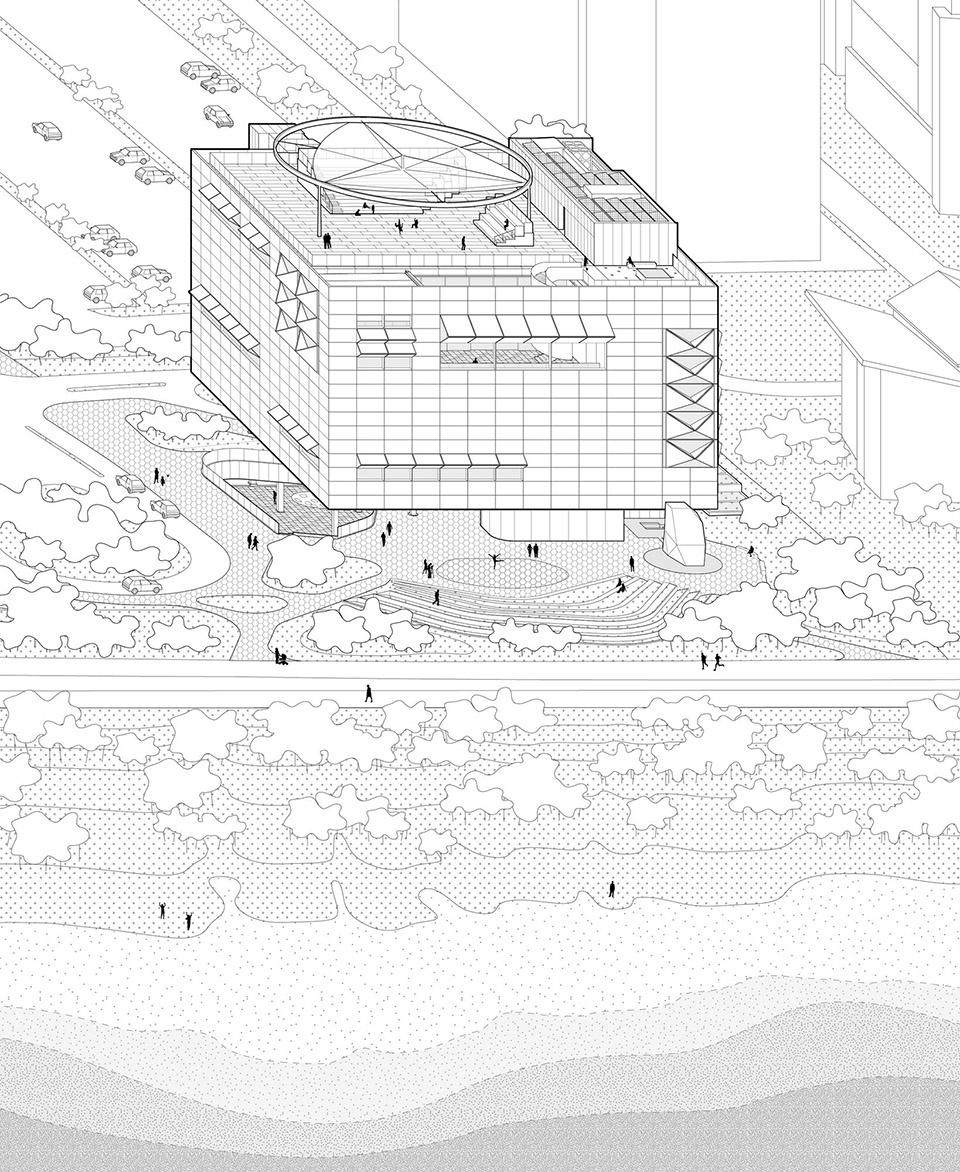
Designed to accommodate a wide spectrum of exhibitions, events, and public activities, the building’s circulation unfolds as a journey of intrigue and discovery. Galleries, circulation paths, terraces, and gathering spaces flow into one another, allowing multiple routes and modes of occupation. This spatial openness encourages free exploration and blurs distinctions between exhibition, movement, and social space. Visitors are no longer passive observers; they become part of the building’s visual and experiential field.
▼开放共享的城市公共文化平台,An open and shared urban public cultural platform
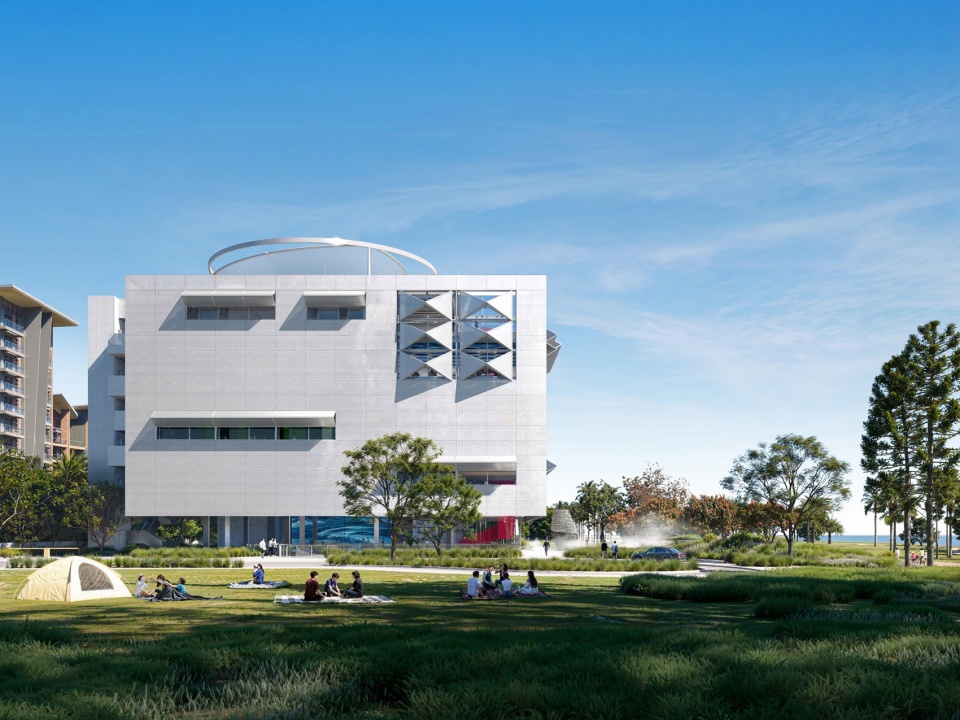
首层空间开放而通透,完全向城市敞开。地景设计受启发于厦门近海群岛的形态特征,在呼应自然地貌的同时,营造出多层次的空间体验。一座水滴形的螺旋楼梯从地面“生长”起来,以美图标志性的红色贯穿各层,引导人们抵达观海平台,继而来到屋顶剧场,在这里观看室外演出、参加活动或是安静地享受天空和大海。
The ground level remains open and porous. Drawing inspiration from the archipelago off Xiamen’s coastline, the landscape design echoes natural geological formations while offering a diversity of spatial experiences. Rising from this terrain, a dramatic water drop-shaped spiral staircase—rendered in Meitu’s signature red—guides visitors upward through all levels to a large ocean-view terrace. From there, another spiral staircase leads to the rooftop, where performances, events, or quiet appreciation of the surrounding landscape can take place.
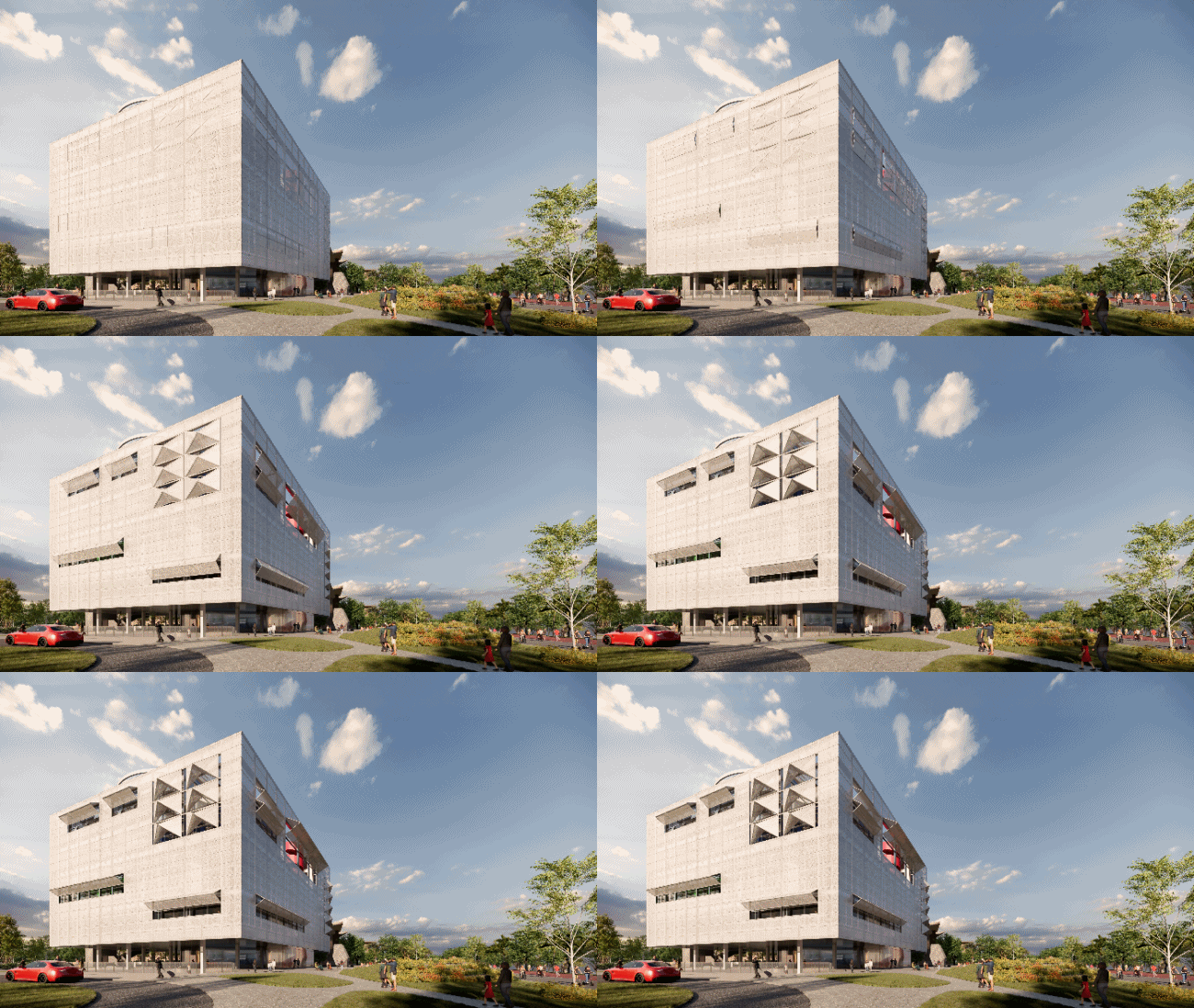
▼可开合的立面,openable facade
由首层向下,一段室外大台阶延伸至下沉广场,咖啡厅与室外公共座席让这里成为活跃的城市生活的一部分。广场连接开放的室内空间,这里可以灵活转换为展览、放映或演出场所。看似简单的立方体体量,内部是相互咬合的多种空间单元:9 米高的黑盒子展厅、可以看海的白盒子展厅、可灵活配置的展览与公共空间、图书馆以及屋顶露台等。展厅和公共空间不预设单一功能,而是在尺度、氛围与使用方式上保持可变性,从传统展览到数字艺术,从演出、讲座、放映到公共活动,皆有可能。屋顶设有面海的阶梯式剧场,并配备酒吧以及直达的观景电梯。
▼简洁的外立面与丰富的室内空间,
Simple exterior facade and rich interior space
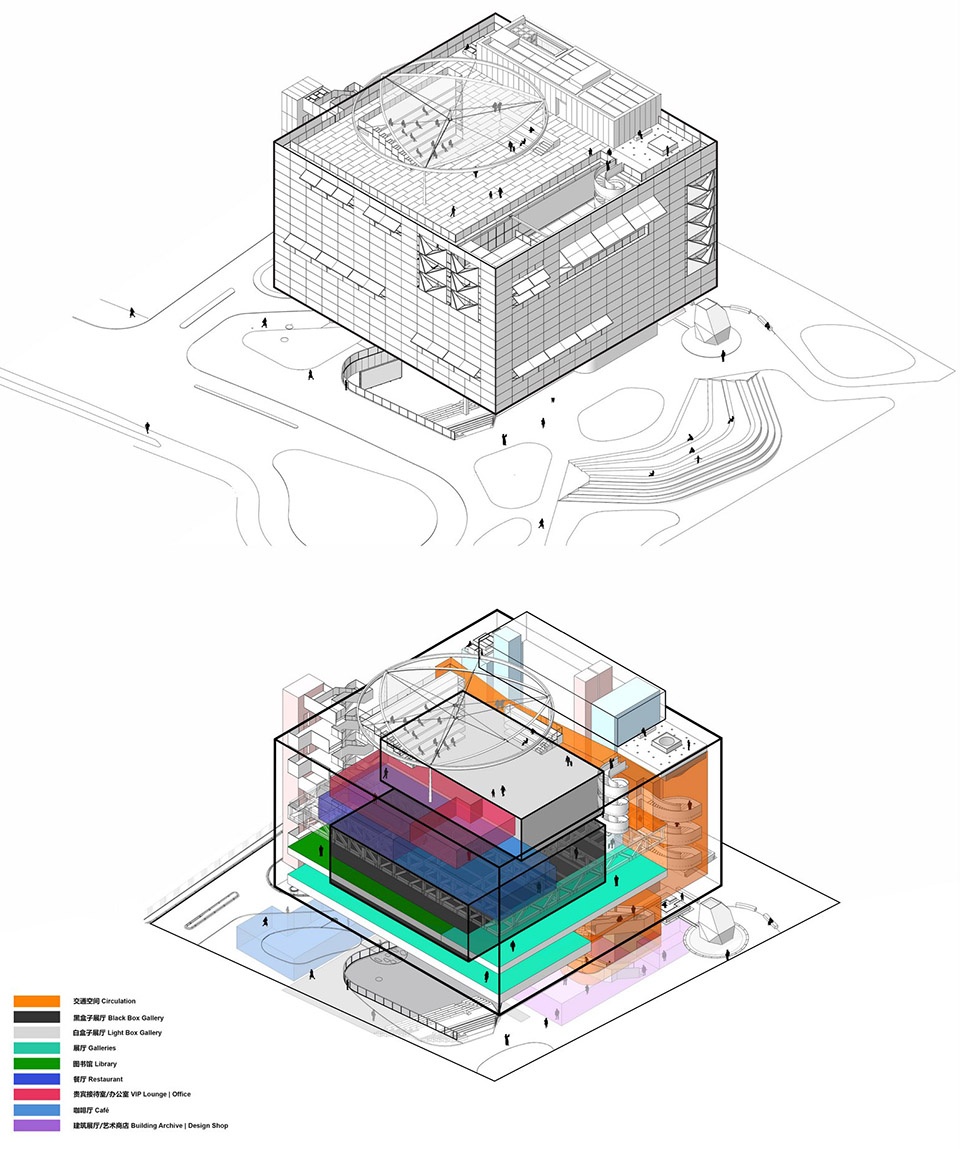
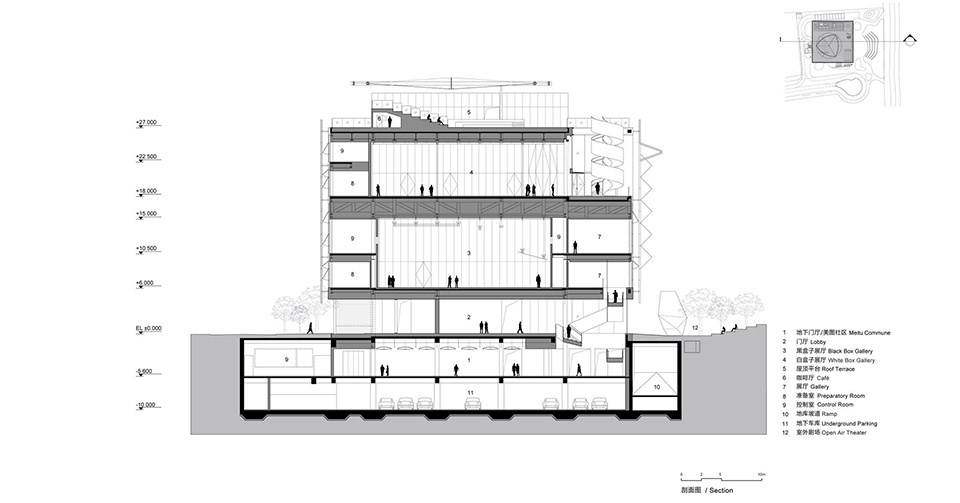
From the ground level, an open-air grand staircase descends to a sunken plaza animated by a café and public seating. This plaza connects to an indoor open area that can be easily transformed into an exhibition hall, screening room, or performance venue. Regardless of the chosen path, visitors eventually return to the ground level, having traversed a kaleidoscope of visual, auditory, spatial, and atmospheric experiences. While the building presents itself as a simple cubic volume, it is in fact composed of interlocking spatial components: a nine-meter-high black-box gallery, a white-box gallery with ocean views, a series of configurable exhibition and gathering spaces, a library, and rooftop terraces overlooking the sea. Rather than prescribing fixed uses, the galleries and public spaces are designed to transform in scale, atmosphere, and function, supporting everything from conventional exhibitions to digital installations, performances, lectures, screenings, and public events. At the rooftop, a theater with wide stepped seating opens toward the ocean, accompanied by a bar; an oceanview elevator offers direct access to this level.
▼一座持续变化的空间装置 ,a constantly changing spatial installation
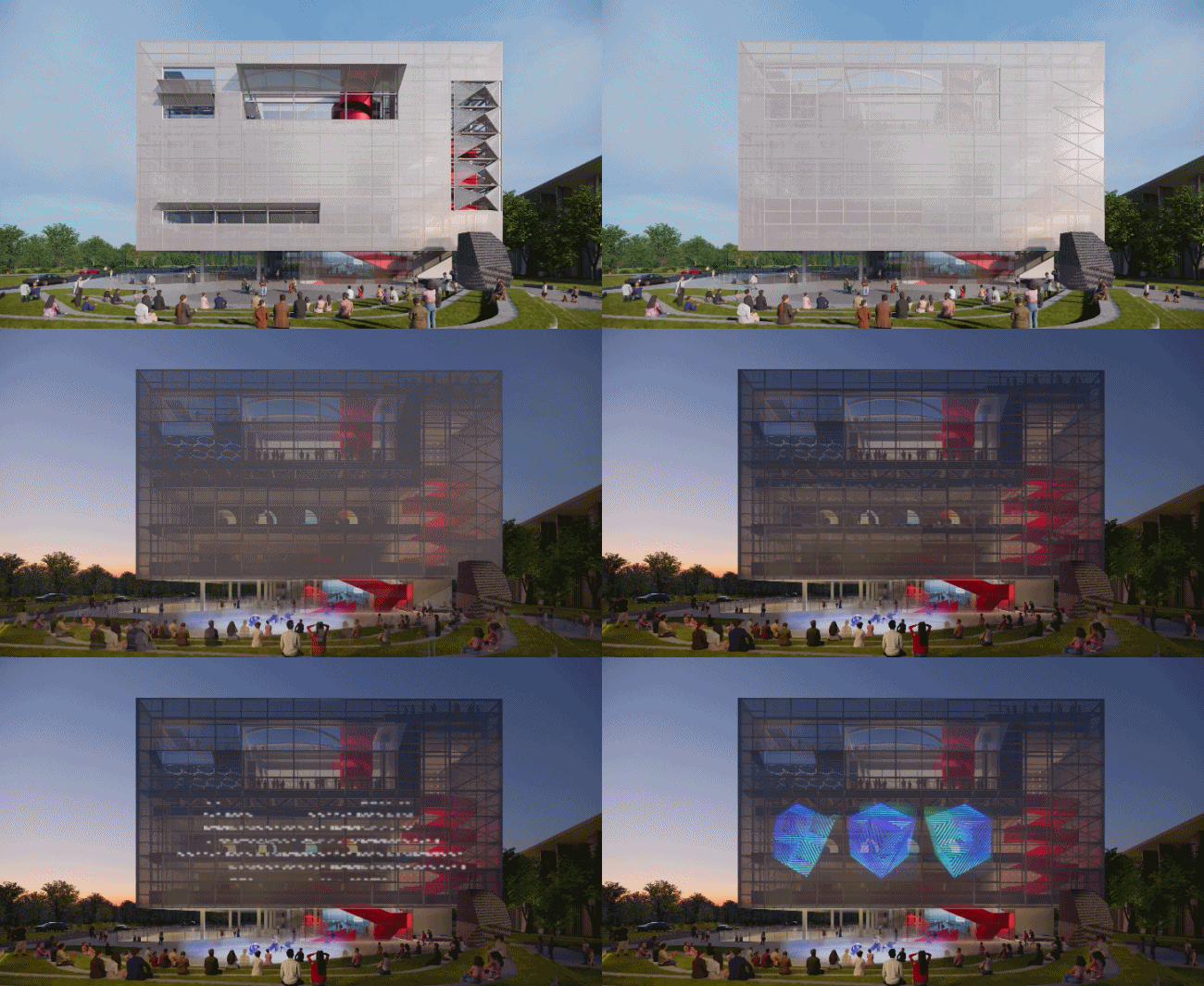
建筑采用双层表皮系统,外表皮为有金属光泽的穿孔 PTFE 材料,整体轻盈通透。白天,半透明表皮让室内外视觉上舒适通透,并映射出环境的变化;傍晚,则转化为可发光的展示界面,让影像与艺术进入城市视野。可持续策略贯穿于设计之中。双层表皮有效降低热负荷,同时引入充足而柔和的自然光;外层开洞与内层窗户经过精心布置,借助主导风向实现高效的自然通风。分区空调系统提升了运营的灵活性与节能效率。雨水花园、透水铺装与蓄水箱共同构成有效的雨洪管理体系,回收雨水与地表径流,用于景观灌溉。屋面光伏板为室外照明提供能源。立体景观在建筑中层层展开,与海岸生态形成连续的对话。
▼可持续设计策略,Sustainable design strategy
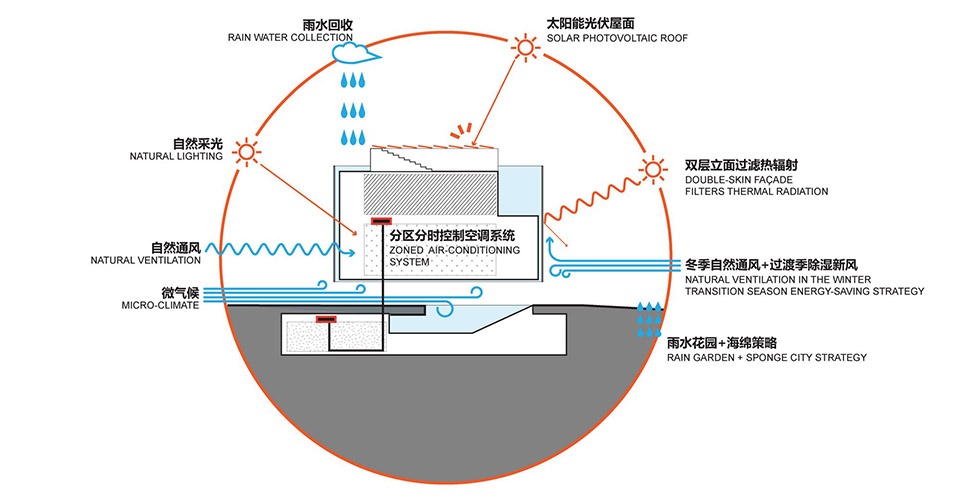
A double-layer façade wrapped in a perforated PTFE outer skin gives the building a light, permeable presence. By day, the diaphanous surface preserves visual continuity between interior and exterior; by night, it becomes a luminous projection canvas, extending the building’s program into the public realm and allowing art to speak directly to the city. Sustainability is woven into the project as a quiet yet essential layer. The double-skin façade reduces thermal load while bringing ample diffused daylight into the building. Openings in the outer layer of the façade and windows on the inner layer are strategically placed to take advantage of the prevailing wind, enabling effective natural ventilation. A zoned air-conditioning system provides operational flexibility while reducing overall energy consumption. Rain gardens, permeable pavement, and water retention tanks form an integrated stormwater management system that captures rainwater and surface runoff for reuse in landscape irrigation. Solar photovoltaic panels on the rooftop power the outdoor lighting. Landscaped areas are stacked throughout the building, reinforcing a continuous dialogue between architecture, ecology, and the coastal environment.
▼双层表皮轻盈通透,The double-layer skin is light and transparent
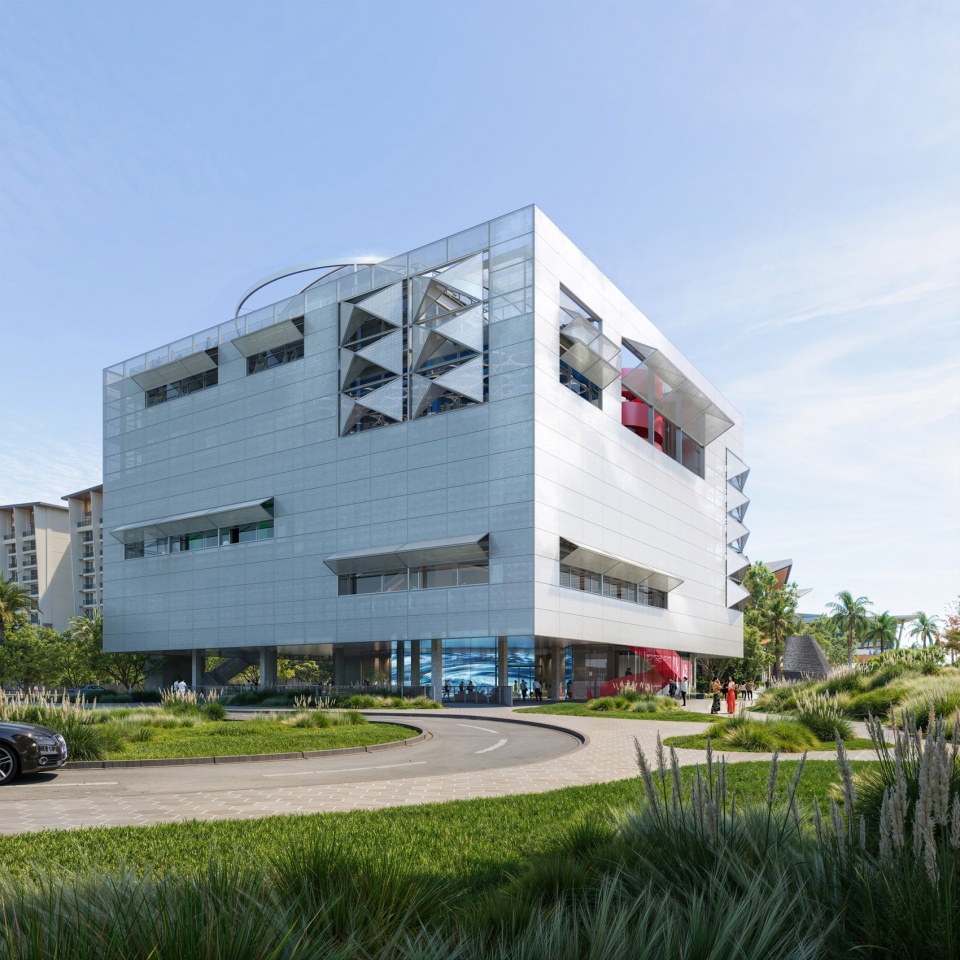
作为可以不断演化的文化载体,美图立方不仅仅是一座艺术场馆,更是开放共享的城市公共文化平台,以可变的建筑连接艺术、科技与公共生活。OPEN 认为,在这个瞬息万变的时代,建筑也应拥有变化的能力。
Through its emphasis on flexibility, openness, and environmental responsiveness, the Cube of Change functions not merely as an exhibition venue, but as an evolving public platform. It invites participation, adapts to shifting cultural needs, and actively contributes to the urban social life. OPEN believes that in a time defined by change, architecture must also remain capable of changing.
▼傍晚透光的外立面,The transparent exterior facade at dusk
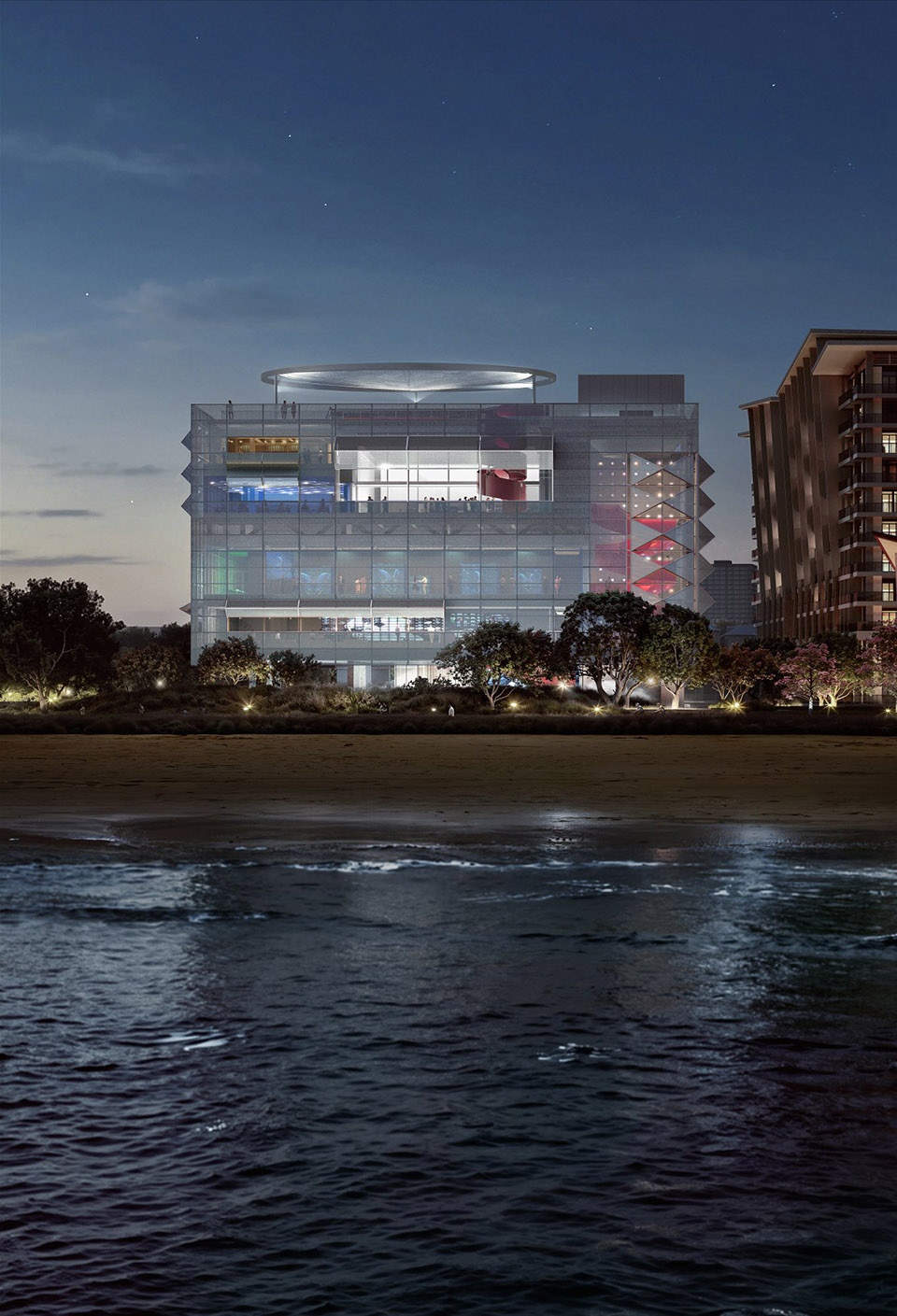
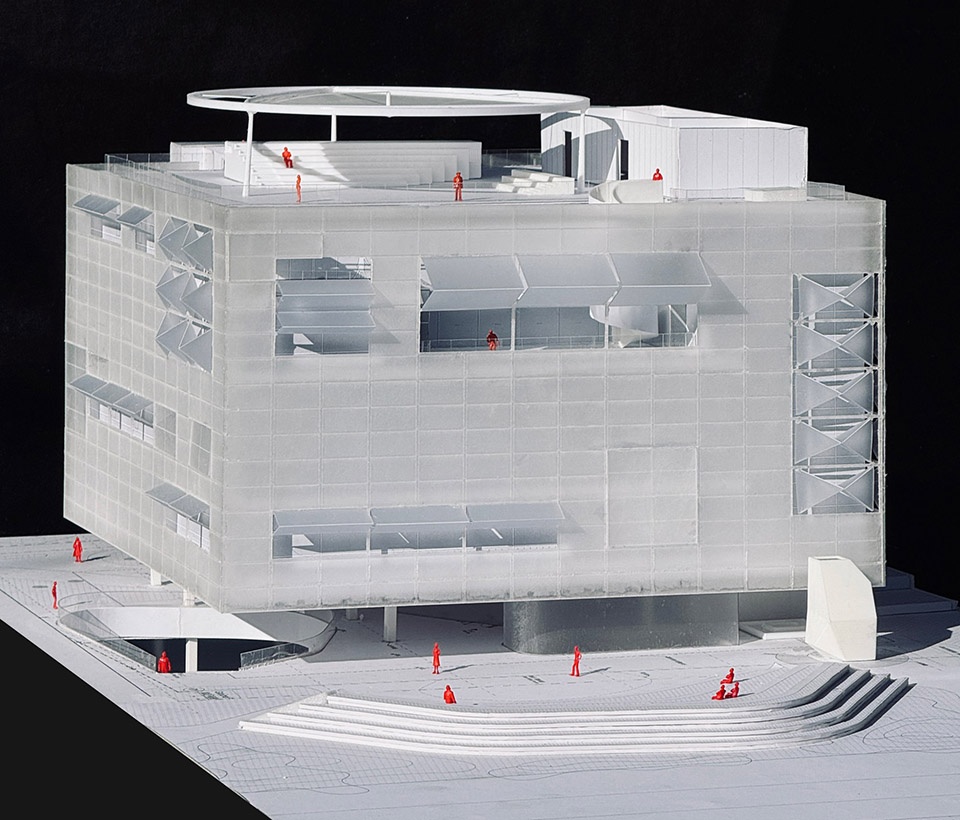
▼研究模型,research model
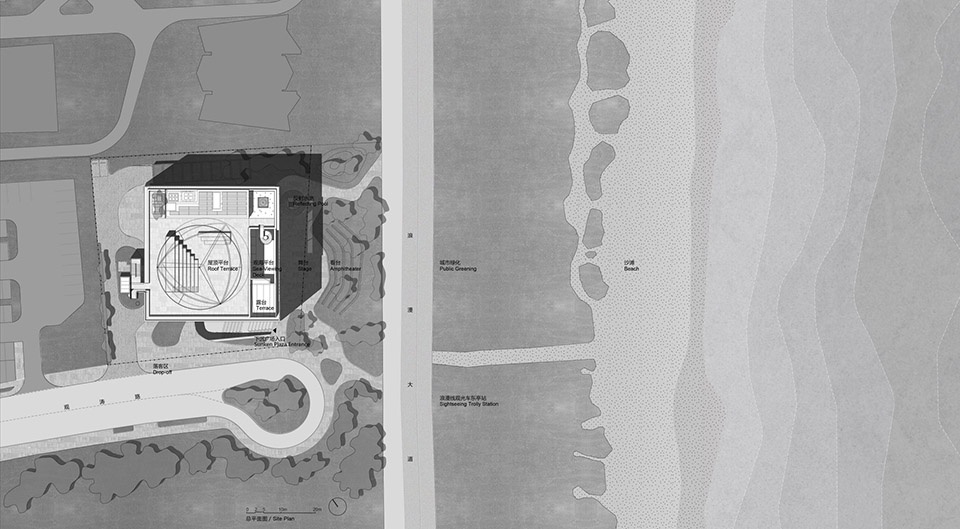
▼总平面图,site plan
▼剖面图,section
项目概况
项目时间:2024 – 2028
阶段:施工中
甲方:厦门美图立方文化发展有限公司
功能:黑盒子展厅、白盒子展厅、线性展厅、小剧场、图书馆、咖啡厅、餐厅、屋顶剧场等
建筑面积:12,200 m²
地点:中国厦门
项目团队
建筑及室内设计:OPEN 建筑事务所
建筑施工图单位、机电、结构及节能顾问:中国建筑科学研究院有限公司
幕墙顾问:阿法建筑设计咨询(上海)有限公司
美术馆场景顾问:dUCKS scéno
剧场及声学顾问:华东建筑设计研究院有限公司 声学及剧场专项设计研究所
景观设计:OPEN 建筑事务所 + 风物营造
照明顾问:格锐照明
Year: 2024 – 2028
Status: Under Construction
Client: Xiamen Meitu Cube Cultural Development Co., Ltd.
Program: Black-box gallery, white-box gallery, linear gallery, library, café, restaurant, rooftop theater
Building Area: 12,200 m²
Location: Xiamen, China
Architectural and Interior Design: OPEN Architecture
Construction Documents, Structural, MEP and Sustainability Consultant: China Academy of Building Research
Curtain Wall Consultant: RFR
Scenographer: dUCKS scéno
Acoustic and Theater Consultant: ECADI
Landscape Design: OPEN Architecture + Landtek Group
Lighting Consultant: Gradient Lighting Design