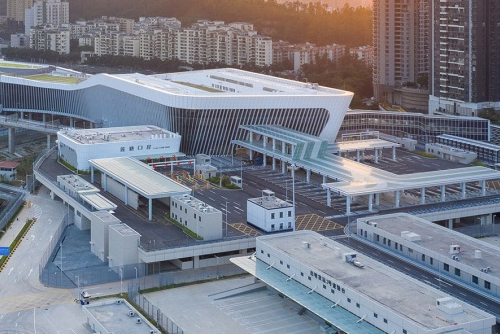
中山客运口岸,广东 / 华阳国际设计集团
在粤港澳大湾区城市群中,随着深中通道全线通车,中山的城市界面正在重新定义。坐落于翠亨新区马鞍岛的万科深业·未来之门(湾中新区),以全功能城市综合体之姿崛起于海岸前线。
Amidst the city cluster in the Guangdong-Hong Kong-Macao Greater Bay Area, the full opening of the Shenzhen-Zhongshan Link is redefining Zhongshan’s urban landscape. Situated on Ma’an Island in Cuiheng New District, the Vanke Shum Yip • Gate to the Future (Bay City Central) has emerged as a full-functional urban complex along the coastal forefront.
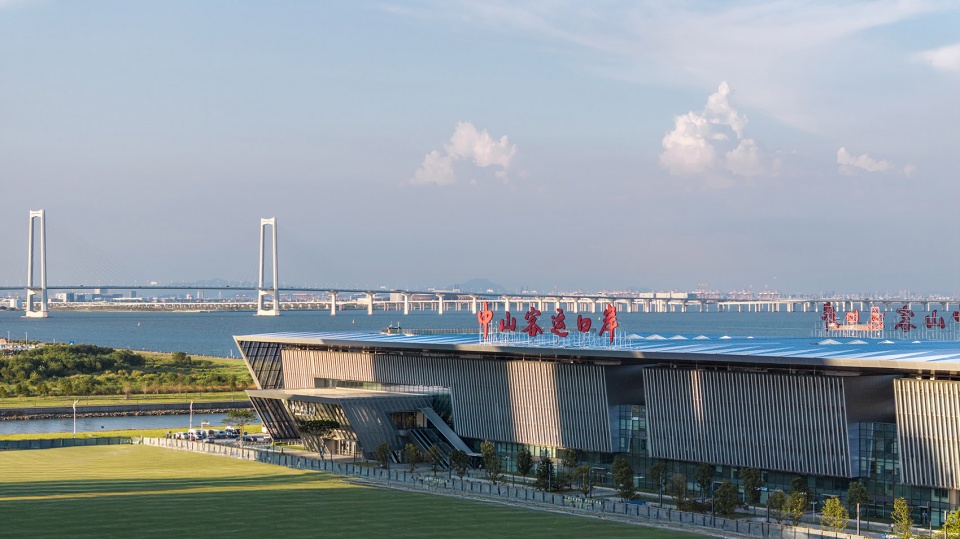
▼项目鸟瞰,Aerialview of the project
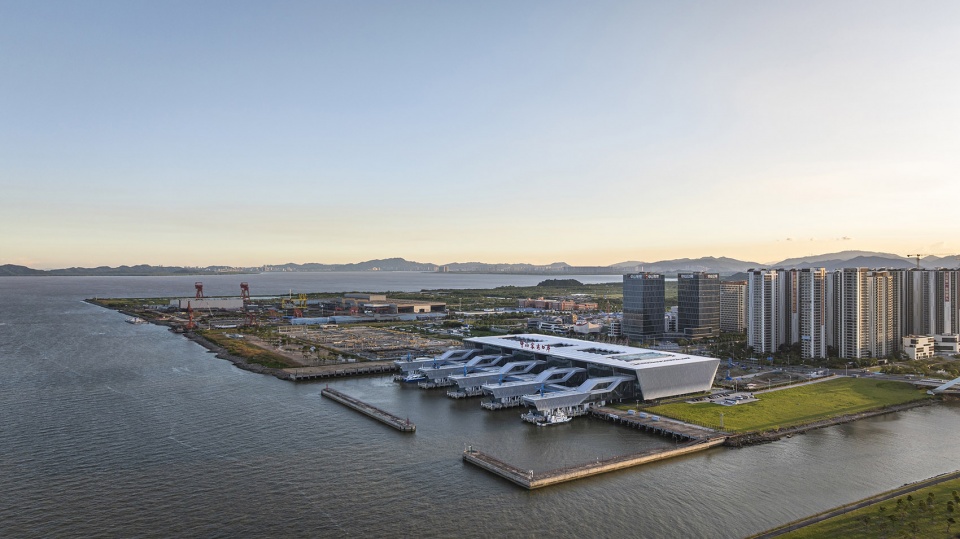
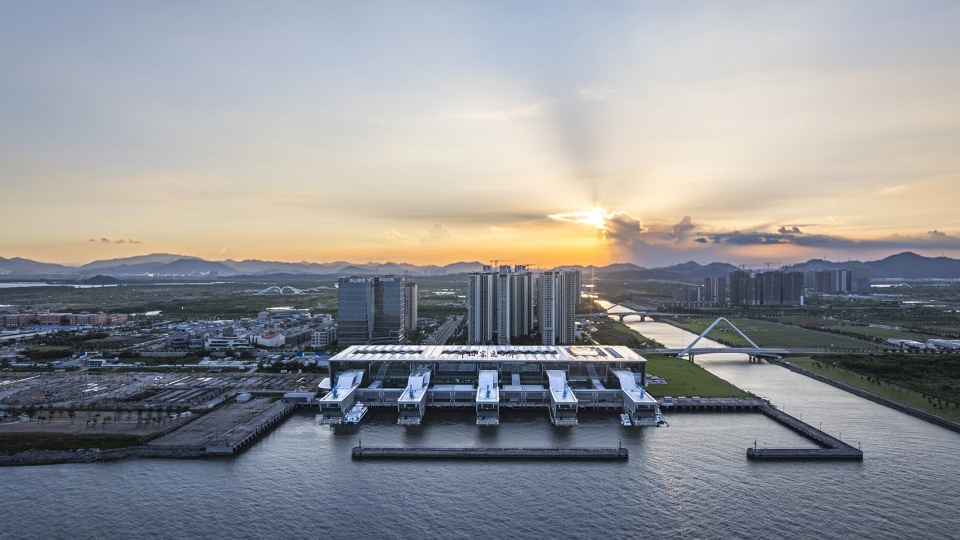
▼百舸争流的湾区前厅,Boat-Race Anteroom
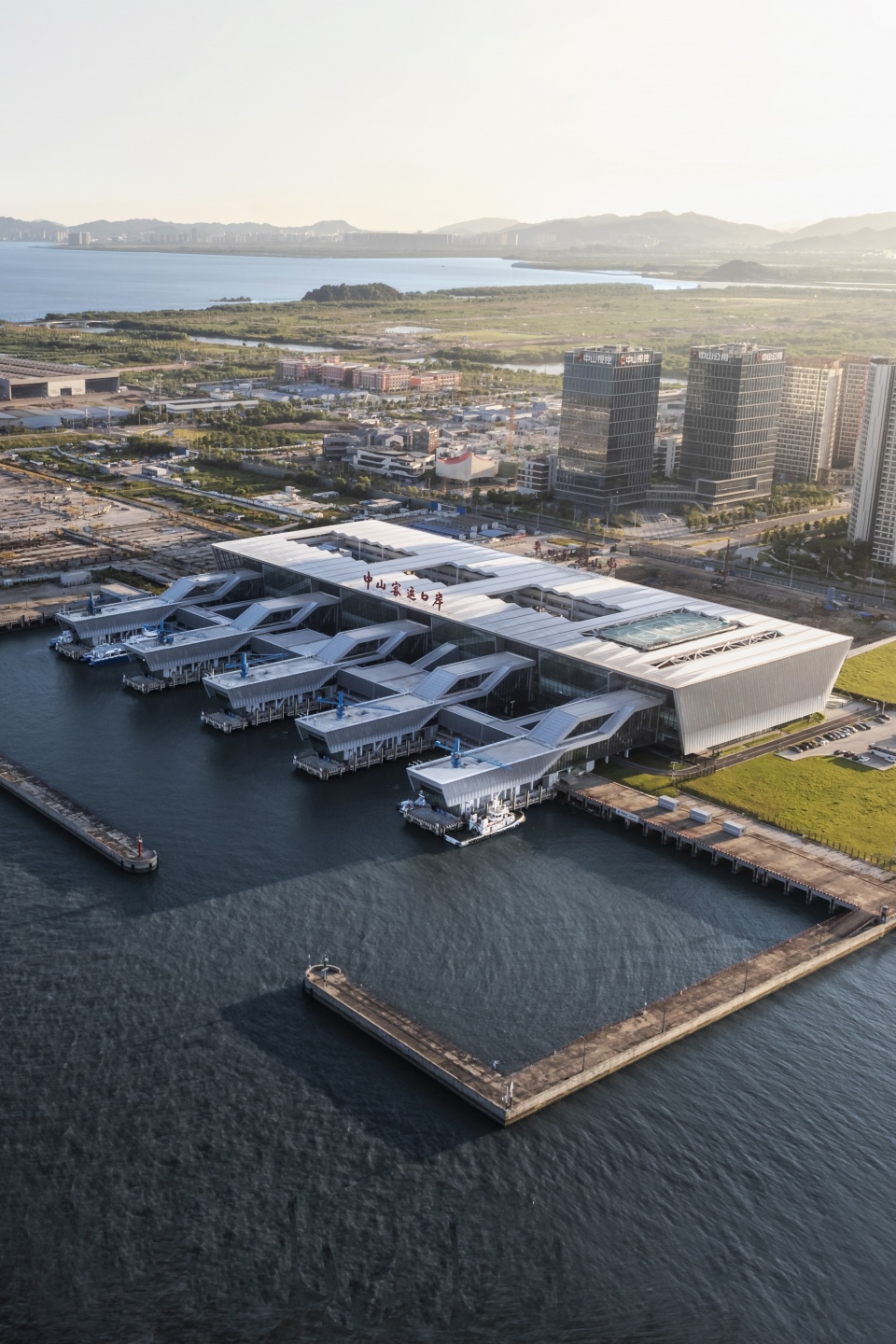
中山客运口岸,作为综合体中率先竣工的地标单体,设计以富有表现力的形象,被誉为“水上版深中通道”,正承载着城市对未来的全新期待。
As the landmark structure completed first within the complex, the Zhongshan Passenger Port features an expressive design and has been acclaimed as a “Shenzhen–Zhongshan Link”on water, carrying the city’s brand new aspiration for the future.
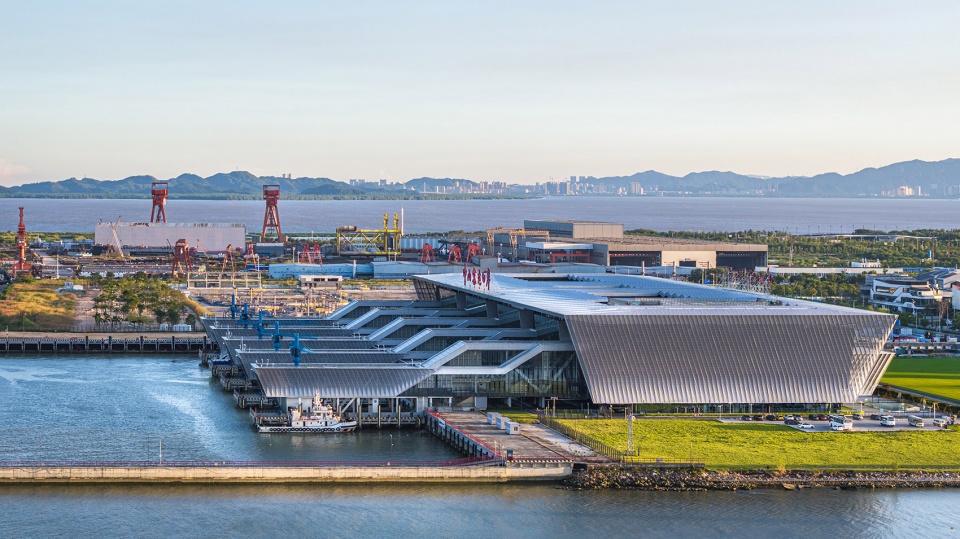
▼联检大楼,Joint Inspection Building
01 规划Planning
湾区的联动Collaboration in the Greater Bay Area
项目位于粤港澳大湾区的交通中枢点马鞍岛,距深中通道出口仅3公里,对外联动出入境,对内链接大湾区城市群,承接中山会展中心的客流,海关、边检、海事、客运、商务局、公安6大系统集约作业。
▼总平面图,Site plan
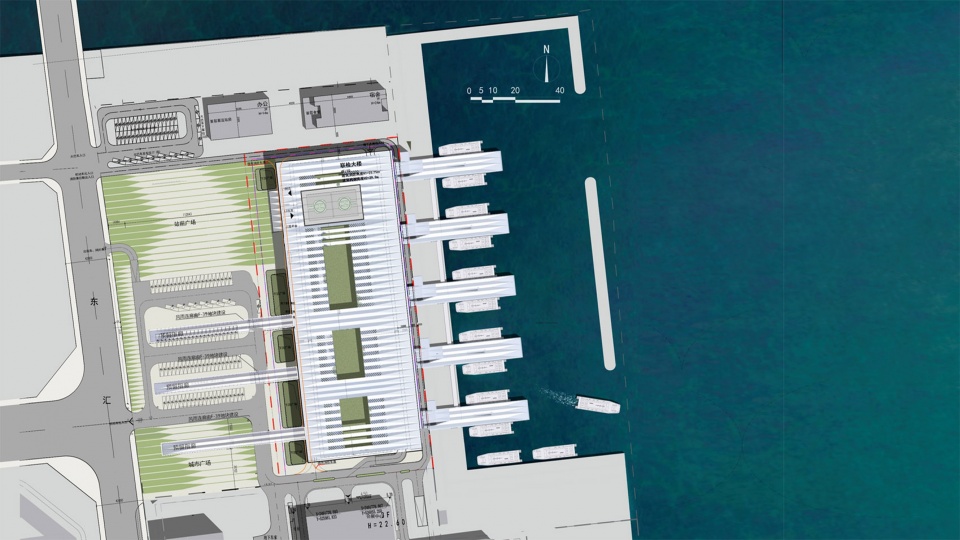
The project is seated on the Ma’an Island, a transport nexus in the Guangdong-Hong Kong-Macao Greater Bay Area, and is only 3 km away from the exit of the Shenzhen-Zhongshan Link. It connects with the outside through entry-exit inspection and quarantine, and links the city cluster in the Greater Bay Area internally. It accommodates the passenger flow from Zhongshan Convention and Exhibition Center, and serves as an integrated operations platform for customs, border inspection, maritime affairs, passenger transportation, commerce bureau, and public security.
▼东侧鸟瞰,Ariel View from East Side
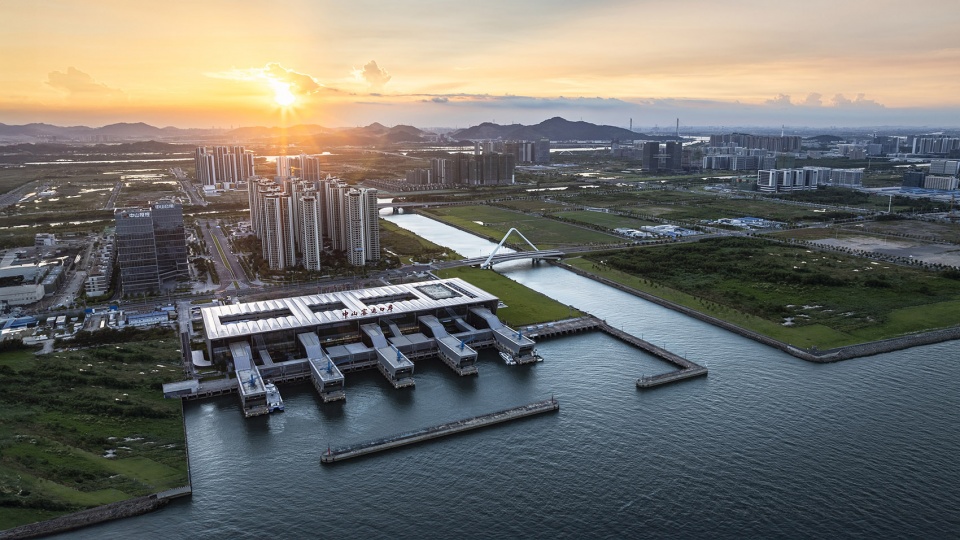
基于土地资源的紧张,旅检区在设计上采用立体叠层、高效集约、人车分离、出入分层、动线融合等方式,极大地提升通关效率。同时,设计将出境旅客引导至三层侯船大厅侯船,可在此欣赏海景及屋顶庭院景观,打造自然舒适的出行体验。
Given the limited land resources, the passenger inspection area adopts a three-dimensional layered design featuring high efficiency, streamlined separation of pedestrians and vehicles, tiered entry and exit routes, and integrated circulation paths, which significantly enhances the clearance efficiency. Meanwhile, the design guides departing passengers to the third-floor waiting hall where they may enjoy a sea view and rooftop garden scenery, thus creating a natural and comfortable travel experience.
▼建筑立面概览,Overview of the Elevation
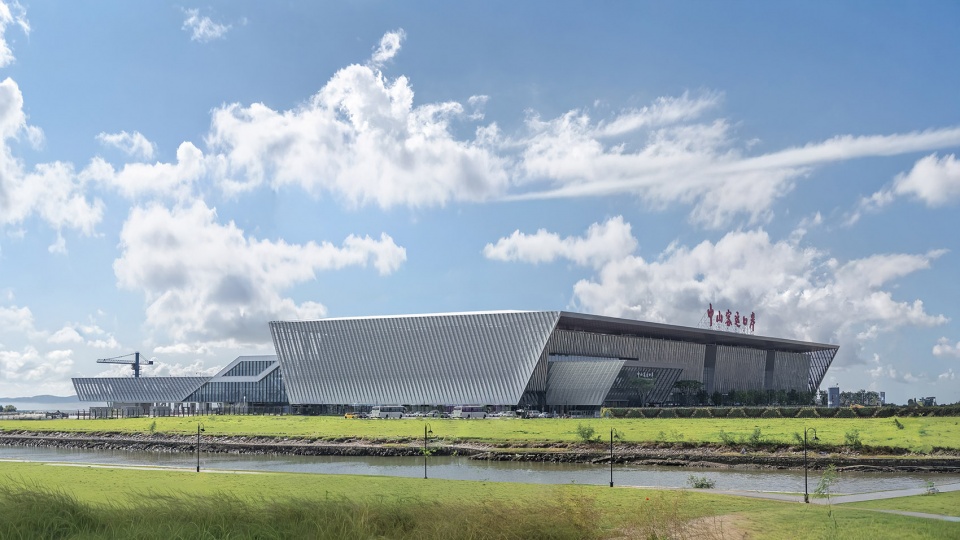
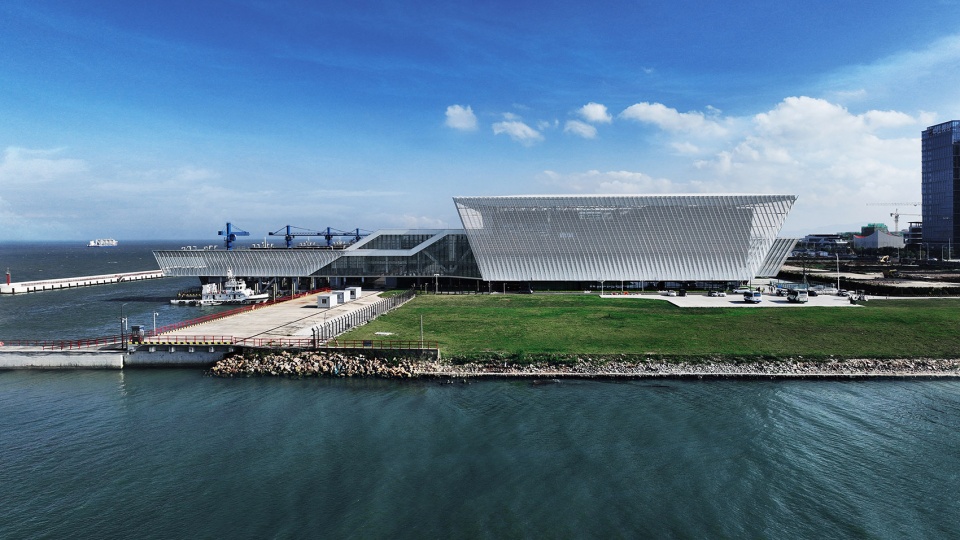
在功能规划上,华阳国际基于过往口岸建筑的设计经验,综合各方需求,设计和谐均衡的空间,同时注重空间灵活使用。
▼设计概念手稿,Sketch
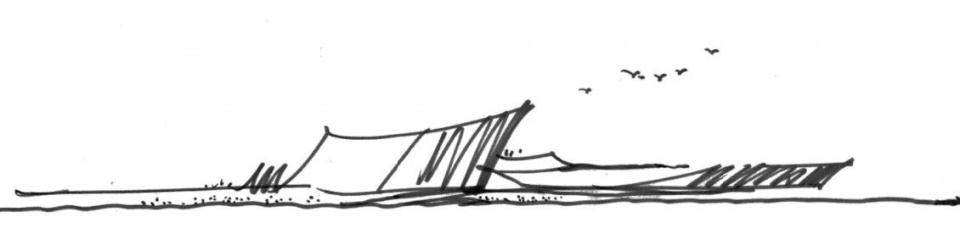
In terms of functional planning, CAPOL leverages its prior experience in port building design to create harmoniously-balanced spaces that give overall consideration for diverse needs while emphasizing spatial flexibility.
▼设计上采用立体叠层,Three-dimensional layered design
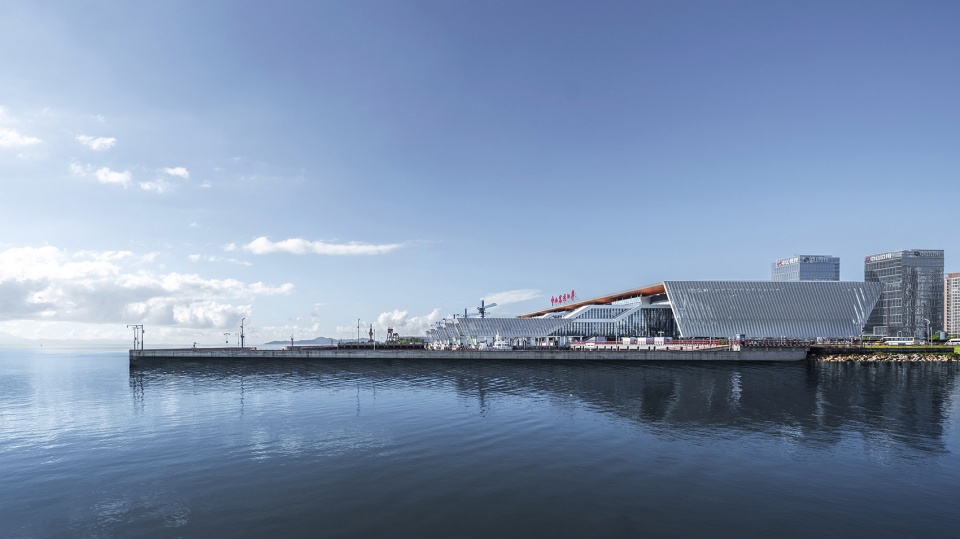
在与会展中心的交通串联上,除首层地面以广场相连外,地下一层亦结合下沉广场预留、会展中心及公交枢纽地块的人行接驳,打造未来海陆交通的“超级连接”。
Regarding connectivity with the convention center, beyond the ground-level linkage by square, the basement level incorporates the preservation for sinking squares and the pedestrian corridors connecting to both the convention center and public transport hubs, forging a “super link” for future land and sea transportation.
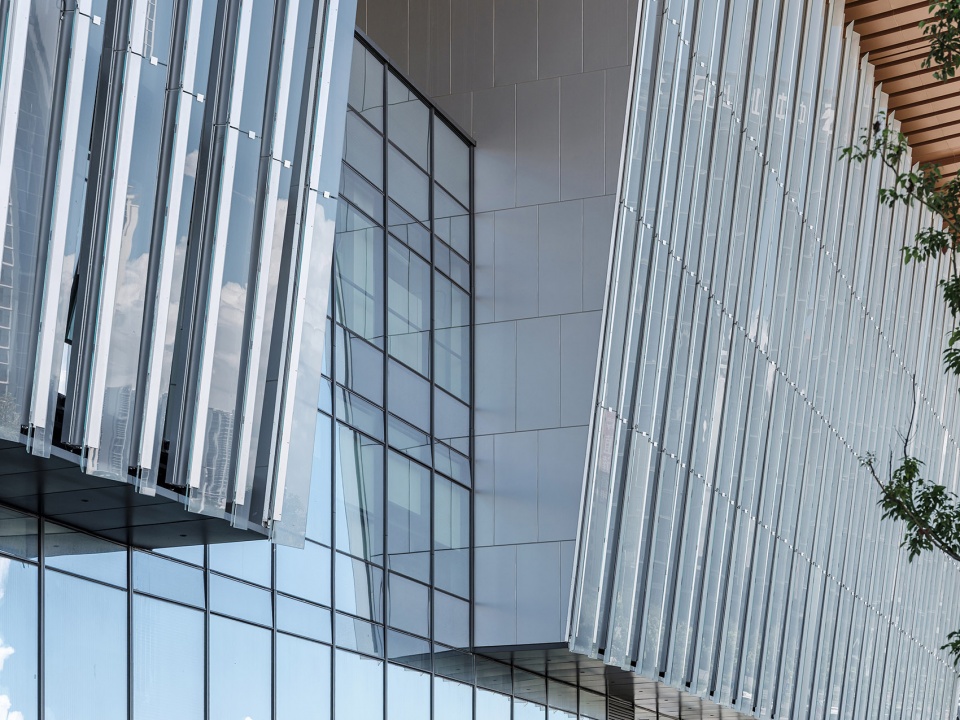
▼立面玻璃幕墙系统,Facade Glass system
02 形象 Image
龙舟的动势Dynamic Dragon Boat
作为城市门户,建筑形态取自城市文脉,又寄予城市厚望。龙舟,作为岭南民俗元素,本是传统水路交通工具,与码头及联检楼属性关联。
As an urban gateway, the architectural form draws inspiration from the city’s cultural context while embodying its aspiration. Dragon boat, a quintessential Lingnan-style folk element, originally serves as a means of traditional water transportation and inherently connects with the attributes of port and joint inspection building.
▼建筑形态以龙舟为概念,Design concept of dragon boat
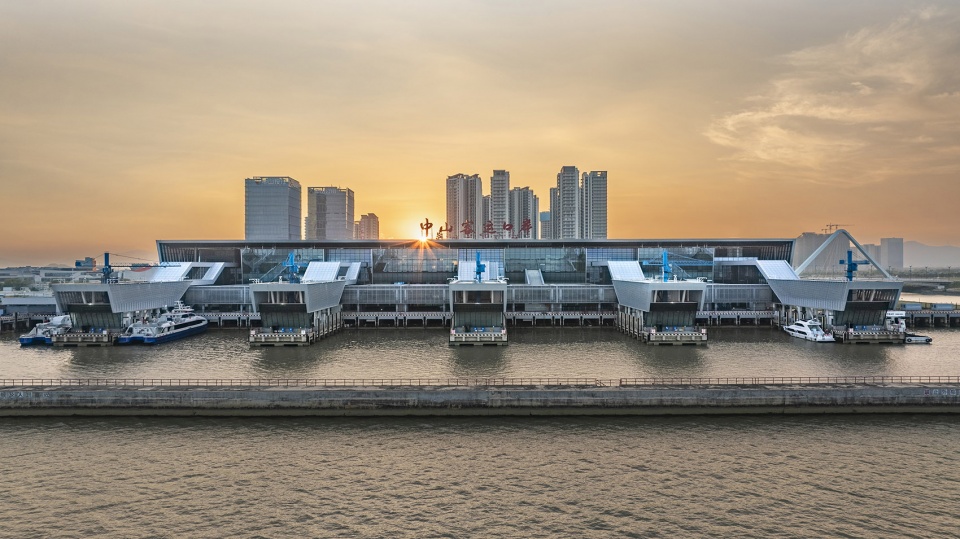
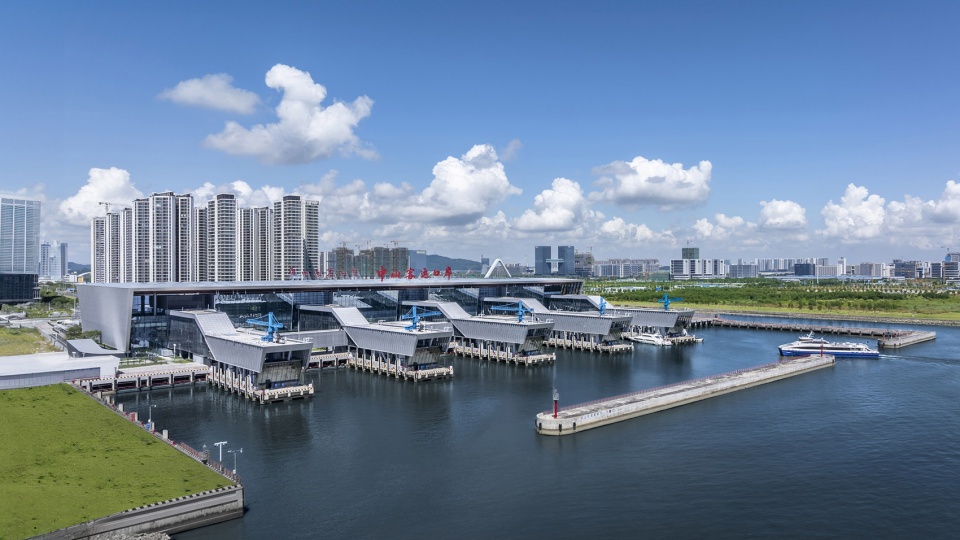
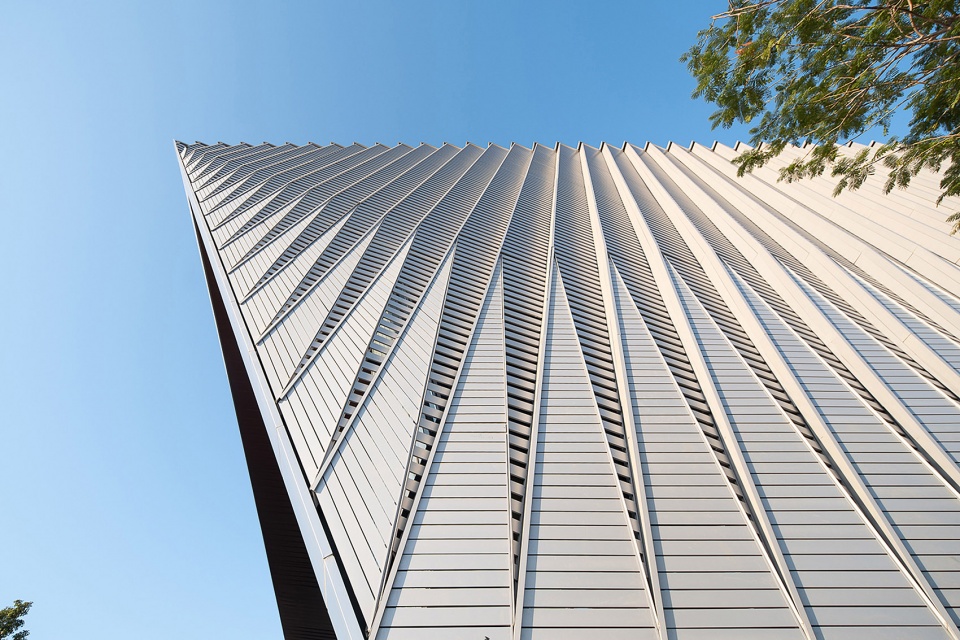
项目形态以龙舟为概念,提取百舸争流之势,以倾斜的形体、舒展的码头指廊、线性的立面构成,表现枢纽建筑的动感与速度,在不同角度呈现富有张力的视觉体验。立面设计,同样从龙舟整齐划一的船桨提取灵感,一方面塑造富有韵律的肌理效果,另一方面斜向的形态进一步强化建筑的张力。
The project takes the design concept of dragon boat, capturing the dynamic momentum of racing boats. Through tilted geometry, expansive port corridor, and linear facade composition, it expresses a vivid sense of motion and speed of hub building, delivering a visually-striking experience from multiple perspectives. The facade design is also inspired by the synchronized oars when rowing a dragon boat, thus achieving a rhythmic textural effect while amplifying the architectural dynamism by tilted forms.
▼东南侧鸟瞰,Ariel View from Southeast Side
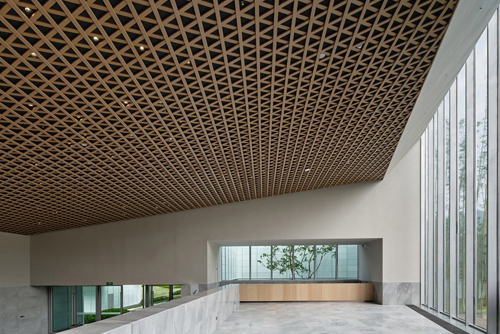
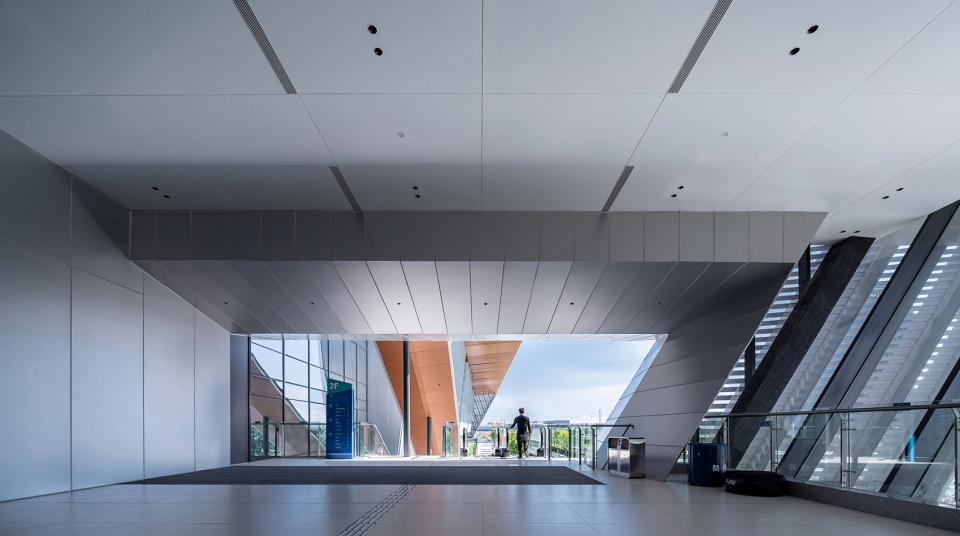
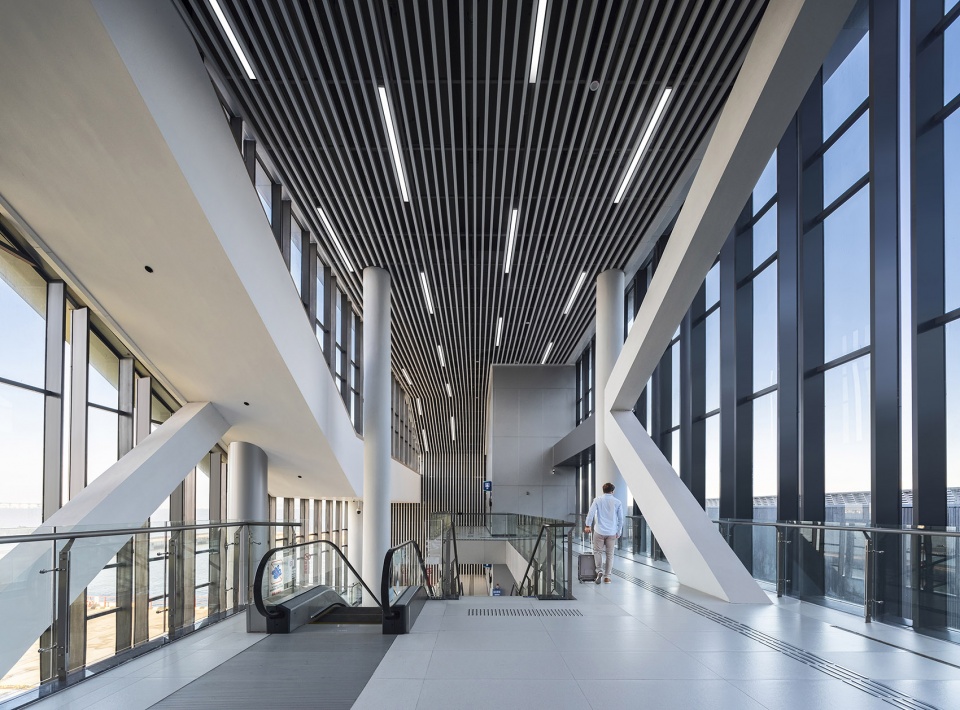
室内设计,延续主体建筑三角及线性几何设计语言,与建筑形态及立面肌理构成一体化感官体验,完成室内外视觉感受的自然过渡。
The interior design extends the triangular, linear and geometric design language of the main structure, creating a cohesive sensory experience that harmonizes with the building’s form and facade texture, thus ensuring a natural visual transition between indoor and outdoor spaces.
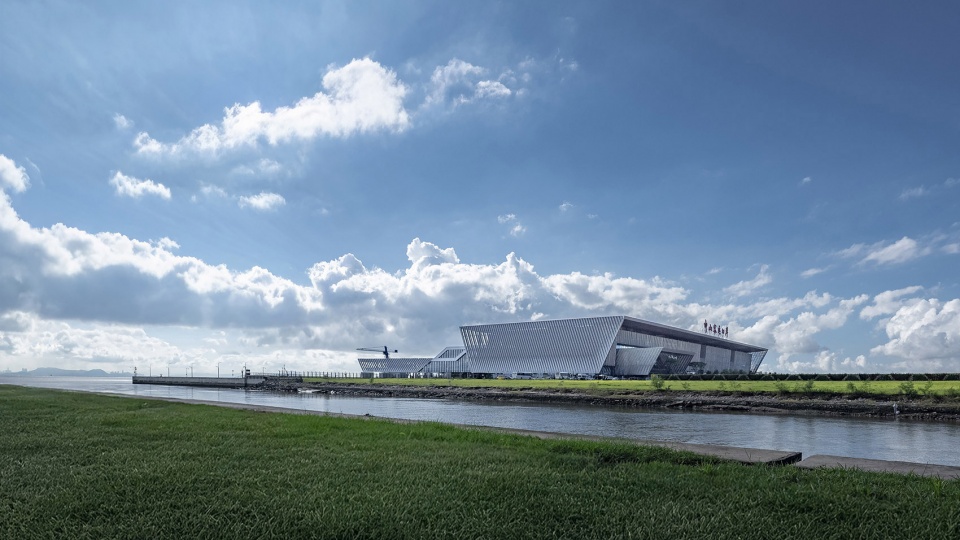
▼西北侧景观与建筑,Perspective View from Northwest Side
03 场所 Space
有温度的体验Human-Centric Experience
在口岸建筑的设计经验中,华阳国际一直希望用设计打破交通建筑的冰冷感。在这一项目中,设计整合多种生态策略,打造有温度与生命力的场所。
In designing port building, CAPOL has consistently sought to dissolve the
ice-cold sense of transportation buildings. For this project, the design integrates ecological strategies to create human-centric spaces.
▼城市广场,City Square
景观设计上,引入了景观广场、下沉庭院以及穿插在其中的空中花园和建筑顶部开放的内庭院,增添交通建筑的层次感与呼吸感,创造丰富多样的行进路径、驻足空间及游弋体验。
The landscape design introduces landscape squares, sinking courtyards, interconnected sky gardens, and rooftop inner courtyards, to create the transportation building’s sense of layering and breathing while fostering diverse circulation paths, stopover spaces and exploratory experiences.
▼西侧主入口广场,Main Entrance Square on West Side
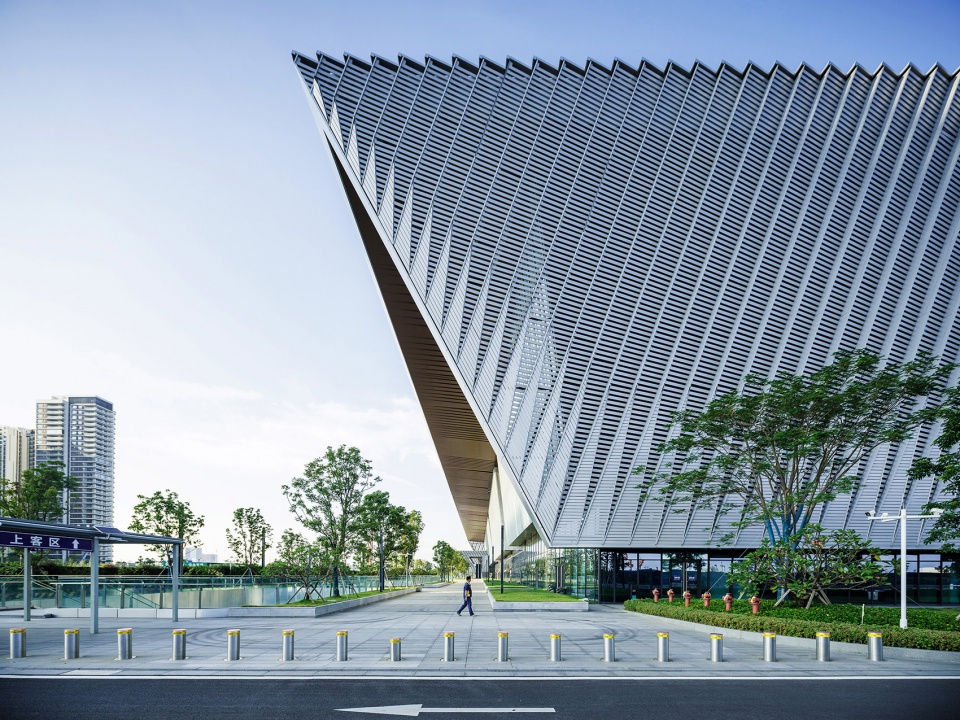
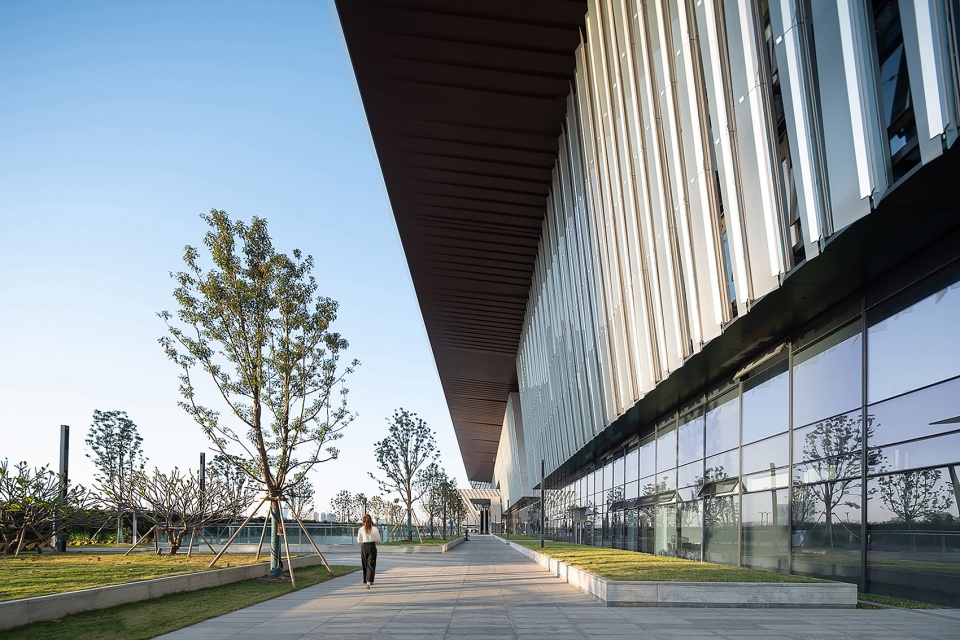
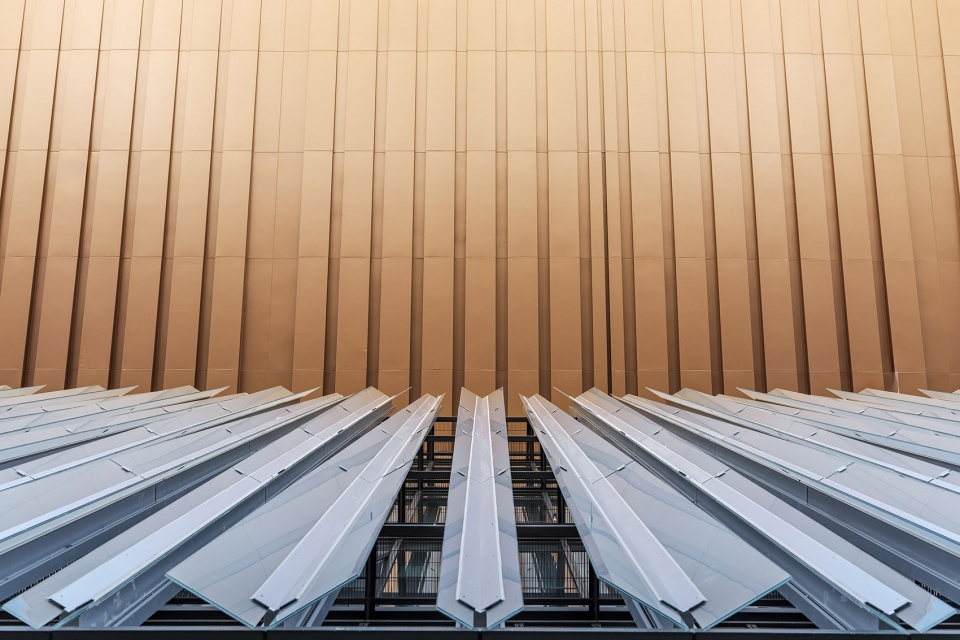
外墙设计上,立面与屋顶一体化设计,强化建筑整体形象。同时,根据朝向及功能适当引入外遮阳格栅,提升维护结构性能减少建筑能耗;格栅所呈现的半通透肌理亦使得立面视觉效果更为丰富。
The design of external wall employs a unified roof and facade, reinforcing the building’s overall image. Appropriate external sunshades are introduced according to the orientation and function to enhance the performance of the maintenance structure and reduce the building’s energy consumption. The semi-transparent texture of these sunshades also enriches the facade’s visual effect.
▼室内出发大厅,Indoor Departure Hall
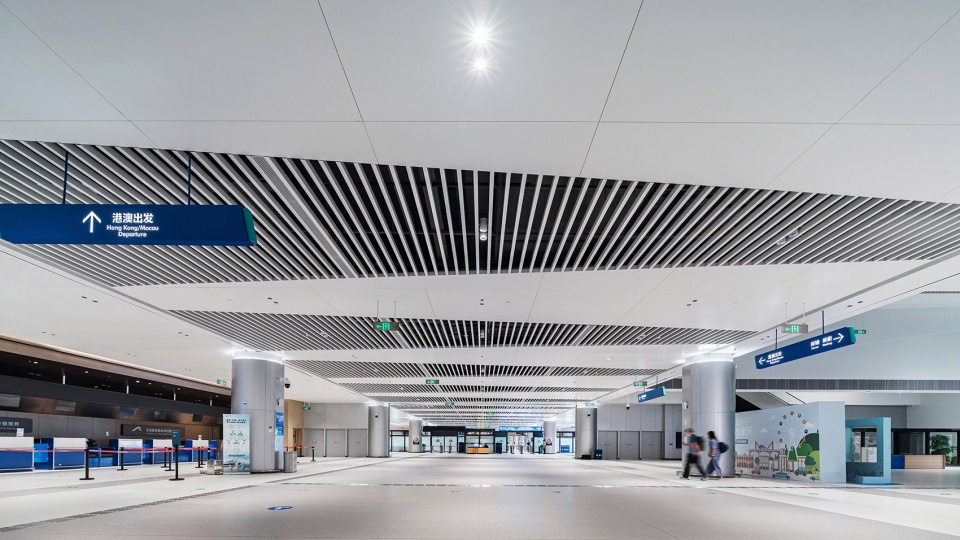
色彩运用上,设计巧妙加入暖铜色材料作为屋顶吊顶,与龙舟制作原材料相呼应,打破交通建筑一贯的黑白灰色调,赋予建筑温馨与活力。海岸的人行廊道,同样采用暖色材料,与建筑吊顶相得益彰。
In terms of color application, the design skillfully incorporates warm copper-colored materials for the roof ceiling to echo the raw materials used in the construction of a dragon boat, which breaks the usual black-and-white color scheme of transportation buildings and gives the building a sense of warmth and vitality. The pedestrian walkways along the coast also employ warm-colored materials, complementing the ceilings of the building.
▼室内空间,Interior Space
中山客运口岸,是华阳国际继莲塘口岸、皇岗口岸新建工程、海口二线口岸之后又一口岸力作。从陆路到海路,华阳国际持续为城市建设发力。
The Zhongshan Passenger Port is another significant project designed by CAPOL after the Liantang Port project, Huanggang Port Expansion Project, and the Haikou Second-Line Port project. From land transportation to maritime transportation, CAPOL has been continuously contributing to urban development.
▼立面肌理,Facade Texture
项目档案:
Project Overview:
Project Name: Zhongshan Passenger Port
Type: Public Works
Location: Zhongshan, Guangdong
Site Area: 41,194.8㎡
Gross Floor Area: 110,694.8㎡
Time of Design: 2021-2024
Time of Completion: 2024
Construction Unit: Zhongshan Shum Yip Wansheng Investment Co., Ltd. (VANKE, and Shum Yip Group)
Design Unit: CAPOL International & Associates Group
Scope of Service: Schematic Design / Architectural Design / Preliminary Design / Construction Drawing / Interior Design
Members of Schematic Design Team: Liang Cuijian, Sun Zhihao, Zhang Shiquan,Lin Yutao, Long Xiaohua, Liu Denghua, You Lingxuan,He Yuanxi
Members of Architectural Design Team: Zhang Shengqiang, Liu Gang, Li Zefeng, Zhang Enkuan, Yang Jinyi, Bi Qinbin, Ning Qiuyan
Members of Site Design Team: Li Yong, Chen Hui
Members of Structural Design Team: Lu Qiufeng, Zhu Zehua, Xiao Faping, Zhang Bo, He Yehai
Members of HVAC Design Team: Li Bin, Cheng Bingbing, Zhang Guanwei, Wu Dingling
Members of Water Supply & Drainage Design Team: Liu Yi, Luo Zhuofeng, Leng Zhichao, Zhang Bingdi, Chen Fuchun
Members of Electrical Design Team: Zhang Dingyun, Wang Bingke, Lin Haifeng, Zang Qi, Wen Yilian, Xu Qinglan
Members of Interior Design Team: Zhou Yi, Shi Jun, Zhu Zuolin, Zhang Ruiqi, Li Dongcheng
Building Photos: Lin Jie