圣诞节的坏习惯,捷克 / Kateřina Šedá + Peer Collective
来自 Peer Collective 的建筑师与艺术家 Kateřina Šedá 正在重塑布尔诺市中心传统圣诞市集的概念——创造一个关于宁静、分享与自我反思的场所。
Architects from Peer Collective and artist Kateřina Šedá are transforming the idea of the traditional Christmas market in the centre of Brno – creating a place for calm, sharing, and self-reflection.
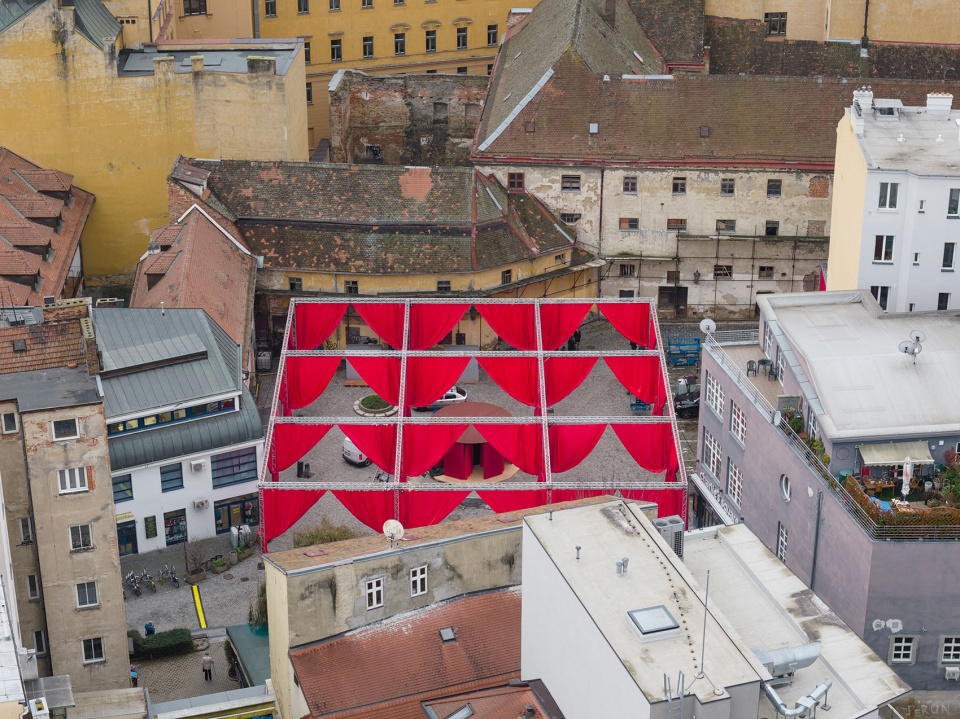
▼项目鸟瞰,Aerial view of the project
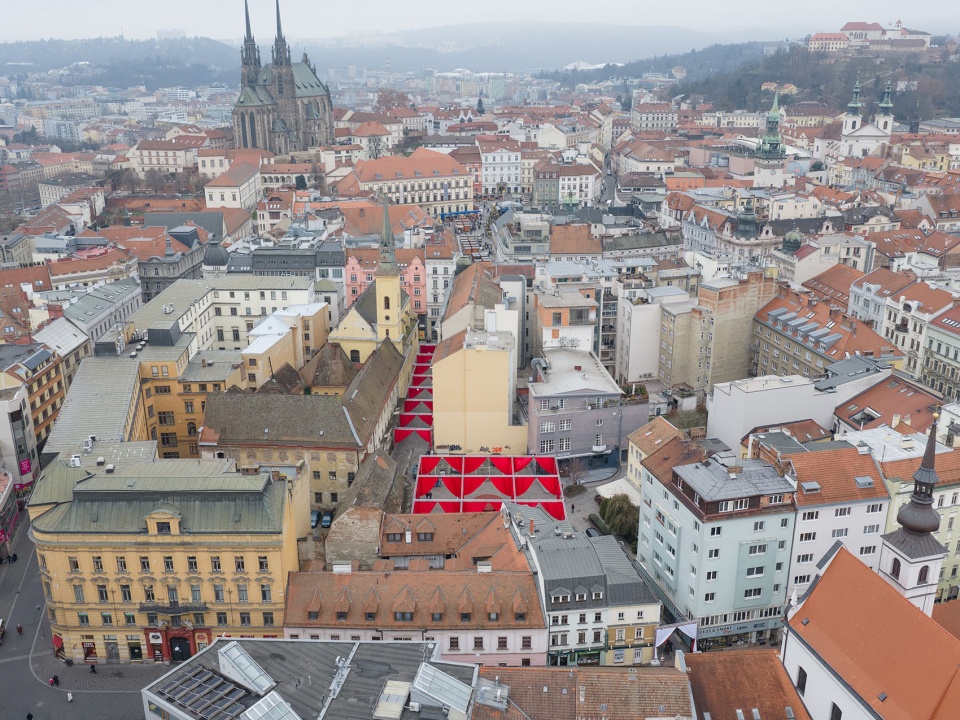
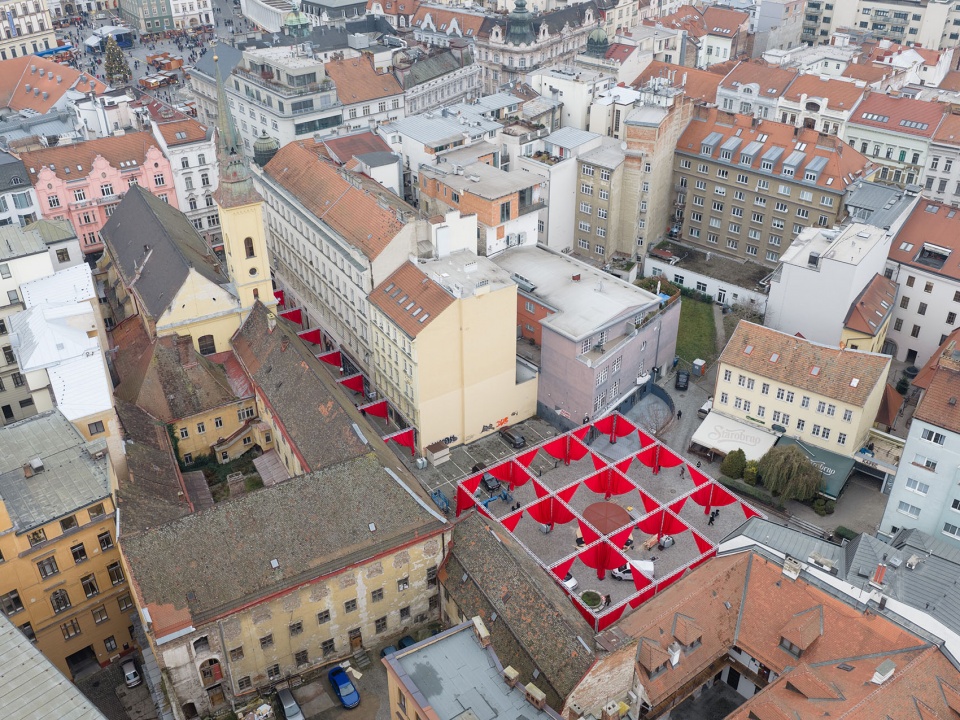
在布尔诺市中心,距离热闹的马萨里科瓦大街仅数步之遥,有一处常常被行人忽视的空间。Římské náměstí(罗马广场)——弗朗齐什坎斯卡街的一段延伸——长期以来一直是城市中被遗忘的角落。然而,今年这里成为一场实验的舞台,这一实验重新思考了我们与圣诞节、以及与城市公共空间之间的关系。“坏习惯的圣诞节”——由艺术家 Kateřina Šedá、建筑事务所 Peer Collective、非营利组织 Renadi 以及布尔诺-中城区政府共同发起的项目——将目光从消费主义主导的圣诞市集转移开来,转而引导人们更深入地体验城市,也审视自我。
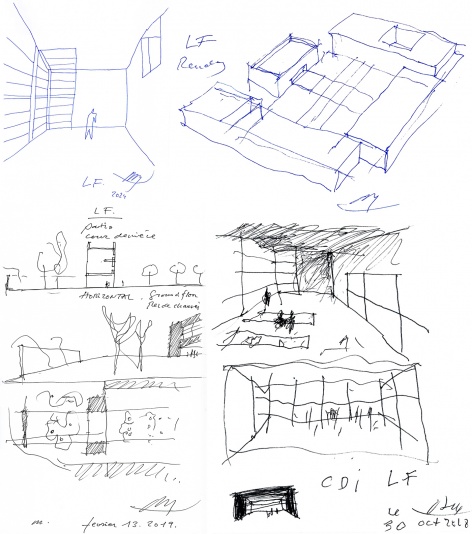
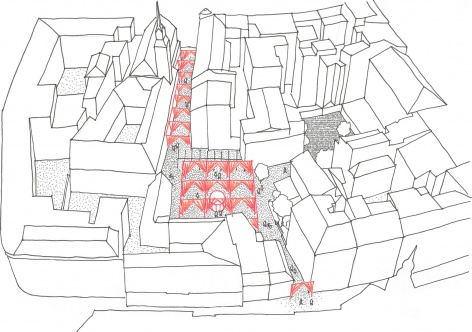
▼场地轴测草图图,Site axonometric sketch
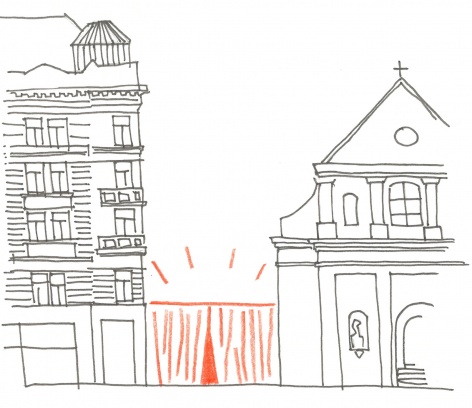
▼幕布效果草图图,Curtain sketch
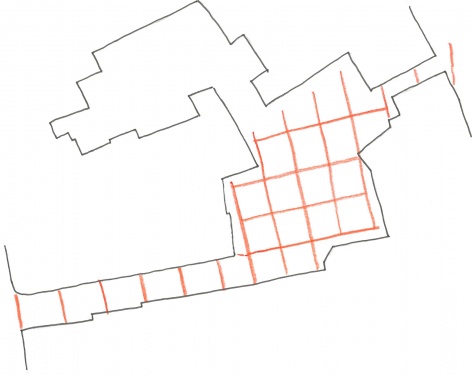
▼框架排布草图图,Framework layout
In the very heart of Brno, just a few steps from the bustling Masarykova Street, lies a space most passersby usually overlook. Římské náměstí (Roman Square) – an extended section of Františkánská Street – has long been a neglected corner of the city. This year, however, it has become the stage for an experiment that reconsiders our relationship to both the Christmas season and urban public space. The Christmas Festival of Bad Habits – a joint project by artist Kateřina Šedá, the architectural studio Peer Collective, the organization Renadi, and the Brno-střed Municipal District – turns attention away from the consumerist tradition of Christmas markets toward a deeper experience of the city and of oneself.
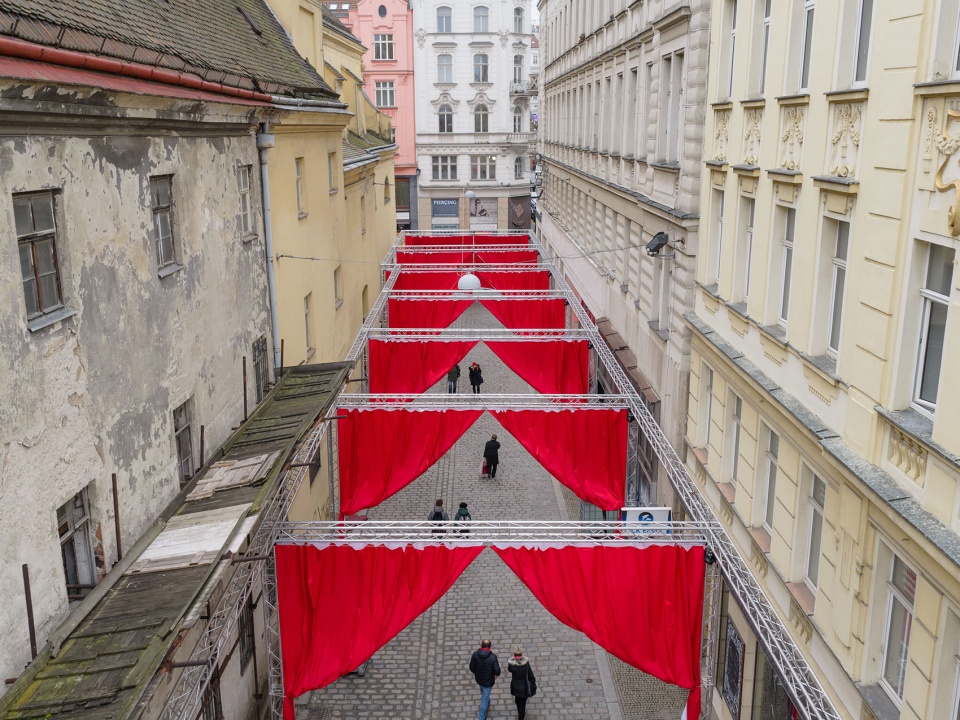
▼街道与广场,Streets and squares
通往自我反思之路Path to Self-Reflection
该项目源自非营利组织 Renadi 的一项倡议。长期以来,Renadi 致力于在节日期间营造一个让社会边缘人群也能感到安全的环境。项目试图打造一个宁静、清醒、无酒精、无经济压力的空间,为传统、往往充满消费色彩的圣诞节提供另一种可能。Renadi 与布尔诺-中城区合作,邀请了以重建人与人之间关系为创作核心的艺术家 Kateřina Šedá。Kateřina 提出将这一初衷与她长期进行的项目《坏习惯国家档案》相结合,创造一个对所有人开放的公共广场。其核心母题是一段通往自我转变的旅程,发生在广场中央的“忏悔室”之中。她邀请 Peer Collective 的建筑师参与合作,最终形成了一个将传统圣诞市集转化为一种更为平静、专注的城市体验方式的项目。
▼模型,Model
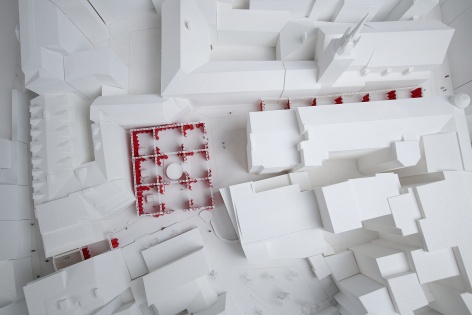
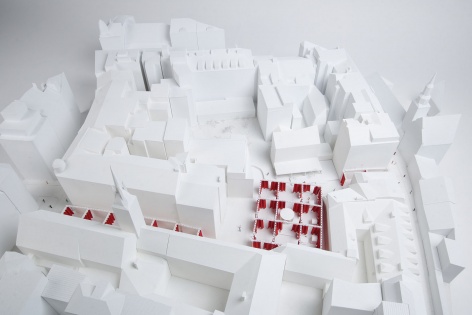
The project originated from an initiative by the non-profit organization Renadi, which has long sought to create an environment where even people on the margins of society can feel safe during the holidays. It seeks to create a peaceful, sober place without alcohol and financial pressure, offering an alternative to the traditional, often consumerist notion of Christmas. In cooperation with the Brno-střed District, Renadi invited Kateřina Šedá, whose work focuses on building new relationships between people. Kateřina came up with the idea of combining this intention with The National Collection of Bad Habits project, on which she had been working for a long time, in order to create a square accessible to everyone. The main motif was to be a person’s journey toward self-transformation, which takes place in the middle of the square – in a confessional. She invited architects from Peer Collective to collaborate, and the result is a project that transforms the classic Christmas market into a way to experience the city in a calmer and more concentrated way.
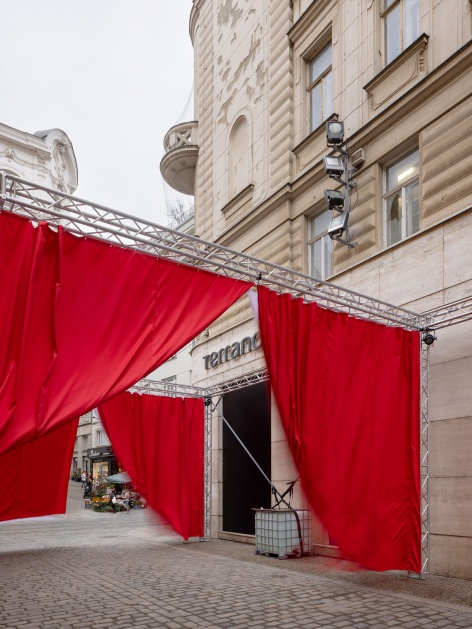
▼白天街道内的布置,Daytime street layout
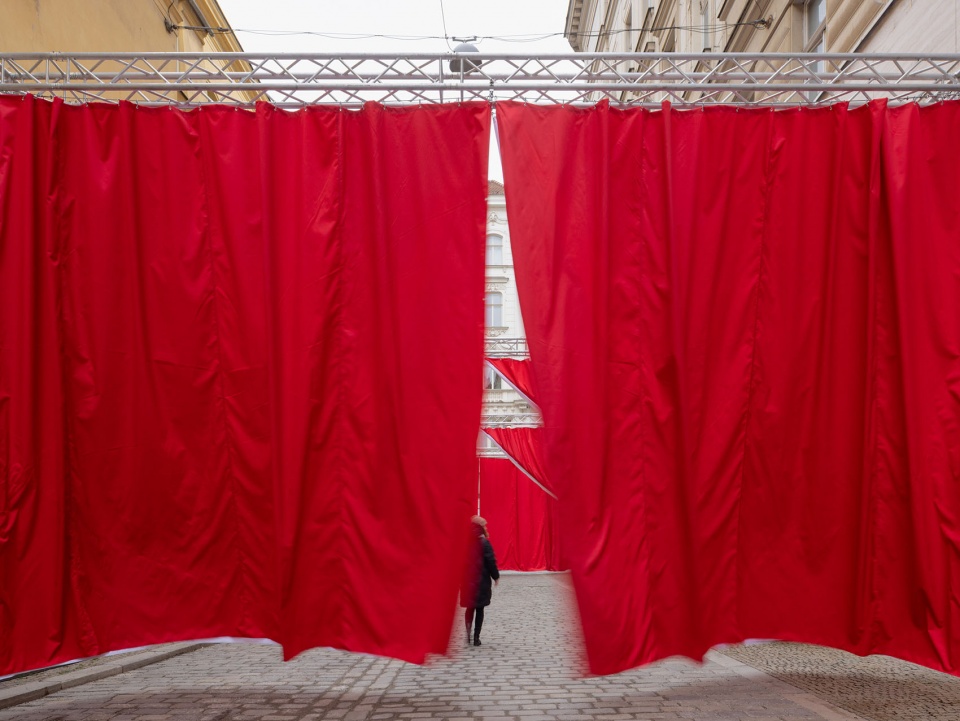
▼室内布置,Interior layout
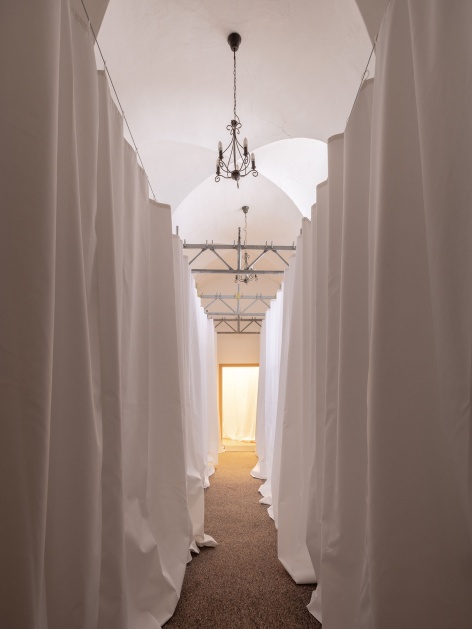
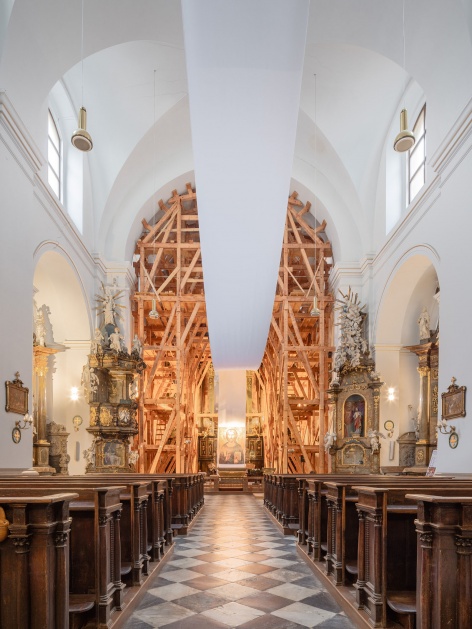
项目的核心理念源于一次简单却深刻的视角转换——整个罗马广场上的节庆被构想为一段自我反思的旅程。访客在行走过程中,逐步经历一系列映照日常习惯的情境。这些内容基于 Kateřina Šedá 长期开展的《坏习惯国家档案》项目,该项目系统梳理了捷克社会中的行为习惯与弱点。这一路径鼓励人们直面并命名自身的坏习惯,将其与他人的经历进行对照,并在象征性的“忏悔室”中将其放下。原本针对特定群体的初衷,逐渐发展为一个向所有人敞开的概念——无论是正面临某种困扰的人,还是仅仅希望抽出片刻直面自我的人。
The core idea is based on a simple shift of perspective – the entire festival on Římské náměstí (Roman Square) is conceived as a journey of self-reflection. Visitors gradually pass through situations that hold up a mirror to their everyday habits. These are built on the long-term project The National Collection of Bad Habits, in which Kateřina Šedá broadly maps Czech customs and weaknesses. The route is designed to encourage people to name their own bad habits, compare them with the experiences of others, and symbolically lay them aside in the “confessional” object. What began as a narrowly focused intention has thus become a concept open to everyone. To people struggling with any form of weakness, as well as those who simply want to take a moment to confront their own bad habits.
▼广场的布置,Squares layout
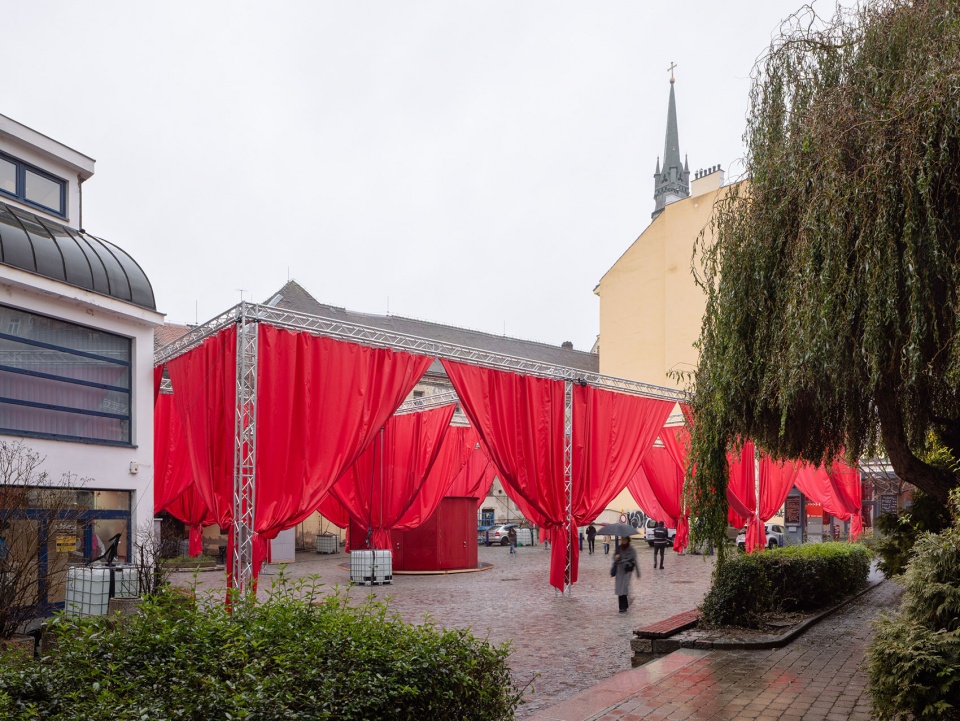
公共空间的可变性Variability of Public Space
Peer Collective 的建筑师以一种极简却富有表现力的空间构成回应了这一主题。他们采用常用于舞台搭建的模块化桁架结构,悬挂起大幅白色与红色织物帘幕。这些帘幕将广场划分为十八个“房间”,形成一系列通道与视线交错的空间序列,访客仿佛在露天环境中穿行于一组私密的室内空间。整个临时帘幕结构覆盖面积达 2,478 平方米,相当于十个网球场的大小,作为一座城市舞台,重新定义了圣诞节在城市中的意义。
Architects from Peer Collective responded to this topic with a minimalist yet expressive spatial composition. Using modular truss structures – commonly used for stage construction – they created a framework from which large-format curtains made of white and red fabric are suspended. The curtains then divide the square into a network of eighteen “rooms” – a sequence of passages and vistas that visitors walk through like a series of intimate interiors under the open sky. The temporary curtain structure – covering a total area of 2,478 m², roughly the size of ten tennis courts – functions as an urban stage redefining the idea of Christmas in the city.
▼为夜晚准备投影的白布,Prepare for projection at night
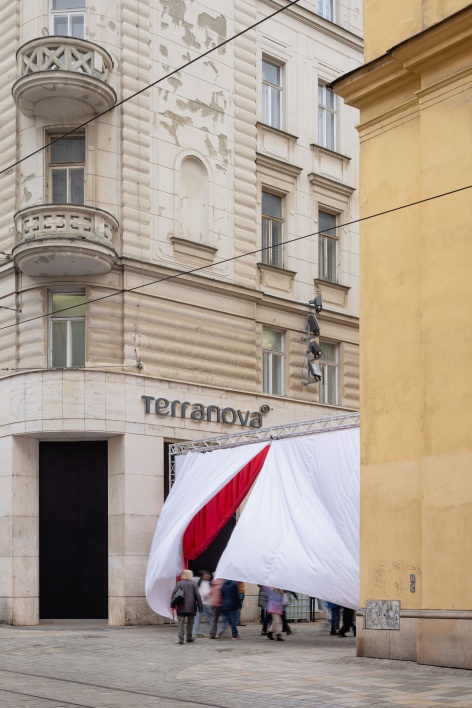
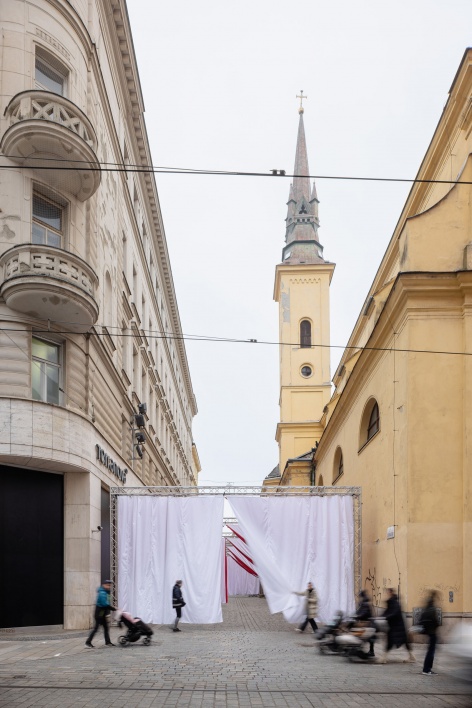
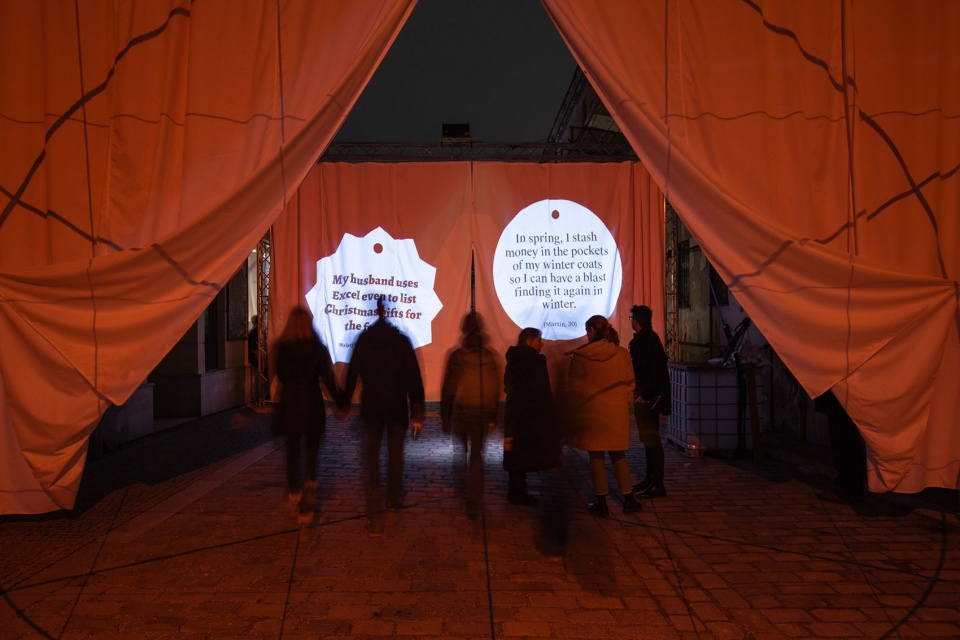
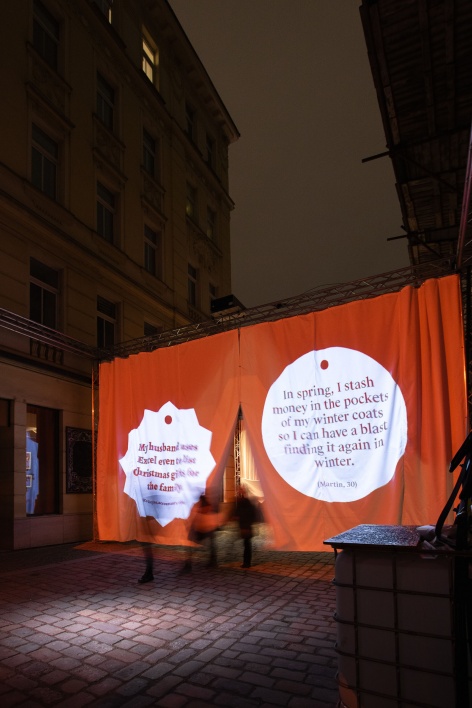
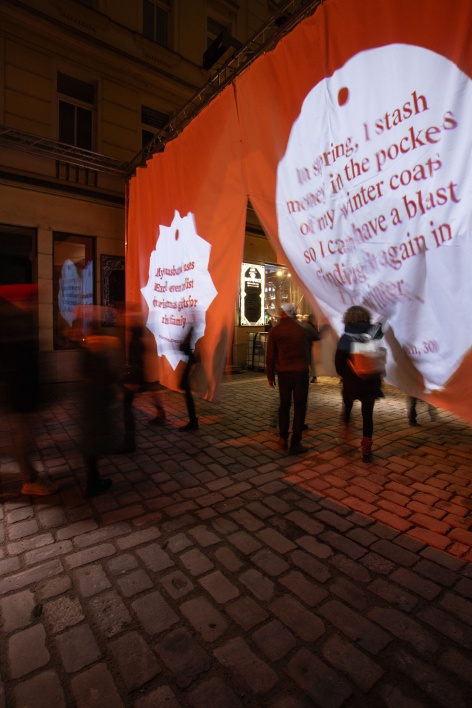
帘幕在隐喻层面象征着需要被跨越的界限,构成一种“柔性建筑”——既允许人们独处,又不脱离城市生活的连续性。夜晚,结构转化为一座露天画廊:《坏习惯国家档案》项目中的文字与证言被投影到白色帘幕之上。在柔和灯光与远处环境音的伴随下,这些影像营造出一种介于公共与私密之间的氛围,在城市中心形成一处亲密的精神空间。
The curtains metaphorically represent barriers that invite us to cross them. They form a kind of soft architecture – a fluid space that allows us to be alone while remaining part of urban life. At night, the structure transforms into an open-air gallery: testimonies from Šedá’s project, The National Collection of Bad Habits, are projected onto the white surfaces. The projections, accompanied by distant ambient sounds and soft light, create an environment on the threshold between the public and the personal – a space of intimacy within the urban centre.
▼夜晚穿越场地的人群,Prepare for projection at night
▼忏悔室”装置,”confessional” object
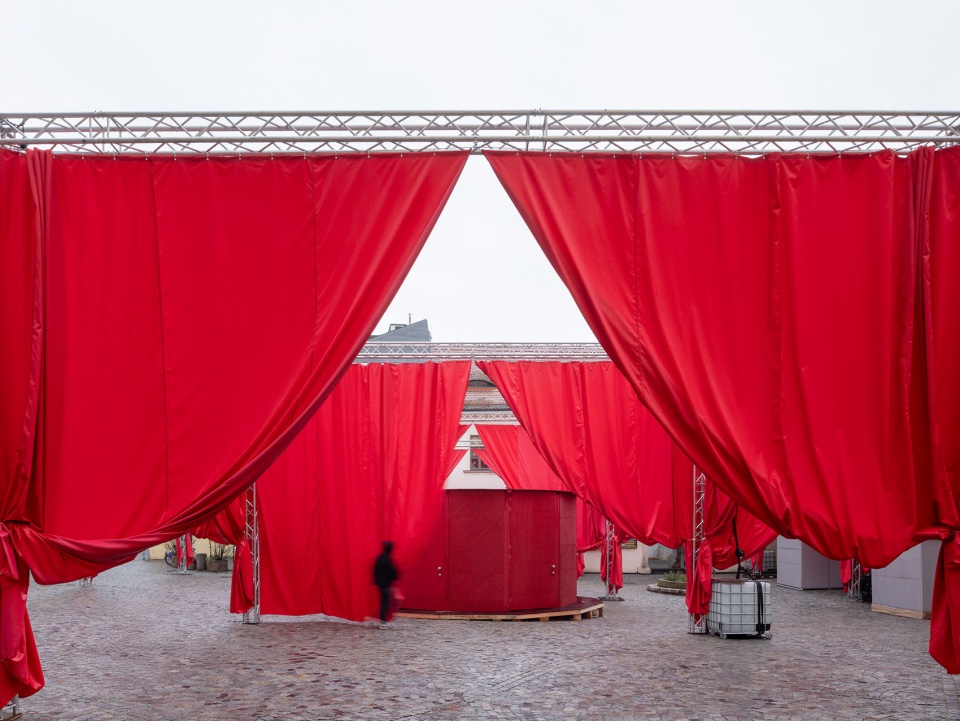
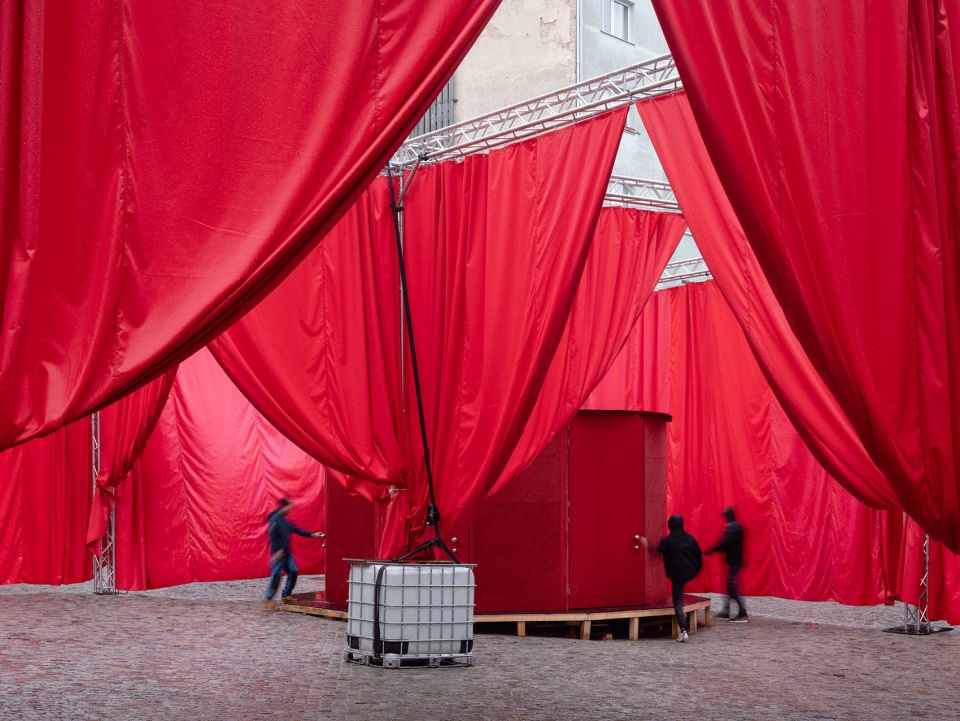
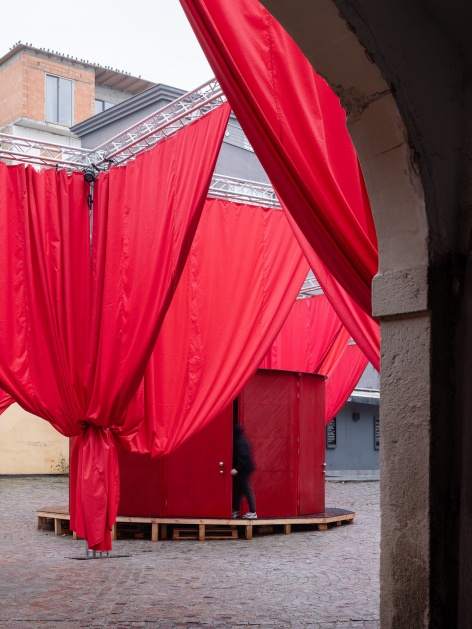
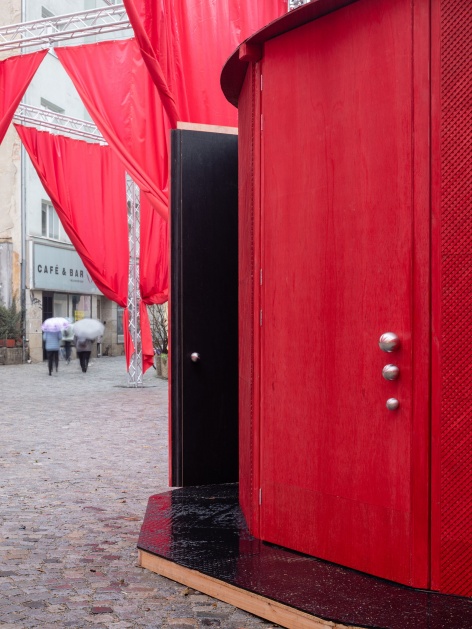
整个节庆的核心是“忏悔室”装置。人们从直面自身坏习惯的旅程,最终抵达这一象征着超越与转化的空间。六个独立的忏悔亭取代了传统市集摊位——人们不再交换商品,而是分享自己的经历、失败与新的开始。互动式视听系统会对访客的输入作出回应,将个人陈述编织成一幅集体肖像,使个体反思转化为共享体验。最终,人们从红色帘幕后方离开——象征着回归那个在片刻之间被安静下来的世界。
The focal point of the entire festival is the “confessional” object. The journey from confronting one’s own bad habits culminates here in a space that offers the opportunity to overcome them. Six separate confession booths replace the classic market stall – instead of exchanging goods, people share their experiences, failures, and fresh starts. An interactive audiovisual system responds to visitors’ input, weaving individual statements into a collective portrait and transforming personal reflection into a shared experience. At the end, visitors return around the back of the red curtains – a symbolic return to the world that, for a moment, has quieted.
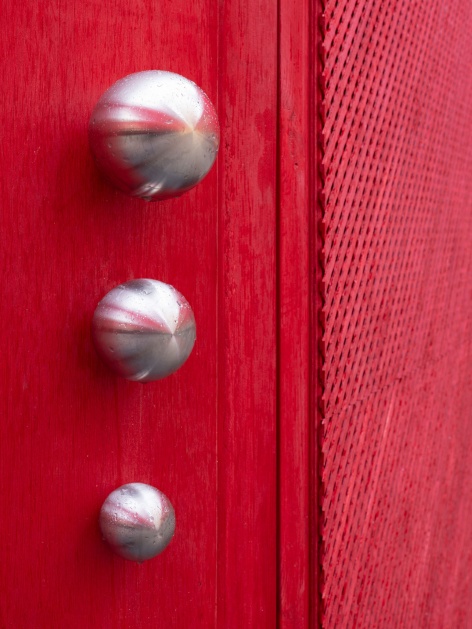
▼忏悔室”细节,”confessional” detail
一座向所有人开放的城市City Accessible to All
“跨越障碍”的主题同样体现在场地的物理改造之中。广场地面通过最小化手段铺设细砾石并进行找平,使其成为无障碍空间,适用于轮椅使用者与推婴儿车的家庭。居民们也在秋季的一场社区活动中参与了空间塑造,在节庆开始之前便自然地建立起参与感。同时,场地内禁止酒精销售,以回应那些不易察觉却真实存在的社会与心理障碍。最终形成的是一个不排斥任何人的空间,让拥有不同经历的人们得以在平等的基础上相遇。
The theme of overcoming barriers is also reflected in the physical adaptation of the site itself. The surface of the square has been leveled with fine gravel using minimal means, making it barrier-free and accessible to all – from wheelchair users to parents with strollers. Residents themselves took part in shaping the space during an autumn community event, creating a natural moment of participation even before the festival began. The sale of alcohol was also banned from the premises, thus responding to less visible barriers – social and psychological ones. The result is a space that excludes no one and allows encounters among people of different experiences on equal terms.
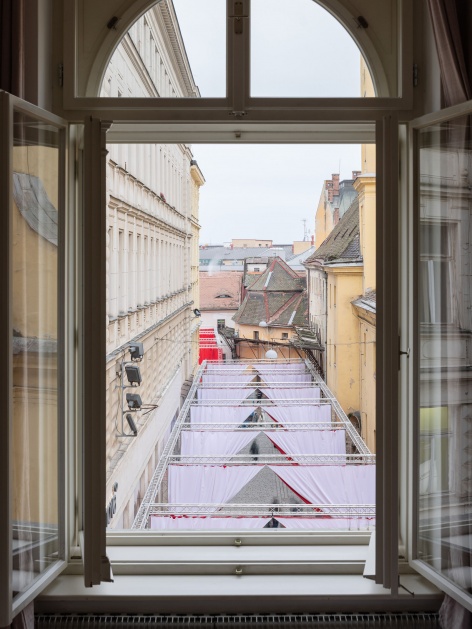
▼从旁边的建筑看向场地,Looking at the site from the nearby building
艺术家 Kateřina Šedá 的长期参与式项目,记录并映射捷克社会中的刻板印象与行为弱点:
Selected quotes from The National Collection of Bad Habits, a long-term participatory project by artist Kateřina Šedá, mapping Czech stereotypes and weaknesses:
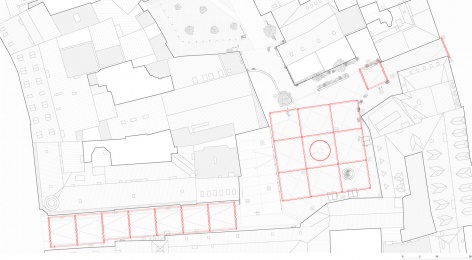
▼项目区位图,site plan
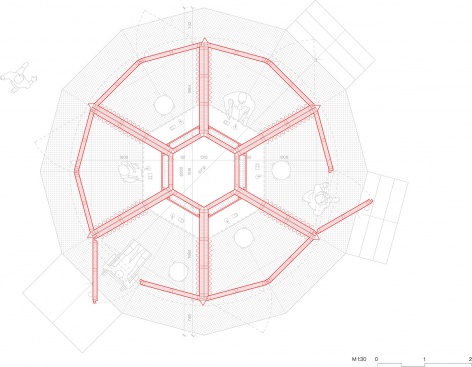
▼忏悔室”平面,”confessional” plan
▼忏悔室”立面,”confessional” elevation
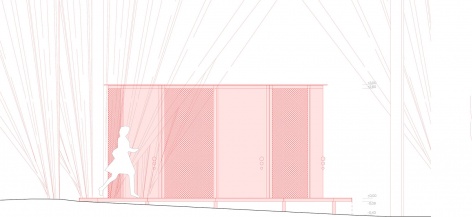
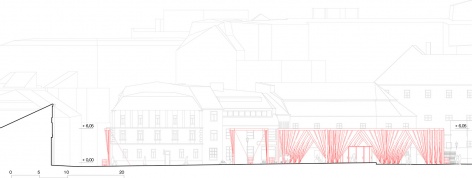
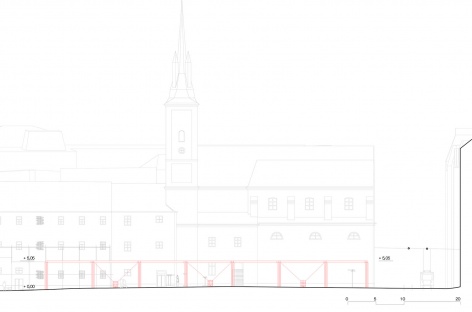
▼剖面图,Section
Studio Architecture: Peer Collective,National Collection of Bad Habits author and art concept: Kateřina Šedá
Author: Daniel Struhařík, Georgi Dimitrov, Ondřej Válek [Peer Collective] Kateřina Šedá
Contact E-mail: gd@peer.archi / katerina.seda@gmail.com
Website: www.peer.archi
www.katerinaseda.cz
Social media www.instagram.com/peer.archi
www.instagram.com/katerinaseda.cz
Studio address: Peer Collective, Štefánikova 104/33, 602 00 Brno, Czech Republic
Design team: Vojtěch Heralecký, Jakub Čevela, Jan Urbášek, Radim Koutný, Monika Matějkovičová, Aneta Báčová
Project location: Římské náměstí, Františkánská ulice, Brno
Project country: Czech Republic
Project year: 2025
Completion year on display: December 9–31, 2025
Built-up area:1784 m²
Client: Brno-střed Municipal District
Client’s e-mail: michal.stastny@brno-stred.cz
Client’s website: www.brno-stred.cz
Project website: www.vanocebrno.cz/en/atrakce/christmas-festival-of-bad-habits
www.sbirkazlozvyku.cz
Photographer:Matej Hakár, www.matejhakar.com, info@matejhakar.com
Night photos: Jan Urbášek [Peer Collective]
Collaborators and suppliers:
Idea initiator: Renadi, www.renadi.cz
Graphic design: Kristína Drinková
Editors: Lucie Faulerová, Petra Konečná
Interactive concept: Zkrat kolektiv, www.zkratkolektiv.com
Production: Martin Ondruš, David Ondra, Lenka Holenda Jirků, Michal Ondráček, Petr Štika, Martina Pokorná, Radim Preuss
Structure contractor: Kletch CZ, www.kletch.cz
Curtain supplier: Kubíček Factory, www.kubicekfactory.com
Contractor of the confessional: Georgi Dimitrov
Projector supplier: Jaroslav Zelina