搭桥之家,北京 / 七巧天工设计
在这套200平米的跃层里,墙是多余的,唯独“看见彼此”不可或缺。房子的女主人是电商创业者,每天要做太多决策,回到家她只想“不用思考”——东西放哪儿、孩子们该在哪儿玩,空间自己会说话。而她的先生,一个心里住着大男孩的程序员,愿望更简单:傍晚西晒阳光进屋的时候,他在厨房忙活,孩子们放学回来,一抬眼就能看见彼此。
In this 200㎡ split-level home, solid partition walls become redundant, with unobstructed sightlines linking family members as the core design priority.The homeowner is an e-commerce entrepreneur overwhelmed by daily decision-making. She longs for a home that frees her from trivial arrangement: storage and kids’ play areas are naturally defined by the layout itself. Her husband, a programmer with a playful inner child, holds a simpler wish: as warm late-afternoon western sunshine streams into the kitchen while he cooks, he can spot their two sons the moment they get home from school.
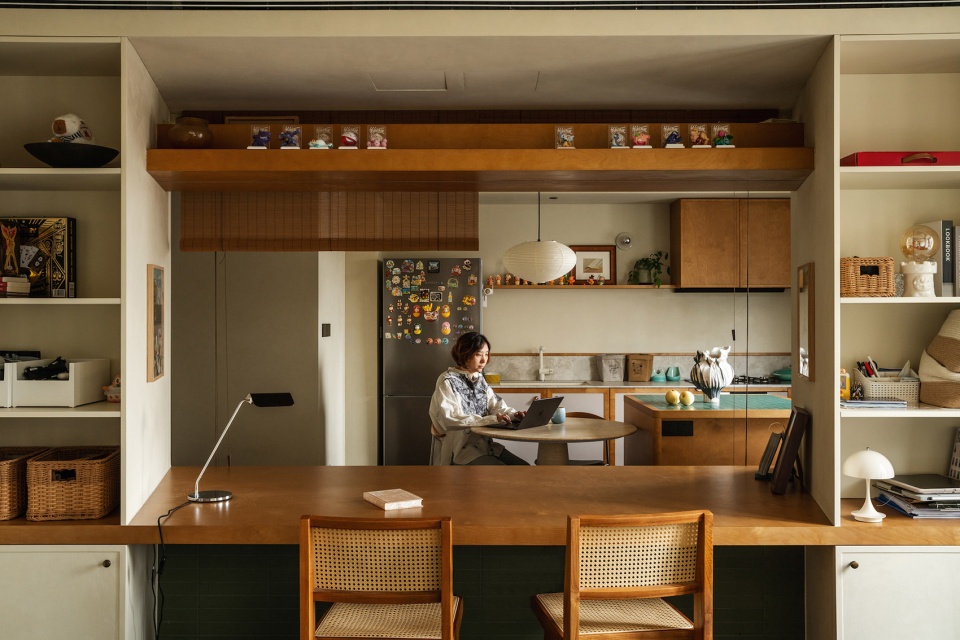
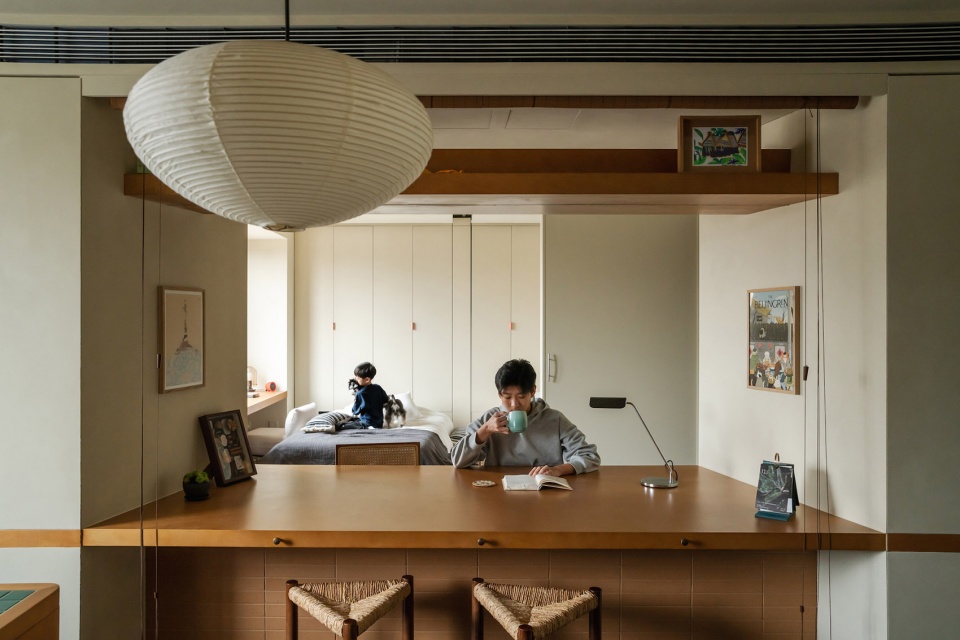
▼餐厅与儿童房的喇叭口视角,Funnel-shaped visual link between dining area and children’s room
这是一场关于“如何让房子变大后,心却不变远”的温暖实验。面对跃层结构带来的垂直分割,设计师没有用墙体划分功能,而是用“搭桥”代替“砌墙”。这道桥,让原本只有一个挑空客厅的南侧空间,生长出丰富的功能。一个空间,被温柔地拆解成七八个可以待得住的地方,却又彼此连通、互相看见。
This project is a heartfelt design experiment: expanding usable floor area without estranging the family emotionally.Instead of erecting solid walls to compartmentalize the vertically split layout, designers built layered structural platforms serving as spatial “bridges”. These structures add diverse functions to the original single double-height south living room, dividing the open area into seven to eight intimate niches that remain visually interconnected.
▼南侧客厅一楼秋千与二楼茶室的交互,
Sight interaction between the first-floor swing and second-floor tea lounge in south living room
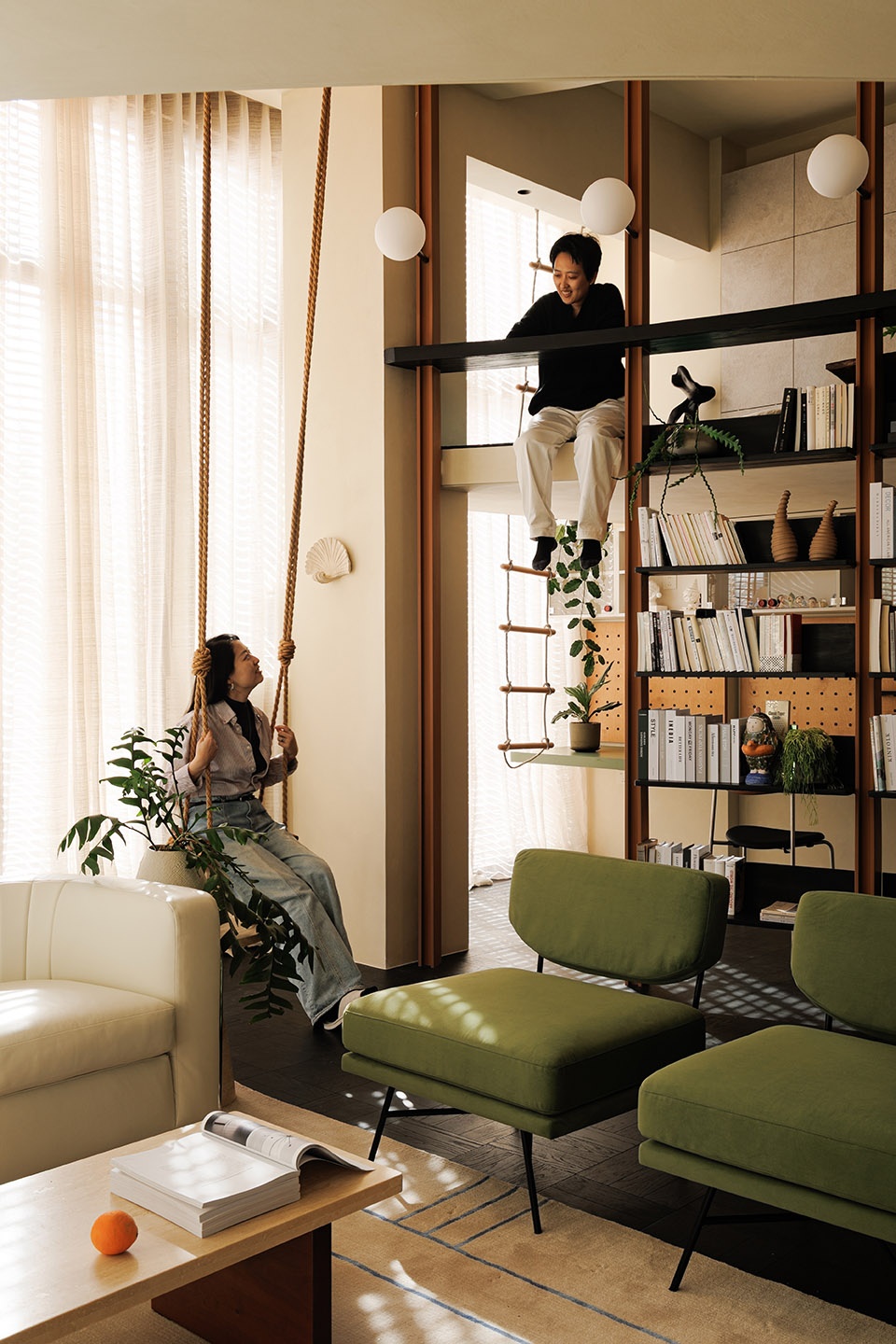
设计师给这个概念起了个名字,叫“网”。这张网要无处不在——让家人无障碍地看见对方、随时交流,但每个人又有自己的“居心地”。入住后的第一个寒假,每个人都能在加找到自己最舒服的角落,女主人感叹焦虑被空间自动稀释了。那张网,把四口人兜得稳稳当当。
▼设计概念图,Design conceptual sketch
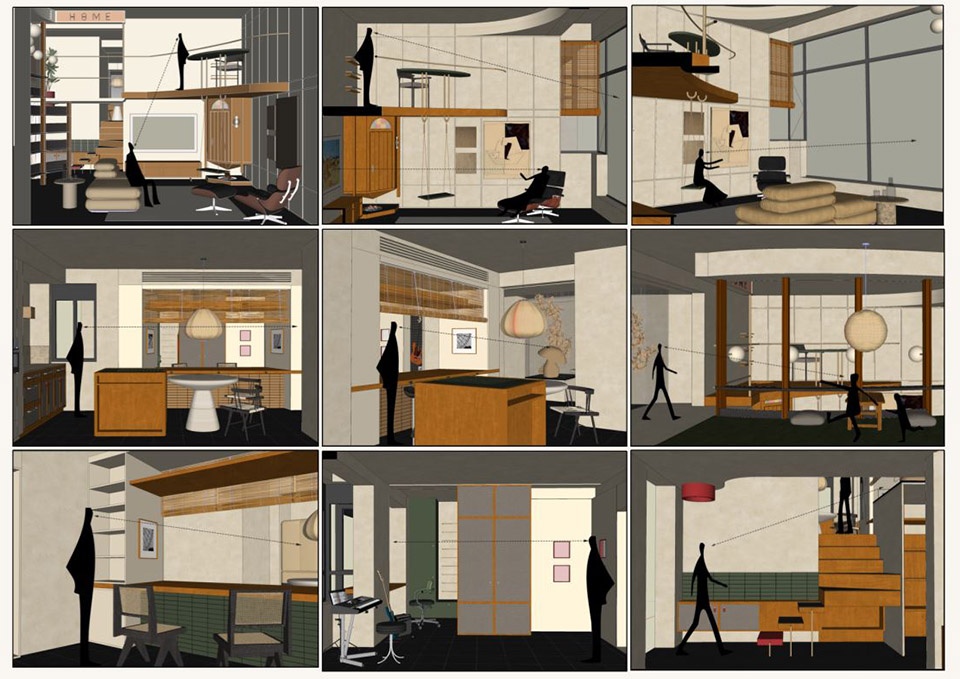
The core design concept is named The Invisible Net. Spanning the entire residence, it enables casual eye contact and free communication among family members while reserving private retreats for personal downtime. After spending their first winter break in the new home, the homeowner shared that daily anxiety fades naturally thanks to the layout; the invisible spatial web holds the four-person family closely bonded.
▼南侧挑空客厅另一个视角的视线交互,
Alternative view of sight connection inside south double-height living room
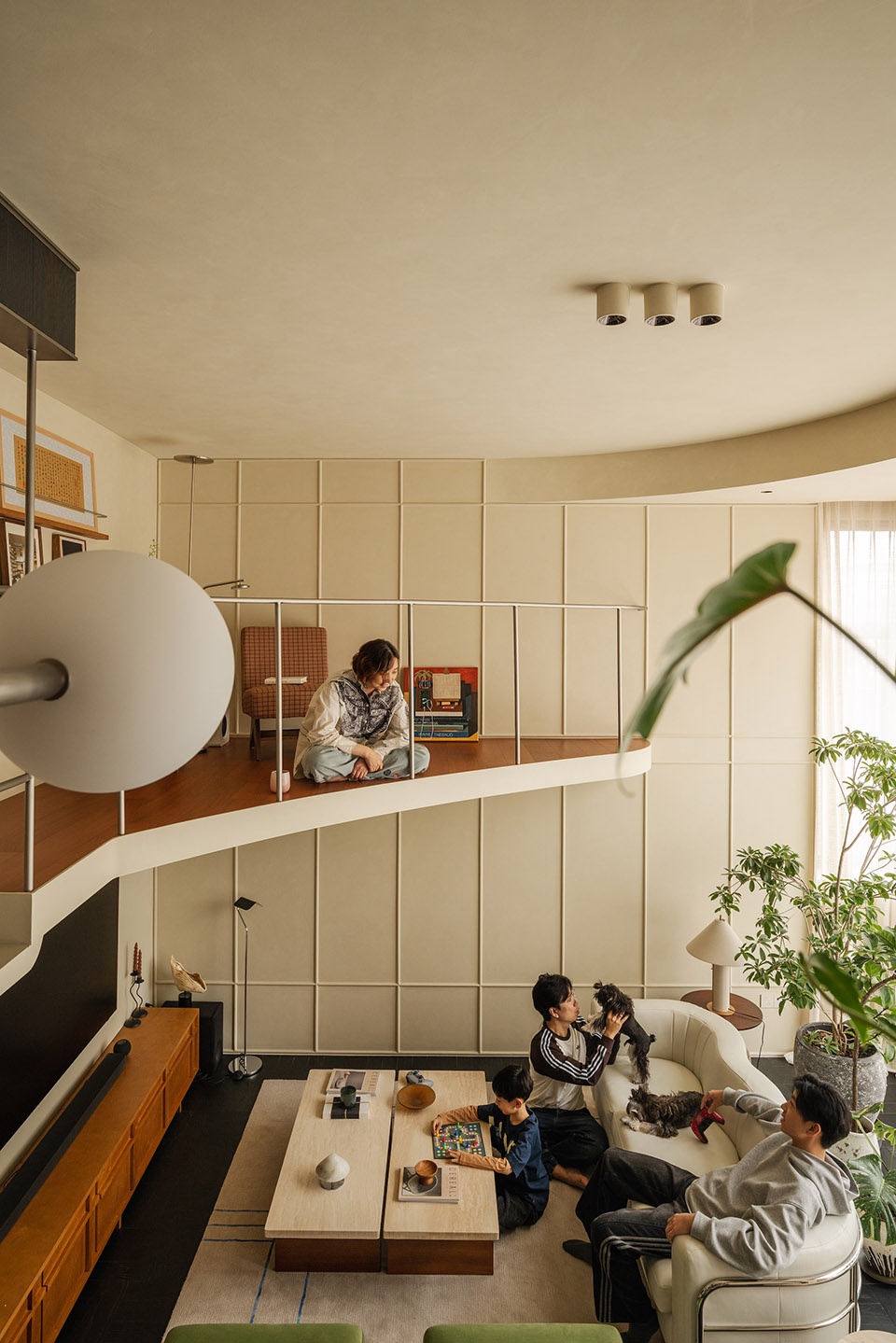
本案是一个跃层结构改造项目,房屋的原始面积虽大,却存在几个影响家庭互动的核心缺陷:
1.入户无玄关:进门即见厅,毫无缓冲与私密性。
2.楼梯阻隔互动:原有楼梯卡在中间,像一道“墙”阻碍了视线与声音的流通。
3.错层动线相对混乱:功能分布零散,导致家人在各自活动时,仿佛置身孤岛,难产生自然交集。
▼改造前户型图,Original Floor Plan
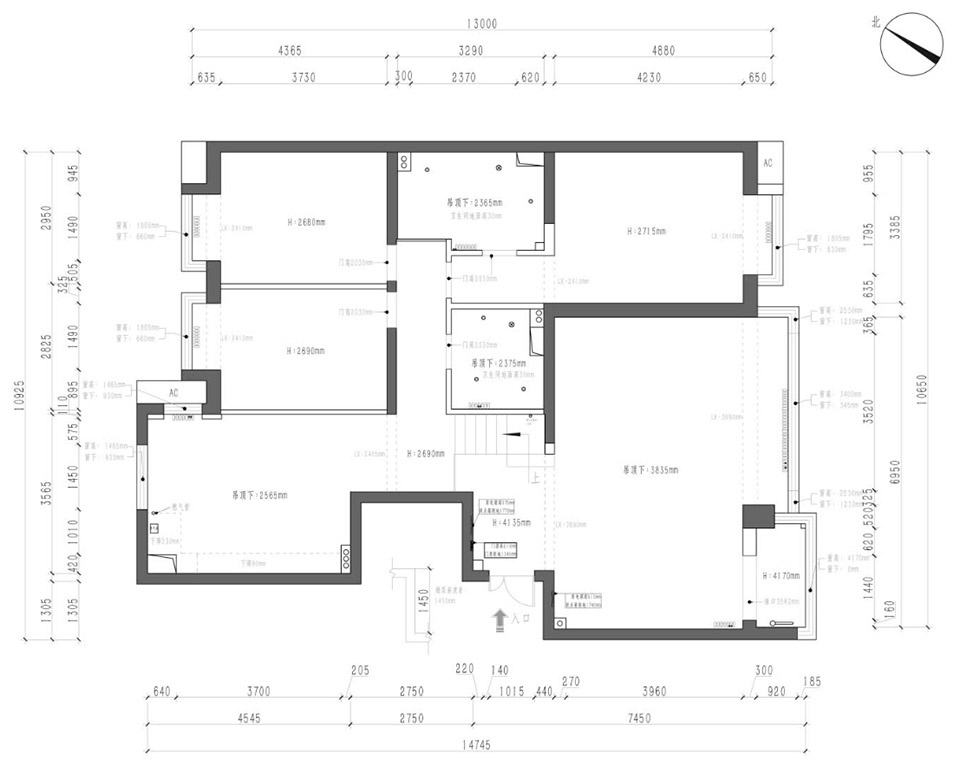
Though spacious, the original split-level layout had three critical drawbacks disrupting family interaction:
1.No dedicated entry foyer: The living room was exposed directly at the entrance, lacking transitional space and privacy.
2.Poorly positioned central staircase: It stood like a solid wall blocking sightlines and sound transmission across rooms.
3.Disjointed circulation: Scattered functional zones isolated each family member into separate islands and impeded casual interaction.
▼改造后客厅,living room after renovation
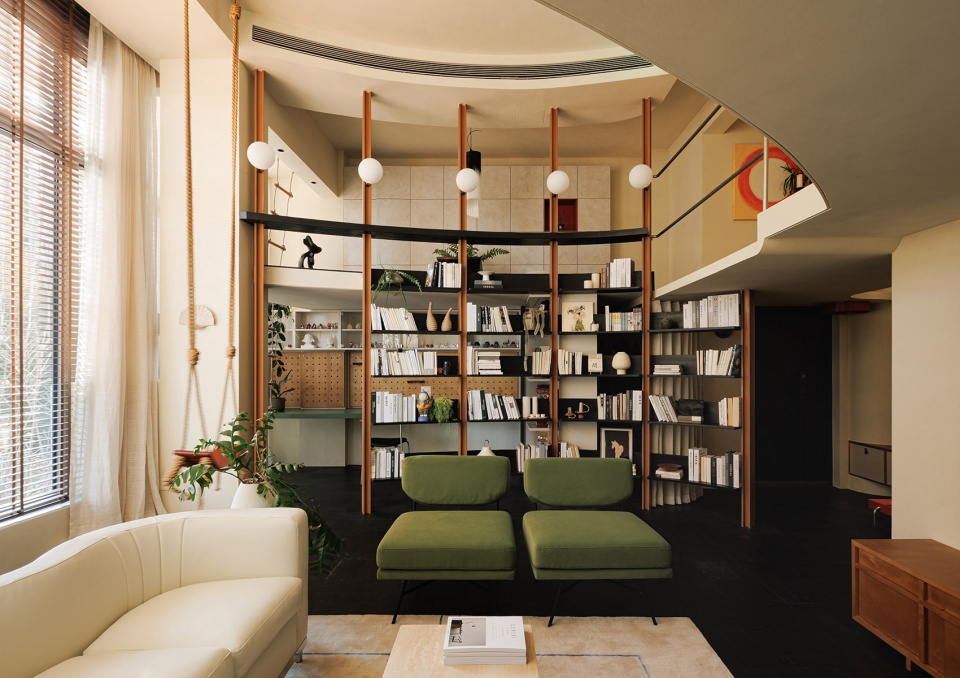
设计师的改造思路,不是填满,而是打开。一切的起点,是南侧挑空客厅搭建的二层平台,以及那道弧形书架墙。它们像一座“隔而不断”的桥,轻轻挡住了入户的直白视线,也自然围出了四个有包裹感的空间:玄关衣帽间、电竞房、二楼茶室、二楼阅读区。
▼改造后户型图,Renovated Floor Plan
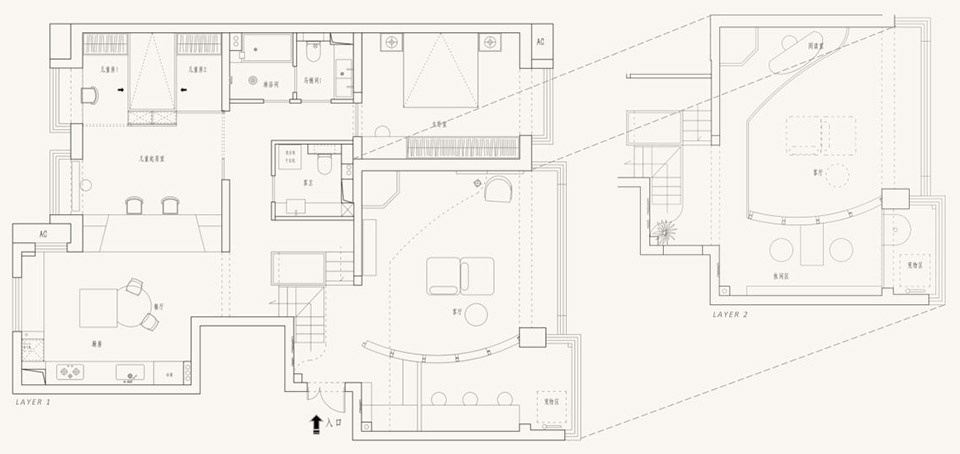
The renovation revolves around opening up space rather than filling voids.The design originates from a custom mezzanine platform and curved open bookshelf built within the south double-height living room. Acting as semi-transparent connecting bridges, they block direct sight from the front door and enclose four cozy functional spaces: an entry cloakroom, a home gaming room, a second-floor tea lounge and an upper reading nook.
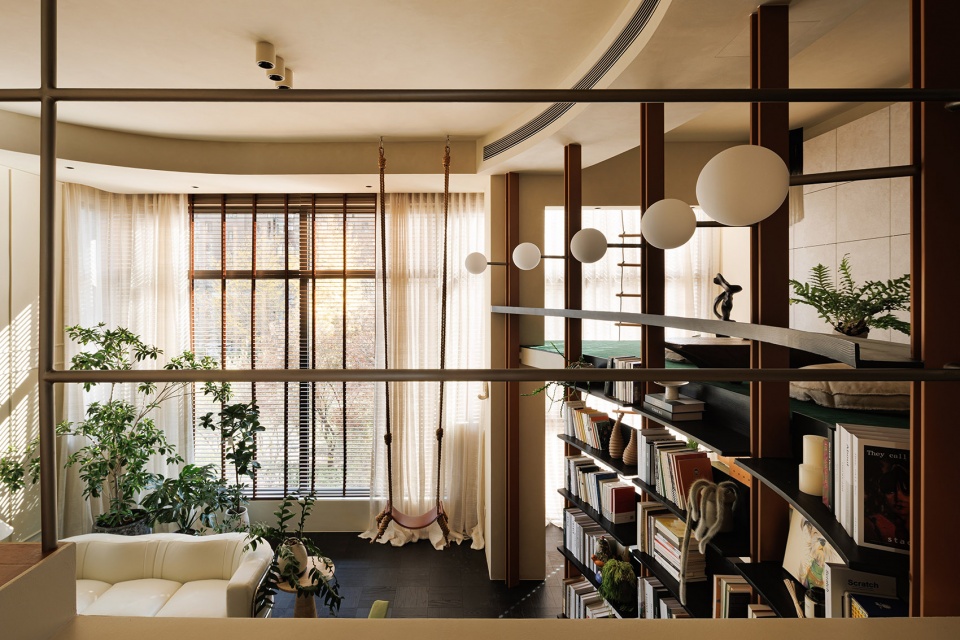
▼书架背后的二楼茶室,
Second-floor tea lounge hidden behind bookshelf
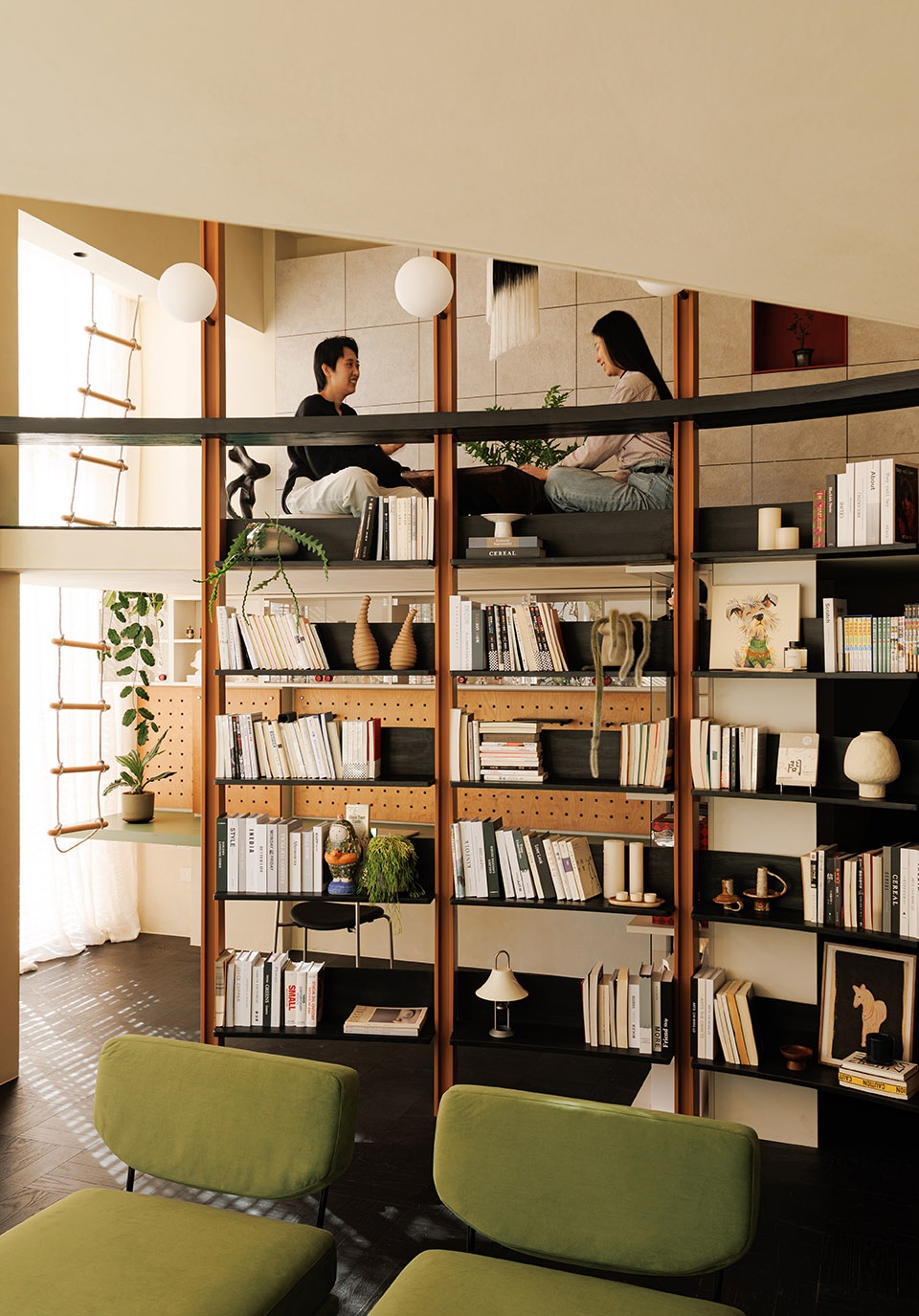
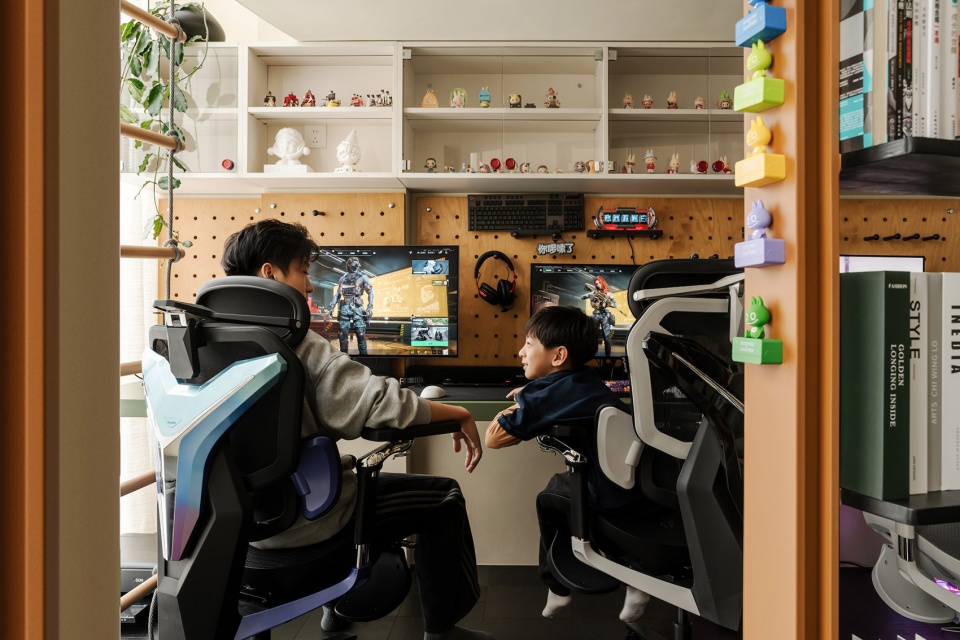
书架的镂空让光线和视线从缝隙里穿过去,家的呼吸感就有了。这座书架成了全家的“精神核心”。女主人坐在客厅休息,透过书架的空隙,能看到先生和两个儿子在电竞房里并排打游戏的背影;登上二楼看书,低头又能望见他们在楼下闹。那种“同在,却不互相打扰”的亲密,是这个家最难得的底色。
Open slat gaps on the shelf allow natural light and sightlines to filter through, endowing the house with an airy vibe.The curved shelving wall becomes the home’s spiritual anchor. Resting in the living room, the wife can peer through shelf gaps to watch her husband and sons gaming side by side downstairs; while reading upstairs, she can glance down at their playful antics. This precious intimacy of coexisting without disturbance defines the home’s core temperament.
▼书架背后的一楼电竞房,Ground-floor gaming den tucked behind shelving
玄关 :半弧书架,化解“开门见厅”的尴尬 Entry Foyer: Curved Bookshelf as a Soft Spatial Screen
客厅的半弧形的挑空书架成功化解了“开门见山”的尴尬,形成了实用的入户衣帽间。书架墙就像一个巨大的“屏风”,挡住了衣帽间的凌乱,日常正面是全家共聚的客厅,背后则暗藏玄机。
The oversized curved double-height bookshelf resolves the awkward straight-through entry layout and incorporates a practical built-in entry cloakroom. Working as an artistic folding screen, it conceals messy storage on its rear side while forming the scenic backdrop of the main living space.
▼从客厅看向入户,View toward entrance from living room
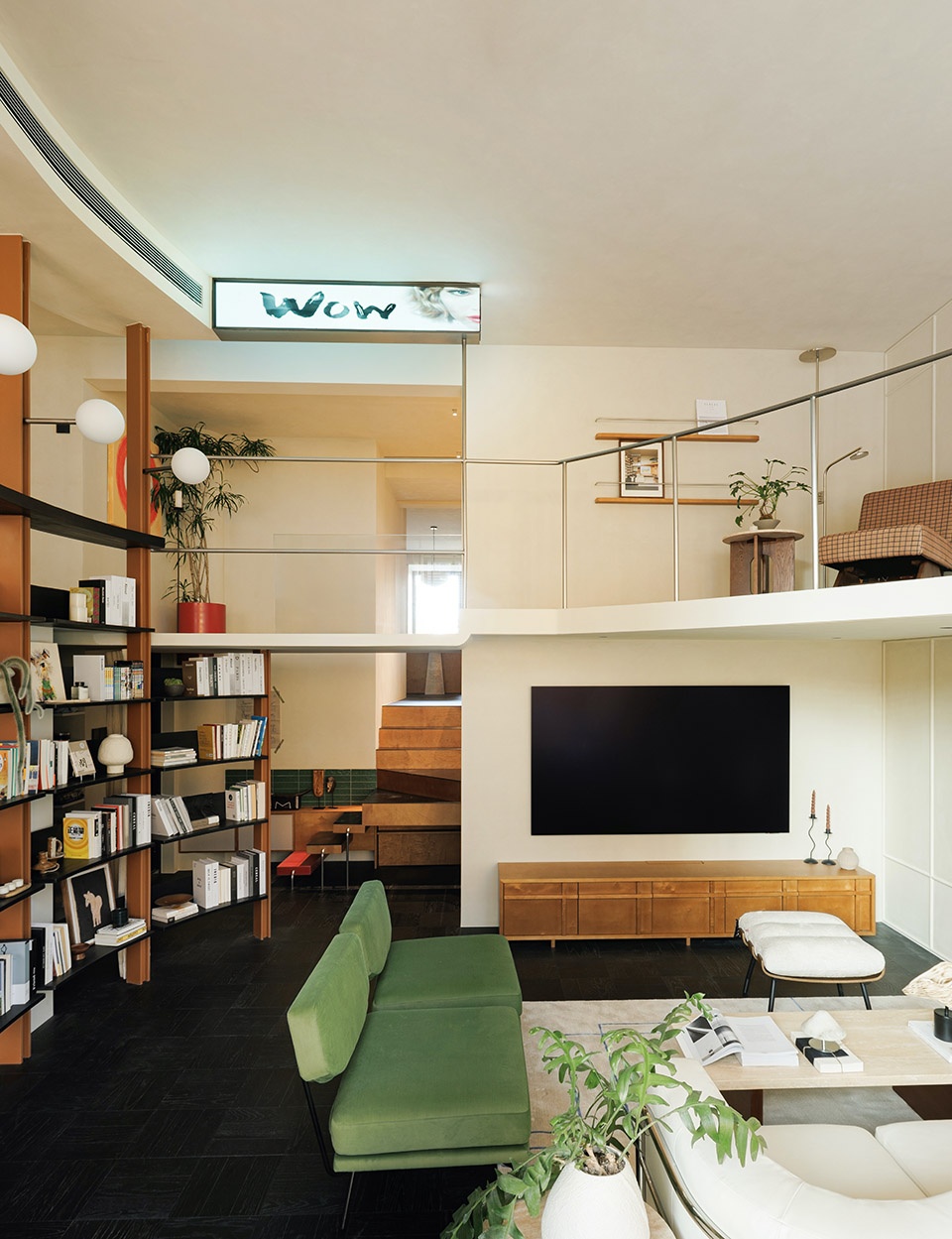
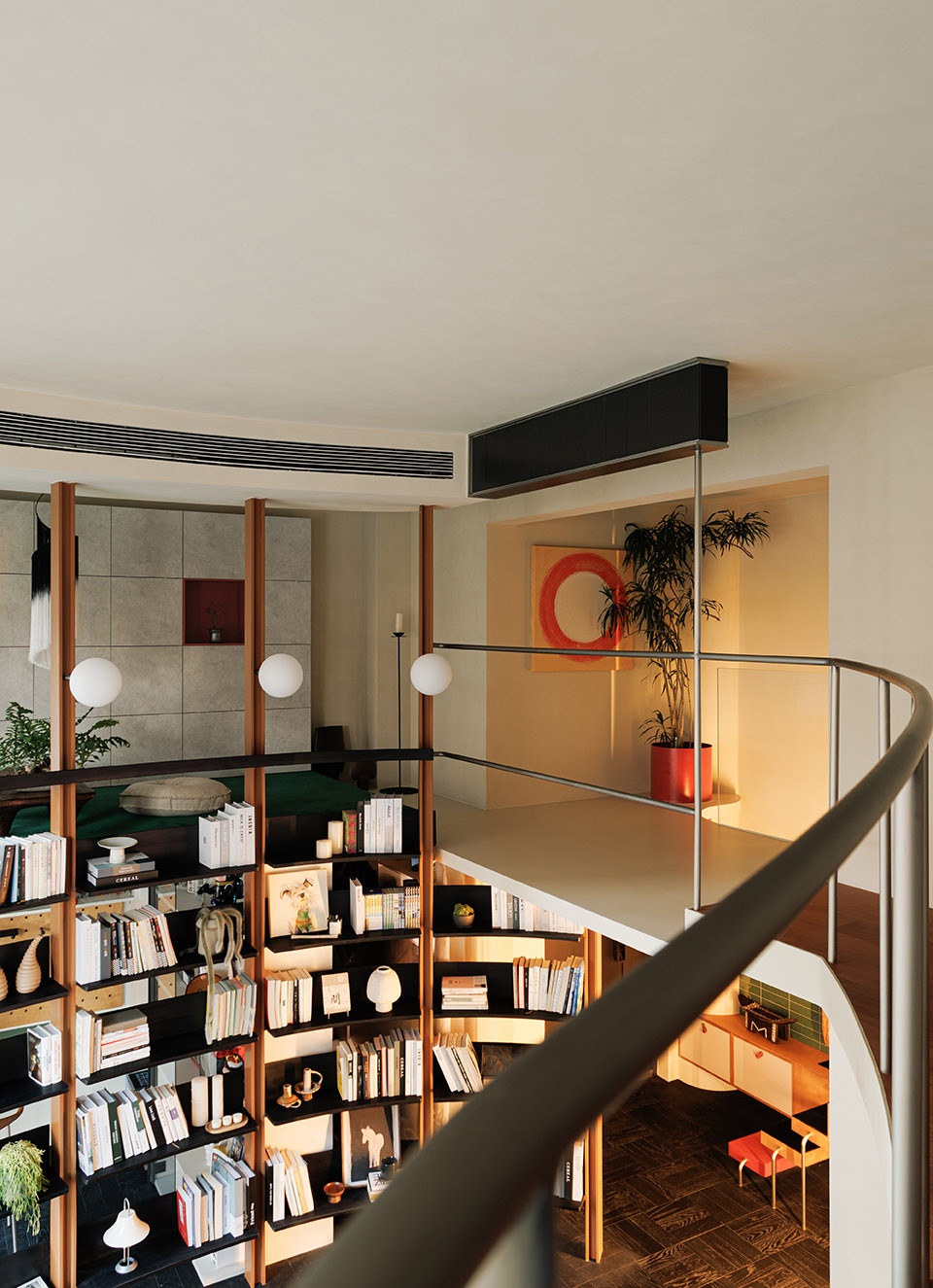
▼二层阅读区看向入户与书架墙的空间关系,
Spatial relation between upper reading nook, entrance and curved shelving wall
客厅:以书架为幕,隔而不断的家庭剧场 Living Room: A Family Hub Framed by Open Shelving
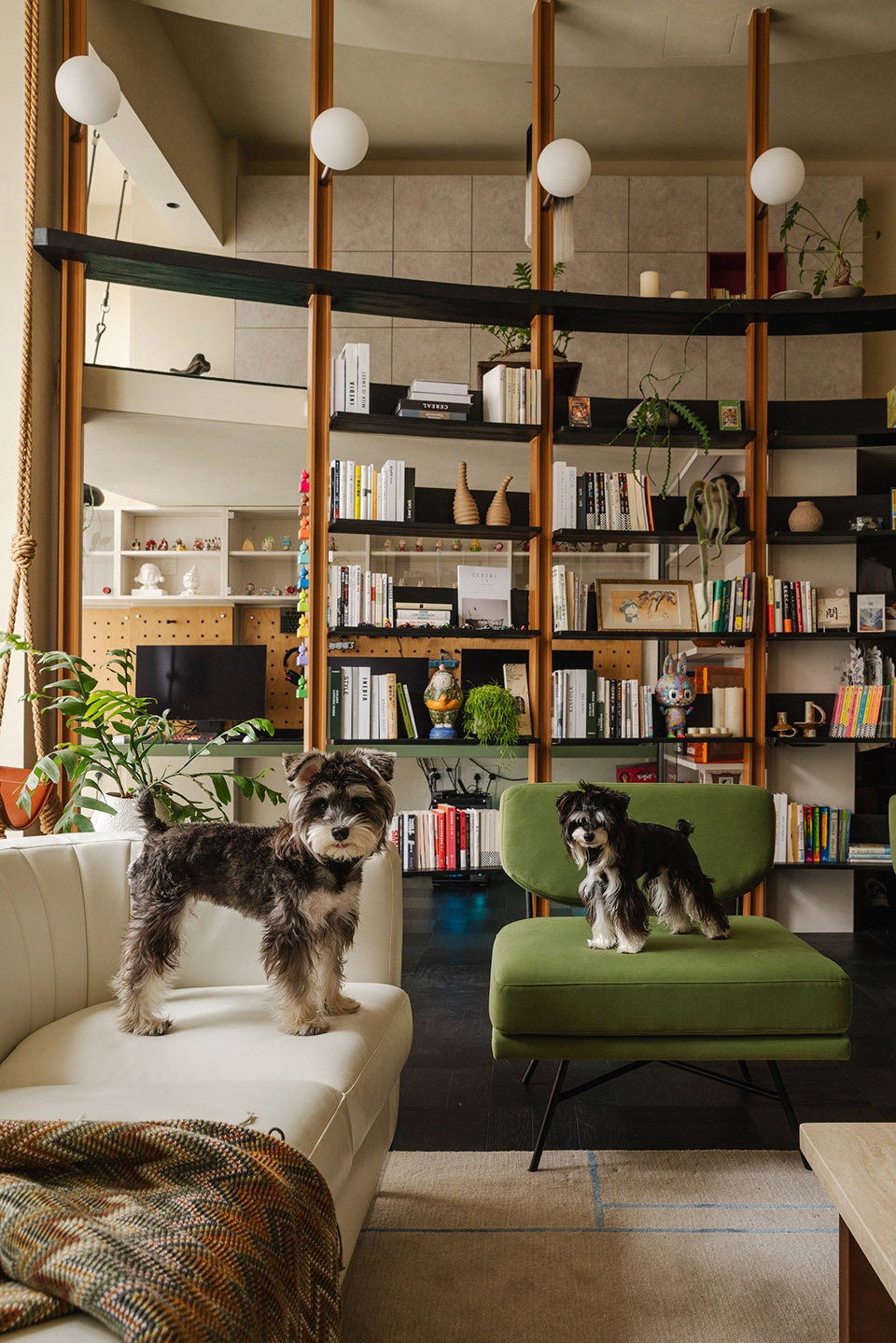
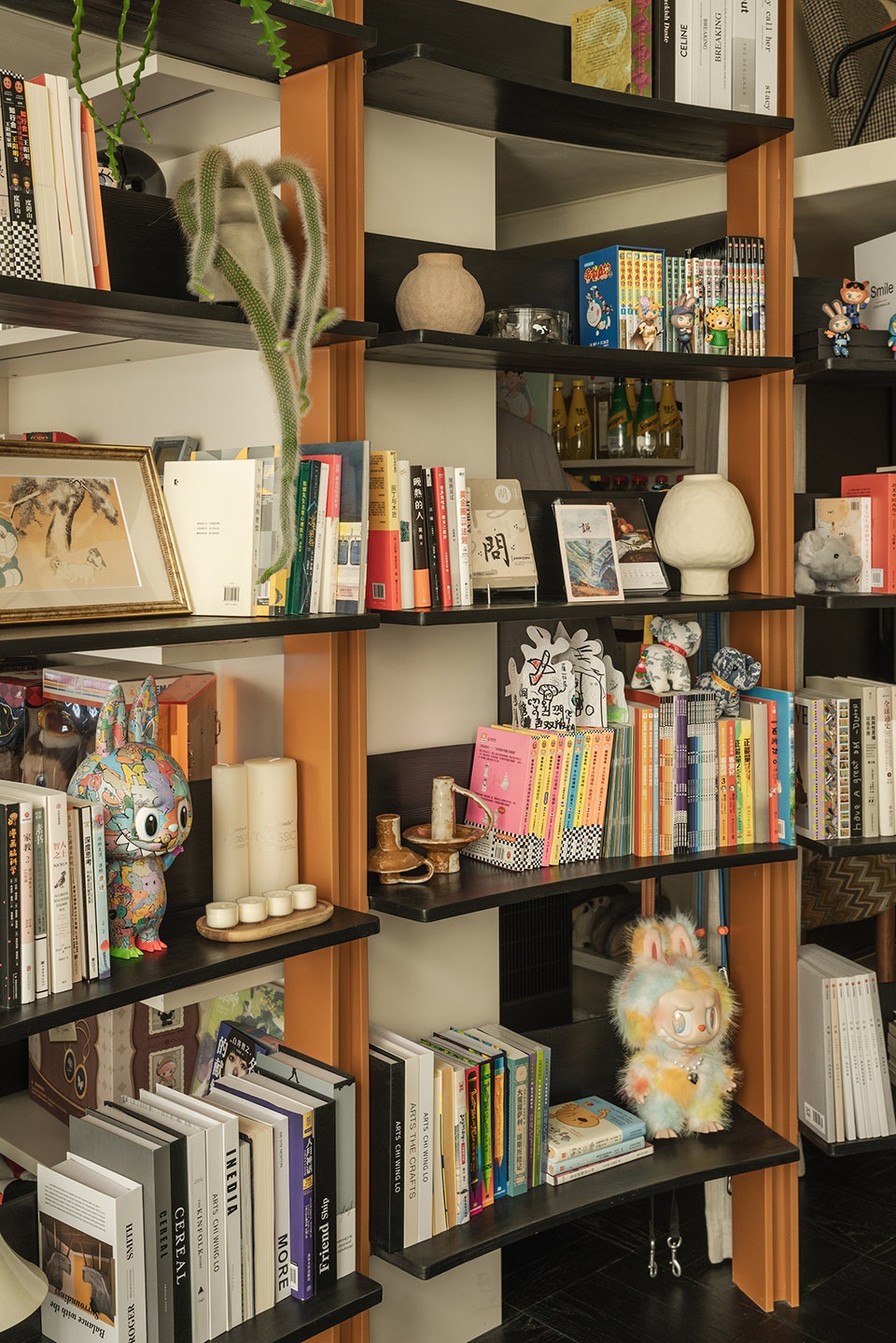
步入厅内,4.1米的挑高与整面落地窗带来的通透感扑面而来。弧形书架在此刻转换角色,成为整个家庭公共区域的 “精神核心”与“互动媒介”。书架采用钢结构焊接而成,表面呈现黑木纹与温润柚木的拼色质感,让光线、视线与声音得以在空间中自由穿透。
Upon entering, residents are welcomed by a 4.1-meter-high ceiling and full-height south-facing windows flooding the space with ample daylight. The curved steel-framed bookshelf, finished with a mix of dark timber grain and warm teak veneer, serves as the public zone’s emotional anchor and interactive medium, enabling unobstructed flow of light, sight and sound through its gaps.
▼弧形书架,the curved steel-framed bookshelf
▼书架细节,Detail close-up of customized bookshelf
书架的一楼背面则形成一个专属的沉浸式电竞房。是爸爸与两个孩子的快乐胜地。
The ground-floor rear of the shelving encloses an immersive gaming haven for the father and his two sons.
▼书架后沉浸式电竞房,an immersive gaming haven at the back
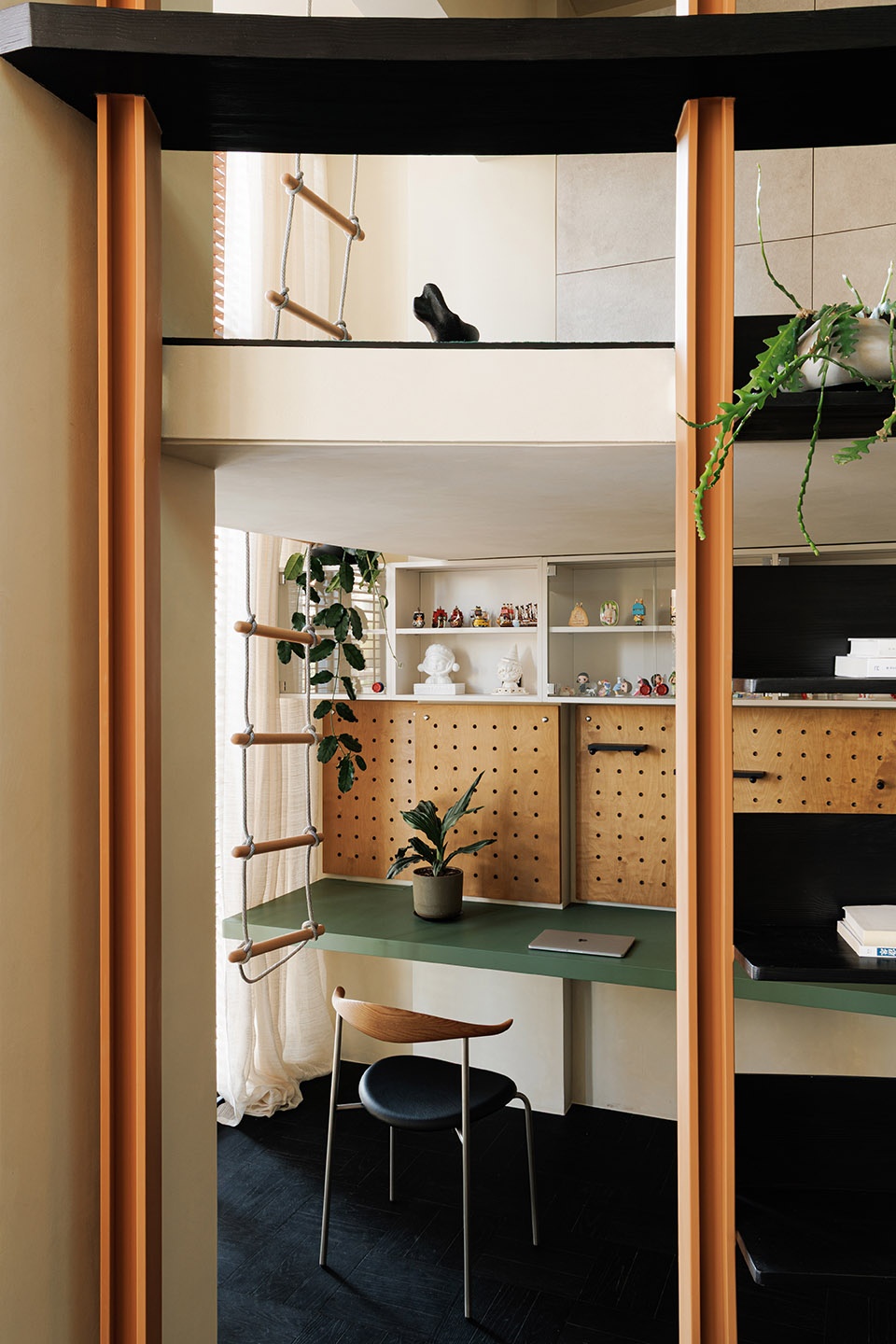
正面的客厅最大限度地保留了南向落地窗,将窗外的四季变幻引入室内。
The full-height south-facing windows are fully preserved to frame shifting seasonal outdoor scenery indoors.
▼将窗外的四季变幻引入室内,
frame shifting seasonal outdoor scenery indoors
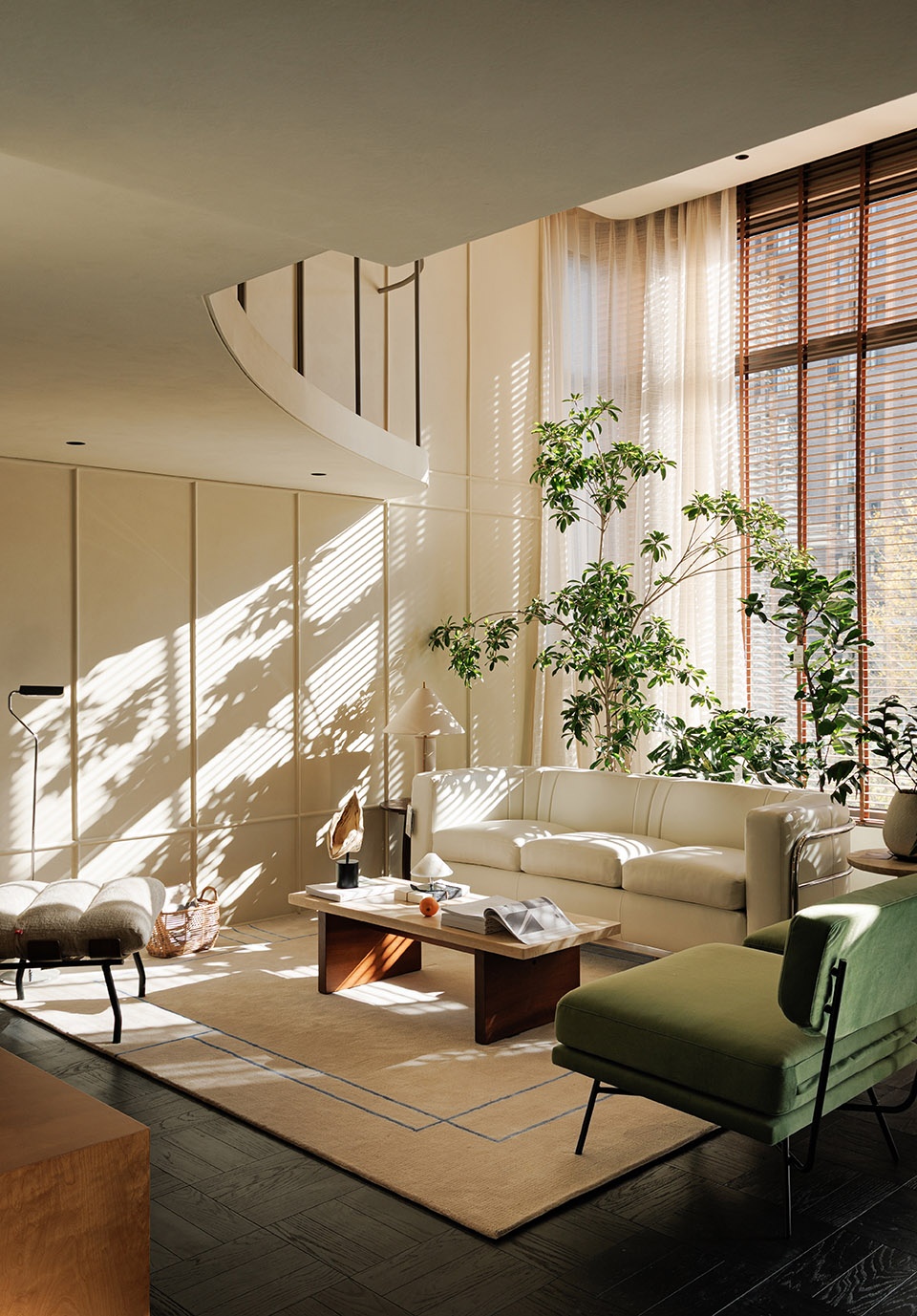
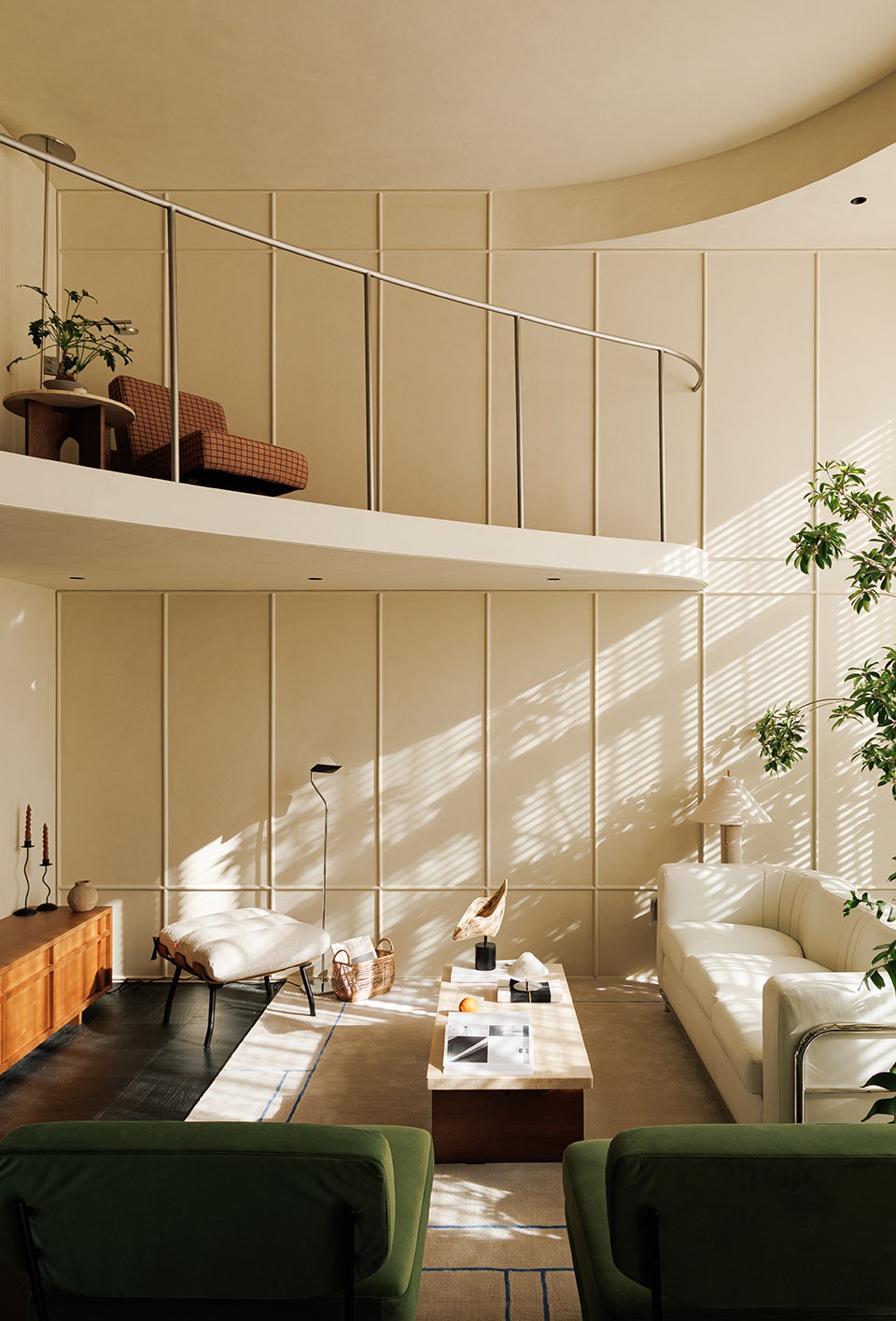
设计师设计了两个半弧形的夹层区域在客厅左侧形成阅读平台,最终呈现出一个集客厅、夹层、连廊于一体的 “垂直复合型”家庭社交场。二楼阅读区是通过架设楼板打造的半包围悬浮式平台,它的体量感被精心控制,可俯瞰下方客厅,形成独特的 “陪伴”视角。
Two semi-circular cantilevered platforms are installed on the living room’s left to build reading terraces, forming a vertical composite social complex integrating lounge, suspended mezzanine and connecting corridors. Built with added floor slabs, the half-enclosed floating upper reading nook is dimensioned with precision, overlooking the living room below to deliver a unique companion-style overlook view.
▼形成独特的 “陪伴”视角,deliver a unique companion-style overlook view
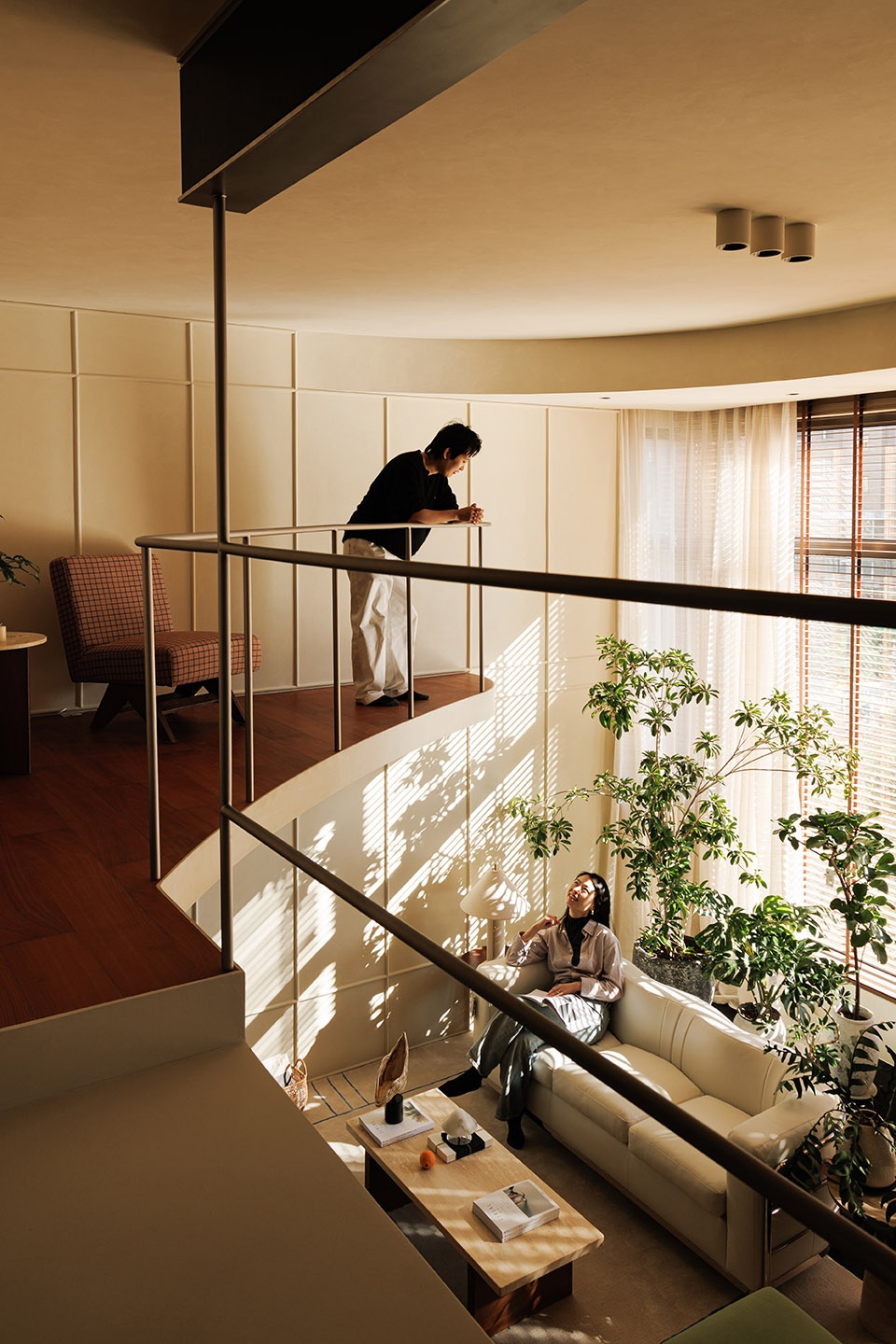
这个夹层阅读区,是家中一处珍贵的“留白”。它不承担繁杂的日常功能,只专注于精神世界的滋养,是家庭成员与自己对话、充电的秘密基地,也是温情家景的最佳观礼台。
This secluded reading nook is a precious blank canvas within the home. Freed from tedious daily chores, it is reserved for mental nourishment: a private retreat for self-reflection and the ideal vantage point to admire warm domestic moments.
▼夹层阅读区,This secluded reading nook
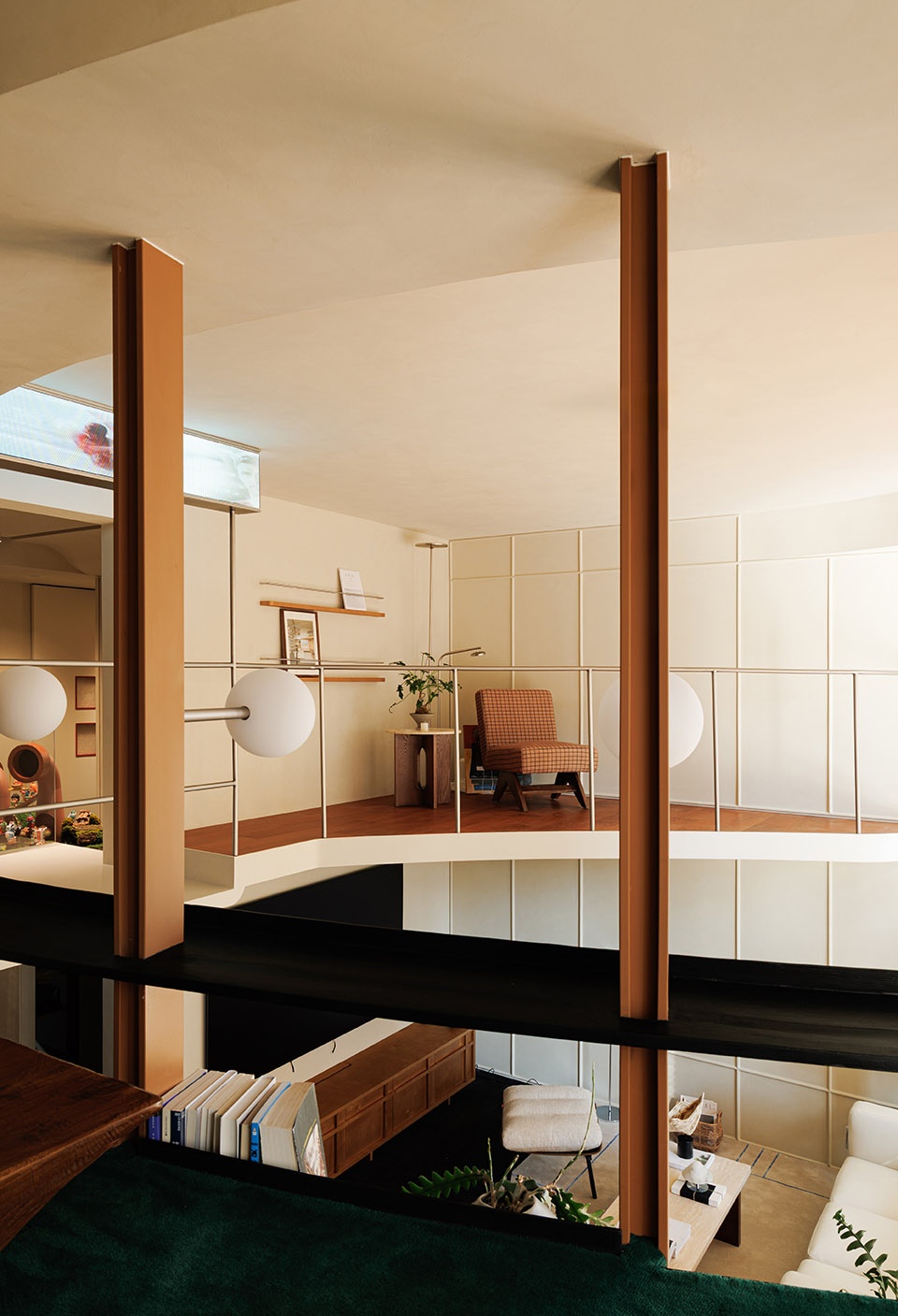
茶室:书架幕布后的隐秘舞台 Tea Lounge: A Hidden Leisure Space Above the Shelving
另一边的茶室位于挑空书架上方的夹层,书架最上面一层置物架自然地转变为二楼茶室的辅助桌板与安全护栏,让上下空间产生温暖的功能对话。
Tucked atop the curved shelving framework, the tea lounge repurposes the shelf’s top planks as auxiliary tabletops and safety railings, creating warm functional interplay between upper and lower floors.
▼夹层茶室,the tea lounge in the mezzanine level
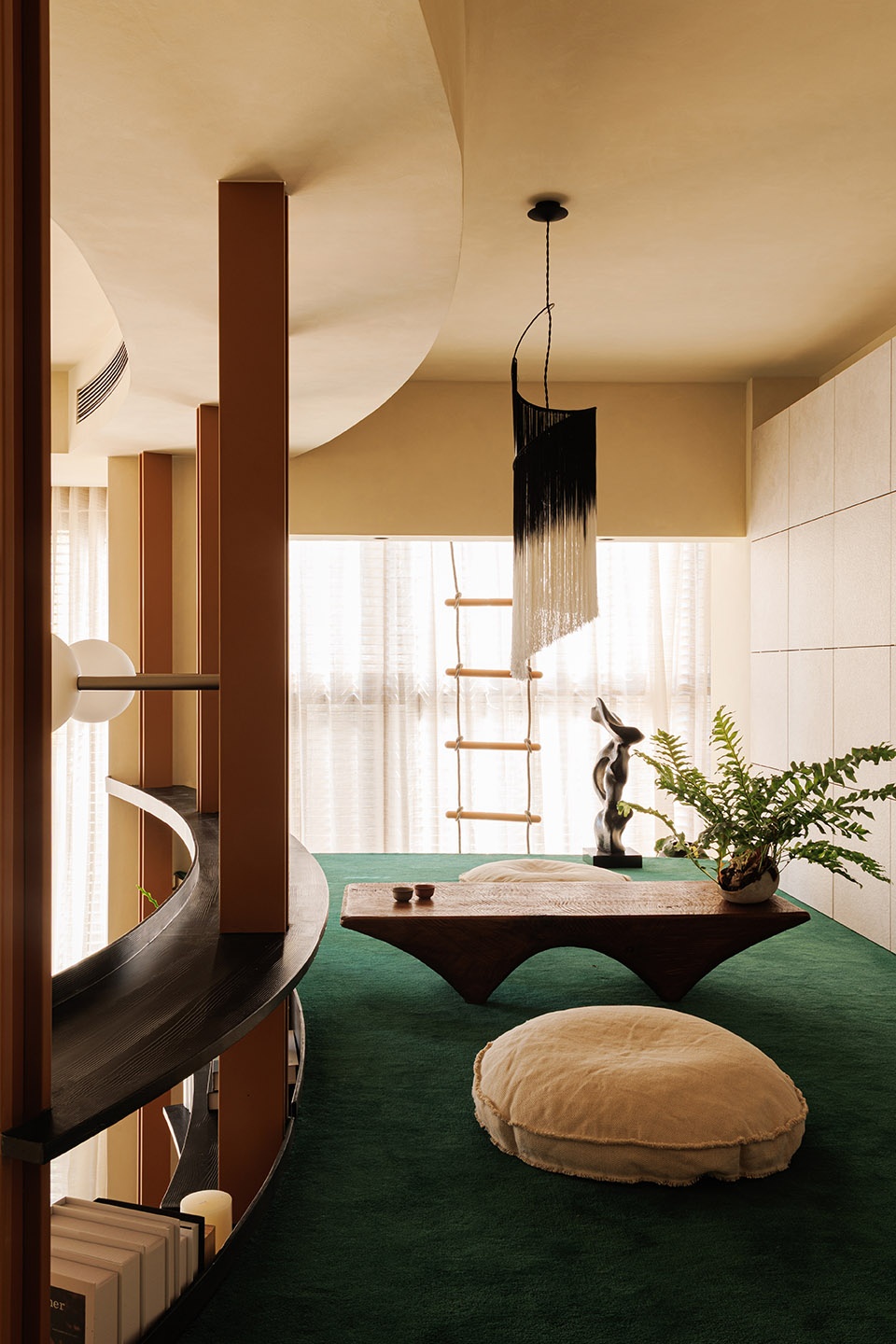
茶室,是对“藏与露”哲学的极致诠释。它将复杂的功能高度集成并隐藏,根据需要瞬间展开,完美平衡了人对安静独处的渴望与随时参与家庭烟火气的自由。
Embodying the design philosophy of balanced concealment and exposure, the lounge features compact foldable furnishings that shift instantly from a quiet private escape to an open gathering spot, reconciling the desire for solitude with easy access to family warmth.
▼夹层茶室,the tea lounge in the mezzanine level
楼梯:从障碍到枢纽,打开南北视野 Staircase: From Spatial Barrier Into Central Home Hub
楼梯在这个家中,被重新定义为连接物理空间与家庭情感的超级纽带,串联挑空厅上下视线、凝聚家人注意力。
Redesigned as the core physical and emotional connector of the house, the staircase links sightlines across the double-height living area and unifies family activities.
▼开门的第一视角的楼梯,底下藏着另一个小仓库,
Front view of entrance staircase with under-stair storage room
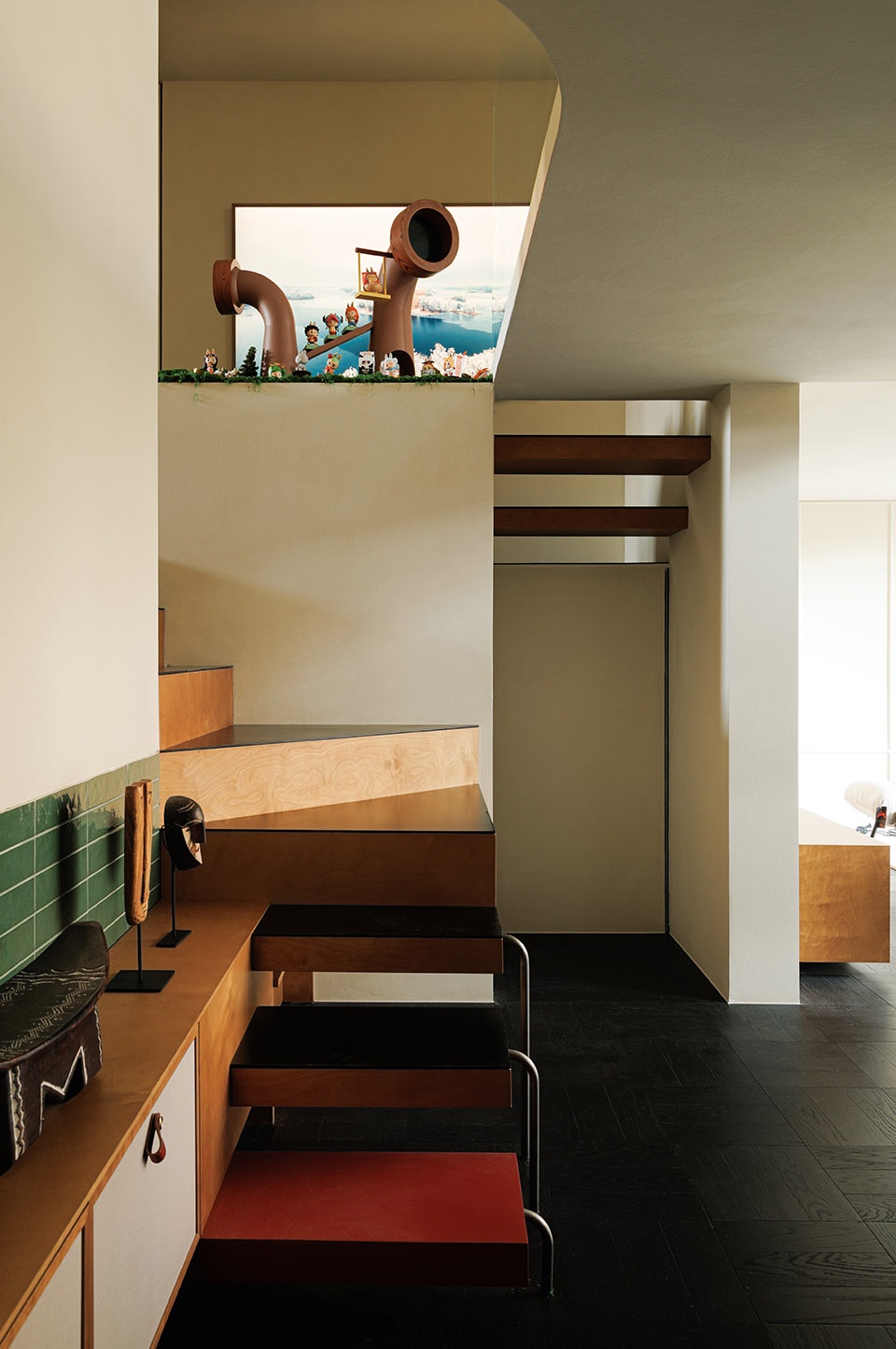
▼从客厅看向楼梯,Staircase seen from living room
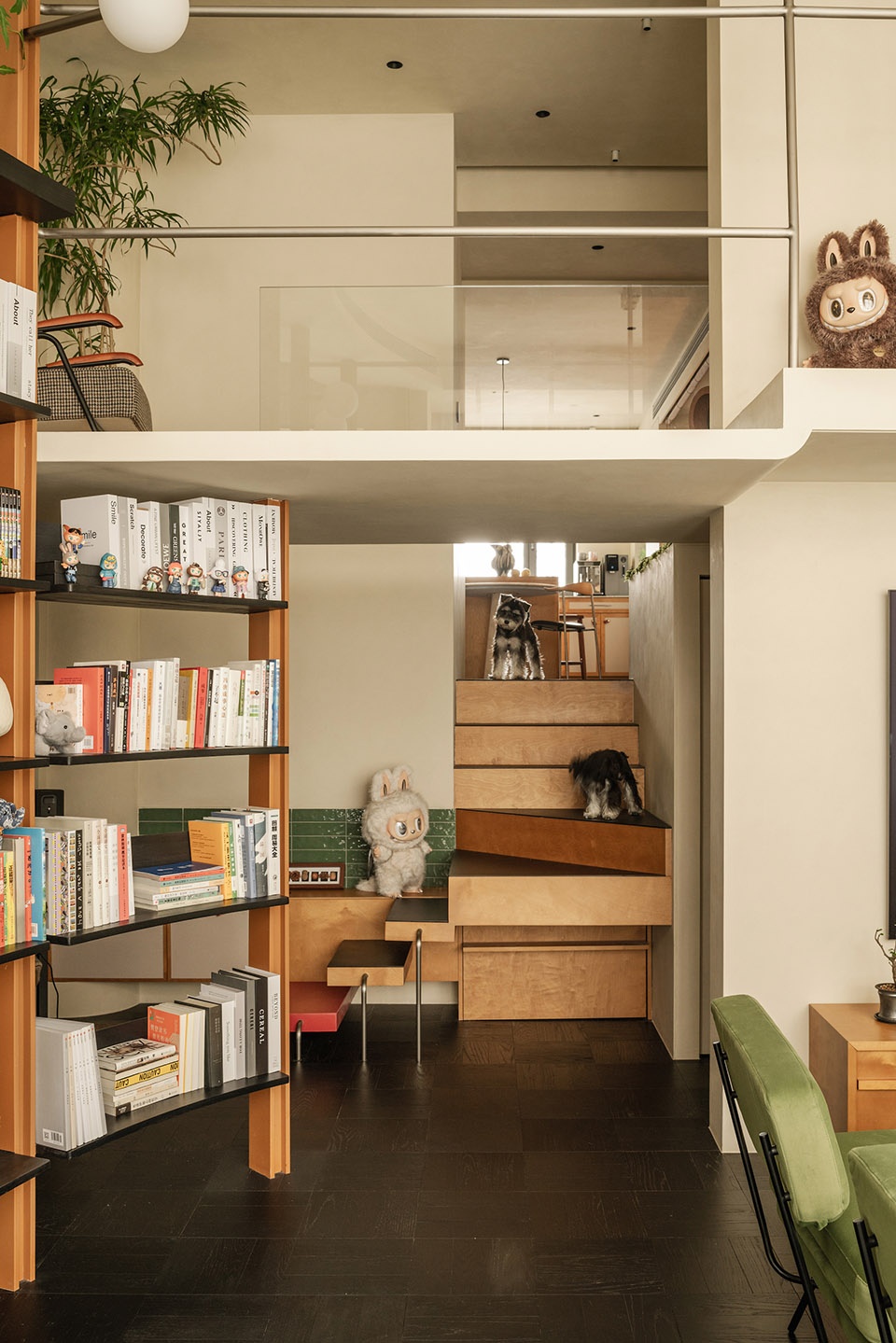
悬浮设计让南北空间的视线与光线得以自由穿透,家的整体感大幅增强。在这个空间中,楼梯不仅是通道,更围绕其建立了一个家的精神文化中心。在楼梯转换平台的上方,创造了一个独一无二的主题装置区——“拉布布乐园”。
Its floating construction opens up unblocked sightlines and natural light between the north and south wings, boosting the home’s spatial integrity. More than a mere transit route, the staircase landing is customized into a unique themed display named Labubu Paradise.
▼“拉布布乐园”,Labubu Paradise
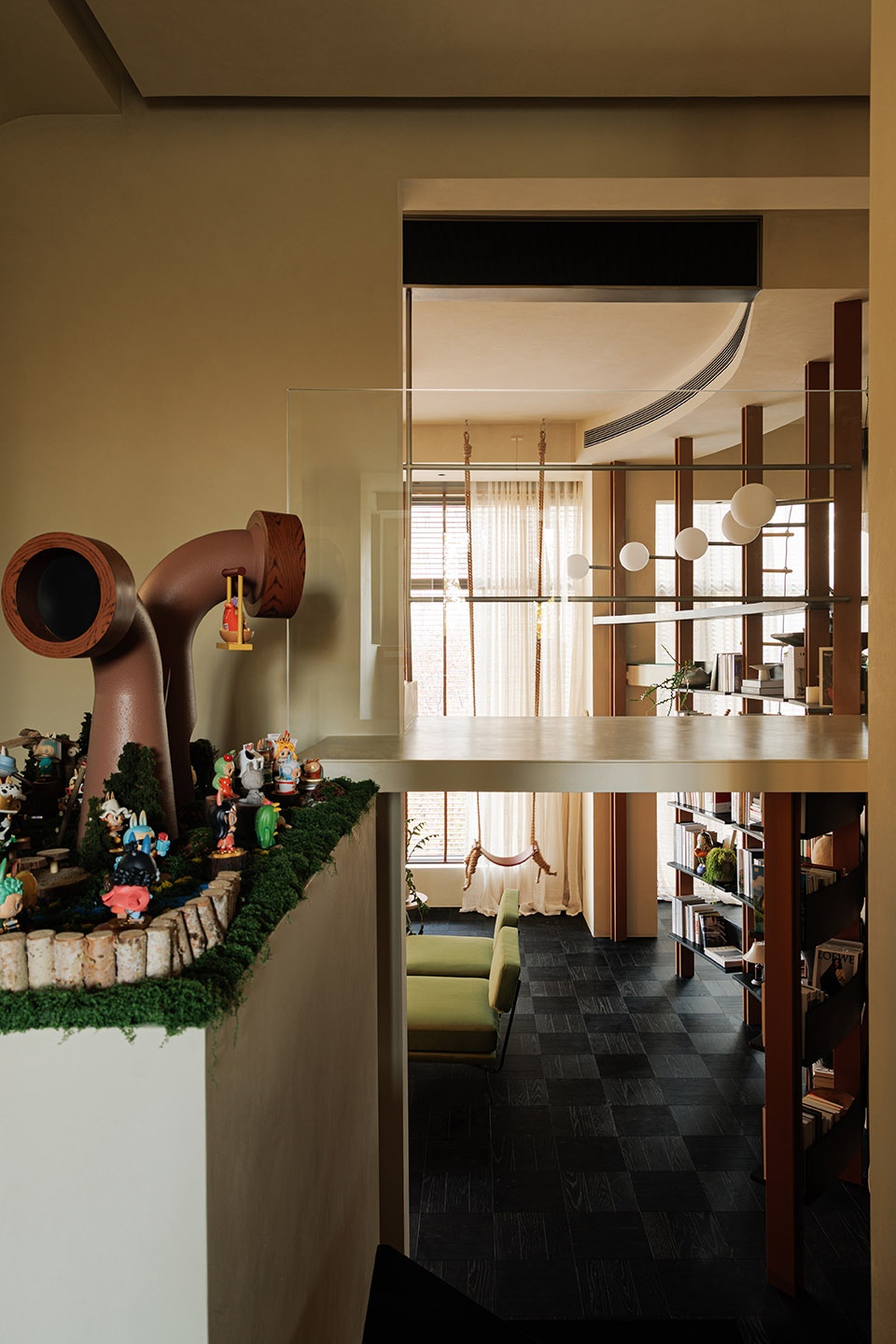
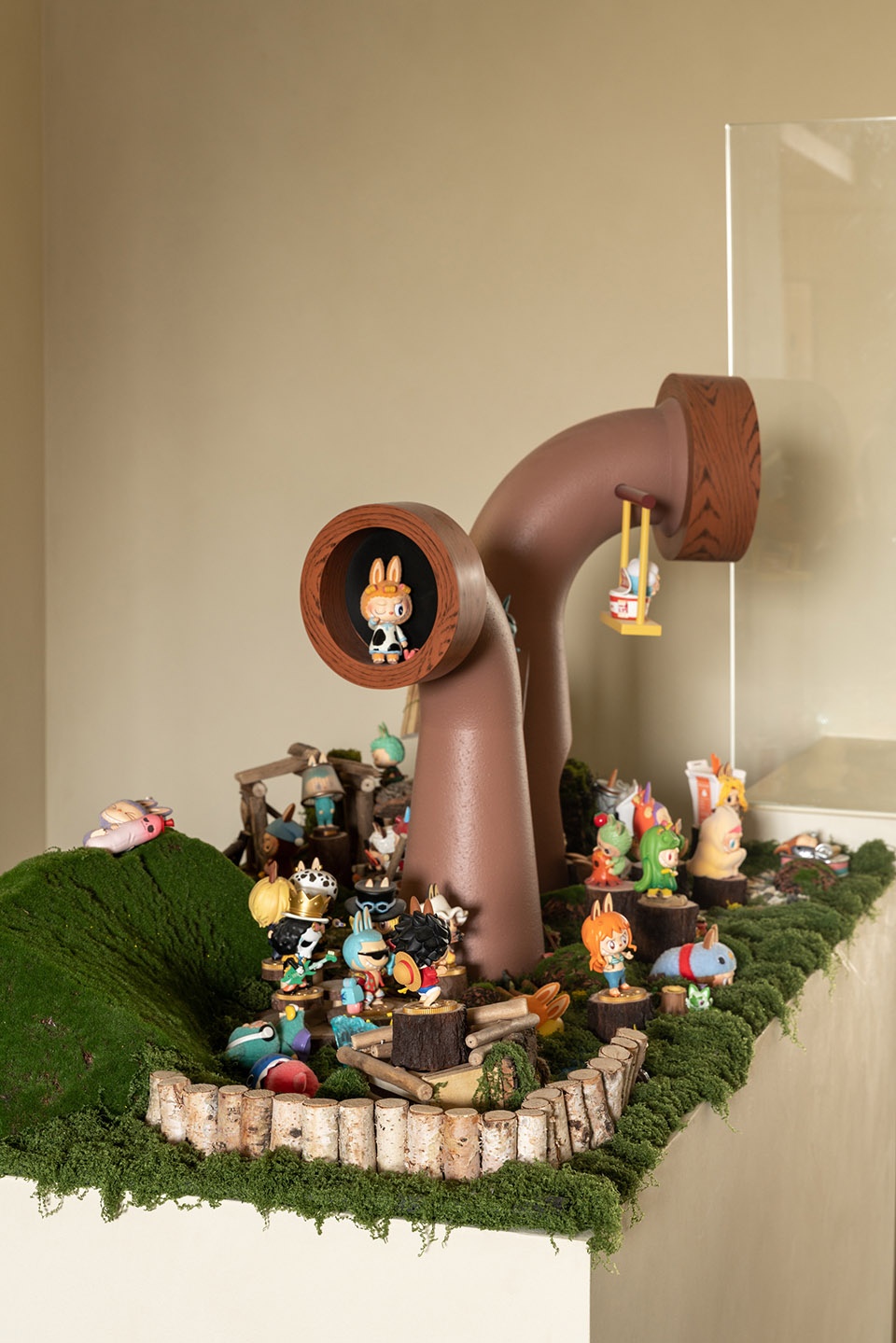
这个微缩景观以绿地、山河、农场与瞭望塔为概念,陈列着全家珍爱的拉布布系列手办,成为一个持续生长的家庭记忆博物馆。
Modelled as a miniature landscape with lawns, hills, farmland and observation towers, the zone showcases the family’s beloved Labubu collection and evolves into a living museum of household memories.
▼“拉布布乐园”,Labubu Paradise
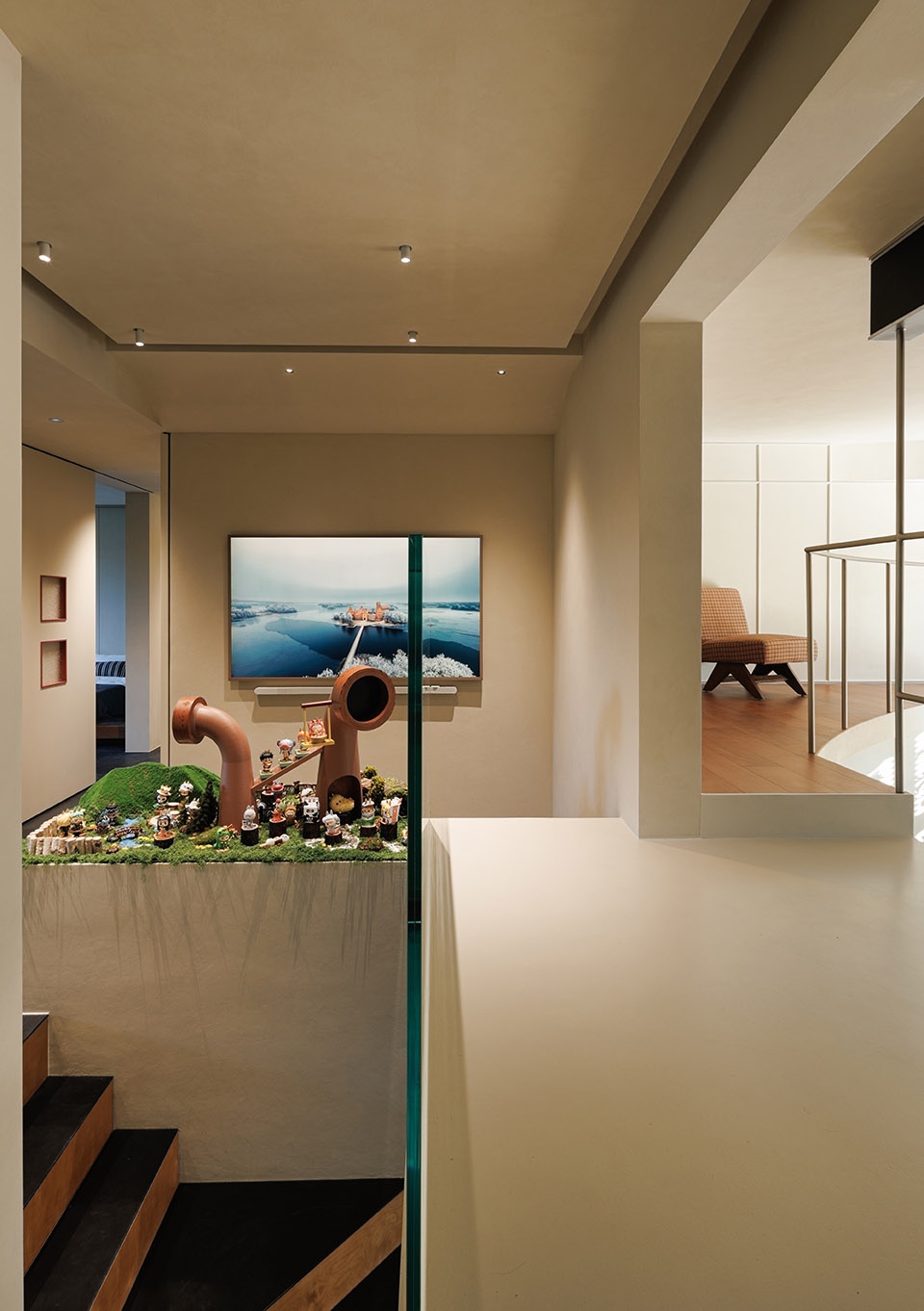
▼“拉布布乐园”,Labubu Paradise
餐厨:以方形岛台为核,烹煮三餐烟火 Kitchen & Dining Area: Island-Centered Hub of Daily Domestic Warmth
北侧的餐厨不仅是烹饪中心,更是家庭情感流动最频繁的“活力心脏”。空间的核心是中央岛台与圆形餐桌的组合。岛台不仅是高效的操作中枢,更是家庭互动的第一现场。
Located on the home’s northern side, the kitchen-dining suite serves as the beating heart of daily family bonding, anchored by a central cooking island paired with a round dining table that functions as the prime spot for daily interaction beyond food prep.
▼餐厅空间,kitchen
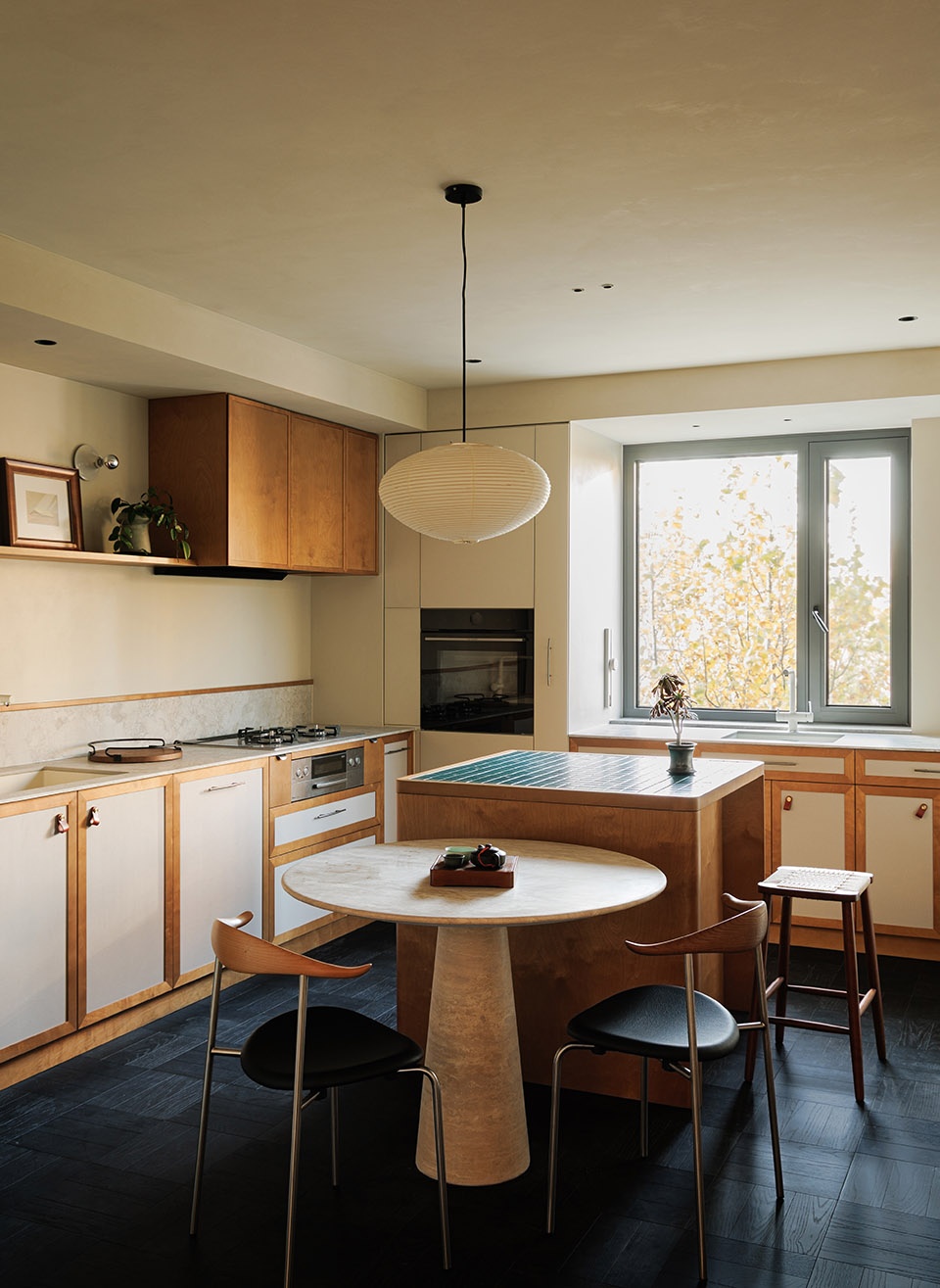
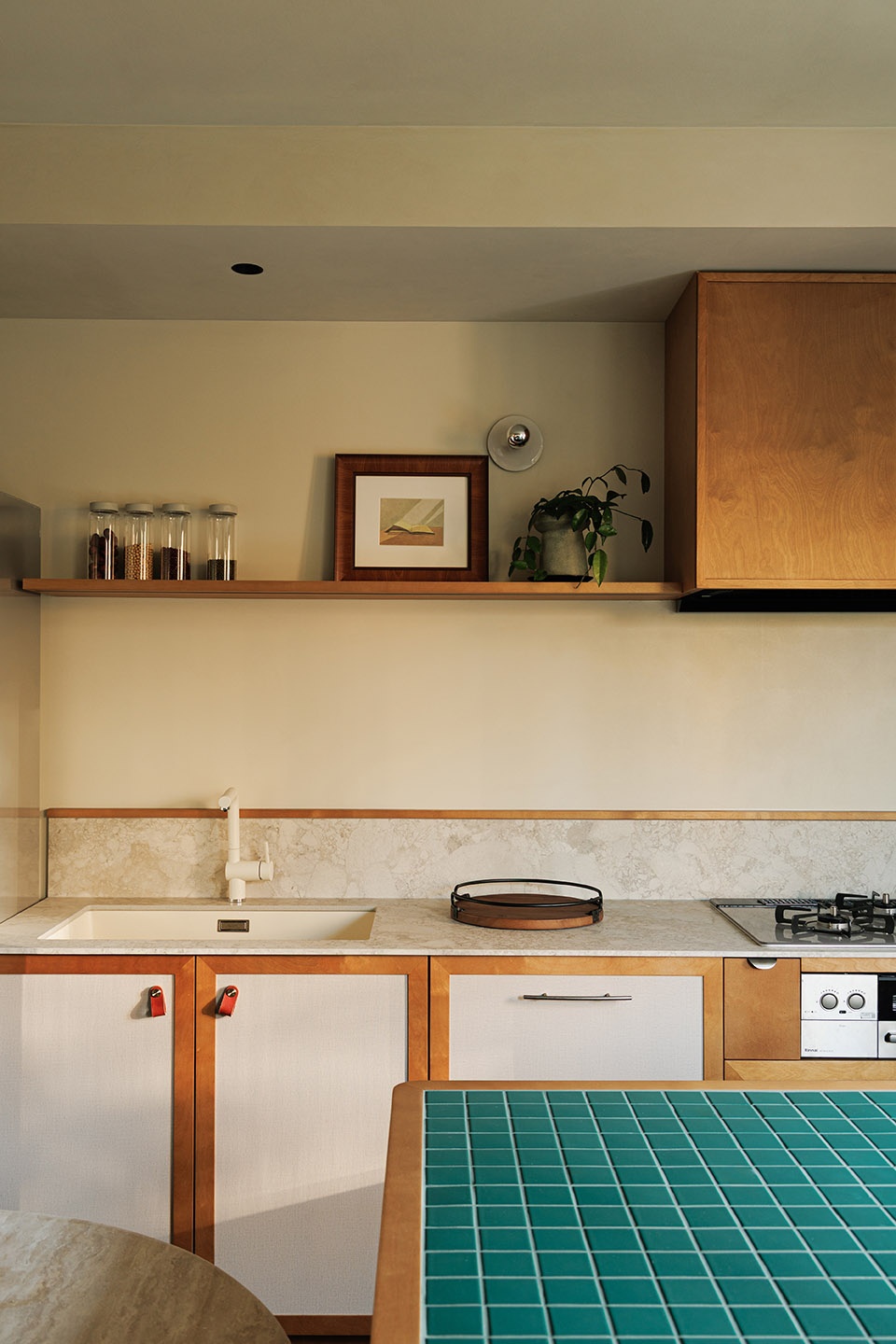
橱柜设计上,以仿布纹理的免漆板营造复古质感,同时确保耐擦洗。傍晚西晒的光线恰好洒入操作区,让烹饪时光沐浴在自然光中。
Cabinetry adopts fabric-texture paint-free panels to deliver vintage aesthetics alongside excellent wipe resistance. Warm late-afternoon western sunlight floods the cooking workspace every day.
▼营造复古质感,deliver vintage aesthetics
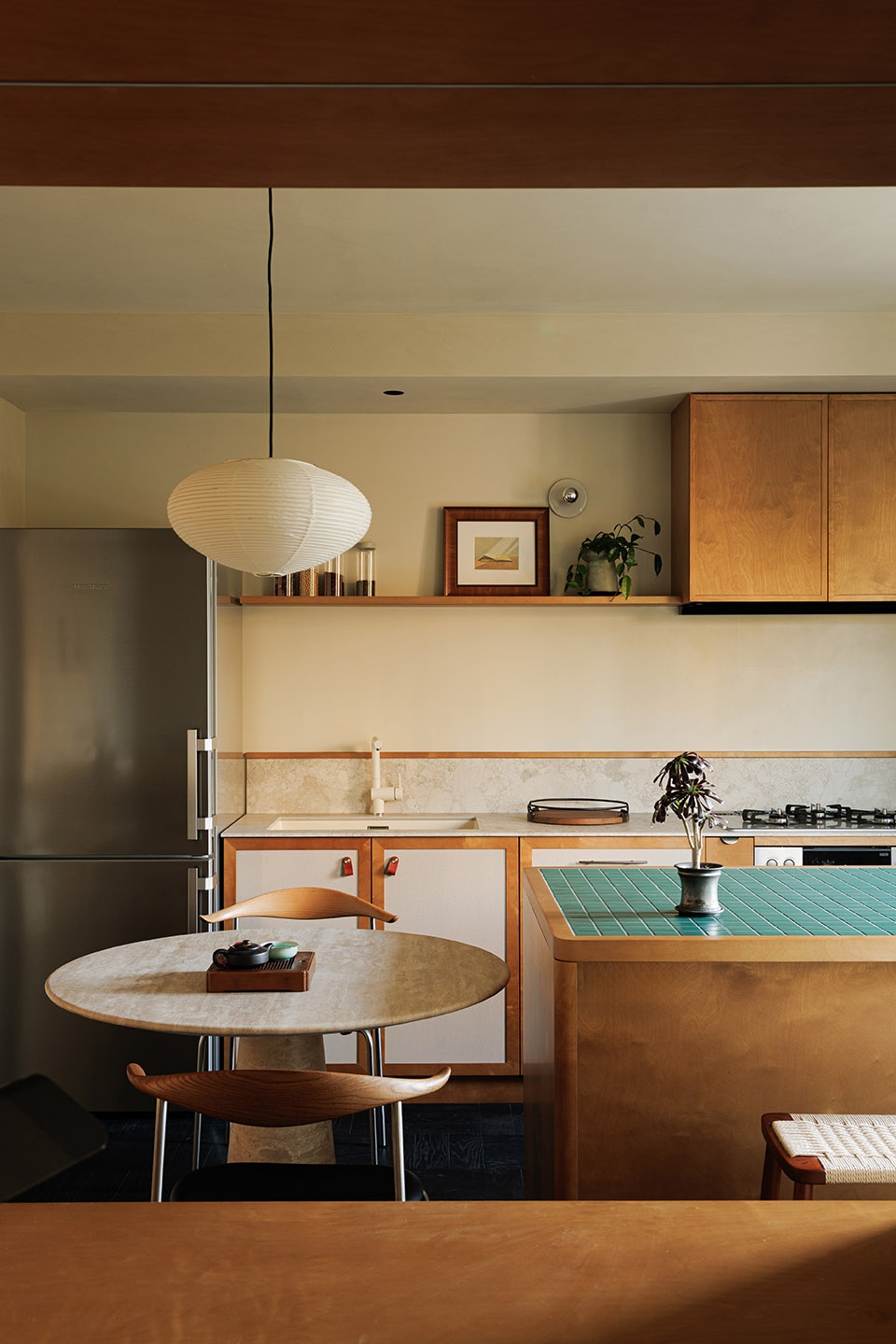
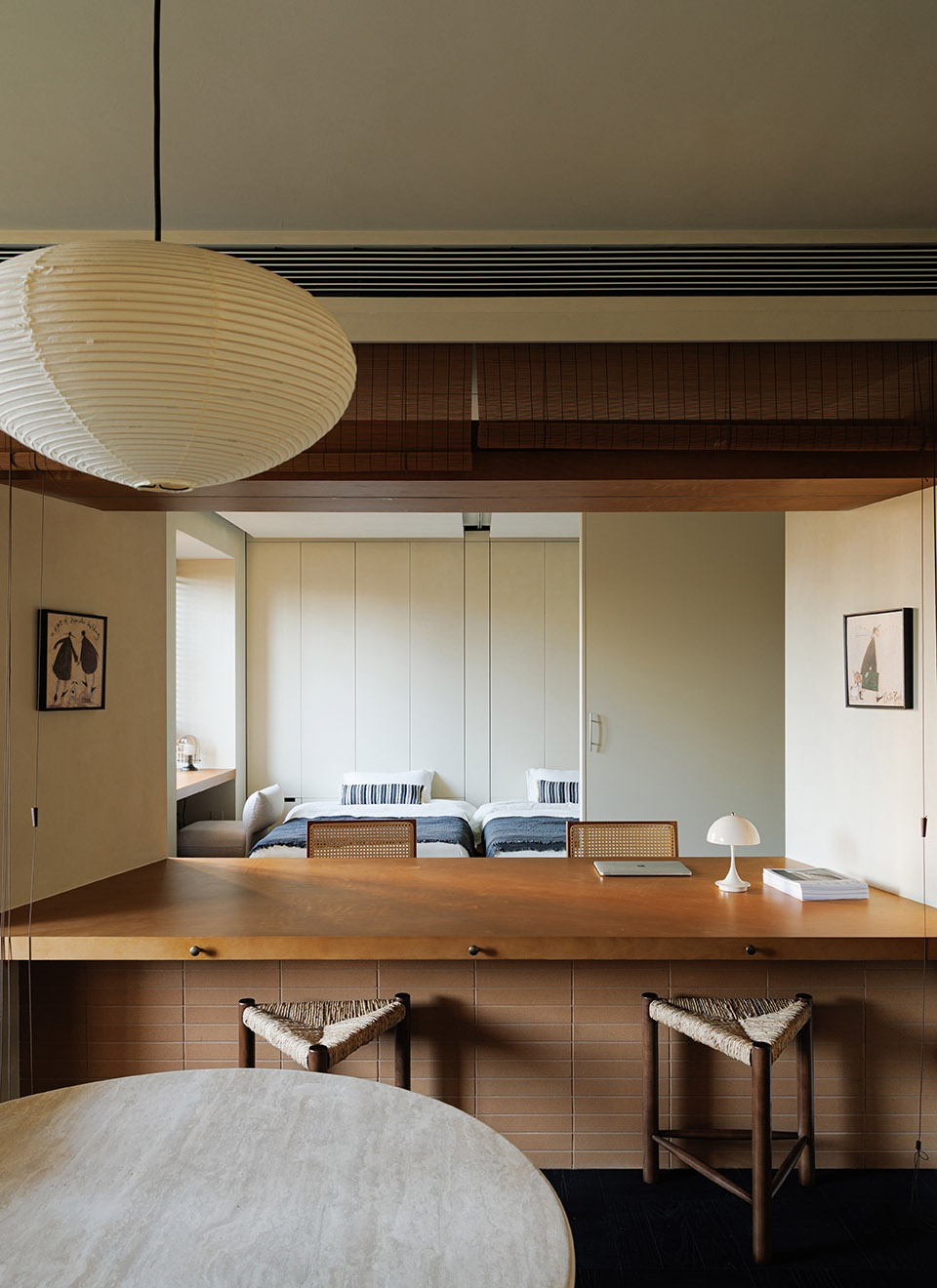
餐厨与儿童学习区之间,以一个 “喇叭口”式的开放结构相连,而非硬性隔断。这意味着大人在厨房洗切炒煮时,能随时看到在长桌上学习或玩耍的孩子们,并进行自然对话。
Instead of a solid dividing wall, a flared funnel-shaped opening connects the kitchen and kids’ study nook, allowing cooking parents to keep sight of their children studying or playing and chat casually at any time.
▼“喇叭口”式的开放结构相连,a flared funnel-shaped opening
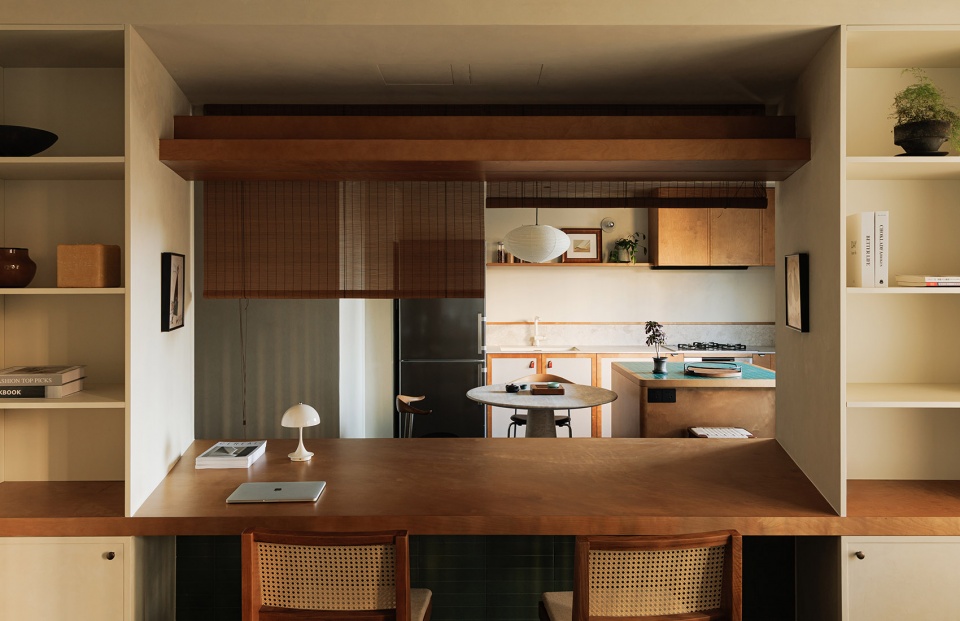
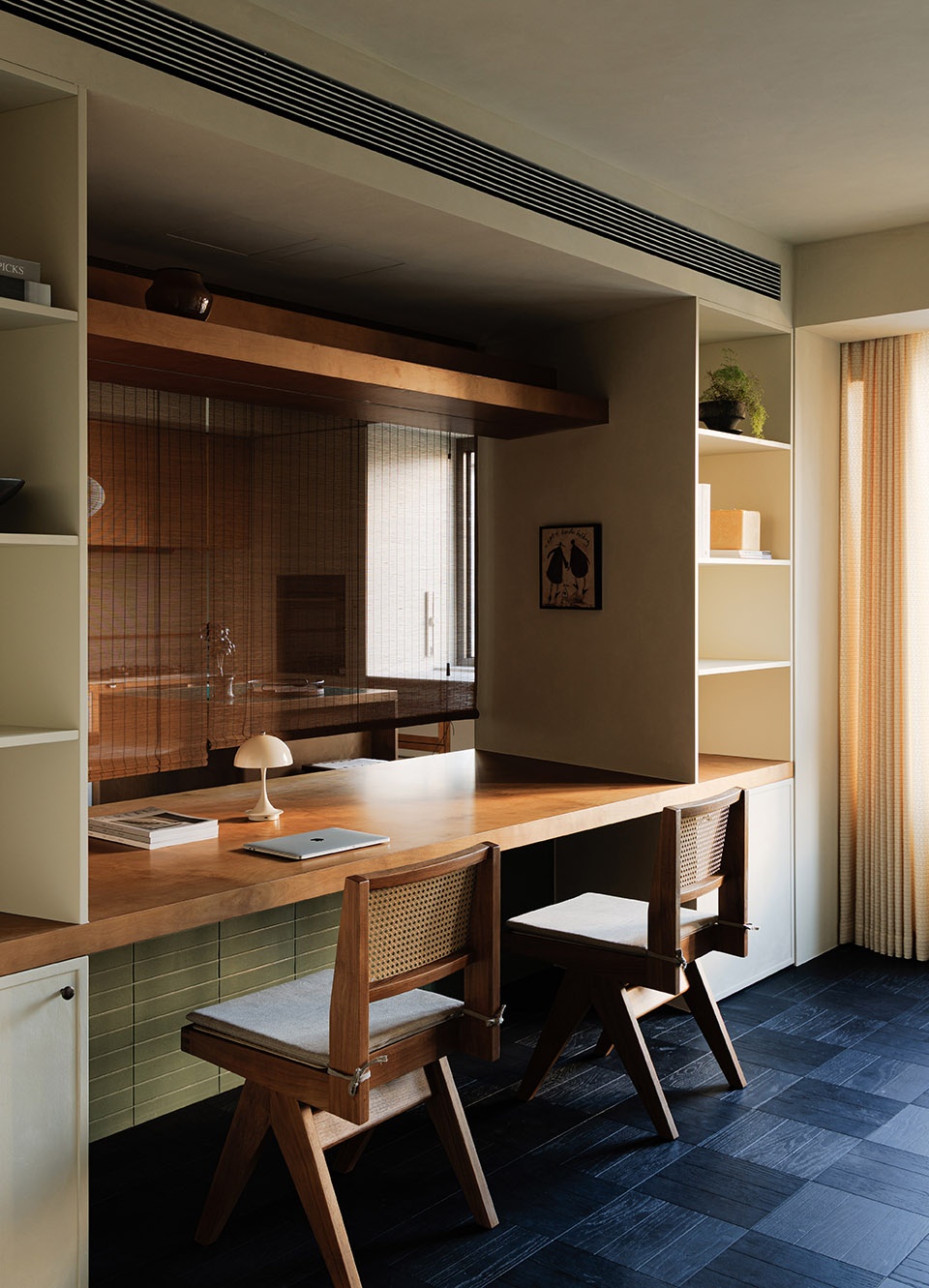
实木大桌平日是孩子们的书桌,当家庭聚会时,便可轻松转变为容纳多人的延伸餐桌。这种布局让家人在各司其“职”时,始终保持亲密的联系。
The solid wooden table doubles as children’s study desk on weekdays and expands for large family feasts, maintaining close family bonds even when everyone follows separate schedules.
▼实木大桌,The solid wooden table
共享儿童房:一个“可分可合”的成长盒子 Kids’ Bedroom: A Convertible Modular Room For Growing Boys
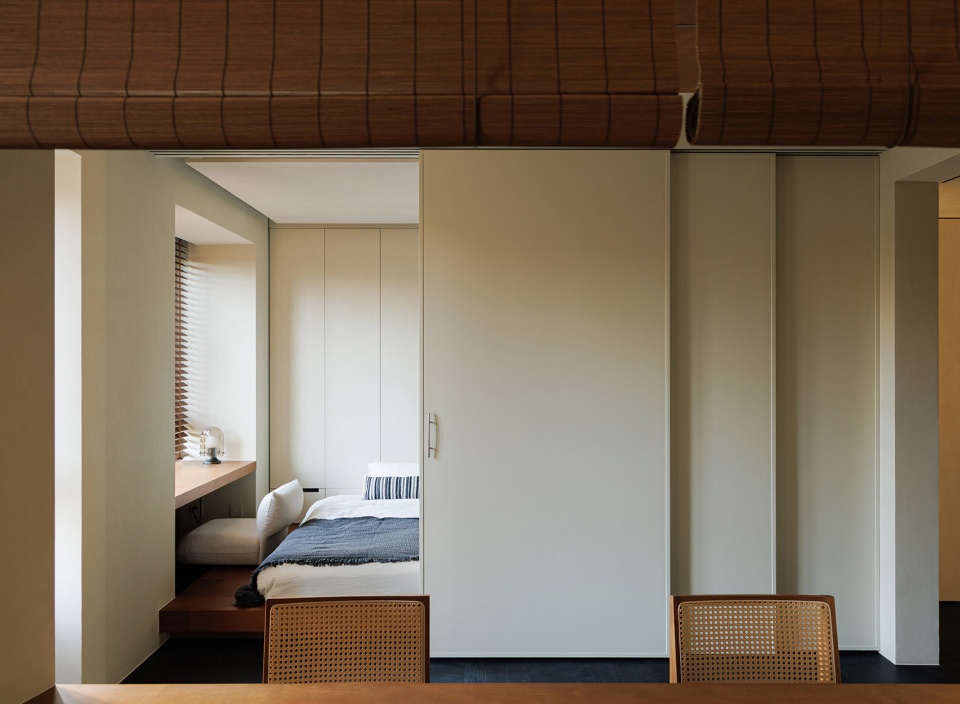
面对两个男孩的成长需求,设计师放弃了传统的两间独立卧室思路,转而创造了一个 “四合一”的可变空间,一道“T字形”移动门定义空间的四种模式:完全开放模式:当所有门扇收起,这里变成一个包含睡眠区、超长双人书桌、阅读角的广阔天,孩子们可以肆意奔跑、共同学习或一起打闹。
Designed for two growing sons, designers replaced two fixed separate bedrooms with a flexible all-in-one room controlled by a T-shaped sliding partition that switches between four layouts: 1.Fully open layout: All sliding panels retract to form one expansive zone with sleeping quarters, an extra-long twin desk and reading corner for free-running, group study and play.
▼共享儿童房,kid’s bedroom
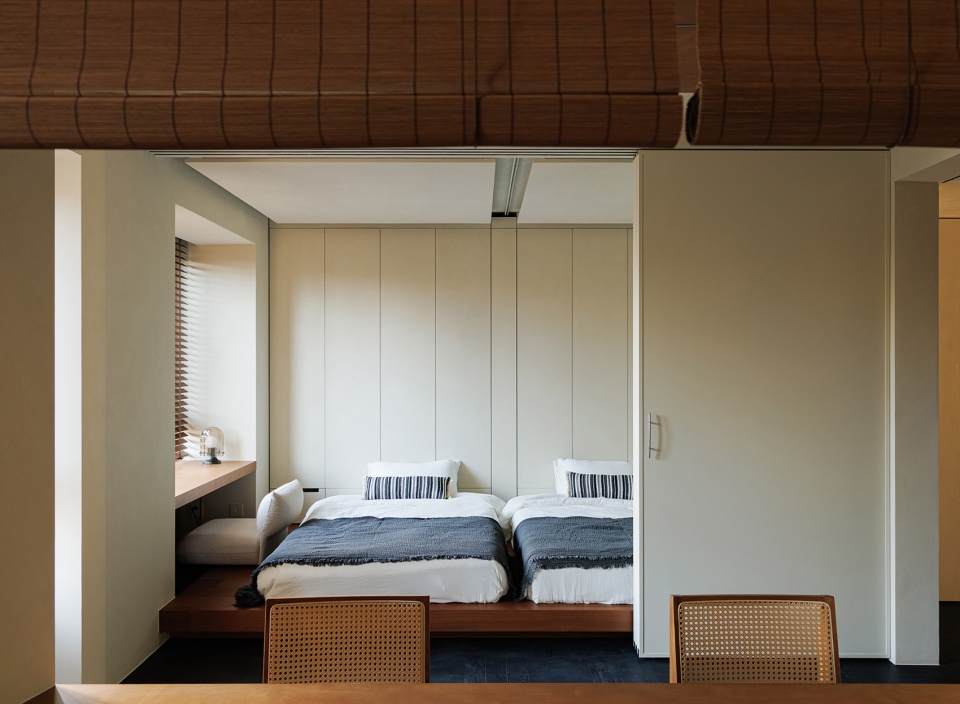
▼共享儿童房,kid’s bedroom
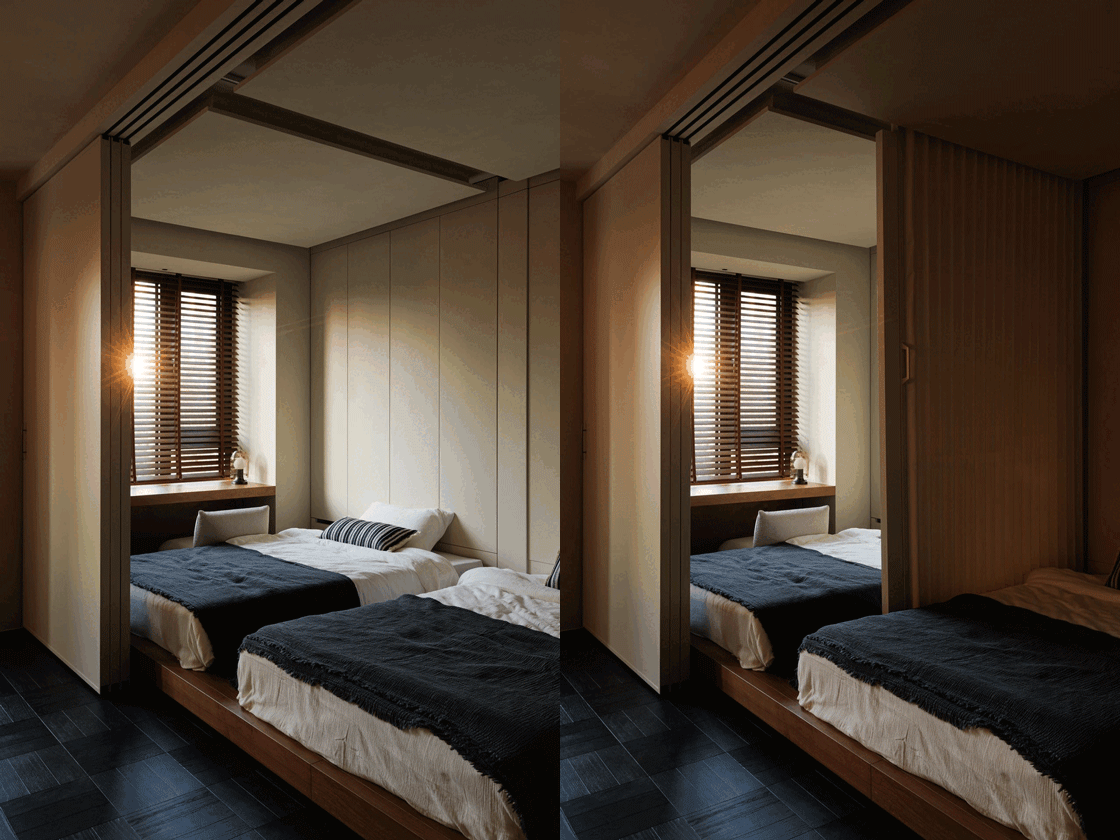
独立双卧室模式:两个床中间预留推拉门轨道,进一步展开隐藏的折叠门,形成“T”字闭合,睡眠区被分隔成两个带独立入口的私密卧室,满足孩子对个人空间日益增长的需求。
2.Dual independent bedroom layout: Hidden folding doors slide along preset tracks to form a T-shaped divider, splitting the space into two private bedrooms with separate entrances to satisfy the boys’ growing need for personal privacy.
▼双卧室模式,dual bedroom layout
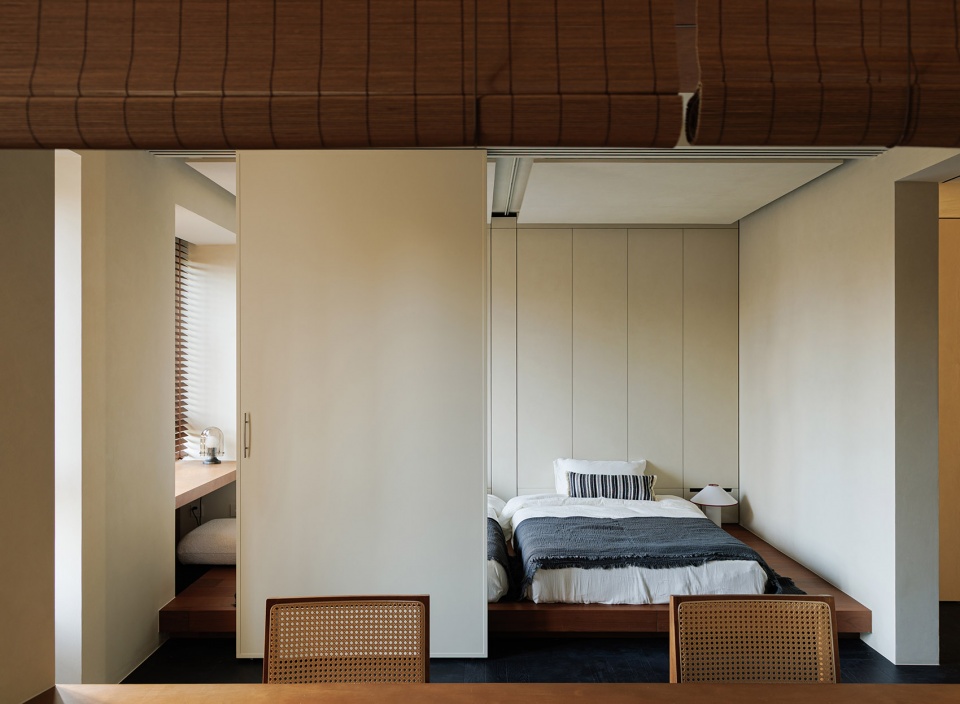
独立学习模式:利用靠窗的飘窗小书桌,当一方需要家教辅导或特别安静时,两个孩子可以在大书桌与小书桌上分开学习,互不打扰。而当推拉门完全关闭时,两间儿童房又可以完全独立。
3.Split-study layout: The compact bay-window desk by the window enables private tutoring for one child while the other studies at the main long desk without mutual disturbance.4.Full separation layout: Fully closed partitions split the room into two entirely standalone bedrooms.
▼学习模式,study layout
客卫:能“变形”的空间枢纽 Guest Powder Room: A Shape-Shifting Multi-Functional Transit Core
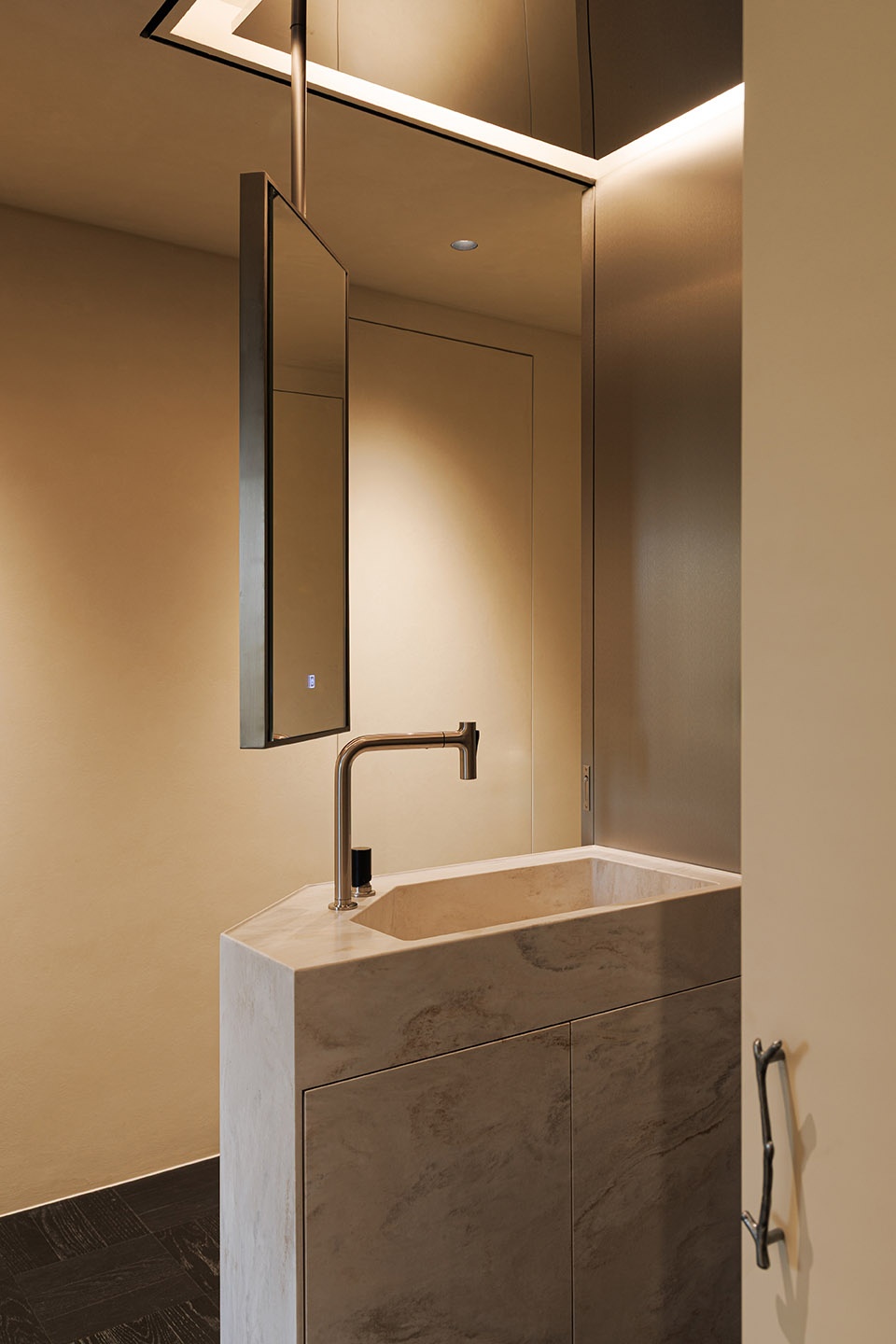
客卫的设计彻底打破了传统卫生间的封闭概念。它被重新定义为一个多功能、可变形的生活枢纽,巧妙嵌入在孩子们卧室与主卧套间的必经走廊上,在不到5平米的空间里,实现了洗漱、更衣、洗衣以及干湿分离。
Breaking conventional enclosed bathroom design, this under-5-square-meter powder room sits along the main corridor linking the kids’ wing and master suite, transformed into a flexible multi-purpose hub integrating washing, changing and laundry with complete wet-dry separation.
▼客卫,guest bathroom
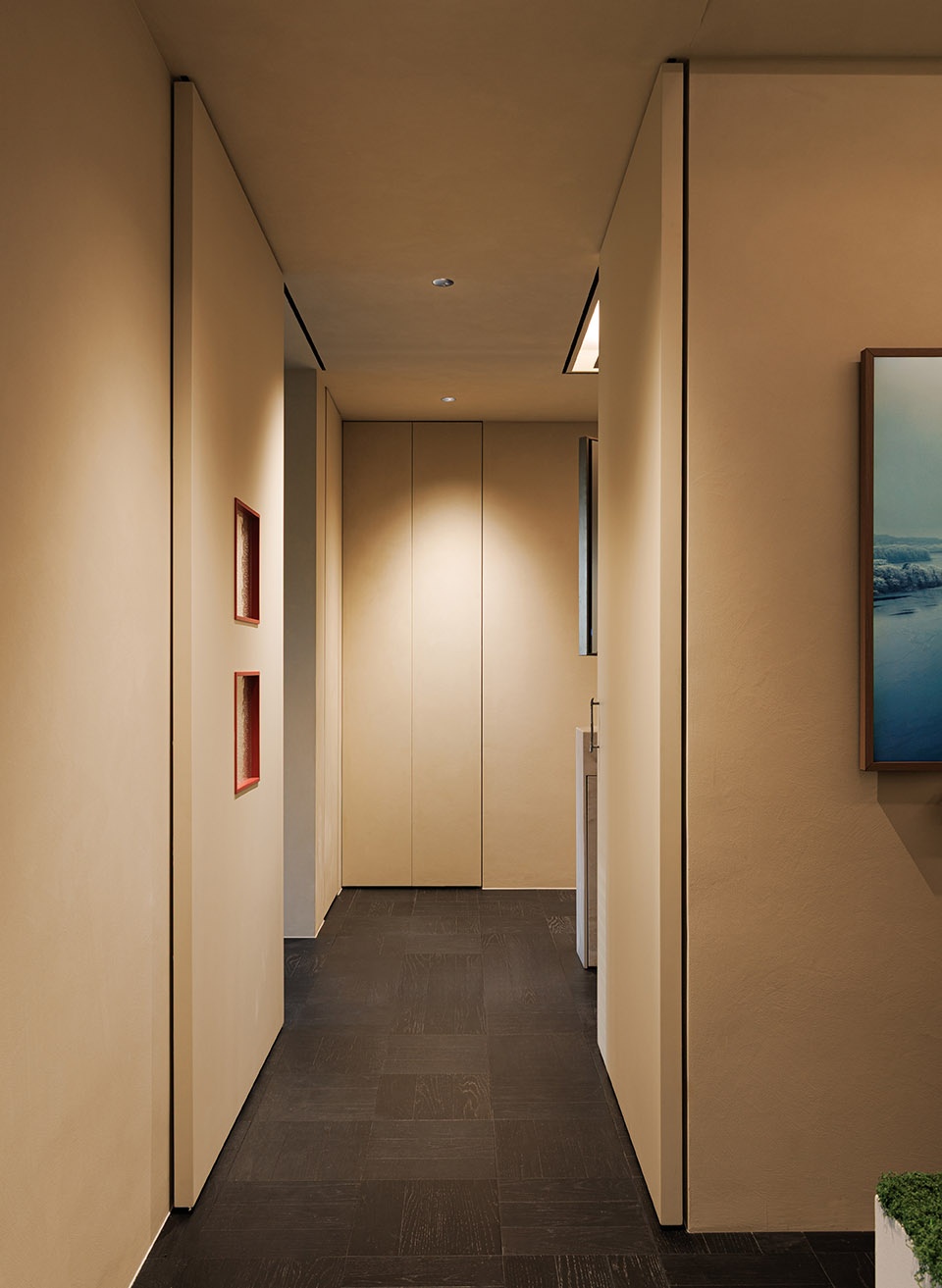
首先将洗手台完全独立外置,实现了彻底的三分离。外置的洗手台就像一个切角式的悬浮岛台。其内侧通往马桶间和淋浴房,外侧则形成通往主卧的走廊,自然分流不同动线,化解了走廊的冗长与无趣。
The vanity counter is fully detached outward to achieve three-part functional separation. This angled floating vanity leads inward to the toilet and shower enclosures, while its outer edge forms a smooth corridor toward the master bedroom, streamlining foot traffic and eliminating tedious long hallways.
▼客卫,guest bathroom
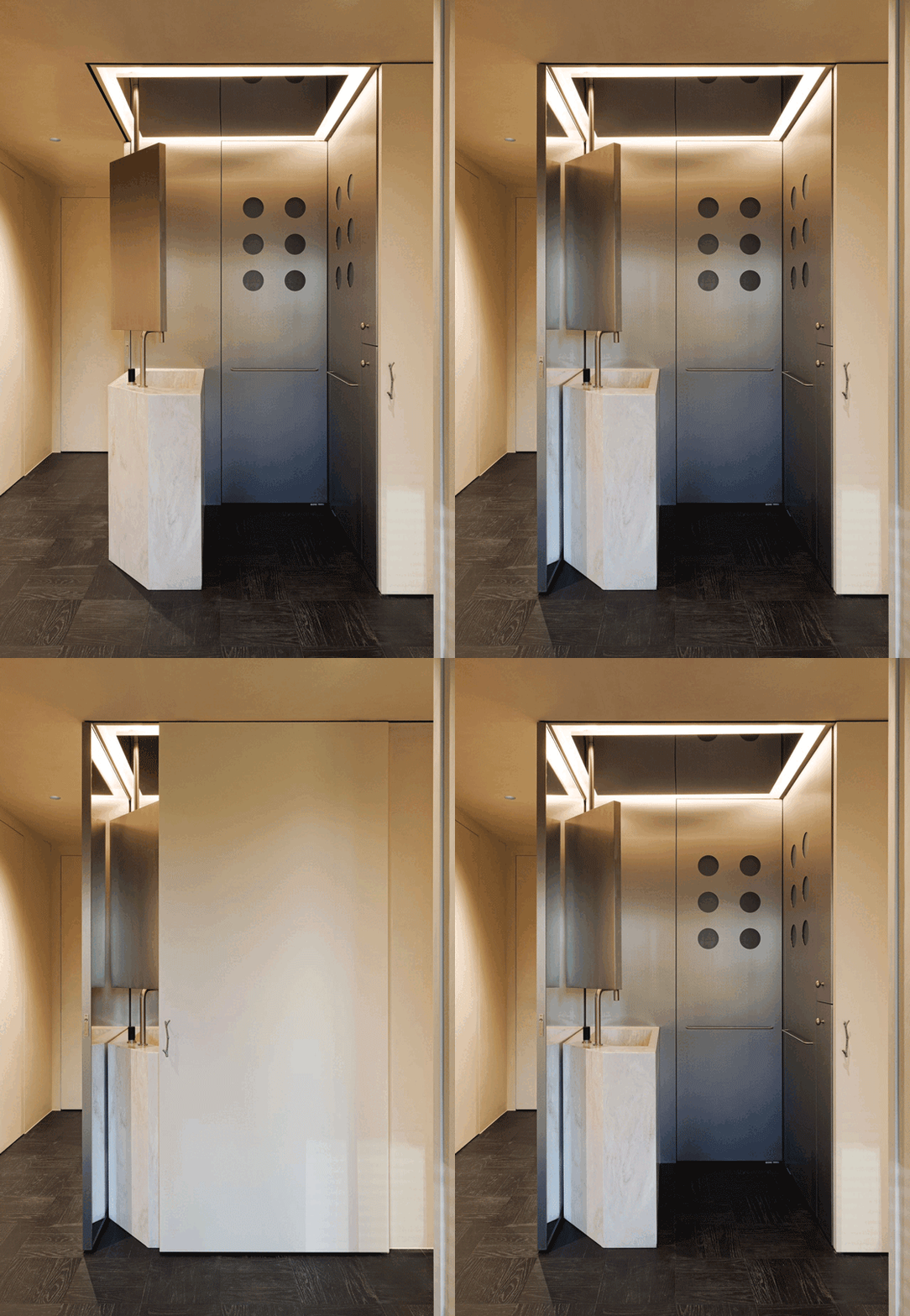
设计师在洗漱台外侧设计了一扇顶天立地的双面镜门,它远不止是一扇门:日常停在走廊,是方便的全身镜。当两扇门闭合时,则能瞬间围合出一个带镜子的私密更衣间。一物多用,优雅地解决了洗漱、更衣与收纳的多重需求。
A full-height double-sided mirrored door beside the vanity serves dual purposes: resting alongside the corridor as a full-length dressing mirror in daily use, or closing to form an instant private mirrored changing room. This multi-functional detail neatly addresses washing, changing and storage demands within limited space.
▼客卫细部,guest bathroom detail
主卧:环环相扣的私密套间 Master Suite: Interconnected Private Retreat
主卧套房的设计,超越了单纯的睡眠功能,它被塑造为一个集安睡、收纳、梳妆、沐浴于一体的高效、宁静且充满互动可能的私属领域。
Beyond basic sleeping functions, the master suite is crafted into an efficient, tranquil private sanctuary combining rest, storage, makeup and bathing with flexible interactive potential.
▼主卧入口,the main bedroom entrance
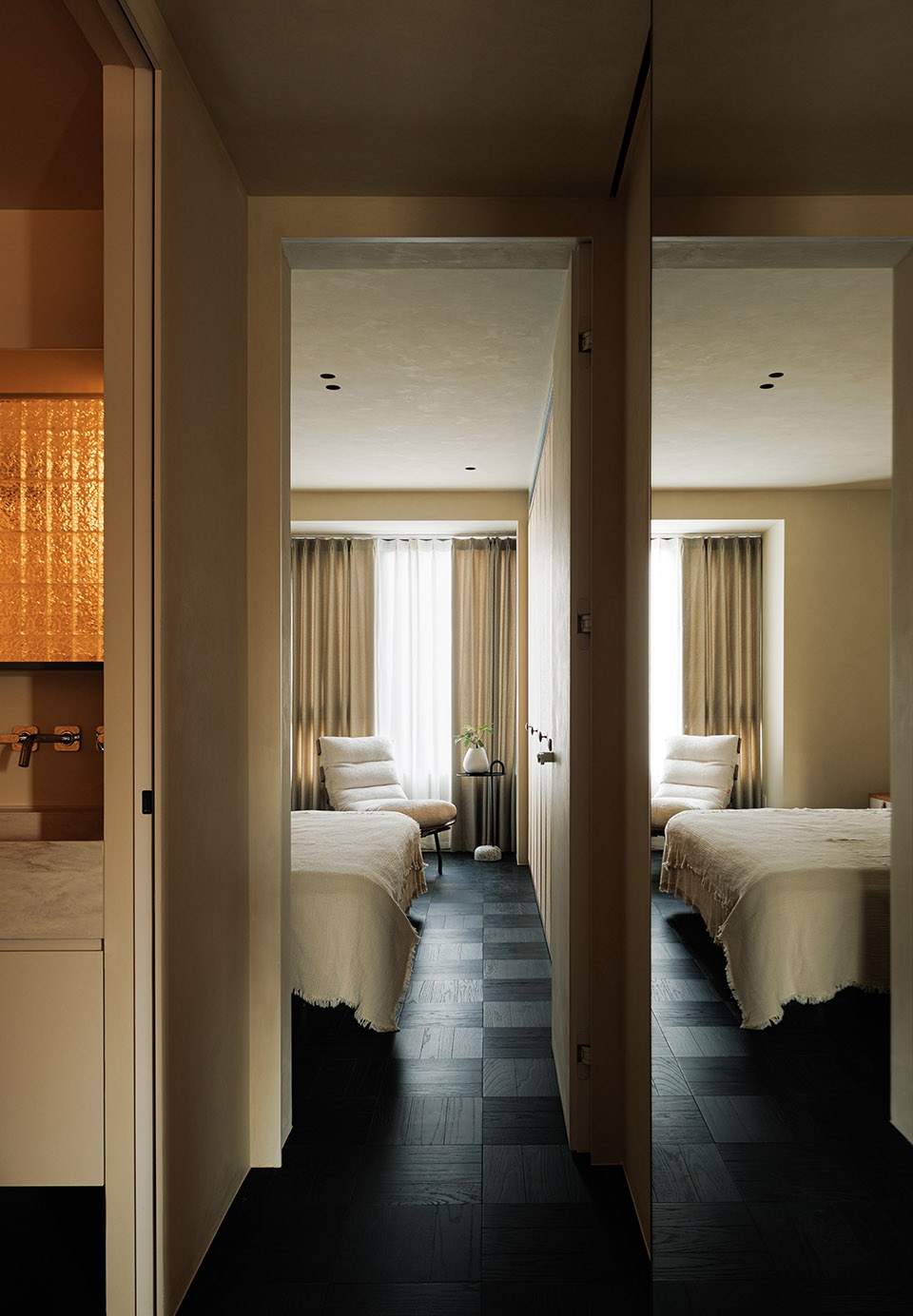
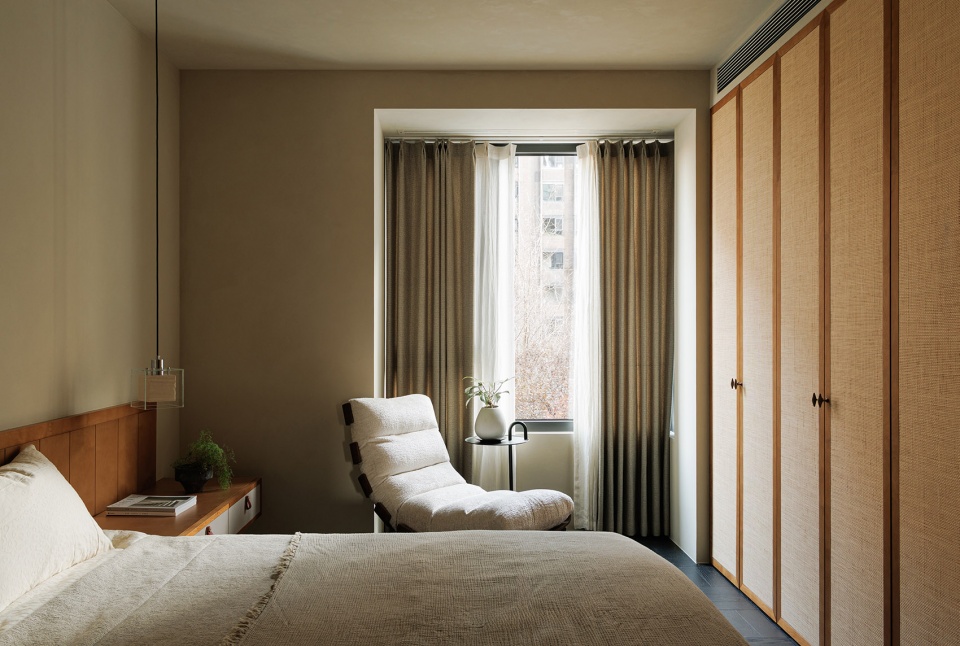
睡眠区内部力求纯粹,仅保留睡眠和收纳两个基础功能,确保卧室能只服务于休息与放松。
The sleeping zone adopts minimalist furnishing with only beds and built-in storage to keep the space tranquil for pure rest.
▼主卧空间,the main bedroom space
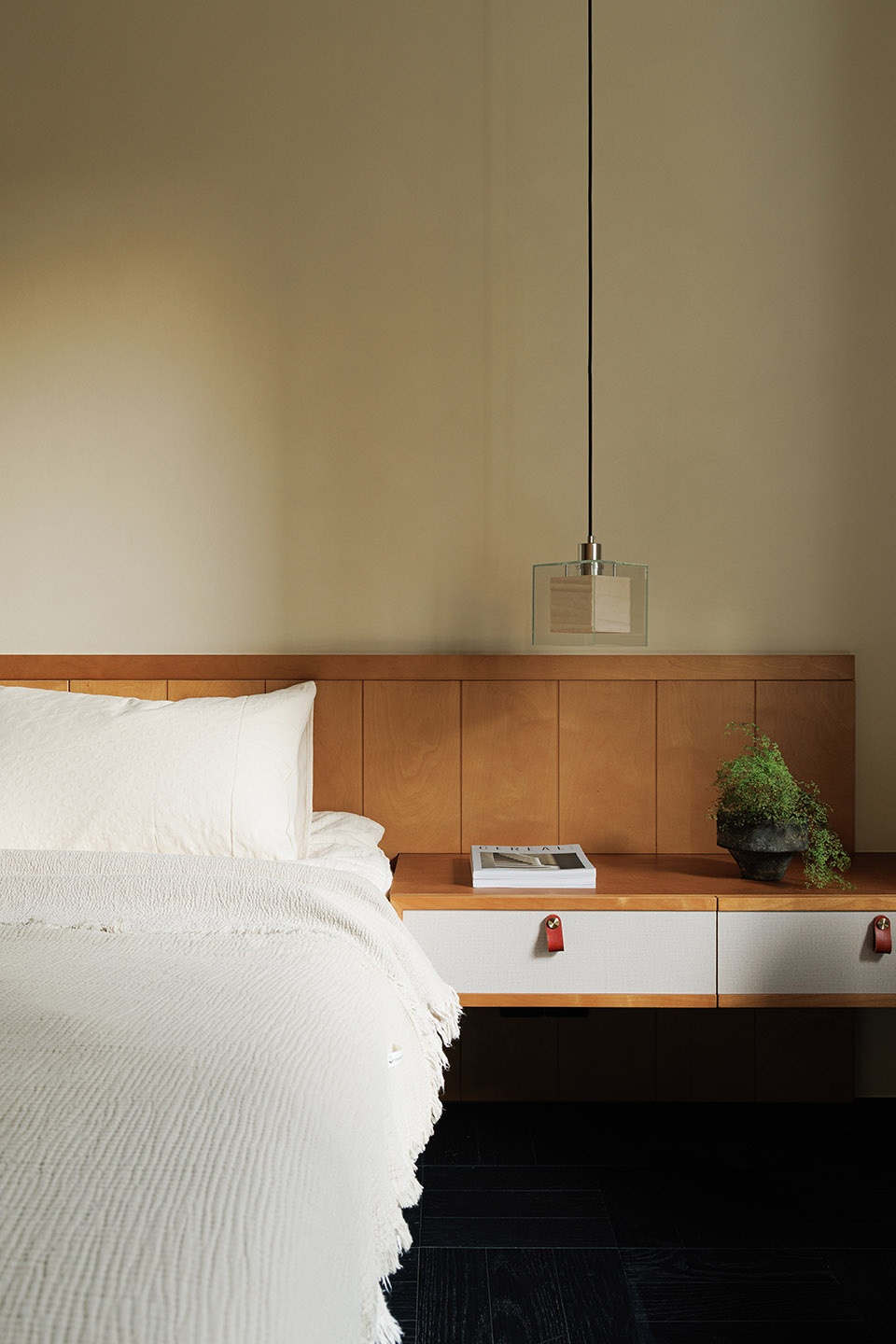
▼卧室设计细节,the main bedroom detail
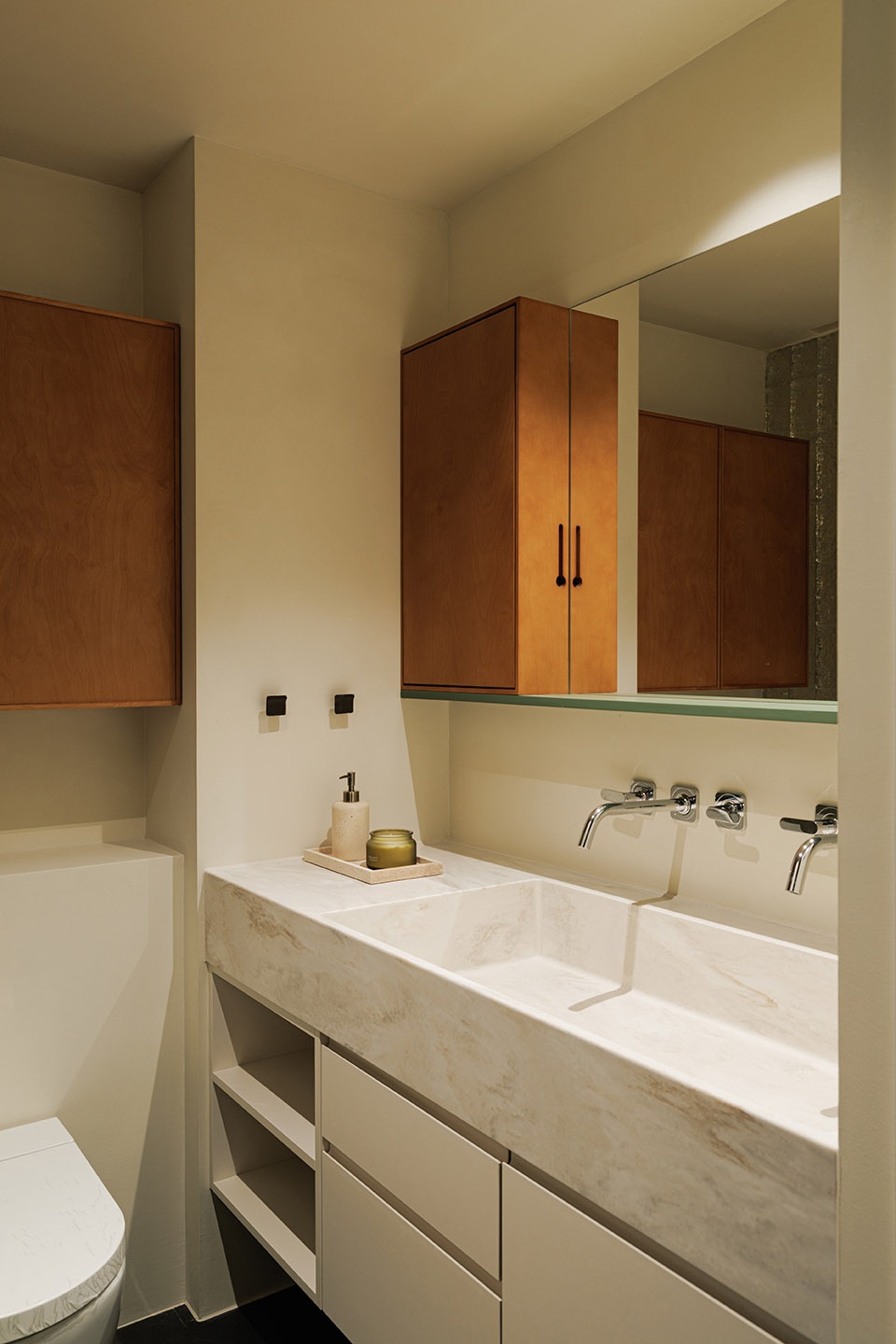
主卫洗漱台配备两个龙头的定制一体化台盆,让早晚高峰时段不再拥挤。上方的镜柜与开放层板组合,既满足了收纳,又方便放置眼镜、香薰等随手物品。
The attached master bathroom features a custom double-sink vanity to ease morning rush congestion; combined wall cabinets and open shelving offer convenient storage for glasses, aromatherapy and daily essentials.
▼定制一体化台盆,a custom double-sink
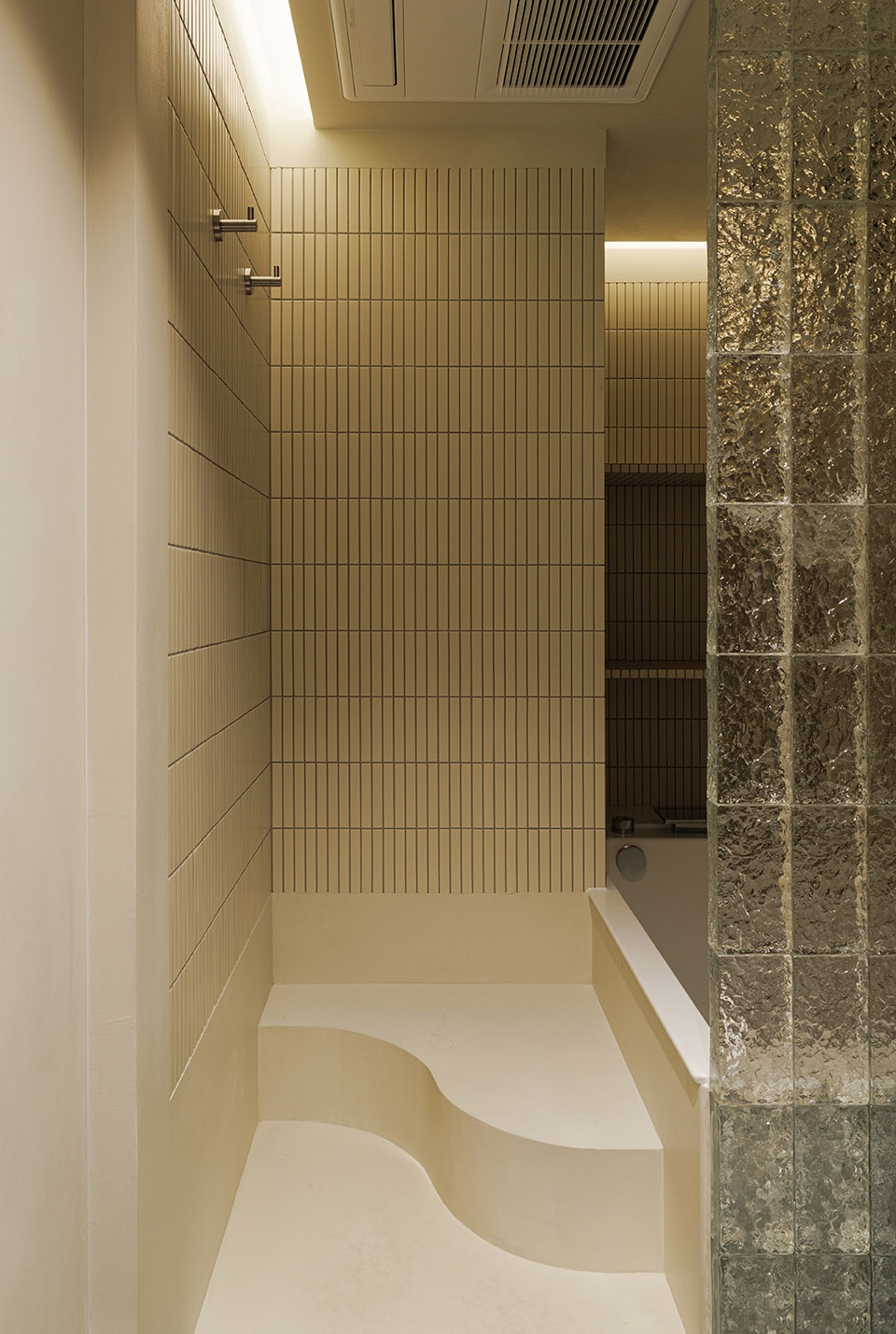
淋浴区与浴缸结合,通过玻璃砖墙实现干湿分离。浴缸旁设置台阶兼作座位,提升泡澡的仪式感与便利性。
The bathtub and shower area are divided by translucent glass blocks for wet-dry separation, with custom built-in steps beside the tub functioning as casual seating to elevate bathing comfort and ritual.
▼淋浴区与浴缸结合,the bathtub and shower area
写在最后 Epilogue
最终,这个家中的每一处设计,都像主卫里那面兼顾隐私与光感的玻璃砖墙一般,在“间隔”与“连通”之间找到了精妙的平衡。这种恰到好处的平衡,让家不再是冰冷的物理空间,而成为一张“无形的网”,让光线、视线与家人的笑声在其中自由穿梭。
Every detail crafted for this home strikes an exquisite balance between partition and connectivity, just like the translucent glass blocks featured in the master bathroom. Far from being a cold structural shell, the house is woven into an invisible spatial web, where sunlight, unobstructed sightlines and the sound of family laughter drift freely across every corner.
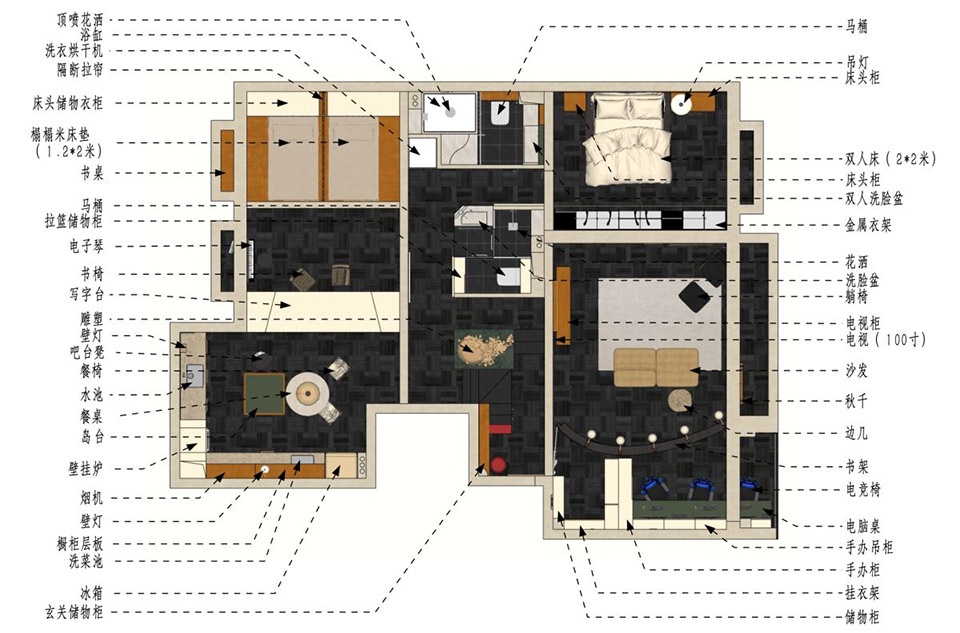
▼功能布局图,function layout
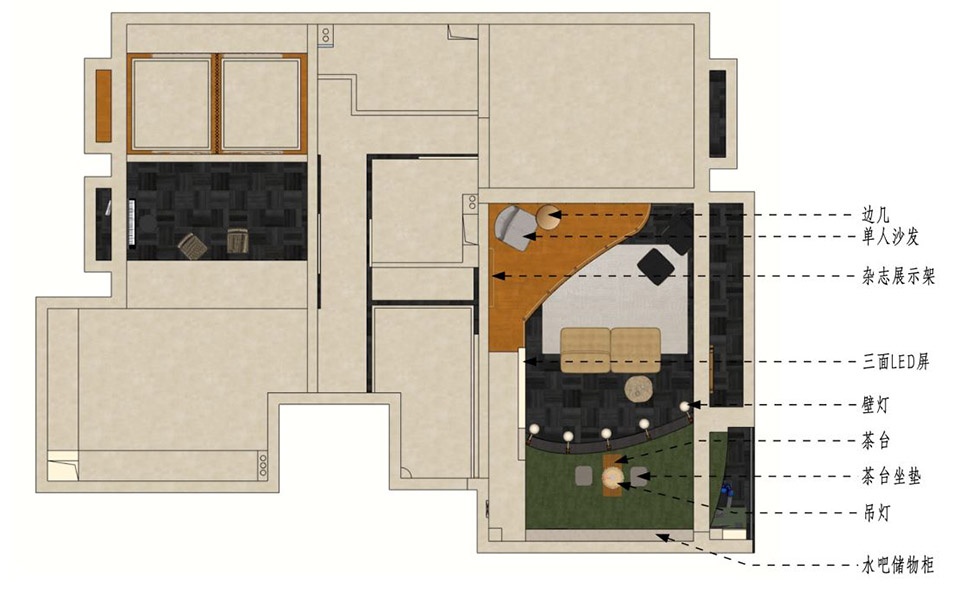
▼夹层功能布局图,mezzanine level function layout
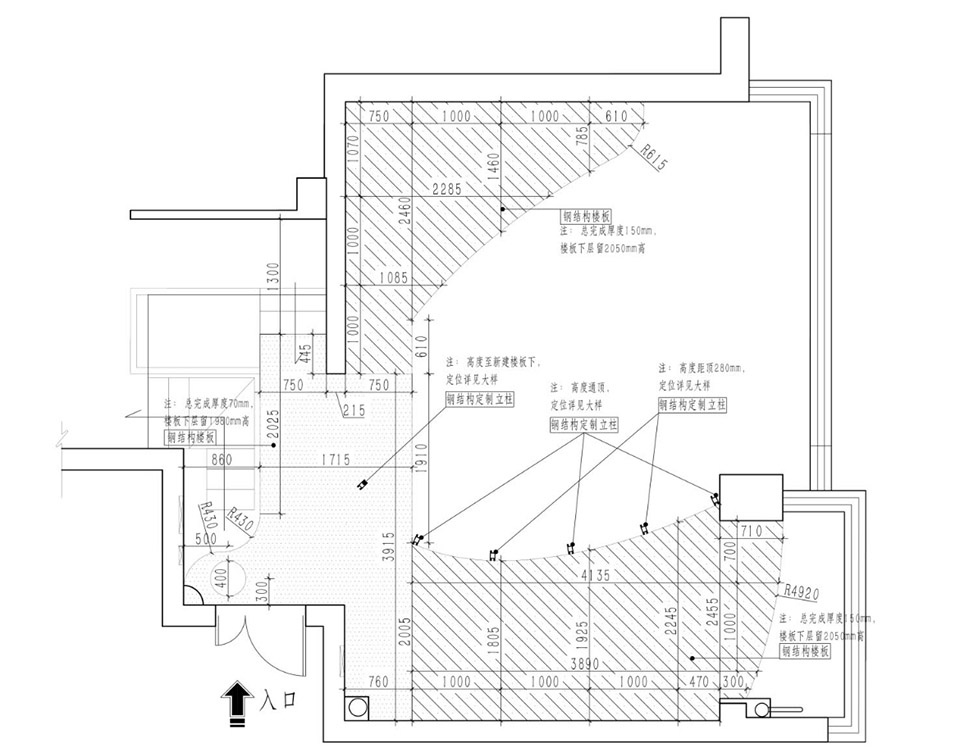
▼二层钢结构尺寸图,Two-story steel structure dimension drawing
Project Name:The Bridge House, Where Tenderness Is Interwoven Through Space
Project Type: Interior Design
Design Firm:7 Design
Leader designer: Bingbing Wang
Contact Email: 2456342943@qq.com
Design Period:Feb 2025
Completion Year: Jan 2026
Project Address: Wangjing, Beijing
Floor Area: 200㎡
Photography Credits: Liming Fang、Qiao Rui
Partners:YICHIYIJIE
Materials: Steel structure、Birch、Brick、Artistic paint、 Tempered glass