经浦园,上海 / 同济原作设计工作室
场地原由高校附属绿地与公共绿地共同构成,长期以内部管理为主,边界围合,空间闲置。设计以“穿林之径,憩水之滨”为题,回应大学城公共空间开放共享的需求,推动高校附属绿地从封闭走向开放。
Originally composed of both university-affiliated green space and public green space, the site had long been managed as an internal campus area, with enclosed boundaries and underused spaces. Taking “A Path Through the Woods, A Resting Place by the Water” as its theme, the design responds to the need for open and shared public spaces in the university town, transforming the once-enclosed university-affiliated green space into an accessible public landscape.
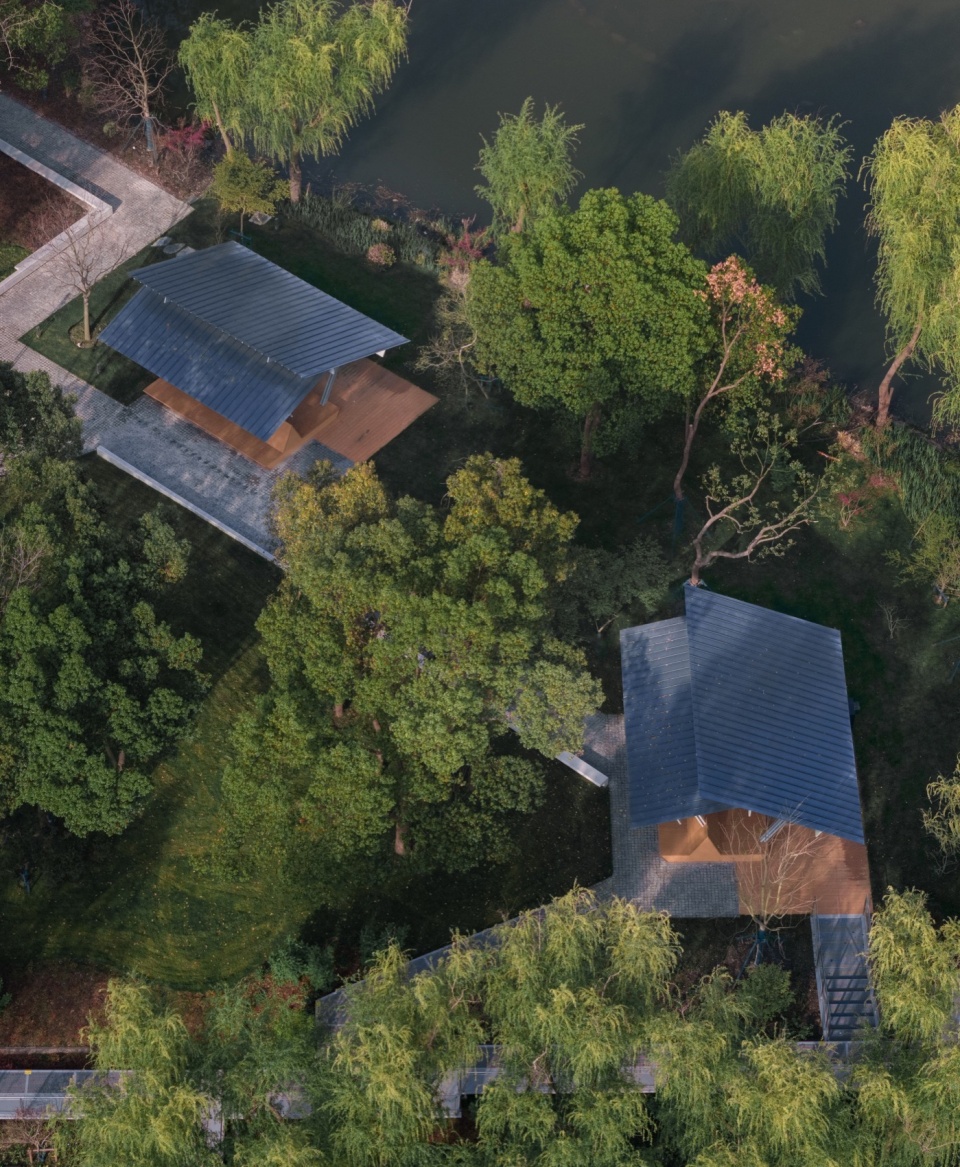
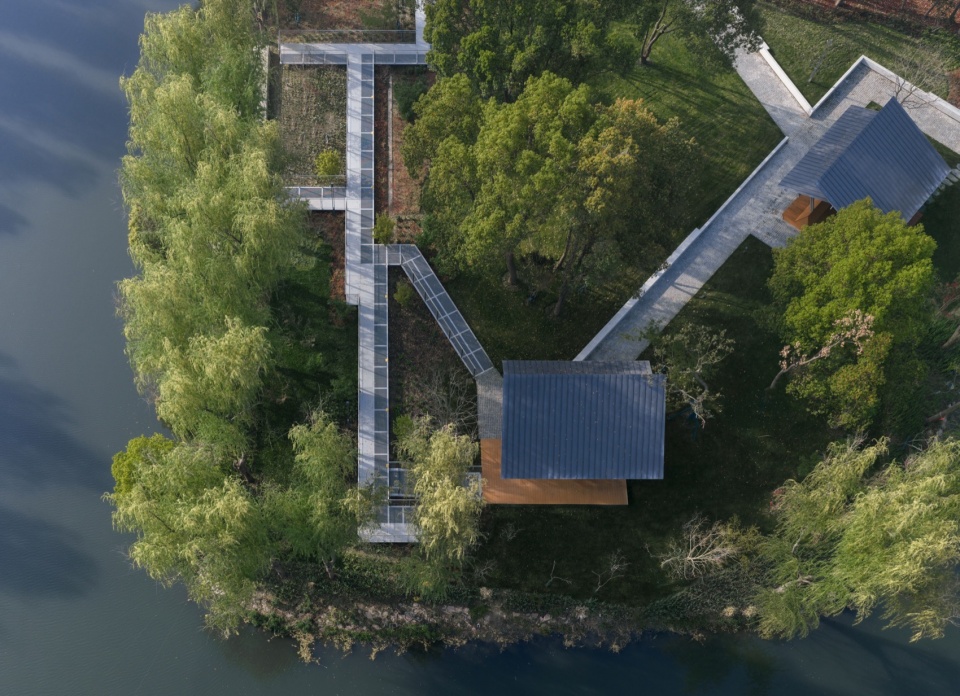
▼鸟瞰经浦园,Aerial View of Jingpu Garden
更新以“低干预、轻介入”为原则,保留原有林地与水岸生态基底,通过打开边界、梳理路径、优化岸线等方式,提升空间的可达性与舒适度。林下空间从单一的绿化背景,转变为可步行、可穿越的慢行通道;滨水岸线则被整理为可停留、交流、休憩的公共界面。由此,场地在校园生活与城市公共生活之间建立起柔性联系,嵌入大学城开放空间体系,成为一处兼具生态底色与公共活力的日常锚点。
Guided by the principles of “low intervention and light-touch design,” the renovation preserves the existing woodland and waterfront ecological base. By opening up the boundaries, reorganizing the circulation, and refining the shoreline, the project enhances the accessibility and comfort of the space. The understory area is transformed from a mere green backdrop into a slow-mobility passage for walking and crossing through, while the waterfront edge is reshaped into a public interface for staying, gathering, and resting. As a result, the site establishes a soft connection between campus life and urban public life, becoming embedded in the university town’s open-space system as an everyday anchor with both ecological character and public vitality.
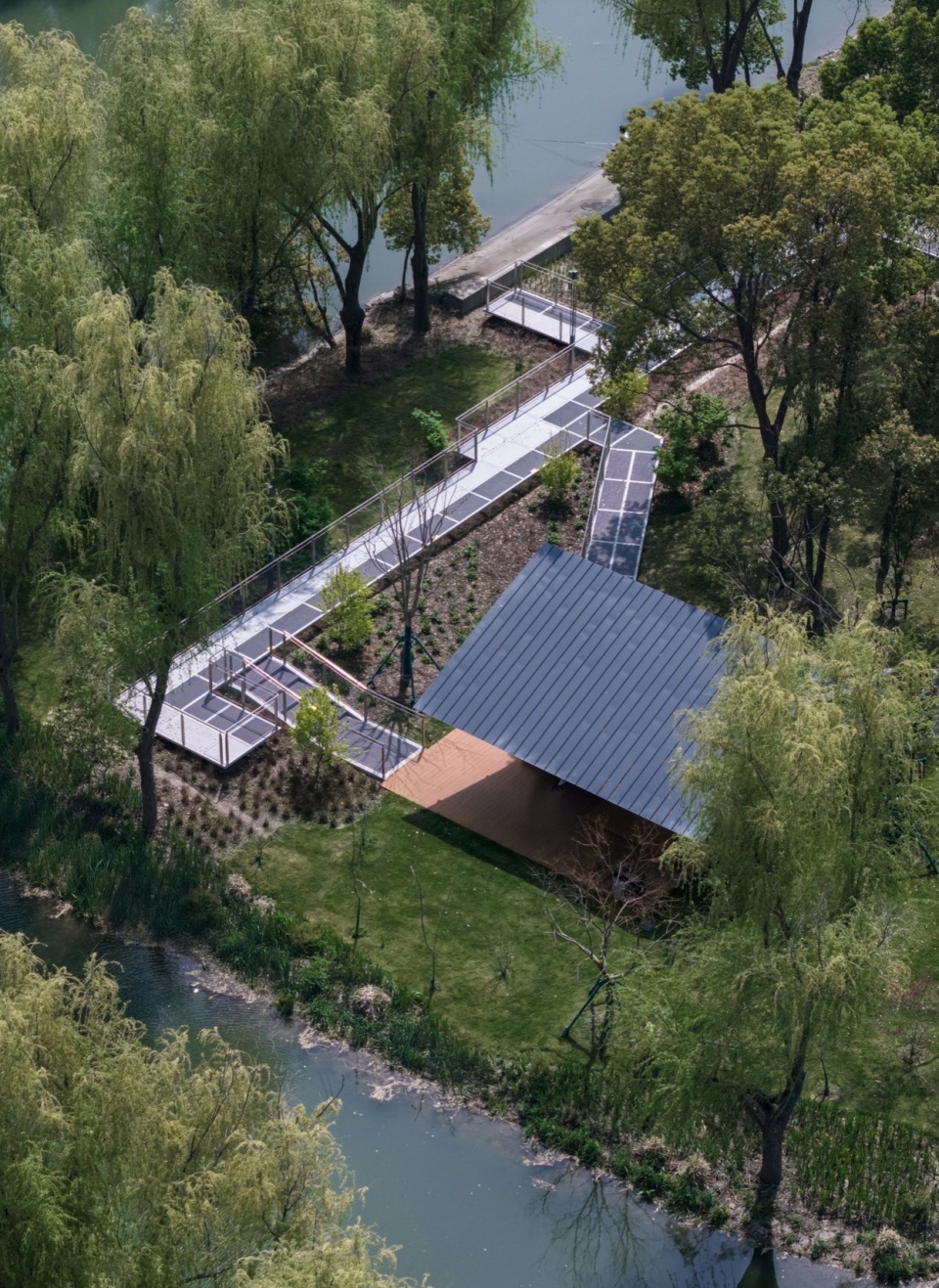
▼穿林之径,Path Through the Woods
01 区位与愿景 01 Location and Vision
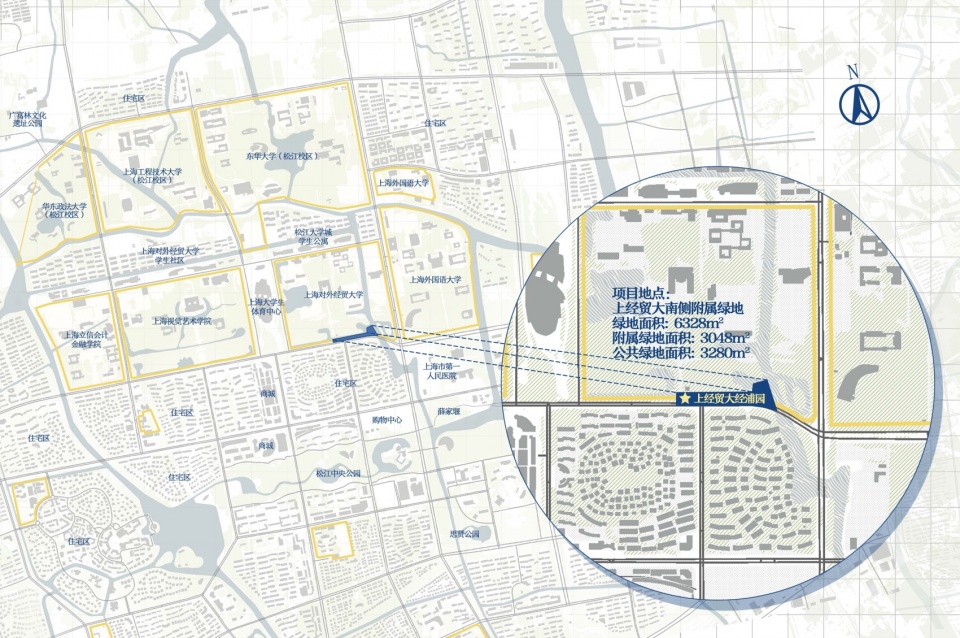
经浦园坐落于上海对外经贸大学南侧,北依龙兴港,南临文翔路,总占地面积6328平方米(含附属绿地3048平方米、公共绿地3280平方米)。场地原为植被郁闭、边界封闭的“绿色屏障”,滨水岸线亦长期处于闲置状态。随着上海推动附属空间向社会开放,经浦园迎来由封闭绿地向公共空间转化的契机。设计团队通过拆围透绿、空间梳理,打造了一个校社共享的游憩枢纽。
Located to the south of Shanghai University of International Business and Economics, Jingpu Garden is bordered by Longxing River to the north and Wenxiang Road to the south. The site covers 6,328 square meters, including 3,048 square meters of affiliated green space and 3,280 square meters of public green space. Originally, the site was a dense and enclosed “green barrier,” while the waterfront edge had long remained underused. As Shanghai promotes the opening of affiliated spaces to the public, Jingpu Garden has gained the opportunity to transform from an enclosed green space into a public space. Through fence removal, green-space exposure, and spatial reorganization, the design team created a recreational hub shared by the campus and the community.
▼项目区位图,Project Location Map
▼场地现状,Site Context

02 理念与策略02 Concept and Strategy
设计团队以“穿林之径,憩水之滨”为核心设计理念,通过“视线渗透、路径优化、水岸织补、弹性模块”四步策略,将原本封闭的林缘转变为可穿行、可停留的开放界面。通过保留现状香樟、柳树等骨干乔木,清理杂乱灌木,设计引导绿地向水岸有机渗透,将原本封闭、单一的绿地空间,转化为具备“空间可达、活动可容、景观可赏”特征的滨水开放空间。
▼场地生成分析图,Site Generation Diagram
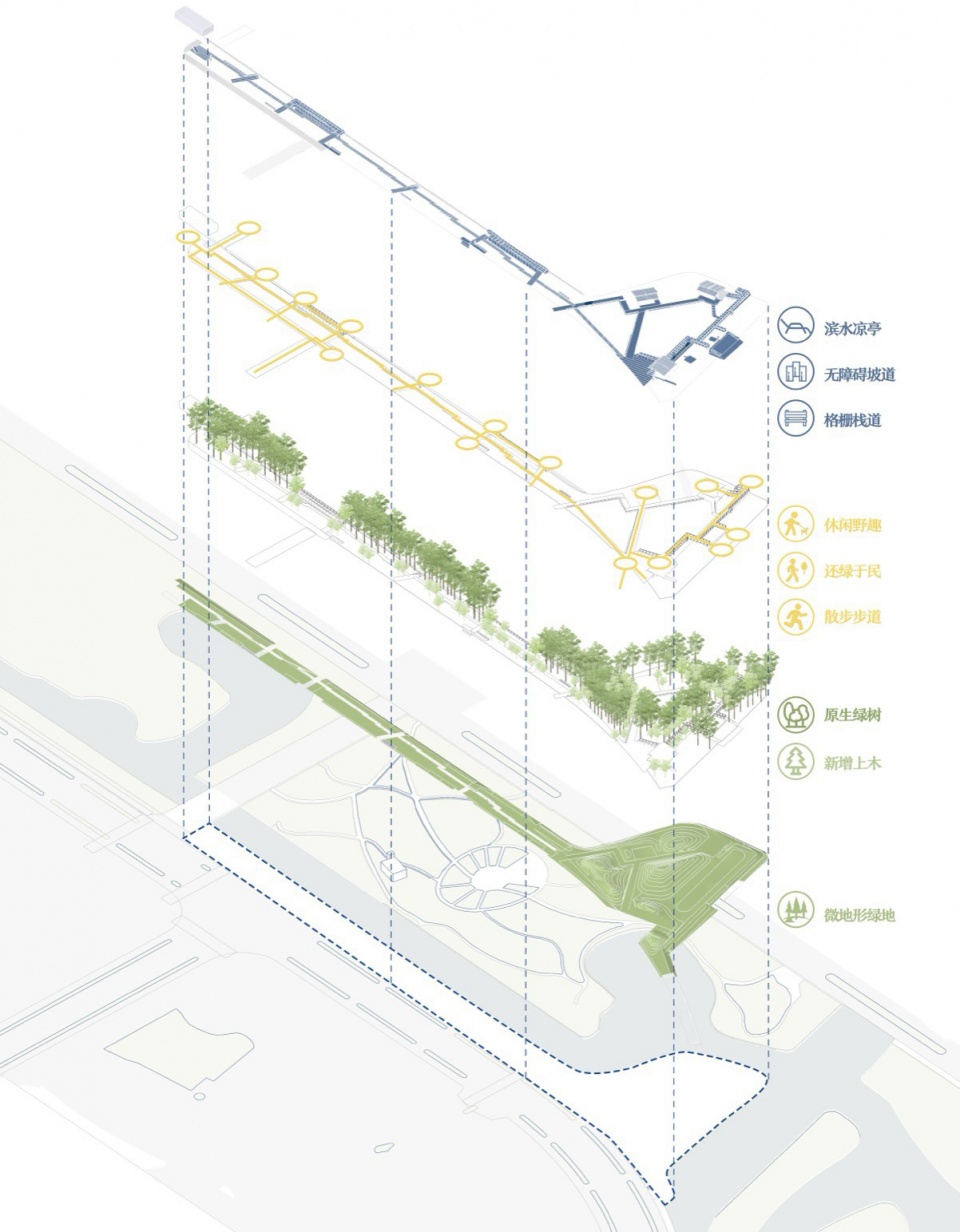
With “A Path Through the Woods, A Resting Place by the Water” as the core design concept, the design team adopted a four-step strategy of visual permeability, path optimization, waterfront stitching, and flexible modules, transforming the formerly enclosed forest edge into an open interface for walking and staying. By preserving existing framework trees such as camphors and willows, clearing disorderly shrubs, and guiding the green space to extend organically toward the waterfront, the design turns an enclosed and singular green space into an open waterfront space characterized by spatial accessibility, capacity for activities, and scenic experience.
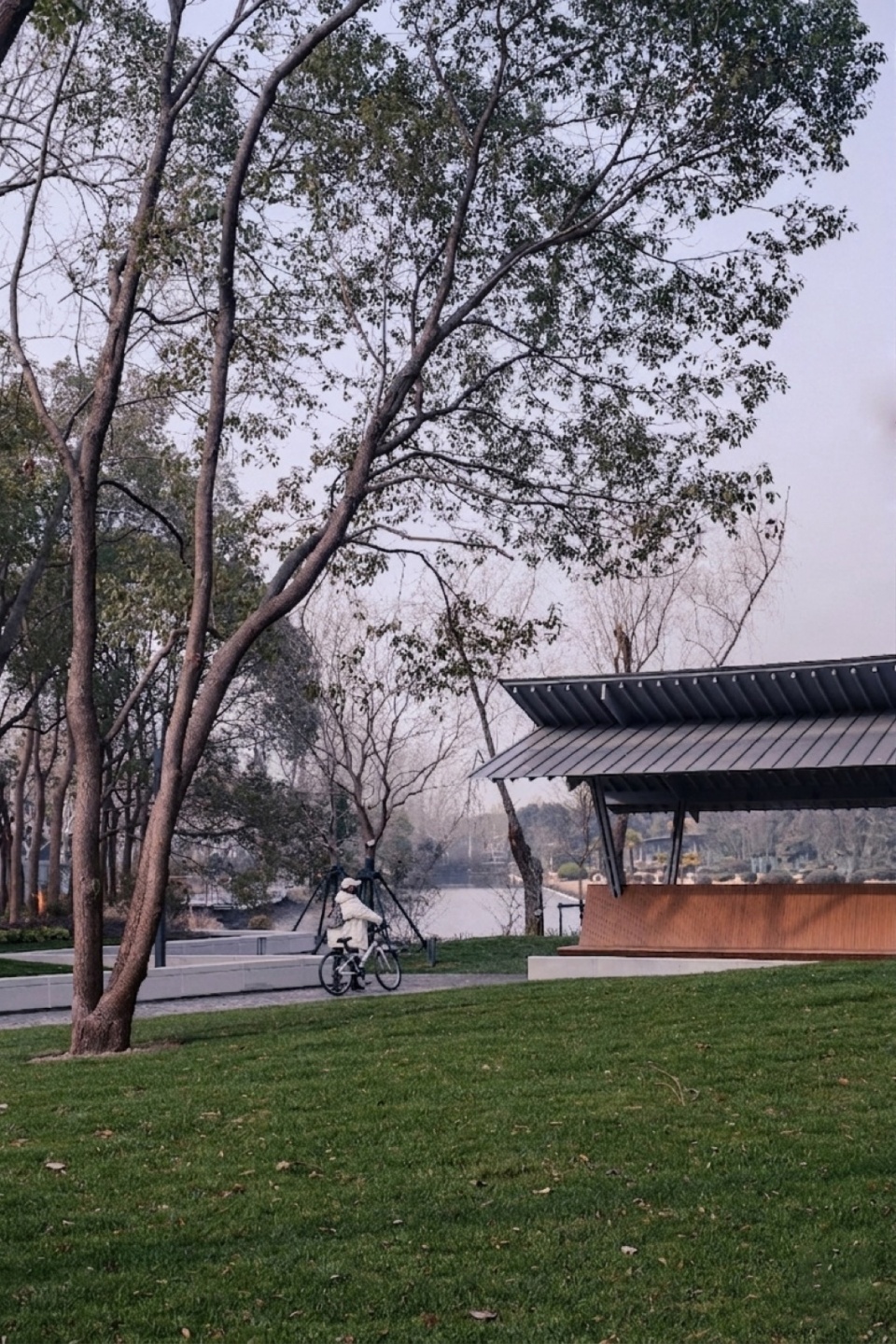
▼保留大树与有风小亭,Retained Trees and the Breezy Pavilion
项目建造周期较短,团队采用预制化加工、平行施工与现场精准对接的建造模式,在保证工程质量与植物保护的前提下,实现了景观空间的快速落地。
The project had a short construction period. The team adopted a construction model combining prefabrication, parallel workflows, and precise on-site coordination, enabling the landscape space to be delivered quickly while ensuring construction quality and plant protection.
▼栈道建造过程,Boardwalk Construction Process

▼小亭及园路建造过程,Pavilion and Path Construction Process

03 空间与构筑03 Space and Structures
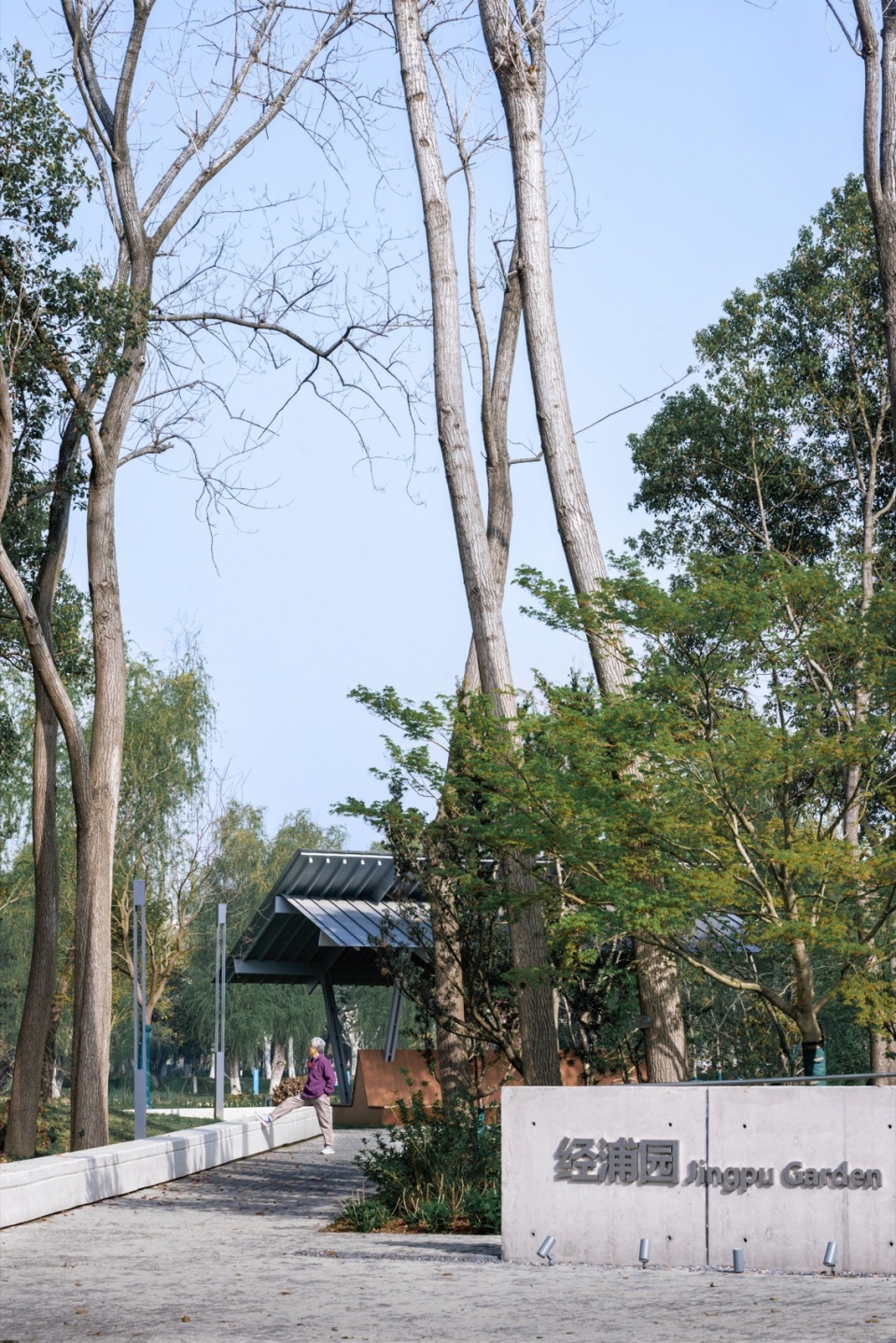
入口空间以景墙与小亭共同界定,景墙题刻“经浦园”标识。无障碍坡道隐匿于景墙之后,与傍亭而设的台阶一起,为不同需求的人群提供了差异化的入园体验。
The entrance space is defined jointly by a feature wall and a small pavilion, with the inscription “Jingpu Garden” marking the wall. An accessible ramp is discreetly tucked behind the feature wall. Together with the steps beside the pavilion, it provides differentiated entry experiences for users with diverse needs.
▼经浦园入口广场,Jingpu Garden Entrance Plaza
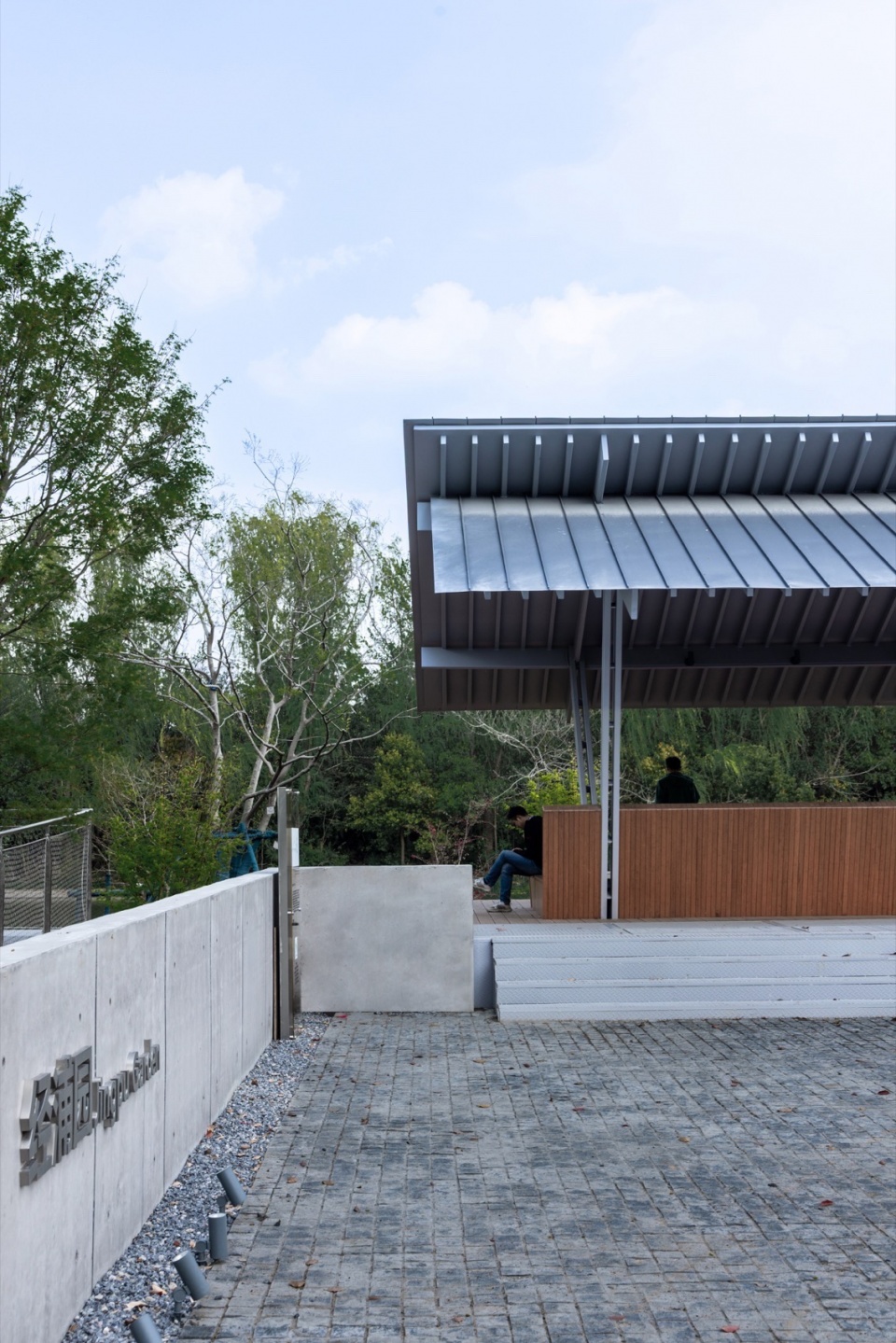
▼入口景墙与对景关系,
Entrance Feature Wall and Framed View toward the Breezy Pavilion
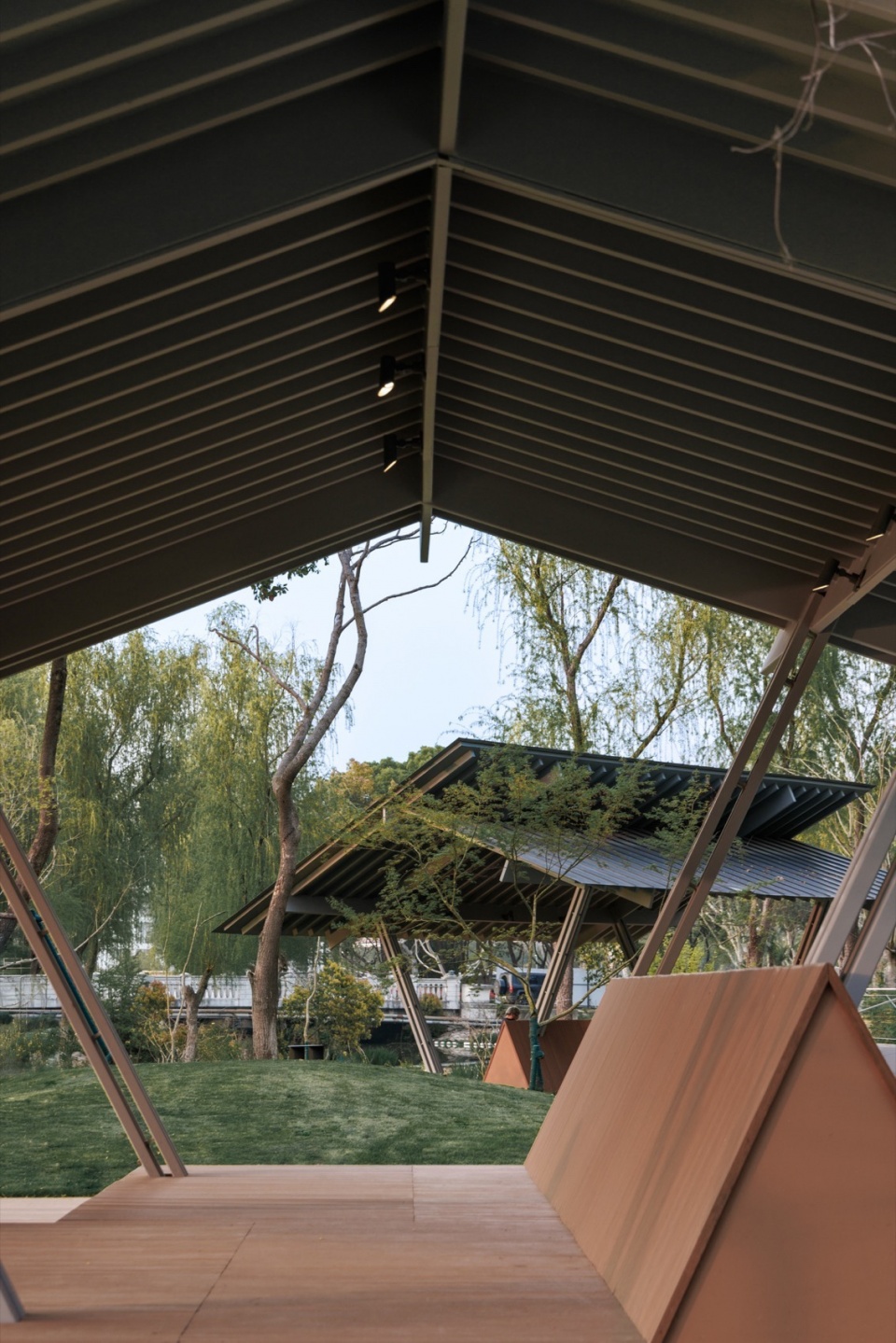
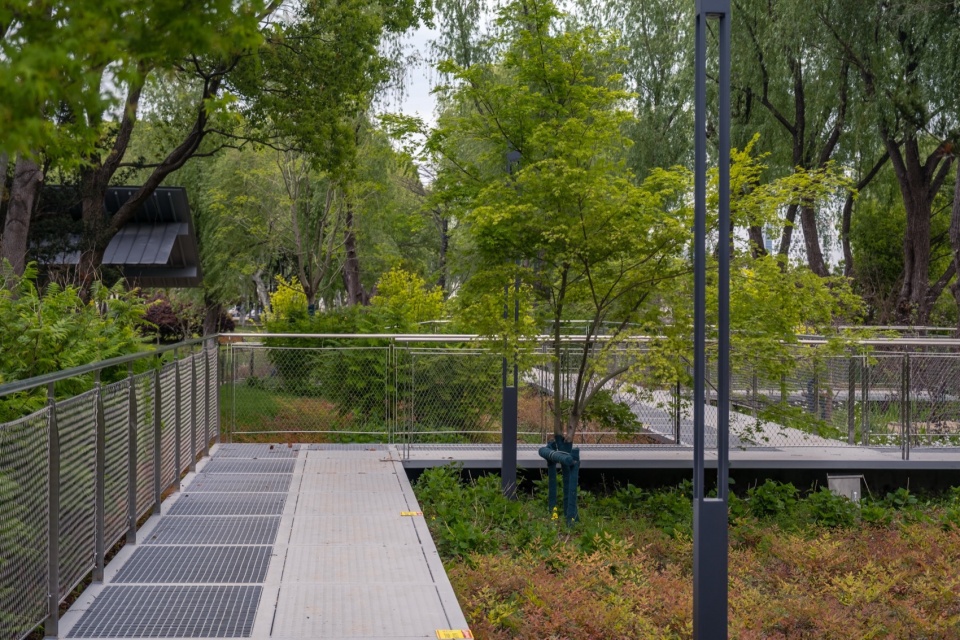
设计通过自由游径和架空栈道两种低干预的构建方式,最大限度减少对现状植被的干扰,使原本封闭的绿地逐步转化为师生与市民共享的开放空间。自由游径兼具通行与停坐功能,形成可行、可坐、可停留的复合界面,架空金属钢格栅栈道则为步行者提供了独特的“悬浮体验”与光影交互。栈道延伸出的“有风小亭”,以钢结构与竹木材料为骨架,既是师生的“户外书房”,也是市民的“水岸客厅”。清风拂来,波光粼粼的水面尽收眼底。
The design adopts two low-intervention construction approaches—free meandering paths and elevated boardwalks—to minimize disturbance to the existing vegetation and gradually transform the formerly enclosed green space into an open space shared by students, faculty, and citizens. The free meandering paths combine circulation and seating, forming a composite interface for walking, sitting, and staying. The elevated metal grating boardwalk offers walkers a distinctive “floating” experience and an interplay of light and shadow. Extending from the boardwalk, the “Breezy Pavilion” uses a steel structure and bamboo-wood materials as its framework, serving both as an “outdoor study” for students and faculty and as a “waterfront living room” for citizens. As the breeze arrives, the shimmering water surface unfolds in full view.
▼架空栈道与有风小亭,Elevated Boardwalk and the Breezy Pavilion
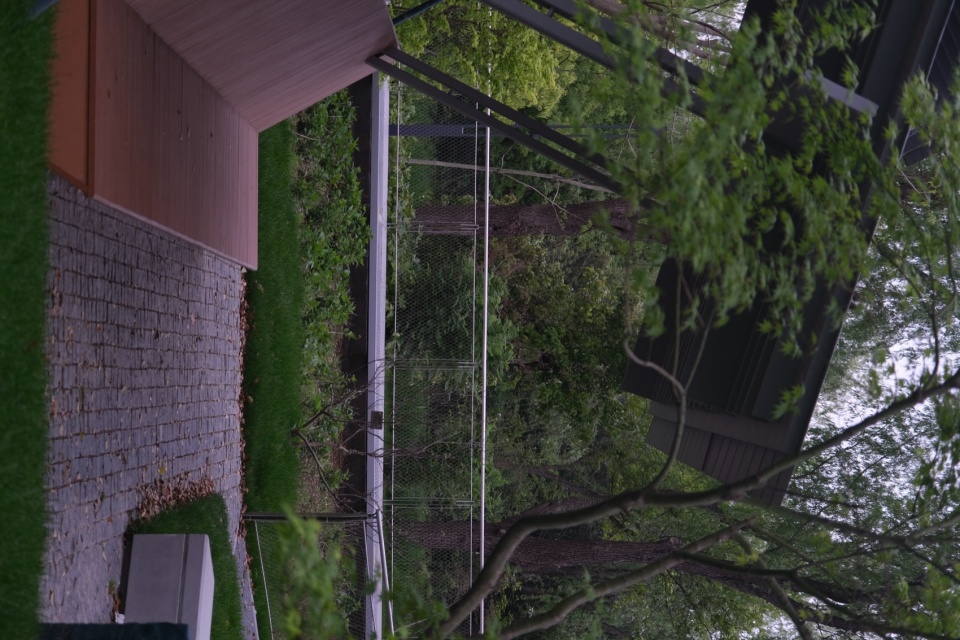
▼小亭内部,Interior of the Breezy Pavilion
04 植被与生境04 Vegetation and Habitat
这片占地6328㎡的带状绿地,以拆墙透绿为起点,进一步展开了关于“自然野趣”的在地探索。基于“低干预、轻介入”原则,设计团队以保留现状香樟、柳树等骨干树种为前提,系统性优化场地竖向,严格维持保留树木根颈标高,避免土方工程对根系的扰动。同时,适度疏剪老化乔灌木,打破郁闭,营造开合有致的林下空间;穿插植入乌桕、小叶鸡爪槭等色叶树种,构建季相分明的绿地景观。
This 6,328-square-meter linear green space takes fence removal and green-space exposure as its starting point, further developing a site-specific exploration of “naturalistic wildness.” Guided by the principles of low intervention and light-touch design, the team prioritized the preservation of existing framework trees, including camphors and willows. The site grading was systematically optimized to strictly maintain the root-collar elevations of retained trees and avoid disturbance to root systems during earthwork. At the same time, aging trees and shrubs were moderately pruned and thinned to open the enclosed canopy and create an understory space with a balanced rhythm of openness and enclosure. Color-leaved species such as Chinese tallow and Japanese maple were interplanted to build a green landscape with distinct seasonal qualities.
▼在现状植被间穿行的架空栈道,Elevated Boardwalk Through Existing Vegetation
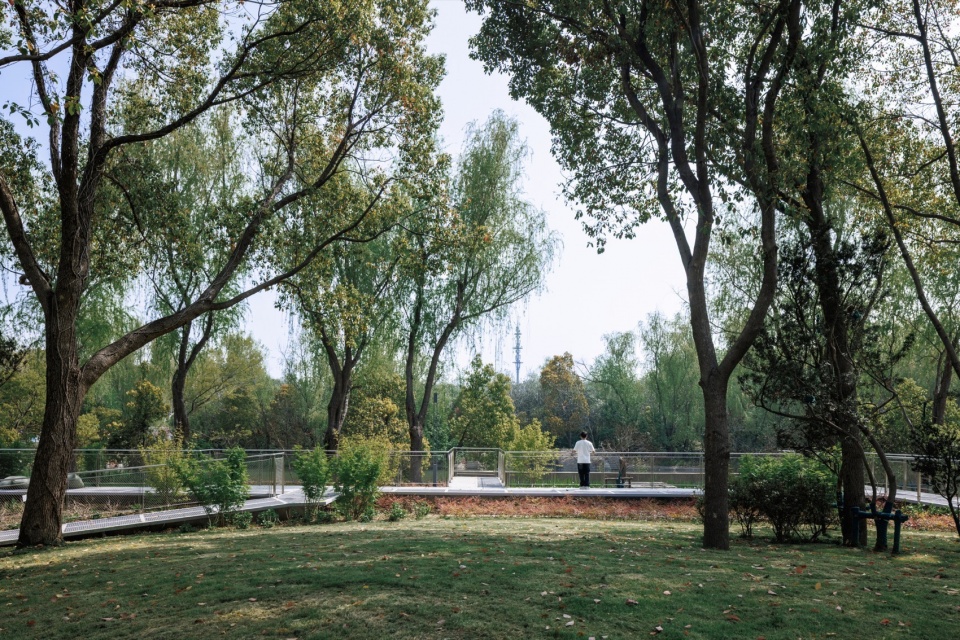
▼保留的植被与起伏的微地形,
Retained Vegetation and Undulating Micro-topography
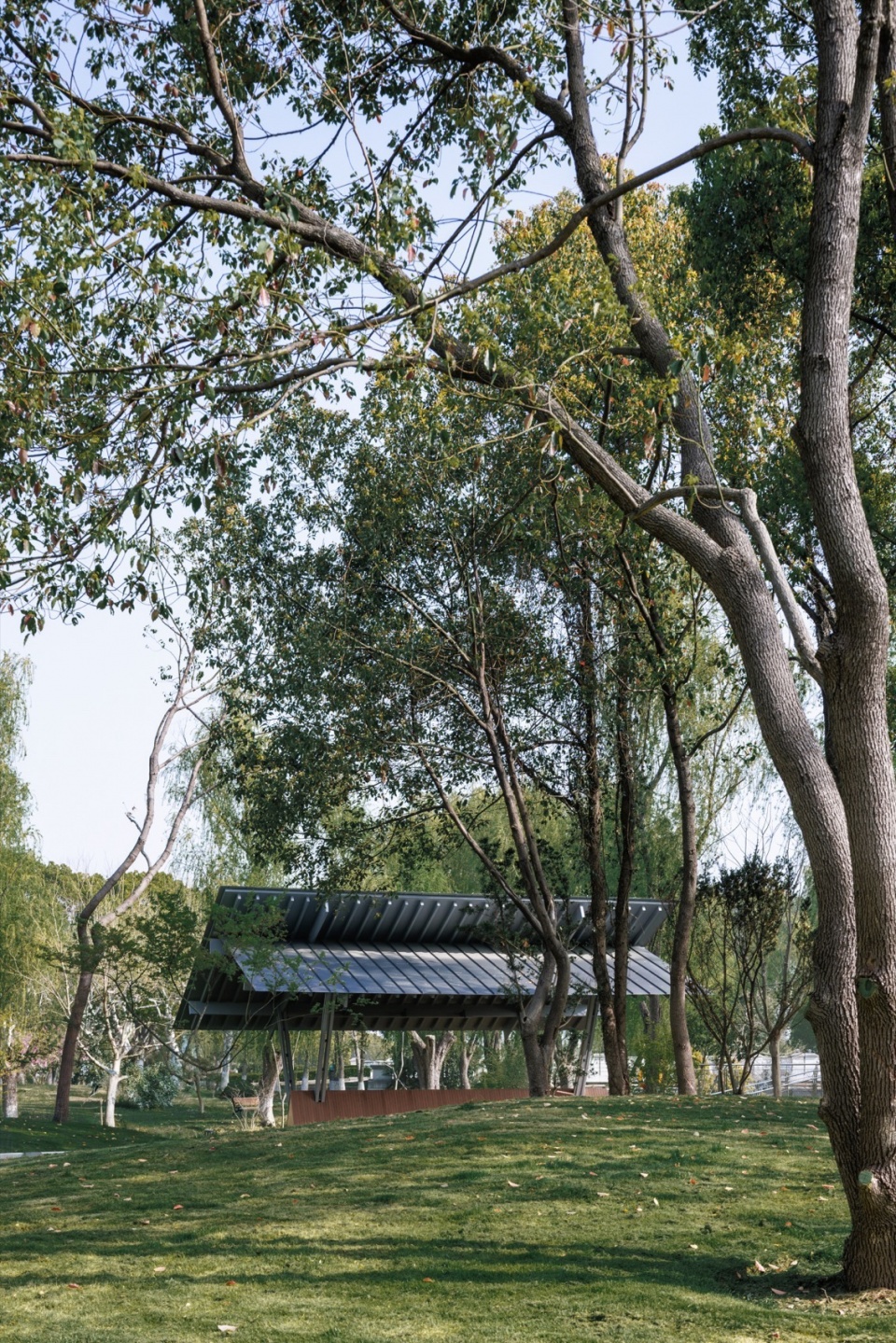
▼架空栈道与自然生境营造,Habitat Creation Along the Elevated Boardwalk
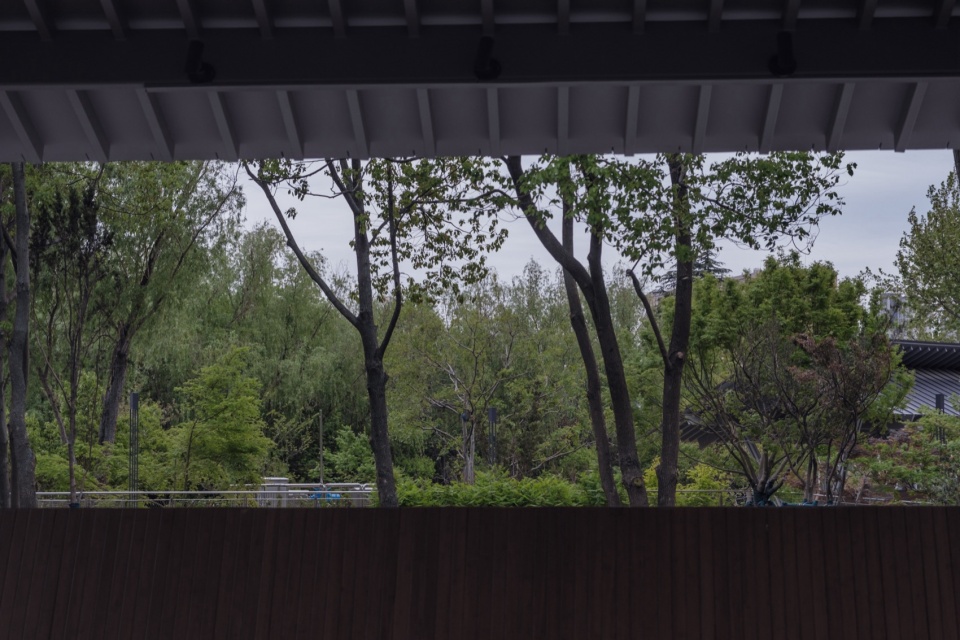
▼现状自然生境,Existing Natural Habitat by the Pavilion
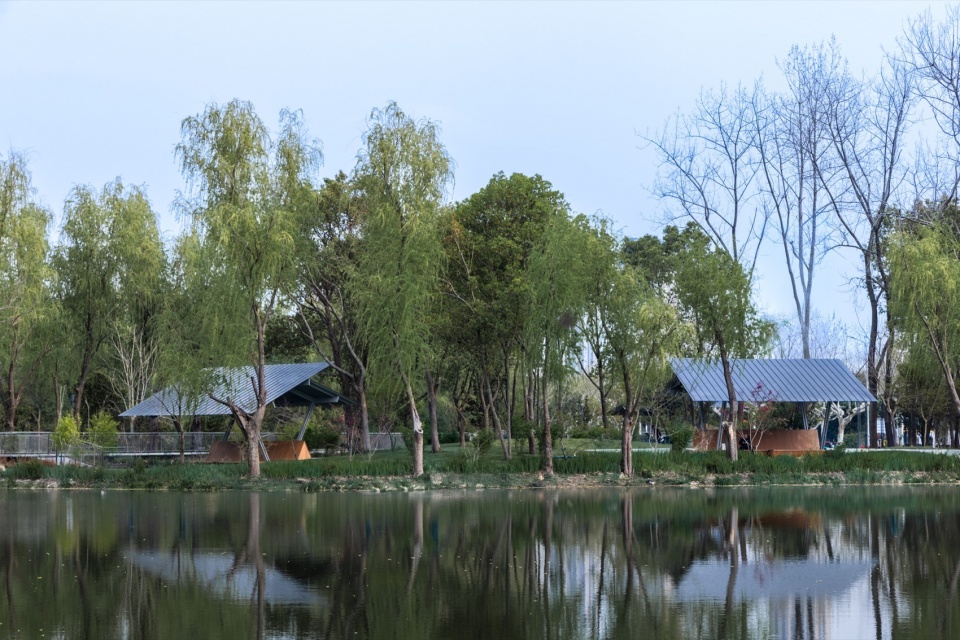
▼从校园遥看设计场地,View of the Design Site from the Campus
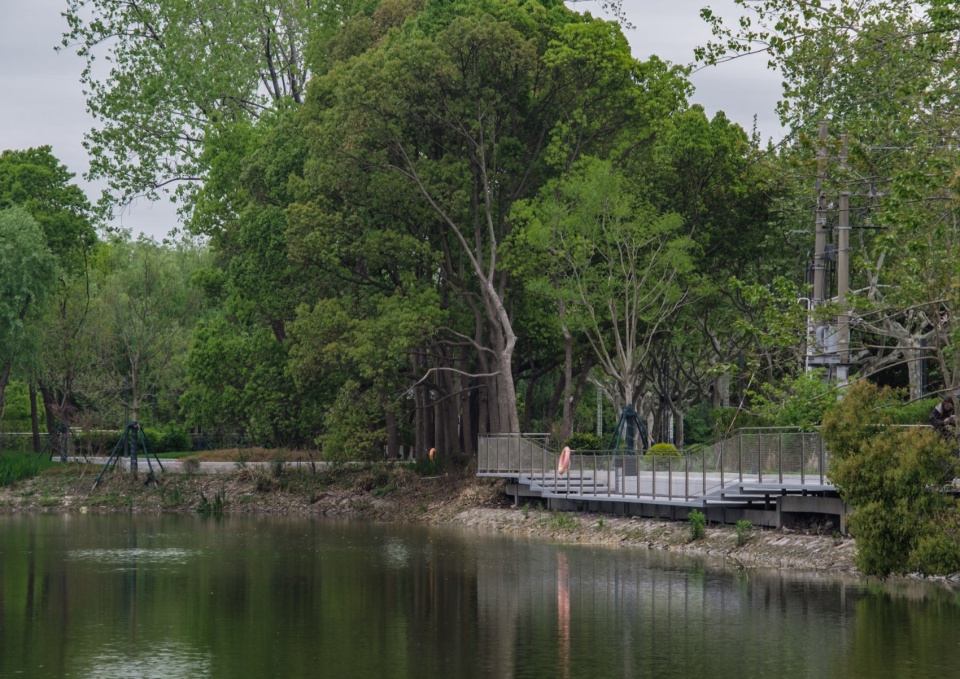
▼亲水平台与保留大树,Waterfront Platform and Retained Trees
05 材料与细节05 Materials and Details
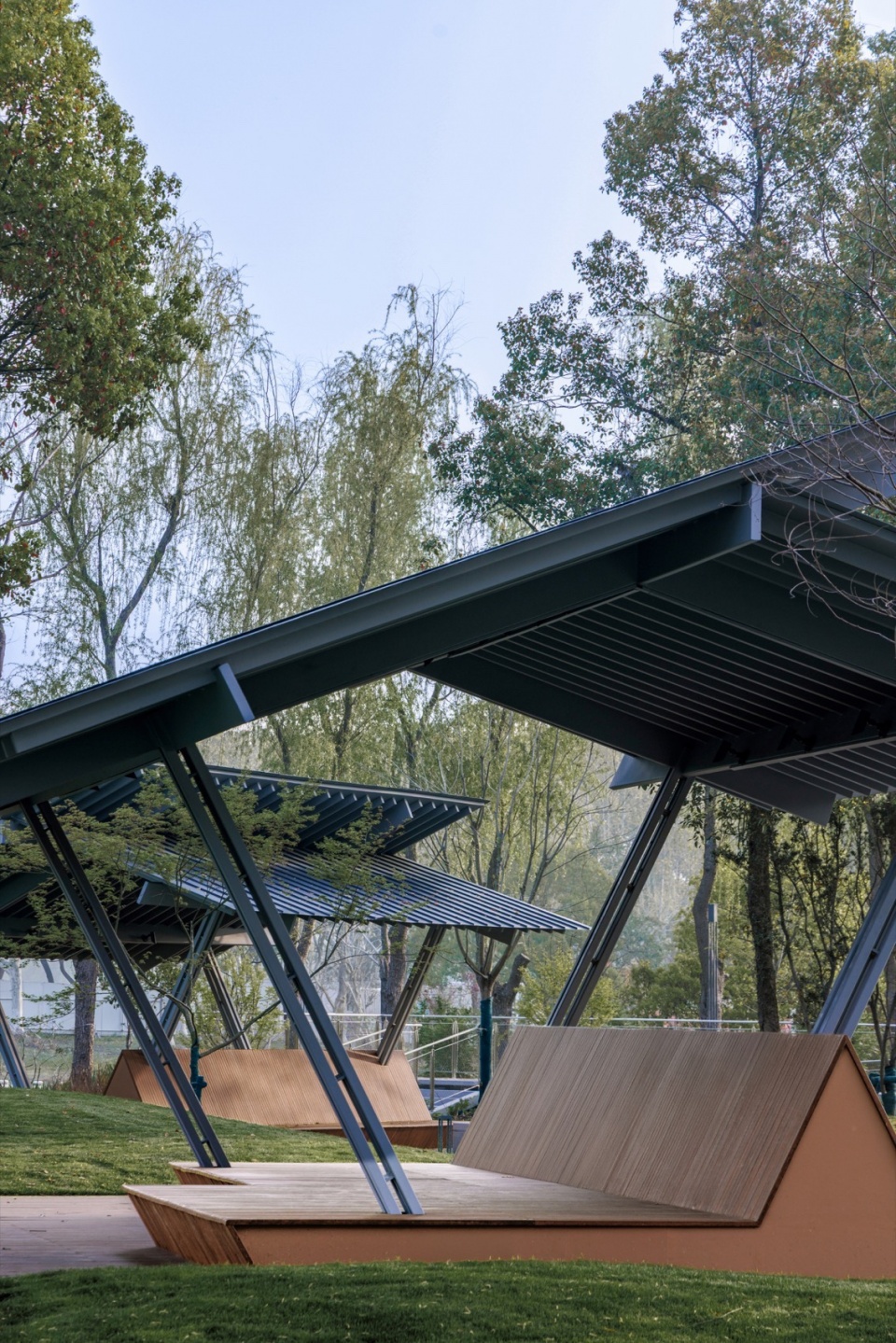
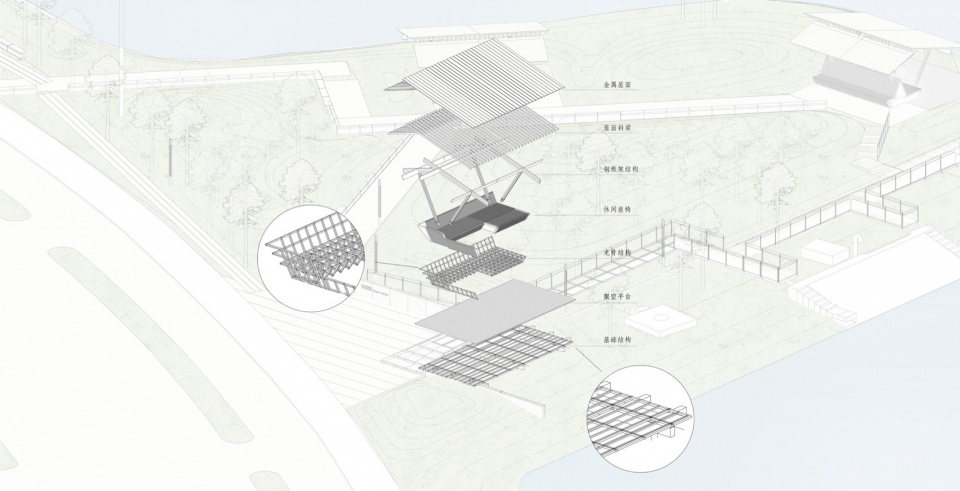
有风小亭采用钢框架结构体系,以60×60mm小截面钢柱组合替代传统粗柱,并与屋面斜梁共同形成稳定的承载体系,将荷载有效传递至基础。整体构筑轻盈,空间通透。
The Breezy Pavilion adopts a steel frame structural system. Small-section steel columns of 60×60 mm are combined to replace traditional thick columns, and together with the inclined roof beams they form a stable load-bearing system that effectively transfers loads to the foundation. The overall structure is light and transparent.
▼有风小亭结构构造,Structural Detail of the Breezy Pavilion
场地选取高强耐用、抗裂防变形的重竹木作为座椅与铺装基材。其温润的材质肌理与周边水绿生境自然交融,消解了人工构筑物的生硬边界。同时,竹木铺装表面的防滑纹理工艺,确保了滨水潮湿环境下的安全性能,践行了关怀老幼的全龄友好设计理念。
The site uses heavy bamboo timber with high strength, durability, and resistance to cracking and deformation as the base material for seating and paving. Its warm texture naturally blends with the surrounding water-and-green habitat, softening the rigid edges of the built structures. Meanwhile, the anti-slip treatment on the bamboo-wood paving surface ensures safety in the humid waterfront environment and embodies an age-friendly design approach that cares for both children and older users.
▼竹木与金属格栅材料,Bamboo-wood and Metal Grille Materials
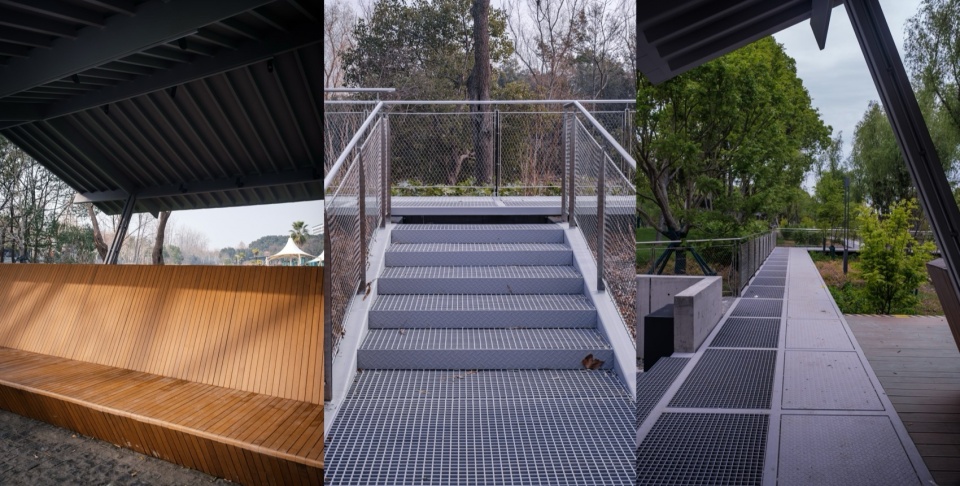
在保障安全的前提下,滨水平台尽可能亲近水面;架空栈道采用单边栏杆设计与虚实镂空的深灰铝格栅模块,通过抬高基础与轻量化构造,形成“悬浮于自然之上”的视觉意象,既保证了视线的通透性,又最大限度地降低了硬质工程对现状地表与植被的干扰。
While ensuring safety, the waterfront platform is positioned as close to the water surface as possible. The elevated boardwalk adopts single-sided railings and dark-gray aluminum grille modules with a rhythm of solid and void. Through raised foundations and lightweight construction, it creates the visual image of “floating above nature,” maintaining open sightlines while minimizing the disturbance of hard engineering to the existing ground surface and vegetation.
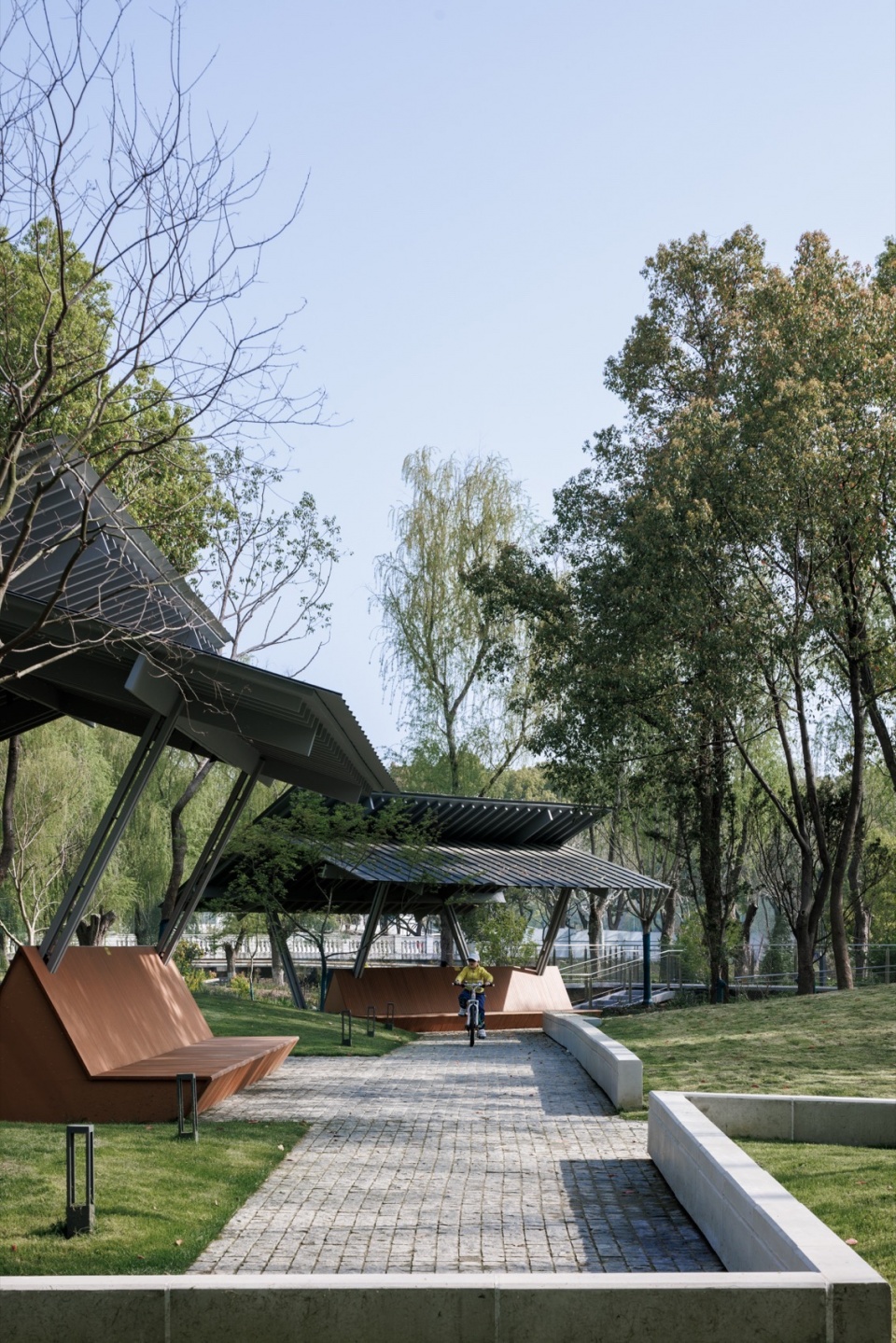
▼树荫下的游园空间,Garden Space under the Trees
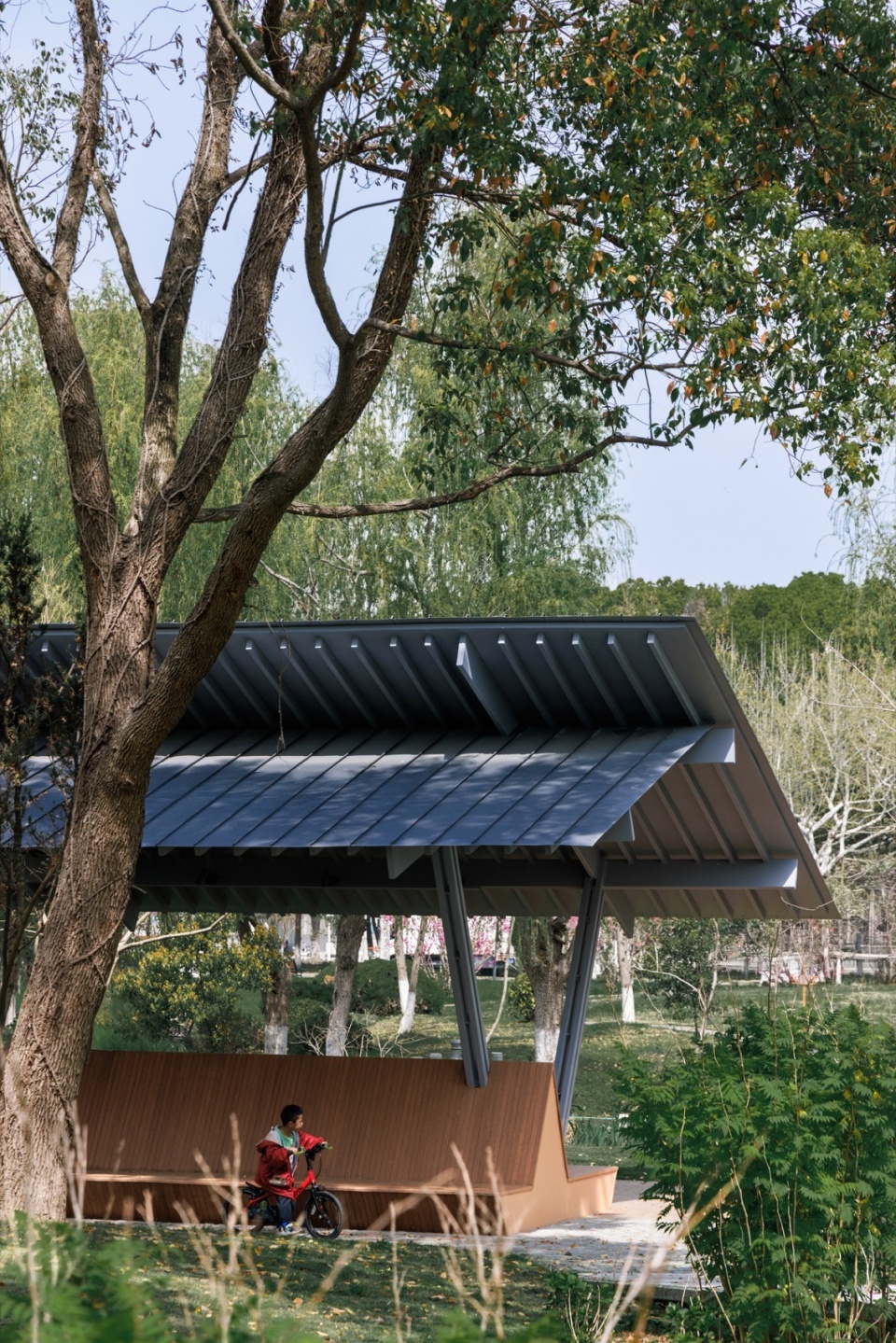
▼路径、小亭、地形与现状植物,Paths, Pavilions, Terrain and Existing Plants
▼安静闲适的亭下休憩空间,Quiet Resting Space Under the Pavilion
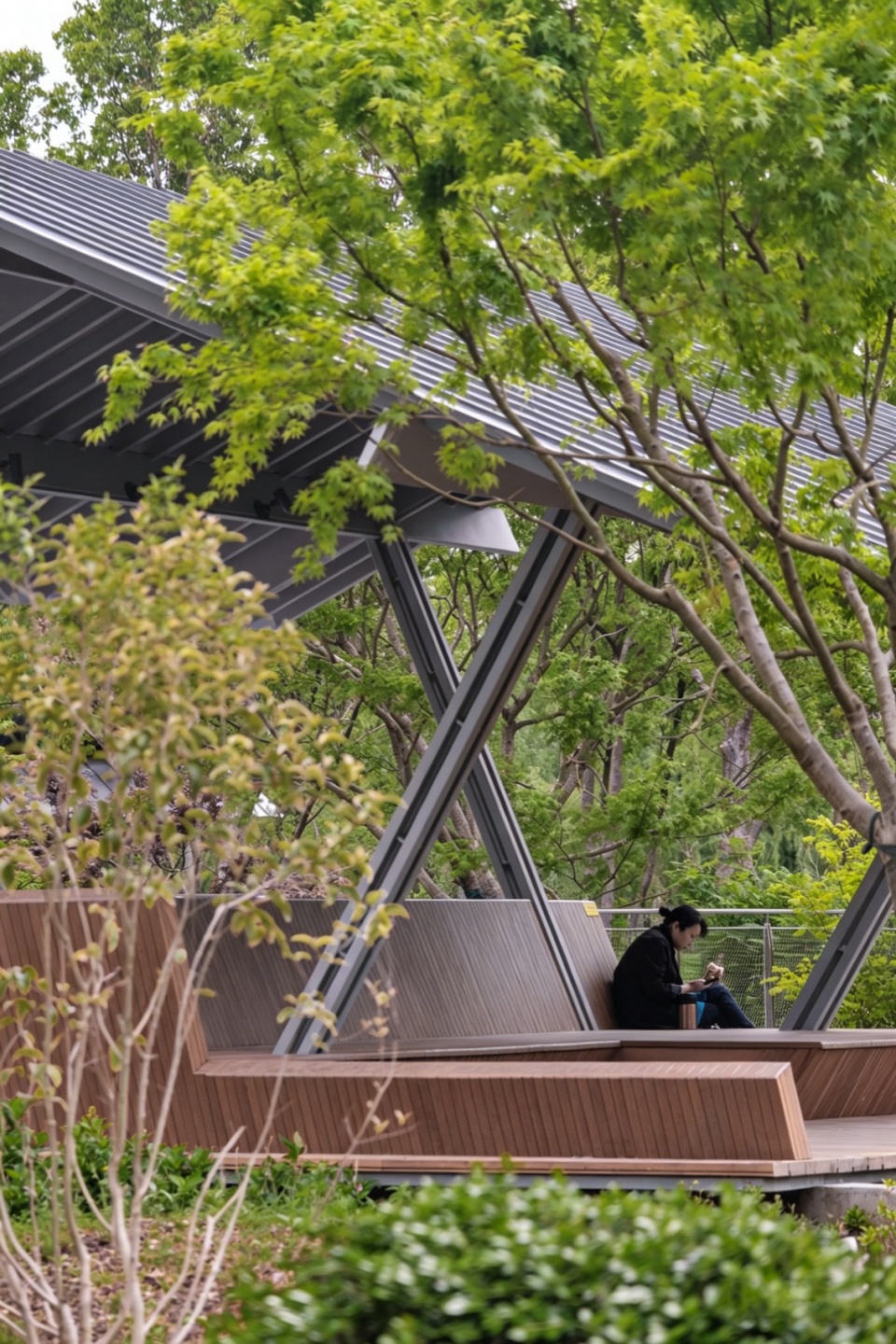
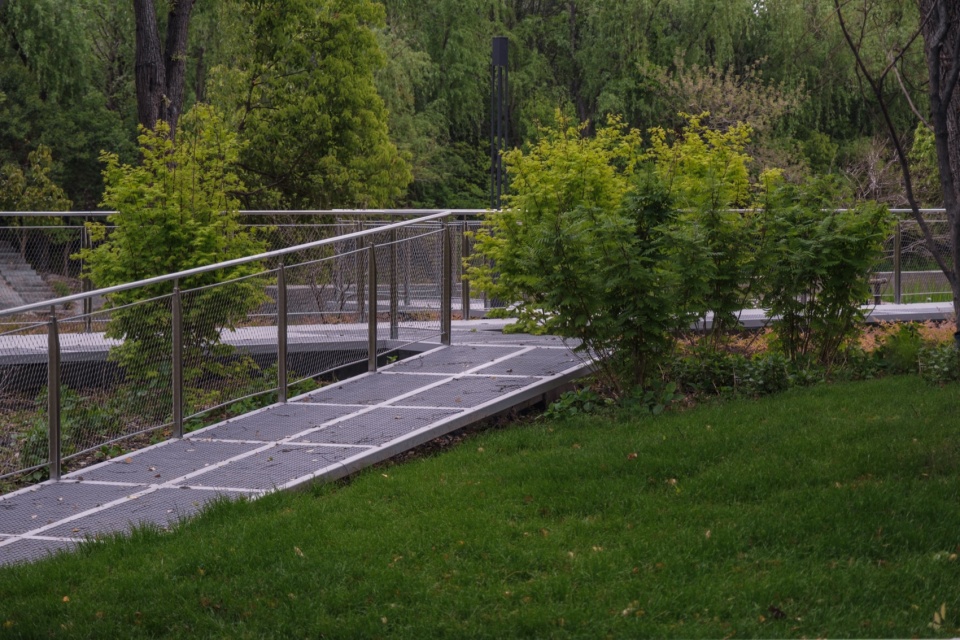
全园设置两处无障碍坡道,形成完整无障碍体系:钢结构坡道轻盈现代,铺装坡道质朴自然。二者均严格遵循无障碍规范,以不同材质语言融入整体环境,让不同使用者都能自然、顺畅地抵达休憩空间。
Two accessible ramps are arranged across the garden to form a complete barrier-free system: the steel-structured ramp is light and contemporary, while the paved ramp is simple and natural. Both strictly follow accessibility codes and integrate into the overall environment through distinct material expressions, allowing different users to reach the resting spaces naturally and smoothly.
▼经浦园鸟瞰,Aerial View of Jingpu Garden
▼架空坡道,Elevated Accessible Ramp
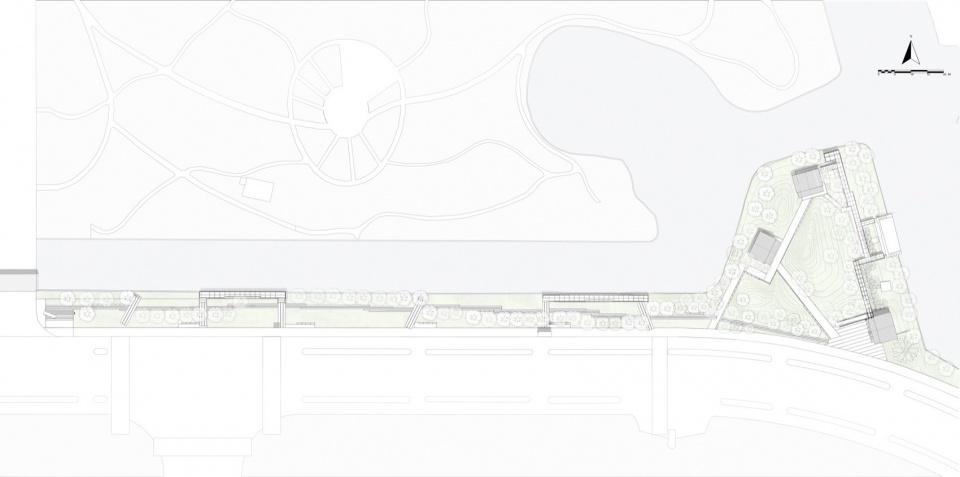
▼平面图,Site Plan
▼有风小亭分析图,Axonometric Exploded Diagram of the Breezy Pavilion
Project Name: Green Space Adjustment around Shanghai University of International Business and Economics (Jingpu Garden)
Design Unit: Original Design Studio, Tongji Architectural Design (Group) Co., Ltd.
Lead Architects: Zhang Ming, Zhang Zi, Shen Jie
Design Team: Hong Feixiang, Li Bin, Wu Yujing (Intern), Ma Ruixue (Intern), Lou Xiaojian (Intern), Shi Ruyun (Intern)
Structural Design Team: Wang Rui, Mou Jie
Electrical Engineering: Jiao Xueyuan, Shen Jian, Yu Chao, Liang Weipeng
Client: Shanghai Songjiang District Landscape Architecture Management Center
Construction Contractor: Shanghai Kaisheng Landscape Engineering Co., Ltd.
Supervision Unit: Shanghai Gaocheng Engineering Supervision Co., Ltd.
Location: Songjiang District, Shanghai
Site Area: 6,328 m²
Design Period: April 2025
Completion Date: January 2026
Photography Credit: Daily Architectural Photography – Liu Guowei; Original Design Studio – Hong Feixiang