上海包玉刚实验学校包陪庆楼 / 山水秀建筑事务所
原载于《建筑学报》2026年4期
理想的校园建筑从来不只是遮风避雨的物理容器,更是无声的教育者。岳麓书院的山林院落、伊顿公学的寄宿社群、东海大学的坡地庭园、EPFL劳力士学习中心的流动空间……,许多跨越时空的校园建筑案例,都印证着建筑与教育理念的共生关系。从华东师范大学附属双语幼儿园、高安路一小华展校区、浦东新区青少年活动中心,到最近建成的宋庆龄幼儿园徐汇园、深圳龙岗文理学校,山水秀建筑事务所在十五年的教育空间实践中,一直尝试将多元教育理念转化为可感知、可交流的场所体验,上海包玉刚实验学校包陪庆楼的设计,便是一次以“界面”为核心,回应全人教育理念、适配场地特质、探索多元教学场景的深度探索。
▼包玉刚实验学校,Anna Pao Sohmen Centre
Ideal campus architecture is never just a physical container providing shelter from the wind and rain, but rather a silent educator. The mountain courtyards of Yuelu Academy, the boarding communities of Eton College, the sloping gardens of Tunghai University, and the fluid spaces of the EPFL Rolex Learning Center—numerous campus architectural precedents across time and space bear witness to the symbiotic relationship between architecture and educational philosophy.
From the East China Normal University Affiliated Bilingual Kindergarten, the Huazhan Campus of Shanghai Gaoan Road No. 1 Primary School, and the Pudong Adolescent Activity Center and Civic Art Center, to the recently completed Xuhui Campus of Soong Ching Ling Kindergarten and Shenzhen Longgang Wenli School, Scenic Architecture Office has spent fifteen years in educational space design attempting to translate multifaceted educational philosophies into perceptible, communicative experiences of place. The design of the Anna Pao Sohmen Centre at Shanghai YK Pao School represents a profound exploration centered on the concept of the “interface” to echo the philosophy of holistic education, adapt to specific site characteristics, and cultivate diverse educational scenarios.
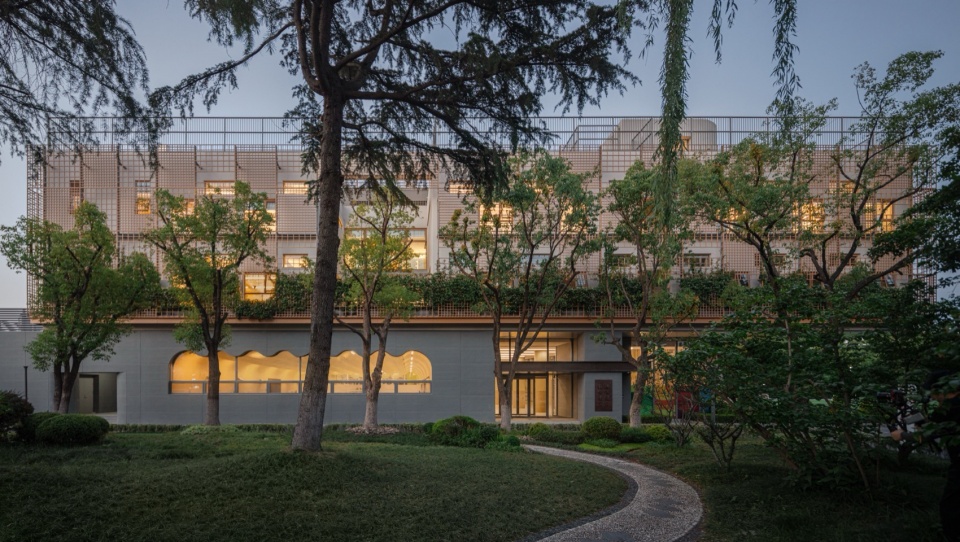
▼从入口花园小径望向包陪庆楼,View from the entrance garden path to the Anna Pao Sohmen Centre
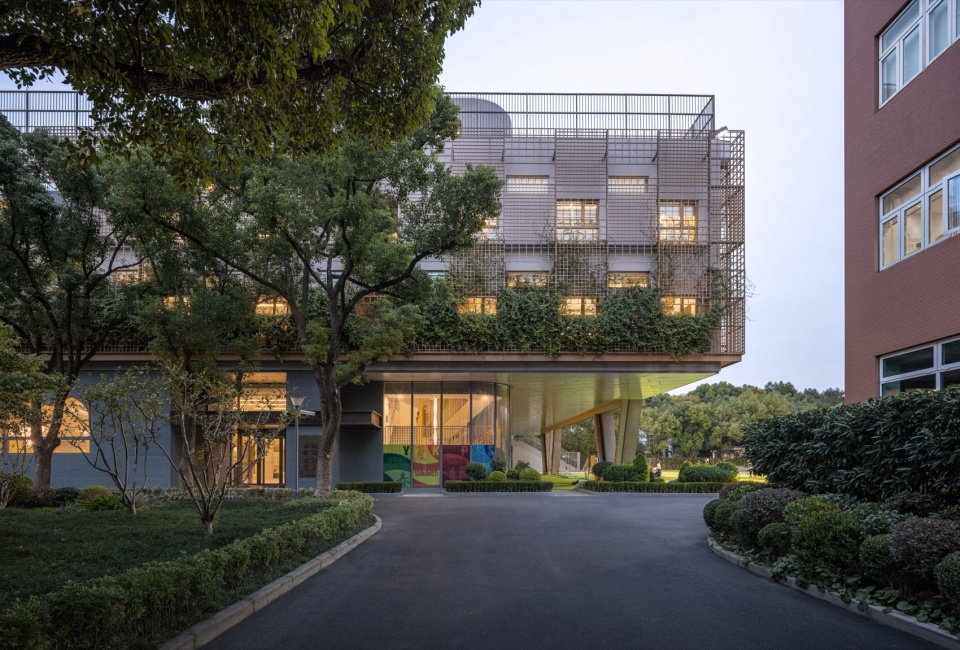
▼从主干道望向包陪庆楼,View from the main road to the Anna Pao Sohmen Centre
缘起与愿景Origin and Vision
2007年,为纪念爱国企业家、慈善家包玉刚先生,包氏家族创办了上海包玉刚实验学校。这所深耕双语教育的12年制民办学校,以“发展全人教育、传承中华文化、拓展国际视野”为办学使命,将上海本土课程与IGCSE、IB等国际化课程相融,力求培养植根中国、面向世界的国际化创新型人才。2020年,山水秀事务所接受委托为包校虹桥校区设计新建综合楼,彼时的虹桥校区地处长宁区虹桥风貌保护区,北临虹桥路与地铁10号线龙溪路站,周边绿意环绕、历史建筑众多,但校内场地却相对局促,唯一经改造的教学楼承载着初中三个年级 500 余名师生的教学与总校行政工作,室内体育设施与专业教室严重匮乏。新建综合楼于是成为校方的迫切需求,而这座建筑,更被寄予了表达包校教育理念的厚望。
In 2007, to commemorate the patriotic entrepreneur and philanthropist Sir Yue-Kong Pao, the Pao family founded Shanghai YK Pao School. This 12-year private school, deeply rooted in bilingual education, takes “To develop holistic education, pass on Chinese culture, and expand international horizons” as its founding mission. It integrates the local Shanghai curriculum with international frameworks like IGCSE and IB, striving to nurture globally-minded, innovative talents who are rooted in China and open to the world. In 2020, Scenic Architecture Office was commissioned to design a new comprehensive building for the school’s Hongqiao Campus, which is located within the Changning District Hongqiao Historic and Cultural Conservation District, bounded by Hongqiao Road and the Longxi Road Station of Metro Line 10 to the north. The surroundings were lush with greenery and historical buildings, but the campus itself was exceptionally compact. The sole existing, renovated teaching building accommodated over 500 students and faculty across three junior high school grades, alongside the central administration team. Indoor sports facilities and specialized classrooms were severely lacking. The new comprehensive building became an urgent need for the school, and was also endowed with the high expectation of expressing YK Pao School’s educational philosophy.
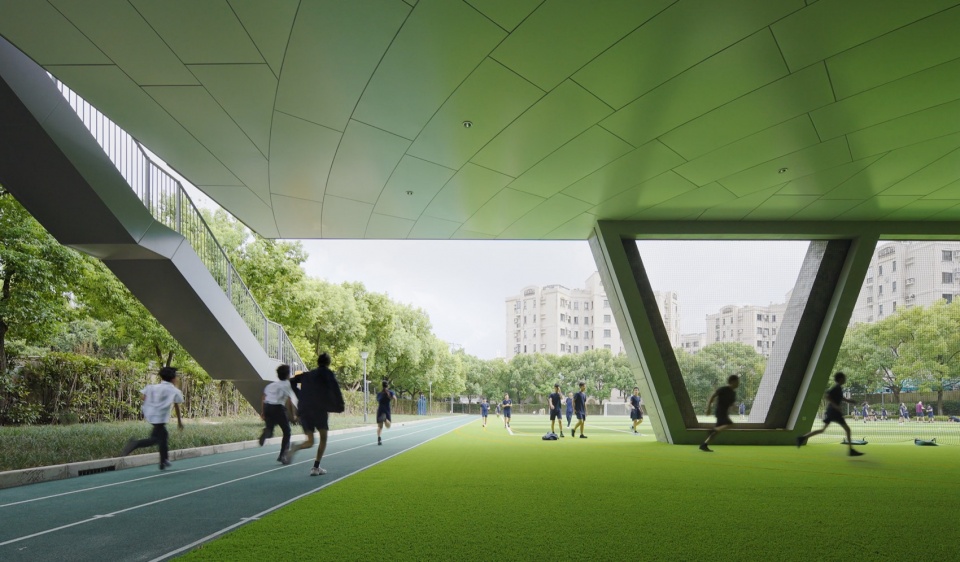
▼桁架下的跑道,Runway under the truss
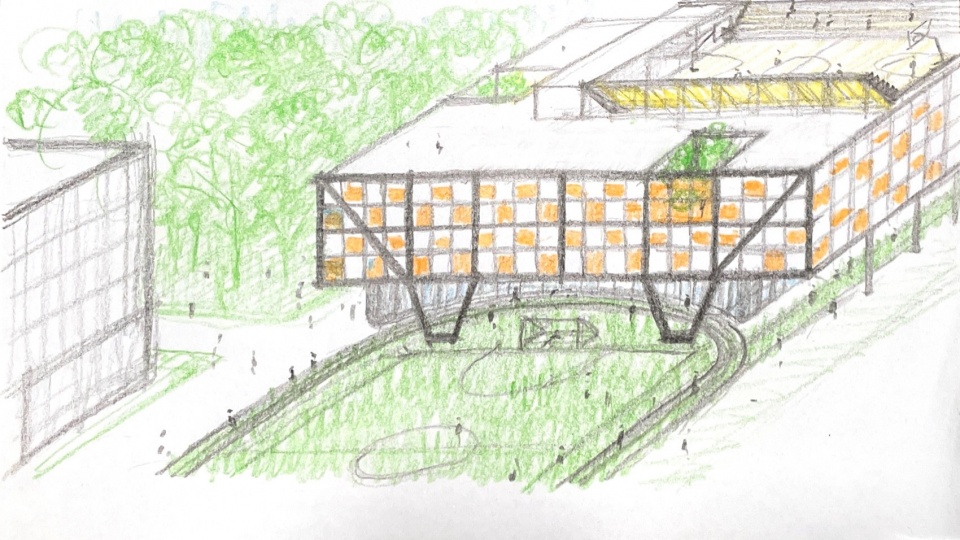
进入21世纪后,旨在培养完整人格、促进个体全面发展的全人教育在观念上已获得全球范围的广泛认可,并通过各种形式在不同地区的教育实践中得到实施和检验。包校在此基础上,结合中国文化传统提出了“仁、义、平”(Compassion, Integrity, Balance)的核心价值观,同时将国际通行的STEM理科框架拓展为融入Art与Sport的STEAMS体系,让全人教育有了属于包校的独特表达,其核心是培养植根中国、面向世界,兼具学术能力、健全人格和社会责任的未来公民。
Entering the 21st century, holistic education—which aims to cultivate a well-rounded personality and promote full individual development—has gained widespread global recognition, having been implemented and tested across various regional educational practices. On this foundation, YK Pao School proposed its core values of “Compassion, Integrity, Balance”by drawing from Chinese cultural traditions. Simultaneously, it expanded the internationally recognized STEM framework into a STEAMS framework by incorporating Art and Sport, giving holistic education a unique expression distinct to YK Pao School. Its essence lies in nurturing future citizens who are rooted in China, open to the world, and equipped with academic competence, sound character, and social responsibility.
▼界面分析,Interface analysis
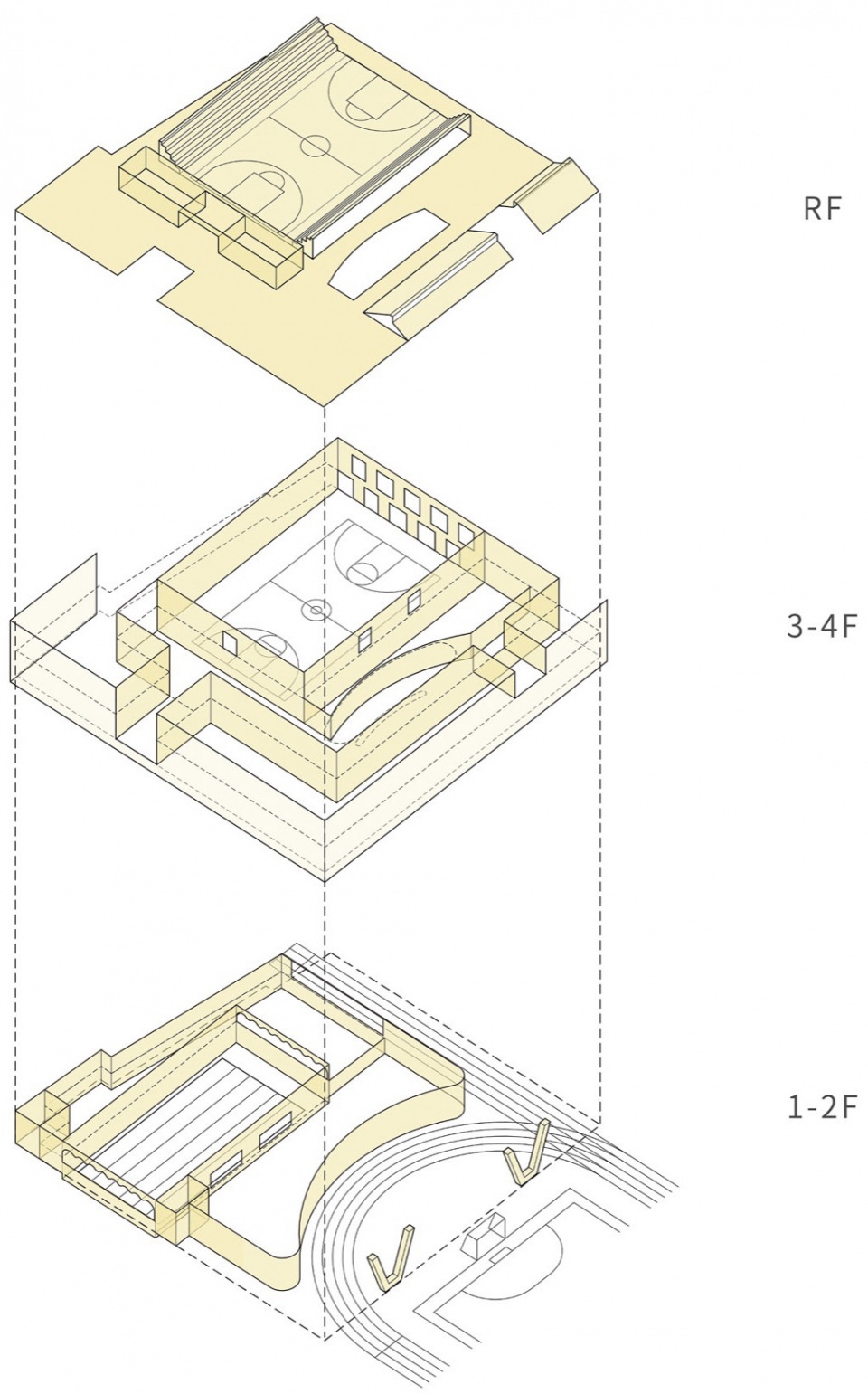
包校创办人包陪庆教授曾说:“我们希望包校不仅根植于中国艺术和文化,还能够在联结中西、古今以及跨学科等方面有所突破,而校园建筑更加应当体现我们的办学使命:全方位塑造人才,根植于中华文化和传统,同时还具有广阔的现代视野。”她还特别向笔者提及新西兰艺术家Hundertwasser 的作品,希望新建筑能于规整的秩序中,生长出有机的活力与灵动的美感——这份期待,也成为设计的核心指引之一。在与校方深度沟通后,我们开始围绕三个问题展开构思:如何让建筑成为全人教育与中西融合理念的物质载体?如何在局促的场地中创造性地挖掘空间潜力?如何回应包校多元化的教学与使用场景?也正是在这样的思考中,“界面建筑”的设计概念逐渐成型,成为贯穿整个设计过程的核心语言。
Professor Anna Pao Sohmen, the founder of YK Pao School, once remarked:
“We hope that YK Pao School is not only rooted in Chinese art and culture, but also capable of making breakthroughs in bridging East and West, past and present, as well as crossing disciplines. Campus architecture, moreover, should embody our educational mission: to nurture well-rounded talents who are deeply rooted in Chinese culture and traditions, while possessing a broad, modern horizon.”
She specifically mentioned to the author the works of New Zealand artist Friedensreich Hundertwasser, expressing her hope that the new building could grow an organic vitality and fluid beauty out of a structured order. This expectation became one of the core directives of our design.
Following deep communication with the school, we began to formulate our concept around three questions:
· How can architecture become the material carrier of holistic education and East-West integration?
· How can we creatively unlock spatial potential within a constrained site?
· How can we respond to the diverse teaching and usage scenarios of YK Pao School?
It was through this reflection that the design concept of “Interface Architecture” gradually took shape, serving as the core language running through the entire design process.
▼体量分析,Massing analysis
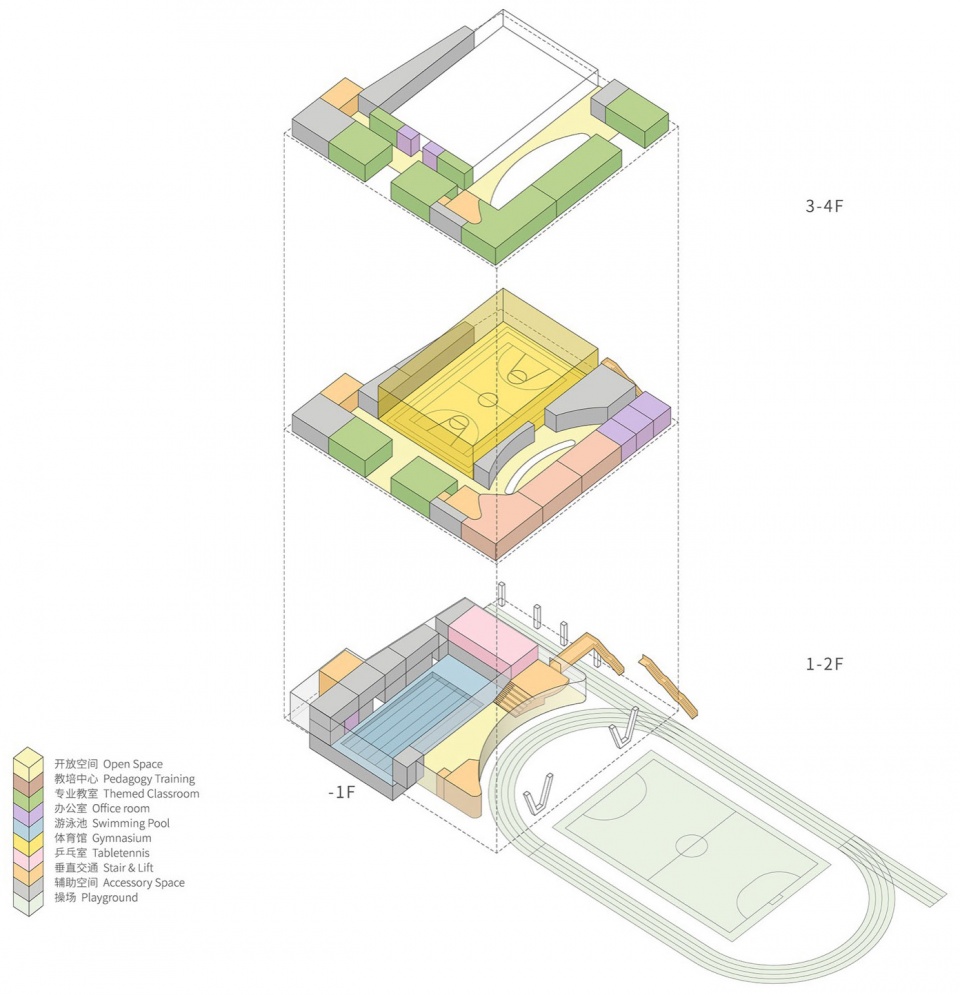
场域界面:锚与嵌Territorial Interface: Anchor and Embed
包校虹桥校区周边分布着虹桥国宾馆、迎宾馆、宋庆龄幼儿园、龙柏饭店、上海动物园等重要历史建筑和场所,风貌导则中的新建筑可以有一定创新,但必须与周边建筑文脉协调。与导则相比,校内的场地条件更为苛刻,直接决定了新楼的选址与布局逻辑:校园内原入口花园、教学主楼为现状使用主体,营建期间需保证正常运营,唯一可行的新楼选址,便是东侧的250米跑道操场。经与校方商议,我们将操场缩减为教委要求的200米跑道,在操场北端为新楼空出建设场地,这一决策,成为场地制约下的唯一解。
The surroundings of the YK Pao Hongqiao Campus host important historical buildings and venues, such as the Hongqiao State Guest House, the West Suburban State Guest House, Soong Ching Ling Kindergarten, the Cypress Hotel, and the Shanghai Zoo. While the historic conservation guidelines allowed for a degree of architectural innovation, the new building had to harmonize with the historic context.
Compared to the guidelines, the internal campus conditions were even more severe, directly dictating the logic behind the new building’s siting and layout. The existing entrance garden and the main teaching building were the primary spaces in active use, and the campus had to remain fully operational during construction. The only viable site for the new building was the 250-meter track field on the east side. After consultations with the school, we reduced the track to a 200-meter loop—the minimum required by the local education bureau—thereby freeing up construction space at the northern end of the field. This decision proved to be the only solution under the site’s strict constraints.
▼外观,Exterior view
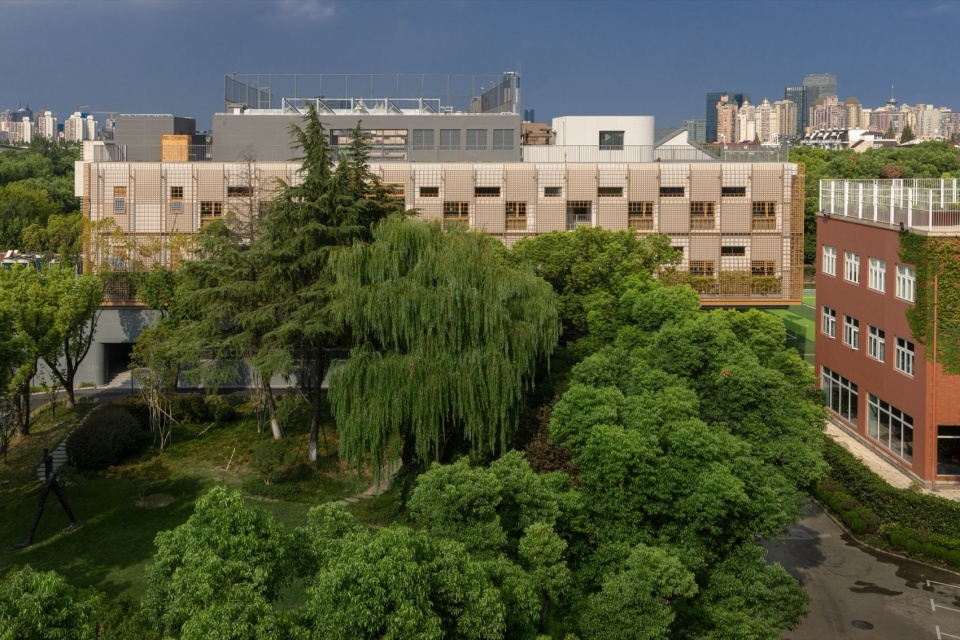
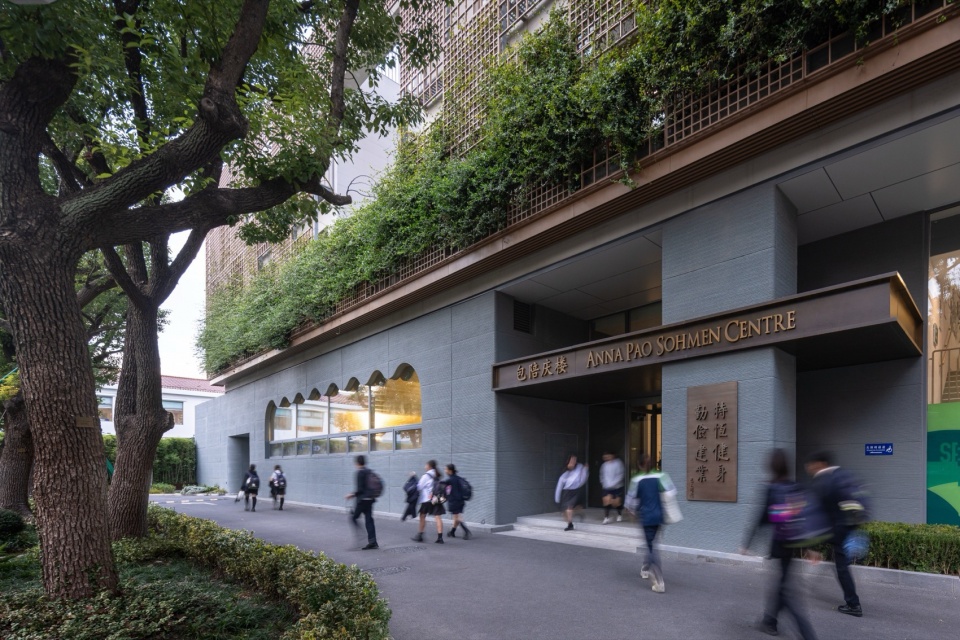
▼西南侧主入口,Main entrance on the southwest side
▼西南侧主入口,Main entrance on the southwest side
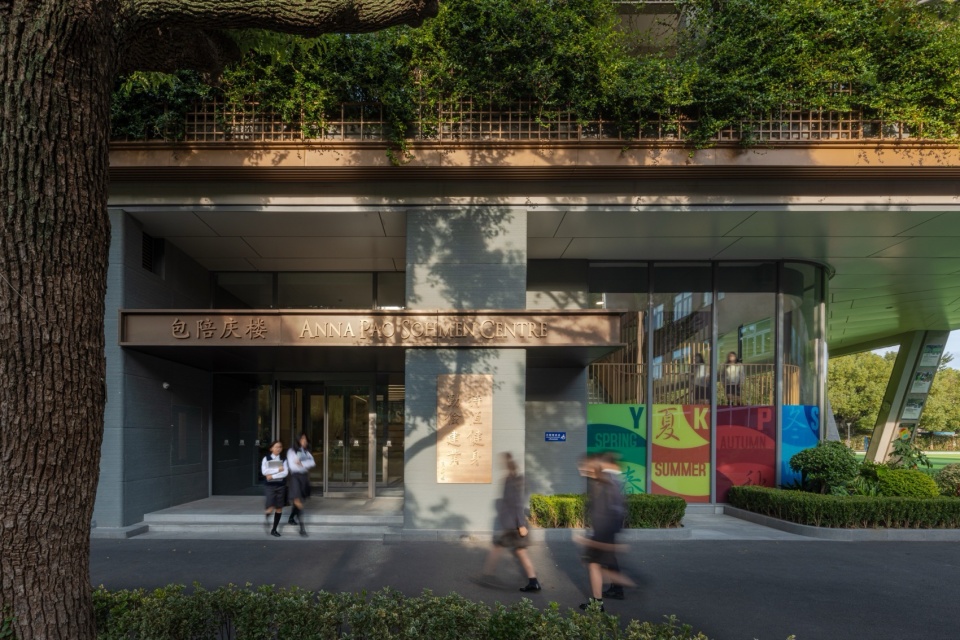
▼西南侧主入口,Main entrance on the southwest side
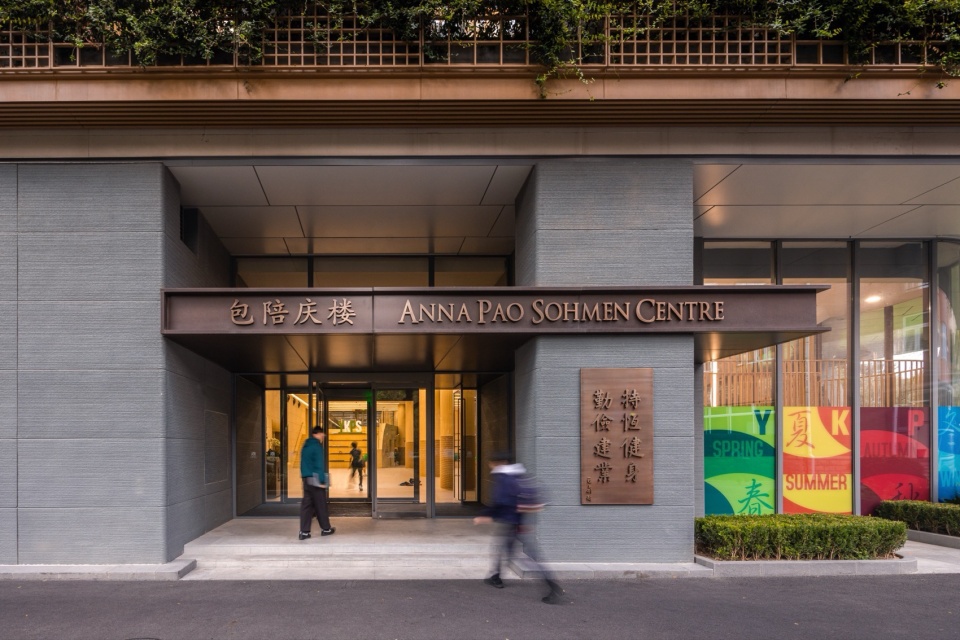
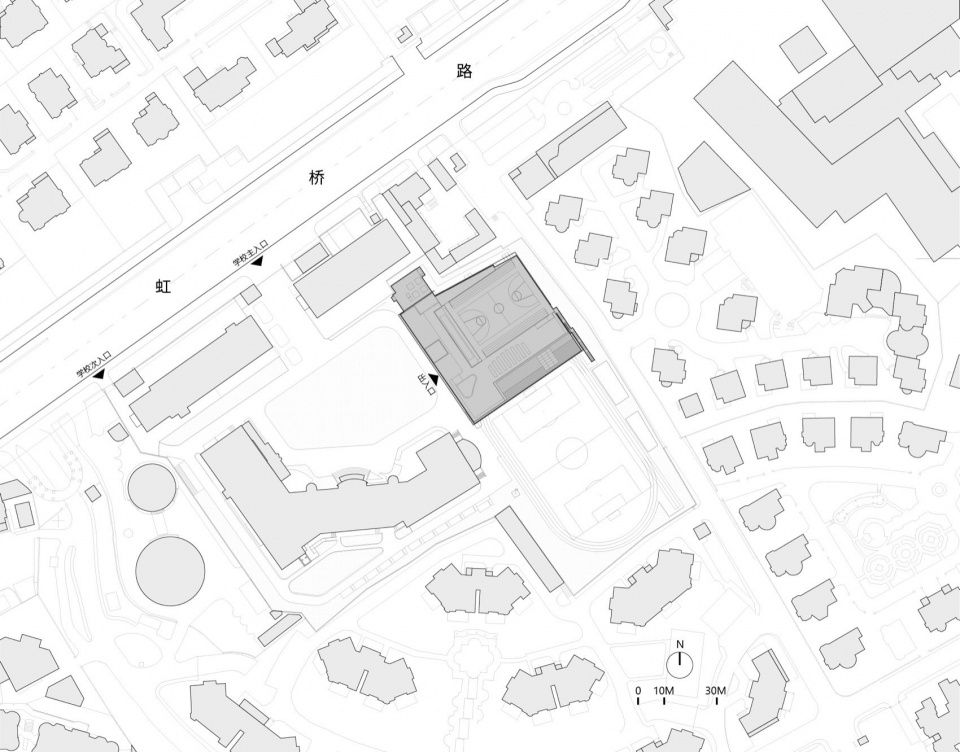
新楼锚固于校园东北方位,与西南的教学主楼形成犄角之势,清晰界定出西北方的入口花园与东南方的新操场,一静一动的外部场域就此相得益彰。从总图视角看,新楼自然形成了四个外部界面:北、东界面朝外,需与风貌区环境建立关联;西、南界面朝内,要呼应入口花园的静谧与运动操场的活力。而场地的局促性仍会带来新的挑战:在扣除新操场与直跑道后,新楼首层可用室内的面积只有约2400平米,即便建至24米高,也无法同时满足游泳馆、体育馆的净高要求与8000平米的整体规模需求。为此,我们决定以架空的方式拓展上部空间,让部分操场与跑道处于建筑覆盖之下,新楼与校园环境的“互嵌”关系,也由此被进一步强化。
The new building is anchored at the northeastern corner of the campus, forming a diagonal relationship with the main teaching building in the southwest. This layout clearly delineates a tranquil entrance garden to the northwest and a vibrant new sports field to the southeast, allowing the quiet and active external territories to complement each other. From a master plan perspective, the new building naturally establishes four external interfaces: the north and east interfaces face outward, requiring a contextual dialogue with the heritage district, while the west and south interfaces face inward, echoing the serenity of the entrance garden and the vitality of the sports field.
Wreathed by the tightness of the site, further challenges emerged. After deducting the new sports field and the straight sprint tracks, the available ground-floor indoor footprint was only about 2,400 square meters. Even if built to the maximum allowable height of 24 meters, it could not simultaneously accommodate the clear height requirements of the swimming pool and sports hall while meeting the overall program demand of 8,000 square meters.
Consequently, we decided to expand the upper volume by elevating the building on pilotis, allowing parts of the sports field and tracks to run beneath the building structure. The relationship of mutual “embedding” between the new building and the campus environment was thus further reinforced.
▼外观,Exterior view
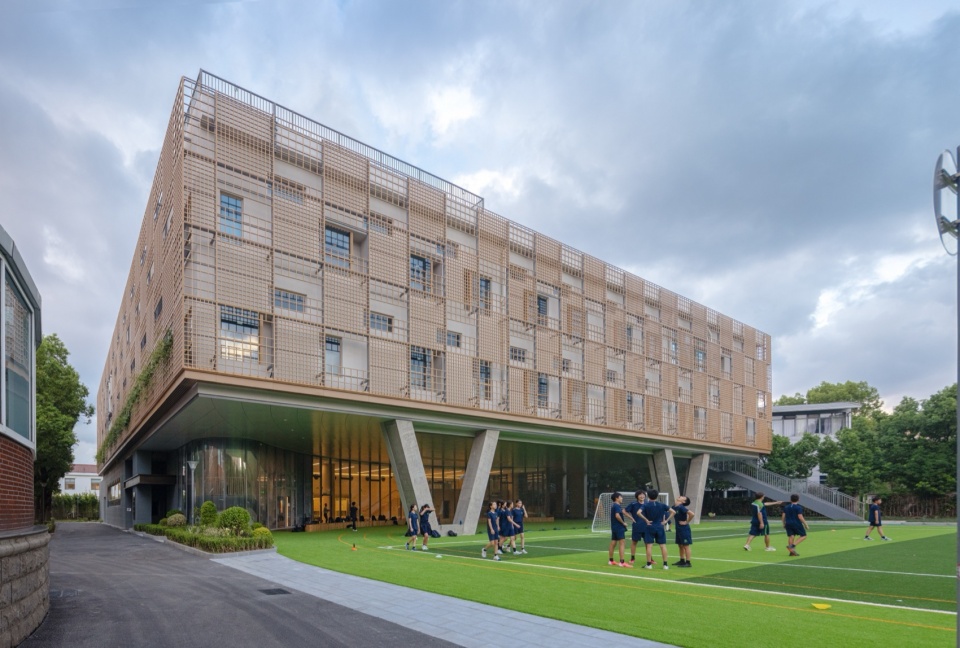
▼东南侧建筑立面,Southeast building facade
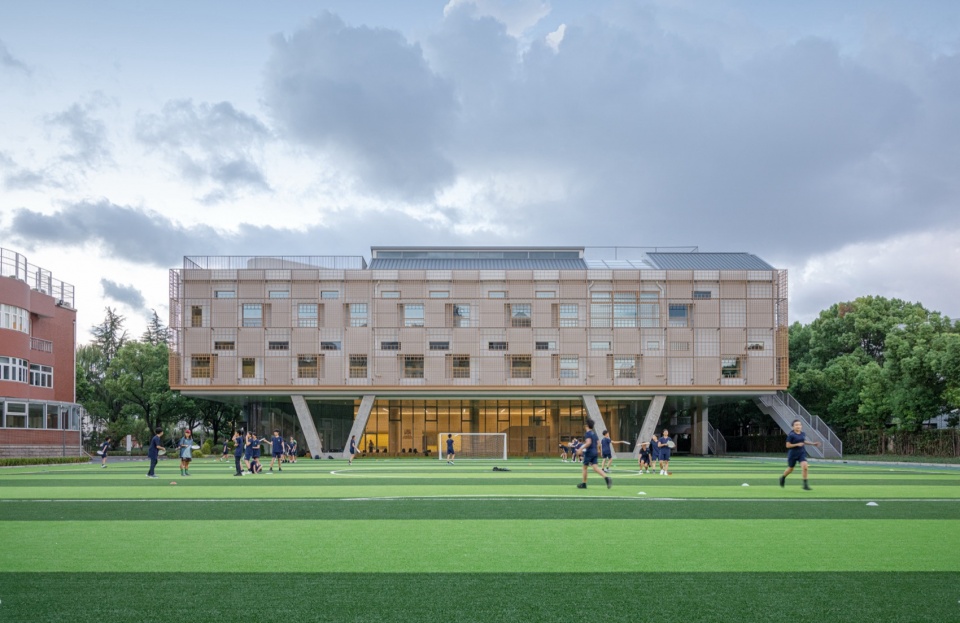
▼延伸到架空空间的跑道,Runway extending into the elevated space
这场与基地的对话,让我们深切意识到“界面”是处理这座新建筑与环境关系的核心——它既可以实现空间的区分,又能创造场景的粘合;既可以是建筑与外部环境的联结纽带,也可以是建筑内部不同空间的边界;更能作为抽象的院墙语言,呼应包校与中国传统文化的关联。以“界面”为核心来构建设计语言,由此成为回应场地与理念的要诀。
This dialogue with the site made us deeply realize that the “interface” is the core mechanism for handling the relationship between this new building and its environment. It can differentiate spaces while binding distinct scenarios together; it can serve as a link between the architecture and the exterior environment, or as a boundary between different interior spaces; furthermore, it can function as an abstract language of traditional courtyard walls, echoing YK Pao School’s connection with Chinese culture. Building our design language around the “interface” became the key to responding to both site and design idea.
▼外观,Exterior view
▼外观,Exterior view
界面交互:隔与透Spatial Interface: Separation and Transparency
包校对新建综合楼的功能需求,远超出一座传统体育建筑的范畴:除了室内游泳馆、多功能篮球馆、乒乓室、屋顶球场等迫切需要的体育设施,另有美术、音乐、ICT、木工作坊、智能机器人、时装设计、摄影等多元化专业教室,以及服务于校内外教师的培训中心,还需要一个兼具报告厅功能的集合大厅。这份多元的功能清单,恰与包校 STEAMS 教学体系相契合,也让我们确信,这座建筑的核心价值,在于成为容纳跨学科教学、激发交流与创造的空间容器。如何在组织空间的过程中发挥 “界面” 的设计潜力,正是激活这份价值的关键。结合功能需求、空间体验与结构合理性,我们将建筑分为上下两个部分,运用界面“隔”、“透”交织的设计语言,营造多层次的立体空间体验,让不同场所既相对独立,又能形成视觉与场景的互动。
The school’s functional requirements for the new comprehensive building far exceeded those of a conventional sports facility. In addition to the urgently needed indoor swimming pool, multi-functional basketball court, ping-pong room, and rooftop sports field, it had to house a wide array of specialized STEAMS classrooms—including art, music, ICT, a wood workshop, intelligent robotics, fashion design, and photography—as well as a teacher training center serving both internal and external faculty, and a collective hub that could double as a lecture hall. This multifaceted program perfectly aligned with the school’s STEAMS pedagogical framework, confirming that the building’s core value lay in becoming a spatial vessel that sparks cross-disciplinary teaching, interaction, and creativity.
The key to activating this value lay in exploiting the design potential of the “interface” during spatial organization. Integrating functional needs, spatial experience, and structural rationality, we divided the building into lower and upper volumes. By employing a design language woven from the “separation” and “transparency” of interfaces, we created a multi-layered, three-dimensional spatial experience where different locales remain relatively independent yet visually and contextually interactive.
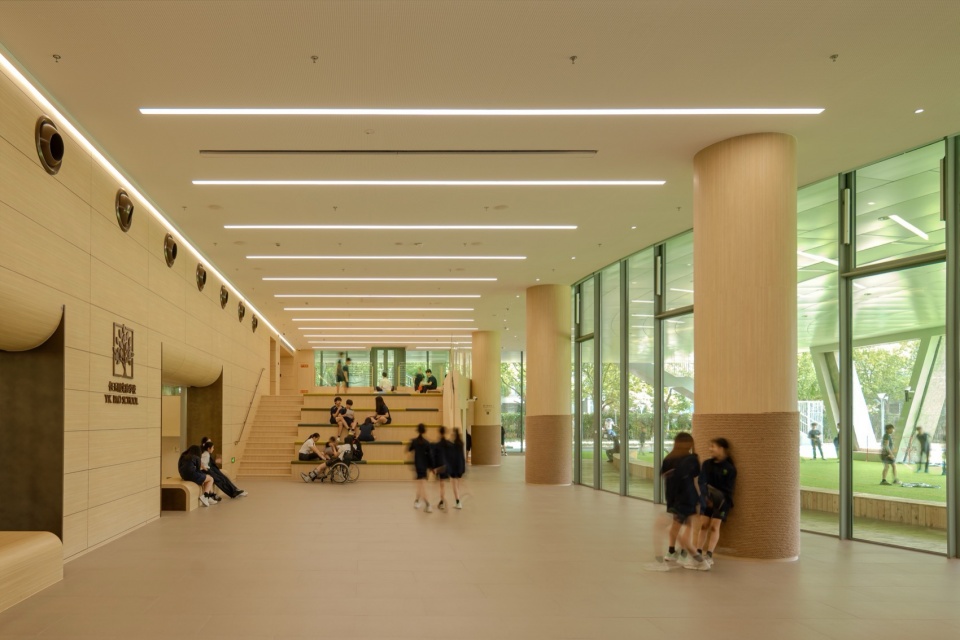
▼集合大厅,Assembly hall
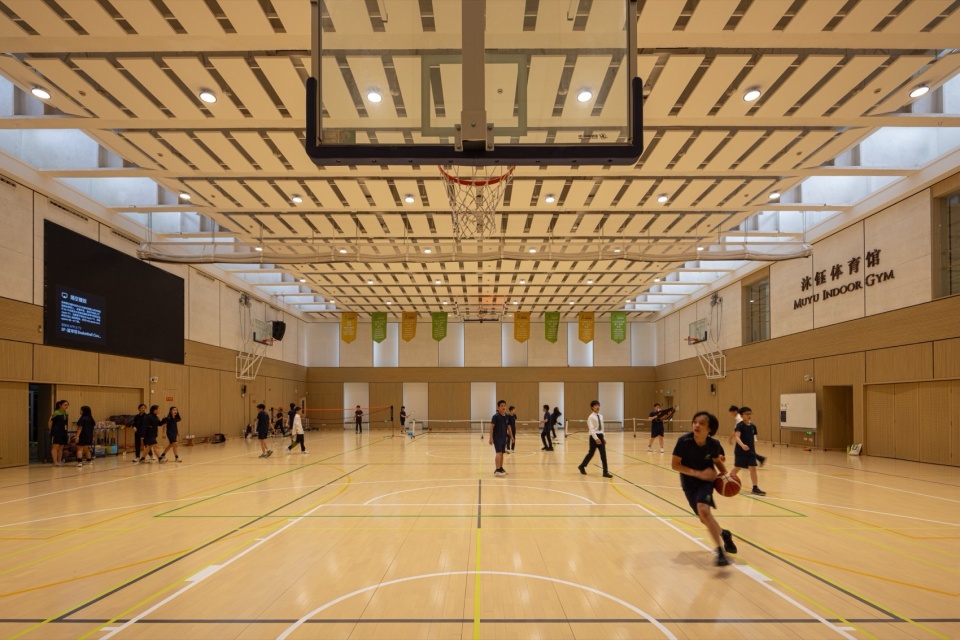
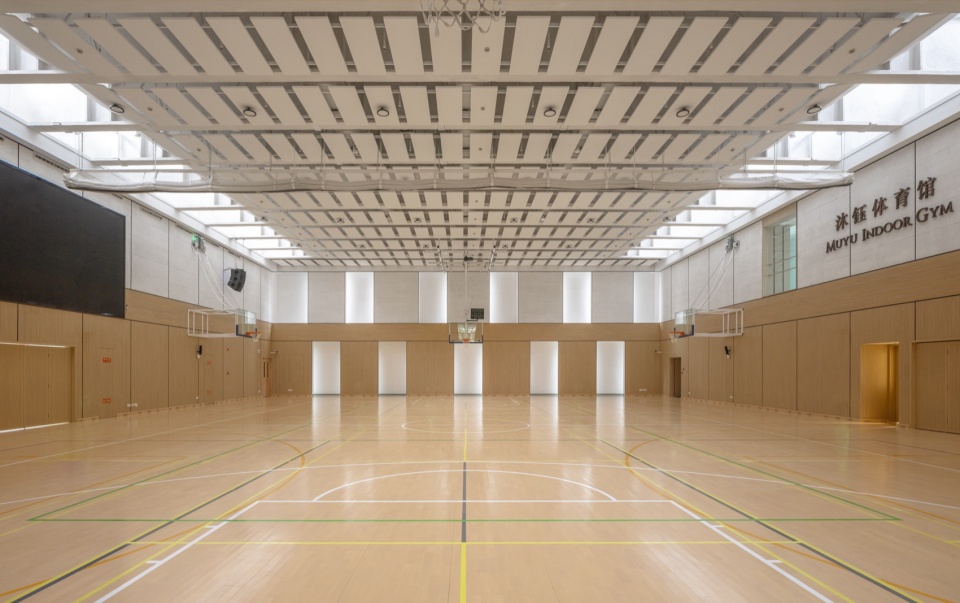
▼多功能篮球馆,Multipurpose basketball gymnasium
▼乒乓球室看向游泳馆,View from the table tennis room to the swimming pool
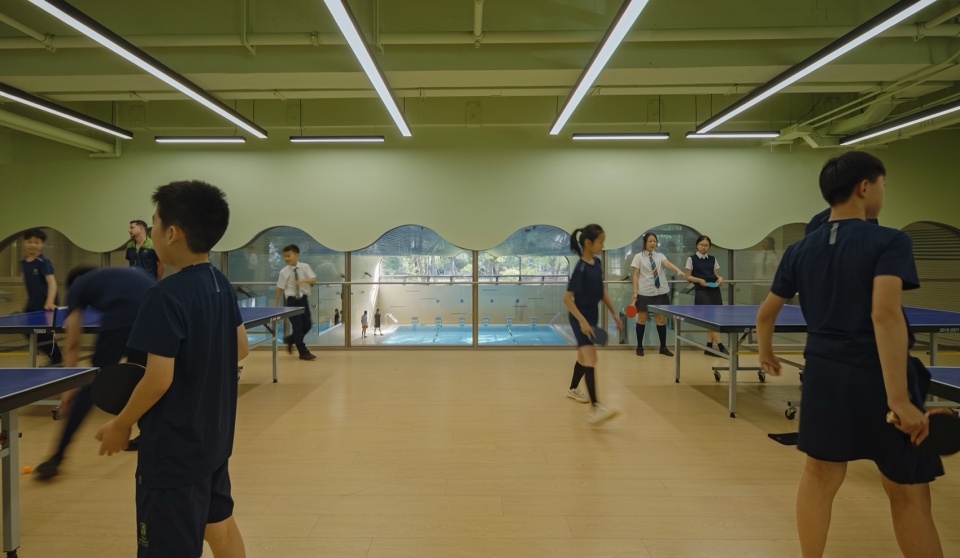
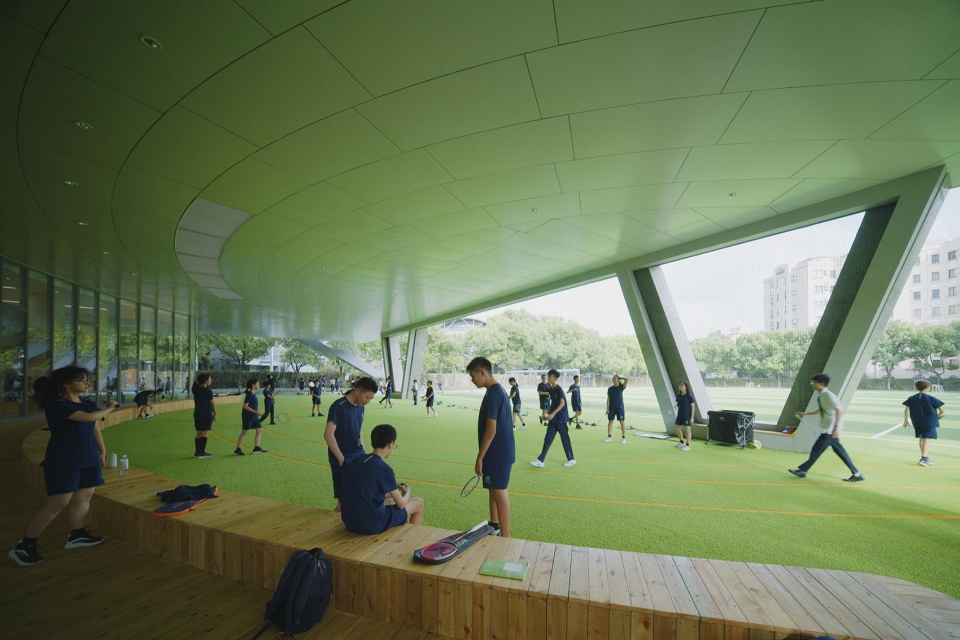
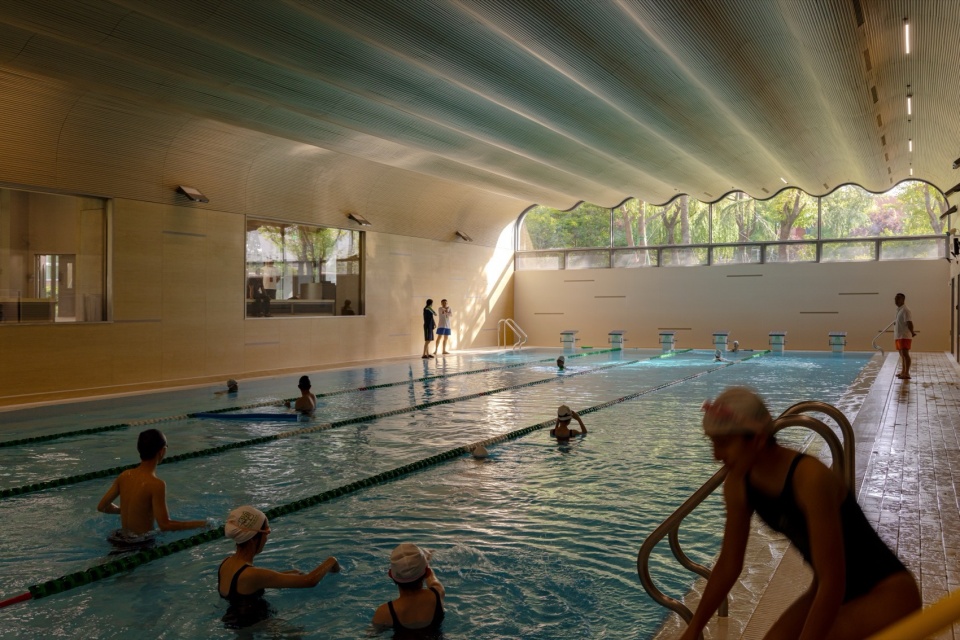
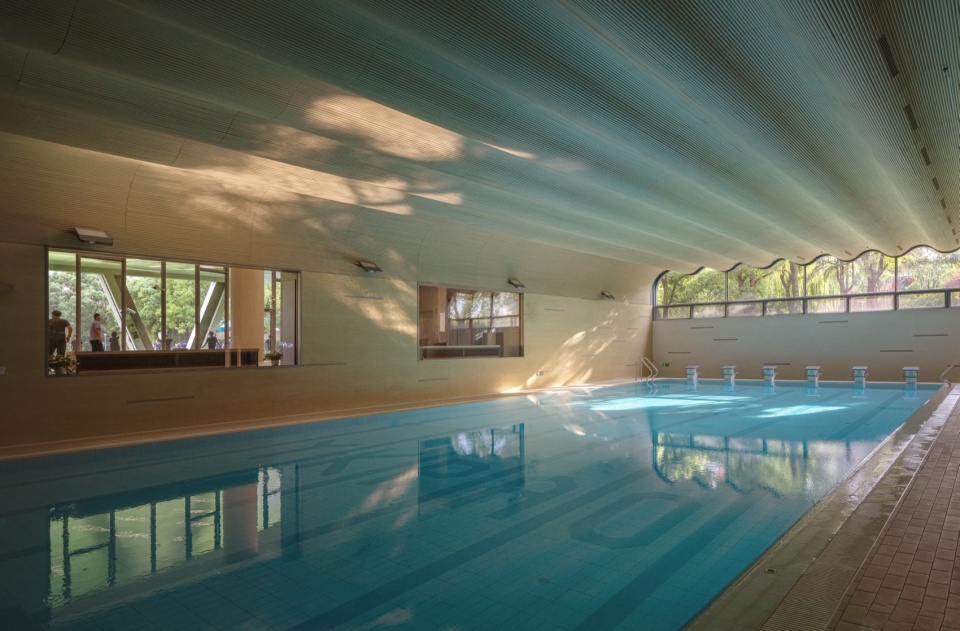
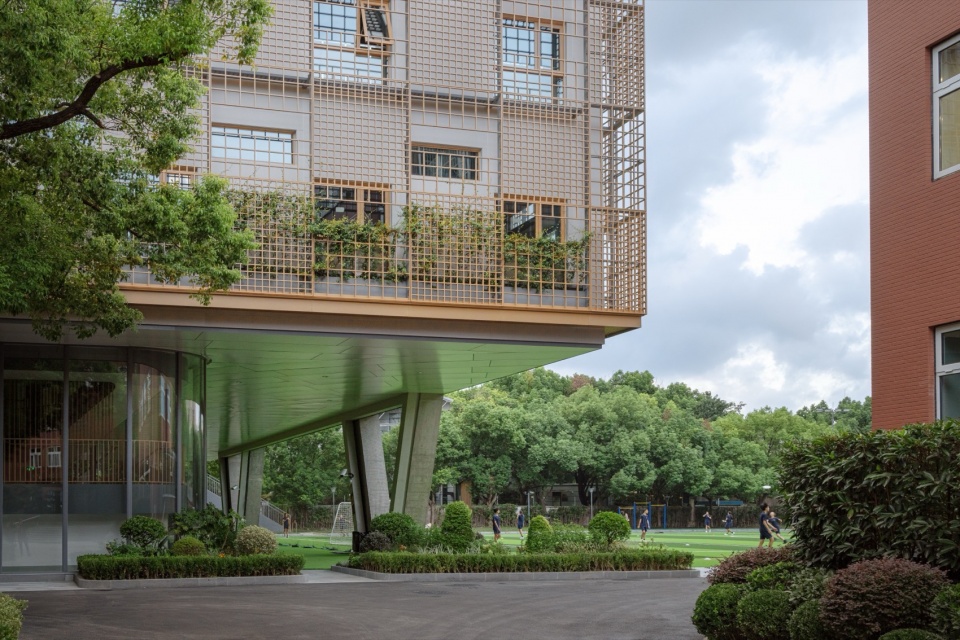
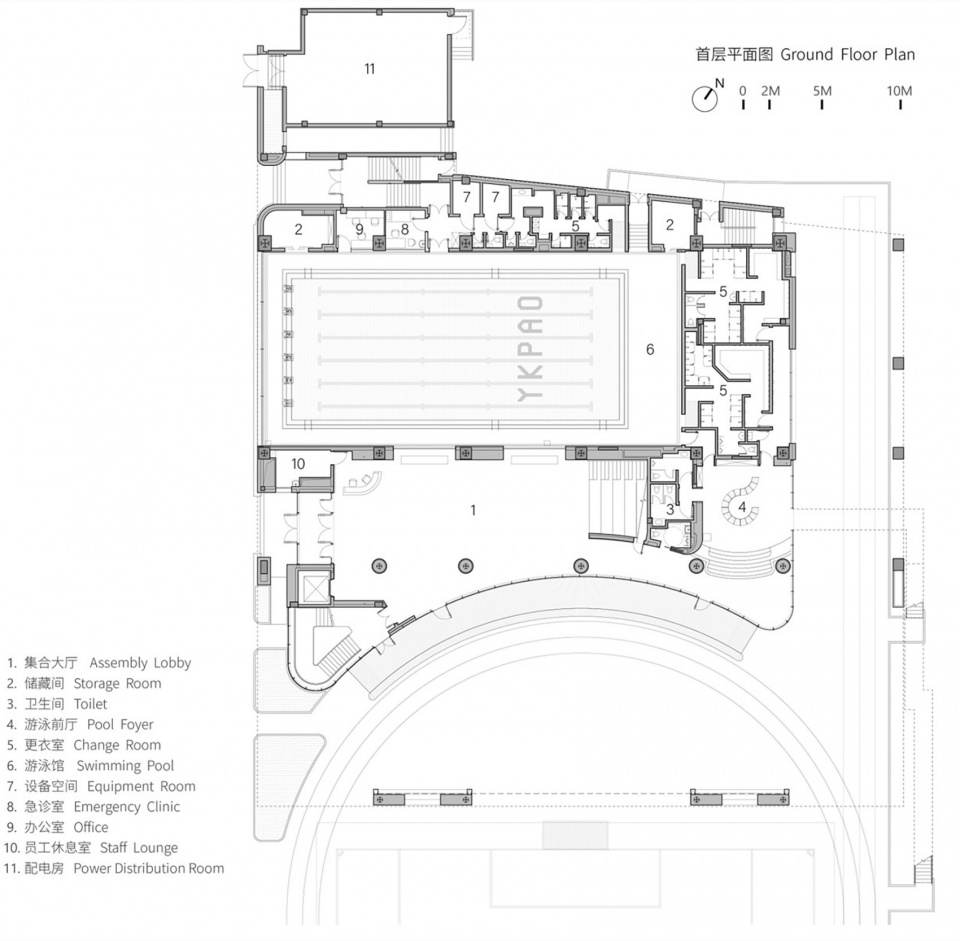
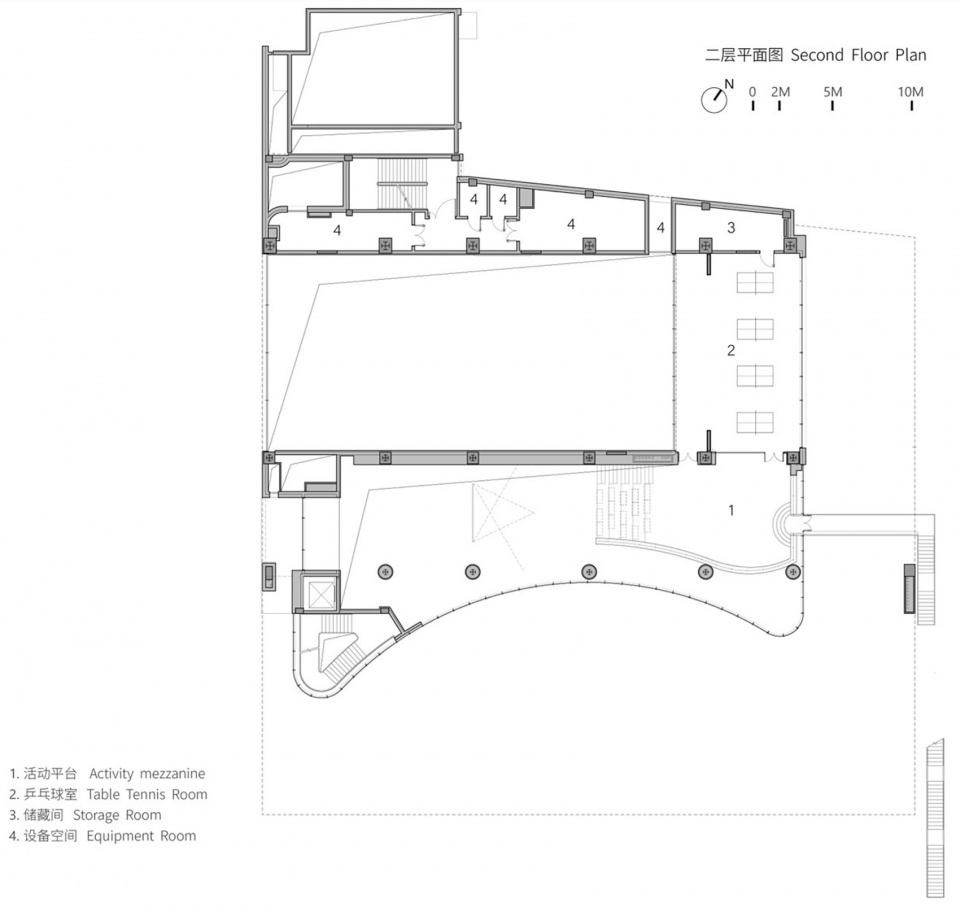
建筑下部,是首层入口集合大厅与半地下25米6道游泳馆,基本符合基底扣除跑道后能容纳的最大室内面积。北侧游泳馆下沉1米,既提升了泳池空间的净高,也在更衣室上部空出一个夹层容纳乒乓室;南侧集合大厅以弧形玻璃幕墙直面操场,幕墙曲率呼应跑步弯道,最大化释放室内空间;大厅西侧为入口,东侧向下连通游泳馆,向上经观演台阶抵达夹层,更可通过连桥跨过百米跑道直达操场。花园 – 泳池 – 乒乓室 – 架空直道、操场 – 架空弯道 – 大厅 – 泳池:我们以架空结构与墙体窗洞为媒介,在东西、南北两个方向的八重界面上营造了多层次的立体空间体验。身处大厅,可同时望见操场与泳池的活力;置身泳池,能感受两侧花园的树影与阳光;驻足乒乓室,又可兼得跑道与泳池的动感。建筑南侧的两组V型柱托起上部结构,打开东南、西南转角,让跑道穿堂而过,定位其间的球门与弧形幕墙,共同界定出半月形架空空间,成为师生们格外喜爱的半户外多功能场所,集合、运动、演出排练等各类校园活动在这里轮番上演。
The lower volume of the building comprises the ground-floor entrance hub (Assembly Hall) and a semi-underground, 25-meter, 6-lane swimming pool, which roughly corresponds to the maximum indoor area permissible after deducting the sports track from the building’s footprint. The swimming pool on the north side is sunken by 1 meter, which not only increases the clear height of the pool hall but also carves out a mezzanine space above the changing rooms to accommodate a ping-pong room.
The Assembly Hall on the south side faces the sports field directly with a curved glass curtain wall; its curvature echoes the bend of the running track, maximizing the liberation of indoor space. The west side of the hall serves as the main entrance, while the east side connects downward to the swimming pool and upward via stepped spectator seating to the mezzanine, and further extends across the 100-meter track via a pedestrian bridge to link directly with the sports field.
Garden–pool–ping-pong room–sheltered straight track; sports field–sheltered curved track–hall–pool: utilizing elevated structures and wall apertures as spatial mediums, we engineered a multi-layered, three-dimensional experience across eight layers of interfaces along both the east-west and north-south axes. Standing within the hall, one can simultaneously witness the vitality of both the sports field and the pool; immersed in the pool, one can sense the shifting tree shadows and sunlight from the flanking gardens; lingering in the ping-pong room, the kinetic energy of the track and the pool can be experienced at once.
On the south side of the building, two pairs of V-shaped columns prop up the superstructure, opening up the southeastern and southwestern corners to allow the running track to pass through the building. The soccer goal positioned within this zone, along with the curved curtain wall, collectively delineates a crescent-shaped sheltered outdoor space. This has become a highly popular semi-outdoor multi-functional venue for teachers and students, where various campus activities—ranging from assemblies and sports to performance rehearsals—take place in rotation.
▼穿堂而过的跑道,The runway cutting through the building
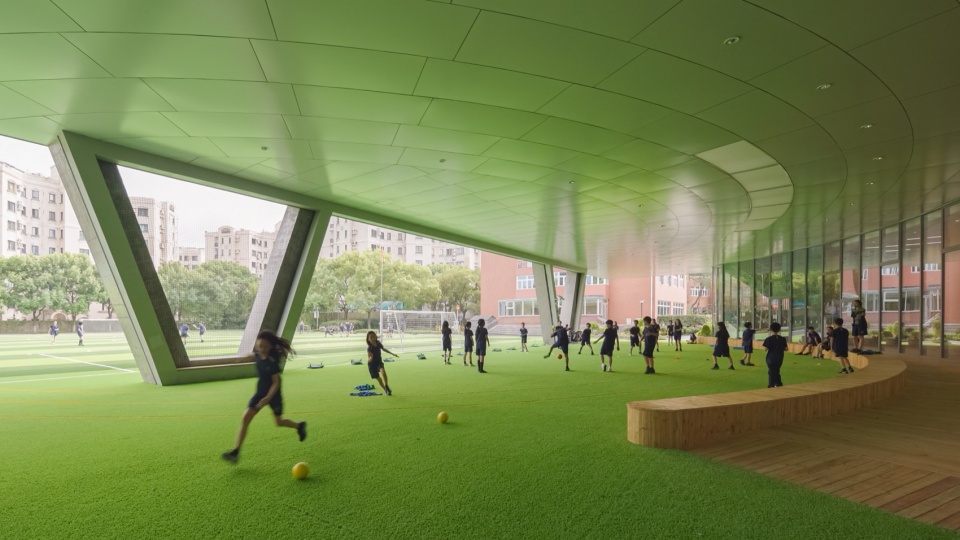
▼半月形的架空空间,Crescent-shaped elevated space
▼游泳馆,Swimming pool
▼游泳馆,Swimming pool
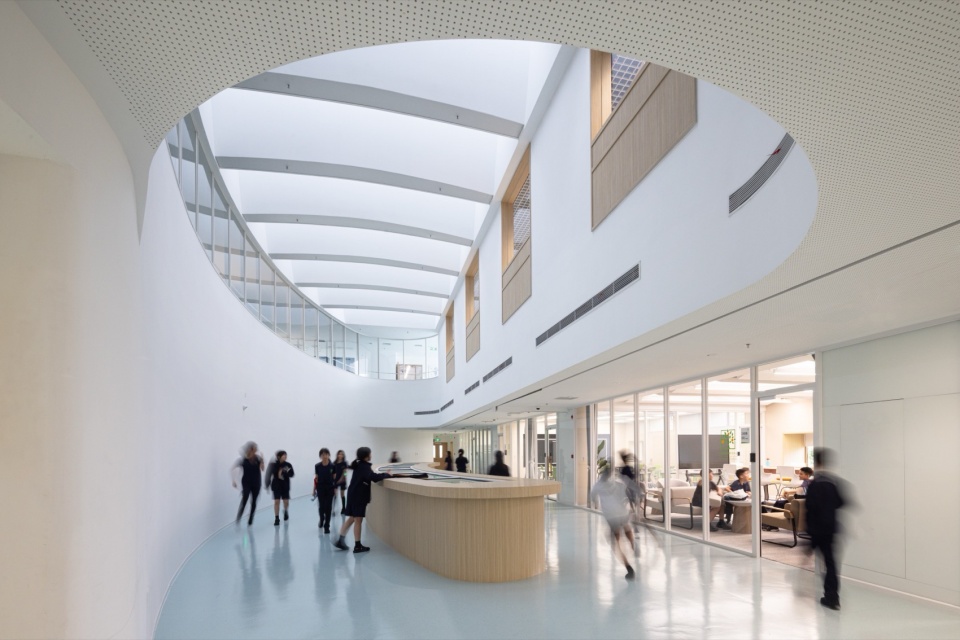
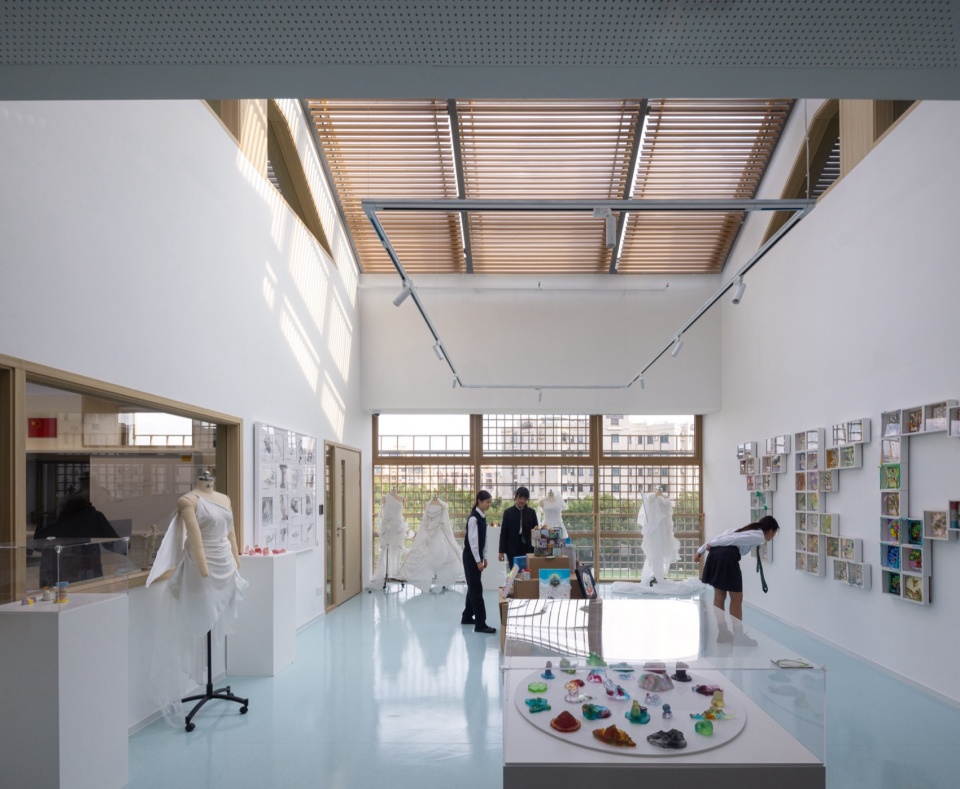
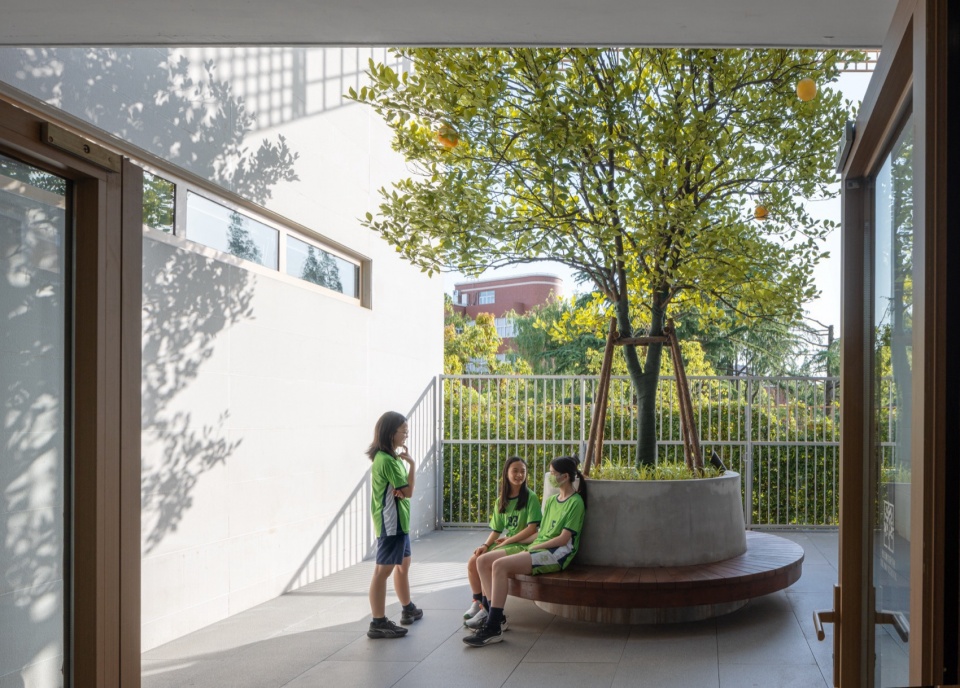
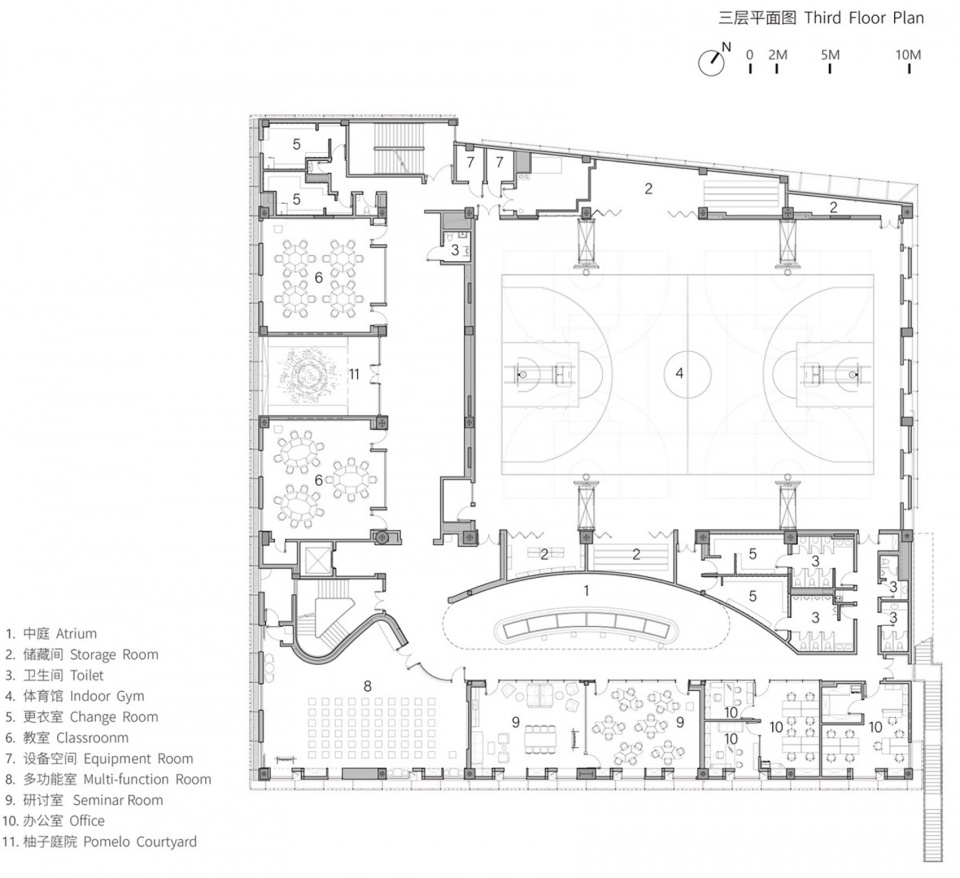
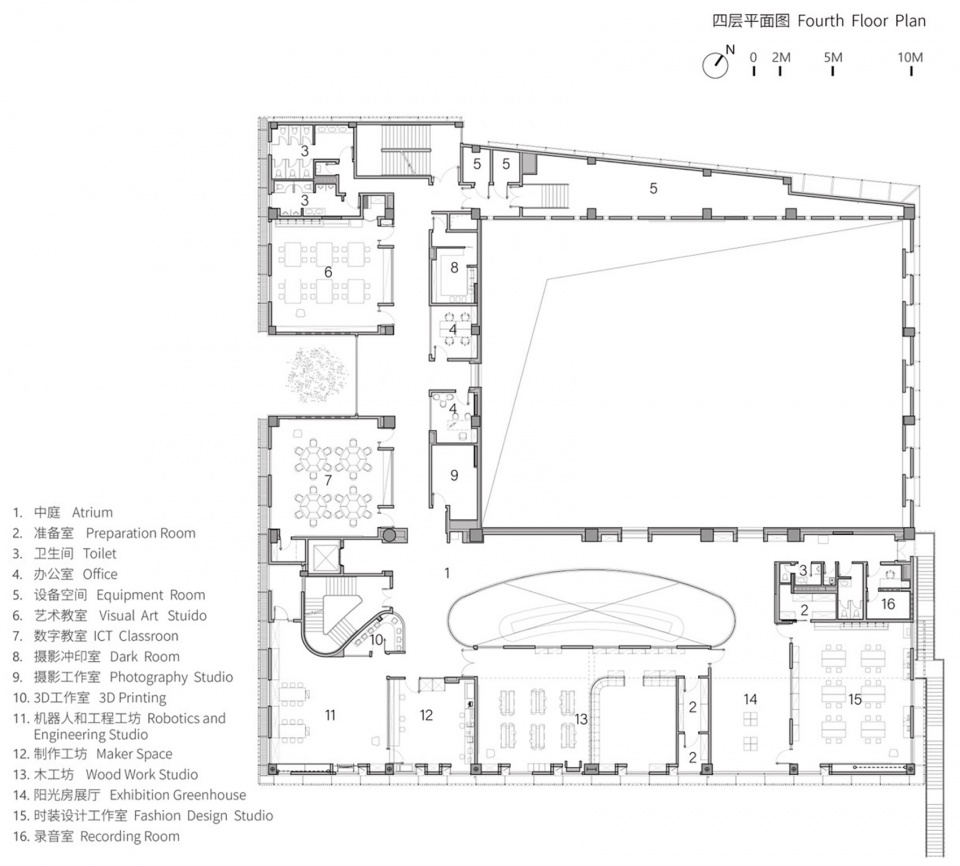
建筑上部,由多功能体育馆与环绕西南两侧的专业教室、教师培训中心组成,这一布局让教学空间拥有西、南朝向的自然采光与校内景观。我们在双层教学带与通高体育馆之间,设计了L形公共空间,作为内部交通与交流的核心。垂直交通设施布置于L形拐点与两端,北侧则集中布置卫生间与设备用房。同样以结构开间与隔墙开洞的方式,我们再一次于南北、东西方向的八重界面中,营造出木工作坊 – 中庭 – 展廊 – 体育馆、教室 / 庭院 – 走廊 – 体育馆的逐次穿透体验。L形公共空间也由此成为有厚度的内部界面,通过西侧教室间的柚子树庭院、南侧木工作坊与时装教室间的阳光花房,以及体育馆与走廊之间的落地窗,打开了空间两侧的视野,让体育、教学与校园环境相互渗透,在不经意间激发师生的探索与交流欲。
The upper volume consists of a multi-functional sports hall enveloped on its south and west sides by specialized classrooms and the teacher training center. This configuration ensures that the academic spaces profit from natural daylighting and scenic views of the campus from the south and west. Between the double-loaded teaching strip and the double-height sports hall, we introduced an L-shaped public space that serves as the core artery for internal circulation and spontaneous interaction. Vertical circulation cores are strategically placed at the vertex and ends of this L-shape, while restrooms and mechanical rooms are clustered on the north side.
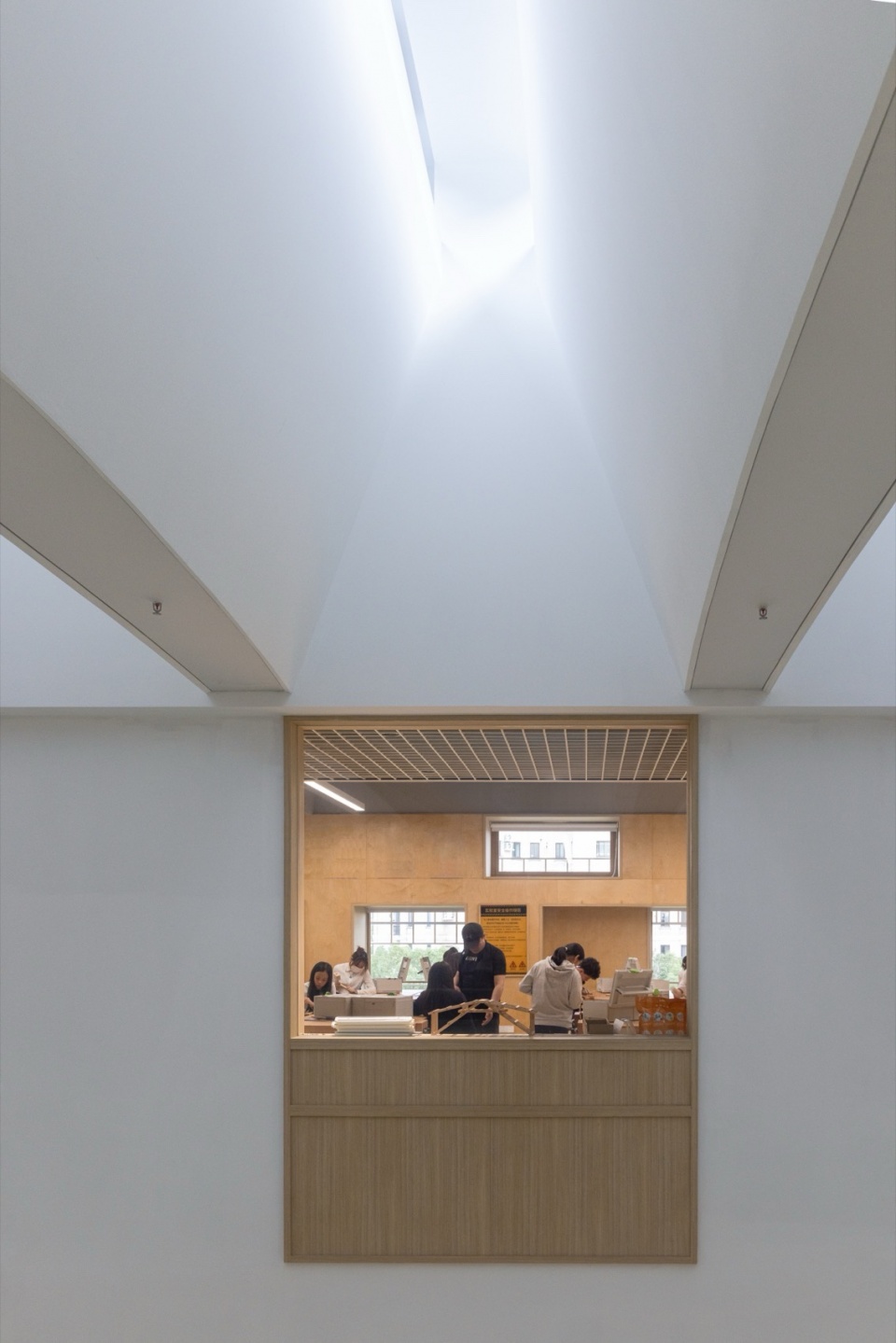
Employing structural bays and partition wall punctures once again, we manifested a sequential transparency across another eight layers of interfaces along both axes: wood workshop–atrium–exhibition gallery–sports hall, and classroom/courtyard–corridor–sports hall. The L-shaped public space thus transforms into an internal interface of significant depth. Through a pomelo tree courtyard nestled between the western classrooms, a sunlit greenhouse between the south-side wood workshop and fashion studio, and expansive floor-to-ceiling windows separating the sports hall from the corridor, vistas on both sides are unlocked. This allows athletics, academics, and the landscape to permeate one another, subconsciously sparking a desire for exploration and dialogue among faculty and students.
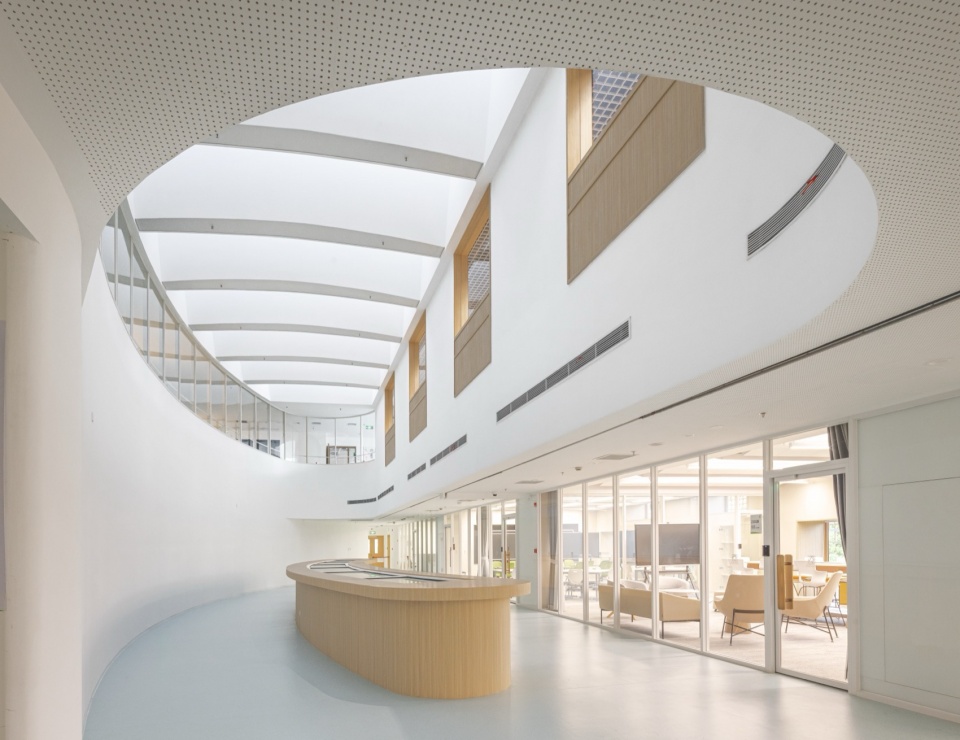
▼三楼中庭空间,Third-floor atrium space
▼三楼中庭空间,Third-floor atrium space
▼阳光房展厅,Sunroom exhibition hall
▼隔中庭望向木工坊,View across the atrium to the wood workshop
▼木工坊,Wood workshop
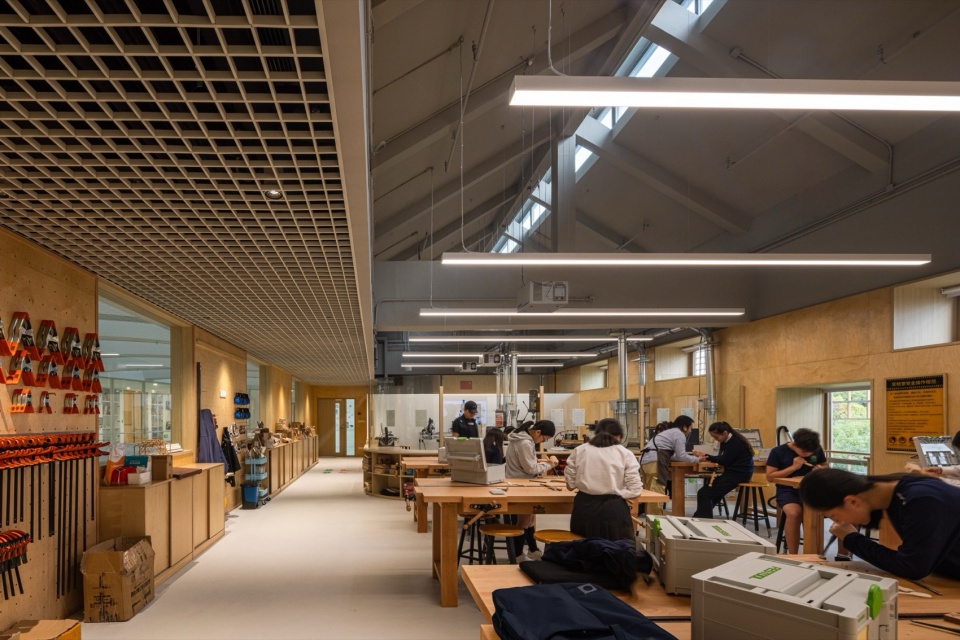
▼木工坊,Wood workshop
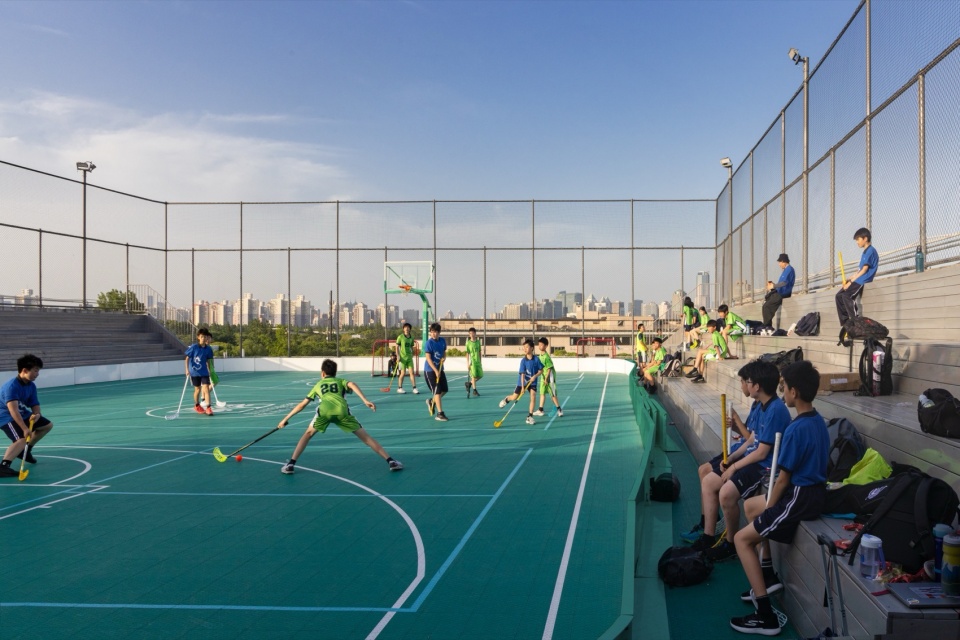
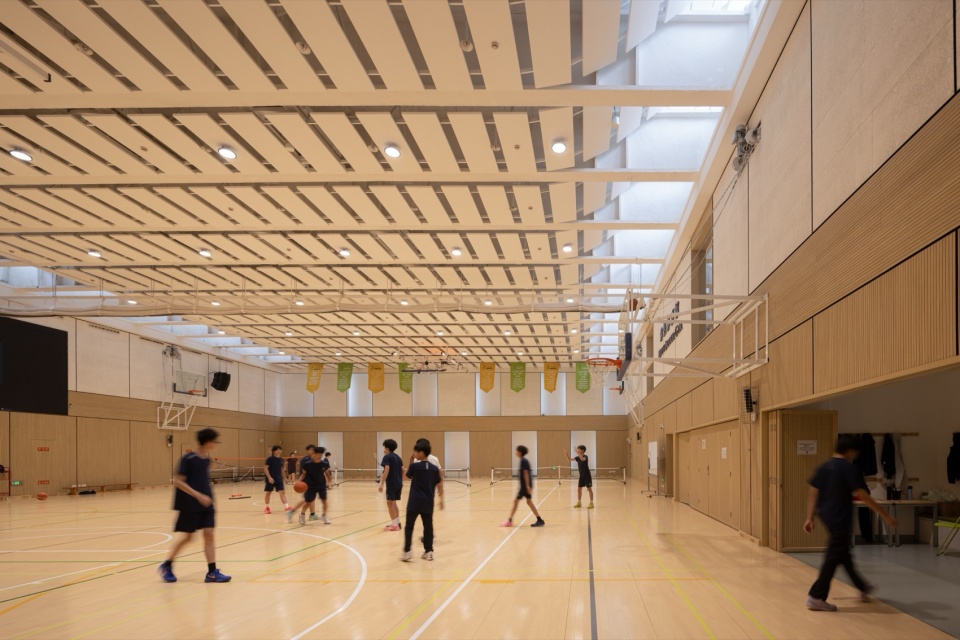
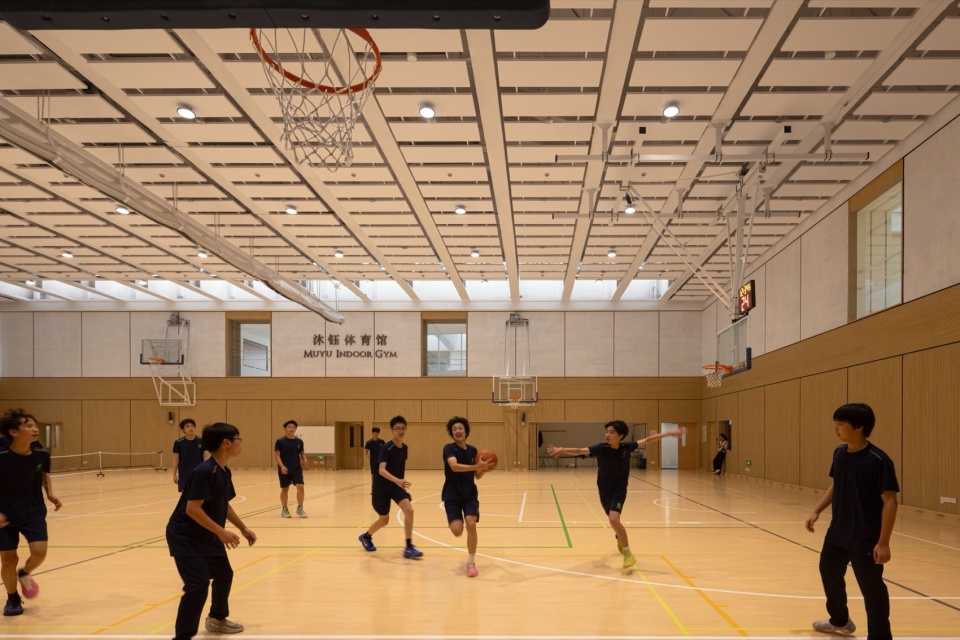
上下两个部分的空间,并非彼此割裂,而是通过垂直界面实现贯通。跑道与中庭之间的弧形天窗、中庭顶部的高侧窗,让地面跑道的弯曲形态向上穿越建筑直达天空,灵动的天光也由此洒向二层中庭与架空层;多功能体育馆的大跨钢梁屋顶上,我们打造了户外篮球场,并将球场两侧屋面板翻起形成看台,同时在下方形成侧高窗,为室内体育馆引入自然天光,既减少人工照明能耗也实现了自然排烟。
The lower and upper volumes are by no means isolated from each other; instead, they are seamlessly unified through vertical interfaces. A curved skylight between the running track and the atrium, coupled with high clerestory windows at the top of the atrium, allows the fluid geometry of the ground-level track to slice upward through the building toward the sky, casting dynamic daylight onto both the second-floor atrium and the sheltered pilotis spaces below. Above the long-span steel roofs of the multi-functional sports hall, we engineered an outdoor rooftop basketball court, folding up the roof slabs on both sides to form spectator stands while generating high side clerestory windows underneath. This design brings natural daylight into the indoor sports hall, reducing artificial lighting energy consumption while facilitating natural ventilation and smoke extraction.
▼屋顶运动场,Rooftop playground
▼多功能篮球馆,Multipurpose basketball gymnasium
▼多功能篮球馆,Multipurpose basketball gymnasium
▼多功能篮球馆,Multipurpose basketball gymnasium
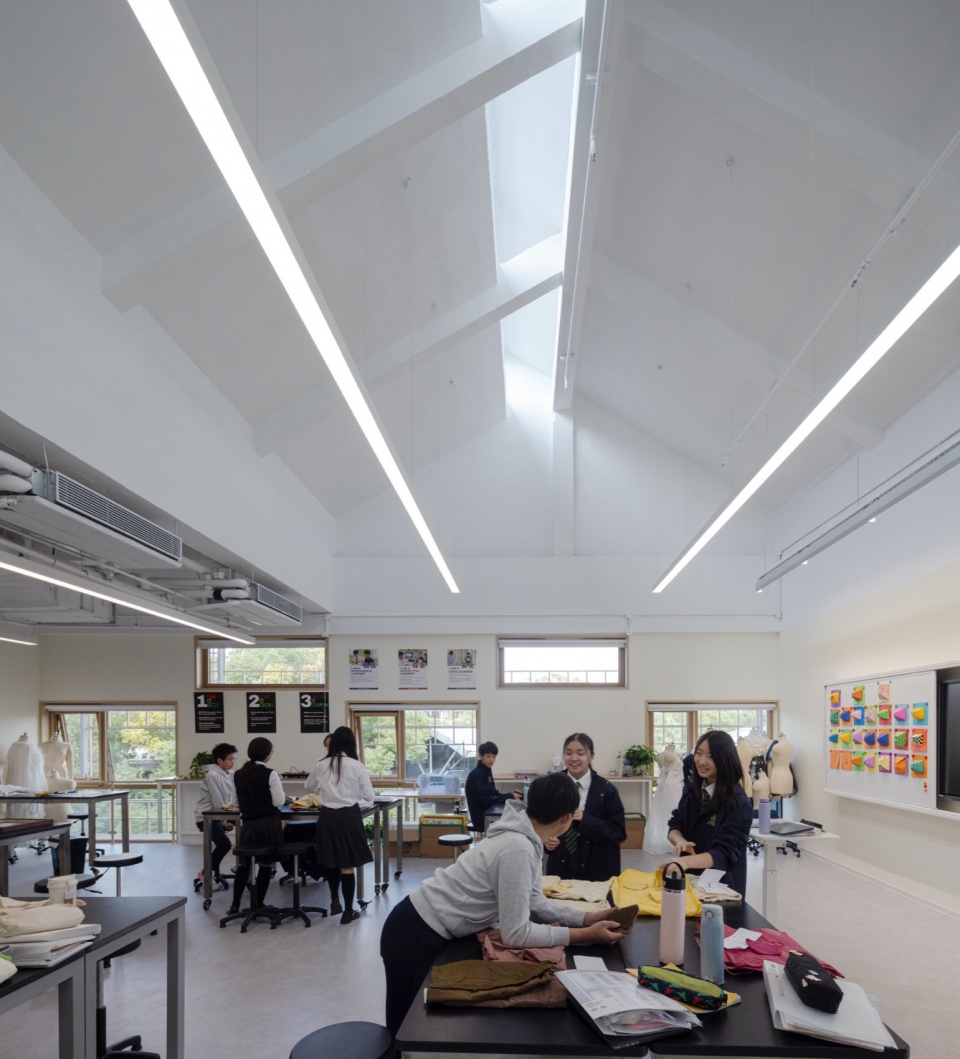
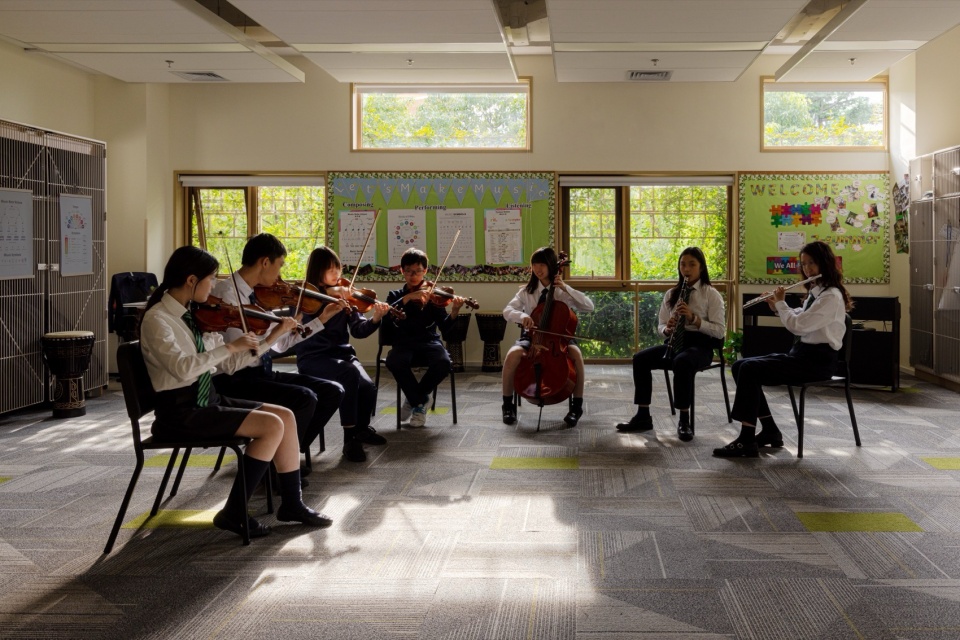
▼艺术教室,Art classroom
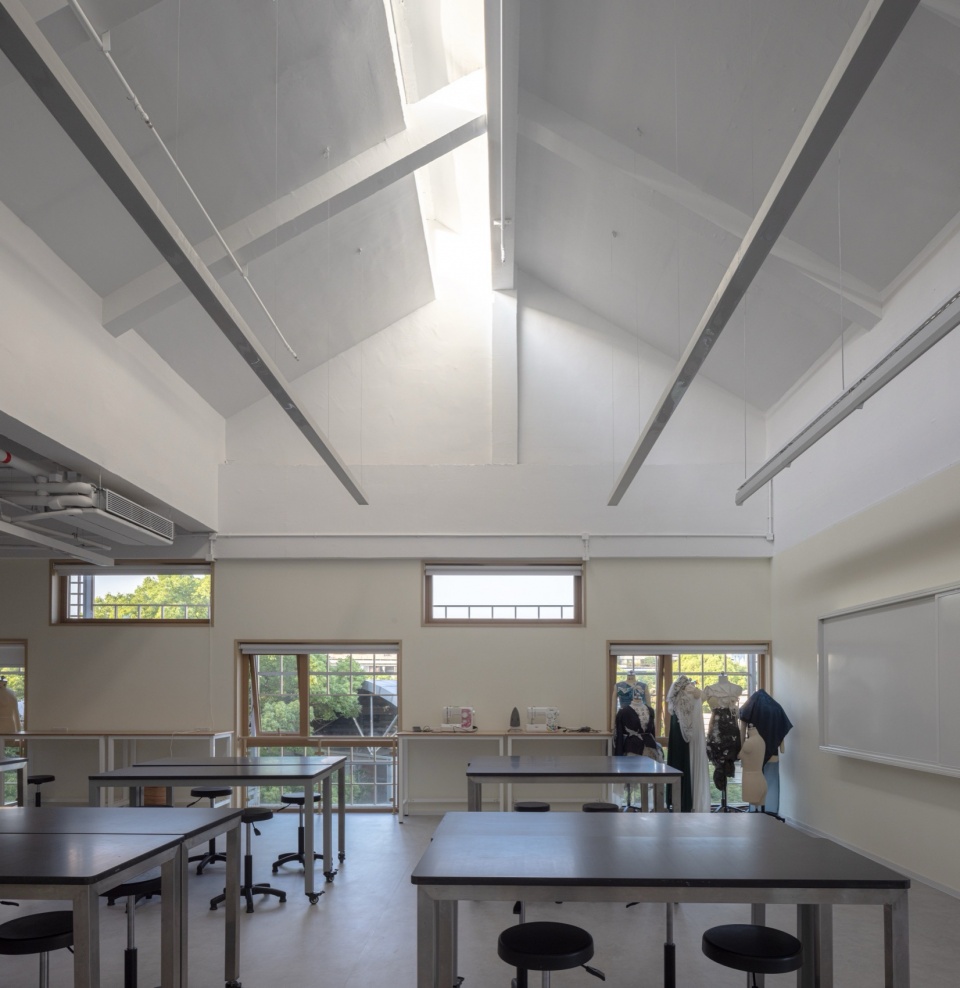
▼艺术教室,Art classroom
整座建筑如同诸多功能盒体的组构,而对盒体间界面“隔”与“透”的组织,则为这种组构注入了有机的灵魂。在多重界面中,建筑师营造出界定与开放、穿越与渗透的多元关系,在借鉴中国传统院落建筑的层进与旷奥之法经营空间的同时,又以现代结构体系与构造方法来营建物质界面,让建筑空间成为全人教育理念的载体——在不同空间的穿越与交互中,师生的行为和感知不仅是传统课堂上的教学关系,而是一次次平等存在的相遇,让不同学科、不同场景相互碰撞,相互启发,让学习超越教室的边界。
The entire building operates like a composition of multiple functional boxes, and the orchestration of “separation” and “transparency” between these boxes injects an organic soul into this compilation. Within these shifting, multi-layered interfaces, the design establishes a dynamic interplay between definition and openness, passage and infiltration. While drawing on the sequential depth and spatial contrast of enclosure and openness (Chang-Ao) found in traditional Chinese courtyard architecture to organize space, it simultaneously deploys modern structural systems and construction methods to build physical interfaces.
This transforms architectural space into a physical vehicle for the philosophy of holistic education. Through the transit and interaction across different spaces, the behaviors and perceptions of teachers and students transcend the rigid pedagogical hierarchies of traditional classrooms. Instead, they materialize as egalitarian encounters where different disciplines and diverse scenarios collide and inspire one another, allowing learning to flow past the boundaries of classroom walls.
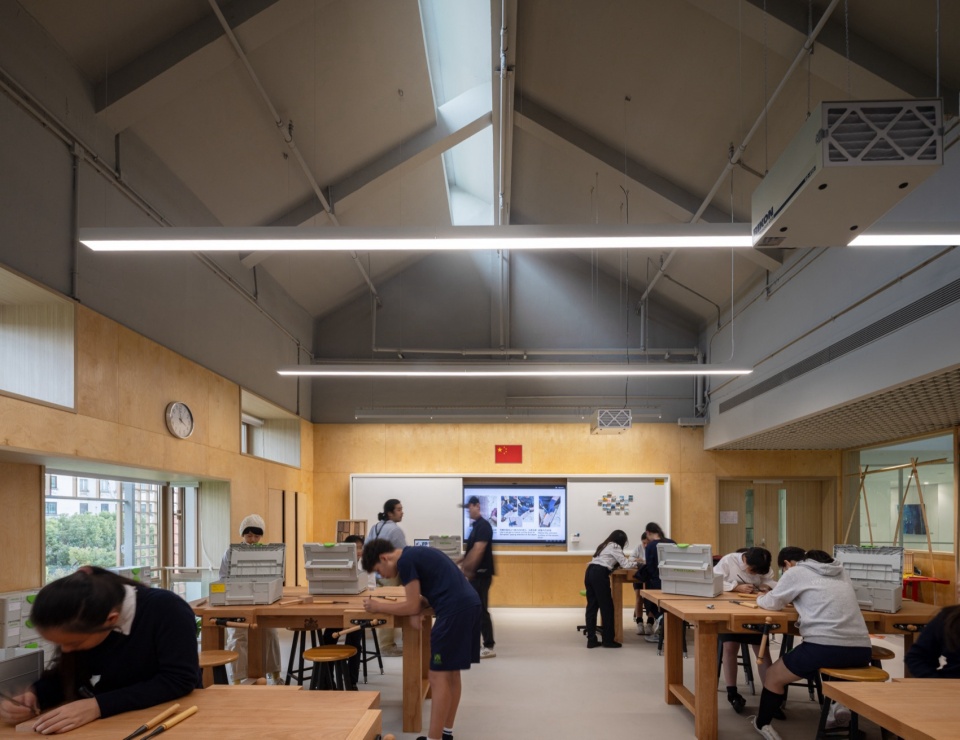
▼教室,Classroom
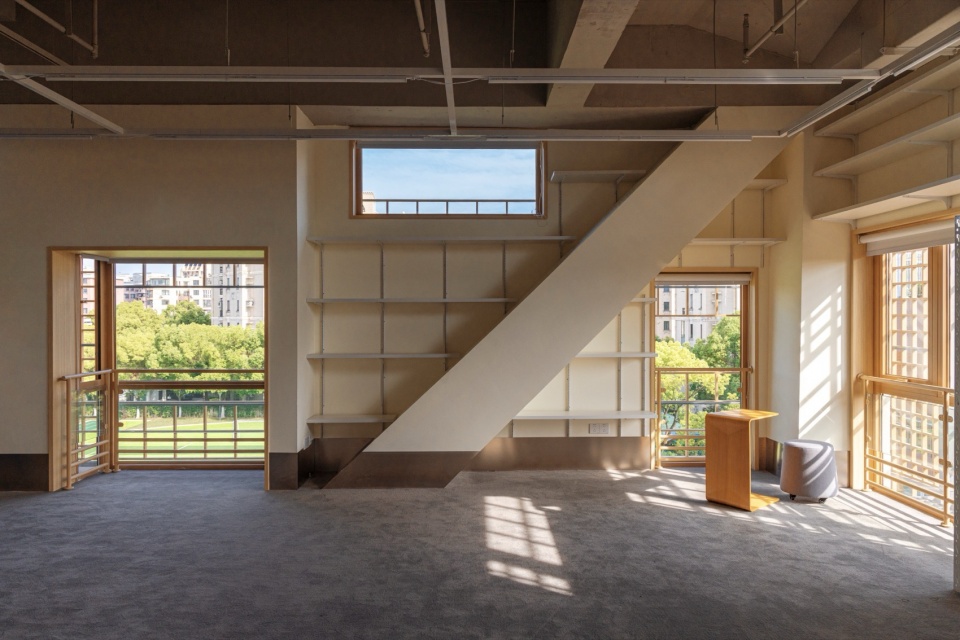
▼使用中的教室,Classroom in use
界面建构:常与殊Tectonic Interface: The Regular and the Exceptional
构成空间界面的柱、墙、板等建筑构件,是理念与体验落地的物质要素。从规整的场地形状与建筑总体效能出发,我们选择模数化的正交框架作为建筑整体的结构体系,但这并不意味着空间体验的刻板与单调。游泳馆、体育馆、集合大厅等空间对净高与跨度的特殊需求,与常规教室、办公室构成差异,这些差异成为结构体系的 “扰动因子”,推动着结构的局部变异,也引导着材料选择与构造设计的方向。
The building components—columns, walls, and slabs—that constitute the spatial interfaces are the physical elements required to manifest concepts into reality. Starting from the regular geometry of the site and overall building efficiency, we chose a modular orthogonal concrete frame as the primary structural system. However, this did not equate to a rigid or monotonous spatial experience. The unique clearance and span requirements of the swimming pool, sports hall, and Assembly Hall stood in contrast to the conventional classrooms and offices. These variances acted as “disruptive factors” within the structural system, prompting localized structural mutations and guiding material selection and tectonic design.
▼夜景,Night view
经过反复推演,我们确定以1.1米作为核心模数,其倍数可适配不同空间的尺度需求:2.2米包容最小门洞高度,也是体育馆屋面钢梁间距、立面开窗与格栅系统的基本模数;4.4米为小办公室面宽与二、三层层高;6.6米是庭院面宽与首层层高;8.8米为教室面宽进深与体育馆层高;15.4米是游泳馆宽度和建筑总层高;33米是体育馆和游泳馆长度;44米是建筑东西向宽度……以此模数为基础,所有功能盒体都拥有了友好的结构对位,界面空间也获得了可变通的秩序:下部架空操场界面采用减柱支撑桁架,上部柚子庭院外界面与中庭内界面采用减梁设计,顶部木工坊、室外球场看台则运用人字梁与斜挑梁。清晰的结构秩序,界定出常规盒体与变异界面的骨架,成为整个建构系统的根基。
Following iterative calculations, we established a core module of 1.1 meters, multiples of which adapt to the scale requirements of different spaces:
· 2.2 meters accommodates the minimum door opening height, and serves as the basic module for the sports hall’s roof steel beam spacing, facade fenestration, and louver systems.
· 4.4 meters defines the width of small offices and the story heights of the second and third floors.
· 6.6 meters matches the width of the courtyards and the ground floor story height.
· 8.8 meters corresponds to the width and depth of standard classrooms and the height of the sports hall.
· 15.4 meters spans the width of the swimming pool and defines the total building height.
· 33 meters dictates the length of both the sports hall and the swimming pool.
· 44 meters forms the total east-west width of the building.
Based on this module, all functional boxes achieve a harmonious structural alignment, and the interface spaces gain an adaptable order. The interface of the sheltered sports field below utilizes column-removal trusses for support; the external interface of the upper pomelo courtyard and the internal interface of the atrium implement beam-elimination designs; the topmost wood workshop and outdoor court stands utilize inverted V-beams and inclined cantilevers. This clear structural order outlines the skeleton of regular boxes and mutated interfaces, forming the bedrock of the entire tectonic system.
▼室内看向柚子庭院,View from inside to the Pomelo Courtyard
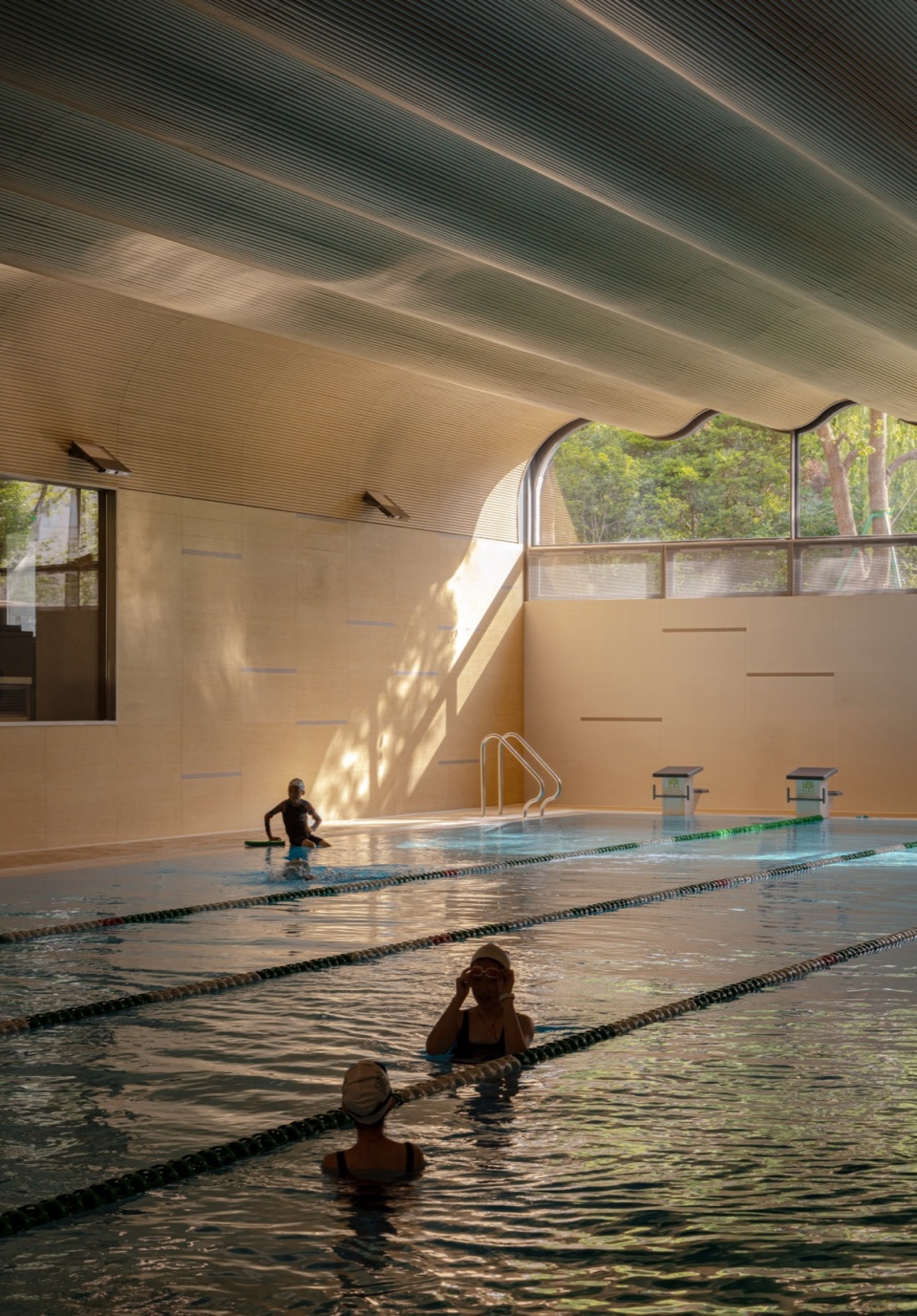
在界面的材质表达上,我们曾面临两个选择:一是在所有界面采用单一材质,最大化呈现 “界面” 的设计概念;二是以多元材质区分场所,维护每个盒体的特殊性。在概念优先和教学体验优先之间,我们选择了后者 —— 让每个空间都拥有属于自己的材质语言,以体验的差异化激发界面间的穿越与互动。漫反射铝板将草坪的绿意倒映在集合大厅的天花,让室外的自然延伸至室内;大厅的墙柱包覆木纹防火板,绕柱麻绳、圆孔风口等细节,隐喻包玉刚先生的船运生涯;游泳馆的波状天花由陶铝吸音板条构成,纵贯东西的线条指向两端的树丛与光晕;体育馆上白下木的分色,让大空间的尺度变得亲切;二层中庭的全白表面,强化了天光与跑道之间的垂直通道;木工作坊、智能机器人工作室的露明混凝土结构,契合了实验教学的特质。
In terms of the material expression of the interfaces, we once faced two choices: either adopting a single material across all interfaces to maximize the architectural concept of the “interface,” or utilizing diverse materials to distinguish different places and safeguard the specificity of each individual box. Between prioritizing an abstract concept or the pedagogical experience, we ultimately chose the latter—allowing each space to possess its own distinct material language, thereby using experiential differentiation to stimulate movement and interaction across interfaces.
Diffuse-reflective aluminum panels cast the green hue of the lawn onto the ceiling of the Assembly Hall, seamlessly extending the outdoor nature into the interior. The hall’s walls and columns are clad in wood-grain fireproof boards, detailed with marine rope wrapping and circular air vents that subtly metaphorize Sir Yue-Kong Pao’s shipping career. The swimming pool’s undulating ceiling is composed of acoustic ceramic-aluminum slats, with lines running from east to west pointing toward the tree canopies and light glares at both ends.
The dual-tone color schema of the sports hall—white on the upper section and wood on the lower—renders the large-scale space more intimate and inviting. The monochromatic all-white finish of the second-floor atrium accentuates the vertical shaft of daylight connecting to the running track below. Finally, the exposed concrete structures of the wood workshop and intelligent robotics studio perfectly align with the hands-on, experimental nature of their courses.
▼游泳馆,Swimming pool
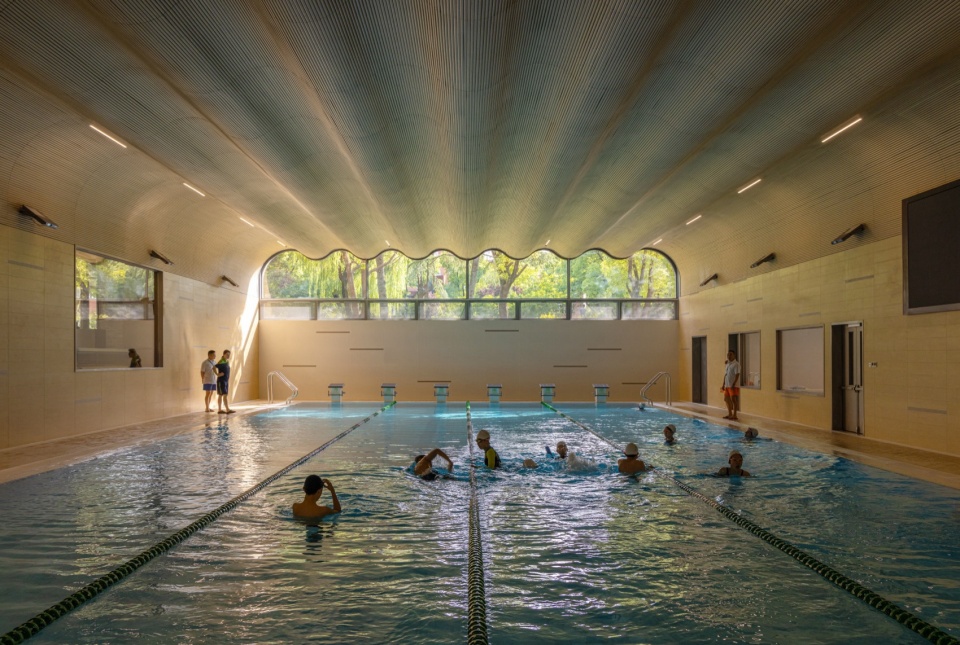
▼游泳馆,Swimming pool
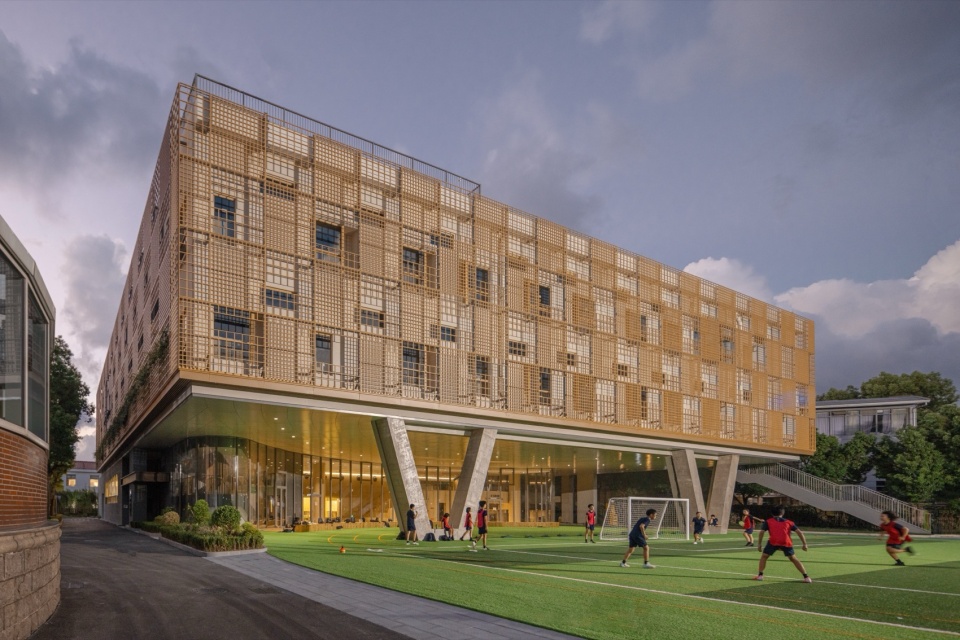
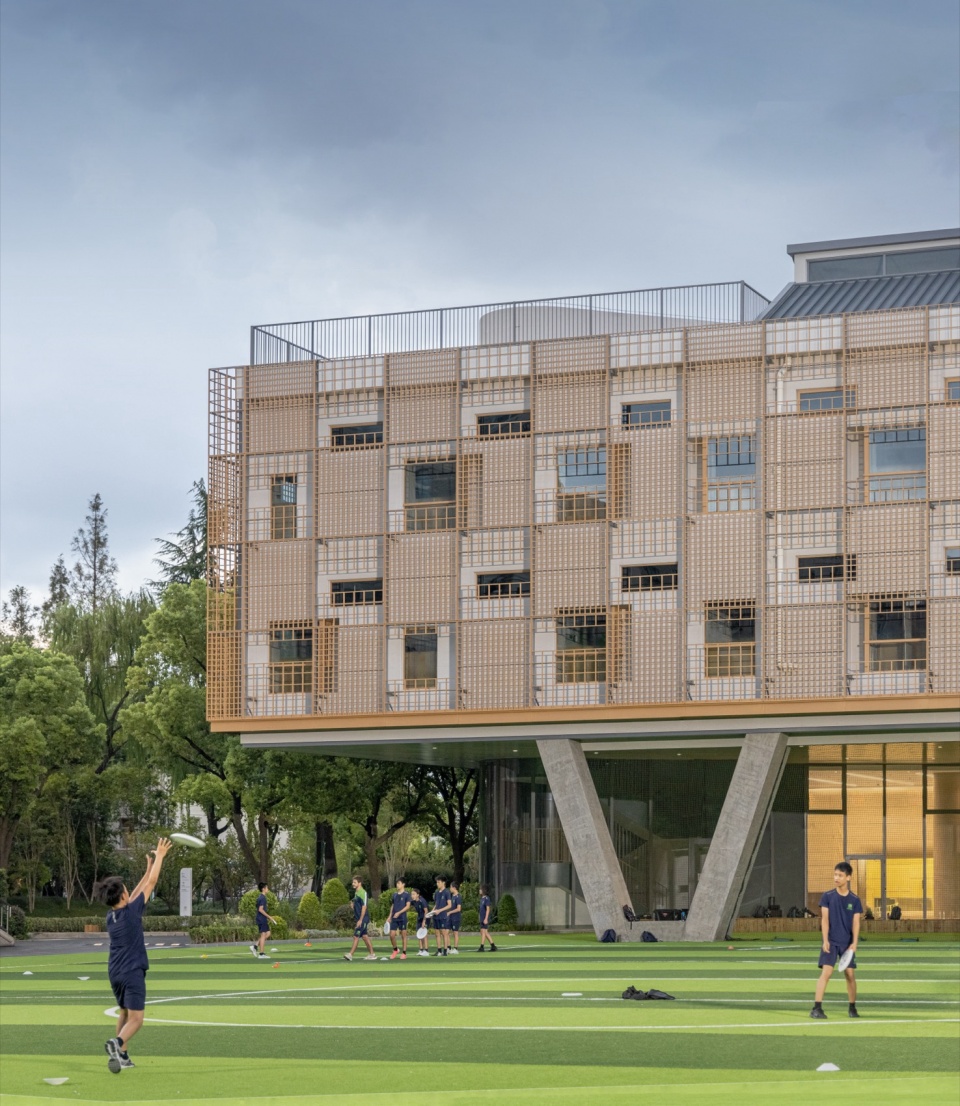
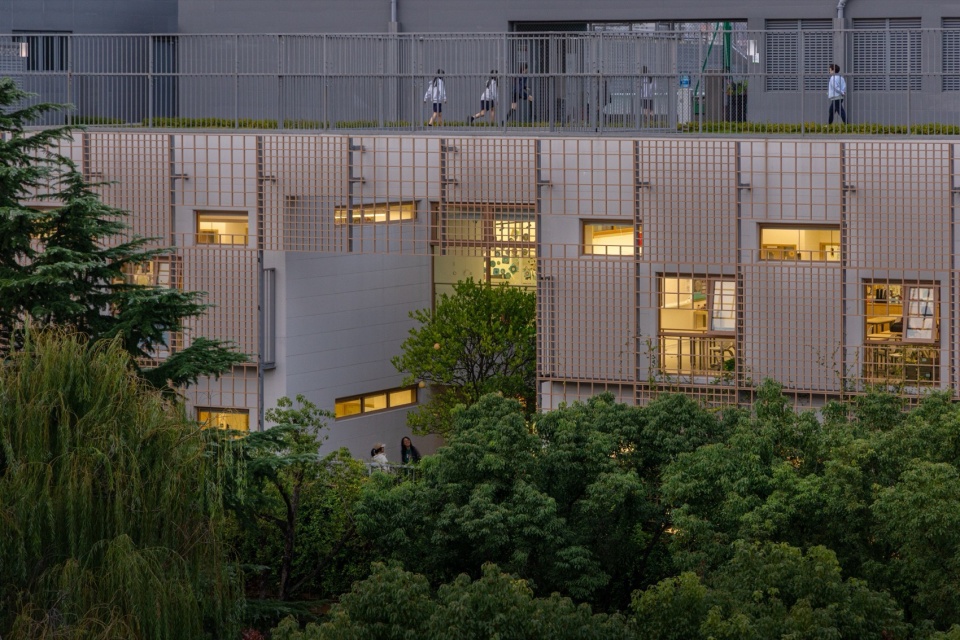
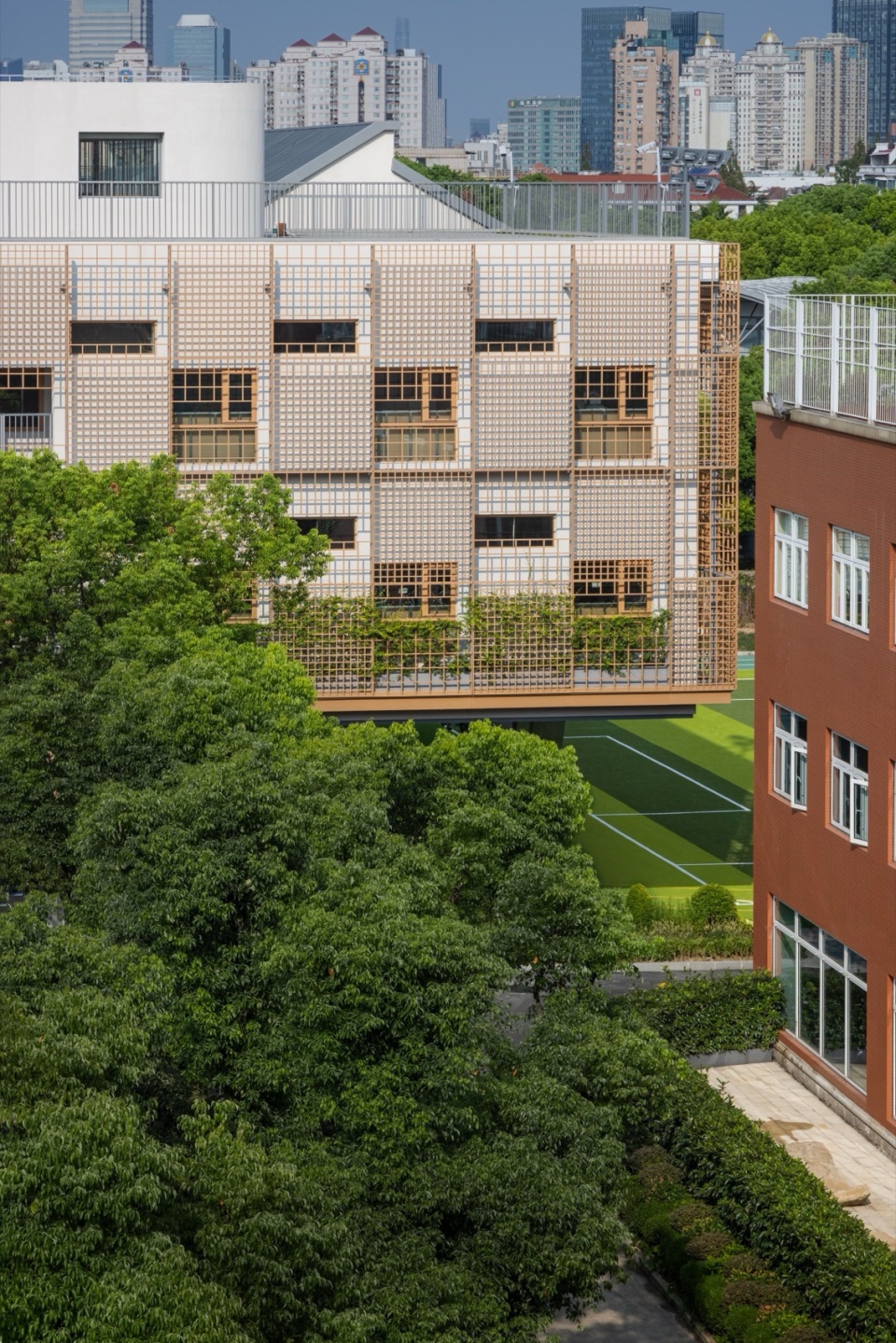
当视线转向建筑外部界面,材质的差异化则趋于收敛,让建筑以完整的形象融入风貌区环境。建筑下部,立面简化为青灰色水泥挂板实墙与门窗洞口,南侧面向操场的通高玻璃幕墙通透开放,游泳馆的印花玻璃窗则为室内引入柔和光线与花园景观;建筑上部,实墙立面统一为米色涂料,窗洞根据内部空间需求设置:体育馆东墙的交错侧窗实现间接采光,西南两侧教室的高低窗则可根据季节调控采光与通风。外墙四周外挂一圈木纹铝管遮阳格栅,格栅疏密随开窗多少调整,日光将木色格栅的投影落在米色墙面上,形成富有深度的立面肌理,既与校园原主楼色彩协调,又以三维方式诠释了Hundertwasser作品中的有机格子。西立面格栅下端设置带自动喷灌的种植箱,风车茉莉沿格栅攀爬,既遮挡西晒,又形成一道绿植界面,让建筑与西侧树林自然交融。格栅旁的内凹小院中,一棵代表包校LOGO的柚子树静静生长,与绿墙上的常春藤一起,成为包校平衡包容、可持续教育理念的生动隐喻。
When looking at the building’s external interfaces, material variation converges to present a unified image within the heritage district. On the lower volume, the facade is simplified into solid walls of charcoal-grey cement fiberboards paired with window openings. The double-height glass curtain wall facing the sports field to the south is highly transparent, while the fritted glass windows of the swimming pool introduce soft daylight and garden views.
On the upper volume, the solid walls are finished in a uniform beige coating, with window apertures carved according to internal programmatic needs: staggered high windows on the east wall of the sports hall achieve indirect lighting, while high and low windows for the southwest classrooms allow seasonal control over daylighting and cross-ventilation.
A perimeter layer of wood-grain aluminum tube shading louvers is hung around the exterior, its density modulating based on the window openings behind. Sunlight projects the shadows of these timber-colored louvers onto the beige walls, generating a facade texture with deep relief that coordinates with the color palette of the campus’s original main building while three-dimensionally interpreting the organic grids found in Hundertwasser’s work.
At the base of the west facade louvers, planter boxes equipped with automated drip irrigation are installed, allowing star jasmine to climb along the grid. This screens off the harsh western sun and forms a living green interface, blending the building into the western woods. In the recessed courtyard beside the louvers, a single pomelo tree—representing the YK Pao School logo—grows quietly. Alongside the ivy on the green wall, it serves as a vivid metaphor for the school’s philosophy of balance, inclusivity, and sustainable education.
▼入口道路看向架空空间,View from the entrance road to the elevated space
落地:守与变Realization: Persistence and Adaptation
从2020年启动设计,到2025年落成启用,包陪庆楼的建设历程,历经了审批、疫情、施工等多重考验,设计也在各种外部变化中不断调整,而我们始终坚守着最初的设计意图,以灵活的应对实现 “守” 与 “变” 的平衡。2021年5月,国内外建筑钢材价格大幅飙升,导致项目预算严重超标,我们不得不将主体结构从钢框架改为混凝土框架,南立面钢桁架改为钢骨混凝土桁架,仅保留体育馆屋面的大跨钢梁。幸而前期确立的模数化体系,有效控制了修改幅度,让建筑的核心空间与结构逻辑未受影响。
Spanning from the inception of design in 2020 to its completion and inauguration in 2025, the construction journey of the Anna Pao Sohmen Centre weathered multiple trials, including rigorous approvals, pandemic disruptions, and construction complexities. The design underwent constant adjustments amid external shifts, yet we consistently preserved the original design intent, achieving a balance between persistence and adaptation.
In May 2021, a sharp surge in domestic and international structural steel prices caused the project budget to severely overrun. We were forced to redesign the primary structure from a steel frame to a reinforced concrete frame, and the south facade’s steel trusses were replaced with steel-concrete composite trusses, retaining steel beams only for the long-span roof of the sports hall. Fortunately, the modular framework established early on effectively controlled the scope of modifications, leaving the core spaces and structural logic unaffected.
▼外观局部,Partial exterior view
建筑外立面格栅的材料选择,也经历了一段反复论证的过程。原设计选用胶合竹木格栅,其质感与自然的包浆效果契合设计期待,但耐久性与维护成本成为顾虑——胶合竹木在无维护条件下易褪色,而定期上漆又可能破坏爬藤植物的生长。为做出科学选择,操场旁搭建了足层高的样板间,模拟西南转角构造,同时悬挂竹木与铝格栅并种植风车茉莉,用一整年的时间,观测两种材料在结构强度、耐候性、色泽变化、表面温度及爬藤适配性上的差异。实验结果表明,铝材的各项性能更稳定,胶合竹木无维护下褪色明显,而两种材料的表面温度与对风车茉莉的适配性并无显著差异。最终,我们与校方一致决定选用铝格栅,以更可持续的方式实现设计初衷。
The material selection for the exterior louvers also underwent a process of iterative evaluation. The initial design specified glulam bamboo-timber louvers, whose texture and natural weathering effects aligned beautifully with the design intent. However, durability and maintenance costs became primary concerns—glulam bamboo-timber tends to fade significantly without ongoing maintenance, yet periodic restaining could disrupt the growth of the climbing plants.
To make an evidence-based decision, a full-scale mock-up was erected next to the sports field, replicating the southwestern corner construction. Glulam Bamboo-timber and aluminum louvers were hung side-by-side, and star jasmine was planted at their base. For an entire year, we monitored the differences between the two materials regarding structural strength, weather resistance, color retention, surface temperature, and compatibility with the climbing vines.
The empirical results showed that aluminum performed with greater stability, whereas the bamboo-timber exhibited noticeable fading without maintenance. Crucially, there was no significant difference between the two materials regarding surface temperature or suitability for the star jasmine. Ultimately, we and the school unanimously elected to use wood-grain aluminum louvers, fulfilling the original design intent in a more sustainable manner.
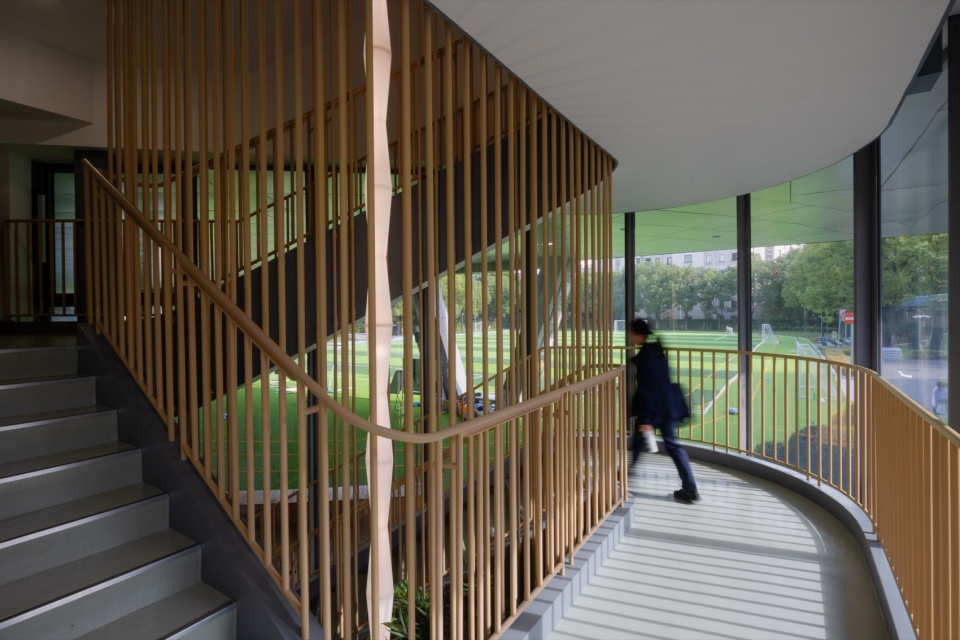
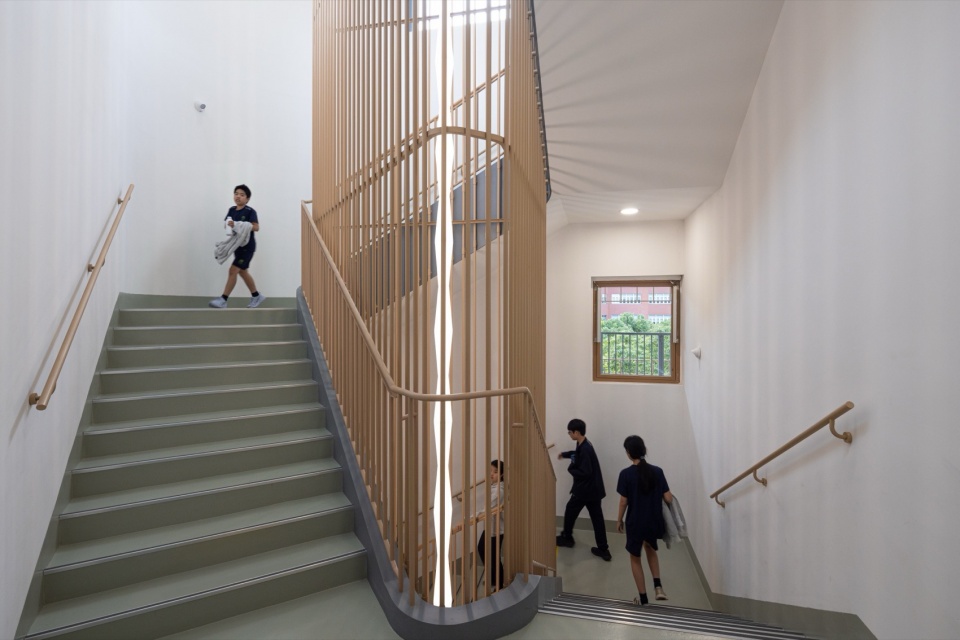
▼南侧楼梯间,Stairwell on the south side
建筑的营造,如同人的成长,都需要时间的沉淀,也需要面对各种未知的变化。包陪庆楼能在诸多挑战中顺利落地,且始终保持甚至不断强化原初的设计意图,离不开包校创办人的信任,更有赖于校方、设计团队与施工团队的紧密协作。新楼启用半年来,穿行于建筑的各个空间,总能看到师生们充满活力的身影,这是作为建筑师最真切的幸福,相信也是对所有建设参与者的最好回报。
The cultivation of architecture, much like the education of a person, requires time to mature and the resilience to face unforeseen transformations. That the Anna Pao Sohmen Centre successfully broke ground and came to fruition through numerous hurdles—while preserving and even sharpening its original design vision—is a testament to the trust given by the school’s founders, and relies heavily on the tight collaboration between the school administration, the design team, and the contractors. Over the past half-year since its opening, walking through the various spaces of the building and witnessing the energetic movements of students and teachers brings the truest sense of fulfillment to us as architects, and stands as the ultimate reward for everyone involved in its creation.
▼南侧楼梯间,Stairwell on the south side
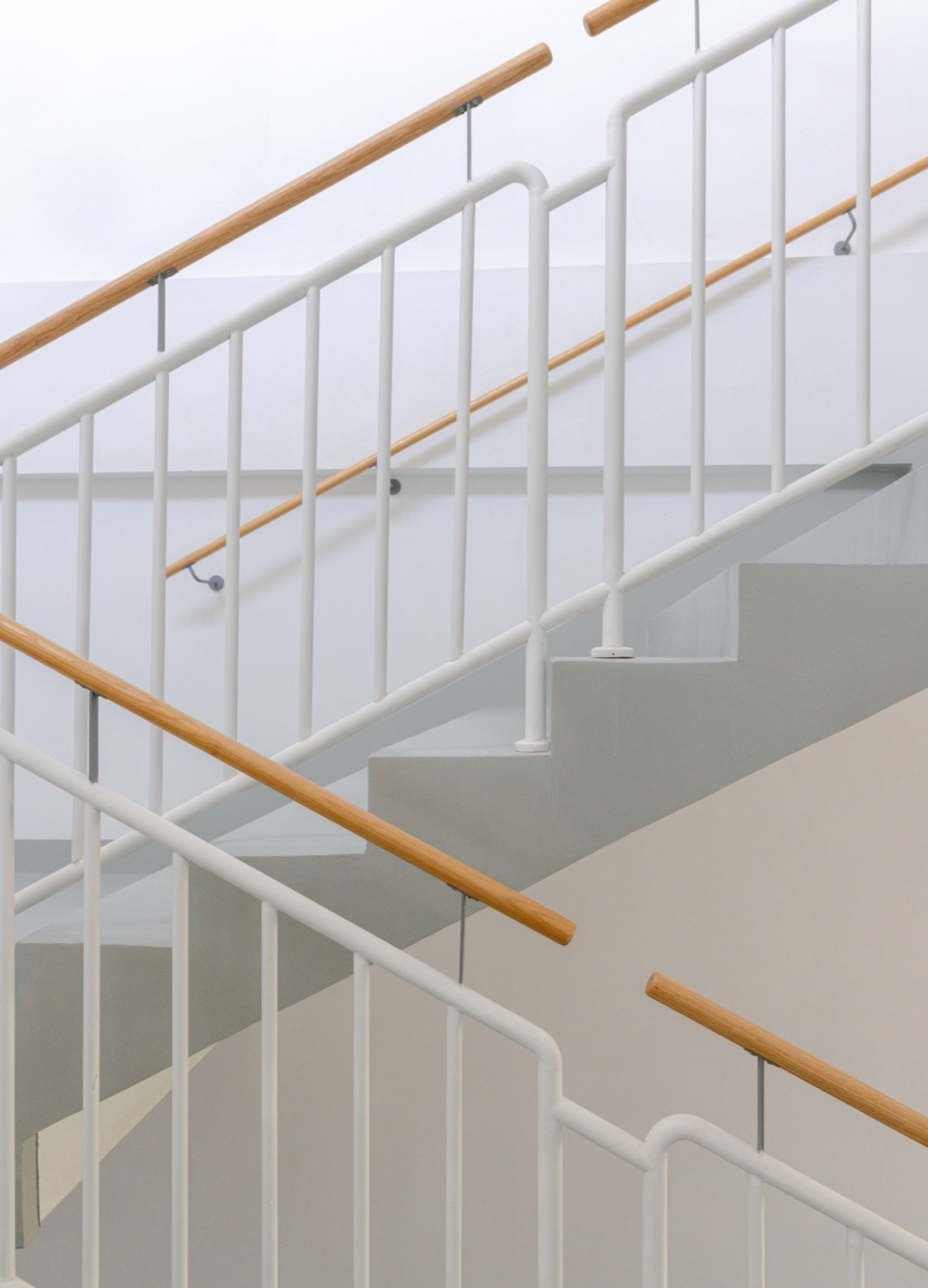
▼楼梯细部,Staircase detail
结语Conclusion
包陪庆楼的设计,运用“界面”为核心设计语言,表达包校的全人教育理念,也对话场地的自然与人文特质。我们相信,这座建筑不仅能满足包校虹桥校区的使用需求,更能以潜移默化的方式,为全人教育的实践提供多元化的空间机遇,让不同学科在这里碰撞,让不同场景在这里交互,让学习成为一场跨越边界的探索。校园建筑是教育理念的物质载体,也是学校成长的见证者。愿这座扎根于虹桥风貌区的新建筑成为一个可持续、多元集约的创新教育场所,在时光的流淌中,持续为包校的教育实践注入活力,见证 “今日兴学,为明日中国;今日兴教,为未来世界” 的包校愿景,慢慢生长,生生不息。
The design of the Anna Pao Sohmen Centre employs the “interface” as its core architectural language, articulating YK Pao School’s philosophy of holistic education while holding an active dialogue with the natural and cultural identity of the site. We believe this building goes beyond meeting the programmatic needs of the Hongqiao Campus; it acts in an imperceptible, ambient way to offer diverse spatial opportunities for the practice of holistic education. It is a place where different disciplines collide, different scenarios interface, and learning transforms into an exploration that spans across borders.
Campus architecture is the material vessel of educational ideals and a witness to a school’s evolution. May this new building, rooted in the Hongqiao historic district, flourish as a sustainable, multi-dimensional, and intensely integrated incubator for innovative education. As time flows, may it continuously infuse vitality into YK Pao School’s pedagogy, bearing witness to the school’s vision—”A school for tomorrow’s China, an education for tomorrow’s world”—as it grows organically and thrives endlessly.
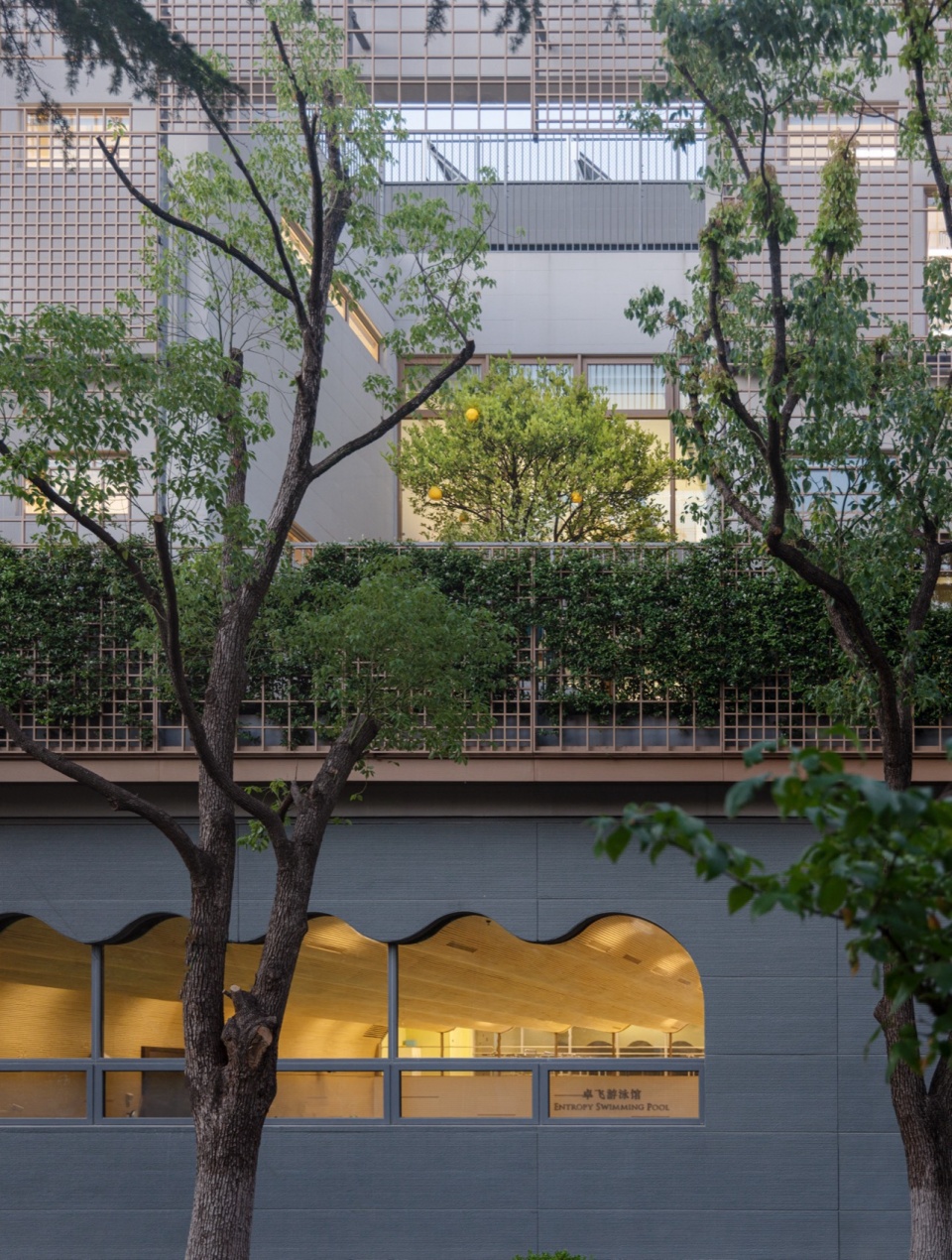
▼外观近景,Close-up exterior view
▼总平面图,Master Plan
▼一层平面图,First Floor Plan
▼二层平面图,Second Floor Plan
▼三层平面图,Third Floor Plan
▼四层平面图,Fourth Floor Plan
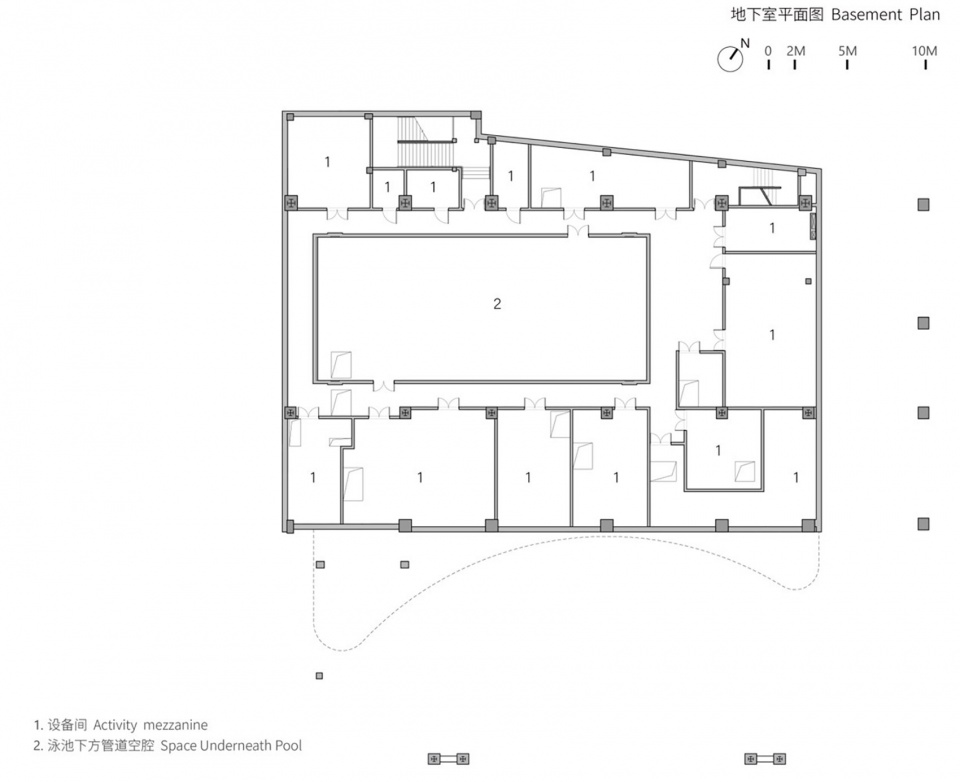
▼地下层平面图,Basement Floor Plan
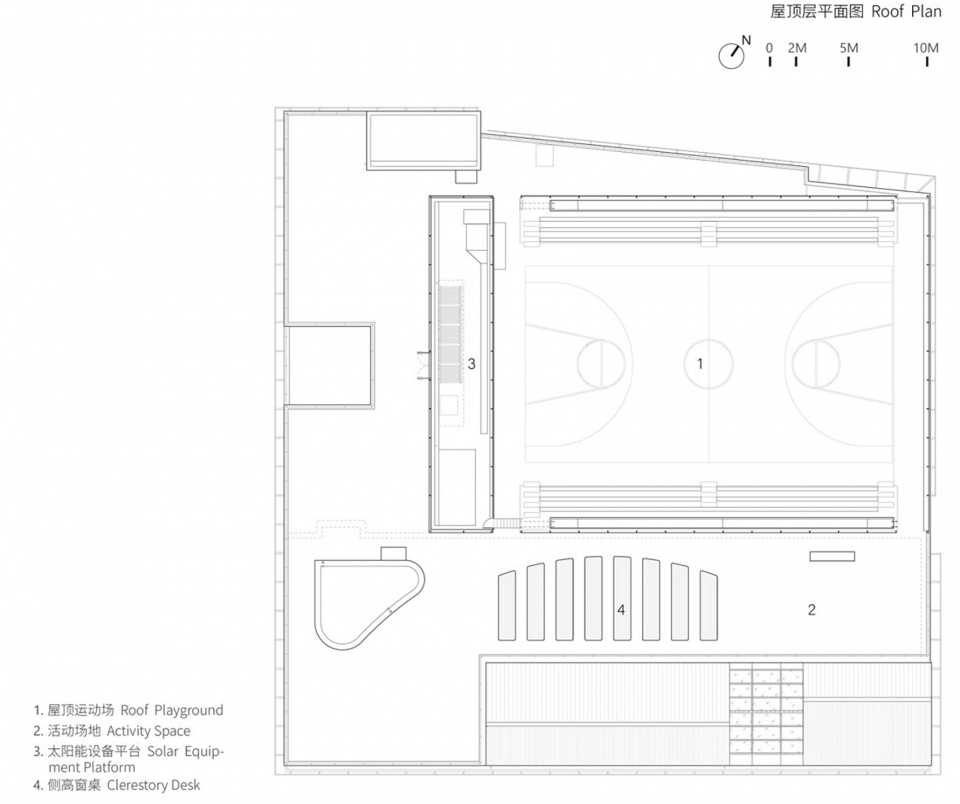
▼屋顶平面图,Roof Plan
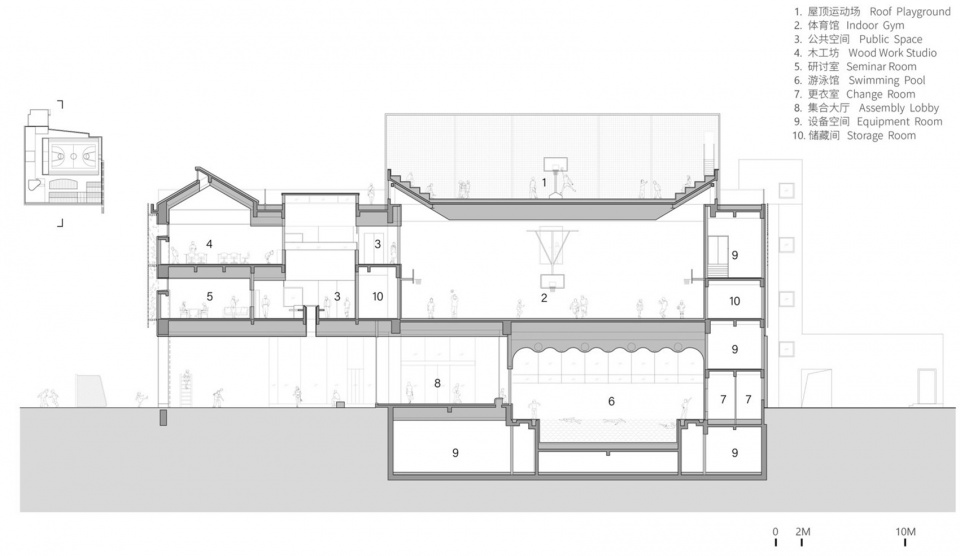
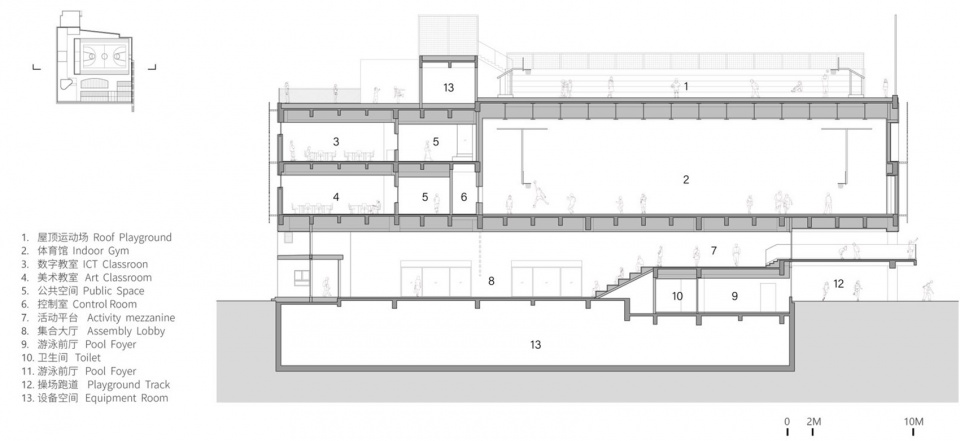
▼剖面图,Section 1
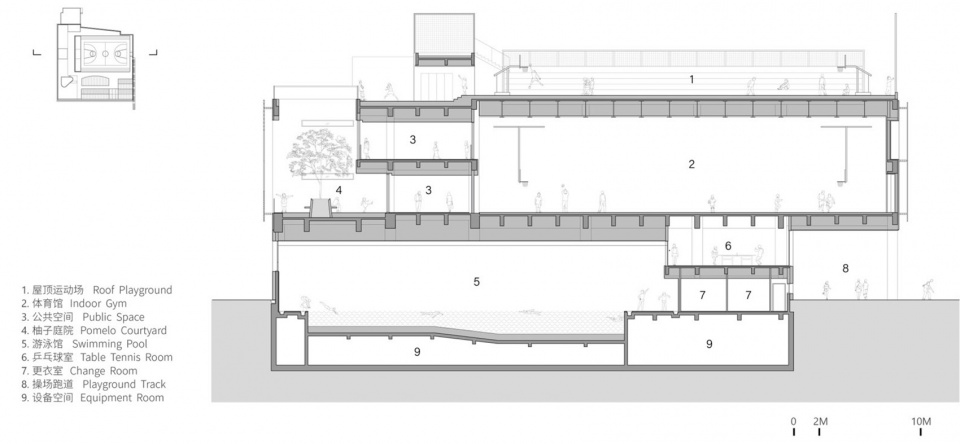
▼剖面图,Section 2
▼剖面图,Section 3
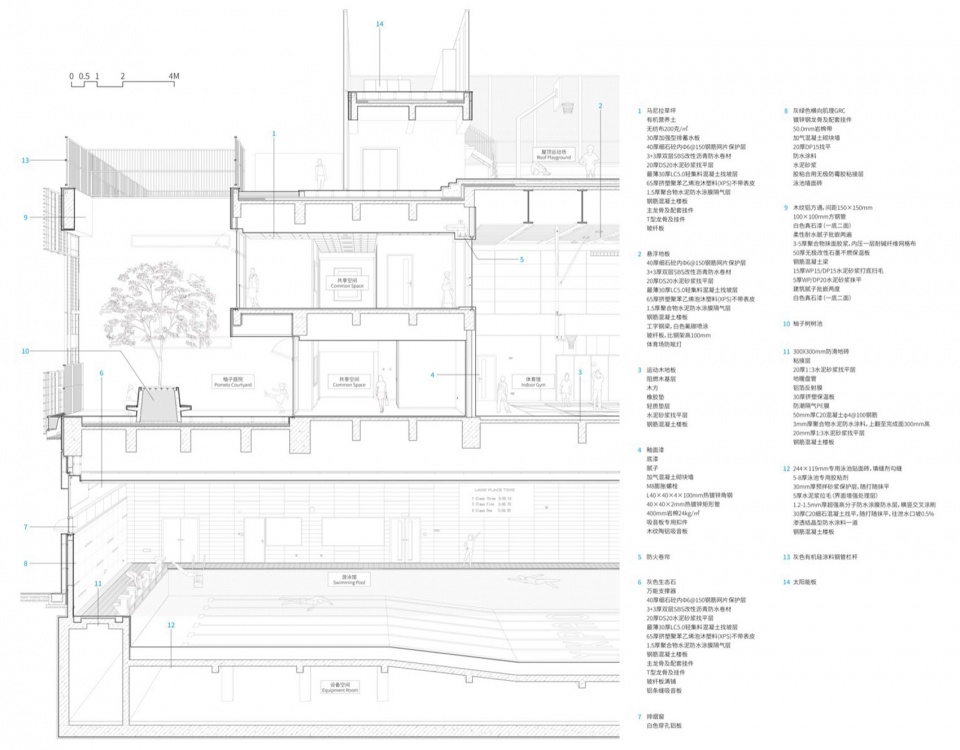
▼剖透视节点,Sectional perspective detail
项目信息:
Project Name: Anna Pao Sohmen Centre at YK Pao School
Location: No 2206, Hongqiao Road, Changning District, Shanghai
Program: Sports & Learning Complex
Campus area: 20,493 m²
Building Plot: 2,473 m²
GFA: 7,911.8 m² (Above-ground: 6,945.5 m²; Basement: 966.3 m²)
Design/built: 2019/2025
Client: YK Pao School
Architectural Design: Scenic Architecture Office (SAO)
– Design Team: Zhu Xiaofeng, Zhuang Xinjia, Jiang Meng, Shen Ziwei, Wang Junyuan, Wang Yiming, Wu Shangrong
– Interns: Li Jiajun, Hu Yujia
Local design institute: Shanghai UCOME Architectural Design Co.,LTD.
Interior Design Consultant: IFstudio
Landscape Design Consultant: Shanghai Wujian Garden Co., Ltd.
Construction Agent: Arcadis Consultancy (Shanghai) Co.,Ltd.
General Contractor: Jiangsu IAQ Engineering Co., Ltd. (Building)
T-DECO Interior Construction Co.,LTD. (Interior)
Supervision Consultant: Shanghai Construction Engineering Supervision Consulting Co.,Ltd.
Structural system: Reinforced concrete frame and truss, partial roof with steel beam
Main materials: Wood-grain aluminum grille, beige stone-powder paint integrated insulation board, profiled striped cement cladding panel, plain concrete protective coating, white aluminum panel ceiling, wood-grain/dark gray aluminum alloy window frame, low-iron Low-E insulating glass unit, blue-gray precast terrazzo floor tile, wood-grain fireproof board, beige gypsum board ceiling, wood-grain ceramic-aluminum acoustic panel, wood-grain wall and floor tile, wood-tone/white/blue anti-slip swimming pool tile, gymnasium-specific solid wood flooring, beige fiber acoustic panel ceiling.
Photography: Su Shengliang/Schran Image