众山集,上海 / 众建筑
搭建式介入以脚手架为基本单元,通过刚性骨架与可变填充体的组合,形成可拆解、可重组、可迁移的空间系统,使工业遗址在轻量干预中获得可变的公共性。
Scaffolding-based intervention uses scaffolding as the basic modular unit. Through the combination of rigid frame and variable infill, it forms a spatial system that is demountable, reconfigurable, and relocatable, allowing the industrial site to gain adaptable publicness through lightweight intervention.
▼“众山集”主入口,Main Entrance, Mount Bazaar
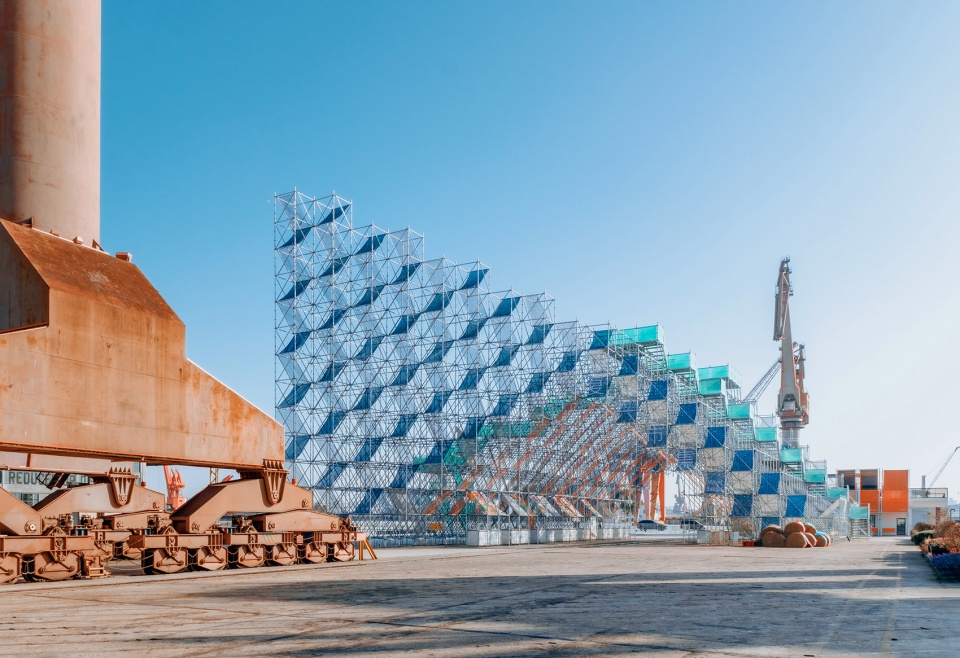
▼“众山集”山体形态,Mountainous Form, Mount Bazaar
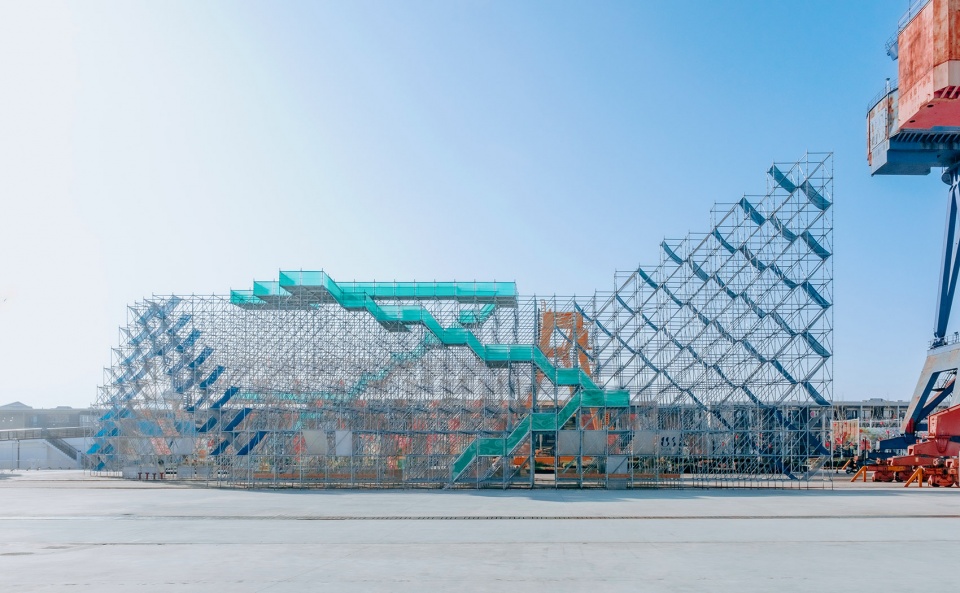
▼轻重对话,Light-Heavy Dialogue
场地Site
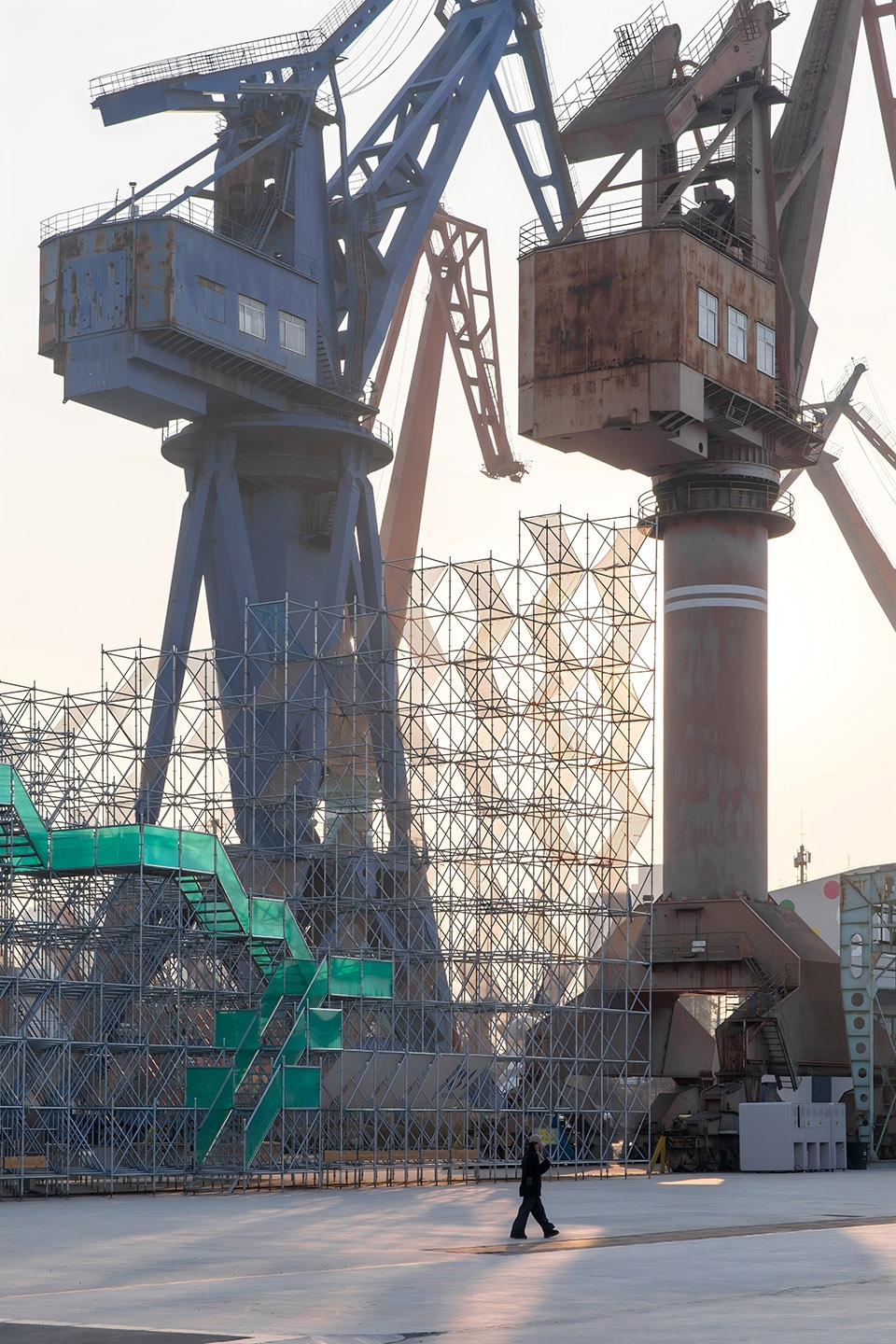
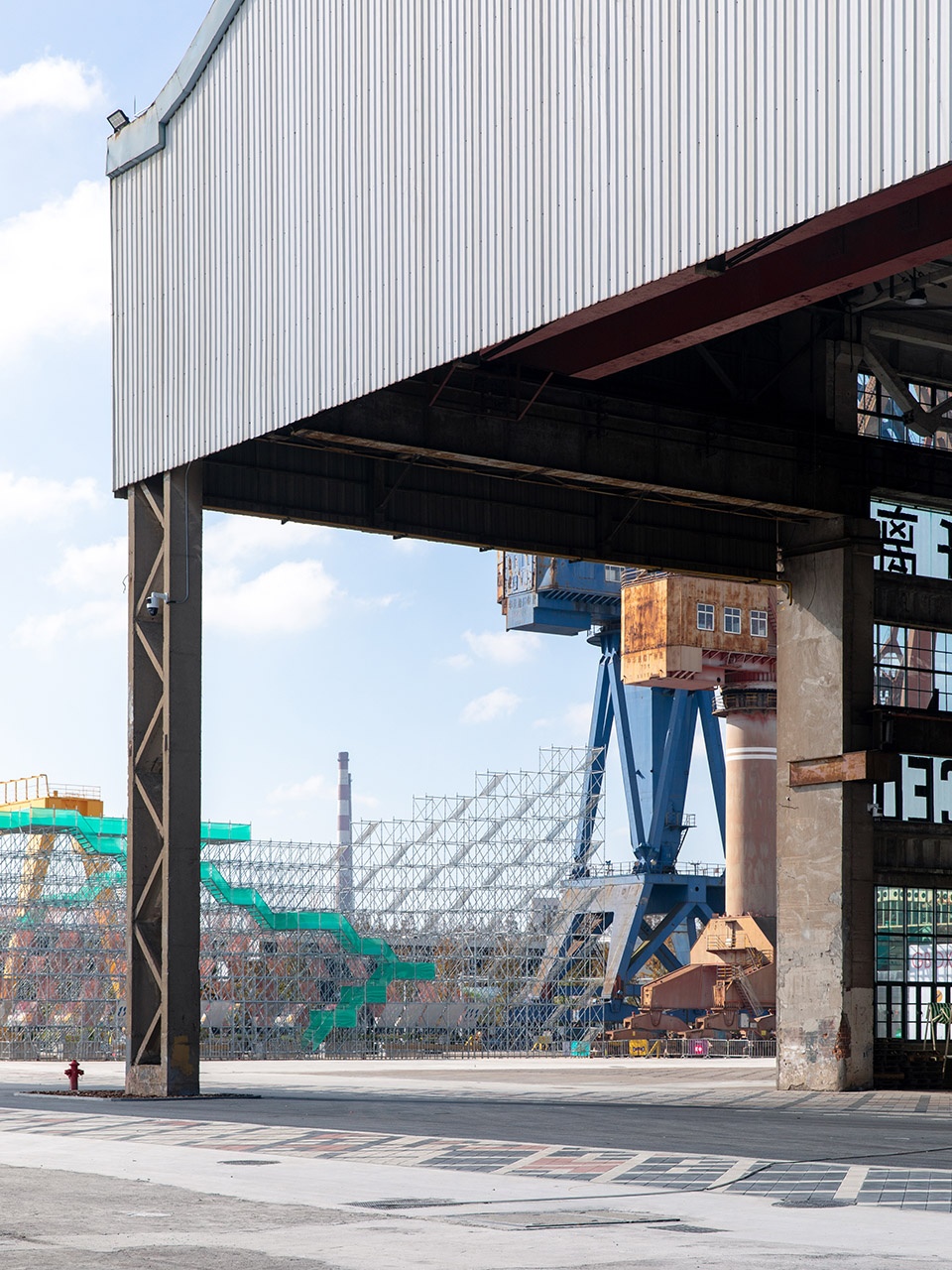
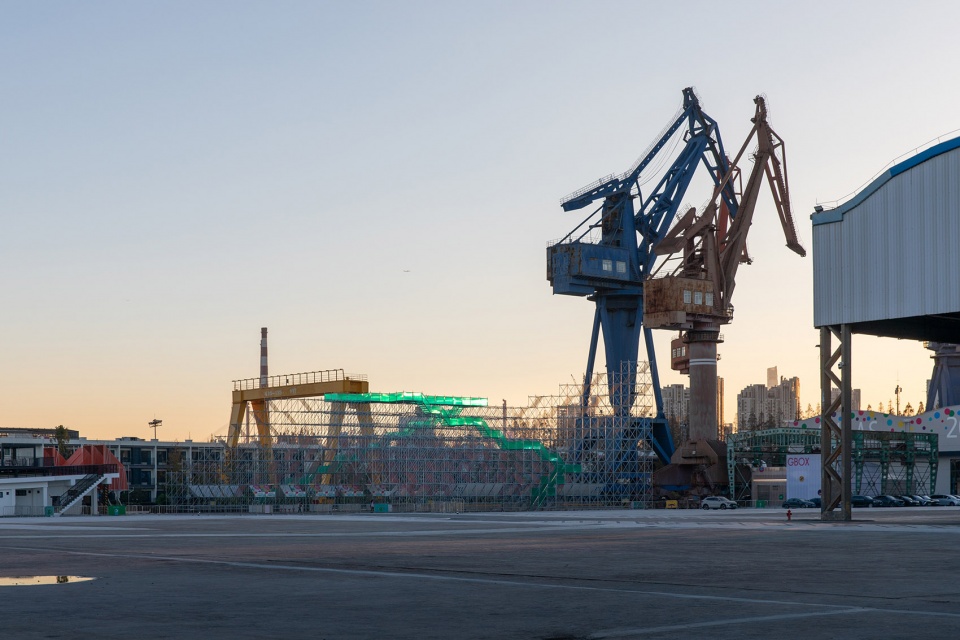
众山集位于上海杨浦区复兴岛船台公园,前身为1926年创立的大中华造船机器厂。场地内保留有两座巨型船台、二十余座塔吊及多座厂房,混凝土斑驳、钢架锈蚀,这些沉默的构件是近代工业城市记忆的物质载体。
Mount Bazaar is located at the Shipyard Park on Fuxing Island, Yangpu District, Shanghai. The site was formerly the Great China Shipbuilding Machinery Factory, founded in 1926. It preserves two giant shipways, over twenty tower cranes, and multiple factory buildings. Weathered concrete and rusted steel frames—these silent components are the material carriers of modern industrial urban memory.
▼“众山集”鸟瞰,Aerial view, Mount Bazaar
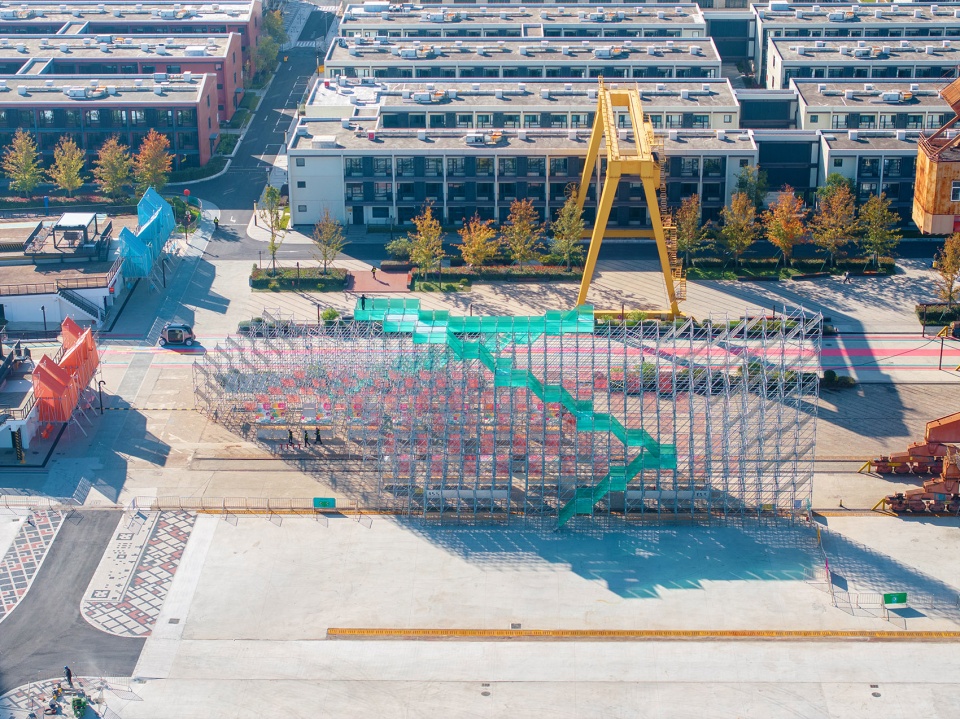
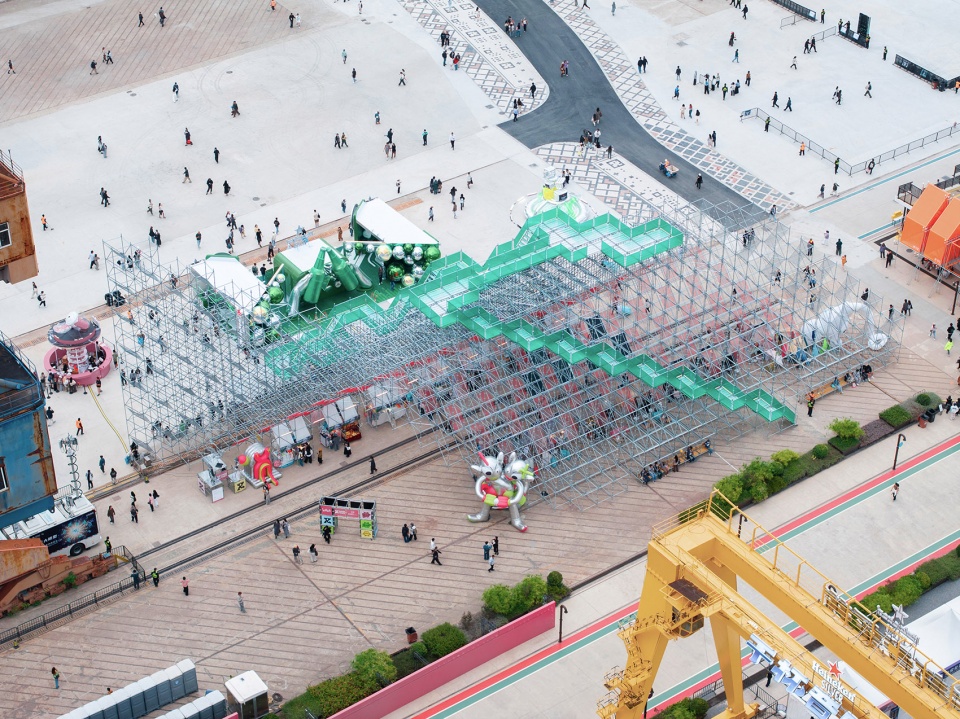
面对这片工业遗址,设计选择不做改造、不添永久建筑,而是以轻介入的搭建方式,临时建构一个新的公共空间。搭建,意味着不扰动原有肌理,也意味着可随时拆解与迁移。工业遗存不再是静止的背景,而成为与新装置平等对话的伙伴。
Faced with this industrial site, the design chooses not to renovate or add permanent structures, but to temporarily construct a new public space through a light-touch, scaffolding-based intervention. Building here means not disturbing the existing fabric, and also means being demountable and relocatable at any time. The industrial remnants are no longer a static backdrop but become partners in equal dialogue with the new installation.
▼“众山集”与工业园区,Mount Bazaar and the industrial Park
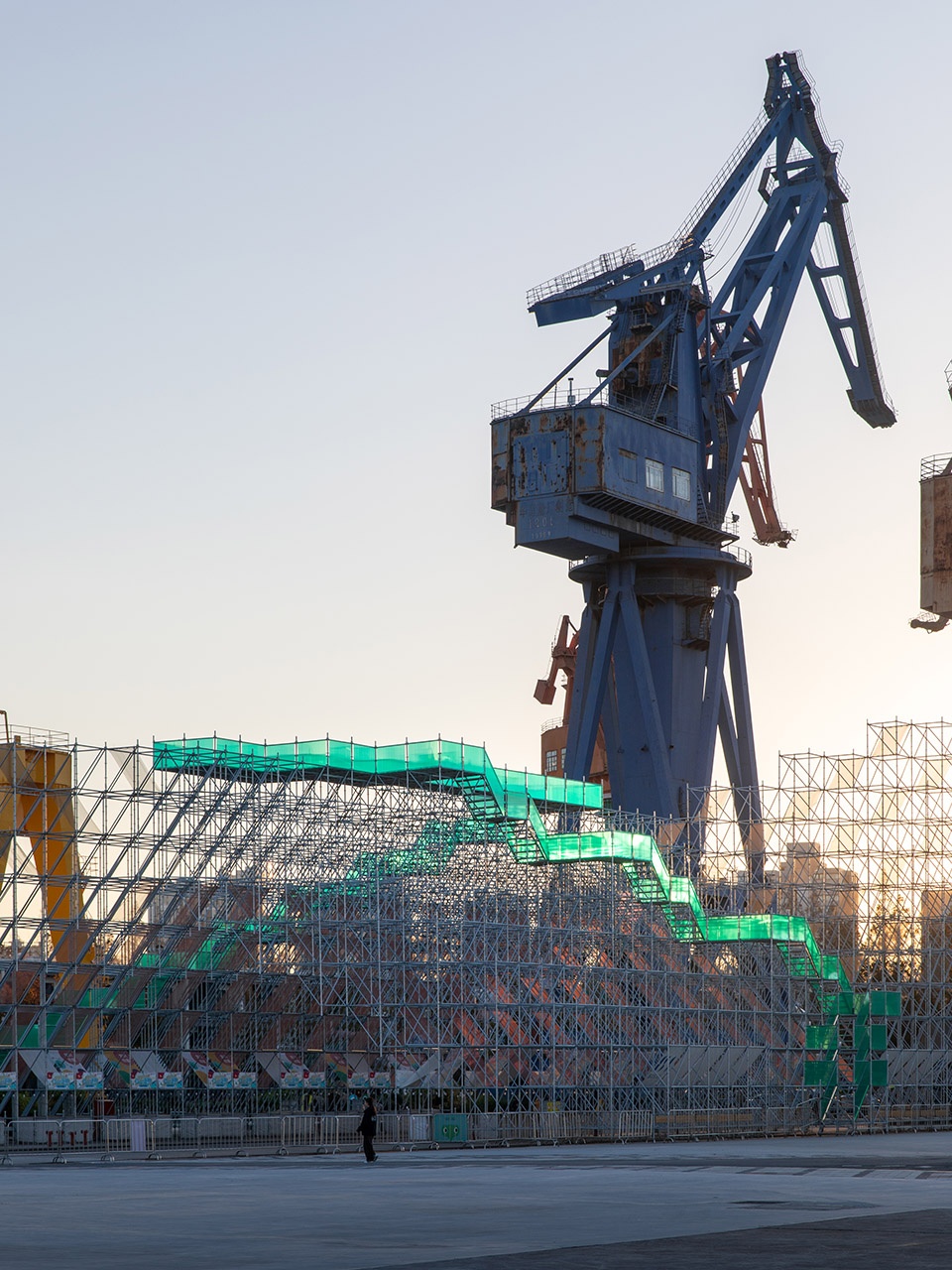
▼“众山集”与塔吊,Mount Bazaar and the Tower Cranes
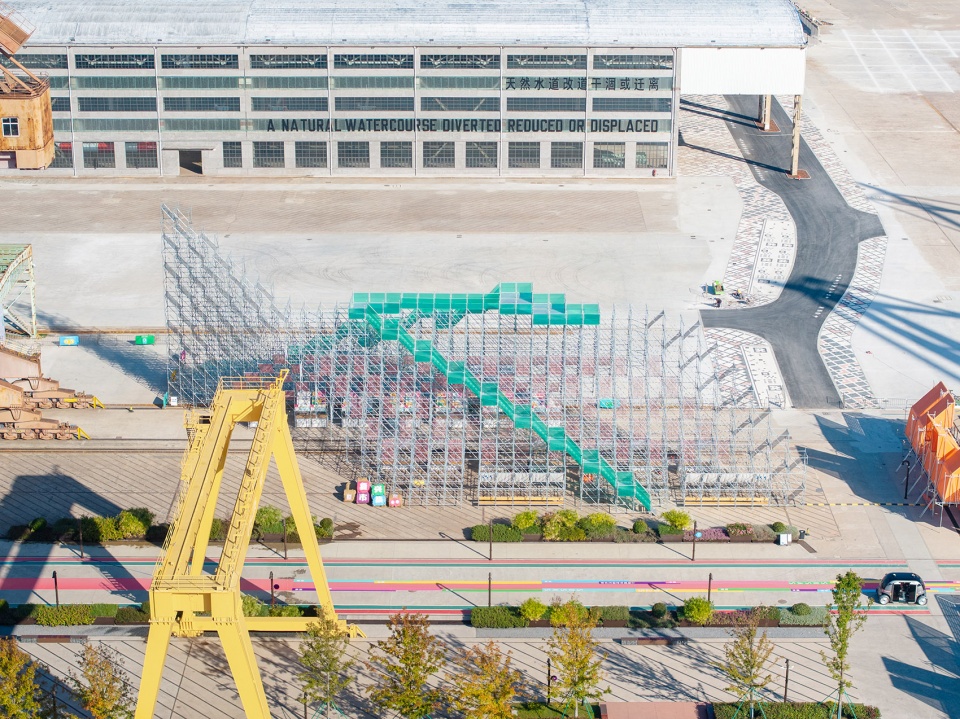
▼“众山集”与厂房,Mount Bazaar and the Factory building
框架Frame
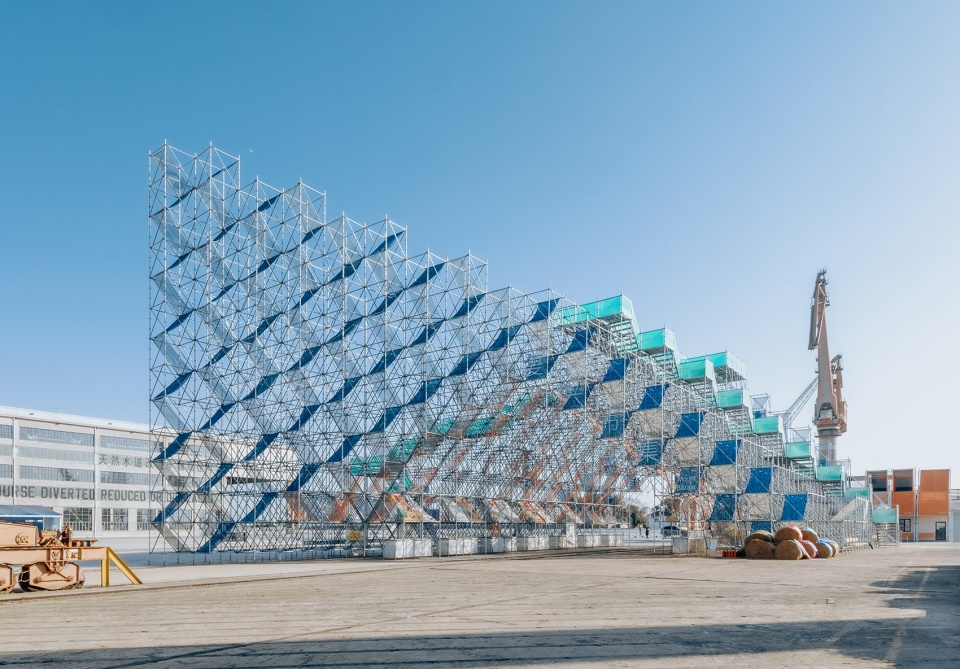
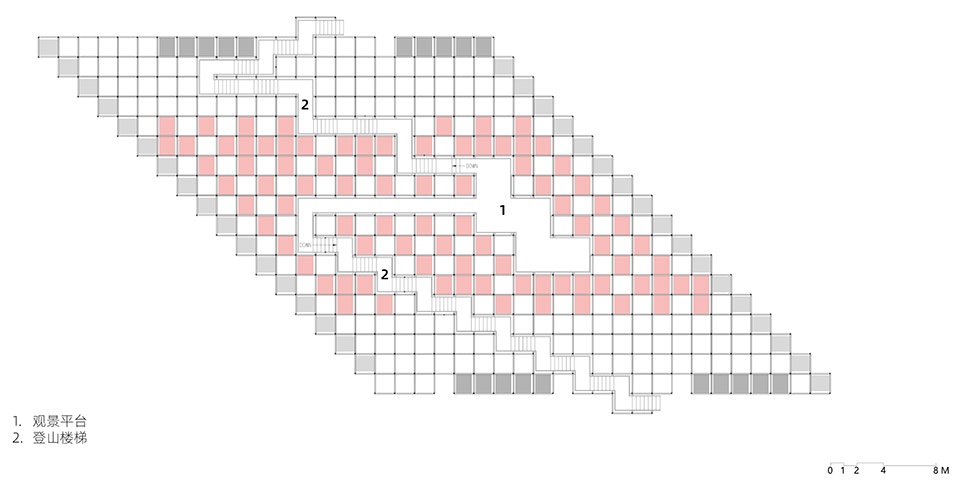
众山集由1.5米模数的盘扣脚手架搭建而成。整体平面呈平行四边形,西北角抬升为视觉制高点,其余方向逐级跌落。两侧斜边自然引导南北方向的人流,汇聚于“山下”的斜顶市集。
▼设计生成,Design Generation
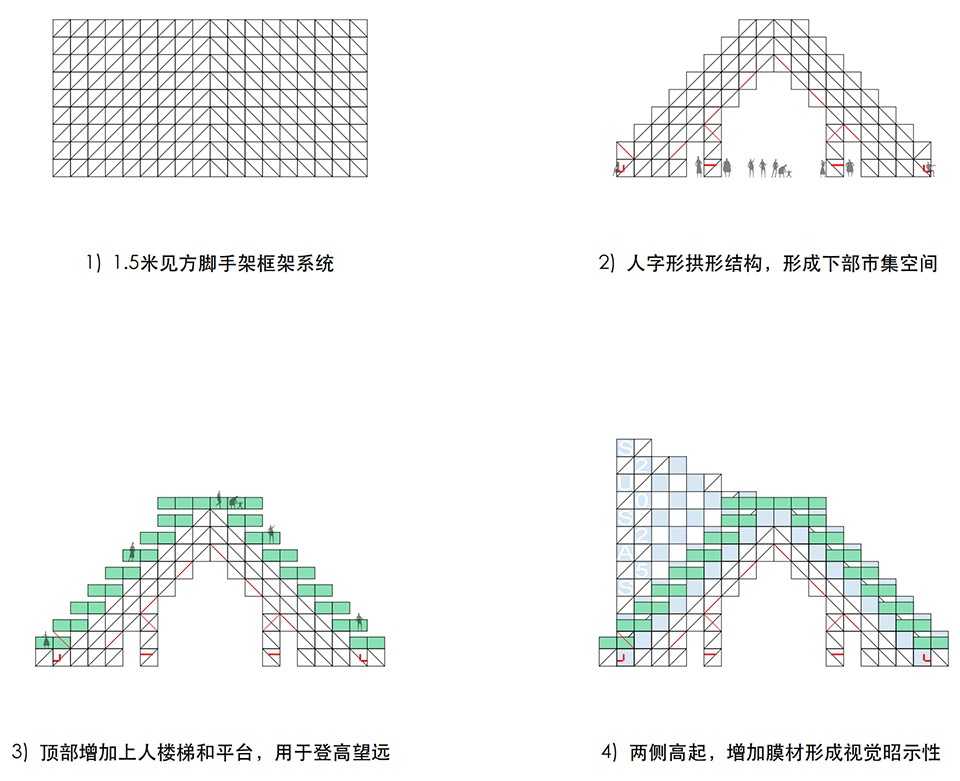
Mount Bazaar is constructed with a 1.5meter modular disklock scaffolding system. Its overall plan is a parallelogram, with the northwest corner raised as the visual high point and the remaining parts stepping down gradually. The two sloping sides naturally channel northsouth pedestrian flow, converging at the inclinedroof bazaar at the “mountain’s base.”
▼红色膜材与绿色楼梯,Red Membrane and Green Staircase
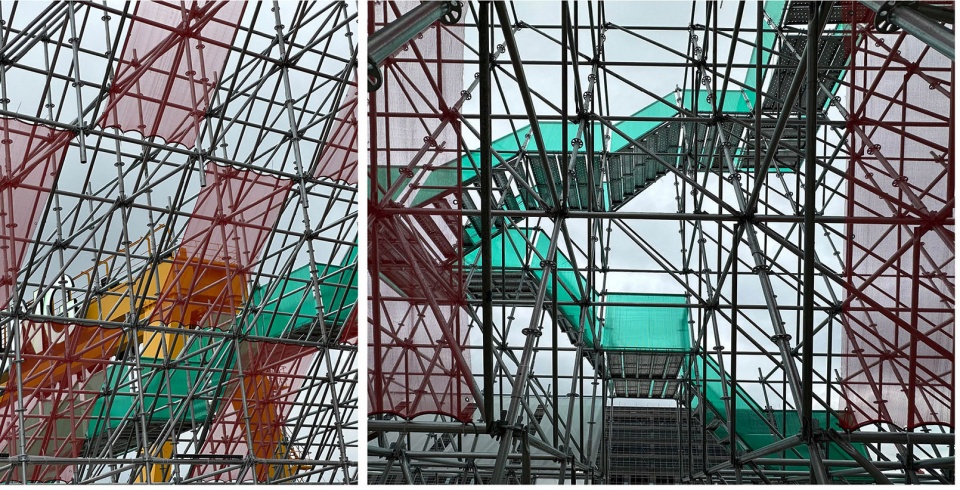
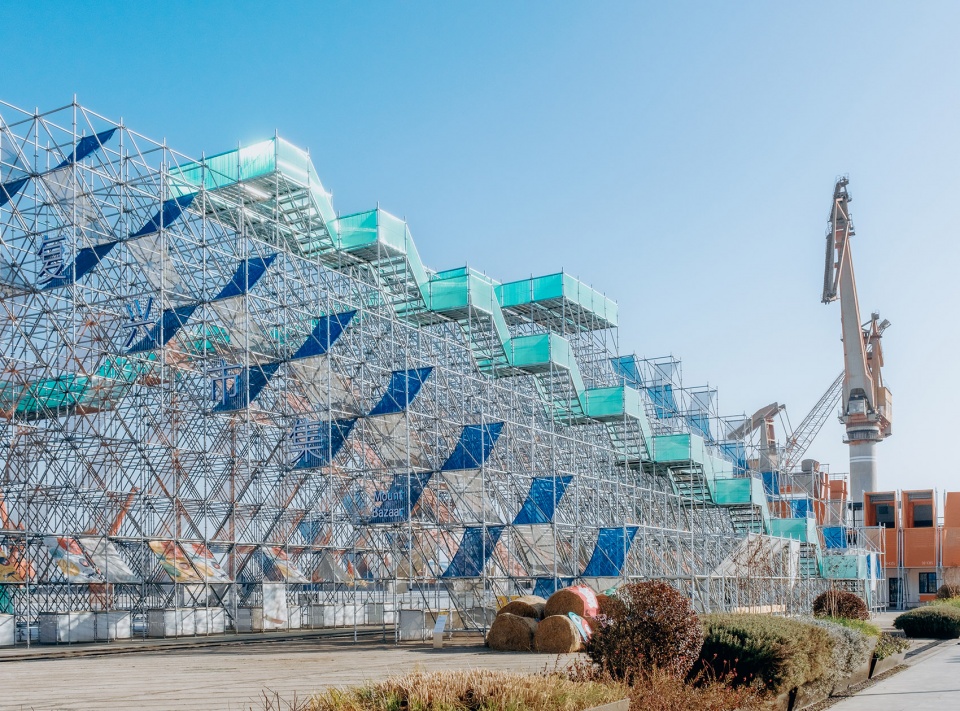
脚手架在此并非施工辅助工具,而是自主建构的主体。它遵循“框架-填充”(Frame and Infill)逻辑关系,刚性脚手架作为固定骨架,膜材、木质摊位、折形楼梯、悬挑平台等作为可变填充体嵌入其中。骨架提供秩序与结构,填充体实现功能与场景的弹性适配。
Here, scaffolding is not merely a construction aid but an autonomous subject of construction. It follows the “Frame and Infill” logic: the rigid scaffolding serves as the fixed frame, while membranes, wooden booths, folded stairs, cantilevered platforms, and other elements are embedded as variable infills. The frame provides order and structure, while the infills enable flexible adaptation of functions and scenarios.
▼市集入口,Bazaar Entrance
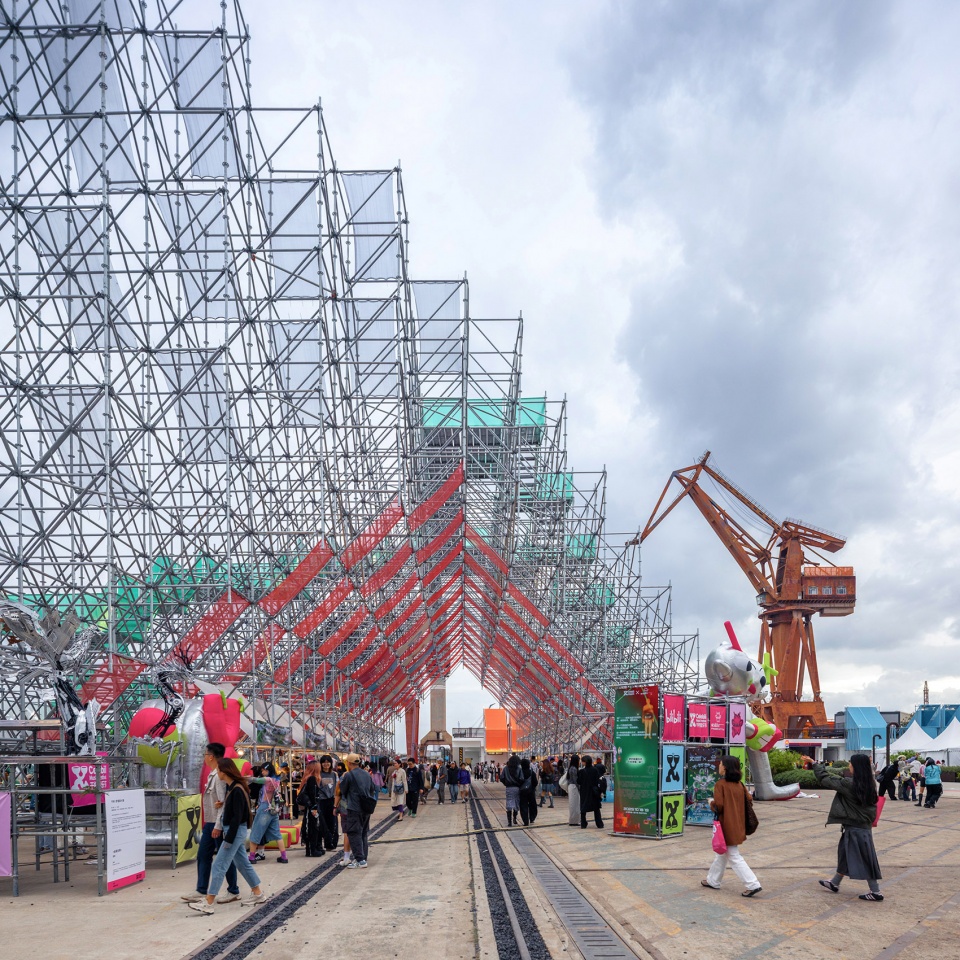
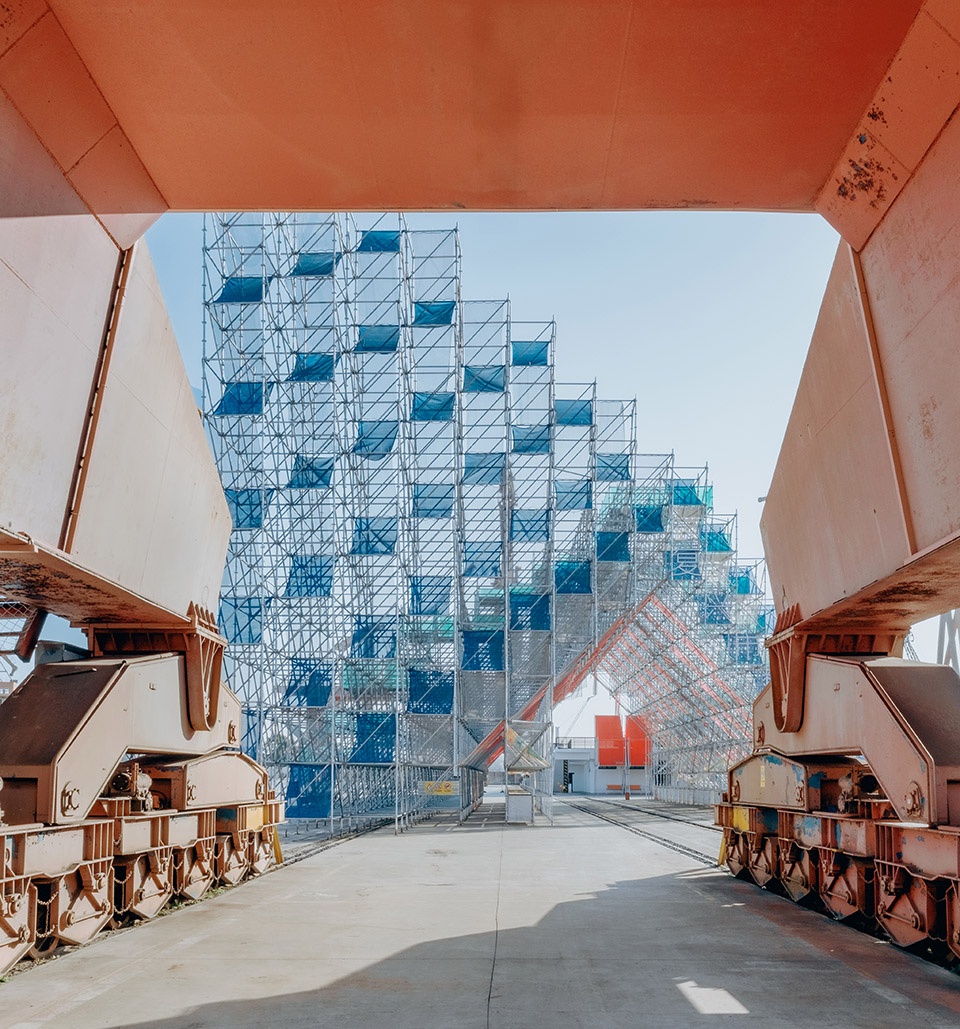
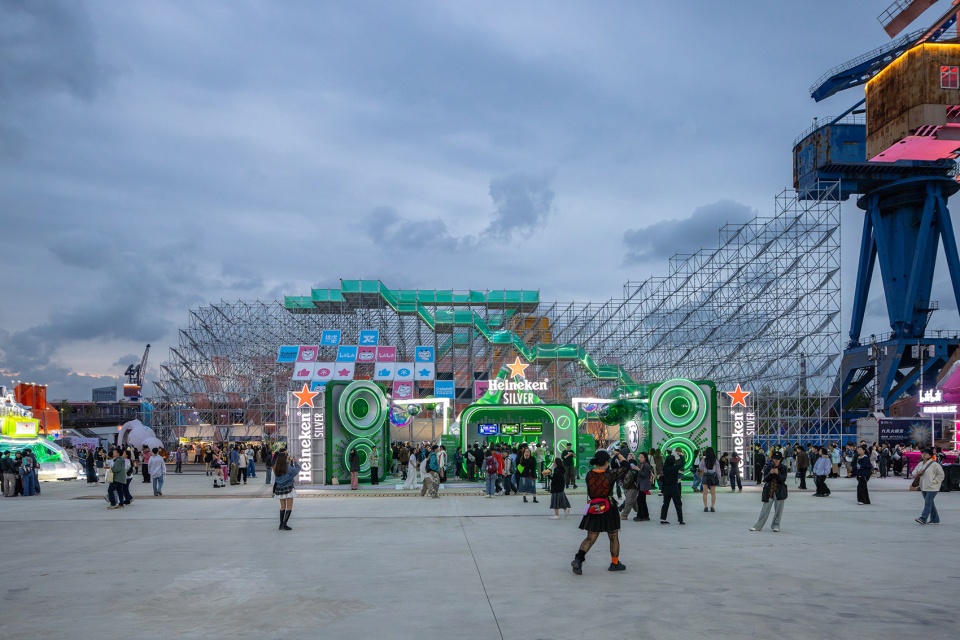
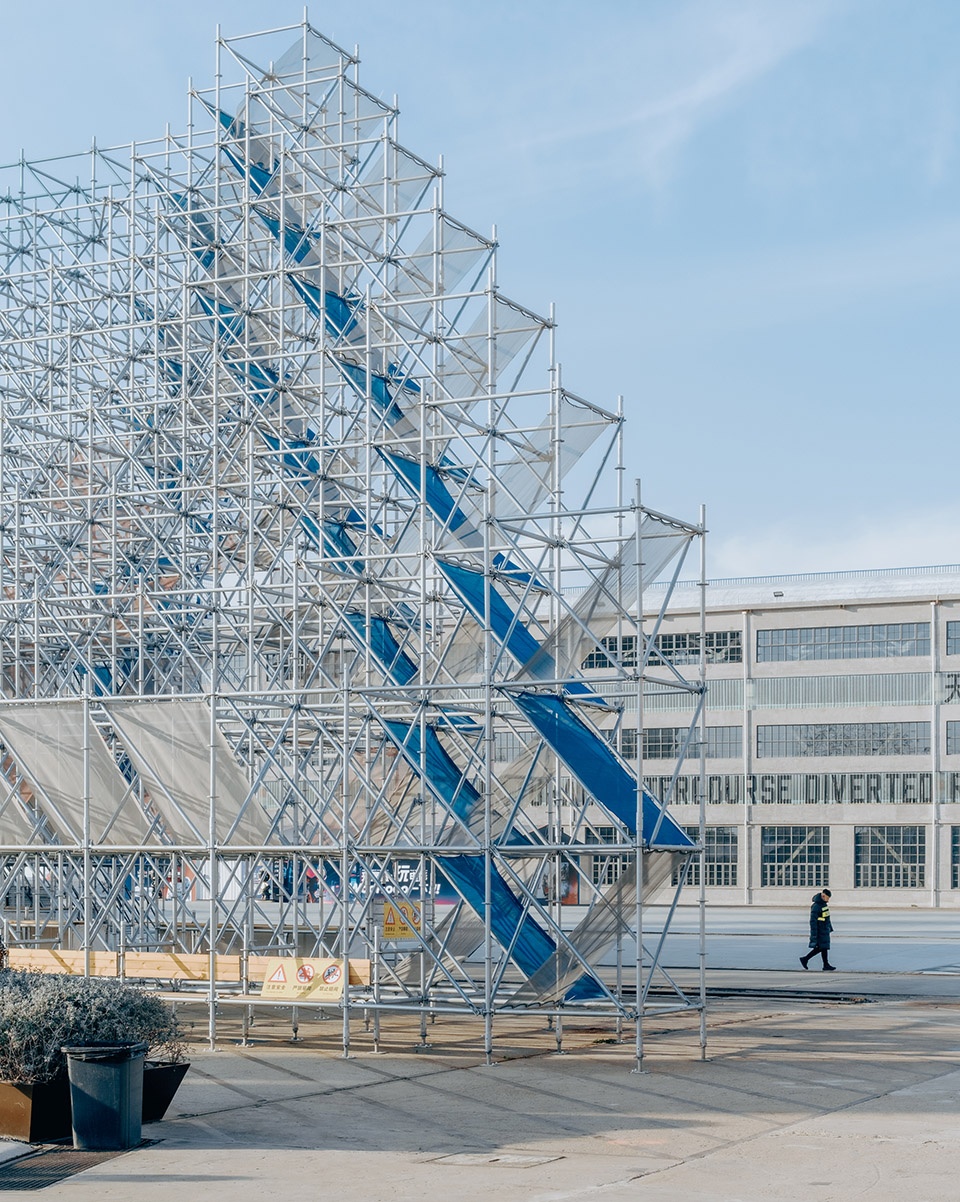
初期主入口视觉焦点以灰色拉膜进行标识,后续业主提出要进一步强化主立面的视觉引导,设计团队随即置入蓝色膜材。两者折拼并置,既形成了入口焦点,也直观呈现了填充体可灵活替换与补充的系统特性。
Initially, the main entrance’s visual focus was marked with a gray tensile membrane. Later, the client requested stronger visual guidance for the main facade, whereupon the design team inserted a blue membrane. The two membranes are juxtaposed in a folded-and-spliced configuration, creating an entrance focal point while visibly demonstrating the system’s flexibility in allowing the infills to be replaced and supplemented.
▼膜材、楼梯与平台,Membrane, Staircase, and Platform
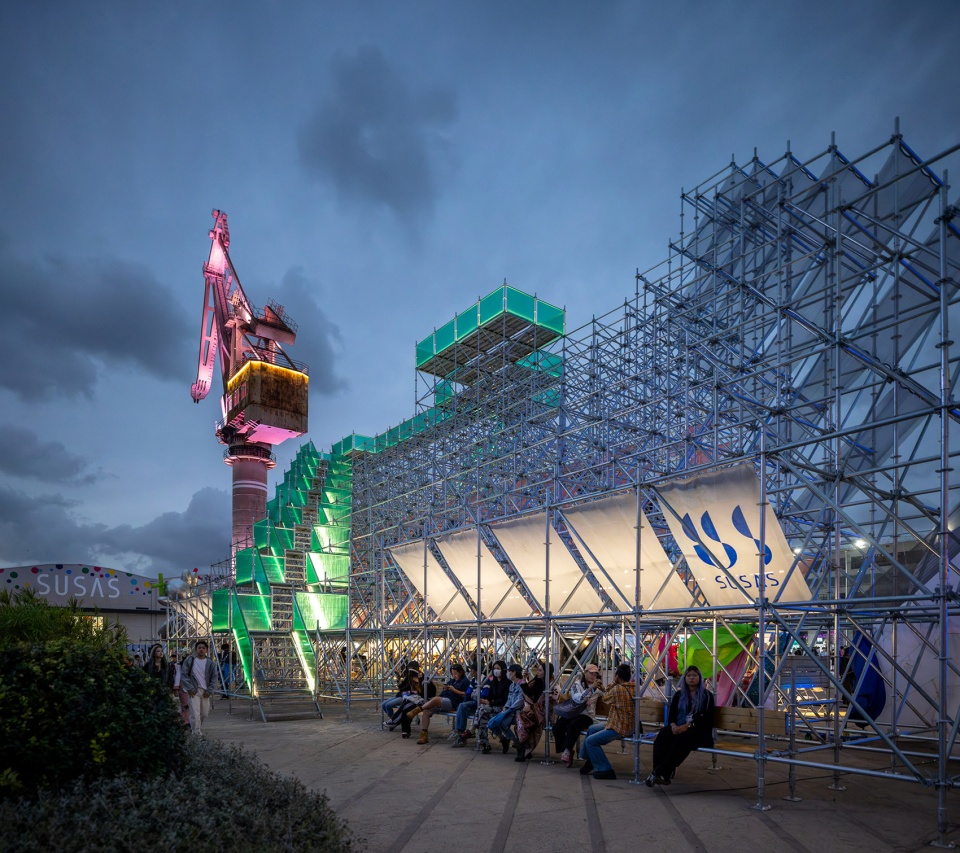
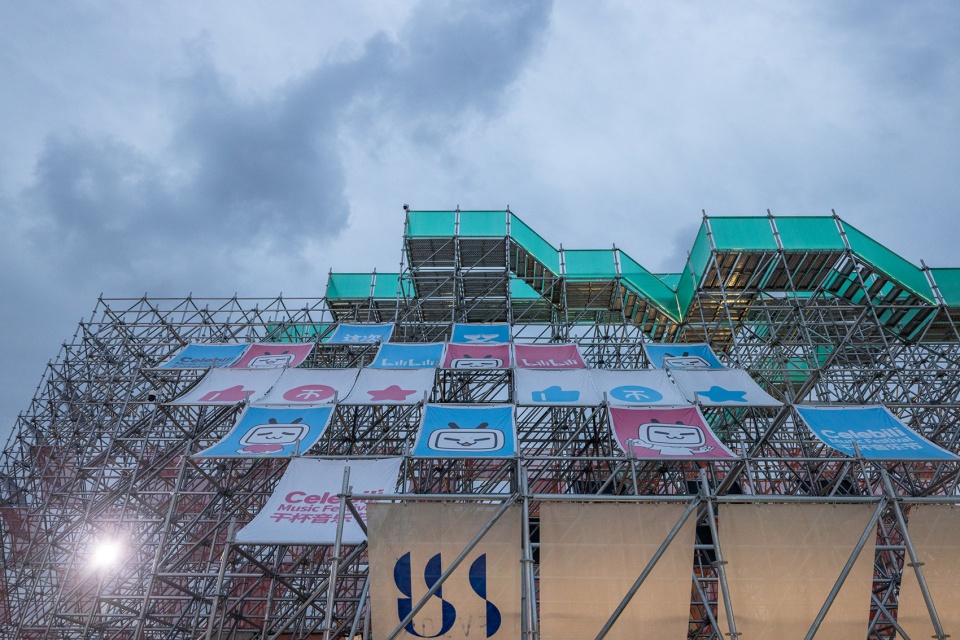
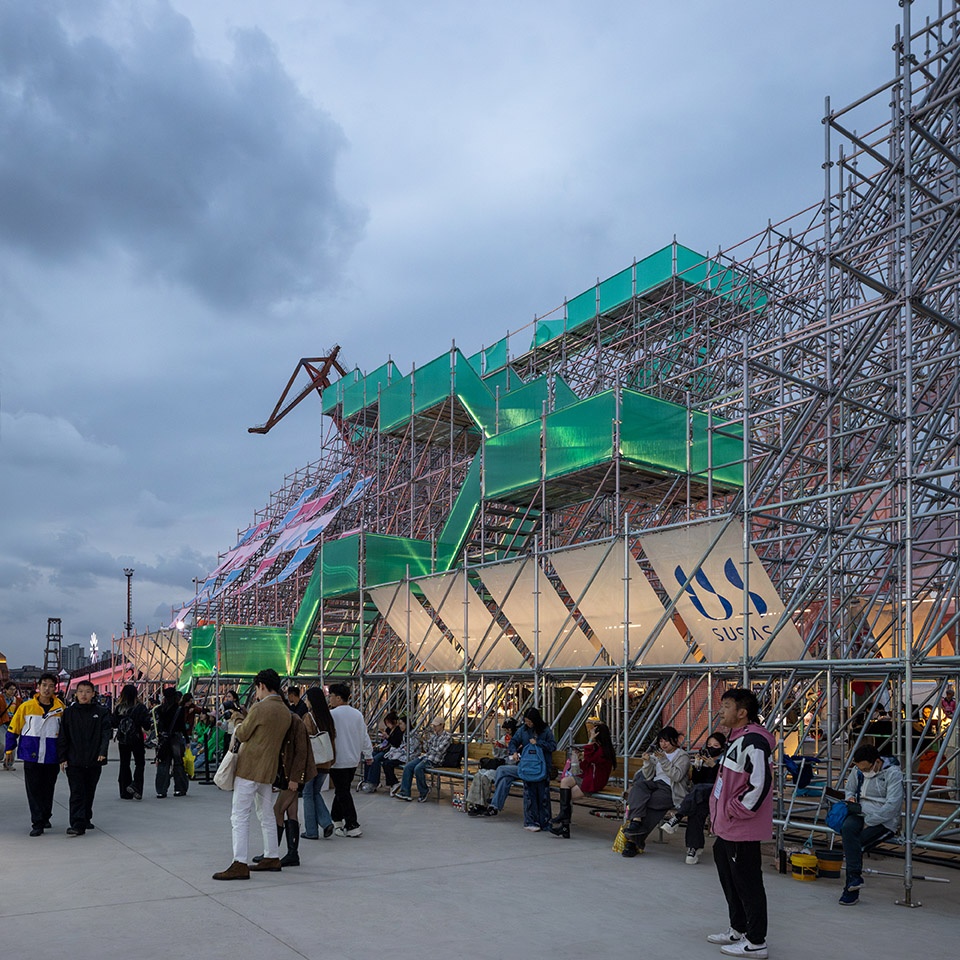
填充体不仅限于膜材与楼梯。市集外侧结合脚手架与拉膜设置木质座椅,供游人休憩;脚手架框架亦可作为大型海报的悬挂支撑,适配音乐节等各类活动。这些可替换的填充元素,使冰冷的脚手架具备了日常使用的温度。
Infills are not limited to membranes and staircases. Wooden seating is installed along the outer side of the bazaar, combined with scaffolding and tensile membrane, offering resting spaces for visitors. The scaffolding frame can also serve as a support for hanging large posters, adapting to various events such as music festivals. These replaceable infill elements give the otherwise cold scaffolding a touch of everyday warmth.
▼“众山集”外侧座椅休息处,Exterior Seating Area, Mount Bazaar
整套系统具备可拆解、可重组、可迁移的循环特质,回应了当代公共艺术低耗、可生长的趋势。
The entire system is demountable, reconfigurable, and relocatable, responding to the contemporary trend of low-consumption and growing public art.
▼“众山集”外侧悬挂海报,Poster Display on the Exterior, Mount Bazaar
搭建 Construction
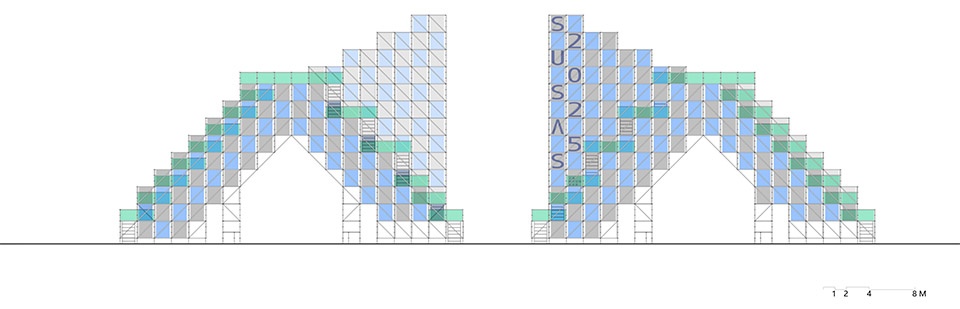
搭建过程本身也成为一种空间语言。拱形市集空间先由脚手架搭出整体架构,完成后拆除下部临时支撑,形成自承重的三角拱廊。这种自支撑拆改工艺,既回应了框架体系的结构灵活性,也把施工的逻辑直接暴露为视觉表达。
The entire system features a circular nature of being demountable, reconfigurable, and relocatable, responding to the contemporary trend of low-consumption and growable public art.
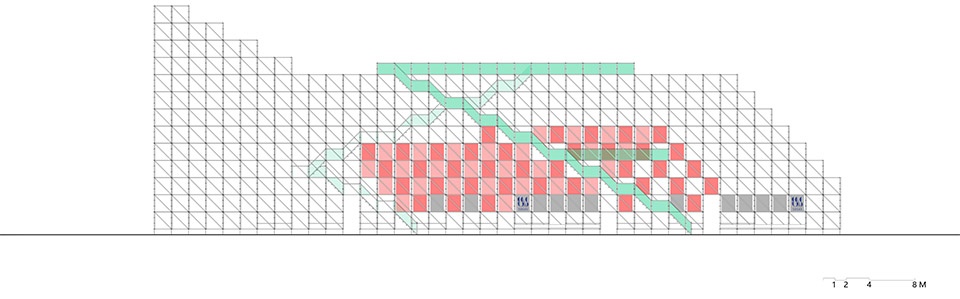
▼“众山集”南立面,South Elevation
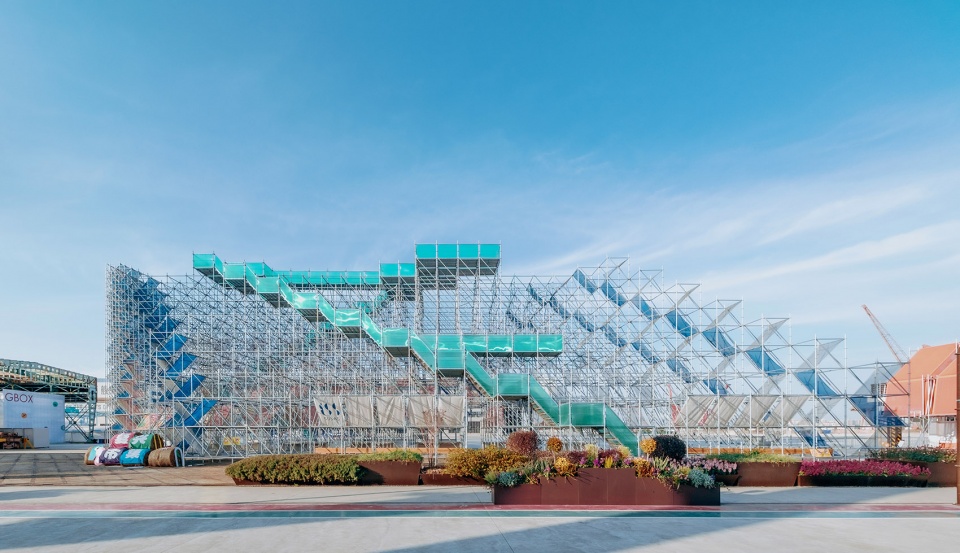
在施工图设计中,脚手架不仅作为最终结构,也作为施工期间的临时支撑,实现了“用脚手架搭建脚手架”的自建构逻辑。线性网格骨架完全外露,节点张力与杆件秩序成为视觉核心。粗粝的工业质感与场地的锈蚀塔吊、斑驳混凝土在建构层面相互呼应。
▼搭建过程,Construction progress
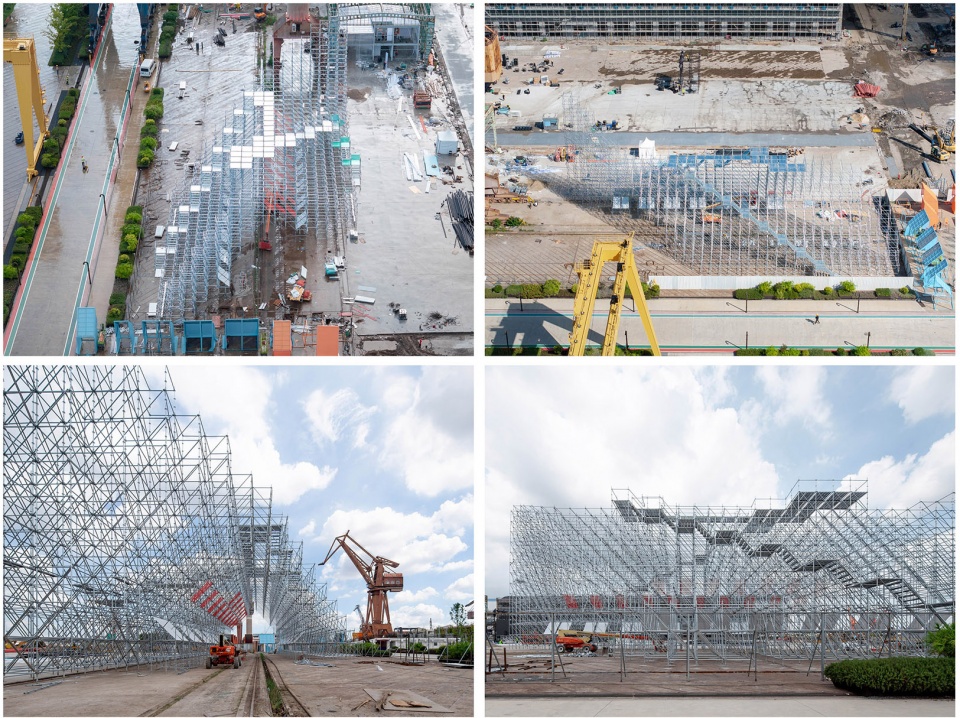
In the construction drawing design, scaffolding serves not only as the final structure but also as temporary support during construction, realizing the self-construction logic of “building scaffolding with scaffolding.” The linear grid skeleton is fully exposed, with joint tension and member order becoming the visual core. The raw industrial texture echoes the site’s rusted tower cranes and weathered concrete at the tectonic level.
▼脚手架整体建构骨架,Overall Scaffold Structure
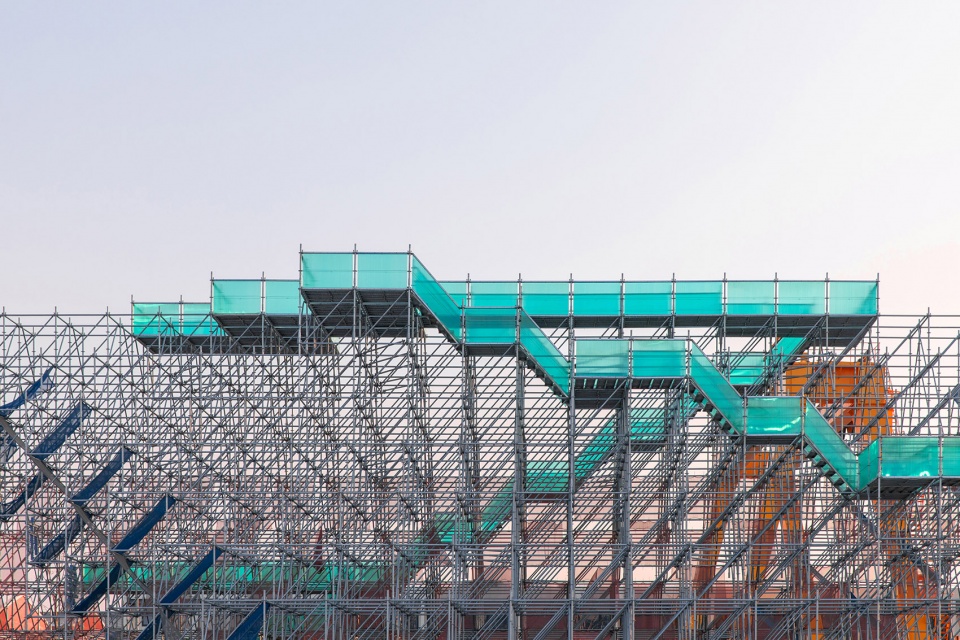
▼楼梯与观景平台,Staircase and Observation Deck
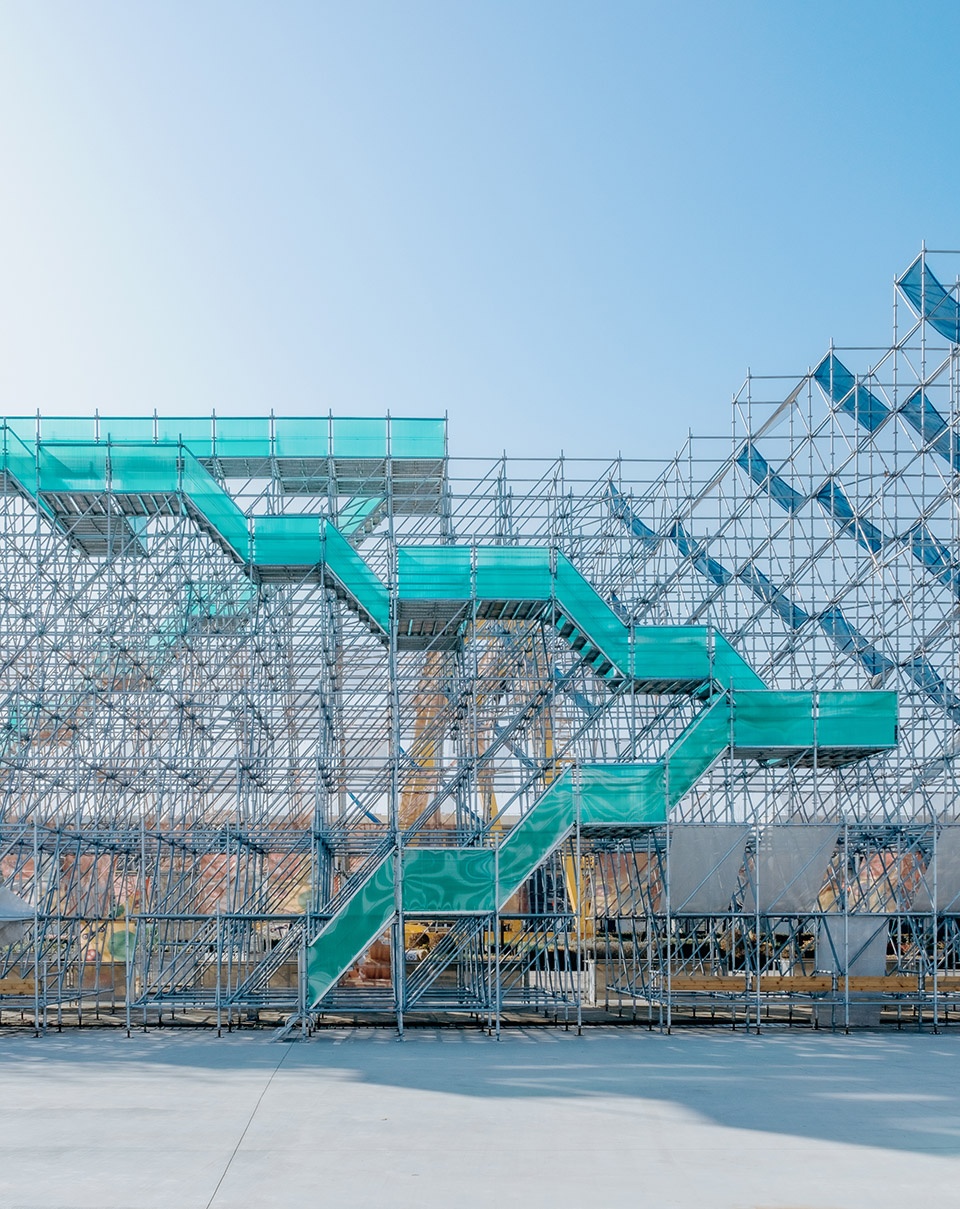
▼“众山集”立面局部,Partial Elevation, Mount Bazaar
市集 Bazaar
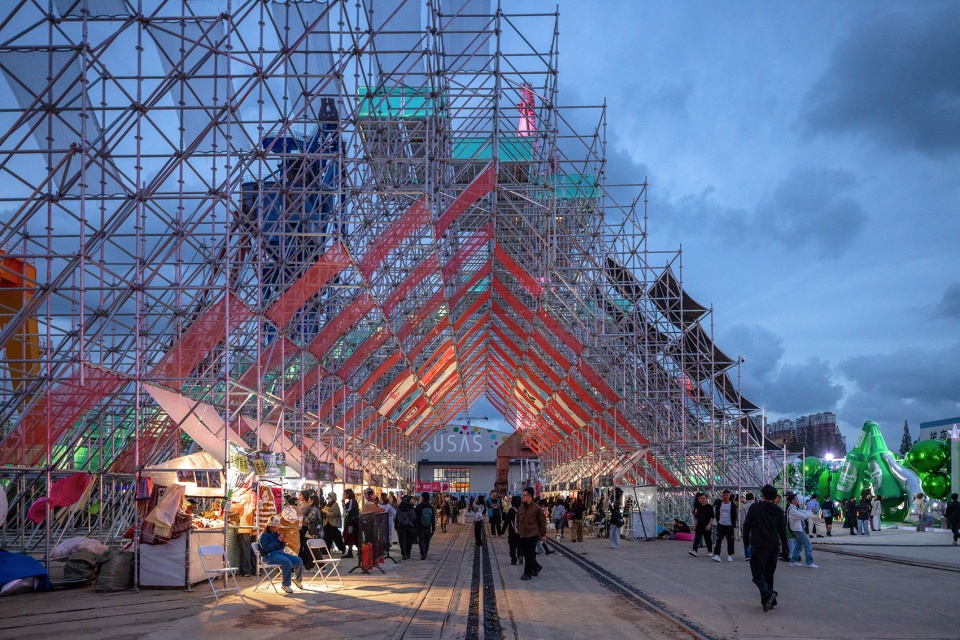
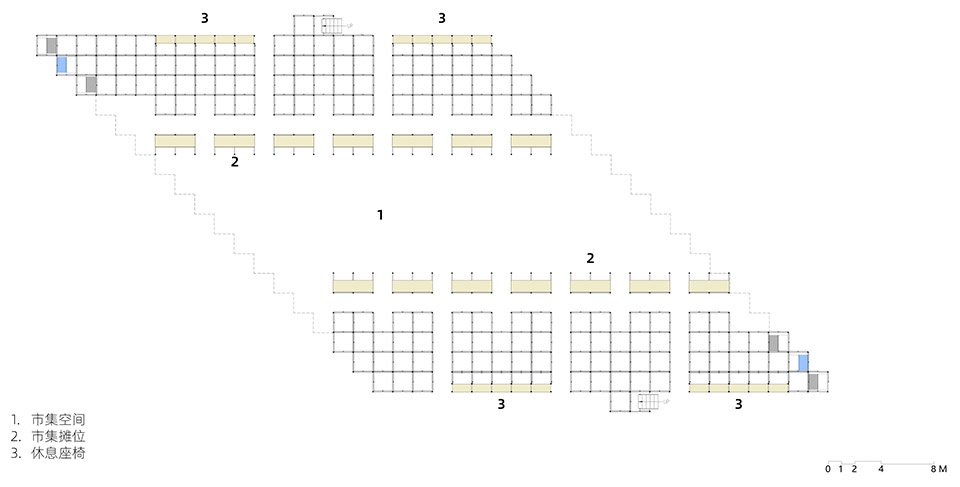
斜顶市集是一个脚手架堆叠出的三角拱廊,通透、开放,打破传统市集的封闭模式。摊位整齐排列于斜顶两侧,木材桌面与膜材围合出独立单元,兼顾秩序感与空间流动性。
The inclined-roof bazaar is a triangular arcade formed by stacked scaffolding. Transparent and open, it breaks away from the enclosed model of traditional bazaars. Booths are neatly arranged on both sides of the sloping roof, with wooden tabletops and membranes enclosing individual units, balancing a sense of order with spatial fluidity.
▼市集入口空间,Bazaar Entrance Space
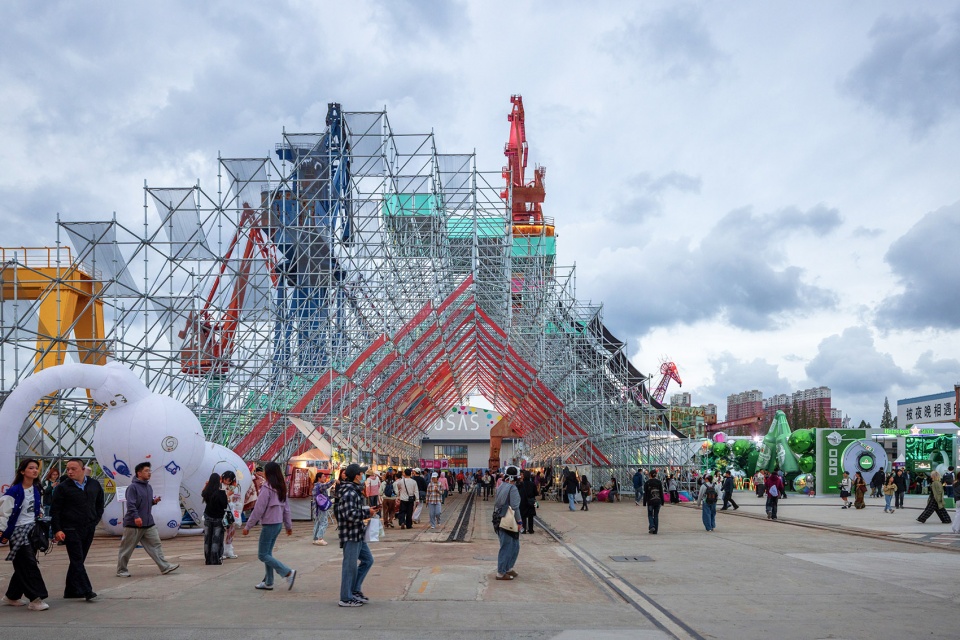
▼市集公共活动空间,Public Gathering Space of the Bazaar
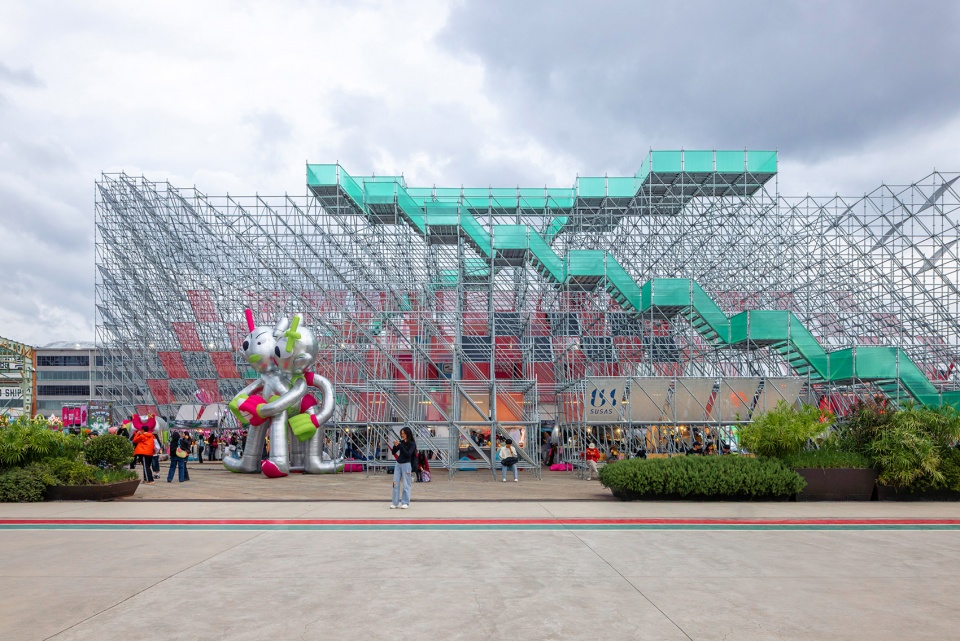
▼拱形底部空间,Arch Underside Space
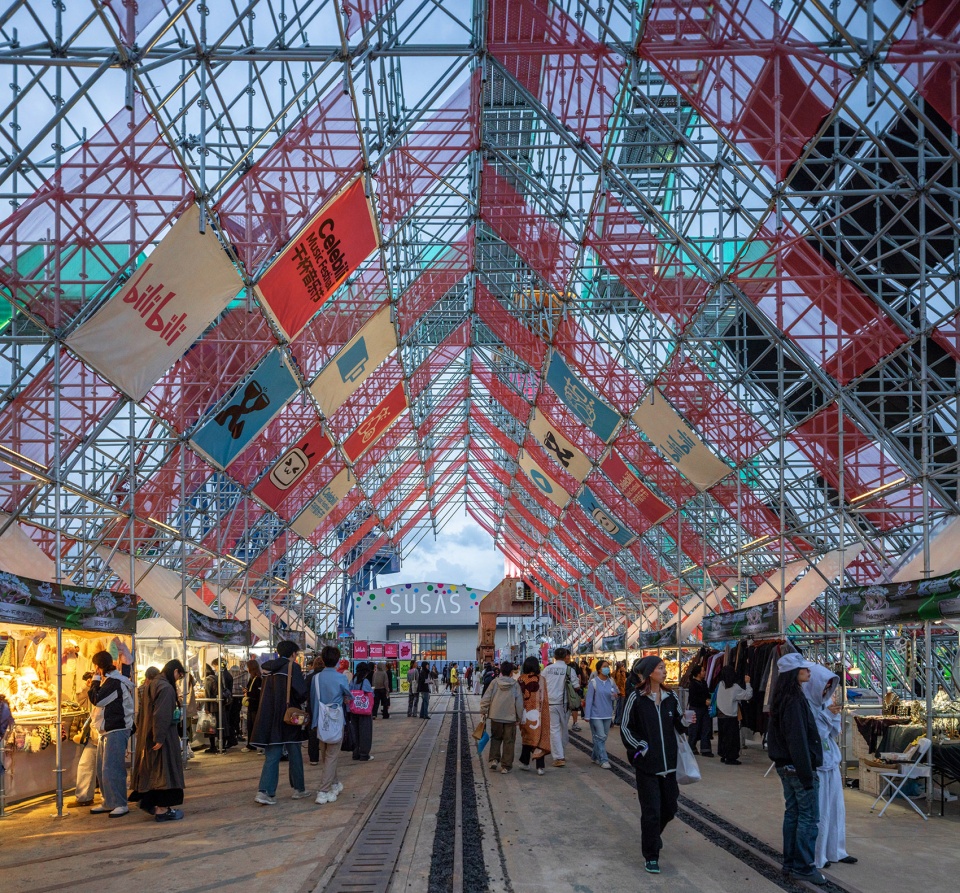
▼市集底部空间,Bazaar Underside Space
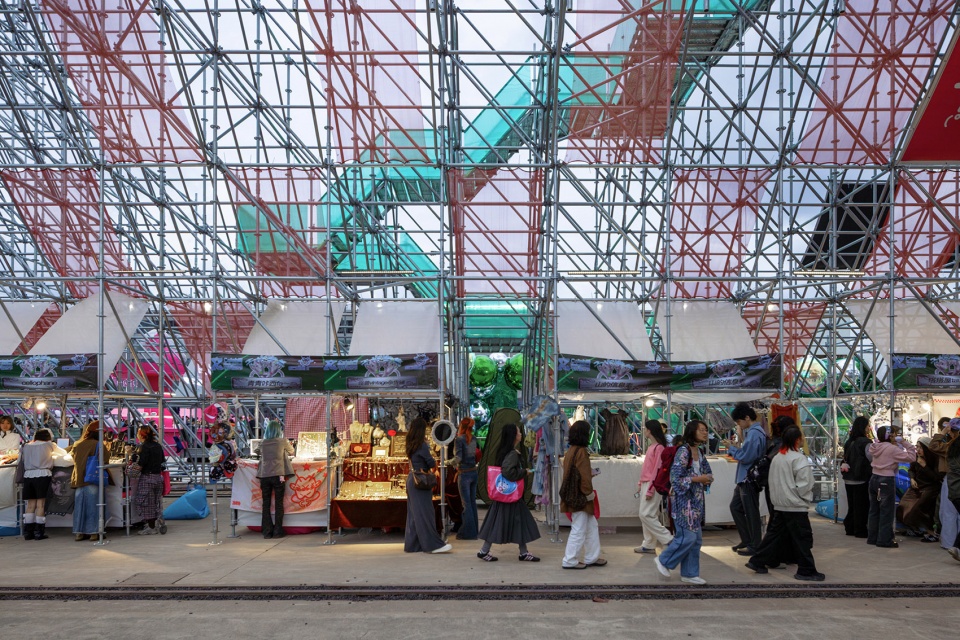
▼市集轴线,Bazaar Axis
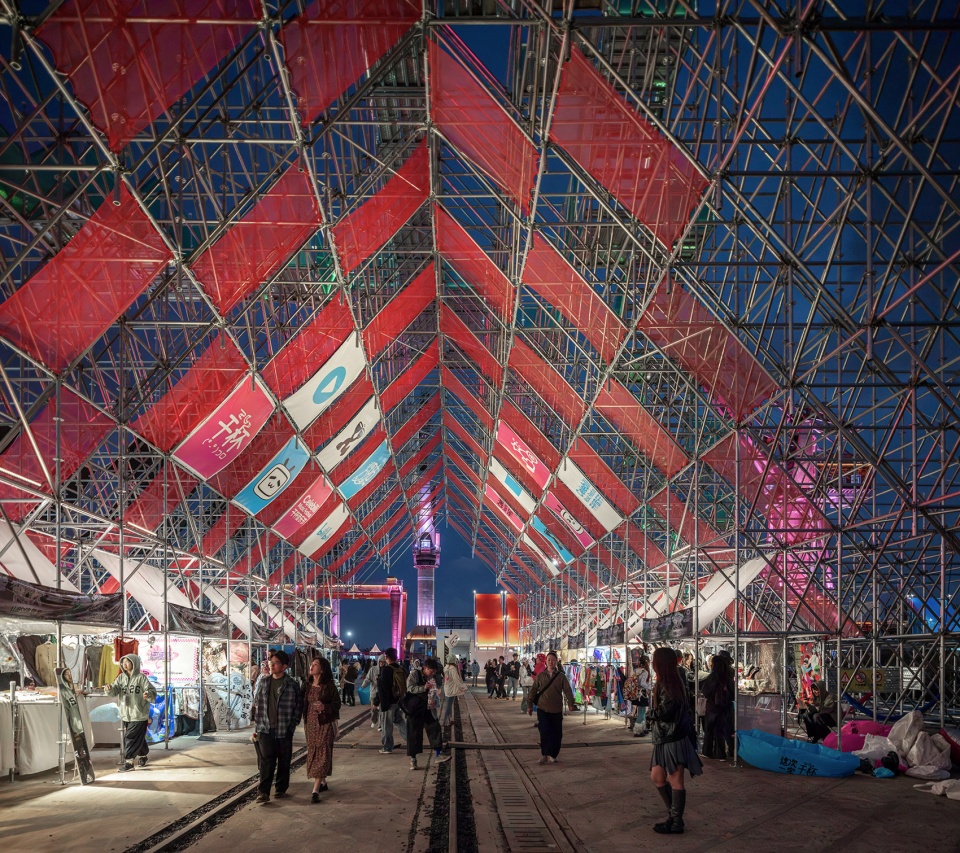
日常,这里是文创、美食、手作的摊位;周末与节假日,转为活动与展演空间;音乐节期间则成为休憩与社交的场所。不同场景的切换,使市集不只是一处功能容器,更成为公共生活的孵化器。
On weekdays, the space accommodates stalls for cultural products, food, and handicrafts. On weekends and holidays, it transforms into a venue for events and performances. During music festivals, it becomes a place for rest and socializing. The shifting between scenarios makes the bazaar not merely a functional container, but an incubator of public life.
▼“众山集”广场,Plaza, Mount Bazaar
▼“众山集”与音乐节,Mount Bazaar and the Music Festival
▼“众山集”与音乐节休息处,Rest Area at Music Festival, Mount Bazaar
登山Mountain Ascent
折形楼梯与悬挑平台串联起山下与山上,构建一条垂直漫游路径。登山路径与下方市集垂直叠合:登山者俯瞰市集,市集中人仰望登山者,上下视线交织,动静互观。
The folded staircase and cantilevered platforms connect the mountain’s base with its summit, creating a vertical promenade. The ascent path vertically overlaps with the bazaar below: climbers look down onto the bazaar, while those in the bazaar look up toward the climbers — a vertical interweaving of sightlines and a reciprocal play of movement and stillness.
▼“登山”路径,Mountain Ascent Path
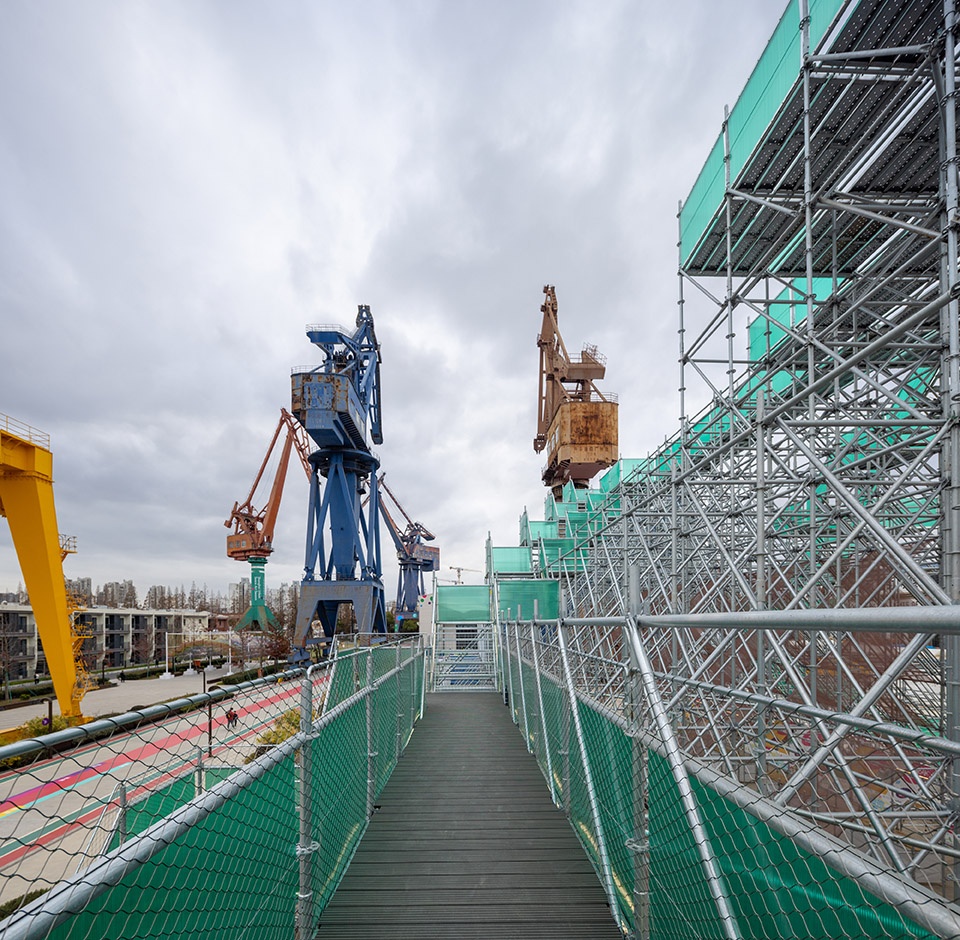
▼蜿蜒向上,Winding Upward
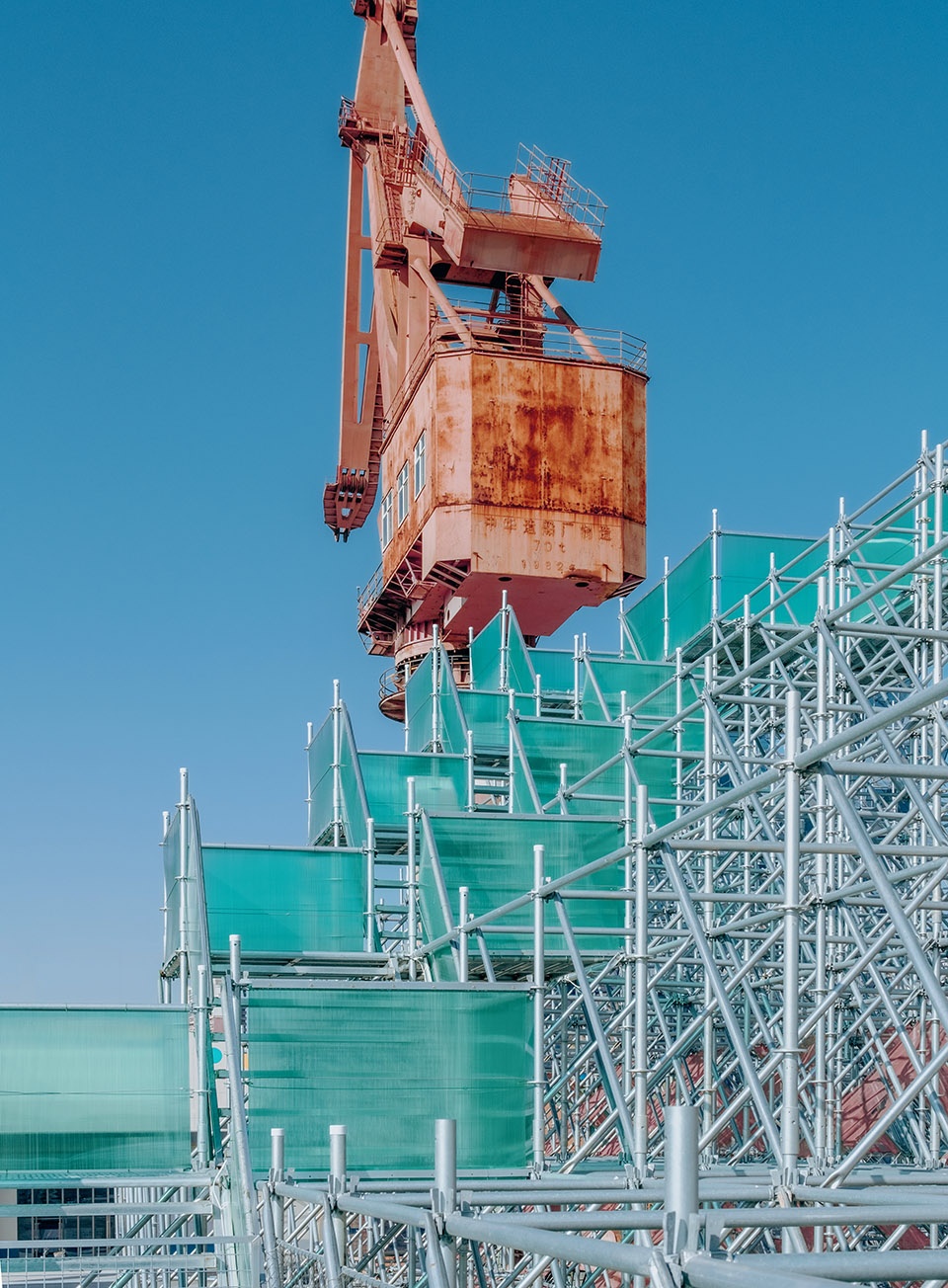
▼“登山”入口,Mountain Ascent Entrance
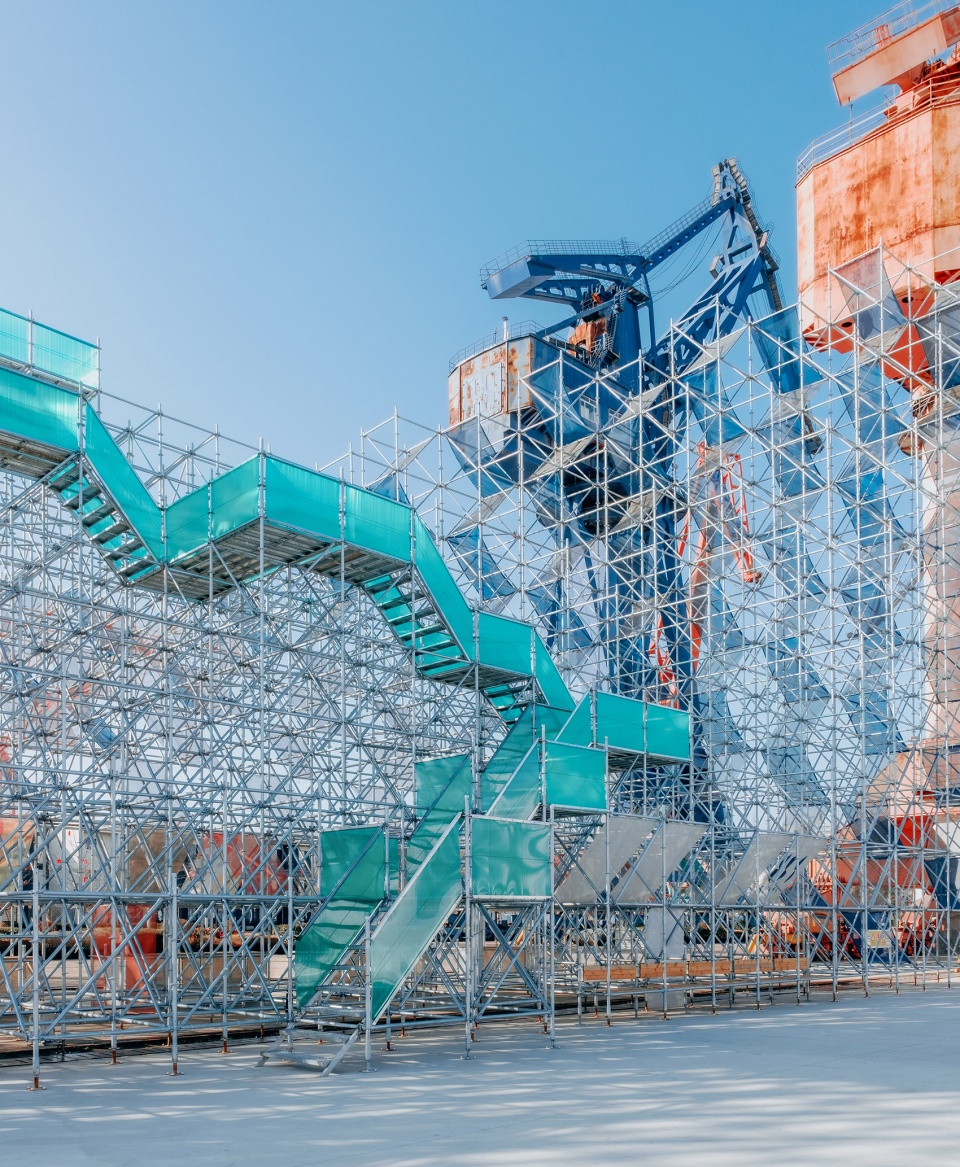
▼“登山”侧端,Side Edge of the Ascent
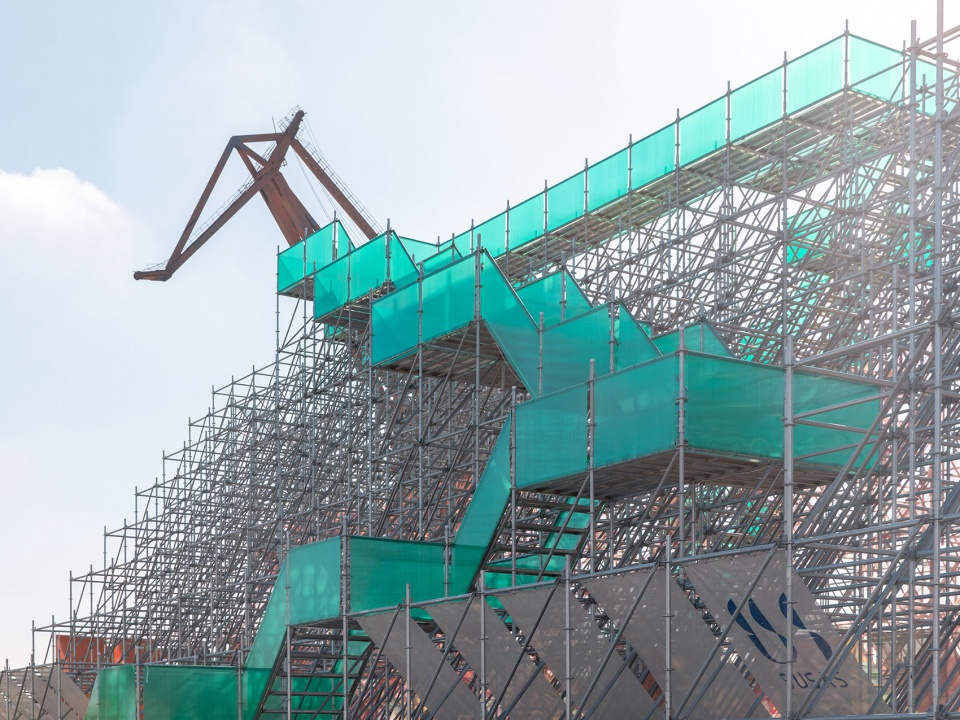
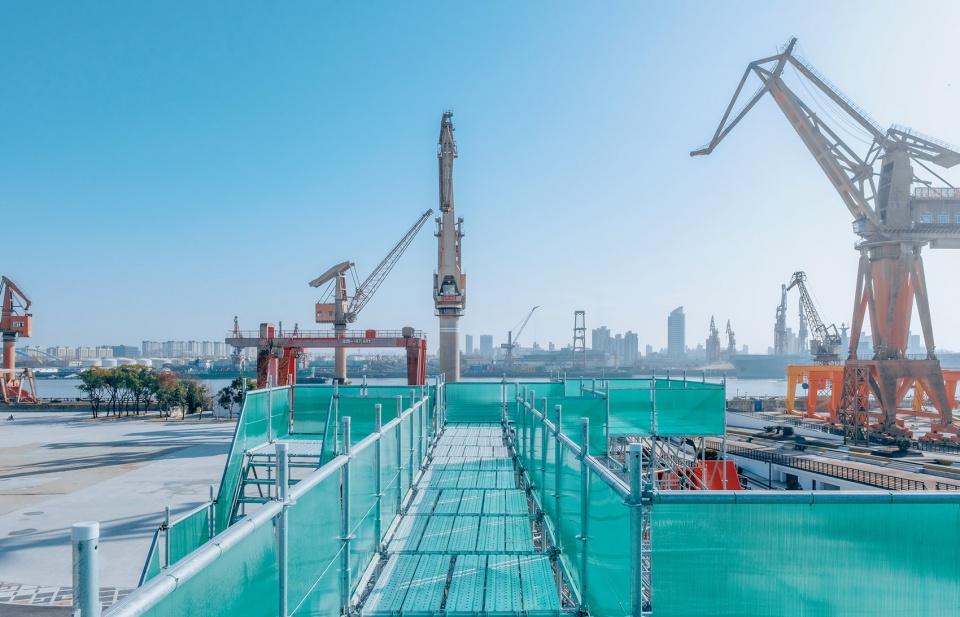
攀爬过程中,视线层层抬升,工业遗存、江岸肌理、城市天际线三重界面依次展开。平台既是休憩点,也可静观场内的塔吊与船台。登顶后,蜿蜒的悬浮平台将黄浦江全景、往来船只与复兴岛工业轮廓一览无余。
During the ascent, the view rises layer by layer, as three successive horizons unfold: the industrial remnants, the riverbank texture, and the urban skyline. The platforms serve as resting points and also as vantage points for quietly observing the tower cranes and shipways on site. Upon reaching the top, the winding suspended platform offers an unobstructed panorama of the Huangpu River, passing vessels, and the industrial silhouette of Fuxing Island.
▼“登山”驻足,Pausing on the Ascent
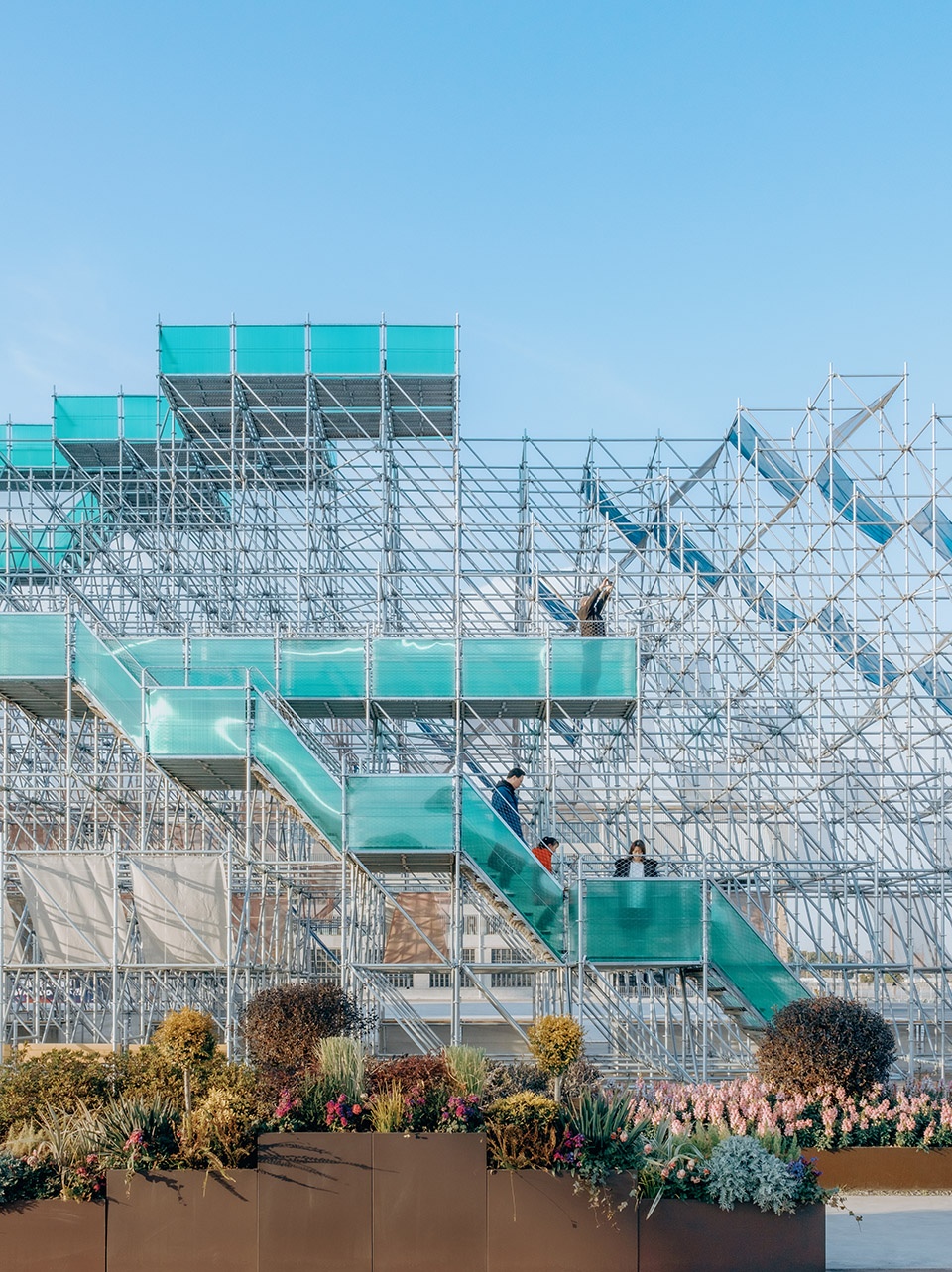
▼登高远眺,Distant View from the Height
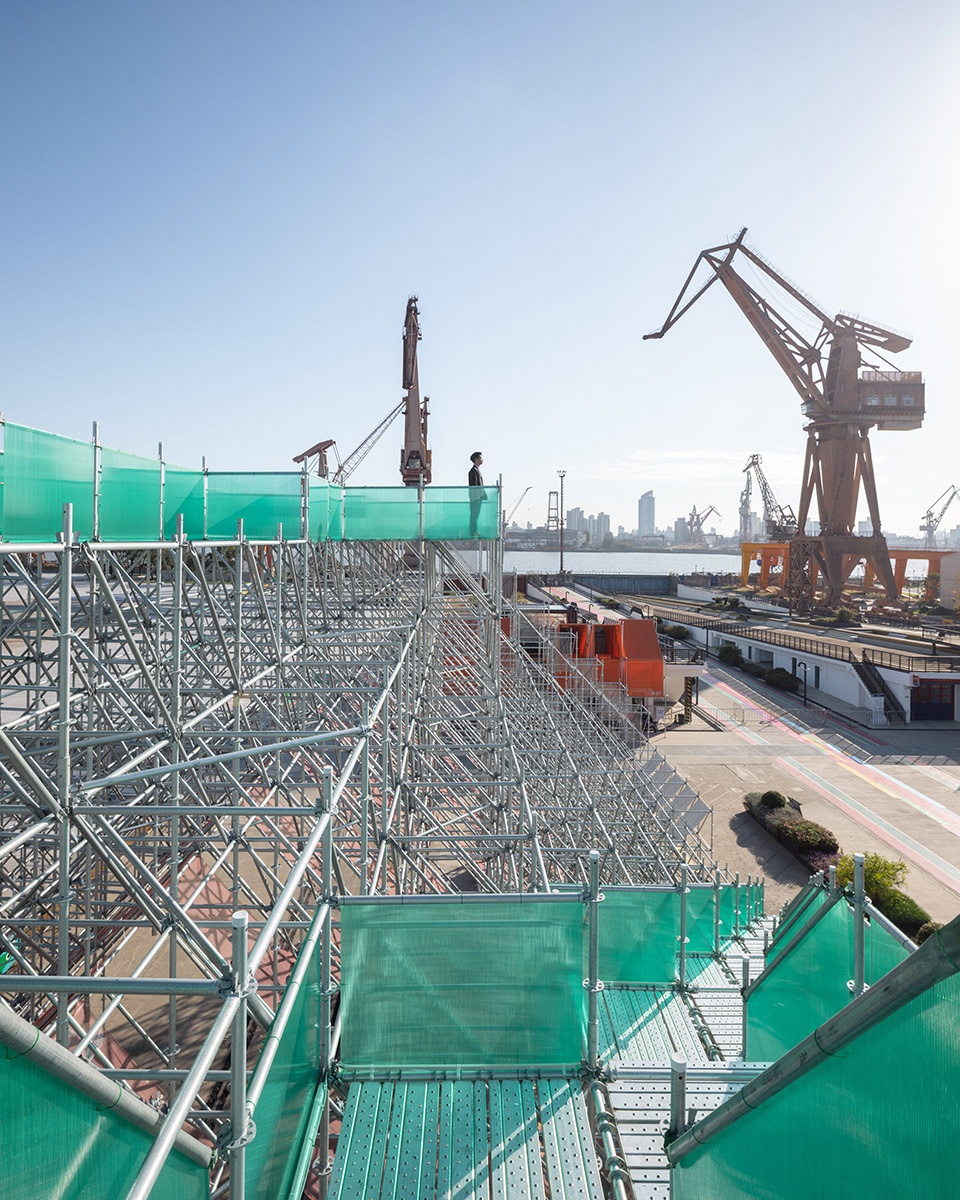
登山者的身体运动与市集人群的平面活动形成动静耦合,打破了公共空间常见的平面局限,拓展了空间体验的纵向维度。
The bodily movement of climbers and the horizontal activities of the bazaar crowd form a coupling of movement and stillness, breaking away from the typical planar limitations of public spaces and extending the vertical dimension of spatial experience.
▼“山海一线”,Mountain-River Horizon
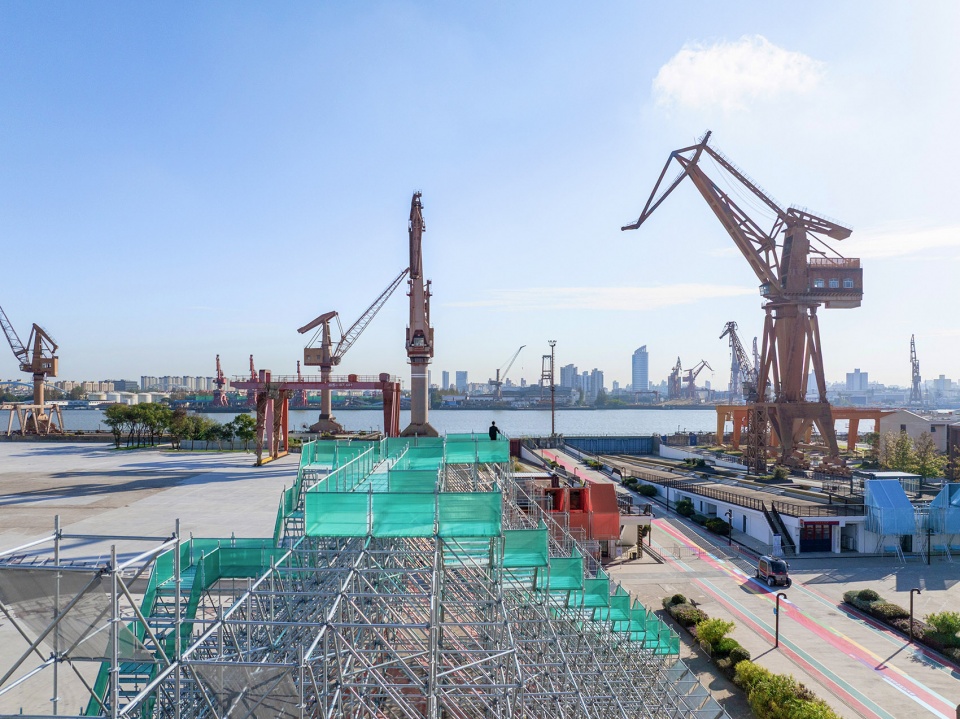
▼“山顶”景观,Summit View, Mount Bazaar
激活Activation
众山集的搭建,核心在于激活沉寂的工业场地。这种激活既依托市集带来的人流与活动,也借助其可变的视觉与空间属性,推动场地从工业遗存转向活力公共空间。
▼轴测分析图, Axonometric Analysis Diagram
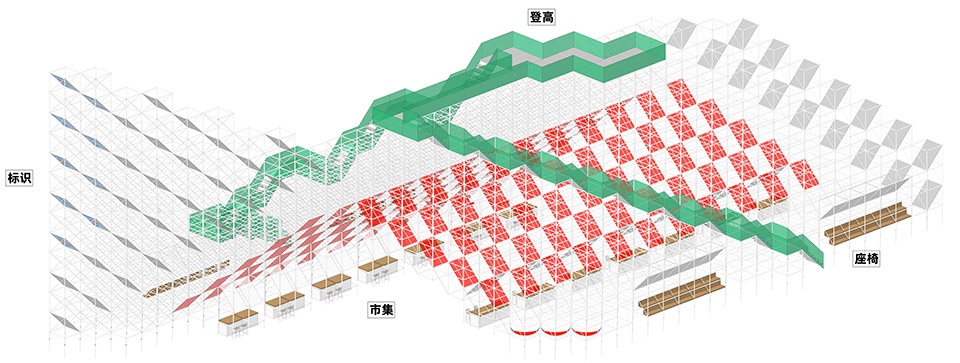
The core of Mount Bazaar’s construction lies in activating the dormant industrial site. This activation relies both on the foot traffic and events brought by the bazaar and on its variable visual and spatial qualities, transforming the site from industrial remnants into a vibrant public space.
▼市集入口, Bazaar Entrance
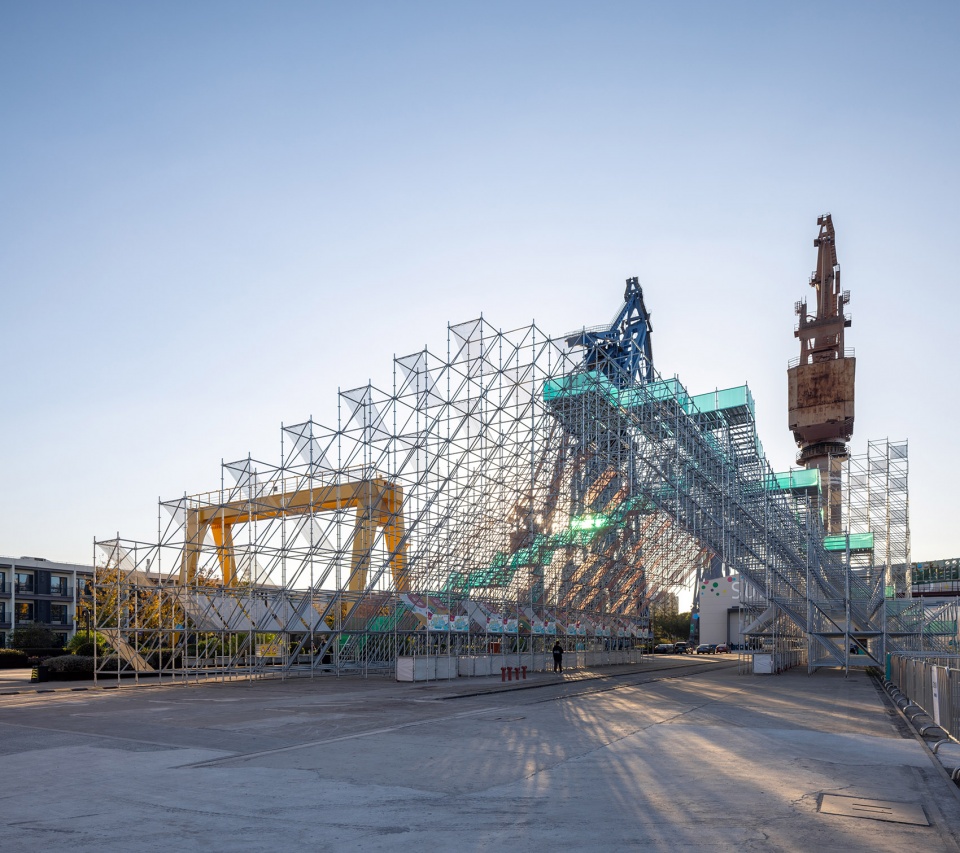
▼“众山集”余晖, Afterglow, Mount Bazaar
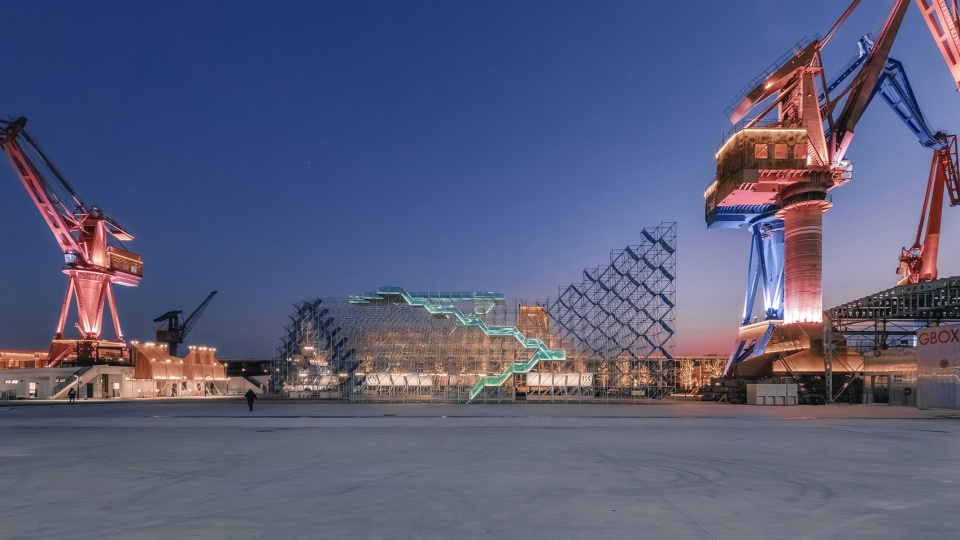
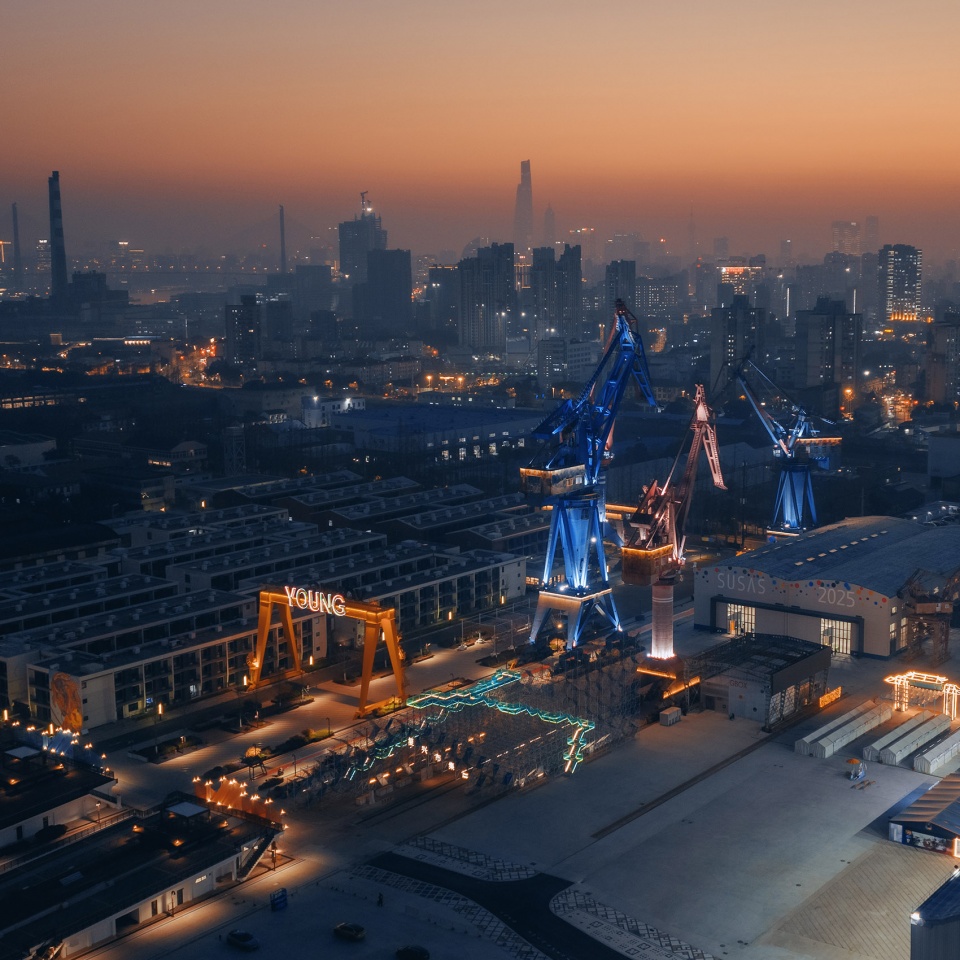
日间,红色拉膜与灰色脚手架形成鲜明对比,成为公园焦点。夜间,绿色栏板与斜顶膜材被灯光点亮,线性骨架被勾勒出立体轮廓,塑造出黄浦江畔极具辨识度的工业夜景。
During the day, the red tensile membrane contrasts sharply with the gray scaffolding, making it a focal point within the park. At night, the green balustrade panels and the inclinedroof membrane are illuminated, outlining the linear frame in a threedimensional silhouette, creating an instantly recognizable industrial nightscape along the Huangpu River.
▼脚手架与填充元素, Scaffolding and Infill Elements
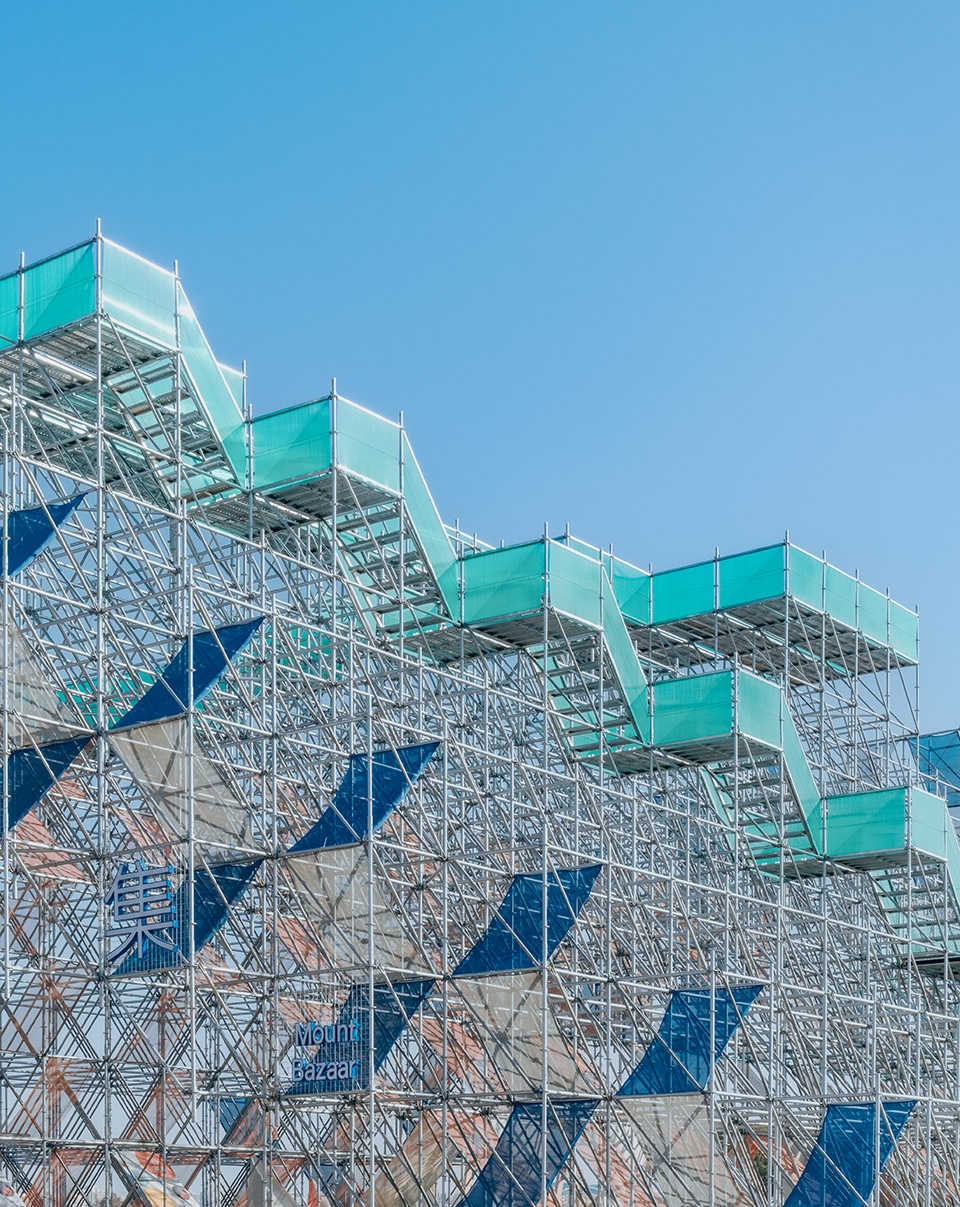
▼脚手架斜向视角, Scaffolding, Oblique View
▼脚手架与膜的编织, Scaffolding-Membrane Weave
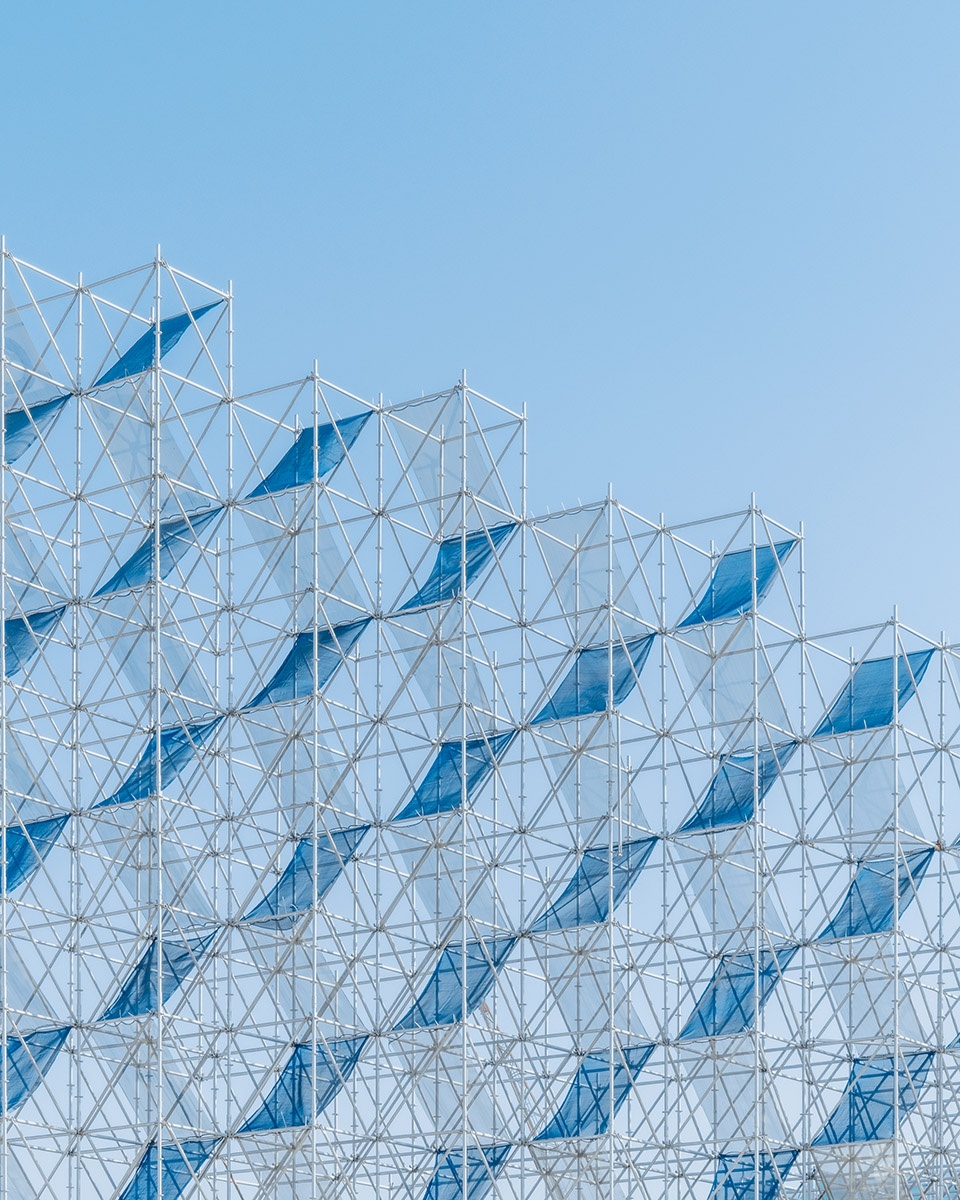
开放框架适配多元场景,使工业遗存不再是静态陈列,而成为可参与、可生长的当代公共场域。
The open frame adapts to multiple scenarios, transforming the industrial remnants from static display into a participatory and evolving contemporary public realm.
▼市集夜景, Night View of the Bazaar
▼“众山集”夜景, Night View, Mount Bazaar
结语Conclusion
脚手架本为临时之物,却足以承载日常。搭建,本身就是设计;临时,自有其力量。
Scaffolding is inherently temporary, yet it suffices to carry everyday life. Construction itself is design; the temporary has its own strength.
▼“众山集”夜景远眺, Distant Night View, Mount Bazaar
▼“众山集”夜景远眺, Distant Night View, Mount Bazaar
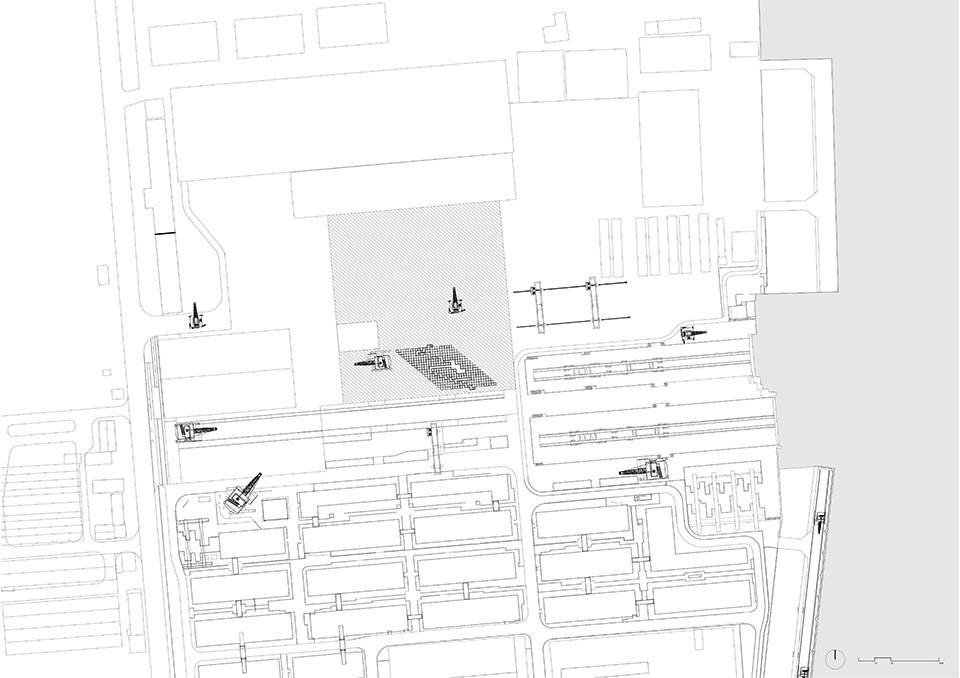
▼总平面图, Site Plan
▼首层平面, Ground Floor Plan
▼屋顶平面, Roof Plan
▼南立面, South Elevation
▼东、西立面, East and West Elevation
Project Information
Project Name: Mount Bazaar
Location: Fuxing Island, Yangpu District, Shanghai
Completion Date: October 2025
Site Area: 470 sqm
Design Firm: People’s Architecture Office (PAO)
Principal: He Zhe, James Shen, Zang Feng
Design Team: Zhang Qiaochu, Zhang Meng
Construction Team: Suzhou Shengyao Environmental Art Engineering Co., Ltd.
Structural Consultant: Liu Su / Beijing Shouang Architectural Structure Studio
Structural Construction Drawings: Tongji Architectural Design (Group) Co., Ltd.
Lighting Consultant: Min Yuebo
Chief Curators: Li Xiangning, Gao Changjun
On-site Coordination: Zhang Feng, Zhang Wenjun
Photography Credits: Yang Chen/whyseeimage, Zhu Yumeng, People’s Architecture Office
Video Credits: Chen Yang/whyseeimage, Zhang Wenjun, Zhu Yumeng, People’s Architecture Office